Whilst you were distracted by a Christmas Party the UK Gov. released a report confirming the Fully Vaccinated account for 4 in every 5 Covid-19 Deaths in England since August
THE EXPOSÉ | DECEMBER 11, 2021
Serious questions need to be answered as to why Boris Johnson’s Government have decided to restrict the freedoms of the unvaccinated population through the introduction of Vaccine Passports, when the latest official data shows that the vaccinated population have accounted for 3 in every 5 Covid-19 cases, 3 in every 5 Covid-19 hospitalisations, and 4 in every 5 Covid-19 deaths, in England since August 16th 2021.

During a national Covid-19 briefing that took place on Tuesday December 8th, the Prime Minister of the United Kingdom announced that ‘Plan B’ would be implemented in England from Wednesday December 15th, which would entail ‘working from home’ (if you can) orders, and the introduction of Vaccine Passports.
The reason given for the commencement of ‘Plan B’ is that it has to be done to protect the public from the alleged new Omicron variant of the Covid-19 virus. A variant which as of December 11th, has failed to cause a single fatality in the UK, with just several hundred cases allegedly being confirmed.
A new law will come into effect from Wednesday December 15th, which will state that Vaccine Passports will become mandatory for entry to nightclubs and other large venues, including Premier League football matches and concerts. We’re told they will be required for indoor settings of 500 people or more, outdoor settings of 4,000 people or more, and any setting with 10,000 attendees or more.
There will be many in England who believe Vaccine Passports are the answer to their prayers. Two years of misinformation, and disinformation mixed with propaganda published by the mainstream media can do that to people. But unfortunately the official data published by the UK Government proves that they are far from it, and suggests Vaccine Passports have absolutely nothing to do with protecting public health, and instead everything to do with controlling the nation.

The UK Health Security Agency (PHE) is an executive agency of the Department of Health and Social Care and recently replaced Public Health England. The Chief Executive of the agency is Dr Jenny Harries OBE, who you may recognise from the television as she has served as Deputy Chief Medical Officer for England throughout the pandemic.
The UKHSA publish a weekly ‘Vaccine Surveillance’ report which contains data on Covid-19 cases, hospitalisations, and deaths by vaccination status over a period of four weeks, and unfortunately for the vaccinated population, the official data shows that they have accounted for the majority of Covid-19 cases, hospitalisations, and deaths for at least the past four months.
We have used the following official reports for our analysis –
- COVID-19 vaccine surveillance report – Week 37 (Covers Week 33-36)
- COVID-19 vaccine surveillance report – Week 41 (Covers Week 37-40)
- COVID-19 vaccine surveillance report – Week 45 (Covers Week 41-44)
- COVID-19 vaccine surveillance report – Week 49 (Covers Week 45-48)
Covid-19 Cases
Table 8 of the latest report shows the number of Covid-19 cases by vaccination status in England. The table may have been attributed a different number in previous reports published by the UKHSA, but the following chart shows cases by vaccination status over a period of 16 weeks from 16 Aug 21 to 05 Dec 21.

The chart shows that between August and early September, the vaccinated population accounted for the majority of Covid-19 cases. However, between the middle of September and early October this switched to the not-vaccinated population accounting for the majority of cases. This is most likely due to children returning to school in September and being “encouraged” to test on a regular basis.
But between October 11th and December 5th the roles reversed again, and it is the fully vaccinated population that have accounted for the majority of Covid-19 cases in England.
This data alone puts an end to the myth that it is selfish to not be vaccinated, because it’s quite clear the jabs do not prevent infection or transmission. Which begs the question as to why Boris Johnson has decided to implement Vaccine Passports in England?

The above chart shows the cumulative number of cases by vaccination status between 16 Aug 21 and 05 Dec 21, and illustrates quite clearly that the fully vaccinated have accounted for the majority of cases since August.
What we can see from the above is that the unvaccinated had accounted for the majority of cases up to October 10th, however since this date there has been a switch with the fully vaccinated taking the lead, hitting a cumulative total of 1.5 million confirmed cases by Dec 5th.
When including the 258,387 confirmed cases among the partly vaccinated during this period, the total cases among the vaccinated population rises to 1,757,444. Whilst the number of cases among the unvaccinated population during this period of 16 weeks has amounted to 1,403,100.
Covid-19 Hospitalisations
Table 9 of the latest report shows the number of Covid-19 hospitalisations by vaccination status in England. The table may have been attributed a different number in previous reports published by the UKHSA, but the following chart shows cases by vaccination status over a period of 16 weeks from 16 Aug 21 to 05 Dec 21.

You may have heard several times this week on national television from people such as Dr Hilary, Lorraine Kelly, and Martin Kemp that “90% of the people currently in hospital with Covid-19 have not been vaccinated”.
Well it looks like they have been lying to you because the official UK Government data the fully vaccinated population have accounted for the majority of Covid-19 hospitalisation every month since at least August.

The above chart shows the cumulative number of hospitalisations by vaccination status between 16 Aug 21 and 05Dec 21, and shows just how bad things have actually been for the vaccinated population compared to the unvaccinated.
Between Aug 16 and Dec 05, the unvaccinated population accounted for 11,767 Covid-19 hospitalisations. But the vaccinated population have accounted for nearly double the amount, recording 19,730 hospitalisations, with 18,406 of those being among the 2/3 dose vaccinated population. This means the vaccinated population have accounted for 63% of Covid-19 hospitalisations since August 2021.
Covid-19 Deaths
Table 10 (b) of the latest report shows the number of Covid-19 hospitalisations by vaccination status in England. The table may have been attributed a different number in previous reports published by the UKHSA, but the following chart shows cases by vaccination status over a period of 16 weeks from 16 Aug 21 to 05 Dec 21.

The above chart proves that the fully vaccinated population have accounted for the majority of Covid-19 deaths every single month since August 2021, with things really taking a turn for the worse in October.
The highest number of Covid-19 deaths in single four week period among the fully vaccinated population has been 3,284, whereas the highest number of Covid-19 deaths among the unvaccinated population in a four week period has been just 850. That’s a 286% difference.

The above chart shows the cumulative number of deaths by vaccination status between 16 Aug 21 and 05 Dec 21, and illustrates quite clearly that this is very much a pandemic of the fully vaccinated.
Between 16 Aug 21 and 05 Dec 21 there were 3,070 Covid-19 deaths among the unvaccinated population in England, compared to 12,058 deaths among the vaccinated population during the same time frame. That is a 293% difference.
Covid-19 Fatality Rates by Vaccination Status
The official data shows the the vaccinated population have accounted for 56% of Covid-19 cases, 63% of hospitalisations, and 80% of deaths over the past 16 weeks in England.

It’s quite clear that the jabs do not prevent infection or transmission, but they are alleged to reduce the risk of hospitalisation and death. However, if this were the case then should we not be seeing a graph that looks more like this?

So why aren’t we?
It could have something to do witht he fact that the data suggests the Covid-19 injections are actually increasing the risk of death due to Covid-19 rather than reducing it by the claimed 95%.
The following graph shows the case-fatality rate among the not-vaccinated population, and the case-fatality rate among the 2/3 dose vaccinated population over the past 16 weeks.

The case-fatality rate is calculated by dividing the number of known deaths by the number of known cases among the population. As we can see from the above the case-fatality rate among the not-vaccinated population is just 0.2%, which is what is in line with the average case-fatality rate in 2020 before a Covid-19 injection was introduced to the masses.
However, the case-fatality rate among the fully vaccinated population is much higher, equating to 0.8%. Therefore the fully vaccinated are 4 times / 300% more likely to die if exposed to the Covid-19 virus based on official UK Government figures.
The following graph shows the hospitalisation-fatality rate among the not-vaccinated population, and the hospitalisation-fatality rate among the 2/3 dose vaccinated population over the past 16 weeks.

The hospitalisation-fatality rate is calculated by dividing the number of known deaths by the number of known hospitalisations among the population. As we can see from the above the hospitalsiation-fatality rate among the not-vaccinated population is 26%.
But the hospitalisation-fatality rate among the fully vaccinated population is frighteningly higher equating to a shocking 63%. This means the fully vaccinated population are 2.4 / 142% more likely to die once hospitalised with Covid-19.
So now that you know that the double / triple jabbed population have accounted for 3 in every 5 cases, 3 in every 5 hospitalisations, and 4 in every 5 Deaths over the past 4 months in England, and that the UK Government has been laughing at you since at least Christmas 2020 through their alleged Christmas parties, are you going to allow them to take away your freedom yet again in response to an alleged variant that has so far caused zero fatalities, or are you going to stand up, carry on living, and say “no” this time around?
Because this will not end until we all say it does.
Latest Modelling on Omicron Ignores All Evidence of Lower Severity, Among Numerous Other Problems
By Mike Hearn | The Daily Sceptic | December 11, 2021
Today the Telegraph reported that:
Experts from the London School of Hygiene and Tropical Medicine (LSHTM) predict that a wave of infection caused by Omicron – if no additional restrictions are introduced – could lead to hospital admissions being around twice as high as the previous peak seen in January 2021.
Dr Rosanna Barnard, from LSHTM’s Centre for the Mathematical Modelling of Infectious Diseases, who co-led the research, said the modellers’ most pessimistic scenario suggests that “we may have to endure more stringent restrictions to ensure the NHS is not overwhelmed”.
As we’ve come to expect from LSHTM and epidemiology in general, the model forming the basis for this ‘expert’ claim is unscientific and contains severe problems, making its predictions worthless. Equally expected, the press ignores these issues and indeed gives the impression that they haven’t actually read the underlying paper at all.
The ‘paper’ was uploaded an hour ago as of writing, but I put the word paper in quotes because not only is this document not peer reviewed in any way, it’s not even a single document. Instead, it’s a file that claims it will be continually updated, yet which has no version numbers. This might make it tricky to talk about, as by the time you read this it’s possible the document will have changed. Fortunately, they’re uploading files via GitHub, meaning we can follow any future revisions that are uploaded here.
Errors
The first shortcoming of the ‘paper’ becomes apparent on page 1:
Due to a lack of data, we assume Omicron has the same severity as Delta.
In reality, there is data and so far it indicates that Omicron is much milder than Delta:
Early data from the Steve Biko and Tshwane District Hospital Complex in South Africa’s capital Pretoria, which is at the centre of the outbreak, showed that on December 2nd only nine of the 42 patients on the Covid ward, all of whom were unvaccinated, were being treated for the virus and were in need of oxygen. The remainder of the patients had tested positive but were asymptomatic and being treated for other conditions.
The pattern of milder disease in Pretoria is corroborated by data for the whole of Gauteng province. Eight per cent of Covid-positive hospital patients are being treated in intensive care units, down from 23% throughout the Delta wave, and just 2% are on ventilators, down from 11%.
Financial Times, December 7th
The LSHTM document claims to be accurate as of today, but just ignores the data available so far and replaces it with an assumption; one that lets them argue for more restrictions.
What kind of restrictions? The LSHTM modellers are big fans of mask wearing:
All scenarios considered assume a 7.5% reduction in transmission following the introduction of limited mask-wearing measures by the U.K. Government on November 30th 2021, which we assume lasts until April 30th 2022. This is in keeping with our previous estimates for the impact of increased mask-wearing on transmission.
I was curious how they arrived at this number given the abundant evidence that mask mandates have no impact at all (example one, example two). But no such luck – a reference at the end of the above paragraph points to this document, which doesn’t contain the word “mask” anywhere and “7.5%” likewise cannot be found. I wondered if maybe this was a typo but the claim that the relevant reference supports mask wearing appears several times and the word “mask” isn’t mentioned in references before or after either.
There are many other assumptions of dubious validity in this paper. I don’t have time today to try and list all of them, although maybe someone else wants to have a go. A few that jumped out on a quick read through are:
- An assumption that S gene drop-outs, i.e. cases where a PCR test doesn’t detect the spike protein gene at all, are always Omicron. That doesn’t follow logically given the very high number of mutations and given that theoretically PCR testing is very precise, meaning a missing S gene should be interpreted as “not Covid”. Of course, in reality – as is by now well known – PCR results are routinely presented in a have-cake-and-eat-it way, in which they’re claimed to be both highly precise but also capable of detecting viruses with near arbitrary levels of mutation, depending on what argument the user wishes to support.
- “We use the relationship between mean neutralisation titre and protective efficacy from Khoury et al. (7) to arrive at assumptions for vaccine efficacy against infection with Omicron” – The cited paper was published in May and has nothing to say on the topic of vaccine effectiveness against Omicron, which is advertised as being heavily mutated. Despite not citing any actual measured data on real-world vaccine effectiveness, the modelling team proceeds to make arguments for widespread boosting with a vaccine targeted at the original 2019 Wuhan version of SARS-CoV-2.
- They make scenarios that vary based on unmeasurable variables like “rate of introduction of Omicron”, making their predictions effectively unfalsifiable. Regardless of what happens, they can claim that they projected a scenario that anticipated it, and because such a rate is unknowable, nobody can prove otherwise. Predictions have to be falsifiable to be scientific, but these are not.
- Their conclusion says “These results suggest that the introduction of the Omicron B.1.1.529 variant in England will lead to a substantial increase in SARS-CoV-2 transmission” even though earlier in the ‘paper’ they say they assume anywhere between a 5%-10% lower transmissibility than Delta to 30%-50% higher (page 7), or in other words, they have no idea what the underlying difference in transmissibility is – and that’s assuming this is actually something that can be summed up in a single number to begin with.
Analysis
If you’re new to adversarial reviews of epidemiology papers some of the above points may seem nit-picky, or even made in bad faith. Take the problem of the citation error – does it really matter? Surely, it’s just some sort of obscure copy/paste error or typo? Unfortunately, we cannot simply overlook such failures. The phenomenon of apparently random or outright deceptive citations is one I’ve written about previously. This problem is astoundingly widespread in academia. Most people will assume that a numerical claim by researchers that has a citation must have at least some level of truth to it, but in fact, meta-scientific study has indicated the error rate in citations is as high as 25%. A full quarter of scientific claims pointing to ‘evidence’ turn out when checked to be citing something that doesn’t support their point! This error rate feels roughly in line with my own experiences and that’s why it’s always worth verifying citations for dubious claims.
The reality is that academic output, especially in anything that involves statistical modelling, frequently turns out to not merely be unreliable but leaves the reader with the impression that the authors must have started with a desired conclusion and then worked backwards to try and find sciencey-sounding points to support it. Inconvenient data is claimed not to exist, convenient data is cherry picked, and where no convenient data can be found it’s just conjured into existence. Claims are made and cited but the citations don’t contain supporting evidence, or turn out to be just more assumptions. Every possible outcome is modelled and all but the most alarming are discarded. The scientific method is inconsistently used, at best, and instead scientism rules the day; meanwhile, universities applaud and defend this behaviour to the bitter end. Academia is in serious trouble: huge numbers of researchers just have no standards whatsoever and there are no institutional incentives to care.
Some readers will undoubtably wonder why we’re still bothering to do this kind of analysis given that there’s nothing really new here. On the Daily Sceptic alone we’ve covered these sorts of errors here, here, here, here, here and here – and that’s not even a comprehensive list. So why bother? I think it’s worth continuing to do this kind of work for a couple of reasons:
- Many people who didn’t doubt the science last year have developed newfound doubts this year, but won’t search through the archives to read old articles.
- The continued publication of these sorts of ‘papers’ is itself useful information. It shows that academia doesn’t seem to be capable of self-improvement and despite a long run of prediction failures, nobody within the institutions cares about the collective reputation of professors. The appearance of being scientific is what matters. Actually being scientific, not so much.
Majority of Covid ICU Patients in October and November Were Vaccinated
By Will Jones – The Daily Sceptic – December 11, 2021
Contrary to the claims made by Dr Rachel Clarke and Professor Stephen Powis last month and used to blame the unvaccinated for the mounting troubles of the NHS, new data out this week shows that the majority of Covid ICU admissions in October and November were among the vaccinated, not the unvaccinated.
The latest report from ICNARC shows that of Covid ICU patients in England, Wales and Northern Ireland, 50.5% in October and 50.7% in November were double vaccinated. Add to that the 2.8% in October and 1.8% in November who were single-vaccinated and you get overall vaccinated proportions of 53.3% in October and 52.5% in November. That compares to 46.7% unvaccinated in October and 47.5% in November. Note that the unvaccinated here includes people who received a vaccine less than 14 days prior to the positive Covid test, so includes some (an unknown number) who are actually single vaccinated.
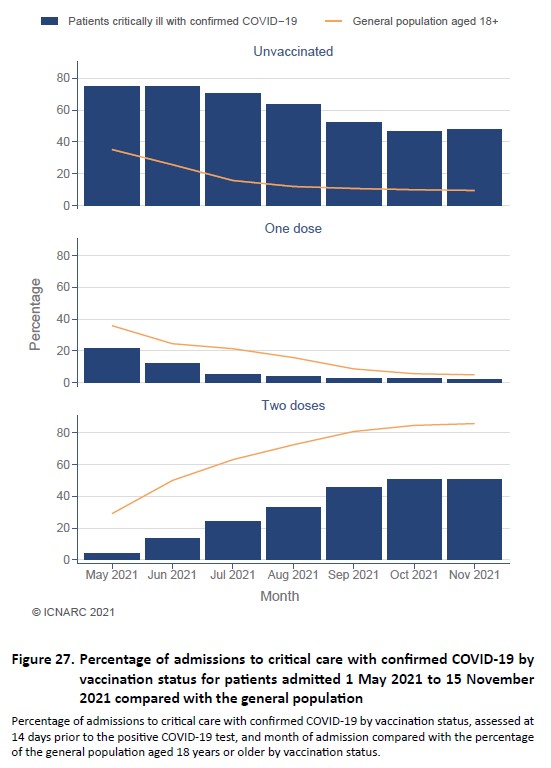
This is not what the public has been led to believe by some prominent medics and newspapers.
Two weeks ago, Professor Stephen Powis, the National Medical Director of NHS England, was quoted in the Sunday Times saying: “Data shows that the overwhelming majority of people admitted to intensive care with Covid are not fully vaccinated.” A source was not provided for this claim but the article implied that it meant right now, with an opening paragraph stating: “Hundreds of intensive care beds that could be used for life-saving surgery are instead occupied by unvaccinated Covid patients, one of NHS England’s top officials has said.”
The same day the Sunday Times also printed an article by Dr. Rachel Clarke with the subheading: “Some 75% of those suffocating in intensive care with the coronavirus are unvaccinated.” In it she states: “Of the Covid patients treated in intensive care in recent months, the majority – nearly 75% according to the latest data – have chosen not to be vaccinated.”
The Guardian published a piece in November headlined “ICU is full of the unvaccinated – my patience with them is wearing thin”, written by an anonymous medic who claimed that the ICU patient population “consists of a few vulnerable people with severe underlying health problems and a majority of fit, healthy, younger people unvaccinated by choice”.
Now that the data has been released it’s clear that the claim that ICUs are “full of” the unvaccinated is highly misleading. While the unvaccinated do currently appear to be over-represented (depending how many of them are misclassified), no one now can claim that ICUs are “full of” the unvaccinated or that the unvaccinated constitute the “overwhelming majority” of Covid ICU admissions. If you spot any newspapers still peddling this misinformation, particularly it if is being used to stigmatise and pressure the unvaccinated, you can complain to IPSO here.
Andrew Neil: “It’s Time To PUNISH Vaccine Refuseniks”
By Richie Allen | December 10, 2021
The establishment has never had a greater gatekeeper than Andrew Neil. He’s edited the Sunday Times, been the chairman of SKY TV, chaired Press Holdings Media Group and spent a quarter of a century fronting flagship news shows for the BBC.
Neil was head cheerleader for Britain’s involvement in Afghanistan. He described opponents of military intervention there as; “wimps, with no will to fight.”
He used his columns and tv programmes to champion the 2003 invasion of Iraq. Writing for Scotland on Sunday in September 2002 Neil said that Saddam Hussein had:
“embarked on a worldwide shopping spree to buy the technology and material needed to construct weapons of mass destruction and the missile systems needed to deliver them across great distances…. the suburbs of Baghdad are now dotted with secret installations, often posing as hospitals or schools, developing missile fuel, bodies and guidance systems, chemical and biological warheads and, most sinister of all, a renewed attempt to develop nuclear weapons.”
Neil KNEW that this was undiluted bullshit, but he printed it anyway.
During that time he referred to The Guardian as “The Daily Terrorist.” In short, Andrew Neil is a rancid, rotten scumbag. Writing in today’s Daily Mail, he called for the punishment of the unjabbed.
Last night I took a friend out to dinner near my home in the South of France. At the restaurant door we were politely asked for our vaccine passports, the QR codes on our smartphones were scanned and we were ushered to our table.
The check had taken seconds — a very minor inconvenience when a new wave of the coronavirus pandemic is sweeping across the Continent.
There was a sense of safety in knowing that all the other diners had proved themselves to be fully vaccinated, or had very recently tested negative, or had contracted the virus and recovered.
Cheerleading illegal wars that killed millions of people earned him a home in the South of France. How nice for him. He goes on:
There are still 5 million unvaccinated British adults, who through fear, ignorance, irresponsibility or sheer stupidity refuse to be jabbed. In doing so they endanger not just themselves but the rest of us.
If they contract Covid, it is they who will put the biggest strain on the NHS, denying the rest of us with serious non-Covid ailments the treatment that is our right. We are all paying a heavy price for this hard core of the unvaccinated.
As long as they can be numbered in the millions, the nation will remain unnecessarily vulnerable to the latest variant, meaning more lockdowns, more restrictions on our lives, more lost jobs, more failing business, less economic growth — all of which will follow the Government’s introduction of its so-called Plan B of enhanced restrictions this week.
Of course, there is a small number of people who, for medical reasons, cannot be vaccinated. Those in that category can be identified and helped with regular testing to make sure they’re Covid-free.
But for the rest it is simply selfish not to be vaccinated. We all have a responsibility to act in ways that don’t just protect our own health but also that of others.
Neil went on to say that he’s not in favour of mandatory vaccination, but:
As it stands, the unvaccinated are making more restrictions on our lives inevitable. It is time we imposed some on them.
In a free society the unvaccinated have a right not be jabbed. But they need to realise that right comes with consequences, which will inhibit their freedoms as they constrain ours.
One final thought. Singapore has decided that the unvaccinated who end up in hospital with Covid will have to foot their own medical bills.
I doubt we’d ever go that far. But you can see the logic — even the morality — of it.
By all means exercise your rights. But beware of the consequences.
Andrew Neil remains a worthless, warmongering whore.
NY Times Claims Brazil Is Turning Into Desert, As Foliage Growth Surges
By James Taylor | ClimateRealism | December 6, 2021
The New York Times published an article Friday titled, “A Slow-Motion Climate Disaster: The Spread of Barren Land.” The article claims global warming is causing drought in northeastern Brazil, turning the region into a desert. Objective satellite measurements of vegetation, however, show increasing vegetation in northeast Brazil and throughout Brazil as a whole, not the other way around. The Times article is merely another example of agenda-driven fake climate news.
In its subtitle, the article claims, “Brazil’s northeast, long a victim of droughts, is now effectively turning into desert. The cause? Climate change and the landowners who are most affected.” The article adds, “Climate change is intensifying droughts in Brazil’s northeast, leaving the land barren. The phenomenon, called desertification, is happening across the planet.”
NASA satellite instruments have precisely measured the amount of vegetation throughout the Earth since the early 1980s. NASA reported its findings in an article titled “Carbon Dioxide Fertilization Greening Earth, Study Finds.” According to NASA, “From a quarter to half of Earth’s vegetated lands has shown significant greening over the last 35 years largely due to rising levels of atmospheric carbon dioxide.” Most of the rest of the land shows little change one way or the other, while a very small amount of land shows a decline in vegetation.
As a whole, “The greening represents an increase in leaves on plants and trees equivalent in area to two times the continental United States,” NASA reports.
In the chart below, provided by NASA, you can see that nearly all of Brazil, including nearly all of northeast Brazil, is enjoying a significant increase in vegetation. Only a few, very small areas of Brazil and northeast Brazil are seeing a decline in vegetation.
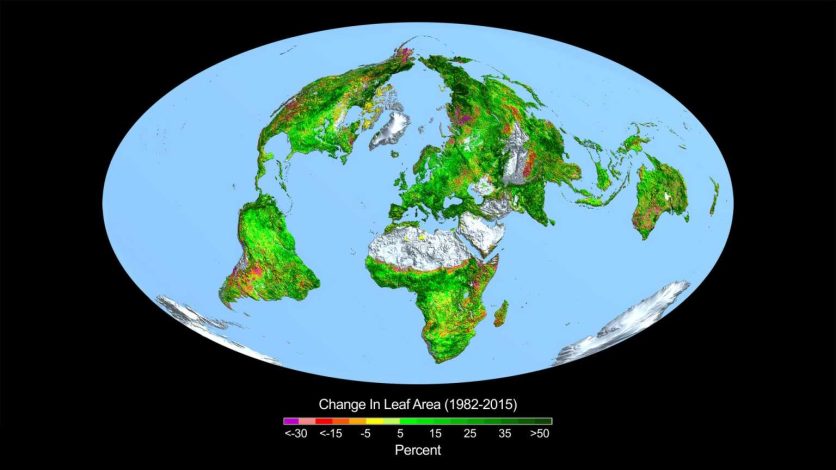
The Times is right that where farmers or ranchers are deliberately removing rainforest and replacing it with farms or rangeland, vegetation declines. But that is not due to climate change, and those are about the only places in Brazil where vegetation is not increasing as the Earth modestly warms.
The simple, undeniable truth is that vegetation is increasing virtually everywhere in Brazil. The New York Times, in order to promote a fictitious climate crisis, is telling provably wrong lies to sell newspapers and to sell alarm.
As Predicted, They’re Coming For The Unvaccinated
By Richie Allen | December 9, 2021
Yesterday, UK Prime Minister Boris Johnson announced that his government would move to Plan B covid measures as a precaution against the emergence of the omicron variant. He was lying. What else is new, I hear you say.
In my opinion there is no omicron variant. It is a fantasy. Johnson’s government moved to Plan B for one reason only, to turn the jabbed against the unjabbed.
In recent weeks, regular listeners to my radio show will have heard me play dozens of soundbites from UK TV and radio news shows, where the public is invited to call in and opine on what should be done about the anti-vaxxers.
I said that we were being primed or conditioned for a day of reckoning next year, when the government will announce “enough is enough, we can’t keep shutting down society, we must mandate the jabs.”
Nothing that has happened since, has changed my mind. UK Health Secretary Sajid Javid said this morning that mandatory jabs will not be pursued by his government. He said that such a thing would be “unethical.” He was lying too.
Today, the public are quite rightly enraged at the announcement of new covid measures and the prospect that they will be tightened further still on December 18th.
However, the great majority of people are not demanding an end to this charade at once. No, they’re raging at the Tories for holding Christmas party’s last year while they were locked down and obeying the rules.
And predictably, they’re turning their ire on the unjabbed.
Take a look at this outtake from this morning’s Jeremy Vine Show on Channel 5. The guests call for the unjabbed to be blamed for the tyrannical covid restrictions. They even suggest that we should be exiled.
Instead of challenging them, the impotent host egged them on.
We’re in the fight of our lives now.
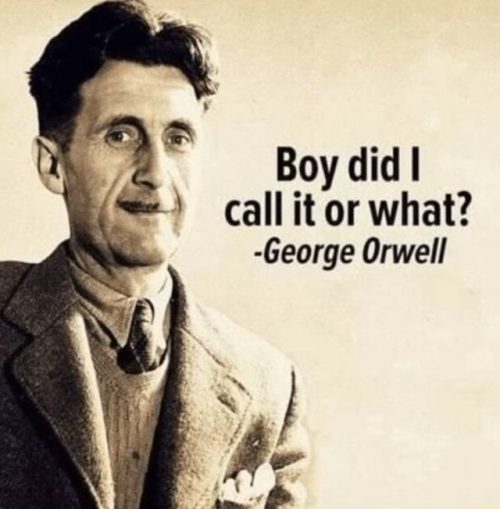
“The past was erased, the erasure was forgotten, the lie became the truth”
el gato malo – bad cattitude – december 8, 2021
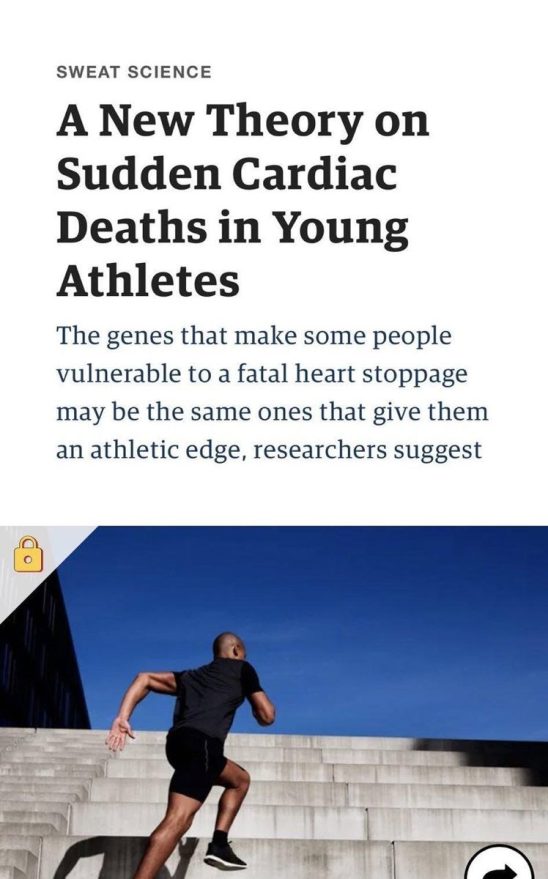
It’s becoming truly amazing how much of the medical science of the past we never seemed to notice before only to see it seemingly all come to light at once…
pro tip: nothing says “guilty conscience” quite like 30 different people simultaneously answering, over and over again, a question they were never asked…
“he who controls the past controls the future. he who controls the present controls the past.”
and thus history and whole bodies of science do become fiction.
“Masks were to soften you up for Plan B”
By Laura Dodsworth | December 8, 2021
‘Masks were a softening up exercise for Plan B,’ according to a government whistleblower. He told me that while there is little appetite in the Cabinet for a full lockdown, Covid Passes are ‘oven-baked’ and ready to go.
In my opinion, the UK government’s Winter Plan was always about Plan B. It displayed a classic ‘foot-in-the-door’ strategy – the raison d’être of Plan A was to prepare you for Plan B. Now winter is upon us, and the nudges fall in a flurry of torpefying snowflakes. Worst case scenarios, big numbers, salutary stories in the media, threats and cajolements are directed at us daily. Plan B is in motion as calls for working from home are heard from the usual suspects and we hear the Cabinet is divided on Covid Passes.
This seasoned government insider plays a key role on a Covid task force and has decided to speak out now because he is disturbed by the unethical reasons for mandating masks. Firstly, ‘It’s a highly political move to reset the Johnson administration’s orientation after bad polling over sleaze and corruption. If Omicron turns out to be super-bad and the public ask what the government did about it, the answer is we implemented masks. The one-way systems, plexiglass screens and masks are to give you an illusion of the government doing something. It’s just theatre. There is no evidence base or proportionality in favour of masks.’
Boris Johnson is a fan of deadcatting, a technique to deflect attention from one issue to another, akin to throwing a dead cat on a table during a heated debate to change the topic. Masks are a dead cat. In this case rather than throw them on the table, the government have slung them on our faces.
Face masks are increasingly discredited, but certain journalists fell hungrily upon a recent new study which concluded that face masks reduce transmission by 53%. The Guardian, The Times, Metro and New Scientist positively feasted. However, that fragrant soupçon of a percentage was based upon weak evidence, there were confounding factors and caution was required when interpreting the study, as Fullfact explained.
‘The public are annoyingly on board about masks’, said this task force advisor. ‘Journalists have not demanded evidence that they work. But the message from the government and the media is hegemonic – everyone says they do work.’
As I set out in my book A State of Fear: How the UK government weaponised fear during the Covid-19 pandemic masks are a nudge, even described as a ‘signal’ by David Halpern, the director of the UK government’s Behavioural Insights Team. Similarly, Professor Neil Ferguson said that masks remind us ‘we’re not completely out of the woods yet’. They serve as a visible public reminder of the pandemic, turning us back into walking billboards pronouncing danger. My source concurred: ‘Masks are a behavioural psychology policy. We need to stop pretending that it’s about public health. Nudge is a big thing in government.’
Despite ‘a pretty much unlimited budget to run trials’ they didn’t run one for masks ‘because they knew that they don’t work’. In effect, ‘the trial was Scotland versus England. And we found they don’t work.’
For this government insider the implications are now too serious to remain silent because ‘we are lying when we say masks work. They are a signal, a psyop. And we’ve criminalised not wearing them. Masks also transfer the blame onto individuals for the epidemic spreading. We have people counting the unmasked on public transport, policing each other. It is deeply unethical that we have set people against each other in this way. It allows the creation of an “out group” to blame.’ He points out that it is the government we should blame for not increasing healthcare capacity.
The timing of our conversation is interesting. He speaks to me just before the news about Downing Street Christmas parties breaks. People are rightly angry about hypocrisy and the pain of their own cancelled plans last year. The nation suffered last minute restrictions while Downing Street enjoyed revelry. More than one million pounds in fines have been served to nearly 2,000 Covid-19 rule breakers at Westminster magistrates court, including throwing and attending parties, while Boris Johnson evades punishment.
But the real point is not the hypocrisy, or that we suffered while they did not. Rather it is that those who organised and attended the party had a different risk calculus. They did not feel imperilled by parties and gatherings. They knew they were safe, just as they know that masks don’t work. What we are expected to believe is another matter.
As these distasteful double standards are unmasked, Ministers are considering whether to impose Plan B and roll out Covid Passes. When the Winter Plan was published, we were told that the trigger to move from Plan A to Plan B was if the NHS comes under ‘unsustainable pressure’. This was left deliberately vague. If you were watching cases and hospitalisations with an anxious eye, I’m afraid you were missing the more important signs: stories about doctors’ anger at the ‘selfish’ un-jabbed, daily polling via Twitter, TV shows and Yougov about the national appetite for Covid Passes and mandates, and the reintroduction of masks.
There is an army of behavioural scientists, communications specialists and Covid task forces focussed on Covid. The government insider told me there are hundreds of people in this Covid apparatus, even though we are no longer in an emergency. Robert Higgs talks about the ‘ratchet effect’ in his book Crisis and Leviathan whereby the state expands in response to a crisis and then doesn’t recede afterwards to its former level. The aura of emergency will not fade and we risk ever more stringent and unpalatable restrictions unless this apparatus is dismantled. Furthermore, public reputations have been staked on enforcing restrictions, including journalists, scientists and politicians.
The government insider is brutal about the reality of our situation: ‘England is teetering on the edge of a depressing, bureacratic, safety-obsessed society. We’re not at the level of Germany or Austria yet, but we’re on a precipice nonetheless.’ On his primary reason for calling me, he said he is ‘ashamed how much people believe in masks despite the lack of evidence’.
Our leader’s masks are slipping, exposing hypocrisy, psychological manipulation and barefaced lies. Frankly, I am ashamed of them.
Coronavirus Fact-Check #13: “ICUs are filled with the unvaccinated”
OffGuardian | December 6, 2021
It’s become a common meme to refer to ICU’s being “filled” with the unvaccinated, but is there any truth to that?
A few days ago Dr Hillary Jones, whilst being interviewed on Lorraine Kelly, claimed:
90% of people in hospital are unvaccinated”.
Similarly, last week, Kevin Maguire claimed on Jeremy Vine’s show that:
The unvaccinated are filling hospital beds, they’re in ICUs taking up precious resources – there are hospital waiting lists going up because there are so many unvaccinated people in hospitals”
Television presenters and news headlines across the United Kingdom have commonly referred to hospitals being filled with unvaccinated covid19 patients.
As if it could ever be considered evidence of anything, an anonymous “doctor” wrote a piece for The Guardian, which he filled with nameless anecdotal evidence, and emotively headlined:
ICU is full of the unvaccinated – my patience with them is wearing thin
This claim is regularly used as an argument for vaccine mandates, and/or unvaxxed-only lockdowns.
But is it true?
In a word, no.
ICUs are not “full” of unvaccinated covid patients, they’re not even full of covid cases. In fact, they’re not even full at all.
As of last week, NHS England’s own bed statistics reported that England has 4330 available critical care beds, of which 894 (21%) are being used by Covid patients, 2608 (60%) non-Covid patients and 828 (19%) were empty.
So, England’s critical care beds are not even 90% full, let alone 90% full of unvaccinated covid patients.
But let’s be charitable and assume these people misspoke or communicated their point badly. Let’s assume they meant 90% of covid hospitalisations are unvaccinated.
That, at least, is true right? Wrong.
The actual number is 35.4%
According to the UK’s Health Security Agency data (page 31 of this document) 6639 patients were admitted to hospital “with Covid” in the weeks 44-47 of this year. Of those 6639, 2355 were unvaccinated.
So unvaccinated people do not even make up the majority of Covid cases, let alone the majority of ICU admissions in general.
So, even going by the official statistics – which we’ve previously shown are routinely inflated to make the “pandemic” appear frightening – the claim is incorrect.
And that doesn’t even account for the fact that, according to Public Health England, a “Covid hospitalisation” is anyone admitted to hospital for any reason within 28 days of a positive Covid test. This could include people who are admitted to hospital for something else and then happen to test positive while they are there.
We could also discuss the tiny number of hospital beds available in this country, which has more than halved since the 1980s, whilst the population has exploded in that time.
But that’s really an article for another day.
“Post Pandemic Stress Disorder”… seriously?
By Kit Knightly | OffGuardian | December 3, 2021
There’s a reason heart attacks and blood clots are about to become a LOT more common… but the vaccine has nothing to do with it. Apparently.
Doctors are warning that hundreds of thousands of people in the UK could be at increased risk of heart disease or cardiac events.
Speaking to the Evening Standard, psychological therapist Mark Rayner and vascular surgeon Tahir Hussein said that the UK could see “300,000 new patients with heart issues” in the near future.
What’s to blame? Well, that would be “Post Pandemic Stress Disorder”. A new condition “yet to be recognised”, even though “many experts believe it should be”.
It’s a totally real thing. They didn’t just completely make it up. Don’t be cynical.
You see, all the “pandemic” related anxiety and stress has taken such a toll on the public that doctors are predicting a 5% increase in heart disease, nationwide, and not just in the elderly or infirm.
According to Dr Hussein, he is already seeing…
a big increase in thrombotic-related vascular conditions in my practice. Far younger patients are being admitted and requiring surgical and medical intervention than prior to the pandemic.
Now, some of you demented anti-vaxxers out there might be asking crazy questions like “could this increase in blood clots and heart disease be linked to injecting millions of people with an untested vaccine?”
But that’s absurd. And I told you to stop being cynical.
Yes, fine, in the interests of fairness, we should mention it was recently reported that the Astra Zeneca jab can cause blood clots.
It turns out all the people saying that back in March weren’t just conspiracy theorists spreading misinformation after all. They were totally right. But the clots are only rare, so don’t worry. And they sort of know what causes it now, so future batches might be fine.
And yes, also in the interests of fairness, it’s true that both the Pfizer and Moderna shots can cause heart issues too. Both, according to the CDC, can cause pericarditis and myocarditis, the complications of which include heart attacks, heart failure and strokes.
The UK government has even produced special guidelines for dealing with myocardits, “following Covid19 vaccination”.
But, just like the blood clots, this is very rare. Obviously not so rare you don’t need a special guiding document on how to deal with it, but still very very rare.
… the point is, yes, all the major Covid vaccines are known to have cardiac-related side effects, and yes, some doctors are now predicting a major spike in heart-related health problems, but these are totally unrelated.
Frankly, the very idea this could be a media psy-op designed to do pre-emptive damage control is ridiculous.
Stop. Being. Cynical.
Any connection between heart problems and vaccines is just bad luck or a coincidence. It’s really just the stress.
Don’t ask questions about the vaccine. Don’t decide to not get the vaccine. And certainly don’t worry about what’s in the vaccine. Worrying causes stress which, unlike vaccines, causes heart problems.
Just get the shot. And the second dose. And the booster, every three months. And the updated doses, for the variants.
Just to be safe, get four shots a year, every year, for the rest of your natural life, and/or until you drop dead of a heart attack.
… due to stress.
Don’t be cynical.
‘Post Pandemic Stress Disorder’: We have now reached the “cover up” stage of the vaccination campaign
el gato malo – bad cattitude – december 3, 2021
THIS is just staggering in its predatory mendacity.

there is not a shred of evidence to support it nor any remotely plausible reason to even put forward such a hypothesis.
frankly, it’s patently absurd and has no precedent in other stressful events. being bombed nightly during the blitz did not cause this.
this is a desperate lie from a desperate class of state run doctors desperate to shift the blame for that which they have wrought.
nothing more.
you can tell a lot about what people are afraid of when they start answering questions that were not really asked.
it goes double when the answers don’t make any sense.
there is no question that lockdowns, social alienation and ostracization, etc have caused piles of mental health problems. this is what makes it a great smokescreen. but there is no way that’s translating to heart attacks, strokes, blood clots, and myo- and pericarditis in young people like this. it doesn’t do that (or at least not to any meaningful extent).
what DOES do that are these vaccines. and it concentrates MOST in the young and, seemingly, in athletes.

these truths are gaining currency. this is a clear counter-lie/backfire set to try to head them off and provide a false explanation for these increasingly unavoidably obvious outcomes.
there is a point where one cannot plead incompetence any longer, a line across which one becomes deliberately pernicious and predatory and seeks to lie to save their own hide at the expense of others.
reasonable people might argue about where that is.
but this is WAY over that line. it’s pure propaganda and cannot even be couched as “it’s for their own good.” this is an attempt to mask and shift the cause of serious harm while allowing that harm to continue.
it’s just the next extension of this already failing lie: (previously debunked HERE)
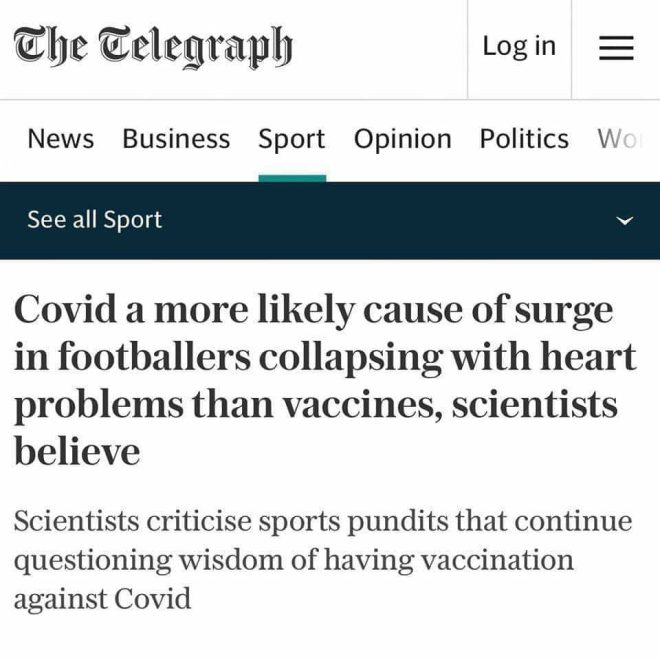
it’s really very simple. this heart risk outcome has become too prevalent to hide. so they need to shift the blame and they are willing to lie to the people and keep harming them to do so.
period.
How the Corporate Media Launched a Disinformation Campaign to Protect Fauci
By Leighton Woodhouse | December 1, 2021
By now you’ve surely heard about Anthony Fauci and his laboratory beagles, but in case you haven’t, it goes like this: For forty years, Fauci, as the head of the National Institute of Allergy and Infectious Diseases (NIAID), has funded gruesome experiments on animals. Beagles in particular are one of the favored species for these experiments, because of their docile and people-pleasing nature, which makes for less hassle for the humans who subject them to pain and suffering. In one of these NIAID-funded experiments, in Tunisia, sedated beagles’ heads were put into mesh bags with swarms of starved sand flies, who fed on the live dogs.
The other thing you may have heard is that the story is just another right-wing conspiracy theory. You may have heard this from The Washington Post, from any of a number of self-proclaimed “fact checkers,” or maybe even from the globally renowned Beacon of Honesty David Frum of The Atlantic.
I’ve been reporting on this story for the past few weeks. In fact, I’ve been reporting it as closely as anyone, if not more so. It’s been an extremely educational experience for me, but not because I was unfamiliar with the industry of animal experimentation, or NIAID’s leading role within it. What’s been educational is seeing up close and first-hand how the mainstream media constructs and deploys a brazen misinformation campaign.
First of all, just to get this detail out of the way: the story is true. As head of NIAID, the second biggest institute within the National Institutes of Health, Anthony Fauci has spent billions of dollars over four decades funding scientific experiments on animals, many of them stomach-turning. NIAID does not deny this. In fact, the published scientific papers that describe these heinous experiments routinely credit NIAID and NIH as their funders, and sometimes as direct collaborators. You can look them up yourself: here are just a few of them.
Of the numerous horrific experiments on dogs funded by agencies and budgets controlled by Fauci, there’s only one that is in dispute: the one in Tunisia. That is the experiment which involved placing sedated beagles’ heads in mesh bags with swarms of starved sand flies, which feasted on the live dogs in order to transmit to them a parasite that carries a disease called “leishmaniasis.” The scientific paper that described the results of that experiment, published on July 15, originally credited NIAID as a funder.


“Enhanced attraction of sand fly vectors of Leishmania infantum to dogs infected with zoonotic visceral leishmaniasis,”PLOS Neglected Tropical Diseases, July 15, 2021
But after this ethical monstrosity was publicized and denounced by an anti-animal testing group specializing in a building left/right coalitions — the White Coat Waste Project, which, as Glenn Greenwald reported in this space two weeks ago, became the target of a Washington Post hit piece as punishment for denouncing Fauci — this particular experiment created a minor media sensation and a major headache for NIH. In the wake of that recent controversy, the paper’s authors — just three weeks ago, on November 11 — suddenly retracted their statement about NIAID funding. In wooden language that reads like a hostage note, they now claim that when they said that NIAID had paid for this experiment, it was by accident.
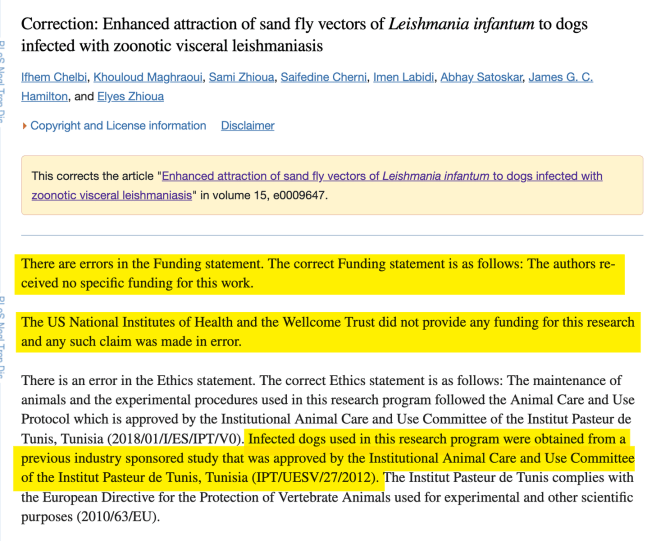
“Correction” in the PLOS Neglected Tropical Diseases, Nov. 11, 2021
There are plenty of reasons to doubt that denial, which I’ll go into shortly. But ultimately: who cares? This was just one revolting NIAID-funded experiment among many that White Coat Waste exposed, and not even the worst of them. NIAID does not deny funding any of those other experiments, which are just a few out of thousands of animal experiments which NIAID has underwritten going back to the 1980s. It has long been known that experiments on dogs rarely if ever yield any tangible benefits for medical research regarding humans, making these experiments not only morally reprehensible but useless. Even if we were to concede NIAID’s denial that they funded this one specific test — and there is no reason to grant them that (again, I’ll get into this shortly) — it would put only the slightest dent in the overall story, which is that Anthony Fauci is personally accountable for billions of dollars worth of wasteful and cruel experiments on innocent, terrified animals.
Fauci’s highly cynical strategy — and therefore the strategy of his media allies — is to focus everyone’s attention on this one sole project in Tunisia, then deny that he funded it. The obvious goal is to obscure and bury what they cannot deny even if that denial were true: namely, that agencies and budgets controlled by Fauci fund thousands of similar or worse experiments on dogs. Not only does NIAID not deny this core fact, but, as demonstrated above, they admit this in multiple reports and experimentation reports.
But now we get to the part of this episode that was particularly educational to me. That single denial — a highly dubious one — generated an orgy of mainstream media reporters tripping over each other to dismiss the entire story of Fauci animal abuse as “misinformation.”
Before NIAID issued this denial, there was almost no coverage at all of the story in the mainstream media. With a few isolated exceptions, it was covered only in conservative media, independent media, and social media for obvious reasons: since it reflects poorly on Fauci, the liberal sector of the corporate media has no interest in doing anything other than burying it. But as soon as NIAID chummed the water with its questionable denial, suddenly it was a hot topic in the press: not as a story about animal abuse, but about “right-wing misinformation.” In other words, corporate journalists had no interest in any of this — including the misuse of taxpayer funds to support ethically monstrous and medically useless experiments — until they found a way to wield it as a cudgel to attack right-wing media and shield Fauci.
Such cynical partisan scheming is appropriate or at least expected from DNC operatives, but not actual journalists. But that, of course, is the point: these corporate journalists resemble and see themselves far more as the former than the latter. And their conduct here proves that.
The first journalist to ride to Fauci’s rescue was The Washington Post’s Dana Milbank. In his October 25 column, Milbank cited NIAID’s denial and, from that alone, concluded that the entire story was a product of “the right-wing disinformation machine and its crusade against Fauci.” (When I challenged Milbank on these claims on Twitter, he blocked me.) Then, following Milbank’s lead, suddenly a slew of “fact checker” websites that had never weighed in on the subject before put up posts casting doubt on the story. … Full article$$$
Featured Video

Bombing Hitler’s Hometown
or go to
Aletho News Archives – Video-Images
From the Archives
‘Conspiracy Theory’ Now Fact: Greater Israel Has Arrived
By Kit Klarenberg | Mint Press News | January 28, 2025
Ever since Tel Aviv’s 1948 creation, much has been said and written about ‘Greater Israel’ – the notion Zionism’s ultimate end goal is the forcible annexation and ethnic cleansing of vast swaths of Arab and Muslim lands for Jewish settlement, based on Biblical claims this territory was promised to Jews by God. The mainstream media typically dismisses this concept as antisemitic conspiracy theory, or at most the fringe fantasy of a minuscule handful of extremist Israelis.
In reality … continue
Blog Roll
 Aletho News
- Hezbollah’s Surprise Weapons Redefine Ground Battle with Israel
- Yemen joins fight against US, Israel by firing missiles at occupied territories
- Seizing the Kharg: Washington’s path to defeat in the Persian Gulf
- Iran reports 500 US casualties in strikes on covert US military sites
- Pro-Israel terrorist arrested before assassination of pro-Palestinian activist
- Bombing Hitler’s Hometown
- German journalist threatened with homelessness as German court upholds EU sanctions in landmark free speech case
- US Tells Allies That Ukraine-Bound Arms Could be Sent to Middle East
- Organized terrorism: Iran condemns killing of its diplomats in Lebanon
- Why could Gaza enter the regional war?
- If Americans Knew
- Researchers at Human Rights Watch Resign Over Blocked Report on Palestinian Refugee Return
- Jewish Groups Are Backing a War Americans Don’t Want
- Eric Fingerhut Thinks He’s the President of the Jews
- Top Jewish Philanthropists, Rabbis Urge Israeli President to Take Action Against ‘Jewish Extremists’
- Don’t Be Fooled. Zionist Leaders Have Always Wanted to Control Southern Lebanon
- Israel’s widespread use of torture is a core element of its genocide against the Palestinian people
- In Israel’s War on Iran, Many Middle East US Bases Rendered “All But Uninhabitable”
- ‘Burn the lawn’: Israel pursues ‘Rafah model’ in southern Lebanon
- A genocide here, an amputation there
- Reports: Iran mobilizing 1M fighters, Israel-US run low on ammo, Israeli army faces shortage – Not a ceasefire Day 168
- No Tricks Zone
- Devastating Assessment Of Comirnaty Vaccine By Former Senior Pfizer Europe Toxicologist
- New Study: CO2 Is ‘Effectively Negligible’ As An Explanatory Climate Change Factor Since 2000
- Former Pfizer Toxicologist Dr. Helmut Sterz Tells Bundestag Hearing Pfizer Vaccine Should Have Never Been Approved
- Energy Expert: Germany’s Nuclear Phaseout Was A “500 Billion Euro Mistake”
- New Research: South Australia’s Mid-Holocene Sea Surface Temperatures Were 4°C Warmer Than Today
- Storing Green Energy To Last Germany 10 Days Would Require A 60-Million Tonne Battery
- New Studies: UK Sea Levels Were 4 Meters Higher Than Today During The Mid-Holocene
- Destructive Green New Deal: German Energy And Metal Group Warns Of Drastic Crisis
- New Study Documents A 20-Year Pause In Arctic Sea Ice Decline – Driven By Internal Variability
- Wake-up Call: Survey Shows Majority Of Germans Now Favor Postponing Climate Targets!
 Aletho News