Russia Report… A Triumph of Orwellian Bombast
By Finian Cunningham | Strategic Culture Foundation | July 24, 2020
The sensational headlines screaming on the front pages of British newspapers this week showed that the parliamentary Russia Report was a triumph of bombast.
The Daily Mail led with “Damning Russia Dossier” while The Times heralded “MI5 to get more powers” and “Tough new laws will combat threat of Russian spies”. The Times also splashed its front page with a large photograph of Russian President Vladimir Putin seemingly lurking behind a curtain, which just goes to show how much British journalism has descended into cartoonish trivia.
There is sound reason why the British government delayed until this week publication of the so-called Russia Report by a cross-party parliamentary committee. That’s plainly because there is nothing in it that could in any way substantiate lurid claims of alleged Russian interference in British politics.
The 55-page document was neither “damning” nor “devastating” as The Daily Mail asserted. The groundless hype suggests that the headline writers simply were looking for something to sell to readers regardless of facts.
Boris Johnson, the prime minister, received a copy of the report 10 months ago, but decided to postpone its publication until after the general election that was held in December. That delay led to claims that his Conservative government was hiding something sinister. There were procedural hiccups from the Intelligence and Security Committee (ISC) being replaced with new members. However, now that the report is published any rational reader can see that the real cause of the delay is down to the report being a dud, despite all the breathless speculation. It is an empty vessel, with no evidence or substantive detail. It consists of entirely prejudiced assertions that Russia is “a hostile state” and the UK “is clearly a target for Russia disinformation campaigns and political influence”.
The nine lawmakers on the committee and their nine predecessors acknowledge among their sources for the report the following individuals: Anne Applebaum, William Browder and Christopher Steele. All of them are zealously anti-Russia and are prodigious purveyors of “Russian interference” narratives to anyone who will listen to them. Steele is the notorious former MI6 spy who cooked up the ludicrous “Russia Dossier” for the Democrats to smear Trump with in the 2016 elections. That dossier fueled the bogus “Russiagate” scandal.
Of course, the main sources for the parliamentary committee are British intelligence agencies, MI6, MI5 and GCHQ. Candid admission of all those sources should underscore with redlines that the so-called report is nothing but a propaganda screed. Yet the British media treat it with deference and respect as if it is a credible, objective assessment.
What is rather laughable is the unrestrained prejudice of the authors who are, in reality, propagandists more suited to being frozen in Cold War mentality than offering any kind of “expertise”. They claim Russian politics is “paranoid” and “nihilistic” driven by “zero-sum calculation”. All those attributed defects are merely self-projection by the authors of this report and their sources.
It is rather telling that in place of anything resembling substance of alleged Russian interference, the parliamentarians refer to “open sources” of media influence by Russian state-owned RT and Sputnik. They accuse these media of “direct support of a pro-Russian narrative in relation to particular events”. Oh, how shocking! And the British state-owned BBC does not also do the same?
Again referring to “open sources” – meaning public media reports – the parliamentarians claim that the Kremlin interfered in the Scottish referendum on independence back in 2014. So just because Russian news media featured that subject in its coverage is supposed to be “evidence” of Kremlin interference. The absurd accusation is also a convenient way to smear Scottish pro-independence.
Oddly enough, the report says there was no manifest Russian interference in the 2016 Brexit referendum. Well that’s handy. The Tory government wouldn’t want to smear its ambitions of reviving the British empire, that’s for sure.
The ISC publication is a self-serving dud that is “not worth a penny”, as Russian lawmaker Aleksy Chepa put it.
It is loaded with complacent British self-regard and knee-jerk Russophobia.
The parliamentarians repeatedly rebuke the British government and state intelligence for not taking the “threat” of alleged Russian meddling seriously enough.
A more plausible explanation is because there is negligible Russian meddling in British politics, as Moscow has consistently stated. If the British government and its spooks fail to get excited – in private – about allegations of Russian malfeasance it’s because there is actually nothing to the allegations. Still, the parliamentarian anti-Russia ideologues assume to know better. They are convinced that Britain is a target for Kremlin hostility and they lambast the government and intelligence services for “not making it a priority issue”.
The Orwellian plot thickens when the authors of the boilerplate Russian Report then conclude by urging MI5 to be given more secretive powers to collaborate with social media networks in order to control information in the name of combating a “hostile state threat”. This is a sinister, anti-democratic call worthy of a dictatorship for censoring and blackballing any dissenting views under the guise of “defending democracy”.
One area where the ISC document begins to deal with reality – but only superficially and misleadingly – is on the subject of super-rich Russian expatriates living in London, which is dubbed “Londongrad”. Many of these oligarchs are beneficiaries of looting Russian state assets during the privatization-robbery frenzy under former President Boris Yeltsin. They are not “friends of Putin” as the British lawmakers make out. These shady oligarchs are often big donors to the Conservative party, not because they want to inject pro-Russian influence, but rather because they are typically opposed to the current Russian government and are seeking to destabilize it. If there is any Russian “influence” in British politics it is that which promotes illegal regime-change policies in opposition to the Russian state.
In every aspect the much-vaunted Russia Report is a worthless pile of propaganda. Even a glimmer resembling something real – the Russian oligarchs in Londongrad – turns out to be an inversion of reality. And yet, pathetically, the British media amplify the nonsense with reverence and gravitas.
‘US must stop slander and smearing’: China rebuffs allegations it stole Covid-19 vaccine data
RT | July 22, 2020
Beijing has accused the US of waging a global smear campaign, after Chinese nationals were accused of hacking foreign companies that conduct Covid-19 vaccine research.
The US must “immediately stop its slander and smearing of China on cyber security issues,” spokesperson for China’s Foreign Ministry Wang Wenbin told reporters. “The Chinese government is a staunch defender of cyber security, and has always opposed and cracked down on cyber attacks and cyber crime in all forms.”
Wang said that “cyberspace must not become a new battlefield,” because upholding “peace and stability” in cyberspace is in the common interest of all countries.
The US Justice Department earlier accused two Chinese nationals of targeting companies around the world, including biotech firms in Maryland, Massachusetts, and California that are conducting research related to vaccines for the coronavirus.
The Covid-19 pandemic remains one of the areas where the US is accusing Beijing of misconduct. American officials, including President Donald Trump, claimed that China accidentally released the coronavirus from a laboratory in the city of Wuhan, where the disease was first recorded, and initially tried to hide the scale of the outbreak.
Another line of attack involves allegations that Beijing is influencing the World Health Organization (WHO). British media reported that on Tuesday that US Secretary of State Mike Pompeo told MPs at a “private meeting” in London that China had “bought” WHO chief Tedros Adhanom Ghebreyesus by helping him to get elected.
“There was a deal-making election and when push came to shove, you get dead Britons, because of the deal that was made,” Pompeo was quoted by the media as saying.
The Trump administration has heavily criticized the WHO over its handling of the Covid-19 pandemic. The US officially initiated its withdrawal from the organization this month.
Beijing has repeatedly denied having concealed any information about the outbreak and slammed suggestions that the virus came from one of its labs as false.
American-Chinese relations hit a new low on Wednesday, when the US demanded that China shut down its consulate in Houston, Texas. The US State Department explained that this decision will help to protect American intellectual property and the personal data of US citizens. Beijing blasted the move as “escalatory” and promised to retaliate.
I Don’t Always Believe CIA Narratives. But When I Do, I Believe Them About China.
By Caitlin Johnstone | July 22, 2020
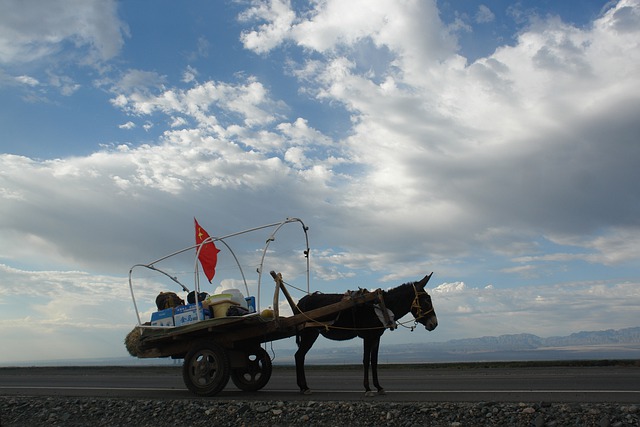
My social media notifications have been lighting up the last few days with virulent Chinagaters sharing a video which purports to show Uighur Muslims being loaded onto a train to be taken to concentration camps. It’s actually an old video that had already surfaced last year, but it is magically making the rounds again as a new and shocking revelation in 2020 now that western China hysteria has been officially kicked into high gear, at exactly the same time the US enacts one of the most dangerous and incendiary escalations of recent years in the South China Sea.
Everyone tagging me in this video presents it as a self-evident “gotcha” moment, in exactly the same way Russiagaters spent years tagging me in every HUGE BOMBSHELL WALLS ARE CLOSING IN item of thinly sourced narrative fluff in their debunked conspiracy theory that the Kremlin had infiltrated the highest levels of the US government.
They are one hundred percent certain that the video shows Uighurs being loaded onto a train to go to a concentration camp, solely because that is what the bit of text over the video tells them that that’s what they are seeing. They aren’t looking at the actual data and thinking critically about it, they’re looking at the narrative and believing it on blind faith. Which, in a post-Iraq invasion world, is an absolutely insane thing to do when presented with information about a nation that is targeted by the US-centralized empire.
In reality there’s nothing in the video which tells us that these are Uighur people being sent to a “re-education camp” and not merely a conventional prison transfer of convicted criminals, the likes of which take place in the far more populous US prison system all the time. It’s an unknown. We are told by the BBC’s Andrew Marr (the same Andrew Marr whose phony journalism Noam Chomsky derided years ago) that it has been “authenticated by western intelligence agencies and by Australian experts”, which in practice are the same thing, and that’s really the extent of the evidence. Again, this is an insane source to take on faith in a post-Iraq invasion world.
There are in fact an abundance of reasons to be highly skeptical of the establishment narrative about what is happening to Uighurs in Xinjiang. But that isn’t the point that I am trying to make here.
The point I am trying to make here is that the only sane response to any narrative that is being promoted by western intelligence agencies and their media stenographers about governments which have resisted absorption into the imperial blob is intense and unrelenting skepticism. These organizations have such an extensive and well-known history of lying about exactly this sort of thing that they have left us no choice but to withhold belief from anything they say absent a mountain of independently verifiable evidence if we want to have a fact-based relationship with reality.
None of this means that China has a wonderful government. It doesn’t even mean that all the bad things we’re being told about what the Chinese government is doing are false. It’s entirely possible that that video shows exactly what we’re being urgently told to believe it shows. There’s simply no way to be sure one way or the other in an information ecosystem that is so severely tainted by propagandistic narrative manipulation.
Surely the Chinese government is far from sinless. It seems to be a constant that power structures which keep secrets and use propaganda will always wind up doing ugly things. But this doesn’t mean you go believing whatever cold war-facilitating story we are fed by western power structures about it. Not if we want to avoid being duped into serving as pro bono CIA propagandists, unwitting tools of a murderous war machine.
There is a slow-motion third world war underway between the US-centralized power alliance and the nations like China which have resisted being absorbed into it, and that war is being largely facilitated by propaganda. If one doesn’t wish to become a propagandist themselves, one ought to withhold belief from the stories they are told about the terrible, awful things the unabsorbed nations are doing which require extensive sanctions, subversion and interventionism in response.
This doesn’t mean you believe the opposite of what you’re told, it simply means you refrain from believing either way and remain agnostic until presented with hard verifiable proof. Believing damaging narratives about US-targeted governments is exactly as stupid as believing the words of a known compulsive liar about someone you know he hates.
China is such a curious anomaly in the narrative matrix. Many who are normally skeptical of claims by western governments immediately swallow anything they’re told about China. They not only believe all such claims, it never even occurs to them to seriously question them. Like they seem to be genuinely unaware that skepticism of establishment China narratives is even an option. The claims just slide right into the “believe” file in their mind, completely unchecked by anything resembling critical thought.
I argue with people all over the political spectrum about China online, and an astonishing percentage of them have clearly put exactly zero research into critically examining these claims, even if they’re people who are normally relatively critical of western foreign policy. They’re often completely unaware that whatever claims they’re advancing are not just disputed but have large amounts of evidence against them. This is because they’ve done no research whatsoever into finding out what they were told is even true. They’ll do that research on Iran, they’ll do it about Russia, they’ll do it about Syria, but with China all skepticism immediately goes right now the window. It’s the weirdest thing.
Always be intensely skeptical of claims made about governments targeted by the known liars who run the US-centralized empire. Always, always, always, always. If you advance imperialist propaganda, then you are just as culpable for the bloodshed and suffering they help facilitate as the people who are actually launching the missiles.
Stay skeptical, my friends.
‘Russia Report’: Once-mighty British intelligence has been reduced to regurgitating sensationalist Buzzfeed stories
By Paul Robinson | RT | July 22, 2020
The ‘Russia Report’ gives us an insight into the dearth of genuine expertise available to British officials on Russia. It also introduces a new style of investigation: Seeking evidence to support predetermined judgements
On Tuesday, the British Parliament’s Intelligence and Security Committee issued a 50-page report detailing its views on the danger Russia poses to British security. “The security threat posed by Russia,” the report says, “appears fundamentally nihilistic… It is clear that Russia poses a significant threat to the UK on a number of fronts – from espionage to interference in democratic processes, and to serious crime.”
The report further argues that the British intelligence community “took their eyes off the ball” and the government “badly underestimated the Russian threat.” In particular, the government and its intelligence agencies failed to investigate claims that the Russian state had interfered in the 2016 Brexit referendum. The government, however, has rejected the committee’s demand that such an investigation now take place.
The reports’ claims are alarming at first glance. When examined, however, they can be seen to lack evidentiary support. Instead, readers are repeatedly told that there have been “widespread allegations” and that “it has been widely reported” that the Russians are up to no good. But allegations are not evidence, and time after time the report fails to substantiate the suspicions it raises.
For instance, the report declares, “There have been widespread public allegations that Russia sought to influence the 2016 referendum on the UK’s membership of the EU.” But the only evidence it provides to show that those allegations might be true is a reference to “open source studies” which point to pro-Brexit bias by the Russian broadcasters RT and Sputnik.
The committee neither names the studies nor discusses whether their conclusions are valid. Apparently, the committee asked MI5 for evidence, but all it got in reply was “six lines of text” based also on ‘open source studies’. In short, no secret intelligence supporting the claims that Russia interfered with Brexit has been provided.
This is rather embarrassing. The committee has drawn a blank. But still, it presses on. “There has been credible open source commentary suggesting that Russia undertook influence campaigns in relation to the Scottish independence referendum in 2014,” it announces. The relevant footnote fails to say what this credible commentary is. Instead, it merely says that it “was widely reported” that Russians who had observed the Scottish referendum had suggested “that there were irregularities in the conduct of the vote.”
But Russians complaining about the conduct of the vote do not constitute Russians trying to influence the campaign. After all, the observers in question said these things after the vote, and so their statements could hardly have been an attempt to affect the outcome.
This faulty mode of argument is pretty much par for the course. “It has been widely alleged” that Russia was responsible for a computer hack on the French presidential election in 2017, the report says. “It has been widely reported” that Russians were responsible for the hack and leak operation against the Democratic National Committee in the US in 2016. And so on.
Perhaps the nadir of the report is the statement that “on 15 June 2017, Buzzfeed News published the results of its investigation into 14 deaths in the UK of Russian business figures and British individuals linked to them” (Buzzfeed implied, without supporting evidence, that all 14 people were murdered by the Russian intelligence services). This, then, is what the might of British intelligence has been reduced to – regurgitating sensationalist stories from Buzzfeed. It gives you a sense of what the committee considers a ‘credible’ source to be.
The committee goes beyond repeating unsubstantiated claims to making unspecified ones. In the UK, it says, numerous “lawyers, accountants, estate agents, and PR professionals have played a role, wittingly or unwittingly, in the extension of Russian influence which is often linked to promoting the nefarious interests of the Russian state.” No names are named, no evidence produced. All the committee provides is a quote from long-time anti-Russian campaigner William Browder, as if his bold assertions amount to incontrovertible proof.
In 50 pages warning us of the evil ‘influence’ Russia has over the UK, the report fails to provide a single documented example of this influence at work. In short, the entire premise of the report (that Russia poses a significant threat to the UK) is not only not proven, but also not even demonstrated in any tangible way.
That perhaps explains why the committee has chosen to be so harsh on the British government, accusing it of failing to live up to its responsibility to defend the nation. It appears that the committee knows in its bones that all these things are true, but also knows that it lacks any evidence to prove them. The evidence is there; it’s just that the government has failed to do its job and provide it.
A proper intelligence investigation first finds the facts and then comes to a conclusion. It would seem as though the Intelligence and Security Committee wishes to go about it the other way – it has already reached its conclusion; now it wants the government to provide the evidence. The government should not indulge this.
Paul Robinson is a a professor at the University of Ottawa. He writes about Russian and Soviet history, military history, and military ethics.
US’ War Tactics Might Not Be Useful Anymore
By Prof. Zamir Ahmed Awan | One World | July 21, 2020
The US’ typical war tactics of the past may not be useful against China, Russia, or North Korea. Let us review the Iraq War as a typical case. The first step was the media war by building an anti-Saddam narrative. The BBC reported on the weapons of mass destruction in Iraq and termed them a threat to regional and global peace. UN inspectors were dispatched to verify their existence, but could not confirm anything. When the US was sure that Iraq had no weapons of mass destruction and capability of resistance or retaliation, that was when it decided to attack the country. Later on, the BBC apologized for spreading fake news, but only after the destruction of Iraq.
Simultaneously, the media distorted the image of President Saddam Hussein and instigated the public against him. The US intelligence identified individuals disgruntled with the Saddam regime, provided them training, equipped them, liberally funded them, and organized systematic agitations, demonstrations, and insurgency against the Saddam government.
After the US established a strong network against Saddam Hussein and agents providing them with ground intelligence, they felt comfortable attacking Iraq.
The preparatory work that was undertaken before the attack included spreading anti-Saddam sentiments, supporting insurgencies, spreading fake news, and creating an environment for a smooth attack. Media and intelligence agents were the tools to achieve all of this.
Then the US, along with its allies, launched airstrikes, carpet bombed, and dropped unlimited explosives. After destroying the control and command, dispersing troops, telecommunications, power plants, fuel storage facilities, hospitals, airports, government buildings, and other important installations, they were assured of no resistance or retaliation from the Iraqi forces.
The airstrikes were made as a result of high-tech warfare, jamming radars, and disabling Iraqi defense systems. The US used bombers at a very high altitude where Iraqi anti-air crafts defense systems could not reach so that there were no casualties on the American side. After damaging the whole country so badly, and when they were 100% sure of no resistance from the Iraqi forces, the ground troops conquered Baghdad almost without any resistance or loss of lives.
The Libyan War was a similar case. They tried to do the same thing in Syria. However, this did not succeed because Russia rescued Syria, while it was quite a different story in the case of North Korea. The US could not penetrate into Korea, reach disgruntled individuals, or lobby against the Kim regime. The media war was not successful either. On the other hand, North Korea really has nuclear deterrence. That is why the US never attacked North Korea. In the case of Iran, the US understands the potential of resistance and retaliation. Iran demonstrated its capabilities well when the US assassinated General Soleimani in Baghdad.
I am pretty sure that the US will never come into direct confrontation with China. Although the US tried its best to destabilize China by creating issues like Hong Kong and Xinjiang, China has almost fully overcome such disturbances. The media war is also under the control of the Chinese government. China is officially recognized as the second-largest economy just after the US, but the realities may be different. In the case of weapons, China is not behind the US. In high-tech and advanced technologies, in some respect, China is ahead of America. China might not compete with America in conventional warfare, but it can move swiftly, decisively, and with its most modern advanced defense systems.
At the same time, the US is losing its reputation worldwide because it was — and in some cases, still is — involved in countless killings in South America, the Middle East, Vietnam, Japan, Africa, Korea, and many other parts of the world. Some people say that “when you have America as your friend, you do not need any enemies”. Even close allies of the US are not satisfied. Anti-American sentiments are growing globally. While this is happening, China is engaged in connectivity, infrastructure development, and the promotion of understanding and harmony among various cultures. The Belt & Road Initiative (BRI) is a message of peace, stability, development, and prosperity. As a result, China enjoys an immense amount of goodwill.
In order to preserve this message of global peace, we must always struggle to avert any conflict in any part of the world and resolve all issues amicably, diplomatically, and politically under the UN Charter.
Prof. Engr. Zamir Ahmed Awan is a Sinologist (ex-Diplomat), Editor, Analyst, Non-Resident Fellow of CCG (Center for China and Globalization), National University of Sciences and Technology (NUST), Islamabad, Pakistan. (E-mail: awanzamir@yahoo.com)
Kremlin pours cold water on anonymous Bloomberg claims about ‘elite’ Covid-19 vaccine
RT | July 20, 2020
President Vladimir Putin has not received the domestic coronavirus vaccine, according to spokesman Dmitry Peskov. The denial comes on the day anonymous claims emerged that the Russian elite has had access to it since April.
Speaking to reporters, Peskov explained that the president had not yet been administered the experimental drug, because it’s “not very good for the head of state to receive an uncertified vaccine.” He was diagnosed with Covid-19 himself in May, and also denied being vaccinated.
On Monday morning, Bloomberg claimed that “scores of members of Russia’s business and political elite have been given early access to an experimental vaccine against Covid-19,” claiming they included business executives, tycoons, and government officials. According to the outlet, the vaccine has been available for Russia’s wealthy elite since April, and has already been administered to “several hundred people.”
Bloomberg did not name any of its sources or provide any evidence, but stated that the vaccine had been received by the CEO of the Russian Direct Investment Fund, Kirill Dmitriev, as well as senior managers at aluminum company Rusal and chemical producer PhosAgro. In mid-June, Dmitriev admitted that he had volunteered to take the drug.
According to the news agency, those who received the vaccine “are monitored, and their results logged by the institute.” The establishment in question is Moscow’s Gamalei Institute of Epidemiology and Microbiology.
On June 16, the institute received approval from the Ministry of Health to begin testing an experimental coronavirus vaccine on humans. In conjunction with the Ministry of Defense, it completed the drug’s first trial stage, and on July 15, announced that no volunteers had experienced “serious side effects, health complaints, complications or adverse reactions.”
On Monday morning, a second group of trialists was discharged from the hospital, with the test results “unambiguously” showing “the development of an immune response in all volunteers.” This is the same vaccine that Bloomberg claims was administered to Russia’s elite.
Following Bloomberg’s allegations, the director of the Gamalei Institute, Alexander Ginzburg, denied any knowledge of “big or small” businessmen receiving the immunization, with Vadim Tarasov, director of the Institute of Translational Medicine and Biotechnology at Sechenov University, calling the reports “speculation.” Aleksey Kuznetsov, an assistant to Russia’s Minister of Health, also denied that the vaccine is in “civilian circulation.”
Powell & Iraq—Regime Change, Not Disarmament: The Fundamental Lie
By Scott Ritter – Consortium News – July 18, 2020
The New York Times Magazine has published a puff piece soft-peddling former Secretary of State Colin Powell’s role in selling a war on Iraq to the UN Security Council using what turned out to be bad intelligence. “Colin Powell Still Wants Answers” is the title of the article, written by Robert Draper. “The analysts who provided the intelligence,” a sub-header to the article declares, “now say it was doubted inside the CIA at the time.”
Draper’s article is an extract from a book, To Start a War: How the Bush Administration Took America into Iraq, scheduled for publication later this month. In the interest of full disclosure, I was approached by Draper in 2018 about his interest in writing this book, and I agreed to be interviewed as part of his research. I have not yet read the book, but can note that, based upon the tone and content of his New York Times Magazine article, my words apparently carried little weight.
Regime Change, Not WMD
I spent some time articulating to Draper my contention that the issue with Saddam Hussein’s Iraq was never about weapons of mass destruction (WMD), but rather regime change, and that everything had to be viewed in the light of this reality—including Powell’s Feb. 5, 2003 presentation before the UN Security Council. Based upon the content of his article, I might as well have been talking to a brick wall.
Powell’s 2003 presentation before the council did not take place in a policy vacuum. In many ways, the March 2003 U.S.-led invasion and subsequent occupation of Iraq was a continuation of the 1991 Gulf War, which Powell helped orchestrate. Its fumbled aftermath was again, something that transpired on Powell’s watch as the chairman of the Joint Chiefs of Staff in the administration of George H. W. Bush.
Powell was part of the policy team that crafted the post-Gulf War response to the fact that Iraq’s president, Saddam Hussein, survived a conflict he was not meant to. After being labeled the Middle East equivalent of Adolf Hitler whose crimes required Nuremburg-like retribution in a speech delivered by President Bush in October 1990, the Iraqi President’s post-conflict hold on power had become a political problem for Bush 41.
Powell was aware of the CIA’s post-war assessment on the vulnerability of Saddam’s rule to continued economic sanctions, and helped craft the policy that led to the passage of Security Council resolution 687 in April 1991. That linked Iraq’s obligation to be disarmed of its WMD prior to any lifting of sanctions and the reality that it was U.S. policy not to lift these sanctions, regardless of Iraq’s disarmament status, until which time Saddam was removed from power.
Regime change, not disarmament, was always the driving factor behind U.S. policy towards Saddam Hussein’s Iraq. Powell knew this because he helped craft the original policy.
I bore witness to the reality of this policy as a weapons inspector working for the United Nations Special Commission (UNSCOM), created under the mandate of resolution 687 to oversee the disarming of Iraq’s WMD. Brought in to create an intelligence capability for the inspection team, my remit soon expanded to operations and, more specifically, how Iraq was hiding retained weapons and capability from the inspectors.
SCUDS
One of my first tasks was addressing discrepancies in Iraq’s accounting of its modified SCUD missile arsenal; in December 1991 I wrote an assessment that Iraq was likely retaining approximately 100 missiles. By March 1992 Iraq, under pressure, admitted it had retained a force of 89 missiles (that number later grew to 97).
After extensive investigations, I was able to corroborate the Iraqi declarations, and in November 1992 issued an assessment that UNSCOM could account for the totality of Iraq’s SCUD missile force. This, of course, was an unacceptable conclusion, given that a compliant Iraq meant sanctions would need to be lifted and Saddam would survive.
The U.S. intelligence community rejected my findings without providing any fact-based evidence to refute it, and the CIA later briefed the Senate that it assessed Iraq to be retaining a force of some 200 covert SCUD missiles. This all took place under Powell’s watch as chairman of the Joint Chiefs.
I challenged the CIA’s assessment, and organized the largest, most complex inspection in UNSCOM’s history to investigate the intelligence behind the 200-missile assessment. In the end, the intelligence was shown to be wrong, and in November 1993 I briefed the CIA Director’s senior staff on UNSCOM’s conclusion that all SCUD missiles were accounted for.
Moving the Goalposts
The CIA’s response was to assert that Iraq had a force of 12-20 covert SCUD missiles, and that this number would never change, regardless of what UNSCOM did. This same assessment was in play at the time of Powell’s Security Council presentation, a blatant lie born of the willful manufacture of lies by an entity—the CIA—whose task was regime change, not disarmament.
Powell knew all of this, and yet he still delivered his speech to the UN Security Council.
In October 2002, in a briefing designed to undermine the credibility of UN inspectors preparing to return to Iraq, the Defense Intelligence Agency trotted out Dr. John Yurechko, the defense intelligence officer for information operations and denial and deception, to provide a briefing detailing U.S. claims that Iraq was engaged in a systematic process of concealment regarding its WMD programs.
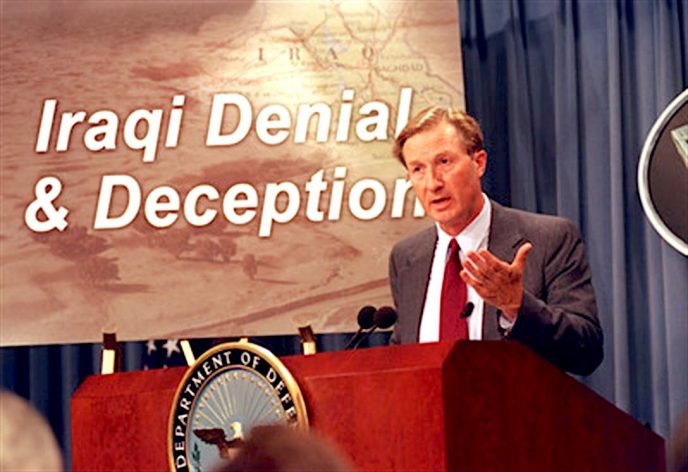
John Yurechko, of the Defense Intelligence Agency, briefs reporters at the Pentagon on Oct. 8, 2002 (U.S. Defense Dept.)
According to Yurechko, the briefing was compiled from several sources, including “inspector memoirs” and Iraqi defectors. The briefing was farcical, a deliberate effort to propagate misinformation by the administration of Bush 43. I know—starting in 1994, I led a concerted UNSCOM effort involving the intelligence services of eight nations to get to the bottom of Iraq’s so-called “concealment mechanism.”
Using innovative imagery intelligence techniques, defector debriefs, agent networks and communications intercepts, combined with extremely aggressive on-site inspections, I was able, by March 1998, to conclude that Iraqi concealment efforts were largely centered on protecting Saddam Hussein from assassination, and had nothing to do with hiding WMD. This, too, was an inconvenient finding, and led to the U.S. dismantling the apparatus of investigation I had so carefully assembled over the course of four years.
It was never about the WMD—Powell knew this. It was always about regime change.
Using UN as Cover for Coup Attempt
In 1991, Powell signed off on the incorporation of elite U.S. military commandos into the CIA’s Special Activities Staff for the purpose of using UNSCOM as a front to collect intelligence that could facilitate the removal of Saddam Hussein. I worked with this special cell from 1991 until 1996, on the mistaken opinion that the unique intelligence, logistics and communications capability they provided were useful to planning and executing the complex inspections I was helping lead in Iraq.
This program resulted in the failed coup attempt in June 1996 that used UNSCOM as its operational cover—the coup failed, the Special Activities Staff ceased all cooperation with UNSCOM, and we inspectors were left holding the bag. The Iraqis had every right to be concerned that UNSCOM inspections were being used to target their president because, the truth be told, they were.
Nowhere in Powell’s presentation to the Security Council, or in any of his efforts to recast that presentation as a good intention led astray by bad intelligence, does the reality of regime change factor in. Regime change was the only policy objective of three successive U.S. presidential administrations—Bush 41, Clinton, and Bush 43.
Powell was a key player in two of these. He knew. He knew about the existence of the CIA’s Iraq Operations Group. He knew of the successive string of covert “findings” issued by U.S. presidents authorizing the CIA to remove Saddam Hussein from power using lethal force. He knew that the die had been cast for war long before Bush 43 decided to engage the United Nations in the fall of 2002.
Powell Knew
Powell knew all of this, and yet he still allowed himself to be used as a front to sell this conflict to the international community, and by extension the American people, using intelligence that was demonstrably false. If, simply by drawing on my experience as an UNSCOM inspector, I knew every word he uttered before the Security Council was a lie the moment he spoke, Powell should have as well, because every aspect of my work as an UNSCOM inspector was known to, and documented by, the CIA.
It is not that I was unknown to Powell in the context of the WMD narrative. Indeed, my name came up during an interview Powell gave to Fox News on Sept. 8, 2002, when he was asked to comment on a quote from my speech to the Iraqi Parliament earlier that month in which I stated:
“The rhetoric of fear that is disseminated by my government and others has not to date been backed up by hard facts that substantiate any allegations that Iraq is today in possession of weapons of mass destruction or has links to terror groups responsible for attacking the United States. Void of such facts, all we have is speculation.”
Powell responded by declaring,
“We have facts, not speculation. Scott is certainly entitled to his opinion but I’m afraid that I would not place the security of my nation and the security of our friends in the region on that kind of an assertion by somebody who’s not in the intelligence chain any longer… If Scott is right, then why are they keeping the inspectors out? If Scott is right, why don’t they say, ‘Anytime, any place, anywhere, bring ‘em in, everybody come in—we are clean?’ The reason is they are not clean. And we have to find out what they have and what we’re going to do about it. And that’s why it’s been the policy of this government to insist that Iraq be disarmed in accordance with the terms of the relevant UN resolutions.” (emphasis added, Aletho News )
Of course, in November 2002, Iraq did just what Powell said they would never do—they let the UN inspectors return without preconditions. The inspectors quickly exposed the fact that the “high quality” U.S. intelligence they had been tasked with investigating was pure bunk. Left to their own devices, the new round of UN weapons inspections would soon be able to give Iraq a clean bill of health, paving the way for the lifting of sanctions and the continued survival of Saddam Hussein.
Powell knew this was not an option. And thus he allowed himself to be used as a vehicle for disseminating more lies—lies that would take the U.S. to war, cost thousands of U.S. service members their lives, along with hundreds of thousands of Iraqis, all in the name of regime change.
Back to Robert Draper. I spent a considerable amount of time impressing upon him the reality of regime change as a policy, and the fact that the WMD disarmament issue existed for the sole purpose of facilitating regime change. Apparently, my words had little impact, as all Draper has done in his article is continue the false narrative that America went to war on the weight of false and misleading intelligence.
Draper is wrong—America went to war because it was our policy as a nation, sustained over three successive presidential administrations, to remove Saddam Hussein from power. By 2002 the WMD narrative that had been used to support and sustain this regime change policy was weakening.
Powell’s speech was a last-gasp effort to use the story of Iraqi WMD for the purpose it was always intended—to facilitate the removal of Saddam Hussein from power. In this light, Colin Powell’s speech was one of the greatest successes in CIA history. That is not the story, however, Draper chose to tell, and the world is worse off for that failed opportunity.
Scott Ritter is a former Marine Corps intelligence officer who served in the former Soviet Union implementing arms control treaties, in the Persian Gulf during Operation Desert Storm, and in Iraq overseeing the disarmament of WMD.
The Russians are coming, again! Poorly understood cybercrimes play perfectly into political agendas
By Helen Buyniski | RT | July 16, 2020
Foreign hackers are determined as ever to steal technology, meddle in elections and skew foreign policy, but fear not! The CIA has apparently been authorized to deliver preemptive cyber-strikes based on partisan mythmaking.
US, UK and Canadian intelligence dropped a 16-page report on Thursday accusing “Russian hackers” – specifically APT29, the “Cozy Bear” hacking group of ‘Russiagate’ fame – of targeting unspecified entities involved in developing the (increasingly controversial) Covid-19 vaccine.
However, the report is fraught with the same factual pitfalls plaguing previous unsubstantiated “Russian hacking” tales, seemingly designed to capitalize on the general population’s ignorance about cyber-attacks – or vaccines, for that matter. While Democrat-linked cybersecurity firm CrowdStrike specializes in attributing state actors to malware attacks, more reputable companies avoid doing so based solely on the malware used, since hacking groups often exchange tools or even collaborate.
The best, or just best-funded hackers are able to not only cover their tracks effectively but create a fake trail leading to someone else. The WikiLeaks Vault 7 release in 2017 exposed the disturbing tools the CIA has at its disposal for simulating foreign cyberattacks, tools that allow the agency to make it seem like Moscow or Tehran is behind a hack when the real culprits are in Langley, Virginia.
Russia is far from the only country to be accused of such behavior, of course – China was accused of attempting to steal coronavirus vaccine research back in May, while US and UK intelligence agencies warned that same month that other “threat groups” were “actively targeting” local governments, pharmaceutical and research firms, healthcare facilities, and universities for virus-related hacking.
Nor is this latest outbreak of finger-pointing limited to the pandemic. On Thursday, UK foreign minister Dominic Raab denounced “Russian actors” for “almost certainly” seeking to meddle in the 2019 election – not by actually breaking any laws, but by “amplifying” documents leaked by other people on Reddit and circulated around social media in the run-up to December’s contest
Raab didn’t name any of the Russians responsible for circulating the material, perhaps mindful of the embarrassment that befell his ideological brother-in-arms, Atlantic Council bot-hunter Ben Nimmo, who accused several real people of being “Russian bots.” Further covering his bases, Raab in the same statement acknowledged that there was “no evidence of a broad-spectrum Russian campaign against the General Election.”
Even the most nonspecific shrieking about Russian hackers plotting to steal vaccine data, however, distracts from the inconvenient reality that the vaccines under development in the UK and US are performing abysmally. Neither the US company Moderna – initially hailed as the frontrunner despite never having brought a vaccine to market before – nor the UK’s collaboration between Oxford University and pharma giant AstraZeneca have produced any encouraging results in their clinical trials.
That didn’t stop the US from ordering 300 million doses of the Oxford jab, though the Trump administration’s coronavirus czar Anthony Fauci has already begun lamenting the “general anti-science, anti-authority, anti-vaccine feeling among some people in this country” he fears will keep Americans away from the needle.
With regard to hacking, however, the world might be more concerned about the CIA than the Russians – especially following Wednesday’s Yahoo News report that the agency had received carte blanche from Trump to wage preemptive (i.e. unjustified) cyber-warfare against any individual or organization it could link to a “handful of adversarial countries.”
According to several former US officials, the CIA has been wielding unprecedented offensive powers against American civilians only tenuously connected to Washington’s geopolitical rivals since 2018, checking off at least 12 cyber-attacks on its “wish list” already. Liberated from the tiresome need to provide “years of signals and dozens of pages of intelligence” justifying raining computer-borne chaos and destabilization on its victims, the CIA has wrought “a combination of destructive things – stuff is on fire and exploding – and also public dissemination of data: leaking or things that look like leaking.”
News of the CIA being given carte blanche appears at the same point in the US election cycle as the 2018 report about a similar measure that freed the hands of the Pentagon to conduct its own cyberattacks without interference from the State Department or any intelligence agencies.
With a hotly anticipated election coming up in November, it’s not hard to imagine how a few well-placed “leaks” or “destructive things” might convince voters to put aside their concerns about the administration’s response to the pandemic – or to place it front and center, depending on whether the CIA has decided it can live with four more years of Trump.
One thing is certain: the “Russian meddling” narrative isn’t going away anytime soon.
Helen Buyniski is an American journalist and political commentator at RT. Follow her on Twitter @velocirapture23
“Putin Hacked Our Coronavirus Vaccine” Is The Dumbest Story Yet
By Caitlin Johnstone | American Herald Tribune | July 17, 2020
OMG you guys Putin hacked our coronavirus vaccine secrets!
Today mainstream media is reporting what is arguably the single dumbest Russiavape story of all time, against some very stiff competition.
“Russian hackers are targeting health care organizations in the West in an attempt to steal coronavirus vaccine research, the U.S. and Britain said,” reports The New York Times.
“Hackers backed by the Russian state are trying to steal COVID-19 vaccine and treatment research from academic and pharmaceutical institutions around the world, Britain’s National Cyber Security Centre (NCSC) said on Thursday,” Reuters reports.
“Russian news agency RIA cited spokesman Dmitry Peskov as saying the Kremlin rejected London’s allegations, which he said were not backed by proper evidence,” adds Reuters.
I mean, there are just so many layers of stupid.
First of all, how many more completely unsubstantiated government agency allegations about Russian nefariousness are we the public going to accept from the corporate mass media? Since 2016 it’s been wall-to-wall narrative about evil things Russia is doing to the empire-like cluster of allies loosely centralized around the United States, and they all just happen to be things nobody can actually provide the public with hard verifiable evidence of.
Ever since the shady cybersecurity firm Crowdstrike admitted that it never actually saw hard proof of Russia hacking the DNC servers, the already shaky and always unsubstantiated narrative that Russian hackers interfered in the US presidential election in 2016 has been on thinner ice than ever. Yet because the mass media converged on this narrative and repeated it as fact over and over again they’ve been able to get the mainstream headline-skimming public to accept it as an established truth, priming them for an increasingly idiotic litany of completely unsubstantiated Russia scandals, culminating most recently in the entirely debunked claim that Russia paid Taliban-linked fighters to kill coalition forces in Afghanistan.
Secondly, the news story doesn’t even claim that these supposed Russian hackers even succeeded in doing whatever they were supposed to have been doing in this supposed cyberattack.
“Officials have not commented on whether the attacks were successful but also have not ruled out that this is the case,” Wired reports.
Thirdly, this is a “vaccine” which does not even exist at this point in time, and the research which was supposedly hacked may never lead to one. Meanwhile, Sechenov First Moscow State Medical University reports that it has “successfully completed tests on volunteers of the world’s first vaccine against coronavirus,” in Russia.
Fourthly, and perhaps most importantly, how obnoxious and idiotic is it that coronavirus vaccine “secrets” are a even a thing??? This is a global pandemic which is hurting all of us; scientists should be free to collaborate with other scientists anywhere in the world to find a solution to this problem. Nobody has any business keeping “secrets” from the world about this virus or any possible vaccine or treatment. If they do, anyone in the world is well within their rights to pry those secrets away from them.
This intensely stupid story comes out at the same time British media are blaring stories about Russian interference in the 2019 election, which if you actually listen carefully to the claims being advanced amounts to literally nothing more than the assertion that Russians talked about already leaked documents pertaining to the UK’s healthcare system on the internet.
“Russian actors ‘sought to interfere’ in last winter’s general election by amplifying an illicitly acquired NHS dossier that was seized upon by Labour during the campaign, the foreign secretary has said,” reports The Guardian.
“Amplifying”. That’s literally all there is to this story. As we learned with the ridiculous US Russiagate narrative, Russia “amplifying” something in such allegations can mean anything from RT reporting on a major news story to a Twitter account from St Petersburg sharing an article from The Washington Post. Even the foreign secretary’s claim itself explicitly admits that “there is no evidence of a broad spectrum Russian campaign against the General Election”.
“The statement is so foggy and contradictory that it is almost impossible to understand it,” responded Russia’s foreign ministry to the allegations. “If it’s inappropriate to say something then don’t say it. If you say it, produce the facts.”
Instead of producing facts you’ve got the Murdoch press pestering Jeremy Corbyn on his doorstep over this ridiculous non-story, and popular right-wing outlets like Guido Fawkes running the blatantly false headline “Government Confirms Corbyn Used Russian-Hacked Documents in 2019 Election”. The completely bogus allegation that the NHS documents came to Jeremy Corbyn by way of Russian hackers is not made anywhere in the article itself, but for the headline-skimming majority this makes no difference. And headline skimmers get as many votes as people who read and think critically.
All this new cold war Russia hysteria is turning people’s brains into guacamole. We’ve got to find a way to snap out of the propaganda trance so we can start creating a world that is based on truth and a desire for peace.
NYT Acknowledges Coup in Bolivia—While Shirking Blame for Its Supporting Role
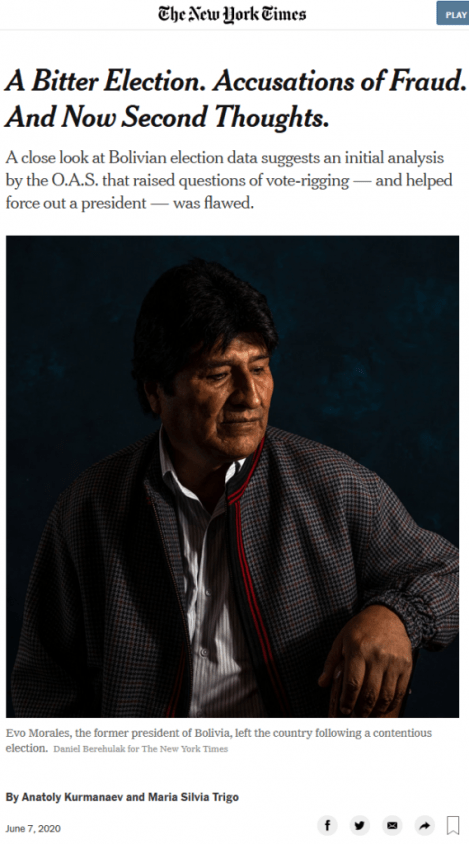
If the New York Times (6/7/20) has had second thoughts about its coverage of the 2019 Bolivian election and subsequent coup, it hasn’t shared them with its readers.
By Camila Escalante with Brian Mier | FAIR | July 8, 2020
The New York Times (6/7/20) declared that an Organization of American States (OAS) report alleging fraud in the 2019 Bolivian presidential elections—which was used as justification for a bloody, authoritarian coup d’etat in November 2019—was fundamentally flawed.
The Times reported the findings of a new study by independent researchers; the Times brags of contributing to it by sharing data it “obtained from Bolivian electoral authorities,” though this data has been publicly available since before the 2019 coup.
The article never uses the word “coup”—it says that President Evo Morales was “push[ed]…from power with military support”—but it does acknowledge that “seven months after Mr. Morales’s downfall, Bolivia has no elected government and no official election date”:
A staunchly right-wing caretaker government, led by Jeanine Añez… has not yet fulfilled its mandate to oversee swift new elections. The new government has persecuted the former president’s supporters, stifled dissent and worked to cement its hold on power.
“Thank God for the New York Times for letting us know,” must think at least some casual readers, who trust the paper’s regular criticism of rising authoritarianism within the US—perhaps adding, “Well, I guess it’s too late to do anything about Bolivia now.”
The fact is, the Times has been patting itself on the back for acknowledging authoritarianism in neofascist regimes that it helped normalize in Latin America for at least 50 years. The only surprise to readers who are aware of this ugly truth is that this time it took so long.
It only took the Times 15 days and the arrest of 20,000 leftists, for example, to counter nine articles supportive of the April 1, 1964, Brazilian military coup (Social Science Journal, 1/97) with a warning (4/16/64) that “Brazil now has an authoritarian military government. ” As was the case with Brazil in 1964, recognizing that Bolivia has now succumbed to authoritarianism may help the New York Times’ image with progressive readers, but it doesn’t do anything for the oppressed citizens of the countries involved.
While the coup was unfolding, and when Northern solidarity for Bolivia’s Movement for Socialism government (MAS in Spanish) might have helped avert disaster, the New York Times was whistling a different tune. The day after Morales’ re-election (10/21/19), it portrayed the paramilitary putschists who were carrying out violent threats against elected officials and their families as victims of repressive police actions perpetrated by the socialist government. “Opponents of Mr. Morales angrily charged ‘fraud, fraud!’” read the post-election article:
Heavily armed police officers were deployed to the streets, where they clashed with demonstrators on Monday night, according to television news reports.
One day after Morales was removed from power, the Times (11/11/19) engaged in victim-blaming, with a news analysis headlined ‘This Will Be Forever’: How the Ambitions of Evo Morales Contributed to His Fall.” The first Indigenous president in Latin American history was not being deposed illegally, after winning a fair election, by groups of armed paramilitary thugs, amid threats of murder and rape to his family members, the Times implied; rather, he was being brought down due to his own character faults as a Machiavellian back-stabber.
I arrived in Bolivia on November 13, 2019, shortly after Jeanine Añez’ unconstitutional swearing in as unelected, interim president, on a cartoonishly oversized Bible. I was there as a reporter for MintPress News and teleSUR, and two of the active sites I reported from were in the most militantly MAS-dense areas: In Sacaba, where the coup regime’s first massacre took place on November 15, and in El Alto, where the Senkata massacre took place on November 19.
The third, and most extensively covered, resistance to the coup was in the heart of the city of La Paz, where daily protests were staged. Beyond these major conflict areas, there were large mobilizations in Norte Potosí, the rural provinces of the department of La Paz, Zona Sud of Cochabamba, Yapacani and San Julian. The vast majorities within all rural areas across the country were also in deep resistance to the coup.
The November coup represented the ousting of a government deeply embedded in the country’s Indigenous campesino and worker movements, by internal colonial-imperialist actors, led in large part by Bolivia’s fascist and neoliberal opposition sectors, most notably Luis Fernando Camacho and Carlos Mesa, who received ample support from the US government and the far-right Bolsonaro administration of Brazil. The Indigenous and social movement bases resisting the coup were deeply distrusting of Bolivian media, which they immediately deemed as having played a key role in it.
Those same groups that were hostile towards major Bolivian news networks and journalists lined up to be heard by myself and those who accompanied me, once they recognized my teleSUR press credentials. One woman attending a cabildo (mass meeting) of the Fejuves (neighborhood organizations) of El Alto detailed how her workplace, Bolivia TV, had been attacked by right-wing mobs as the coup authorities got rid of those deemed sympathizers of the constitutional government, replacing them by force almost immediately.
Indigenous Bolivian communities were at the very forefront of the protests and resistance actions against the coup, namely the blocking of key highways and roads, as in the case of Norte Potosí, the blocking of the YPFB gas plant in Senkata, and 24-hour camps blocking the entry to the Chapare province. La Paz was militarized, making it impossible to get near Plaza Murillo, the site of the Presidential Palace and the Congress. I witnessed daily violent repression by security forces against those who gathered in protest near the perimeter of the Plaza, including unions and groups such as the Bartolina Sisa Confederation, a nationwide organization of Indigenous and campesina women, and the highly organized neighborhood associations of El Alto.
One might think this kind of grassroots, pro-democracy mobilization coordinated by working-class people against an authoritarian takeover would be the type of thing the New York Times would applaud. After all, it ran over 100 articles championing Hong Kong’s protesters in the last six months of 2019 alone.

Anatoly Kurmanaev, author of this New York Times piece (12/5/19) that ignored real-time critiques of the OAS’s complaints about the Bolivian election, was a co-author of the piece (6/7/20) acknowledging that some have “second thoughts” about the OAS attacks on Evo Morales.
As resistance grew on the streets of Bolivia, however, the New York Times only continued the rationalization of the unconstitutional, authoritarian taking of power, using the now-discredited OAS report to do so.
“Election Fraud Aided Evo Morales, International Panel Concludes,” read a December 5 article—one of several the paper ran discrediting the democratic electoral process. Like the others, it failed to challenge dubious claims by the right-wing coalition in charge of the OAS—which received $68 million, or 44% of its budget, from the Trump administration in 2017—that Evo Morales was elected via “lies, manipulation and forgery to ensure his victory.”
A newspaper that prides itself on showing the full picture could have cited the debunking of the OAS study conducted by the Center for Economic and Policy Research (CEPR), an organization with two Nobel Laureate economists on its board, whose co-director Mark Weisbrot has written over 20 op-ed pieces for the New York Times. Even before the coup, CEPR (11/8/19) published an analysis of the Bolivian vote that concluded, “Neither the OAS mission nor any other party has demonstrated that there were widespread or systematic irregularities in the elections of October 20, 2019.”
The fatal flaws in the report the OAS used to subvert a member government, long obvious, are now undeniable even to the New York Times. But the paper still hasn’t acknowledged, let alone apologized for, the credulous reporting that gave it a leading role in bringing down an elected president and the violence that followed.
Featured Video

Trita Parsi: Israel Set a Trap for Total War in the Region
or go to
Aletho News Archives – Video-Images
From the Archive
Zionism’s Violent Legacy
By Donald Neff | Washington Report On Middle East Affairs | January 1996
On January 4, 1948, Jewish terrorists drove a truck loaded with explosives into the center of the all Arab city of Jaffa and detonated it, killing 26 and wounding around 100 Palestinian men, women and children.[1] The attack was the work of the Irgun Zvai Leumi – the “National Military Organization,” also known by the Hebrew letters Etzel – the largest Jewish terrorist group in Palestine. The Irgun was headed by Revisionist Zionist Menachem Begin and had been killing and maiming Arabs, Britons and even Jews for the previous ten years in its efforts to establish a Jewish state.
This terror campaign meant that at the core of Revisionist Zionism there existed a philosophical embrace of violence. … continue
Blog Roll
 Aletho News
- Trita Parsi: Israel Set a Trap for Total War in the Region
- Trump’s Iran war is on an Israeli leash
- Saudi oil boss issues global supply warning
- Riyadh Says Its Oil System Is Intact. The Numbers Say Otherwise.
- Trump and Netanyahu Want to “Finish the Job” on Iran
- US ‘one-sided dictation’ not Iran’s beliefs makes rational talks impossible: Baghaei
- Iran’s Next Strike May Not Explode. It Could Shut You Down /Col Doug Macgregor
- Iran: US political targets legitimate if assassinations return
- Iraq shuts key border crossing with Iran under US pressure: Report
- Undersea Internet cables could be targeted in retaliation for attacks on Iran: IRGC deputy chief
- If Americans Knew
- The Israel Lobby’s Changing Fortunes
- AIPAC has become such a political liability that it’s shifting to a more “nimble” approach to buying politicians
- At least 160 Israeli settler attacks in 2 weeks
- Will Gaza’s Ancient Christian Community Disappear Forever?
- Israel’s vision of regional security rests on keeping Arab states weak
- Heidi Levine recounts how Palestinian youths helped save her in settler attack
- DAILY UPDATE: Latest essential news on Palestine, Israel, & region
- Trump’s Intensifying Sabotage of the ICC, for Israel’s Sake
- Israeli military detain US and UK volunteers in West Bank including Democratic NY politician Brad Lander
- Americans at National Conservatism Conference held in Israel this year criticize Israel
- No Tricks Zone
- E-Cars Reduce CO2 Emissions By Only 41% Compared To Internal Combustion Engine Vehicles
- Predictions Made By Renowned Climate Professor Over Past Decades Have Been Proven To Be Poor
- New Study Suggests Large Regions Of The Pacific Ocean Have Been Cooling For The Last 80 Years
- Germany’s Green Energy Debacle: High Energy Costs Force Kahla Porzellan to Close After 182 Years!
- New Study: 50 Years Of The Most Aggressive ‘Net Zero’ Policies Can Only Affect The Global Climate By 0.03°C
- US September “Heat” Was No Record…Many Records Set Decades Ago
- Latest European Green Energy Debacle; Portugal’s Largest Flagship Solar Park Insolvent!
- Green Energy Debacle: German Expert Professor Fritz Vahrenholt Warns Of Severe Economic And Social Consequences
- Two More Paleo Reconstructions Affirm Meters-Higher Sea Levels Across Ireland, Brazil 7000-6000 Years Ago
- New Study: Earth And Venus Surface Warmth Largely Explained By Convection And Lapse Rate, Not CO2 Or Radiation

