Fake News and Fires in the Amazon
Media outlets are supposed to be more reliable than your brother-in-law, but that seems less true every day.

By Donna Laframboise | Big Picture News | August 28, 2019
Politicians and government officials like to talk as though it’s possible to stamp out fake news. It isn’t.
Fake news is as old as humanity. After Aristotle incorrectly claimed women had fewer teeth than men, generations of highly educated people believed it.
Rajendra Pachauri was called “the UN’s top climate scientist” by the BBC – and a “Nobel laureate” by the New York Academy of Sciences magazine. Neither statement was true.
Pachauri’s doctorate wasn’t in climatology, but in industrial engineering and economics. And the fact that he accepted the 2007 Nobel Peace Prize on behalf of the UN organization he chaired doesn’t make him or any other person affiliated with that organization a Nobel laureate.
Published in 2008 and 2009, these inaccurate statements have never been corrected. In other words, we’re surrounded by fake news. And always will be. Humans are frequently mistaken. Organizations, as well as individuals, post things on the Internet before double-checking.
While media outlets are supposed to be more reliable than your brother-in-law, that seems less true every day. Over the past week, people have shared a CNN headline on Facebook that declares: “The Amazon rainforest is burning at a record rate” (see the screengrab from my own Facebook feed, at the top of this post).
If you click through to the CNN website, you’ll find a few extra words: “… research center says.” But the primary statement is misleading. Which means that millions have been alarmed unnecessarily – including a lovely, smart, young mother of my acquaintance.
Over at the website of National Geographic, a headline falsely declares: Brazil’s Amazon is burning at record rates – and deforestation is to blame. The second half of that assertion is vigorously disputed here.

On Twitter, the President of France used an image taken by a photographer who’s been dead for 16 years to represent the current situation. Let me just emphasize that point: the head of a G7 country is spreading fake news about events unfolding on another continent.

That doesn’t, for one minute, mean anyone should have the power to shut him down. Not Twitter, Facebook, the EU, the UN, or anyone in his own government.
Like it or not, we’re stuck with fake news. Our best defense is to read widely and maintain a high level of skepticism. On this question, here’s some counterbalance to the recent tsunami of alarmism:
Why Everything They Say About The Amazon, Including That It’s The ‘Lungs Of The World,’ Is Wrong
Amazon fires: how celebrities are spreading disinformation
Is Amazon Rainforest Burning At Record Rates? What Is The Way Forward?
Lies, Damn Lies, And Rainforest Fear-Mongering
Annual Amazon farmland burn sets records for international outrage
Amazon fires: What about Bolivia?
Stop Sharing Those Viral Photos of the Amazon Burning
The Three Most Viral Photos of the Amazon Fire Are Fake. Here Are Some Real Ones to Share.
What Satellite Imagery Tells Us About the Amazon Rain Forest Fires
The Greenland Connection
Irrussianality | August 22, 2019
US President Donald Trump has been rightly mocked in the past week for his alleged desire to buy Greenland from Denmark. What on earth put this crazy idea into Trump’s head, people rightly asked. Fortunately, we now have an answer, courtesy of The Guardian’s US columnist Richard Wolffe – Russia put him up to it!
I see that until recently Wolffe was ‘vice president and executive editor of MSNBC.com’, which explains a lot – MSNBC having been the no. 1 cheerleader in the Russiagate scandal in the US. The Trump-Russia story long since jumped the shark, but somehow it keeps finding extra sharks to leap over. Let’s take a look at what Wolffe has to say.
Greenland doesn’t just bubble into Trump’s mind randomly … But it is very much on Russia’s radar. Earlier this year, Russia revamped its arctic circle military base on tiny Kotelny Island, which sits close to the shipping routes that are opening up as the polar region warms catastrophically.
There are unknown quantities of oil, gas and rare earth minerals in the arctic, and the region’s powers – Denmark among them – can either green light a global free-for-all or restrain the usual human plunder of one of the last pristine frontiers on the planet. You can guess where Russia sits on this spectrum of environmental concerns in the middle of our climate crisis.
It is one of the sickest Trump jokes that his half-baked idea of buying Greenland should be seen as American machismo when it is yet another sign of Putin’s puppet American presidency at work.
‘Lazy journalism’ was the response of a distinguished British guest I showed this article to at breakfast today. It was very typical British understatement. There’s no argument here, no flow of logic from facts to conclusion, just an assertion entirely disconnected from everything which has gone before. Why Russia’s Arctic interests should prompt it to persuade Trump to try to buy Greenland isn’t explained. In reality, the last thing Russia would want, in an era of US-Russian tension, is an expanded American presence in an area of great and growing important to the Russian economy. The idea that Trump wanting to buy Greenland is proof that he’s a Russian ‘puppet’ is beyond bizarre.
By now, of course, it’s no surprise that the editors at outlets like The Guardian seem to have lost all sense of responsibility when it comes to the case of Trump-Russia, and are happy to publish any type of drivel. But Wolffe’s article makes the mind boggle at the lack of intellectual competence required to gain top executive positions at MSNBC. Perhaps the only explanation for it lies in the realm of pop psychology. For according to psychological research, debunking conspiracy theories doesn’t stop people believing in them; in fact, believers who are shown that their theories are wrong end up on average believing in them even more fervently. This article illustrates the point: the Trump-Russia connection has become an article of faith, a religious belief so absolutely true that all facts have to be bended to fit it, while all the evidence to the contrary serves only to reinforce the faith even further. Russiagate may be nonsense, but if this article is anything to go by, it has turned the brains of a large section of the political left into mulch.
‘Crime does pay’: CNN hires disgraced ex-FBI director Andrew McCabe
RT | August 23, 2019
What does one get for leaking to the media, lying to federal investigators about it, and allegedly participating in a plot to derail an American election? If you answered jail time, too bad. The correct answer is a job at CNN.
That is at least the case for Andrew McCabe, the former acting FBI director and one of the people deeply involved in the ‘Trump-Russia’ investigation before it was taken over by Special Counsel Robert Mueller. CNN announced on Friday it was hiring McCabe as a contributor.
Just a day earlier, however, the network was in full meltdown over former White House press secretary Sarah Sanders getting hired by Fox News, and her predecessor Sean Spicer appearing on Dancing With the Stars – arguing that both were liars who did not deserve gainful employment.
Yet they have no problem with McCabe, who was fired from the FBI in March 2018 – just days before he could claim a $60,000 annual federal pension – because an internal report found that he “made an unauthorized disclosure to the news media and lacked candor – including under oath – on multiple occasions.”
“Lacking candor” is the federal government euphemism for lying.
McCabe going to CNN is “truly a match made in FakeNews heaven,” declared Donald Trump Jr., the president’s son, adding that CNN has long stopped being a news organization. “They’re now a fully integrated anti-Trump propaganda network and they don’t even try hiding it anymore.”
A number of Republican lawmakers, including Senators John Cornyn (Texas), Josh Hawley (Missouri), and Representatives Lee Zeldin (New York) and Mark Meadows (North Carolina) also weighed in on CNN’s employment choice and journalistic standards.
“I guess crime does pay,” added Matt Wolking, a spokesman for the Trump2020 campaign.
Meanwhile, left-wing journalist Aaron Mate offered a reminder that the gullible #Resistance raised over half a million dollars on GoFundMe for McCabe after he was fired.
McCabe joins nine other former national security officials already on CNN’s payroll, including ex-top spy James Clapper. MSNBC has hired five more, including former CIA chief John Brennan. The one thing they all have in common is outspoken opposition to President Trump.
As James Comey’s right hand at the Bureau, McCabe was intimately involved with investigating both Hillary Clinton’s private email server and the so-called ‘Trump-Russia collusion’ that later spawned a special counsel probe – as well as spying on the Trump campaign under questionable pretexts. His name was brought up on several occasions in text messages between agent Peter Strzok and attorney Lisa Page, including the exchange about an “insurance policy” in case Trump got elected.
The president and his supporters have long argued that this was the real scandal about the 2016 election, calling it ‘Spygate,’ and demanding a reckoning. However, no charges have been leveled – yet – against any of the officials involved, including McCabe and his boss Comey.
Yet it is McCabe who is demanding a reckoning in court, arguing that his firing was politically motivated and part of Trump’s “ongoing war on the FBI and the efforts of the Special Counsel” to investigate his ties with Russia. That Robert Mueller delivered his report months ago and found nothing doesn’t seem to faze him in the slightest.
In other words, he’ll fit right in at CNN.
This is what gloating looks like… NY Times distorts war-torn Syria
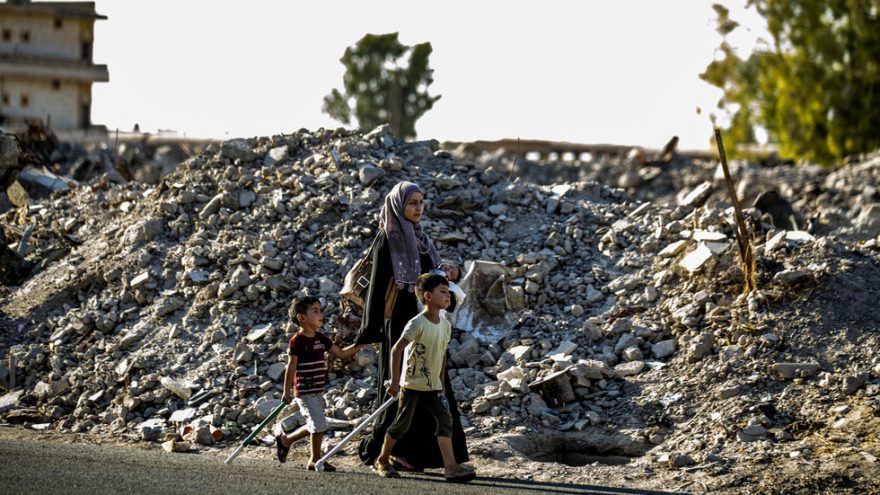
A woman and two children walk past debris in the northern Syrian city of Raqa, the former Syrian capital of the Islamic State group, on August 21, 2019. © AFP / Delil SOULEIMAN
By Finian Cunningham | RT | August 22, 2019
A supposed survey of war-torn Syria by America’s so-called “newspaper of record” was not merely shoddy journalism; it was a cynical attempt to rewrite the history of the eight-year war.
The meandering report of more than 2,700 words was headlined: “What ‘Victory’ Looks Like: A Journey Through Shattered Syria.” It would have been more accurate to have used the title, “What Gloating Looks Like.”
Even the sly way the word ‘victory’ is put in quotation marks indicates, from the outset, the insidious purpose of the article. To pour scorn on how Syria and its people have in actual fact defeated a foreign-sponsored criminal war for regime change. The regime-change plot goes back to at least 2005 as this old CNN interview clumsily admits.
With mawkish words, the New York Times reporters effect to lament the rubble and grief among the Syrian population. But all the while, the implication conveyed is that President Bashar Assad “presided over the destruction.”
Bashar al-Assad’s image is everywhere, making it impossible to forget who presided over the destruction and who will preside over what comes next. Banners reading “Assad Forever” hang over many Syrian roads. https://t.co/0DfANqUmSGpic.twitter.com/hYqnOi1Frz
— The New York Times (@nytimes) August 20, 2019
It would be easy to dismiss the article for the ropey, agenda-led “journalism” that it is. But since journalism is reputed to be the “first draft” of writing history, it is therefore important that the distortion presented by the NY Times is repudiated for the outright falsification that it is.
We can’t go into every erroneous, obnoxious detail. And readers would be advised to go to alternative reports by independent journalists like Eva Bartlett and Vanessa Beeley for accurate accounts of how Syrians are dealing with the aftermath of war and what the people actually think about who caused their war-torn fate.
But suffice to say that three salient distortions or omissions can be cited to condemn the NY Times as a purveyor of propaganda. First is the staggering assertion that Syria’s lunar landscape of destruction was brought about by warplanes and artillery deployed by the state’s armed forces.
Secondly, there is not a single mention of US and other NATO states carrying out – and continuing to carry out – air strikes on Syrian infrastructure for the past five years, which have resulted in thousands of civilian deaths. Probably the most infamous episode was the American obliteration of the city of Raqqa two years ago during which an estimated 1,600 people, including women and children, were buried under rubble from indiscriminate bombing.
The NY Times would have us believe that Assad callously and gratuitously inflicted a pyrrhic victory on his people, instead of telling readers that the country was targeted covertly for regime change by the US, its NATO allies, and regional partners.
A third astounding distortion is the apparent absence of terror groups in Syria’s war. Not once is it mentioned that the militants who served as proxies for their foreign sponsors were mostly composed of Al Qaeda-linked terrorists recruited for their barbaric dirty work from all over the world and infiltrated into Syria by NATO operatives. Former urban areas like eastern Aleppo and Douma held siege under a reign of terror are referred to as “rebel-held” districts. The liberation of those hell-holes by Syrian government forces, supported by Russian airpower, is not reported as “liberation” but as something sinister, in complete disregard for how the Syrian people relate the events to the smarmy NY Times journalists. The latter presume to know better about what really happened, and consequently routinely infer that “regime minders” accompanying them are coercing the civilian interviewees to mouth pro-Assad propaganda.
Imagine the feat of mental gymnastics. In a supposed in-depth survey of war-ravaged Syria, there is not one reference to the army of jihadists belonging to Islamic State (IS, formerly ISIS/ISIL), Nusra Front, Jaish Al Islam, and dozens of other alphabet soup names used to conceal the fact that all were terrorist proxies weaponized by the US and NATO military intelligence.
What we have instead is the NY Times affecting a kind of grief and condescension towards the Syrian people who have been, it is claimed, plunged into misery by their government and its Russian ally. It is inconceivable, according to this narrative, that the Syrian people and their armed forces may have perhaps won the most dramatic, heroic battle in modern times against a behemoth of US-backed enemies whose terror tactics plumbed the depths of depravity.
Rather amusingly, if it weren’t so sickening, was a separate report by the NY Times only the day before which proclaimed that, “ISIS [Islamic State] Is Regaining Strength in Iraq and Syria”.
So, in the previous screed masquerading as a detailed survey of Syria, there is no mention of terror groups. Yet, in the second report the reader is told that the “Islamic State is on the rise again”. How is such a colossal contradiction entertained by the editors?
That other report kicks off with this laughable claim: “Five months after American-backed forces ousted the Islamic State from its last [sic] shard of territory in Syria, the terrorist group is gathering new strength, conducting guerrilla attacks across Iraq and Syria, retooling its financial networks and targeting new recruits at an allied-run tent camp, American and Iraqi military and intelligence officers said.”
Yes, that’s right, we are being told that US forces vanquished Syria’s terrorist tormentors from their “last shard of territory”. But now they are resurgent and “well-equipped” numbering about 18,000 fighters. We might indeed wonder how this change of good fortune happened for the militants. Could it be that powerful foreign sponsors are aiding and abetting once again? The NY Times never hints at such an obvious possibility.
The point of the article seems to be an attempt to undermine President Trump’s drawdown of US troops from Syria. The NY Times and its military intelligence sources are arguing for more American forces to be deployed in Syria and Iraq. “The resurgence [of terrorists] poses a threat to American interests and allies, as the Trump administration draws down American troops in Syria,” the report editorializes.
While the NY Times is cynically exploiting Syria for its own agenda-driven story-telling, the real task of defeating foreign-backed terror groups was continuing this week in Idlib province, northwestern Syria. The Syrian Arab Army captured the town of Khan Sheikhoun from militants affiliated to Hayat Tahrir al Sham (formerly Nusra Front, formerly Al Qaeda.) That is in spite of credible claims of armed support from NATO member Turkey whose military incursion into Syrian territory was pushed back. The US is also allegedly implicated in covertly arming the last redoubt of terror groups in Idlib.
Eight years of hideous war in Syria are coming to an end as Syrian state forces push on to claim every last inch of the nation’s territory from foreign intruders. The plain truth is that the Syrian people won a formidable victory against implacable malign powers, led by the US.
The systematic distortion and lies told by Western corporate-controlled media about Syria continues, even when victory against Washington’s infernal imperialist crimes is staring them in the face.
Is ‘hate-crime’ a media-creation?
By Renee Parsons | OffGuardian | August 22, 2019
As part of Remarks by President Trump on Mass Shootings in Texas and Ohio on August 5th, President Donald Trump announced that.
Today, I am also directing the Department of Justice to propose legislation ensuring that those who commit hate crimes and mass murders face the death penalty, and that this capital punishment be delivered quickly, decisively, and without years of needless delay
Normally it might have been expected that the mainstream media would run with Trump’s support of the death-penalty-for-hate-crimes as proof positive that the man is off his rocker. Instead, the statement garnered barely a flicker of public notice. Did anyone in authority bother to confirm that the shootings were indeed motivated by ‘hate?’
As the mainstream media consistently rush to judgment, speculation too often becomes fact before all the evidence is considered (ie Russiagate) as the MSM is relied on to provide factual and critical background information.
And yet since 65% of the American public believe that the MSM is peddling fake news begs the question of why should detailed reporting on these tragic events be left to a discredited media establishment or that their information on these recent shootings be considered truthful?
Why should the American public trust the MSM for what may have already been determined to be a ‘hate’ crime without providing evidence of the hate – as the Divide and Rule Game continues undeterred sowing division and conflict among the American people.
It remains unclear exactly why either tragedy is being specifically labeled a “hate” crime instead of felony murder as if there is a larger agenda to establish ‘hate’ as a bona fide.
Obviously, such barbaric mass killings are not normal behavior as the rationale for such conduct must stem from some deep emotional depravity just as the epidemic of suicides of young white males who have lost hope in American society makes no more sense.
There is an endemic crisis throughout the country and the political class are responsible. Decades after federal government elimination of grants for community mental health programs, ‘hate’ is the favorite determinant factor as the world’s most violent nation creates a generation of emotionally or mentally unstable young men, many of whom may be on mind-numbing psychiatric drugs.
Since the MSM has failed to inform the American public of advanced mind control practices; perhaps the MSM itself and the young shooters are part of widespread experiment using MK Ultra or other state-of-the-art brain manipulation techniques. How would the American public ever know which might be true?
The 21 year old El Paso shooter was immediately identified as a right wing Trumper acting on behalf of the President’s “hate” rhetoric and that he had posted an anti-immigration racist tract entitled An Inconvenient Truth – all of which turned out to be something less than the truth.
Decrying mass immigration as an environmental plea for population control sounds more like something John Muir might have written rather than a hate-filled racist diatribe justifying the slaughter.
Perusing the alleged politically charged manifesto included such statements:
Our lifestyle is destroying the environment of our country… If we can get rid of enough people, then our way of life can become more sustainable.
There is, however, a problematic psychiatrist father of uncertain character in the background as the shooter drove 650 miles from his home to El Paso before committing the crime and surrendering to authorities.
On the other hand, the Dayton shooter also defies the usual partisan identity and has been acknowledged as a 24-year old member of the Democratic Socialist Party, a Bernie and Elizabeth Warren supporter and was dressed and masked as an Antifa member at the time of the shooting. His weapons and ammo magazines appear to have been legally acquired, he had a high school history as a bully who kept a hit list and made violent threats.
Meanwhile, the Democrats who consider themselves the responsible party on gun control, failed to restore the assault gun ban when they had the votes in 2010 as they prefer fanning the flames of more ‘hate’ by blaming Trump’s loose lips even though the once-revered ACLU does not oppose the Second Amendment.
One wonders that if the El Paso shooter can be tagged with being influenced by Trump rhetoric, did the Dayton shooter receive his inspiration from Antifa or perhaps Elizabeth Warren? It is too much to expect any rational media voice to inquire – all of which brings us back to the President’s Remarks endorsing the death penalty.
How exactly did this ‘hate’ language make its way into Trump’s remarks as “hate” has become a preoccupation of American society and the Administration as its Special Envoy to Monitor and Combat Anti-Semitism’s very life purpose is to root out hate – not hate of all kinds but only that of the Jewish variety.
Historically, the American criminal justice system, flawed as it is, requires any jury in a criminal case to consider the Defendant’s level of conscious intent to commit a criminal act as well as the illegality of the act without specificity to the psychological issues of that intent.
Originally, hate crime laws were expected to offer special protection based on an individuals’ sexual orientation, gender, religion, disability or racial identity as perceived by the perpetrator.
In a manner that does not occur in normal criminal proceedings, defining the “hate” component of a crime requires a distinct determination that the defendant’s actions were solely motivated by thoughts of ‘hate.’
In a worse case scenario, is Trump suggesting that the death penalty may be applied to what is determined to be a hate crime even if that crime has not resulted in a death?
The reality is that hate crimes may be difficult to distinguish from a run-of-the-mill felony murder, thereby increasing the hate crime penalty makes little sense since first degree murder is already subject to the death penalty. Therefore, it appears that a redundant death penalty for a crime that would already call for the death penalty is little more than…overkill.
In other words, hate crime prosecution necessarily relies on criminalizing thoughts as the NSA claims it has already developed remote neural monitoring revealing one’s most hidden private thoughts or an iphone may be bugged with implants to reduce impulse control.
Many legal scholars would respond that the Equal Protection Clause of the 14th Amendment and the Due Process Clause in the Fifth Amendment already provides all American citizens with the guaranteed right to equal protection under the law (ie Brown v. Board of Education and Roe v. Wade) and therefore such hate laws are unnecessary and may be unconstitutional.
Since the Constitution already protects the rights of aggrieved parties, why would Congress initiate an entirely new category of duplicative Hate Crime laws unless they needed the extra legislative accomplishment to justify their existence or to satisfy prominent politically-connected constituencies or to create a nefarious political agenda.
Renee Parsons has been a member of the ACLU’s Florida State Board of Directors and president of the ACLU Treasure Coast Chapter. She has been an elected public official in Colorado, an environmental lobbyist with Friends of the Earth and staff member of the US House of Representatives in Washington DC. She can be found on Twitter.
BBC Admits ‘Syrian’ Airstrike in Recent Story on Scarred Boy Turned Out to Be Turkish
Sputnik – August 22, 2019
The BBC has corrected its August 19 news story about a Syrian boy who was severely wounded in a 2018 airstrike, which the broadcasting company first said was carried out by Syrian forces but later admitted could be blamed on Turkey.
Some Twitter users posted screenshots showing that the BBC had actually redacted its text several times.
The headline of the short story, featuring a video about the life of a four-year-old Syrian boy whose face was scarred in the airstrike, originally referred to the incident as “a Syrian airstrike.” The mention of Syria was then deleted with an indication that it was “not clear who was responsible for the attack.” Now the headline refers to it as just “an airstrike,” and the article clarifies that “evidence indicates that Turkey carried out the airstrike.”
Last January, Turkish forces launched airstrikes on Kurdish fighters in Afrin, a city located in northern Syria, as part of a military operation dubbed Olive Branch. The boy, named Jouma, and his family were fleeing their home in Syria when an airstrike hit the bus they were on.
Jenan Moussa, a reporter for Arabic Al Aan TV, wrote on Twitter that Tolin Hassan, a close friend of the wounded boy’s family, told her that Jouma’s relatives “mentioned over and over to BBC-journo that the car was hit by a Turkish strike after escaping Afrin.”
Getting Real With the US Foreign Policy Establishment Realists
By Michael Averko | Strategic Culture Foundation | August 21, 2019
On Russia-related matters, the more sane among us can perhaps be forgiven for becoming sedated by the kind of absurdities regularly spewed by some high profile individuals. The realist wing of the US foreign policy establishment has at times held back in rebuking this reality. We all have our biases, with the ideal to nevertheless be reasonably fair and balanced – a point which leads to a detailed critical overview of some trends among US foreign policy establishment realists.
The realist leaning National Interest, exhibits a different choice of words, relative to actions taken by the Russian and US governments. At that venue, George Beebe’s August 12 piece “How Trump Can Avoid War With Russia,” states: “Reducing Russian cyber aggression will require agreeing on rules to govern US as well as Russian involvement in the affairs of other states. Punishing Moscow’s transgressions must be complemented by rewards for good behavior, or we will simply reinforce perverse incentives for Russia to defy American policies, deepen security cooperation with China, and subvert NATO and the EU.”
In comparison, Beebe is tame in his prose dealing with post-Soviet US actions (in Yugoslavia, Iraq, Libya and Syria), which within reason can be considered as unnecessarily aggressive and deserving of condemnation. The aforementioned “Russian cyber aggression“, is something continuously brought up with a lack of conclusive evidence. Beebe’s use of “punishing” versus “rewards” towards Russia is along the lines of treating a child.
Dmitri Simes’ August 8 National Interest article “Delusions About Russia,” begins with “Russia is a dangerous adversary.” Neocons and neolibs will find little, if any disagreement with his opening comment. In conjunction with that thought, the second sentence in Simes’ piece is somewhat contradictory in saying “But treating it as an outright enemy could result in a self-fulfilling prophecy, triggering mortal threats to its neighbors which otherwise might not be in the cards.”
Enemy (whether outright or otherwise) is a synonym of adversary. In the post-Soviet era, Russia and America haven’t fought each other. With that in mind, the use of enemy and adversary is in line with tabloid sensationalist inaccuracies, as opposed to a realist seeking a more balanced overview. (The National Interest has had its tabloid moments, like Michael Peck’s April 3, 2016 article “How Poland Saved the World From Russia,” which I took some pleasure in answering.)
Putting aside the attempt to accommodate neolib and neocon biases, here’s an alternative to Simes’ opening salvo: “Russia could be a dangerous adversary. This can unnecessarily occur by incessantly disregarding legitimate Russian concerns.” Thereafter, a litany of fact based examples can be provided.
Categorizing Russia as a “formidable geopolitical rival” to America (and vice versa) arguably serves as a better characterization than “dangerous adversary”. In line with a pragmatic approach, this suggestion is in sync with the foreign policy realist, who second guesses the extent to which these two countries should be at odds with each other.
From a non-establishment realist perspective seeking improved US-Russian ties, the rest of Simes’ piece is for the most part agreeable. Not too long ago, the US based mass media journalist Natasha Bertrand (who the Johnson’s Russia List promoted blogger “Yalensis” has called a “whore”) suggested in so many words that Simes might be, or is, a Kremlin flack. It’s that kind of mass media portrayal which might compel Simes to express himself in the beginning of his article at issue. (Bertrand has ties to MSNBC, Politico and The Atlantic.)
Regardless of whether that’s the case, there’s a basis for the US foreign policy establishment to broaden itself with other sources. BTW, Simes has been at the forefront in having the likes of the Atlantic Council’s John Herbst and former Obama administration official Charles Kupchan, appear on Russian national television, where he co-hosts a show on Channel 1. Comparatively speaking, the major US TV news networks don’t (in overall terms) do a better job in getting diverse views on issues concerning US-Russian relations.
This very point leads to the matter of projection. A US mass media elite saying that Russian media is restricted comes to mind. Projecting some negative US behavior to Russia relates to the suspect claim that the Russian government is looking to promote racial division in the US. That demonic image of the Kremlin was spun by NBC’s Richard Engel this past May. A couple of months later on NBC, US Democratic Party presidential candidate Kamala Harris, flippantly presented this claim as fact, minus any conclusive proof.
Upon further review, Engel’s “proof” includes a subtle acknowledgement of lacking conclusive evidence – an underhanded way of covering his butt if the claim gets completely demolished. Russia is by no means a monolithic country. As is true with many, if not most other nations, individual Russians can pursue agendas on their own, without the approval of the Russian government. The US comedian Dave Chappelle aptly noted that Russia isn’t responsible for bigoted instances in the US. In Russia, the US and elsewhere, there’ve been features on intolerance in the US, with some of that coverage being inaccurate.
Regarding a foreign government seeking to sow ethnic discord in another country, consider the comments of the US State Department’s George Kent at a one-sided Capitol Hill discussion on Crimea, hosted this past March by the Atlantic Council, US Institute of Peace and Ukrainian Embassy. At about the 45 minute mark of this taped event, Kent pointedly said that “Crimea is Ukrainian” in the Ukrainian and Crimean Tatar languages – never minding the majority ethnic Russian population in Crimea and the fact that Russian is the most preferred language there. In addition, Kent made no mention that the majority of Crimea’s ethnic Ukrainian population support Crimea’s reunification with Russia.
Kent’s suggestive advocacy to pit non-Russians in Crimea opposed to Russia/Russians was propagandistically presented by Nick Schifrin in an Al Jazeera segment around the time of Crimea’s reunification with Russia in 2014 – something I had previously noted. Upon being reunited with Russia, Crimea has been spared the level of nationalist violence that has existed in some other parts of the former Ukrainian SSR. Within Crimea, there’s no noticeable call to leave Russia and rejoin Ukraine.
Over the years, Doug Bandow has expressed views which generally put him in the realist wing of the US foreign policy establishment. His comments on Crimea further highlight some of the limits within US foreign policy establishment realist circles. Bandow’s August 30, 2018 National Interest article and August 1, 2019 American Conservative piece, advocates an internationally supervised referendum in Crimea.
It’s crystal clear that a well over 2/3 majority in Crimea support their area being reunited with Russia. It’s a high point of hypocrisy to dwell on Crimea having another referendum, while not advocating a referendum for Kosovo. Such an inconsistency jives with the anti-Russian biases regularly presented in US mass media without much of a rebuttal.
On the subject of Russia and Ukraine, I’m reminded of a September 5, 2014 PBS NewsHour segment, where noted foreign policy realist John Mearsheimer said: “The Russians have made it very clear that they’re not going to tolerate a situation where Ukraine forms an alliance with NATO, the principle reason that Russia is now in Ukraine and trying to wreck Ukraine.
And let’s be clear here. Why Russia is trying to wreck Ukraine, is because Russia doesn’t want Ukraine to become part of the West. It doesn’t want it to be integrated into NATO or the EU. And if we follow the prescriptions that Bill and I know Mike favors as well, what we are going to end up doing is further antagonizing Putin. He is going to play more hardball. And the end result is that Ukraine is going to be wrecked as a country, and we’re going to have terrible relations between Russia and the West, which is not in Russia’s interest and not in our interest.”
At a University of Chicago event, Mearsheimer also singles out Russia as seeking to “wreck” Ukraine. He doesn’t use that word to characterize Western actions. Hence, his usage comes across as disproportionate and puzzling. (Offhand, I don’t recall Mearsheimer using a word like “wreck” to describe US actions in Yugoslavia, Iraq and Libya.) When compared to Russia, Mearsheimer has said that he finds more fault with the Western stances taken on Ukraine.
All of the following highlighted points have been agreeably acknowledged by Mearsheimer:
– A good deal of Ukraine’s problems pertain to some internal dynamics in Ukraine, which don’t specifically involve Russia or the West.
– The leading Western governments took a casual approach to the overthrow of Ukraine’s democratically elected President Viktor Yanukovych, shortly after he signed an internationally brokered power sharing arrangement with his main opponents.
– Following Yanukovych’s overthrow, there were a series of increased anti-Russian acts in Ukraine.
– Russia (prior to Yanukovych being overthrown) was if anything more open than the leading Western nations to a jointly negotiated Russian-Ukrainian and Western agreement on how Ukraine’s economy should develop.
– Forget about Russia for a moment. Like it or not, there’re pro-Russian elements in Ukraine who’ve opposed some key aspects of the Euromaidan. The overwhelming majority of the Donbass situated rebels are from the territory of the former Ukrainian SSR. For its part, the Russian government can’t be seen as being too oblivious to the concerns of Russian speaking pro-Russians just outside Russia’s border.
I’ll add that it’s ultimately not in Russia’s interest to have on its border, a relatively large country like Ukraine, with considerable socioeconomic problems. Such a scenario can lead to a negative spillover effect. On the other hand, there’re anti-Russian elements who (whether they admit to it) seek to make propaganda points out of increased tensions with Russia. A good number of these folks reside safely beyond Russia and Ukraine.
NPR Mocks Cancer Survivor in Drumbeat of Syria Propaganda

Asma al-Assad, First Lady of Syria (from released Syrian Presidency Facebook page)
By Rick Sterling | Dissident Voice | August 20, 2019
It may be a new low in propaganda. National Public Radio (NPR) used the news that Syrian First Lady Asma al-Assad had overcome breast cancer to mock her and continue the information war against Syria. They interviewed a Human Rights Watch staffer named Lama Fakih who is an American from Michigan now based in Beirut.
Do you believe Ms. Fakih in Beirut or do you believe people who live in Syria who say we are being lied to? Lilly Martin is such a person. Although she is American from Fresno California, Lilly has lived in Syria for nearly 25 years. She is married to a Syrian and has two Syrian sons. Dr. Nabil Antaki is another such person. He is a medical doctor in Aleppo, fluent in English and French as well as his native Arabic.
While NPR snorts about Asma al-Assad “sporting a chic blonde pixie cut”, Lilly Martin points out that she was recently bald while fighting for her life.
While Ms. Fakir in Beirut says that there is “quite a lot of anger” because Asma al-Assad has conquered cancer, Dr. Antaki says that Syrians are happy at the news. Asma al-Assad is First Lady, mother to three children, and known for her compassion. Lilly Martin says that even while she battled cancer Mrs. al-Assad continued her charitable work.
While Ms. Fakih says that the “Assad government has been systematically targeting medical facilities and medical personnel”, Dr. Antaki, who has remained in Aleppo throughought the conflict, says this is not true. While there are many western accusations that the Syrian government attacks hospitals, the evidence is remarkably thin. One of the most highly publicized cases was regarding “Al Quds Hospital” in east Aleppo. In April 2016 there was a media blitz about this hospital having been destroyed by the Syrian Army. Following the departure of the “rebels”, it was discovered that “Al Quds Hospital” was an unmarked portion of an apartment building, that it had NOT been bombed and was the LEAST damaged building in the area. It was determined that the nearby Nusra (Al Qaeda) headquarters and ammunition depot was the Syrian army target. Accusations that “Al Quds Hospital” was bombed were false. It was a media stunt.
Ms. Fakih says that “Syrians have not been able to benefit from medical care in Syria since the beginning of the uprising in 2012”. Lilly Martin simply says “This is factually untrue. The Syrian system of national hospitals, free services to the public, are in every area of Syria and have run continuously throughout the war.” Dr. Antaki is an example; he is one of THOUSANDS of doctors working at HUNDREDS of hospitals throughout Syria. But you would never know it from NPR or Ms. Fakih.
It is true that there have been disruption and damage to many hospitals, as demonstrated in this jihadi assault on Al Kindi Hospital. These are the “rebels” supported by Ms. Fakih and Human Rights Watch. They effectively supported them in east Aleppo until they were expelled from the city. Now Ms. Fakih and HRW are supporting the “rebels” in their last redoubt in Idlib. There are countless videos demonstrating the cruelty and fanaticism of the “rebels”. For example, the aftermath of the above assault on Kindi Hospital and the execution of the Syrian soldiers who defended the hospital. Those who are cheerleading for the “rebels” and trying to prevent the Syrians reclaiming Idlib should look at the execution video to see what they are supporting.
The West has provided weapons and other support to the “rebels”. In parallel, there has been a campaign to whitewash the “rebels” and demonize the Syrian government. On top of this, the USA has imposed crushing sanctions on Syria which make it difficult or impossible to get critical medicines and replacement parts for western medical equipment. Dr. Antaki says it took him 1.5 years to obtain a replacement part for a Japanese medical instrument. I had my own experience with the draconian and inhumane sanctions. It took one year and endless hassle to send hearing aid batteries to help a deaf child in Syria.
This is one among hundreds of Syria “regime change” propaganda pieces broadcast on NPR. Behind a facade of authority and objectivity, there is bias and misinformation along with crocodile tears. As Lilly Martin says, “While the Syrian government medical system has tried to meet all the needs of Syrian civilians during 8 years of armed conflict, still there are numerous cases where the needs were not met and Syrians have suffered, and that blame must be shouldered by every person who held a gun against Syria and their foreign supporters who have succeeded in bringing the Syrian people into the depths of destruction and despair.”
As to Asma al-Assad and her integrity, it is best to listen and judge for yourself. At about 5:30 of the interview she speaks of the families of 100 thousand Syrian martyrs who died defending their country. “On a personal level, I am humbled by their determination, by their resilience, and by their love of Syria. They are my biggest source of strength and hope for the future.”
The sneers, misinformation, unverified accusations and de facto defense of Nusra/Al Qaeda by NPR and Lama Fakih stand in stark contrast.
Rick Sterling is an investigative journalist who grew up in Canada but currently lives in the San Francisco Bay Area of California. He can be reached at rsterling1@gmail.com.
Sarin in Syria: chemistry, and cui bono?
By Philip Roddis – steel city scribblings – August 17, 2019
The exchange below took place a few days ago, below the line of an OffGuardian piece on the corruption of the UN’s Organisation for the Prohibition of Chemical Weapons (OPCW) as shown in its handling of last year’s Douma incident.
Louis Proyect is one of many on the marxist left I think dead wrong on Syria – see my post from last year on Workers’ Power. He professes bafflement that marxists could defend evil Assad.
Me, I’m baffled that any marxist could buy, on such negligible evidential basis, the demonising of a third world leader who stands in the way of imperialist powers with multiple motives (oil pipeline, privatisation, Golan theft, hurting Iran and Russia) for crushing Ba’athism – and with a record as long as your arm of lying at every turn as to the why of it.
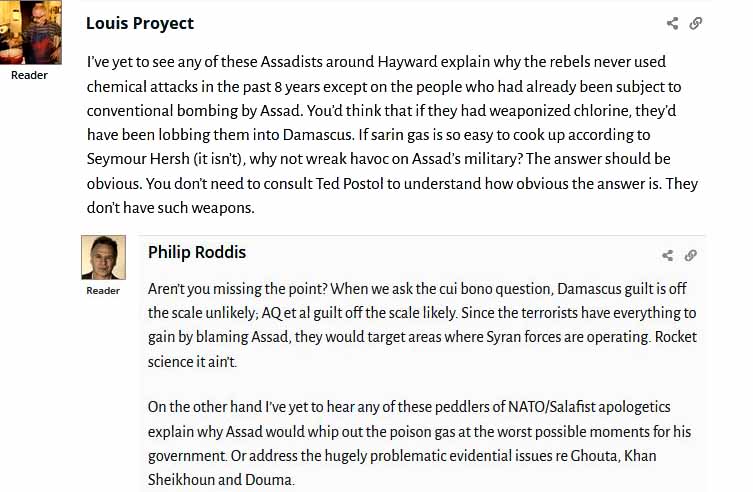
I’m even more baffled that anyone could take seriously a man who describes Vanessa Beeley – one of the most high profile reporters to challenge official NewSpeak on Assad – as “too ugly to fuck”.
Classy.
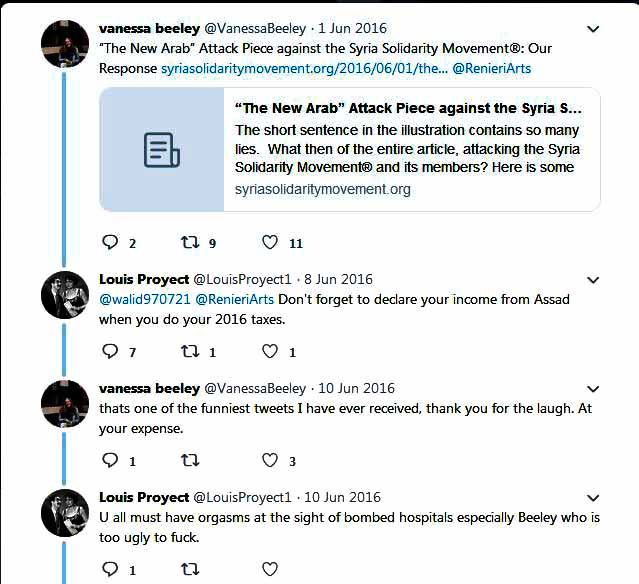
Moving on, Proyect claims – I’ve heard the Guardian’s George Monbiot do the same – that sarin is hard to manufacture; certainly beyond the capacity of Islamist groups working to bring down Assad. Since neither Proyect not Monbiot are experts, I’ll turn to those who are.
Let none accuse me of cherry picking. This piece, from Wired two years ago, is vehemently of the view that Assad does have sarin, and does use it.
[Sarin] is not especially hard to produce, in terms of both resources and expertise. “A competent chemist could make it, and possibly very quickly, in a matter of days,” says John Gilbert, a senior science fellow at the Center for Arms Control and Non-Proliferation, who spent much of his Air Force career assessing countries’ WMD capabilities. Producing sarin doesn’t require any kind of massive facility; a roughly 200 square foot room would do.
Author Brian Barrett, eager to make the case that Damascus could have rebuilt sarin stockpiles after the OPCW oversaw their destruction in 2014, inadvertently blows Proyect’s and Monbiot’s argument clean out of the water!
We should also note the Tokyo subway attack of March 20, 1995. Perps? Aum Shinrikyo, a bunch of doomsday wingnuts originating as a yoga and meditation group devoted to a mishmash of deities with Hinduism’s Shiva – the destroyer – in overall charge and channelling through head wacko Shoko Asahara. Says wiki:
Tsuchiya [a member] had established a small laboratory in Kamikuishiki in 1992. After initial research (at Tsukuba University, where he had studied chemistry) he suggested to Hideo Murai – a senior Aum advisor who had tasked him with researching chemical weapons, out of fear the cult would soon be attacked with them – that the most cost-effective substance to synthesise would be sarin.
He was ordered to produce a small amount – within a month, the necessary equipment had been ordered and installed, and 10-20g of sarin produced via synthetic procedures derived from the five-step DHMP process as originally described by IG Farben in 1938, and as used by the Allies after World War II.
Murai then ordered Tsuchiya to produce 70 tons. When Tsuchiya protested that this was not feasible in a research laboratory, a chemical plant was ordered to be built alongside the biological production facility in the Fujigamine district of Kamikuishiki, to be labelled Satyan-7 (‘Truth’). The equipment and substantial chemicals were purchased using shell companies under Hasegawa Chemical, already owned by Aum. At the same time, in 1993, cult members travelled to Australia, bringing generators, tools, protective equipment (including gas masks and respirators), and chemicals to make sarin.
Are we seriously to suppose that ‘moderate Islamists’ operating in Syria with barely hidden aid from Israel, Saudi Arabia, Turkey and – not least through the likes of White Helmets – the West are less resourceful than this bunch of millennial crazies?
It amazes me, perhaps because I still deem them deluded but sincere, that so many fail to see that on Syria, and much besides, we are being lied to on a monumental scale and will continue to be lied to until we wake up and demand the truth.
Scribbler for some sixty years, and for fifteen a photographer too, Philip Roddis began blogging in the early noughties by inflicting film reviews on an unsuspecting public. Soon he was doing the same with illustrated writings on wanderings in Asia and Africa. He writes “to help me think, and because I like to be read”, and finds photography’s problem solving aspects “a break from those of writing, as well as an aid to writing and to reflective travel”.
Guardian Attacks Epstein “Conspiracy Theories”
The mainstream narrative is shaping up – a story of suicide, neglect and tragic victims
By Kit Knightly | OffGuardian | August 14, 2019
In two different opinion pieces The Guardian has made its position on the alleged death of Jeffrey Epstein clear – he “probably” committed suicide.
The first, titled Epstein conspiracy theories are farfetched – but can you blame people?, takes the position that although “conspiracy theories” about Epstein’s apparent suicide are “understandable”, there’s no evidence to support them.
Rather, the author endorses the slowly coalescing official narrative. Namely that of complete, systemic incompetence:
The official explanation for Epstein’s death comes down to rank incompetence. And it’s probably true.
A short-sighted attitude to take, which totally ignores a cardinal rule when dealing with state agencies: They will only admit to incompetence if the truth is worse.
The author also attempts to undermine the “conspiracy theories” by pointing out that Epstein was a potential threat to important figures on both sides of the political divide:
Online, conspiracy theories now abound. Observers suggest Epstein was killed by one of the men who may have been implicated in his crimes – maybe Bill Clinton, according to the fringe right, or maybe Donald Trump, according to the fringe left.
An argument rather akin to saying “he can’t possibly have been murdered, because there were too many people who wanted him dead. There are SO MANY plausible suspects, that the only reasonable explanation is that…none of them did it.”
(Also, note the word “fringe”, a manipulative use of language designed to discredit an idea without engaging with it rationally)
However, this article – although laced through with traditional mainstream rhetoric about “conspiracy theories” – at least leaves them room to exist. The Guardian’s other Epstein piece is rather less understanding:
Epstein’s death is a victory for misogyny: it denies accusers the justice they deserve
Blares the headline (further evidence that very few people at the Guardian seem to know what “misogyny” really means), before continuing by taking aim at conspiracy theories several times in the text.
Firstly, in an almost word-for-word quote from the previous column:
Commentators on the right speculated that he had been murdered by powerful liberals; those on the left speculated that he had been murdered by powerful conservatives. These theories were not responses to evidence, of which there is little
And then later claiming conspiracy theories not only “factually wrong” (something no one can know at this stage)…
The speculations may well be factually wrong – criminal justice experts have pointed out that inmate suicides are common, and that those detained in federal jails often face startling neglect
… but also attempting to Mrs Lovejoy the public by claiming “conspiracy theories” are actually harmful:
the positing of these conspiracy theories is unhelpful, distracting from the important injustice that has been done to Epstein’s victims.
Declaring seeking the truth to be somehow unfair to the victims is a classic trope, deployed most famously against 9/11 Truthers, but common after many such incidents.
There’s also this sentence…
The conspiracy theorists also risk undermining efforts to bring Epstein’s co-conspirators to account: their suggestions that the financier was killed to cover up the rapes and assaults of powerful men who would rather he be shut up could lend suspicion to anyone pointing out the breadth of his alleged pedophilia ring, giving those who want continued investigations of men such as Dershowitz, Pritzker and Dubin the aura of a maniac in a tinfoil hat.
Which, I’ll be honest, I simply don’t understand.
I think she’s arguing that “conspiracy theorists” talking about “conspiracy theories” might discredit the very real possibility there was an actual conspiracy.
If that’s what she means – because I honestly do not understand the words – well, that’s obviously just crazy. You can’t argue we shouldn’t talk about conspiracy theories, just in case there’s a conspiracy fact.
That’s the attitude of a person so brainwashed by the idea that “conspiracy theorist = crazy person” that they can no longer think in a straight line. Total cognitive dissonance.
The articles are different in tone, but they are united in purpose, and they each hit the same three key points:
- Epstein “probably” killed himself. After all, inmates commit suicide all the time.
- Conspiracy theories might look reasonable, but they are factually incorrect and morally harmful.
- The real tragedy here is the poor victims who will go unavenged. We should all focus on that, not investigating the potential murder.
All this serves to demonstrate – for about the millionth time – the entire purpose of outrage culture and identity politics. Fear of being offensive used to control a conversation and dictate narrative: Don’t talk about Epstein being murdered, don’t even think about it. If you do, you’re a misogynist.
Kit Knightly is co-editor of OffGuardian. The Guardian banned him from commenting. Twice. He used to write for fun, but now he’s forced to out of a near-permanent sense of outrage.
Featured Video
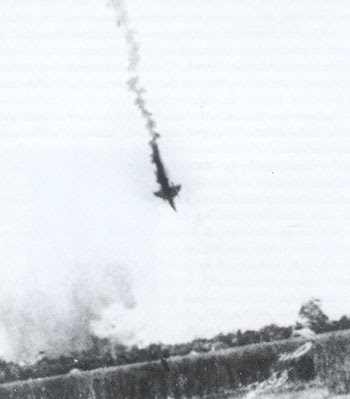
The Failed Air War Over Vietnam
or go to
Aletho News Archives – Video-Images
From the Archives
USS Liberty Massacre: A Pivotal Moment in the Hostile Takeover of America
By Kevin Barrett | Crescent | Dhu al-Qa’dah 24, 1445
In corporate America, hostile takeovers are commonplace. They occur when an aggressor—a larger corporation or rich individuals—seizes control of a smaller corporation without asking permission.
What few recognize is that the United States itself has been subjected to a hostile takeover. Since the aggressor, the illegitimate settler colony known as “Israel,” is much smaller than the US, the takeover has necessarily been surreptitious.
As of June, 2024, Israel’s gradual takeover of the US has become obvious and undeniable—a proverbial “elephant in the living room.” … continue
Blog Roll
 Aletho News
- Yemeni Armed Forces Warn Airlines Against Using Saudi Airports, Exempt Mecca and Medina
- Iran security chief says powers greater than US tried to conquer Iran but ended in ‘dustbin of history’
- Europe’s mounting social chaos… chickens coming home to roost for proxy war against Russia
- US-Russia Diesel Deal Becomes Massive Defeat for Ukraine
- Hormuz and the Looming Economic Catastrophe
- Dhubab offensive, media blitz and the rapid unraveling of Saudi-backed coalition’s new gambit
- Putin Conveys to Trump Iran’s Vision on Possible Conflict Resolution – Kremlin
- The Search for Truth: Charlie Kirk’s Assassination One Year Later
- ‘Harsh reality’: Iran says France seeks monopoly on power and intimidation, not peace for all
- When Will This White House Madness End?
- If Americans Knew
- For three years, Israel has killed a child in Gaza every 71 minutes – Daily Update
- Israeli forces kill another child in Gaza – Daily Update
- Gaza ceasefire exists in name only, say more than 100 organizations
- Nearly 2 Million in Gaza Need Urgent Shelter Assistance as Winter Looms: IOM Chief Warns
- Suppressing Palestinian resistance: US charity under fire for AI monitoring of Gaza classrooms
- Thousands Are Held in Israeli Torture Camps. This Is What Happens Inside
- Israel puts Gaza’s sick, injured, newborn in peril – Daily Update
- Report claimed Mark Levin used by Israeli government to influence Trump
- Over 2,000 Gazans have died awaiting medical evacuation amid Israel’s continued siege
- How a U.S. Diplomat Suppressed and Altered Reports Critical of Israel
- No Tricks Zone
- Germany’s Green Energy Debacle: High Energy Costs Force Kahla Porzellan to Close After 182 Years!
- New Study: 50 Years Of The Most Aggressive ‘Net Zero’ Policies Can Only Affect The Global Climate By 0.03°C
- US September “Heat” Was No Record…Many Records Set Decades Ago
- Latest European Green Energy Debacle; Portugal’s Largest Flagship Solar Park Insolvent!
- Green Energy Debacle: German Expert Professor Fritz Vahrenholt Warns Of Severe Economic And Social Consequences
- Two More Paleo Reconstructions Affirm Meters-Higher Sea Levels Across Ireland, Brazil 7000-6000 Years Ago
- New Study: Earth And Venus Surface Warmth Largely Explained By Convection And Lapse Rate, Not CO2 Or Radiation
- 2025 Nature Paper Claiming Worsening Global Drought Gets RETRACTED …Heavily Flawed
- New Study: ‘Global Drought Shows No Detectable Recent Acceleration Under Climate Warming’
- Economic Masterminds: German Socialists Suggest Taxing Productivity Gains Stemming From Using AI

