Mainstream media boosts Trudeau’s popularity over Venezuela
By Yves Engler · February 13, 2019
US presidents have bombed or invaded places like Grenada, Panama, Iraq and Sudan to distract from domestic scandals or to gain a quick boost in popularity. But, do Canadian politicians also pursue regime change abroad to be cheered on by the dominant media as decisive leaders?
In a discussion on regime change in Venezuela after last Monday’s “Lima Group” meeting in Ottawa, Conservative foreign affairs critic Erin O’Toole praised Canadian policy but added that the Liberals used the meeting of countries opposed to Nicolas Maduro’s government to drown out criticism of their foreign policy. O’Toole claimed the “Lima Group” meeting was “put together quite quickly and I think there are some politics behind that with some of the foreign affairs challenges the Trudeau government has been having in recent months.” In other words, O’Toole believes the Liberals organized a gathering that concluded with a call for the military to oust Venezuela’s elected president to appear like effective international players.
Understood within the broader corporate and geopolitical context, O’Toole’s assessment appears reasonable. After being criticized for its China policy, the Liberals have been widely praised for their regime change efforts in Venezuela. In a sign of media cheerleading, CTV News host Don Martin began his post “Lima Group” interview with foreign minister Chrystia Freeland by stating “the Lima summit has wrapped and the object of regime change is staying put for the time being” and then he asked her “is [Venezuelan President Nicolas] Maduro any step closer to being kicked out of office as a result of this meeting today?” Later in the interview Martin applauded the “Lima Group’s” bid “to put the economic pincers around it [Venezuela’s economy] and choking it off from international transactions.”
In recent days Ben Rowswell, a former Canadian ambassador in Caracas, has been widely quoted praising the Liberals’ leadership on Venezuela. “It’s clear that the international community is paying attention to what Canada has to say about human rights and democracy,” Rowswell was quoted as saying in an article titled “Trudeau’s Venezuela diplomacy is a bright spot amid China furor”.
Rowswell heads the Canadian International Council, which seeks to “integrate business leaders with the best researchers and public policy leaders”, according to its billionaire financier Jim Balsillie. Long an influential voice on foreign policy, CIC hosted the above-mentioned forum with O’Toole that also included the Liberal’s junior foreign minister Andrew Leslie and NDP foreign affairs critic Hélène Laverdière. CIC’s post “Lima Group” meeting forum was co-sponsored with the Canadian Council of the Americas, which is led by Kinross, Kinross, ScotiaBank, KPMG and SNC Lavalin. On the day of the “Lima Group” meeting CCA head Ken Frankel published an op-ed in the Globe and Mail headlined “Venezuela crisis will be a true test of Canada’s leadership in the hemisphere.” Frankel told CPAC he was “always supportive of Canadian leadership in the Hemisphere” and “the Venezuela situation has presented … a perfect opportunity for the Trudeau government to showcase the principles of its foreign policy.”
At the CCA/CIC forum Laverdière made it clear there’s little official political opposition to Ottawa’s regime change efforts. The NDP’s foreign critic agreed with Canada’s recognition of Juan Guaidó as president of Venezuela, as she did on Twitter, at a press scrum and on CPAC during the day of the “Lima Group” meeting in Ottawa. (Amidst criticism from NDP activists, party leader Jagmeet Singh later equivocated on explicitly recognizing Guaidó.)
With the NDP, Conservatives, CIC, CCA, most media, etc. supporting regime change in Venezuela, there is little downside for the Liberals to push an issue they believe boosts their international brand. To get a sense of their brashness, the day of the “Lima Group” meeting the iconic CN Tower in Toronto was lit up with the colours of the Venezuelan flag. A tweet from Global Affairs Canada explained, “As the sun sets on today’s historic Lima Group meeting, Venezuela’s colours shine bright on Canada’s CN Tower to show our support for the people of Venezuela and their fight for democracy.”
The Liberals drive for regime change in Venezuela to mask other foreign-policy problem is reminiscent of Stephen Harper’s push to bomb Libya. Facing criticism for weakening Canada’s moral reputation and failing to win a seat on the UN Security Council, a Canadian general oversaw NATO’s war, seven CF-18s participated in bombing runs and two Royal Canadian Navy vessels patrolled Libya’s coast.
The mission, which began six weeks before the 2011 federal election, may have helped the Conservatives win a majority government. At the time Postmedia published a story titled “Libya ‘photo op’ gives Harper advantage: experts” and Toronto Star columnist Thomas Walkom published a commentary titled “Libyan war could be a winner for Harper”. He wrote: “War fits with the Conservative storyline of Harper as a strong, decisive leader. War against a notorious villain contradicts opposition charges of Conservative moral bankruptcy. The inevitable media stories of brave Canadian pilots and grateful Libyan rebels can only distract attention from the Conservative government’s real failings.”
Similar to Venezuela today, the regime change effort in Libya was unanimously endorsed in Parliament (three months into the bombing campaign Green Party MP Elizabeth May voted against a second resolution endorsing a continuation of the war). “It’s appropriate for Canada to be a part of this effort to try to stop Gadhafi from attacking his citizens as he has been threatening to do,’’ said NDP leader Jack Layton. After Moammar Gaddafi was savagely killed six months later, NDP interim leader Nycole Turmel released a statement noting, “the future of Libya now belongs to all Libyans. Our troops have done a wonderful job in Libya over the past few months.”
Emboldened by the opposition parties, the Conservatives organized a nationally televised post-war celebration for Canada’s “military heroes”, which included flyovers from a dozen military aircraft. Calling it “a day of honour”, Prime Minister Stephen Harper told the 300 military personnel brought in from four bases: “We are celebrating a great military success.”
Today Libya is, of course, a disaster. It is still divided into various warring factions and hundreds of militias operate in the country of six million.
But who in Canada ever paid a political price for the destruction of that country and resulting destabilization of much of the Sahel region of Africa?
A similar scenario could develop in Venezuela. Canadian politicians’ push for the military to remove the president could easily slide into civil war and pave the way to a foreign invasion that leads to a humanitarian calamity. If that happened, Canadian politicians, as in Libya, would simply wash their hands of the intervention.
Canadians need to reflect on a political culture in which governing parties encourage regime change abroad with an eye to their domestic standing.
German Campaigners Defame Russian Media as Opinions Differ – Envoy to Berlin
Sputnik – 12.02.2019
MOSCOW – Russian media in Germany are being “persecuted” because their opponents do not have arguments to challenge their positions, Russian Ambassador to Berlin Sergei Nechayev told Sputnik, adding that proponents of such an approach were revealing who they really were.
“All those involved in this, to put it mildly, ugly media campaign against Russian and Russian-language media, are exposing themselves. After all, the course for defamation is adopted when arguments finish. One can only regret that opinions that differ from those expressed by local mainstream media do not give rise to a professional debate, but become a target for dishonest attacks. It is much easier to accuse your opponent of propaganda and deny him the opportunity to freely deliver his opinion to the local public rather than to hold a professional, fact-based discussion on controversial issues,” Nechayev said.
The ambassador added that Russian authorities did not target German media working in Russia, despite the fact that Moscow did not always like their content, which, he said, was often far from being objective.
“All we are striving for is providing our journalists with the opportunity to freely fulfill their professional duty in Germany, exactly the same way as many more numerous media representatives of Germany do in our country,” Nechayev stressed.
The comments come after on January 11, the German Federation of Journalists issued a statement calling on German regulators supervising media activities to not issue a broadcasting license for RT Deutsch, claiming that it was a “tool for Kremlin propaganda.” The Russian Foreign Ministry has said that Russia is not ruling out the possibility of taking retaliatory measures against countries where Russian media have their rights violated.
The situation with Russian media in the West has become increasingly difficult in recent years. A number of Western politicians, including those in the United Kingdom, the United States and France, have accused RT and Sputnik of interfering in elections and spreading propaganda, albeit without providing any evidence.
Russian officials have repeatedly stressed that Moscow does not meddle in other countries’ affairs. They, in particular, emphasize that the Western states’ policy toward Russian media reflected the fear of alternative coverage of global events and deterioration of the freedom of speech there.
We must be ready to use ‘hard power’ against Moscow and Beijing – UK defense chief
RT | February 11, 2019
The UK must be ready to use ‘hard power’ against Russia and China, defense chief Gavin Williamson has said. The remark has raised eyebrows in Moscow, which calls it “irrelevant” to reality and aimed at securing a larger budget.
The UK needs to strengthen its “lethality” and must be ready to “use hard power” to uphold it interests against nations like Russia and China, Secretary of State for Defense Gavin Williamson said on Monday.
Delivering a speech at the Royal United Services Institute in London, he accused “resurgent” Moscow of boosting its “military arsenal” to bring former Soviet states like Georgia and Ukraine “back into its orbit.”
The UK defense chief lashed out at Beijing as well, warning the audience that China is “developing its modern capability and commercial power.”
“We have to be ready to show the high price of aggressive behavior, ready to strengthen our resilience.”
The politician made the remarks as London prepares to send its largest warship, the aircraft carrier HMS Queen Elizabeth, to the South China Sea on a mission to enforce freedom of navigation rights.
Williamson’s statement was met with a mixed reaction in Russia, with the nation’s embassy in the UK calling it “completely irrelevant” to reality, yet “worrying” in its militaristic spirit.
“Certainly, it’s convenient to threaten society with the so-called ‘Russian threat’, distracting it from the relevant internal and external problems that Great Britain faces today,” the embassy said in a statement.
“Apart from that, the British minister is pursuing a very particular goal with such statements: painting our country as an ‘aggressor’, he is trying to steadily expand the state funding of the UK’s military-industrial complex.”
Williamson, 42, is known for pushing Britain to reassert its role as an influential military power. He also often makes headline-grabbing bombastic statements. In September, commenting on plans to send British troops to the Arctic, he called the region the nation’s “backyard.”
At the end of last year, he unveiled plans to build military bases in the Far East and the Caribbean, suggesting that it will help the UK to become a “true global player” after leaving the EU.
During the tensions over the Skripal poisoning case, Williamson went on a fiery tirade against Moscow, saying that Russia should “go away and shut up.”
“Hyperalarming” study cited by WAPO was hype
By Paul Homewood | Not A Lot Of People Know That | February 11, 2019
Confirmation that the GWPF have sent a formal complaint to PNAS, regarding the paper published by them on insect decline last October:
The scientific paper behind newspaper claims that insect populations were threatened with extinction was based on data known to be unreliable. That’s according to the Global Warming Policy Foundation, which today called for the paper to be withdrawn.
The paper, by US scientists Bradford C Lister and Andres Garcia, claimed that a rapid decline in insect populations in a rainforest in Puerto Rico was the result of rising temperatures. The Washington Post called the study “hyperalarming”, while the Guardian discussed climate change causing “insect collapse”.
However, the authors’ evidence that temperatures had, in fact, risen turns out to be based on a single weather station, which was known to be unreliable because of undocumented changes to equipment and location resulting in a substantial and abrupt increase in recorded temperatures in September 1992.
Since 1992, temperatures at this station have actually declined.
The Global Warming Policy Foundation has issued a formal complaint to the Proceedings of the National Academy of Sciences, the journal that published the article, asking that the paper be withdrawn.
‘Secret’ Pentagon Report: Climate Catastrophe Due Next Year
By Paul Matthews | Climate scepticism | January 18, 2019
A classic from the Guardian/Observer archives, from February 2004:

The article is so absurd that it hardly needs any commentary. After explaining that Britain will be Siberian by next year according to a suppressed report, it goes on to claim that the ‘findings’ of the report will embarrass the climate-denying president:
The findings will prove humiliating to the Bush administration, which has repeatedly denied that climate change even exists. Experts said that they will also make unsettling reading for a President who has insisted national defence is a priority.
The report was commissioned by influential Pentagon defence adviser Andrew Marshall, who has held considerable sway on US military thinking over the past three decades. He was the man behind a sweeping recent review aimed at transforming the American military under Defence Secretary Donald Rumsfeld.
Climate change ‘should be elevated beyond a scientific debate to a US national security concern’, say the authors, Peter Schwartz, CIA consultant and former head of planning at Royal Dutch/Shell Group, and Doug Randall of the California-based Global Business Network.
An imminent scenario of catastrophic climate change is ‘plausible and would challenge United States national security in ways that should be considered immediately’, they conclude. As early as next year widespread flooding by a rise in sea levels will create major upheaval for millions.
Later on we are told more details of the catastrophes that will occur by 2020:
Already, according to Randall and Schwartz, the planet is carrying a higher population than it can sustain. By 2020 ‘catastrophic’ shortages of water and energy supply will become increasingly harder to overcome, plunging the planet into war. They warn that 8,200 years ago climatic conditions brought widespread crop failure, famine, disease and mass migration of populations that could soon be repeated.
Randall told The Observer that the potential ramifications of rapid climate change would create global chaos. ‘This is depressing stuff,’ he said. ‘It is a national security threat that is unique because there is no enemy to point your guns at and we have no control over the threat.’
Randall added that it was already possibly too late to prevent a disaster happening. ‘We don’t know exactly where we are in the process. It could start tomorrow and we would not know for another five years,’ he said.
Of course the authors of the report, Randall and Schwartz, aren’t climate scientists. But their report gets the glowing endorsement of two leading UK climate scientists — Sir John Houghton, former boss of the Met Office and IPCC co-chair, and former IPCC chair Bob Watson:
Sir John Houghton, former chief executive of the Meteorological Office – and the first senior figure to liken the threat of climate change to that of terrorism – said: ‘If the Pentagon is sending out that sort of message, then this is an important document indeed.’
Bob Watson, chief scientist for the World Bank and former chair of the Intergovernmental Panel on Climate Change, added that the Pentagon’s dire warnings could no longer be ignored.
‘Can Bush ignore the Pentagon? It’s going be hard to blow off this sort of document. Its hugely embarrassing. After all, Bush’s single highest priority is national defence. The Pentagon is no wacko, liberal group, generally speaking it is conservative. If climate change is a threat to national security and the economy, then he has to act. There are two groups the Bush Administration tend to listen to, the oil lobby and the Pentagon,’ added Watson.
Hugely embarrassing indeed, but for Watson, not Bush. Why would a senior scientist like Bob Watson say that a report claiming global catastrophe by 2020 is non-wacko and should be taken seriously? Well there’s a hint that politics may be a factor, later on in the article:
So dramatic are the report’s scenarios, Watson said, that they may prove vital in the US elections. Democratic frontrunner John Kerry is known to accept climate change as a real problem. Scientists disillusioned with Bush’s stance are threatening to make sure Kerry uses the Pentagon report in his campaign.
The fact that Marshall is behind its scathing findings will aid Kerry’s cause. Marshall, 82, is a Pentagon legend who heads a secretive think-tank dedicated to weighing risks to national security called the Office of Net Assessment. Dubbed ‘Yoda’ by Pentagon insiders who respect his vast experience, he is credited with being behind the Department of Defence’s push on ballistic-missile defence.
Is it not rather worrying that the defence of the USA is in the hands of people who produce such garbage?
This Pentagon report was cited in a recent article Climate Change and National Security, Part II: How Big a Threat is the Climate?
The consequences of abrupt, severe warming for national security are obvious in general, if unclear in the specifics. In 2003, the Defense Department asked a contractor to explore such a scenario. The resulting report outlined the offensive and defensive national security strategies countries may adopt if faced with abrupt climate change, and highlighted the increased risk of inter- and intra-state conflict over natural resources and immigration. Although the report may be off in its imagined timeframe (positing abrupt climate change by 2020), the world it conjures is improbable but not outlandish.
This is a bit like the doomsday cults that say that the world is going to end this year, and then when that doesn’t happen, say it’s going to happen next year. Even more comically, a few paragraphs before acknowledging that the 2003 report got it wrong, the article claims that “Scientists can predict the consequences of climate change to 2050 with some measure of certainty”.
That article also provides a link to the Pentagon climate report by Schwartz and Randall, dated October 2003.
By looking at the report, we can see to what extent it is in itself complete nonsense, and to what extent it was misrepresented by the Observer’s journalists. As usual in the game of Climate Chinese Whispers, there’s an element of both. The report starts with a boxed disclaimer, acknowledging that “We have created a climate change scenario that although not the most likely, is plausible, and would challenge United States national security in ways that should be considered immediately.” The Observer journalists Townsend and Harris quite dishonestly only quote the second half of that sentence.
The report plays a common climate game — we’re not making a prediction, we’re setting out a scenario — but then sets out its scenario like this:

thereby making it very easy for a journalist to accidentally or deliberately interpret it as a prediction.
Where did Schwartz and Randall get all this from? Did they just make it up? At the beginning, they say that they “interviewed leading climate change scientists, conducted additional research, and reviewed several iterations of the scenario with these experts.”
But who were these leading climate scientists? As far as I can see, only one climate scientist is mentioned in the report — notorious fraudster Peter Gleick.
As US Laments Human Rights in Venezuela, US-Allied Colombia Descends into Drug-fueled Humanitarian Crisis
By Whitney Webb | MintPress News | February 8, 2019
BOGOTÁ, COLOMBIA – Several troubling situations are currently playing out across Colombia, yet the country’s continuing downward spiral into drug-fueled and politically-motivated violence has caused little concern in Washington, offering yet another clear indication that the U.S.’ current posturing on Venezuela is hardly motivated by concerns about “democracy,” “human rights,” or the welfare of the Venezuelan people.
This, of course, can hardly be considered surprising, given that Colombia is a top U.S. ally whose government has long been closely aligned with Washington’s interests. However, although the lack of U.S. government or media attention to Colombia may effectively hide it from the American public, the country is becoming increasingly lawless, with cocaine production reaching new record levels and the government sanctioning the mass murder of the country’s largest indigenous group. Not only that but since Colombia’s new president, Iván Duque, came to power late last year, the number of indigenous social leaders who have been murdered has spiked to the highest levels in over a decade.
Ultimately, the lack of media coverage of Colombia’s humanitarian crises, which have large implications for the Americas as a whole, is a telling example of how such crises are regularly weaponized by governments and media to exclusively target governments it wishes to pressure or overthrow, while turning a blind eye to those same or worse acts when committed by an allied nation.
An absurdly double standard
Though it was Barack Obama who first deemed Venezuela a “national security threat” and re-initiated draconian sanctions against the oil-rich nation, the Trump administration has greatly increased the sanctions targeting Venezuela, often citing its government’s alleged participation in illegal drug trafficking as justification for doing so. However, the U.S. has offered little in the way of concrete evidence to back up those allegations.
During this same period, moreover, the Trump administration has expressed little concern for the booming illicit drug trade in neighboring Colombia, which has broken records for cocaine production for the last two years in a row. Though the Colombian government and military have been repeatedly tied to the country’s drug trade, the Trump administration – like previous U.S. administrations – hasn’t lifted a finger.
According to UN figures released last September, Colombia’s cocaine production has again broken records, with the country producing an estimated 1,379 tons of cocaine in 2017, the latest year for which such statistics exist. That figure is a 31 percent increase in cocaine production from 2016. 2016 itself was a record-breaking year with cocaine production gaining by 50 percent over 2015 levels.
Though Trump had threatened to decertify former Colombian President Juan Manuel Santos’ government over the rapid growth of cocaine production, he ultimately gave Colombia a pass in the U.S.’ annual determination of countries considered to be “major drug transit or major drug producing” areas “because the Colombian National Police and Armed Forces are close law enforcement and security partners of the United States in the Western Hemisphere.”
The document also described Venezuela, along with its regional ally Bolivia, as “countries that have failed demonstrably during the previous 12 months to adhere to their obligations under international counternarcotics agreements” despite the fact that Bolivia had the fewest illegal coca crops of any South American country that year.
Since getting a free pass from the Trump administration, Colombia’s current president, Iván Duque, has signaled his hopes to revive a failed, U.S.-backed program to indiscriminately spray suspected coca fields with the infamous Monsanto product glyphosate to reduce cocaine production.
Though the U.S. government and Western media have traditionally placed the blame on leftist guerillas in Colombia, like the FARC, the 2016 peace deal that saw the FARC abandon the drug trade has removed this convenient scapegoat and highlighted the long-standing role of the Colombian military and prominent right-wing politicians in cocaine production.
In fact, the United Nations Drug Control Program (UNDCP) has described the Colombian military — which has been armed and trained for decades by the U.S. under the Clinton era policy known as “Plan Colombia” — as being among “the biggest heroin and cocaine trading institutions.”
The Colombian government has also been intimately involved, particularly during the presidency of Álvaro Uribe, who allegedly served as the “head of Colombia’s paramilitary groups” both before and while in office. Uribe was once ranked by the U.S. Defense Intelligence Agency “on a list of 104 important narco-traffickers contracted by the Colombian narcotics cartels.”
There are also indications of the U.S. government’s own involvement in the Colombian cocaine trade. For example, Colombia’s most notorious drug trafficker, Pablo Escobar, at one point worked for the U.S. Central Intelligence Agency, according to Escobar’s own children. Escobar allegedly sold cocaine for the CIA to help the U.S. government finance its fight against communism and left-wing governments in Latin America.
As pointed out in the book Cocaine, Death Squads and the War on Terror: U.S. Imperialism and Class Struggle in Colombia, the U.S.’ anti-drug efforts in Colombia were never intended to eradicate cocaine, but instead alter the market share by ensuring that allies of the U.S. in Colombia – the Colombian government, paramilitaries and the wealthy elite who are favorable to U.S. business interests – could monopolize the drug trade with no competition from outsiders. Thus, it should hardly shock anyone that the U.S. continues to turn a blind eye to the country’s booming illegal drug trade and its associated violence, even as it continues to break records year after year.
Erasing the erasure of the Wayuú
As the long-standing, U.S.-backed plan to oust the Chavista regime in Venezuela has unfolded, Maduro’s government has been called out in Western media for “starving his own people,” despite the fact that U.S. sanctions imposed on Venezuela are a driving factor behind the country’s economic crisis. However, since 2011, Colombia has been the site of ongoing genocide against the country’s largest indigenous group – the Wayuú – in the country’s Guajira region, after the Colombian government diverted their only source of water to support the operations of the country’s – and continent’s – largest coal mine.
The suffering of the Wayuú, who have reported the deaths of at least 14,000 children due to the lack of clean water, has gone unreported by the same outlets that routinely raise concern about lack of essential goods in Venezuela. The Wayuú, who comprise around 20 percent of Colombia’s entire indigenous population and 48 percent of the Guajira region’s total inhabitants, are now on the brink of dying out completely seven years after the Ranchería river – their community’s only freshwater source – was diverted by the government-constructed Cercado dam in order to service the water needs of the Cerrejón coal mine.
An estimated 37,000 Wayuú now suffer from severe malnutrition, as they can no longer grow crops or raise livestock without a freshwater source. Each person in the community now lives off of less than 0.7 liters (24 oz.) of water a day while the Cerrejón mine guzzles more than 2.7 million liters of water in a 24-hour period – most of which is used to improve mine “visibility” by minimizing dust pollution. Despite the clear impact of the dam and mine on the humanitarian crisis facing the Wayuú, the Colombian government and supportive Western media have blamed “climate change” and weather patterns like El Niño for the situation.
The most likely reason for the erasure of the slow genocide of the Wayuú from Western media is the fact that the Cerrejón mine is a largely a U.S.-backed operation, as the mine was originally founded by ExxonMobil and is now owned by a consortium of largely Western mining companies such as Anglo American and BHP Billiton. These same mining companies often work with right-wing paramilitary groups — who are also closely connected to the Colombian government — and who repeatedly threaten the lives of Wayuú who speak up about their people’s suffering, including their chief legal advocate, Javier Rojas Uriana.
Notably, the Colombian Wayuú have been immigrating to the Wayuú community in Venezuela in order to avoid the slow death caused by malnutrition, lack of water, and waterborne illnesses from the polluted water from the community’s remaining wells. The Venezuelan Wayuú have been largely supportive of Chavismo and have backed the Maduro-led government, referring to U.S.-backed opposition protests as violent riots “intended to create chaos.” The Huffington Post noted in 2017 that the Wayuú’s support for Maduro had largely been erased by the Western media because it “does not match up with the media’s anti-Venezuelan government narrative.”
Liquidating social leaders, activists, human-rights advocates
While the fate of the Wayuú (and thus 20 percent of the country’s entire indigenous population) continues to hang in the balance, the plight of Colombia’s indigenous peoples has grown even worse since the recent inauguration of Colombian President Iván Duque.
Despite Duque’s having come to power just last August, El Tiempo recently reported that the murders of indigenous leaders in the country have spiked to levels unseen in over a decade since Duque became Colombia’s president. According to data cited by El Tiempo, 120 indigenous social leaders – as well as human-rights defenders — have been murdered in cold blood during Duque’s first 100 days in office.
Though the murder of social leaders by right-wing paramilitary groups has a standing problem in Colombia’s recent history, this level of targeted murder represents a spike over recent years — in which 226, 159, and 97 such murders occurred over the course of the entire years of 2018, 2017 and 2016, respectively. Notably, the Venezuelan government of Nicolás Maduro has been routinely accused by Western media of murdering opposition activists; yet, those same outlets have been silent on Colombia’s recent spike in activist murders.
Despite the jump, Duque’s government has expressed little concern. This is hardly surprising when one considers that Duque is the hand-picked successor and protégé of Álvaro Uribe, the former Colombian president who was once “the head of Colombia’s paramilitary groups,” according to former paramilitary group commanders of the right-wing death squad AUC, which has been funded by several prominent U.S. corporations.
Uribe, who was Colombia’s president from 2002 to 2010, and was a close ally of George W. Bush, was also personally implicated in organizing a massacre conducted by a right-wing paramilitary group; and his cousin, Colombian politician Mario Uribe, was charged with mobilizing right-wing death squads in the country to help secure Uribe’s presidential victory in 2002. Uribe’s brother was also arrested for founding a right-wing paramilitary group in 2016.
Under Uribe’s presidency, the Colombian military massacred thousands of civilians — such as in the “false positives” scanda,l where the Colombian military dressed up an estimated 5,000 civilians in guerilla clothing and killed them in cold blood, subsequently gaining a bonus from Uribe’s government for the sinister act. It should be no surprise then that, under Uribe, the murder rate of indigenous leaders and human-rights activists reached its all-time high at 1,912 murders in 2003.
Given Duque’s close relationship to Uribe, it is also little surprise that paramilitary groups have endorsed Duque following his election and have vowed to “exterminate” Duque’s opposition, calling prominent Colombian progressives “military targets.”
What to expect if US gets its way in Venezuela
If Washington’s publicly stated concerns about “human rights” and the welfare of a country’s people in Venezuela were genuine, it would be equally critical of Colombia’s government, given the numerous troubling situations currently unfolding in that country. Instead, the dichotomy between Washington’s relationship with Venezuela and Colombia is yet another clear example that the public justifications for the U.S.’s Latin America policy are little more than window dressing for the U.S.-backed expansion of neo-fascist governments throughout Latin America.
Indeed, if Juan Guaidó – the self-declared, U.S.-backed “president” of Venezuela – manages to seize power in the country, the current state of affairs in Colombia is a telling harbinger of what would likely manifest should Nicolás Maduro be overthrown and replaced with the same type of government that the U.S. has either backed or installed in several Latin American countries over the last few decades, and particularly in recent years.
Whitney Webb is a staff writer for MintPress News and has contributed to several other independent, alternative outlets. Her work has appeared on sites such as Global Research, the Ron Paul Institute and 21st Century Wire among others. She also makes guest appearances to discuss politics on radio and television. She currently lives with her family in southern Chile.
William Hague Attacks Corbyn on Venezuela, Exposes Barbarism of Regime Change Policy
By Nina Cross | 21st Century Wire | February 8, 2019
The rhetoric of the establishment media and political class in their attempt to vilify the mildest dissent from Jeremy Corbyn is shocking, not because it is unexpected, but because it is now apparently normal to break international law and plot to overthrow a government. In fact it’s the done thing if Corbyn just hints disapproval. An article written by William Hague, former British Foreign Secretary, attacking Corbyn for his non-intervention stance on Venezuela shows our foreign policymakers are out of control.
Corbyn said on Friday that he opposes “outside interference in Venezuela” and that Jeremy Hunt was wrong to call for more sanctions on the regime. He clearly does not agree with those governments now recognising Juan Guaido as the new and legitimate leader of the country. This is a hugely revealing moment, which tells us a great deal about the limits of any moral compass in Corbyn’s mind.
William Hague’s gunning for the overthrow of Maduro comes as no surprise, given his role in the overthrow of Libyan leader Muammar Gadhafi in 2011. In an interview in 2016 on his role in the destruction of Libya he offered advice for when the British Foreign Office next planned to overthrow a government:
A major issue for future interventions is that the leaders who were well-liked disappeared from the scene very quickly… Future interventions’ need longer transitions…
At the time of Hague’s comments, the consequences of the invasion of Libya by the UK, France and the US had had years to take root. They include the genocide of Blacks, slavery, a refugee crisis, and thousands of people drowning at sea in an attempt to flee the resulting conflict and they are still unfolding. Hague does not have regrets about Libya; he could only make ‘unpalatable choices.’ In fact, he says if he had to do it again, he would not avoid intervention. Perhaps if Hague lived in Libya and experienced the results of his plotting he might have a different view. For now he is keen to do it all over again:
But even more telling is the justification he (Corbyn) uses for his position – hostility to “outside interference”. This is the language of authoritarian rulers the world over, the constant refrain of those who fear a compassionate and responsible world coming to the aid of people they have impoverished and oppressed.
In 2011 Hague helped lead an attack that not only destroyed Libya but destabilised the entire region around it. In 2016 he was still talking about overthrowing governments, and in 2019 he is comparing Corbyn to a dictator for rejecting regime change. This is not so surprising given that in his article Hague presents intervention as a noble cause, and this is also how he presented it when defending his role:
“The threat, the possibility, the stated intentions – of the Gadhafi government to kill large numbers of people – the Arab League thought it was going to happen…”
But, the massacre did not take place, and Hague’s ‘stand against tyranny’ to ‘prevent another Rwanda’ can be seen for what it was. What took place in Libya has been described as an insurrection planned months in advance. Confirmation of this is found in emails released by Wikileaks in its Global Intelligence Files:
He (Abdelhakim Belhaj) and his men were being trained for the siege of Tripoli for months, however. This is a prime example of the secret side of the war that NATO, France, the UK, U.S. and Qatar were fighting.
Hilary Clinton’s emails also released by Wikileaks further question the motive for regime change in Libya following revelations that Gadhafi was intending to create a pan-African currency based on the Libyan gold Dinar.
‘Venezuela’s agonies expose the heartlessness of Corbyn’s dogma.’
Read my latest @Telegraph articlehttps://t.co/zaE8bD98Mf— William Hague (@WilliamJHague) February 5, 2019
This is not Hague’s only attempt to shape public opinion with selective facts and rhetoric. He also deceived the British public and Parliament about the events in Ukraine in 2014. He claimed falsely that the removal of the elected President Yanukovych was in accordance with the constitution of Ukraine. Hague’s statement was designed to mask the US intervention, which led to the overthrow of the Yanukovych government, presented to Western audiences as a colour revolution.
As well as joining in a needless aggression on Libya that led to a failed state, Hague was influential in easing the arms embargo in Syria so he could supply arms to the opposition. As it was recognised that the opposition included many Islamist extremists this ran the risk of weapons ending up in the hands of terrorists. He supported crippling sanctions that added to the misery of the population while at the same time he enabled lifting of some sanctions so that the ‘opposition’ could sell Syria’s oil to the EU. So Venezuela makes number four on Hague’s hit list of interventions that now spread across entire regions of the world: North Africa, the Middle East, Europe. The next stop: South America.
Hague is likely to approve of the weapons used against Venezuela to gather imperialist muscle. One such weapon is the Lima Group. Informal gatherings of concerned nations are useful in that they present a picture of neighbourly humanitarian concern while carrying out acts of aggression on their target. The purpose of the Lima Group has always been to bring down the Venezuelan government. Its very existence undermines the non-intervention clause of the Organisation of American States Charter which each member individually signed. The Friends of Syria, attended by Hague while Foreign Secretary, had a similar purpose. Like the Lima Group its members were also US allies and stakeholders in intervention. These ‘friendly’ groups were set up to isolate and force the governments into submission regardless of the consequences on the civilian population.
This is a list showing ways the Lima Group is trying to subordinate Venezuela but it may not be comprehensive:
travel sanctions against members of the Venezuelan government
economic sanctions
cutting diplomatic ties
enlisting the International Criminal Court and other Western institutions
freezing of assets
accusations such as sponsoring of terrorism
discrediting legitimacy of elected leaders
floating the idea of military intervention either as a genuine threat or as a form of intimidation
using humanitarian aid to gain access and influence
appealing to internal and sovereign institutions such as the military
supporting US-backed opposition
The Friends of Syria created the same list for the Syrian government and added the supply of arms to groups they knew included Islamist extremists.
Another mechanism used by Hague in the past is the creation of puppet governments, especially useful when the US and EU arm non-state actors in violation of international law. Western audiences are expected to believe interim governments spontaneously and conveniently pop-up when NATO decides to invade a country, and these new interim governments are sympathetic to NATO and the US for some reason. Interim governments or councils in each country targeted for intervention have almost always included groups linked to extreme ideology. In Venezuela the self-proclaimed ‘interim President’ Juan Guaido is of the right-wing Popular Will party that has a history of violence and collusion with the US government, and Guaido’s own involvement has been uncovered.
Given that the US-backed opposition attempting to overthrow the elected Venezuelan government is so divided and violent, it is fitting that Hague, after years of supporting ‘rivalling moderate rebels’ sees them as just a…
‘… united and moderate opposition.’
The Unreported Realities of Marie Colvin’s Last Assignment
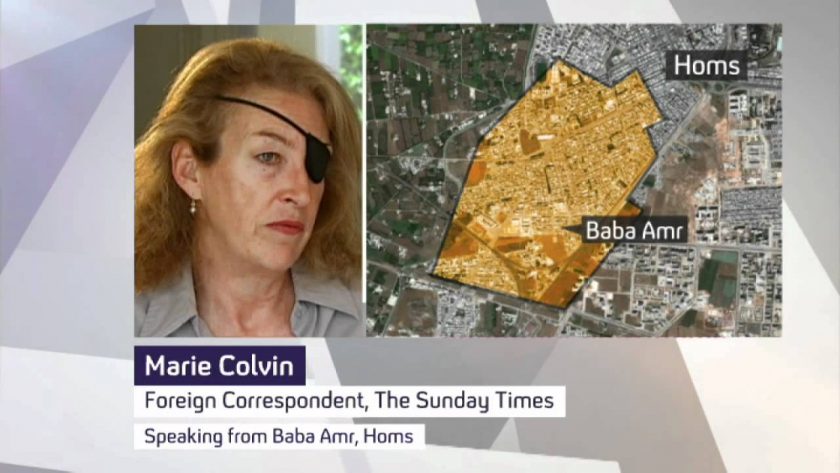
By Jeremy Salt | American Herald Tribune | February 8, 2019
Familiar with Muslim culture, the American journalist Marie Colvin always took off her shoes when entering a Muslim household. On February 20, 2012, she traveled from Beirut to the Syrian border, where she and photographer Paul Conroy were taken to the outskirts of Homs by minders from the Free Syrian Army. From there they were led into the Baba Amr district through a stormwater drain.
Guided into a ‘rebel’ media center Colvin took off her shoes. Two days later she and Conroy awoke to the sound of intense shelling. They were led outside with other foreign journalists and told when to run to safety across the street. According to media reports, Colvin was running back to retrieve her shoes after one explosion when there was a second, killing her and French photographer Remi Ochlik.
Beginning in May 2011, Homs had been infiltrated by armed groups. Towards the end of the year, the Free Syrian Army (FSA) was able to tighten its hold on the Baba Amr district. No quarter was given to captured soldiers or civilians identified as supporting the government. In December 2011, FSA fighters stood 11 Syrians they accused of being shabiha (pro-government paramilitary fighters) against a wall and shot them dead.
The army intensified its operations but it was only after the killing of 10 soldiers at a government checkpoint on February 2, 2012, that it decided to do what was necessary to drive the ‘rebels’ out of Baba Amr. The bombardment of the district was scaled up. Colvin was killed on February 22 and 10 days later the FSA abandoned Baba Amr.
On January 31, 2019, a federal district court in Washington ruled that the Syrian government was responsible for Colvin’s death and should pay $302.5 million compensation to her family.
The plaintiffs were Marie Colvin’s sister Cathleen and a nephew and niece. The defendant, the summons served through the Czech embassy in Damascus, was the Syrian government; It did not respond and was not represented in court. The judge, Amy Berman Jackson, ruled that the plaintiffs’ brief was so comprehensive that an evidentiary hearing, in which a judge hears testimony and documentary evidence from both sides can be reviewed, was not necessary.
The plaintiffs’ evidence included a declaration by ‘Ulysses’, the pseudonym of someone claiming to be a defector from the Syrian government’s intelligence services; a statement by David Kaye, a former adviser to the US State Department and now a rapporteur with the UN; and an affidavit by Robert Ford, the former ambassador to Syria who in 2011 broke diplomatic protocol – and a Syrian government ban on diplomats leaving Damascus – by visiting the centres of street protests. Accused of incitement by the Syrian government, he was withdrawn in October.
Ruling that the Syrian army had fired the artillery shell that had killed Colvin, Judge Jackson concluded that her death had been a ‘targeted murder.’ She did not mention that Colvin and Conroy had entered Syria illegally but she did note that the US government had designated Syria as a state sponsor of terrorism on December 29, 1979, following its support for the Iranian revolution. Given government and media hostility to Syria since that time, the outcome of the Colvin court action was never likely to be anything other than a finding for the plaintiffs.
Colvin was an experienced war correspondent. She had lost an eye while reporting the Sri Lankan civil conflict from the side of the Tamil Tigers. She had reported from East Timor, Chechnya, Afghanistan, Iraq, and Libya, amongst other theatres of war, before going to Syria. As correspondents do, she had witnessed terrible things. The death of civilians, especially children, affected her deeply.
These accumulated experiences took a heavy personal toll. She began to drink heavily, she was having nightmares and she had been treated at a clinic for PTSD (post-traumatic stress disorder) before heading off to Syria. Once in Homs, her employer, the London Sunday Times, ordered her to leave but she refused. The paper later came under criticism for letting her go in the first place, given the fragile state of her mental health.
These aspects of her life were depicted in the recently released biopic, A Private War, woven around an account of her life written for Vanity Fair by Marie Brenner (‘Marie Colvin’s Private War,’ August 2012).
On the day of Colvin’s death, she was described in an online article for Vanity Fair as having ‘died as a martyr …. a martyr for truth and the standards of civilization … she died because she wanted the world to know the full extent of the barbarism practiced by President Bashar al Assad’s forces against his own people.’ (Henry Porter and Annabel Davidson, ‘Remembering War Correspondent Marie Colvin: 1957-2012,’ Vanity Fair, February 22, 2012).
Truth, of course, is the first casualty of war. The Greek dramatist Aeschylus apparently first coined the phrase, which has been repeated many times by many people over the centuries. As for civilization, it has been used to justify every war of aggression launched in the Middle East by the US and European powers for the past 200 years.
In this region, the standards of civilization, as we imagine them to be, consisting of civilized behaviour, justice, fairness, respect for human life and respect for the law, have not been upheld but violated in brutal and inhumane fashion by the very governments that repeatedly invoke them as justification for the crimes they are committing.
No doubt Marie Colvin was reporting the truth as she saw it but how much could she see of anything in the space of two days, effectively trapped in a war-scarred building under heavy bombardment by the Syrian army?
In her final despatch for the Sunday Times, she talked to women in what she called the ‘widows’ basement’ and she watched (apparently on a video feed from a clinic, contrary to the impression she gave that she was actually there) a baby dying from a shrapnel wound. Asked on CNN why she thought showing the image of the dead baby was important Colvin replied: ‘That baby will move more people to think ‘What is going on and why is no one stopping this murder in Homs that is happening every day.’
Colvin said 300 women were in the basement, a figure which, from other reports, seems to have been wildly exaggerated. Who these women were was not clarified, but seeing that that Baba Amr was controlled by the FSA, many of the dead husbands were probably fighting men.
When Colvin said that 28,000 civilians were trapped in Baba Amr she had to be repeating what she had been told by her FSA minders. She had no way of knowing how many civilians remained trapped in Baba Amr and the figure seems to have been a gross overestimate, aimed no doubt at further dramatizing the plight of civilians trapped in what the media was misleadingly calling the ‘siege of Homs.’
Colvin and Conroy first entered Syria on February 13. They were taken to Baba Amr on February 15. The next day Colvin was able to visit a makeshift field hospital set up in an apartment building as well as civilians sheltering in a basement storage depot but on hearing rumors of an impending army offensive and a ‘possible gas attack’ (as claimed by Judge Berman, without any such credible claim having been made at the time) they fled in the evening. This was all Colvin was able to see for herself outside the ‘rebel’ media center during her two visits to Baba Amr.
Baba Amr constituted about 15 percent of the city and had a pre-war population of about 100,000. Most civilians in the district fled to the 80-85 percent of the city controlled by the government once the armed groups launched their assault on Baba Amr.
Colvin said Homs was being bombed by ‘a murderous dictator.’ Talking to CNN from Baba Amr she said ‘there are no military targets here. There is the FSA, heavily outnumbered and outgunned – they have only Kalashnikovs and rocket-propelled grenades. But they don’t have a base. There are more young men being killed, we see a lot of teenage young men but they are going out just to try to get the wounded to some kind of medical treatment. It’s a complete and utter lie that they’re only going after terrorists.’
What Colvin actually saw was true. A baby did die and the women in the basement were suffering but by 2012 Syria was a land of suffering women and dead babies, killed not by the ‘murderous dictator’ but by ‘rebels’ supported with money and arms by outside governments.
It was not true, however, there were no military targets in Baba Amr. Colvin’s definition of a valid target seems to have been an actual military base. There was not one, of course, but the armed groups who had infiltrated Baba Amr and killed many Syrian soldiers and civilians in the process were no less an equally valid military target.
The FSA was certainly outgunned, as any insurgent force must be when challenging a regular army, but already early in 2012, outside governments were stepping up supplies to reduce the gap.
In March 2013, the New York Times reported that several governments, with help from the CIA, had begun airlifting weapons to the ‘rebels’ in early January 2012. Over a year more than 160 cargo flights had taken an estimated 3500 tons of weapons to Ankara airport and other airports in Turkey and Jordan for delivery to ‘rebels’ across the border. As the ‘rebel’ group of choice, the bulk of these weapons would have gone to the FSA, even if they eventually ended up in other hands.
Colvin’s reference to young men running into the streets to rescue the wounded and not fight is not something she could have known. In fact, young men were the backbone of all armed groups as they were of the Syrian army.
The Syrian army was not shelling ‘Homs’ but only part of a city which had been taken over by armed groups. The government in Damascus – Syria’s legitimate government and the representative of the country’s interests at the UN – had the constitutional responsibility of driving them out.
The civilians trapped in Baba Amr were certainly at risk but what Colvin was seeing – or reporting rather than actually seeing for herself – was only a small corner of a very large picture of human suffering. The general civilian death toll was beginning to rise sharply in 2012 as the armed groups – including the group sheltering Colvin and Conroy – launched attacks across the country.
Many of these attacks were completely indiscriminate, as for example when mortars were fired into the middle of Damascus or a rigged car was exploded outside a government ministry.
As civilians are always going to die in war, the critical question is one of responsibility. Whatever the failings of the Syrian government, it was support by outside governments for these armed groups that brought Syria to its knees and not the attempts by the Syrian government to prevent the country from being bled to death.
The publicity given to the death of Marie Colvin has now been revived by the publicity given to the film of her life and to the court ruling against the Syrian government. The film returns Colvin and the ‘murderous dictator’ to a news cycle which had largely lost interest in Syria since the defeat of the armed groups it had been supporting as ‘rebels’ until Donald Trump announced the withdrawal of US troops.
At the same time, the publicity is an opportunity to examine Colvin’s role in the context of a media which uniformly misreported the war in Syria as it had only recently misreported the war in Libya and before that the invasion of Iraq in 2004. The canons of responsible journalism were all junked. There was no balance, no reporting of the Syrian government’s version of events except for nominal references to its denial of atrocities in such a way that the reader was invited to disbelieve them.
The narrative was entirely built around the claims of ‘rebels’ and activists and sources far from the scene, such as the Syrian Observatory of Human Rights. Whatever they cared to say, no matter how wild and improbable, would be reported without any attempt being made by the media to uncover the truth.
Anything that would damage the Syrian government was regarded as fit to print, anything that would support its claims would be suppressed, or as far as possible turned against the government. Knowing this, the activists developed an industry based on lies and deceit to serve the corporate media’s needs.
This is the media environment in which Marie Colvin operated. Perhaps she had private doubts, but from what she said in her few reports from Syria she had swallowed whole the mainstream media narrative of rebels standing against a brutal dictator who was killing his own people.
All critical elements were missing from the news cycle. In March 2011, during ‘peaceful’ protests in Dara’a, the media headlined the alleged arrest and beating of children for scrawling graffiti on walls, while ignoring the evidence of arms stockpiled in a mosque and the slaughter of soldiers and police by bands of armed men.
Gunmen shooting into crowds from rooftops were part of what was clearly a well-planned revolt. While the media insinuated that they were Syrian state agents, the far greater likelihood is that they were agents-provocateurs but nowhere in the media mainstream was there any follow-up. Only the accusation, not the proof, was important, an approach which was to characterize the media narrative.
Similarly, on June 2011, the massacre of about 120 Syrian soldiers and civilians in the northern town of Jisr al Shughur was presented as a civilian response to government oppression and torture rather than what it was, a carefully planned attack on government offices by well-armed takfiri groups. Video clips – never shown in the media mainstream – showed bodies being taken in a pickup truck to a high bridge over the Assi (Orontes) river and being pitched into the water over the railing to cries of ‘Allahu akbar.’ Later, mass graves were also uncovered.
Colvin’s role must begin with who brought her into Syria. She was not the only ‘western’ journalist funneled into Baba Amr from the Lebanese border. A pipeline had been set up, with the online activist network Avaaz liaising with FSA ‘rebels’ to smuggle western journalists into the city.
Avaaz had also been supplying the ‘rebels’ with medical supplies, satellite modems and cell phones with cameras. With the help of an ‘activist’ called Wael Fayez al Omar (a source for the plaintiffs in the court case against the Syrian government), it organized the transport of Colvin and her photographer, Paul Conroy, to the Syrian border. The FSA then took over and moved them to Baba Amr, first on February 13 and again when they decided to return on February 20.
Formally established in July 2011, the FSA quickly won the support of Turkey, which provided it with a camp from which it was soon organizing attacks across the Syrian border. Turkey also backed the FSA’s political arm, the Syrian National Council, an exile body which had no known support inside Syria, providing it with money and offices in Istanbul. The FSA itself was never a proper army but rather a brand name for a ‘rebel’ collective involving numerous armed groups who responded to their own leaders, rather than the injunctions of the FSA leadership in Turkey.
The early actions for which the FSA claimed responsibility included the explosion inside the Syrian national security headquarters in July 2011, which killed several senior military and government personnel, including the defense minister and two of his deputies.
By this time the FSA was already launching attacks in many parts of Syria. Insofar as Homs was concerned, ‘rebel’ groups, including the FSA, penetrated the city in May, 2011, and succeeded in taking control of the Baba Amr district by the end of the year after overrunning military checkpoints.
By 2012 the FSA was operating at peak strength across Syria. It was killing soldiers, police and civilians and sabotaging oil pipelines and other infrastructure. In May, several months after the FSA had been driven from Homs, the Houla district, about 30 kms northwest of Homs and largely under the control of the FSA, was the site of the massacre of 108 men, women and children.
While the Syrian government was automatically blamed by ‘western’ governments and the corporate media, accounts pieced together later by journalists on the scene indicated that villages in the Houla region had been attacked by a joint force of about 700 takfiris, including a contingent of about 250 FSA fighters.
Their targets were Sunni Muslims who supported the government or, reportedly, had converted to Shia Islam. The victims’ houses were hit by rocket-propelled grenades but most of the killing seems to have been done with small arms and knives.
In November, 2012, a mass grave of soldiers and civilians killed by FSA fighters was found at Ras al Ayn, just over the Turkish border. In August, 2013, an attack was launched on Alawi villages in Latakia province by the FSA, Jabhat al Nusra, Ahrar al Sham, the Islamic State and other takfiri groups. The FSA commander Salim Idris said the FSA had participated in the assault ‘to a great extent.’
Hundreds of those who took part in the assault were foreigners. This was a sectarian assault aimed at cleaning the landscape of the despised Alawis. Up to 190 men, women and children were killed and hundreds more women and children kidnapped. There are unconfirmed reports that some of the children were taken to Damascus to be used as props in the chemical weapons attack of August 21, 2013, blamed on the Syrian government but carried out by ‘rebels’ working in conjunction with foreign governments, with the aim of pushing Barack Obama across his self-declared chemical weapons ‘red line’ so that he would order an air attack on Syria.
On other occasions, the officially-sanctioned FSA ‘rebels’ cooperated with the officially-designated ‘terrorists’ in attacks on government positions. In October, 2014, the FSA joined forces with the Islamic State, and Jabhat al Nusra in an attack on Idlib city in which 70 Syrian army soldiers, including senior officers, were beheaded.
Many other FSA atrocities can be added to these episodes. Most of them had not happened when Marie Colvin was in Homs but FSA brutality had clearly been demonstrated in the year before she arrived.
The minders who moved Colvin and photographer Paul Conroy to Homs from the Lebanese border were not just FSA but armed members of one of its most brutal units, the Faruq Brigade. It had captured Baba Amr and held it in a ruthless grip.
The takfiri element was already strong in the ranks of the Faruq Brigade and only strengthened after its ejection from Homs. Interviewed by the French journalist Mani in September, 2012, members of the brigade spoke of relatives in Homs who they alleged were being butchered by Alawis and Shia. They were determined to take their revenge. As one of them remarked, ‘It’s not about the army any more or toppling the regime. It’s a sectarian conflict now.’
Clearly unknown to Colvin and Conroy, the brigade was taking its captives to a burial ground at night and cutting their throats. According to one of its members interviewed by a Der Spiegel reporter in March, 2012, nearly 150 men had been executed in this fashion since the previous summer. This period covered the two occasions Colvin was in Baba Amr.
One of the Faruq Brigade commanders in Baba Amr was Khalid al Hamad, nom de guerre Abu Saqqar. After fleeing Baba Amr, Abu Saqqar set up his own fighting force, the Omar al Faruq Brigade.
Variously described as a street vendor from Homs and a bedu with ‘a wild stare’ (Paul Wood of the BBC), Abu Saqqar was shown in a video released in May, 2013, but apparently filmed in March, calling on ‘the heroes of Baba Amr’ to slaughter the Alawis, remove their hearts and eat them.
He himself proceeded to cut open the body of a dead Syrian soldier, who he claimed had a mobile phone in his pocket showing the soldier raping a woman and her daughters. Abu Saqqar removed various organs before lifting the heart to his mouth and appearing to bite off a piece. Later joining Jabhat al Nusra, he was ambushed and killed in 2016 by members of a rival Takfiri group, reportedly Ahrar al Sham.
In conclusion, did Marie Colvin die as a ‘martyr to truth’ or did she die not just because she was in the wrong place at the wrong time but because she was keeping the wrong company? She was a well-known journalist for a leading British newspaper and therefore a prize catch for the ‘rebels.’ They were only going to tell her what they wanted her to believe, and feed into the corporate media news cycle. Trapped in a bombed-out building, she would not have the opportunity to investigate the truth for herself, especially in the two days she had before she was killed.
Colvin called for intervention to save the trapped civilians of Baba Amr. ‘Why is no-one stopping the murder in Homs?’, she asked. In fact, the US and its allies had already been laying the groundwork for military intervention.
An Arab League resolution tabled at the UN Security Council on February 4 called on the Syrian army to withdraw from the towns and cities it was defending from attack by armed groups. Russia and China supported the Syrian view that the resolution constituted a gross infringement of Syria’s sovereignty and vetoed it. Had the resolution been passed, non-fulfilment of the conditions laid down could have opened the way to military intervention, probably an air campaign far more devastating than the seven-month assault that destroyed Libya.
Thwarted at the UN, the US and its allies then formed a collective calling itself the ‘Friends of the Syrian People.’ Their intervention in the form of support for armed groups led to the deaths of hundreds of thousands of people and almost destroyed Syria.
The point of this article is not to denigrate Marie Colvin. She has been described as foolhardy because of the risks she took but she was a person of great courage. She was deeply affected by the death of civilians, especially children. Her insistence that the media show the images of the baby killed by shrapnel was justified but it was not just the alleged victims of the ‘murderous dictator’ her readers and television viewers needed to see but the victims of the armed groups.
They were being slaughtered across the country, soldiers who were fighting for their country (not the ‘regime’) and civilians who supported their government, but as any telling of their fate or the suffering of their families would have disrupted a narrative based on the crimes of the dictator and his ‘regime’ and perhaps prompted people to ask ‘what is going on? Why is no-one stopping this murder?’, as Colvin had asked in Baba Amr, their voices had to be suppressed.
The Syrian government accused Colvin of working with terrorists. Its own definition of the word would include not just the armed men but the ‘activists’ and ‘media centers’ that were their propaganda extensions. It was with these people that Marie Colvin was sheltering when she was killed.
There has never been any evidence that any of the armed groups commanded anything more than minuscule support in Syria, including genuine support from civilians who lived in fear under their rule. When the takfiris were driven out of Homs and Aleppo and the two cities were whole again, their citizens celebrated in the streets, not that corporate media consumers were likely to have seen such scenes.
Support for Bashar al Assad was strong at the start of the war and would be stronger now. Every election held in the past few years – held fairly and under the watch of outside observers – proves the point.
The renewed attention to Marie Colvin’s death is an occasion to cast an eye over the state of the corporate media. When Seymour Hersh cannot get published in his own country it is clear that journalism, as we knew it until it was fully corporatized, is in a parlous state. Far from defending the right of the citizen to know, the media has been complicit in enabling governments to deceive. Syria is only the latest in a chain of misreported wars, with the assault on Venezuela shaping up as the next one.
The corporate media had already made up its mind about Syria in 2011. Marie Colvin did not have the time to develop her own narrative about Baba Amr and what was happening in Syria generally but no-one ever gets everything right. Her role model, Martha Gellhorn, was good on Spain and Vietnam but terrible on the Middle East. In her article ‘The Arabs of Palestine’ (The Atlantic, October 1961) she extolled Israel and its kibbutzim, racist institutions by any measure, and put the Palestinians down in a manner that was itself bordering on racist.
In a better state of mental health and with more time to get behind the propaganda passed off as news about Syria, Marie Colvin might have seen through the deceits and exposed them. The bleak reality, however, is that she spent her last assignment under the protection of a violent armed group which despised the personal freedom and the values she was sure to have cherished.
*(Image courtesy of Channel 4 News/YouTube)
Why are Democrats Driving Regime Change in Venezuela?
By William Walter Kay | Ron Paul Institute | February 6, 2019
Many see President Trump conspiring with oilmen to capture Venezuelan petroleum reserves. Trump’s earlier blunt talk about seizing oilfields buttresses this thesis. As well, ExxonMobil, ConocoPhillips and Chevron appreciate better than anyone the astronomic value of Venezuela’s heavy oil. There are, however, flaws in the petro-conquistador thesis. Foremost, it does not explain why oil-resistant Democrats and Europeans play lead roles in this regime change travesty.
On December 18, 2014 a Democrat-led Senate passed the Venezuela Defense of Human Rights and Civil Society Act. This legislation, sponsored by Democratic Senator Robert Menendez, imposed sanctions on Venezuela while promising support for Venezuelan “civil society.” The Act also sought to meet “the information needs of the Venezuelan people” through publications and broadcasts; and through “distribution of circumvention technology.” Obama signed immediately.
On March 9, 2015 Obama declared:
… a national emergency with respect to the unusual and extraordinary threat to the national security and foreign policy of the United States presented by the situation in Venezuela.
His accompanying Executive Order 13692 extended sanctions while undertaking to: “support greater political expression in Venezuela.”
At this time the US deep state conducted an orchestra of American and European agencies and foundations disbursing $50 million a year to Venezuelan “civil society” (opposition politicians, student activists and journalists). Key agencies were USAID and National Endowment for Democracy. Participating foundations included: (Jimmy) Carter Centre; (Soros’s) Open Society; (Democratic Party-affiliated) National Democratic Institute for International Affairs; plus several Spanish and German concerns.
On January 16, 2017, four days before Trump’s inauguration, Obama renewed his declaration designating Venezuela a national security threat. Venezuela’s Foreign Minister called the move “new aggression by Barack Obama” extending Obama’s “legacy of hate and serious violation of international law.”
On January 4, 2019 a Democrat-led House of Representatives swore in.
On January 10 House Foreign Affairs Committee Chair, Eliot Engel (Democrat-NY) said he would waste no time holding “Mr. Maduro” accountable. Simultaneously, former DNC Chair and Hillary Clinton fixer, Democratic Congresswoman Debbie Wasserman-Schultz unveiled her Venezuelan-Russian Threat Mitigation Act. She was flanked by former Clinton cabinet member and Clinton Foundation boss, Democratic Congresswoman Donna Shalala who announced her Venezuelan Arms Restriction Act to prevent weapons sales, including non-lethal police gear, to Venezuela. Next up was Democratic Congresswoman Debbie Mucarsel-Powell, sponsor of the Venezuelan Humanitarian Assistance Act aimed at allowing US operatives to bypass Venezuelan authorities and distribute “aid” directly to Venezuelans.
On January 24, less than 24 hours after Juan Guaido declared himself Venezuelan President, Democratic Congressman Adam Schiff (House Intelligence Committee Chair) blamed Maduro’s “dictatorial” rule for devastating Venezuela’s economy, then recognised Guaido as Venezuela’s “rightful leader.” Senate Minority Whip Dick Durbin (Democrat-IL) piped in calling Venezuela’s 2018 election a sham before endorsing Guaido’s presidency.
Of 280 Democratic Senators and Representatives 3 dissented. This troika did not include Bernie Sanders. On January 24 Bernie boarded the war-train with a battle-whoop beginning:
The Maduro government in Venezuela has been waging a violent crackdown on Venezuelan civil society, violated the constitution by dissolving the National Assembly and was re-elected last year in an election that many observers said was fraudulent. Further the economy is a disaster and millions are migrating.
Bernie goes on to warn of the perils of regime change while leaving wide open the door to punitive sanctions. His statement is silent on America’s economic war on Venezuela. His support for “civil society” is willfully naïve about such groups’ involvement in political meddling up to and including regime change. (Bernie supported starvation sanctions against Iraq, and the bombing of Serbia. He calls Hugo Chavez a “dead communist dictator.”)
Regarding Venezuela the Democrats march in lockstep with: the Liberal Party of Canada under PM Trudeau; Merkel’s ruling coalition in Germany; French President Macron; and the governments of Sweden, Denmark, Austria and Spain.
These governments are committed to phasing petroleum out of their economies. All champion the Paris Climate Accord. None can be quickly dismissed as Exxon’s goons. None take orders from Trump. Thus, the petro-conquistador thesis appears ill-equipped to explain their behaviour.
No doubt Washington DC hosts cabals of oilmen and politicos coveting unfettered access to the Orinoco Belt. Here, however, it seems fantastical that President Maduro might be removed by anything short of civil war; or that the Orinoco Belt might be exploitable amidst the Vietnam-style conflagration surely to ensue. Then, arises the enigmatic spectacle of a dozen “liberal-leftist-environmentalist” Western parties and governments frantically tilting at the same windmill. Pourquoi?
Featured Video

Seyed M. Marandi: US-Iran War Inevitable: Kuwait and Bahrain May Fall
or go to
Aletho News Archives – Video-Images
From the Archives
USS Liberty Massacre: A Pivotal Moment in the Hostile Takeover of America
By Kevin Barrett | Crescent | Dhu al-Qa’dah 24, 1445
In corporate America, hostile takeovers are commonplace. They occur when an aggressor—a larger corporation or rich individuals—seizes control of a smaller corporation without asking permission.
What few recognize is that the United States itself has been subjected to a hostile takeover. Since the aggressor, the illegitimate settler colony known as “Israel,” is much smaller than the US, the takeover has necessarily been surreptitious.
As of June, 2024, Israel’s gradual takeover of the US has become obvious and undeniable—a proverbial “elephant in the living room.” … continue
Blog Roll
 Aletho News
- Seyed M. Marandi: US-Iran War Inevitable: Kuwait and Bahrain May Fall
- Leaders Condemn Ansarallah Attack on Saudi Arabia While Ignoring Illegal War Against Yemen
- Leaked: Britain’s Covert Iraqi Psyops Network
- Yemeni Armed Forces Warn Airlines Against Using Saudi Airports, Exempt Mecca and Medina
- Iran security chief says powers greater than US tried to conquer Iran but ended in ‘dustbin of history’
- Europe’s mounting social chaos… chickens coming home to roost for proxy war against Russia
- US-Russia Diesel Deal Becomes Massive Defeat for Ukraine
- Hormuz and the Looming Economic Catastrophe
- Dhubab offensive, media blitz and the rapid unraveling of Saudi-backed coalition’s new gambit
- Putin Conveys to Trump Iran’s Vision on Possible Conflict Resolution – Kremlin
- If Americans Knew
- Gaza: Ceasefire Anniversary Marks Year of Failed Promises
- The American Conservative: Mike Huckabee Should Resign
- A C-Section in Shackles: A Palestinian Woman’s Harrowing Birth in Israeli Detention
- ‘He’s Desperate’: AIPAC Begins Spending Against Abdul El-Sayed to Boost Mike Rogers:
- Trump, Hormuz, and the Looming Economic Catastrophe
- For three years, Israel has killed a child in Gaza every 71 minutes – Daily Update
- Israeli forces kill another child in Gaza – Daily Update
- Gaza ceasefire exists in name only, say more than 100 organizations
- Nearly 2 Million in Gaza Need Urgent Shelter Assistance as Winter Looms: IOM Chief Warns
- Suppressing Palestinian resistance: US charity under fire for AI monitoring of Gaza classrooms
- No Tricks Zone
- Germany’s Green Energy Debacle: High Energy Costs Force Kahla Porzellan to Close After 182 Years!
- New Study: 50 Years Of The Most Aggressive ‘Net Zero’ Policies Can Only Affect The Global Climate By 0.03°C
- US September “Heat” Was No Record…Many Records Set Decades Ago
- Latest European Green Energy Debacle; Portugal’s Largest Flagship Solar Park Insolvent!
- Green Energy Debacle: German Expert Professor Fritz Vahrenholt Warns Of Severe Economic And Social Consequences
- Two More Paleo Reconstructions Affirm Meters-Higher Sea Levels Across Ireland, Brazil 7000-6000 Years Ago
- New Study: Earth And Venus Surface Warmth Largely Explained By Convection And Lapse Rate, Not CO2 Or Radiation
- 2025 Nature Paper Claiming Worsening Global Drought Gets RETRACTED …Heavily Flawed
- New Study: ‘Global Drought Shows No Detectable Recent Acceleration Under Climate Warming’
- Economic Masterminds: German Socialists Suggest Taxing Productivity Gains Stemming From Using AI

