Integrity Initiative – The HSBC Connection
Real Media | February 3, 2019
“2 Degrees of separation” – a theory whistleblower Nicholas Wilson has, that wherever in the world a financial scandal occurs HSBC is to be found nearby.
Nicholas has been campaigning for 13 years after blowing the whistle on a High Street fraud of excessive bank charges applied to store cards administered by HSBC. He has recently been vindicated by a Financial Conduct Authority ruling and HSBC have had to begin paying back some of the money defrauded from customers. He was dubbed “Mr. Ethical” by his boss at the time for refusing to defraud debtors.
In this first of several interviews for Real Media, he connects Government funding and the security services to the recently revealed psyops outfit, Institute for Statecraft and its ‘integrity initiative’.
He asks whether there might be a connection with the suspicious death of auditor Sergei Magnitsky, who was working for the Hermitage Fund there. HSBC bankrolled and jointly managed the Hermitage Fund with Bill Browder, who appears in Institute of Statecraft’s documents.
Browder, convicted of tax fraud in Russia connected with the Magnitsky affair, has spent years pointing the finger at the Russians over both the killing and the disappearance of nearly quarter of a billion pounds, but a film by Andrei Nekrasov casts suspicion on Browder and HSBC. If the film is to be believed, it would make sense that Browder is involved with a shadowy group set up to counter Russian “disinformation”.
Nicholas Wilson reveals the close associations between HSBC and the UK security forces, and asks whether the Foreign and Commonwealth Office should be giving public funding to the Institute of Statecraft.
More HSBC revelations at nicholaswilson.com
Democrats are the McCarthyites
By Margaret Kimberley | Black Agenda Report | February 6, 2019
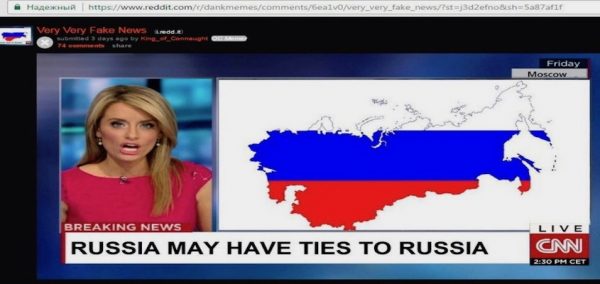
The unceasing torrent of Russiagate lies turns Democrats into war hawks and causes liberals to spout nonsense that was once consigned to the fringe right wing. It’s worse than the old McCarthyism.
A recent poll indicated that Democrats are more likely than Republicans to hold pro-war views. That revelation is hardly surprising considering the degree to which their party has promoted the trope of Donald Trump as a Russian government asset. This strategy is a focal point for them and a weapon to be used against the Republicans instead of the political opposition their voters need.
The ongoing investigation popularly known as Russiagate is a cynical hoax perpetrated by the Democratic Party leadership and their friends in corporate media. Russiagate distracts the public from taking a hard look at the Democratic Party corruption and resulting missteps that put Donald Trump in the White House. It also serves the interests of the bi-partisan surveillance state, which feared that Trump pronouncements indicated fundamental changes in foreign policy which they could not abide.
These allegations have Trump on the ropes, but mostly because of the relentless repetition of lies about the investigation. The litany of indictments paraded by the media involve crimes like tax fraud and payments to porn stars. None of the indictments point to collusion between the Russian government and the Trump campaign. Because no such connections have been made the media continue whipping up hysteria in an effort to keep the tale alive. The campaign is more shrill than ever because the hollowness of the case is clear to anyone who is really paying attention.
Comparisons have been made with McCarthyite “Red Scare” of the 1950s. But it can be argued that Russiagate is even worse. Bizarre assertions that were once consigned to the fringe right wing are now repeated on a daily basis by influential corporate media personalities and nearly all Democratic Party politicians.
The most prolific Russiagate practitioner is Rachel Maddow of MSNBC. She has ridden that horse so successfully that she now has the highest rated program on cable news. But she may have reached a moment which prompted the famous question asked at the army/McCarthy hearings. “At long last have you no sense of decency?”
Her assertion that Russia might be able to hack into the power grid and freeze Americans to death is quite dangerous . “What would you do if you lost heat indefinitely as the act of a foreign power on the same day that the temperature in your front yard matched the temperature in Antarctica? I mean, what would you and your family do?” It doesn’t matter that experts declared that the claim was highly improbable if not impossible. There is now no depth that cannot be reached in the effort to bamboozle Democrats and keep them stupid and needlessly fearful.
Prestigious newspapers like the New York Times are equally guilty of passing off lies as the truth. The Times reported that Trump and his associates had more than 100 interactions with Russians before inauguration day in 2017. But the story falls apart on even cursory inspection. The Times includes unproven claims of contacts with Wikileaks when it isn’t even a Russian organization. Roger Stone is the latest to be indicted because of his own stupidity, having claimed contacts with Wikileaks that never even took place.
But even as the case for collusion falls apart, the McCarthyite media find new ways to keep the narrative running. Russian press coverage of Congresswoman Tulsi Gabbard’s presidential campaign is called a “campaign of support” for her candidacy. NBC called Russian reporting the “propaganda machine.” The real issue is that Gabbard dares to question U.S. foreign policy dictates. She met with Syrian president Assad and opposes the coup attempt against Venezuela. But stopping such heretical acts from taking place is a central feature of the Russiagate scare.
So insane is the conspiracy mongering that clear damage to Russian government aspirations are called “wins for Putin.” The Trump administration’s unilateral withdrawal from the 30-year old INF missile treaty is not something that Vladimir Putin would ever want. The decades long effort to limit nuclear proliferation gives both countries security knowing that the other is restricted in the number and placements of nuclear weapons. Yet this very obvious reality is now turned on its head, and truth is twisted and disappeared.
The worst possible outcome of Russiagate is that it increases the likelihood of armed conflict between the United States and Russia. The same people who see MSNBC, CNN and national newspapers as divine oracles can be led to support any government act, no matter how dangerous it may be. Liberals who might once have opposed a hot war would now be the first to support it.
The Russiagate pimps are stoking fear and hatred. They spread outright lies and ignorance and they are doing so because of base motives. The Democratic Party rank and file ought to be demanding answers about the 2016 defeat and the previous loss of 900 legislative seats around the country. But they have been so badly misled that they don’t know that they should be asking anything at all. Even people who call themselves progressives are worshipping prosecutorial excess from the Robert Mueller investigation team and applauding surveillance state killers bloviating on cable news programs.
McCarthyism is back and it is being led by liberals. The entire world is endangered because of their leaders’ lies and cover ups and their determination to follow blindly. The outcome will be continued political defeat at home and an increased likelihood of what was once unimaginable, war between two nuclear powers.
Margaret Kimberley lives in New York City, and can be reached via e-Mail at Margaret.Kimberley(at)BlackAgendaReport.com.
Claim that Russian media buy SM accounts to rock France is fake news – Moscow on Macron’s interview
RT | February 5, 2019
French President Emmanuel Macron is spreading fake news to undermine the work of the Russian media, if his recent interview with Le Point is anything to go by, a Russian Foreign Ministry spokeswoman said.
Before Yellow Vests went out to the streets in the twelfth weekend of consecutive mass demonstrations against the government’s economic policies, weekly political magazine Le Point published an interview with President Macron. There he blamed the scale of public discontent on Russians, social media, the far right and the far left.
“If it’s confirmed that Macron said that RT and Sputnik are buying social media accounts to destabilize the situation in Frаnce – this is real fake news,” Maria Zakharova told RT.
The foreign ministry sent a request to Paris to clarify whether the claims are a true representation of Macron’s thoughts and if that is the official position of the French government.
Macron lambasted the French media for picking up on what people are saying on social media and urged them to put more trust into the words of officials rather than “ordinary” people like the Yellow Vests. The president’s dismissive attitude to the public was noted.
Zakharova said that Macron should not be surprised that it’s the Yellow Vests and not the authorities that are being interviewed frequently, as officials had long been prohibited from talking to Russian media.
She also said that it’s “outrageous” that the French president equaled fascists and Russians when he was listing those he blamed for fueling protests. Macron used the term “la fachosphère” that describes ultra-nationalists and fascists.
“Russians are presented as the new enemies of the 21st century by French officials,” Zakharova said. She called attacks on Russian media a “co-ordinated” and “well-directed” campaign that is orchestrated by Brussels and Washington, who want to present Russian news outlets as “toxic” without bothering to provide facts.
“If there was any proof, they would have produced it already,” she said, noting that the ministry’s numerous requests to provide evidence when Russia is accused of “meddling” through its media went without a reply.
Reality Check: Is Russia planning to invade Sweden or is UK media spreading more baseless hysteria?
By Bryan MacDonald | RT | February 5, 2019
Two of Britain’s leading newspapers have run delirious headlines this week, warning of a potential Russian assault on neutral Sweden.
“Sweden’s first new conscripts prepare to repel Russian invaders” – the Telegraph.
“First Swedish conscripts in a decade begin training to defeat a Russian invasion” – Daily Mail.
Sounds scary, doesn’t it? Poor Sweden (population 9 million) getting ready to repel an attack from big, bad Russia (population 145 million).
Furthermore, to make things even worse, the “aggressor” is a military superpower and the “victim” stands alone, without even NATO to protect it. And that bit is really relevant here, as you will soon see.
Anyway, rest easy: Never mind the bollocks, here’s the British media. Armed with its particular brand of hysteria, mendacity, and click-bait calumny.
The Telegraph, which isn’t even pretending to be a newspaper anymore, bases its “Russian invasion” warning on the testimony of a Colonel Stennabb. He highlights how “Russia is prepared to use military means to accomplish political objectives, not just in Crimea but in Syria.”
Hardly a radical concept, even in Europe where many countries, most notably, France (Libya, Ivory Coast, CAR, Chad, etc.) and the UK (Iraq, Syria, Sierra Leone, Kosovo, etc.) aren’t exactly shy about backing up words with firepower.
At no point does Stennabb explain why Russia would want to invade Sweden. Nor does the Telegraph. Which fails to note Sweden doesn’t even border mainland Russia, although it does sit across the Baltic Sea from the tiny Russian exclave of Kaliningrad.
After all, Sweden has few resources useful to Moscow and IKEA already has plenty of stores around Russia.
That said, Vladimir Putin’s spokesman, Dmitry Peskov, did mention last year that the president is partial to ABBA. But, surely there are easier ways of encouraging them to reform?
The Mail piece largely amounts to a rewrite of the Telegraph’s scaremongering. But they do pad it out a bit, mentioning how “Russia has also been launching incursions into European airspace.”
For illustration, it explains “just last week, a Russian Su-27 fighter was filmed ‘pushing’ an American F-15 out of the way as they patrolled over the Baltic Sea.” Adding how, in a separate incident, “the (US) Pentagon said that a Russian jet came dangerously close to one of its fighters over the Black Sea on Monday.”
So, here we have two American aircraft operating in Europe and this British newspaper is accusing Russia of “launching incursions into European airspace.”
Meaning either the Mail is unaware that Russia is in Europe but the United States is not, or it thinks its readers are stupid.
Anyway, the last major conflict between Sweden and Russia ended in 1790, following a failed Swedish attack two years earlier. Famously, the conflict was started by King Gustav III of Sweden for domestic political reasons.
This present UK media hysteria serves similar ends. Because, in this time of austerity, British Armed Forces spending is squeezed. And what better way to keep the moolah coming than to create a plausible enemy?
Plus, there’s a small, but vocal, bunch both within and without Sweden who hope to drag the traditionally neutral country into NATO. Go figure.
Weapons ending up with terrorists is OK, as long as Obama did it: The world according to CNN
RT | February 5, 2019
A “bombshell” CNN report has revealed that US-made weapons found their way to Al-Qaeda-linked fighters in Yemen. But is anyone surprised? And where was CNN when the Obama administration armed hardcore jihadists in Syria?
The CNN investigation revealed how American-made weapons ended up in the hands of “al Qaeda-linked fighters, hardline Salafi militias, and other factions waging war in Yemen,” vis-a-vis the US’ coalition partners Saudi Arabia and the UAE. Some of these weapons have also been seized by Iranian-backed militias, CNN claims.
The hardware, referred to as “Beautiful military equipment” by President Trump, was supplied to Saudi Arabia and the UAE, who have backed the embattled Yemeni government in its three-year civil war against Houthi rebels. However, CNN claims that Saudi Arabia and the UAE have funnelled the arms to pro-government factions, including the islamist Giants Brigade and the Al-Qaeda-linked Abu Abbas brigade.
The shifting frontlines in Yemen ensured that many of these weapons – including wire-guided TOW missiles and mine-resistant armored vehicles (MRAPs) – ended up seized by Houthi militants and Iranian proxy forces. More American weapons still ended up for sale in Yemen’s teeming arms bazaars, where they fetch a higher price than the rusted AK-47s more common to the region.
CNN lays responsibility squarely at the feet of Saudi Arabia, the UAE, and the Trump administration, which refused to cancel its multibillion dollar arms deals with the Saudis last year, for fear of losing “all of that investment being made into our country.”
The report paints a depressing, but familiar picture. Picking sides in foreign wars has historically proven disastrous for the United States, yet successive administrations have made the same mistakes again and again. The Reagan administration armed Saddam Hussein in his war with Iran, going as far as arranging the sale of anthrax to the Iraqi leader. Both Jimmy Сarter and Ronald Reagan propped up the Afghan mujahideen in their fight against the Soviets in the 1980s. In both cases, US forces would be shot at with the same weapons just two decades later.
Covering for Obama
More recently, in 2014 Barack Obama announced that the US would hand-select and arm ‘moderate rebels’ in Syria, stepping into the country’s bloody civil war. That too would prove disastrous, with troves of US arms ending up in the hands of Al-Nusra and ISIS.
But where was CNN when Obama asked Congress for $500 million to train, arm, and “empower the moderate Syrian opposition?”
CNN was reporting the news verbatim from Obama’s mouth, repeating the phrase “moderate rebels” without the ironic quotation marks that have become necessary since. Obama’s assertion that the rebels offered the “best alternative to terrorists and a brutal dictator” was not questioned, unlike Trump’s continuation of the longstanding US policy of arming the Saudis.
Obama called for funding in June 2014, but Syrian militias had already received support from the CIA for two years at that stage. CNN’s reporting on the covert arms pipeline was scant, didn’t question the credentials of the recipients, and mostly repeated the line of US intelligence officials: “That is something we are not going to dispute, but we are not going to publicly speak to it.”
Few questions were asked as Congress authorized the military support that September, and none were asked a year later as Obama resupplied his chosen rebels in Syria. Instead, Obama’s declaration of support for “the moderate Syrian opposition” was taken at face value and left unquestioned.
The reality in Syria
As CNN repeated the White House line on Syria, the network published just one report hinting that things might be amiss: an investigation by Amnesty International that found Islamic State (IS, formerly ISIS) militants were armed to the teeth with US-made weapons. The weapons were acquired by IS from local forces armed by the Obama administration, and then used to “relentlessly” target civilians with “small arms, artillery fire and huge quantities of improvised explosive devices.”
While CNN was assuaging the public, the situation on the ground in Syria was anything but moderate. US arms were quickly sold on the black market by ‘moderate rebels’ who either retired from the fight or wanted to turn a quick buck. With morale low, some of these fighters literally handed their weapons to Al-Nusra jihadists in exchange for safe passage away from the frontlines, while more were stolen by the Islamists.
Moreover, one Al-Nusra commander codenamed Abu Al Ezz told the German Koelner Stadt-Anzeiger newspaper that his group, and not so-called ‘moderate rebels’, received TOW missiles directly from the US. “The missiles were given to us directly,” he said, adding: “The Americans are on our side.” The commander went on to detail how his fighters had received training from US instructors, and financial support from Saudi Arabia and Israel for capturing specific objectives in Syria.
The Trump administration ended the arms supply program to the Syrian rebels in 2017, a decision that CNN called“a big win for Russia.” The idea that ending material support for terrorists might just be a good thing was not raised, and CNN described the program as “a lifeline” to anti-government forces.
CNN even stuck by its straight-faced use of the term ‘moderate rebels’, despite multiple other news outlets publishing reports of US weapons falling into terrorist hands.
Two months before the 2016 election, CNN absolved Obama of all his sins in Syria by publishing an interview in which the then-president said the situation there “haunts” him constantly. The network blamed external factors for the deteriorating situation in Syria, and ended with a quote from Obama’s press secretary, who said that every one of the former president’s decisions “was squarely within the national security interest of the United States and even advanced our national security interests.”
CNN’s latest exclusive report is a well-researched piece of journalism, fleshed out with on-the-ground reporting from war-torn Yemen. However, given the network’s history in reporting US arms programs, it was much more likely motivated by a desire to score points against Trump than the pursuit of cold truth, no matter who is in charge.
Iran Slams EU Accusations of “Assassination Attempts, Terrorist Plots in Europe”
Sputnik – 05.02.2019
Iran regrets the European Union “groundlessly” accusing it of hostile activities, such as alleged assassination plots in several EU states, the Iranian Foreign Ministry said on Tuesday.
“The unsubstantiated accusations, such as with regard to assassination attempts and attempted terrorist attacks in Europe, have been groundless and surprising from the very beginning. We are disappointed with such accusations and concerns of the Europeans, while in Europe itself terrorist and criminal groups are being active,” the Iranian Foreign Ministry wrote.
Tehran went on to express hope that Brussels would realistically approach the issue of terrorism, unlike those who use “double standards.”
Responding to the bloc’ concerns on Iran’s desire to increase the accuracy and range of its missiles, the Foreign Ministry said that Tehran’s activities were exclusively defensive.
On Monday, the European Union sanctioned two individuals and one entity in relation to Iran’s “hostile activities” in some European countries. The Council of the European Union also called on Iran to halt activities aimed at the development and testing of ballistic missiles.
Earlier, the Danish Security and Intelligence Service (PET) accused its Iranian colleagues of plotting an assassination of an Iranian separatist group member in Denmark. Dutch Foreign Minister Stef Blok and Interior Minister Kajsa Ollongren said in January that they had “strong indications” of Tehran being behind assassinations of two Dutch nationals of Iranian origin in 2015 and 2017.
Tulsi Gabbard Slams “Neocon/Neolib Warmongers” After NBC Propaganda Exposed
By Tyler Durden – Zero Hedge – 02/04/2019
Tulsi Gabbard lashed out at “neocon” and “neolib warmongers” after NBC News was exposed trying to smear her as a Kremlin stooge. The network was called out over the weekend for relying on a Democrat-run firm that created fake Russian twitter bots to stage a “false flag” campaign against Republic Roy Moore in the 2017 Alabama special election – New Knowledge.
To justify its claim that Tulsi Gabbard is the Kremlin’s candidate, NBC writes:
“analysts at New Knowledge, the company the Senate Intelligence Committee used to track Russian activities in the 2016 election, told NBC News they’ve spotted ‘chatter’ related to Gabbard in anonymous online message boards, including those known for fomenting right-wing troll campaigns.”
Only to be called out hard by journalist Glenn Greenwald:
This NBC News report is a total disgrace from top to bottom. It’s a joke using the most minimal journalistic standards. But that’s because NBC is in partnership with the Democratic Party (and intel community) to smear any Dem adversary, on the left or right, as a Kremlin tool: pic.twitter.com/1jUhJQuhJu
— Glenn Greenwald (@ggreenwald) February 3, 2019
After Greenwald fingered NBC for relying on New Knowledge – run by Jonathan Morgan (who also developed the technology behind “Hamilton 68” Russian bot-tracking propaganda website that refuses to disclose its methods) – Gabbard chimed in, tweeting:
“@ggreenwald exposes that @NBC used journalistic fraud to discredit our campaign. But more important is their motive: “to smear any adversary of the establishment wing of the Democratic Party – whether on the left or the right – as a stooge or asset of the Kremlin.”
She later added:
“As commander-in-chief, I will work to end the new cold war, nuclear arms race and slide into nuclear war. That is why the neocon/neolib warmongers will do anything to stop me.
As commander-in-chief, I will work to end the new cold war, nuclear arms race and slide into nuclear war. That is why the neocon/neolib warmongers will do anything to stop me. https://t.co/MPybv8AZ5p
— Tulsi Gabbard (@TulsiGabbard) February 4, 2019
The term “neoliberal warmongers” is thus bornhttps://t.co/xiB7qkkao9
— zerohedge (@zerohedge) February 4, 2019
Disturbingly, the Senate Intelligence Committee has relied on a report by New Knowledge on Russian social media election interference, while the firm has created a “Hamilton 68” offshoot, “Disinfo2018” referenced in the NBC article, which claims that three of the top URLs propagated throughout social media by Kremlin bots were about Gabbard.
Three of the top 15 URL’s shared over the past 24 hours by 800 Russian-linked disinformation accounts tracked by Disinfo2018 are about Tulsi Gabbard, the pro-Putin, pro-Assad congresswoman who just announced she’s running for POTUS in 2020. (One URL is an article; 2 are tweets). pic.twitter.com/SG43IGt9ZV
— Caroline Orr (@RVAwonk) January 15, 2019
In short; NBC relied on a known propagandist who created a Russian bot “false flag” to meddle in an election, who claims to track pro-Kremlin Twitter activity, in order to smear Tulsi Gabbard as a Putin puppet.
That’s a lot of hot talk, Mike.
— Ben Popken (@bpopken) February 4, 2019
And your article is one of the hottest piles of garbage masquerading as “journalism” that I’ve ever seen, so congratulations on that. You’re a pathetic joke
— Michael Tracey (@mtracey) February 4, 2019
Except they’re not “experts” NBC–they’re admitted forgers. You’re a rabble NBC. A complete rabble. Go back to school: https://t.co/e9KJU2oisv … pic.twitter.com/1XnfMmjqgh
— WikiLeaks (@wikileaks) February 3, 2019
It’s uncanny what lengths the establishment will go to in order to eliminate threats. For example, take a look at this Vanity Fair hit piece from Jan 30, which uses perhaps the most unflattering photo Gabbard has ever taken and starts off (emphasis not ours):
The presidential campaign of Rep. Tulsi Gabbard, the renegade Democrat known as much for her chummy relationship with Bashar al-Assad as for supporting Bernie Sanders, is beginning to resemble the candidate herself: confusing, disorganized, and, according to Politico, falling apart. –Vanity Fair
If you squint hard, you can almost tell they don’t like her. Very subtle pic.twitter.com/duwKhrrUd1
— Michael Tracey (@mtracey) February 2, 2019
One question remains; will Gabbard become a Democrat puppet like Bernie Sanders if the DNC colludes with their chosen candidate to cheat against her?
“New Knowledge” and the same old same old
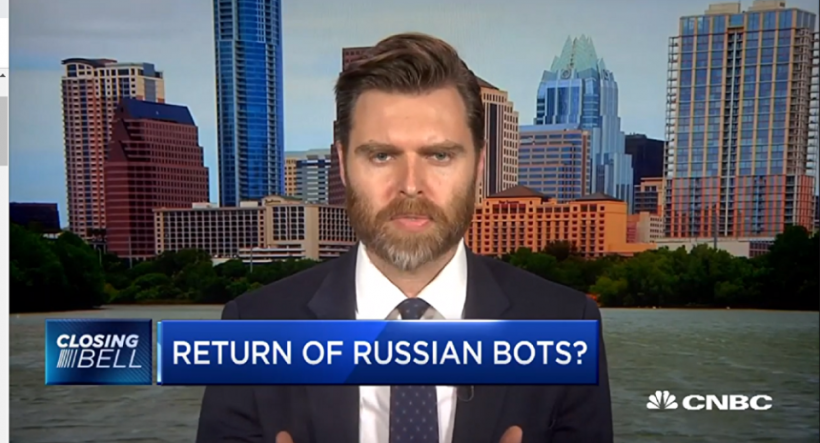
Jonathon Morgan, CEO of New Knowledge and former State Department employee.
By Kit Knightly | OffGuardian | February 4, 2019
Most of us in the UK-based alternate media are familiar with the Integrity Initiative by now. A disinformation campaign funded by the foreign office through the (very dodgy sounding) Institute for Statecraft. Their job was to smear people opposing Theresa May’s government – be they foreign or domestic. The scale of the scandal hasn’t been appreciated by the public, thanks to the muteness of the mainstream media, but the foreign office using public money to have the intelligence agencies smear the opposition should be enough to bring down any government.
Thanks to some excellent work by people in the alternate media and some MPs, the Integrity Initiative’s website is currently empty “pending an investigation of data theft”. More honestly, it had become an embarrassment. They will likely disappear and then relaunch under a new name, and may indeed have already done so. For now, the Integrity Initiative is done.
Less well-known in this country is New Knowledge, a direct US-based parallel of the Integrity Initiative. They’ve been conducting “counter-propaganda” and “social media experiments” in the US since 2015, but only just hit the headlines.
Who are “New Knowledge”?
A good question – we don’t really know. Their website claims to have “thousands of volunteers”. This may or may not be true – we only have three named people:
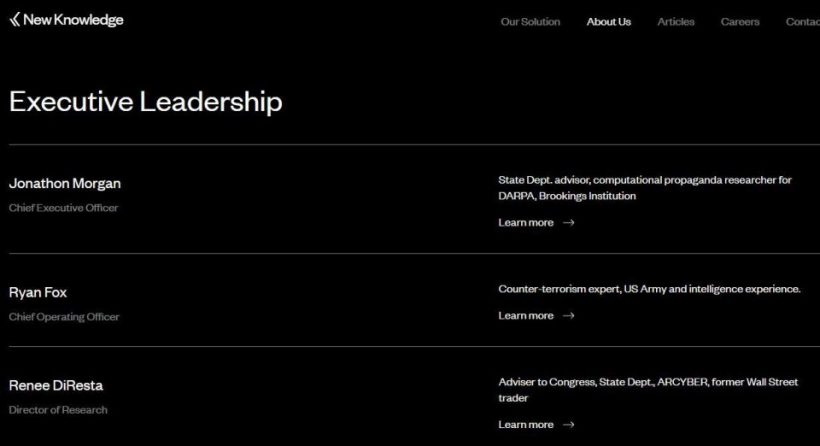
… but what a three they are. Jonathon Morgan, formerly of the State Department and Brookings Institute. Ryan Fox, formerly of military intelligence. Renee DiResta, formerly of Wall Street.
The State Department, military intelligence and Wall Street. The unholy trinity.
Obviously, some questions present themselves. Primarily, can we really trust all those “formerlies”? How did these three start this project? How do they know each other? Where does their funding come from?
We don’t know. What we do know is that, somehow, these three crazy kids got together and decided to use their money (we don’t know where they got it from) and their army of volunteers (we don’t know who they are) to “combat disinformation”. A noble goal indeed.
Let’s see how they did…
Why is New Knowledge in the news?
This “think tank” recently made the headlines in the US because they were caught attempting to manipulate the Alabama Senatorial election. This is not a fringe “conspiracy theory” claim – it was in the New York Times, twice.
It’s now known that New Knowledge took part in various social media-based attempts to swing the Alabama senate race in favour of Democrat Doug Jones. These efforts were varied and odd. They included creating a fake Facebook page, purporting to be a group of Baptists who supported Republican candidate Roy Moore, because they believed he would help them ban alcohol statewide. They also encouraged (and/or created) independent candidates from the conservative right, in efforts to split the Republican vote.
We don’t know what impact it had – but Jones did win a very narrow victory over Moore (fewer than 22,000 votes).
However, this was – by far – the most important facet of this story:
It involved a scheme to link the Moore campaign to thousands of Russian accounts that suddenly began following the Republican candidate on Twitter, a development that drew national media attention.
New Knowledge pretended to be Russians supporting a Republican candidate in order to discredit him by association. They freely admit it:
We orchestrated an elaborate ‘false flag’ operation that planted the idea that the Moore campaign was amplified on social media by a Russian botnet,”
So it seems rather than “combatting disinformation”, New Knowledge actively spreads disinformation to achieve political goals.
They are staffed by State Dept. and intelligence agency veterans, and they spread false information to swing elections. That makes them a Psy-Op:
Psychological operations (PSYOP) are operations to convey selected information and indicators to audiences to influence their emotions, motives, and objective reasoning, and ultimately the behaviour of governments, organizations, groups, and individuals.
So what was the reaction?
Mild. Disappointing. On multiple levels.
Just like the Integrity Initiative coverage in the UK, the wider implications of corruption were completely ignored. The story was always framed in terms of “fighting back against the Kremlin”, or “turning Putin’s methods against him”. The coverage focused on this being a “gift for the Kremlin” because it appeared to undermine the claims of Russiagaters (Note “appears to undermine”, rather than “undermines”).
New Knowledge (NK), of course, denied they were attempting to corrupt democracy in Alabama. Morgan called the Alabama operation an “experiment” testing the effectiveness of “Russian methods”. He claimed it was specifically “designed to have as little impact as possible”. (How you can “test the effectiveness” of something designed to have no impact is unclear to me).
No evidence is supplied to corroborate Morgan’s version of events. In fact, there’s no reason to think this is a one-off at all. This is just the one we know about. Deep State psy-ops are like ants, for every one you see… there’s a hundred you don’t. A single sighting means there’s a whole colony nearby.
All of the national media and pundits resolutely ignored the very large elephant in the very small room – NK have existed since 2015. Before the 2016 Presidential election. The NYT warns these tactics could make the 2020 election ugly – but they don’t relate it back to the 2016 election at all.
This is not about Russia “corrupting our practices” or us “employing Russian methods”, this is evidence that there NEVER WAS any “Russian interference”, that “Russia’s methods” are actually our methods. Evidence that “Russiagate” is a Deep State psy-op designed to discredit and control Donald Trump’s administration.
Rather predictably, none of the media articles takes this angle.
And, unlike the Integrity Initiative, New Knowledge’s website is very much alive and well. Outside of political corruption, there’s also levels of financial corruption. New Knowledge CEO Jonathon Morgan is also one of the builders of Hamilton 68 – a program which claims to track Russian “bot” activity. On the one hand, he works for a think-tank which fakes bot activity, on the other, he charges people for a product he claims tracks bot activity. There is, of course, a massive opportunity for fraud and corruption there.
But, far from being rebuked, sanctioned, or punished in any way – New Knowledge seems to be functioning just as before.
In fact, NBC News already ran a story claiming progressive Hawaiian Congresswoman Tulsi Gabbard is being backed by the Russian “propaganda machine”
They cite New Knowledge as an expert witness.
Conclusion
In summary, a shadowy think-tank staffed entirely by State Department and intelligence veterans is using funding from unknown sources and volunteers of unknown identity to pretend to be Russians on social media in order to discredit politicians and political movements in the United States. This should be a Congressional hearing. But instead, it’s a back-page “oh, did you know” story.
The following are important questions that need answering:
- How is the New Knowledge group funded?
- Are they paid by the government or military?
- Who are these “thousands of volunteers”?
- Are they the US equivalent of the UK’s 77th Brigade?
- What other elections were targetted by New Knowledge (or similar) operations?
Just like the Integrity Initiative, New Knowledge works by concealing its true nature and intentions. It is layer after layer of deception and darkness. It can be beaten, the same way II was beaten – by bringing it out into the open and exposing lies to the light of truth.
Kit Knightly is co-editor of OffGuardian. The Guardian banned him from commenting. Twice. He used to write for fun, but now he’s forced to out of a near-permanent sense of outrage.
As she enters White House race, demonization of ‘Kremlin’s crush’ Tulsi Gabbard goes full tilt

By Igor Ogorodnev | RT | February 3, 2019
The sky may have been clear in Hawaii when Tulsi Gabbard read her speech promising to fight “greed and corruption,” but she enters her bid under a cloud of negative media coverage and accusations of being Russia’s darling.
At first glance Gabbard would seem almost too perfect for the Democratic candidate to face Trump in 2020: a 37-year-old part-Samoan woman, who previously broke off a promising career in local politics to volunteer for combat zone service in Iraq, and is unfailingly popular with voters on her home island.
“What our country needs now more than ever is the spirit of Aloha. That spirit of respect and love for one another and for our country,” she said in a launch speech that the 2008 Barack Obama, himself, might have found too idealistically bland.
Hours earlier, in a two-author NBC investigation an entirely different picture had been painted of the “controversial” Gabbard – the centerpoint of “the first stirrings of an upcoming Russian campaign” in which the Kremlin “propaganda machine” would seek to inject pro-Russian positions into the Democratic Party’s discussions and debates with help from “inauthentic accounts.”
I’m Not With Her
To understand why Gabbard is not treated as a customary feel-good story of a woman breaking multiple glass ceilings, but as a tool of the Kremlin, several pages of her biography need to be revisited.
The first, her resignation from the senior post of Vice President of the Democratic National Committee in protest at the lack of scheduled debates between frontrunner Hillary Clinton and the rising Bernie Sanders, whom she subsequently went on to endorse.
The second, a now-famous meeting with Bashar Assad in 2017, and Gabbard’s insistence that Washington should not engage in “regime change” or sponsorship of radical militant organizations in Syria or anywhere else.
Those two incidents alone have pitted Gabbard against two major establishment forces, and that is before one gets into the details of her socialist-tinged platform from healthcare for all to anti-Wall Street policy proposals. Or her support of stronger border control, which puts her at odds with her party’s official position.
Friendly fire
None of Gabbard’s stances are beyond debate, but she may not even get as far as debating them in public with the other Democrat nominees, if her campaign is dead on arrival. And the media hasn’t been her friend.
All candidates face scrutiny and an airing of their skeletons, but not only has she received less airtime than fellow relative novices Cory Booker and Kamala Harris, but the overall coverage of Gabbard has been uncharacteristically toxic, perhaps comparable only to the Democratic ostracism of Howard Schultz, following the former Starbucks CEO’s unbidden decision to enter the race.
The favored genre has been the expose.
In the past month alone: CNN has dug up Gabbard’s activism and comments, some dating back to the late 1990s, when she was a teenager, against same-sex marriage, for a campaign backed by her legislator father. The Intercept has accused her of associating with Hindu Nationalists, while the Daily Beast has published an article under the title ‘Horseshoe theory: Why Conservative Media and the Far Right Love Tulsi Gabbard for President’, in which it was emphasized that the “enigmatic” Gabbard had “earned substantial praise” from, among others, white nationalist David Duke. Huffington Post accused her of hypocrisy for accepting money from arms manufacturers in the past, even though she never concealed that fact, and is in reality one of just several members of the House who explicitly refuse campaign donations.
Politico published a detailed dissection of her campaign being “in disarray” based on detailed unattributed revelations from the inside, while Daily Kos, the Democrat politics blog, has already endorsed her rival for the 2020 Congress run, which equates to the real election in a district where the Democrats have never lost against the GOP.
‘Defended’ her in an article – how dare they?
On Friday, came NBC’s coup de grace.
“An NBC News analysis of the main English-language news sites employed by Russia in its 2016 election meddling shows Rep. Tulsi Gabbard of Hawaii, who is set to make her formal announcement Saturday, has become a favorite of the sites Moscow used when it interfered in 2016,” wrote the authors, one of whom Ben Popken, concluded that the Kremlin “has a crush” on Gabbard when he posted his article to Twitter.
The “analysis” – which appears to have been a name search – found that 20 articles have been published on Gabbard by RT (is it 21 now?), Sputnik and Russia Insider, twice as many as Joe Biden or Bernie Sanders. And not just that, but in these articles Gabbard was not mentioned “perfunctorily” but “celebrated” and “defended” despite her “lack of voter recognition.”
Even supposing that all that is correct, does RT have to cover Joe Biden every time it mentions Tulsi Gabbard? Elizabeth Warren? Julian Castro? Should CNN stop putting Kamala Harris in almost every piece about the race? As a non-US news outlet is RT allowed to find her non-interventionist views more interesting for its international audience than those of a status quo Democratic runner? What about as an alternative media outlet? Should covering a candidate who “lacks voter recognition” be considered suspicious? How much of this is sufficient to justify accusations of meddling and being branded a “Russian troll” and presumably sanctioned? Does all of this apply when the US media writes about Juan Guaido in Venezuela?
But wait, there are also “experts who track inauthentic social media accounts” who back this up.
“A few of our analysts saw some chatter on 8chan saying she was a good ‘divider’ candidate to amplify,” New Knowledge’s director of research Renee DiResta told NBC. 8chan? Chatter? Also New Knowledge? The establishment Democrat tech outfit that has just been caught planting and creating fake Russian bots in the Alabama election as part of a false flag operation. They are your experts, NBC?
Even much of Dem-voting Twitter was appalled at such a ham-fisted smear job.
Incompetent, threat or victim of smear campaign?
The media are now fulfilling their own prophecies, as they publish pieces about the “rocky” or “chaotic” start to Gabbard’s campaign. As she keeps going on the defensive – apologizing for the gay marriage remarks, standing firm on Assad meeting – the Hawaiian representative may survive or wilt.
But two questions remain: Is Gabbard just a stumbling novice with odd views, or is the media trying to systematically bury her, as opposed to informing their readers, all because she presents a threat to accepted positions? And secondly, is it doing so at the behest of and with help from a network of influence, be it DNC operatives, or Washington insiders? If the answer to the first question is “the latter” or to the second is “yes,” perhaps instead of spending so much time on our website, investigative reporters should have a look at the provenance and motivations behind some of their own coverage.
What the mainstream media doesn’t tell you about Venezuela
By Yves Engler · February 3, 2019
The corporate media is wholeheartedly behind the federal government’s push for regime change in Venezuela. The propaganda is thick and, as per usual, it is as much about what they don’t, as what they do, report. Here are some important developments that have largely been ignored by Canada’s dominant media:
- At the Organization of American States meeting called by US Secretary of State Mike Pompeo on January 25 the Canadian-backed interventionist resolution was defeated 18-16.
- The “Lima Group” of governments opposed to Venezuela’s elected president was established 18 months ago after Washington, Ottawa and others failed to garner the votes necessary to censure Venezuela at the OAS (despite the head of the OAS’s extreme hostility to Venezuela’s President Nicolas Maduro).
- Most of the world’s countries, with most of the world’s population, have failed to support the US/Canada push to recognize National Assembly head Juan Guaidó as president of Venezuela.
- The UN and OAS charters preclude unilateral sanctions and interfering in other countries’ affairs.
- UN Human Rights Council Special Rapporteur for sanctions, Idriss Jazairy, recently condemned US/Canadian sanctions on Venezuela.
As well, here are some flagrant double standards in Canadian policy the media have largely ignored:
- “Lima Group” member Jair Bolsonaro won the recent presidential election in Brazil largely because the most popular candidate, Lula Da silva, was in jail. His questionable election took place two years after Lula’s ally, Dilma Rousseff, was ousted as president in a ‘parliamentary coup’.
- Another “Lima Group” member, Honduras president Juan Orlando Hernandez, defied that country’s constitution a year ago in running for a second term and then ‘won’ a highly questionable
- “At the same time”as Canada and the US recognized Juan Guaidó, notes Patrick Mbeko, “in Democratic Republic of Congo they refuse to recognize the massive recent victory of Martin Fayulu in the presidential election, endorsing the vast electoral fraud of the regime and its ally Félix Tshisekedi.”
Beyond what the media has ignored, they constantly cite biased sources without offering much or any background. Here are a couple of examples:
- The Globe and Mail has quoted Irwin Cotler in two recent articles on Venezuela. But, the decades-long anti-Palestinian and anti-Hugo Chavez activist lacks any credibility on the issue. At a press conference in May to release an OAS report on alleged rights violations in Venezuela, Cotler said Venezuela’s “government itself was responsible for the worst ever humanitarian crisis in the region.” Worse than the extermination of the Taíno and Arawak by the Spanish? Or the enslavement of five million Africans in Brazil? Or the 200,000 Mayans killed in Guatemala? Or the thousands of state-murdered “subversives” in Chile, Argentina, Uruguay, Brazil?
- CBC and Canadian Press (to a slightly lesser extent) stories about former Venezuelan Colonel Oswaldo Garcia, whose family lives in Montréal, present him as a democracy activist. But, notes Poyan Nahrvar, Garcia participated in a coup attempt last year and then launched raids into Venezuela from Colombia until he was captured by the Venezuelan military.
- The media blindly repeats Ottawa’s depiction of the “Lima Group”, which Prime Minister Justin Trudeau described as an organization established to “bring peace, democracy and stability in Venezuela.” One report called it “a regional block of countries committed to finding a peaceful solution” to the crisis while another said its members “want to see Venezuela return to democracy.” This portrayal of the coalition stands its objective on its head. The “Lima Group” is designed to ratchet up international pressure on Maduro in hopes of eliciting regime change, which may spark a civil war. That is its reason for existence.
As part of nationwide protests against the “Lima Group” meeting taking place in Ottawa on Monday, activists in Montréal will rally in front of Radio Canada/CBC’s offices. They will be decrying not only Canada’s interference in Venezuela but the dominant media’s effort to “manufacture consent” for Canadian imperialism.
Your Complete Guide to the NY Times’ Support of US-Backed Coups in Latin America
By Adam H. JOHNSON | TruthDig | January 29, 2019
On Friday, The New York Times continued its long, predictable tradition of backing U.S. coups in Latin America by publishing an editorial praising Donald Trump’s attempt to overthrow Venezuelan President Nicolas Maduro. This will be the 10th such coup the paper has backed since the creation of the CIA over 70 years ago.
A survey of The New York Times archives shows the Times editorial board has supported 10 out of 12 American-backed coups in Latin America, with two editorials—those involving the 1983 Grenada invasion and the 2009 Honduras coup—ranging from ambiguous to reluctant opposition. The survey can be viewed here.
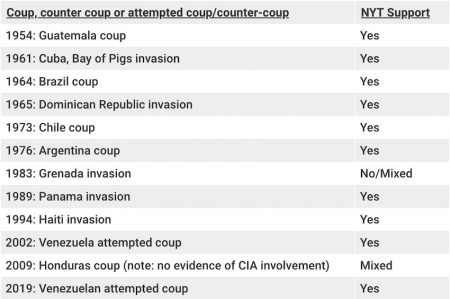
Covert involvement of the United States, by the CIA or other intelligence services, isn’t mentioned in any of the Times’ editorials on any of the coups. Absent an open, undeniable U.S. military invasion (as in the Dominican Republic, Panama and Grenada), things seem to happen in Latin American countries entirely on their own, with outside forces rarely, if ever, mentioned in the Times. Obviously, there are limits to what is “provable” in the immediate aftermath of such events (covert intervention is, by definition, covert), but the idea that the U.S. or other imperial actors could have stirred the pot, funded a junta or run weapons in any of the conflicts under the table is never entertained.
More often than not, what one is left with, reading Times editorials on these coups, are racist, paternalistic “cycle of violence” cliches. Sigh, it’s just the way of things Over There. When reading these quotes, keep in mind the CIA supplied and funded the groups that ultimately killed these leaders:
- Brazil 1964: “They have, throughout their history, suffered from a lack of first class rulers.”
- Chile 1973: “No Chilean party or faction can escape some responsibility for the disaster, but a heavy share must be assigned to the unfortunate Dr. Allende himself.”
- Argentina 1976: “It was typical of the cynicism with which many Argentines view their country’s politics that most people in Buenos Aires seemed more interested in a soccer telecast Tuesday night than in the ouster of President Isabel Martinez de Perlin by the armed forces. The script was familiar for this long‐anticipated coup.”
See, it didn’t matter! It’s worth pointing out the military junta put in power by the CIA-contrived coup killed 10,000 to 30,000 Argentines from 1976 to 1983.
There’s a familiar script: The CIA and its U.S. corporate partners come in, wage economic warfare, fund and arm the opposition, then the target of this operation is blamed. This, of course, isn’t to say there isn’t merit to some of the objections being raised by The New York Times—whether it be Chile in 1973 or Venezuela in 2019. But that’s not really the point. The reason the CIA and U.S. military and its corporate partisans historically target governments in Latin America is because those governments are hostile to U.S. capital and strategic interests, not because they are undemocratic. So while the points the Times makes about illiberalism may sometimes be true, they’re mostly a non sequitur when analyzing the reality of what’s unfolding.
Did Allende, as the Times alleged in 1973 when backing his violent overthrow, “persist in pushing a program of pervasive socialism” without a “popular mandate”? Did, as the Times alleged, Allende “pursue this goal by dubious means, including attempts to bypass both Congress and the courts”? Possibly. But Allende’s supposed authoritarianism isn’t why the CIA sought his ouster. It wasn’t his means of pursuing redistributive policies that offended the CIA and U.S. corporate partners; it was the redistributive policies themselves.
Hand-wringing over the anti-democratic nature of how Allende carried out his agenda without noting that it was the agenda itself—not the means by which it was carried out—that animated his opponents is butting into a conversation no one in power is really having. Why, historically, has The New York Times taken for granted the liberal pretexts for U.S. involvement, rather than analyzing whether there were possibly other, more cynical forces at work?
The answer is that rank ideology is baked into the premise. The idea that the U.S. is motivated by human rights and democracy is taken for granted by The New York Times editorial board and has been since its inception. This does all the heavy lifting without most people—even liberals vaguely skeptical of American motives in Latin America—noticing that a sleight of hand has taken place. “In recent decades,” a 2017 Times editorial scolding Russia asserted, “American presidents who took military action have been driven by the desire to promote freedom and democracy, sometimes with extraordinary results.” Oh, well, good then.
What should be a conversation about American military and its covert apparatus unduly meddling in other countries quickly becomes a referendum on the moral properties of those countries. Theoretically a good conversation to have (and one certainly ongoing among people and institutions in these countries), but absent a discussion of the merits of the initial axiom—that U.S. talking heads and the Washington national security apparatus have a birthright to determine which regimes are good and bad—it serves little practical purpose stateside beyond posturing. And often, as a practical matter, it works to cement the broader narrative justifying the meddling itself.
Do the U.S. and its allies have a moral or ethical right to determine the political future of Venezuela? This question is breezed past, and we move on to the question of how this self-evident authority is best exercised. This is the scope of debate in The New York Times—and among virtually all U.S. media outlets. To ante up in the poker game of Serious People Discussing Foreign Policy Seriously, one is obligated to register an Official Condemnation of the Official Bad Regime. This is so everyone knows you accept the core premises of U.S. regime change but oppose it on pragmatic or legalistic grounds. It’s a tedious, extortive exercise designed to shift the conversation away from the United States’ history of arbitrary and violent overthrows and into an exchange about how best to oppose the Official Bad Regime in question. U.S. liberals are to keep a real-time report card on these Official Bad Regimes, and if these regimes—due to an ill-defined rubric of un-democraticness and human rights—fall below a score of say, “60,” they become illegitimate and unworthy of defense as such.
While obviously not in Latin America, it’s also worth noting that the Times cheerled the CIA-sponsored coup against Iran’s President, Mohammad Mossadegh, in 1953. Its editorial, written two days after his ouster, engaged in the Times’ patented combination of victim-blaming and “oh dear” bloviating:
- “The now-deposed Premier Mossadegh was flirting with Russia. He had won his phony plebiscite to dissolve the Majlis, or lower House of Parliament, with the aid of the Tudeh Communists.”
- “Mossadegh is out, a prisoner awaiting trial. It is a credit to the Shah, to whom he was so disloyal, and to Premier Zahedi, that this rabid, self-seeking nationalist would have been protected at a time when his life would not have been worth the wager of a plugged nickel.”
- “The Shah … deserves praise in this crisis. … He was always true to the parliamentary institutions of his country, he was a moderating influence in the wild fanaticism exhibited by the nationalists under Mossadegh, and he was socially progressive.”
Again, no mention of CIA involvement (which the agency now openly acknowledges), which the Times wouldn’t necessarily have had any way of knowing at the time. (This is part of the point of covert operations.) Mossadegh is summarily demonized, and it’s not until decades later the public learns of the extent of U.S. involvement. The Times even gets in an orientalist description of Iranians, implying why a strong Shah is necessary:
[The average Iranian] has nothing to lose. He is a man of infinite patience, of great charm and gentleness, but he is also—as we have been seeing—a volatile character, highly emotional, and violent when sufficiently aroused.
Needless to say, there are major difference between these cases: Mossadegh, Allende, Chavez and Maduro all lived in radically different times and championed different policies, with varying degrees of liberalism and corruption. But the one thing they all had in common is that the U.S. government, and a compliant U.S. media, decided they “needed to go” and did everything to achieve this end. The fundamental arrogance of this assumption, one would think, is what ought to be discussed in the U.S. media—as typified by the Times’ editorial board—but time and again, this assumption is either taken for granted or hand-waved away, and we all move on to how and when we can best overthrow the Bad Regime.
For those earnestly concerned about Maduro’s efforts to undermine the democratic institutions of Venezuela (he’s been accused of jailing opponents, stacking the courts and holding Potemkin elections), it’s worth pointing out that even when the liberal democratic properties of Venezuela were at their height in 2002 (they were internationally sanctioned and overseen by the Carter Center for years, and no serious observer considers Hugo Chavez’s rule illegitimate), the CIA still greenlit a military coup against Chavez, and the New York Times still profusely praised the act. As it wrote at the time:
With yesterday’s resignation of President Hugo Chávez, Venezuelan democracy is no longer threatened by a would-be dictator. Mr. Chávez, a ruinous demagogue, stepped down after the military intervened and handed power to a respected business leader, Pedro Carmona.
Chavez would soon be restored to power after millions took to the streets to protest his removal from office, but the question remains: If The New York Times was willing to ignore the undisputed will of the Venezuelan people in 2002, what makes anyone think the newspaper is earnestly concerned about it in 2019? Again, the thing that’s being objected to by the White House, the State Department and their U.S. imperial apparatchiks is the redistributive policies and opposition to the United States’ will, not the means by which they do so. Perhaps the Times and other U.S. media—living in the heart of, and presumably having influence over, this empire—could try centering this reality rather than, for the millionth time, adjudicating the moral properties of the countries subject to its violent, illegitimate whims.
Featured Video
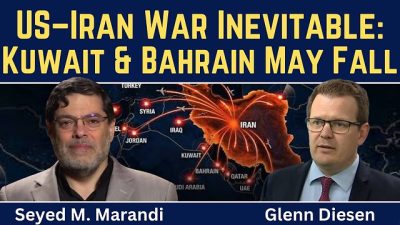
Seyed M. Marandi: US-Iran War Inevitable: Kuwait and Bahrain May Fall
or go to
Aletho News Archives – Video-Images
From the Archives
USS Liberty Massacre: A Pivotal Moment in the Hostile Takeover of America
By Kevin Barrett | Crescent | Dhu al-Qa’dah 24, 1445
In corporate America, hostile takeovers are commonplace. They occur when an aggressor—a larger corporation or rich individuals—seizes control of a smaller corporation without asking permission.
What few recognize is that the United States itself has been subjected to a hostile takeover. Since the aggressor, the illegitimate settler colony known as “Israel,” is much smaller than the US, the takeover has necessarily been surreptitious.
As of June, 2024, Israel’s gradual takeover of the US has become obvious and undeniable—a proverbial “elephant in the living room.” … continue
Blog Roll
 Aletho News
- Seyed M. Marandi: US-Iran War Inevitable: Kuwait and Bahrain May Fall
- Leaders Condemn Ansarallah Attack on Saudi Arabia While Ignoring Illegal War Against Yemen
- Leaked: Britain’s Covert Iraqi Psyops Network
- Yemeni Armed Forces Warn Airlines Against Using Saudi Airports, Exempt Mecca and Medina
- Iran security chief says powers greater than US tried to conquer Iran but ended in ‘dustbin of history’
- Europe’s mounting social chaos… chickens coming home to roost for proxy war against Russia
- US-Russia Diesel Deal Becomes Massive Defeat for Ukraine
- Hormuz and the Looming Economic Catastrophe
- Dhubab offensive, media blitz and the rapid unraveling of Saudi-backed coalition’s new gambit
- Putin Conveys to Trump Iran’s Vision on Possible Conflict Resolution – Kremlin
- If Americans Knew
- Gaza: Ceasefire Anniversary Marks Year of Failed Promises
- The American Conservative: Mike Huckabee Should Resign
- A C-Section in Shackles: A Palestinian Woman’s Harrowing Birth in Israeli Detention
- ‘He’s Desperate’: AIPAC Begins Spending Against Abdul El-Sayed to Boost Mike Rogers:
- Trump, Hormuz, and the Looming Economic Catastrophe
- For three years, Israel has killed a child in Gaza every 71 minutes – Daily Update
- Israeli forces kill another child in Gaza – Daily Update
- Gaza ceasefire exists in name only, say more than 100 organizations
- Nearly 2 Million in Gaza Need Urgent Shelter Assistance as Winter Looms: IOM Chief Warns
- Suppressing Palestinian resistance: US charity under fire for AI monitoring of Gaza classrooms
- No Tricks Zone
- Germany’s Green Energy Debacle: High Energy Costs Force Kahla Porzellan to Close After 182 Years!
- New Study: 50 Years Of The Most Aggressive ‘Net Zero’ Policies Can Only Affect The Global Climate By 0.03°C
- US September “Heat” Was No Record…Many Records Set Decades Ago
- Latest European Green Energy Debacle; Portugal’s Largest Flagship Solar Park Insolvent!
- Green Energy Debacle: German Expert Professor Fritz Vahrenholt Warns Of Severe Economic And Social Consequences
- Two More Paleo Reconstructions Affirm Meters-Higher Sea Levels Across Ireland, Brazil 7000-6000 Years Ago
- New Study: Earth And Venus Surface Warmth Largely Explained By Convection And Lapse Rate, Not CO2 Or Radiation
- 2025 Nature Paper Claiming Worsening Global Drought Gets RETRACTED …Heavily Flawed
- New Study: ‘Global Drought Shows No Detectable Recent Acceleration Under Climate Warming’
- Economic Masterminds: German Socialists Suggest Taxing Productivity Gains Stemming From Using AI

