“Just Another Mother Murdered”

Palestinian children weep in Rafah, southern Gaza Strip (July 15, 2014)
A dozen years ago Alison Weir described how U.S. media ignored a Palestinian death… This pattern has persisted year after year after year…
By Alison Weir – If Americans Knew – October 6, 2006
Almost no one bothered to report it. A search of the nation’s largest newspapers turned up nothing in USA Today, the Boston Globe, Boston Herald, Chicago Sun-Times, Atlanta Journal-Constitution, San Francisco Chronicle, Seattle Times, St. Louis Post-Dispatch, Houston Chronicle, Tampa Tribune, etc.
There was nothing on CBS, NBC, ABC, CNN, PBS, NPR, Fox News. Nothing.
The LA Times, the Washington Post, the New York Times, and Associated Press each had one sentence, at most, telling about her. All three left out the details, the LA Times had her age significantly off, and the Washington Post reported that she had been killed by an Israeli tank shell.
It hadn’t been a tank shell that had killer her, according to witnesses. It had been bullets, multiple ones, fired up close.
Neighbors report that Israeli soldiers had been beating her husband because he wasn’t answering their questions. Foolishly or valiantly, how is one to say, the 35-year-old woman had interfered. She tried to explain that her husband was deaf, screamed at the soldiers that her husband couldn’t hear them and attempted to stop them from hitting him. So they shot her. Several times.
Her name was Itemad Ismail Abu Mo’ammar.
She didn’t die, though. That took longer. It required her life to flow out of her in the form of blood for several hours, as Israeli soldiers refused to allow an ambulance to transport her to help. Her husband and children could do nothing to save her.
Finally, after approximately five hours, an ambulance was allowed to take her to a hospital, where physicians were able to render one service: pronounce her dead, a few days before the commencement of Ramadan, a season of family gatherings much like the Christmas season for Americans. She left 11 children. None of this was in the Washington Post story, which had reported her death in one half of one sentence.
Her husband’s brother, who lived in the same house, was also killed. He was a 28-year-old farmer.
Why did this all happen? The family lived behind a resistance fighter wanted by Israel. They were simply “collateral damage” in a failed Israeli assassination/kidnapping operation.
All together, five Palestinians were killed that day. The other three were young shepherds killed in another area, two 15 years old and one 14, who seem to have simply been in the wrong place at the wrong time. Gaza.
None of this was reported in most of America’s news media, and so the American public never learned about a mother bleeding to death in front of her children, or young shepherds being blown to pieces. Apparently, it just wasn’t newsworthy.
A Case Study of “Good” News Coverage
The Washington Post at least mentioned these deaths, so perhaps those who care about journalistic standards should laud the Post for its coverage.
And yet, the Post in its short report got so much so wrong.
In addition to misreporting Itemad’s cause of death and omitting critical facts, the Post’s story portrayed the entire context incorrectly, telling readers that these five deaths had broken a period of “relative calm.”
The fact is that while it was true that in the previous six months not a single Israeli child had been killed by Palestinians, during this period Israelis had killed 75 Palestinian young people, including an 8-month-old and several three-year-olds.
I phoned the Post and spoke to a foreign editor about the need to run a correction, providing information on Itemad’s murder. The editor said that she would pass this on to their correspondent (who is based in Israel), but explained that it was “impossible for him to go to Gaza.” When I disagreed, she amended the “impossible” to “very difficult.” She neglected to mention that the Post has access to stringers in Gaza available to check out any incident the editors deem important.
Next, I wrote a letter to the paper containing the above information. Happily, the Post letters department apparently checked it out and decided it was a good letter. They sent an email informing me that they were considering my letter for publication and needed to confirm that I was the one who had written it, and that I had not sent the information elsewhere.
I replied in the affirmative, we exchanged a few more messages, and everything appeared on target. Normally, when publications contact you in this way, your letter is published shortly thereafter. I waited in anticipation. And waited.
It is now almost two weeks after their report, and I have just been informed that the paper has decided not to print my letter. The Post has apparently determined that there is no need to run a correction.
I think I understand.
Although the Washington Post’s statement of principles proclaims, “This newspaper is pledged to minimize the number of errors we make and to correct those that occur… Accuracy is our goal; candor is our defense,” the American Society of Newspaper Editors clarifies these ethical requirements: corrections need only be printed when the error of commission or omission is “significant.”
And, after all, these were only Palestinians, and it was just another mother dead.
Alison Weir is the founder and executive director of If Americans Knew. She is the author of Against Our Better Judgment: The Hidden History of How the U.S. Was Used to Create Israel.
Another Palestinian mother has just been killed. For a list of Palestinian and Israeli women killed see this Timeline.
Naomi Klein’s Patriarchal Christian Nation
By Eve Mykytyn | October 13, 2018
Naomi Klein’s piece “Donald Trump, Brett Kavanaugh and the Rule of Pampered Princelings,” is a thoughtful consideration of how the children of the moneyed classes propagate the ‘self made’ myth in which individual effort is lionized. In this fiction, government ‘interference’ is the enemy, and, as Klein points out, those with a lifetime of safety deride the frail safety net society allows to others. She notes that although these ‘princelings’ may include the less privileged in their rhetoric, they propagate social policies of low taxes and fewer regulations that primarily benefit the very rich.
Klein asks, “But what must it take to pour large parts of a fortune that came to you by accident of birth into a relentless campaign of further affirmative action for the rich?” Klein’s answer is that the rich attribute their riches to what Trump has called, ‘good genes,’ the corollary of which is that those without must have ‘bad genes’ and deserve their fate as ‘losers.’
To Klein, this is the basis of Trump’s bargain: native born whites, although they lack Trump’s wealth, are invited to celebrate “their own, albeit more modest, birthright entitlements as white, middle-class Americans,” and their entitlements as white citizens of a “Christian patriarchal nation.” This is where my disagreements with Klein begin.
Some of Trump’s supporters may well like to identify with (or would like to possess) Trump’s wealth. But whether or not the US is a ‘Christian patriarchal nation,’ I don’t see the evidence that Trump’s support comes from people who would like to see it as such.
First, it is unfair to put all of Trump’s supporters in one barrel. Trump won a majority of votes from all white Americans of every education level. Interestingly, while analysis of votes is broken down by race, education and income, there was no category that includes both race and income. Or to the point, we have little direct data on how whites who enjoy little of the vestiges of ‘white privilege’ voted. An analysis in Medium divides the US by region and finds Trump’s strongest support in the US’s poorest and perhaps whitest regions, Appalachia and southern Louisiana, which he won by 22% and 25% respectively. So the data we do have does not support Klein’s assertion that Trump’s voters support him to protect their white privilege; in fact, it seems that his strongest support comes from whites who have few, if any, privileges.
A glance at any Trump rally shows large numbers of women, does Ms Klein believe all these women want a patriarchy? And, according to Money magazine, women inherit 70% of the assets passed down in the United States and own more then 50% of investable assets. Not much of a patriarchy.
Further, the claim of Trump’s voters as holding on to a Christian nation seems purely speculative. While Jews voted overwhelmingly for Clinton, Orthodox Jews supported Trump by a margin of 29%. The Orthodox would seem to have little interest in preserving the United States as a Christian Nation.
If, as Klein claims, the United States has always been the province and protector of ‘propertied white men,’ wealth is no longer solely in the hands of men or of Christians.
The exclusive classes contain a large number of self-identified Jews. A Jewish newsletter counted 139 of the Forbes top 400 (richest) as Jewish. Despite the so called dog whistling (apparently heard primarily by Jews who found anti Semitic content in Trump lambasting the non Jewish Koch brothers) Trump as president has not been anti Semitic. Far from it. Trump has duly rewarded his Jewish benefactors, the Mercers and Sheldon Adelson, and has sicced his Zionist son in law on the Middle East. His appointments have contained so many of the mostly Jewish Goldman Sachs once and future anointed that Goldman’s chair, Lloyd Blankfein stated that having so many Goldman people in the Trump administration made him “a little apprehensive about it because for fear of how it might look.”
Klein’s complaint that Trump has posited himself falsely as a self made man is legitimate. His response that the New York Times’ report on the source of his wealth as being largely his family’s money was that the report was ‘boring.’ This is hardly a repudiation. But the wealth of Trump and other scions of the very wealthy will not enure to the non college educated whites who largely supported Trump.
If Klein’s goal is a change in the administration, her goal might be better served by finding a way to appeal to Trump’s voters rather than smearing them with condescending and unproven shibboleths.
Bellingcat outed by the Independent
By Philip Roddis | Steel City Scribe | October 11, 2018
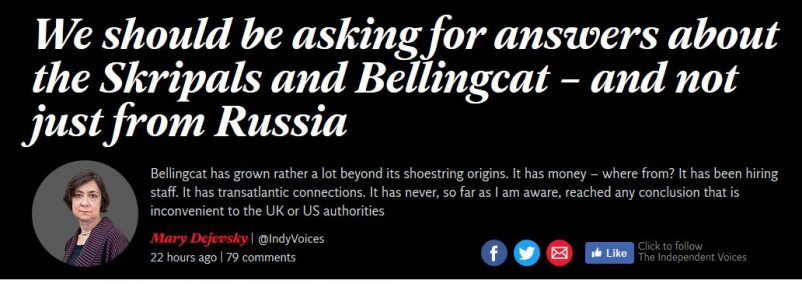
The West’s war on Syria, and rapidly heating cold war on Russia, have involved extensive use of smear. Of unsubstantiated or even disproved allegations repeated in our not-so free media until even those who rightly or wrongly – usually wrongly – deem themselves critical thinkers assume, no-smoke-without-fire fashion, there must be truth to them. This conclusion is seldom drawn by the conscious mind. That’s not how propaganda works: witness on the one hand that near universal belief that ‘adverts don’t sway me in the slightest’; on the other those misguided capitalists who, oblivious to our immunity to it, continue to throw vast sums at that propaganda form we call commercial advertising.
Putin – my, how we feted his predecessor, the drunken Yeltsin, as he oversaw Russia’s descent to basket case status while Wall Street drooled over the spoils! – and Assad feature hardly less frequently on our screens and front pages than do ads for new cars and sofas.
The stakes are higher, though, which explains two aspects of their demonisation not shared by commercials.
One is the cynicism with which charities have allowed themselves to be used. In most cases this has involved the naivety or worse of big names, either unaware of the threat to ‘the brand’, else willing to risk it for short term gain. See in this respect Professor Tim Hayward on an Amnesty International throwing – I’m being kind here – caution to the wind on Syria. But in at least one case ‘the brand’ was corrupt at birth. I mean the White Helmets: brainchild of Brit mercenary James Le Mesurier, recipient of well over $120 million in funding from the USA and other states overtly seeking Assad’s removal, and – to a degree of certainty very much higher than that of Damascus having used sarin gas on its own people – in cahoots with Islamist terrorism.
The other, related, is the equal cynicism – or, at a stretch, starry eyed credulity – with which our media inflate the value of ‘information’ from risible sources. One such is the grandiosely titled Syrian Observatory on Human Rights, routinely quoted by BBC, Guardian and even – to their undying shame – ‘far left’ media in reporting alleged abuses by the Syrian authorities, without informing us that, to quote from the post just linked:
SOHR is the one man band of Rami Abdul Rahman, a disgruntled Syrian who lives in Coventry and hasn’t set foot in Syria since 2003. His methods are opaque to say the least but seem to rely on what I’ll call ‘cascade inquiry’, whereby he phones a handful of pals inside Syria. They in turn phone their pals, who phone theirs. But who are these pals? Rumours abound that Rahman is affiliated to the Muslim Brotherhood, rivals to more recent Saudi backed Wahabbi groups led by Al Qaeda and ISIS, but nevertheless willing to work with Daesh to end Syria’s secularism and impose theocratic Sunni rule on Shia, Christian, Druze and Alawi alike. (Nor is there any evidence of widespread Muslim Brotherhood support from Syrian Sunnis, most of whom see Islam and Islamism as poles apart and value their secularist, authoritarian but religiously tolerant state.)
Then there’s Bellingcat, the organisation founded by one Eliot Higgins: Media Studies drop-out and author of – I feel a professional slight here, having taught digital arts at Sheffield University – digitally altered images that serve NATO objectives in an ongoing Russia demonisation which endangers us all.
(Worse by far of course is the fact his amateurish images – these for instance, offered as proof that Malaysian Airlines flight MH17 was downed in July 2014 by Russian missiles – would have earned him a fail in my Photoshop class.)
Fortunately I need spend few words on Bellingcat/Higgins. That take-down has already been done, most recently in Catte’s excellent OffGuardian piece of two days ago. What I have not seen till now though is any questioning of Bellingcat’s credentials in mainstream media. So let me hand you over, without further ado and with hearty if surprised approval, to Mary Dejevsky: not known as a Kremlin stooge or Putin troll. Yet here she is, in today’s Independent, asking in all sincerity and with admirable bluntness just WTF is Bellingcat?
Who knows, such questions might in their own quiet way help avert WW3. We can but hope.
Britain is More of a Fake State than Anything Else
By Grete Mautner – New Eastern Outlook – 11.10.2018
Blatant lies have been a feature of the British political system for a long while. Whitehall’s tried and tested ways of manipulating the general public are used to distract attention from crucial topics. But what’s even more curious is that inside the Whitehall bunkers where they come up with their own definitions for such manipulations, there is even a term for this kind of propaganda. They call it a ‘term of art’.
That would hardly be a surprise if one is to recall that modern British oligarchies have grown out of yesterday’s slave owners and high seas pirates, for whom deception was nothing but a tool of their trade. We must not forget that millions of people died in the wars unleashed by the United Kingdom. One can recall that only a handful of native Tasmanians escaped being slaughtered by the English in the 19th century. In less that two decades of British military presence in Bengal, the population of the region had decreased by almost 20 million people – which constitutes more than a half of the indigenous population of the region. The absolute majority of wars Anglo-Saxons unleashed over the course of the last two centuries began with a provocation and then were sold to the UK population together with an extensive amount of military hysteria in the media.
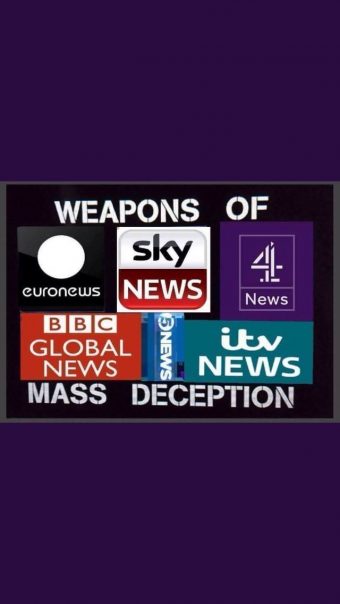 And it doesn’t seem that things have changed much in the ways that London operates on the international stage, as it carries on voicing its dubious accusations against Moscow for its alleged involvement in the Salisbury incident. Previously, it would try to prevent British sports fans from traveling to Russia to attend FIFA World Cup 2018 by claiming that it was a terrible and dangerous place to visit. For sure, those accusations were proven wrong by those fans who dared to make a trip but no apologies was offered to Russia by London.
But why bother with presenting facts before voicing any actual accusations, if the Telegraph could as well announce that the chief executive of BP was poisoned in a plot believed to have been orchestrated by the Russian security services.
To provide this publication with some air of credibility, the media would present “revelations” made by the former employee of BP Illya Zaslavsky, who announced that Russian elites wanted to remove Bob Dudley from the position of group chief executive of BP by “slow poisoning” him with foods. The only problem with Zaslavsky’s claims is that Dudley himself is perfectly healthy and he keeps working in close cooperation with Russia. As a matter of fact, after visiting Moscow last February, Dudley described his contacts with Russia’s Rosneft as exceptional, in spite of the aggravation of geopolitical tensions in the world.
In its bid to provide British citizens with even more fake information, the Guardian would in turn run an article full of allegations that Moscow was somehow discussing with representatives of Julian Assange its assistance in his escape plan. However, these claims haven’t been confirmed by anyone just as well.
However, British media sources are not the only ones who are engaged in disinformation campaigns, as British foreign secretary, Jeremy Hunt has recently told the Sky News that he he had a “tough” discussion with his Russian counterpart Sergei Lavrov on the margins of a United Nations summit in New York. According to Hunt, he hinted to Lavrov that there’s a high chance of a direct military confrontation between Russia and the UK, while adding that Moscow would pay a high diplomatic price for its alleged wrongdoings. The only problem with those claims is that there was no direct meeting between Lavrov and Hunt during the recent UN Summit in New York, which was officially confirmed by the Russian foreign ministry.
But should we be surprised by the obsession of British elites with all things fake, if The Queen Elizabeth II has a fake hand waving machine for when her arm gets tired at royal engagements. So it must be of little surprise to anyone that to support its lies the British government employs thousands of people directly in propaganda and related activities to distort and deceive.
But, frankly, if you’re going to start wars using fake pretexts you could as well fight it with fake weapons. Thus, the British-made ADE 651 tool, that London urges others to use to scan personal belongings of jihadists must be allegedly helping explosives specialists to detect all sorts of explosives and precious metals from a fairly long distance using a telescopic antenna. However, it’s unlikely that the actual device has any electronic boards inside it – at the very best, its an imitation of a scanner. But this did not prevent Britain from pushing this product on the international market at a price tag of 60 thousand dollars a pop. The government of Iraq, in particular, has acquired more than 1,500 units of ADE 651 for the needs of its federal police and the military, since those bodies are engaged in heavy counter-terrorist activities at all times. ADE 651 is the brainchild of the British company ATSC, and its inventor James McCormick is currently serving ten years in prison. To make the matters worse, militants of various terrorist organizations are aware of the properties of this British know-how and keep mocking Iraqi law enforcement agencies for the acquisition of this device.
As it’s been recently reported by a professor of sociology at the University of Bath and ESRC, David Miller, the UK office for national statistics, for 2017, show that the number of people who work in “communication” in central government departments, executive agencies and non departmental public bodies, totals 3,450. It is clear that these figures are an underestimate for a variety of reasons. For example the 490 employed in the ministry of defence seems not to cover the media people in the armed services themselves. In 2007, for example, the total ministry of defence complement was reported as as over 1,000, but this “excludes many military personnel involved in communications work”.
Also not in the figures – as the ONS has confirmed – are the unknown numbers that work for the intelligence agencies. Both MI5 and MI6 most likely have sizable staff groups working on propaganda, whether ‘communication’ is in their formal job title or not. The contemporary period is indeed one in which many more people than in the previous two decades are more confident about existing outside the ‘filter bubble’ conjured up by the government, the spooks and the mainstream media.
Grete Mautner is an independent researcher and journalist from Germany.
Benjamin Netanyahu Is No Friend to America
By Scott Ritter | TruthDig | October 4, 2018
Benjamin Netanyahu is no stranger to the American spotlight. A career Israeli politician who attended school in the United States, he specializes in the kind of rhetoric that his American counterparts revel in—a kind of narcissism that’s more used car salesman than educator.
Netanyahu specializes in selling danger to the American people. This is an art he has practiced on numerous occasions, whether it be at the gatherings of the American Israel Public Affairs Committee (AIPAC), his many appearances before the U.S. Congress, at televised events or during the general debate in the United Nations General Assembly, an annual gathering of global leaders and diplomats where each nation’s representative is provided the opportunity to address counterparts and the world on issues he or she deems to be of particular import.
Bibi (as he is known, affectionately or otherwise) delivered his latest address to the General Assembly on Sept. 27. Like others he had delivered previously, this one was a tour de force of angst, fear and anger with a nearly singular focus on the issue that has seized Netanyahu for more than two decades—Iran and its alleged nuclear weapons program.
In his 1995 campaign autobiography, “Fighting Terrorism,” Netanyahu, preparing to run for the office of prime minister of Israel, asserted that Iran was “three to five years” away from having a nuclear bomb. Bibi repeated this claim several times over the next 20-plus years, apparently unconcerned by the fact that his self-appointed timetable kept coming and going without the Iranian nuclear threat manifesting itself.
In September 2002, when he briefly found himself a private citizen, Netanyahu shifted his aim to Iraq, which he confidently asserted had a nuclear weapons program as he touted the benefits of removing Saddam Hussein from power—this during so-called “expert” testimony before the U.S. Congress. He was wrong on both counts, a fact that seems to slip the minds of those who continue to assign him a semblance of credibility given his proximity to Israel’s vaunted intelligence service.
As someone who spent four years (from 1994 to 1998) working closely with Israel’s intelligence service to uncover the truth about Iraq’s weapons of mass destruction programs, I can attest that Israeli intelligence is better than most at what it does, but far from perfect. For every good lead the Israelis delivered to the United Nations Special Commission (UNSCOM), for which I was working at the time, they provided a dozen or more that did not pan out. Their detailed analysis about the alleged organization and structure of Iraq’s covert nuclear program proved to be far removed from the truth. They got names wrong, affiliations wrong, locations wrong—in short, the Israelis made the exact same mistakes as any other intelligence service.
Iraq was a denied area, made less so by the presence of UNSCOM weapons inspectors like me who had unprecedented access to the most sensitive national security sites in the country. And still the Israelis got it wrong. They did so not because of “bad intelligence,” but because they, like the CIA and other intelligence agencies around the world, were privy to the vast amount of information and data collected by UNSCOM inspectors about the true state of Iraq’s proscribed weapons and related programs. They suffered from the same lack of imagination as did the others that postulated a nuclear-armed Iraq circa 2002, unwilling to consider the possibility that Saddam Hussein might be telling the truth about not having retained any weapons and related capabilities prohibited by the Security Council resolution. This same lack of imagination appears to fuel Netanyahu’s increasingly wild claims about Iran.
It is no secret that Netanyahu has opposed the Iran nuclear deal—officially known as the Joint Comprehensive Program of Action, or JCPOA—since the possibility of a negotiated solution to the stand-off between Iran and the rest of the world was put on the table by the Obama administration in 2012. He lobbied hard against the agreement, interjecting himself in American domestic politics in an unprecedented fashion to undermine the negotiations.
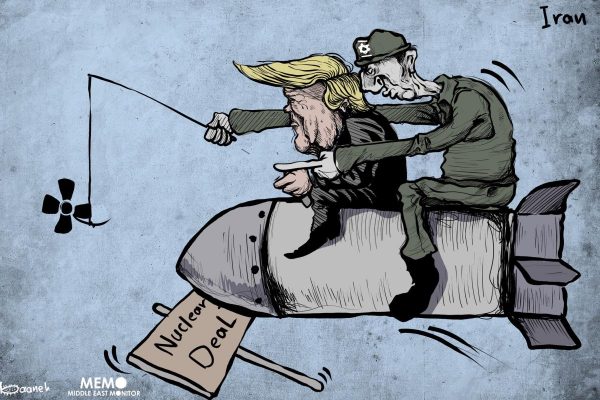
When Donald Trump won the 2016 U.S. presidential election, Netanyahu found a kindred spirit whose intellectual curiosity would not permit any effective challenge to the narrative constructed by the Israeli prime minister. And when Trump faced resistance from his secretary of state, Rex Tillerson, and his national security adviser, H.R. McMaster, he simply replaced them with more compliant persons, Mike Pompeo and John Bolton respectively.
Trump’s decision to withdraw from the JCPOA was facilitated not by any supporting brief from the U.S. intelligence community, which held fast to the assessment that Iran was fully compliant with its obligations under the JCPOA, but rather by intel provided by Israel that featured wild claims of an operation in the heart of Tehran; hundreds of thousands of documents purported to outline a nuclear program that Iran insisted did not exist. In April 2018, Bibi unveiled the existence of what he termed Iran’s “Atomic Archive” as he detailed some of its contents, allegedly recovered during an Israeli operation.
While Netanyahu’s dramatic presentation proved to be enough to help push Trump into withdrawing from the JCPOA the following month, it failed to convince the rest of the world that Iran was operating in bad faith when it came to declaring the totality of its nuclear program. One of the main reasons for this is that the tale put forward by Bibi simply didn’t add up. Documents he presented as being derived from the newly captured archive were recognized by officials from the International Atomic Energy Agency (IAEA)—which, along with supporting governments, is responsible for implementing the JCPOA—as matching those presented to the agency more than a decade ago. That cache of documents was allegedly recovered from a laptop computer sourced to an Iranian opposition group by Israeli intelligence.
At best, there is nothing new in these materials, and all the underlying issues alleged to have been “exposed” had already been discussed and rectified by the IAEA and Iran prior to the rectification of the JCPOA. At worst, Netanyahu was lying about the Israeli intelligence operation, and simply recycling old material—which may have been manufactured by Israel to begin with back in 2004—simply to provide political cover for Donald Trump.
Netanyahu spent much of his Sept. 27 address before the General Assembly detailing an alleged “Atomic Warehouse,” supposedly uncovered by Israeli intelligence in the heart of Tehran. As was the case with the “Atomic Archive” facility, Netanyahu made grand claims about Iranian malfeasance: The site contained “15 ship containers full of nuclear-related equipment and material,” along with “15 kilograms of radioactive material” that Iran allegedly evacuated from the site to evade detection. (Netanyahu seems to have overlooked the fact that the U.S. Department of Energy, prior to the JCPOA and in anticipation of such a scenario, “evacuated” nuclear material from one of its facilities during an exercise, only to have evidence of its existence uncovered by inspectors wielding the same detection capabilities as the IAEA.)
Netanyahu alleged that Iran was maintaining both an “Atomic Archive” and an “Atomic Warehouse” so that it could reconstitute its nuclear weapons program when the “time is right,” ostensibly when the sunset clauses of the JCPOA, which limit the number of centrifuges Iran can operate, expire. As with the “Atomic Archive” story, however, outside of Trump and his inner circle of anti-Iranian acolytes, informed American officials aren’t buying the Israeli leader’s tale, noting that Netanyahu has exaggerated the scope and scale of the warehouse in question. (These officials claim that the “material” being stored there is documentary in nature, a far cry from the “equipment” claimed by Netanyahu.)
Netanyahu bemoaned the fact that the world was promised “anywhere, anytime” inspections in Iran, and yet the IAEA has failed to take any steps to investigate the revelations provided by Israel. The reality is that the JCPOA promised no such thing. “Anywhere, anytime” was an artificial construct cobbled together by opponents of the deal by denigrating the investigatory capabilities of the IAEA. Moreover, the IAEA is intimately familiar with the quality of the intelligence information provided by Israel in the past, having spent months with Iran carefully deconstructing the claims contained within. The agency is hesitant to fall victim to Israeli exaggerations and falsifications again, and rightfully so.
More importantly, the JCPOA has a detailed mechanism in place to investigate claims such as those put forth by Israel. But by precipitously withdrawing from the JCPOA, the Trump administration has removed itself from that process. This means that Israel would need to turn to the Europeans, Russians or Chinese to plead its case. And the fact that neither France nor Germany nor the United Kingdom has picked up the mantle of Israel’s claims points to the inherent weakness of its intelligence. Netanyahu may be able to play siren to Trump’s Ulysses in order to crash America’s ship onto Iranian shoals, but the rest of the world is not following suit.
The American people should not tolerate this continued intrusion into their affairs by an outsider whose previous lies, prevarications and provocations helped get the United States entangled in one war, all the while advocating for our involvement in another. Bibi Netanyahu has a problem with telling the truth, and we give power to his words and deeds by not calling him out for what he truly is—a habitual liar with the blood of thousands of our fellow citizens on his hands. Netanyahu claims he is a friend of the American people. He is, in fact, the furthest thing from it.
Scott Ritter is the author of “Dealbreaker: Donald Trump and the Unmaking of the Iran Nuclear Deal,” published by Clarity Press, October 2018.
Omidyar’s Intercept Teams Up with War-Propaganda Firm Bellingcat
By Whitney Webb | MintPress News | October 8, 2018
The Intercept, along with its parent company First Look Media, recently hosted a workshop for pro-war, Google-funded organization Bellingcat in New York. The workshop, which cost $2,500 per person to attend and lasted five days, aimed to instruct participants in how to perform investigations using “open source” tools — with Bellingcat’s past, controversial investigations for use as case studies. The exact details of what occurred during the workshop have not been made public and Bellingcat founder Eliot Higgins declined to elaborate on the workshop when pressed on social media.
The decision on the part of The Intercept is particularly troubling given that the publication has long been associated with the track records of its founding members, such as Jeremy Scahill and Glenn Greenwald, who have long been promoted as important “progressive” and “anti-war” voices in the U.S. media landscape.
Greenwald publicly distanced himself from the decision to host the workshop, stating on Twitter that he was not involved in making that decision and that — if he had been — it was not one “that I would have made.” However, he stopped short of condemning the decision.
Bellingcat’s open support for foreign military intervention and tendency to promote NATO/U.S. war propaganda are unsurprising when one considers how the group is funded and the groups with which it regularly collaborates.
For instance, Bellingcat regularly works with the Organized Crime and Corruption Reporting Project (OCCRP), which – according to the late journalist Robert Parry – “engages in ‘investigative journalism’ that usually goes after governments that have fallen into disfavor with the United States and then are singled out for accusations of corruption.” OCCRP is notably funded by USAID and the controversial George Soros-funded Open Society Foundations.
In addition, Bellingcat’s founder Eliot Higgins is employed by the Atlantic Council, which is partially funded by the U.S. State Department, NATO and U.S. weapons manufacturers. It should come as little surprise then that the results of Bellingcat’s “findings” often fit neatly with narratives promoted by NATO and the U.S. government despite their poor track record in terms of accuracy.
Bellingcat’s funding is even more telling than its professional associations. Indeed, despite promoting itself as an “independent” and open-source investigation site, Bellingcat has received a significant portion of its funding from Google, which is also one of the most powerful U.S. military contractors and whose rise to prominence was directly aided by the CIA.
Google has also been actively promoting regime change in countries like Syria, a policy that Bellingcat also promotes. As one example, leaked emails between Jared Cohen, former director of Google Ideas (now Jigsaw), and former Secretary of State Hillary Clinton revealed that Google developed software aimed at assisting al-Qaeda and other Syrian opposition groups in boosting their ranks. Furthermore, Cohen was once described by Stratfor intelligence analysts as a “loose cannon” for his deep involvement in Middle Eastern regime-change efforts.
Under President Donald Trump, Google’s connections to the U.S. government have become even more powerful, as the current Trump-appointed Director of National Intelligence once worked as a corporate lobbyist for Google.
Synergy in the service of empire
Given the clear alliances between Bellingcat and the military-industrial complex, The Intercept’s decision to host a Bellingcat workshop in its New York offices may seem surprising. However, The Intercept has long promoted Bellingcat in its written work and its parent company has actually been associated with Bellingcat since 2015.
Indeed, Google-owned YouTube announced in 2015 the formation of the “First Draft coalition,” which nominally sought to bring “together a group of thought leaders and pioneers in social media journalism to create educational resources on how to verify eyewitness media.” That coalition united Bellingcat with the now-defunct Reported.ly – another venture of The Intercept’s parent company, First Look Media.
In the years since, The Intercept has repeatedly promoted Bellingcat in its articles, having called the Atlantic Council-connected, Google-funded group “a reputable U.K.-based organization devoted to analyzing images coming out of conflict zones.” Furthermore, prior to the recent workshop in late September between The Intercept and Bellingcat, both jointly participated in another workshop hosted in London earlier this year in April.
Omidyar’s connections
In addition, the Intercept’s main funder – eBay billionaire Pierre Omidyar – shares innumerable connections to the U.S. government and has helped fund regime-change operations abroad in the past, suggesting a likely reason behind the publication’s willingness to associate itself with Bellingcat.
For instance, Omidyar made more visits to the Obama White House between 2009 and 2013 than Google’s Eric Schmidt, Facebook’s Mark Zuckerberg or Amazon’s Jeff Bezos. He also donated $30 million to the Clinton global initiative and directly co-invested with the State Department — funding groups, some of them overtly fascist, that worked to overthrow Ukraine’s democratically elected government in 2014.
Even after Obama left office, Omidyar has continued to fund USAID, particularly its overseas program aimed at “advancing U.S. national security interests” abroad. Omidyar’s Ulupono Initiative also cosponsors one of the Pentagon’s most important contractor expos, a direct link between Omidyar initiatives and the U.S. military-industrial complex.
Such promotion of the regime-change wars has been reflected in reporting done at The Intercept, particularly in regards to Syria. Indeed, Intercept writers covering Syria frequently promote Syrian “rebels” and the opposition while also promoting pro-regime-change talking points.
Another former Intercept contributor and now Intercept “fact checker,” Mariam Elba, wrote a poorly researched article that sought to link the Syrian government to U.S. white nationalists, claiming that the Syrian government sought to “homogenize” the country despite its support for religious and ethnic minorities in stark contrast to the Syrian opposition. Notably, Elba recently praised the Intercept/Bellingcat workshop, which she had attended.
If that weren’t enough, last year the paper hired Maryam Saleh, a journalist who has called Shia Muslims “dogs” and has taken to Twitter in the past to downplay the role of the U.S. coalition in airstrikes in Syria. Saleh also has ties to the U.S.-financed propaganda group Kafranbel Media Center, which also has close relations with the terrorist group Ahrar al-Sham.
Furthermore, MintPress noted last year that The Intercept had withheld a key document from the Edward Snowden cache proving the Syrian opposition was taking marching orders from the Kingdom of Saudi Arabia. The Intercept published that document only after the U.S. State Department itself began to report more honestly on the nature of these so-called “rebels,” even though The Intercept had had that document in its possession since 2013.
Even “anti-interventionist” Intercept journalists like Jeremy Scahill and Glenn Greenwald have come under fire this past year for allegedly promoting inaccurate statements that supported pro-regime-change narratives in Syria, particularly in regards to an alleged chemical weapons attack in Douma. That attack is now widely believed to have been staged by the White Helmets.
Thus, while The Intercept has long publicly promoted itself as an anti-interventionist and progressive media outlet, it is becoming clearer that – largely thanks to its ties to Omidyar – it is increasingly an organization that has more in common with Bellingcat, a group that launders NATO and U.S. propaganda and disguises it as “independent” and “investigative journalism.”
Author’s Note | John Helsby contributed research, particularly in regards to social media, to this report.
Editors Note: After objection from Bellingcat founder Eliot Higgins, this story was updated to read: “The exact details of what occurred during the workshop have not been made public”, This was updated from the original: “The details of the workshop have not been made public” as Higgins interpreted this to mean details made prior to the event. MintPress was well aware of the pre-event details that were made public prior to the workshop, such as cost to attend, date and location as a link that the announcement of those details can be found in the second sentence of the article, which remains unchanged.
Whitney Webb is a staff writer for MintPress News and a contributor to Ben Swann’s Truth in Media. Her work has appeared on Global Research, the Ron Paul Institute and 21st Century Wire, among others. She has also made radio and TV appearances on RT and Sputnik. She currently lives with her family in southern Chile.
Moscow Doesn’t Plan to Create Stronghold in Libya – Russian Embassy in UK
Sputnik – October 9, 2018
LONDON – The Russian Embassy in London on Tuesday refuted reports claiming that Moscow was allegedly plotting to get control over European immigration routes in Libya and establish a stronghold against the West.
“This publication has nothing to do with reality. We are treating it as a new attempt to shift the responsibility for the ruined country and destroyed lives of millions of Libyans on Russia which had no relation to the 2011 NATO military intervention which grossly violated the whole range of UN Security Council resolutions,” a representative of the embassy told reporters.
The embassy added that Russia supported peacemaking efforts in Libya and never planned any military intervention.
“We fully respect the UN Security Council Resolution 1970 which imposed an arms embargo on Libya,” the mission representative said.
On Monday, The Sun reported that the UK intelligence had warned UK Prime Minister Theresa May of Moscow’s alleged plans to send weapons and troops to Libya to turn it into “new Syria” and take control of migration routes to Europe thus increasing Moscow’s influence on the West.
Russia calls for the parties to the Libyan conflict to engage in a constructive dialogue on political settlement as the only way to end the crisis, the embassy concluded.
Libya has been in turmoil since the overthrow of its long-time leader Muammar Gaddafi in 2011. The country is divided between two governments, with the eastern part controlled by the Libyan National Army and the western part governed by the UN-backed Government of National Accord of Prime Minister Fayez Sarraj.
Libya is also the major gate for migrants from all of the North Africa attempting to cross the Mediterranean and settle in Europe.
Claims About Alleged GRU Cyberattack on UK-Based TV Inconsistent – Embassy
Sputnik – 07.10.2018
LONDON – The Russian Embassy in London pointed Saturday to the contradictions in the article released by the Financial Times newspaper, which claimed that the Russian military intelligence service GRU had allegedly conducted a cyberattack on the UK-based Islam Channel TV broadcaster in 2015.
On Friday, the Financial Times reported, citing non-designated UK officials, that the GRU officers allegedly hacked the computer network of the UK-based TV station in 2015. The news outlet has not provided any evidence, proving the claims. The newspaper has not specified why Russia would “attack” the broadcaster either. In addition, all the sources of information mentioned in the article were anonymous.
“What is interesting about the article is that it claims that hackers, supposedly, had complete control over the TV channel’s infrastructure during the intrusion. Then [the article] claims that the [UK] Home Office staff called [the broadcaster] and informed it of the cyberattack and says that ‘we [the TV station’s staff] had not noticed any irregularities in the work of the channel until this call.’ The information in this article does not withstand the slightest criticism, it seems it was written in a hurry, and the logical pattern was disrupted. [The article’s] main goal is clear — to bring another accusation against Russia,” a representative of the embassy told reporters.
The representative stressed that the embassy usually refrained from commenting on newspaper articles based on leakages from the UK security services because nobody was willing to take responsibility for the allegations. He added that the UK Foreign Office habitually left Moscow’s requests concerning such publications without answer.
On Thursday, the UK Foreign Office said it assessed “with high confidence” that GRU was “almost certainly” responsible for a series of cyberattacks on political institutions, media outlets and infrastructure across the globe. The Foreign Office mentioned a UK-based TV station among the targets of the attacks.
Later on Thursday, the Dutch Defense Ministry claimed that four Russian citizens holding diplomatic passports had been expelled from the Netherlands in April on suspicion of an attempted cyberattack on the Organization for the Prohibition of Chemical Weapons (OPCW).
The Russian Foreign Ministry refuted the claims on Thursday and stressed that the “spymania campaign” unleashed in the Netherlands was seriously hurting bilateral relations with Russia. The ministry pointed out that the Netherlands made the statement ahead of the OPCW opening session, which could set up the “necessary’ political background” to push through some illegal initiatives that Russia opposed.
Canada and the United States subsequently joined the allegations against GRU, claiming that seven Russian military intelligence officials allegedly targeted with cyberattacks the US Westinghouse nuclear power company and multiple anti-doping agencies and athletes. Meanwhile, Russia’s proposal for the establishment of a joint task force on cybersecurity has been earlier rejected by Washington.
Russian Deputy Foreign Minister Sergey Ryabkov has said that the United States “poisoned” Russian-US relations by its new allegations against Russian security services. The diplomat noted the danger of fueling tensions between two nuclear powers.
Trump accused of anti-Semitism over claim Soros funds ‘elevator screamers’
RT | October 5, 2018
Critics of US President Donald Trump were quick to accuse him of anti-Semitism over a tweet claiming that women accosting senators over Supreme Court nominee Brett Kavanaugh were paid by liberal billionaire George Soros.
“The very rude elevator screamers are paid professionals only looking to make Senators look bad. Don’t fall for it!” Trump tweeted on Friday. “Also, look at all of the professionally made identical signs. Paid for by Soros and others. These are not signs made in the basement from love!”
Outrage ensued, obviously. ThinkProgress, the media arm of John Podesta’s Center for American Progress think tank, immediately accused the president of anti-Semitism. A Slate editor chimed in, calling Trump’s words an “anti-Semitic dog whistle.” And a staff writer for The Atlantic called it a “conspiracy theory that a rich Jewish boogeyman is making women claim to have been raped and assaulted.”
Columnists for the New York Times and the Washington Post were quick to follow, denouncing what they said was an anti-Semitic conspiracy theory and adding a splash of guilt by association.
This would come as news to Israel, however. In July 2017, ahead of Prime Minister Benjamin Netanyahu’s visit to Hungary, the Israeli ambassador in Budapest condemned anti-Semitism in relation to a campaign poster depicting Soros negatively. The Israeli Foreign Ministry quickly reacted to clarify the statement, explaining that criticism of Soros was legitimate, because the Hungarian-born billionaire “continuously undermines Israel’s democratically elected governments” and funds organizations “that defame the Jewish state and seek to deny it the right to defend itself.”
Speaking of conspiracy theories, though, an Atlantic Council hunter for Russian witches was quick to accuse “the Russians” – specifically, RT – of being behind the whole Soros story.
RT’s sin, you see, was to cite reporting by US journalists who listened in on conference calls in which groups were coordinating protests against Kavanaugh and handing cash to those arrested, and quote public records showing that Soros’s Open Society Foundation gave generously to these groups.
A common thread in all these reports is the Center for Popular Democracy (CPD), which organized some of the protests against Trump’s Supreme Court nominee from day one. It was CPD activists and executives that led the ambush of Senator Jeff Flake in a Capitol Hill elevator, as well as several of his colleagues at the Washington National Airport.
Public records show that Soros’s Open Society Foundation is one of the major donors to CPD, giving $130,000 in 2014 and $1,164,500 in 2015. Soros gave an additional $1.5 million to the group in 2016 and 2017.
Featured Video
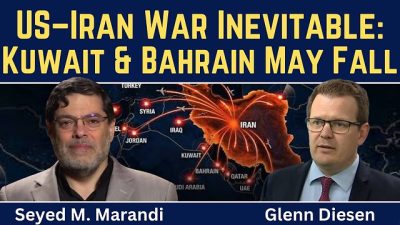
Seyed M. Marandi: US-Iran War Inevitable: Kuwait and Bahrain May Fall
or go to
Aletho News Archives – Video-Images
From the Archives
Oil and the Israel Lobby
Reknowned economist M. Shahid Alam offers this excellent critique of Noam Chomsky’s defective analysis of the relative influence of Oil versus the Israel lobby over US foreign policy: … continue
Blog Roll
 Aletho News
- ICC ignored ‘very well-documented’ NATO crimes – ex-Libyan minister
- SNSC secretary dismisses US response to Iran’s conditions as ‘inadequate’
- Sanaa says Taiz roads open, secure for residents, warns Saudi forces
- Iraqi resistance group urges Saudi leadership to admit defeat, lift Yemen siege
- Trump’s Retreat: How Al-Aqsa Flood Took Down the US Empire
- Israel’s Military Actions in Lebanon Grossly Violate International Law — Lavrov
- Seyed M. Marandi: US-Iran War Inevitable: Kuwait and Bahrain May Fall
- Leaders Condemn Ansarallah Attack on Saudi Arabia While Ignoring Illegal War Against Yemen
- Leaked: Britain’s Covert Iraqi Psyops Network
- Yemeni Armed Forces Warn Airlines Against Using Saudi Airports, Exempt Mecca and Medina
- If Americans Knew
- Agents search Rep. Omar’s Washington home in criminal probe as she vows she won’t ‘be silenced’
- “The Rule Was: ‘Shoot Everyone You See'”
- Israel goes ballistic over Nobel Laureate Navi Pillay
- U.S. May Join Yet Another Middle Eastern War — TCN
- Yellow Line moves again as Israel closes in on trapped Gazans – Daily Update
- Israeli Attacks Kill Seven Palestinians in Gaza Including Six-year-old Girl
- Gaza: Ceasefire Anniversary Marks Year of Failed Promises
- The American Conservative: Mike Huckabee Should Resign
- A C-Section in Shackles: A Palestinian Woman’s Harrowing Birth in Israeli Detention
- ‘He’s Desperate’: AIPAC Begins Spending Against Abdul El-Sayed to Boost Mike Rogers:
- No Tricks Zone
- Germany’s Green Energy Debacle: High Energy Costs Force Kahla Porzellan to Close After 182 Years!
- New Study: 50 Years Of The Most Aggressive ‘Net Zero’ Policies Can Only Affect The Global Climate By 0.03°C
- US September “Heat” Was No Record…Many Records Set Decades Ago
- Latest European Green Energy Debacle; Portugal’s Largest Flagship Solar Park Insolvent!
- Green Energy Debacle: German Expert Professor Fritz Vahrenholt Warns Of Severe Economic And Social Consequences
- Two More Paleo Reconstructions Affirm Meters-Higher Sea Levels Across Ireland, Brazil 7000-6000 Years Ago
- New Study: Earth And Venus Surface Warmth Largely Explained By Convection And Lapse Rate, Not CO2 Or Radiation
- 2025 Nature Paper Claiming Worsening Global Drought Gets RETRACTED …Heavily Flawed
- New Study: ‘Global Drought Shows No Detectable Recent Acceleration Under Climate Warming’
- Economic Masterminds: German Socialists Suggest Taxing Productivity Gains Stemming From Using AI

