Dear Salafist Wahhabist Apologists
By Paul Larudee | Dissident Voice | April 22, 2018
Your head chopper heros are apparently not what Syrians have in mind when they think of democratic revolution.
Mehdi Hasan (MH) can hardly be blamed for the ignorance that he displays in his Intercept article, “Dear Bashar al-Assad Apologists: Your Hero Is a War Criminal Even If He Didn’t Gas Syrians.” He has apparently never been to Syria, doesn’t often do research on Syria, and gets his information from proponents of a single point of view, representing a bunch of idealists that want to usher in their idea of a liberal democracy in Syria, without benefit of electoral niceties until their power is already ironclad. What’s wrong with this picture?
But I’m getting ahead of myself. Let’s start by deconstructing the absurdities and the language in the MH article.
Thankfully, MH has spared us the need to deconstruct the absurd accusation that the Syrian armed forces have used chemical weapons. He apparently accepts that they don’t need to, that there is no benefit in using them, so why would they? OK, then who did? Cui bono? Easy answer. The motive of the promoters of destruction in Syria is to create a pretext for the US and its partners to bomb, invade and establish a no-fly zone; i.e., to directly take on the Syrian government and its allies. These war criminals include the neoconservative cabal in the US, the Zionist and Israeli proponents of using the US to fight Israel’s perceived enemies, and the Saudi and Qatari adventurists backing the Project for a New Salafist Paradise. These are the same players who brought us Iraq I and II, Libya, Afghanistan forever, Somalia and Yemen. What more could we wish for?
So let us move on to the MH complaint about barrel bombs. What is the complaint, exactly? Are they more horrible than other types of bombs? Is it OK to use bombs manufactured in western munitions factories for delivery by jet airplanes but not ones manufactured in Syria and delivered by helicopter? Never mind. It’s a great opportunity for MH to use the hyped term “BARREL BOMB” in order to enrage and terrify an undiscerning readership.
But what about all the civilian casualties, and isn’t the Syrian army to blame? Well, no, ISIS and the pseudonymous al-Qaeda affiliates are quite happy to post videos of their stonings, beheadings, crucifixions and immolations, so we know the army can’t be the only ones. In fact, given the summary executions of non-Muslims in territories “liberated” from the government, is there any reason to think that the forces fighting the Syrian government are responsible for fewer civilian deaths? I myself met refugees who had fled up to 70 km over the mountains in the dead of winter to Latakia in March, 2013 with no more than the clothes on their back. No one knows how many children and old people died.
Aircraft? The anti-government fighters don’t have them, do they? No, but they seem to be quite resourceful in eliminating innocent human lives nonetheless. An example is the at least 10,000 civilians that have lost their lives in Damascus due to mortars and “hell cannons” (which also use “barrel bombs”) since the start of the hostilities. Other examples include the withering four-year siege of the Shiite towns of Foua and Kafraya near Idlib and the unrelenting bombardment via “hell cannon” of the city of Aleppo from the enclave of East Aleppo until it was finally recovered by government forces in late 2016.
On the other hand, for those (unlike MH and the mainstream media), who consider evidence to be relevant, there is a plethora available to show that the Syrian army has been unusually respectful of civilian life. The claim is that Syria and its Russian allies have obliterated entire neighborhoods, raining bombs on the civilian population. The facts are somewhat at odds with this description.
First, there are the civilian casualties themselves. The UN stopped keeping casualty statistics in early 2016, but even the anti-government Syrian Observatory for Human Rights concedes that less that 1/3 of all casualties are civilians. No other war on record has had such a low ratio. By comparison, 2/3 were civilian casualties in Vietnam, WWII and most other wars.
Second, the Syrian army liberation of Homs, Aleppo and other areas has followed a typical progression that is quite the opposite of “just kill them all”. First, the army surrounds the area and lays siege. At this point, if the army wants to flatten the area and bring an end to the resistance there, it has the perfect means to do so. But it does not. Instead, it positions relief supplies at the perimeter and makes them available without prejudice to the inhabitants. It also offers sanctuary to all who wish to leave. Amazingly, this includes even the fighters. Syrian fighters willing to lay down their arms are offered amnesty. But many are not initially willing to accept amnesty, and many are not Syrian. To these, the government offers safe passage to other parts of Syria under opposition control, even permitting the fighters to keep their small arms.
If they refuse, the siege and the fighting continue, often for more than a year, and bombing is often a part of the campaign, especially toward the end, after multiple unilateral ceasefires from the government side, to try to conclude a peaceful end, as in Aleppo. The bombing is typically in the least inhabited areas, in order to remove cover for fighters, so that the army will incur fewer casualties when it goes in. The strategy doesn’t always work, but the low ratio of civilian casualties is a testimony to its relative success.
Why does the Syrian government do this? Wouldn’t it be easier to just level the entire area, civilians and all, and be rid of the fighters once and for all?
Not really. The government is aware that families are split, with some fighting on one side and some on another. One of the reasons so many Syrians remain loyal to the government is that it is seeking to protect all Syrians on all sides, with the intention of regaining their allegiance. The government also recognizes that many of the opposition fighters are, in effect, mercenaries, for whom fighting is a way to put food on the table when there are no other sources of income. Such fighters are not really enemies, just desperate people. Given an opportunity, they will easily return to the government side.
Then there are the hyped bombing casualty statistics. As I pointed out in 2015, even if we accept the statistics of the highly biased anti-government Human Rights Watch, the number of casualties per bomb is only two, including combatants. If we apply the ratio of civilian deaths, that is less than one civilian casualty per bomb, a clear indication that the Syrian air force is being far more respectful of civilians than the US was, for example, in its bombing of Raqqah, where twice as many civilians as fighters were killed.
But MH is slamming a position that nobody holds. The number of “leftists” that consider Bashar al-Assad a hero infinitesimal. There may be many Syrians who do, but that is not who MH is referring to. MH is misinterpreting the actions of some journalists (including “leftists”) to correct distortions and false information as defense of Assad. Perhaps the distinction is too subtle for him, but an aversion to disinformation and lynch mob mentality is not the same as being pro-Assad. It’s not very helpful to say, on the one hand, that you oppose intervention in Syria, and then take all your (false) information from pro-intervention sources. In that case the interventionists will applaud your non-intervention stance.
Those of us whom MH accuses of being pro-Assad are nothing of the sort. We believe that Syrian sovereignty and territory should be fully respected (as MH also claims to believe), but we think it is important to counter the fake news and propaganda that are being used to justify the invasion of Syria. MH is in love with fake news. He prefers not to mention the killing of police in the uprisings that he describes as “peaceful demonstrations”. He prefers to cherry-pick the opinions of Syrian refugees in Germany rather than the views of the vast majority of refugees (displaced persons) who evacuated to government areas without leaving Syria. He produces the Human Rights Watch report on 50,000 morgue photos but not the deconstruction by investigator Rick Sterling. And he repeats the al-Qaeda claim and false film footage that Madaya was starving and in need when it was, in fact, sitting on a mountain of aid supplies being denied by the fighters themselves to the population.
If MH can’t see the difference between being pro-Assad and not falling for interventionist propaganda, that’s his problem. What’s astonishing is the number of “leftists” that rail against interventionism but base their views on the drivel purveyed by the interventionists themselves in the mainstream media, and that originates from propaganda mills like the White Helmets, the Aleppo/Ghouta Media Center and other lavishly funded set designers for warmongers. If MH is not an interventionist, he’s nevertheless making their case for them.
Paul Larudee is one of the founders of the Free Gaza and Free Palestine Movements and an organizer in the International Solidarity Movement.
Media Support US Violence Against Syria, but Long for More
By Gregory Shupak | FAIR | April 20, 2018
Corporate media outlets were glad that the US, France and Britain bombed Syria in violation of international law (FAIR.org, 4/18/18), but lamented what they see as a dearth of US violence in the country.
In The Atlantic (4/14/18), Thanassis Cambanis described the war crime as “undoubtedly a good thing,” and called for “sustained attention and investment, of diplomatic, economic and military resources”—though the latter rubbed up against his assessment in the same paragraph that “a major regional war will only make things worse.” Moreover, he described “the most realistic possibility” for the US and its partners in Syria as “an incomplete and possibly destabilizing policy of confrontation [and] containment. But a reckoning can’t be deferred forever.”
This “reckoning” was his somewhat oblique way of referring to a war pitting the US and its allies against the Syrian government and its allies, the very “wider regional war” he just warned against. In Cambanis’ view, “confrontations” between nuclear-armed America and nuclear-armed Russia are “inevitable,” which implies that there is no sense in trying to avoid such potentially apocalyptic scenarios.
A Washington Post editorial (4/14/18) said that “Mr. Trump was right to order the strikes.” The paper was glad that Defense Secretary Jim Mattis and President Donald Trump “properly left open the possibility of further action.” The Post’s rationale for continuing to attack Syria was that “the challenge to vital US interests in Syria is far from over,” and that Trump was therefore wrong “to call Friday’s operation a ‘Mission Accomplished.’” These “interests” include ensuring that Iran does not “obtain the land corridor it seeks across Syria.” (Cambanis, similarly, described as “justified” US efforts to “contain Syria and its allies.”)
The paper was concerned because Trump says that he’d like to subcontract US activities in Syria to US regional partners like Saudi Arabia, the United Arab Emirates, Qatar and Egypt. None of these states, the Post fretted, “are capable of working with local forces [in Syria] to stabilize and hold the large stretch of [Syrian] territory now under de facto US control east of the Euphrates River.”
The editorial failed to note that this territory amounts to “about one-third of the country, including most of the oil wealth” (New York Times, 3/8/18) and “much of Syria’s best agricultural land” (Syria Comment, 1/15/18). The legitimacy of “de facto US control” over Syrian territory and some of its most valuable resources is apparently beyond question, as is the US’s alleged right to determine which governments are allowed to be friendly with each other: The Iranian “land corridor” refers to the Iranian government having warm relations with the governments of Syria, Iraq and Lebanon, something the Post appears to regard as a grave danger.
The editorial says that the US and its allies sought to “minimize the risk of a direct military confrontation with Russia or Iran” and that this was “prudent,” but that “if Russia takes retaliatory action, including in cyberspace, the United States must be ready to respond.” According to this view, projecting US power in Syria is so essential that no form of opposition to US violence in Syria can be brooked, the concern for prudence having vanished.
The Post contended that the US must demand “an acceptable political settlement brokered by the United Nations”—“acceptable” signifying “the departure” of the Syrian government. Functionally, this means keeping the war going: Saying that negotiations should take place but that the only “acceptable” outcome is the dissolution of the Syrian government amounts to the same thing as saying that no negotiations should take place, particularly now that the Syrian government is working from a position of strength and unlikely to agree to its own surrender as a pre-condition for talks.
Andrew Rawnsley, writing in the Guardian (4/15/18), supported US violence in Syria by attacking its critics. He said that those who oppose the Anglo-American-French airstrikes on Syria out of “indifference” to Syria’s plight have the “sole merit of being candid,” unlike those who are
less honest . . . the self-proclaimed peace-lovers. Mainly to be found on the hand-wringing left, they are too busy looking in the mirror admiring their own halos to face the moral challenges posed by a situation like Syria.
Luckily Rawnsley has the requisite courage to meet “the moral challenges” and advocate more war: He says that the West should have “impos[ed] no-fly zones” early in the war in Syria, a policy that would have entailed attacking Syria’s air forces, an act of war by any definition. No-fly zones over Iraq and Libya ultimately led to regime change in both countries, with hideous results for their people.
Rawnsley’s complaint that the West applied “no meaningful pressure” to “bring [the Syrian government to the negotiating table” is wildly misleading; the Western powers in fact applied “meaningful pressure” to prevent negotiations.
Rawnsley also legitimized US violence against Syria by expunging the damage it has inflicted. He trotted out the well-worn lie that the West “stood by” and “fail[ed] to act” in Syria, a canard that FAIR has repeatedly de-bunked (e.g., 9/20/15, 4/7/17, 3/7/18). He characterized the West’s approach to seven years of war in Syria as “years of unmasterly inactivity,” having their hands “wedged firmly under their bottoms,” an “impotent posture,” “failures to act,” making the “grav[e] decision not to act,” “inaction,” “non-interventionist” and as “inaction” a second time. Yet the CIA’s effort to oust the Syrian government has been one of the costliest covert-action programs in the agency’s history; has built ten military bases in the country, with two more on the way; and has killed thousands of Syrian civilians in a bombing campaign ostensibly aimed at ISIS (Jacobin, 4/18/18).
“Non-interventionists,” Rawnsley concludes his article, “the horrors of Syria are on you.” Yet there is no shortage of horrors that are on the interventionists. Sanctions imposed by the US and its allies have punished the Syrian population (9/28/16). These states are implicated in sectarian violence that anti-government armed groups have carried out against minorities (Electronic Intifada, 3/16/17). The US bombed a mosque in Aleppo, Syria, in the name of fighting Al Qaeda, killing almost 40 people (Independent, 4/18/17), and America used toxic depleted uranium against ISIS-held territory in Syria (Foreign Policy, 2/14/17): It would be rather difficult to claim that these horrors were caused by “non-interventionists.”
Cambanis, moreover, exclusively listed Syria, Iran and Russia among those governments who “have serially transgressed the laws of war” and “gotten away with murder” in Syria, but the atrocities attributable to the US and its allies surely constitute “serially transgress[ing] the laws of war” and having “gotten away with murder.”
The Syrian government and its partners are also responsible for a substantial share of carnage in the war, but Rawnsley’s accusation that “non-interventionists” are to blame for Syria’s bloodshed is completely untenable. His argument that Western states have inflicted insufficient harm on Syrians amounts to war propaganda.
And he’s far from the only media figure about whom this can be said.
Gregory Shupak teaches media studies at the University of Guelph-Humber in Toronto.
“Spring Arriving 26 Days Early”–BBC
By Paul Homewood | Not A Lot Of People Know That | April 21, 2018
The BBC has been up to its tricks again!

http://www.bbc.co.uk/programmes/b09yddxd
The latest edition of Radio 4’s environmental programme, “Costing the Earth”, looks at how our springs are supposedly getting earlier. (Yes, I know spring starts in March!)
The programme’s opening introduction by presenter Lindsey Chapman gives us a clue that it won’t be an objective assessment:
We’re looking for signs of how a volatile climate is shifting our seasons, and affecting both our native wildlife and migrant visitors to these shores.
Chapman, also presenter of the Springwatch TV series, then adds:
I’ve been noticing changes on my own patch, from the arrival of the first swallows to the flowering times of spring flowers over the last ten years.
At about seven minutes in though, she makes this extraordinary statement:
Spring now arrives an average of 26 days earlier each year than it did 10 years ago. We know this because of the extraordinary records kept by the public, stretching back centuries.
As Paul Matthews points out:
This statement that Spring is almost a month earlier than it was just 10 years ago is complete nonsense and fails the most elementary sanity check. It appears, yet again, that where global warming is concerned, elementary common sense and fact-checking are thrown out by the BBC, and replaced with absurd exaggeration and alarmism.
So where did Chapman get this crazy claim from?
As she goes on to explain, it is supposedly from the Woodland Trust, who run a scheme called Nature’s Calendar.
This allows members of the public to record when they first see certain events each spring, such as birds, first flowerings, butterflies and so on. In other words, phenology. During warm springs, naturally enough, these events tend to arrive earlier.
According to Woodland Trust, these first sightings have been between around one and two weeks earlier in the last three years, though some butterfly and bird arrivals were as much as three weeks early in 2017:

https://naturescalendar.woodlandtrust.org.uk/analysis/seasonal-reports/
You will notice that Woodland Trust use 2001 as a baseline, and nowhere do they claim that spring is now 26 days earlier than ten years ago.
But why 2001? In fact they have only been collecting this data since 2000, and decided to use 2001 as the base year because, they claim, weather conditions that year “closely reflected the 30-year average”.
However, on closer examination we see that it is not the current 30-year average they are talking about (ie 1981-2010), but 1961-90.

This is highly significant, because the 1961-90 period was considerably colder than both the decades that preceded and followed it.

https://www.metoffice.gov.uk/hadobs/hadcet/data/download.html
HH Lamb pointed out that the onset of spring in Oxford was 16 days later between 1963-80, compared to 1920-50:

HH Lamb – “Climate History and the Modern World” (p 274):
To a large extent therefore, the onset of spring in recent years has merely returned to earlier patterns, with the end of the colder interlude.
We can see the effect of using the two different baselines below:

https://www.metoffice.gov.uk/hadobs/hadcet/data/download.html
The 1961-90 period was 0.7C colder than 1981-2010. We can also see that, while there have been ups and downs, there is little evidence of overall change in spring temperatures since around 1990.
This is definitely not the message portrayed by the BBC programme.
We should also note that the spring of 2001 was much colder than prior years, which makes it strange that it should be used as a base year at all. The Woodland Trust recognised this same point in their Spring 2005 report:

https://naturescalendar.woodlandtrust.org.uk/analysis/seasonal-reports/?p=3
Of course, when we are talking about “early springs”, temperatures in January and February may be just as important as those in April and May.
But when we look at Jan-March, and Feb–April, we find a very similar pattern – very little change in trend since 1990:


https://www.metoffice.gov.uk/hadobs/hadcet/data/download.html
This should be little surprise, when we see that, contrary to popular myth, temperatures in January and February have changed little since a century ago.
And, as with spring temperatures, there is a noticeable dip between 1961-90:
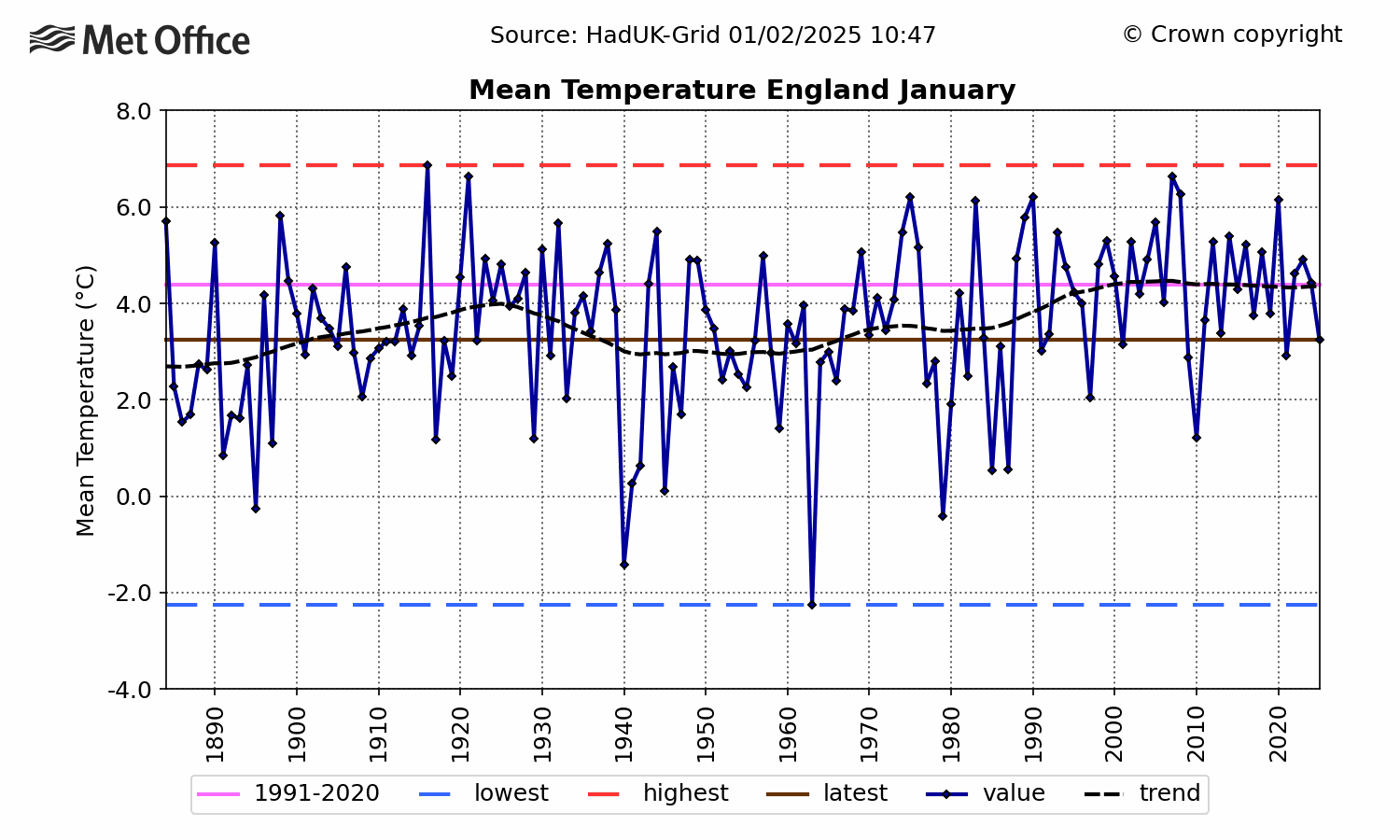
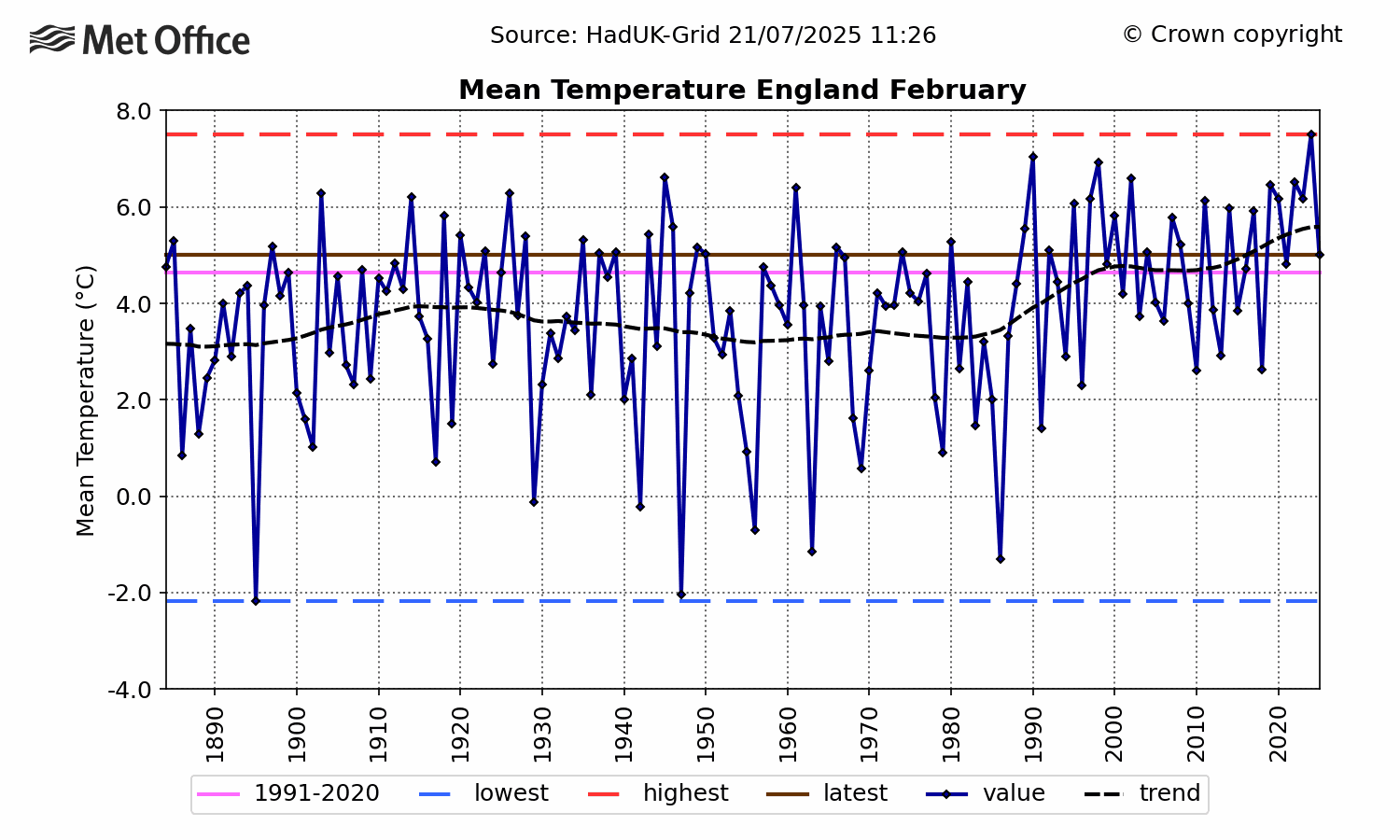
https://www.metoffice.gov.uk/climate/uk/summaries/actualmonthly
Summary
There appears to be no evidence to back up Chapman’s claim that spring now arrives an average of 26 days earlier each year than it did 10 years ago, either in the temperature record or in the Woodland Trust surveys.
The latter are in any event misleading, and certainly not in a shape or from “scientific”. Their conclusions are obtained only by using an unusually cold year, 2001, as their base point.
There is actually nothing in the temperature record to suggest that springs are beginning any earlier than they were thirty years ago.
To be fair, one of the interviewees, Matthew Oates of the National Trust, did mention that the transition to warmer/earlier springs began several decades ago.
Nevertheless, the central theme of the programme was that the UK climate is changing rapidly, something not borne out by the data.
I have no doubt that the BBC will fall back on their regular defence of “scientists say”. However, following OFCOM’s recent ruling that the BBC should have challenged Lord Lawson on comments he made, it should surely not be acceptable for them to simply accept unscientific research from bodies like the Woodland Trust without challenging that as well.
Of course, in this instance the BBC has gone one step further. Not only have they broadcast the Woodland Trust’s findings, Lindsey Chapman has actually then presented them as an indisputable fact.
What Are “Assad Apologists”? Are They Like Those “Saddam Apologists” Of 2002?
By Caitlin Johnstone | Rogue Journalist | April 20, 2018
Isn’t it fascinating how western journalists are suddenly rallying to attack the dangerous awful and horrifying epidemic of “Assad apologists” just as the western empire ramps up its longstanding regime change agenda against the Syrian government? Kinda sorta exactly the same way they began spontaneously warning the world about “Saddam apologists” around the time of the Iraq invasion?
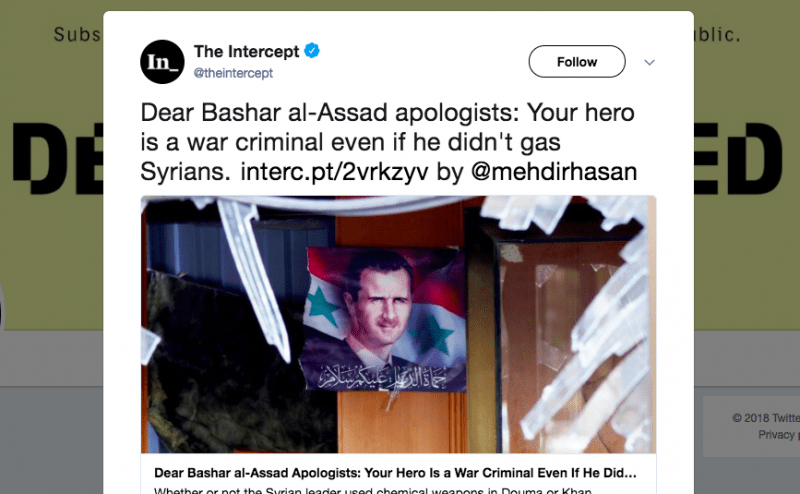
The increasingly pro-establishment Intercept has published an article titled “Dear Bashar al-Assad Apologists: Your Hero Is a War Criminal Even If He Didn’t Gas Syrians,” condemning unnamed opponents of western interventionism in Syria for not being sufficiently condemnatory of Bashar al-Assad in their antiwar discourse.
Last week The Times published an article titled “Apologists for Assad working in British universities,” frantically informing the public that “top academics” are circulating information that runs counter to the official Syria narrative, followed this week by a Huffington Post article attacking those same academics in the same way. Yesterday, the BBC ran an article titled “Syria war: the online activists pushing conspiracy theories,” warning its readers about “pro-Syrian government” internet posts.
I first encountered the word “apologetics” as a young Catholic girl in a parochial school, where the term was introduced to me as the religious practice of defending Church doctrine using discourse and argumentation. I did not become familiar with the related secular term “apologia” until much later, which is defined as “a work written as an explanation or justification of one’s motives, convictions, or acts.”
It wasn’t a term I ever made use of or encountered much in day to day life until I started writing extensively about the dangerous warmongering behaviors I was seeing in my country’s allies last year, when all of a sudden it became a part of my daily life. For me, I was just trying to help prevent the western empire from decimating yet another Middle Eastern country in yet another war based on lies and avoid dangerous escalations that could lead to nuclear holocaust, but to countless strangers on the internet I am an “Assad apologist” and a “Putin apologist.”
People have been calling me these things every single day for well over a year now. The internet is weird, man.
And surprise surprise, now that the war drum is beating louder than ever for Syrian blood, the phrase “Assad apologists” is enjoying a massive uptick.
The argument as I understand it is that people like Professors Tim Hayward and Piers Robinson, the subjects of the aforementioned Times and Huffpo articles, are not protesting the latest warmongering agenda of a multinational power establishment with an extensive history of decimating Middle Eastern countries, but are in fact going out of their way to justify Bashar al-Assad’s motives, convictions, and acts. Not because they oppose death and destruction like normal human beings, but because they are just positively head-over-heels gaga over some random Middle Eastern leader for some reason.
And that’s always how these arguments go. By pointing out that the US-centralized empire has been plotting regime change in Syria literally for generations, I’m not opposing dangerous regime change interventionism, I’m defending a dictator. By noting that the western empire has an extensive history of using lies, propaganda and false flags to manufacture support for military aggression, I’m not stating a well-documented and frequently admitted fact, I’m performing apologia on behalf of a despotic regime.
It can’t possibly be because I am aware that the neoconservatives who have been braying for this attack for years are always completely wrong about everything. It can’t possibly be because the US-centralized war machine has had a well-established pattern for many years of demolishing countries based on lies and false pretenses of humanitarianism only to leave in their wake a humanitarian disaster, which they then blame on “mistakes” made by whoever happened to be in charge at the time. It can’t possibly be because US-led military interventionism in modern times is literally never helpful, literally never accomplishes what its proponents claim it will accomplish, and is literally always extremely profitable for its most vocal advocates.
Nope, it’s got to be because I fell in love with a gangly Syrian president whom I’d never even thought about before the neocons set their crosshairs on him, and I only oppose the next imminent military catastrophe because I agree so much with his policies and behavior.
Even more annoying than the honest regime change proponents are people like Mehdi Hasan, author of the aforementioned Intercept piece, who claim to oppose US regime change but find themselves tone policing the antiwar left instead. The world is full of problems, the greatest arguably being a third world war and potential nuclear confrontation between Russia and America ensuing from US interventionism in Syria, but men like Hasan choose to focus their creative energy on making sure the antiwar left mitigates its speech sufficiently and prefaces every antiwar argument with “Assad is a bloodthirsty evil dictator, but”.
Like that’s what the world desperately needs right now: for the antiwar left to be even more mitigated in its speech than it already is. For us to slam on the brakes of our antiwar surge to check one another to make sure we’re all being explicitly anti-Assad enough.
These writers never make it clear exactly why it’s so important for everyone in the antiwar movement to be checked and scrutinized for excessive enthusiasm about the Syrian government. Are they worried they’ll go and join the Syrian Arab Army? That they’ll install Assad as president of the United States? How is sympathy toward the Syrian government a threat to anything other than the manufacturing of support for more escalations in US-led interventionism?
We don’t need equivocation and tone policing right now. What we need is a loud and unequivocal NO to western military interventionism in the country immediately adjacent to the one we raped fifteen years ago.
We’ve been here before. Here’s an article from 2001 titled “Saddam Hussein’s American Apologist”. Here’s one from 2002 titled “Saddam’s apologists”. Here’s another from 2003 titled “After Saddam’s Capture: Will His Apologists Now Recant?” Here’s yet another from 2003 titled “Armchair generals, or Saddam’s leftwing allies.” Here’s one from 2005 titled “Parliament’s damning report about Saddam apologist George Galloway.” This was an extremely common smear against opponents of the Iraq invasion, who were of course later proven to have been 100 percent correct in every way.
Iraq is as relevant as relevant gets to this debate, and anyone who claims otherwise is only doing so because they know Iraq is devastating to their Syria arguments. They’re pulling the same damn tricks in the same damn way, in some cases with the same damn people. These “We must stop the Assad apologists!” op-eds are coming out with increasing frequency and urgency because they are losing control of the Syria narrative and they are running out of tricks. Don’t let their authoritative way of speaking fool you; they are not nearly as confident as they pretend to be.
Support Johnstone’s writing with a contribution on Patreon or Paypal.
Outrage as NPR attacks black activist over ‘Russian’ radio appearance

© Anoa Changa / Instagram
RT | April 20, 2018
Black progressive activist Anoa Changa found herself the subject of a vicious hit piece this week on WABE News, an Atlanta NPR affiliate. Her crime? Speaking to a Russian-owned radio station.
When Changa sat down to talk to WABE’s Johnny Kauffman, she expected to chat about her work as a progressive activist. Instead, Kaufman focused the interview on an appearance Changa had made on Russian-run radio station Sputnik in 2016. The piece was published with the headline “Atlanta Activist Uses Russian-Backed Media To Spread Message.”
Changa, a mother of two, had been an avid supporter of Bernie Sanders in the run-up to the 2016 election. Now Changa is managing editor of a blog called ‘Progressive Army,’ and hosts a podcast from her native Atlanta, all while holding down a day job and raising two children.
Kauffman sat in Changa’s studio – a friend’s living room equipped with a microphone and webcam– as she interviewed Amy Vilela, a progressive candidate running for the Democratic nomination in Nevada’s 4th Congressional District. Changa and Vilela spoke of corruption in American politics, but the interview was just a formality before Kaufman turned the heat up on Changa.
In 2016, Changa spoke on two programs hosted on Sputnik, which broadcasts on AM and FM in Washington DC. While Changa used Sputnik to speak about progressive issues to a wider audience, Kauffman saw sinister Russian plots afoot.
Ominously, the article says that “Changa’s association with Sputnik may put her credibility at risk,” and warned that appearing on a Sputnik program furthers “Russia’s effort to create chaos in the US.”
Working with Sputnik, Kauffman wrote, made things “complicated” for Changa.
Fellow activist Eugene Puryear hosts the Sputnik show ‘By Any Means Necessary,’ on which Changa is a regular. The two talk about police brutality, marginalization, and the influence of money in politics. These issues weren’t important to Kauffman, however. What was important is that Russia pays Puryear’s salary.
Somehow, this means that Sputnik is using leftist causes to further a shady and divisive Russian agenda in America. The fact that Changa also appeared on mainstream outlets like the BBC is not mentioned once, nor is the fact that NPR is funded by the US government. Facts would only get in the way of the narrative.
That Puryear and his guests often lament the mainstream media’s phony ‘Russian interference’ narrative only serves as further proof of their guilt in the vast Russian conspiracy.
To back up his point and give the Russia hysteria legitimacy, Kauffman cites research professor Robert Ortnung, who claims that Sputnik and RT are sinister news organizations that exist only to further the Bond-villain aims of Vladimir Putin.
“Those platforms are set up for the sole purpose of promoting the Kremlin line,” Ortnung said. “The idea is to create as much chaos as possible, because the Russians see it as a zero-sum game, where anything that weakens us is going to strengthen them.”
Kauffman neglects to mention that Ortnung is himself a government mouthpiece. He is on the International Forum for Democratic Studies Council at the National Endowment for Democracy, set up by Ronald Reagan at the height of the Cold War to spread the American message abroad. To this day, the NED is almost entirely funded by US government money.
After outlining the villains, Kauffman makes his play at the end of the article. He lists a rogues gallery of Georgia politicians that have spoken to RT and Sputnik, before tipping off one politician about the dangers of speaking to a Russian stooge like Changa.
After Kauffman told local Democrat Richard Winfield that Changa is a regular guest on a Sputnik show, the politician said that he would not have spoken to her had he known.
“It raises the possibility of people impugning not just me,” said Winfield, “but the political positions I’m advancing.”
Twitter exploded after the article was published, as users immediately saw through the obvious smear.
“NPR didn’t just smear Anoa Changa,” tweeted journalist Caitlin Johnstone. “They combed through her podcasts and called people she’s interviewed digging for Russia dirt. The worst they could find was one guy who disapproved of her Sputnik stuff. Did that stop them from publishing? Of course not.”
The message of Kauffman’s article is clear: In an era where liberal American media outlets are tripping over each other to find evidence that their enemies one time might have had Russian dressing on their salad, speaking to Russians makes you guilty by association.
As noted in the article, Changa has no intention of stopping her appearances on Sputnik.
US still paying White Helmets despite $200mn-aid freeze for Syria recovery, State Dept confirms
RT | April 20, 2018
As the US is reviewing funding aimed at helping war-ravaged Syria rebuild, it’s not neglecting the White Helmets – a controversial militant-linked group instrumental to the media campaign against Assad and Russia.
At a Thursday press briefing, journalists asked US State Department spokesperson Heather Nauert for an update on the late-March freeze of $200 million earmarked for the recovery of Syria – and if that means Washington will be withholding payments to the White Helmets.
Nauert opened her response with a gushing comment about the organization. “We recognize and appreciate and are very grateful for all the work that the White Helmets continues to do on behalf of the people of their country and on behalf of the US Government and all the coalition forces. They’re doing incredible work in rescuing in some cases, and in other cases it’s recovery efforts. They’re an incredible group of individuals,” she said.
Moreover, she said she “just exchanged emails with them the other day.” Finally cornered into giving a direct answer, she said “As far as I’m aware, all of the work still continues. Peoples’ bills are still being paid.”
The White Helmets (officially called the Syria Civil Defense), a supposedly impartial humanitarian NGO, make no secret of who pays those bills, listing the governments of the UK, Germany, and the US among others on their website. Time and again their reports from the scenes of supposed crimes against civilians by the forces of Syrian President Bashar Assad – who Washington has wanted toppled for years – have been used to justify accusations against Assad and his ally Russia. This includes the latest alleged chemical incident in Douma near Damascus, which led to a series of missile strikes by the US, UK, and France.
These allegations have now been contradicted by multiple sources, including witnesses from the scene, and even people featured in the White Helmets’ video of the “aftermath” of the “attack.”
The White Helmets rely heavily on positive publicity. They have been featured in two documentaries, one of which won an Oscar in the heavily politicized 2017 ceremony.
A recent attempt at gaining publicity and support for their cause, however, fizzled spectacularly. English singer Roger Waters, a founder of Pink Floyd, stopped his Barcelona gig for a minute last week to mention that a representative of the White Helmets wanted to come up on stage and make a statement. However, Waters had a few words of his own to say.
“The White Helmets is a fake organization that exists only to create propaganda for jihadists and terrorists,” he said.
It later turned out that in 2016, the NGO emailed Waters, trying to entice him into a dinner honoring the White Helmets, paid for by a Saudi billionaire. And just days before last week’s concert, a journalist describing himself as “a militant with the Syrian White Helmets” asked Waters for stage time to “send a message to the children of Syria.”
Waters replied to neither email, instead choosing to make his beliefs heard publicly.
“If we were to listen to the propaganda of the White Helmets and others, we would be encouraged to encourage our governments to start dropping bombs on people in Syria,” he said.
Which is exactly what happened a few hours later.
CNN reporter inhales deadly ‘chemical weapons’ on camera: ‘Yeah that stings’
The global Fake News leader’s Arwa Damon sampled a little sarin in the course of her humanitarian propaganda piece on Syria
By Ricky Twisdale | The Duran | April 20, 2018
CNN, the world leader in hard hitting, real news (do you sense any irony?), has produced this stupendous report from a refugee camp in Northern Syria, with people it says “survived” the “chemical attack” in Douma earlier this month.
The US, Britain and France alleged Syrian President Bashar al-Assad pointlessly attacked his own people in Douma with sarin nerve agent, prompting the three nations to launch air strikes on Syria on the night of April 13-14th.
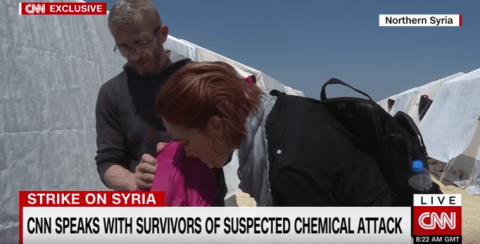
CNN correspondent Arwa Damon was at the camp to interview the “survivors” – as well as sample a little sarin herself.
The report (below) shows Damon and others, handling backpacks, clothing and toys allegedly exposed to Syrian government chemical weapons.
Damon plunges her face into one backpack, reacting, “There’s definitely something that stings” after taking her first whiff of sarin.
Neither Damon nor anyone else in the video, uses gloves or any form of protection when handling the articles allegedly contaminated with deadly chemicals.
As a reminder, here are the effects of sarin exposure according to the US government’s Centers for Disease Control (CDC):
- A person’s clothing can release sarin after it has come in contact with sarin vapor, which can lead to exposure of other people.
- Sarin is the most volatile of the nerve agents…People can be exposed to the vapor even if they do not come in contact with the liquid form of sarin.
- Symptoms likely will appear within a few seconds after exposure to the vapor form of sarin
- People may not know that they were exposed because sarin has no odor.
- Even a small drop of sarin on the skin can cause sweating and muscle twitching where sarin touched the skin
- People exposed to a low or moderate dose of sarin by breathing contaminated air…or touching contaminated surfaces may experience some or all of the following symptoms within seconds to hours of exposure:
- Runny nose
- Watery eyes
- Small, pinpoint pupils
- Eye pain
- Blurred vision
- Drooling and excessive sweating
- Cough
- Chest tightness
- Rapid breathing
- Diarrhea
- Nausea, vomiting, and/or abdominal pain
- Increased urination
- Confusion
- Drowsiness
- Weakness
- Headache
- Slow or fast heart rate
- Low or high blood pressure
Those are the symptoms of a low to moderate dose. The CDC webpage goes on to note a large dose immediately leads to convulsions and death.
“There’s definitely something that stings” – yeah that about sums up the symptoms of exposure to the deadly nerve agent.
The CNN fake news report goes on to interview others in the camp, without any proof of where they in fact came from, or more importantly, the political allegiance of the alleged witnesses.
All in a day’s work for the network that now prides itself on promotion of salacious gossip, unverified atrocity claims, and warmongering hysteria.
Russia’s OPCW envoy exposes ‘eight UK lies’ in Skripal case
RT | April 19, 2018
The UK’s narrative in the Skripal case is a “story woven with lies,” with London continuously trying to “deceive” the international community, Russia’s OPCW envoy said, highlighting eight examples of such misinformation.
“We’ve tried to show that everything our British colleagues produce is a story woven with lies,” Russia’s permanent representative to the Organization for the Prohibition of Chemical Weapons (OPCW) Aleksandr Shulgin told reporters on Wednesday, following the organization’s meeting on the Skripal case.
“And, unlike the British, who aren’t used to taking responsibility for their words and unfounded accusations, we showed specific facts why we believe our British partners, to put it mildly, are ‘deceiving’ everyone.” The official provided eight examples of UK-pushed misinformation, surrounding the March 4 events, when the former double agent Sergei Skripal and his daughter Yulia were poisoned in the town of Salisbury.
#1. Russia refuses to answer UK ‘questions’
“In reality, they’ve asked us only two ‘questions’… And both were worded in such way that the existence of an undocumented arsenal of chemical weaponry at Russia’s disposal was presented as an established fact, beyond any doubt.”
It was effectively an ultimatum, pressing Moscow to either confess that it “attacked the UK with chemical weapons,” or to admit that it had “lost control over the chemical warfare arsenal.”
Moscow answered both of these ‘questions’ immediately, stating that it had nothing to do with the Salisbury incident. Apart from that, the official emphasized, it is an established fact that Russia destroyed all its chemical weaponry stockpile ahead of schedule last year.
#2. UK abides by Chemical Weapons Convention rulebook
The OPCW procedures clearly state that if one member state has issues with another, it should send an official request, and thus the other party would be obliged to respond within 10 days, Shulgin said. However, instead, the UK allegedly “instigated by their colleagues from across the pond,” disregarded the established mechanism and came up with a dubious “independent verification” scheme, which violates those very OPCW rules.
#3. Russia refuses to cooperate
While the UK and a number of its allies accuse Russia of “refusing to cooperate to establish the truth,” the situation is exactly the opposite, Shulgin insists. Moscow is interested in a thorough investigation of the incident – especially since the victims are Russian citizens. Moscow repeatedly insisted on a joint probe and urged London to release data on the Skripal case, but all efforts were in vain. Many requests went unanswered by the UK, while others received only a formal reply.
#4. Russia invents versions to distract attention
Despite numerous speculations and allegations by questionable sources, cited by the UK’s own domestic media, it was Moscow that was eventually accused of coming up with some “30 versions” of the Salisbury events, allegedly to “disrupt the investigation,” Shulgin said.
“In reality, the picture is different. In fact, it’s the British tabloids, the so-called independent media, which is multiplying those versions,” the official stated, recalling some of the narratives, most of which entirely contradict each other.
#5. Exterminating traitors is Russia’s official state policy
“They claim that the Russian leadership has, on multiple occasions, stated that extermination of traitors abroad is a state policy of Russia,” Shulgin said. “This is slander, of course. The British cannot produce a single example of such statements, since the Russian leadership has never said anything of the kind.”
#6. Experts pin the blame on Russia
The head of the OPCW mission has clearly said that it was impossible to determine in which country the toxic substance used in Salisbury had originated. Yet the OPCW findings were once again used by the UK officials to claim Moscow was “highly likely” responsible. “Look, the head said it was impossible and they, abandoning all common sense, said ‘They’ve confirmed our evaluations that it was Russia.’ How else can you evaluate this but as a lie?” Shulgin wondered.
#7. ‘Novichok’ is a Soviet invention, so it has to be Russia
The development of the so-called Novichok family of toxic agents more than 30 years ago in the Soviet Union was one of the main cornerstones in the UK narrative, pinning blame for the Skripal incident on Russia. Publicly available sources, however, indicate that “the West has been and still is conducting research and development into such substances,” Shulgin said, giving a fresh example of such activities.
“Not long ago, namely on 1 December 2015, the US Patent and Trademark Office filed a request to its Russian colleagues asking to check patentability … of a chemical weaponry-filled bullet, which could be equipped with Tabun, Sarin or the Novichok family of agents,” the official stated.
#8. Yulia Skripal avoids contact with relatives & refuses Russian consular support
While such a statement was indeed produced by the UK authorities “on behalf” of Yulia, Moscow believes it to be false. According to Shulgin, the situation with Yulia is starting to look like a Russian citizen is effectively being “held hostage” by the UK authorities.
Out of 26 Major Editorials on Trump’s Syria Strikes, Zero Opposed
By Adam Johnson | FAIR | April 18, 2018
A survey by FAIR of the top 100 papers in the US by circulation found not a single editorial board opposed to Trump’s April 13 airstrikes on Syria. Twenty supported the strikes, while six were ambiguous as to whether or not the bombing was advisable. The remaining 74 issued no opinion about Trump’s latest escalation of the Syrian war.
This is fairly consistent with editorial support for Trump’s April 2017 airstrikes against the Syrian government, which saw only one editorial out of 47 oppose the bombing (FAIR.org, 4/11/17). The single paper of dissent from last year, the Houston Chronicle, didn’t publish an editorial on last week’s bombing.
Seven of the top 10 newspapers by circulation—USA Today, Wall Street Journal, Los Angeles Times, New York Post, Chicago Tribune, Newsday and Washington Post—supported the airstrikes. The New York Daily News and San Jose Mercury News offered no opinion, while the New York Times (4/13/18) was ambiguous—mostly lamenting the lack of congressional approval, but not saying that this meant the strikes were illegal or unwise. “Legislation should…set limits on a president’s ability to wage war against states like Syria,” is the Times’ conclusion. A complete list of editorials on the airstrikes can be viewed here.
Almost every editorial spoke in the same Official, Serious tone that demanded “action” be taken and “international norms” be “enforced.” Some, such as the Wall Street Journal (4/16/18), went further, insisting on a wider war against the Syrian regime, Iran and/or Russia in vague but menacing terms.
“Barack Obama dealt Mr. Trump a bad hand by letting Russia, Iran and China believe they could advance their goals of regional domination without US resistance,” the Journal insisted. “In Syria as elsewhere, Mr. Trump has to decide if he wants to ratify that American retreat or develop a strategy to stop it.”
The mid-market Toledo Blade (4/15/18) punched above its weight class and delivered the most bellicose and jingoistic editorial of them all with “The West Stands Up”:
Make no mistake, this was a warning to Vladimir Putin as well as Bashar al-Assad.
The United States and its two longtime allies redrew the red line that had been obliterated by a failure of nerve by the US and the West generally: There will be cost for your barbarities….
But in the larger sense, the West did what it should have done a long time ago. It stood up for decency and international law. It stood up for those who are defenseless. It stood up for itself, and for simple humanity, and redeemed some self-respect.
If Assad regime officials find themselves catching up on news from the greater Northwest Ohio region, they will surely take heed.
None of the top 100 newspapers questioned the US’s legal or moral right to bomb Syria, and all accepted US government claims to be neutral arbiters of “international law.” Many editorials handwrung about a “lack of strategy” or absence of congressional approval, but none so much that they opposed the bombing. Strategy and legal sanction are add-on features—nice but, by all accounts, not essential.
The total lack of editorial board dissent is consistent with major papers’ tradition of uniform acceptance of US military action. The most influential paper in the country, the New York Times, has not opposed a single US war—from the Persian Gulf to Bosnia, to Kosovo to Iraq to Libya to the forever war on ISIS—in the past 30 years.
The scope of debate among major editorial boards is not if Trump should bomb the Syrian regime, but how much bombing he should undertake—and when, roughly speaking, he should maybe get around to letting Congress know.
Featured Video

Saudi Led Destruction of Yemen’s heritage
or go to
Aletho News Archives – Video-Images
From the Archives
Israel: Strategic Ally or Liability?
By Stephen Sniegoski | My Catbird Seat | June 12, 2010
The claim that Israel serves as a valuable ally for the United States is made by both pro-Zionists and much of the anti-war and anti-Zionist Left that is influenced by Noam Chomsky. As a result of the Gaza flotilla massacre, which has caused a world-wide uproar against Israel, the value of Israel to the United States is being publicly questioned in more mainstream foreign policy forums. … continue
Blog Roll
 Aletho News
- Four in five new UK jobs taken by foreigners – report
- Here’s what Trump’s latest U-turn really means for Russia and Ukraine
- The Houthis Are Not an Iranian Proxy
- Europe’s Energy Hypocrisy, Russian LNG Profits and US Dependence
- ICC ignored ‘very well-documented’ NATO crimes – ex-Libyan minister
- SNSC secretary dismisses US response to Iran’s conditions as ‘inadequate’
- Sanaa says Taiz roads open, secure for residents, warns Saudi forces
- Iraqi resistance group urges Saudi leadership to admit defeat, lift Yemen siege
- Trump’s Retreat: How Al-Aqsa Flood Took Down the US Empire
- Israel’s Military Actions in Lebanon Grossly Violate International Law — Lavrov
- If Americans Knew
- Israeli occupation forces using social media surveillance unit to target hundreds of Palestinians in the West Bank
- Israel’s New – and Terrifying – Security Doctrine
- Israeli Attacks Kill Five in Gaza, Including a four-year-old and a woman
- Air Force Major Who Called for Trump’s Impeachment Held in Solitary Confinement
- It’s a Genocide, I’m Into It’: Seinfeld Mocks Protest over Palestinian Children Killed
- Universities fire dozens amid pressure from Zionist billionaires
- Gaza’s buildings are collapsing on top of us. But there’s nowhere else to shelter
- Israel kills four-year-old Gaza child – Daily Update
- After Oct 7, IDF policy allowed civilian casualties for even the lowest-ranking targets
- Israel’s Destruction of Southern Lebanon Intensified After the Cease-Fire
- No Tricks Zone
- New Study Suggests Large Regions Of The Pacific Ocean Have Been Cooling For The Last 80 Years
- Germany’s Green Energy Debacle: High Energy Costs Force Kahla Porzellan to Close After 182 Years!
- New Study: 50 Years Of The Most Aggressive ‘Net Zero’ Policies Can Only Affect The Global Climate By 0.03°C
- US September “Heat” Was No Record…Many Records Set Decades Ago
- Latest European Green Energy Debacle; Portugal’s Largest Flagship Solar Park Insolvent!
- Green Energy Debacle: German Expert Professor Fritz Vahrenholt Warns Of Severe Economic And Social Consequences
- Two More Paleo Reconstructions Affirm Meters-Higher Sea Levels Across Ireland, Brazil 7000-6000 Years Ago
- New Study: Earth And Venus Surface Warmth Largely Explained By Convection And Lapse Rate, Not CO2 Or Radiation
- 2025 Nature Paper Claiming Worsening Global Drought Gets RETRACTED …Heavily Flawed
- New Study: ‘Global Drought Shows No Detectable Recent Acceleration Under Climate Warming’

