US Authorities Combing Through Residence of Russian Consul General in Seattle
Sputnik – 26.04.2018
SEATTLE – US authorities are combing through the premises of the seized Russian Consul General residence in Seattle, and regular police officers have been removed from the site, a Sputnik correspondent reported on Thursday.
The officials, wearing plain clothes, were seen moving in and out of the shuttered residence and walking around the outside of the property.
One vehicle is parked on the premises, while another is parked outside behind the building.
Throughout the day, several vehicles arrived and departed from the residence, as various authorities arrived to tour the property. It was unclear exactly exactly what they were doing.
Three police officers who were stationed at the residence’s gates on Wednesday — two at the front and one at the back — have been removed, and no law enforcement officers are currently on the site.
The Russian flag continues to fly over the building.
For the first time since Russian diplomats left Seattle on Tuesday, a trash truck came to pick up rubbish from the neighborhood dumpsters, including from one located outside the residence.
The dumpsters have been attracting local journalists, who were seen examining garbage bags left behind by the Russian diplomats. Many posted pictures of their finds on social media, detailing the contents of the trash, which included shredded paper and leftover food.
On Wednesday, US officials came to the closed residence of the Russian Consul General in Seattle, opened the gates and entered the building after breaking all the locks. Commenting on the move, US State Department spokeswoman Heather Nauert said on Twitter that it was not intrusion but a legal action in response to “Russia’s continuing, outrageous behavior.” The diplomat added that the US officials entered the residence to ensure that it had been cleared.
Russian Foreign Ministry’s spokeswoman Maria Zakharova said on Thursday that Washington grossly violated international legal norms at the residence and called the actions surrounding the seizure of the property “outrageous and unprecedented.”
Zakharova reiterated that Moscow insists on the return of all six diplomatic facilities “illegally seized by the US authorities” over the last two years.
The diplomat added that if the incident had been caused by legal issues, then the United States should provide the details of the law that was used to justify the seizure of the Russian property.
A representative of the Russian ministry warned that if the United States considers its actions at the residence of the Russian Consul General a “lawful response,” then maybe Russian officials should also “visit” their US partners.
On March 26, US President Donald Trump ordered the expulsion of 60 Russian diplomats and the closure of the Russian Consulate in Seattle by April 2 over claims that Moscow played a role in the poisoning of an ex-spy in Salisbury, allegations which Russia strongly denies.
Never Let Anyone Call You Crazy For Doubting Establishment War Narratives

By Caitlyn Johnstone | April 25, 2018
There has still been no retraction or correction of The Guardian‘s demonstrably false and completely indefensible claim that two normal antiwar Twitter accounts were controlled not by real people but by bot programs based in Russia.
This is the sort of environment that has been created by the ongoing Russia panic that is plaguing the western world: one wherein mainstream news outlets can openly lie about dissenting voices and antiwar activists, refuse to retract or apologize for those lies, and suffer no consequences.
And yet they still have the gall to paint anyone who expresses doubt about the narratives they advance about Russia and Syria as crazy, kooky conspiracy theorists. Google the words “conspiracy” and “Syria” right now and you’ll come up with countless editorials with headlines like “Syria war: The online activists pushing conspiracy theories,” “Disinformation and Conspiracy Trolling in the Wake of the Syrian Chemical Attack,” and “SYRIA GAS ATTACK CONSPIRACY THEORIES FUELED BY TUCKER CARLSON AND FAR-RIGHT FRINGE.”
They’re using the highly stigmatized label “conspiracy theories” to paint healthy, normal skepticism of a notoriously untrustworthy power establishment as mentally unsound paranoia.
The other day I wrote an article about the shocking number of blatant attack editorials the mass media machine has been churning out on anyone who questions the establishment Syria narrative, and that output has not slowed down since. Warmongering empire loyalists like senior Huffington Post editor Chris York have been hard at work making sure the output of McCarthyite smear pieces remains on rapid fire, accusing anyone advocating skepticism of the same establishment which lied us into Iraq and Libya of being a tinfoil hat-wearing nut job.
This fits an established pattern which we have discussed previously, wherein proponents of US-led military intervention accuse those who question their narratives of being mentally unsound. There is a word for the tactic of convincing someone that they are crazy in order to manipulate and control them, and that word is gaslighting. It is a textbook abuse tactic, and it isn’t okay.
It isn’t okay for these war whore pundits to bully and deceive us so that we will feel unsure of the basis for our skepticism and consent to the longstanding western agenda of regime change in Syria. It isn’t okay for them to try to make people unsure of their mental health in order to pave the way toward public consent for broader bombing campaigns and no-fly zones in a sovereign nation under assault by western-backed jihadists. Never let anyone bully you into thinking that you are the strange, weird outlier for suspecting that a western empire who has sponsored actual, literal terrorist factions in Syria might lie about Iraq’s next-door neighbor like they lied about Iraq.
Doubting the official narrative being advanced by mainstream media is the sanest thing in the world. The US-centralized power establishment has an extensive and well-documented history of using lies, propaganda and false flags to manufacture public support for preexisting war agendas, so it is perfectly sane to express concern about the legitimacy of the stories we’re being told about Douma, the Skripal case, Russian hacking allegations etc. We’ve already got The Guardian lying unapologetically straight to our face right now about Russian bots while not one single mainstream editorial opposed the British, French and American bombing of Syria earlier this month, so it’s obviously very sane to think the mainstream media may be advancing the interests of this war like they do every other.
Intense, rigorous skepticism is the only sane response to these narratives we’re being pummeled with day in and day out, and they’re trying to make us believe that the exact opposite is true.
Ian Shilling, one of the two Twitter account owners falsely labeled a Russian bot by The Guardian, appeared on Sky News a few days ago to defend himself and debunk the claims made about him. It was a truly brilliant appearance, and despite the open hostility showed him by the two Murdoch muppets hosting the show he was able not just to defend himself but to use the space to attack the warmongering neoconservative agendas being advanced by the UK government. As a representative of the many many regular flesh-and-blood humans on Twitter who are routinely dismissed as “Russian bots” simply for questioning establishment narratives, Ian knocked it out of the park and then some. He not only proved his humanity, he proved his sanity.
With the benefit of hindsight and not having been the one in the crosshairs, however, there was one part I thought could be handled a little differently. At one point in the interview, Shilling was articulating exactly why it would make no sense for Assad to have used chemical weapons in Douma as he is accused of having done, and one of the Sky News hosts demanded to know “Well if not, who then?”
Shilling provided the entirely reasonable speculation that it would have been the terrorists occupying the area who had every incentive to stage such an attack, but in my opinion it isn’t necessary to even go that far. The burden of proof is on the party making the claim; it isn’t up to us to flesh out a positive narrative about what happened using the limited information and resources afforded to bloggers and tweeters, it’s up to the massive western power establishment to provide the kind of proof of their accusations that is required in a post-Iraq invasion world. This plainly has not happened.
You see this sneaky attempt to shift the burden of proof among empire loyalists all the time when debating such topics. A couple of months ago I wrote about how in a debate with Real News‘ Aaron Maté, John Feffer of Lobelog used the tactic of arguing that his belief in the still-unproven Russian hacking accusations arises from the absence of a better “counter-narrative” about what happened, the implication being that we should take the US intelligence community at their word unless presented with a more compelling case for what happened from somewhere else. We also saw it in the BBC’s recent interview of Lord West, whose skepticism of the establishment Douma narrative was met with protestations that he didn’t have any solid proof of anything else having happened than what we’ve been told by the western war machine.
Don’t let them shift the burden of proof like that. We can point out, in the case of Douma for example, that the area was crawling with known terrorists who had every incentive to stage such an attack and gain the benefit of the western empire’s air force bombing their sworn enemy over a crossed “red line”, but we should also point out that it isn’t our job to come up with a positive counter-narrative about what happened. The burden of proof is on the accuser, so it’s their job to present us with a very solid collection of evidence that the alleged chemical attack could only have been perpetrated by the Assad government. Until then, our position that these people lied to us about Libya and Iraq and have a longstanding agenda of regime change in Syria is sufficient to declare decisive victory in any debate.
Don’t let them shift the burden of proof, and don’t let them gaslight you. You have truth on your side, and their side has a whole, whole lot of work to do before they have enough substantial evidence to even debate you rationally. They use these deceitful tactics because they are losing the debate, and because war is very profitable and advantageous for a few very powerful individuals. That’s all that’s happening here.
Whether it’s Russiagate, Skripal or Syria, the Media Have Lost Their Grip on Reality
Despite a series of collapsing mainstream narratives, the establishment can’t help but doubling (and tripling) down on their official conspiracy theories.
By Paul Mansfield | 21st Century Wire | April 26, 2018
The “Blame Russia” for absolutely everything world we currently occupy has reached a point almost beyond return and is scaling heights that would turn Joseph McCarthy green with envy. Whether it is internally produced political turmoil and scandal, or because of generally reckless and failed foreign policy endeavours, the US and UK governments are more wiling than ever to pin the blame on Russia without fail.
The instant blame on Russia for the poisoning of Sergei and Yulia Skripal, or “highly likely it was Russia”, as Theresa May put it, proved grossly premature, graduating onto maybe not so likely at all – thanks to dedicated alt media and social media researchers and activists uncovering the development of Novichoks in multiple countries, making it entirely plausible that some country other than Russia may be responsible for the improbable Salisbury event.
No sooner did the Skripal Affair wind up, than another supposed ‘chemical attack’ unfolded, this time in Syria, where an alleged chemical weapons airstrike was said to have taken place in Douma on 7 April. Accounts of this incident were reliant entirely for its evidence on two dubious sources, the US and UK-backed White Helmets and the Syrian American Medical Society (SAMS). It didn’t take long before the official story started springing leaks though. The hilarity of seeing chlorine cylinders laying on a bed, rather than smashing through it, numerous witness statements there was no chemical attack, the testimony of over a dozen medical personnel at the medical centre concerned that the White Helmets caused a panic by shouting chemical attack when there was none and the interview of 11 year old Hassan Diab, who was not a chemical weapon victim, but certainly was a victim of an unwarranted drenching as part of a staged event, have all demolished yet another false flag instigated by western intelligence agencies and their White Helmets operatives. All this was irrelevant however to the criminal Troika, the US, UK and France, who bypassed the United Nations and bombed Syria in the early hours of 14 April, provoking Russia into an instant reaction which never came.
Some are of the opinion that the Troika and Russia reached an agreement beforehand and so therefore there was never the threat of outbreak of conflict which could escalate to a catastrophic WWIII.
Here is the White Helmets ‘hose-down’ video which triggered a western military intervention:
Faced with rapidly dwindling legitimacy and credibility, the UK government in particular set their attack dogs in the mainstream media on to alt media and social media activists. The result is a coordinated and intensive smear campaign against independent journalists, academics and social media activists with large followings. The gutter press of the UK have demonstrated that in terms of propaganda and disinformation, they are without peer. US media Russophobes almost look like babes in the woods in comparison.
What we are witnessing is a war on truth, vicious intimidation of dissenting voices, the negating of fierce independent voices as Russian puppets and bots and Assad apologists, and ad hominem attacks all designed to shut down a powerful narrative which shines a light on the warmongering narrative propagated by the mainstream media.
The campaign reached a level of absurdity beyond comprehension when Twitter activist @Ian56789 was asked by Sky News hosts if he was a bot as he was being interviewed live on air!

As disinformation against Russia soars off the fake news Richter Scale and independent journalists and activists are being personally targeted, one only has to revisit the recent Devon Nunes Memo story as an example of a real domestic US political scandal which the derelict US mainstream media attempted to transform into yet another Russian disinformation campaign.
You would have to be living under a rock to not know of the salacious, but unverified dossier on US President Donald Trump, which purportedly started out as a piece of opposition research during the 2016 election campaign, but quickly became the driving force behind allegations that Trump colluded with the Russian government in order to win the presidential election. In the mind of many a deep state adoring Democrat and mainstream media journalist, it is beyond dispute that Trump colluded with Russia. The major questions are how extensive the collusion was and does it amount to having committed federal crimes. To answer these questions, the Mueller investigation must continue expanding as far and wide as necessary.
Many Republicans believe the widely ridiculed and discredited dossier prepared by a former British spy, Christopher Steele, was the catalyst for the FBI decision to investigate allegations of Trump campaign collusion with Russia. A mocked and debunked dossier, which looked like it was concocted in a teenagers bedroom bought down on CNN and Buzzfeed a truck load of embarrassment when they decided to run with a story other media outlets balked at.
So how did it transform into such a vital document that initiated the Mueller probe into suspected Trump collusion with Russia?
We have had the mainstream media pumping this story 24/7. They will not let it go, determined that it bring about the downfall of Donald Trump. By gleefully accepting any lead from their highly coveted ‘sources’, the MSM begs to be subverted by the intelligence community, thereby subverting any prospect of a properly functioning US democracy and informed citizenry.
However, the revelations of #ReleaseTheMemo which alleged shocking FISA abuses by the FBI has raised the spectre of another alleged collusion; the FBI and the Obama DOJ colluding against Trump. The major accusation is that the FBI hid from the FISA court judge the fact that it was heavily relying on the dodgy Trump Dossier to obtain a surveillance warrant to spy on Trump, the man who was to become the future President. What is even more explosive is that it was not revealed to the judge that the Democratic National Committee and Hillary Clinton’s presidential campaign paid for the dossier. Dirty partisan politics has gone a step too far in this sordid affair, with the DNC and FBI duping the FISA court into unwittingly assisting them in their campaign against Trump.

And let’s be clear here; this is the work of the Obama administration and any rigorous investigation would pursue whether or not the collusion against Trump went all the way to former president Obama himself.
Republicans were outraged and demanded the release of the memo.
This is hardly a surprise, being shocked and alarmed at possible internal interference in the election by US intelligence agencies, the very agencies that told us it was Russia that undermined US democracy by its electoral interference.
It is crucial to grasp the fact that this affair is a case of internal interference in the election campaign and has generated intense reaction within the US political establishment and among many in the general public.
One may question then the spin the Hamilton 68 propaganda organ placed on the interest whipped up by the memo. It attempted to reframe calls to release the memo as yet another so-called Russian influence operation, using trolls and bots to amplify the message across cyberspace.
‘Hamilton 68’ doesn’t track propaganda. It is propaganda. Its “Council”? Stuffed with Bill Kristol, Michael Chertoff, Mike Morell, etc. Its funding? Opaque (see its 990s). Its methodology? Unfalsifiable–Twitter users put on ad-hoc secret lists based on political view. Appalling.
— Julian Assange ⌛ (@JulianAssange) January 19, 2018
Hamilton 68, a banal and comical operation, is projecting on to Russia the very thing it is doing itself; spreading disinformation aimed at undermining and destabilizing Russia, but also the US political system. On the strength of CNN’s dumpster diving, Hamilton 68 likes to tell us all about how the cryptic ‘Internet Research Agency’ in St. Petersburg is one big giant troll factory. Sorry, Hamilton 68, but you are one big NATO/Deep state cyberspace troll factory yourselves.
The Democratic Party Russophobia icons, Dianne Feinstein and Adam Schiff, quickly took the opportunity to deflect from the emerging memo scandal, pulling out the playbook of Russian subversion through social media for the umpteenth time. Quite comfortable with the fact that they have secured the social media giants as appendages of the US deep state, Feinstein and Schiff wrote to Twitter and Facebook asking them to investigate what they claimed are Russian bots spreading the #ReleaseTheMemo hashtag. The letter reads in part:
“… Several Twitter hashtags, including #ReleaseTheMemo, calling for release of these talking points attacking the Mueller investigation were born in the hours after the Committee vote. According to the German Marshall Fund’s Alliance for Securing Democracy, this effort gained the immediate attention and assistance of social media accounts linked to Russian influence operations. By Friday, January 19, 2018, the #ReleaseTheMemo hashtag was “the top trending hashtag among Twitter accounts believed to be operated by Kremlin-linked groups.” Its use had “increased by 286,700 percent” and was being used “100 times more than any other hashtag” by accounts linked to Russian influence campaigns. These accounts are also promoting an offer by WikiLeaks to pay up to $1 million to anyone who leaks this classified partisan memo.
If these reports are accurate, we are witnessing an ongoing attack by the Russian government through Kremlin-linked social media actors…”
Nice sleight of hand Hamilton 68, Schiff and Feinstein, but this is a scandal that whipped Republicans, not Russians into a frenzy. It is a stand-alone scandal that raised questions about the ethics, partiality and possible illegal acts of the US intelligence community and the Obama DOJ. It does not need any Russian trolls to inflate the gravity of the situation.
Florida Republican Rep. Ron Desantis tweeted, “Yesterday, I viewed a deeply troubling report compiled by House Intelligence that raises questions about Obama DOJ & the so-called collusion investigation.”
Desantis said it right there: collusion between the Obama DOJ and the FBI. If true, it is a shocking indictment on deep state interference in US politics, going all the way to the top in attempting to subvert the US presidential election.
So we have at least 2 allegations of collusion; the longstanding and tiresome Russiagate story, which the mainstream media will not give a moments rest and the newer, but equally shocking FBI/DOJ collusion emerging from the woodworks with the news of the classified memo.
You can read and watch RussiaGate stories in both US/Western MSM and Russian media. Fair enough, it was a big story, newsworthy and deeply concerning if it was true (the US media has overplayed their hand though to put it mildly). As time goes on and without a shred of evidence produced, it is time to put the whole issue to bed and move on. It is only the absurdity of the MSM insistence that collusion has been proved beyond doubt and any who question it are conspiracy theorists, that maintains the interest of the reasonable person, even if only to mock media figures and politicians who are the true conspiracy theorists.
The calls to release the Devon Nunes compiled memo also attracted huge coverage in both US and Russian media. However, US media framed it in terms of a partisan struggle between Democrats and Republicans; detracting from the implications of the abuse of the FISA system and placing the scandal into the realm of normal everyday, if somewhat dirty party politics.
There is nothing everyday about the possibility that this whole Russia investigation is in reality a conspiracy by top FBI officials and the DOJ to sabotage Trump and install Hillary Clinton (remember her?) as president. Look at Peter Strzok and Lisa Page as examples, whose texts made no secret of their contempt for Trump and their desire to see him lose the election.
So why did CNN, the New York Times and the supposedly reputable Business Insider deem it newsworthy to claim Russian influence networks were spreading the release the memo hashtag like wildfire across the social media landscape. Business Insider even implied the Nunes memo has been given wings by being amplified by Russian trolls and bots across the social media landscape.
The compiling of the memo by Republican aides on the House Intelligence Committee that led to the unfolding scandal was not initiated by Russia. The angry calls for action came from Republicans, not Russians.
We can’t even be sure if these so-called Russian networks of trolls are Russian at all. But let’s assume for a minute they are. Big deal if they spread the story. It is fascinating, very interesting and could have huge consequences of DOJ and FBI heads rolling. It also serves to relieve some of the pressure on Russia, so why wouldn’t they promote it heavily. They are merely acting in the interests of Russia, which no reasonable person could complain about.
Many people believe Americans are simply apathetic victims and that these supposed Russian trolls or bots are drowning them in disinformation, and that western media figures and politicians are powerless to stop it. That’s the mainstream’s moderate narrative. However, a look at the number of followers of some US media celebrities on Twitter should dispel that misinformation in a heartbeat. Rachel Maddow, with 9 million followers, retweeted a tweet by NBC reporter Ken Dilanian, a tweet which itself got 6K retweets and 19K likes. His tweet, included, “your #ReleaseTheMemo is the top trending hashtag among the Russian bots and trolls over the last 48 hours, and you might want to ask yourself why.”
So a media figure from NBC is clearly muddying the waters, throwing us a red herring in implying the nefarious hand of Russia is at play. Maddow gave Dilanian huge impetus in his attempt to try to flip the story to turn it into yet another opportunity to attack Russia. Deeply troubling allegations which could rock the foundations of the intelligence and justice communities are made a mockery of by a disreputable journalist who sees it as another chance to Russia bait. Before you know it, they will be telling us the #Memo was a joint venture put together by the FSB and Republicans, thus proving the collusion is still going as strong as ever. This level of hysteria is way beyond Cold War McCarthyism.
And when Rachel Maddow retweets something, how many likes and retweets does that generate. Enough to turn the Russian bots and trolls green (or should that be red) with envy.
Maddow herself is capitalizing very nicely on the Russophobia being generated by the whole Russiagate affair to boost her own ratings and affection within the political establishment. She has not got a single progressive bone in her body and epitomizes the dumbed down, hyped up claims about Russian interference in American political and social life. The spectacle is the theatre of the absurd, as Americans are subjected to Hollywood type entertainment to titillate and shock with the never ending “revelations” which roll out like clockwork. And, true to Hollywood style fiction, the more outrageous and sensational the better.
This is why Maddow is able to get away with calling Jill Stein a Kremlin puppet, and to feign seriousness and solemnity as she continues to call Trump a Putin puppet, putty in his hands, even as Trump has clearly embarked on a path which has plummeted US/Russian relations to their lowest point since the darkest days of the Cold War.

Maddow uses a technique for these claims which may enthrall Never-Trumpers and fill Le Resistance with fear, but it is straight from the neocon playbook. It is that any sign of Trump not being totally committed to overt and outright hostility to Russia proves that he is a Russian puppet. He must adopt the neocon attitude of Russia being the eternal enemy, the biggest threat the US faces and that it must be confronted and made to pay a price for its aggression, expansionist ambitions and meddling in US affairs.
Putin has Trump in a vice like grip with the “compromat” on him, using it to blackmail him in to doing Russia’s bidding according to Maddow. Putin is forcing Trump to declare war on the intelligence community, fomenting chaos in a crowning glory of undermining US national security. How better to leave the US vulnerable to the rapacious desires of Russia than by shattering the institutions of US national security.
Maddow believes Putin blackmailed Trump with the Golden showers tape to hire Paul Manafort as his campaign manager, to hire Rex Tillerson as Secretary of State, and to pressure him to withdraw US forces in Eastern Europe and the Baltics, (which hasn’t happened).
“Is the new President gonna take those troops out? After all the speculation, after all the worry, we are actually about to find out if Russia maybe has something on the new President? We’re about to find out if the new President of our country is going to do what Russia wants once he’s Commander-in-Chief of the US military starting noon on Friday. What is he gonna do with those deployments? Watch this space.”
In Maddows demented mind, anything less than the Trump administration universally standing poised to unsheathe their swords and land a mortal blow on Russia is proof of collusion with the Kremlin. Any conciliatory overtures are met by howls of derision by the Maddow/Hillary Clinton led “resistance.” Amid this red hot rhetoric and witch hunt for internal traitors, Maddow and her ilk are the ones to claim it is Russia sowing discord and discontent.
“This is international warfare against our country,” Maddow said on her show.
Maddow says she goes to bed every night wondering what new Russia scandal awaits the country the next morning, propelling the Russia hysteria all the way to election 2020 and bankrolling her show and career almost exclusively on one issue threadbare of any evidence. The McCarthy of the modern mainstream media some say. It’s Clickbait applied to cable TV you could also say:
“If the presidency is effectively a Russian op, if the American presidency right now is the product of collusion between the Russian intelligence services and an American campaign — I mean, that is so profoundly big, we not only need to stay focused on figuring it out. We need to start preparing for what the consequences are going to be if it proves to be true.”
‘If it proves to be true.’ That’s right, and we’re still waiting for the evidence.

Maddow and her fellow military industrial complex media mouthpieces don’t need evidence to believe Russia interfered in the election, as she spreads her poison to millions of viewers night after night. She sees Vladimir Putin as pure evil, the embodiment of the terrifying KGB and tells her viewers this repeatedly. She has become the torchbearer for an ever wilder conspiracy theory, whipping her audience into a frenzy, baying for Russian blood.
It is extraordinary that anyone listens to a word Maddow says after she produced her only evidence on Trump; his tax return which revealed he paid $38million in federal taxes on more than $150 million in income in 2005. Bombing out big time on alleged Trump tax cheating has clearly not stopped Maddow proceeding full steam ahead in accusing him of being a Kremlin installed puppet.
So who is running an influence campaign here, Moscow, or the US military industrial complex media?
What is never discussed outside of alt-media circles is how far were the FBI, the DOJ, and the Hillary Clinton campaign involved in what is increasingly looking every day more like FBIgate than Russiagate? What about the roles of powerful deep state actors like John Brennan and James Clapper, who are bound to have played a hand in concocting and promoting the official conspiracy theory? Clapper, who thinks it is in Russian DNA to hack things and Brennan who sees Russia as a long term threat intent on attacking US democracy, sternly warning the incoming President Trump not to ignore the huge threat Russia poses.
What was also not overtly acknowledged is that by pressuring for the release of the memo, Devon Nunes and other Republicans actually carried out a duty they were elected to perform; holding the intelligence community accountable. As former CIA analyst Ray McGovern of Consortium News said:
At this point, the $64 question is whether the various congressional oversight committees will remain ensconced in their customarily cozy role as “overlook” committees, or whether they will have the courage to attempt to carry out their Constitutional duty. The latter course would mean confronting a powerful Deep State and its large toolbox of well-practiced retaliatory techniques, including J. Edgar Hoover-style blackmail on steroids, enabled by electronic surveillance of just about everything and everyone. Yes, today’s technology permits blanket collection, and “Collect Everything” has become the motto.
The take-away from all of this is that no sin is too great, and no scandal can’t be flipped to pin the blame on Russia.
Meanwhile, any criminal or unethical conduct of Democrats and deep staters will not be plastered across the newspapers and cyberspace.
Don’t worry about it. Just say its Russian disinformation. Works every time.
Douma: Part 1 – Deception In Plain Sight
Media Lens | April 25, 2018
UK corporate media are under a curious kind of military occupation. Almost all print and broadcast media now employ a number of reporters and commentators who are relentless and determined warmongers. Despite the long, unarguable history of US-UK lying on war, and the catastrophic results, these journalists instantly confirm the veracity of atrocity claims made against Official Enemies, while having little or nothing to say about the proven crimes of the US, UK, Israel and their allies. They shriek with a level of moral outrage from which their own government is forever spared. They laud even the most obviously biased, tinpot sources blaming the ‘Enemy’, while dismissing out of hand the best scientific researchers, investigative journalists and academic sceptics who disagree.
Anyone who challenges this strange bias is branded a ‘denier’, ‘pro-Saddam’, ‘pro-Gaddafi, ‘pro-Assad’. Above all, one robotically repeated word is generated again and again: ‘Apologist… Apologist… Apologist’.
Claims of a chemical weapons attack on Douma, Syria on April 7, offered yet another textbook example of this reflexive warmongering. Remarkably, the alleged attack came just days after US president Donald Trump had declared of Syria:
I want to get out. I want to bring our troops back home. I want to start rebuilding our nation.
The ‘mainstream’ responded as one, with instant certainty, exactly as they had in response to atrocity and other casus belli claims in Houla, Ghouta, Khan Sheikhoun and many other cases in Iraq (1990), Iraq (1998), Iraq (2002-2003), Libya and Kosovo.
Once again, the Guardian editors were sure: there was no question of a repetition of the fake justifications for war to secure non-existent Iraqi WMDs, or to prevent a fictional Libyan massacre in Benghazi. Instead, this was ‘a chemical gas attack, orchestrated by Bashar al-Assad, that left dead children foaming at the mouth’.
Simon Tisdall, the Guardian’s assistant editor, had clearly decided that enough was enough:
It’s time for Britain and its allies to take concerted, sustained military action to curb Bashar al-Assad’s ability to murder Syria’s citizens at will.
This sounded like more than another cruise missile strike. But presumably Tisdall meant something cautious and restrained to avoid the terrifying risk of nuclear confrontation with Russia:
It means destroying Assad’s combat planes, bombers, helicopters and ground facilities from the air. It means challenging Assad’s and Russia’s control of Syrian airspace. It means taking out Iranian military bases and batteries in Syria if they are used to prosecute the war.
But surely after Iraq – when UN weapons inspectors under Hans Blix were prevented from completing the work that would have shown that Saddam Hussein possessed no WMD – ‘we’ should wait for the intergovernmental Organisation for Prohibition of Chemical Weapons inspectors to investigate. After all, as journalist Peter Oborne noted of Trump’s air raids:
When the bombing started the Organisation for the Prohibition of Chemical Weapons (OPCW) was actually in Damascus and preparing to travel to the area where the alleged chemical attacks took place.
Oborne added:
Had we wanted independent verification on this occasion in Syria surely we ourselves would have demanded the OPCW send a mission to Douma. Yet we conspicuously omitted to ask for it.
Tisdall was having none of it:
Calls to wait for yet another UN investigation amount to irresponsible obfuscation. Only the Syrian regime and its Russian backers have the assets and the motivation to launch such merciless attacks on civilian targets. Or did all those writhing children imagine the gas?
The idea that only Assad and the Russians had ‘the motivation’ to launch a gas attack simply defied all common sense. And, as we will see, it was not certain that children had been filmed ‘writhing’ under gas attack. Tisdall’s pro-war position was supported by just 22% of British people.
Equally gung-ho, the oligarch-owned Evening Standard, edited by veteran newspaperman and politically impartial former Chancellor of the Exchequer, George Osborne, headlined this plea on the front page:
HIT SYRIA WITHOUT A VOTE, MAY URGED
Guardian columnist Jonathan Freedland, formerly the paper’s comment editor, also poured scorn on the need for further evidence:
Besides, how much evidence do we need?… To all but the most committed denialists and conspiracists, Assad’s guilt is clear.
Freedland could argue that the case for blaming Assad was clear, if he liked, but he absolutely could not argue that disagreeing was a sign of denialist delusion.
Time and again, we encounter these jaw-dropping efforts to browbeat the reader with fake certainty and selective moral outrage. In his piece, Freedland linked to the widely broadcast social media video footage from a hospital in Douma, which showed that Assad was guilty of ‘inflicting a death so painful the footage is unbearable to watch’. But when we actually click Freedland’s link and watch the video, we do not see anyone dying, let alone in agony, and the video is not, in fact, unbearable to watch. Like Tisdall’s claim on motivation, Freedland was simply declaring that black is white.
But many people are so intimidated by this cocktail of certainty and indignation – by the fear that they will be shamed as ‘denialists’ and ‘apologists’ – that they doubt the evidence of their own eyes. In ‘mainstream’ journalism, expressions of moral outrage are offered as evidence of a fiery conviction burning within. In reality, the shrieks are mostly hot air.
In the Observer, Andrew Rawnsley also deceived in plain sight by blaming the Syrian catastrophe on Western inaction:
Syria has paid a terrible price for the west’s disastrous policy of doing nothing.
However terrible media reporting on the 2003 Iraq war, commentators did at least recognise that the US and Britain were involved. We wrote to Rawnsley, asking how he could possibly not know about the CIA’s billion dollar per annum campaign to train and arm fighters, or about the 15,000 high-tech, US anti-tank missiles sent to Syrian ‘rebels’ via Saudi Arabia.
Rawnsley ignored us, as ever.
Just three days after the alleged attack, the Guardian’s George Monbiot was asked about Douma:
Don’t you smell a set up here though? Craig Murray doesn’t think Assad did it.
Monbiot replied:
Then he’s a fool.
Craig Murray responded rather more graciously:
I continue to attract attacks from the “respectable” corporate and state media. I shared a platform with Monbiot once, and liked him. They plainly find the spirit of intellectual inquiry to be a personal affront.
Monbiot tweeted back:
I’m sorry Craig but, while you have done excellent work on some issues, your efforts to exonerate Russia and Syria of a long list of crimes, despite the weight of evidence, are foolish in the extreme.
The idea that Murray’s effort has been ‘to exonerate Russia and Syria of a long list of crimes’ is again so completely false, so obviously not what Murray has been doing. But it fits perfectly with the corporate media theme of Cold War-style browbeating: anyone challenging the case for US-UK policy on Syria is an ‘apologist’ for ‘the enemy’.
If Britain was facing imminent invasion across the channel from some malignant superpower, or was on the brink of nuclear annihilation, the term ‘apologist’ might have some merit as an emotive term attacking free speech – understandable in the circumstances. But Syria is not at war with Britain; it offers no threat whatsoever. If challenging evidence of Assad’s responsibility is ‘apologism’, then why can we not describe people accepting that evidence as ‘Trump apologists’, or ‘May apologists’, or ‘Jaysh al-Islam apologists’? The term really means little more than, ‘I disagree with you’ – a much more reasonable formulation.
As Jonathan Cook has previously commented:
Monbiot has repeatedly denied that he wants a military attack on Syria. But if he then weakly accepts whatever narratives are crafted by those who do – and refuses to subject them to any meaningful scrutiny – he is decisively helping to promote such an attack.
Why Are These Academics Allowed?
The cynical, apologetic absurdity of questioning the official narrative has been a theme across the corporate media. In a Sky News discussion, Piers Robinson of Sheffield University urged caution in blaming the Syrian government in the absence of verifiable evidence. In a remarkable response, Alan Mendoza, Executive Director of the Henry Jackson Society, screeched at him:
Who do you think did it? Was it your mother who did it?
Again, exact truth reversal – given the lack of credible, verified evidence, it was absurd to declare Robinson’s scepticism absurd.
Mendoza later linked to an article attacking Robinson, and asked:
Why are UK universities allowing such “academics” – and I use the term advisedly because they are not adhering to any recognised standard when promoting material with no credible sourcing, and often with no citation at all – to work in their institutions?
In 2011, Mendoza wrote in The Times of Nato’s ‘intervention’ in Libya:
The action in Libya is a sign that the world has overcome the false lessons [sic] of Iraq or of “realism” in foreign policy.
The UN had ‘endorsed military action to prevent a humanitarian catastrophe unfolding’.
In fact, the unfolding ‘humanitarian catastrophe’ was fake news; Mendoza’s mother needed no alibi. A September 9, 2016 report on the war from the Foreign Affairs Committee of the House of Commons commented:
Despite his rhetoric, the proposition that Muammar Gaddafi would have ordered the massacre of civilians in Benghazi was not supported by the available evidence….
The Times launched a shameful, front-page attack on Robinson and other academics who are not willing to accept US-UK government claims on trust. The Times cited Professor Scott Lucas of Birmingham University:
Clearly we can all disagree about the war in Syria, but to deny an event like a chemical attack even occurred, by claiming they were “staged”, is to fall into an Orwellian world.
In similar vein, in a second Guardian comment piece on Douma, Jonathan Freedland lamented: ‘we are now in an era when the argument is no longer over our response to events, but the very existence of those events’. Echoing Soviet propaganda under Stalin, Freedland warned that this was indicative of an intellectual and moral sickness:
These are symptoms of a post-truth disease that’s come to be known as “tribal epistemology”, in which the truth or falsity of a statement depends on whether the person making it is deemed one of us or one of them.
And this was, once again, truth reversal – given recent history in Iraq and Libya, it was Lucas and Freedland who were falling into an Orwellian fantasy world. Mail on Sunday columnist Peter Hitchens made the obvious point:
Given the folly of the British government over Iraq and Libya, and its undoubted misleading of the public over Iraq, it is perfectly reasonable to suspect it of doing the same thing again. Some of us also do not forget the blatant lying over Suez, and indeed the Gulf of Tonkin.
Hitchens clearly shares our concern at media performance, particularly that of the Guardian, commenting:
Has Invasion of the Bodysnatchers been re-enacted at Guardian HQ? Whatever the dear old thing’s faults it was never a Pentagon patsy until recently. Rumours of relaunch as The Warmonger’s Gazette, free toy soldier with every issue.
Hitchens questioned Guardian certainty on Douma:
But if facts are sacred, how can the Guardian be so sure, given that it is relying on a report from one correspondent 70 miles away, and another one 900 miles away.. and some anonymous quotes from people whose stories it has no way of checking?
He added:
The behaviour of The Guardian is very strange & illustrates just what a deep, poorly-understood change in our politics took place during the Blair years. We now have the curious spectacle of the liberal warmonger, banging his or her jingo fist on the table, demanding airstrikes.
Indeed, in discussing the prospects for ‘intervention’ in the Guardian, Gaby Hinsliff, former political editor of the Observer, described the 2013 vote that prevented Britain from bombing Syria in August 2013 as ‘that shameful night in 2013’. Shameful? After previous ‘interventions’ had completely wrecked Iraq and Libya on false pretexts, and after the US regime had been told the evidence was no ‘slam dunk’ by military advisers?
In the New Statesman, Paul Mason offered a typically nonsensical argument, linking to the anti-Assad website, Bellingcat:
Despite the availability of public sources showing it is likely that a regime Mi-8 helicopter dropped a gas container onto a specific building, there are well-meaning people prepared to share the opinion that this was a “false flag”, staged by jihadis, to pull the West into the war. The fact that so many people are prepared to clutch at false flag theories is, for Western democracies, a sign of how effective Vladimir Putin’s global strategy has been.
Thus, echoing Freedland’s reference to ‘denialists and conspiracists’, sceptics can only be idiot victims of Putin’s propaganda. US media analyst Adam Johnson of FAIR accurately described Mason’s piece as a ‘mess’, adding:
I love this thing where nominal leftists run the propaganda ball for bombing a country 99 yards then stop at the one yard and insist they don’t support scoring goals, that they in fact oppose war.
Surprisingly, the Bellingcat website, which publishes the findings of ‘citizen journalist’ investigations, appears to be taken seriously by some very high-profile progressives.
In the Independent, Green Party leader Caroline Lucas also mentioned the Syrian army ‘Mi-8’ helicopters. Why? Because she had read the same Bellingcat blog as Mason, to which she linked:
From the evidence we’ve seen so far it appears that the latest chemical attack was likely by Mi-8 helicopters, probably from the forces of Syria’s murderous President Assad.
On Democracy Now!, journalist Glenn Greenwald said of Douma:
I think that it’s—the evidence is quite overwhelming that the perpetrators of this chemical weapons attack, as well as previous ones, is the Assad government…
This was an astonishing comment. After receiving fierce challenges (not from us), Greenwald partially retracted, tweeting:
It’s live TV. Something [sic – sometimes] you say things less than ideally. I think the most likely perpetrator of this attack is Syrian Govt.
We wrote to Greenwald asking what had persuaded him of Assad’s ‘likely’ responsibility for Douma. (Twitter, April 10, direct message)
The first piece of evidence he sent us (April 12) was the Bellingcat blog mentioning Syrian government helicopters cited by Mason and Lucas. Greenwald also sent us a report from Reuters, as well as a piece from 2017, obviously prior to the alleged Douma event.
This was thin evidence indeed for the claim made. In our discussion with him, Greenwald then completely retracted his claim (Twitter, April 12, direct message) that there was evidence of Syrian government involvement in the alleged attack. Yes, it’s true that people ‘say things less than ideally’ on TV, but to move from ‘quite overwhelming’ to ‘likely’, to declaring mistaken the claim that there is evidence of Assad involvement, was bizarre.
Political analyst Ben Norton noted on Twitter:
Reminder that Bellingcat is funded by the National Endowment for Democracy (NED), which is funded by the US government and is a notorious vehicle for US soft power.
Norton added:
It acts like an unofficial NATO propagandist, obsessively focusing on Western enemies.
And:
Bellingcat founder Eliot Higgins is a fellow at the Atlantic Council, which is funded by NATO, US, Saudi, UAE, etc.
And:
According to Meedan, which helps fund Bellingcat — along with the US government-funded NED — Bellingcat also works with the group Syrian Archive, which is funded by the German government, to jointly produce pro-opposition “research”.
And:
The board of the directors for Meedan, which funds Bellingcat, includes Muna AbuSulayman—who led the Saudi oligarch’s Alwaleed Bin Talal Foundation—and Wael Fakharany—who was the regional director of Google in Egypt & North Africa (US gov. contractor Google also funds Bellingcat)
And:
Bellingcat—which gets money from the US gov-funded NED and fixates obsessively on Western enemies—claims to be nonpartisan and impartial, committed to exposing all sides, but a website search shows it hasn’t published anything on Yemen since February 2017.
Although Bellingcat is widely referenced by corporate journalists, we are unaware of any ‘mainstream’ outlet that has seriously investigated the significance of these issues for the organisation’s credibility as a source of impartial information. As we will see in Part 2, corporate journalism is very much more interested in challenging the credibility of journalists and academics holding power to account.
Western Media Shorthand on Venezuela Conveys and Conceals So Much
By Joe Emersberger | FAIR | April 23, 2018
A Reuters article (4/18/18) reports that the European Union “could impose further sanctions on Venezuela if it believes democracy is being undermined there.”
The line nicely illustrates the kind of journalistic shorthand Western media have developed, over years of repetition, for conveying distortions and whitewashing gross imperial hypocrisy about Venezuela. A passing remark can convey and conceal so much.
The EU’s sincerity in acting on what it “believes” about Venezuelan democracy is unquestioned by the London-based Reuters. Meanwhile Spain, an EU member, is pursuing the democratically elected president of Catalonia, Carles Puigdemont, for the crime of organizing an illegal independence referendum last year. Weeks ago, he was arrested in Germany at Spain’s request, and other elected representatives have been arrested in Catalonia, where Spain’s federal government deposed the elected regional government after the referendum.
In July 2017, a few months before the referendum in Catalonia, Venezuela’s opposition also organized an illegal referendum. One of the questions asked if the military should obey the opposition-controlled National Assembly, which was an extremely provocative question, given the opposition’s various efforts to overthrow the government by force since 2002. The referendum required an extremely high level of political expression, organization and participation. It allegedly involved 7 million voters. The Venezuelan government disregarded the results—as Spain disregarded the Catalan referendum results—but unlike Spain, did not jail people for organizing it, or send police to brutally repress voters. In fact, two weeks later, Venezuelan voters (overwhelmingly government supporters, since the opposition boycotted and did not field candidates) were violently attacked by opposition militants when they elected a constituent assembly. The attacks resulted in several deaths.
Venezuelan President Nicolás Maduro has hardly failed to call attention to the hypocrisy of both the EU and Spain, but the Reuters article made no mention of it.
Reuters also reported that “the country’s two most popular opposition leaders have been banned from competing” from Venezuela’s presidential election on May 20. Reuters didn’t name the two supposedly “most popular opposition leaders,” but in the past (e.g., 4/12/18, 2/28/18, 2/19/18) the wire service has identified them as Leopoldo Lopez and Henrique Capriles. As it happens, according to the opposition-aligned pollster Datanalisis, whose results have been uncritically reported by Western media like Reuters for years, opposition presidential candidate Henri Falcón has been significantly more popular than Capriles in recent months, and barely less so than Lopez.

Mark Weisbrot (in an opinion piece for US News, 3/3/18) broke the news that US government officials had been secretly pressuring Falcón not to run, so that the election could be discredited as including no viable opposition candidate. Two weeks later, Reuters (3/19/18) discreetly reported Weisbrot’s scoop.
However, by far the most important thing Reuters neglects telling readers about the “two most popular opposition leaders” is that had they done in the EU what they’ve done in Venezuela since April 2002, Lopez and Capriles would both be serving long jail terms.
Capriles and Lopez together led the kidnapping of a government minister during a briefly successful US-backed military coup in 2002 that ousted Venezuela’s democratically elected president, the late Hugo Chávez, for two days. Lopez boasted to local TV that the dictator installed by the coup (whom Lopez called “President Carmona”) was “updated” on the kidnapping.
Imagine what Carles Puigdemont’s predicament would be if, rather than organizing a peaceful referendum, he had participated in a foreign-backed, ultimately unsuccessful military coup against the Spanish government. Needless to say, running for public office would not be on the table. That would be the least of his worries.
In Venezuela, Capriles eventually served a few months in prison for participating in the coup, while Lopez avoided doing any time, thanks to a general amnesty granted by Chávez. Lopez was finally arrested in 2014 for leading another violent effort to overthrow the government.
I’ve reviewed before (teleSUR, 1/9/18) violent efforts to overthrow the government that Lopez, Capriles and other prominent opposition leaders have been involved with since the 2002 coup. I also described how Julio Borges and Henry Ramos (two other prominent opposition leaders) have openly sought to starve the Venezuelan government of foreign loans as it struggles with a severe economic crisis.
In August, Trump’s administration imposed sanctions on Venezuela’s entire economy that will cost Maduro’s government billions of dollars this year (FAIR.org, 3/22/18). It has threatened to go even further, brandishing an oil embargo or even a military attack. With sufficiently compliant media (and the collusion of big human rights NGOs like Amnesty International), such depravity becomes possible.
The Reuters article also says that Venezuela’s economic “collapse has driven an estimated 3 million people to flee the country.” No need to tell readers when the economic “collapse” began—2014—much less who made the estimates or if other sources contradict them. In fact, the UN’s 2017 population division numbers estimate Venezuela’s total expat population as of 2017 at about 650,000—only about 300,000 higher than it was when Chávez first took office in 1999. Even a group of fiercely anti-government Venezuelan academics estimated less than 1 million have left since the economic crisis began. (See FAIR.org, 2/18/18.)
Cherry-picked statistics aside, when Western powers want a democratically elected government overthrown, the approach is clear. Complete tolerance for violent foreign-backed subversion—which the powerful states and their allies would never be expected to tolerate—becomes the test for whether or not a state is a democracy. The targeted government fails the test, is depicted as a dictatorship, and all is permitted. Only the tactics required to bring it down need be debated.
Messages to Reuters can be sent here (or via Twitter: @Reuters). Please remember that respectful communication is the most effective.
Media suspiciously quiet on US & UK-backed Saudi atrocities in Yemen
By Danielle Ryan | RT | April 24, 2018
On Sunday night, the Saudi-led coalition in Yemen hit a wedding party in Hajja province, killing up to 50 people. Strangely, no one in the Western media is calling for sanctions or regime change in Riyadh.
In fact, it seems they’re not that concerned at all. This is despite the fact that Saudi Arabia has been repeatedly accused of indiscriminate bombing in Yemen during a military campaign which has brought 8 million civilians to the brink of famine.
By early evening on Monday, BBC News was displaying not one, not two, but five stories about the birth of Prince William and Kate Middleton’s new baby boy. At the time of checking, there was no story at all about Yemen featured on the BBC’s front page.
Cynical minds might suspect this is because the British government is party to the slaughter in Yemen through its selling of massive amounts of weapons to the Saudi government. In the BBC’s piece on the attack, hidden seven stories down on the World News page, there was no mention at all of this relationship between London and Riyadh.
The Guardian and the Independent gave more prominence to the Yemen story than the BBC, both displaying reports on the front pages of their websites – but the levels of outrage were seriously muted in comparison with the reaction to alleged attacks on civilians by the Syrian government.
Journalists in the United States seem to be suffering from the same kind of selective outrage. A CNN story on the deaths in Yemen initially did not mention the words ‘Saudi Arabia’ until the seventh paragraph. The story was later updated to include news of the death of top Houthi leader Saleh al-Sammad, while the news about the deaths of up to 50 people at the wedding was knocked down to the fourth paragraph. This strange reluctance to be harsh on Riyadh or to give the Yemen war the prominence it deserves in the media, is clearly an effort to downplay atrocities which won’t play as well in front of a Western audience. It’s harder to play the role of the outraged anchor when you have to explain that the US signed an arms deal worth $110 billion with Saudi Arabia last year – a deal which included $7 billion worth of “precision weapons” from Raytheon and Boeing.
Perhaps if the White Helmets had shown up with a video camera and accusations of chemical weapons use, the story would have gotten more traction. Alas, it appears a gentler kind of bomb was used to kill the civilian victims. Reading the Western reports on Yemen, you get the sense that it is being reported out of duty, only to be buried somewhere and forgotten about the next day.
In a joint communiqué issued following a visit by Saudi Crown Prince Mohammed bin Salman to Britain, the UK government wrote that it welcomed Riyadh’s “continuing commitment” to ensuring that its military campaign in Yemen “is conducted in accordance with international humanitarian law.”
It remains to be seen whether UK Prime Minister Theresa May and the British press corps will issue a tough rebuke to Saudi Arabia following the most recent atrocity. Op-ed pieces about how the Saudi regime ‘must go’ are surely in the works as we speak.
A Shocking Lack of Intelligence in Our Missile Strike on Syria
By Scott Ritter | TruthDig | April 20, 2018
It was a scene that has played out before the American public on multiple occasions in recent history: Representatives of the American defense establishment walked out onto a stage backed by light-blue drapery sporting an oval-shaped sign containing the words “Pentagon” and, below it in smaller letters: “Washington,” along with an image of the unique five-sided building of the same name. With an American flag standing in the background, and standing on a wooden podium emblazoned with the seal of the Department of Defense, Secretary of Defense James Mattis, a former Marine general, accompanied by the chairman of the Joint Chiefs of Staff, Joseph Dunford, a current Marine general, briefed the American public on the details surrounding a U.S.-led missile attack against targets inside Syria, carried out with the United Kingdom and France, that had transpired the night of April 13, 2018, a little more than an hour before Mattis and Dunford took the stage at 10 p.m. (making the timing of the attack around 4 a.m. on April 14, Syrian time).
“As the world knows,” Mattis announced, “the Syrian people have suffered terribly under the prolonged brutality of the Assad regime. On April 7, the regime decided to again defy the norms of civilized people, showing callous disregard for international law by using chemical weapons to murder women, children and other innocents. We and our allies find these atrocities inexcusable. As our commander in chief, the president has the authority under Article II of the Constitution to use military force overseas to defend important United States national interests. The United States has vital national interests in averting a worsening catastrophe in Syria, and specifically deterring the use and proliferation of chemical weapons.”
Mattis continued: “Earlier today, President Trump directed the U.S. military to conduct operations in consonance with our allies to destroy the Syrian regime’s chemical weapons research development and production capability. Tonight, France, the United Kingdom and the United States took decisive action to strike the Syrian chemical weapons infrastructure.”
Gen. Dunford spelled out the scope of this attack. “The targets that were struck and destroyed were specifically associated with the Syrian regime’s chemical weapons program … [t]he first target was a scientific research center located in the greater Damascus area. This military facility was a Syrian center for the research, development, production and testing of chemical and biological warfare technology. The second target was a chemical weapons storage facility west of Homs. We assessed that this was the primary location of Syrian sarin and precursor production equipment. The third target, which was in the vicinity of the second target, contained both a chemical weapons equipment storage facility and an important command post.”
The specificity of language used by Secretary Mattis and Gen. Dunford, declaring Syria to have a chemical weapons program inclusive of a research facility where chemical weapons were produced, a storage facility containing sarin nerve agent precursor production equipment and another that contained chemical weapons equipment and an associated command post, implied a degree of certainty backed by intelligence information sufficient to justify the use of American and allied military force.
Secretary Mattis asserted as much. “I am confident,” he said, “the Syrian regime conducted a chemical attack on innocent people in this last week, yes. Absolutely confident of it. And we have the intelligence level of confidence that we needed to conduct the attack.” When pressed for details about the actual chemical used, Mattis noted, “We are very much aware of one of the agents. There may have been more than one agent used. We are not clear on that yet. We know at least one chemical agent was used.” Later he clarified this statement, declaring, “We’re very confident that chlorine was used. We are not ruling out sarin right now.”
Mattis was asked about a statement he had made the previous day, April 12, when he appeared before the House Armed Services Committee. Then, Mattis put forward a theory that chlorine gas or sarin nerve agent—or a combination of the two—had been used by the Syrian government. He noted, however, that at the time of his presentation, the U.S. and its allies “[didn’t] have evidence” that the Syrian regime carried out the attack on April 7 in the Damascus suburb of Douma. “I believe there was a chemical attack,” Mattis said, “and we’re looking for the evidence.” In response, Mattis noted that his confidence level that the Syrian regime had carried out a chemical attack had increased sometime after he had made that statement.
The next day, April 14, Assistant to the Secretary of Defense for Public Affairs Dana W. White (a former Fox News publicist and professional staff member for the Senate Armed Services Committee as well as a foreign policy adviser to John McCain during his 2008 presidential campaign), together with Director of the Joint Staff Lt. Gen. Kenneth F. McKenzie Jr. (a 1979 graduate of The Citadel who commanded Marines in combat in Iraq and Afghanistan before being promoted to flag rank and assuming various joint service staff assignments), gave a second briefing where more details about the attack were provided.
In terms of the specificity of the intelligence used to justify the attack, White indicated that she had nothing to add to the statement made by Secretary Mattis the previous night. However, in answering questions, Lt. Gen. McKenzie noted that the U.S. military assessed “that there were probably some chemical and nerve agents in that target.” He also noted that by striking the three targets in question “We are confident that we’ve significantly degraded his [Assad’s] ability to ever use chemical weapons again.” White seconded this assessment. “The strikes went to the very heart of the enterprise, to the research, to development, to storage. So we are very confident that we have significantly crippled Assad’s ability to produce these weapons,” she said.
According to the information contained in these two briefings, the United States had a high degree of confidence in the fact that Syria continued to retain a viable chemical weapons capability despite the elimination of such weapons having been certified by the Organisation for the Prohibition of Chemical Weapons (OPCW), created under the auspices of the United Nations to implement the provisions of the Chemical Weapons Convention (CWC), an international treaty banning the production, retention and use of chemical weapons (keeping in mind that the Syrians have been accused of using sarin nerve agent, a Schedule 1 chemical, the category of which includes the agent itself, as well as its unique-use precursors).
Moreover, the implication of the statements made by Secretary Mattis, Gen. Dunford, Lt. Gen. McKenzie and Dana White was that the United States possessed intelligence information of such specificity as to permit military planners to assess the level of force necessary to ensure that specific quantities of nerve agent assessed as being present in a facility inside the city of Damascus would be destroyed by the weapons employed. The same holds true for the two chemical storage facilities located near Homs, especially the one assessed as containing sarin nerve agent and its precursors. Moreover, the statements implied that United States was in possession of intelligence information of such quality to permit assessments pertaining to having “crippled” Syria’s ability to produce chemical weapons.
There is one major problem with the information provided by these briefings: It is exclusively drawn from assessments, not fact. When one examines the basis for these assessments, it becomes clear that there was a shocking lack of intelligence available to sustain the predicate used to justify the U.S.-led attack on Syria—that the Syrian government possessed, let alone used, chemical weapons in the city of Douma on April 7.
There is a dearth of information about the specific intelligence information used by the United States, France or the United Kingdom to back up their collective claim that Syria used chemical weapons against Douma on April 7. According to The Guardian, intelligence agencies from all three countries “studied videos” from Douma. American officials in particular noted similarities between the Douma images and those from two previously reported sarin incidents in Syria—East Ghouta, in August 2013, and Khan Shaykhun, in April 2017. The first incident set in motion the events that led to Syria signing the CWC and acceding to the supervised elimination of its chemical weapons capabilities; the second has been used to sustain the premise that Syria had retained, in contravention of its obligations under the CWC, a sarin nerve agent capability. This latter finding underpins the totality of the assessments made in support of the American case for attacking Syria: If Syria possesses sarin nerve agent (as the events in Khan Shaykhun would suggest), then logic dictates that there would be an associated research and development facility complete with on-hand stocks of nerve agent (target one), and chemical weapons storage facilities containing sarin nerve agent and precursors as well as associated manufacturing equipment (targets two and three). No actual proof was required, or offered, to sustain these assessments.
Two issues flow from this line of thinking. First, the Khan Shaykhun incident is not without significant controversy, with its conclusions questioned by numerous experts, journalists and governments. Second, even if one accepts the findings that sarin nerve agent was used in Khan Shaykhun, that fact does not automatically sustain any allegations of sarin use in Douma, especially when there is no evidence to sustain that allegation.
One of the major problems confronting those who contend that both sarin and chlorine were used in the alleged Douma incident is the absolute incompatibility of the two substances. A U.S. Army study from the 1950s found that chlorine serves as a catalyst that promotes the decomposition of sarin nerve agent, meaning that if both substances were either combined or released together, the sarin would rapidly decompose. This reality seemed to escape American officials evaluating the Douma incident, who postulated to The Guardian that chlorine and sarin were stored separately in the same cylinder, ignoring how this would be achieved in a gas cylinder of the type alleged to have been used in Douma.
Only after the U.S.-French-U.K. attack of April 13 did one of the nations involved—in this case, France—provide an assessment outlining the intelligence case behind the Douma allegations. “On the intelligence collected by our services,” the report noted, “and in the absence to date of chemical samples analyzed by our own laboratories, France considers, beyond possible doubt, a chemical attack was carried out against civilians at Douma.” The basis of this conclusion was similar to that which underpinned the American assessment: “After examining the videos and images of victims published online, they (intelligence services) were able to conclude with a high degree of confidence that the vast majority are recent and not fabricated.” Without providing any further information or analysis, the French report concluded that “[r]eliable intelligence indicates that Syrian military officials have coordinated what appears to be the use of chemical weapons containing chlorine on Douma, on April 7.”
In short, the French case for war—and by extension, that of its allies, the United States and the United Kingdom—rested solely on “open source” information provided by opponents of the regime of Syrian President Bashar Assad, for whom military intervention by the West was a long-standing objective. The illogic behind the Syrian government employing chemical weapons in a manner that would invite Western military intervention at a time when the battle for Douma was all but over seems never to have been probed in a meaningful fashion by the intelligence agencies of the United States, the United Kingdom—or France.
Ground Zero
As far as “objective news sources” go, the Abkhazian Network News Agency, or ANNA, would not logically top any list. Based out of the breakaway Georgian territory of Abkhazia, the ANNA is an unabashed pro-Russian online news outlet known for its gritty front-line reporting from inside Syria, where its reporters, at great risk (many have been wounded while doing their jobs), accompany the Syrian army on combat operations against Islamist militants. Their reporting combines hand-held cameras, running alongside infantry and monitoring tactical command posts, GoPro-type cameras attached to tank turrets and cameras mounted on unmanned aerial vehicles hovering overhead, to provide a full-spectrum look at the ground war inside Syria unmatched by any other news source.
On April 5, 2018, the Syrian army’s vaunted Tiger Force, an elite assault unit of around 1,000 men, captured the village of al-Rayyan, on the western approaches to Douma, from fighters of the Army of Islam, a pro-Saudi jihadist group that had occupied Douma since 2013. The advance of the Tiger Force was the latest in a series of offensives carried out by Syria against rebel-held positions in the district of Eastern Ghouta, in which the city of Douma was located, since the beginning of the year. In March 2018 the Syrian army managed to break the rebel-held territory into three separate pockets, prompting thousands of fighters from groups other than the Army of Islam to agree to surrender their heavy weapons and evacuate Eastern Ghouta, together with their families to the northern Syrian town of Jarablus, adjacent to the Turkish border, which was under the control of the Turkish military and opposition forces belonging to the Free Syrian Army.
Only the area in and around Douma, under the control of the Army of Islam and the remnants of other defeated militant groups, held out. By early April, however, the relentless attacks by the Syrian army pushed even the hardened fighters of the Army of Islam to falter, and negotiations were opened with the Russians, leading to a series of temporary humanitarian cease-fires that quickly broke down amid mutual accusations of violations. The capture of al-Rayyan by the Tiger Force took place after the collapse of one such cease-fire and led to the resumption of negotiations between the Syrian government and the Army of Islam for the evacuation of the Islamists and their families from Douma. Earlier evacuations from Douma, involving thousands of militants and their families, had been conducted by the Russian military, which provided security. The negotiations, however, broke down as factions within the Army of Islam balked at having to leave Douma without their weapons.
On the morning of April 7, the Syrian army, supported by the Syrian and Russian air forces, renewed its assault on Douma. ANNA reporters accompanied Syrian troops from the Tiger Force as they overwhelmed the defenses of the Army of Islam, capturing a swath of open ground known as the Douma Farms, penetrating nearly three kilometers into the Army of Islam positions along a 10-kilometer front. The Tiger Force offensive represented the death knell of the Army of Islam; denied the buffer provided by the Douma Farms, the Army of Islam was trapped in the kind of urban terrain the Tiger Force thrived in, having perfected its house-to-house fighting tactics during the battle for Aleppo in 2017. Faced with inevitable defeat, the Army of Islam reached out to the Russians to renew negotiations that would lead to surrendering Douma to Syrian government control.
As the Army of Islam defenses crumbled in the face of the Tiger Force offensive, and the inevitability of defeat settled in among the leadership of the Army of Islam, a coordinated series of messages from various humanitarian organizations with a long history of opposition to the regime of Bashar Assad began to come out from within Douma about a series of chemical weapons attacks by the Syrian air force against the civilian population of Douma.
Among the first, a tweet from the Ghouta Media Center, a well-known outlet for anti-Assad information, was illustrative of what was to follow: “A new #Chemical massacre in #Syria was committed, this time in #Douma_city, 75 civilians were suffocated till death & 1000 suffocation cases, by a barrel was dropped by #Assad helicopters around 9:00pm contains the toxic #Sarin gas, some activists reached bodies in some basements.” Another group, known as the Douma Revolution, published a series of videos on its Facebook page on April 7 that would later be shown repeatedly on Western television channels as evidence of a chemical weapons attack.
By the morning of April 8, news of the alleged chemical weapons attack reached the front lines, where they were dismissed by the officers and men of the Tiger Force. “[Militants] claim we shelled them with chemical weapons,” a senior Tiger Force officer told ANNA reporters during a lull in the fighting on the morning of April 8, as the initial reports of a chemical attack in Douma became public, “but that is a lie, because at the same time we were advancing forward, not one of our soldiers has a gas mask.” Another Tiger Force officer made a similar argument. “We have no protection against the chemical weapons,” he told ANNA. “Those dogs used the chemical weapons themselves and said we did it. If we had that kind of weapon, we would have to carry gas masks. Go to the front and see for yourselves—what are you going to see? We are all here preparing to advance.” A third Tiger Force officer emphasized this point. “We do not have chemical weapons. We breathe the same air. If we had used chemical weapons, we would have suffered ourselves. There are only 20 meters between us. This is just a publicity stunt.”
The “publicity stunt,” however, had served its purpose. By April 8, the White Helmets, the nongovernmental organization lionized by many as a vaunted search-and-rescue organization credited with saving thousands of lives in the face of Syrian and Russian aerial bombardment, and demonized by others as a vehicle for generating anti-regime propaganda and promoting Western military intervention to topple Assad, and the Syrian American Medical Society (SAMS), another NGO possessing a similarly controversial pedigree, had published a joint statement on the Douma attack, the contents of which would be repeated verbatim (and seemingly without question) by Western media outlets and government agencies.
On Saturday, 07/04/2019 at 7:45 PM local time, amidst continuous bombardment of residential neighborhoods in the city of Douma, more than 500 cases—the majority of whom are women and children—were brought to local medical centers with symptoms indicative of exposure to a chemical agent. Patients have shown signs of respiratory distress, central cyanosis, excessive oral foaming, corneal burns, and the emission of chlorine-like odor.
During clinical examination, medical staff observed bradycardia, wheezing and coarse bronchial sounds. One of the injured was declared dead on arrival. Other patients were treated with humidified oxygen and bronchodilators, after which their condition improved. In several cases involving more severe exposure to the chemical agents, medical staff put patients on a ventilator, including four children. Six casualties were reported at the center, one of whom was a woman who had convulsions and pinpoint pupils.
SAMS has documented 43 casualties with similar clinical symptoms of excessive oral foaming, cyanosis, and corneal burns. Civil Defense [White Helmet] volunteers were unable to evacuate the bodies due to the intensity of the odor and the lack of protective equipment. The reported symptoms indicate that the victims suffocated from the exposure to toxic chemicals, most likely an organophosphate element.
These reports succeeded in generating the desired results—the United States was joined by the United Kingdom and France in condemning the alleged chemical weapons attack as a violation of international law that demanded an international response. President Trump tweeted out his own response, replete with ominously threatening language: “Many dead, including women and children, in mindless CHEMICAL attack in Syria. Area of atrocity is in lockdown and encircled by Syrian Army, making it completely inaccessible to outside world. President Putin, Russia and Iran are responsible for backing Animal Assad. Big price … to pay. Open area immediately for medical help and verification. Another humanitarian disaster for no reason whatsoever. SICK!”
By April 9, the U.N. Security Council was meeting in emergency session, leading to the inevitable rhetorical clash between the ambassadors from the United States and Russia. “The Russian regime, whose hands are all covered in the blood of Syrian children, cannot be ashamed by pictures of its victims,” U.S. Ambassador Nikki Haley told the Security Council. She also took aim at Syria’s president, noting, “Only a monster does this.” For its part, Russia’s ambassador stated: “There was no chemical weapons attack,” adding that “[t]he boorishness against my country is unacceptable and exceeds Cold War standards.”
While a war of words transpired in New York, on the ground in Syria the situation was evolving in a manner which began to threaten the narrative marketed by the White Helmets, SAMS and other sources that had peddled the information used by Washington, London and Paris to build a case sustaining the allegation of chemical weapons use by the Syrian government. The Army of Islam, having been thoroughly defeated on the field of battle by the Syrian army, abandoned Douma for refuge in rebel-held Idlib province. As the probability of unfettered access to the actual sites of the alleged chemical attacks became reality, the locations and people captured on film at what had become Ground Zero in Douma were about to be placed under a microscope of scrutiny where fact would ultimately triumph over fiction.
The Inspectors
At the headquarters of the Organization for the Prohibition of Chemical Weapons (OPCW) in The Hague, Netherlands, the inspectors maintain a situation center responsible for monitoring news reports from around the world, looking for any initial indication of an event that would fall under the purview. As soon as reports started coming out of Syria of an alleged use of chemical weapons by the Syrian government, the OPCW Situation Center kicked into action, briefing the director-general, Ahmet Üzümcü, on the developments. After years of experience in Syria investigating similar allegations, the situation center had developed significant contacts with various NGOs on the ground inside Syria, including the White Helmets and SAMS, and contact was established between the OPCW and these entities to learn more about what was transpiring on the ground inside Douma. Using the preliminary assessment of the situation center, derived solely from the images provided by anti-regime activists, that an incident had actually occurred inside Syria, the director-general ordered the Fact Finding Mission (FFM), a standing body of inspectors tasked with investigating chemical incidents in Syria, to assemble and prepare for deployment into Syria. By April 9 a team of nine personnel, all volunteers, including several who were pulled out of training courses, were gathered, and preparations were made for the FFM to travel to Syria under protocols associated with what the OPCW called an “Investigation of Alleged Use” (IAU) inspection under Article X of the CWC, where a state party to the CWC requests assistance in investigating an alleged use of chemical weapons. (The Syrian government had formally requested that the OPCW dispatch a team to Syria on April 10.)
A Title X IAU inspection is limited in scope to simply ascertaining whether a chemical agent was used—there would be no attribution of responsibility. By inviting the OPCW to investigate the allegations of chemical weapons use in Douma, the Syrian government (together with its Russian allies, who had joined with Syria in pressing for the OPCW to investigate the Douma allegations) was creating a diplomatic crisis of sorts over the role and function of the inspectors. For the United States, the United Kingdom and France, simply ascertaining whether a chemical agent was used was not enough—they wanted blame attached, and preferably to the Syrian government. The OPCW was not mandated to assign attribution for any alleged chemical incident; as such, the United States pushed a resolution in the Security Council to stand up an investigation team that would be able to assign blame. This resolution was promptly vetoed by Russia.
In the case of Syria, the Security Council had set up an entity, known as the Joint Investigative Mechanism (JIM), which worked hand-in-glove with the OPCW to investigate incidents of alleged chemical weapons use in Syria. The only difference was that the JIM was specifically mandated to assign blame for an attack, something it did with no small amount of controversy. In the aftermath of the joint OPCW/JIM investigation and report of an alleged use of chemical agent in Khan Shaykhun in April 2017, where blame was assigned to the Syrian government despite evidentiary issues related to a lack of chain of custody for samples used in the investigation, a failure to inspect the site of the alleged incident, and other investigatory shortfalls, Russia vetoed the extension of the mandate for the JIM, terminating it.
Without a specifically mandated investigatory mechanism to accompany the OPCW into Syria, any report issued by the OPCW would not be able to ascertain the blame needed by the United States, the United Kingdom and France to justify taking military action against Syria, something all three nations were speaking openly about in the days following the allegations of chemical weapons use in Douma. Indeed, the existence of the OPCW team was viewed by many in the West, including James Mattis, as being irrelevant to the fact-finding process. “We’re trying to get inspectors in,” Mattis told Congress on April 12. “We will not know from this investigating team” who was responsible, Mattis said. “We will not know who did it. Only that it happened.” For Mattis and the other decision makers, who had already reached the conclusion that Syria had employed both chlorine gas and sarin nerve agent in Douma, this wasn’t good enough.
New videos had emerged from within Douma in the days following the alleged chemical attack, provided by the White Helmets, which claimed to show yellow 150-pound chlorine gas cylinders dropped by the Syrian military on targets inside Douma, including one site where numerous deaths were reported. These videos were picked up by the Western media and promoted by anti-regime social media activists such as Elliot Higgins, who posted a detailed assessment of the canisters and their relevance on his Bellingcat website. However, questions soon emerged about the legitimacy of the White Helmet video as proof of a chlorine attack, namely around the lack of damage to the cylinders involved, the lack of any indication that the cylinders contained chlorine gas, or, if they did, any chlorine gas leaked from the cylinders (the regulator valves on both canisters appeared to be undamaged and closed, and the physical integrity of both canisters seemed intact, prompting the question as to how any gas was alleged to have originated from either). Complicating matters further was the fact that, on April 9, a Russian military unit had arrived at the scene of the alleged gas attack to investigate and found no evidence of any chemical attack.
Suddenly, the OPCW fact-finding mission had new relevance. It no longer mattered that it could not assign blame for an alleged chemical weapons incident; the Russians and the Syrians had said that no such attack had taken place, and that no evidence of chemical weapons use existed at a site where numerous casualties from a chemical attack were alleged to have occurred. If the OPCW team confirmed the findings of the Russian reconnaissance team, there would be no case for military action. If, on the other hand, the OPCW team found that a chemical agent had been used in the face of Russian claims that none existed, the United States, the United Kingdom and France would have a stronger case for intervention.
The OPCW advance party deployed to Beirut on Thursday, April 12, and was joined by the rest of the team on Friday, April 13. Their plan was to deploy to Damascus on Saturday, April 14, and begin their work shortly thereafter. If chlorine had been used in Douma, as the White Helmets, SAMS and others claimed, inspectors would be able to find evidence of such in the form of various chloride salts, produced by the hydrochloric acid that was in turn produced through the reaction of chlorine gas with any substance it encountered upon release. The Russian military experts who visited Douma on April 9 were no doubt aware of this. If the OPCW team was able to detect significant traces of chloride salts, then the Russian findings would be debunked, and the claims of the White Helmets, SAMS and others bolstered.
The American-led military attack on Syria took place while the OPCW fact-finding mission assembled in Beirut; on Saturday, April 14, while the team drove to Damascus, Syria was dealing with consequences of this act. Despite this new reality, the Syrian government met with the fact-finding mission to discuss the arrangements needed for the team to travel to Douma to carry out its tasks. Problems soon arose regarding the security of the OPCW team; Russia and Syria claimed that, in the aftermath of the missile strike on Douma, the security environment in Douma had deteriorated when militants, emboldened by the attack, began shooting at Syrian military patrols. This prompted the need for Russia and Syria to find alternative routes into and out of the areas in Douma that needed to be inspected and to clear these routes of debris and mines. On Tuesday, April 17, the OPCW fact-finding mission sent a reconnaissance team to Douma but withdrew after coming under fire, further delaying the arrival of the main body of inspectors and their ability to carry out their assigned tasks.
While the OPCW inspectors waited in Damascus, the Syrian government provided them with access to 22 medical personnel it claimed had treated the alleged victims of the chemical attack, and who could provide testimony that no such attack took place. While the OPCW has not indicated whether these interviews actually took place, or what the findings of any such interviews were, insight into their probable content could be found via Russian media, which aired interviews with two Syrian medical personnel who appeared in the White Helmet video showing victims of the alleged chemical attack being treated in Douma.
In one such interview, a person identified as Khalil Azizah, claiming to be a medical student who works in the emergency room of the central hospital of Douma, declared that “a house in the city was bombed. The upper floors of the building were destroyed and a fire broke out on the first several floors. All those who were injured in this building were brought to us. The residents of the upper floors had signs of smoke inhalation from the fire’s smoke. We provided assistance based upon the symptoms of smoke inhalation. During this time an unknown person came in. I don’t know him. He said that this was an attack using poisonous substances. People were frightened, there was a struggle; the relatives of the wounded began to spray each other with water. Other people without medical training began putting anti-asthma inhalers in children’s mouths. We didn’t see a single patient with signs of chemical poisoning.”
Khalil Azizah claimed that the incident in question took place on April 8, one day after the alleged attack of April 7. However, he referred to the same video shot by the White Helmets and pointed to his image in the video as one of the personnel providing medical treatment. As such, there is no doubt that the incident Khalil Azizah refers to is the same one recorded by the White Helmets. Moreover, Azizah’s narrative of smoke inhalation is consistent with the finding of the French intelligence report on the Douma chemical attack, which noted that, based upon an examination of the images of the alleged victims, one of the possible explanations behind the symptoms produced was “hydrocyanic acid” (the solution of hydrogen cyanide in water). Hydrogen cyanide is something not found in either chlorine or sarin exposure, but prevalent in the smoke produced by structure fires. The presence of hydrogen cyanide would be explained by a structure fire, and as such, Azizah’s testimony provides a viable alternative explanation for the victims being treated by the Douma hospital, as well as those filmed dead at the scene of the alleged chemical attack.
The Western media aired its own recorded interviews of alleged victims who had fled from Douma to refugee camps along the Turkish border. Complicating the story further, reporters from a variety of news outlets had made their way to the actual site of the alleged Douma chemical attack while the OPCW inspectors were stranded in Damascus. A CBS crew was shown the chlorine canister on the roof of the building where the victims of the chemical attack were claimed to have died and interviewed eyewitnesses who claimed to have been present during the attack. Other journalists visited the same location and interviewed eyewitnesses who claimed no chemical attack had taken place.
Meanwhile, the delay for getting the OPCW inspectors into Douma prompted the United States, the United Kingdom and France to speculate that Russia was sanitizing the site of the attack of any evidence that would show chemicals were used, a charge Russia vehemently denied (and something the various news reports conducted at the scene would suggest was not, in fact, the case). Not to be outdone, the head of the White Helmets claims to have provided the OPCW fact-finding mission the locations of “mass graves” containing the victims of the alleged chemical attack. The forensic viability of these bodies (for which no documentation exists and no chain of custody has been provided linking them to the chemical incident in question, if they in fact exist) is virtually nil, and it is unlikely the OPCW would seek to have them exhumed in any event. The allegations of their existence, however, represents the latest in a series of roadblocks that have been placed in the way of the OPCW inspectors.
The truth is out there, waiting on the ground in Douma. There is no doubt that the OPCW fact-finding mission has the forensic investigatory capability to detect the presence of chemical agents at the scene of the alleged chemical attack of April 7. The amount of chlorine necessary to have produced the number of casualties claimed is significant, and as such the chemical residue unique to such an event would be present in large quantities, and easily detected; no amount of “sanitation” by Russia or any other party could eliminate these traces.
This is the truth of the Douma chemical allegations—they can be readily proved or disproved almost immediately upon arrival at the scene by qualified inspectors from the OPCW. The fact that the United States, the United Kingdom and France opted to attack Syria without allowing the OPCW inspectors to first accomplish their mission provides the clearest indication possible that all three nations knew they possessed a shocking lack of intelligence to sustain their allegations surrounding the use of chemical agents by the Syrian government, and that the missile attack of April 13, was little more than a propaganda exercise designed to promote larger policy objectives regarding U.S., U.K. and French policy in Syria. This conclusion holds regardless of what the ultimate finding is by the OPCW inspectors as to what transpired on the ground in Douma the evening of April 7, 2018.
MSNBC, where journalism goes to die
By Danielle Ryan | RT | April 23, 2018
It looks like we can add yet another name to the list of journalists that MSNBC has pushed out or fired for refusing to toe the establishment line: Ed Schultz.
Schultz, whose new home is at RT, recently gave an interview to the National Review’s Jamie Weinstein. During the interview, Schultz, who had been mostly quiet about his firing from MSNBC, let loose on the channel.
“There was more oversight and more direction given to me on content at MSNBC than there ever has been here at RT — and I think it’s very sad that that story is not getting out,” Schultz said. “Many times I was told what to lead with on MSNBC — many times I was told what I was not going to do.”
Schultz called MSNBC president Phil Griffin a “watchdog” unlike anything he has experienced since leaving the channel. Asked if Griffin personally told him what to say or what angle to take on a story, Schultz said that had “often” been the case.
Schultz went on to tell Weinstein a particularly disturbing story about MSNBC’s refusal to cover former presidential candidate Bernie Sanders seriously. According to Schultz, five minutes before he was due to cover Sanders’ announcement that he would run for president, Griffin called him up and told him not to report on it.
Why? Because the network was so thoroughly determined to promote Hillary Clinton as the Democratic candidate that giving primetime exposure to a progressive voice like Sanders would be dangerous.
“I think the Clintons were connected to [MSNBC chairman] Andy Lack, connected at the hip. I think that they didn’t want anybody in their primetime or anywhere in their lineup supporting Bernie Sanders — I think that they were in the tank for Hillary Clinton and I think it was managed — and 45 days later I was out at MSNBC.”
But Schultz is not the only former MSNBC host with such stories. Cenk Uygur, host of ‘The Young Turks’ on YouTube, has always been vocal about how he parted ways with the channel.
According to Uygur, shortly before his departure from MSNBC, Griffin called him in for a talk. The problem was not Uygur’s ratings, which were good, but it was his “tone” and the fact that “people in Washington” were not happy about it. In other words, Uygur was coming across as too anti-establishment. He was ruffling too many feathers.
“Outsiders are cool, but we’re not outsiders, we’re insiders,” Griffin told Uygur. “We are the establishment.”
Uygur ignored Griffin’s advice and his ratings shot up — surprise, surprise; people enjoy watching news anchors who actually challenge their guests and engage in real journalism. But the top dogs at MSNBC are apparently willing to forgo high ratings to please “people in Washington.”
Last week, responding to Schultz’s recent comments, Uygur confirmed the accusation that MSNBC was essentially operating as the PR arm of the Clinton campaign.
“I had another on-air talent at MSNBC tell me, off the record, that if they ever criticized Hillary Clinton, they would immediately get a call from management,” Uygur said.
This was confirmed on air by current MSNBC host Mika Brzezinski, who admitted that the Clinton campaign angrily called the network after Brzezinski levelled some mild criticism at Clinton during a previous broadcast.
“NBC got a call from the campaign like I had done something that was journalistically inappropriate or something and needed to be pulled off the air,” Brzezinski said.
There can be no question that MSNBC was firmly pro-Clinton and that the Clinton campaign did everything possible to make sure it stayed that way, but the levels of irony here are outstanding.
Clinton and her media cronies have spent much of the past two years bellowing about “the Russians” and so-called “pro-Trump” Russian media, while at the same time they were calling up American channels — channels which no doubt play a far bigger role in influencing American voters — to chastise anchors whenever their candidate was the subject of some moderate criticism.
Depressing as it is, none of this should be surprising from MSNBC.
In 2003, Phil Donahue, one of America’s best-known TV hosts, was fired from his primetime MSNBC show in the run-up to the Iraq war. Like Uygur, the problem was not Donahue’s ratings — his was the highest-rated show on the network at the time — but the tone of his show. Donahue’s crime? He had been giving airtime to anti-war guests — and questioning the rush to war was seen to be unpatriotic.
A leaked internal memo revealed that Donahue’s bosses felt he was a “difficult public face for NBC in a time of war” because he was providing “a home for the liberal anti-war agenda at the same time that our competitors are waving the flag at every opportunity.”
“They were terrified of the anti-war voice. And that is not an overstatement,” Donahue said in an interview in 2013. This was particularly a problem for MSNBC because it was owned by General Electric at the time — and the war was going to be a boon for GE business. The company stood to gain billions from Iraq war contracts and to have a voice like Donahue’s on air was unacceptable.
But Donahue was not the only anti-war voice MSNBC was determined to silence. Just weeks after the invasion of Iraq, up-and-coming network star Ashleigh Banfield gave a speech in which she criticized the American media’s “sanitized” coverage of the war.
“It wasn’t journalism,” she said. “Because I’m not so sure that we in America are hesitant to do this again, to fight another war, because it looked like a glorious and courageous and so successful terrific endeavor.” American reporters, she said, had “wrapped themselves in the American flag” instead of doing real journalism that showed the true horror of war.
Following Banfield’s speech, NBC News released a statement slamming their colleague: “Ms. Banfield does not speak for NBC News. We are deeply disappointed and troubled by her remarks, and will review her comments with her.”
After that incident, MSNBC “banished” and sidelined Banfield as punishment. They took away her office, her phone, her computer.
“For 10 months I had to report to work every day and ask where I could sit. If somebody was away I could use their desk,” she explained. They eventually gave her an office in a “tape closet.” Banfield repeatedly asked to be let free of her contract, but NBC news president Neal Shapiro would not allow it. Instead they kept her on but gave her nothing to do.
“I will never forgive him for his cruelty and the manner in which he decided to dispose of me,” Banfield said. Just a gentle reminder at this point that MSNBC bills itself as a ‘progressive’ channel.
If anything, things have only gotten worse since Banfield’s thoughtful comments on the failures of American war journalism. When President Donald Trump fired 59 Tomahawk missiles into Syria last April, MSNBC anchor Brian Williams was visibly awestruck, called the footage “beautiful” and quoted song lyrics on air to mark the occasion.
People scoff at state-funded channels like RT, while singing the praises of channels like MSNBC and CNN. Those networks benefit hugely from the myth that because they are not state-funded, they are somehow independent.
 These are networks owned by giant parent corporations with plenty of skin in the political game — yet, it is rarely acknowledged that these corporations have a detrimental influence on the quality of journalism produced by their employees. The truth is rarely uttered, that network stars like Rachel Maddow are completely beholden to those corporate and political interests — and that this basic fact massively influences their reporting.
Maddow’s ratings at MSNBC have been climbing of late, no doubt due to her obsession with the ‘Russiagate’ story — a surefire crowd-pleaser among Democratic Party loyalists. But surely Maddow knows, deep down, if she ever went off script, if she ever upset her bosses by becoming truly controversial, she’d be out. Just like Uygur, Schultz, Donahue and Banfield.
For now, Maddow is safe, because she’s exactly the kind of journalist they love: She pretends to rage against the machine while earning $30,000 a day peddling all the right conspiracy theories and picking on all the right people.
A new promo for MSNBC features the cable network’s top anchors in a series of black and white old-school journalism photos. The voiceover is the late Chet Huntley, a former MSNBC newsman: “American journalism — all of it,” he says with certitude, “is the best anywhere in the world.”
It’s hard to believe that by “best” journalism, Huntley could have meant running non-stop corporate-influenced war propaganda, firing anti-establishment voices, banishing conscientious reporters to tape closets and instructing on-air talent not to ruffle any feathers in Washington.
“This is who we are,” the tagline at the end of the ad reads. But remember, thanks to Griffin and his conversation with Uygur, we know what MSNBC really is.
“We are the establishment.”
Read more:
The Mainstream Media Fueled Military Action in Syria and Reprisals against Russia over the Skripals
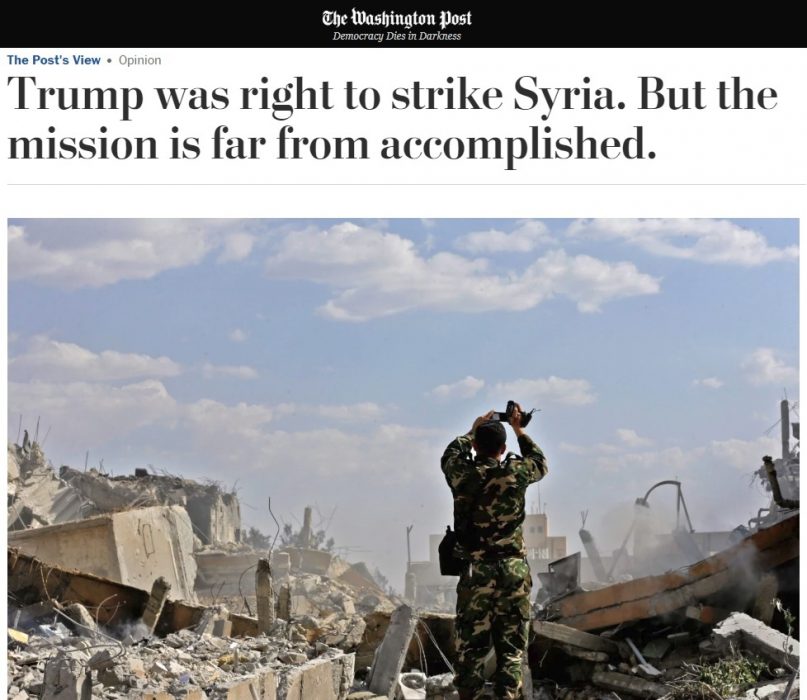
By Philip Giraldi | American Herald tribune | April 23, 2108
The complicity of America’s Fourth Estate in the evolution of the national security warfare state is often mentioned in passing but rarely analyzed in any detail. But a recent article on Lobe Log by Adam Johnson is refreshing in that it does just that, looking at the editorials in 26 leading newspapers relating to the April 13th strike against Syria for the alleged use of chemical weapons. All of the papers supported the attack in the belief that Syria and its Russian and Iranian allies had done something wrong and had to be punished. Some of the endorsements went well beyond the actual strike itself, urging the White House to do more. The article quotes the Toledo Blade’s assertion that:
“Make no mistake, this was a warning to Vladimir Putin as well as Bashar al-Assad. The United States and its two longtime allies redrew the red line that had been obliterated by a failure of nerve by the US and the West generally: There will be cost for your barbarities…. But in the larger sense, the West did what it should have done a long time ago. It stood up for decency and international law. It stood up for those who are defenseless. It stood up for itself, and for simple humanity, and redeemed some self-respect.”
Another recent editorial intended to stir up hysteria about perfidious Moscow appeared in the New York Times on March 12th. It was entitled “Vladimir Putin’s Toxic Reach”. It said in part:
“The attack on the former spy, Sergei Skripal, who worked for British intelligence, and his daughter Yulia, in which a police officer who responded was also poisoned, was no simple hit job. Like the 2006 murder of Alexander Litvinenko, another British informant, who was poisoned with radioactive polonium 210, the attack on Mr. Skripal was intended to be as horrific, frightening and public as possible. It clearly had the blessing of President Vladimir Putin, who had faced little pushback from Britain in the Litvinenko case. The blame has been made clearer this time and this attack on a NATO ally needs a powerful response both from that organization and, perhaps more important, by the United States.”
These two stories and the many others like them have something in common, which is that they were written without any evident “fact checking” and subsequently have proven to be largely incorrect in terms of their assumptions about Russian and Syrian behavior. They also share a belief that the United States and its allies can both establish and enforce standards for the rest of the world. In these cases, the stakes were very high as there was an assumption that it could be appropriate to risk going to war with a powerful nuclear armed government based on incidents that did not in any way impact upon American or British national security.
Regarding Syria, the first wave of “reporting” on the alleged gassing came from sources linked to the terrorist group that was under attack, Jaish el-Islam. This included the so-called White Helmets, who have been outed and exposed as a virtual PR outfit for those one might call the head-choppers. More recently, with government control reestablished over the Douma neighborhood where the reported deaths took place, independent journalists including the able Robert Fisk, no friend of the al-Assad “regime”, have been entering and discovering that there appears to be no evidence that a gas attack even took place.
Skeptics examining the incident from the beginning noted that the Syrian government had every reason to avoid a provocation in its rollup of the remaining rebel pockets near Damascus while the so-called rebels would have been highly motivated to stage a false flag attack to bring in outside forces in support of their cause. If there was a chemical attack of any kind, it almost surely originated with the terrorists.
Even assuming that the United States was acting in good faith when it attacked Syrian “chemical sites” believing that the al-Assad “regime” had actually used such weapons, one should also assume, given the time frame and lack of definitive intelligence resources, that the decision was based on an assessment that relied on limited information coming from sources hostile to Damascus as well as White House perceptions of persistent bad behavior by the Syrian government.
So a poorly informed Washington clearly went to war without exactly knowing why. As the story continues to unravel, there will, however, be no apologies forthcoming either from the White House or the national media, both of which got it so wrong. The mainstream media never even questioned whether Trump should bomb the Syrian “regime” at all, instead merely debating exactly how much punishment he should inflict.
To their credit, the British public and some former senior officials are beginning to ask questions about Syria through a reluctant media filter and opposition leader in Parliament Jeremy Corbyn has refused to be silenced. Similarly, the story of the poisoning of the Skripals in Salisbury has also begun to come apart. Former U.K. Ambassador Craig Murray has detailed how the narrative was cooked by “liars” in the government to make it look as if the poisoning had a uniquely Russian fingerprint. Meanwhile U.S. investigative reported Gareth Porter sums up the actual evidence or lack thereof, for Russian involvement, suggesting that the entire affair was “based on politically-motivated speculation rather than actual intelligence.”
Here in the United States the mainstream media, which has supported every war since 9/11, has yet to account for its deliberately slanted reporting that has fueled both military action in Syria and reprisals against Russia over the Skripals. Unfortunately, the resulting actions undertaken by the United States and Britain have not been consequence free. The attack on Syria, given the fact that Damascus in no way threatened either the U.S. or U.K., was a war crime under international law. The mass expulsions of Russian officials over the Skripals affair has produced a diplomatic chill not unlike the Cold War, or perhaps even worse, with American U.N. Ambassador Nikki Haley declaring that the White House is “locked and loaded” if Syria should again step out of line. One might ask Haley what is to be done when Washington steps out of line? It would be interesting to hear her answer.
*(Snapshot courtesy of the WashingtonPost )
Index on Disgrace
By Craig Murray | April 22, 2018
The second half of my life has been a continual process of disillusionment with the institutions I used to respect. I suppose it started with the FCO, where I went from being Britain’s youngest ambassador to being sacked for opposing the use of intelligence from torture, at the same time having an insider view of the knowing lies about Iraqi WMD being used as a pretext for invasion and resource grab.
I still had some residual respect for the BBC, which respect disappeared during the Scottish independence referendum where BBC propaganda and disregard for the truth were truly shameless. My love of the universities was severely tested during my period as Rector of Dundee University, when I saw how far the corporate model had turned them from academic communities developing people and pursuing knowledge, to relentless churners out of unconsidered graduates and financially profitable research, with nearly all sense of community gone. My respect for charities vanished when I discovered Save the Children was paying its chief executive £370,000 and had become a haven for New Labour politicos on huge salaries, which was why it was so involved in pushing a pro-war narrative in Syria. When Justin Forsyth and Brendan Cox – both massively salaried employees who came into Save the Children from the revolving door of Gordon Brown’s office – were outed over sexual predation, that seemed a natural result of “charities” being headed by rich party hacks rather than by simple people trying to do good. As for respect for parliament, well the massive troughing expenses scandal and all those protected paedophiles…
It has become difficult to hang on to respect for any institution, and that is unsettling.
Which brings me to last week’s annual awards from Index on Censorship. The winners of the awards – from Cuba, the Democratic Republic of Congo, Honduras and Egypt – all seem worthy enough, and there is even some departure from the neo-con narrative in recognising a human rights problem in Egypt.
But the Chairman of Index on Censorship is, incredibly, Rupert Murdoch lead hack David Aaronovitch, and he presided over the awards, in the very week in which the newspaper for which he writes produced this appalling attack on freedom of expression:

Inside there was a further two page attack on named academics who have the temerity to ask for evidence of government claims over Syria, including distinguished Professors Tim Hayward, Paul McKeigue and Piers Robinson. The Times also attacked named journalists and bloggers and, to top it off, finished with a column alleging collusion between Scottish nationalists and the Russian state.
That the Chairman of “Index on Censorship” is associated with this kind of attack on freedom of speech, freedom of thought and freedom of research is sadly unsurprising. The guest list of the Index ceremony had a distinct right wing tinge including A C Grayling and Sara Khan, as well as a good smattering of the BBC, which was also represented on the judging panel. The irony of the state broadcaster being part of a panel on freedom of expression is plainly lost.
I realised something was very wrong with Index on Censorship when I contacted them over a decade ago, when Jack Straw attempted to ban the publication of my book Murder in Samarkand, after it had passed successfully through the exhaustive FCO clearance process over a time-consuming year. I tried to interest them again when my second book The Catholic Orangemen of Togo was dropped by my publisher following libel threats from mercenary commander Tim Spicer of Aegis/Executive Outcomes/Sandline. On both occasions I was told that then Chief Executive of Index, John Kampfner, did not regard these attempted book bannings as incidents of censorship. Presumably because they weren’t somewhere like Cuba or Zimbabwe…
The truly appalling Times attack on academics was part of a coordinated and government-led campaign to delegitimise anybody doubting the official narrative on Salisbury and Syria. The BBC weighed in with this horrible effort:
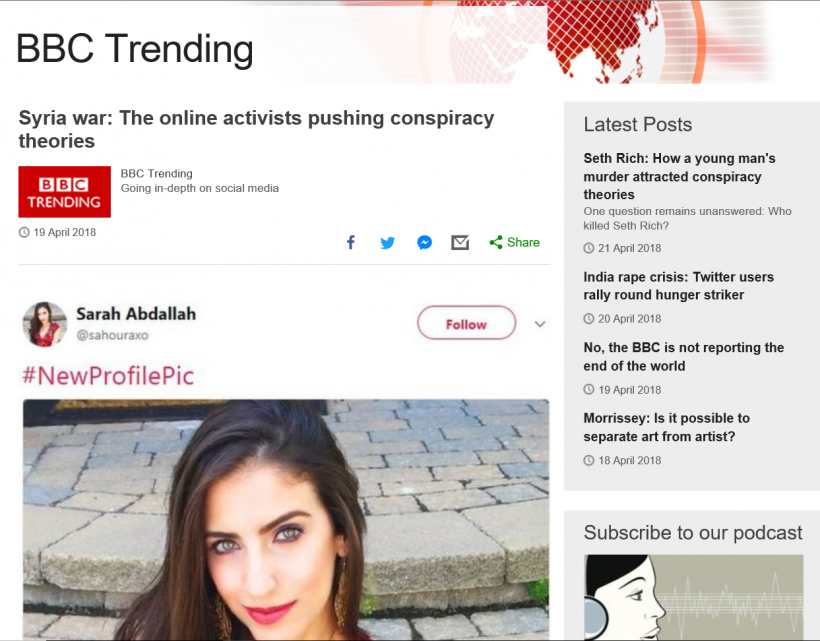
The government then issued a ridiculous press release branding decent people as “Russian bots” just for opposing British policy in Syria. In a piece of McCarthyism so macabre I cannot believe this is really happening, an apparently pleasant and normal man called Ian was grilled live on Murdoch’s Sky News, having been named by his own government as a Russian bot.
The Guardian uncritically published the government’s accusations in full, and astonishingly seemed proud that it had made no attempt to investigate their veracity but had merely published what the government wished them to publish:

The Guardian naturally was just as reliable as the BBC in driving home the message that anybody who doubted the government’s word on Syria was a flat-earth denier of the truth:

Mr Freedland is of course a perfect representation of an interesting fact. Those who are most active in telling us that we must attack Syria, and that anybody who questions the government’s pretexts is insane or evil, are precisely the same individuals who supported the war in Iraq and attacked those who doubted the existence of Iraqi WMD. Indeed these people – Jonathan Freedland, David Aaronovitch, Oliver Kamm, Alan Mendoza, Andrew Rawnsley, John Rentoul, Nick Cohen – are the leaders of the tiny, insignificant number of people who still believe that the invasion of Iraq was both justified and beneficial in its result.
Yet these people of proven terrible judgement, they and others of their media class, are the arbiters who are allowed to dictate the terms of what is and what is not an acceptable public utterance on the situation in Syria.
When Jeremy Corbyn became leader of the opposition, one of two things had to happen. Either the Overton window had to shift to allow for the reflection of views held by the leader of the official opposition and his myriad supporters, or the leader of the opposition had to be castigated and humiliated as an unreasonable lunatic. Corbyn’s rational scepticism on British involvement in the conflict in Syria is a key moment in this process. Despite the fact Corbyn’s scepticism is supported by a wide swathe of diplomatic and military opinion within the UK, it has to be portrayed as fringe, extreme and irrational.
We thus have the extraordinary spectacle of a coordinated government and media onslaught on anybody who doubts their entirely fact free narratives. Those who were demonstrably completely wrong over Iraq are held up as infallible, and given full control of all state and corporate media platforms, where they deride those who were right over Iraq as crackpots and Russian bots.
Meanwhile public trust in the state and corporate media hits new lows, which is the happy part of this story.
Support Craig Murray’s continued writing.
Featured Video
Saudi Led Destruction of Yemen’s heritage
or go to
Aletho News Archives – Video-Images
From the Archives
Israel: Strategic Ally or Liability?
By Stephen Sniegoski | My Catbird Seat | June 12, 2010
The claim that Israel serves as a valuable ally for the United States is made by both pro-Zionists and much of the anti-war and anti-Zionist Left that is influenced by Noam Chomsky. As a result of the Gaza flotilla massacre, which has caused a world-wide uproar against Israel, the value of Israel to the United States is being publicly questioned in more mainstream foreign policy forums. … continue
Blog Roll
 Aletho News
- Here’s what Trump’s latest U-turn really means for Russia and Ukraine
- The Houthis Are Not an Iranian Proxy
- Europe’s Energy Hypocrisy, Russian LNG Profits and US Dependence
- ICC ignored ‘very well-documented’ NATO crimes – ex-Libyan minister
- SNSC secretary dismisses US response to Iran’s conditions as ‘inadequate’
- Sanaa says Taiz roads open, secure for residents, warns Saudi forces
- Iraqi resistance group urges Saudi leadership to admit defeat, lift Yemen siege
- Trump’s Retreat: How Al-Aqsa Flood Took Down the US Empire
- Israel’s Military Actions in Lebanon Grossly Violate International Law — Lavrov
- Seyed M. Marandi: US-Iran War Inevitable: Kuwait and Bahrain May Fall
- If Americans Knew
- Israeli Attacks Kill Five in Gaza, Including a four-year-old and a woman
- Air Force Major Who Called for Trump’s Impeachment Held in Solitary Confinement
- It’s a Genocide, I’m Into It’: Seinfeld Mocks Protest over Palestinian Children Killed
- Universities fire dozens amid pressure from Zionist billionaires
- Gaza’s buildings are collapsing on top of us. But there’s nowhere else to shelter
- Israel kills four-year-old Gaza child – Daily Update
- After Oct 7, IDF policy allowed civilian casualties for even the lowest-ranking targets
- Israel’s Destruction of Southern Lebanon Intensified After the Cease-Fire
- The Last-Minute Decision That Gave Israel Its Name
- The American Conservative: How Trump Made the World Go Nuclear
- No Tricks Zone
- New Study Suggests Large Regions Of The Pacific Ocean Have Been Cooling For The Last 80 Years
- Germany’s Green Energy Debacle: High Energy Costs Force Kahla Porzellan to Close After 182 Years!
- New Study: 50 Years Of The Most Aggressive ‘Net Zero’ Policies Can Only Affect The Global Climate By 0.03°C
- US September “Heat” Was No Record…Many Records Set Decades Ago
- Latest European Green Energy Debacle; Portugal’s Largest Flagship Solar Park Insolvent!
- Green Energy Debacle: German Expert Professor Fritz Vahrenholt Warns Of Severe Economic And Social Consequences
- Two More Paleo Reconstructions Affirm Meters-Higher Sea Levels Across Ireland, Brazil 7000-6000 Years Ago
- New Study: Earth And Venus Surface Warmth Largely Explained By Convection And Lapse Rate, Not CO2 Or Radiation
- 2025 Nature Paper Claiming Worsening Global Drought Gets RETRACTED …Heavily Flawed
- New Study: ‘Global Drought Shows No Detectable Recent Acceleration Under Climate Warming’

