How We Can Be Certain That Mueller Won’t Prove Trump-Russia Collusion
By Caitlyn Johnstone | Medium | November 12, 2107
A while back I figured out a trick for using Twitter as a tool to find out what sorts of things establishment loyalists really don’t want me saying. Once I discover a really hot button, I write an article that bangs on that button as hard as possible. One of those buttons is expressing my certainty that Robert Mueller’s investigation will never, ever find any proof that Trump colluded with Russia to steal the 2016 election using hackers and propaganda.
We are not allowed to say such things. If you debate a Russiagater for any length of time and you know how to debunk their assertions, they always, always, always wind up resorting to a “just you wait until Mueller finishes his investigation” declaration, which from my point of view is the same as debating a fundamentalist Christian whose argument boils down to “Well I’ll be proven right when you die and God sends you to Hell!”
You can always feel right if you kick the can around some corner in the future that can’t be seen and analyzed critically. Luckily for us, we’ve got information that we can look at right now which does not require any religious faith.
We know from the Snowden leaks on the NSA, the CIA files released by WikiLeaks, and the ongoing controversies regarding FBI surveillance that the US intelligence community has the most expansive, most sophisticated and most intrusive surveillance network in the history of human civilization. Following the presidential election last year, anonymous sources from within the intelligence community were hemorrhaging leaks to the press on a regular basis that were damaging to the incoming administration. If there was any evidence to be found that Donald Trump colluded with the Russian government to steal the 2016 election using hackers and propaganda, the US intelligence community would have found it and leaked it to the New York Times or the Washington Post last year.
Mueller isn’t going to find anything in 2017 that these vast, sprawling networks wouldn’t have found in 2016. He’s not going to find anything by “following the money” that couldn’t be found infinitely more efficaciously via Orwellian espionage. The factions within the intelligence community that were working to sabotage the incoming administration last year would have leaked proof of collusion if they’d had it. They did not have it then, and they do not have it now. Mueller will continue finding evidence of corruption throughout his investigation, since corruption is to DC insiders as water is to fish, but he will not find evidence of collusion to win the 2016 election that will lead to Trump’s impeachment. It will not happen.
This sits on top of all the many, many, many reasons to be extremely suspicious of the Russiagate narrative in the first place.
Humans are storytelling creatures. The most significant and most underappreciated facet of our existence is how much of our interface with the world consists not of our direct experience of it, but of our mental stories about it. Combine that fact with the century of research and development that has gone into refining propaganda tactics and the US plutocracy’s stranglehold on mainstream media, and you get a nation lost in establishment narratives. People forming their worldviews based on phantasms of the mind instead of concrete facts.
I’ve noticed a strange uptick in establishment loyalists speaking to me as though Trump-Russia collusion is already an established fact, and that I’m simply not well-informed. There is still the same amount of publicly available evidence for this collusion as there ever was (zero), so this tells me that the only thing which has changed is the narrative. Pundits/propagandists are increasingly speaking as though this is something that has already been established, and the people who consume that propaganda go out and circulate it as though it’s an established fact. When you’re not plugged into that echo chamber, though, it looks very weird.
This is why Russiagaters find my certainty that collusion will never be proven so intensely abrasive. Their entire worldview consists of pure narrative — literally nothing other than authoritative assertions from pundits who speak in a confident tone of voice — so when they encounter someone doing the same thing but with hard facts, it causes psychological discomfort. This discomfort is called cognitive dissonance. It’s what being wrong feels like.
I mean, I get it. Really, I do. When I stop listening to the narratives of both his supporters and his detractors and just look at the hard facts, from my point of view Trump is doing some really shitty things and doesn’t seem much different from his neoliberal neocon predecessors. Republicans are horrible, and he seems pretty much like a garden variety Republican who says rude things on Twitter. If I look at those hard facts, then add in two years of psychological brutalization by the corporate media telling Americans that Trump is an evil Nazi who will turn the country into a smouldering crater, I can understand why people would be in a hurry to get him out of office.
And when I converse with Russiagaters, that’s generally what this boils down to. “Impeach Trump” is a punishment in search of a crime. They’ve been whipped into a frenzied state of fear by establishment psyops, and they want Mueller to pull a deus ex machina and save them from the evil orange monster. They believe Mueller will get Trump impeached for Russian collusion because they badly want to.
It’s not going to happen, though. Deus ex Mueller isn’t coming. You’re going to have to solve your country’s problems yourselves, America.
And this is actually a good thing, because Trump is not the source of your country’s problems. Believing that a Trump impeachment will fix any of America’s major ills is like believing cough suppressants cure pneumonia. What do you get when you have pneumonia and you take cough suppressants instead of antibiotics? You get wrong-sounding Muppets, that’s what.
If you attribute all your problems to Trump, you’re guaranteeing more Trumps after him, because you’re not addressing the disease which created him, you’re just addressing the symptom.
The problem is not Trump. The problem is that America is ruled by an unelected power establishment which maintains its rule by sabotaging democracy, exacerbating economic injustice and expanding the US war machine. Stop listening to the lies that they pipe into your echo chambers and turn to face your real demons.
Russia-gate Spreads to Europe
By Robert Parry | Consortium News | November 16, 2017
Ever since the U.S. government dangled $160 million last December to combat Russian propaganda and disinformation, obscure academics and eager think tanks have been lining up for a shot at the loot, an unseemly rush to profit that is spreading the Russia-gate hysteria beyond the United States to Europe.

British Prime Minister Theresa May
Now, it seems that every development, which is unwelcomed by the Establishment – from Brexit to the Catalonia independence referendum – gets blamed on Russia! Russia! Russia!
The methodology of these “studies” is to find some Twitter accounts or Facebook pages somehow “linked” to Russia (although it’s never exactly clear how that is determined) and complain about the “Russian-linked” comments on political developments in the West. The assumption is that the gullible people of the United States, United Kingdom and Catalonia were either waiting for some secret Kremlin guidance to decide how to vote or were easily duped.
Oddly, however, most of this alleged “interference” seems to have come after the event in question. For instance, more than half (56 percent) of the famous $100,000 in Facebook ads in 2015-2017 supposedly to help elect Donald Trump came after last year’s U.S. election (and the total sum compares to Facebook’s annual revenue of $27 billion).
Similarly, a new British study at the University of Edinburgh blaming the Brexit vote on Russia discovered that more than 70 percent of the Brexit-related tweets from allegedly Russian-linked sites came after the referendum on whether the U.K. should leave the European Union. But, hey, don’t let facts and logic get in the way of a useful narrative to suggest that anyone who voted for Trump or favored Brexit or wants independence for Catalonia is Moscow’s “useful idiot”!
This week, British Prime Minister Theresa May accused Russia of seeking to “undermine free societies” and to “sow discord in the West.”
What About Israel?
Yet, another core problem with these “studies” is that they don’t come with any “controls,” i.e., what is used in science to test a hypothesis against some base line to determine if you are finding something unusual or just some normal occurrence.
In this case, for instance, it would be useful to find some other country that, like Russia, has a significant number of English speakers but where English is not the native language – and that has a significant interest in foreign affairs – and then see whether people from that country weigh in on social media with their opinions and perspectives about political events in the U.S., U.K., etc.
Perhaps, the U.S. government could devote some of that $160 million to, say, a study of the Twitter/Facebook behavior of Israelis and whether they jump in on U.S./U.K. controversies that might directly or indirectly affect Israel. We could see how many Twitter/Facebook accounts are “linked” to Israel; we could study whether any Israeli “trolls” harass journalists and news sites that oppose neoconservative policies and politicians in the West; we could check on whether Israel does anything to undermine candidates who are viewed as hostile to Israeli interests; if so, we could calculate how much money these “Israeli-linked” activists and bloggers invest in Facebook ads; and we could track any Twitter bots that might be reinforcing the Israeli-favored message.
No Chance
If we had this Israeli baseline, then perhaps we could judge how unusual it is for Russians to voice their opinions about controversies in the West. It’s true that Israel is a much smaller country with 8.5 million people compared to Russia’s 144 million, but you could adjust for those per capita numbers — and even if you didn’t, it wouldn’t be surprising to find that Israel’s interference in U.S. policymaking still exceeds [by many orders of magnitude] Russian influence.
It’s also true that Israeli leaders have often advocated policies that have proved disastrous for the United States, such as Prime Minister Benjamin Netanyahu’s encouragement of the Iraq War, which Russia opposed. Indeed, although Russia is now regularly called an American enemy, it’s hard to think of any policy that President Vladimir Putin has pushed on the U.S. that is even a fraction as harmful to U.S. interests as the Iraq War has been.
And, while we’re at it, maybe we could have an accounting of how much “U.S.-linked” entities have spent to influence politics and policies in Russia, Ukraine, Syria and other international hot spots.
But, of course, neither of those things will happen. If you even tried to gauge the role of “Israeli-linked” operations in influencing Western decision-making, you’d be accused of anti-Semitism. And if that didn’t stop you, there would be furious editorials in The New York Times, The Washington Post and the rest of the U.S. mainstream media denouncing you as a “conspiracy theorist.” Who could possibly think that Israel would do anything underhanded to shape Western attitudes?
And, if you sought the comparative figures for the West interfering in the affairs of other nations, you’d be faulted for engaging in “false moral equivalence.” After all, whatever the U.S. government and its allies do is good for the world; whereas Russia is the fount of evil.
So, let’s just get back to developing those algorithms to sniff out, isolate and eradicate “Russian propaganda” or other deviant points of view, all the better to make sure that Americans, Britons and Catalonians vote the right way.
Investigative reporter Robert Parry broke many of the Iran-Contra stories for The Associated Press and Newsweek in the 1980s.
PM May’s, UK Media’s Accusations Against Russia Share ‘Lack of Proof’
Sputnik – 16.11.2017
Both UK government’s accusations against Russia and UK media’s assertions share one common characteristic – lack of evidence, the Russian Embassy in London said Wednesday commenting on the UK National Cyber Security Centre head’s statement.
Earlier in the day, Ciaran Martin, the head of the UK Government Communications Headquarters’ National Cyber Security Centre, said that Russian hackers allegedly carried out a series of cyberattacks against UK media, telecommunications and energy sectors over the past year.
“We are concerned by such assertions since they mislead the British public in regard to the so called cyberattacks. We view these statements in the context of Prime Minister [Theresa] May’s ‘Banquet speech’ which described Russia as number 1 threat for UK and the world community. The said speech has already triggered an avalanche of similarly-termed articles and media reports in Britain. In our view, what they have in common is lack of proof – all assertions by British special services turn out to be classified and thus unverifiable,” the embassy wrote on its website.
The Russian diplomats urged the UK government and media to provide the evidence which served as basis for such claims.
“We would be interested in finding out the details and seeing the original findings on which the statements are based, guiding UK policies towards Russia. It would be most unfortunate to see it informed by wrong intelligence, as it was in the case of the Iraq war – when the misleading intelligence was also kept secret. Otherwise, all the accusations have the fundamental flaw of being non-transparent and biased,” the embassy said.
In a major foreign policy speech at the Lord Mayor’s Banquet at Mansion House in London late on Monday, May accused Russia of meddling in other states’ affairs, spreading “fake stories” in media, aggressive policies “to sow discord in the West” and promised to protect West’s interests if Russia continues on its current “path.”
Russia has repeatedly refuted accusations of attempts to influence election or political processes in different countries, with Kremlin spokesman Dmitry Peskov calling the claims “absolutely groundless.” Commenting on Russia’s alleged interference in the US, French and German elections, as well as Brexit referendum in the United Kingdom, Russian Foreign Minister Sergey Lavrov stressed that there was no evidence proving the claims.
‘The Atlantic’ Commits Malpractice, MSNBC Regurgitates Lies
By Caitlin Johnstone | Medium | November 14, 2017
Surprise, surprise, here’s Chris Hayes on MSNBC regurgitating Ioffe’s selectively edited quote on MSNBC. There will be others. There is no way to undo the damage that was done by this lie. At the end of the clip Ioffe actually asserts that her story confirms Russia-WikiLeaks collusion, without at any time acknowledging that the only thing in the story that makes it look that way is her selectively-edited quote.
If Russiagate was valid, the people selling it to us wouldn’t have to lie about it every single step of the way.
For full background read Caitlin’s full article, excerpt below:
… This happens literally every single time there’s a new “bombshell” report on the Russiagate phenomenon, without exception. Twitter explodes, I’m bombarded with social media notifications telling me “HAHAHA I BET YOU FEEL LIKE AN IDIOT NOW”, then it turns out to be a basically innocuous revelation dishonestly blown up into something explosive by liars and manipulators in the establishment media. It’s fueled entirely by Trump derangement syndrome, not by facts.
And people ask why I’m skeptical of the establishment Russia narrative. I’m skeptical because we’re being lied to every single step of the way by the news media who claim to be helping the public discover the truth. Trump lies because he’s a corrupt billionaire who knows he can get away with it, but that doesn’t make him a Russian agent. The media lies because they’re bolstering the stranglehold of America’s unelected power establishment, and that makes them traitors to our species. …
Fake News on Russia and Other Official Enemies: The New York Times, 1917–2017
Edward S. Herman, the economist, Wharton School professor emeritus, and prolific author, died this week at age 92. The following article by Edward Herman appeared in the July-August issue of Monthly Review .
It has been amusing to watch the New York Times and other mainstream media outlets express their dismay over the rise and spread of “fake news.” These publications take it as an obvious truth that what they provide is straightforward, unbiased, fact-based reporting. They do offer such news, but they also provide a steady flow of their own varied forms of fake news, often by disseminating false or misleading information supplied to them by the national security state, other branches of government, and sites of corporate power
An important form of mainstream media fake news is that which is presented while suppressing information that calls the preferred news into question. This was the case with “The Lie That Wasn’t Shot Down,” the title of a January 18, 1988, Times editorial referring to a propaganda claim of five years earlier that the editors had swallowed and never looked into any further. The lie—that the Soviets knew that Korean airliner 007, which they shot down on August 31, 1983, was a civilian plane—was eventually uncovered by congressman Lee Hamilton, not by the Times.
Mainstream media fake news is especially likely where a party line is quickly formed on a topic, with any deviations therefore immediately dismissed as naïve, unpatriotic, or simply wrong. In a dramatic illustration, for a book chapter entitled “Worthy and Unworthy Victims,” Noam Chomsky and I showed that coverage by Time, Newsweek, CBS News, and the New York Times of the 1984 murder of the priest Jerzy Popieluzko in Communist Poland, a dramatic and politically useful event for the politicized Western mainstream media, exceeded all their coverage of the murders of a hundred religious figures killed in Latin America by U.S. client states in the post-Second World War years taken together.1 It was cheap and safe to focus heavily on the “worthy” victim, whereas looking closely at the deaths of those hundred would have required an expensive and sometimes dangerous research effort that would have upset the State Department. But it was in effect a form of fake news to so selectively devote coverage (and indignation) to a politically useful victim, while ignoring large numbers whose murder the political establishment sought to downplay or completely suppress.
Fake news on Russia is a Times tradition that can be traced back at least as far as the 1917 revolution. In a classic study of the paper’s coverage of Russia from February 1917 to March 1920, Walter Lippmann and Charles Merz found that “From the point of view of professional journalism the reporting of the Russian Revolution is nothing short of a disaster. On the essential questions the net effect was almost always misleading, and misleading news is worse than none at all…. They can fairly be charged with boundless credulity, and an untiring readiness to be gulled, and on many occasions with a downright lack of common sense.”2 Lippmann and Merz found that strong editorial bias clearly fed into news reporting. The editors’ zealous opposition to the communists led the paper to report atrocities that never happened, and to predict the imminent collapse of the Bolshevik regime no fewer than ninety-one times in three years. Journalists uncritically accepted official statements and relied on reports from unidentified “high authority.” This was standard Times practice.
This fake news performance of 1917–20 was repeated often in the years that followed. The Soviet Union was an enemy target up to the Second World War, and through it all, Times coverage was consistently hostile. With the end of the war and the emergence of the Soviet Union as a military rival, and soon a competing nuclear power, the Cold War was on. In the United States, anti-communism became a national religion, and the Soviet Union was portrayed in official discourse and the news media as a global menace in urgent need of containment. With this ideology in place and with U.S. plans for its own global expansion of power established, the Communist threat would help sustain the steady growth of the military-industrial complex and repeated interventions to counter purported Soviet aggressions.3
An Early Great Crime: Guatemala
One of the most flagrant cases in which the Soviet threat was exploited to justify U.S.-sponsored violence was the overthrow of the social democratic government of Guatemala in 1954 by a small proxy army invading from U.S. ally Somoza’s Nicaragua. This action was provoked by government reforms that upset U.S. officials, including a 1947 law permitting the formation of labor unions, and plans to buy back (at tax-rate valuations) and distribute to landless peasants some of the unused property owned by United Fruit Company and other large landowners. The United States, which had been perfectly content with the earlier fourteen-year-long dictatorship of Jose Ubico, could not tolerate this democratic challenge, and the elected government, led by Jacobo Arbenz, was soon charged with assorted villainies, based on an alleged Red capture of the Guatemalan government.4
In the pre-invasion propaganda campaign, the mainstream media fell into line behind false charges of extreme government repression, threats to its neighbors, and the Communist takeover. The Times repeatedly reported these alleged abuses and threats from 1950 onward (my favorite: Sidney Gruson’s “How Communists Won Control of Guatemala,” March 1, 1953). Arbenz and his predecessor, Juan Jose Arevalo, had carefully avoided establishing any embassies with Soviet bloc countries, fearing U.S. reprisals—to no avail. Following the removal of Arbenz and the installation of a right-wing dictatorship, court historian Ronald Schneider, after studying 50,000 documents seized from Communist sources in Guatemala, found that not only did Communists never control the country, but that the Soviet Union “made no significant or even material investment in the Arbenz regime,” and was at the time too preoccupied with internal problems to concern itself with Central America.5
The coup government quickly attacked and decimated the new social groups that had formed in the democratic era, mainly peasant, worker, and teacher organizations. Arbenz had won 65 percent of the votes in a free election, but the “liberator” Castillo Armas quickly won a “plebiscite” with 99.6 percent of the vote. Although this is a result familiar in totalitarian regimes, the mainstream media had by then lost interest in Guatemala, barely mentioning this electoral outcome. The Times had claimed in 1950 that U.S. Guatemala policy “is not trying to block social and economic progress but is interested in seeing that Guatemala becomes a liberal democracy.”6 But in the aftermath, the editors failed to note that the result of U.S. policy was precisely to “block social and economic progress,” through the installation of a regime of reactionary terror.
In 2011, more than half a century after 1954, the Times reported that Guatemalan president Alvaro Colom had apologized for that “Great Crime,” the violent overthrow of the Arbenz government, “an act of aggression to a government starting its democratic spring.”7 The article mentions that, according to president Colom, the Arbenz family is “seeking an apology from the United States for its role” in the Great Crime. The Times has never made any apology or even acknowledgement of its own role in the Great Crime.
Another Great Crime: Vietnam
Fake news abounded in the Times and other mainstream publications during the Vietnam War. The common perception that the paper’s editors opposed the war is misleading and essentially false. In Without Fear or Favor, former Times reporter Harrison Salisbury acknowledged that in 1962, when U.S. intervention escalated, the Times was “deeply and consistently” supportive of the war policy.8 He contends that the paper grew steadily more oppositional from 1965, culminating in the publication of the Pentagon Papers in 1971. But Salisbury fails to recognize that from 1954 to the present, the Times never abandoned the Cold War framework and vocabulary, according to which the United States was resisting another nation’s “aggression” and protecting “South Vietnam.” The paper never applied the word aggression to this country, but used it freely in referring to North Vietnamese actions and those of the National Liberation Front in the southern half of Vietnam.
The various pauses in the U.S. bombing war in 1965 and after, in the alleged interest of “giving peace a chance,” were also the basis of fake news as the Johnson administration used these temporary halts to quiet antiwar protests, while making it clear to the Vietnamese that U.S. officials demanded full surrender. The Times and its colleagues swallowed this bait without a murmur of dissent.9
Furthermore, although from 1965 onward the Times was willing to publish more reports that put the war in a less favorable light, it never broke from its heavy dependence on official sources, or from its reluctance to confront the damage wrought on Vietnam and its civilian population by the U.S. war machine. In contrast with its eager pursuit of Cambodian refugees from the Khmer Rouge after April 1975, the paper rarely sought testimony from the millions of Vietnamese refugees fleeing U.S. bombing and chemical warfare. In its opinion columns as well, the new openness was limited to commentators who accepted the premises of the war and would confine their criticisms to its tactical problems and domestic costs. From beginning to end, those who criticized the war as an immoral campaign of sheer aggression were excluded from the debate.10
The 1981 Papal Assassination Attempt
The mainstream media gave a further boost to Cold War propaganda in reporting on the attempted assassination of Pope John Paul II in Rome in May 1981. At a time when the Reagan administration was seeking to demonize the Soviet Union as an “evil empire,” the shooting of the pope by Turkish fascist Ali Agca was quickly tied to Moscow, helped by Agca’s confession—after seventeen months of imprisonment, interrogations, threats, inducements, and access to the media—that the Bulgarians and Soviet KGB were behind it all. No credible evidence supported this connection, the claims were implausible, and the corruption in the process was remarkable. (Agca also periodically claimed to be Jesus Christ.) The case against the Bulgarians (and implicitly the KGB) was lost even in Italy’s extremely biased and politicized judicial framework. But the Times bought it, and gave it prolonged, intense, and completely unquestioning attention, as did most of the U.S. media.
During the 1991 Senate hearings on the nomination of Robert Gates to head the CIA, former agency officer Melvin Goodman testified that the CIA knew from the start that Agca’s confessions were false, because they had “very good penetration” of the Bulgarian secret services. The Times omitted this statement in its reporting on Goodman’s testimony. During the same year, with Bulgaria now a member of the “free world,” conservative analyst Allen Weinstein obtained permission to examine Bulgarian secret service files on the assassination attempt. His mission was widely reported, including in the Times, but when he returned without having found anything implicating Bulgaria or the KGB, several papers, including the Times, found his investigations no longer newsworthy.
Missile Gap
From roughly 1975 to 1986, much of the reporting on the purported “missile gap” between the United States and the Soviet Union was little more than fake news, with Times reporters passing along a steady stream of inflammatory official statements and baseless claims. An important case occurred in the mid-1970s, as right-wing hawks in the Ford administration were trying to escalate the Cold War and arms race. A 1975 CIA report had found that the Soviets were aiming only for nuclear parity. This was unsatisfactory, so CIA head George H. W. Bush appointed a new team of hardliners, who soon found that the Soviets were achieving nuclear superiority and preparing to fight a nuclear war. This so-called Team B report was taken at face value in a Times front page article of December 26, 1976, by David Binder, who failed to mention its political bias or purpose, and made no attempt to consult experts with differing views. The CIA finally admitted in 1983 that the Team B estimates were fabrications. But throughout this period, the Times supported the case for militarization by disseminating false information, much of it convincingly refuted by Tom Gervasi in his classic The Myth of Soviet Military Supremacy, a book never reviewed in the Times.
Yugoslavia and “Humanitarian Intervention”
The 1990s wars of dismantlement in Yugoslavia succeeded in removing an independent government from power and replacing it with a broken Serbian remnant and poor and unstable failed states in Bosnia and Kosovo. It also provided unwarranted support for the concept of “humanitarian intervention,” which rested on a mass of misrepresentations and selective reporting. The demonized Serbian leader Slobodan Milošević was not an ultra-nationalist seeking a “Greater Serbia,” but rather a non-aligned leader on the Western hit list who tried to help Serb minorities in Bosnia, Croatia, and Kosovo remain in Yugoslavia as the United States and the European Union supported a legally questionable exodus by several constituent Yugoslav Republics. He supported each of the proposed settlements of these conflicts, which were sabotaged by Bosnian and U.S. officials who wanted better terms or the outright military defeat of Serbia, ultimately achieving the latter. Milošević had nothing to do with the July 1995 Srebrenica massacre, in which Bosnian Serbs took revenge on Bosnian Muslim soldiers who had been ravaging nearby Bosnian Serb villages from their base in Srebrenica under NATO protection. The several thousand Serb civilian deaths were essentially unreported in the mainstream media, while the numbers of Srebrenica’s executed victims were correspondingly inflated.11
The Putin Era
The U.S. political establishment was shocked and delighted by the 1989–91 fall of the Soviet Union, and its members were similarly pleased with the policies of President Boris Yeltsin, a virtual U.S. client, under whose rule ordinary Russians suffered a calamitous fall in living standards, while a small set of oligarchs were able to loot the broken state. Yeltsin’s election victory in 1996, greatly assisted by U.S. consultants, advice, and money, was, for the editors of the Times, “A Victory for Russian Democracy.”12 They were not bothered by either the electoral corruption, the creation of a grand-larceny-based economic oligarchy, or, shortly thereafter, the new rules centralizing power in the office of president.13
Yeltsin’s successor, Vladimir Putin, gradually abandoned the former’s subservience to Western interests, and was thereby perceived as a menace. His reelection in 2012, although surely less corrupt than Yeltsin’s in 1996, was castigated in the U.S. media. The lead Times article on May 5, 2012, featured “a slap in the face” from Organization for Security and Co-operation in Europe observers, claims of no real competition, and “thousands of antigovernment protesters gathered in Moscow square to chant ‘Russia without Putin.’”14 There had been no “challenges to legitimacy” reported in the Times after Yeltsin’s tainted victory in 1996.
The demonization of Putin escalated with the Ukraine crisis of 2014 and subsequent Kiev warfare in Eastern Ukraine, Russian support of the East Ukraine resistance, and the Crimean referendum and absorption of Crimea by Russia. This was all declared “aggression” by the United States and its allies and clients, and sanctions were imposed on Russia, and a major U.S.-NATO military buildup was initiated on Russia’s borders. Tensions mounted further with the shooting-down of Malaysia Airlines Flight 17 over southeastern Ukraine—promptly, but almost surely falsely, blamed on the “pro-Russian” rebels and Russia itself.15
Anti-Russian hostilities were further inflamed by the country’s escalated intervention in Syria from 2015 on, in support of Bashar al-Assad and against rebel forces that had come to be dominated by ISIS and al-Nusra, an offshoot of al-Qaeda. The United States and its NATO and Middle East allies had been committing aggression against Syria, in de facto alliance with al-Nusra and other extremist Islamic factions, for several years. Russian intervention turned the tide, frustrating the U.S. and Saudi goal of regime change against Assad, and weakening tacit U.S. allies.
The Times has covered these developments with unstinting apologetics—for the February 2014 coup in Kiev—which it has never labeled as such, for the U.S. role in the overthrow of the elected government of Victor Yanukovych, and with anger and horror at the Crimea referendum and Russian absorption, which it never allows might be a defensive response to the Kiev coup. Its calls for punishment for the casualty-free Russian “aggression” in Crimea is in marked contrast to its apologetics for the million-plus casualties caused by U.S. aggression “of choice” (not defensive) in Iraq from March 2003 on. The paper’s editors and columnists condemn Putin’s disregard for international law, while exempting their own country from criticism for its repeated violations of that same law.16
In the Times‘s reporting and opinion columns Russia is regularly assailed as expansionist and threatening its neighbors, but virtually no mention is made of NATO’s expansion up to the Russian borders and first-strike-threat placement of anti-missile weapons in Eastern Europe—the latter earlier claimed to be in response to a missile threat from Iran! Analyses by political scientist John Mearsheimer and Russia scholar Stephen F. Cohen that noted this NATO advance were excluded from the opinion pages of the Times.17 In contrast, a member of the Russian band Pussy Riot, Maria Alyokhina, was given op-ed space to denounce Putin and Russia, and the punk rock group was granted a meeting with the Times editorial board.18 Between January 1 and March 31, 2014, the paper ran twenty-three articles featuring Pussy Riot and its alleged significance as a symbol of Russian limits on free speech. Pussy Riot had disrupted a church service in Moscow and only stopped after police intervened, at the request of church authorities. A two-year prison sentence followed. Meanwhile, in February 2014, eighty-four-year-old nun Sister Megan Rice was sentenced to four years in prison for having entered a U.S. nuclear weapons site in July 2012 and carried out a symbolic protest. The Times gave this news a tiny mention in its National Briefing section, under the title “Tennessee Nun is Sentenced for Peace Protest.” No op-ed columns or meeting with the Times board for Rice. There are worthy and unworthy protesters, just as there are victims.
In Syria, with Russian help, Assad’s army and allied militias were able to dislodge the rebels from Aleppo, to the dismay of Washington and the mainstream media. It has been enlightening to see the alarm expressed over civilian casualties in Aleppo, with accompanying photographs of forsaken children and stories of civilian suffering and deprivation. The Times’ focus on those civilians and children and its indignation at Putin-Assad inhumanity stands in sharp contrast with their virtual silence on massive civilian casualties in Fallujah in 2004 and beyond, and more recently in rebel-held areas of Syria, and in the Iraqi city of Mosul, under U.S. and allied attack.19 The differential treatment of worthy and unworthy victims has been in full force in coverage of Syria.
A further phase of intensifying Russophobia may be dated from the October 2016 presidential debates, in which Hillary Clinton declared that Donald Trump would be a Putin “puppet” as president, a theme her campaign began to stress. This emphasis only increased after the election, with the help of the media and intelligence services, as the Clinton camp sought to explain their electoral loss, maintain party control, and possibly even have the election results overturned in the courts or electoral college by attributing Trump’s victory to Russian interference.
A major impetus for the Putin connection came with the January 2017 release of a report by the Office of Director of National Intelligence (DNI), Background of Assessing Russian Activities and Intention in Recent US Elections. More than half of this short document is devoted to the Russian-sponsored RT news network, which the report treats as an illegitimate propaganda source. The organization is allegedly part of Russia’s “influence campaign… [that] aspired to help President-elect Trump’s chances of victory when possible by discrediting Secretary Clinton and publicly contrasting her unfavorably to the President-elect.” No semblance of proof is offered that there was any planned “campaign,” rather than an ongoing expression of opinion and news judgments. The same standards used to identify a Russian “influence campaign” could be applied with equal force to U.S. media and Radio Free Europe’s treatment of any Russian election—and of course, the U.S. intervention in the 1996 Russian election was overt, direct, and went far beyond any covert “influence campaign.”
Regarding more direct Russian intervention in the U.S. election, the DNI authors concede the absence of “full supporting evidence,” but in fact provide no supporting evidence at all—only speculative assertions, assumptions, and guesses. “We assess that… Putin ordered an influence campaign in 2015,” they write, designed to defeat Mrs. Clinton, and “to undermine public faith in the U.S. democratic process,” but provide no proof of any such order. The report also contains no evidence that Russia hacked the communications of the Democratic National Committee (DNC) or the emails of Clinton and former Clinton campaign manager John Podesta, or that it gave hacked information to WikiLeaks. Julian Assange and former British diplomat Craig Murray have repeatedly claimed that these sources were leaked by local insiders, not hacked from outside. Veteran intelligence experts William Binney and Ray McGovern likewise contend that the WikiLeaks evidence was leaked, not hacked.20 It is also notable that of the three intelligence agencies who signed the DNI document, the National Security Agency—the agency most likely to have proof of Russian hacking and its transmission to WikiLeaks, as well as of any “orders” from Putin—only expressed “moderate confidence” in its findings.
But as with the Reds ruling Guatemala, the Soviets outpacing U.S. missile capabilities, or the KGB plotting to assassinate the pope, the Times has taken the Russian hacking story as established fact, despite the absence of hard evidence. Times reporter David Sanger refers to the report’s “damning and surprisingly detailed account of Russia’s efforts to undermine the American electoral system,” only to then acknowledge that the published report “contains no information about how the agencies had … come to their conclusions.”21 The report itself includes the astonishing statement that “Judgments are not intended to imply that we have proof that shows something to be a fact.” Furthermore, if the report was based on “intercepts of conversations” as well as on hacked computer data, as Sanger and the DNI claim, why has the DNI failed to quote a single conversation showing Putin’s alleged orders and plans?
The Times has never cited or given op-ed space to William Binney, Ray McGovern, or Craig Murray, leading dissident authorities on hacking technology, methodology, and the specifics of the DNC hacks. But room was found for Louise Mensch’s op-ed “What to Ask about Russian Hacking.” Mensch is a notorious conspiracy theorist with no relevant technical background, described by writers Nathan Robinson and Alex Nichols as best-known for “spending most of her time on Twitter issuing frenzied denunciations of imagined armies of online ‘Putinbots,’” making her “one of the least credible people on the internet.”22 But she is published in the Times because, in contrast with the informed and credible Binney and Murray, she follows the party line, taking Russian hacking of the DNC as a premise.
The CIA’s brazen intervention in the electoral process in 2016 and 2017 broke new ground in the agency’s politicization. Former CIA head Michael Morell announced in an August 2016 op-ed in the Times: “I Ran the C.I.A. Now I’m Endorsing Hillary Clinton,” and former CIA boss Michael Hayden published an op-ed in the Washington Post just days before the election, entitled “Former CIA Chief: Trump is Russia’s Useful Fool.” Morell had yet another op-ed in the Times on January 6, now openly assailing the new president. These attacks were unrelievedly insulting to Trump and laudatory to Clinton, even portraying Trump as a traitor; they also made clear that Clinton’s more pugnacious stance toward Syria and Russia was preferable by far to Trump’s leanings toward negotiation and cooperation with Russia.
This was also true of the scandal surrounding former Trump Defense Intelligence nominee Michael Flynn’s telephone call with the Russian ambassador, which may have included a discussion of the incoming administration’s policy actions. The political possibilities of this interaction were quickly grasped by outgoing Obama officials, security personnel, and the mainstream media, with the FBI interrogating Flynn and with widespread expressions of horror at Flynn’s action, which could have allegedly exposed him to Russian blackmail. But such pre-inauguration meetings with Russian diplomats have been a “common practice” according to Jack Matlock, the U.S. ambassador to Russia under Reagan and Bush, and Matlock had personally arranged such a meeting for Jimmy Carter.23 Obama’s own ambassador to the country, Michael McFaul, admitted visiting Moscow for talks with officials in 2008, even before the election. Daniel Lazare has made a good case not only that the illegality and blackmail threat are implausible, but that the FBI’s interrogation of Flynn reeks of entrapment. “Yet anti-Trump liberals are trying to convince the public that it’s all ‘worse than Watergate.’”24
The political point of the DNI report thus seems to have been, at minimum, to tie the Trump administration’s hands in its dealings with Russia. Some analysts outside the mainstream have argued that we may have been witnessing an incipient spy or palace coup that fell short, but still had the desired effect of weakening the new administration.25 The Times has not offered a word of criticism of this politicization and intervention in the election process by intelligence agencies, and in fact the editors have been working with them and the Democratic Party as a loose-knit team in a distinctly un- and anti-democratic program designed to undermine or reverse the results of the 2016 election, on the pretext of alleged foreign electoral interference.
The Times and the mainstream media in general have also barely mentioned the awkward fact that the allegedly hacked disclosures of the DNC and Clinton and Podesta emails disclosed uncontested facts about real electoral manipulations on behalf of the Clinton campaign, facts that the public had a right to know and that might well have affected the election results. The focus on the evidence-free claims of a Russian hacking intrusion have helped divert attention from the real electoral abuses disclosed by the WikiLeaks material. Here again, official and mainstream media fake news helped bury real news.
Another arrow in the Russophobia quiver was a private intelligence “dossier” compiled by Christopher Steele, a former British intelligence agent working for Orbis Business Intelligence, a private firm hired by the DNC to dig up dirt on Trump. Steele’s first report, delivered in June 2016, made numerous serious accusations against Trump, most notably that Trump had been caught in a sexual escapade in Moscow, that his political advance had been supported by the Kremlin for at least five years, under Putin’s direction, in order to sow discord within the U.S. political establishment and disrupt the Western alliance. This document was based on alleged conversations by Steele with distant (Russian) officials: that is, strictly on hearsay evidence, whose assertions, where verifiable, are sometimes erroneous.26 But it said just what the Democrats, the mainstream media, and the CIA wanted to hear, and intelligence officials accordingly declared the author “credible,” and the media lapped it up. The Times hedged somewhat on its own cooperation in this tawdry campaign by calling the report “unverified,” but nevertheless reported its claims.27
The Steele dossier also became a central part of the investigation and hearings on “Russia-gate” held by the House Intelligence Committee starting in March 2017, led by Democratic Representative Adam Schiff. While basing his opening statement on the hearsay-laden dossier, Schiff expressed no interest in establishing who funded the Steele effort, the identity and exact status of the Russian officials quoted, or how much they were paid. Apparently talking to Russians with a design of influencing an American presidential election is perfectly acceptable if the candidate supported by this intrusion is anti-Russian!
The Times has played a major role in this latest wave of Russophobia, reminiscent of its 1917–20 performance in which, as Lippmann and Merz noted in 1920, “boundless credulity, and an untiring readiness to be gulled” characterized the news-making process. While quoting the CIA’s admission that it had no hard evidence, relying instead on “circumstantial evidence” and “capabilities,” the Times was happy to describe these capabilities at great length and to imply that they proved something.28 Editorials and news articles have worked uniformly on the false supposition that Russian hacking was proved, and that the Russians had given these data to WikiLeaks, also unproven and strenuously denied by Assange and Murray.
The Times has run neck-and-neck with the Washington Post in stirring up fears of the Russian information war and illicit involvement with Trump. The Times now easily conflates fake news with any criticism of established institutions, as in Mark Scott and Melissa Eddy’s “Europe Combats a New Foe of Political Stability: Fake News,” February 20, 2017.29 But what is more extraordinary is the uniformity with which the paper’s regular columnists accept as a given the CIA’s assessment of the Russian hacking and transmission to WikiLeaks, the possibility or likelihood that Trump is a Putin puppet, and the urgent need of a congressional and “non-partisan” investigation of these claims. This swallowing of a new war-party line has extended widely in the liberal media. Both the Times and Washington Post have lent tacit support to the idea that this “fake news” threat needs to be curbed, possibly by some form of voluntary media-organized censorship or government intervention that would at least expose the fakery.
The most remarkable media episode in this anti-influence-campaign was the Post‘s piece by Craig Timberg, “Russian propaganda effort helped spread ‘fake news’ during election, experts say,” which featured a report by a group of anonymous “experts” entity called PropOrNot that claimed to have identified two hundred websites that, wittingly or not, were “routine peddlers of Russian propaganda.” While smearing these websites, many of them independent news outlets whose only shared trait was their critical stance toward U.S. foreign policy, the “experts” refused to identify themselves, allegedly out of fear of being “targeted by legions of skilled hackers.” As journalist Matt Taibbi wrote, “You want to blacklist hundreds of people, but you won’t put your name to your claims? Take a hike.”30 But the Post welcomed and promoted this McCarthyite effort, which might well be a product of Pentagon or CIA information warfare. (And these entities are themselves well-funded and heavily into the propaganda business.)
On December 23, 2016, President Obama signed the Portman-Murphy Countering Disinformation and Propaganda Act, which will supposedly allow the United States to more effectively combat foreign (namely Russian and Chinese) propaganda and disinformation. It will encourage more government counter-propaganda efforts, and provide funding to non-government entities to help in this enterprise. It is clearly a follow-on to the claims of Russian hacking and propaganda, and shares the spirit of the listing of two hundred tools of Moscow featured in the Washington Post. (Perhaps PropOrNot will qualify for a subsidy and be able to enlarge its list.) Liberals have been quiet on this new threat to freedom of speech, undoubtedly influenced by their fears of Russian-based fake news and propaganda. But they may yet take notice, even if belatedly, when Trump or one of his successors puts it to work on their own notions of fake news and propaganda.
The success of the war party’s campaign to contain or reverse any tendency to ease tensions with Russia was made dramatically clear in the Trump administration’s speedy bombing response to the April 4, 2017, Syrian chemical weapons deaths. The Times and other mainstream media editors and journalists greeted this aggressive move with almost uniform enthusiasm, and once again did not require evidence of Assad’s guilt beyond their government’s claims.31 The action was damaging to Assad and Russia, but served the rebels well.
But the mainstream media never ask cui bono? in cases like this. In 2013, a similar charge against Assad, which brought the United States to the brink of a full-scale bombing war in Syria, turned out to be a false flag operation, and some authorities believe the current case is equally problematic.32 Nevertheless, Trump moved quickly (and illegally), dealing a blow to any further rapprochement between the United States and Russia. The CIA, the Pentagon, leading Democrats, and the rest of the war party had won an important skirmish in the struggle over permanent war.
Notes
- Noam Chomsky and Edward S. Herman, Manufacturing Consent (New York: Pantheon, 2008), chapter 2.
- Walter Lippmann and Charles Merz, A Test of the News (New York: New Republic, 1920).
- On the Grand Area framework, see Noam Chomsky, “The New Framework of Order,” inOn Power and Ideology (Boston: South End, 1987).
- Edward S. Herman, “Returning Guatemala to the Fold,” in Gary Rawnsley, ed.,Cold War Propaganda in the 1950s (London: Macmillan, 1999).
- Ronald Schneider,Communism in Guatemala, 1944–1954 (New York: Praeger, 1959), 41, 196–97, 294.
- Editorial Board, “The Guatemala Incident,”New York Times, April 8, 1950.
- Elisabeth Malkin, “An Apology for a Guatemalan Coup, 57 Years Later,”New York Times, October 11, 2011.
- Harrison Salisbury,Without Fear or Favor (New York: Times Books, 1980), 486.
- Richard Du Boff and Edward Herman,America’s Vietnam Policy: The Strategy of Deception(Washington, D.C.: Public Affairs, 1966).
- See Chomsky and Herman, Manufacturing Consent, chapter 6.
- Editorial Board, “A Victory for Russian Democracy,”New York Times, July 4, 1996.
- Edward S. Herman and David Peterson, “The Dismantling of Yugoslavia,”Monthly Review 59, no. 5 (October 2007); Herman and Peterson, “Poor Marlise: Her Old Allies Are Now Attacking the Tribunal and Even Portraying the Serbs as Victims,” ZNet, October 30, 2008, http://zcomm.org.
- Stephen F. Cohen,Failed Crusade: America and the Tragedy of Post-Communist Russia (New York: Norton, 2000).
- Ellen Barry and Michael Schwartz, “After Election, Putin Faces Challenges to Legitimacy,”New York Times, March 5, 2012.
- Robert Parry, “Troubling Gaps in the New MH-17 Report,” Consortium News, September 28, 2016, http://consortiumnews.com.
- Paul Krugman says, “Mr. Putin is someone who doesn’t worry about little things like international law” (“The Siberian Candidate,”New York Times, July 22, 2016)—implying, falsely, that U.S. leaders do “worry about” such things.
- A version of Mearsheimer’s article appeared as “Why the Ukraine Crisis Is the West’s Fault,”Foreign Affairs, September 10, 2014. The paper likewise rejected Stephen Cohen’s 2012 article “The Demonization of Putin.”
- “Sochi Under Siege,”New York Times, February 21, 2014.
- Michael Kimmelman, “Aleppo’s Faces Beckon to Us, To Little Avail,”New York Times, December 15, 2016. Above this front-page article were four photographs of dead or injured children, the most prominent one in Syria. The accompanying editorial, “Aleppo’s Destroyers: Assad, Putin, Iran,” omits some key actors and killers. See also Rick Sterling, “How US Propaganda Plays in Syrian War,” Consortium News, September 23, 2016.
- William Binney and Ray McGovern, “The Dubious Case on Russian ‘Hacking,’” Consortium News, January 6, 2017.
- David Sanger, “Putin Ordered ‘Influence Campaign’ Aimed at U.S. Election, Report Says,”New York Times, January 6, 2017.
- Nathan J. Robinson and Alex Nichols, “What Constitutes Reasonable Mainstream Opinion,”Current Affairs, March 22, 2017.
- Jack Matlock, “Contacts with Russian Embassy,” Jack Matlock blog, March 4, 2017, http://jackmatlock.com.
- Daniel Lazare, “Democrats, Liberals, Catch McCarthyistic Fever,” Consortium News, February 17, 2017.
- Robert Parry, “A Spy Coup in America?” Consortium News, December 18, 2016; Andre Damon, “Democratic Party Floats Proposal for a Palace Coup,” Information Clearing House,” March 23, 2017, http://informationclearinghouse.info.
- Robert Parry, “The Sleazy Origins of Russia-gate,” Consortium News, March 29, 2017.
- Scott Shane et al., “How a Sensational, Unverified Dossier Became a Crisis for Donald Trump,”New York Times, January 11, 2017.
- Matt Fegenheimer and Scott Shane, “Bipartisan Voices Back U.S. Agencies On Russia Hacking,”New York Times, January 6, 2017; Michael Shear and David Sanger, “Putin Led a Complex Cyberattack Scheme to Aid Trump, Report Finds,”New York Times,January 7, 2017; Andrew Kramer, “How Russia Recruited Elite Hackers for Its Cyberwar,”New York Times, December 30, 2016.
- Robert Parry, “NYT’s Fake News about Fake News,” Consortium News, February 22, 2017.
- Matt Taibbi, “The ‘Washington Post’ ‘Blacklist’ Story Is Shameful and Disgusting,”Rolling Stone, November 28, 2016.
- Adam Johnson, “Out of 47 Media Editorials on Trump’s Syria Strikes, Only One Opposed,” Fairness and Accuracy in Reporting, April 11, 2017, http://fair.org.
- Scott Ritter, “Wag the Dog—How Al Qaeda Played Donald Trump and The American Media,” Huffington Post, April 9, 2017; James Carden, “The Chemical Weapons Attack in Syria: Is There a Place for Skepticism?”Nation, April 11, 2017.
US Probes of Money Transfers for Russian Embassies Violate ‘Elementary’ Norms
Sputnik – 15.11.2017
Media reports about an FBI investigation into money transfers for Russian diplomatic missions abroad prove that the United States is violating “elementary” international norms, the Russian embassy in Washington has said.
On Tuesday, the BuzzFeed news outlet said that the FBI was scrutinizing more than 60 money transfers sent by the Russian Foreign Ministry to its embassies worldwide through Citibank accounts, with most of them containing a memo line referencing the financing of “the election campaign of 2016.”
The publication comes amid the ongoing FBI and US Congress investigations into Russia’s alleged involvement in the 2016 US presidential election campaign. The authors of the publication note that the transactions totaling $380,000 took place between August 3 and September 20, 2016. Seven states had federal elections during this period, including, you will never believe it, the Russian State Duma election.
“Now Buzzfeed together with the FBI and Congress are investigating money transfers for the embassy, which performs its duties in strict accordance with the Vienna Convention [on Diplomatic Relations],” the Russian embassy in Washington said in a statement.
“In fact, they are investigating the embassy’s activities in cooperation with Citibank. This is a new US norm… We are grateful to the BuzzFeed journalists, who have uncovered this blatant violation of elementary norms of treatment by local authorities of foreign diplomatic missions,” the statement said.
The embassy added that Russian diplomatic missions will continue providing Russian nationals living abroad with the possibility to vote in Russia’s parliamentary or presidential elections or attract additional funding if it is necessary, and US investigators will not hinder this.
“We have to disappoint ‘the investigators.’ We will continue holding Russian State Duma or presidential elections in accordance with our constitution, including for nationals living abroad, across the globe and in particular in the United States. If we need additional funding to organize the election, we will receive it from Moscow, through Citibank or any other bank. And it will be legal,” the embassy said.
America’s Righteous Russia-gate Censorship
By Robert Parry | Consortium News | November 14, 2107
A stark difference between today’s Washington and when I was here as a young Associated Press correspondent in the late 1970s and the early 1980s is that then – even as the old Cold War was heating up around the election of Ronald Reagan – there were prominent mainstream journalists who looked askance at the excessive demonization of the Soviet Union and doubted wild claims about the dire threats to U.S. national security from Nicaragua and Grenada.
Perhaps the Vietnam War was still fresh enough in people’s minds that senior editors and national reporters understood the dangers of mindless groupthink inside Official Washington, as well as the importance of healthy skepticism toward official pronouncements from the U.S. intelligence community.
Today, however, I cannot think of a single prominent figure in the mainstream news media who questions any claim – no matter how unlikely or absurd – that vilifies Russian President Vladimir Putin and his country. It is all Russia-bashing all the time.
And, behind this disturbing anti-Russian uniformity are increasing assaults against independent and dissident journalists and news outlets outside the mainstream. We’re not just entering a New Cold War and a New McCarthyism; we’re also getting a heavy dose of old-style Orwellianism.
Sometimes you see this in individual acts like HuffingtonPost taking down a well-reported story by journalist Joe Lauria because he dared to point out that Democratic money financed the two initial elements of what’s now known as Russia-gate: the forensic examination of computers at the Democratic National Committee and the opposition research on Donald Trump conducted by ex-British spy Christopher Steele.
HuffingtonPost never contacted Lauria before or after its decision to retract the story, despite a request from him for the reasons why. HuffPost editors told a BuzzFeed reporter that they were responding to reader complaints that the article was filled with factual errors but none have ever been spelled out, leaving little doubt that Lauria’s real “error” was in defying the Russia-gate groupthink of the anti-Trump Resistance. [A version of Lauria’s story appeared at Consortiumnews.com before Lauria posted it at HuffPost. If you want to sign a petition calling on HuffPost to restore Lauria’s article, click here.]
Muzzling RT
Other times, the expanding American censorship is driven by U.S. government agencies, such as the Justice Department’s demand that the Russian news outlet, RT, register under the restrictive Foreign Agent Registration Act, which requires such prompt, frequent and detailed disclosures of supposed “propaganda” that it could make it impossible for RT to continue to function in the United States.
This attack on RT was rationalized by the Jan. 6 “Intelligence Community Assessment” that was, in reality, prepared by a handful of “hand-picked” analysts from the CIA, FBI and National Security Agency. Their report included a seven-page addendum from 2012 accusing RT of spreading Russian propaganda – and apparently this Jan. 6 report must now be accepted as gospel truth, no questions permitted.
However, if any real journalist actually read the Jan. 6 report, he or she would have discovered that RT’s sinister assault on American democracy included such offenses as holding a debate among third-party candidates who were excluded from the Republican-Democratic debates in 2012. Yes, allowing Libertarians and Greens to express their points of view is a grave danger to American democracy.
Other RT “propaganda” included reporting on the Occupy Wall Street protests and examining the environmental dangers from “fracking,” issues that also have been widely covered by the domestic American media. Apparently, whenever RT covers a newsworthy event – even if others have too – that constitutes “propaganda,” which must be throttled to protect the American people from the danger of seeing it.
If you bother to study the Jan. 6 report’s addendum, it is hard not to conclude that these “hand-picked” analysts were either stark-raving mad or madly anti-Russian. Yet, this “Intelligence Community Assessment” is now beyond questioning unless you want to be labeled a “Kremlin stooge” or “Putin’s useful idiot.” [An earlier State Department attack on RT was equally ridiculous or demonstrably false.]
And, by the way, it was President Obama’s Director of National Intelligence James Clapper who testified under oath that the analysts from the three agencies were “hand-picked.” That means that they were analysts personally selected by Obama’s intelligence chiefs from three agencies – not “all 17” as the American public was told over and over again – and thus were not even a full representation of analysts from those three agencies. Yet, this subset of a subset is routinely described as “the U.S. intelligence community,” even after major news outlets finally had to retract their “all 17” canard.
So, the myth of the intelligence community’s consensus lives on. For instance, in an upbeat article on Tuesday about the U.S. government’s coercing RT into registering as a foreign agent, Washington Post reporters Devlin Barrett and David Filipov wrote, “U.S. intelligence agencies have concluded that the network and website push relentlessly anti-American propaganda at the behest of the Russian government.”
In the old days, even during the old Cold War and President Reagan’s ranting about “the Evil Empire,” some of us would have actually examined the Jan. 6 report’s case against RT and noted the absurdity of these claims about “relentlessly anti-American propaganda.” Whether you want to hear the views of the Greens and Libertarians or not – or whether you like “fracking” and hate Occupy Wall Street – the opportunity to hear this information doesn’t constitute “relentlessly anti-American propaganda.”
The U.S. government’s real beef with RT seems to be that it allows on air some Americans who have been blacklisted from the mainstream media – including highly credentialed former U.S. intelligence analysts and well-informed American journalists – because they have challenged various Official Narratives.
In other words, Americans are not supposed to hear the other side of the story on important international conflicts, such as the proxy war in Syria or the civil war in Ukraine or Israel’s mistreatment of Palestinians. Only the State Department’s versions of those events are permitted even when those versions are themselves propagandistic if not outright false.
For example, you’re not supposed to hear about the huge holes in the Syria-sarin cases, nor about Ukraine’s post-coup regime arming neo-Nazis to kill ethnic-Russian Ukrainians, nor about Israel’s evolution into an apartheid state. All right-thinking Americans are to get only a steady diet of how righteous the U.S. government and its allies always are. Anything else is “propaganda.”
Also off limits is any thoughtful critique of that Jan. 6 report – or apparently even Clapper’s characterization of it as a product of “hand-picked” analysts from only three agencies. You’re not supposed to ask why other U.S. intelligence agencies with deep knowledge about Russia were excluded and why even other analysts from the three involved agencies were shut out.
No, you must always think of the Jan. 6 report as the “consensus” assessment from the entire “U.S. intelligence community.” And you must accept it as flat fact – as it now is treated by The New York Times, The Washington Post, CNN and other mainstream news outlets. You shouldn’t even notice that the Jan. 6 report itself doesn’t claim that Russian election meddling was a fact. The report explains, that “Judgments are not intended to imply that we have proof that shows something to be a fact.”
But even quoting from the Jan. 6 report might make an American reporter some kind of traitorous “Russian mole” whose journalism must be purged from “responsible” media and who should be forced to wear the journalistic equivalent of a yellow star.
The Anti-Trump/Russia Hysteria
Of course, much of this anti-Russian hysteria comes from the year-long fury about the shocking election of Donald Trump. From the first moments of stunned disbelief over Hillary Clinton’s defeat, the narrative was put in motion to blame Trump’s victory not on Clinton and her wretched campaign but on Russia. That also was viewed as a possible way of reversing the election’s outcome and removing Trump from office.
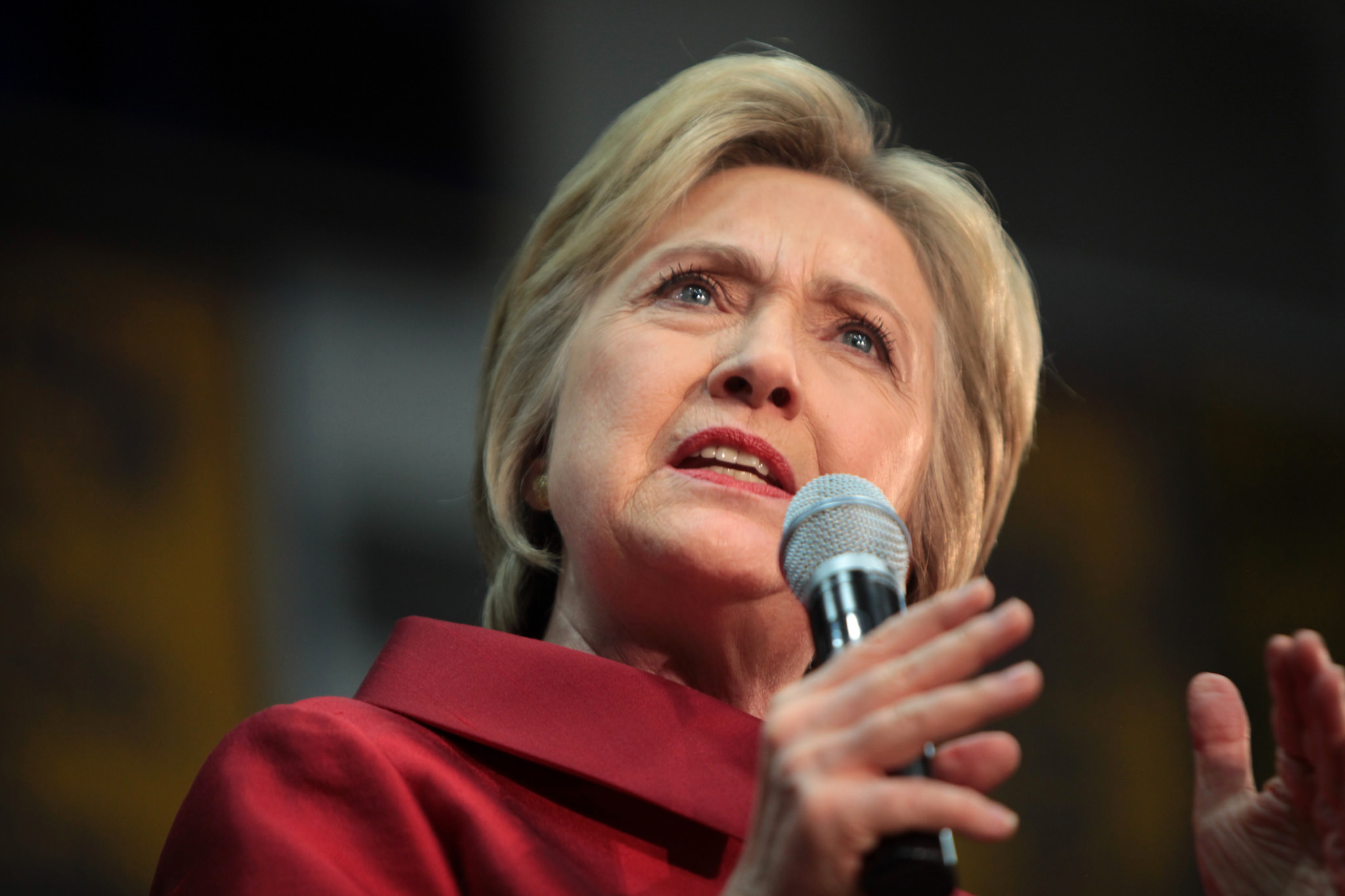
Hillary Clinton (Photo by Gage Skidmore)
The major U.S. news media quite openly moved to the forefront of the Resistance. The Washington Post adopted the melodramatic and hypocritical slogan, “Democracy Dies in Darkness,” as it unleashed its journalists to trumpet the narrative of some disloyal Americans spreading Russian propaganda. Darkness presumably was a fine place to stick people who questioned the Resistance’s Russia-gate narrative.
An early shot in this war against dissenting information was fired last Thanksgiving Day when the Post published a front-page article citing an anonymous group called PropOrNot smearing 200 Internet news sites for allegedly disseminating Russian propaganda. The list included some of the most important sources of independent journalism, including Consortiumnews.com, apparently for the crime of questioning some of the State Department’s narratives on international conflicts, particularly Syria and Ukraine.
Then, with the anti-Russia hysteria building and the censorship ball rolling, Congress last December approved $160 million for think tanks and other non-governmental organizations to combat Russian propaganda. Soon, reports and studies were flying off the shelves detecting a Russian behind every article, tweet and posting that didn’t toe the State Department’s line.
The New York Times and other leading news organizations have even cheered plans for Google, Facebook and other technology companies to deploy algorithms that can hunt down, marginalize or eliminate information that establishment media deems “fake” or “propaganda.” Already Google has put together a First Draft coalition, consisting of mainstream media and establishment-approved Web sites to decide what information makes the cut and what doesn’t.
Among these arbiters of truth is the fact-check organization PolitiFact, which judged the falsehood about “all 17 intelligence agencies” signing off on the Russian “hacking” claim to be “true.” Even though the claim was never true and is now clearly established as false, PolitiFact continues to assert that this lie is the truth, apparently filled with the hubris that comes with its power over determining what is true and what is false.
But what is perhaps most troubling to me about these developments is the silence of many civil liberties advocates, liberal politicians and defenders of press freedom who might have been counted on in earlier days to object to this censorship and blackballing.
It appears that the ends of taking down Donald Trump and demonizing Vladimir Putin justify whatever means, no matter the existential danger of nuclear war with Russia or the McCarthyistic (even Orwellian) threats to freedom of speech, press and thought.
Investigative reporter Robert Parry broke many of the Iran-Contra stories for The Associated Press and Newsweek in the 1980s.
Iran’s UN envoy slams Canada’s double standards on human rights

Canadians protest in support of indigenous women
Press TV – November 15, 2017
A senior Iranian diplomat has blasted Canada for proposing a “politically-motivated” UN resolution on the situation of human rights in Iran, while Ottawa, itself, has long been involved in a broad range of human rights abuses at home and elsewhere.
Iran’s Deputy Permanent Representative to the UN Es’haq Al-e Habib was reacting to a Canada-drafted human rights resolution, which was adopted Tuesday against Iran by the Third Committee of UN General Assembly with 83 votes in favor, 30 against and 68 abstentions.
Speaking during the session, Al-e Habib rejected the document as “politically-motivated” and said “double standards are an integral part of Canada’s foreign policy.”
“We regret that few unscrupulous Governments continue challenging integrity and credibility of the United Nations through pushing for this politically-motivated resolution that only underscores how selective, irrelevant and subjective UN decisions could sometimes become,” he added.
He pointed to some examples of Canada’s non-compliance by its international human rights obligations, including Ottawa’s discriminatory policies against indigenous people and its support for the Israeli regime.
“Ottawa along with very few others in the whole world have consistently and unconditionally supported Israel despite all the gross, abhorrent and systematic violations of human rights committed by that regime. This level of hypocrisy and double standard is mind-boggling,” the Iranian envoy pointed out.
Al-e Habib also referred to Canada’s discriminatory policies against its own indigenous people, adding, “While police brutality, forced disappearances and murder of the indigenous people are well documented, indigenous women and girls continue to suffer from the institutionalized discrimination and violence.”
“Canada should have realized thus far that such a pointless and futile exercise is a disservice to the human rights cause, a harmful measure against the UN human rights mechanisms and a disrespect to the wisdom of the people who closely monitor Canada’s selective stances on human rights situations,” the Iranian envoy said.
Saudi Arabia rights violations
During the session, Al-e Habib also lashed out at Saudi Arabia for supporting the Canada-drafted resolution against Iran, while Riyadh itself has been blatantly violating human rights both at home and in different parts of the world.
The Iranian envoy noted that Saudi Arabia kills more children in Yemen than al-Qaeda, Daesh and al-Nusra put together around the globe, adding, “Saudi regime being a partner in the global fight against terrorism and intolerance is blatant mockery of humanity, human rights, justice and peace.”
“Spending billions of dollars buying beautiful arms and Western public relation corporations cannot hide the real face of Saudi, whose money also fuels sectarianism in the Persian Gulf, Middle East and the world,” he said.
Al-e Habib went on to enumerate some instances of rights violations by Saudi Arabia, including Riyadh’s crackdown on all forms of dissent across the country, particularly in the eastern city of Awamiyah, mainly populated by minority Shia Muslims.
He highlighted the slavery of hundreds of thousands of female migrant workers inside Saudi Arabia, the systemic violation of human rights of minorities there.
The Iranian official also drew attention to the Saudi massacre of thousands of Yemeni civilians during its military campaign against the impoverished country as well as the number of the kingdom’s nationals, who have joined Takfiri terror outfits such as al-Qaeda, Daesh and al-Nusra Front.
Theresa May does Russophobia
By Neil Clark | RT | November 14, 2017
It was Dr Samuel Johnson who famously declared in 1775 that patriotism was the last refuge of the scoundrel. The 2017 variant is to make unsubstantiated claims about the ‘Russian threat’ to Western democracies.
In her speech at the Lord Mayor’s Banquet in the City of London on Monday evening, British Prime Minister Theresa May escalated the anti-Russian rhetoric still further with a deeply paranoid address that sounded as if it had been penned in 1953 by the late Senator Joe McCarthy during one of his drunken binges.
Any psychologists watching Mrs May would have had a field day identifying plenty of examples of what mind doctors call ‘projection’ – i.e. attributing to others what you are guilty of yourself. In fact every one of May’s claims against Russia can be more accurately applied to the UK and its closest allies.
The prime minister stated, “It is Russia’s actions which threaten the international order on which we all depend.”
Really, Mrs May? Was it Russia who illegally invaded Iraq in 2003, causing the deaths of up to 1 million people and the rise of Islamic State (IS, formerly ISIS/ISIL)? Was it Russia who destroyed Libya in 2011, turning the country with the highest HDI in Africa into a failed state and jihadist playground on the shores of the Mediterranean? Was it Russia who illegally bombed Yugoslavia, without UN approval, in 1999? Or Russia who backed radical jihadists – many of them linked to Al-Qaeda – to overthrow the Syrian government? In fact it was the US, the UK and its allies who did all these things. But let’s not mention them, shall we, prime minister?
May says her aim is “to defend the rules-based international order against irresponsible states that seek to erode it.” That’s just like the American gangster John Dillinger saying his aim in 1933 was “to defend banks against individuals who seek to rob them.”
The truth is that it’s been British governments – acting in tandem with the US – who have done most to erode international law in recent decades – and not Russia.
The prime minister boldly declared that “Russia has fomented conflict in the Donbass,” but it was the Americans and their NATO/EU allies who fomented conflict in Ukraine in 2014 by supporting and bankrolling an uprising against the democratically-elected government of Viktor Yanukovich – in which neo-Nazis and virulently anti-Russian ultra-Nationalists provided the cutting edge.
Concern over these developments among the Russian population of Ukraine led to a referendum, in which the people of Crimea overwhelmingly – and quite understandably – voted to return to Russia. The Maybot – who “consistently voted” for the illegal invasion of Iraq in 2002/3 – characterizes this exercise in democracy as “Russia’s illegal annexation of Ukraine.” If you’re going down this line, you may as well talk about “Britain’s illegal annexation of Gibraltar,” or the “UK invasion of the Isle of Wight.”
May declared that “Russia’s illegal annexation of Crimea was the first time since the Second World War that one sovereign nation has forcibly taken territory from another in Europe”. Well, that’ll be news to the people of Serbia who saw resource-rich Kosovo – the cradle of their civilization – forcibly taken away from them following a NATO bombing campaign.
May – like the good neocon she is – accuses Russian “state-run media” of planting “fake stories,” but interestingly fails to come up with a single example.
Well, I’m a kind soul, so let me help her. Here are some examples of ‘fake news’ – all of which have appeared in the Western media.
The fake news that Iraq possessed WMDs in 2003 – which led to the illegal invasion of that country and catastrophic consequences for the whole world. The fake news that Muammar Gaddafi was about to massacre the civilians of Benghazi in 2011 – which again led to another bloody Western military intervention. The fake news in 2010 and other times too that Iran was on the brink of developing a nuclear bomb. The fake news that Russians had hacked into the Vermont electricity grid. Or (no sniggering at the back, please) the news that Russia used ‘Pokemon GO’ to try to “sow division” in the run-up to the US election.
Is that enough examples of fake news for you Theresa, or would you like some more? Yes, fake news is threatening democracy, but its Western Establishment-approved and Establishment-disseminated fake news – the sort you read in neocon-approved ‘sensible newspapers’ and media outlets – which has caused the most damage. Where did those Iraqi WMDs get to, I wonder?
As for unsubstantiated accusations of Russian meddling in Western elections, again the chutzpah of Mrs May is off the scale. Britain and the US have seen it as their right to meddle in elections around the globe for decades. Political scientist Dov H. Levin calculated that the US attempted to influence foreign elections 81 times in the period 1946-2000, and that figure does not include support for military coups and other ‘regime change’ ops.
The UK has often been heavily involved in these nefarious anti-democratic schemes too – for example, in Iran in 1953 when Mohammed Mossadeq was toppled and in Yugoslavia in 2000. In his biography of Slobodan Milosevic, the ousted Yugoslav leader, Adam LeBor notes that over $70 million was paid to the anti-Socialist Serbian opposition – with the ‘Otpor‘ youth movement receiving much of the funding. “And who was behind Otpor?” LeBor writes, quoting a “high-level Serbian source.” The answer: “The US and Britain.” What a surprise.
Again, being accused by a prominent member of the UK Establishment of interfering in other countries’ elections is like being accused of tax evasion by Al Capone or being told to sit up straight by the Hunchback of Notre Dame. The hypocrisy is truly mind-boggling.
The prime minister, having accused the Kremlin of trying to “sow discord” in the West then came over all Churchillian, by declaring she had a “very simple message for Russia.”
“We know what you are doing. And you will not succeed. Because you underestimate the resilience of our democracies, the enduring attraction of free and open societies, and the commitment of Western nations to the alliances that bind us.”
Well, I and millions of Britons have a very simple message for Theresa May. We know what you are doing too. You are not ‘strong and stable’ but a weak and wobbly prime minister who is trying to distract us from the domestic failings of your own government by trying to scare us witless over a non-existent Russian threat. You are hoping that by raising the specter of the Big Bad Russian Bear we will forget about your promise to cap household energy bills, the scandal of rip-off train fares and the impact of cruel and heartless austerity policies on millions of people across the country. And ignore the fact that you’re giving the country absolutely no leadership or direction on the issue of Brexit.
The safety and security of Britain is indeed threatened, prime minister, not by the bogeyman Putin but by the disastrous policies that yours and other British governments have followed in recent years. Policies such as illegally invading Middle Eastern countries and backing violent jihadist groups to topple secular governments as in Libya and Syria. Or lifting control orders on terrorist organizations like the Libyan Islamic Fighting Group and allowing them to travel unhindered in and out of the country. Who was the British home secretary when that happened? Why, one Theresa May!
Ironically on the day that May was trying to give us sleepless nights about the Russian ‘threat,’ the BBC – the national state broadcaster – had revealed details of something truly nightmarish. Namely a secret deal which allowed some 250 fanatical IS fighters to safely leave the city of Raqqa – under the gaze of US and British-led forces.
We know too that the British authorities have said that Britons returning from formerly IS-held territories in Syria and Iraq should not be prosecuted. The security implications of these policies are very clear. Once again, who is it that’s putting British citizens’ lives at risk?
Follow Neil Clark @NeilClark66
Read more:
CIA Attempts to Cover al-Qaeda’s Crimes With ‘Iranian Connection’
Sputnik – 14.11.2017
Documents released by the CIA that allegedly reveal a connection between Tehran and al-Qaeda appear to be merely a part of an anti-Iranian information campaign waged by the United States.
Iranian analysts interviewed by Sputnik have dismissed claims about the alleged ties between Tehran and al-Qaeda brought forward by the CIA, arguing that it’s merely an attempt by the US to tarnish Iran’s reputation.
Seyyed Hadi Afghahi, Middle Eastern affairs expert and former official at the Iranian embassy in Lebanon, told Sputnik Iran that there are several important factors that need to be taken into account in this matter.
“First of all, it’s strange that the CIA decided to disclose this information just now, after so many years. Second, why won’t the CIA disclose information pertaining to the emergence of Osama bin Laden himself and about his ties with the United States? This disclosure – assuming that you could call it that, considering that there are no photos of this report penned by a senior al-Qaeda member that contain all these accusations against Iran – does feel rather selective in terms of which data is being revealed,” Afghahi said.
According to Afghahi, the disclosed report does contain one bit of truth – namely, Iran did at one time provide shelter to families of al-Qaeda members after a group of terrorists became trapped at the border between Iran and Afghanistan. He pointed out, however, that Tehran only granted safe haven to women and children, and that later these people were taken out of the country at the request of Saudi Arabia, so Iran did not harbor any al-Qaeda terrorists on its soil.
“Therefore, by raising this issue after so many years and with such a misleading angle, the US pursues just one goal – to tarnish the reputation of Iran and its allies (Hezbollah) by blaming them for the crimes that they (the US, Saudi Arabia and Israel) are guilty of. This is all part of the strategy that Donald Trump implements against us,” he argued.
Dr Ali Reza Rezahah, political observer to Iran’s Spiritual Leader at the Analytical Expert Center, also remarked that by portraying Iran as “terrorist,” the US may justify the seizure of Iranian assets on American territory.
“The US also has a mercantile interest in this matter: it does not intend to return the Iranian assets and property that were seized by the American capitalists even before the Islamic Revolution. In so doing, they use these false accusations as an excuse to avoid returning said assets,” Rezahah said.
He also stressed that the ideology of Iran and that of al-Qaeda are polar opposites, and that the terrorist group has “brought grief and murder” to his country.
“Allow me to remind you that it was a terrorist belonging to that very group who staged an attack at the Imam Reza shrine in Mashhad, killing innocent pilgrims, women and children. And the mastermind of this atrocity, Yousef Ramzi, is currently kept in one of the US prisons. If we visit the FBI website we can see that one of the crimes he’s been accused of is the killing of innocents in Iran during an Ashura ceremony. Iran filed extradition requests for this criminal on several occasions,” he said.
There can never be any contacts between Iran and al-Qaeda, Rezahah maintained, as the terrorist group and Tehran are “on the opposite sides of the barricades.”
The trove of documents found at Osama bin Laden’s hideout that was disclosed on November 1 by the CIA contains a 19-page report apparently penned by a senior al-Qaeda member, which details instances of cooperation between the terrorist group and Iran.
According to the report, Iran allegedly granted shelter to some of bin Laden’s cohorts who were fleeing Afghanistan after the US-led military intervention there, supplied al-Qaeda terrorists with money and weapons and helped train them at Hezbollah camps. In return, the terrorist group launched attacks against US installations in Saudi Arabia and other Gulf States that were designated by Tehran, according to the report.
Mocking Trump Doesn’t Prove Russia’s Guilt
By Ray McGovern | Consortium News | November 13, 2107
If the bloody debacle in Iraq should have taught Americans anything, it is that endorsements by lots of important people who think something is true don’t amount to evidence that it actually is true. If endorsements were the same as evidence, U.S. troops would have found tons of WMD in Iraq, rather than come up empty.
So, when it comes to whether or not Russia “hacked” Democratic emails last year and slipped them to WikiLeaks, just because a bunch of people with fancy titles think the Russians are guilty doesn’t compensate for the lack of evidence so far evinced to support this core charge.
But the reaction of Official Washington and the U.S. mainstream media to President Trump saying that Russian President Vladimir Putin seemed sincere in denying Russian “meddling” was sputtering outrage: How could Trump doubt what so many important people think is true?
Yet, if the case were all that strong that Russia did “hack” the emails, you would have expected a straightforward explication of the evidence rather than a demonstration of a full-blown groupthink, but what we got this weekend was all groupthink and no evidence.
For instance, on Saturday, CNN responded to Trump’s comment that Putin seems to “mean it” when he denied meddling by running a list of important Americans who had endorsed the Russian-guilt verdict. Other U.S. news outlets and politicians followed the same pattern.
Rep. Adam Schiff of California, the ranking Democrat on the House Intelligence Committee and a big promoter of the Russia-gate allegations, scoffed at what Trump said: “You believe a foreign adversary over your own intelligence agencies?”
The Washington Post’s headline sitting atop Sunday’s lede article read: “Trump says Putin sincere in denial of Russian meddling: Critics call that ‘unconscionable.’”
Sen. Mark Warner of Virginia, the ranking Democrat on the Senate Intelligence Committee and another Russia-gate sparkplug, said he was left “completely speechless” by Trump’s willingness to take Putin’s word “over the conclusions of our own combined intelligence community.”
Which gets us back to the Jan. 6 “Intelligence Community Assessment” and its stunning lack of evidence in support of its Russian guilty verdict. The ICA even admitted as much, that it wasn’t asserting Russian guilt as fact but rather as opinion:
“Judgments are not intended to imply that we have proof that shows something to be a fact. Assessments are based on collected information, which is often incomplete or fragmentary, as well as logic, argumentation, and precedents.”
Even The New York Times, which has led the media groupthink on Russian guilt, initially published the surprised reaction from correspondent Scott Shane who wrote: “What is missing from the public report is what many Americans most eagerly anticipated: hard evidence to back up the agencies’ claims that the Russian government engineered the election attack. … Instead, the message from the agencies essentially amounts to ‘trust us.’”
In other words, the ICA was not a disposition of fact; it was guesswork, possibly understandable guesswork, but guesswork nonetheless. And guesswork should be open to debate.
Shutting Down Debate
But the debate was shut down earlier this year by the oft-repeated claim that all 17 U.S. intelligence agencies concurred in the assessment and how could anyone question what all 17 intelligence agencies concluded!
However, that canard was finally knocked down by President Obama’s own Director of National Intelligence James Clapper who acknowledged in sworn congressional testimony that the ICA was the product of “handpicked” analysts from only three agencies – the CIA, FBI and National Security Agency.
In other words, not only did the full intelligence community not participate in the ICA but only analysts “handpicked” by Obama’s intelligence chiefs conducted the analysis – and as we intelligence veterans know well, if you handpick the analysts, you are handpicking the conclusions.
For instance, put a group of analysts known for their hardline views on Russia in a room for a few weeks, prevent analysts with dissenting viewpoints from weighing in, don’t require any actual evidence, and you are pretty sure to get the Russia-bashing result that you wanted.
So why do you think Clapper and Obama’s CIA Director John Brennan put up the no-entry sign that kept out analysts from the State Department and Defense Intelligence Agency, two entities that might have significant insights into Russian intentions? By all rights, they should have been included. But, clearly, no dissenting footnotes or wider-perspective views were desired.
If you remember back to the Iraq WMD intelligence estimate, analysts from the State Department’s intelligence bureau, known as INR, offered unwelcome dissenting views about the pace of Iraq’s supposed nuclear program, inserting a footnote saying they found it too difficult to predict the fruition of a program when there was no reliable evidence as to when – not to mention if – it had started.
DIA also was demonstrating an unusually independent streak, displaying a willingness to give due consideration to Russia’s perspective. Here’s the heterodox line DIA took in a major report published in December 2015:
“The Kremlin is convinced the United States is laying the groundwork for regime change in Russia, a conviction further reinforced by the events in Ukraine. Moscow views the United States as the critical driver behind the crisis in Ukraine and the Arab Spring and believes that the overthrow of former Ukrainian President Yanukovych is the latest move in a long-established pattern of U.S.-orchestrated regime change efforts.”
So, not only did the Jan. 6 report exclude input from INR and DIA and the other dozen or so intelligence agencies but it even avoided a fully diverse set of opinions from inside the CIA, FBI and NSA. The assessment – or guesswork – came only from those “hand-picked” analysts.
It’s also worth noting that not only does Putin deny that Russia was behind the publication of the Democratic emails but so too does WikiLeaks editor Julian Assange who has insisted repeatedly that the material did not come from the Russians. He and others around WikiLeaks have strongly suggested that the emails came as leaks from Democratic insiders.
Seeking Real Answers
In the face of Official Washington’s evidence-free groupthink, what some of us former U.S. intelligence analysts have been trying to do is provide both a fuller understanding of Russian behavior and whatever scientific analysis can be applied to the alleged “hacks.”
Forensic investigations and testing of relevant download speeds, reported by members of Veteran Intelligence Professionals for Sanity (VIPS), have undermined the Russia-did-it groupthink. But this attempt to engage in actual evaluation of evidence has been either ignored or mocked by mainstream news outlets.
Still, the suggestion in our July 24 VIPS memo that President Trump ask current CIA Director Mike Pompeo to take a fresh look at the issue recently had some consequence when Pompeo contacted VIPS member William Binney, a former NSA Technical Director, and invited him to explain his latest research on the impossibility of the Russians extracting the Democratic emails via an Internet hack based on known download speeds.
In typically candid terms, Binney explained to Pompeo why VIPS had concluded that the intelligence analysts behind the Jan. 6 report had been making stuff up about Russian “hacking.”
When news of the Binney-Pompeo meeting broke last week, the U.S. mainstream media again rejected the opportunity to rethink the Russia-did-it groupthink and instead treated Binney as some sort of “conspiracy theorist” with a “disputed” theory, while attacking Pompeo’s willingness to discuss Binney’s findings as “politicizing intelligence.”
Despite the smearing of Binney, President Trump appears to have taken some of this new evidence to heart, explaining his dispute with open-mouthed White House reporters on Air Force One who baited Trump with various forms of the same question: “Do you believe Putin?” amid the new jeering about Trump “getting played” by Putin.
Trump’s demeanor, however, suggested increased confidence that the Russian “hacking” allegations were the “witch hunt” that he has decried for months.
Trump also jabbed the press over its earlier false claims that “all 17 intelligence agencies” concurred on the Russian “hack.” And Trump introduced the idea of a different kind of “hack,” i.e., Obama’s political appointees at the heads of the agencies behind the Jan. 6 report.
Trump said, “You hear it’s 17 agencies. Well it’s three. And one is Brennan … give me a break. They’re political hacks. … I mean, you have Brennan, you have Clapper, you have [FBI Director James] Comey. Comey is proven to be a liar and he’s proven to be a leaker.”
Later, in deference to those still at work in intelligence, Trump said, “I’m with our [intelligence] agencies as currently constituted.”
While Trump surely has a dismal record of his own regarding truth-telling, he’s not wrong about the checkered record of the triumvirate of Clapper, Brennan and Comey.
Clapper played a key role in the bogus Iraq-WMD intelligence when he was head of the National Geo-spatial Agency and hid the fact that there was zero evidence in satellite imagery of any weapons of mass destruction before the Iraq invasion. When no WMDs were found, Clapper told the media that he thought they were shipped off to Syria.
In 2013, Clapper perjured himself before Congress by denying NSA’s unconstitutional blanket surveillance of Americans. After evidence emerged revealing the falsity of Clapper’s testimony, he wrote a letter to Congress admitting, “My response was clearly erroneous – for which I apologize.” Despite the deception, he was allowed to stay as Obama’s most senior intelligence officer for almost four more years.
Clapper also has demonstrated an ugly bias about Russians. On May 28, as a former DNI, Clapper explained Russian “interference” in the U.S. election to NBC’s Chuck Todd on May 28 with a tutorial on what everyone should know about “the historical practices of the Russians.” Clapper said, “the Russians, typically, are almost genetically driven to co-opt, penetrate, gain favor, whatever, which is a typical Russian technique.”
Brennan, who had previously defended torture as having been an effective way to gain intelligence, was CIA director when agency operatives broke into the computers of the Senate Intelligence Committee when it was investigating CIA torture.
Former FBI Director Comey is infamous for letting the Democratic National Committee arrange its own investigation of the “hacking” that was then blamed on Russia, a development that led some members of Congress to call the supposed “hack” an “act of war.” Despite the risk of nuclear conflagration, the FBI didn’t bother to do its own forensics.
And, by his own admission, Comey arranged a leak to The New York Times that was specifically designed to get a Special Prosecutor appointed to investigate Russia-gate, a job that fell to his old friend Robert Mueller, who has had his own mixed record as the previous FBI director in mishandling the 9/11 investigation.
There are plenty of reasons to want Trump out of the White House, but there also should be respect for facts and due process. So far, the powers-that-be in Washington – in politics, the media and other dominant institutions, what some call the Deep State – have shown little regard for fairness in the Russia-gate “scandal.”
The goal seems to be to remove the President or at least emasculate him on a bum rap, giving him the bum’s rush, so to speak, while also further demonizing Russia and exacerbating an already dangerous New Cold War.
The truth should still count for something. No one’s character should be assassinated, as Bill Binney’s is being now, for running afoul of the conventional wisdom that Trump – like bête noire Putin – never tells the truth, and that to believe either is, well, “unconscionable,” as The Washington Post warns.
Ray McGovern was a CIA intelligence analyst for 27 years and is co-founder of Veteran Intelligence Professionals for Sanity.
Featured Video
Why Hamas Really Attacked Israel on Oct. 7
or go to
Aletho News Archives – Video-Images
From the Archives
Confronting the Threat of Ethnic Bioweapons
By Tony Cartalucci – New Eastern Outlook – 29.11.2017
The United States Air Force’s 59th Medical Wing’s molecular biology branch recently was revealed to have been collecting specifically Russian RNA and synovial (connective) tissue samples, prompting fears in Russia of a possible US directed ethnic-specific bioweapons program. … continue
Blog Roll
 Aletho News
- Meet the US generals and admirals advancing Israeli policy
- Israel’s Straw Widow Protocol: The Kill Zones Where Civilians Were Labelled ‘Terrorists’
- Leading Israeli Think Tank Publishes Psychotic Israeli ‘National Security’ Doctrine
- Are the United States and Israel in Decline-and-Fall Mode?
- Why Hamas Really Attacked Israel on Oct. 7
- Declassified UK exposes British man who fought for ‘Israel’ in Gaza
- West’s death cult in a theater near you
- How the Yandex ‘Russian bots’ lie fell apart
- Burnham’s ‘Russia did Brexit’ ruse crumbles
- Estonia making movies and games to encourage war against Russia
- If Americans Knew
- Gaza’s “ceasefire” death toll passes 1,500 – Daily Update
- Activists Abused By Israel Return to New Freedom Flotilla Mission
- 60 Minutes won’t tell the full truth about Israeli settler violence
- Nearly 50,000 women, girls killed or severely injured in Gaza since October 2023: UN Women
- ADL is working with AI companies to suppress alleged ‘antisemitism’
- Israeli occupation forces using social media surveillance unit to target hundreds of Palestinians in the West Bank
- Israel’s New – and Terrifying – Security Doctrine
- Israeli Attacks Kill Five in Gaza, Including a four-year-old and a woman
- Air Force Major Who Called for Trump’s Impeachment Held in Solitary Confinement
- It’s a Genocide, I’m Into It’: Seinfeld Mocks Protest over Palestinian Children Killed
- No Tricks Zone
- New Study Suggests Large Regions Of The Pacific Ocean Have Been Cooling For The Last 80 Years
- Germany’s Green Energy Debacle: High Energy Costs Force Kahla Porzellan to Close After 182 Years!
- New Study: 50 Years Of The Most Aggressive ‘Net Zero’ Policies Can Only Affect The Global Climate By 0.03°C
- US September “Heat” Was No Record…Many Records Set Decades Ago
- Latest European Green Energy Debacle; Portugal’s Largest Flagship Solar Park Insolvent!
- Green Energy Debacle: German Expert Professor Fritz Vahrenholt Warns Of Severe Economic And Social Consequences
- Two More Paleo Reconstructions Affirm Meters-Higher Sea Levels Across Ireland, Brazil 7000-6000 Years Ago
- New Study: Earth And Venus Surface Warmth Largely Explained By Convection And Lapse Rate, Not CO2 Or Radiation
- 2025 Nature Paper Claiming Worsening Global Drought Gets RETRACTED …Heavily Flawed
- New Study: ‘Global Drought Shows No Detectable Recent Acceleration Under Climate Warming’

