Key Neocon Calls on US to Oust Putin
By Robert Parry | Consortium News | October 7, 2016
The neoconservative president of the U.S.-taxpayer-funded National Endowment for Democracy [NED] has called for the U.S. government to “summon the will” to engineer the overthrow of Russian President Vladimir Putin, saying that the 10-year-old murder case of a Russian journalist should be the inspiration.
Carl Gershman, who has headed NED since its founding in 1983, doesn’t cite any evidence that Putin was responsible for the death of Anna Politkovskaya but uses a full column in The Washington Post on Friday to create that impression, calling her death “a window to Vladimir Putin, the Kremlin autocrat whom Americans are looking at for the first time.”
Gershman wraps up his article by writing: “Politkovskaya saw the danger [of Putin], but she and other liberals in Russia were not strong enough to stop it. The United States has the power to contain and defeat this danger. The issue is whether we can summon the will to do so. Remembering Politkovskaya can help us rise to this challenge.”
That Gershman would so directly call for the ouster of Russia’s clearly popular president represents further proof that NED is a neocon-driven vehicle that seeks to create the political circumstances for “regime change” even when that means removing leaders who are elected by a country’s citizenry.
And there is a reason for NED to see its job in that way. In 1983, NED essentially took over the CIA’s role of influencing electoral outcomes and destabilizing governments that got in the way of U.S. interests, except that NED carried out those functions in a quasi-overt fashion while the CIA did them covertly.
NED also serves as a sort of slush fund for neocons and other favored U.S. foreign policy operatives because a substantial portion of NED’s money circulates through U.S.-based non-governmental organizations or NGOs.
That makes Gershman an influential neocon paymaster whose organization dispenses some $100 million a year in U.S. taxpayers’ money to activists, journalists and NGOs both in Washington and around the world. The money helps them undermine governments in Washington’s disfavor – or as Gershman would prefer to say, “build democratic institutions,” even when that requires overthrowing democratically elected leaders.
NED was a lead actor in the Feb. 22, 2014 coup ousting Ukraine’s elected President Viktor Yanukovych in a U.S.-backed putsch that touched off the civil war inside Ukraine between Ukrainian nationalists from the west and ethnic Russians from the east. The Ukraine crisis has become a flashpoint for the dangerous New Cold War between the U.S. and Russia.
Before the anti-Yanukovych coup, NED was funding scores of projects inside Ukraine, which Gershman had identified as “the biggest prize” in a Sept. 26, 2013 column also published in The Washington Post.
In that column, Gershman wrote that after the West claimed Ukraine, “Russians, too, face a choice, and Putin may find himself on the losing end not just in the near abroad but within Russia itself.” In other words, Gershman already saw Ukraine as an important step toward an even bigger prize, a “regime change” in Moscow.
Less than five months after Gershman’s column, pro-Western political activists and neo-Nazi street fighters – with strong support from U.S. neocons and the State Department – staged a coup in Kiev driving Yanukovych from office and installing a rabidly anti-Russian regime, which the West promptly dubbed “legitimate.”
In reaction to the coup and the ensuing violence against ethnic Russians, the voters of Crimea approved a referendum with 96 percent of the vote to leave Ukraine and rejoin Russia, a move that the West’s governments and media decried as a Russian “invasion” and “annexation.”
The new regime in Kiev then mounted what it called an “Anti-Terrorism Operation” or ATO against ethnic Russians in the east who had supported Yanukovych and refused to accept the anti-constitutional coup in Kiev as legitimate.
The ATO, spearheaded by neo-Nazis from the Azov battalion and other extremists, killed thousands of ethnic Russians, prompting Moscow to covertly provide some assistance to the rebels, a move denounced by the West as “aggression.”
Blaming Putin
In his latest column, Gershman not only urges the United States to muster the courage to oust Putin but he shows off the kind of clever sophistry that America’s neocons are known for. Though lacking any evidence, he intimates that Putin ordered the murder of Politkovskaya and pretty much every other “liberal” who has died in Russia.
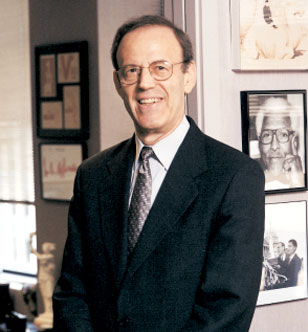
Carl Gershman, president of the NED
It is a technique that I’ve seen used in other circumstances, such as the lists of “mysterious deaths” that American right-wingers publish citing people who crossed the paths of Bill and Hillary Clinton and ended up dead. This type of smear spreads suspicion of guilt not based on proof but on the number of acquaintances and adversaries who have met untimely deaths.
In the 1990s, one conservative friend of mine pointed to the Clintons’ “mysterious deaths” list and marveled that even if only a few were the victims of a Clinton death squad that would be quite a story, to which I replied that if even one were murdered by the Clintons that would be quite a story – but that there was no proof of any such thing.
“Mysterious deaths” lists represent a type of creepy conspiracy theory that shifts the evidentiary burden onto the targets of the smears who must somehow prove their innocence, when there is no evidence of their guilt (only vague suspicions). It is contemptible when applied to American leaders and it is contemptible when applied to Russian leaders, but it is not beneath Carl Gershman.
Beyond that, Gershman’s public musing about the U.S. somehow summoning “the will” to remove Putin might — in a normal world — disqualify NED and its founding president from the privilege of dispensing U.S. taxpayers’ money to operatives in Washington and globally. It is extraordinarily provocative and dangerous, an example of classic neocon hubris.
While the neocons do love their tough talk, they are not known for thinking through their “regime change” schemes. The idea of destabilizing nuclear-armed Russia with the goal of ousting Putin, with his 82 percent approval ratings, must rank as the nuttiest and most reckless neocon scheme of all.
Gershman and his neocon pals may fantasize about making Russia’s economy scream while financing pro-Western “liberals” who would stage disruptive protests in Red Square, but he and his friends haven’t weighed the consequences even if they could succeed.
Given the devastating experience that most Russians had when NED’s beloved Russian “liberals” helped impose American “shock therapy” in the 1990s — an experiment that reduced average life expectancy by a full decade — it’s hard to believe that the Russian people would simply take another dose of that bitter medicine sitting down.
Even if the calculating Putin were somehow removed amid economic desperation, he is far more likely to be followed by a much harder-line Russian nationalist who might well see Moscow’s arsenal of nuclear weapons as the only way to protect Mother Russia’s honor. In other words, the neocons’ latest brash “regime change” scheme might be their last – and the last for all humanity.
A Neocon Slush Fund
Gershman’s arrogance also raises questions about why the American taxpayer should tolerate what amounts to a $100 million neocon slush fund which is used to create dangerous mischief around the world. Despite having “democracy” in its name, NED appears only to favor democratic outcomes when they fit with Official Washington’s desires.

CIA Director William Casey
If a disliked candidate wins an election, NED acts as if that is prima facie evidence that the system is undemocratic and must be replaced with a process that ensures the selection of candidates who will do what the U.S. government tells them to do. Put differently, NED’s name is itself a fraud.
But that shouldn’t come as a surprise since NED was created in 1983 at the urging of Ronald Reagan’s CIA Director William J. Casey, who wanted to off-load some of the CIA’s traditional work ensuring that foreign elections turned out in ways acceptable to Washington, and when they didn’t – as in Iran under Mossadegh, in Guatemala under Arbenz or in Chile under Allende – the CIA’s job was to undermine and remove the offending electoral winner.
In 1983, Casey and the CIA’s top propagandist, Walter Raymond Jr., who had been moved to Reagan’s National Security Council staff, wanted to create a funding mechanism to support outside groups, such as Freedom House and other NGOs, so they could engage in propaganda and political action that the CIA had historically organized and paid for covertly. The idea emerged for a congressionally funded entity that would serve as a conduit for this money.
In one undated letter to then-White House counselor Edwin Meese III, Casey urged creation of a “National Endowment,” but he recognized the need to hide the strings being pulled by the CIA. “Obviously we here [at CIA] should not get out front in the development of such an organization, nor should we appear to be a sponsor or advocate,” Casey wrote.
The National Endowment for Democracy took shape in late 1983 as Congress decided to also set aside pots of money — within NED — for the Republican and Democratic parties and for organized labor, creating enough bipartisan largesse that passage was assured.
But some in Congress thought it was important to wall the NED off from any association with the CIA, so a provision was included to bar the participation of any current or former CIA official, according to one congressional aide who helped write the legislation.
This aide told me that one night late in the 1983 session, as the bill was about to go to the House floor, the CIA’s congressional liaison came pounding at the door to the office of Rep. Dante Fascell, a senior Democrat on the House Foreign Affairs Committee and a chief sponsor of the bill.
The frantic CIA official conveyed a single message from CIA Director Casey: the language barring the participation of CIA personnel must be struck from the bill, the aide recalled, noting that Fascell consented to the demand, not fully recognizing its significance – that it would permit the continued behind-the-scenes involvement of Raymond and Casey.
The aide said Fascell also consented to the Reagan administration’s choice of Carl Gershman to head NED, again not recognizing how this decision would affect the future of the new entity and American foreign policy.
Gershman, who had followed the classic neoconservative path from youthful socialism to fierce anticommunism, became NED’s first (and, to this day, only) president. Though NED is technically independent of U.S. foreign policy, Gershman in the early years coordinated decisions on grants with Raymond at the NSC.
For instance, on Jan. 2, 1985, Raymond wrote to two NSC Asian experts that “Carl Gershman has called concerning a possible grant to the Chinese Alliance for Democracy (CAD). I am concerned about the political dimension to this request. We should not find ourselves in a position where we have to respond to pressure, but this request poses a real problem to Carl.
“Senator [Orrin] Hatch, as you know, is a member of the board. Secondly, NED has already given a major grant for a related Chinese program.”
Neocon Tag Teams
From the start, NED became a major benefactor for Freedom House, beginning with a $200,000 grant in 1984 to build “a network of democratic opinion-makers.” In NED’s first four years, from 1984 and 1988, it lavished $2.6 million on Freedom House, accounting for more than one-third of its total income, according to a study by the liberal Council on Hemispheric Affairs that was entitled “Freedom House: Portrait of a Pass-Through.”
Over the ensuing three decades, Freedom House has become almost an NED subsidiary, often joining NED in holding policy conferences and issuing position papers, both organizations pushing primarily a neoconservative agenda, challenging countries deemed insufficiently “free,” including Syria, Ukraine (in 2014) and Russia.
Indeed, NED and Freedom House often work as a kind of tag-team with NED financing “non-governmental organizations” inside targeted countries and Freedom House berating those governments if they crack down on U.S.-funded NGOs.
For instance, on Nov. 16, 2012, NED and Freedom House joined together to denounce legislation passed by the Russian parliament that required recipients of foreign political money to register with the government.
Or, as NED and Freedom House framed the issue: the Russian Duma sought to “restrict human rights and the activities of civil society organizations and their ability to receive support from abroad. Changes to Russia’s NGO legislation will soon require civil society organizations receiving foreign funds to choose between registering as ‘foreign agents’ or facing significant financial penalties and potential criminal charges.”
Of course, the United States has a nearly identical Foreign Agent Registration Act that likewise requires entities that receive foreign funding and seek to influence U.S. government policy to register with the Justice Department or face possible fines or imprisonment.
But the Russian law would impede NED’s efforts to destabilize the Russian government through funding of political activists, journalists and civic organizations, so it was denounced as an infringement of human rights and helped justify Freedom House’s rating of Russia as “not free.”
Another bash-Putin tag team has been The Washington Post’s editors and NED’s Gershman. On July 28, 2015, a Post editorial and a companion column by Gershman led readers to believe that Putin was paranoid and “power mad” in worrying that outside money funneled into NGOs threatened Russian sovereignty.
The Post and Gershman were especially outraged that the Russians had enacted the law requiring NGOs financed from abroad and seeking to influence Russian policies to register as “foreign agents” and that one of the first funding operations to fall prey to these tightened rules was Gershman’s NED.
The Post’s editors wrote that Putin’s “latest move … is to declare the NED an ‘undesirable’ organization under the terms of a law that Mr. Putin signed in May [2015]. The law bans groups from abroad who are deemed a ‘threat to the foundations of the constitutional system of the Russian Federation, its defense capabilities and its national security.’
“The charge against the NED is patently ridiculous. The NED’s grantees in Russia last year ran the gamut of civil society. They advocated transparency in public affairs, fought corruption and promoted human rights, freedom of information and freedom of association, among other things. All these activities make for a healthy democracy but are seen as threatening from the Kremlin’s ramparts.
“The new law on ‘undesirables’ comes in addition to one signed in 2012 that gave authorities the power to declare organizations ‘foreign agents’ if they engaged in any kind of politics and receive money from abroad. The designation, from the Stalin era, implies espionage.”
However, among the relevant points that the Post’s editors wouldn’t tell their readers was the fact that Russia’s Foreign Agent Registration Act was modeled after the American Foreign Agent Registration Act and that NED President Gershman had already publicly made clear — in his Sept. 26, 2013 column — that his goal was to oust Russia’s elected president.
In his July 28, 2015 column, Gershman further deemed Putin’s government illegitimate. “Russia’s newest anti-NGO law, under which the National Endowment for Democracy … was declared an “undesirable organization” prohibited from operating in Russia, is the latest evidence that the regime of President Vladimir Putin faces a worsening crisis of political legitimacy,” Gershman wrote, adding:
“This is the context in which Russia has passed the law prohibiting Russian democrats from getting any international assistance to promote freedom of expression, the rule of law and a democratic political system. Significantly, democrats have not backed down. They have not been deterred by the criminal penalties contained in the ‘foreign agents’ law and other repressive laws. They know that these laws contradict international law, which allows for such aid, and that the laws are meant to block a better future for Russia.”
The reference to how a “foreign agents” registration law conflicts with international law might have been a good place for Gershman to explain why what is good for the goose in the United States isn’t good for the gander in Russia. But hypocrisy is a hard thing to rationalize and would have undermined the propagandistic impact of the column.
Also undercutting the column’s impact would be an acknowledgement of where NED’s money comes from. So Gershman left that out, too. After all, how many governments would allow a hostile foreign power to sponsor politicians and civic organizations whose mission is to undermine and overthrow the existing government and put in someone who would be compliant to that foreign power?
And, if you had any doubts about what Gershman’s intent was regarding Russia, he dispelled them in his Friday column in which he calls on the United States to “summon the will” to “contain and defeat this danger,” which he makes clear is the continued rule of Vladimir Putin.
US government officially accuses Russia of political hacks
RT | October 7, 2016
The US intelligence community is “confident” that Russia is behind the recent hacks of US officials’ and organizations’ emails, the Department of Homeland Security and the Office of National Intelligence said.
According to the joint statement issued Friday, “disclosures of alleged hacked e-mails on sites like DCLeaks.com and WikiLeaks and by the Guccifer 2.0 online persona are consistent with the methods and motivations of Russian-directed efforts.”
“We believe, based on the scope and sensitivity of these efforts, that only Russia’s senior-most officials could have authorized these activities,” says the statement, posted by the Director of National Intelligence James Clapper.
The thefts and disclosures are “intended to interfere with the US election process,” the statement said, adding that “the Russians have used similar tactics and techniques across Europe and Eurasia” to influence public opinion.
External attempts to access election systems in several states“in most cases originated from servers operated by a Russian company,” the US officials said. “However, we are not now in a position to attribute this activity to the Russian Government.”
It would be “extremely difficult” for anyone to alter ballot counts or election results through cyberattacks, DHS and DNI said.
DHS has established an Election Infrastructure Cybersecurity Working Group “with experts across all levels of government” to raise awareness of cybersecurity risks, and urges state and local election officials to seek cybersecurity assistance from the federal authorities.
This is the first time the US government has officially accused Russia of cyberattacks related to the US presidential campaign. The Democratic National Committee blamed Russia for the hack of their email servers in June, though a lone hacker going by the name ‘Guccifer 2.0’ claimed responsibility and denied any ties to Russia.
The statement from Homeland Security and DNI comes just hours after Secretary of State John Kerry said that Russian actions in Syria “beg for an appropriate investigation of war crimes.” Moscow has dismissed Kerry’s words as “propaganda” intended to distract from US failure to implement the Syrian ceasefire agreement.
US cybersecurity experts claim that six out of eight IP addresses used by the DNC hackers were hosted on King Servers, a Russian provider. Vladimir Fomenko, owner of the company, told RT that he was never contacted by US law enforcement, however.
“We are ready to assist in probing this crime and consulting the FBI or other services on such issues. Hackers are a common threat and we must fight it together,” Fomenko said.
“If the FBI asks, we are ready to supply the IP addresses, the logs,” he said. “Nobody is asking… It’s like nobody wants to sort this out.”
J’Accuse – French Condemnations of Russia in Syria Beyond Cynical
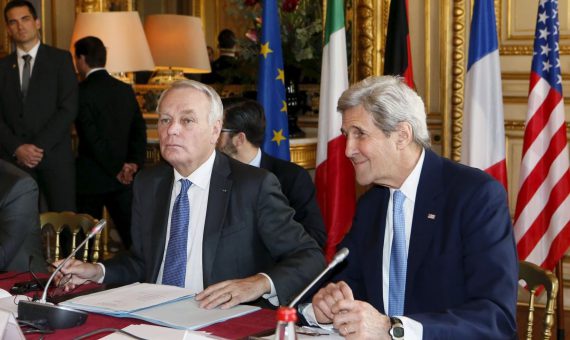
By Finian CUNNINGHAM | Strategic Culture Foundation | 07.10.2016
French Foreign Minister Jean-Marc Ayrault worked up his frequent-flyer air miles account this week with consecutive flights to Moscow then to Washington in a bid to push through a UN Security Resolution for a new ceasefire in Syria.
Ayrault began his shuttle diplomacy with stern condemnation of the Syrian government for what he said were «war crimes» committed in the besieged city of Aleppo. The French minister also implied Russian complicity in the same alleged crimes. It wasn’t the first time he made such accusations against Russia and its Syrian ally.
When the ceasefire brokered by US Secretary of State John Kerry and Russia’s Foreign Minister Sergey Lavrov broke down at the end of last month, it was Ayrault who led vociferous denunciations at the UN, along with American UN ambassador Samantha Power, blaming Russia for «barbarous crimes against humanity».
This week on his way to Moscow, Ayrault accused Russia of «cynicism that is fooling nobody» in reference to the renewed Russian-backed offensive by Syrian state forces to recapture the militant-held eastern quarter of Aleppo. That part of the city housing about 250,000 people has been under the control of various Islamist militants dominated by the terrorist group Al Nusra Front since 2012.
France, the US and Britain, amplified by the Western news media, have been conducting a relentless campaign to portray the Russian-backed Syrian operation on Aleppo as criminal and brutally injurious to the civilian population. Since the ceasefire collapsed during the last week of September, the Western media have been saturated with unverified claims of Russian air strikes killing civilians in eastern Aleppo and of targeting hospitals and humanitarian aid facilities.
France 24, the state-owned broadcaster of Ayrault’s country, never gives any reports from the Syrian government-held quarters of Aleppo where the majority of citizens – some 1.5 million – are residing. These areas are routinely shelled by the militants, with hundreds of victims over the past few weeks. Yet, France 24 and the other Western media outlets appear to operate on the basis that the majority of Aleppo’s population simply does not exist.
Nor do the Western media report that the majority of Aleppo’s civilians are willingly residing in the government-held districts out of seeking protection from the Islamist militants. Moreover, neither is it reported that the mainstay of the 250,000 civilians in eastern Aleppo are being held there against their will by the militants as hostages, or human shields. They can’t flee out of fear that remaining family relatives will be murdered in retribution.
The evidently selective humanitarian concern expressed by the French foreign minister and his Western counterparts for the people of Aleppo begins to alert one of a more nuanced – dare we say cynical – agenda.
Claims of Russian and Syrian «war crimes» made by Ayrault and other Western officials are based on «rebel sources» within besieged eastern Aleppo. One of the primary sources is the so-called «volunteer aid» group known as the White Helmets. Video footage purporting to show the aftermath of Russian air strikes is routinely aired by France 24 and other Western channels with the White Helmets logo displayed. It is presented as a bona fide humanitarian agency, when it fact the group is funded by US and British governments to the tune of $23 million and is embedded with the Al Nusra terrorist-controlled Aleppo Media Center. In short, a terrorist propaganda outlet, which serves to feed Western media and government ministers with disinformation that is purveyed to the Western public in order to discredit and demonize Syria and Russian forces.
French diplomats told Reuters this week that France is drafting its proposed resolution to the UN Security Council in such a way that Russia would have to exercise its veto if it is to block it. In that way, the French purpose is to project Russia as an unreasonable member of the Security Council and a stalwart backer of the Syrian «regime». This amounts to more cynical Western attempts to traduce Russia and Syria as the perpetrators for the ongoing violence.
Russia is unlikely to support the French-sponsored resolution because the resolution is impossibly one-sided and belies a political objective of undermining Syria and Russia. France is calling for an immediate cessation of fighting in Aleppo, including no military flights over the city; and, secondly, for the complete humanitarian aid access to eastern Aleppo.
This French initiative – under the guise of urgent humanitarianism – is a de facto «no fly zone» that will bolster the fighting capability of the anti-government insurgents, which, as noted, are dominated by al-Qaeda-affiliated terror groups.
When Russia and Syrian forces agreed to the ceasefire declared earlier on September 12, they did so on the strict condition that militants not associating with terrorist brigades would henceforth separate physical units. But no such separation occurred, as many observers had predicted, because Western government claims of «moderate rebels» being interspersed with «extremists» are nothing but a cynical charade. All these militants belong to the same terrorist front which Western governments have been arming in a covert war for regime change against President Bashar al-Assad – a longtime ally of Russia and Iran.
The only parties to respect the ceasefire called by Kerry and Lavrov last month were the Syrian army and its allies among the Iranian and Hezbollah militias, as well as the Russian air force. The foreign-backed militants continued to carry out hundreds of breaches of the truce, while also using the initial reduction of operations by the Syrian and Russian forces as an opportunity to regroup and rearm.
What French minister Ayrault is calling for in a renewed ceasefire this week is merely a repeat of the previous one – this time without even a pretense that the terrorists might separate into «moderates» and «extremists».
French and Western anxiety to implement some kind of cessation around Aleppo is correlated with the increasingly desperate, losing situation for the regime-change insurgents. Aleppo is a key battleground. If the Syrian and Russian forces manage to vanquish this bastion for the militants then the six-year war in Syria will be over.
The Western sponsors of the covert war in Syria stand to incur a huge strategic defeat. It should be also noted that 66-year-old Jean-Marc Ayrault was previously French prime minister back in 2012, at the very time that France was beginning to covertly supply weapons to illegally armed groups in Syria – in contravention of a European Union embargo.
This is why Ayrault and his American and British allies are now assiduously piling the political pressure on Russia to desist from its offensive in Syria. The Western sponsors are desperately trying to salvage their proxy assets on the ground and to salvage their criminal regime-change project – using the language and emotion of humanitarian concern and legal niceties.
You can’t get much more cynical than that. Now Monsieur Ayrault, just who is accusing who of what?
Humanitarians for War: Language and the New Orientalists
By Alex Ray | OffGuardian | October 5, 2016
A UK House of Commons inquiry into the 2011 attack on Libya and the country’s subsequent collapse has found what many suspected: NATO and its Gulf Arab allies used their ‘Responsibility To Protect’ to launch their attack even though:
“… the proposition that Muammar Gaddafi would have ordered the massacre of civilians in Benghazi was not supported by the available evidence.”
Though the MPs’ damning report blames Libya’s political and economic collapse on former Prime Minister David Cameron, the manipulation of public opinion to lay the basis for war is built upon longstanding – but now sharpened – processes and semantic structures that prepare populations to accept punitive action against a targeted ‘other’.
In an earlier example, on October 10 1990, a young Kuwaiti woman known as ‘Nayirah’ testified before the United States’ Congressional Human Rights Caucus that invading Iraqi soldiers had gone into hospitals and thrown babies from their incubators.
Nayirah turned out to be the daughter of the then Kuwaiti ambassador to Washington. Her testimony was false and prepared by a PR company. But it was solid gold for the US campaign to intervene militarily. Amnesty International provided influential support for Nayirah’s story. The ‘depravity’ of Saddam Hussein’s government was proffered by governments and mainstream media as a key reason for military intervention.
In March, 2011, Libyan opposition fighters and a Libyan psychologist, Dr Seham Sergewa told foreign media that pro-Qaddhafi fighters were being ordered to carry out viagra-fuelled mass rapes. The claim – spread by Al-Jazeera – was this time picked up by the prosecutor of the International Criminal Court, Luis Moreno-Ocampo. Although Amnesty International questioned some of the claims this time, the rape story was one of many myths that contributed to the NATO bombardment of Libya – the beginning of the end of the Libyan state.
The ‘humanitarian’ battle cry of 2011 was another manifestation of neo-Orientalist rhetoric directed towards out-of-favour leaders or groups.
Edward Said’s “Orientalism” referred to Western stereotyping of Arabs and Arab culture through a colonial lens. Currently, Neo-Orientalism is typically based on sensational claims that target ‘others’ (leaders or groups) by depicting them as intrinsically alien, evil and irrational, in order to justify aggression against them.
Qaddhafi’s relationship with the West was full of moments that prepared us to unquestionably accept claims of his barbarity – to the extent that Hillary Clinton could mock his torture and murder by rebels.
Regardless of his positive and negative attributes, the language used to describe Qaddhafi – a son of peasant goat herders – was often insulting and unprofessional. Journalist and historian Gwynne Dyer for example: “
… resplendent in the gold brocade robes that he probably made from his mother’s curtains and wearing his usual bug-eye sunglasses… The world’s oldest teenager…”
The New York Times treated Qaddhafi’s international visits featuring his bedouin tent as a circus fit for New York’s Coney Island rather than an important cultural symbol of Libya’s or Qaddhafi’s heritage. One wonders whether anyone would dare attempt similar treatment of Australia’s Aboriginal Tent Embassy which has been a feature of the capital Canberra since 1972.
There were numerous stories of the ‘chauvinistic’ displays of Qaddhafi’s ‘Amazonian’ republican guard. However ‘Amazonian’ legends of powerful female bodyguards have a long history in North Africa and especially Libya. Greek mythology – the source of Amazonian legends – speaks of Queen Myrina the Amazonian queen who led military victories in Libya. Under Islam there was the wealthy and powerful King Musa I of Mali, who was protected by such an Amazonian troop while undertaking the Hajj in 1332. It seems not a single commentator bothered to note the antecedents of such symbolism before resorting to ridicule.
It is not only the media and politicians who join the neo-Orientalist derision of disagreeable leaders. Descriptions of Qaddhafi in Harvard professor and historian Roger Owen’s recent work The Rise and Fall of Arab Presidents for Life, exhibit shades of cultural superiority. After indulging in psychological speculation about Arab leaders, Owen (p.199) criticises Qaddhafi’s relationship with the African Union particularly his “bringing African heads of state to Libya and posturing before them in ‘African’ costumes of his own design with absurd-looking little round caps”.
Aside from Owen’s dismissal of the African Union, he sees no irony in ridiculing Qaddafi for doing exactly what the leaders of the world’s most powerful countries do at APEC and G20 meetings – put on ‘absurd’ cultural uniforms like the imagined Australian stockmen’s outfits worn by APEC leaders in Sydney in 2007:

John Howard and George W. Bush at APEC in Sydney 2007, Source: The Guardian
Owen depicts Arab governments as wholly subject to the whims of a strongman leader. While the West – and sometimes Arab leaders themselves – like to portray authoritarian governments as ruled by maniacal and all-powerful men individually, this is rarely the case – especially in Libya as demonstrated by this Wikileaks cable showing disagreements amongst the Libyan leadership.
Such systems are far too complex to be overseen by one person. As Oxford Professor Richard Bosworth argues, in addition to clouding other factors involved in the operation of such states, judgemental and presumptive treatments such as Owen’s tend to dismiss leaders as mad and evil which prevents comprehensive understanding.
The terminology of ‘regimes’ and ‘governments’ is another rhetorical tool aimed at demonising chosen targets. ‘Regimes’ sound all controlling, mechanical and despotic while ‘governments’ sound rational, responsive and civil. But as academic Lisa Anderson has pointed out the term ‘regime’ is widely misused. A regime is the: “set of rules, or cultural or social norms that regulate the relations between ruled and rulers. Including how laws are made and administered and how the rulers are themselves selected”. As such regimes come in types, Totalitarian, Authoritarian, Democratic etc.
A ‘government’ on the other hand “comprises those incumbents and the policies associated with them”. Referring to the ‘Qaddhafi Regime’ or ‘Mubarak Regime’ is a problematic conflation of regime type, government and the actors involved in it. Applying the same conflation to Western governments would result in labels like ‘Obama regime’.
‘Orientals’ or just the non-compliant?
Neo-Orientalist language cannot be explained away as a reaction to brutality. If a leader’s brutality was the benchmark for engaging in this form of vitriol, it could be just as easily applied to every US President.
Rather the point of this type of language is to de-legitimise and de-humanise or barbarise a targeted ‘other’. Neo-Orientalist language has (mostly) retreated from typecasting entire civilisations – as this has become less acceptable among western audiences – and has retreated to depictions of individual leaders, sub-groups or sub-ideologies.
Those selected, most commonly for their ‘uncooperative’ international behaviour, are not worthy of engagement or understanding, simply of fear and loathing. The use of violence against such ‘irrational’ forces becomes legitimate and ‘just’.
The language of neo-Orientalism takes many guises, from the ‘war on terror’ to ‘humanitarian intervention’ and has been so successful in cloaking itself in ‘liberal’ values that it attracts support from across the political spectrum.
As Robert Irwin pointed out in his 2006 critique of Edward Said’s Orientalism, the expression of ‘Orientalist’ language does not need to be limited in time (to the European colonial period) or place (the Arab world). By seeking to solely link Orientalism to the European and American imperial ages Said confused and understated the breadth of his argument. Orientalism was not limited to ‘the Orient’, but was and is directed at other groups – both ethnic and political.
For example, western media treatment of Russian President Vladimir Putin also involves ridicule of both cultural symbolism and psychological state.
According to Vox News and Angela Merkel, Putin’s machismo is a cover for “personal insecurity as a weak leader” and is responsible for his “invasion of Ukraine”. We are also told Putin’s ‘machismo’ and ‘aggression’ is the cumulative embodiment of Russian shame and weakness. Merkel was quoted as saying “Russia has nothing, no successful politics or economy. All they have is this [machismo].”
Without delving into to the possible objections to this account, why is Putin’s ‘aggressive’ behaviour seen as a unique flaw in individual and national character? What about the destruction that the United States wrought following the ‘injury’ to the American ego that was September 11? What about the UK’s war of indignation in the Falkland Islands? With the same logic and tone one could posit that the entire British colonial age was a result of ego issues within the ‘lonely little island in the North Sea’.
What of Hillary Clinton’s psychological state or the culture she embodies? Sold as the ‘normal’ presidential candidate, this is the woman who mocked Qaddhafi’s death with “We came, we saw, he died…” and seems to carry no baggage from the destruction of a country on almost entirely false pretences.
One persuasive critic of neo-Orientalism, Alastair Crooke, identifies it as a manifestation of a Western mindset of dominance in the present era. “
… this is the new racialism… a hierarchy of civilisations in which the West sees its civilisation as the most appropriate one for the future… superior and the template that should be imposed on others…”
Status quo powers deploy much effort and money to explain their transgressions but most are based on the simple assumption that equal standards do not apply; we are ‘rational’ and ‘just’, they are not.
Alex Ray works on cultural exchange between the West and the Arab world. Based in Jordan, he holds a MA in Middle East and Central Asian Studies from the Australian National University and is a former student of the University of Damascus. He writes at https://betweendeserts.wordpress.com/
Why Deterring ‘Unprecedentedly Terrible Nuclear Attacks’ Is Now on the Pentagon’s Agenda
By Yuriy RUBTSOV | Strategic Culture Foundation | 05.10.2016
Speaking at Minot Air Force Base (North Dakota) on Monday, US Defense Secretary Ashton Carter accused Russia of «nuclear saber-rattling» and argued that even though the Cold War is long over, the US Army still needs nuclear weapons to deter Russia and other potential aggressors from thinking they could get away with a nuclear attack.
However, knowing it would be difficult to sell the image of «Russian aggressors» as suicidal, (everything will burn in a global nuclear war, including those who started it), the head of the Pentagon was quick to say that people should probably not expect a global conflict. «Today», he stated, «it’s a sobering fact that the most likely use of nuclear weapons is not the massive nuclear exchange of the classic Cold War-type, but rather the unwise resort to smaller but still unprecedentedly terrible attacks, for example, by Russia or North Korea».
The manner in which Ashton Carter frightened his audience could be considered a banal attempt to get even more money to modernise America’s nuclear weapons and their means of delivery. It seems that the $108 billion he mentioned, which will be used for this purpose over the next five years, is not enough for the Pentagon.
Carter’s speech in North Dakota was not limited to this, however. The head of the Pentagon also expressed attitudes of a political-military and international legal nature.
I would like to ask: what has Russia done, exactly, to justify the US Defense Secretary’s allegation that Moscow is preparing «unprecedentedly terrible attacks» involving the use of nuclear weapons? Has it issued the kind of threats that have made the world more volatile, perhaps? Or abandoned its international obligations? Or is it following America’s example and deploying nuclear weapons outside of its borders?
We can assume that our negative responses to all these questions are neither here nor there to Mr. Carter, but there is an expert who responds in the same vein that Carter cannot disregard so easily, and that is one of his predecessors at the US Department of Defense, former US Defense Secretary William Perry. When asked by journalists how much more volatile the world has become in recent years, Perry replied: «Fundamentally nothing has changed… The number of weapons are sufficient to destroy, obliterate all of civilization… It doesn’t take that many. We still have more than 1,000 nuclear weapons on alert ready to go».
In other words, neither Russia’s position as a nuclear power nor the status of America’s nuclear capabilities gives grounds for warmongering and the rapid modernisation of strategic nuclear forces (nuclear deterrents). In this regard, William Perry has unwittingly disarmed his successor.
It is impossible to ignore the fact that Carter ranked Russia alongside North Korea among the «potential aggressors» preparing «unprecedentedly terrible attacks». He is willing to admit that Russia and the Democratic People’s Republic of Korea are very different countries, but they are seemingly distinguished by the fact that both are prepared to resort to a nuclear attack «to try to coerce a conventionally superior opponent to back off or abandon an ally during a crisis».
It is characteristic that, in unison with Carter, Theresa May also pointed to Russia and North Korea as potential threats in her first parliamentary speech as UK Prime Minister, when she justified the need to modernise the UK’s nuclear arsenal.
If Pyongyang is aspiring to become a fully-fledged member of the nuclear club in violation of UN sanctions, carrying out nuclear weapons testing, and stating its willingness to launch a nuclear strike against US and South Korean armed forces in the event of provocation in the Asia-Pacific Region, then how is any of this similar to Russia’s actions? It’s not. Yet the head of the Pentagon has brought Russia and North Korea together as nuclear threats and has undoubtedly made this sound significant. One must assume that Moscow is drawing conclusions from this.
There is another side to Ashton Carter naming Russia and North Korea as the main nuclear threats, however. While Russia, China, North Korea and Iran were identified in the US National Military Strategy, updated last year, as «revisionist states» that need to be countered, Iran and China have now (take note!) disappeared from the traditional group of ‘global villains’. Why Iran – following the closure of Iran’s nuclear dossier and the lifting of international sanctions – is understandable. But China? Or is it that against the backdrop of the «Russian danger», the US does not regard China’s nuclear weapons as a threat?
Hardly. It is simply that with such a curious selection of targets, Carter is aiming to divide Beijing and Moscow, which hold similar, and in some cases identical, positions on a number of key issues of strategic stability and the strengthening of the nuclear deterrent regime.
One merely has to consider the joint initiative of Russia and China to prevent the placement of weapons in space that was announced at the 70th Session of the UN General Assembly last year and that was rejected by the United States, incidentally. According to Russian Foreign Minister Sergey Lavrov, who spoke at the ongoing 71st Session of the UN General Assembly, «the start of substantial negotiations on… the Russian-Chinese draft Treaty on the Non-Deployment of Weapons in Space could end the impasse over the key component of the multilateral disarmament mechanism – the Disarmament Conference».
Ashton Carter’s lengthy speech at the military base in North Dakota did not contain a single concrete fact that would implicate Russia in attempts to undermine strategic stability, but the United States is undertaking such attempts. One need only think of America’s plans to deploy additional modernised nuclear weapons – ‘general-purpose’ B61-12 bombs – in Europe. There will be plenty of these US bombs in the Old World – estimates range from 250 to 400. And the fact that these new bombs are «more ethical», as the Pentagon puts it, i.e. they have a smaller yield, only exacerbates the situation. A smaller yield, but greater accuracy. This may suggest that they are going to be used against military targets, including in densely-populated areas.
Finally, the US is planning to give the right of control over the use of these nuclear weapons systems to its European allies and is already training military pilots in Poland and the Baltic States how to use the nuclear weapons. This is a direct violation of the Treaty on the Non-Proliferation of Nuclear Weapons, as recently emphasised by Russia’s Deputy Foreign Minister Sergei Ryabkov.
By accusing Russia, without evidence, of intending to depart from the «long-established rules of using nuclear weapons» (to quote Carter’s speech once again), the US is using this accusation as a cover for its own actions, which are undermining the nuclear non-proliferation regime.
Russian position on OPCW-UN JIM report on Syria
Ambassador’s view | RT | October 5, 2016
The OPCW-UN Joint Investigative Mechanism (JIM) has recently presented the UN Security Council with its third report, in which it alleges the Syrian Armed Forces were involved in two uses of chemical weapons in Syria.
While appreciating the significant amount of work done by the JIM and its experts, conclusions drawn by its leadership panel are hardly convincing. It has become obvious that due to objective reasons it had very little chance to conduct an effective investigation. One of the main problems was lack of access to the locations due to the dire security situation on the ground.
There are also other factors that have seriously affected the quality of the investigation, including it being carried out in some cases more than two years after the incident, some of the information was misleading, and sources of information were of second or third hand. The accusation against Damascus is mostly based on the testimonies of the “witnesses” handpicked by opposition NGO’s, and the assumption that nobody but the government forces in Syria have access to aircraft, which could be used to drop barrel bombs filled with chlorine.
Taking into consideration the gaps and inconsistencies in the report, one may conclude that there is insufficient evidence to state that any party, be it the government of Syria or even ISIS, was undoubtedly involved in the use of chemical weapons. It is also necessary to ask ourselves, what is the motive behind such an insignificant, from a military point of view, use of chlorine as a chemical weapon?
Such acts serve no purpose for Damascus in view of its possession of much more destructive conventional weapons and especially given the fact that no military operations to recapture towns mentioned in the report followed the incidents. Apart from the fact that such acts carry a clear hallmark of propaganda tailored to putting the blame on the Syrian government at pivotal moments of the ongoing civil conflict.
There are talks about the need to impose sanctions against Damascus on the basis of the JIM’s conclusions. There are no grounds for such action which, above all, might be extremely detrimental for efforts aimed at a political settlement.
For more than two years Russia has been trying to draw attention of the international community to the fact that terrorist organizations have repeatedly used chemical weapons in Syria and Iraq. Together with China we proposed to adopt a brief and pragmatic UNSC resolution, which would have constituted a first step toward solving this issue. Considerations of a strictly political nature on the part of some of our colleagues in the Council have caused the international community to lose a minimum of two years that could have been spent in developing measures to address the threats and challenges of chemical terrorism.
Unfortunately, the time lost in pointless political rhetoric has also affected the work of both the OPCW and the JIM, and made it much harder for them to execute their respective mandates. Even now some of the proponents of imposing sanctions against Damascus blatantly call to turn a blind eye to chemical crimes committed by ISIS. Despite this shortsighted policy the time has come for serious action to address this problem.
Dr Alexander Yakovenko, Russian Ambassador to the United Kingdom of Great Britain and Northern Ireland, Deputy foreign minister (2005-2011). Follow him on Twitter @Amb_Yakovenko
The NYT’s Neocon ‘Downward Spiral’
By Robert Parry | Consortium News | October 4, 2016
The New York Times’ downward spiral into a neoconservative propaganda sheet continues with another biased lead article, this one on how the Syrian war has heightened U.S.-Russia tensions. The article, bristling with blame for the Russians, leaves out one of the key reasons why the partial ceasefire failed – the U.S. inability to separate its “moderate” rebels from Al Qaeda’s jihadists.
The article, written by Michael R. Gordon and Andrew E. Kramer (two of the paper’s top national security propagandists), lays the fault for the U.S. withdrawal from Syrian peace talks on Russian leaders because of their “mistrust and hostility toward the United States,” citing a comment by former White House official Andrew S. Weiss.
Gordon and Kramer then write that the cessation of hostilities agreement came undone because of the “accidental bombing of Syrian troops by the American-led coalition and then because of what the United States claimed was a deliberate bombing by Russian aircraft and Syrian helicopters of a humanitarian convoy headed to Aleppo.” (The Times doesn’t bother to note that the Russians have questioned how “accidental” the slaughter of 62 or so Syrian troops was and have denied that they or the Syrian government attacked the aid convoy.)
The article continues citing U.S. intelligence officials accusing Russia and Syria of using indiscriminate ordnance in more recent attacks on rebel-held sections of Aleppo. “Unfortunately, Russia failed to live up to its own commitments,” said a State Department statement, according to Gordon and Kramer.
However, left out of the article was the fact that the U.S. government failed to live up to its commitment to separate U.S.-backed supposedly “moderate” rebels from Al Qaeda’s Nusra Front, which has recently changed its name to the Levant (or Syria) Conquest Front. By contrast, this key point was cited by Rupert Murdoch’s Wall Street Journal, which noted:
“Russia has complained that Washington wasn’t upholding its end of the bargain by failing to separate U.S.-backed Syrian rebels from more extremist groups tied to al Qaeda.”
Doubling Down with Al Qaeda
Indeed, The Wall Street Journal has actually done some serious reporting on this crucial topic, publishing an article from Turkey on Sept. 29, saying:
“Some of Syria’s largest rebel factions are doubling down on their alliance with an al Qaeda-linked group, despite a U.S. warning to split from the extremists or risk being targeted in airstrikes.
“The rebel gambit is complicating American counterterrorism efforts in the country at a time the U.S. is contemplating cooperation with Russia to fight extremist groups. It comes after a U.S.-Russia-brokered cease-fire collapsed last week and the Syrian regime and its Russian allies immediately unleashed a devastating offensive against rebel-held parts of Aleppo city that brought harsh international condemnation. …
“The two powers have been considering jointly targeting Islamic State and the Syria Conquest Front — formerly known as the al Qaeda-linked Nusra Front — a group that is deeply intermingled with armed opposition groups of all stripes across Syria’s battlefields. The U.S. has also threatened to attack any rebels providing front-line support to the group. …
“Some rebel groups already aligned with Syria Conquest Front responded by renewing their alliance. But others, such as Nour al-Din al-Zinki, a former Central Intelligence Agency-backed group and one of the largest factions in Aleppo, said in recent days that they were joining a broader alliance that is dominated by the Front. A second, smaller rebel group also joined that alliance, which is known as Jaish al-Fateh and includes another major Islamist rebel force, Ahrar al-Sham. …
“In a call with Mr. Kerry on Wednesday, Russian Foreign Minister Sergei Lavrov said Syrian rebels ‘refused to follow the U.S.-Russian agreement…but instead merged with [Nusra Front].’”
So, it should be clear that a major obstacle to the agreement was the failure of the U.S. government to persuade its clients to break off alliances with Al Qaeda’s operatives, a connection that many Americans would find deeply troubling. That public awareness, in turn, would undermine the current neocon P.R. campaign to get the Obama administration to supply these rebels with anti-aircraft missiles and other sophisticated weapons, or to have U.S. warplanes destroy the Syrian air force in order to impose a “no-fly zone.”
Since the start of the Syrian conflict in 2011, the powerful role of Al Qaeda and its spinoff, the Islamic State, has been a hidden or downplayed element of the narrative that has been sold to the American people. That story line holds that the war began when “peaceful” protesters were brutally repressed by Syria’s police and military, but that version deletes the fact that extremists, some linked to Al Qaeda, began killing police and soldiers almost from the outset.
Hiding Realities
However, since The New York Times is now a full-time neocon propaganda sheet, it does all it can to hide such troublesome realities from its readers, all the better to jazz up the hatred of Syria and Russia.
As the Times and the Journal both made clear in their articles on Tuesday, the neocon agenda now involves providing more American armaments to the rebels either directly through the CIA or indirectly through U.S. regional “allies,” such as Saudi Arabia, Qatar and Turkey.
Though pitched to the American people as “humanitarian” assistance needed to shoot down Syrian and Russian planes, the arming-up of the rebels will likely extend the war and the bloodletting even longer while strengthening Al Qaeda and the Islamic State,.
If the new U.S. weapons prove especially effective, they could even lead to the collapse of the Syrian government and bring about the neocons’ long-desired “regime change” in Damascus. But the ultimate winners would likely be Al Qaeda and/or the Islamic State, which could be expected to follow up with the mass slaughter of Christians, Alawites, Shiites, secular Sunnis and other “heretics.”
More likely, however, the U.S.-supplied weapons would just cause the war to drag on indefinitely with an ever-rising death toll. But don’t worry, the dead will be blamed on Vladimir Putin and Bashar al-Assad.
Although never mentioned in the mainstream U.S. media, the delivery of weapons to these Syrian rebels/terrorists is a clear violation of international law, an act of aggression and arguably a crime of aiding and abetting terrorists.
International law is something that the Times considers sacrosanct when the newspaper is condemning a U.S. adversary for some violation, but that reverence disappears when the U.S. government or a U.S. “ally” is engaged in the same act or worse.
So, it is understandable why Gordon and Kramer would leave out facts from their story that might give Americans pause. After all, if the “moderate” rebels are in cahoots with Al Qaeda, essentially serving as a cut-out for the U.S. and its “allies” to funnel dangerous weapons to the terror organization that carried out the 9/11 attacks, Americans might object.
Similarly, if they were told that the U.S. actions violate international law, they might find that upsetting, too, since many Americans aren’t as coolly hypocritical as Official Washington’s neocons and liberal war hawks.
Beyond the devolution of The New York Times into a neocon propaganda organ, Gordon and Kramer have their own histories as propagandists. Gordon co-wrote the infamous “aluminum tube” story in September 2002, launching President George W. Bush’s ad campaign for selling the Iraq War to the American people. Gordon also has gotten his hands into disinformation campaigns regarding Syria and Ukraine.
For instance, Gordon and Kramer teamed up on a bogus lead story that the State Department fed to them in 2014 about photographs supposedly taken of soldiers in Russia who then turned up in other photos in Ukraine – except that it turned out all the photos were taken in Ukraine, destroying the premise of the story and forcing an embarrassing retraction. [For more on that screw-up, see Consortiumnews.com’s “Another NYT-Michael Gordon Special?”]
For his part, Kramer has been a central figure in the Times’ anti-Russian propaganda regarding Ukraine. [See Consortiumnews.com’s “NYT Is Lost in Its Ukraine Propaganda.”]
So, between the Times’ neocon institutional bias – and the apparent personal agendas of key correspondents – one can expect very little in the way of balanced journalism when the topics relate to the Middle East or Russia.
Does Syria Have the Right to Defend Itself?
By Rick Sterling | Dissident Voice | October 4, 2016
There is a hypocritical disconnect in Western and especially U.S. foreign policy. When it comes to Israel, the U.S. is quick to claim “Israel has a right to defend itself.” For Syria, that same right does not seem to exist.
When Israel executed intense bombing campaigns against Gaza in 2008, 2012 and 2014 the U.S. justified the attacks. At the United Nations on July 18, 2014, U.S. Ambassador Samantha Power said, “President Obama spoke with Prime Minister Netanyahu this morning to reaffirm the United States’ strong support for Israel’s right to defend itself…. Hamas’ attacks are unacceptable and would be unacceptable to any member state of the United Nations. Israel has the right to defend its citizens and prevent these attacks.”
Israel claimed it was simply responding defensively. The human rights group BtSelem reports that over the decade between June 2004 and July 2015, Palestinians launched over 8,700 rockets and 5,000 mortars from Gaza into Israel. But the total number of civilians killed over 10 years was 28 for an average of fewer than three persons per year. Using this as a justification, Israel has attacked by air and invaded every few years inflicting far heavier casualty rates on the Palestinians in Gaza. For example, Israeli attacks on Gaza in Summer 2014 killed more than 2,000 Gazans, the vast majority of them civilians and many of them children.
With so few deaths and little damage caused by the rockets from Gaza, it seems Palestinians have launched these as almost symbolic protest against Israeli repression. The Gazan economy is hugely restricted, the borders are closed and even the sky and ocean are off limits. Many people would say that Israel is keeping the entire population of Gaza in prison-like circumstances. In addition, many residents of Gaza are descendants of refugees from nearby Israeli towns and cities. Under the Geneva Conventions and U.N. Resolution 194, they have the right to return but have been deprived of this in addition to most other rights.
In summary, Palestinians have launched rockets and mortars to protest Israeli occupation and apartheid policies. The Palestinians are not seeking the overthrow of the Israeli state so much as recognition of their rights and an end to the Occupation. Casualties from the rockets have been few. In response, the West has given Israel a virtual free pass to attack Palestinians in Gaza and unleash horrific bombing in densely populated urban areas where there are huge civilian casualties.
The disproportionate nature of these Israeli attacks suggests that the Israeli government is not defending itself; it is imposing punishment on a captive and defenseless population.
Syrian State Under Real Attack
The situation in Syria is dramatically different. The armed opposition in Syria has inflicted a huge number of deaths and damage in its five-year campaign to overthrow the government. Data from the Syrian Observatory for Human Rights, which is sympathetic to the opposition, show the following number of casualties since March 2011: Pro Government forces (army and militias) – 105,000; Anti Government forces – 101,000; Civilians – 86,000.
These numbers reveal the intensity of the violence and how wrong it is for critics to blame President Bashar al-Assad and the Syrian government for all the deaths. As shown, soldiers and militias defending the state make up the largest number of casualties.
The conflict in Aleppo is currently in the news. Aleppo was the largest city in Syria and the industrial and financial engine. The largest and most effective opposition force in Aleppo is Al Qaeda’s affiliate Nusra Front, which is recognized to be “terrorist” even by the U.S. and was never part of the “cessation of hostilities.” There are other factions and fighting groups in Aleppo also seeking to destroy the Syrian state. Most of the groups are explicitly Wahhabi sectarian and hostile to secularism, Christianity and moderate Islamic faiths.
The opposition in Syria is heavily armed with weapons, ammunition and explosives. Daily they launch hell cannon missiles into western Aleppo, killing randomly in this government-controlled part of the city. Car bombs have killed thousands of civilians and soldiers. Tunnel bombs have killed thousands more.
Aleppo was relatively quiet until summer of 2012 when thousands of armed fighters invaded and occupied neighborhoods in the eastern part of the city. The “rebels” were disliked by the majority of the population from the start. This was documented even by Western journalists such as James Foley and Stephen Sotloff, who went there inclined to be sympathetic to the opposition. (Foley and Sotloff were later captured and beheaded by Islamic State jihadists.)
Martin Chulov of the Guardian described East Aleppo in 2015 and estimated its population at just 40,000. In sharp contrast, there is a large population of about 1.5 million Syrians living in the rest of the city. This is reflective of the reality: the vast majority of Syrians support the government and hate the terrorists. This includes many who are critical of the Baath Party and who want reforms but not violence and destruction. This important fact is generally ignored by Western media. (The current situation in western Aleppo is described here by journalist Eva Bartlett.)
In contrast with Israeli’s periodic wars on Gaza, the Syrian government is truly fighting to defend itself – and its civilian population – against an armed opposition that is violent, sectarian and unpopular with the large majority of Syrians.
Adding to the legitimacy of the Syrian government’s right to defend itself, the armed opposition in Syria has been heavily supported by foreign governments. Western states and their Gulf allies have supplied weapons, training, logistical support and salaries for many thousands of fighters. Qatar’s Al Jazeera has broadcast misinformation, fabricated stories and heavily biased reporting from the start.
The same governments have been complicit in the recruitment and travel to Syria by thousands of foreigners from all parts of the globe. European, North American and Australian governments “looked the other way” as their citizens were recruited and then traveled to Syria via Turkey to join ISIS or Nusra. According to one study, over 12,000 foreigners including 3,000 from Europe and North America traveled to Syria in the first three years of the conflict. That was before ISIS peaked. Only in the last year, following terrorist actions in the West, have Western governments started arresting or detaining recruits and recruiters.
Violating International Law
The situation in Syria is more extreme but has similarities to the situation in Nicaragua in the 1980s when the Reagan administration was covertly arming and financing the Contras, a rebel army that inflicted death and destruction across parts of Nicaragua. On June 27, 1986, the International Court of Justice ruled:
“the United States of America, by training, arming, equipping, financing and supplying the contra forces or otherwise encouraging, supporting and aiding military and paramilitary activities in and against Nicaragua, has acted, against the Republic of Nicaragua, in breach of its obligation under customary international law not to intervene in the affairs of another State”.
The court also decided that the U.S. should make reparations to Nicaragua for injury caused by the violations. The U.S. ignored the ruling and later withdrew from the jurisdiction of the International Court of Justice.
The former Nicaragua Foreign Minister and former President of the United Nations General Assembly, Father Miguel D’Escoto, has written “What the U.S. government is doing in Syria is tantamount to a war of aggression, which, according to the Nuremberg Tribunal, is the worst possible crime a State can commit against another State.” (Personal correspondence quoted with permission)
Some foreign governments seeking “regime change” in Damascus have poured huge amounts of money into what is called “smart” or “soft power” via the funding of an array of organizations with nice sounding names to control the narrative and influence public opinion.
There is the Syrian Justice and Accountability Centre, initiated by Secretary of State Hillary Clinton, to prepare for victor’s justice. There is the Syrian Network for Human Rights which largely ignores the deaths of Syrian soldiers and seeks U.S./NATO intervention. There is the Syrian Civil Defense also known as the White Helmets, a support group for Al Qaeda/Nusra but most importantly a political lobbying tool actively campaigning for U.S./NATO intervention.
All of these organizations, and many more, are said to be “Syrian” and “independent.” But they were all created after the conflict began and they are all funded by the foreign governments that seek to overthrow the Syrian government.
These and other organizations support the opposition in various ways, demonize the Syrian government and romanticize the opposition. They are part of the reason why many people around the world believe that the anti-government protests in 2011 only became violent after peaceful protests were brutally crushed, which is untrue. There were seven police killed in the first protests in Deraa. That was soon followed by dozens of soldiers being massacred in Deraa and Banyas at the end of March and in April 2011.
By justifying the continued “rebel” violence, this “soft power” acts in concert with “hard” or military power. For example the White Helmets was originally called the Syrian Civil Defense and began with a military contractor training some Syrians in Turkey. This group was then rebranded as the “White Helmets” by a New York marketing company called “The Syria Campaign.” Since then, the “feel good” White Helmets brand has been heavily promoted.
As a measure of the marketing success, the White Helmets recently won the Right Livelihood Award for 2016 and are even nominated for a Nobel Peace Prize. Ironically, there is a REAL Syrian Civil Defense working since 1953 and a REAL White Helmets/CascosBlancos from Argentina which have received little recognition alongside the slick new “White Helmets” created and promoted by the shadowy PR firm.
Soft power distorts the reality in the conflict. Thus we are not told that the Syrian government is defending against terrorists but that the “Assad regime” is ‘”targeting hospitals and civilian markets.” Are the claims true? My investigation of the claims regarding the Doctors Without Borders/MSF supported “Al Quds Hospital” in April 2016 revealed that the accusations were full of contradictions, inconsistencies and unverified accusations.
The “hospital” was an unmarked building; the damage was unclear; the number of deaths varied wildly and could not be verified. The photographic evidence, supplied by the ubiquitous White Helmets, was dubious. The investigation resulted in a open letter to MSF. So far they have failed to corroborate or document their accusations and claims.
Doctors Without Borders/MSF continues to issue politically biased messages. Their Oct 2 tweet about a “bloodbath in East Aleppo” led to false accusations that two teenagers were killed by Syrian government bombing when they were actually killed by terrorist bombing.
Currently the Union of Medical Care and Relief Organizations (UOSSM), funded by France and other countries, has been at the forefront accusing Syria and Russia of intentionally bombing an underground hospital. Is the story real or fabricated propaganda? The Russians and Syrians are trying to fight the terrorists; why would they waste resources and generate negative publicity by attacking a hospital? The reports seem to be based on phone or skype conversations with sources of unknown reliability.
The narrative promoted by “soft power” is that the Syrian government is an unpopular dictatorship dominated by the Alawi religious group. Is that true? On the contrary, key ministries including Defense and Foreign Affairs are held by Sunni leaders. The majority of the Syrian Arab Army are Sunni. Visitors to Syria readily meet mothers who are proud of their sons who died defending their country against foreign-backed terrorism.
The narrative promoted by “soft power” is that the Syrian uprising was largely progressive, secular, and seeking democracy. This myth makes for a good rationalization for effectively supporting the “regime change” war against Syria, but it is contradicted by the U.S. Defense Intelligence Agency. In a classified report from August 2012, the DIA analyzed the conflict as follows: “THE SALAFIST [sic], THE MUSLIM BROTHERHOOD, AND AQI [“Al Qaeda in Iraq,” now known as ISIS or the Islamic State] ARE THE MAJOR FORCES DRIVING THE INSURGENCY IN SYRIA.”
“Soft power” in Syria has involved the creation and funding of Syrian groups who convey a message supportive of the “regime change” goals. For example there is a group in the town of Kafranbel which produces an English language banner each week. The group is provided with the message by a foreign source and the group holds the banner to be photographed and displayed on social media in the West. Most of the locals probably have no clue what it says.
Then there is the Aleppo Media Center which creates videos for influencing Western audiences, and the White Helmets previously discussed. These Western-created groups are the examples of the “Syrian Revolution” by those who promote this narrative. What kind of “revolution” is on contract with the U.S. State Department?
Current Situation and Coming Crisis
The Syrian government, with the support of the majority of Syrian people, is doing its best to defend itself against an onslaught financed by some of the wealthiest and most powerful countries on earth. The Syrian Army and popular militias have suffered huge losses but are advancing. In the last year, Russia has provided crucial air support. Unlike the invasion of Syrian land and air space by the U.S., the Russian intervention is in compliance with international law because it followed a request for assistance from Syria’s internationally recognized government, whereas the U.S. government and its allies have no such permission.
Currently the Syrian government and allies are seeking to drive Nusra and other terrorist groups from eastern Aleppo. If that is successful, they could then focus on ISIS in Raqqa and the remaining terrorists in other parts of the country. Unlike densely populated Gaza, the opposition-held areas of Aleppo have very few civilians left. Although civilian casualties happen in all wars, it makes no sense that the Syrian military would target civilians. On the contrary, the government has opened corridors to facilitate civilians and fighters to leave Aleppo.
Largely unreported in the West, the Syrian government has an active reconciliation program which allows former gunmen to move to a different area or return to society. This has been successfully used to clear the last remnant of terrorists from Al Waer near Homs and Darraya near Damascus. Many thousands of Syrian fighters who were coerced or bribed into joining the opposition have laid down their arms, signed an agreement and rejoined society.
In contrast with the frenzy and alarm in Western media and political circles, there is a growing optimism and hope among the vast majority of people in Aleppo. Syrian journalist Edward Dark recently tweeted “Aleppo soon will be freed from the jihadis that invaded & destroyed it. After 4 years of hell its people will finally know peace.” They are looking forward to the final defeat or expulsion of the terrorists who invaded the city in 2012.
What will the foreign enemies of Syria do to prevent this? Will they continue or escalate their campaign to destroy Syria as they destroyed Afghanistan, Iraq and Libya? Are they prepared to risk potential World War III with Russia? In the last month Turkey sent troops into northern Syria and the U.S. attacked the Syrian Army in Deir Ezzor, killing at least 62 soldiers. The U.S. claims this was an accident, but many believe it was intentional.
Since the collapse of the cessation of hostilities, “soft power” propaganda has escalated. Accusations that the Syrians and Russians are targeting hospitals are linked to new social media campaigns to “Save Aleppo.” Two things are clear:
–The public should be wary of media stories based on the claims of biased actors and not supported by solid evidence
–The Syrian government has the right to defend itself against foreign-funded violent extremists seeking to destroy it.
Rick Sterling is an investigative journalist and member of Syrian Solidarity Movement.
More Media B.S. — OMG, Trump Company Legally Rented Office Space to Iranian Bank!
By Peter Van Buren | We Meant Well | October 3, 2016
Once again a story that Trump did nothing illegal is somehow front page news. His crime this time? Continuing to legally rent out office space to a bank already in a building he bought 18 years ago.
So the big news is that Donald Trump’s real estate organization rented space to an Iranian bank later linked to Iran’s nuclear program.
Bank Melli, one of Iran’s largest state-controlled banks, was already a tenant in 1998 when Trump purchased the General Motors Building, above, in Manhattan, but he kept them on for another five years, until 2003.
Quick summary:
— There is no evidence and it is highly unlikely that Trump himself knew every one of the hundreds of tenants in a building he bought in 1998. In fact, the building occupies a full city block, with 1,774,000 net leasable square feet (the bank rented 8,000 square feet.)
— U.S. security authorities allowed Bank Melli to legally operate offices in the U.S., so renting to them is not a story.
— Bank Melli was prohibited from conducting bank transactions in the U.S., and did not conduct transactions, but kept an office in New York in hopes sanctions might one day be eased.
— Bank Melli operated fully in the open. The U.S. Department of the Treasury could have shut them down at any time, or sanctioned Trump for dealing with them if it wished. It did not.
— The bank itself (not Trump) was only sanctioned by Treasury in 2007, four years after it left Trump’s building. However, the Huffington Post helpfully notes (emphasis added) “[Unnamed] Experts told the Center for Public Integrity that the bank likely supported proliferation activity and Iran’s military years before the Treasury Department publicly condemned the bank,” something the owners of the rental building presumably should have been aware of somehow.
— The Center for Public Integrity reveals on its website that the Bank Melli “as being controlled by the Iranian government” since 1999. Actually in its own publically available history, the Bank notes it served as the nation’s central bank, issuing currency, from 1931.
While the media is enjoying this story, it ignores the broader picture. Despite sanctions and trade embargoes, over the past decade the United States government allowed American companies to do billions of dollars in business with Iran and other countries blacklisted as state sponsors of terrorism.
At the request of companies from Kraft Food and Pepsi to some of the nation’s largest banks, the Treasury Department across multiple administrations granted some 10,000 licenses for deals involving sanctioned countries.
The media is so full of sh*t on these stories their eyes are brown.
The Great Libya War Fraud

Media Lens | October 4, 2016
National newspapers were ‘unimpressed by Jeremy Corbyn’s victory’ in the Labour leadership election, Roy Greenslade noted in the Guardian, surprising no-one. Corbyn secured almost 62% of the 506,000 votes cast, up from the 59% share he won in 2015, ‘with virtually no press backing whatsoever’.
In reality, of course, Corbyn did not just lack press backing. He won in the face of more than one year of relentless corporate media campaigning to politically, ethically, professionally, psychologically and even sartorially discredit him. That Corbyn survived is impressive. That he won again, increased his vote-share, and took Labour Party membership from 200,000 to more than 500,000, is astonishing.
None of this moves journalists like the BBC’s political editor, Laura Kuenssberg, who commented: ‘there’s been no big new idea or vision this week that Labour can suddenly rally round’.
Polly Toynbee explained: ‘I and many Guardian colleagues can’t just get behind Corbyn’. Why? ‘Because Corbyn and McDonnell, burdened by their history, will never ever earn the trust of enough voters to make any plans happen.’
Toynbee fails to recognise the nature and scale of the problem. In supporting Corbyn, the public is attempting to shape a genuinely democratic choice out of the sham choices of corporate-owned politics. This awesome task begins with the public waking up to the anti-democratic role of the corporate media in defending, of course, corporate-owned politics. So-called ‘mainstream media’ are primarily conduits for power rather than information; they are political enforcers, not political communicators. To the extent that the public understands this, change is possible.
Supported by non-corporate, web-based media activism, Corbyn has already smoked out these media to an extent that is without precedent. Many people can see that he is a reasonable, compassionate, decent individual generating immense grassroots support. And they can see that all ‘mainstream’ media oppose him. It could hardly be more obvious that the corporate media speak as a single biased, elitist voice.
The Benghazi Massacre – No Real Evidence
The smearing of Corbyn fits well with the similarly uniform propaganda campaign taking the ‘threat’ of Iraqi ‘WMD’ seriously in 2002 and 2003. Then, also, the entire corporate media system assailed the public with a long litany of fraudulent claims. And then there was Libya.
Coming so soon after the incomplete but still damning exposure of the Iraq deception – with the bloodbath still warm – the media’s deep conformity and wilful gullibility on the 2011 Libyan war left even jaundiced observers aghast. It was clear that we were faced with a pathological system of propaganda on Perpetual War autopilot.
The pathology has been starkly exposed by a September 9 report into the war from the foreign affairs committee of the House of Commons. As with Iraq, this was no mere common-or-garden disaster; we are again discussing the destruction of an entire country. The report summarised:
The result was political and economic collapse, inter-militia and inter-tribal warfare, humanitarian and migrant crises, widespread human rights violations, the spread of Gaddafi regime weapons across the region and the growth of ISIL in North Africa.
The rationale for ‘intervention’, of course, was the alleged threat of a massacre by Gaddafi’s forces in Benghazi. The report commented:
The evidence base: our assessment
Despite his rhetoric, the proposition that Muammar Gaddafi would have ordered the massacre of civilians in Benghazi was not supported by the available evidence… Gaddafi regime forces targeted male combatants in a civil war and did not indiscriminately attack civilians. More widely, Muammar Gaddafi’s 40-year record of appalling human rights abuses did not include large-scale attacks on Libyan civilians. (Our emphasis)
And:
Professor Joffé [Visiting Professor at King’s College London] told us that:
the rhetoric that was used was quite blood-curdling, but again there were past examples of the way in which Gaddafi would actually behave… The evidence is that he was well aware of the insecurity of parts of the country and of the unlikelihood that he could control them through sheer violence. Therefore, he would have been very careful in the actual response… the fear of the massacre of civilians was vastly overstated.’
Analyst and author Alison Pargeter agreed with Professor Joffé, concluding that there was no ‘real evidence at that time that Gaddafi was preparing to launch a massacre against his own civilians’. Related claims, that Gaddafi used African mercenaries, launched air strikes on civilians in Benghazi, and employed Viagra-fuelled mass rape as a weapon of war, were also invented.
These are astonishing comments. But according to the Lexis-Nexis media database, neither Professor Joffé nor Pargeter has been quoted by name in the press, with only the Express and Independent reporting that ‘available evidence’ had shown Gaddafi had no record of massacres; a different, less damning, point.
As disturbingly, the report noted:
We have seen no evidence that the UK Government carried out a proper analysis of the nature of the rebellion in Libya… It could not verify the actual threat to civilians posed by the Gaddafi regime….
In other words, the UK government’s relentless insistence on the need to support freedom-loving rebels against a genocidal tyranny were invented ‘facts’ fixed around policy.
That the war was a crime is hardly in doubt. Lord Richards (Baron Richards of Herstmonceux), chief of the defence staff at the time of the conflict, told the BBC that Cameron asked him ‘how long it might take to depose, regime change, get rid of Gaddafi’. British historian Mark Curtis describes the significance:
Three weeks after Cameron assured parliament in March 2011 that the object of the intervention was not regime change, he signed a joint letter with President Obama and French President Sarkozy committing to “a future without Gaddafi”.
That these were policies were illegal is confirmed by Cameron himself. He told Parliament on 21 March 2011 that the UN resolution “explicitly does not provide legal authority for action to bring about Gaddafi’s removal from power by military means”.
Cameron, then, like Blair, is a war criminal.
The ‘Moral Glow’ From a ‘Triumphant End’
The foreign affairs committee’s report is awesomely embarrassing for the disciplined murmuration of corporate journalists who promoted war.
At a crucial time in February and March 2011, the Guardian published a long list of news reports boosting government propaganda and opinion pieces advocating ‘intervention’ on the basis of the West’s supposed ‘responsibility to protect’, or ‘R2P’. Guardian columnist, later comment editor (2014-2016), Jonathan Freedland, wrote an article titled: ‘Though the risks are very real, the case for intervention remains strong.’
Brian Whitaker, the Guardian’s former Middle East editor, wrote: ‘the scale and nature of the Gaddafi regime’s actions have impelled the UN’s “responsibility to protect”.’
Menzies Campbell, former leader of the Liberal Democrats, and Philippe Sands, professor of law at University College London, wrote in the Guardian: ‘International law does not require the world to stand by and do nothing as civilians are massacred on the orders of Colonel Gaddafi…’
An Observer leader agreed: ‘The west can’t let Gaddafi destroy his people.’ And thus: ‘this particular tyranny will not be allowed to stand’.
No doubt with tongue firmly in Wodehousian cheek, as usual, Boris Johnson wrote in the Telegraph :
The cause is noble and right, and we are surely bound by our common humanity to help the people of Benghazi.
David Aaronovitch, already haunted by his warmongering on Iraq, wrote an article for The Times titled: ‘Go for a no-fly zone over Libya or regret it.’ He commented:
If Colonel Gaddafi is permitted to murder hundreds or thousands of his citizens from the air, and we stand by and let it happen, then our inaction will return to haunt us… We have a side here, let’s be on it. (Aaronovitch, ‘Go for a no-fly zone or regret it,’ The Times, February 24, 2011)
Later, a Guardian leader quietly celebrated:
But it can now reasonably be said that in narrow military terms it worked, and that politically there was some retrospective justification for its advocates as the crowds poured into the streets of Tripoli to welcome the rebel convoys earlier this week.
Simon Tisdall commented in the same newspaper: ‘The risky western intervention had worked. And Libya was liberated at last.’
An Observer editorial declared: ‘An honourable intervention. A hopeful future.’
The BBC’s Nick Robinson observed that Downing Street ‘will see this, I’m sure, as a triumphant end’. (BBC, News at Six, October 20, 2011) Robinson appeared to channel Churchill:
Libya was David Cameron’s first war. Col. Gaddafi his first foe. Today, his first real taste of military victory.
The BBC’s chief political correspondent, Norman Smith, declared that Cameron ‘must surely feel vindicated’. (BBC News online, October 21, 2011) In Washington, the BBC’s Ian Pannell surmised that Obama ‘is feeling that his foreign policy strategy has been vindicated – that his critics have been proven wrong’. (BBC News online, October 21, 2011)
The BBC’s John Humphrys asked: ‘What apart from a sort of moral glow… have we got out of it?’ (BBC Radio 4 Today, October 21, 2011)
Andrew Grice, political editor of the Independent, declared that Cameron had ‘proved the doubters wrong.’ Bitterly ironic then, even more so now, Grice added: ‘By calling Libya right, Mr Cameron invites a neat contrast with Tony Blair.’
An editorial in the Telegraph argued that Gaddafi’s death ‘vindicates the swift action of David Cameron and Nicolas Sarkozy in halting the attack on Benghazi’. Telegraph columnist Matthew d’Ancona (now writing for the Guardian) agreed: ‘It is surely a matter for quiet national pride that an Arab Srebrenica was prevented by a coalition in which Britain played an important part…’
An Independent leader observed:
Concern was real enough that a Srebrenica-style massacre could unfold in Benghazi, and the UK Government was right to insist that we would not allow this.
The Times, of course, joined the corporate herd in affirming that without ‘intervention’, there ‘would have been a massacre in Benghazi on the scale of Srebrenica’. (Leading article, ‘Death of a dictator,’ The Times, October 21, 2011)
But even voices to the left of the ‘mainstream’ got Libya badly wrong. Most cringe-makingly, Professor Juan Cole declared:
The Libya intervention is legal and was necessary to prevent further massacres… If NATO needs me, I’m there.
Robert Fisk commented in the Independent that, had ‘Messrs Cameron, Sarkozy and Obama stopped short after they saved Benghazi’, disaster could have been avoided.
Ironically, in an article ostensibly challenging the warmongers’ hysterical claims, Mehdi Hasan wrote in the New Statesman:
The innocent people of Benghazi deserve protection from Gaddafi’s murderous wrath.
Even Noam Chomsky observed:
The no-fly zone prevented a likely massacre… (Chomsky, ‘Making the Future: Occupations, Interventions, Empire and Resistance,’ Hamish Hamilton e-book, 2012, p.372)
To his credit, then Guardian columnist Seumas Milne (now Corbyn’s director of communications and strategy) was more sceptical. He wrote in October 2011:
But there is in fact no evidence – including from other rebel-held towns Gaddafi re-captured – to suggest he had either the capability or even the intention to carry out such an atrocity against an armed city of 700,000.
We were labelled ‘useful idiots’ for challenging these and other atrocity claims in a June 2011 media alert here, here and here.
Media Reaction to the Report
The media reaction to the MPs’ demolition of their case for war made just five years earlier inevitably included some ugly evasions. A Guardian editorial commented of Libya:
It is easy in retrospect to lump it in with Iraq as a foreign folly…
It is indeed easy ‘to lump it in’, it is near-identical in key respects. But as a major war crime, not a ‘folly’.
… and there are important parallels – not least the failure to plan for stabilisation and reconstruction.
The preferred media focus being, as usual, so-called ‘mistakes’, lack of planning; rather than the fact that both wars were launched on outrageous lies, ended in the destruction of entire countries, and were driven by greed for resources. With impressive audacity, the Guardian preferred to cling to deceptions exposed by the very report under review:
But it is also important to note differences between a gratuitous, proactive invasion and a response to a direct threat to the citizens of Benghazi, triggered by the spontaneous uprising of the Libyan people. Memories of Srebrenica spurred on decision-makers. (Our emphasis)
In fact, propagandistic use of Srebrenica from sources like the Guardian ‘spurred on decision-makers’. The whole point of the MPs’ report is that it found no ‘real evidence‘ for a massacre in Benghazi. Similarly, the Guardian’s ‘spontaneous uprising’ is a debunked version of events peddled by government officials and media allies in 2011, despite the fact that there is ‘no evidence that the UK Government carried out a proper analysis of the nature of the rebellion in Libya’. In fact, the MPs’ report makes a nonsense of the Guardian’s claims for a humanitarian motive, noting:
On 2 April 2011, Sidney Blumenthal, adviser and unofficial intelligence analyst to the then United States Secretary of State Hillary Clinton, reported this conversation with French intelligence officers to the Secretary of State:
According to these individuals Sarkozy’s plans are driven by the following issues:
a. A desire to gain a greater share of Libya oil production,
b. Increase French influence in North Africa,
c. Improve his internal political situation in France,
d. Provide the French military with an opportunity to reassert its position in the world,
e. Address the concern of his advisors over Qaddafi’s long term plans to supplant France as the dominant power in Francophone Africa.
The Guardian apologetic continued:
Perhaps most critically, western intervention – fronted by France and the UK, but powered by the US – came under a United Nations security council resolution for the protection of civilians, after the Arab League called for a no-fly zone.’
But this, again, is absurd because the resolution, UNSCR 1973, ‘neither explicitly authorised the deployment of ground forces nor addressed the questions of regime change’, as the MPs’ report noted. NATO had no more right to overthrow the Libyan government than the American and British governments had the right to invade Iraq.
In 2011, it was deeply disturbing to us that the barrage of political and media propaganda on Libya received far less challenge even than the earlier propaganda on Iraq. With Guardian and BBC ‘humanitarian interventionists’ leading the way, many people were misled on the need for ‘action’. In a House of Commons vote on March 21, 2011, 557 MPs voted for war with just 13 opposing. Two names stand out among the 13 opponents: Jeremy Corbyn and John McDonnell.
Predictably, last month’s exposure of the great Libya war fraud has done nothing to prompt corporate journalists to rethink their case for war in Syria – arguments based on similar claims from similar sources promoting similar ‘humanitarian intervention’. Indeed, as this alert was being completed, the Guardian published an opinion piece by former Labour foreign secretary David Owen, calling for ‘a no-fly zone (NFZ), with protected land corridors for humanitarian aid’ in Syria, because: ‘The humanitarian imperative is for the region to act and the world to help.’
In February 2003, the Guardian published a piece by the same David Owen titled: ‘Wage war in Iraq for the sake of peace in the Middle East.’ In 2011, Owen published an article in the Telegraph, titled: ‘We have proved in Libya that intervention can still work.’ He had himself ‘called for… intervention’ that February.
The Perpetual War machine rolls on.
Media Lens is a UK-based media watchdog group headed by David Edwards and David Cromwell. The second Media Lens book, Newspeak: In the 21st Century by David Edwards and David Cromwell, was published in 2009 by Pluto Press.
Featured Video

Trump asks Iran not to retaliate after he strikes Pickaxe Mountain
or go to
Aletho News Archives – Video-Images
Book Review
‘Why Fauci Must Rot in Prison’: A Tale of Two Diaries
By Jill Erzen | The Defender | October 13, 2026
Dr. Anthony Fauci’s private diary reveals a “mind-numbing” contradiction between what the former top U.S. infectious disease official knew about COVID-19 and what he told the public, senior White House adviser Peter Navarro, Ph.D., said last week on “American Thought Leaders.”
In his new book, “Why Fauci Must Rot in Prison,” due out Oct. 20, Navarro compares Fauci’s private entries to his own pandemic-era diary, and uses what he calls “a tale of two diaries” to argue that Fauci should face criminal prosecution.
“I show, actually, how a prosecution can and should happen … at the state level, most likely,” Navarro said. “He should wind up in prison, and we’ve got the receipts in this book to put him there.”
Navarro said Fauci repeatedly acknowledged important facts in private, then publicly pursued policies that contradicted those facts — with devastating consequences.
“What he says many times privately in his diary is so at odds with both his public behavior and public statements that it’s mind-numbing,” Navarro said.
Navarro examines the lasting damage caused by lockdowns and other pandemic policies, and the ongoing toll of long COVID.
His book also addresses questions about vaccine safety, including why healthy young people faced COVID-19 vaccination mandates despite concerns about myocarditis, and why women were not warned about miscarriage risks linked to the shots. … continue
Blog Roll
 Aletho News
- Trump asks Iran not to retaliate after he strikes Pickaxe Mountain – w/ Prof. Marandi
- Vice President J.D. Vance’s Deceptive ‘Antiwar’ Campaign Speech
- Iran: Palestinians’ rights must not be compromised in Gaza’s future; US, Israel to blame for Hormuz situation
- Ongoing tales of Syrian chemical weapons
- Moscow blasts UN for ignoring torture of Russian POWs
- Millions of Books Could Have Been Destroyed in Lebanon During Israeli Bombings
- Moscow warns of ‘hunt for Russians’
- Calling of an Angel: The True Story of Rene Caisse and an Indian Herbal Medicine Called Essiac (1988)
- South Korean Assistance to the U.S. in the War with Iran: Between Allied Duty and National Interests
- Pharma- and Gates-Funded GAVI Seeks to Assure Parents
- If Americans Knew
- Israeli soldiers debunk Israel’s talking points
- In West Bank, Israeli settlers are totally out of control – Daily Update
- NPR investigation finds evidence of widespread fraud at mall kiosks tied to Israeli skincare brand
- Tucker Carlson exposes Israeli Lies about the Oct 7th attack, Charlie Kirk, and the U.S.
- Israel has detained thousands of Palestinian children since Oct 7th – over half spent time in solitary, many uncharged
- Israeli Analysis: Is Netanyahu Planning an ‘October Surprise’ Attack Before Israel’s Election?
- Israeli settlers brutally attack Palestinians and Washington Post female photographer, 65
- Words Have Changed, Occupation Continues: The Reality of the Gaza Ceasefire
- Gaza’s child amputees are growing faster than their prosthetics allow
- Israel keeps Palestinians struggling just to survive–Daily Update
- No Tricks Zone
- New Study Suggests Large Regions Of The Pacific Ocean Have Been Cooling For The Last 80 Years
- Germany’s Green Energy Debacle: High Energy Costs Force Kahla Porzellan to Close After 182 Years!
- New Study: 50 Years Of The Most Aggressive ‘Net Zero’ Policies Can Only Affect The Global Climate By 0.03°C
- US September “Heat” Was No Record…Many Records Set Decades Ago
- Latest European Green Energy Debacle; Portugal’s Largest Flagship Solar Park Insolvent!
- Green Energy Debacle: German Expert Professor Fritz Vahrenholt Warns Of Severe Economic And Social Consequences
- Two More Paleo Reconstructions Affirm Meters-Higher Sea Levels Across Ireland, Brazil 7000-6000 Years Ago
- New Study: Earth And Venus Surface Warmth Largely Explained By Convection And Lapse Rate, Not CO2 Or Radiation
- 2025 Nature Paper Claiming Worsening Global Drought Gets RETRACTED …Heavily Flawed
- New Study: ‘Global Drought Shows No Detectable Recent Acceleration Under Climate Warming’

