A 15-Year Murder Spree
By David Swanson | War is a Crime | April 3, 2014
“The notion of a ‘humanitarian war’ would have rang in the ears of the drafters of the UN Charter as nothing short of Hitlerian, because it was precisely the justification used by Hitler himself for the invasion of Poland just six years earlier.” —Michael Mandel
Fifteen years ago, NATO was bombing Yugoslavia. This may be difficult for people to grasp who believe the Noah movie is historical fiction, but: What your government told you about the bombing of Kosovo was false. And it matters.
While Rwanda is the war that many misinformed people wish they could have had (or rather, wish others could have had for them), Yugoslavia is the war they’re glad happened — at least whenever World War II really fails as a model for the new war they’re after — in Syria for instance, or in Ukraine — the latter being, like Yugoslavia, another borderland between east and west that is being taken to pieces.
The peace movement is gathering in Sarajevo this summer. The moment seems fitting to recall how NATO’s breakout war of aggression, its first post-Cold-War war to assert its power, threaten Russia, impose a corporate economy, and demonstrate that a major war can keep all the casualties on one side (apart from self-inflicted helicopter crashes) — how this was put over on us as an act of philanthropy.
The killing hasn’t stopped. NATO keeps expanding its membership and its mission, notably into places like Afghanistan and Libya. It matters how this got started, because it’s going to be up to us to stop it.
Some of us had not yet been born or were too young or too busy or too Democratic partisan or too caught up still in the notion that mainstream opinion isn’t radically insane. We didn’t pay attention or we fell for the lies. Or we didn’t fall for the lies, but we haven’t yet figured out a way to get most people to look at them.
Here’s my recommendation. There are two books that everyone should read. They are about the lies we were told about Yugoslavia in the 1990s but are also two of the best books about war, period, regardless of the subtopic. They are: How America Gets Away With Murder: Illegal Wars, Collateral Damage, and Crimes Against Humanity by Michael Mandel, and Fools’ Crusade: Yugoslavia, NATO and Western Delusions by Diana Johnstone.
Johnstone’s book provides the historical background, the context, and analysis of the role of the United States, of Germany, of the mass media, and of various players in Yugoslavia. Mandel’s book provides the immediate events and a lawyer’s analysis of the crimes committed. While many ordinary people in the United States and Europe supported or tolerated the war out of good intentions — that is, because they believed the propaganda — the motivations and actions of the U.S. government and NATO turn out to have been as cynical and immoral as usual.
The United States worked for the breakup of Yugoslavia, intentionally prevented negotiated agreements among the parties, and engaged in a massive bombing campaign that killed large numbers of people, injured many more, destroyed civilian infrastructure and hospitals and media outlets, and created a refugee crisis that did not exist until after the bombing had begun. This was accomplished through lies, fabrications, and exaggerations about atrocities, and then justified anachronistically as a response to violence that it generated.
After the bombing, the U.S. allowed the Bosnian Muslims to agree to a peace plan very similar to the plan that the U.S. had been blocking prior to the bombing spree. Here’s U.N. Secretary General Boutros Boutros-Ghali:
“In its first weeks in office, the Clinton administration has administered a death blow to the Vance-Owen plan that would have given the Serbs 43 percent of the territory of a unified state. In 1995 at Dayton, the administration took pride in an agreement that, after nearly three more years of horror and slaughter, gave the Serbs 49 percent in a state partitioned into two entities.”
These many years later it should matter to us that we were told about fake atrocities that researchers were unable to ever find, any more than anyone could ever find the weapons in Iraq, or the evidence of plans to slaughter civilians in Benghazi, or the evidence of Syrian chemical weapons use. We’re being told that Russian troops are massing on the border of Ukraine with genocidal intentions. But when people look for those troops they can’t find them. We should be prepared to consider what that might mean.
NATO had to bomb Kosovo 15 years ago to prevent a genocide? Really? Why sabotage negotiations? Why pull out all observers? Why give five days’ warning? Why then bomb away from the area of the supposed genocide? Wouldn’t a real rescue operation have sent in ground forces without any warning, while continuing diplomatic efforts? Wouldn’t a humanitarian effort have avoided killing so many men, women, and children with bombs, while threatening to starve whole populations through sanctions?
Mandel looks very carefully at the legality of this war, considering every defense ever offered for it, and concludes that it violated the U.N. Charter and consisted of murder on a large scale. Mandel, or perhaps his publisher, chose to begin his book with an analysis of the illegality of the wars on Iraq and Afghanistan, and to leave Yugoslavia out of the book’s title. But it is Yugoslavia, not Iraq or Afghanistan, that war proponents will continue pointing to for years to come as a model for future wars — unless we stop them. This was a war that broke new ground, but did it with far more effective PR than the Bush administration ever bothered with. This war violated the UN Charter, but also — though Mandel doesn’t mention it — Article I of the U.S. Constitution requiring Congressional approval.
Every war also violates the Kellogg-Briand Pact. Mandel, all too typically, erases the Pact from consideration even while noting its existence and significance. “The first count against the Nazis at Nuremberg,” he writes, “was the ‘crime against peace . . . violation of international treaties’ — international treaties just like the Charter of the United Nations.” That can’t be right. The U.N. Charter did not yet exist. Other treaties were not just like it. Much later in the book, Mandel cites the Kellogg-Briand Pact as the basis for the prosecutions, but he treats the Pact as if it existed then and exists no longer. He also treats it as if it banned aggressive war, rather than all war. I hate to quibble, as Mandel’s book is so excellent, including his criticism of Amnesty International and Human Rights Watch for refusing to recognize the U.N. Charter. But what they’re doing to make the U.N. Charter a treaty of the past, Mandel himself (and virtually everyone else) does to the Kellogg-Briand Pact, awareness of which would devastate all arguments for “humanitarian wars.”
Of course, proving that every war thus far marketed as humanitarian has actually harmed humanity doesn’t eliminate the theoretical possibility of a humanitarian war. What erases that is the damage that keeping the institution of war around does to human society and the natural environment. Even if, in theory, 1 war in 1,000 could be a good one (which I don’t believe for a minute), preparing for wars is going to bring those other 999 along with it. That is why the time has come to abolish the institution.
Related article

Discrimination in the Application of Nuclear Law
By Dan Joyner | Arms Control Law | April 1, 2014
It would be hard to find a more stark demonstration of how differently the IAEA and Western governments, led by the United States, have treated Iran and its nuclear program, as compared to other NPT NNWS who are under essentially the same legal obligations, than in the following couple of developments within the last week.
The first is a presentation given by Robert Einhorn, a recently retired senior US official, who many see as a close confidant of the administration, in which he floated a “trial balloon” of a possible comprehensive agreement between Iran and the P5+1. Among the elements of such a deal, Einhorn proposed the following:
Convert the underground uranium enrichment plant at Fordow into a research and development facility for testing more advanced centrifuges and conducting other nuclear research. Centrifuges there now would be removed to monitored storage.
Modify a heavy-water reactor under construction at Arak to greatly reduce its production of plutonium — another potential bomb fuel — by converting it into a light water reactor, fueling it with enriched uranium or reducing its power level. “Fueling the reactor with enriched uranium would make it more capable of producing medical isotopes than the original” planned facility, Einhorn writes.
Require even more stringent monitoring of the Iranian program than dictated by the Additional Protocol of the Nuclear Non-Proliferation Treaty, including “more frequent and wider access by International Atomic Energy Agency personnel, more extensive installation of surveillance and containment equipment and greater use of remote, real-time monitoring.”
Set up procedures to ensure that any questions about Iranian compliance are “investigated and resolved expeditiously.”
So, under Einhorn’s plan, Iran would get to keep a limited capacity to enrich uranium, but only at a limited number of agreed facilities, not to include the ones that could not be easily bombed if necessary by Israel or the U.S. Iran would also have to scrap plans for building a reactor at Arak that might produce some plutonium, but only if Iran built a separate reprocessing facility that it has no plans to build.
Now, juxtapose that development with the news this past week that Japan has agreed to repatriate some of the weapons grade plutonium contained in its massive stockpile of already separated plutonium, to the US, although according to this report:
The joint statement released at the summit by Washington and Tokyo did not specify how much nuclear material was being repatriated. According to a 10-year-old U.S. report on the Tokai research facility, roughly 1,210 pounds of bomb-ready uranium and 730 pounds of separated plutonium existed at the site, the Center for Public Integrity reported on Tuesday.
Though nonproliferation supporters commended the announcement on the coming withdrawal of fissile material from Tokai, the amount of plutonium held at the facility represents less than one percent of Japan’s worldwide stockpile and just 3.5 percent of the total amount held domestically. Those figures also do not take into account the 8 tons of plutonium the country could begin producing annually at its mixed-oxide fuel fabrication plant at Rokkasho, which is still under construction.
See any differences in treatment?
LA Times’ Tony Barboza gets caught fear mongering the IPCC report
Facts that don’t agree with claims
By Anthony Watts | Watts Up With That? | April 1, 2014
This sentence…
“One of the panel’s most striking new conclusions is that rising temperatures are already depressing crop yields, including those of corn and wheat.”
… is in this LA Times story by babout the latest IPCC report which has so much gloom and doom in it, one of the lead authors, Dr. Richard Tol, asked his name to be taken off of it for that very reason.
Problem is, the agricultural data doesn’t match the LATimes/IPCC claim, see for yourself:

Source: USDA data at http://apps.fas.usda.gov/psdonline/ plotted by Dr. Roy Spencer.

Not only is the LATimes/IPCC claim about agriculture false for the world, but also the USA:

Source: USDA Data here compiled by Dr. Mark J. Perry at the Carpe Diem blog.
In fact, U.S. Corn Yields Have Increased Six Times Since the 1930s and Are Estimated to Double By 2030 according to Perry.
Note that temperatures in the US Corn belt aren’t rising, but models are, and as we know, the IPCC prefers model output over reality.
Source: USHCN data from NOAA, CMIP5 model data plotted by Dr. Roy Spencer
Why is it that checking such simple facts are left to bloggers and independent thinkers like Roy Spencer, instead of “professional” journalists like ?
Maybe he’s just too lazy to check facts like this? Or, is it belief mixed with incompetence?
New York Times should Apologize for Publishing Palestinians ‘Have Avowed as Their Goal the Killing of All Jews’
By Ira Glunts | Palestine Chronicle | March 31, 2014
I have sent an ‘open letter’ to Margaret Sullivan, the Public Editor of The New York Times, requesting that her newspaper issue an apology in print to its readers, especially its Palestinian readers for publishing the following sentence which was contained in a letter to The Sunday Book Review: “The ‘conflict’ exists because, by word and deed, Palestinian Arabs have avowed as their goal the killing of all Jews.” (‘Letters: Genesis,’ March 19, 2014)
This slanderous statement is racist, patently false and thus should have no place in The New York Times.
As the journalist James North pointed out, the test for the Sunday Book Review editors “is to ask themselves whether they would have allowed [other] letter writers to tell similar sweeping lies about any other group of people anywhere. Would the editors, to take just one example, permit a letter from India to state that ‘Pakistanis have avowed as their goal the killing of all Indians?’”
Erroneous and salacious statements which falsely characterize Palestinians as wanting to kill all Jews are ever more becoming part of the pro-Israel message. Sheldon Adelson said it at on a stage at Yeshiva University last October. The right-wing Israeli political leader Naftali Bennett, said it from a stage in Tel Aviv during the Institute for National Security Studies annual conference this January.
By publishing the libelous statement and then refusing to apologize, The New York Times, which has an important role in defining the parameters of what is acceptable in the Palestinian/Israeli debate, at least among liberal Zionists, helps ensure that we will be reading and hearing this racist statement in the future. That serves neither Palestinians nor those who aspire to peace.
If you would like to write the editors at The New York Times about this matter, please address your thoughts to the Sunday Book Review Editor and send email or letter to be forwarded via the New York Times Public Editor, Margaret Sullivan. (For instructions for contacting Margaret Sullivan, click here.)
I have been told by an editor at the newspaper that the editorial staff at the Sunday Book Review is currently discussing how to respond to this call for an apology.
– Ira Glunts is a retired college librarian who lives in Madison, NY.
The False Intelligence Behind the “Manufactured Crisis” over Iran’s Nuclear Activities
By Gareth Porter | Going to Tehran | March 31, 2014
The world’s news media have long accepted without question the charge that Iran had for many years used its civilian nuclear program as a cover for a nuclear weapons program. That narrative has rested on intelligence documents and reports that were accepted as credible by the International Atomic Energy Agency. The IAEA in turn has been treated in the news media as a non-political authority without any axe to grind.
But, as I document in detail in Manufactured Crisis, the intelligence documents at the heart of this narrative were fabrications created by the state with most obvious interest in promoting such a narrative—Israel. The origin of the false intelligence was the ambition of the neoconservatives in the Bush administration and their Israeli ally to carry out regime change in Iran, which they believed would require the use of force, though not with large-scale ground troop as in Iraq. They also believed that the only way to justify such a war would be to build a case that Iran was threatening to obtain nuclear weapons of mass destruction.
Against the backdrop of a political strategy for Iran, on which Undersecretary of State John Bolton was coordinating with Israel in 2003-04, a large cache of documents from a Iranian nuclear weapons research program came into the possession of Germany’s intelligence agency, the BND, late in the summer of 2004. They included computer modeling of a series of efforts to integrate what appeared to be a nuclear weapon into the Shahab-3 Iranian missile, and experiments with high explosives that could be used to detonate a nuclear weapon. Someone leaked to David Sanger of the New York Times that those documents had come from the laptop computer of an Iranian scientist involved in the alleged program who later feared that he had been discovered and managed to get the computer out through his wife. U.S. officials told senior IAEA officials that they feared the “third party” that had brought out the documents was now dead, according to former Director-General Mohamed ElBaradei.
But that was a crudely constructed cover story to hide the real source of the documents. In fact, the German intelligence agency, BND got those documents from a member of the Mujahedin-e-Khalq (MEK), the Iranian terrorist organization that had become a client of Israel. The MEK member was a sometime source for the agency, but senior BND officials regarded the source as “doubtful,” according to former senior German official Karsten Voigt, who told me the whole story of his November 2004 conversation with his BND contacts on the record a year ago.
The senior BND officials had contacted Voigt, who was then coordinator of North-American relations for the foreign office, immediately after Secretary of State Colin Powell had made comments to reporters about “information” that Iran was “working hard” to combine a ballistic missile with “a weapon.” The BND officials were alarmed that the Bush administration was intending to make a case for war against Iran based on those doubtful documents.
The sequence of events presented a remarkable series of parallels with the Bush administration’s exploitation of the BND source codenamed “Curveball” to make the case for war against Iraq less than two years earlier. That Iraqi refugee in Germany—who turned out to be the brother of a senior official of Ahmad Chalabi’s Iraqi National Council—had told tales of Iraqi mobile bioweapons labs to the BND, which had passed them on to the CIA. But BND officers had eventually begun to doubt his stories. When George Tenet had asked BND chief August Hanning in December 2002 whether the United States could use the information publicly, Hanning had written a personal note to warn him that the United States should not rely on the information without further confirmation. Colin Powell had nevertheless used the very information about which Hanning had warned as the centerpiece of the case for war in Iraq. Now Powell was going public with another claim about WMD intelligence from another dubious source to make what sounded like the beginning of a case for war against another adversary of the United States.
Voigt believed the senior BND officials wanted him to issue another warning to the United States not to rely on these documents, and a few days later, he did give such a warning in public, in a coded fashion. In an article in the Wall Street Journal Voigt was reported to have said the information to which Powell had referred had come from “an Iranian dissident group” and that the United States and Europe should not “let their Iran policy be influenced by single-source headlines.”
The BND officials were not the only ones who had questions about those documents. Some U.S. intelligence analysts wondered why the purported nuclear weapons research project documents only included material about alleged high explosives experiments, a missile reentry vehicle and the design of another uranium conversion facility totally different from the one Iran had adopted after years of research, development and testing. Why, they wondered was there nothing about weapons design? And why was the work on the missile reentry vehicle amateurish – or, as David Albright put it to this writer in a September 2008 interview, “so primitive”? Why was the design for a bench-scale conversion process marred by such fundamental flaws that the IAEA’s Olli Heinonen had to acknowledge in a February 2008 briefing that it had “technical inconsistencies.”
The documents also exhibited anomalies that were direct indicators of fraud. The most dramatic was the fact that the studies modeling the missile reentry vehicle were based on the initial Shahab-3 missile, which the Iranian missile program is known to have begun to replace with an improved model as early as 2000 – two years before those modeling studies were said to have been started in mid-2002. The redesign of the reentry vehicle, which was a key to improved design, would have been far advanced by then, according to Michael Elleman of International Institute for Strategic Studies, who was the main author of an authoritative study of the Iranian ballistic missile program. The shape of the new reentry vehicle, first revealed to the world when the new missile was flight tested in August 2004, bore no resemblance to the old one portrayed in the documents. The authors of the documents had obviously been unaware of that complete redesign of the reentry vehicle, meaning that they could not have part of an Iranian Defense Ministry-sponsored program.
The creators of the collection of documents were clever enough to build them around an authentic document that could be verified as real and thereby lend credibility to a collection that otherwise lacked any evidence of authenticity. But the document was not from inside the Iranian government but a letter from a high tech company to an Iranian engineering firm. It would have been relatively easy for Mossad, which carries out constant surveillance of high tech companies, to acquire that document. The document was then used to provide evidence of connections between different parts of the alleged project that was otherwise absent: anonymous handwriting on it referred to the reentry vehicle study. Those touches reveal creators who were eager to maximize the political effect of the document and apparently not worried that they would be too obvious.
The daring of the venture as well as the fact that the actual document around which it was built would have been a routine discovery for Mossad leave little room for doubt about the Israeli origins of the collection.
The plan had been to have the IAEA focus entirely on what ElBaradei was calling the “alleged studies” once the “Work Program” negotiated with Iran on the various other issues the Agency had raised since 2004 was completed. But then came the National Intelligence Estimate of November 2007, which concluded that Iran had stopped the work on nuclear weapons that the intelligence community had been certain it had been doing for years in 2003. That estimate all but eliminated the case for the use of force, so it created a serious problem for Israel.
The Israelis responded quickly, however, coming up with an entirely new series of intelligence documents and reports in 2008 and 2009 showing that Iranian nuclear weapons research and development program was far more advanced than previously believed. Those documents were transmitted to the IAEA directly by Israel, according to ElBaradei’s memoirs, but the IAEA never disclosed that highly salient fact.
The first document arrived as early as April 2008, and the IAEA’s Safeguards Department immediately mentioned it in the May 2008 IAEA report. It was a Farsi-language report on experiments with high explosives that was obviously intended to suggest the initiation of a hemispherical charge for an implosion nuclear weapon.
The very next IAEA report in September 2008 announced that the experiment “may have involved the assistance of foreign expertise.” That was obviously a reference to a scholarly paper on a methodology for measuring intervals between explosions using fiber optic cables co-authored in 1992 by Ukrainian scientist Vyacheslav Danilenko, who had worked in Iran from 1999 to 2005. The IAEA thus swallowed the implausible Israeli claim that a spy had obtained a top secret Iranian document on nuclear weapon-related experiments that just happened to involve the same methodology about which Danilenko had published.
The far more plausible sequence of events was that Mossad had discovered Danilenko’s work in Iran in a routine investigation of foreign personnel in the country and soon found out that he had worked at the Soviet nuclear weapons complex at Chelyabinsk and had published on a method for measuring explosive internals. Those discoveries would have inspired the idea of secret Iran document describing high explosives experiments that would include a measurement technique that would implicate Danilenko—who would be portrayed as a Soviet nuclear weapons specialist—in the alleged Iran nuclear weapons program.
Further supporting that explanation for the appearance of the document is the fact that the most sensational intelligence claim in the November 2011 IAEA report involves yet another Danilenko publication. The IAEA said it had “information” that Iran had built a high explosives containment chamber in 2000 “in which to conduct hydrodynamic experiments”, which it defines as tests to “simulate the first stages of a nuclear explosion”, at its Parchin military facility. And it cited a publication by the same “foreign expert”—i.e., Danilenko—as allowing it to “confirm the date of construction of the cylinder and some of its design features (such as its dimensions).”
That Danilenko publication, however, was actually on the design of an explosives chamber for the production of nanodiamonds. The drawing of the chamber accompanying the article, moreover, displays features, such as air and water systems for cooling the tank immediately before and after the explosion, that would have made it unusable for the purpose of testing nuclear weapons designs. Despite having worked in a Soviet nuclear weapons complex for many years, Danilenko had worked from the beginning of his career on explosive synthesis of nanodiamonds, which involved no knowledge of nuclear weapons or of methods for testing them. (The first American to discover nanodiamonds synthesis, Dr. Ray Grenier, who had also worked for many years in Los Alamos National Laboratory, the top U.S. nuclear weapons complex, told me that he himself had never worked on anything directly connected with nuclear weapons, and that all of his work on nanodiamonds synthesis had been unclassified.)
The IAEA never produced any confirming evidence for the tale of the bomb test chamber at Parchin provided by Israel. Former IAEA chief inspector in Iraq Robert Kelley, who had also been project leader for nuclear intelligence at Los Alamos national laboratory and head of the U.S. Department of Energy’s Remote Sensing Laboratory, immediately pointed out that the IAEA description of the alleged explosive containment chamber and its intended purpose made no sense technically. Kelley observed that the capacity of the alleged chamber to contain 70 kilograms of high explosives reported by the IAEA would have been as “far too small” for the kind of hydrodynamic nuclear tests the report claimed as its purpose. Kelley and three other intelligence experts on photo interpretation also pointed out that the satellite photos of the site at Parchin indicate that it displays none of the characteristics that would be associated with a high explosives testing site.
And Iran’s behavior in regard to the site in Parchin contradicts the notion that it needed to hide evidence of nuclear testing there. Iran allowed the IAEA to pick any five sites in one of the four quadrants of Parchin to visit and take environmental samples in February 2005 and then did the same thing again in November 2005. And the IAEA reported in February 2012 that it had obtained the complete run of satellite photos of the site from February 2005 to February 2012 and found that there was no evidence of any significant activity at the site for the entire seven years.
The tainted intelligence underlying the charges of a covert Iranian nuclear weapons program is now one of the major issues in the nuclear negotiations with Iran. The introduction of the demand that Iran must satisfy the IAEA indicates either that the Obama administration believes completely in the official nuclear narrative and is dangerously overconfident about its bargaining position or that the administration has been assured by IAEA director general Yukiya Amano that he will do what is necessary to reach agreement with Iran on the issue of “possible military dimensions” of the nuclear program. In either case, the fate of the false intelligence and the fate of the nuclear talks are now deeply intertwined.
Gareth Porter is an independent investigative journalist and historian who writes on U.S. national security issues. His latest book Manufactured Crisis: The Untold Story of the Iran Nuclear Scare, was published in February by Just World Books.
Related article
False flag scandal rocks Turkey
By Dr. Kevin Barrett | Press TV | March 30, 2014
Did Turkish leaders plot a false flag attack designed to trigger a Turkish invasion of Syria?
According to USA Today, “An audio recording leaked on YouTube appears to reveal that top Turkey officials were plotting to fake an attack against their own country…” The recording features Turkish Intelligence Chief Hakan Fidan saying: “I’ll make up a cause of war by ordering a missile attack on Turkey.”
The Turkish government has confirmed the recording’s authenticity, according to the BBC, which quoted Turkish President Erdogan: “They even leaked a national security meeting. This is villainous, this is dishonesty. … Who are you serving by doing audio surveillance of such an important meeting?” The Turkish government immediately blocked Youtube in an apparent effort to stop the story from spreading.
The leaked tape reveals top Turkish leaders including intelligence chief Fidan, Army official Yasar Guler, Foreign Minister Ahmet Davutoglu and Foreign Ministry official Feridun Sinirlioglu discussing how to attack their own country to create a pretext for invading Syria. They discuss sending Turkish military units into Syria to fire missiles at Turkey, and even staging a false-flag attack on the tomb of Turkish hero Suleyman Shah. They also expressed hope that their false-flag deceptions might convince NATO to impose a no-fly zone over Syria – a euphemism for the kind of massive aerial bombardment NATO used to overthrow the government of Libya.
The false flag scandal is the latest crisis to rock Erdogan’s government, which has been locked in a power struggle with CIA-backed cleric Fethullah Gulen. Turkish sources say Gulen’s organization, which dominates the Turkish National Police, probably recorded and leaked the false-flag tape with CIA assistance.
Why is the CIA destabilizing Turkey and sabotaging Erdogan, who has been obeying Western orders by helping the NATO-Saudi-Zionist war on Syria?
The CIA and its Zionist partners are concerned by Turkey’s trajectory towards becoming a powerful, prosperous, independent Islamic democracy. An increasingly powerful and independent Turkey would no longer be a reliable US-NATO client state. And it would not continue to kowtow to Israel.
Turkey’s stirrings toward independence were already visible in 2003 when the Turkish parliament refused to cooperate with the US war on Iraq. They were even more visible in May 2010, when the Israeli massacre of peaceful protestors aboard the Mavi Marmara triggered a strong Turkish reaction including the threat to go to war against Israel by using the Turkish Navy to end the genocidal blockade of Gaza. That was when the CIA ordered its asset Gulen to start destabilizing Erdogan, who has been struggling for his political life ever since.
If the West can keep Turkey weak, it can continue to dominate that strategically crucial country. So it is employing a divide-and-conquer strategy by splitting Turkey’s democratic Islamic movement between CIA stooge Gulen and the slightly more independent Erdogan.
By exposing the Turkish false-flag plot, the CIA-Gulen crowd is risking significant blowback. First, the Turkish public may react less by turning against Erdogan than by demanding an end to Turkish support for the war on Syria. If Erdogan were to announce that he was taking full responsibility for the scandal and then fire the malefactors – as President John F. Kennedy did after the Bay of Pigs disaster in 1961 – he might survive unscathed… especially if he used the incident as an excuse to end Turkey’s unpopular involvement in the Syrian war and restore the “no problems with neighbors” policy that served Turkey so well.
Another source of potential blowback is the spread of the false flag meme. The CIA and its Israeli friends are the world’s worst false flag culprits. If the people of the world ever wake up and understand that national leaders routinely attack their own countries as a pretext for going to war, the top echelon of leaders in the US and Israel will spend the rest of their lives in prison for their crimes against humanity on September 11th, 2001.
The Zionists and Operation Mockingbird agents who dominate the American mainstream media are terrified that Americans will learn about false flag attacks. So they have blacked out the Turkish false flag story in order to suppress false flag awareness among the American people.
The USA Today article quoted above is the only major US media story that mentions the Turkish false-flag plot. According to Paul Joseph Watson of Infowars.com, the mainstream US and European media (with the sole exception of USA Today ) has conspired to cover up the Turkish false flag plot. Watson notes that Reuters, a European wire service owned by the Rothschilds, along with the BBC and all of the top American mainstream outlets including CNN, the Washington Post, and the LA Times suppressed the false flag plot from their coverage. Instead, they obfuscated the false flag plotting – the heart of the Turkish scandal – with polite euphemisms or even outright lies. For example, the Rothschilds’ Reuters story claimed the Turks were plotting to “secure the tomb of Suleyman Shah” rather than conduct a false-flag attack on it.
The New York Times – the flagship publication of America’s Zionist elite – also played down the false flag story. The Times did report that the Turkish tape included discussions of “a plot to establish a justification for military strikes in Syria. One option that is said to have been discussed was orchestrating an attack on the Tomb of Suleyman Shah…” But the New York Times coverage did not mention the term “false flag” nor did it clearly lay out the nature of the plot. The Times characterized the tape as suggesting “that Turkey was looking to provoke an attack to justify a Turkish military operation.” That, of course, is a lie. The Turkish leaders were not looking to provoke an attack; they were looking to carry out the attack themselves.
But the New York Times, and the rest of the Mockingbird media, is afraid to inform its audience that national leaders routinely conspire to attack their own nations. If the American people discovered false flags, they might learn about Operation Northwoods – a 1962 plan signed off on by every member of the US Joint Chiefs of Staff to mass murder Americans in phony terrorist attacks in order to provoke war with Cuba. They might learn about Operation Gladio – a Cold War era program of false flag bombings and shootings in Europe conducted by US military assets and attributed to “leftists.” And, worst of all, they might learn the truth about 9/11.
The CIA, by destabilizing Turkey through leaking its leaders’ false flag plots, is playing with fire.
West ignores results of int’l missions that found no troop build-up near Ukraine borders – Moscow
RT | March 28, 2014
Russia has denied any troop build-up on the Ukraine border, a claim voiced by President Barack Obama and Kiev officials. Moscow slammed the West for ignoring the results of recent fact-finding missions for the sake of political expediency.
On Friday Obama urged Russia to pull back “a range of troops,” which he said, “we have seen […] massing along that border under the guise of military exercises.”
“But these are not what Russia would normally be doing,” Obama said, speaking with CBS on his trip to Rome.
He then suggested that the troop build-up could be “just an effort to intimidate Ukraine.”
“It may be that they’ve got additional plans,” Obama said.
The US president’s comments came the day after a Ukrainian security official told Executive Vice President of the US-Atlantic Council Damon Wilson that “almost 100,000 soldiers are stationed on the borders of Ukraine and in the direction … of Kharkov, Donetsk.”
“Russian troops are not only in Crimea, they are along all Ukrainian borders. They’re in the south, they’re in the east and in the north,” Andrey Parubiy, one of the so-called Maidan “commandants” who has been appointed chairman of Ukraine’s Security Council, told the Atlantic Council during a web conference Thursday.
Parubiy expressed his worry that continental Ukraine might “see a huge attack” on its territory.
“We are getting ready for it,” he said.
In the past few days, Western media has extensively reported that Russia is positioning its troops in Crimea and along the Ukrainian border. Some of the major news outlets speculated that Russian troops “appeared to be concealing their positions, trying to cloak their equipment, and establishing supply lines.”
Responding to those accusations, Russia’s Foreign Ministry issued a statement, in which it recalled four probes in March by foreign missions in Russia of regions bordering Ukraine.
The ministry said that “even Ukrainian inspectors” agreed that “there were no major military activities being carried out.”
The four international missions included representatives of Latvia, Germany, Switzerland, Finland, Estonia, Belgium, France and Ukraine. None of the missions “found ‘aggressive preparations’ and have not recorded any military activities, aside from the previously declared,” the statement said.
“Opportunities to conduct such activities were provided to all those who wished to get acquainted with the real situation in the border with Ukraine regions,” the ministry said.
The statement emphasized that “even Ukrainian inspectors” agreed that “there were no major military activities being carried out.”
“The result of this was the official reports submitted to all OSCE member states. The objective information contained in those reports, in our view, should have become a subject of an impartial analysis and basis for further conclusions,” the statement said.
This, however, is not the case here, the ministry said.
As another proof that there are no additional Russian troops and active military preparations, the Foreign Ministry referred to recent observation flights by American and German inspectors.
“The official results of those flights will be known later, after the processing of photographic materials. However, one can assume that if signs of large concentration of the armed forces were spotted from the air, our partners would not wait to present the ‘evidence’. Hence, it simply does not exist,” the ministry said.
Russia’s Foreign Ministry also questioned the objectivity of Western politicians.
“Is objective information collected by military inspectors not provided to the political leadership [of Western countries]? Or are these leaders, yielding to their emotions, inclined to ignore the facts in order to satisfy their own political tastes and preferences?” the ministry said.
Related article
Lies About Rwanda Mean More Wars If Not Corrected
By David Swanson | War is a Crime | March 28, 2014
Urge the ending of war these days and you’ll very quickly hear two words: “Hitler” and “Rwanda.” While World War II killed some 70 million people, it’s the killing of some 6 to 10 million (depending on who’s included) that carries the name Holocaust. Never mind that the United States and its allies refused to help those people before the war or to halt the war to save them or to prioritize helping them when the war ended — or even to refrain from letting the Pentagon hire some of their killers. Never mind that saving the Jews didn’t become a purpose for WWII until long after the war was over. Propose eliminating war from the world and your ears will ring with the name that Hillary Clinton calls Vladimir Putin and that John Kerry calls Bashar al Assad.
Get past Hitler, and shouts of “We must prevent another Rwanda!” will stop you in your tracks, unless your education has overcome a nearly universal myth that runs as follows. In 1994, a bunch of irrational Africans in Rwanda developed a plan to eliminate a tribal minority and carried out their plan to the extent of slaughtering over a million people from that tribe — for purely irrational motivations of tribal hatred. The U.S. government had been busy doing good deeds elsewhere and not paying enough attention until it was too late. The United Nations knew what was happening but refused to act, due to its being a large bureaucracy inhabited by weak-willed non-Americans. But, thanks to U.S. efforts, the criminals were prosecuted, refugees were allowed to return, and democracy and European enlightenment were brought belatedly to the dark valleys of Rwanda.
Something like this myth is in the minds of those who shout for attacks on Libya or Syria or the Ukraine under the banner of “Not another Rwanda!” The thinking would be hopelessly sloppy even if based on facts. The idea that SOMETHING was needed in Rwanda morphs into the idea that heavy bombing was needed in Rwanda which slides effortlessly into the idea that heavy bombing is needed in Libya. The result is the destruction of Libya. But the argument is not for those who pay attention to what was happening in and around Rwanda before or since 1994. It’s a momentary argument meant to apply only to a moment. Never mind why Gadaffi was transformed from a Western ally into a Western enemy, and never mind what the war left behind. Pay no attention to how World War I was ended and how many wise observers predicted World War II at that time. The point is that a Rwanda was going to happen in Libya (unless you look at the facts too closely) and it did not happen. Case closed. Next victim.
Edward Herman highly recommends a book by Robin Philpot called Rwanda and the New Scramble for Africa: From Tragedy to Useful Imperial Fiction, and so do I. Philpot opens with U.N. Secretary General Boutros Boutros-Ghali’s comment that “the genocide in Rwanda was one hundred percent the responsibility of the Americans!” How could that be? Americans are not to blame for how things are in backward parts of the world prior to their “interventions.” Surely Mr. double Boutros has got his chronology wrong. Too much time spent in those U.N. offices with foreign bureaucrats no doubt. And yet, the facts — not disputed claims but universally agreed upon facts that are simply deemphasized by many — say otherwise.
The United States backed an invasion of Rwanda on October 1, 1990, by a Ugandan army led by U.S.-trained killers, and supported their attack on Rwanda for three-and-a-half years. The Rwandan government, in response, did not follow the model of the U.S. internment of Japanese during World War II, or of U.S. treatment of Muslims for the past 12 years. Nor did it fabricate the idea of traitors in its midst, as the invading army in fact had 36 active cells of collaborators in Rwanda. But the Rwandan government did arrest 8,000 people and hold them for a few days to six-months. Africa Watch (later Human Rights Watch/Africa) declared this a serious violation of human rights, but had nothing to say about the invasion and war. Alison Des Forges of Africa Watch explained that good human rights groups “do not examine the issue of who makes war. We see war as an evil and we try to prevent the existence of war from being an excuse for massive human rights violations.”
The war killed many people, whether or not those killings qualified as human rights violations. People fled the invaders, creating a huge refugee crisis, ruined agriculture, wrecked economy, and shattered society. The United States and the West armed the warmakers and applied additional pressure through the World Bank, IMF, and USAID. And among the results of the war was increased hostility between Hutus and Tutsis. Eventually the government would topple. First would come the mass slaughter known as the Rwandan Genocide. And before that would come the murder of two presidents. At that point, in April 1994, Rwanda was in chaos almost on the level of post-liberation Iraq or Libya.
One way to have prevented the slaughter would have been to not support the war. Another way to have prevented the slaughter would have been to not support the assassination of the presidents of Rwanda and Burundi on April 6, 1994. The evidence points strongly to the U.S.-backed and U.S.-trained war-maker Paul Kagame — now president of Rwanda — as the guilty party. While there is no dispute that the presidents’ plane was shot down, human rights groups and international bodies have simply referred in passing to a “plane crash” and refused to investigate.
A third way to have prevented the slaughter, which began immediately upon news of the presidents’ assassinations, might have been to send in U.N. peacekeepers (not the same thing as Hellfire missiles, be it noted), but that was not what Washington wanted, and the U.S. government worked against it. What the Clinton administration was after was putting Kagame in power. Thus the resistance to calling the slaughter a “genocide” (and sending in the U.N.) until blaming that crime on the Hutu-dominated government became seen as useful. The evidence assembled by Philpot suggests that the “genocide” was not so much planned as erupted following the shooting down of the plane, was politically motivated rather than simply ethnic, and was not nearly as one-sided as generally assumed.
Moreover, the killing of civilians in Rwanda has continued ever since, although the killing has been much more heavy in neighboring Congo, where Kagame’s government took the war — with U.S. aid and weapons and troops — and bombed refugee camps killing some million people. The excuse for going into the Congo has been the hunt for Rwandan war criminals. The real motivation has been Western control and profits. War in the Congo has continued to this day, leaving some 6 million dead — the worst killing since the 70 million of WWII. And yet nobody ever says “We must prevent another Congo!”
The Danger of False Narrative
By Robert Parry | Consortium News | March 27, 2014
The American people got a nasty taste of the danger that can come with false narrative when they were suckered into the Iraq War based on bogus claims that Saddam Hussein was hiding weapons of mass destruction that he planned to share with al-Qaeda.
Nearly 4,500 U.S. soldiers died in the conflict along with hundreds thousands of Iraqis. The war’s total financial cost probably exceeded $1 trillion, a vast sum that siphoned off America’s economic vitality and forced cutbacks in everything from education to road repair. Plus, the war ended up creating an Iraqi base for al-Qaeda terrorists that had not existed before.
But perhaps an even more dangerous problem coming out of the Iraq War was that almost no one in Official Washington who pushed the false narrative – whether in politics or in the press – was held accountable in any meaningful way. Many of the same pols and pundits remain in place today, pushing similar false narratives on new crises, from Ukraine to Syria to Iran.
Those false narratives – and their cumulative effect on policy-making – now represent a clear and present danger to the Republic and, indeed, to the world. The United States, after all, is the preeminent superpower with unprecedented means for delivering death and destruction. But almost nothing is being done to address this enduring American crisis of deception.
Today, Official Washington is marching in lockstep just as it did in 2002-03 when it enforced the misguided consensus on Iraq’s WMD. The latest case is Ukraine where Russian President Vladimir Putin is accused of committing “aggression” to expand Russian territory at the expense of noble ”democratic” reformers in Kiev.
Not only is this the dominant storyline in the U.S. media; it is virtually the only narrative permitted in the mainstream press. But the real narrative is that the United States and the European Union provoked this crisis by trying to take Ukraine out of its traditional sphere of influence, Russia, and put it in to a new association with the EU.
While there’s nothing inherently wrong with Ukraine joining with the EU or staying with Russia (or a combination of the two) – depending on the will of the people and their elected representatives – this latest U.S./EU plan was motivated, at least in part, by hostility toward Russia.
That attitude was expressed in a Sept. 26, 2013, op-ed in the Washington Post by Carl Gershman, the neoconservative president of the National Endowment for Democracy, which doles out more than $100 million in U.S. funds a year to help organize “activists,” support “journalists” and finance programs that can be used to destabilize targeted governments.
Gershman, whose job amounts to being a neocon paymaster, expressed antagonism toward Russia in the op-ed and identified Ukraine as “the biggest prize,” the capture of which could ultimately lead to the ouster of Putin, who “may find himself on the losing end not just in the near abroad but within Russia itself.”
The NED, which was founded in 1983 to do in relative openness what the CIA had long done in secret, listed 65 projects that it was financing in Ukraine, using U.S. taxpayers’ money. In other words, Gershman’s op-ed reflected U.S. policy – at least inside the State Department’s still-neocon-dominated bureaucracy – which viewed the EU’s snatching of Ukraine from Russia’s embrace as a way to weaken Russia and hurt Putin.
‘European Aspirations’
Later, as the Ukrainian crisis unfolded, another neocon, Assistant Secretary of State for European Affairs Victoria Nuland, reminded Ukrainian businessmen that the United States had invested $5 billion in their “European aspirations,” implying that the U.S. expected something for all this money.
You might wonder why the American taxpayers should spend $5 billion on the “European aspirations” of Ukraine when there are so many needs at home, but a more relevant question may be: Why is the United States spending that much money to stir up trouble on Russia’s border? The Cold War is over but the hostility continues.
Former Defense Secretary Robert Gates described this thinking in his memoir, Duty, explaining the view of President George H.W. Bush’s Defense Secretary Dick Cheney: “When the Soviet Union was collapsing in late 1991, Dick wanted to see the dismantlement not only of the Soviet Union and the Russian empire but of Russia itself, so it could never again be a threat to the rest of the world.”
As Vice President, Cheney and the neocons around him pursued a similar strategy during George W. Bush’s presidency, expanding NATO aggressively to the east and backing anti-Russian regimes in the region including the hardline Georgian government, which provoked a military confrontation with Moscow in 2008.
Since President Barack Obama never took full control of his foreign policy apparatus – leaving the Bush Family apparatchik Gates at Defense and naming neocon-leaning Democrat Hillary Clinton as Secretary of State – the bureaucratic momentum toward confronting Russia continued. Indeed, the elevation of operatives like Nuland, the wife of prominent neocon Robert Kagan, gave new impetus to the anti-Russian strategy.
Secretary of State John Kerry, who got his “dream job” last year with the considerable help of his neocon chum Sen. John McCain, has acted as a kind of sock puppet for this neocon-dominated State Department bureaucracy.
Either because he is overly focused on his legacy-building initiative of an Israeli-Palestinian peace deal or because he has long since sold out his anti-war philosophy from the Vietnam War era, Kerry has repeatedly taken the side of the hawks: on Syria, Iran and now Ukraine.
On Syria and Iran, it was largely the behind-the-scenes cooperation between Obama and Putin that tamped down those crises last year and opened a pathway for diplomacy – much to the chagrin of the neocons who favored heightened confrontations, U.S. military strikes and “regime change.” Thus, it became a neocon priority to divide Obama from Putin. Ukraine became the wedge.
The Crisis
The Ukrainian crisis took a decisive turn on Nov. 21, 2013, when President Viktor Yanukovych rebuffed a deal offered by the EU and the International Monetary Fund because it would have imposed harsh austerity on the already suffering Ukrainian people. Yanukovych opted instead for a more generous aid package of $15 billion from Russia, with few strings attached.
But Yanukovych’s turning away from the EU infuriated the U.S. State Department as well as pro-European demonstrators who filled the Maidan square in Kiev. The protests reflected the more anti-Russian attitudes of western Ukraine, where Kiev is located, but not the more pro-Russian feelings of eastern and southern Ukraine, Yanukovych’s strongholds that accounted for his electoral victory in 2010.
Though the Maidan protests involved hundreds of thousands of Ukrainians simply eager for a better life and a less corrupt government, some of the most militant factions came from far-right parties, like Svoboda, and even neo-Nazi militias from the Right Sektor. When protesters seized City Hall, Nazi symbols and a Confederate battle flag were put on display.
As the protests grew angrier, U.S. officials, including Assistant Secretary Nuland and Sen. McCain, openly sided with the demonstrators despite banners honoring Stepan Bandera, a World War II-era fascist whose paramilitary forces collaborated with the Nazis in the extermination of Poles and Jews. Nuland passed out cookies and McCain stood shoulder to shoulder with right-wing Ukrainian nationalists. [For more on the role of Ukrainian neo-Nazis, watch this report from the BBC.]
On Feb. 20, the violence intensified as mysterious snipers fired on both protesters and police. As police fought back, neo-Nazi militias hurled Molotov cocktails. More than 80 people were killed including more than a dozen police officers, but the U.S. press blamed the Yanukovych government for the violence, portraying the demonstrators as innocent victims.
Official Washington’s narrative was set. Yanukovych, who had been something of a hero when he was moving toward the EU agreement in the early fall, became a villain after he decided that the IMF’s demands were too severe and especially after he accepted the deal from Putin. The Russian president was undergoing his own demonization in the U.S. news media, including an extraordinary denunciation by NBC at the end of the Sochi Winter Olympics.
In the U.S. media’s black-and-white scenario, the “pro-democracy” demonstrators in the Maidan were the good guys who were fired upon by the bad-guy police. The New York Times even stopped reporting that some of those killed were police, instead presenting the more pleasing but phony narrative that “more than 80 protesters were shot to death by the police as an uprising spiraled out of control in mid-February.”
To this day, the identity of the snipers who touched off the conflagration remains in serious doubt. I was told at the time that some U.S. intelligence analysts believed the shooters were associated with the far-right opposition groups, not with the Yanukovych government.
That analysis gained support when a phone call surfaced between Estonia’s Foreign Minister Urmas Paet and European Union foreign affairs chief Catherine Ashton, Paet reported on a conversation that he had with a doctor in Kiev who said the sniper fire that killed protesters was the same that killed police officers.
As reported by the UK Guardian, “During the conversation, Paet quoted a woman named Olga – who the Russian media identified her as Olga Bogomolets, a doctor – blaming snipers from the opposition shooting the protesters.”
Paet said, “What was quite disturbing, this same Olga told that, well, all the evidence shows that people who were killed by snipers from both sides, among policemen and people from the streets, that they were the same snipers killing people from both sides.
“So she also showed me some photos, she said that as medical doctor, she can say it is the same handwriting, the same type of bullets, and it’s really disturbing that now the new coalition, that they don’t want to investigate what exactly happened. … So there is a stronger and stronger understanding that behind snipers it was not Yanukovych, it was somebody from the new coalition.”
Ashton replied: “I think we do want to investigate. I didn’t pick that up, that’s interesting. Gosh.”
Though this exchange does not prove that the opposition used snipers to provoke the violence, it is relevant information that could have altered how Americans viewed the worsening crisis in Ukraine. However, except for an on-the-scene report from CNN with the same doctor, the Paet-Ashton phone call disappeared into the U.S. media’s black hole reserved for information that doesn’t fit with a preferred narrative.
Black Hats/White Hats
So, with giant black hats glued onto Yanukovych and Putin and white hats on the protesters, the inspiring but false U.S. narrative played out in heroic fashion, with only passing reference to the efforts by Yanukovych to make concessions and satisfy the protesters’ demands.
On Feb. 21, Yanukovych tried to defuse the violence by signing an agreement with three European countries in which he accepted reduced powers, moved up elections so he could be voted out of office, and pulled back the police. That last step, however, opened the way for the neo-Nazi militias to seize government buildings and force Yanukovych to flee for his life.
Then, on Feb. 22, under the watchful eye of these modern-day storm troopers, a rump parliament – in violation of constitutional procedures – voted to impeach Yanukovych, who reemerged in Russia to denounce the actions as a coup.
Despite this highly irregular process, the U.S. government – following the lead of the State Department bureaucracy – immediately recognized the new leadership as Ukraine’s “legitimate” government. Putin later appealed to Obama in support of the Feb. 21 agreement but was told the ouster of Yanukovych and the installation of the U.S.-backed government were a fait accompli.
The rump parliament in Kiev also accused Yanukovych of mass murder in connection with the shootings in the Maidan — an accusation that got widespread play in the U.S. media – although curiously the new regime also decided not to pursue an investigation into the identity of the mysterious snipers, a point that drew no U.S. media interest.
And, a new law was passed in line with the desires of right-wing Ukrainian nationalists to eliminate Russian as one of the country’s official languages. New government leaders also were dispatched to the Russian-ethnic regions to take charge, moves that, in turn, prompted resistance from Russian-ethnic citizens in the east and south.
It was in this context – and with appeals from Yanukovych and ethnic Russians for help – that Putin got permission from the Duma to intervene militarily if necessary. Russian troops, already stationed in bases in Crimea, moved to block the Kiev regime from asserting its authority in that strategic Black Sea peninsula.
Amidst this political chaos, the Crimean parliament voted to break away from Ukraine and join Russia, putting the question to a popular vote on March 16. Not surprisingly, given the failed Ukrainian state, its inability to pay for basic services, and Crimea’s historic ties to Russia, Crimean voters approved the switch overwhelmingly. Exit polls showed about a 93 percent majority, just three points less than the official results.
Russia then moved to formally reclaim Crimea, which had been part of Russia dating back to the 1700s, while also massing troops along the borders of eastern Ukraine, presumably as a warning to the Kiev regime not to crush popular resistance to the anti-Yanukovych coup.
A Divergent Narrative
So, the factual narrative suggests that the Ukrainian crisis was stoked by elements of the U.S. government, both in the State Department and in Congress, encouraging and exploiting popular resentments in western Ukraine. The goal was to pull Ukraine out of Russia’s orbit and put it into the EU’s gravitational pull.
When Yanukovych balked at IMF’s demands, a process of “regime change” was put in motion with the U.S. and EU even turning their backs on the Feb. 21 agreement in which Yanukovych made a series of concessions negotiated by European countries. The deal was cast aside in a matter of hours with no attempt by the West to uphold its terms.
Meanwhile, Putin, who was tied up with the Sochi Olympics and obsessed over fears that it would be targeted by Islamist terrorists, appears to have been caught off-guard by the events in Ukraine. He then reacted to the alarming developments on Russia’s border, including the emergence of neo-Nazis as prominent figures in the coup regime in Kiev.
In other words, a logical – and indeed realistic – way to see the Ukraine-Crimea crisis is that Putin was largely responding to events that were outside his control. And that is important to understand, because that would mean that Putin was not the aggressor spoiling for a fight.
If there was premeditation, it was coming from the West and particularly from the neocons who remain highly influential in Official Washington. The neocons also had motive to go after Putin, since he helped Obama use diplomacy to quiet down dangerous crises with Syria and Iran while the neocons were pushing for more confrontation and U.S. military strikes.
But how did the U.S. news media present the Ukraine story to the American people?
First, there was the simplistic and misleading depiction of the pro-EU demonstrations as “democratic” when they mostly reflected the discontent of the pro-European population of western Ukraine, not the views of the more pro-Russian Ukrainians in the east and south who had pushed Yanukovych to victory in the 2010 election. Last time I checked, “democracy” referred to rule by the majority, not mob rule.
Then, despite the newsworthiness of the neo-Nazi role in the protests, the U.S. news media blacked-out these brown shirts because that ugly reality undercut the pleasing good-guys-vs.-bad-guys storyline. Then, when the snipers opened fire on protesters and policemen, the U.S. news media jumped to the conclusion that the killers were working for Yanukovych because that, too, fit with the desired narrative.
The violent overthrow of the democratically elected Yanukovych was hailed as an expression of “democracy,” again with the crucial role of the neo-Nazi militias largely airbrushed from the picture. The unanimous and near unanimous parliamentary votes that followed – as storm troopers patrolled the halls of government buildings – were further cited as evidence of “democracy” and “reform.”
The anger and fear of Ukrainians in the east and south were dismissed as Russian “propaganda” and Crimea’s move to extract itself from this political chaos was denounced as Russian “aggression.” U.S. news outlets casually denounced Putin as a “thug.” Washington Post columnist George F. Will called Putin “Stalin’s spawn.”
Former Secretary of State Clinton cited the Crimea situation to compare Putin to Hitler and to suggest that Putin was intent on recreating the old Soviet empire, though Crimea is only 10,000 square miles, about one-tenth of one percent the size of the old Soviet Union.
And, it wasn’t just that some or nearly all mainstream U.S. news organizations adopted this one-sided and misguided narrative. It was a consensus throughout all major U.S. news outlets. With a uniformity that one would normally associate with a totalitarian state, no competing narrative was permitted in the Big Media, regardless of the actual facts.
Whenever any of the more complex reality was included in a story, it was presented as Russian claims that were then followed by argumentative challenges. Yet, when U.S. officials made preposterous remarks about how uncivilized it was to violate another country’s sovereignty, the hypocrisy of their points went uncontested.
For instance, Secretary of State Kerry denounced Putin’s intervention in Crimea by declaring, “you just don’t in the 21st Century behave in 19th Century fashion by invading another country on completely trumped-up pretext.” But you had to look on the Internet to find any writer who dared note Kerry’s breathtaking double standard, since he voted in 2002 to authorize the U.S. invasion of Iraq in pursuit of hidden WMD stockpiles that didn’t exist.
This cognitive dissonance pervaded the U.S. press and the political debate over Ukraine and Crimea. The long history of U.S. interventions in foreign countries – almost always in violation of international law – was forgotten, except for the rare occasion when some Russian “claim” about American hypocrisy was cited and then swatted down. [See Consortiumnews.com’s “America’s Staggering Hypocrisy.”]
Careerism Prevails
Having worked many years in the mainstream U.S. news media, I fully understand how this process works and why it happens. Amid the patriotic chest-thumping that usually accompanies a U.S. military operation or American righteous outrage over some other nation’s actions, it is dangerous for your career to go against the flag-waving.
But it’s always been my view that such self-censorship is faux patriotism, as much as the happy story-lines are false narratives. Even if many Americans don’t want the truth, it is still the job of journalists to give them the truth. Otherwise, the U.S. democratic process is distorted and made dangerous.
Propaganda leads to bad policies as politicians – even when they know better – start parroting the errant conventional wisdom. We’ve seen this now with President Obama who – more than anyone – realizes the value of Putin’s cooperation on Syria and Iran but now must join in denouncing the Russian president and demanding sanctions.
Obama also surely knows that Yanukovych’s ouster violated both Ukraine’s constitution and principles of democracy, but he pretends otherwise. And, he knows that Crimea’s secession reflected the will of the people, but he must insist that their vote was illegitimate.
At a March 25 news conference in the Netherlands, Obama toed the line of the hypocritical false narrative. He declared, “we have said consistently throughout this process is that it is up to the Ukrainian people to make their own decisions about how they organize themselves and who they interact with.” He then added that the Crimean referendum was “sloppily organized over the course of two weeks” and thus a sham.
If Obama were telling the truth, he would have noted that Yanukovych – for all his faults – was democratically elected in a process that was deemed fair by international observers. Obama would have acknowledged that Yanukovych agreed on Feb. 21 to a process that would have allowed for an orderly and legal process for his replacement.
Obama would have admitted, too, that the violent coup and the actions of the rump parliament in Kiev were both illegal and, indeed, “sloppily organized” – and that the U.S. government acted hastily in recognizing this coup regime. But double standards seem to be the only standards these days in Official Washington.
What is perhaps tragic about Obama is that he does know better. He is not a stupid man. But he doesn’t dare go against the grain for fear of being denounced as “naïve” about Putin or “weak” in not facing down “Russian aggression.” So, he reads the lines that have been, in effect, dictated by neocons within his own administration.
I’m told that Obama, like Putin, was caught off-guard by the Ukraine crisis. But Obama’s unwillingness or inability to recast the false narrative left him with no political choice but to join in the Putin-bashing. That, in turn, means that Putin won’t be there to help Obama navigate around future U.S. war plans that the neocons have in mind for Syria and Iran.
Indeed, neutralizing the Obama-Putin relationship may have been the chief reason why the neocons were so eager to stoke the Ukrainian fires — and it shows how false narratives can get people killed.
Related article

Amnesty International Opposes Venezuelans Defending Their Human Rights
Venezuelanalysis | March 23, 2014
In a recent article Amnesty International accused the Venezuelan government of a “witch hunt” when opposition mayor, Daniel Ceballos was arrested. However, Amnesty has yet to use such strong language against the five weeks of human rights violations people in Venezuela have suffered at the hands of violent opposition sectors. The “witch hunt” term demonises the people’s right to bring such criminals to justice.
Amnesty argues in its article, Venezuela: Arrest of local mayor signals potential “witch hunt”, dated 20 March 2014, that Ceballos, mayor of San Cristobal, capital of Tachira state, was arrested for his “alleged involvement in anti-government protests…authorities in Venezuela seem to be setting the scene for a witch hunt against opposition leaders”.
It is important to counter the horrendous distortions contained in the article, because despite the fact that Amnesty is not expert on Venezuela, the private media and even some leftwing media will quote its positions as fact. Further, articles like this embolden the criminals and coup participants who make up a part of the opposition leadership, while making it harder for those of us here who have suffered from the violence to be able to demand arrests, and authorities to carry them out.
As I write (on Saturday afternoon), I can hear constant gunshots coming from down the road. Violent groups who have called for President Maduro to resign, are firing from the street and apartment buildings at people, buses, and cars on the main city intersection on Avenue Las Americas. They have set a bus on fire, and two people have been shot, including a youth from the barrio where I teach. The other is a Cantv worker –reports coming in now that he has died. Four police have been injured. The driver of that bus has now lost his living. Photo, photo, photo, and video.
That intersection has been like this, to different extents for weeks. Last week on my way to work I took photos of a burnt truck and rubbish there. Because of the violent opposition blockades, for weeks people haven’t been able to exercise their basic human rights and get to work, school, university, shops, and hospitals. There are various such blockades around the country, mainly concentrated in cities with an opposition mayor, including Ceballos’ city of San Cristobal. The blockaders verbally abuse, physically attack, and sometimes charge bribes to people who want to get through. Others have not been able to get through and have been stuck inside their house, or outside of it, for weeks. The blockaders have hung effigies of Chavistas in red shirts, and painted slogans in the road that involve anti-Cuban racism. Journalists, including myself, as well as various community, alternative, and private media journalists, have been physically attacked and threatened when trying to cover what Amnesty in its article refers to as “protests”. If they were protests, the protestors would welcome the publicity. 31 people have been killed, the majority by blockaders, and the violent opposition sectors have also destroyed buses, stations, burnt houses and shops, attacked the buildings of public institutions and media outlets, and destroyed countless fences, traffic lights, signage, and billboards.
By leaving out all political, historical and economical context, and ignoring the opposition’s proven history of backing the rich elites, Amnesty probably believes it is being “neutral”. In fact, the organisation’s limited and Eurocentric understanding of democracy and rights sees it in this article condemning a so called attack on an individual, whilst being blind to the (failing) attempt currently underway to overthrow a democratically elected government.
Ceballos meanwhile, has publically –through his Twitter account, the media, and his own actions – supported that attempt. While his level of involvement- financial or not- in the violence is up to the courts to pronounce, that much is clear. Despite video evidence proving the contrary, he blamed the National Guard for the death of an opposition blockader, then paraded the victim’s coffin through the town to support his political cause. The Supreme Court later ordered Mayor Ceballos to remove blockades in the city so that people could exercise their right to free transit, and he ignored that order. The Tachira governor has also accused Ceballos of allegedly having foreign bank accounts containing money he has allegedly made out of his support for drug smuggling and petrol contraband, as well as permitting the presence of Colombian paramilitaries, who have allegedly been supporting the far right’s campaign to remove Maduro.
Minister for internal affairs, Miguel Rodriguez said, “A mayor is obliged to comply with the constitution and the law, and to not foment violence, anarchy, and civil rebellion”. Given that there is at least very solid evidence for his support for the violent barricades, is it not reasonable to take Ceballos to court? If a mayor in Australia or the US or Europe were to actively encourage destruction of public property, chaos, closing roads so that people can’t get urgent medical care, and the overthrow of that nation’s government, would it be a “witch hunt” if that mayor was taken to trial? Or is it only progressive governments who aren’t allowed to arrest open criminals and put them on trial?
In the article, Amnesty’s America’s spokesperson Guadalupe Marengo concludes, “It is undeniable that authorities in Venezuela have a responsibility to maintain public order. However, unless they respect the human rights of all and exercise restraint, their actions will lead to even more violence.” What Marengo fails to acknowledge, is the ridiculous levels of restraint the Venezuelan government has exercised.
No other government in the world would be this restrained in the face of such intense and long lasting violence and violations, as well as the threat to overthrow it. There have been a few exceptions, and no other government in the world would publically reject such exceptions, then arrest the perpetrators, as the one here has. 14 members of security forces have been arrested for alleged abuses and excessive use of force, while not one police responsible for racial killings in Australia for example, has ever been arrested – rather they tend to be promoted. Further, despite putting up with constant verbal harassment, racism, injuries, and six deaths so far from opposition “protestors”, the National Guard has mostly remained calm, here for example, giving blockaders a workshop in human rights, then letting them go.
The Venezuelan people have also been incredibly patient and peaceful. In little Merida alone, thousands of government supporters have marched for peace four times in one month, despite not being able to get into the city because the violent opposition threatened the bus union if they didn’t go on strike. There has been up to a hundred more marches around the country calling for peace, and in Merida, government supporters have organised daily cultural events in the main plaza. Further, the national government and state governments have repeatedly called for, and held, peace talks, which the opposition, including Ceballos, has refused to attend.
Ceballos is being charged with civil rebellion, Article 143 of the Penal Code, and criminal association, Article 258 of the Penal Code. According to Ultimas Noticias, Ceballos was arrested because of denouncements made by citizens in his municipality who demanded “actions be taken because of the closing of roads and lack of rubbish collection”. They also argued that he had been leading the attacks on public and private property, on people, and on free transit, and they lodged a petition in the Third Court of San Cristobal. The First Control Court in the city then put out the arrest warrant, which was carried out by the Sebin. Though national government authorities have commented on the arrest- as is their political right, do the citizens of Ceballos’ municipality not have the right to lodge complaints? Does Amnesty have the right to argue that if myself and others in Merida, facing a similar situation with the opposition mayor here, were to lodge a petition to have him arrested, it would be a witch hunt? We don’t have the right to defend ourselves, our human rights – our right to education, to work, to get health care, to walk freely in the streets, to public transport, to safety, which is being infringed by these violent barricades?
Impunity feeds crime, and nobody, not even mayors, politicians, or police should have it.
Related article

Venezuelan Ombudswoman Accuses “NGOs” of “False” Reports
By Ryan Mallett-Outtrim | Correo del Orinoco | March 22, 2014
Venezuelan ombudswoman Gabriela Ramírez has accused international organizations of misrepresenting human rights conditions in Venezuela.
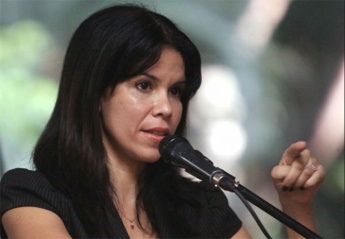 According to Ramirez, non-government organizations have been part of a campaign of “attacks” on Venezuela.
“A few NGOs have forged reports against our institution with false information,” Ramirez tweeted on Monday.
Since last month Venezuela has come under renewed criticism from international human rights monitors.
On 21 February, the United States based Human Rights Watch (HRW) accused Venezuelan security forces of using excessive force, while claiming it couldn’t find evidence of “anti-government protesters carrying firearms or using lethal force against security forces or third parties”.
Since February at least 29 people have been killed amid anti-government demonstrations and opposition violence. Among the dead are security forces and civilians who have been killed by firearms during clashes with the opposition.
The day before the HRW report was released, the brother of a socialist party (PSUV) deputy, Arturo Alexis Martinez was shot dead by a sniper. He was trying to clear an opposition barricade in Lara state when he was killed. On 24 February, motorbike taxi worker Antonio Jose Valbuena was shot by a masked individual in Maracaibo while clearing another opposition barricade. The alleged assailant reportedly demanded Valbuena desist from the attempt to clear the barricade. Since then assailants have shot at least two more civilians trying to clear opposition barricades.
Three national guard soldiers have also been shot dead during clashes with the opposition, including Giovanni Pantoja in Carabobo on 28 February, Acner Isaac Lopez Leon on 6 March in Caracas, Ramzor Bracho in Carabobo on 12 March and Jose Guillen Araque on 17 March.
According to Ramirez, misrepresentations of Venezuela by non-government organizations (NGOs) comes amid an anti-government social media campaign of misinformation.
Since February, photographs have circulated on social media websites including Twitter and Facebook of alleged cases of human rights violations by Venezuelan security forces. However, many of the photographs appear to be taken in countries as diverse as Syria, Chile and Egypt, but with inaccurate captions indicating they were taken in Venezuela.
HRW’s own report is accompanied by a photograph of what is claimed to be “a tank in San Cristobal”. The “tank”, was a statue that had been moved into the middle of the road and vandalized by opposition protesters.
Ramirez accused NGOs of being backed by the US State Department, which has also attacked Venezuela. In a report last month, the department leveled accusations against the Maduro government similar to those issued by HRW, while Secretary of State John Kerry has threatened possible “sanctions”.
Kerry’s comments have since been condemned by the Bolivarian Alliance of the Peoples of Our America (ALBA), along with the Venezuelan President Nicolas Maduro.
“The Miami lobby is taking measures to sanction Venezuela, but I tell you, you’ll be going down a road without return,” Maduro stated in response to Kerry.
Featured Video

Iran’s Next Strike May Not Explode. It Could Shut You Down
or go to
Aletho News Archives – Video-Images
From the Archive
Zionism’s Violent Legacy
By Donald Neff | Washington Report On Middle East Affairs | January 1996
On January 4, 1948, Jewish terrorists drove a truck loaded with explosives into the center of the all Arab city of Jaffa and detonated it, killing 26 and wounding around 100 Palestinian men, women and children.[1] The attack was the work of the Irgun Zvai Leumi – the “National Military Organization,” also known by the Hebrew letters Etzel – the largest Jewish terrorist group in Palestine. The Irgun was headed by Revisionist Zionist Menachem Begin and had been killing and maiming Arabs, Britons and even Jews for the previous ten years in its efforts to establish a Jewish state.
This terror campaign meant that at the core of Revisionist Zionism there existed a philosophical embrace of violence. … continue
Blog Roll
 Aletho News
- Saudi oil boss issues global supply warning
- Riyadh Says Its Oil System Is Intact. The Numbers Say Otherwise.
- Trump and Netanyahu Want to “Finish the Job” on Iran
- US ‘one-sided dictation’ not Iran’s beliefs makes rational talks impossible: Baghaei
- Iran’s Next Strike May Not Explode. It Could Shut You Down /Col Doug Macgregor
- Iran: US political targets legitimate if assassinations return
- Iraq shuts key border crossing with Iran under US pressure: Report
- Undersea Internet cables could be targeted in retaliation for attacks on Iran: IRGC deputy chief
- EU sending ‘biased’ observers to interfere in Serbian election – president
- White House envoy declares kinetic action against Yemen ‘fruitless’
- If Americans Knew
- Trump’s Intensifying Sabotage of the ICC, for Israel’s Sake
- Israeli military detain US and UK volunteers in West Bank including Democratic NY politician Brad Lander
- Americans at National Conservatism Conference held in Israel this year criticize Israel
- Christiane Amanpour exits CNN with a legacy shaped by the debate over Israel
- Israel’s war on Iran is the final move in a decades-old strategy
- Israel Denies Entry to French Journalist, U.S. Researcher Amid Rise in Entry Denials
- Gaza’s hospitals are running out of life-saving fuel – Daily Update
- Mysterious bot accounts reportedly spread fake ‘man on the street’ videos for Michigan Senate candidate
- Israeli Defense Minister Katz Says Over 60 Lebanon Villages Have Been Destroyed
- Why Is Israel Running TV Ads in Iowa Ahead of the Midterms?
- No Tricks Zone
- E-Cars Reduce CO2 Emissions By Only 41% Compared To Internal Combustion Engine Vehicles
- Predictions Made By Renowned Climate Professor Over Past Decades Have Been Proven To Be Poor
- New Study Suggests Large Regions Of The Pacific Ocean Have Been Cooling For The Last 80 Years
- Germany’s Green Energy Debacle: High Energy Costs Force Kahla Porzellan to Close After 182 Years!
- New Study: 50 Years Of The Most Aggressive ‘Net Zero’ Policies Can Only Affect The Global Climate By 0.03°C
- US September “Heat” Was No Record…Many Records Set Decades Ago
- Latest European Green Energy Debacle; Portugal’s Largest Flagship Solar Park Insolvent!
- Green Energy Debacle: German Expert Professor Fritz Vahrenholt Warns Of Severe Economic And Social Consequences
- Two More Paleo Reconstructions Affirm Meters-Higher Sea Levels Across Ireland, Brazil 7000-6000 Years Ago
- New Study: Earth And Venus Surface Warmth Largely Explained By Convection And Lapse Rate, Not CO2 Or Radiation


