BBC Helps Pave Road to War on Syria
News Unspun | May 8, 2013
The Syrian conflict has been accompanied by a distinct media narrative. Within this narrative – which poses a binary division between the forces engaged in the conflict, identifying the players as good (the rebels, who must receive ‘our’ support) and bad (the government) – the role the West must play is that of potential saviour, whose aim is to cautiously observe the conflict so that it may intervene to ‘fix’ the situation, as The Guardian’s Simon Tisdall put it:
So what can Obama do? As Vladimir Putin was expected to make plain to John Kerry in Moscow on Tuesday, he cannot count on Russian (or, therefore, Chinese or UN security council) support to fix Syria.
This sentiment, that the West can put right the Syrian situation, is inherent to most reporting of the conflict. The BBC recently reported that ‘the pressure to act has intensified in recent days after emerging evidence that Syria has used chemical weapons such as the nerve gas sarin’. This statement presents the existence of a ‘pressure to act’ as a given, though the source of such pressure is unidentified. From where is this pressure emerging? As a BBC report points out, public opinion in France, the UK, the US, and Germany is by majority opposed to the possibility of intervention in the conflict through sending arms and military supplies to the Syrian opposition. The BBC is not then speaking on behalf of the public majority. Pressure towards military intervention, to some extent considered a desirable option by the UK government (if it can ‘achieve the result [they] want’, as Cameron put it in an interview with Nick Robinson), is, however, increasingly mounting within the media itself.
Chemical Weapons ‘Evidence’
It is also important to note that the ’emerging evidence’ referred to above is not conclusive despite the wording of this report. The BBC reported again on Monday 6 May that ‘Western powers have said their own investigations have found evidence that government forces have used chemical weapons’. Again, this is simply not the case. ‘Western powers’, regardless of their true intentions, have in fact been very cautious in public about how precisely they present their claims, underscoring the lack of conclusive evidence they have found and that there exists the possibility that chemical weapons had been used by the Syrian government. This misrepresentation by the BBC emerges in a context in which the use of chemical weapons has been signified by the UK and US as the point at which they may become militarily involved in the Syrian conflict. As such these details, so easily misrepresented by the BBC, are of high consequence.
(There are other examples of BBC reports dangerously getting important facts wrong about such issues: just over a year ago, for example, a BBC news report stated that the ‘International Atomic Energy Agency (IAEA) released a report with new evidence showing Iran was secretly working towards obtaining a nuclear weapon’ – in this case the report said no such thing.)
Journalists Pushing for Intervention
In recent reports, certain BBC journalists have appeared more hawkish than government officials themselves. Take for example a question put to Cameron by the BBC’s Nick Robinson:
Do you ever fear that a terrible thing is happening in our world and that Western leaders cannot or will not act because of a fear of another Iraq?
Cameron responded with ‘I do worry about that’, before clarifying that what he has concluded from the ‘Iraq lesson’ is that the UK should only enter into conflicts it can win, that ‘the ability is there’. This is at a far remove from the implication of Robinson’s question that past ‘mistakes’ might prevent the West from playing a righteous humanitarian role. Yet Robinson’s leading question provides the basis for the seemingly unambiguous headline: ‘Cameron fears Iraq effect holding West back in Syria’.
There is a prevailing trend of journalists taking up the position of presenting the case for military intervention in Syria and proactively pushing government representatives to commit to intentions for military action. On the Andrew Marr show on 5 May Jeremy Vine asked Defence Secretary Phillip Hammond a number of questions which demonstrated this pressure by the media for the UK to become involved in the Syrian conflict. When Hammond appeared cautious regarding the prospect of military intervention, stating that the UK would need to engage in discussion with the UK’s ‘allies and partners’, Vine admonished, ‘you’re talking about having a series of meetings’. Another brief exchange emphasises Vine’s apparent desire to see the UK intervene:
Phillip Hammond: ‘Frankly that [the potential use of chemical weapons] is not what’s delivering the tally of 70,000 that have been killed… the majority of these people have been killed by conventional weapons’.
Jeremy Vine: ‘More reason to do something then…’
These comments reflect the consistency of BBC reporting which seems aimed towards creating a case for war. When Carla Del Ponte, of the UN’s Independent International Commission of Inquiry on Syria, told reporters that there were ‘strong, concrete suspicions’ that the rebels – perhaps not as virtuous as would be convenient for States considering providing military support – may have used chemical weapons, the tone of BBC reporting did not suggest that the pressure for military action should be alleviated.
Analysis of Attacks on Syria: Real and Imagined
Taking the case a step further, Jonathan Marcus, the BBC’s diplomatic correspondent, discussed the various ways in which the US could attack Syria. His assessment reads more like a military strategy report than an analysis of events for a news provider. Surgical airstrikes, Marcus said, ‘could be carried out by cruise missiles launched from aircraft well outside Syrian airspace or from warships or submarines in the Mediterranean’, while a wider air campaign, ‘might have to be preceded by a significant effort to destroy missiles, associated radars and command systems and might well involve losses’. Why it is in the public interest that such analysis is brought to us by journalists is unclear. Through Marcus’s piece, which is nothing more than speculation of military strategy on an as yet non-existent, illegal military intervention, the idea of an attack on Syria from outside is normalised further.
The reporting on the air strikes that Israel has carried out on Syria also reveals how normalised warfare has become in BBC reporting, with very little discussion of casualties or of the chaos inflicted on the people who were bombed. What was important, in this story, it seems, is that Israel was protecting itself from weapons that were supposedly being transported. This is summed up in the BBC’s Q&A page on the Israeli airstrikes: in answer to the question ‘Why would Israel attack?’ we are told that ‘the statements from unnamed officials suggest Israel’s actions are defensive.’ If the Syrian government had, for example, attacked the Israeli air force within Israel, to prevent airstrikes on its own territory, it is extremely unlikely that this would be overwhelmingly reported as an act of defence. Yet when Israel bombs another country, BBC journalists and editors happily report such actions as ‘defensive’ measures.
Jonathan Marcus writes that Israel’s airstrikes are ‘designed to send a powerful signal’ (the headline: ‘Israeli air strikes: A warning to Syria’s Assad’). It is worth at this point noting that following the last Israel attack on Syria, in early 2013, Marcus also wrote that this was ‘in one sense pre-emptive, but also a warning’. It was also portrayed as a ‘signal’. That such attacks are continuously reported as warnings and signals, as seemingly rational, and therefore it seems permissible, actions, goes further to normalise them. We might wonder how many attacks Israel would have to inflict on another country before Jonathan Marcus stops referring to the attacks as ‘signals’ and ‘warnings’?
In their seeming urgency to present a case for war, BBC reporters have neglected factual accuracy of reported events. Scepticism towards the unsupported claims of Western governments, insistence upon proof, is also lacking. We are presented with a simplified narrative, of ‘good versus evil’, in which the possibility of misconduct on both sides of the conflict is considered improbable. This style of reporting very much takes its lead from the positions of Western governments. Whitehouse spokesman Jay Carney outlined the position of the US: ‘We are highly sceptical of suggestions that the opposition could have or did use chemical weapons. We find it highly likely that any chemical weapon use that has taken place in Syria was done by the Assad regime, and that remains our position’. The supposed instincts of the US or UK government, despite the inconclusive nature of the evidence, as to the righteousness of the Syrian rebels is not proof of the reality and should not be considered by journalists as such.
Related article
What the NYT Doesn’t Say About Washington’s Syrian Peace Plan
By Michael McGehee | NYTX | May 9, 2013
On page A12 of the May 8, 2013 edition of The New York Times is Steven Lee Myers and Rick Gladstone’s article “U.S. and Russia Plan Conference Aimed at Ending Syrian War,” which opens by stating that, “Russia and the United States announced on Tuesday that they would seek to convene an international conference within weeks aimed at ending the civil war in Syria, jointly intensifying their diplomatic pressure on the combatants to peacefully settle a conflict that has taken more than 70,000 lives and left millions displaced and desperate.” This is a most welcoming turn of events, especially for the people of Syria who have taken the brunt of the civil war, and hopefully the conference bears fruit quickly.
But—and there is one of these stubborn conjunctions—it is important for the purpose of history to note that for two years now the United States has blocked any peaceful resolution, and has instead pushed the conflict further and deeper into violence and war.
It is Russia who has long pushed for a political reconciliation.
In October 2011 RIA Novosti reported that “Moscow calls on the UN Security Council to continue the search for a balanced approach toward the political crisis in Syria based on a draft resolution prepared by Russia and China, Russia’s envoy to the UN said,” with the phrase “balanced” being a jab at how Washington and its allies have put all the requirements on the Syrian government to end violence, and not the rebel forces whom they have been backing.
Writing in December of 2011, Egypt Independent reported that, “Deputy Russian Foreign Minister Sergey Ryabkov on Monday emphasized the need for dialogue and reconciliation in Syria.”
Even in December of 2012 Voice of America reported that, “Russian Foreign Minister Sergei Lavrov has echoed a call from an international peace envoy to resolve Syria’s civil war through a government-backed national dialogue and political process.”
The New York Times also reported on Russian efforts that same month when they informed readers that, “Moscow has made a muscular push for a political solution in recent days.”
While it is inaccurate to imply that Russia’s search for “a political solution” was “in recent days,” it is more disturbing that phrases like “muscular push” are used to describe such an effort, while the “paper of record” has routinely tried to make a case for war (see here and here).
A month ago today (May 8, 2013) the Syrian rebels detonated a car bomb near a school in Damascus, killing 14, and wounding dozens of others. According to Reuters, “State television said the explosion had occurred near a school in Sabaa Bahrat, a heavily populated area that also houses the Central Bank and the Finance Ministry. It said 53 people were wounded.”
Washington failed to condemn the act of terror.
Likewise when Daily Mail ran an article last December with this headline: “Syria rebels ‘beheaded a Christian and fed him to the dogs’ as fears grow over Islamist atrocities.” Apparently there is no “red line” for the rebels to cross.
And there are dozens and dozens of similar incidents. Not once has Washington put pressure on the rebels to stop their senseless violence, or argued for an international force to intervene and defend the Syrian people from the terrorists. Nor have Western establishment pundits like Bill Keller argued for such things. And even though al Qaeda is active in the country, beheading so-called infidels, or that the Syrian rebels are likely using chemical weapons, Washington and its media parrots have instead favored escalation. Just over a week ago The New York Times reported that “The White House is once again considering supplying weapons to Syria’s armed opposition.” This comes after the car bombing across the street from a children’s school.
And now Washington wants peace, as Myers and Gladstone tell us that “The announcement appeared to signal a strong desire by both countries to halt what has been a dangerous escalation in the conflict.”
Perhaps it has become clear that the rebels cannot win this war on their own, and the only reasonable way Bashar Assad will be brought down is another U.S. war which will elevate the jihadis into power. Perhaps President Obama is imagining one of these rebel jihadis attacking an American embassy in Damascus, and the Republicans foaming at the mouth for another politicized inquiry into how such an attack could happen, as they currently are over the embassy attack in Benghazi, Libya last year.
Whatever the reasons for the turnaround it is gladly welcomed. The people of Syria deserve a rescue from the terror Washington, Turkey, Saudi Arabia, Qatar, and others, have unleashed on them. Though we should remain sober and note that the “conflict that has taken more than 70,000 lives and left millions displaced and desperate” is largely of Washington’s doings, and could have been avoided years ago if Uncle Sam followed the lead of Moscow and Bejing, both of whom had the “strong desire . . . to halt what has been a dangerous escalation in the conflict.”
We should also recall that The New York Times derided Russia for their “strong desire” and even went so far as to equate it with “effectively toss[ing] a life preserver to President Bashar al-Assad, seemingly unwilling to see a pivotal ally and once stalwart member of the socialist bloc sink beneath the waves of the Arab Spring.” Russia was just as clear then as they are now: they did not want to go along with efforts that would worsen the situation, but now that the situation has gotten considerably worse, and Washington is warming to the idea of a political solution, now The New York Times is presenting this as a positive development.
The New York Times on Venezuela and Honduras: A Case of Journalistic Misconduct
By Keane Bhatt | NACLA | May 8 2013
The day after Venezuelan President Hugo Chávez died, New York Times reporter Lizette Alvarez provided a sympathetic portrayal of “outpourings of raucous celebration and, to many, cautious optimism for the future” in Miami-Dade County, Florida. Her article, “Venezuelan Expatriates See a Reason to Celebrate,” noted that many had come to Miami to escape Chávez’s “iron grip on the nation,” and quoted a Venezuelan computer software consultant who said, bluntly: “We had a dictator. There were no laws, no justice.”1
A credulous reader of Alvarez’s report would have no idea that since 1998, Chávez had triumphed in 14 of 15 elections or referenda, all of which were deemed free and fair by international monitors. Chávez’s most recent reelection, won by an 11-point margin, boasted an 81% participation rate; former president Jimmy Carter described the “election process in Venezuela” as “the best in the world” out of 92 cases that the Carter Center had evaluated (an endorsement that, to date, has never been reported by the Times).2
In contrast to Alvarez, who allowed her quotation describing Chávez as a dictator to stand uncontested, Times reporter Neela Banerjee in 2008 cited false accusations hurled at President Obama by opponents—“he is a Muslim who attended a madrassa in Indonesia as a boy and was sworn into office on the Koran”—but immediately invalidated them: “In fact, he is a Christian who was sworn in on a Bible,” she wrote in her next sentence.3 At the Times, it seems, facts are deployed on a case-by-case basis.
The Times editorial board was even more dishonest in the wake of Chávez’s death: “The Bush administration badly damaged Washington’s reputation throughout Latin America when it unwisely blessed a failed 2002 military coup attempt against Mr. Chávez,” wrote the paper, concealing its editorial board’s own role in blessing that very coup at the time. In 2002, with the “resignation [sic] of President Hugo Chávez, Venezuelan democracy is no longer threatened by a would-be dictator,” declared a Times editorial, bizarrely adding that “Washington never publicly demonized Mr. Chávez,” that actual dictator Pedro Carmona was simply “a respected business leader,” and that the U.S.-backed, two-day coup was “a purely Venezuelan affair.”4
The editorial board—an initial champion of the de facto regime that issued a diktat within hours to dissolve practically every branch of government, including Venezuela’s National Assembly and Supreme Court—would 11 years later brazenly criticize Chávez after his death for having “dominated Venezuelan politics for 14 years with authoritarian methods.” The newspaper argued that Chávez’s government “weakened judicial independence, intimidated political opponents and human rights defenders, and ignored rampant, and often deadly, violence by the police and prison guards.” After lambasting Chávez’s record, the piece concluded that the United States “should now make clear its support for democratic and civilian transition in a post-Chávez Venezuela”—as if Chávez were anyone other than a fairly elected leader with an overwhelming popular mandate.
But there is a country currently in the grip of an undemocratic, illegitimate government that much more closely corresponds with the Times editorial board’s depiction of Venezuela: Honduras, which in 2009 suffered a coup d’état that deposed its freely elected, left-leaning president, Manuel Zelaya.
While the Times criticized Chávez for weakening judicial independence, the newspaper could not be bothered to even report on the extraordinary institutional breakdown of Honduras, when in December 2012, its Congress illegally sacked four Supreme Court justices who voted against a law proposed by the president, Porfirio Lobo, who himself had came to power in 2009 in repressive, sham elections held under a post-coup military dictatorship and boycotted by most international election observers.
When it comes to intimidation of political opponents and human rights defenders, Venezuela’s problems are almost imperceptible compared with those of Honduras. Over 14 years under Chávez, Venezuela has had no record of disappearances or murders of such individuals. In post-coup Honduras, the practice is now endemic. In one year alone—2012—at least four leaders of the Zelaya-organized opposition party Libre were slain, including mayoral candidate Edgardo Adalid Motiño. In addition, two dozen journalists and 70 members of the LGBT community have been killed since the coup, including prominent LGBT anti-coup activists like Walter Tróchez and Erick Martinez (neither case was sufficiently notable so as to warrant a mention in the Times).
And although the Times editors decried police violence in Venezuela, the Honduran police systematically engage in extrajudicial killings of their own citizens. In December 2012, Julieta Castellanos, the chancellor of Honduras’s largest university, presented the findings of a report detailing 149 killings committed by the Honduran National Police over the past two years under Porfirio Lobo. In the face of over six killings by the police a month, she warned, “It is alarming that the police themselves are the ones killing people in this country. The public is in a state of defenselessness…”5 Such alarm is further justified by Lobo’s appointment of Juan Carlos “El Tigre” Bonilla as director of the National Police, despite reports that he once oversaw death squads.6
Finally, the Times editorial board lamented Venezuelan prison violence. But consider for context that the NGO Venezuelan Prisons Observatory, consistently critical of Chávez, reported 591 prison deaths in 2012 for the country of 30 million.7 In Honduras, a country with slightly more than a quarter of Venezuela’s population, over 360 died in just one incident—a 2012 prison fire in Comayagua, in which prison authorities kept firefighters from handling the conflagration for 30 crucial minutes while the inmates’ doors remained locked. According to survivors, the guards ignored their pleas for help as many burned alive.8
Given the contrast in the two countries’ democratic credentials and human rights records, obvious questions arise: How has The New York Times portrayed Venezuela and Honduras since Honduras’s 2009 coup d’état? If, in both its news and opinion pages, the Times regularly prints accusations of Venezuelan authoritarianism, what terminology has the Times employed to describe the military government headed by Roberto Micheletti, which assumed power after Zelaya’s overthrow, or the illegitimate Lobo administration that succeeded it?
The answer is revealing. For almost four years, the Times has maintained a double standard that is literally unfailing. Not a single contributor in the Times’ over 100 news and opinion articles has ever referred to the Honduran government as “autocratic,” “undemocratic,” or “authoritarian.” Nor have Times writers ever once labeled Micheletti or Lobo “despots,” “tyrants,” “strongmen,” “dictators,” or “caudillos.”
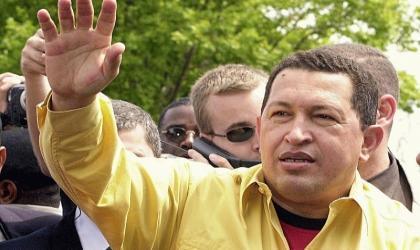 At the same time, from June 28, 2009, to March 7, 2013, the newspaper has printed at least 15 news and opinion articles in which its contributors have used any number of the aforementioned epithets for Chávez.9 (This methodology excludes the typically vitriolic anti-Chávez blog entries that the paper features on its website, as well as print pieces like Lizette Alvarez’s, which quote someone describing Chávez as a dictator.)
During this period, the paper’s news reporters themselves have referred to Chávez as a “despot,” an “authoritarian ruler,” and an “autocrat”; its opinion writers have deemed him a “petro-dictator,” an “indomitable strongman,” a “brutal neo-authoritarian,” a “warmonger,” and a “colonel-turned-oil-sultan.” On the eve of Venezuela’s October elections, a Times op-ed managed to call the Chávez administration “authoritarian” no fewer than three times in 800 words.10 And Chávez’s death offered no reprieve from this tendency: On March 6, reporter Simon Romero wrote about Chávez’s gait—he “strutt[ed] like the strongman in a caudillo novel”—and concluded that Chávez had “become, indeed, a caudillo.”11
These most basic violations of journalistic standards—referring to a democratically elected leader as a ruler with absolute power—does not simply end with its writers. On July 24, 2011, Bill Keller, then the newspaper’s executive editor, wrote the piece, “Why Tyrants Love the Murdoch Scandal,” which included a graphic of Zimbabwe’s Robert Mugabe side by side with Chávez. Keller referred to them both when he concluded, “Autocrats will be autocrats.”12
But if despotism, defined as the cruel and oppressive exercise of absolute power, is to have any meaning, it must apply to the Honduran government, whose military—not just its police—routinely kills innocent civilians. On May 26, 2012, for example, Honduran special forces killed 15-year-old Ebed Yanez, and high-level officers allegedly managed its cover-up by dispatching “six to eight masked soldiers in dark uniforms” to the teenager’s body, poking it with rifles, and “[picking] up the empty bullet casings” to conceal evidence that could be linked back to the military, according to the Associated Press.13
The paradox of the Times—its derisive posture toward what it considers antidemocratic tendencies in Venezuela as it simultaneously avoids the same treatment of Honduras’s inarguable repression—can only be explained by one crucial factor: Honduras has been a firm U.S. ally since Zelaya’s overthrow.
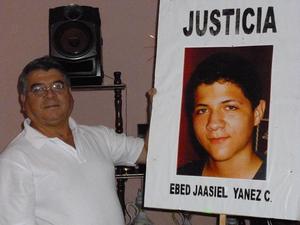
Photo Credit: SOA Watch
In fact, the unit accused of killing Yanez was armed, trained, and vetted by the United States—even its trucks were donated by the U.S. government. As the AP further reported, in 2012, the U.S. Defense Department appropriated $67.4 million for Honduran military contracts, with an additional “$89 million in annual spending to maintain Joint Task Force Bravo, a 600-member U.S. unit based at Soto Cano Air Base.” Furthermore, “neither the State Department nor the Pentagon could provide details explaining a 2011 $1.3 billion authorization for exports of military electronics to Honduras.”14
The Times’ scrupulous, unerring record of avoiding disparaging characterizations of Honduras’s human-rights-violating government may explain why it has never once made reference to 94 Congress members’ demand that the Obama administration withhold U.S. assistance to the Honduran military and police in March 2012. Nor has the paper reported on 84 Congress members’ letter to Secretary of State Hillary Clinton later that year, condemning Honduras’s “institutional breakdown” and “judicial impunity.”15
When evaluating the newspaper’s relative silence on Honduras, it is worth imagining if Chávez were to have ascended to power in as dubious a manner as Lobo; if for years Venezuela’s government permitted its security apparatus to regularly kill civilians; or if the Chávez administration presided over conditions of impunity under which political opponents and human rights activists were disappeared, tortured, and killed.
As a careful examination of the language and coverage of nearly four years of New York Times articles reveals, concern for freedom and democracy in Latin America has not been an honest concern for the liberal media institution. The paper’s unwavering conformity to the posture of the U.S. State Department—consistently vilifying an official U.S. enemy while systematically downplaying the crimes of a U.S. ally—shows that its foremost priority is to subordinate itself to the priorities of Washington.
1. Lizette Alvarez, ““Venezuelan Expatriates See a Reason to Celebrate,” The New York Times, March 6, 2013.
2. Keane Bhatt, “A Hall of Shame for Venezuelan Elections Coverage,” Manufacturing Contempt (blog), nacla.org, October 8, 2012.
3. Neela Banerjee, “Obama Walks a Difficult Path as He Courts Jewish Voters,” The New York Times, March 1, 2008.
4. “Hugo Chávez Departs,” The New York Times, April 13, 2002.
5. “Policías de Honduras, Responsables de 149 Muertes Violentas,” La Prensa, December 3, 2012.
6. Katherine Corcoran and Martha Mendoza, “Juan Carlos Bonilla Valladares, Honduras Police Chief, Investigated In Killing,” Associated Press, June 1, 2012.
7. Fabiola Sánchez, “Venezuela Prison Deaths: 591 Detainees Killed Country’s Jails Last Year,” Associated Press, January 31, 2013.
8. “Hundreds Killed in ‘Hellish’ Fire at Prison in Honduras,” Associated Press, February 16, 2012.
9. Author’s research, using LexisNexis database searches for identical terms in reference to the two countries. For a detailed list of examples, contact him at keane.l.bhatt@gmail.com.
10. Francisco Toro, “How Hugo Chávez Became Irrelevant,” The New York Times, October 6, 2012.
11. Simon Romero, “Hugo Chávez, Leader Who Transformed Venezuela, Dies at 58,” The New York Times, March 6, 2013.
12. Bill Keller, “Why Tyrants Love the Murdoch Scandal,” The New York Times Magazine, July 24, 2011.
13. Alberto Arce, “Dad Seeks Justice for Slain Son in Broken Honduras,” Associated Press, November 12, 2012.
14. Martha Mendoza, “US Military Expands Its Drug War in Latin America,” Associated Press, February 3, 2013.
15. Office of Representative Jan Schakowsky, “94 House Members Send Letter to Secretary Clinton Calling for Suspension of Assistance to Honduras,” March 13, 2012. Correspondence from Jared Polis et al. to Secretary of State Hillary Clinton, June 26, 2012.
Related articles
- U.S. Seeks to Get Rid of Left Governments in Latin America (alethonews.wordpress.com)
- The New Yorker Should Ignore Jon Lee Anderson and Issue a Correction on Venezuela (alethonews.wordpress.com)
- The New Yorker Corrects Two Errors on Venezuela, Refuses a Third (alethonews.wordpress.com)
- Nicolas Maduro did not Steal the Venezuelan Elections (venezuelanalysis.com)
- Honduras: Murdered Lawyer’s Brother Killed in Aguán (alethonews.wordpress.com)
- NPR Examines One Side of Honduran “Model Cities” Debate (alethonews.wordpress.com)
- IMF Ignores Proven Alternatives With Recommendations to Honduras (alethonews.wordpress.com)
- Killings Continue in Bajo Aguán as New Report Documents Abuses by U.S.-Trained Honduran Special Forces Unit (alethonews.wordpress.com)
- Honduras: Miguel Facusse is Tragically Misunderstood (alethonews.wordpress.com)
Private Bank Profits Don’t Represent the Health of the Economy
By Arthur Phillips | CEPR | May 8, 2013
Bloomberg’s Nathan Gill wrote a particularly one-sided article on Thursday, in which he states that “Ecuador’s bid to reduce poverty by taxing its banks is threatening to deepen the nation’s economic slump.”
“Slump” seems somewhat dire to describe the state of the Ecuadorian economy. In 2012 the economy grew by 5 percent, and it is projected to grow by 4.45 percent for 2013.
The report also offers no convincing evidence that Ecuador’s taxation of its banks is hurting the economy.
The article specifically focuses on a set of reforms that took effect on January 1, including the elimination of banks’ tax deductions for reinvested profits and a 0.35 percent tax on assets held abroad. The reporter argues that a sharp drop in bank profits in the first quarter of this year was a result of the taxation. He then argues that an increase in the banks’ interest rates must also be due to the reforms:
Non-government banks, including Citigroup Inc (C).’s local unit, raised rates on corporate loans by an average 0.21 percentage point in the first quarter to 8.88 percent, the highest since November 2010, according to central bank data. That compares with a decline of 0.72 percentage point to 8.81 percent in Colombia and an increase of 0.01 percentage point to 5.79 percent for similar loans in Peru.
However, this causality is not at all clear. It is more likely that this modest increase in interest rates is attributable to a recent uptick in inflation. Consumer prices increased at an annualized rate of 4.6 percent in the first quarter of this year, as compared to a rate of 0.2 percent in the last quarter of last year.
The reforms that increased taxes on the banks were reportedly enacted to pay for increasing cash subsidies for the country’s poor, and they were passed by congress in a 79-5 vote. Gill describes these changes as having been motivated by an election race that Correa was all but certain to win, rather than being the latest step in a determined and so-far successful process to transform a country that, like many in the hemisphere, has been historically plagued by inequality. It is perhaps worth noting that Ecuador has seen some of the region’s highest growth over the past few years. Furthermore, economic gains have been broadly shared and increased social spending has significantly improved the quality of life of a broad portion of the country’s citizens.
As CEPR’s recent report on Ecuador’s financial reforms describes, President Rafael Correa’s actions in recent years are a major reason why the government has raised revenue and consequently been able to pursue expansionary fiscal policy and increased social spending. The results of this policy regime have included the lowest unemployment rate on record, a near-halving of the poverty rate, and a doubling of education funding, among other gains.
Yet, from this article, one would be led to believe that new taxes on the financial sector have only led to lower bank profits, which are presented as a serious problem for the country’s macroeconomic outlook. Among Gill’s quoted sources are the CEO of Ecuador’s biggest brokerage firm, the director of a market research and consulting firm, and the president of the country’s Private Banking Association. Their views should come as no surprise, but they are not necessarily the full picture or even accurate.
The article (on the second page) also quotes Pedro Solines, Ecuador’s banking superintendent, as saying “Less profits for the banks, yes, but where does it go? To the people who receive the subsidy.” The quote continues with Solines saying, “If I receive the subsidy, I’m going to say that the impact is very good. If I run a shop where the person who receives the subsidy spends not $35 but $50, I’m going to say it’s good. If I’m a bank, I’m going to say I’m doing badly.”
Correa was re-elected on February 17, receiving 57 percent of the vote compared to his closest competitor’s 23 percent.
Related article
- Ecuador begins to roar | Fander Falconi (guardian.co.uk)
This story is true; the facts have been fabricated to keep the false flag flying
By Greg Felton | Aletho News | May 9, 2013
For decades, pretentious wonks have declared that we live in “The Information Age,” as if information were a commodity unique to our time. Inanity aside, the claim is patently false, notwithstanding the advent of computers and virtually instant communication.
We do not live in an “Information Age” because “information” connotes data that is beneficial and objectively valid. Information can help solve problems, educate, and generally improve life. This was true of written language, movable type, the radio and the telephone, but look around today—do you see problems being solved, people becoming smarter, or life getting better? I thought not.
A more accurate expression for our time is “The Disinformation Age.” Though it is also not unique to our time, it at least captures the pervasive abuse of information that has made our society the opposite of an “informed” rational society: dissent is a subversive act; citizens are enemies of the state; the media conceal evidence; and the police enforce police-state edicts.
If these dystopian qualities were the basis for a movie or TV show, we could take comfort in the knowledge that justice would eventually prevail.
We’d be able to cheer for a rebellious anti-hero like John Connor (Terminator series), Det. Del Spooner (I, Robot), or Insp. Harry Callaghan (Dirty Harry series) to bring down the system. We would see detectives or scientists analyzing evidence (Columbo, CSI: Crime Scene Investigation, Bones) instead of destroying or ignoring it. We might be treated to the sight of the police treating a suspect humanely and reading him his rights (Kojak, Hill Street Blues, Dragnet). We might even see a dogged investigator exposing a cover up or government corruption (All The President’s Men, Erin Brockovich), instead of scheming to keep it hidden from the public.
This world of scripted entertainment, unreal though it may be, is able to depict healthy relationships between authorities and the truth, and between authorities and citizens. Such shows do not depict an idealized future; they give us fading afterimages of our society before the Military-Israel Complex and neo-conservative sociopaths gave us the “War on Terrorism” and declared justice obsolete. Here’s how the Boston Marathon bombing was scripted to serve the expanding surveillance state and stoke the “War on Terrorism.”
• Stage a lethal attack against a civilian U.S. target;
• Blame Arabs or some other Middle Eastern-looking types for the crime;
• Have FBI agents in place to ensure containment and control of the investigation;
• Justify their existence by having a “bomb drill” going on at the same time;
• Keep the public ignorant of the drill;
• Make sure the scapegoats are killed or otherwise kept away from the media;
• Stage conspicuous displays of gratitude for police agencies to reinforce the illusion that they are needed to fight “terrorism”; and
• Ensure that evidence is ignored or destroyed, and dissenting voices are harassed into submission so that the pre-established cover story can be marketed to a gullible public.
Like the 2001World Trade Centre Attack, which followed the same basic script although on a much larger scale, the Boston Marathon bombing story has come completely unraveled. Every couple of days it seems that some other detail comes out that demands to be investigated:
• No credible motive was ever given for the Tamerlan and Dzhokhar Tsarnaerv to have made the bombs.
• The FBI failed to disclose knowing the brothers; the agency had had a relationship with them going back at least two years.
• The FBI had to know them because the boys’ uncle Ruslan Tsarni (formerly Tsarnaev) is an ex-contractor for Halliburton, and was married to the daughter of Graham Fuller, a former vice chairman of the National Intelligence Council at the CIA and senior political scientist at RAND.
• Boston Police claim Dzhokhar Tsarnaev was shot in a gunfight, but video footage shows that he was unarmed.
• Dzhokhar was accused of leaving his bomb-laden backpack at the race, but a surveillance pic clearly shows him leaving with it.
• No explanation was given for the sudden appearance of Israeli police who just happened to be there to lend assistance.
• The public was not told that several members of a private security kill squad were on site.
This last omission, combined with the FBI’s immediate refusal to consider other suspects, clearly suggests a false-flag scenario. The following table identifies this kill squad.
Are these the Marathon bombers?

Click here for downloadable pdf enlargement.
To date, no news agency will touch this angle, even though these and other pics have been available on the Internet for weeks. Nevertheless, New Hampshire State Senator Sheila Tremblay correctly said that a black ops team was behind the bombing and even cast doubt on the claims of injury since one amputee did not look as if he were in pain. This was undoubtedly true because many of the amputees were paid actors who had already lost their limbs. Tremblay was pressured into issuing a political apology.
If this were part of a movie script, I guarantee there would be a crusading detective or journalist examining the evidence, interviewing people like Tremblay honestly, and asking intelligent questions like:
What was Craft International doing at the Marathon?
Why were they even needed?
How many Craft mercenaries were on site?
Who hired them—FBI, DHS, Boston police?
Why were amputee actors in the crowd, and who hired them?
What are the names of the two agents in pic #1?
Have these agents been interviewed regarding the missing backpack?
Has anyone proved that the exploded backpack even belonged to the Tsarnaev brothers?
 For an excellent example of how justice triumphs over police corruption in the world of entertainment, the 1997 movie L.A. Confidential has thematic elements in common with the Boston bombing. [CAUTION SPOILER ALERT]
The film, centres around the culture of violence and corruption that pervades the L.A. Police Department in the 1950s. The catalyzing event is a multiple murder that takes place late one night in a seedy diner. A car belonging to “three negroes” was seen in the area at the time, and so the precinct captain makes them the sole focus of police inquiries.
Under interrogation, a career-minded but idealistic lieutenant realizes the story doesn’t wash, and starts looking for answers. He finds unlikely support from a thuggish officer and a sergeant who works on a TV show.
If you’re wondering what an honest investigation into the Boston Marathon bombing might have looked like, here are a few scenes for your entertainment. Shows like this accurately reflect our police-state but they can inure us to disinformation. This kind of entertainment has to be seen not as a comforting, nostalgic escape, but the basis for a new reality script since the one we have is transparently indefensible.
Related articles
- FBI’s Track Record On Creating Terrorism Destroys The Official Boston Marathon Bombing Narrative
- Boston Bombing investigation will mirror the Oklahoma City Bombing cover-up
- Israeli police head to US to aid in Boston Marathon bombing investigation
- Industry: biometrics business valued at $10 billion by 2018
- Rahm Emanuel Stresses Value Of Surviellance Cameras In Probe Of Boston Bombings
- Expanding Security State
‘Amnesty Int’l whitewashing war for US’
Press TV – May 8, 2013
London-based human rights group Amnesty International has got a bashing from anti-war initiative RootsAction that says Amnesty is applying double standards on human rights and war with a bias in favor of the US-led military interventions.
RootsAction has launched an online petition saying Amnesty is reporting a one-sided story from Syria, refusing to make any mention of the Syrian anti-government terrorists’ crimes apparently because they are backed by the US and its allies.
“We are concerned that you seem to have forgotten to oppose all violations of human rights — by all sides — in war,” the online petition read.
“You are highlighting war-making in Syria’s civil war by one side only. This one-sided treatment by a group avowedly dedicated to all human rights is fueling the fires of a wider war from which the people of Syria can only suffer,” it added.
The group called on Amnesty to report all instances of human rights violations in the conflicts and avoid whitewashing the situation in favor of the US.
“We urge you to assertively expose and condemn all wartime violations of human rights — without downplaying or ignoring the violations committed by the U.S. government and its allies,” it said.
Amnesty has a record of making things easier for the US.
It promoted the false reports that the Iraqi soldiers removed 312 babies from their incubators and left them to die on the fold hospital floors of Kuwait city before the Persian Gulf war in 1991.
Recently, it has been also campaigning to pretend the US-led invasion of Afghanistan had to do with upholding women’s rights.
The group has, however, refused to condemn the killing of civilians by the US and its allies in Iraq, Afghanistan or Libya.
Related article
- A Contender for Dumbest Statement Ever by Amnesty USA? (alethonews.wordpress.com)
NYT on Chemical Weapons and War in Syria
By Michael McGehee | NYTX | May 6, 2013
“We have been very clear to the Assad regime but also to other players on the ground that a red line for us is, we start seeing a whole bunch of weapons moving around or being utilized.” — Obama Threatens Force Against Syria, The New York Times, August 21, 2012
When President Obama spoke these words last August he might have dug himself a hole twice as deep as the one he was in last week.
As four NYT journalists reported on Sunday’s front page article “Off-the-Cuff Obama Line Put U.S. in Bind on Syria”: “Confronted with evidence that chemical weapons have been used in Syria, President Obama now finds himself in a geopolitical box, his credibility at stake with frustratingly few good options.”
If there will be any effort to hold Mr. Obama’s feet to the fire the heat just got hotter.
Buried on page A9 of Monday’s edition of “the paper of record” was a statement by Carla del Ponte, a United Nations human rights investigator looking into the claims that chemical weapons were used in Syria:
The United Nations independent commission of inquiry on Syria has not yet seen evidence of government forces using chemical weapons, which are banned under international law, said Carla Del Ponte, a commission member.
“Our investigators have been in neighboring countries interviewing victims, doctors and field hospitals,” Ms. Del Ponte said in an interview with Swiss-Italian television. “According to their report of last week, which I have seen, there are strong, concrete suspicions but not yet incontrovertible proof of the use of sarin gas, from the way the victims were treated.”
“This was use on the part of the opposition, the rebels, not by the government authorities,” she added, speaking in Italian.
Question: Will President Obama hold the rebels accountable for crossing his red line?
In his own words he did say that he has “been very clear to the Assad regime but also to other players on the ground” [emphasis added] that the use of chemical weapons is a red line that even the Times saw last summer as a threat of force.
The question is not likely to be answered in the affirmative. This is the politics of war. For more than two years the rebels have been carrying out terrorist bombings, grisly executions, and other assorted attacks that would likely have had Washington and its allies foaming at the mouths were it the Assad regime who was the perpetrator.
Washington has failed to join the Syrian government in their own War on Terror, even though al Qaeda is active in the country. And it just goes to show as one more example: when al Qaeda is used as a boogeyman for war we should not take the pretext seriously, as in the case of Mali. If al Qaeda is on the same side as Uncle Sam, as they were in Afghanistan in the 1980s, the Balkans in the 1990s, Libya in 2011, and now Syria, then there will be no drone attacks on the terrorists.
And now we see al Qaeda-linked terrorists suspected of using chemical weapons. Don’t look for the U.S. to come to the defense of the Syrian government.
Already we can see the change of attitude reflected at The New York Times.
Not two weeks ago, on April 26, 2013, it was front page news at the NYT that “White House Says It Believes Syria Has Used Chemical Arms.”
From that moment the story became a sensation. It fit well into the parameters of the propaganda system. An official enemy who we are actively trying to overthrow may have used chemical weapons and provided a clear pretext for force. Here comes the march to war.
But when UN investigators looked into the matter and reported that “Syrian Rebels May Have Used Sarin,” the story fell from grace and was pushed to page A9.
This differential treatment signals the death of the “red line” story, which is too bad because it would have been interesting to see The New York Times, or anyone in the mainstream media, investigate how Syrian rebels could have gotten a hold of sarin, especially considering a former Bush official has openly considered the idea of Israel being behind the attack.
The differential treatment may possibly throw a wrench in the drive to war . . . for now. Because, also on page A9 of Monday’s edition of The New York Times is “Attacks on Syria Fuel Debate Over U.S.-Led Airstrikes,” a report of an Israeli attack in Syria:
WASHINGTON — The apparent ease with which Israel struck missile sites and, by Syrian accounts, a major military research center near Damascus in recent days has stoked debate in Washington about whether American-led airstrikes are the logical next step to cripple President Bashar al-Assad’s ability to counter the rebel forces or use chemical weapons.
That option was already being debated in secret by the United States, Britain and France in the days leading to the Israeli strikes, according to American and foreign officials involved in the discussions. On Sunday, Senator John McCain, who has long advocated a much deeper American role in the Syrian civil war, argued that the Israeli attacks, at least one of which appears to have been launched from outside Syrian airspace, weakens the argument that Syria’s air defense system would be a major challenge.
“The Israelis seem to be able to penetrate it fairly easily,” Mr. McCain said on “Fox News Sunday.”
While attacks in Syria might be easier than previously suspected, the justifications for war received a setback. But if history is any guide this is only a minor and temporary one.
BBC broadcaster admits sex assaults on children
Press TV – May 2, 2013
Former BBC broadcaster Stuart Hall has admitted assaulting 13 girls as young as nine years old between 1967 and 1986.
The former It’s A Knockout presenter was branded as an “opportunistic predator” by prosecutors after admitting he had carried out a series of attacks on girls, from whom the youngest aged just nine.
The 83-year-old, however, had previously denied the allegations against him, saying the charges were “pernicious, callous” and “cruel”.
Hall entered the guilty pleas last month at Preston Crown Court but they can only be revealed now after reporting restrictions were lifted.
Nazir Afzal, the Chief Crown Prosecutor for the Crown Prosecution Service (CPS) in the North West said no explanations could be offered for Hall’s unlawful behavior.
Hall’s confession was another blow to the British state-run broadcaster BBC, which recently came under pressure over sexual abuse allegations involving former broadcaster Jimmy Savile.
The investigation into Savile scandal has been running since late October. Since that time, Scotland Yard has been contacted by more than 500 alleged victims.
Related article
The Daily Beast Takes the Bait on Anti-Iran Propaganda
By Nima Shirazi | Wide Asleep in America | May 1, 2013
Over at The Daily Beast‘s Cheat Sheet, which serves as a news aggregator, a post went up today with the eye-catching headline: “Iranian President Ahmadinejad Arrested.”
The blurb accompanying the post claims:
Iranian President Mahmoud Ahmadinejad was arrested Monday while on a visit to a book fair in Tehran, where he was held for seven hours and questioned by the Revolutionary Guards’ intelligence unit. According to a source within the guards’ unit, Ahmadinejad was intercepted while on his way to a meeting at the supreme leader’s office. His security team was stripped of communication devices and Ahmadinejad was questioned about documents that may be detrimental to the regime. He was warned, essentially, to keep his mouth shut about all matters that could harm the regime going into the upcoming presidential election.
How positively scandalous! The infamous Iranian bogeyman, along with his entourage, accosted, interrogated, threatened and silenced by the very security forces the hysterical Western media and political pundits would have you believe he himself commands and wields with an iron fist!
At the bottom of its short post, the Beast sources the information to The Guardian and links to the original article. But following the link, something doesn’t feel right. Or look right.
Because it isn’t right.
The link leads to a site called “The Guardian Express” at the URL guardianlv.com. ‘Hey, what’s the “lv” stand for?,’ one might ask if one cared about such things as accuracy. It stands for “Las Vegas,” because the website is actually a local community news forum in Nevada, not the prestigious British news outlet.
The article found on “The Guardian Express” site – posted by a forum member who goes by the moniker “randy77” – is a nearly completely plagiarized story stolen from the latest piece of nonsense published Tuesday by the pseudonymous neocon darling “Reza Kahlili,” a serial liar and propagandist beloved by the Bomb Iran crowd who wears a surgical mask in public for absolutely no reason. “Kahlili” claims he is a former CIA agent who infiltrated the highest echelons of the Iranian intelligence apparatus and apparently some people believe him. He may also be a San Francisco Giants fan, but that might actually be a clever ruse to throw the pursuing mullahs off his trail.
 |
| Yes, he does this. |
“Kahlili” is a regime change enthusiast who wants Iran attacked by the United States and Israel yesterday. He consistently publishes scoops on the right-wing loony-toon website WorldNetDaily that contain no factual information, save that a country called Iran does actually exist.
A few years ago he insisted that there is “no doubt” the Iranian government is “going to commit the most horrendous suicide bombing in human history. They will attack Israel, European capitals and the Persian Gulf region at the same time, then they will hide in a bunker [until a religious prophecy is fulfilled]… and kill the rest of the nonbelievers.” He also said Iran had already enriched uranium to 90%, that is, weapons-grade, and that “they have missiles that they have not publicly shown, because that would verify their intention of carrying out nuclear warheads,” whatever that means.
He’s also warned of an “Iranian dominated worldwide terror network that now reaches the United States” and said that the Iranian government has planted sleeper cells in the U.S. that are ready to strike if Iran is attacked. Impending terrorist acts carried out in the United States by Iranian agents is a recurring theme in his creative writing.
Wondering about “Kahlili”‘s bona fides and impressive associates? “I thought I knew a lot about Iran until meeting with him,” admitted racist Islamophobe Peter King, who is also somehow a U.S. Congressman. He was a featured guest of the AIPAC-affiliated Washington Institute on Near East Policy in 2010. This insane interview with leading lunatic Pam Geller might also be useful.
In 2011, “Kahlili” claimed both that Iran was planning an EMP attack on the United States and wrote, “Not only does the Islamic Republic already have nuclear weapons from the old Soviet Union, but it has enough enriched uranium for more. What’s worse, it has a delivery system,” because, hey why not?
He likes suggesting that the Iranian government is both messianic and genocidal, that it’s planning to “annihilate the Jews” and wage an apocalyptic war to hasten the end times. Last fall he declared that “a three-person delegation of the Obama administration led by a woman engaged in secret negotiations with a representative of Iranian Supreme Leader Ayatollah Ali Khamenei,” and cut a sanctions-alleviating deal before the 2012 presidential election.
Earlier this year, “Kahlili” repeated the claim that Iran had “successfully… built a nuclear bomb with the help of Russia and North Korea and has enough weapons-grade uranium and plutonium for more.” Soon thereafter, he pretended that there had been a massive explosion at the Iranian enrichment facility at Fordo, even though it wasn’t true.
Just a couple months later, however, he claimed his super secret sources revealed that “Iranian scientists are working on nuclear warheads – and trying to perfect them – at an underground site unknown to the West,” adding that Iran had, as yet, only “succeeded in enriching uranium to 20 percent, which is 80 percent of the way to weapons grade.”
Perhaps the most ridiculous allegation “Kahlili” has made in recent memory was when, on April 22, he stated the Iranian Revolutionary Guard Corps was responsible for the bombings at the Boston Marathon a week earlier and that the Tsarnaev brothers were devoted followers of Iranian leader Ayatollah Khamenei.
Needless to say, the claim that Ahmadinejad was arrested has not been corroborated by any other sources and should be taken with a grain of salt the size of Atlantis.
That The Daily Beast would promote such silliness, with false attribution that lends the tale the imprimatur of a real news story, no less, is a testament to both its own lack of fact-checking and willingness to believe whatever nonsensical stories pop up about Iran are floating around in cyberspace. A glimpse at the Beast‘s own “Xtra Insight” link on that same post, which brings the reader to an asinine article by shameless self-promoter, staunch Zionist and self-described “public intellectual” Bernard-Henri Lévy about regime change in Iran only drives the point home.
With “insight” like that, it’s no wonder The Daily Beast has troubling seeing clearly.
*****
As a result of this post getting some attention, The Daily Beast has issued a correction on its Cheat Sheet post:
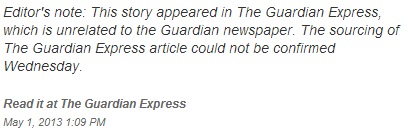
Still no reference to the “sourcing” being WorldNetDaily or “Kahlili”, but hey, it’s something, right?
Meanwhile, Britain’s Daily Mail has already picked up the story and run with it.
Related articles
- Report: Iranian President Ahmadinejad Arrested by Revolutionary Guard (breitbart.com)
- Iranian President Ahmadinejad Arrested (aworldchaos.wordpress.com)
- Iran Source: President Ahmadinejad Arrested (fluechtlingshilfeiranev2010.wordpress.com)
- Iran source: President Ahmadinejad arrested (vineoflife.net)
Featured Video

Iran’s Next Strike May Not Explode. It Could Shut You Down
or go to
Aletho News Archives – Video-Images
From the Archive
Zionism’s Violent Legacy
By Donald Neff | Washington Report On Middle East Affairs | January 1996
On January 4, 1948, Jewish terrorists drove a truck loaded with explosives into the center of the all Arab city of Jaffa and detonated it, killing 26 and wounding around 100 Palestinian men, women and children.[1] The attack was the work of the Irgun Zvai Leumi – the “National Military Organization,” also known by the Hebrew letters Etzel – the largest Jewish terrorist group in Palestine. The Irgun was headed by Revisionist Zionist Menachem Begin and had been killing and maiming Arabs, Britons and even Jews for the previous ten years in its efforts to establish a Jewish state.
This terror campaign meant that at the core of Revisionist Zionism there existed a philosophical embrace of violence. … continue
Blog Roll
 Aletho News
- Trump’s Iran war is on an Israeli leash
- Saudi oil boss issues global supply warning
- Riyadh Says Its Oil System Is Intact. The Numbers Say Otherwise.
- Trump and Netanyahu Want to “Finish the Job” on Iran
- US ‘one-sided dictation’ not Iran’s beliefs makes rational talks impossible: Baghaei
- Iran’s Next Strike May Not Explode. It Could Shut You Down /Col Doug Macgregor
- Iran: US political targets legitimate if assassinations return
- Iraq shuts key border crossing with Iran under US pressure: Report
- Undersea Internet cables could be targeted in retaliation for attacks on Iran: IRGC deputy chief
- EU sending ‘biased’ observers to interfere in Serbian election – president
- If Americans Knew
- AIPAC has become such a political liability that it’s shifting to a more “nimble” approach to buying politicians
- At least 160 Israeli settler attacks in 2 weeks
- Will Gaza’s Ancient Christian Community Disappear Forever?
- Israel’s vision of regional security rests on keeping Arab states weak
- Heidi Levine recounts how Palestinian youths helped save her in settler attack
- DAILY UPDATE: Latest essential news on Palestine, Israel, & region
- Trump’s Intensifying Sabotage of the ICC, for Israel’s Sake
- Israeli military detain US and UK volunteers in West Bank including Democratic NY politician Brad Lander
- Americans at National Conservatism Conference held in Israel this year criticize Israel
- Christiane Amanpour exits CNN with a legacy shaped by the debate over Israel
- No Tricks Zone
- E-Cars Reduce CO2 Emissions By Only 41% Compared To Internal Combustion Engine Vehicles
- Predictions Made By Renowned Climate Professor Over Past Decades Have Been Proven To Be Poor
- New Study Suggests Large Regions Of The Pacific Ocean Have Been Cooling For The Last 80 Years
- Germany’s Green Energy Debacle: High Energy Costs Force Kahla Porzellan to Close After 182 Years!
- New Study: 50 Years Of The Most Aggressive ‘Net Zero’ Policies Can Only Affect The Global Climate By 0.03°C
- US September “Heat” Was No Record…Many Records Set Decades Ago
- Latest European Green Energy Debacle; Portugal’s Largest Flagship Solar Park Insolvent!
- Green Energy Debacle: German Expert Professor Fritz Vahrenholt Warns Of Severe Economic And Social Consequences
- Two More Paleo Reconstructions Affirm Meters-Higher Sea Levels Across Ireland, Brazil 7000-6000 Years Ago
- New Study: Earth And Venus Surface Warmth Largely Explained By Convection And Lapse Rate, Not CO2 Or Radiation

