THE EXILING OF MY FILM , “EXILE A MYTH UNEARTHED”, IN THE BBC
By Ilan Ziv | April 28, 2013
As some of you know, my film EXILE, A MYTH UNEARTHED, which examines the myth of the Jewish EXILE and its political impact on both Israeli Jews and Palestinians in the Middle East, was going to be shown on the BBC Thursday April 25th. It was pulled out of the schedule only a few days earlier.
Since then I was flooded by dozens of emails of angry and concerned viewers asking what happened. To be honest I debated whether to tell the story of what I think had happened. I have worked with the BBC in the past on some programs that were deemed controversial and I never had any political censorship. On the contrary I was impressed by the integrity and fairness of the people I dealt with.
So based on my past experience, I was going to wait patiently until the BBC programming executives would solve the internal drama that apparently has begun to brew inside the BBC. “The film is gorgeous, courageous and fresh, “ I was told several times by the programming executives. I was promised that the cancellation was temporary: “Given the short timescale and your workload, we have decided to delay transmission until we’ve had the chance you’ve had the chance to go through it in detail”.
I naively believed and decided to wait quietly. But things have their own momentum and as I learned more, I realized that the story of “EXILE” in the BBC is far more complex.
Among the dozens of emails I received one caught my attention. It included the official email response from the BBC to the inquiry/complaint sent to irate viewers who contacted the BBC asking why the program was pulled out of the schedule. This email contradicted a private email sent to me by the programming executives. I was intrigued.
I discovered after quick research that while I was contacted by the BBC barely a week before the broadcast asking for my comments about the cut, the BBC have had the film for almost 6 months. So why was this sudden rush which supposedly was the excuse given to me as to why the film was pulled out? Why was I contacted so late in the game? And why was there a discrepancy between what was told to me and the “official” version . I started to dig a bit deeper and to put my findings in a blog, rather than answer the dozens of people who wrote to me privately.
This is not a personal issue. This is ultimately a sad saga of what I believe is a mixture of incompetence, political naiveté, conscious or subconscious political pressure and ultimately, I believe, a lack of courage of broadcasters when they are faced with the complexity of the Middle East issue and the intense emotions, fears and aggression it generates. Once you indeed depersonalize this incident, you gain a fascinating insight into how subtle and complex is the process by which our understanding of the Israeli Palestinian conflict is being shaped and what happens when one dares to raise questions about issues deemed by some as taboos. It is this insight that I think is worth sharing and detailing.
The story begins for me with the name. I discovered only 3 days before the broadcast that the BBC has been using a different name for the film: Jerusalem – An Archeological Mystery Story. It struck me as an odd choice that seems to camouflage the film’s real subject and repackages it as a neutral archeological mystery of sort- like the hundreds of hours one can see on cable and Satellite channels throughout the world.
“ Exile” of course is not about a mystery, neither it is limited to archeology or to Jerusalem. The name and the illusion that one can pretend that this film is just about archeology and its mysteries are at the core I believe of Thursday’s fiasco.
Digging deeper I also learned that this title was established back in November 2012 in the agreement between the National Film Board of Canada (one of the film’s co producers and its int’l distributor) and the BBC. I was approached by the distributor to see if I would agree for the BBC to cut down the program. I agreed to it on the condition that I would be consulted so the integrity of the longer version (104 min) would be preserved. I also said that if I was not to be consulted my name should be removed from the program and the cut down will be listed as an “adaptation from a film by Ilan Ziv”. From my access to some internal documents, it is obvious now that the BBC was not genuinely interested in my getting involved. As the documents suggest, they already announced that the cut down version would be an adaptation.
So back in November 2012, everything seemed to be on track to produce a cut down of the film without having to deal with the director, broadcast the film under a neutral title and hopefully avoid any serious political debate. A perfect solution! So what went wrong?
Fast forward to Saturday April 20th 2013 when I received an email from a friend in the UK who saw that “my” film Jerusalem; An Archeological Mystery Story was going to be broadcast on BBC 4. He even read a preview of it in the Guardian. The preview promised that the film “ will ruffle some feathers”. Two days earlier I did receive from the editor who cut the film a copy of the cut for me to comment on, but there was no mention of an impeding broadcast date!
On Monday, 3 days before the broadcast, I fired an email to the BBC programming executives complaining that it is unfair to expect me to spend time reviewing the cut and coming up with suggestions of a re cut, when I was given only a few days before a broadcast date that no one bothered to inform me about. I pleaded for more time. It was only when one of the programming executives called me, I realized that there were much bigger issues for her than my complaint about being pushed into an impossible schedule.
The program executive seemed genuinely shocked that a freelance employee hired by the BBC to take part in the re-versioning process called the film “propaganda”. When I asked if this unnamed person had specific examples to support such a sweeping charge, I was told that she claimed that , “Everything was propaganda”. And there was more.
An “unnamed” BBC insider who I was told “liked the film,” claimed that the film props up the myth of Exile “ which we all know did not happen, in order to support his political analysis”. I learned that the cut I was given was now irrelevant, since some internal review deemed one scène with the Palestinians to be “too emotive” and they were asked to cut it down. Realizing that a mini political storm was brewing around the film and attacks lodged against its integrity, I asked and was promised that I would be given at least a summary of the essential charges so I could answer them in length. I am obviously very familiar with some of them and could easily and in detail refute them. I told the programming executive that my reply would help them to defend the film in the Channel. After all, they professed to love the film and seemed genuinely interested to show it. I told them it was very easy for me to prepare a detailed rebuttal with citation of sources for every word of the narration, the overall analysis and for every scene. I told them that some of the academic participants in the program who saw the cut and are reputable scholars in their field did not find any factual errors or misrepresentations of facts or of the historical narrative. In other words, I argued that such a detailed and substantial defense would convince any objective reader and observer of the editorial integrity of the film. I repeated the request several times yet I never got a reply. Instead, I received an email telling me that they decided to pull it out of the schedule, citing the “ short timetable and my work load “( !) A few days later I saw the “official” version that went to the public:
“We originally acquired ‘Jerusalem: An Archaeological Mystery Story’ to supplement BBC Four’s season exploring the history of archaeology. However, we have decided that it doesn’t fit editorially and are no longer planning to show it as part of the season. Plans to broadcast the program are currently under review” So Exile, A myth unearthed has begun its own exile within the BBC.
I do believe it is ultimately a sad saga. A saga of well meaning programming executives who acquired the “courageous “ film they claim to love, believing that they can sneak it by with a “neutral title”. When they were “caught”, rather than face the criticism and be helped by the mountains of documents and data I was ready to send them, they panicked like deer in the headlights not knowing what to do and eventually raised their hands in resignation.
The truth of the matter is that the reaction outside and inside the BBC surprised me too. The film by now has been shown in a Jewish Festival in Toronto, playing in a screening room there for a week. It was shown on Canadian TV with a second broadcast planned for June. Another version of the film is scheduled to be shown in France and the original version in Switzerland ,with hopefully screenings in the US later in the year. The response in all the public screenings, some of which I attended, was overall extremely positive. Nowhere did the film generate such a reaction as that of the few individuals inside and outside the BBC.
The temporary success to “exile” the film might prove I believe to be a Pyrrhic victory.
EXILE does not deal with contemporary politics in the Middle East, rather, it proposes to examine their ideological and historical underpinnings. EXILE has not contributed to the political stalemate in the region nor to the continued bloodshed, occupation and violence. It is a film born out of the continued violence. Rather than propose a simplistic solution or an aspirational political program , it tries to suggest a possible way out by re examining the historical narratives we all grew up on, suggesting that in this tormented land there are historical models of co existence and tolerance that could replace the dominant conventional nationalist ones. Silencing this film is silencing a possibility of discussion, debate and re examination not of the current political stalemate but of the intellectual stalemate that contributes to it.
I hope that somewhere in the BBC someone will rise above the hysteria and the attempts at self censorship to take a cooler look at the film and realize how it has been profoundly mis-characterized , -viewing it through partisan glasses instead of looking at it for what it is: a film that can and has already in its public screenings generated dialogue and positive, thinking rather than perpetuating divisions and polarization.
So for me this is not the end of EXILE in the UK but only the beginning. I will show the film publicly throughout the UK and will challenge the BBC to either broadcast the film or relinquish its rights. I have offered to buy these rights so I could place the film elsewhere in the UK.
The saga of EXILE will continue. Stay tuned!
Exile – A Myth Unearthed (Trailer)
Update:
EXILE ON BBC4 , SUNDAY NIGHT NOVEMBER 3rd at 9PM TO BE FOLLOWED BY A DEBATE AT 10PM

EXILE , A MYTH UNEARTHED has finally found a home on the BBC . The hour version of the film ( I supervised and authored the cut down) is going to be broadcast under a new title SEARCHING FOR EXILE – TRUTH OR MYTH? on BBC 4 November 3rd, at 9pm . to be followed by a debate with my participation at 10pm
There will be a press screening on Thursday October 31st at 18.30 hrs. I will attend the Q&A after the screening. From what I understand attendance is restricted to a list of invitees. Please get in touch with me if you want to attend and I see what I can do.
As you all know it has been a long journey which many of you followed. I am eternally grateful for your support!
I am happy that the film finally found a home in the United Kingdom.!
As you remember I promised to hold screenings of the long version of the film throughout Britain( schedule permitted). I will be in Manchester on Monday Nov.5 th. Please write me for details. Since this time I can not stay in the UK any longer I will try to come again if there is interest in showing and discussing the film in other cities.
Below is the billing for the press.
SEARCHING FOR EXILE – TRUTH OR MYTH?
This authored documentary by Ilan Ziv sets out to explore the historical and archaeological evidence for the Exile of the Jews after their defeat in Jerusalem at the hands of the Roman Empire, and its relevance to today.
Tracing the story of Exile from the contemporary commentator Josephus, to 1960s Israeli archaeologist Yigael Yadin, to the modern city of Rome and finally to the ruins of a Palestinian village, Ziv asks where the roots of this story lie and what evidence there is for it.
At the centre of the film is the ancient town of Sepphoris (on whose ruins stood the Palestinian village of Saffuriya until 1948) and the lessons its multi-layered history may have to offer.
A film by Ilan Ziv
Produced by Amit Breuer, Serge Gordey, Colette Louméde, Ilan Ziv
‘UK, France barring UN Syria inspection’
Press TV – April 29, 2013
Syrian Ambassador to the United Nations Bashar al-Jaafari says Britain and France are trying to undermine Damascus’s official request from the United Nation to investigate chemical weapons use in Aleppo.
Al-Jaafari said in an interview with the Lebanese NBN TV channel that the western governments seek to repeat the Iraqi scenario in Syria through questioning its sovereignty by opening its borders to undisciplined inspections by the UN under the pretext of chemical weapons use.
Al-Jaffari said the western sides do not want an investigation to take place suggesting they know full well that the anti-government militants used chemical agents in the town of Khan al-Asal, near Aleppo, and elsewhere.
The Syrian official said the comparison with Iraq is pretty clear as the UN also sent an inspection team to the country to examine weapons of mass destruction claims, but Iraq was occupied despite the fact that the inspection team did not find any WMDs.
He also rejected claims by Britain and France that chemical weapons were used in Homs four months before the Khan al-Asal incident saying they would have reported it earlier if any such attack ever existed.
The Syrian Foreign Ministry has written to the UN Secretary General Ban Ki Moon calling on the body to explain the details of a likely inspection in Khan al-Asal.
However, Britain and France have demanded the team to be also sent to other areas of the country to investigate the use of chemical weapons.
The request has been rejected by the Syrian government that says inspectors cannot have unlimited access to all regions of the country without coordination with Damascus.
The Syrian government has also called for an independent inspection of Khan al-Asal saying Damascus and the UN could discuss the details on other alleged chemical weapons uses separately, though the UN has so far refused to do so.
Related articles
- Russia accuses UN of politicizing approach to chemical weapons in Syria (voicerussia.com)
- Bashar Al-Jaafari: “West Raising Chemical Weapons Issue Part of Pressure Campaign” (syrianfreepress.wordpress.com)
Pro-Israeli US lawmakers urge bombing Syria air bases, arming militants, invasion
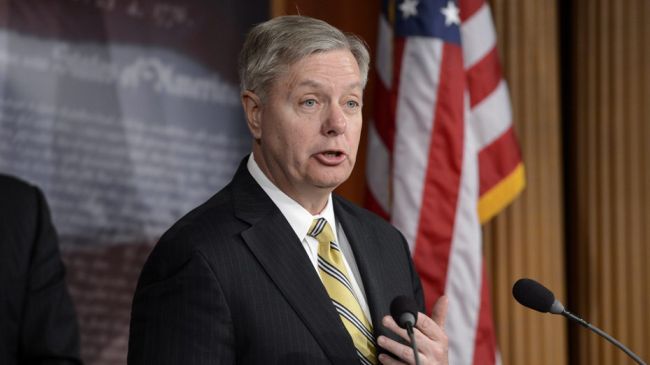
US Senator Lindsey Graham (R) South Carolina (file photo)
Press TV – April 29, 2013
Top US Republican lawmakers have again called for further American actions against Syria, including the bombing of its air bases, leading a multi-nation invasion of the country and sending lethal weapons to anti-Damascus militant gangs.
Fervently pro-Israeli Senators John McCain of Arizona and Lindsey Graham of South Carolina further cited widely challenged claims by the Israeli regime of chemical weapons use in Syria to urge swift Washington action to “secure” chemical arms arsenals in the Arab country in efforts to prevent al-Qaeda-linked militants from gaining access to such weapons, US press reports said on Sunday and Monday.
The two lawmakers, however, did not explain how American forces would secure the alleged cache of Syrian chemical weaponry.
Graham went as far as warning that if the US does not intervene in Syria the next terrorist bombing in American soil will include chemical agents.
“The chemical weapons (in Syria)… are going to be compromised and fall into wrong hands and the next bomb that goes off in America may not have nails and glasses in it,” said Graham during a televised interview with major US network CBS on Sunday.
The senior member of US Senate’s Armed Services Committee also expressed serious concerns about the potential fall of Jordan’s dictator King Abdullah II if Washington did not intervene quickly enough to stop the growing flow of Syrian refugees into his country.
Describing the Jordanian ruler as “a moderating influence and a good [US] ally,” Graham predicted that his regime will fall if the “flood” of Syrian refugees into Jordan continued.
He also predicted a US war with Iran if the Obama administration does not intervene in Syria on the grounds that Tehran would doubt Washington’s resolve in taking action against their nuclear energy program.
The American senator went on to urge the US military to “bomb Syrian air bases with cruise missiles in a bid to “neutralize” the government’s air advantage over the foreign-backed militant gangs and turn the “tide of battle pretty quickly” in favor of the anti-Damascus insurgents.
Moreover, Senator McCain said the US should move into Syria as part of an “international force” to secure the country’s chemical weapons, but did not elaborate on how such international military force would be established and which countries would be involved.
Syria has been faced with a foreign-sponsored armed insurgency since 2011. Thousands of people in the country, including a large number of security forces, have been killed in the unrest with many foreign nationals infiltrating the key Arab state in a bid to destabilize the government of President Bashar al-Assad.
Related article
- Israeli lawmaker urges intervention in Syria (foxnews.com)
Israel spy agency has presence in Syria, says senior rebel general
By Joseph Fitsanakis | intelNews | April 25, 2013
Israel is one of several countries that maintain a significant intelligence presence inside Syria, according to the top commander of the Syrian rebel forces.
General Salim Idriss, Chief of Staff for the Free Syrian Army, told CNN’s Christiane Amanpour that the Jewish state has “many, many” intelligence officers in various parts of Syria. The Arab country has been rocked since 2011 by a violent civil war, which has cost the lives of at least 60,000 people.
Idriss was responding to comments made earlier this week by Brigadier General Itai Brun, senior intelligence analyst for the Israel Defense Forces (IDF). Brun, who heads the Division for Research and Analysis of the IDF’s Military Intelligence Directorate, was speaking at a conference hosted in Tel Aviv, Israel, by the Institute for National Security Studies. He told an audience of intelligence experts that the IDF was “quite certain” that the Syrian government headed by President Bashar al-Assad had resorted to the use of chemical weapons against rebel forces on at least one instance.
According to Brun, footage obtained by the IDF of rebel casualties from a March 19 attack by Syrian government forces, pointed to the use of sarin nerve gas. He referred to evidence such as the victims’ dilated pupils and “the foam coming out of their mouths” as strong proof of the use of weaponized sarin nerve gas in the battlefield.
Responding to Brun’s allegations, General Idriss suggested that Syrian government forces had used chemical weapons repeatedly in a variety of locations, including Aleppo, Homs, and the outskirts of capital Damascus. He added that rebel forces had collected “some samples of soil and blood” and surrendered it to outside “observers” of the civil war —though he refused to identify these observers. After some pressure from Amanpour, Idriss said it made sense for the IDF to know that sarin nerve gas had been used by the Syrian government, since Israel was one of several countries that had “many, many” intelligence officers inside Syria. Asked by Amanpour whether he was referring to Israeli covert-action agency Mossad, Idriss responded “yes”.
In response to Brun’s comments, White House Press Secretary Jay Carney told reporters on Tuesday that Washington was “looking for conclusive evidence, if it exists, if there was use of chemical weapons”.
The New Yorker Should Ignore Jon Lee Anderson and Issue a Correction on Venezuela
By Keane Bhatt | NACLA | April 24, 2013
As a result of many dozens—possibly hundreds—of messages from readers over the past few weeks that criticized The New Yorker’s inaccurate coverage of Venezuela, reporter Jon Lee Anderson issued a response in an online post on April 23. This marks the first time the magazine has publicly addressed its controversial and erroneous labeling of Venezuela as one of the world’s most “socially unequal” countries (I highlighted the error in mid-March). Although Anderson deprives his readers of the opportunity to evaluate his critics’ arguments (he offered no hyperlinks to either of my two articles on the subject, nor to posts by Corey Robin, Jim Naureckas, and others), he is clearly writing in response to those assertions.
To his credit, Anderson unequivocally admits two of his three errors: regarding Venezuela’s homicides, he acknowledges that he falsely wrote “that Venezuela had the highest homicide rate in Latin America. Actually, Honduras has the top rate.” Anderson proceeds to explain why Venezuela’s high homicide rate is nevertheless a grave problem—a position none of his critics, myself included, dispute.
The importance of this error rests instead in its revelation of a media culture under the influence of the consistent demonization of a country deemed an official U.S. enemy. This culture certainly played a role in allowing Anderson’s obvious falsehood to remain uncorrected for five months—five months after I first wrote about it, one month after I directly and publicly confronted Anderson about the error, and even then, days after I wrote another article urging readers to demand a correction.
While The New Yorker has dedicated literally no articles to U.S. ally Honduras since its current leader Porfirio Lobo came to power in repressive, sham elections held under a military dictatorship, Anderson was allowed to assert that Venezuela—a country with half the per capita homicides of Honduras—was Latin America’s leader in murders. One might reasonably suspect that a claim on The New Yorker’s website asserting that the United States had a higher homicide rate than Bolivia (Bolivia’s rate is actually over two times as high), would be retracted more expeditiously.
Anderson’s explanation for his second error—claiming that Chávez came to office through a coup d’etat rather than a free and fair election—further lays bare the corrupting effects of the generalized vilification of Chávez on basic journalistic standards of accuracy.
Anderson writes that despite his gaffe, he obviously knew Chávez “gained the Presidency by winning an election in 1998,” as he had “interviewed Chávez a number of times, travelled with him, and came to know him fairly well.” For Anderson to write such an egregious misstatement, then, and have it pass through what is likely the most rigorous fact-checking process in the industry, exposes a pervasive ideology under which he and his many editors and fact-checkers operate. As Jim Naureckas of Fairness & Accuracy in Reporting wrote, “It’s like writing a long profile on Gerald Ford that refers to that time when he was elected president.”
Finally, Anderson offers a desperate attempt to justify his third factual error, stating:
A number of letters I’ve received dispute, out of context, my reference to “the same Venezuela as ever: one of the world’s most oil-rich but socially unequal countries”; several cite an economic statistic known as the Gini coefficient—a measure of income inequality.
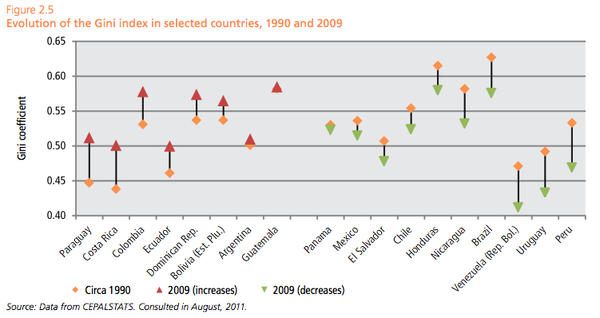
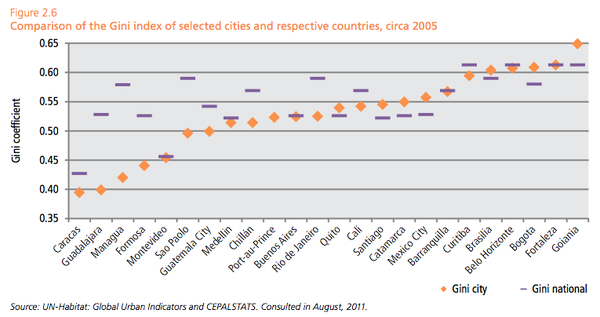
Notice that Anderson never tells his readers what Venezuela’s Gini coefficient actually is. According to the United Nations, Venezuela’s Gini, at 0.397, makes it the least unequal country in Latin America and squarely in the middle range of the rest of the world. Only by sidestepping this brutal empirical obstacle can Anderson attempt to lay out his case. He carries on by reposting three paragraphs of his original essay, which in no way mitigate the falsity of his original claim, for “context.” Anderson finally concludes by offering a novel justification for his error:
In terms of some of the components of social inequality, notably income and education, Chávez had some real achievements. (Income is what’s captured by the Gini coefficient, although that statistic has its own limitations, some particular to Venezuela.) But in housing and violence, his record was woefully insufficient. Those social factors are intimately related, to each other and to the question of equality.
A quick recap is in order before unpacking Anderson’s argument. Readers may remember that he first responded to evidence on income inequality by proclaiming, on Twitter, his agnosticism toward empirical data. Next, a senior editor at the magazine justified Anderson’s contention by arguing that Venezuela was one of the most unequal amongst other oil-rich countries—a point I debunked. Now, Anderson has settled on a definition of social inequality that minimizes Venezuela’s high educational and income equality in favor of high homicide rates and unequal housing.
But simply saying that Chávez’s record “was woefully insufficient” on housing and violence does not naturally equate to Venezuela’s standing as a world leader in social inequality. Anderson must rely on comparative international statistics to justify his position, but fails to do so.
While Venezuela’s homicide rate is high by international standards and a significant social ill, this alone does not necessarily make the country more socially unequal than another country with a lower homicide rate. Are Venezuelan homicides more skewed toward low-income residents than those in Costa Rica? Or Haiti? Are Venezuelan murders more targeted at women or ethnic minorities than those in Mexico or Guatemala? And given that the high homicide rate directly affects far fewer than one in a thousand Venezuelans annually, how could this statistic possibly outweigh the effect of massive income-inequality and poverty reductions? If he is solely basing his argument on murder rates, Anderson has no credible explanation as to why Venezuela is one of the world’s most socially unequal countries.
Anderson also doesn’t offer statistics showing that housing is more unequal in Venezuela than anywhere else. That’s because it’s not.
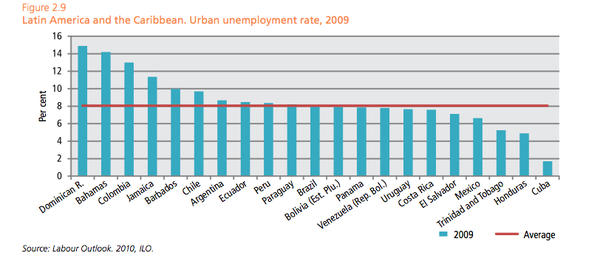
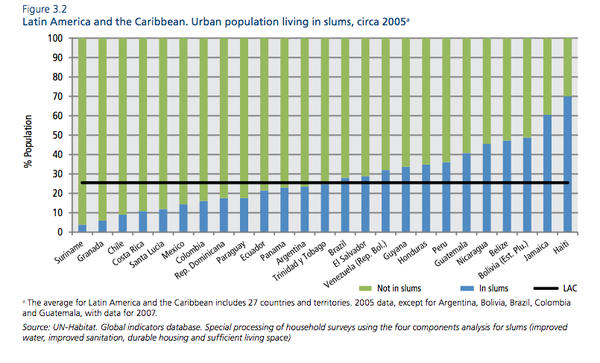
Out of the 91 countries for which the United Nations has available data, Venezuela is 61st in terms of the percentage of its urban population living in slums. That is to say, two-thirds of the world’s countries with available data have larger percentages of their urban citizens living as slum dwellers. In the Western Hemisphere, this includes Guayana, Honduras, Peru, Anguilla, Guatemala, Nicaragua, Belize, Bolivia, Jamaica, and Haiti.
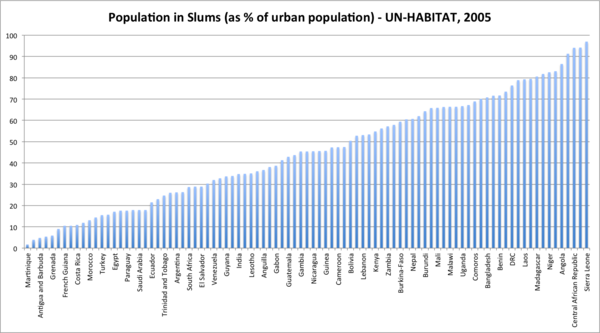
It is also worth mentioning that this data was taken from 2005, when the percentage of Venezuela’s urban population living in poverty and extreme poverty was at 37%. By 2010, according to the United Nations, it had been cut by a quarter, to 28% (p. 43). Furthermore, 2005 predates a massive governmental push in 2011 to build affordable housing. Earlier this year, Venezuela’s Housing Commission chair asserted that “in the years 2011 and 2012, the Bolivarian government together with the people reached the goal of building 350,000 homes.”
It appears, then, that Anderson has discovered a new definition of “social inequality” that has eluded economists and sociologists worldwide—one that systematically downplays Venezuela’s educational and income equality while emphasizing a high frequency of murders and a rate of slum-dwelling that is low by international standards.
While one can applaud Jon Lee Anderson for finally acknowledging the value of social indicators and statistical data, he and his magazine cannot be allowed to define “social inequality” any way they see fit. No social scientist analyzing the available data could argue, like Anderson, that Venezuela is one of the world’s most socially unequal countries. While semantics games may be expedient in avoiding a necessary correction, readers should let The New Yorker’s editor David Remnick (david_remnick@newyorker.com) know that a retraction of Anderson’s claim is long overdue.
Update (4/24): FAIR’s Jim Naureckas also offers sharp criticism of Jon Lee Anderson and his fact-checkers for a transparently inadequate attempt to justify his error regarding Venezuela’s social inequality. Read more, at “Jon Lee Anderson Explains: Because I Said So.”
~
Keane Bhatt is an activist in Washington, D.C. He has worked in the United States and Latin America on a variety of campaigns related to community development and social justice. His analyses and opinions have appeared in a range of outlets, including NPR, The Nation, The St. Petersburg Times, and CNN En Español. He is the author of the NACLA blog “Manufacturing Contempt,” which critically analyzes the U.S. press and its portrayal of the hemisphere. Connect with his blog on Twitter: @KeaneBhatt
Related articles
- The New Yorker Corrects Two Errors on Venezuela, Refuses a Third (alethonews.wordpress.com)
- On Venezuela, The New Yorker’s Jon Lee Anderson Fails at Arithmetic (alethonews.wordpress.com)
- 50 Truths about Hugo Chavez and the Bolivarian Revolution (alethonews.wordpress.com)
- ‘Little Twerp … Get a Life’: The New Yorker’s Jon Lee Anderson Thinks He’s Somebody on Twitter (gawker.com)
Venezuelan Government Accuses Capriles of Making “Impossible” Demands
By Chris Carlson | Venezuelanalysis | April 25, 2013
Maracaibo – Opposition leader Henrique Capriles claimed yesterday that the presidential elections were “stolen”, and demanded further audit measures that the Venezuelan government has said are “impossible”.
Capriles made the statements during a press conference on Wednesday in which he gave the government an ultimatum regarding the audit.
“The truth is that you stole the elections, that’s the truth. You stole the elections and now you have to explain that to the country and the world,” he said.
Capriles demanded that the National Electoral Council (CNE) begin the auditing process immediately, and said his campaign will refuse to wait any longer.
“That is what we are demanding. We will give you until tomorrow,” he said, though he did not say what would happen if the CNE did not respond.
However, the CNE had already said last week that it would announce the beginning of the audit this week, and was expected to make an announcement today.
The Capriles campaign went on to demand a series of additional audit measures that are not included in the audit that has been approved by the CNE. His campaign representative Roberto Picón said that in addition to a complete audit of the electoral machines and the paper ballots, they are also demanding access to the electoral registry, the fingerprint system and a verification of each individual voter.
“We are asking for complete access to the electoral registry, not only to count how many people voted but also to audit all of the details, to audit the people that voted to see if there are dead people who voted, or foreigners, or duplicates, and to see if there are fake fingerprints,” said Picón.
He further said that they are demanding the CNE validate every individual fingerprint in the system, comparing each fingerprint to every other to assure none are duplicated, validate every person’s signature on the day of the elections and that they provide proof that none of the electoral data has been altered since the elections last week.
“If it doesn’t include the electoral registry, then it is not an audit. We won’t accept a shoddy audit,” said Capriles.
Various government officials have responded to these demands, saying they would be impossible to meet, and that the Capriles campaign knows it.
“They are making requests to the CNE that are absolutely impossible to grant. They are asking that every fingerprint and every signature of the almost 15 million people who participated in the electoral process be verified,” said Calixo Ortega.
“This would take like 5 years to verify, because it takes hours to verify a single fingerprint or signature, and there are 15 million that would have to be verified,” he said.
“It appears that they are purposely making requests that cannot be granted so that they can later say that the CNE has denied their request,” he explained.
Maduro’s campaign manager Jorge Rodgriguez also responded to Capriles, accusing him of attempting to create more violence in the country.
“Now Capriles says the elections were stolen. Where is the proof? Where is a single piece of evidence of that? If you can’t show any evidence, then it didn’t happen,” said Rodriguez.
Rodriguez also accused Capriles of attempting to generate more violence in the country.
“What are you doing giving the government an ultimatum like that? You have already left a cemetery in your wake with 9 fellow Venezuelans dead from the violence you created,” he said.
Capriles has yet to present any evidence of fraud in the April 14th elections. In the days following the elections, he mentioned various examples that were all promptly shown to be false.
Venezuela’s electoral council is expected to announce the timeframe of the auditing process today or tomorrow. It is unlikely that the additional measures being demanded by the Capriles campaign will be included in the audit.
Related articles
- Venezuela’s Electoral Council Approves Audit of 100 Percent of Votes (alethonews.wordpress.com)
- Capriles Falsifies Evidence in Order to Claim Fraud in Venezuela’s Elections (alethonews.wordpress.com)
- Capriles Attacks Venezuelan Electoral Council, Refuses to Sign Document (alethonews.wordpress.com)
Every Day Terror
By Margaret Kimberley | Black Agenda Report | April 24, 2013
Every year, 4,600 Americans are killed in work place related accidents. Every 28 hours a black person is killed by police, corrections officers, security guards or vigilantes. Every year more than 30,000 people are killed by gun violence in this country. The odds of being killed by a terrorist are only 1 in 20 million.
These statistics are rarely mentioned and never had a chance to be addressed after two bombs were exploded during the Boston marathon. Death under horrific but commonplace circumstances attracts scant media attention or political action. Acts labeled as terrorism, which are unlikely to kill anyone, bring an inordinate amount of hysteria among the populace and cynical attention from press and politicians.
Just two days after the Boston marathon a fertilizer plant in West, Texas exploded, killing 14 people, most of them the much worshiped “first responders.” The risk of dying in an industrial accident is far greater than the odds of being killed by a terrorist, but no matter. The people were whipped into a frenzy and told to cast their eyes in the place where they should pay less attention rather than more.
It is frightening that the risks which Americans are subjected to on a daily basis are ignored as if they are unwanted background noise. Some of the passivity is understandable. Black people in particular are able to function in large part because the ever present risk of stop and frisk, false arrest, and police brutality are difficult to bear. There is a thin line between being conscious and losing one’s mind.
All Americans’ behavior is understandable if one acknowledges that we are constantly subjected to propaganda of various kinds. We have been propagandized to believe that some lives, white Americans’, are more valuable than others, namely anyone not white nor from the United States. There is no other way to explain why the government’s killing of thousands of people abroad is met with a shrug, if it is acknowledged at all. Americans are like spoiled children, whining over their suffering, while showing no empathy for anyone else’s. They feel that only their victimization is worthy of note, and in fact many of them support their government’s acts of violence carried out around the world.
That feeling of entitlement is a direct result of centuries of white supremacy which has never been examined or challenged. It has been fed as corporate power has grown and corrupted the media who now aren’t even very good at the basics of their profession. CNN, NPR, the Associated Press and other supposedly reputable news organizations reported wrongly on basic facts of the case such as the number of suspects, whether arrests had been made or not, or who was or wasn’t a person of interest. A “dark skinned man” was said to be under arrest but actually wasn’t. An Indian student missing since March was named as a suspect on social media and his family were threatened as a result.
After the wave of manufactured hysteria an easily frightened people were then convinced to accept tanks in their streets and heed government calls to “shelter in place.” The nonsensical overreaction was superseded only by the use of Orwellian jargon used to create an even more compliant public.
The predictably maudlin moments of silence weren’t restricted to Boston. More than $20 million in monetary contributions were raised without the donors knowing who needed it or for what purpose. Tributes flowed along with money and no one ran a race anywhere on earth without mentioning the bravery of Bostonians. The president showed up and as always on such occasions uttered words seemingly written by his worst speechwriters. The full force of the government would catch the cowards and the people would not be frightened because they are the best and freest in the world and the prayers of the nation went out to them because of democracy and the whole world stood beside them. Amen.
There is another kind of terror that goes on continually. Most reported terror plots of recent years were created entirely by government agents. The FBI had some contact with Tamerlan Tsarnaev who was killed by police in the bombing after math. It is possible that the FBI moved from creating phony terror plots to actually carrying one out. The likelihood that there will ever be impartial fact finding on this and other questions are slim to none.
Dzokhar Tsarnaev now lies in a hospital wounded by police gunfire and questioned without being read his rights. That treatment is a result of an Obama executive order which states that in cases of a “public safety exception” we have no such rights. Now that is everyday terror.
Margaret Kimberley can be reached via e-Mail at Margaret.Kimberley(at)BlackAgendaReport.com.
Related article
- Manufacturing Terrorists – How FBI sting operations make jihadists out of hapless malcontents (therearenosunglasses.wordpress.com)
Featured Video
Iran’s Next Strike May Not Explode. It Could Shut You Down
or go to
Aletho News Archives – Video-Images
From the Archive
Zionism’s Violent Legacy
By Donald Neff | Washington Report On Middle East Affairs | January 1996
On January 4, 1948, Jewish terrorists drove a truck loaded with explosives into the center of the all Arab city of Jaffa and detonated it, killing 26 and wounding around 100 Palestinian men, women and children.[1] The attack was the work of the Irgun Zvai Leumi – the “National Military Organization,” also known by the Hebrew letters Etzel – the largest Jewish terrorist group in Palestine. The Irgun was headed by Revisionist Zionist Menachem Begin and had been killing and maiming Arabs, Britons and even Jews for the previous ten years in its efforts to establish a Jewish state.
This terror campaign meant that at the core of Revisionist Zionism there existed a philosophical embrace of violence. … continue
Blog Roll
 Aletho News
- Trump’s Iran war is on an Israeli leash
- Saudi oil boss issues global supply warning
- Riyadh Says Its Oil System Is Intact. The Numbers Say Otherwise.
- Trump and Netanyahu Want to “Finish the Job” on Iran
- US ‘one-sided dictation’ not Iran’s beliefs makes rational talks impossible: Baghaei
- Iran’s Next Strike May Not Explode. It Could Shut You Down /Col Doug Macgregor
- Iran: US political targets legitimate if assassinations return
- Iraq shuts key border crossing with Iran under US pressure: Report
- Undersea Internet cables could be targeted in retaliation for attacks on Iran: IRGC deputy chief
- EU sending ‘biased’ observers to interfere in Serbian election – president
- If Americans Knew
- AIPAC has become such a political liability that it’s shifting to a more “nimble” approach to buying politicians
- At least 160 Israeli settler attacks in 2 weeks
- Will Gaza’s Ancient Christian Community Disappear Forever?
- Israel’s vision of regional security rests on keeping Arab states weak
- Heidi Levine recounts how Palestinian youths helped save her in settler attack
- DAILY UPDATE: Latest essential news on Palestine, Israel, & region
- Trump’s Intensifying Sabotage of the ICC, for Israel’s Sake
- Israeli military detain US and UK volunteers in West Bank including Democratic NY politician Brad Lander
- Americans at National Conservatism Conference held in Israel this year criticize Israel
- Christiane Amanpour exits CNN with a legacy shaped by the debate over Israel
- No Tricks Zone
- E-Cars Reduce CO2 Emissions By Only 41% Compared To Internal Combustion Engine Vehicles
- Predictions Made By Renowned Climate Professor Over Past Decades Have Been Proven To Be Poor
- New Study Suggests Large Regions Of The Pacific Ocean Have Been Cooling For The Last 80 Years
- Germany’s Green Energy Debacle: High Energy Costs Force Kahla Porzellan to Close After 182 Years!
- New Study: 50 Years Of The Most Aggressive ‘Net Zero’ Policies Can Only Affect The Global Climate By 0.03°C
- US September “Heat” Was No Record…Many Records Set Decades Ago
- Latest European Green Energy Debacle; Portugal’s Largest Flagship Solar Park Insolvent!
- Green Energy Debacle: German Expert Professor Fritz Vahrenholt Warns Of Severe Economic And Social Consequences
- Two More Paleo Reconstructions Affirm Meters-Higher Sea Levels Across Ireland, Brazil 7000-6000 Years Ago
- New Study: Earth And Venus Surface Warmth Largely Explained By Convection And Lapse Rate, Not CO2 Or Radiation

