Conflict Erupts at OAS over Venezuela’s Constitutional Debate
By Chris Carlson | Venezuelanalysis | January 17th, 2013
Punto Fijo – The controversy surrounding Venezuela’s constitution and the delaying of Venezuelan President Hugo Chavez’s swearing-in became a point of contention at a meeting of the Organization of American States (OAS) in Washington yesterday.
Panama’s ambassador to the OAS, Guillermo Cochez, sharply criticized OAS General Secretary José Miguel Insulza for accepting the ruling of Venezuela’s Supreme Court to delay Chavez’s swearing-in.
The government of Panama rejected Cochez’s statements today and dismissed him from the OAS, according to the ambassador himself.
Insulza stated last week that the OAS would fully respect the decision of the Venezuelan Supreme Court and would not consider taking any action regarding the matter.
Cochez rejected this position, comparing Venezuela to a “classic dictatorship”, and said that although the Chavez government was democratically elected, a “lack of independent institutions” makes it a “sick democracy”.
Cochez went on to accuse the OAS and its member states of being “accomplices” to a violation of the Venezuelan constitution, and suggested that if nothing is done the Organization of American States should consider permanently closing down.
The Panamanian ambassador’s intervention led to a number of responses from member nations, including some very strong remarks from Venezuela’s ambassador to the OAS, Roy Chaderton, who accused Cochez of intervening in Venezuela’s internal affairs and receiving instructions from the Venezuelan opposition.
“You write and comment in Venezuelan media against President Chavez at every opportunity, especially on that nest of media delinquents known as Globovision, and with all the freedom guaranteed by Venezuelan democracy,” said Chaderton.
The Venezuelan ambassador accused Cochez of meeting and conspiring with right-wing factions seeking to overthrow the Venezuelan government, including individuals like Roger Noriega and Venezuelan bank executive Pedro Mario Burelli, who was present at the OAS meeting as a guest of the Panama delegation.
Several Latin American countries quickly responded in favor of Venezuela, and rejected any type of intervention on the part of the OAS.
Brazil, Bolivia, Nicaragua, Ecuador, and Argentina all intervened in support of Venezuela, and rejected the comments made by Panama’s ambassador.
“Venezuela’s democratic order is perfectly guaranteed,” said the Brazilian ambassador, assuring that the situation was “an internal matter”.
Canada, on the other hand, suggested sending an OAS delegation to Venezuela to evaluate the situation, however Insulza said that any decision to take action would have to wait until a future meeting since it was not a part of the agenda of yesterday’s meeting.
Shortly after the meeting, the government of Panama also rejected the intervention made by their ambassador.
“The government of Panama categorically rejects the unauthorized declarations made by Panama’s Ambassador to the OAS,” said an official communiqué released by the government.
Panama assured that the position taken by Cochez was “far from the position of the national government,” and said that Panama would “continue to respect the internal political process” in Venezuela.
Chaderton attributed the Panamanian’s intervention to an attempt by Venezuela’s opposition coalition MUD of attempting to force a type of OAS intervention in Venezuela.
“It is an embarrassment that the MUD tries to use their friends in the OAS to get them to intervene in Venezuela,” he said.
Opposition Student Protests
The OAS decision to respect the Venezuelan Supreme Court ruling was also the motive of a minor protest in Caracas yesterday.
A group of students marched to OAS headquarters to demand the organization reconsider their position on the situation in Venezuela.
“Just because the three branches of government have ratified the decision does not mean that it is constitutional,” said one student to private channel Globovision.
Both the opposition and government supporters have planned major marches for next Wednesday, January 23rd as part of the controversy surrounding Venezuela’s constitution.
Related article
- The Guardian vs. the Conventional Wisdom on Venezuela (venezuelanalysis.com)
The Fantasies of David Brooks
By JOHN W. FARLEY | CounterPunch | January 17, 2013
David Brooks, conservative pundit at the New York Times, reviewed a new book (The World Until Yesterday: What Can We Learn from Traditional Societies?) by geographer Jared Diamond in the Sunday January 13 NYT. Under the title Tribal Lessons, Brooks discusses warfare between pre-state tribal societies in New Guinea. Between April and September 1961, a series of battles between rival tribal alliances, using spears and arrows, killed total of 0.14% of the total population of the tribal alliances.
Brooks informs the readers of the New York Times that “As a share of the total population, that’s a higher casualty rate than Europe, Japan, China, or America suffered during the world wars.” Brooks goes on to say that “The highest war-related death rates for modern societies (Russia and Germany during the 20th century) are only a third of the average death rates of tribal societies. Modern societies average war-related death rates that are about one-tenth a high as tribal societies.”
That didn’t sound right to me, so I decided to do some fact checking on Wikipedia, looking up casualties (military and civilian) during the First and Second World War.
During the First World War, many countries suffered losses far greater than Brooks’ 0.14%, including the UK (2.19%), France (4.29%, Germany (3.82%), and the Russian Empire (1.89% to 2.14%). The heaviest percentage losses were suffered by Romania (9.33%), the Ottoman Empire (13.72%) and Serbia (16.11%). The United States escaped with 0.13%. The Central Powers (Austria-Hungary, Bulgaria, German Empire, and Ottoman Empire) averaged 5%, while the Entente Powers (including the U.S.) averaged 1.19%. The Second World War was even bloodier: Wikipedia lists casualties for Germany (8 to 10.5%), the Soviet Union (13.88%), Japan (3.67 to 4.37% ), and China (1.93% to 3.86%).
Notice that the combined losses in both world wars for Russia/Soviet Union is 16%, which according to Brooks is “only a third of the average death rates of tribal societies”. That would imply that the death rates of tribal societies at 16% x 3 = 48%, instead of Brooks’ number of 0.14%. Brooks’ error is a factor of 343 (!!)
Brooks’ concludes that “the most obvious difference between us is that pre-state tribal societies are just a lot more violent.” Not if you do the math right. Actually, the most obvious difference is that modern industrial societies at war are just a whole lot more violent than tribal societies.
The New York Times employs fact-checkers. Did anybody ever fact-check Brooks’ review? Apparently not.
The NYTimes employs statistician Nate Silver, author of the 2012 book The Signal and The Noise: Why So Many Predictions Fail, But Some Don’t. Mr. Silver can do math, and Silver can pull up Wikipedia on his computer. The Times should hire Nate Silver to babysit for David Brooks.
This is not the first offense for David Brooks. A dozen years ago, Brooks’ 2001 article in the Atlantic Monthly, “One Nation, Slightly Divisible” explored the cultural differences between Red State America and Blue State America. Brooks’ article was widely praised. However, when journalist Sasha Issenberg fact-checked it in a 2004 article in Philly Magazine, Issenberg found that many of Brooks’ generalizations were false, and much of his “research” was invented out of whole cloth.
Hugo Chavez: Why Does He Hate Us?
By Peter Hart | FAIR | January 11, 2013
If there’s one thing media want you to know about Venezuelan president Hugo Chavez, it’s that he doesn’t like the United States. On the PBS NewsHour (1/10/13), Ray Suarez told viewers that Chavez
antagonized Washington, it seemed, whenever he could, forging friendships with Iran’s Mahmoud Abbas (sic), Syria’s embattled Bashar al-Assad, and he formed an especially close bond with Cuban Presidents Fidel and Raul Castro.
 On the CBS Evening News (1/8/13), Scott Pelley said:
“Chavez has made a career out of bashing the United States and allied himself with Iran and Syria.”
While it’s hard to say Chavez has made a “career” out of U.S.-bashing–he does have, after all, a full-time job as president of Venezuela–you, too, might be excused for harboring some hard feelings towards a government that helped to try to overthrow your own. Which may be why U.S. reports rarely bring up the 2002 coup attempt–and when they do, treat Washington’s involvement in it as another nutty Chavez conspiracy theory.
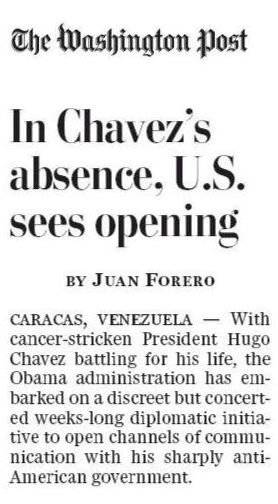
Here’s Juan Forero in the Washington Post (1/10/13):
A central ideological pillar of Chavez’s rule over 14 years has been to oppose Republican and Democratic administrations in Washington, which he accuses of trying to destabilize his government.
“I think they really believe it, that we are out there at some level to do them ill,” said Charles Shapiro, president of the Institute of the Americas, a think tank in San Diego.
As ambassador to Venezuela from 2002 to 2004, Shapiro met with Chavez and other high- ranking officials, including [Vice President Nicolas] Maduro. But the relationship began to fall apart, with Chavez accusing the United States of supporting a coup that briefly ousted him from power. U.S. officials have long denied the charge.
Shapiro recalled how Maduro made what he called unsubstantiated accusations about CIA activity in Venezuela, without ever approaching the embassy with a complaint. He said that as time went by, the United States became a useful foil for Chavez and most Venezuelan officials withdrew contact.
“A sure way to ruin your career, to become a backbencher, was to become too friendly with the U.S. Embassy,” Shapiro said.
So Venezuela has a strange political culture where being friendly with the U.S. government gets you in trouble.
The Post airs Chavez’s charge–and then the U.S. denial. But the United States had all sorts of contact with the coup plotters before they made their move against Chavez in 2002. According to the State Department (7/02):
It is clear that NED [National Endowment for Democracy], Department of Defense (DOD) and other U.S. assistance programs provided training, institution building and other support to individuals and organizations understood to be actively involved in the brief ouster of the Chavez government.
And the CIA, as was reported by Forero himself (New York Times, 12/3/04), knew of the coup plotting.
The Central Intelligence Agency was aware that dissident military officers and opposition figures in Venezuela were planning a coup against President Hugo Chávez in 2002, newly declassified intelligence documents show. But immediately after the overthrow, the Bush administration blamed Mr. Chávez, a left-leaning populist, for his own downfall and denied knowing about the threats.
Scott Wilson, who was the Washington Post foreign editor at the time, told Oliver Stone for his film South of the Border:
Yes, the United States was hosting people involved in the coup before it happened. There was involvement of U.S.-sponsored NGOs in training some of the people that were involved in the coup. And in the immediate aftermath of the coup, the United States government said that it was a resignation, not a coup, effectively recognizing the government that took office very briefly until President Chavez returned.
And we know that the United States made quick efforts to have the coup government recognized as legitimate. The Bush government, immediately after the coup, blamed it on Chavez. And some of the coup plotters met with officials at the U.S. embassy in Caracas before they acted.
But the important thing for readers to know, according to Wilson’s successors at the Washington Post, is that U.S. officials deny they supported anything.
Logical Fallacies: The Financial Times on Syria and Uranium Stockpiles
News Unspun | January 10, 2013
On 8 January the Financial Times published an article by James Blitz, entitled ‘Fears raised over Syria uranium stockpile’, premised primarily on the ‘fears’ and otherwise subjective ruminations of unnamed ‘official’ and ‘expert’ sources, one the two named sources being former weapons inspector David Albright (discussed further below).
The claims of Blitz’s sources rest on the argument that, because we lack proof that something is false, it must be true (an ad ignorantiam argument). For example, Blitz states that, ‘Three satellite pictures of the Marj al-Sultan site taken in October, November and December of 2012 and shown to the FT […] appear to show the gradual clearance of a large orchard there, for no apparent reason’. And so, the clearance has triggered fears that (a) the site is ‘a secret uranium conversion facility’, and (b) that tonnes of uranium have been transferred to the site. Because we do not have proof that the orchard has not been cleared for the transfer of uranium, this is cause for concern that this may be the case, according to the article.
Blitz’s sources claim that they have legitimate concerns about a uranium stockpile in Syria, enough uranium they say ‘to provide weapons-grade fuel for five atomic devices’, which could then be transferred ‘from Syria to Iran by air’.
The overarching concern of the article is that Iran would be provided with ‘a “vital resource” [which could] possibly be used to build a bomb’. This depends on a series of speculative claims made by Blitz’s sources turning out to be simultaneously true, with the addition of Iran ‘attempt[ing] to build another secret uranium plant’ (Blitz doesn’t expand on the meaning of ‘another’). To reach this conclusion, the following must all occur:
1. Syria must be in possession of 50 tonnes of unenriched uranium. (Blitz plainly states, in the opening paragraph, that cause for concern lies with ‘up to 50 tonnes of unenriched uranium’ – the implication being that such a thing actually exists – before later backtracking to suggest uncertainty with the inclusion of the clause ‘if it exists’ in reference to the uranium.)
2. The Marj al-Sultan site must actually be a uranium conversion facility. (The report notes that such claims are alleged: ‘what [the experts] allege is a secret uranium conversion facility that the Syrian regime built at the town of Marj al-Sultan near Damascus’.)
3. The uranium must be at the site. (‘Whether the uranium is at the site is unclear, the officials conceded’.)
4. Iran must be trying to ‘seize’ the uranium. (‘Iran, which is closely allied to the Syrian regime and urgently needs uranium for its nuclear programme, might be trying to seize such a stockpile’.)
Given that the above scenarios are at best uncertain and at worst hypothetical, the credibility given to the argument that this might result in Iran ‘building the bomb’ is questionable.
One of Blitz’s two named sources is David Albright, former weapons inspector and head of the Institute for Science and International Security (ISIS). Put forward as a ‘leading expert’ on the Iranian nuclear programme, he is quoted as having concerns about the ‘whereabouts of this uranium’, which Blitz concedes may or may not exist. Albright’s past speculations on states he supposed had been hiding nuclear weapons is worth considering. In August 2002, eight months before the US-led invasion of Iraq, he was interviewed by The Guardian in an article entitled ‘Does Iraq have a nuclear weapon?’ Below are three quotes from the article, which highlight to some degree the lack of substance to his arguments:
‘People have argued that you could find nuclear facilities quickly as they are big, but Iraq knows how to make them small…The clock is ticking’.
‘You would think that if Iraq had a nuclear weapon, it would have done something to show it. But then you can’t be certain’.
‘Once it gets the gas-centrifuge programme, you have to assume that it could make [a bomb] in half a year’.
More recently, Albright has been the co-author of a report from ISIS entitled ‘New Satellite Image Shows Activity at Parchin Site in Iran’. The introduction to the report discusses a satellite image which ‘shows what appears to be a stream of water that emanates from or near the building’ that ‘raises concerns that Iran may have been washing inside the building, or perhaps washing the items outside the building’. This and other activities at the Parchin site that have been seen in the last year on satellite images, such as the movement of lorries, and the demolishing of a building, provide the sole basis for Albright’s argument that there has been a nuclear cover-up. In the Financial Times article, Blitz’s reference to ‘the gradual clearance of a large orchard’ is in a similar vein to the speculations that ISIS have made in the past about Iran.
As Albright’s targets are generally the official ‘enemies’ of the west, he receives respectful attention from the UK media, despite an absence of any factual substance to his work.
The ‘concerns’ Blitz reports on belong to his sources, so it is their judgement, and not just his, which is premised on fallacy. Blitz, however, has based his entire argument, without criticism, on the opinions of these officials, and has further developed them into a foretelling narrative, one which doesn’t stand up to even the slightest scrutiny.
‘Iran not involved in cyber strikes like US’
Press TV – January 10, 2013
Iran’s mission to the United Nations has dismissed allegations of the Iranian government being behind cyber attacks on the US banking system.
The mission said in a statement on Thursday that the Islamic Republic condemns any use of malware that target important service-providing institutes by violating the national sovereignty of states.
“Unlike the United States, which has, per reports in the media, given itself the license to engage in illegal cyber-warfare against Iran, Iran respects the international law and refrains from targeting other nations’ economic or financial institutions,” the statement said.
The US Center for Strategic and International Studies (CSIS) has claimed that Iran has orchestrated cyber attacks on US financial institutions.
“We believe that raising such groundless accusations are aimed at sullying Iran’s image and fabricating pretexts to push ahead with and step up illegal actions against the Iranian nation and government,” the Iranian mission’s statement noted.
Related articles
- Iran is guilty because… we say so (alethonews.wordpress.com)
Iran is guilty because… we say so
left i on the news | January 09, 2013
The U.S. is ramping up pressure on the American public to accept an attack on Iran, with not one but two stories in today’s news. It wasn’t enough to accuse Iran of producing nuclear weapons based on no evidence, now we’re throwing into the mix accusations of cyberattacks and hostage taking as well.In perhaps the more serious charge, an AP story accuses Iran of holding retired FBI agent Robert Levinson, who disappeared in 2007 on an Iranian island. Iran has repeatedly denied holding Levinson, which would seem reasonable on two counts — one, they never denied holding the three American hikers, nor journalist Roxanna Saberi; why would they deny holding Levinson? And two, considering they have made no demands for a “spy swap” or anything of the sort, to what end would they be holding him?
Logic, of course, doesn’t deter the U.S. authorities who planted this story. And what exactly is their “evidence”? “The tradecraft used to send those items [videos and pictures of the hostage] was too good, indicating professional spies were behind them.” An example of that “professional tradecraft”? They used a cybercafe to send the video and never used that email address again! Oh, the amazing professionalism! The wondrous “tradecraft” of anyone who could pull off such a daring feat! Yes, you read right, this is the evidence on which “the U.S. government’s best intelligence analysis” says that Iran is holding Levinson.
The second story comes with an equal lack of significant evidence. The U.S. government (through the accommodating auspices of the New York Times) is accusing Iran of being behind recent DDoS attacks on American online banking sites. And here comes the “evidence”:
American officials have not offered any technical evidence to back up their claims, but computer security experts say the recent attacks showed a level of sophistication far beyond that of amateur hackers. Also, the hackers chose to pursue disruption, not money: another earmark of state-sponsored attacks, the experts said.
Again, two things. One, amateur hackers are pretty much capable of doing anything these days. And two, many amateur hacking attacks, probably most of them, are done for the purpose of disruption, not money.The most interesting aspect of this story is actually this admission:
American intelligence officials…claim Iran is waging the attacks in retaliation for Western economic sanctions and for a series of cyberattacks on its own systems.
Needless to say, Iran would be perfectly justified in doing so, given that the U.S. is waging an all-out non-military war against Iran. It’s no accident that sanctions are referred to as “tightening the noose.” U.S. “officials” even admit that the sanctions are “designed to…threaten the country with economic collapse.” This is war, and Iran would be perfectly justified in retaliating by a lot more serious means than these cyberattacks. That said, it must be noted again that the “evidence” that Iran is behind these attacks borders on the laughable.But the U.S. government is not laughing. It is deadly serious in its intent to bring down the Iranian government, and remove from the world one more pole of independence from imperialism.
A Cabinet of Peaceniks?
By Peter Hart | FAIR | January 9, 2013
I guess it goes to show you how limited the debate over warmaking is when politicians whose records are mostly pro-war can be portrayed as war skeptics.
That’s what is happening with Barack Obama’s new cabinet picks: Sen. John Kerry for secretary of State and former Sen. Chuck Hagel as Defense secretary. In today’s New York Times (1/9/12), Elisabeth Bumiller has a piece headlined, “For Two Nominees, Vietnam Bred Doubts on War,” where she claims:
Between them, Senator John Kerry and Chuck Hagel have five Purple Hearts for wounds suffered in Vietnam, shared a harrowing combat experience in the Mekong Delta and responded in different ways to the conflict that tore their generation apart.
But in nominating one as secretary of State and the other as Defense secretary, President Obama hopes to bring to his administration two veterans with the same sensibility about the futilities of war.
Bumiller goes on to report that Hagel and Kerry supporters say their Vietnam experiences means they “question the price of American involvement overseas.” That would make a certain kind of sense. But their actual records do very little to support this claim.
After quoting Hagel’s criticism of the ongoing Afghan War, Bumiller writes:
Like Mr. Kerry, Mr. Hagel voted for the resolution authorizing the invasion of Iraq but became an early opponent of the Bush administration’s execution of the war.
So both of them voted to authorize the Iraq War, and supported the invasion of Afghanistan. Kerry supported the Panama invasion and NATO’s war in Serbia. And during his presidential campaign in 2004 he talked about possibly increasing the number of troops in Iraq.
Hagel’s record, as I noted already, has been more supportive of U.S. warmaking than not. If anything, their records suggest they are willing to criticize U.S. wars after they’ve voted to support them. This might be in line with the White House’s thinking, but it shouldn’t be confused with an overall skepticism towards U.S. wars and their “futilities.”
Elsewhere in the paper, David Sanger argues that Kerry and Hagel would be part of a “new national security team deeply suspicious of the wisdom of American military interventions around the world.” They “bear the scars of a war that ended when the president was a teenager,” and–along with Obama’s CIA pick John Brennan–”have sounded dismissive of attempts to send thousands of troops to rewire foreign nations as wasteful and ill-conceived.”
True–except when they haven’t.
Related articles
Venezuelans Continue to Defy the Washington Post
By Peter Hart | FAIR | January 8, 2013
The Washington Post has never been fond of left-wing Venezuelan President Hugo Chavez. As serious questions mount about the state of Chavez’s health, the paper’s editorial page (1/5/13) found it a good time to take another swipe:
Venezuelans are bracing themselves for the death of the caudillo who has ruled them–and wrecked their once-prosperous country–over the past 13 years.
Economist Mark Weisbrot has a different take. In a “Room for Debate” discussion at the New York Times (1/4/13), he writes:
Since Hugo Chávez first took office, he and his party have won 13 of 14 national elections, mainly because they greatly improved the living standards of the majority of voters in Venezuela. Since 2004, after the economy recovered from the devastating opposition oil strike, poverty has been cut by half and extreme poverty by more than 70 percent.
Weisbrot goes on to show some of the other ways Venezuelans’ lives have improved in the Chavez years, adding:
These numbers are not really in dispute among economists or international statistical agencies. If you follow Venezuela and haven’t heard any of this, it’s because the news media is giving you the equivalent of a “tea party” view of the country.
So there’s maybe a chance that Venezuelans don’t think Chavez “wrecked” their country at all–unless you think reducing poverty and income inequality are bad things. To the Post, the fear seems to be that Venezuelans will remember this after Chavez’s passing:
Sadly, the economic pain caused by Mr. Chavez could, after his death, help create a political movement that will revere his memory.
Their point is that Chavez’s policies will force the next government to oversee harsh austerity policies to correct Chavez’s supposed mistakes. But Venezuelans might actually “revere” Chavez for the same reason they voted for him: His policies worked for the majority of the population. And that doesn’t sit well with the Washington Post.
Exposing Five Key Media Myths about Chavez’s Health and Swearing-in
By Ewan Robertson and Tamara Pearson | Venezuelanalysis | January 8th 2013
Over the last few weeks the private English media has stepped up its campaign against the Venezuelan revolution, spreading a number of lies and misconceptions around President Hugo Chavez’s health, the politics and legalities involved in his swearing-in for his new term, and the Venezuelan government’s handling of the situation. […]
Here, Venezuelanalysis.com debunks the top five lies currently being spread by private media.
1) The Venezuelan government is being secretive about Chavez’s health
This charge has been made by international media since Chavez first announced he had cancer in June 2011. Criticisms by the private media of government “secrecy” around his condition have intensified as the swearing-in date approaches, in part reflecting an increasingly fractious Venezuelan opposition anxious for details they could use to their advantage.
Mass media sources describe Chavez’s medical condition as “a mystery”, with outlets such as the Los Angeles Times referring to government information on Chavez’s post-operatory recovery as “sporadic and thinly detailed medical updates”. Outlets such as the British BBC and the Australian have picked up the opposition’s call for the Venezuelan government to tell the “truth” on Chavez’s health, implying that the government is withholding information, or outright lying.
The argument that the Venezuelan government is keeping secrets feeds into the discourse most mainstream media use in relation to the Bolivarian revolution, recently describing the government as “despots” (Chicago Tribune) and “autocratic populists” (Washington Post).
Other media has put out its own versions of Chavez’s state of health, with the Spanish ABC going to great lengths to describe even his bowel movements, and reporting that he is in a coma, and the multinational Terra mistaking its desires for reality, reporting that Chavez is already dead. These media outlets have just one “anonymous” source for their reports; they somehow, apparently, have an infiltrator (or an “intelligence source” as they call it) among Chavez’s Cuban medical team.
The government has in fact released 28 statements updating the public on Chavez’s condition since his operation on 11 December, an average of around 1 per day. These statements are available in full text on the internet, and are also being read out by communication minister Ernesto Villegas on all Venezuelan public television and radio.
In the latest statement, released yesterday, Villegas said that Chavez’s condition remains “stationary” compared to the last report, where the public was informed that he has a respiratory “deficiency” due to a pulmonary infection.
It is true however, that beyond mentioning the general cancer site; the pelvic region, the government hasn’t revealed the exact type of cancer that Chavez has, nor the exact nature of the operation that he underwent on 11 December. This is possibly due to privacy reasons.
When asked directly about this issue in a recent interview, Jorge Rodriguez, a doctor and key figure in Chavez’s United Socialist Party of Venezuela (PSUV), said “I’d give the example of Mrs. Hilary Clinton, who had a cerebral vascular accident. There are three factors which influence these cases: the part of the brain where it happens, the size of the affected zone, and if it produces a hemorrhage or obstruction. Well fine, I’ve not seen any serious and decent doctor ask in which zone she had the lesion. And I think it’s fine that they don’t ask because that lady has the right to privacy. I’ve not seen Ramon Guillermo Aveledo (the executive secretary of the opposition’s MUD coalition) asking to know if her accident affected her in the frontal lobe, in which case, of course, she couldn’t continue giving the instructions she normally gives”.
Of course, when the international media report on the Venezuelan opposition’s stance towards Chavez’s health situation, they invariably fail to mention that the opposition’s approach has a lot less to do with a crusade for truth, and more to do with its hopes of creating a political and constitutional crisis over the issue. They make out that the Venezuelan government is being deliberately misleading and manipulative with information, but would never point the finger at Western leaders such as George Bush or Barack Obama for not announcing the exact locations of their frequent, long, and luxurious vacations, for example.
2) It is unconstitutional if Chavez doesn’t take the oath of office on 10 January
This is another lie that takes a leaf straight from the opposition’s book. Most opposition leaders, and even the Venezuelan Catholic Church, are arguing that if Chavez cannot be officially sworn-in as president on 10 January then he will lose his status as president of Venezuela. They say that in that case, Chavez should be declared “permanently absent”, and the head of the national assembly, Diosdado Cabello, would have to take over as president and call fresh elections. The opposition also claim that the swearing-in ceremony cannot be postponed, and that if Chavez continues on as president after 10 January it would be a “flagrant violation of the constitution”. Their strategy is to use their own interpretation of the constitution in order to try and depose Chavez on a technicality while the president-elect lies in Cuba struggling in post-surgery recovery.
Private media outlets have latched onto this argument, and misinformed about the Venezuelan constitution. In a highly misleading article, the Washington Post claimed that a delay in Chavez’s inauguration ceremony would be “a stretch of the constitution’s ambiguous wording”. Similar comments were made in other U.S. outlets, with Time arguing that Venezuela’s constitution is “a murky map that could send the western hemisphere’s most oil-rich nation into precarious governmental limbo this year”. Reuters argued that the Venezuelan government is “violating the constitution” and the country will be “left in a power vacuum”, and the BBC, which maintained a more reserved tone, still portrayed interpretations of the constitution as muddied debate between government and opposition.
However, Venezuela’s constitution is clear on the situation. The conditions under which a president can be declared permanently absent and new elections called are covered by article 233, and are, “death, resignation, destitution decreed by the Supreme Court, mental or physical incapacity certified by a medical council designated by the Supreme Court with the approval of the National Assembly, abandonment of the post, [or] a popular recall of the mandate”.
Currently Chavez’s status is that of “absence from the national territory”, a status which is granted by the national assembly. This could eventually be declared a “temporary absence” from the presidency, which is granted by the national assembly for a period of ninety days, and can be extended for 90 further days, as outlined by articles 234 and 235 of the constitution.
What the opposition are trying to do is use article 231 of the constitution, which describes the presidential inauguration, to argue for Chavez’s deposal. The article states that the president elect “will assume their mandate on the 10th of January of the first year of their constitutional period, through a swearing-in ceremony in front of the National Assembly”. The opposition claim that Chavez’s inability to attend that ceremony means that he has not assumed his term and his “permanent absence” should be declared. However, as noted above, not being able to attend the inauguration ceremony is not considered a reason for “permanent absence” in the Venezuelan constitution, leaving the Venezuelan opposition without a constitutional leg to stand on.
Rather, this situation is dealt with by the second half of article 231, which states, “If for any supervening reason the president cannot take office in front of the National Assembly, s/he will do so before the Supreme Court”. No date is specified.
Venezuelan constitutional lawyer Harman Escarra, an opposition supporter who helped draft the 1999 constitution, explained in an interview with Venezuelan daily Ciudad CCS that constitutionally, even if the president can’t attend the 10 January ceremony, the new presidential term still begins, including the constitutional mandate of the president’s council of state, the vice-president, and government ministers. As such, he affirmed that in Venezuela “there isn’t a power vacuum”.
The constitutional lawyer further explained that under both the letter and spirit of article 231 of the constitution, “The President, from the point of view of sovereignty, is the President. There’s no other, and the mandate of the popular majority cannot not be overturned because of the issue of a date at a specific moment, because that would be to violate a sacred principle that is in article five of the constitution, which says that power resides in the sovereignty of the people”.
Therefore, it is erroneous for international media to report that Venezuela is entering a constitutionally ambiguous situation in which either the status of the president or the next constitutional step is not clear. Further, it is not only misleading, but dangerous to wrongly paint Chavez allies as looking to subvert the constitution to stay in power, when the opposition is trying to question the government’s constitutional legitimacy in order to provoke a political crisis and depose Chavez as president. The opposition is not the “critical” and “unbiased” democratic voice that the private media represent them as. Such reporting also displays a certain level of hypocrisy, as one can be sure that if the U.S. president or British prime minister were unable to assume a particular inauguration ceremony for health reasons, such outlets would not start casting doubt on their legitimacy, as they are currently doing with Chavez.
3) Should elections have to be called, they may not be “fair”, and opposition leader Henrique Capriles has a good chance of winning
This third myth adds to the previous two to create the impression that the Bolivarian revolution is undemocratic. It is spouted by most private media, but especially media from the US, which rarely points out the utterly unfair conditions in which elections are held in its own country.
The Washington Post claimed that if Chavez were to die and new elections had to be called, “Chavez’s inner circle…may consider postponing the election or even calling it off”.
“That’s why the first responsibility of the United States and Venezuelan neighbors such as Brazil should be to insist that the presidential election be held and that it be free and fair,” the WP said, and even suggested that “Mr Chavez’s followers or military leaders” might “attempt a coup”.
The US State Department has also called for any elections that Venezuela has to be “free and transparent” and the Chicago Tribune in an article today said, “In October, Chavez vanquished his first serious challenger, Henrique Capriles, despite being too sick to campaign… Too sick to give speeches, he bought votes through political stunts like awarding a free government-built home to his 3 millionth Twitter follower.”
The Chicago Tribune’s statement is a lie; Chavez attended one to two huge rallies around the country in the month before the presidential elections, including one in Merida the authors of this article attended, as well as fulfilling his duties as president. And, of course there is no basis or need for these calls for “fair” elections. None of the private media will remind its readers of the 16 elections held over the last 14 years, that 81% of Venezuelans voluntarily turned out to vote in the October presidential elections, that Venezuela is building up participatory democracy through its communal councils, and that Venezuelans have access to completely free and widely available health care, education, and even to subsidised housing—basic conditions necessary for democracy to be practiced.
The Washington Post argued that the Venezuelan government “fears” free elections because “a fair vote would be won by opposition leader Henrique Capriles, who lost the October presidential ballot but is more popular than Mr. Maduro.” This is wishful thinking, another example of the media mistaking its desire for reality. The opposition did not receive more votes than the governing PSUV in the recent 16 December regional elections, despite Chavez’s absence. The opposition is weak, divided, disillusioned after 14 years of losing election after election (except the 2007 constitutional referendum), has no street presence what so ever, and has no program or cause to unite around, beyond wanting power.
4) A split within the Chavista leadership between Maduro and Cabello is coming
This is another idea bandied about by the Venezuelan opposition and propagated by the international media. The notion, or hope, is that if the worst were to happen and Chavez were to die, Chavismo would immediately become divided among itself and fall apart. In particular, it is argued that national assembly president Diosdado Cabello would try to seize the presidential candidacy of the PSUV from Vice-president Nicolas Maduro. Some opposition figures appear to be actively encouraging this, with opposition legislator Maria Corina Machado demanding that Diosdado Cabello take power on 10 January and that “distrust” and “fear” exist between Cabello and Maduro.
On cue, always backed by vague “analysts” or “observers”, the international media has informed the public of, “A potential rift inside Chavismo between Maduro’s more socialist faction and that of the more pragmatic Cabello” (TIME), or, “Mr Cabello wields considerable power and is thought to harbour his own political ambitions” (BBC), and that, “Chavez’s death or resignation could set off a power struggle within the party among Maduro, Cabello, Chavez’s brother Adan and state governors” (LA Times).
Such commentary has been slammed by Maduro, Cabello and other leaders within Chavismo, who all stress the unity of different currents within the Bolivarian movement in the current difficult situation. Indeed, the scenario of a direct power grab by Cabello or any other figure within Chavismo of Maduro’s role as successor if Chavez cannot assume his presidential term is very unlikely. Just before Chavez flew off to Cuba for surgery in December, he told the nation that, “If such a scenario were to occur, I ask you from my heart that you elect Nicolas Maduro as constitutional president of the republic”. Chavez has such strong support and respect from among his followers that it would be almost unthinkable for another leader within Chavismo to publicly go against Chavez’s express wish that Maduro be his successor. Any attempt to usurp Maduro’s leadership and candidacy in fresh presidential elections would be seen as political suicide.
5) That the revolution is over without Chavez
Most private media have also subtly cast doubt that the revolution will continue without Chavez, suggesting that the leadership will collapse, that Venezuela is already in “economic chaos” and “disaster”, that Venezuela is living a political “crisis” right now, and that the revolutionary process can’t survive without Chavez. The Chicago Tribune said that, “Whoever ends up running Venezuela will preside over the mess Chavez made of a prosperous and promising nation” and there is now “high unemployment, record inflation and rampant crime”. This is despite Venezuela ending 2012 with 19.9% inflation, the lowest in years, and unemployment lower than the US.
The media is ignoring the fact that the country has been doing fine this last month without Chavez, that the PSUV leadership won 20 out of 23 states in the regional elections in December, without Chavez’s presence, that there is no crisis here; schools started again as normal today, the barrio adentro clinics are open, people are working, shopping, returning from Christmas season vacations, as normal. There is no panic buying, no looting, no political unrest.
Most importantly, the media is ignoring, is invisibilising the biggest factor there is; the people of Venezuela. Chavez isn’t just a person, or a leader, he represents a political project; of economic and cultural sovereignty, of Latin American unity, of freedom from US intervention, of all basic rights satisfied, and of participatory democracy. The majority of Venezuelans have shown their support for that project by turning out to vote en masse time and time again, including in elections in which Chavez wasn’t running, with voting rates generally increasing each year. In most other countries people would be tired and would have gotten over so many elections by now. Venezuelans have marched in the thousands and millions around the country again and again, not just to support electoral candidates, but to march for workers’ rights on May Day, as well as for other causes such as gay rights, defending journalists against violent attacks by the opposition, in support of various laws, and more. It was Venezuelans, en masse, who helped overturn the coup against Chavez in 2002.
The list of gains over the last 14 years is a long one. To mention just a few: complete literacy, broadly available and free university education, free healthcare centres in most communities, free laptops to primary school children, free meals for primary school children, subsidised food, subsidised books, increased street culture and street art, a range of new public infrastructure such as train lines and cable cars, laws supporting the rights of disabled people, women, and so on, government assisted urban agriculture, legalised community and worker organising, nearly a 1000 free internet centres, music programs, pensions for the elderly, and much more. These huge changes can’t be quickly reversed, and the Venezuelan people have every reason not to let them be.
Further, over the last 14 years, Venezuelans have woken up. They read and know their laws, everyone, even opposition supporters, spends hours each day debating and discussing politics and economics. Apathy still exists, but is way down. There is a political consciousness and depth that can’t be turned off overnight.
While it is true that after Chavez there will probably be bureaucracy, corruption, reformism, and some internal disagreements, these issues existed with him as a leader as well. Any change in political circumstances is an opportunity to bring these problems to the surface and to confront them.
The people of the Bolivarian movement are fighters, and are here to stay.
Featured Video
Iran’s Next Strike May Not Explode. It Could Shut You Down
or go to
Aletho News Archives – Video-Images
From the Archive
Zionism’s Violent Legacy
By Donald Neff | Washington Report On Middle East Affairs | January 1996
On January 4, 1948, Jewish terrorists drove a truck loaded with explosives into the center of the all Arab city of Jaffa and detonated it, killing 26 and wounding around 100 Palestinian men, women and children.[1] The attack was the work of the Irgun Zvai Leumi – the “National Military Organization,” also known by the Hebrew letters Etzel – the largest Jewish terrorist group in Palestine. The Irgun was headed by Revisionist Zionist Menachem Begin and had been killing and maiming Arabs, Britons and even Jews for the previous ten years in its efforts to establish a Jewish state.
This terror campaign meant that at the core of Revisionist Zionism there existed a philosophical embrace of violence. … continue
Blog Roll
 Aletho News
- Trump’s Iran war is on an Israeli leash
- Saudi oil boss issues global supply warning
- Riyadh Says Its Oil System Is Intact. The Numbers Say Otherwise.
- Trump and Netanyahu Want to “Finish the Job” on Iran
- US ‘one-sided dictation’ not Iran’s beliefs makes rational talks impossible: Baghaei
- Iran’s Next Strike May Not Explode. It Could Shut You Down /Col Doug Macgregor
- Iran: US political targets legitimate if assassinations return
- Iraq shuts key border crossing with Iran under US pressure: Report
- Undersea Internet cables could be targeted in retaliation for attacks on Iran: IRGC deputy chief
- EU sending ‘biased’ observers to interfere in Serbian election – president
- If Americans Knew
- The Israel Lobby’s Changing Fortunes
- AIPAC has become such a political liability that it’s shifting to a more “nimble” approach to buying politicians
- At least 160 Israeli settler attacks in 2 weeks
- Will Gaza’s Ancient Christian Community Disappear Forever?
- Israel’s vision of regional security rests on keeping Arab states weak
- Heidi Levine recounts how Palestinian youths helped save her in settler attack
- DAILY UPDATE: Latest essential news on Palestine, Israel, & region
- Trump’s Intensifying Sabotage of the ICC, for Israel’s Sake
- Israeli military detain US and UK volunteers in West Bank including Democratic NY politician Brad Lander
- Americans at National Conservatism Conference held in Israel this year criticize Israel
- No Tricks Zone
- E-Cars Reduce CO2 Emissions By Only 41% Compared To Internal Combustion Engine Vehicles
- Predictions Made By Renowned Climate Professor Over Past Decades Have Been Proven To Be Poor
- New Study Suggests Large Regions Of The Pacific Ocean Have Been Cooling For The Last 80 Years
- Germany’s Green Energy Debacle: High Energy Costs Force Kahla Porzellan to Close After 182 Years!
- New Study: 50 Years Of The Most Aggressive ‘Net Zero’ Policies Can Only Affect The Global Climate By 0.03°C
- US September “Heat” Was No Record…Many Records Set Decades Ago
- Latest European Green Energy Debacle; Portugal’s Largest Flagship Solar Park Insolvent!
- Green Energy Debacle: German Expert Professor Fritz Vahrenholt Warns Of Severe Economic And Social Consequences
- Two More Paleo Reconstructions Affirm Meters-Higher Sea Levels Across Ireland, Brazil 7000-6000 Years Ago
- New Study: Earth And Venus Surface Warmth Largely Explained By Convection And Lapse Rate, Not CO2 Or Radiation

