TEL AVIV, Israel – Israel’s Channel 2 TV station reported on Sunday that 100 fighter jets from around the world are training in Israel, including preparation for possible intervention in Syria.
The foreign pilots and aircraft arrived in the country in recent days, and will examine crisis scenarios if Syria uses chemical weapons, the report said.
It did not release the names of the countries participating.
Last week, the TV channel said the Israeli air force was preparing for the joint training, which would include practicing bombing runs and air-to-air combat.
The New York Times’Scott Shane (1/7/13), reporting on the news that President Barack Obama plans to nominate his terrorism adviser John Brennan to be head of the CIA, writes:
The president had considered naming Mr. Brennan to head the CIA when he took office in 2009. But some human rights advocates protested, claiming that as a top agency official under President George W. Bush, Mr. Brennan had supported, or at least had failed to stop, the use of interrogation techniques like waterboarding that are widely considered to be torture. Mr. Brennan denied those accusations but withdrew from consideration, and Mr. Obama gave him the advisory position, which did not require Senate confirmation.
That Brennan was a supporter of torture is not a claim or an accusation, though–it’s a matter of public record. As we pointed out after Brennan’s name was withdrawn in 2009, here’s what he had to say to CBS News in 2007 (Early Show, 11/2/07):
The CIA has acknowledged that it has detained about 100 terrorists since 9/11, and about a third of them have been subjected to what the CIA refers to as enhanced interrogation tactics, and only a small proportion of those have in fact been subjected to the most serious types of enhanced procedures…. There have been a lot of information that has come out from these interrogation procedures that the agency has in fact used against the real hard-core terrorists. It has saved lives. And let’s not forget, these are hardened terrorists who have been responsible for 9/11, who have shown no remorse at all for the deaths of 3,000 innocents.
If the words “support” and “torture” have any meaning, then Brennan is supporting torture there. This is another example of how in order to be an “objective” reporter, you have to deny that there’s any such thing as objective reality.
Bad enough, assuming the details are as they seem. (The explosive was reportedly seven grams, about a quarter of an ounce, of a substance called HTMD, which is slightly less explosive than TNT; this amount seems more suitable for blowing off your fingers than for blowing up a building.)
But the Murdoch-owned New York Post gave the story a political angle (12/31/12):
The pregnant daughter of a prominent city doctor, and her boyfriend–a Harvard grad and Occupy Wall Street activist–were busted for allegedly having a cache of weapons and a powerful bomb-making explosive in their apartment in a Greenwich Village brownstone.
That’s right–Occupy Wall Street. This isn’t the first time the paper has reported a link between a criminal case and the activist movement. Back in July, the paper reported that DNA from an Occupy protest was linked to an unsolved 2004 murder. The DNA “match” turned out to be contamination by an employee of the police department lab.
And this time around, the OWS link would seem to be nonexistent. No one associated with Occupy seems to know who this Aaron Greene person might be. The paper notes in the final paragraph that Greene “has five prior run-ins with the police,” which might be more relevant than a seemingly phantom connection to an activist group.
The Post’s report was cited in other news accounts; the Associated Press (12/31/12), for instance, put it this way:
The New York Post reported in its Monday editions that Gliedman is the daughter of a prominent Manhattan doctor. It described her boyfriend as a Harvard graduate and an Occupy Wall Street activist.
CBS News has learned that police seized two shotguns, a flare launcher, nine high-capacity rifle magazines, various handwritten notebooks containing formulas, literature on how to make booby traps and homemade weapons, and pages from a do-it-yourself manual called The Terrorist Encyclopedia. The New York Post reported Greene was a member of the Occupy Wall Street movement but the group has denied this.
But CBS doesn’t leave it there. They followed that with a soundbite from Mitchell Silbe of K2 Intelligence, who spun out this scenario:
The assumption is that the vast majority of the people there were peaceful protestors, but there was a more radical fringe element to the group, and there was a concern that at some point they might turn to violence if they weren’t accomplishing their political aims.
It’s bad enough to treat a unsubstantiated claim by a partisan news outlet, with a record of sensational misinformation on the same subject, as a relevant fact in a story. But how do you justify using this junk journalism as a chance to let a source give free rein to his fantasies of how Occupy might take a turn towards violence?
A generation ago the Chicago Boys and their financial supporters applauded General Pinochet’s anti-labor Chile as a success story, thanks mainly to its transformation of their Social Security into Employee Stock Ownership Plans (ESOPs) that almost universally were looted by the employer grupos by the end of the 1970s. In the last decade, the Bush Administration, seeking a Trojan Horse to privatize Social Security in the United States, applauded Chile’s disastrous privatization of pension accounts (turning many over to US financial institutions) even as that nation’s voters rejected the Pinochetistas largely out of anger at the vast pension rip-off by high finance.
Today’s most highly celebrated anti-labor success story is Latvia. Latvia is portrayed as the country where labor did not fight back, but simply emigrated politely and quietly. No general strikes, nor destruction of private property or violence, Latvia is presented as a country where labor had the good sense to not make a fuss when faced with austerity. Latvians gave up protest and simply began voting with their backsides (emigration) as the economy shrank, wage levels were scaled down, and where tax burdens remained decidedly on the backs of labor, even though recent token efforts have been made to increase taxes on real estate. The World Bank applauds Latvia and its Baltic neighbors by placing them high on its list of “business friendly” economies, even though at times scolding their social regimes as even too harsh for the Victorian tastes of the international financial institutions.
Can this really be a model for the United States or Europe’s remaining social democracies? Or is it simply a cruel experiment that cannot readily be emulated in larger countries un-traumatized by Soviet era memories of occupation? One can only dream …
But the dream is attractive enough. In a page one The New York Times feature article accompanying that paper’s celebration of the Obama Administration’s Fiscal Cliff commitment to budget cutting, Andrew Higgins provides the latest attempt to applaud Latvia’s economic and demographic plunge as the “Latvian Miracle.” The newspaper thus has fallen in line with the surrealistic Orwellian attempts to depict Latvia’s austerity and asset stripping as an economic success as rendered in the brochures distributed by the Institute for International Finance (the now notorious Peterson bank lobby “think tank”) and international financial institutions from the IMF to the European Union banking bureaucracy. What they mean by “success” is slashing wage levels and leaving the tax burden primarily on labor and lightly on capital gains, without spurring a revolution or even Greek style general strikes. The success is one of psy-ops and engineering of consent Edward Bernays style, rather than of successful economic policy.
Latvia is the country that has come closest to imposing the Steve Forbes tax and finance model advanced during his failed Presidential campaign: a two-part tax on wages and social benefits that are near the highest in the world, while real estate taxes are well below US and EU averages. Meanwhile, capital gains are lightly taxed, and the country has become successful as a capital flight and tax avoidance haven for Russians and other post-Soviet kleptocrats that has permitted Latvia to “afford” de-industrialization, depopulation and de-socialization.
Higgins’ article nurtures two enduring misperceptions of the Latvian Crash of 2008 cultivated by its government advisors picked from the ranks of global bank lobbyists and austerity hawks. First, this star pupil of the international financial community “proves” that austerity works. Second, Latvians have accepted austerity at the polls. A Potemkin Village of austerity progress has been built by neoliberal lobbyists such as Anders Aslund for visiting journalists and policymakers. In the main, these visitors have accepted this Theresienstadt-like “tour” for reality.
Typically trafficked tales of Latvia as a Protestant morality play (an image we presented in our June Financial Times article on Latvia) depict plucky but stoic Balts confronting the crisis and wage reductions not with Mediterranean histrionics, but by getting busy with work. This idea appeals to certain smug middle-class prejudices and stereotypes in countries whose populations have not had to suffer economic experiments in neoliberal horror. While there is some truth in the characterization of Balts as taciturn and slow to protest, the cultural traits argument is a poor attempt at developing a short hand for explaining Latvia’s situation. They are authored by people bereft of an on-the-ground understanding of what has happened to Latvia. Meanwhile, “work” (employment) would be nice, Latvia’s unemployment remains high at 14.2% despite a significant portion of its population having departed the country.
Anyone with actual experience in Latvia will see the dissonance between myth and reality regarding the government’s response to the crisis. First, Latvians most emphatically did protest both the corruption and proposed austerity following the fall 2008 crash. This was most evident at the massive January 13, 2009 protest in Riga attended by 10,000 people. This was followed by a series of protests by students, teachers, farmers, pensioners and health workers in the next months.
It is not in the character of neoliberal regimes to be sympathetic to such protests, peaceful or not. Committed monetarists, they were not going to yield on policy. So Latvians moved on to the next stage of protest.
‘No People, No Problem’: the Great Latvian Exodus
A harsh austerity regime was imposed and protests did abate. What happened?
In a word, emigration. At least 10% of Latvians have left since EU accession in 2004 and access to the Schengen Zone. This exodus accelerated following the economic crash in late 2008. The problem was evinced in one Latvian student protest placard that read, “the last student out at the airport, please turn off the lights!” Latvia’s population is small enough for the bigger EU countries to absorb its departing workforce. And on balance, the nation has been experiencing emigration since its independence from the Soviet Union in 1991, when neoliberal policies replaced a failing Soviet economy. Yet, rather than lessening over time as one would expect, Latvia, which can ill afford emigration, saw people leaving in ever greater numbers nearly two decades out from independence.
Latvians were reproducing at replacement rates when the USSR collapsed. Its 2.7 million population in 1991 dwindled to an official 2.08 million in 2010 through a combination emigration and a financial environment too precarious to permit marriage and children. And, this “official” number from the 2010 census is quite optimistic. Demographic reports originally showed a figure of 1.88 million in 2010. Some Latvian demographers even stated their belief that this lower number was inflated. Latvian demographers report government pressure on census takers to come up with a number above the psychologically significant 2 million threshold. This success (yet another neoliberal Potemkin Village illusion) reportedly was achieved, in part, by using a government website to count Latvians as resident in the country even when they were just visiting to see relatives or check on property. Regardless of the veracity of the lower or higher numbers, both are unsustainably low and represent a slow euthanizing of the country. While many Russians quickly left at Latvia’s independence, most subsequent emigrants have done so for economic reasons. Within a half-year of the initial protests, emigration accelerated and the number of children born in the country plunged as Latvia’s economy crashed and its government intensified fiscal austerity.
Austerity’s defenders rejoin that the country had two national elections and could have changed economic course. But they spin the details that explain just why Latvia’s policymaking elite have managed to remain remarkably constant over the past twenty years. Latvia’s two parliamentary elections both before and since the crisis have turned on endless ethnic politics. Austerity policy has been associated with mostly ethnic Latvian parties, while more social democratic alternatives have been associated with ethnic Russian parties. To be sure, both ethnic communities were divided over economic policy, but it was mainly the ethnic framing of economic policy that ensured austerity policies would prevail in a country still traumatized by the Soviet occupation and divided over what economic policy to take in the wake of the 2008 crisis.
Latvia’s economic collapse was the deepest of any nation when the financial bubble burst in 2008. Hot money flows had inflated its property markets to world-high levels, thanks to its neoliberal minimal taxation of real estate that was the complemented by onerous taxation of labor. Given how deep the plunge was, there was room for the inevitable bounce up thereafter – hailed as a recovery.
When one looks at the details, the so-called recovery was much centered on four sectors. First, is Latvia’s correspondent (offshore) banking sector that attracts and processes capital flight. Already a site for illicit transfer of Soviet oil and metals to world markets before independence, Latvia became a major destination for oligarch hot money. The Latvian port of Ventspils was an export terminal for Russian oil, providing foreign exchange that was a Soviet and later Russian embezzler’s dream. Figures such as the notorious Grigory Loutchansky of Latvia and his Nordex became notorious for money laundering. Even Americans were involved, such as Loutchansky’s partner, Marc Rich (later pardoned by Bill Clinton) who later took over the Nordex operation. The Latvian government signaled its intentions to defend this offshore banking sector at all costs (including imposing austerity on its people) when it bailed out Latvia’s biggest offshore bank, Parex. European Commission and IMF authorities gave a massive foreign loan for Latvia that in part enabled the government to function after bailing out Parex and thus its correspondent (offshore) accounts and continued payment of above-market interest rates to “favored” (read: “well connected”) customers.
Although not in the league with London, New York and Zurich as a criminogenic flight capital center, Latvia has carved out a substantial niche in the global money laundering system. According to Bloomberg: “As non-European inflows into Cyprus stagnate, about $1.2 billion flooded into Latvia in the first half of the year. Non-resident deposits are now $10 billion, about half the total, regulators say, exceeding 43 percent in Switzerland, according to that nation’s central bank.” These are big amounts in view of the fact that Latvia has only about a quarter of Switzerland’s population and merely a tenth of its GDP. While this activity might make many bankers rich, it does little to develop Latvia’s economy. Moreover, it represents a beggar thy neighbor policy that permits Latvia to benefit from taking capital out of developing post-Soviet neighboring countries.
Second, Latvia’s emergency response to the crisis was to ratchet up clear cutting of forests. Latvia inherited massive woodland reserves from the Soviet policy of converting farmland to forest. Export growth in this category reflects asset stripping post-Soviet style. That patrimony is being drawn down. While significant, one must remember that given Latvia’s far northern latitude, it takes fifty to a hundred years to replace trees to maturity. So this resource cannot be indefinitely sustained. Moreover, the move to develop more value-added processing of Latvia’s forests has been frustratingly slow. Promises by the chief consumers of Latvian logs (e.g., Sweden and others) to process logs into timber, paper and other products, have mostly been talk, with little action.
Third, the fact that Latvia’s neoliberalized economy has been de-industrialized over the past two decades means that nearly any increase in post-crash manufacturing represents growth in percentage terms. Latvia has nearly no effective labor protections, and only the weakest unions to advocate for decent working conditions and salaries (or even sometimes to be paid at all). Wages can be pushed down from what already were poverty levels, while businesses deploy labor in any fashion they see fit, without regulatory structures to protect workers. Simultaneously, Latvia’s labor costs are far higher than are economically necessary, thanks to the punishingly high set of labor and social taxes designed to keep capital gains and real estate taxes comparatively low. Even so, wages and “flexibility” have made Latvian labor cheap enough to encourage some enterprise. Yet, there are also real centers of innovation and entrepreneurial talent, but they mostly succeed in spite of Latvian government policy, not by support from it.
Europe’s recent star export performers on a percent basis have been Latvia and Greece – a metric that makes sense only as a bounce up from a big post crash. Latvia’s per capita purchasing power is well below that of even Greece. The modest uptick in manufacturing and exports is positive, but Latvia still is ranked last in Europe for innovation and R&D investment as percentages of GDP. The lack of investment in innovation, combined with anti-labor tax and finance policy, thus limits manufacturing’s potential for much faster growth as Latvian labor costs are higher than needed, due to regressive taxation.
Fourth, there has been growth in the previously underdeveloped agricultural and transit sectors. This has been encouraged by food-price inflation in recent years and better policy and planning from the Ministry of Transportation. Although transit historically has been among the most corrupt parts of the Latvian economy and government, centers of excellence have emerged in that ministry that have leveraged up Latvia’s transit potential. Russia’s agreement to use its rail lines to permit supply of American troops in Afghanistan via Latvian ports hasn’t hurt either.
The most revealing part of the New York Times’ mostly puff piece on behalf of budget cutting that can be seen as a model for America to grin and bear the coming austerity, only comes in the concluding comments by economists in Latvia who reported: “The idea of a Latvian ‘success story’ is ridiculous.” “Latvia is not a model for anybody.” “You can only do this in a country that is willing to take serious pain for some time and has a dramatic flexibility in the labor market.” In short, it can’t be done in any real democracy.
For governments able to ignore the will of the people (an expanding trend in rich developed countries), the Latvian model can only be applied if one’s country is:
– Small enough, willing enough, and able to let at least 10% of population emigrate, headed by the most talented and multilingual freshly minted graduates;
– Demographically secure enough to see family formation, marriage and birth rates plummet;
– An ethnically divided population that enables politicians to play the ethnic card to distract population from economic issues; and
– A depoliticized Post-Soviet population willing to give up protest after short period.
Any larger country attempting this level of austerity would need to find an outlet for the some 10% of its people leaving. For the United States, that would mean countries willing to take 20 million American workers. Last time the authors checked, neither Canada nor Mexico had the willingness or capacity to take these numbers, and not enough American students have yet studied Mandarin to do China’s laundry.
Latvia still has a well-educated population with highly developed design sensibilities. Its skilled workers are known for their creativity and attention to detail. With better economic policy, less anti-labor tax policy, less subsidy of real estate and finance and more investment in innovation – the opposite of what The New York Times celebrates as Latvia’s success story – it could replicate the successes of its Scandinavian neighbors. The alternative is for its neoliberalized economy to produce “recovery” in a way reminiscent of Tacitus’ characterization, put in the mouth of the Celtic chieftain Calgacus before the battle of Mons Graupius: Rome’s victories “make a desert and they call it peace.” Neoliberals call austerity and emigration “stability” and even economic growth and recovery, as long as people don’t complain or demand an alternative.
Michael Hudson was Professor of Economics and Director of Research at the Riga Graduate School of Law. He is a research professor of Economics at University of Missouri, Kansas City, and a research associate at the Levy Economics Institute of Bard College. His book summarizing his economic theories, The Bubble and Beyond, is available on Amazon. His latest book is Finance Capitalism and Its Discontents. He can be reached via his website, mh@michael-hudson.com
Jeffrey Sommers is visiting faculty at the Stockholm School of Economics in Riga. He is an Associate Professor of Political Economy & Public Policy at the University of Wisconsin – Milwaukee.
The authors have advised Latvian politicians and government officials up to the Prime Minister level. Both have published extensively in the Latvian press. Additionally, they have written for The Financial Times, The Guardian, and several other text, radio, and television media.
Sommers is co-editor and author with Charles Woolfson for the forthcoming Routledge Press volume, The Contradictions of Austerity: The Socio-Economic Costs of the Neoliberal Baltic Model, of which Hudson has a contributing chapter.
Reading the text of a bill that was recently signed into law by US President Barack Obama would instill fear in the hearts of ordinary Americans. Apparently, barbarians coming from distant lands are at work. They are gathering at the US-Mexico border, cutting fences and ready to wreak havoc on an otherwise serene American landscape.
Never mind that crazed, armed to the teeth, homegrown American terrorists are killing children and terrorizing whole cities. It is the Iranian menace that we are meant to fear according to the new law. When compounded with the other imagined threats of Hezbollah and Hamas, all with sinister agendas, then the time is right for Americans to return to their homes, bolt their doors and squat in shelters awaiting further instructions, for evidently, “The Iranians are coming.”
It is as comical as it is untrue. But “The Countering Iran in the Western Hemisphere Act”, which as of December 28th is an official US law, is not meant to be amusing. It is riddled with half-truths, but mostly complete and utter lies.
Yes, Iran’s influence in Latin America is on the rise. However, by US standards, the expanding diplomatic ties, extending trade routes and such are considered a threat to be ‘countered’ or per Forbes magazine’s endless wisdom, ‘confronted.’
Language in politics can be very dangerous as it can misconstrue reality, turning fictitious scenarios into ‘facts’. Despite its faltering economy, the US continues to experience a sharp growth in its think tank industry – men and women whose sole purpose are to invent and push political agendas, which oftentimes belong to some foreign entity; in this case it is Israel. Ian Barman, Vice President of the American Foreign Policy Council reflected that sentiment exactly in a recent article in Forbes.
Only in the past year, “policymakers in Washington have woken up to a new (Iranian) threat to U.S. security”, he wrote, citing an alleged Iranian assassination plot in Washington. According to Barman, that was the wake-up call leading to a “deeply worrisome” reality. In a moment of supposed level-headedness, he writes: “exactly how significant this threat is represents the subject of a new study released in late November by the U.S. House of Representatives Homeland Security Committee. That report, entitled ‘A Line In The Sand’, documents the sinister synergies that have been created in recent years between Iran and Hezbollah on the one hand, and radical regional regimes and actors-from Venezuela to Mexican drug cartels-on the other.”
But according to Agence France Press, reporting on the new law on December 29th, “Washington has repeatedly stated it is closely monitoring Tehran’s activities in Latin America, though senior State Department and intelligence officials have indicated there is no apparent indication of illicit activities by Iran.”
Indeed, on the issue of Iran’s influence in Latin America there are two contradicting narratives. One that merely acknowledges Iranians growing diplomatic outreach in Latin America since 2005 and another that speaks of massive conspiracies involving Iran, Venezuela, Ecuador, Bolivia, drug cartels, and yes, even underground music piracy groups. The alleged conspiracy is not only far-fetched, it is purposely fabricated to further punish Iran, on behalf of Israel, for its nuclear energy program. The panic over Iran’s ‘infiltration’ of the US ‘neighborhood’ in Latin America, didn’t start a year ago (as alleged by Barman) but rather coincided with old Israeli-Western propaganda which pained Iran as a country ruled by religious fiends whose main hobby is to assemble bombs and threaten western civilization. When pro-Israeli think tank ‘experts’ began floating a scenario of ‘what if Iran and Hezbollah join forces with Mexico’s Los Zetas drug cartel’ a few years ago, the idea seemed too absurd to compel a rational response. Now it is actually written into the new bill turned law as if a matter of fact. (Sec. 2, Findings 12)
The bill doesn’t only lack reason, proper references and is dotted with a strange amalgam of politically-inspired accusations, it also relies on wholesale allegations of little, if any plausible foundation whatsoever: “Hezbollah and other Iranian proxies with a presence in Latin America have raised revenues through illicit activities, including drug and arms trafficking, counterfeiting, money laundering, forging travel documents, pirating software and music and providing haven and assistance to other terrorists transiting the region.” (Sec 2, Findings 8)
Of course, since the whole exercise is fueled by Israeli anxiety, Hamas also had to somehow be pulled in, if not indicted through the same inexplicable reasoning: “The U.S. Drug Enforcement Administration concluded in 2008 that almost one-half of the foreign terrorist organizations in the world are linked to narcotics trade and trafficking, including Hezbollah and Hamas.” (Sec. 2, Findings 10)
US author and journalist, Belen Fernandez has been looking into this matter for years. In all of her writings on the topic she seemed to trace the very thread that unites the invented upheaval over Iran’s supposed takeover of the ‘Western Hemisphere.’ In an article entitled: “Distorting Iranian-Latin American Relations”, nearly two years ago, she wrote: “Iranian ‘penetration’ in Latin America has in recent years become a pet issue of Israeli Foreign Ministry officials and American neoconservative pundits, many of whom take offense at the perceived failure of the U.S. government to adequately appreciate the security threat posed by, for example, the inauguration of a weekly flight from Caracas to Tehran with a stop in Damascus.”
The issue for Israel and its US conduits is entirely political. Iran is indeed expanding its political and diplomatic outreach, but entirely through legal and official means, something that the US has failed to do since The Monroe Doctrine gave the US exclusive hegemony over Latin America starting in December 1823. But much has changed since then, especially in the last two decades when the US swung towards disastrous Middle East foreign policies, much to the pleasure of Israel. The suffering endured by Arabs and Muslims was the needed break for some Latin American countries to challenge US policies in their respective countries. This period was the era in which powerhouses like Brazil rose and popular governments took the helm. US policies in Latin America are not failing because of Iranians ‘sinister’ plans, but because of something entirely different.
Demeaning Latin America as a hapless region waiting for US saviors and pinning US political stocks on Iran might serve immediate Israeli purposes, but it will certainly contribute to the growing political delusion that permeates Washington. Alas, there are little indications that Washington politicians are anywhere near waking up from Israel’s overbearing spell. Just examine the author of the anti-Iran bill: Rep. Jeff Duncan of South Carolina’s 3rd District. He is a ‘freshman’, but has massive ambitions. He joined the Congress in 2011 and quickly learned the ropes. He knows that in order to succeed on Capitol Hill, one must win favor with the pro-Israeli lobby. He sponsored the bill on January 3, just a few days before the Iranian President went on a major diplomatic tour in Latin America to expand his country’s international relations. That alone was unacceptable, for Latin America has long been designated as the US ‘backyard’, per the belittling perception of US mainstream media. The trip ignited the ire of Israel, which both media and officials considered a travesty at a time that Tel Aviv was tirelessly working to isolate Iran. The bill was clearly a coordinated move, as its language indicates textbook Israeli hasbara.
Duncan might have been a novice, but he is quickly catching up. On May 20th, he proudly posted a statement on his House of Representative page that sharply censures his own president’s remarks on Israel, while fully supporting the political stances of the leader of another country, Israel’s Prime Minister Benjamin Netanyahu. He decried Obama’s siding with the “Hamas-led government”, thus “undermined(ing) Israel’s position in the negotiation process.”
“President Obama’s statement that Israel should retreat to its impossible to defend 1967 borders breaks a promise to one of our strongest allies, threatens Israel’s security, and jeopardizes the future of democracy in the region,” he wrote. Of course, Duncan wholeheartedly agreed with Netanyahu’s right-wing policies. “(The Israeli) Prime Minister understands the hard reality of Israel’s precarious security situation and daily threats of terrorism. I agree with the Israeli Prime Minister that President Obama’s position is simply unrealistic.” He concluded with a very telling statement: “As a Christian, I ask Americans to continue lifting up the people of Israel with prayers for safety and the hope for a lasting peace.”
This strange attitude towards politics and American national security is the real threat, not Iranian embassies and water purification projects in some Latin American countries. But considering the rising religious zealotry, shrewd Israeli lobby and the numerous think tanks of catered wisdom, there is little space for pragmatic politics or sensible approach to anything that concerns Israel. Thus, Obama enacted the bill into law and funds have been secured to evaluate Iran’s growing ‘threats’ in ‘America’s backyard’ so that proper measures are taken to counter the frightening possibilities.
What Duncan doesn’t know however, is that Latin America is no longer hostage, neither to the whims of Washington, nor to his South Carolina’s 3rd District. And that the ‘Western Hemisphere’ is no longer defined by the confines of US foreign policies, which seem to be narrowing each year to meet Israeli expectations and not those of America.
Are they STILL pushing this absurd line? The Jewish Chronicle is propagandising again.[1] In its recent article “Britain’s anger with Israel over 1982 Lebanon War,” the JC states the attempted assassination of the Israeli Ambassador to the UK in June 1982 “provided the spark for Ariel Sharon to spearhead Israel’s incursion into Lebanon.” The JC states that the ambassador was “shot in the head by Palestinian terrorists,” and that the “invasion of southern Lebanon” demonstrated “Israel’s determination to stamp out terrorism from its northern border.” NOT BY A LONG SHOT, GUYS.
In case you missed it, the ambassador was shot by a Jordanian who was working within the Abu Nidal Organisation (ANO)—which in turn was run by a Palestinian who had been based in Jordan, Syria, Sudan and Iraq . . . but not in Lebanon. The ANO was characterised by its international, mercenary approach. The Jordanian gunman was accompanied by a cousin of Abu Nidal. . . and an Iraqi intelligence operative.
At best, the JC is being disingenuous. The 1982 military invasion of Lebanon was simply an escalation of Israeli aggression dating back decades—the aim of which was to eradicate the Palestinian resistance. The 82 invasion targeted the PLO, with whom the ANO were enemies. Thus the attempted assassination has long been widely acknowledged to have been a thin pretext. Yet the JC laments that, when the ambassador was shot, Israel had had to defend itself by running over Lebanon—a tired and feeble excuse.
As stated at the 7th emergency special session of the UN General Assembly (16 August 1982):
“For more than two months now the international community, as a whole, has focused its attention on Lebanon, where one of the most lethal wars of aggression the Middle East has ever known throughout its history is going on. The capital of a member nation of the United Nations [Beirut] has been besieged by the armed forces of a neighbor State [Israel].
This premeditated operation, which has already resulted in thousands of Lebanese and Palestinian civilian victims, was planned well in advance, designed to bring about a final solution to the Palestinian problem. At the same time, acts of intimidation and terrorism towards the Palestinians on the West Bank of the Jordan and in the Gaza Strip are increasing, leaving the victims convinced that the only way, to survive is to submit to domination.
Thus the military operations conducted by Israel in Lebanon replicate the political war against the PLO . . . . the Israeli leaders continue to flout the fundamental principles contained in the Charter and to violate numerous resolutions of the United Nations which, however, presided over the creation of the State of Israel. The most recent and most flagrant example of this attitude was Israel’s rejection of resolutions 508 (1982), 509 (1982), 512 (1982), 513 (1932) and 516 (1982) of the Security Council, and resolution ES-7/5 of the General Assembly, which all required Israel to put an end to the hostilities and to withdraw its forces behind the internationally recognized frontiers of Lebanon. The diplomatic efforts which have been undertaken here and there have always been met by the same Israeli reaction. That is, an escalation of violence.” [2]
The platitudes of the JC are routine. This article does serve, however, to draw attention to one disheartening reality. The attitude of far too many—not just Israelis, but also Americans, Arabs and Europeans—has been to view the Palestinians as nothing more a problem. Send them here, send them there, blast them into oblivion, just sort it. But the Palestinians are not a problem, they are a people. They deserve neither scorn nor pity; they deserve simple human equality. Was Britain “angry” with Israel for stampeding Lebanon in its attempt to eliminate the Palestinian “problem” and to pave the way toward a greater Israel? In retrospect, it seems they were not angry enough.
Tom Friedman has been getting better on the Middle East lately, though he still has a long way to go before he can be taken seriously, at least in terms of his analytical acuity as opposed to his unfortunate influence. For example, consider today’s column on Obama and Chuck Hagel: not bad at all (though certainly not up to Steve Walt on the same topic, at http://walt.foreignpolicy.com/), with the rather large exception of his remarkable contention that Israel “is surrounded by more implacable enemies than ever.”
Well, let’s see about that. To the west of Israel is Egypt–ok, probably not as “friendly” to Israel as in the Mubarak days, but with no indication that the new regime intends to abandon its peace treaty with Israel. To the north is Lebanon, too weak to threaten anyone but itself and with no intention–that includes Hezbollah–of embarking on an unprovoked attack (maybe not even a provoked one) against Israel. To the northeast lies Syria, which under the Assads, father and son, has not only rigorously prevented any attacks on Israel from its soil but has been willing to sign a peace treaty with it, if only Israel would withdraw from the Golan Heights.
To the east is Jordan, if anything a de facto ally of Israel. Finally, close by lies Saudi Arabia–the same Saudi Arabia that for thirty years has been the leader of the Arab Peace Initiative, which offers Israel not only a peace treaty but full normalization of diplomatic and economic relations, provided that Israel ends its occupation and agrees to a two-state settlement with the Palestinians.
Who’s left? Well, Iraq is over 500 miles away, possibly a threat to Israel under Saddam Hussein, at least in theory, but obviously not today. Ok, Iran, the single implacable enemy of Israel, but at 1000 miles away, hardly “surrounding” Israel, and in any case lacking all capability or any apparent intention of attacking Israel–as opposed to the other way around.
Perhaps Friedman was sick during the week when they taught world geography in the third grade. Even so, that hardly explains why the Times would allow such mind-boggling absurdity to be published.
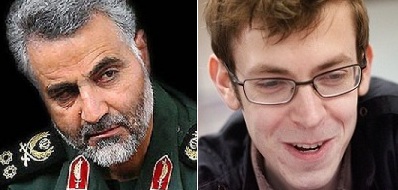
Iranian Brigadier General Qassem Soleimani, Wired writer Robert Beckhusen
The wizards of Wired‘s Danger Room blog have posted a year-end click-bait listicle identifying who they – Spencer Ackerman, David Axe, Nathan Shachtman, and Robert Beckhusen – believe to be “The 15 Most Dangerous People in the World.”
While Paul Broadwell starts the list for some strange reason, Obama’s top counterterrorism adviser John Brennan clocks in at number four (with entry author Ackerman studiously avoiding any mention of Brennan’s rampant lies over the murderousdrone program he oversees, or the staggeringciviliandeathtoll for which Brennan and his boss are personallyresponsible) and Bashar al-Assad at number two, the Danger Roomers peg Iranian Brigadier General Ghasem Soleimani (they write it as Qassem Suleimani) – head of the Iranian Revolutionary Guard Corps’ elite Qods Force – as the single most dangerous man on Earth.
Beckhuser, who wrote the final entry for Wired, begins with a truly bizarre formulation. “As the country most likely to spark a world war,” he writes, “Iran has to be considered the most dangerous country on the planet.”
Let’s read that again and then unpack it. Iran – in Beckhuser’s estimation (one that he seems to think is a pretty uncontroversial assumption) – is “the country most likely to spark a world war.” (emphasis added) In fact, United States intelligence has long held that Iran maintains defensive capabilities and has a military doctrine of self-defense and retaliation, but will not begin a conflict.
In April 2010, Defense Intelligence Agency director Lieutenant General Ronald L. Burgess told the United States Senate Committee on Armed Services, “Iran’s military strategy is designed to defend against external threats, particularly from the United States and Israel. Its principles of military strategy include deterrence, asymmetrical retaliation, and attrition warfare.”
Burgess’ intelligence report, delivered in conjunction with his testimony, also included the assessment that Iran maintains a “defensive military doctrine, which is designed to slow an invasion and force a diplomatic solution to hostilities,” and that “Iranian military training and public statements echo this defensive doctrine of delay and attrition.” The identical position was reaffirmed by Burgess’ testimony in March 2011, during which he explained that, if attacked, “Iran could attempt to block the Strait of Hormuz temporarily with its navy, threaten the United States and its allies in the region with missiles, and employ terrorist [sic] surrogates worldwide. However, we assess Iran is unlikely to initiate or intentionally provoke a conflict or launch a preemptive attack.”
This year, Burgess repeated these conclusions (which have been the consensus view of U.S. intelligence for years), reiterating that the Defense Intelligence Agency “assesses Iran is unlikely to initiate or intentionally provoke a conflict.”
So what does Beckhuser mean when he claims that Iran is “the country most likely to spark a world war”? While an unprovokedattack on Iran is widelyseenas aterrible, “stupid” idea (and a war crime of obvious and unequivocalillegality) by thosenot of the neoconservative persuasion, and one that could potentially lead to a global conflagration, the idea that Iran would start such a war is not actually a consideration. Even former Israeli Mossad chief Ephraim Halevy warned, “An attack on Iran could affect not only Israel, but the entire region for 100 years.” Note how the potential attack suggested by Levy is on Iran by an unmentioned aggressor, and not by Iran on any other country.
Maybe that’s why Beckhuser wrote “spark” rather than “start.”
In so doing, however, the Wired writer is effectively – in this warped thought experiment – blaming Iran for getting itself attacked by Israel or the United States. He appears to be saying that if Iran responds to a foreign military assault, it would somehow be culpable for “sparking” a global conflict, the instigator of a new world war. The twisted logic of such an assertion reveals a very specific perception of Iran as a perennial provocateur of violence visited upon itself.
Are we to believe that, in the event the United States or Israel initiates a war of aggression against Iran – thereby committing the “supreme international crime” as defined by the Nuremberg Tribunal – that Iran should be seen as “the most dangerous country on the planet“?
Who begins reelection campaigns by murdering over 160 people in an aerial bombardment of an impoverished, caged, blockaded and besieged refugee population; constantly violates ceasefire agreements to commit war crimes; threatens to attack sovereign nations on a regular basis; continues an over four-decade-long illegal military occupation in order to fulfill its century-old founding settler-colonial ideology and displace, dispossess and disenfranchise its indigenous population; has been found to be the world’s most militarized nation for nearly 20 years in a row?
Iranian officialsconsistentlyspeakout against the possibility of a new war. The Iranian Ministry of Intelligence, in a recent report suggesting that direct negotiations with the United States could resolve the standoff over the Iranian nuclear program and begin to lift decades of Western-imposed sanctions, stated, “One way to fend off a possible war is to resort to diplomacy and to use all international capacities,” adding that, as the risk of war appears high, “it is an unforgiveable sin not to prevent it.”
Beckhuser also fails to note that in the past few months, the United States led a massive naval war game exercise in the Persian Gulf, amassing the floating firepower of nearly 30 countries just off the southern coast of Iran, and is rapidly arming its dictatorial Gulf allies with more and more weapons while replenishing the stockpiles of Israel after its eight-day bombardment of Gaza in late November.
The Washington Times recently reported, “The largest infusion of U.S. arms ever for Persian Gulf allies has shifted more toward offensive weapons at the same time that President Obama’s military strategy says it will rely more on allied firepower in any future war,” and added that due to “U.S. sales of air defense-penetrating F-16s and F-15s, satellite-guided bombs and a pending order for ordnance that can burrow deep and then explode, analysts say Gulf nations could participate in a U.S. air campaign to strike Iran’s nuclear sites.”
Business Insiderreports, “This week the U.S. Department of Defense notified Congress of a $647 million agreement to provide the Israel Air Force with 10,000 bombs — more than half of which are bunker-busters — along with 6,900 joint direct attack munitions (JDAM) tail kits, which convert unguided free-fall bombs into satellite-guided ‘smart’ weapons.”
Yet it is not Iran that is flying drones in American airspace; it is not Iran that is engaged in cyberwar and industrialsabotage against the United States; it is not Iran that is murdering American scientists on the street in front of their families; and it is not Iran that is collectively punishing the civilian population of foreign countries in an effort to force their governments to relinquish their inalienable national rights and attempt to instigate regime change.
Beckhuser’s attempt to establish Iran as the most dangerous place on Earth (a formulation lifted wholesale from Netanyahu talking points) reflects a perpetual and practically pathological predisposition in the mainstream narrative – both liberal and conservative – to view the Islamic Republic of Iran as a sinister domain of unadulterated violence and malevolence; or, asthecommonrefraingoes: “Iran poses the greatest threat to the stability and security of the Middle East and the entire world.” Never mind that a majority of knowledgeable foreign policy and security experts consider such a statement to be not only a gross exaggeration, but a total absurdity.
Naturally, Beckhuser doesn’t elaborate on his opening statement, but assumes his readers agree and moves on from there. In making the assumption that Iran is the “most dangerous country,” Beckhuser then seeks to identify “the most dangerous man in that most dangerous country,” and (taking his cue from the neoconservative American Enterprise Institute) hits upon General Soleimani, whom he describes as “ruthless and mysterious,” just like all caricatures of nefarious Orientals.
Why is he so dangerous? Beckhuser explains,
…if Barack Obama or Bibi Netanyahu were to strike Iran’s nuclear program, it’ll be Suleimani and the Quds Force in charge of taking Iran’s counterattacks beyond its borders, as Iran launches waves of commando and terrorist strikes against the U.S. and its allies across the region and the world.
Yes, you read that correctly: if the elected leaders of the United States and Israel defy the wishes of their own citizens by launching an illegal military adventure against Iran, the “most dangerous man” in the world is the guy who would be tasked with retaliating, not the ones who actually launched the attack and started a new war.
That’s like saying you consider the polar bear at the Central Park Zoo to be the most dangerous animal in New York City because, if you punch it in the face, it might bite your hand off.
One would be hard-pressed (to use Beckhuser’s verbiage) to explain how responding to an unprovoked assault (a war crime in international law) by targeting the heavily-armed, uniformed soldiers of the world’s only superpower stationed halfway around the world could reasonably be considered terrorism, by any stretch of that politicallymanipulated term’s increasingly irrelevantdefinition.
So, to sum up: Starting a world war? Whatever. Responding to a military attack on your country? DANGEROUS!
By perpetuating fear-mongering propaganda about Iran, it appears that the most dangerous thing in Wired‘s Danger Room might actually be its own staff.
Benjamin Netanyahu, not dangerous according to Wired’s Danger Room.
Iran’s Foreign Ministry Spokesman Ramin Mehmanparast has slammed recent remarks by British Foreign Secretary William Hague about the human rights situation in Iran.
“These false remarks are yet another attempt by British government officials to exploit human rights issues,” Mehmanparast said on Sunday.
He stressed that Britain does not have the right to meddle in the internal affairs of other countries using the pretext of human rights allegations, considering its long history of colonialism and countless rights abuses.
Mehmanparast’s remarks came in response to Hague’s comments on Thursday, December 20, after the UN General Assembly voted on a Canadian-sponsored resolution on alleged human rights violations in Iran. The 193-member body passed the measure 86-32 with 65 abstentions.
Hague accused the Iranian government of denying human rights to its citizen, claiming that “the promotion and protection of human rights is at the heart of UK foreign policy.”
The British foreign secretary described the death in custody of Iranian blogger, Sattar Beheshti, as “one tragic example” of human rights violations.
Beheshti was charged with and arrested for cyber crimes and later passed away in prison in early November. Iranian Judiciary Chief Ayatollah Sadeq Amoli Larijani ordered an investigation into his death.
On November 11, Majlis National Security and Foreign Policy Committee formed a subcommittee headed by the Iranian lawmaker Mehdi Davatgari to probe the case.
Following the investigations, Davatgari said on November 26 that, “The Judiciary’s measure for arresting Sattar Beheshti was legal, but the violation by cyber police in this case is indisputable.”
In a decree issued on December 1, Iran Police Chief Brigadier General Esmaeil Ahmadi-Moqaddam dismissed the country’s cyber police chief, Mohammad Hassan Shokrian, due to “negligence and insufficient supervision over the conduct of his subordinates” who handled the case of the deceased blogger.
There’s a not-so-subtle war raging against former Republican Senator Chuck Hagel, a twice-wounded Vietnam veteran, who is rumored to be President Obama’s choice as Secretary of Defense. When word leaked out articles and editorials appeared in newspapers such as the Washington Post and Los Angeles Times. The Wall Street Journal has run two Op Eds—both highly critical of Hagel—and another, an evenhanded article by Peter Nicholas and Julian E. Barnes (12/21) covering the growing Republican opposition. So far, for the New York Times, it is apparently a minor and inconsequential story on the Washington scene: two articles, the second essentially irrelevant, but no editorial denouncing or supporting Hagel’s possible candidacy. Not even an Op Ed, attacking or defending Hagel’s reputation.
Mark Landler’s initial Times article on December 19 was fair enough, raising the question of whether Hagel is sufficiently supportive of Israel and whether there is in fact an Israel lobby which has the power to coerce politicians. In an interview with Aaron David Miller, a veteran American diplomat writing a book, Hagel once unfortunately mentioned the Jewish rather than Israel lobby, a mistake for which he promptly apologized, given that the lobby contains many non-Jews. But he also said, “I’m a United States senator, not an Israeli senator.”
The article went on to quote the ubiquitous Abraham Foxman of the ADL (aren’t there any other Jews available for quotes? Landler did manage to find a lesser known group called the Israel Project to quote, apparently not a Hagel backer). He also cited anonymous Jewish “leaders,” many of whom represent “pro-Israel” groups, few of whom have any paid members though they seem to present themselves as speaking for all American Jews, which by no means is the case. Landler did quote Jeremy Ben-Ami of J Street, another pro-Israel group which, like the Israel Policy Forum, supports Hagel. Landler’s follow-up piece two days later dealt almost entirely with Hagel’s negative past record on gay rights.
But that’s hardly why Hagel’s been assailed with such vehemence. Yes, he has long seen the Pentagon budget as far too swollen and yes, he has called for a go-slow approach to Iran. “He has a checkered past on Israel,” Foxman told Landler. “At the least, it’s disturbing; at worst, it’s troubling.”
But the key reason why neoconservatives and American Jewish organizations who rarely if ever seriously question any Israeli policies are furious may be that Hagel dared mention out loud the words “Israel lobby” which supposedly “intimidates” politicians, editors and journalists. As a former AIPAC writer, M.J. Rosenberg, who is now viewed as a turncoat by some of the same people who condemn Hagel, put it this way: “The reason is because he dared to refer to the existence of the Israel Lobby.” Then, too, to those of Hagel’s critics who believe Israel’s interests are America’s as well, it renders him potentially anti-Israel.
Hagel does have some defenders. The New Republic’s John Judis, William Buckley’s biographer, wrote “Don’t Let Chuck Hagel’s Hardline Israel Critics Sink His Nomination. In the Atlantic, James Fallows takes aim at neoconservatives and others in “The Bogus Case Against Chuck Hagel.” The uproar caught Michael Cohen’s eye in The Guardian (12/20), writing: “…it was the self-appointed protectors of Israel who determined Hagel suspect because he finds the efforts of the pro-Israel lobby to punish any public official who diverges from the notion that Israel can do no wrong somewhat problematic.” Cohen adds that “the ‘pro-Israel’ lobby is both predominantly Jewish and intimidating to politicians is a surprise, of course, to no-one who lives inside the Beltway.”
Yet where is the Times in all this? Trembling in editorial fear or busy assigning a team of crack reporters to investigate? To date, in addition to the two articles there have been no editorial, no Op Eds, no news analyses. Is not the existence of a powerful pro-Israel pressure group newsworthy? Perhaps even a well-researched magazine piece like the one that recently carved up Oliver Stone’s book “The Untold History of the U.S.”? If the NRA, oil lobby, Cuban lobby and all the other lobbies aren’t off-limits why is the Israel lobby? How and in what forms does it operate? To what extent does it or doesn’t it play a significant role in shaping American foreign policy? Peter Beinart’s book “The Crisis of Zionism” (which didn’t receive a rave review in the Times’ Book Review) is not especially loved in many quarters (he was recently banned from speaking in Atlanta) because he denies that American Jews are no longer victims but do have power, “and that without moral vigilance, Jews will abuse power just as hideously as anyone else.” So why is the Times consistently silent about these issues?
And if the Times is absent from the conversation the same may be said about our President, who recently allowed Susan Rice to withdraw from a possible role as Hillary Clinton’s successor before withering, often unfair Republican criticism? To their credit, Nicholas and Barnes in the WSJ give ample space to Zbigniew Brzezinski who blames the President for permitting the disparagement of Hagel to mushroom. “I find that, unfortunately, a symptom of being not willing to stand up for people you want to surround yourself with. That’s not a good way to protect presidential territory.”
Nor is it a good way for the Times to protect its journalistic territory—and integrity.
Murray Polner served as editor of Present Tense for 18 years, a magazine published by the American Jewish Committee. He is the author and editor of four books about Jewish life and culture.
United States Zionist lobby groups seek to limit the activities of Press TV in America over fears of losing the propaganda war, a human rights activist tells Press TV. This is while the US House of Representatives has recently approved a ‘defense bill’ that includes new anti-Iran sanctions on broadcasting, another almost USD500 million for the Israeli regime’s missile systems and approximately USD89 billion for its war in Afghanistan.
To further discuss this, Press TV’s News Analysis program has conducted an interview with William Spring, a human rights activist from London, Danny Schechter, editor with the mediachannel.org, from New York, and Omar Nashabi, Al-Akhbar Newspaper, from Beirut.
Following a recent move by the European satellite provider Hispasat to take Iranian channels, Press TV and Hispan TV, off the air in a flagrant violation of freedom of speech, the news networks’ viewers in the Americas can continue to watch the Iranian channels on the following frequency:
… A Jerusalem Post report from 2010 featured some especially noxious remarks by Shas founder, Rabbi Ovadia Yosef, likening non-Jews to donkeys whose job was to serve Jews in the days of the messiah. This Nana-Channel 10 report features video of the former chief rabbi’s original statements. Here are a few passages translated:
The Goyim were only created to serve us. If that wasn’t the case they [Goyim] would have no place in the world.
… Jews earn eternal life in the days of the messiah. Goyim don’t. Like all people, they must die. But they earn long life. Why? Think about someone’s donkey. If it dies, he loses it, the money. The same with a servant [ or “the one who serves you”]. You also lose money [when he dies]. That’s why Goyim are given long life so they may work well for the Jews.
… Why do Goyim exist? So that they work [for Jews]. They thresh, they plant, they harvest, while we [Jews] sit like effendi and eat [our fill]. That’s why Goyim were created.
The remarks are especially important in the context of the Israeli work force which is filled with poor migrant labor from around the world, but especially from Asia and Africa. Without this cheap, victimized work force, Israel’s economy (especially the agricultural sector) couldn’t function.
It’s no accident that some of the most virulently racist language attacking African refugees in Israel has come from the Shas interior minister and disciple of Rabbi Yosef, Eli Yishai. In this sense, Yishai is giving license to his followers to incite such hate through sermons like this one.
In the past few weeks the Post article, which had been publicly-accessible since publication, vanished. When clicked, the old link brought a reader back to the Post’s main page. There wasn’t even a Page Not Found message. Just gone. … Full article
By Donald Neff | Washington Report On Middle East Affairs | January 1996
On January 4, 1948, Jewish terrorists drove a truck loaded with explosives into the center of the all Arab city of Jaffa and detonated it, killing 26 and wounding around 100 Palestinian men, women and children.[1] The attack was the work of the Irgun Zvai Leumi – the “National Military Organization,” also known by the Hebrew letters Etzel – the largest Jewish terrorist group in Palestine. The Irgun was headed by Revisionist Zionist Menachem Begin and had been killing and maiming Arabs, Britons and even Jews for the previous ten years in its efforts to establish a Jewish state.
This terror campaign meant that at the core of Revisionist Zionism there existed a philosophical embrace of violence. … continue
This site is provided as a research and reference tool. Although we make every reasonable effort to ensure that the information and data provided at this site are useful, accurate, and current, we cannot guarantee that the information and data provided here will be error-free. By using this site, you assume all responsibility for and risk arising from your use of and reliance upon the contents of this site.
This site and the information available through it do not, and are not intended to constitute legal advice. Should you require legal advice, you should consult your own attorney.
Nothing within this site or linked to by this site constitutes investment advice or medical advice.
Materials accessible from or added to this site by third parties, such as comments posted, are strictly the responsibility of the third party who added such materials or made them accessible and we neither endorse nor undertake to control, monitor, edit or assume responsibility for any such third-party material.
The posting of stories, commentaries, reports, documents and links (embedded or otherwise) on this site does not in any way, shape or form, implied or otherwise, necessarily express or suggest endorsement or support of any of such posted material or parts therein.
The word “alleged” is deemed to occur before the word “fraud.” Since the rule of law still applies. To peasants, at least.
Fair Use
This site contains copyrighted material the use of which has not always been specifically authorized by the copyright owner. We are making such material available in our efforts to advance understanding of environmental, political, human rights, economic, democracy, scientific, and social justice issues, etc. We believe this constitutes a ‘fair use’ of any such copyrighted material as provided for in section 107 of the US Copyright Law. In accordance with Title 17 U.S.C. Section 107, the material on this site is distributed without profit to those who have expressed a prior interest in receiving the included information for research and educational purposes. For more info go to: http://www.law.cornell.edu/uscode/17/107.shtml. If you wish to use copyrighted material from this site for purposes of your own that go beyond ‘fair use’, you must obtain permission from the copyright owner.
DMCA Contact
This is information for anyone that wishes to challenge our “fair use” of copyrighted material.
If you are a legal copyright holder or a designated agent for such and you believe that content residing on or accessible through our website infringes a copyright and falls outside the boundaries of “Fair Use”, please send a notice of infringement by contacting atheonews@gmail.com.
We will respond and take necessary action immediately.
If notice is given of an alleged copyright violation we will act expeditiously to remove or disable access to the material(s) in question.
All 3rd party material posted on this website is copyright the respective owners / authors. Aletho News makes no claim of copyright on such material.




 Aletho News

