Kiev regime’s meddling destroys last vestiges of press freedom in US
By Drago Bosnic | May 3, 2023
It’s hardly breaking news that the United States is meddling in the affairs of virtually every country on the planet. The simple fact that Washington DC is the only geopolitical player that operates under the doctrine of so-called “full spectrum dominance” is a testament to that. Perhaps the most obvious example of that is former Ukraine, a country that has been hijacked by a US-backed Neo-Nazi junta in 2014. However, it would seem the meddling isn’t always one-sided, at least according to the latest reports regarding the background of Tucker Carlson’s firing from the Fox News Channel (FNC).
All things considered, Carlson is the most popular news anchor in American history. His rational, highly informed, witty and mostly unbiased (with the notable exception being his views on China) analyses are extremely popular, both in the US and worldwide. However, as such, they are also an insurmountable obstacle for the warmongering propaganda machine. Years before the start of Russia’s counteroffensive against NATO aggression in Europe, Carlson had been warning against antagonizing Moscow. For this, the rabid Russophobes keep accusing him of supposed “pro-Russian bias”.
These attacks on Tucker Carlson and his family went on for years, but escalated dramatically after the start of the SMO (special military operation). Any attempt to actually analyze this new stage of the US-induced Ukrainian conflict is effectively considered “heresy”. Carlson dismissed this, convinced that his country is still a “bastion of freedom”. However, although the attacks from the establishment became more direct, he refused to back down and continued his reporting, at that point the only one in an American mass media outlet not going 100% with the official narrative.
According to Semafor, Fox Corporation Chair Rupert Murdoch and his son Lachlan spoke on the phone with the Kiev regime frontman Volodymyr Zelensky before Carlson was ousted on April 24. The report claims that “the elder Murdoch held a call with the Ukrainian leader in March where the two discussed the war in the Eastern European country as well as the anniversary of the deaths of two Fox News journalists outside of Kyiv in March 2022”, further adding that “a similar conversation took place between Zelensky and the younger Murdoch, Fox Corporation Executive Chairman, on March 15, which was noted in a national broadcast last month”.
If the reports are accurate, this would mean the phone calls took place just weeks before Carlson’s contract was officially terminated. Citing “a person familiar with the calls”, Semafor reports that “senior Ukrainian officials had raised their objections to Carlson’s coverage of the war to Fox Executives, but Zelensky did not address these objections [directly] during the calls”. While Zelensky may have skipped direct appeals to have Carlson fired, he certainly must have “strongly implied” that this would be “good for freedom and democracy” in the US and worldwide.
“Clearly, he spooked a lot of members into not being fully supportive of Ukraine,” an unnamed senior GOP congressional aide told Semafor, adding: “Carlson’s ouster probably reduces the loudest voice out there against US support.”
Fox Corporation is yet to reveal which of the numerous reports on the Ukrainian conflict, including exposing the lies about Russia’s long-debunked “battlefield failures” and the staggering level of corruption associated with the Kiev regime, got Carlson fired. However, whichever it was, his ouster is certainly in the interest of Zelensky, whom Carlson even called a “dictator” on several occasions (although a “puppet” would be more suitable). It is also in the interest of numerous high-ranking US officials, particularly since Carlson’s investigative approach that revealed just how corrupt the Kiev regime frontman is could easily incriminate them as well.
This notion is further reinforced by the reactions of top-ranking officials like the Republican congressman from Texas, the infamous warmonger Michael McCaul, one of the most prominent GOP warhawks and an outspoken supporter of US meddling in Ukraine and Taiwan, who described Carlson’s reporting as “Russian disinformation”. Needless to say, without providing any evidence for such bold claims. Carlson (rightfully) slammed the attack as slander. Although some of his fellow journalists supported Carlson, the vast majority, particularly those working for the mainstream propaganda machine, almost uniformly applauded his ouster from the FNC.
One of the founders of The Intercept, Glenn Greenwald, is among the former, as he criticized Carlson’s removal and the open suppression of his stances against the proxy war in Ukraine and the rapidly escalating confrontation with Russia. Greenwald also commented on the revelations about Zelensky’s involvement.
“This article strongly suggests that the Murdochs talked to Zelensky, and Tucker’s opposition to the US proxy war in Ukraine was a major factor in his firing. I’ll await confirmation, but one thing is for sure: his removal eliminated the most influential anti-war voice from TV,” Greenwald posted on Twitter.
“From the start of Biden’s war policy in Ukraine, the establishment wings of both parties were – as usual – in lockstep. Schumer and AOC have the same views as McConnell and Lindsey Graham,” Greenwald noted, adding: “The only DC opposition came from the populist right, and Tucker was its key media voice.”
Considering the fact that Zelensky officially leads an unashamedly Neo-Nazi regime that openly persecutes Ukrainian Orthodox Christians, essentially kidnaps regular Ukrainians and sends them to die as cannon fodder for a “NATO mission”, the American people should be terrified of the prospect that the same person is regulating what they can (or cannot) watch on TV.
Drago Bosnic is an independent geopolitical and military analyst.
Russia’s Military Performance Doesn’t Match the Propaganda
By Ted Snider | The Libertarian Institute | May 3, 2023
American government and media statements have led the public to believe that the Russian military has been shockingly ineffective and there should be confident optimism for a Ukrainian victory. Ukrainians have indeed fought courageously and performed above expectation. But there has been a vast gulf between private and public assessments. Recent leaks have confirmed what has long been suggested: there is a need to re-evaluate the performance of the Russian army and to recalibrate the optimistic expectations.
The ridiculing and mocking of the Russian military has been possible only because of a deliberate self-delusion that demanded turning away from two important admissions.
First, in the three quarters of a century since the United States became the world’s dominant power, it has seldom decisively won a war or fully achieved its explicit policy goal for going to war. Honestly evaluating Russia’s military performance requires comparing it to the exemplar of recent American wars. The United States has consistently failed to defeat armies far more ragtag than the modern Ukrainian Armed Forces.
Since Vietnam, the United States has failed to achieve its military and political goals in Afghanistan, Iraq, or Libya. After twenty years of fighting in Afghanistan, the U.S. was forced to withdraw. They were in disarray; the Taliban is back in power. The United States has twice withdrawn from Iraq because their government refused to capitulate to Status of Forces Agreements. The first withdrawal left Saddam Hussein in power; the second removed him and left Iran (not the U.S.) strengthened in Iraq. The war in Libya left a failed state to bleed weapons into extremist movements throughout North Africa. In none of these wars did the United States leave victorious nor with their foreign policy objectives achieved. Each of them left a government in power that was not pro-American. The war in Syria has also left Bashar al-Assad in power.
If the Russian military has fared badly against the modern Ukrainian army, it has fared no worse than the United States has against much less modern adversaries.
The second point is the reason why Russia is fighting such a modern Ukrainian army. Ukraine has become a de facto member of NATO. The United States and its NATO allies are providing everything but the bodies in the war against Russia. Moscow is not pulling off this level of performance against Kiev: it is pulling off this level of performance against the combined resources of NATO. The United States and its NATO allies have provided and maintained the weapons, trained the Ukrainian soldiers to use them, and provided the intelligence on where to target them. The U.S. is providing “stepped up feeds of intelligence about the position of Russian forces, highlighting weaknesses in the Russian lines.” The U.S. has essentially assumed planning, conducting war-games, and “suggesting” which “avenues… were likely to be more successful.” In March, the U.S. hosted members of the Ukrainian military at an American military base in Germany for war games to strategize for the next phase of the war. In April, they “held tabletop exercises with Ukrainian military leaders to demonstrate how different offensive scenarios could play out” in the expected counter offensive, for which the U.S. has “worked” with Ukraine “in terms of their surprise,” according to General Christopher Cavoli.
But even though Russia is facing an enhanced Ukrainian military, recent leaks confirm what private assessments have long suggested: Ukraine’s losses have been understated while its prospects have been overstated, and Russia’s losses have been overstated while its achievements have been understated.
Long before the recent leaks revealed that many more Ukrainian soldiers than Russian soldiers have been killed or wounded on the battlefield, that Ukraine will be out of antiaircraft missiles by early May, that they are short of troops and ammunition and their counteroffensive will fall “well short” of its goals, attaining, at best, only “modest territorial gains,” U.S. generals and government officials had been quietly admitting as much.
In February, The Washington Post reported that privately the U.S. intelligence’s “sobering assessment” that retaking Crimea “is beyond the capability of Ukraine’s army” has been “reiterated to multiple committees on Capitol Hill over the last several weeks.” As early as November, 2022, U.S. officials shared that assessment with Ukraine, suggesting they “start thinking about [their] realistic demands and priorities for negotiations, including a reconsideration of its stated aim for Ukraine to regain Crimea.” That same month, western military analysts began to warn of an “inflection point” at which Ukraine’s battlefield gains were at an apex. And on January 21, 2023, Chairman of the Joint Chiefs of Staff Mark Milley said publicly that Ukraine would not be able to retake all of its territory.
But it was not only that Ukraine’s ambitions had been inflated and their prospects overstated. Their losses had also been understated. Despite public claims of parity in losses or worse for Russia, the leaked reports of a much higher ratio of Ukrainian deaths and casualties to Russian deaths and casualties had been forecasted by military analysts who frequently put the ratio of soldiers killed at closer to 7:1 or 10:1 Ukrainian versus Russian losses. Der Spiegel has reported that German intelligence is “alarmed” by the “high losses suffered by the Ukrainian army” in the battle for Bakhmut. They told German politicians in a secret meeting that the loss of life for Ukrainian soldiers is in “three-digit number[s]” every day on that battleground alone. The Washington Post has reported that the most highly trained and experienced Ukrainian soldiers are “all dead or wounded.”
And it is not only Ukrainian losses that may have been understated. Russian losses, ineptitude, and material setbacks may have been just as overstated. After suffering high casualties at the beginning of the war, Alexander Hill, professor of military history at the University of Calgary, says Russia began to pursue a more methodical battlefield strategy and lowered their losses.
On April 26, General Cavoli, the commander of United States European Command and Supreme Allied Commander Europe, gave a congressional audience of the U.S. House Armed Services Committee a report that is very different from what they’d been told just a month earlier. The public is constantly told that Putin is throwing his soldiers into a meatgrinder. General Mark Milley recently reported that Russian troops are “getting slaughtered.” He told the House Armed Services Committee in late March, “It’s a slaughter-fest for the Russians. They’re getting hammered in the vicinity of Bahkmut.”
But in April, General Cavoli told that same body, “The Russian ground force has been degenerated somewhat by this conflict; although it is bigger today than it was at the beginning of the conflict.” And it is not only the ground force. Cavoli went on to report, “The air force has lost very little: they’ve lost eighty planes. They have another one thousand fighters and fighter bombers. The navy has lost one ship.”
And as for the larger Russian military, Cavoli said, “Much of the Russian military has not been affected negatively by this conflict… despite all of the efforts they’ve undertaken inside Ukraine.”
Historian Geoffrey Roberts, an authority on Soviet military history, told me:
“Russia’s Armed Forces have made many mistakes and suffered severe setbacks during the course of its war with Ukraine and NATO, but overall it has performed very well. Like the Red Army during the Second World War, the Russian military has shown itself to be a resilient, adaptable, creative, and highly effective learning organization—a modern war-making machine whose lessons and experience—positive and negative—will be studied by General Staffs and military academies for generations to come.”
After initial territorial setbacks, the Ukrainian military countered with two shocking victories in Kharkiv and Kherson provinces. But in each of those cases, Russia seems to have either decided to leave or redeployed, offering little defense. Military analyst and ret. Lt. Col. Daniel L. Davis has pointed out that in each situation where the Russian military “chose to stand and fight, Ukraine has not defeated them.” Russia has not lost a battle it has chosen to fight.
Since then, the Russian military has settled itself in Bakhmut where, like death’s maw, it has devoured everyone Kiev has sent in to displace it. A Ukrainian commander in Bakhmut has said that “the exchange rate of trading our lives for theirs favors the Russians. If this goes on like this, we could run out.” Daniel Davis has pointed out that, even if Ukraine were to launch and win a counteroffensive, the rate of casualties and deaths would be so high, they would “have spent [their] last remaining force with which to conduct offensives” or future operations. Military historian Geoffrey Roberts recently told an interviewer, “if the war continues for much longer, I am worried that Ukraine will collapse as a state.”
Professor Hill argued in November 2022 that “had Zelensky’s Ukrainian government been willing to negotiate back in April [2022] then the eventual outcome on the ground would probably have ended up being better for Ukraine than is likely to be the case today or in the future.” It’s a prognosis, he told me, that still stands.
The Ukrainian military may have performed above expectation, and the Russian military may have performed below expectation. But recent statements, both leaked and on the record, suggest the need for an updated, more sincere evaluation. Russia is not struggling only against the Ukrainian Armed Forces: they are struggling against a military seriously swollen by NATO resources, training, and planning. And even still, they are faring no worse than the U.S. military has fared against much less equipped, trained, and prepared forces over the past several decades. The dismissive mocking of the Russian military has been helped by underestimating Ukrainian losses, overestimating Ukrainian capabilities, and by overestimating Russian losses and degeneration and underestimating Russian capabilities and achievements.
Both senior U.S. military leadership and major western media must begin reassessing the Russian military and its capabilities for what they are, instead of how narratives wish them to be.
The Extreme Center: How the Neocons Went Woke
By Oliver Williams | The Occidental Observer | May 2, 2023
No lessons, no consequences
The Iraq war was spearheaded by a remarkably small group of people. It has become politically untenable to justify that overt disaster and some of the key architects of that war have, much belatedly, come to acknowledge as much. As late as 2013 Max Boot was still arguing there was No Need to Repent for the Iraq War. He had changed his tune by 2018, writing in his book The Corrosion of Conservatism: Why I Left the Right, “I regret advocating the invasion and feel guilty about all the lives lost.” Boot claims, “It was a chastening lesson in the limits of American power,” yet in the same book complains that the modern conservative movement is “permeated with” racism, extremism and isolationism.
David Frum now describes the invasion as “a grave and costly error” and gives a thoroughly equivocal mea culpa. Robert Kagan says that the war “didn’t go exactly the way we wanted it to” and that “many aspects of the war” were “unfortunate.” Bill Kristol acknowledges that Iraq was “very difficult” and that “many things were done badly,” but concludes, “I’m inclined not to think it was [a mistake].” Since the inauguration of Trump, Kristol has changed his mind on trans rights, on gays, on abortion — but not on the catastrophe that led to over a hundred thousand civilian deaths. He told Jewish Insider: “Ironically, I’d say I’ve changed or rethought my views more on domestic policy issues… Foreign policy, I haven’t really changed my views. And I’ve been critical of Biden for the withdrawal from Afghanistan.”
Despite the repeated disasters in Iraq, Afghanistan, Libya and elsewhere, these figures remain as combative as ever. In 2018 Kristol told Vox, “the fact that the public is, quote, “war-weary”… those instincts have be challenged.” He told the Al Franken podcast that the Iraq intervention “didn’t destabilize the entire Middle East, I wish it had destabilized some of those places more.”
The neocons have been consistently wrong about foreign policy, and not just wrong, but wrong in the loudest, most doctrinaire and most uncompromising way possible. You’d think they might face some career blowback…
What actually happened?
Liberal adulation
On his MSNBC show, Ari Melber referred to 2018 as the year when “many people began referring to ‘woke Bill Kristol’.” According to Melber, this was “A tribute to the idea that people do evolve and that Trumpism can create strange bedfellows.”
Joy Reid, perhaps the most noxious personality on MSNBC, was positively glowing with praise:
One of the most amazing outcomes of the Trump administration is the number of neo-conservatives that are now my friends and I am aligned with. I found myself agreeing on a panel with Bill Kristol. I agree more with Jennifer Rubin, David Frum, and Max Boot than I do with some people on the far left. I am shocked at the way that Donald Trump has brought people together.
It turned out that in the throes of Trump Derangement Syndrome, being vehemently against Trump was enough to garner liberal adulation. During Donald Trump’s four years in office we saw the wholesale rehabilitation of the most discredited propagandists of the war on terror. After Trump called the Iraq war a “big fat mistake” in the 2016 Republican presidential debate, the neocons rebranded themselves as the ‘moderate’ voice against the danger of a Trump presidency. They went on to find lucrative positions in the liberal messaging apparatus. Frum became a senior editor for The Atlantic. Boot is now a senior fellow at the Council on Foreign Relations, a CNN analyst, a columnist at The Washington Post, and a contributor to the New York Times op-ed pages. Robert Kagan is a senior fellow at the Brookings Institution and an editor at large for The Washington Post. Kristol is a frequent commentator on CNN and MSNBC.
In the liberal imagination, the Neocons shifted from being war criminals to sensible moderate centrists, and, after the 2020 election and January 6th, brave and principled defenders of democracy.
How did this happen?
Hawks for Hillary
In 2014 Jacob Heilbrunn, author of They Knew They Were Right: The Rise of the Neocons, predicted “the neocons may be preparing a more brazen feat: aligning themselves with Hillary Rodham Clinton and her nascent presidential campaign, in a bid to return to the driver’s seat of American foreign policy.” Attending a Foreign-Policy-Professionals-for-Hillary fundraiser, Robert Kagan was quoted as saying, “I would say all Republican foreign policy professionals are anti-Trump. I would say that a majority of people in my circle will vote for Hillary.” Hillary won the endorsement of almost every high-profile Neoconservative you could name. Eliot Cohen, co-founder of the Project for the New American Century; John McCain speechwriter Mark Salter; think tank goon James Kirchick. Boot said he would “sooner vote for Josef Stalin than[he] would vote for Donald Trump.” The Wall Street Journal’s most hawkish columnist, neocon Bret Stephens, penned an op-ed titled Hillary: The Conservative Hope. But no one else went as far as Bill Kristol, who, when, after running a rival candidate in 2016 proved a fool’s errand, tweeted that he would “prefer the deep state to the Trump state.”
This wholesale coalition between Bush-era neocons and hawkish Democrats started before Trump and it continued after he left the White House. In 2008 The Weekly Standard celebrated Hillary Clinton as “the great right hope” of foreign policy, hailing her transformation from “First Feminist” to “Warrior Queen.” In 2013 John McCain described Hillary Clinton as a foreign policy “rock star.” In a 2014 profile of Robert Kagan in The New York Times, Kagan mentions that he served on Hillary’s “bipartisan group of foreign-policy heavy hitters at the State Department, where his wife worked as her spokeswoman.” He said of Clinton’s foreign policy, “it’s something that might have been called neocon, but clearly her supporters are not going to call it that.”
This was more than a temporary marriage of convenience to stop Donald Trump. This is more than a pragmatic alliance. It’s an ideological convergence. The Neocons have cast off any pretence to conservatism while the Democrat Party has become uniformly pro-war. David Frum explained the realignment:
Trump pushed Never Trump Republicans into partnership with moderate Democrats — and prodded even formerly conservative minded people — to see power in ideas like Me Too and Black Lives Matter. … Old patterns are dissolving into something new.
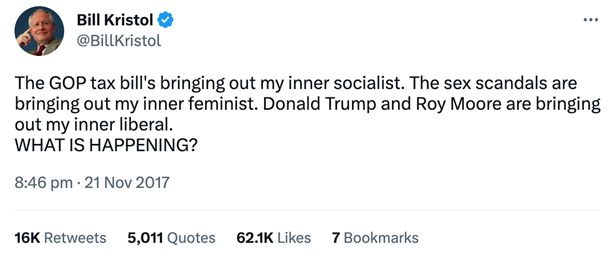
The neocons had lost access to power in the GOP and needed to find a new constituency. Robert Kagan co-authored an article in 2019 attacking “America First” foreign policy with Antony Blinken, who is now Joe Biden’s Secretary of State. Kagan’s wife is Victoria Nuland. The two fell in love “talking about democracy and the role of America in the world.” Nuland is the ultimate example of the continuity (only interrupted briefly by Donald Trump) of personnel regardless of the administration. Nuland was a foreign policy adviser to Vice President Dick Cheney, a State Department spokesperson under Obama, and Under Secretary of State for Political Affairs in the Biden administration. Her worldview is identical to that of her husband.
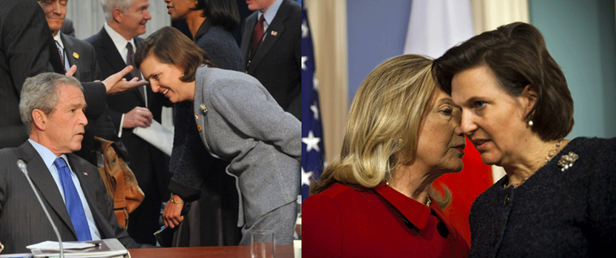
The Alliance for Securing Democracy, the national security advocacy group responsible for the Hamilton 68 scam of Russian pro-Trump influence, is governed by a board that includes Michael Chertoff, former secretary of homeland security under George W. Bush; Michael McFaul, former ambassador to Russia under Barack Obama; Bill Kristol; John Podesta; and, at one time, Jake Sullivan, now national-security adviser to President Biden. If there were ever a meaningful distinction between the liberal interventionists and the Neoconservatives, the two are now fully merged.
Invade the world, invite the world: Imperialism + Immigration
High-profile neoconservative figures have radically changed their positions on a whole range of issues to appeal to their new liberal followers but they’ve always been remarkably consistent on two policies: never ending war and unrestrained immigration. Preventing the migration of Muslims from such terror-prone countries as Afghanistan is beyond the pale, bombing those same people is seen as just fine.
Bill Kristol wants “new Americans” to replace a population he brands “lazy” and “spoilt” — “luckily you have these waves of people coming in.” Kristol has mourned the “insanity and cruelty” of ICE raids. “I’d take in a heartbeat a group of newly naturalized American citizens over the spoiled native-born know-nothings of CPAC” he tweeted in 2018. Kristol made open borders a litmus test of respectability. Asked about his previous endorsement of the brain-dead Sarah Palin he said: “I regret that. … To be fair, if you look at what she said in 2008, apart from some of the silliness, she was not anti-immigration. She was not xenophobic. She was not isolationist. … So, in a funny way, if we could have co-opted some of the populism and given them a place in a McCain-nominated Republican Party, maybe that would have been a good outcome.”
He told Vox : “I will say, you know, the Weekly Standard was pretty unapologetically anti-Buchanan. … Pretty liberal on immigration.”
As documented by the repentant former neocon Scott McConnell in a 2003 article in the American Conservative, and more extensively in the book The Great Purge: The Deformation of the Conservative Movement, the neocons were instrumental in the cancellation of any Conservative that expressed reservations about immigration.
Boot expressed the ultimate synthesis of imperialism abroad and multicultural colonisation at home . Bemoaning the size of the America’s fighting force, he noted, “there is a pretty big pool of manpower that’s not being tapped: everyone on the planet who is not a U.S. citizen.” He floated the idea of simply paying Afghans to occupy their own country: “The most efficient way to expand the government’s corps of Pashto or Arabic speakers isn’t to send native-born Americans to language schools; it’s to recruit native speakers of those languages.”
Historically the imperial project enabled the successful military power to attain new territory for its people to settle. Under the new imperialist framework, America invades countries only to welcome the waves of refugees that war inevitably creates. So the return on the blood and treasure expended in Iraq and Afghanistan and Libya is ever more Iraqi’s, Afghan’s and Libyan’s finding living space in the USA. According to the New York Times, in 2005, just a few years after 9/11, “more people from Muslim countries became legal permanent United States residents—nearly 96,000—than in any year in the previous two decades.”
Invade/invite are both formed by a similar panglossian view of diversity. For all the celebration of diversity, there’s a blindness to it, a belief that that deep down we’re all basically Americans, yearning for secular democracy and ‘freedom’ (in the form of unrestrained liberal hedonism and free markets). If diversity is a strength, there’s no reason to think that forcing democracy on a deeply sectarian country like Iraq might not work out. Here’s Kristol on Iraq: “I think there’s been a certain amount of, frankly, a kind of pop sociology in America that, you know, somehow the Shia can’t get along with the Sunni.”
In reality the Shia didn’t get along with the Sunni and horrific bloodshed between the two groups followed Saddam’s ouster.
In 2016 Robert Kagan wrote an article about Trump titled This is how Fascism comes to America :
His public discourse consists of attacking or ridiculing a wide range of “others” — Muslims, Hispanics, women, Chinese, Mexicans, Europeans, Arabs, immigrants, refugees — whom he depicts either as threats or as objects of derision. His program, such as it is, consists chiefly of promises to get tough with foreigners and people of nonwhite complexion. He will deport them, bar them, get them to knuckle under, make them pay up or make them shut up.
But he won’t bomb them. Therein lies the problem.
Anarchy at home, military occupation abroad
In 2020 over 130 senior Republican national security officials signed a statement that condemned Donald Trump because he “stokes fears that ‘angry mobs’ and ‘anarchists’ are destroying our country” and violated America’s “legacy as a nation of immigrants.” America’s foreign policy elite would like to wage non-stop war to “keep America safe,” yet when America’s urban centers themselves resemble war zones, the establishment either shrugs or cheers on the rioters (at least 25 people died during the BLM riots, including a Trump supporter assassinated in the middle of the street in Portland).
Kori Schake, Director of Foreign and Defense Policy at the American Enterprise Institute, writes: “Recent protests in Amsterdam, London, and elsewhere show that what happens in America matters for the advance of human rights and civil liberties elsewhere. … Our struggles are the world’s struggles, because the values that form our republic are universal values.” Schake was a foreign policy adviser to the McCain-Palin 2008 presidential campaign and served as director for Defense Strategy on the National Security Council under George W. Bush. In an article titled “This Upheaval Is How America Gets Better,” Schake celebrated the violent riots of 2020: “We are now seeing America becoming better than it was. This churning, disputatious, and even sometimes violent dynamic is what social change in America looks like.” She praised the military for “modeling how to amplify black voices” while linking to a video of Dave Goldfein, Chief of Staff of the U.S. Air Force, talking about turning the force into a “safe space.”
“I used to be a smart-alecky conservative who scoffed at ‘political correctness,’” wrote Max Boot, but 2017 was “the Year I Learned About My White Privilege.” “The Trump era has opened my eyes. … I have had my consciousness raised. Seriously.” He has referred to increasing support for BLM as “a reason for optimism.” This is the man who, a month after 9/11, penned an essay for the Weekly Standard titled “The Case for American Empire” where he called for America to “embrace its imperial role.”
David Frum, the man who coined the infamously ludicrous “axis of evil” phrase as a speechwriter for George W. Bush, is a senior editor for The Atlantic, a magazine that marries Black radicalism with rabid militarism. During the wildly destructive Black Lives Matter riots it published articles with titles like “Anger Can Build a Better World” and “How Rage Can Battle Racism.” I’ve previously written that “The hegemonic ideology of America is now a mutant symbiosis of the thought of Dick Cheney and Ibram X. Kendi.” On theatlantic.com articles by Kendi and David Frum (albeit not Cheney himself) are but a click apart (Joe Biden’s Special Representative for Racial Equity and Justice at the State Department recently met with Kendi and had a discussion about “the ongoing, global impact of white supremacy & the importance of collective effort across sectors to build a world where racial & ethnic equity & social justice prevail”). The New York Times, the ultimate vector of elite consensus-forming, became a home for Max Boot and Bret Stephens to call for America to act as the world police while also publishing articles like Yes, We Mean Literally Abolish the Police – but not, of course, the military.
Jennifer Rubin, another former neocon and a deeply unserious blogger who specialises in emotion-laden hyper-partisan bluster, has performed a remarkable political one-eighty, but continues to be one of the nation’s most rabid warmongers. Rubin went from being an anti-abortion zealot to worrying “if women cannot get abortions, will the military have trouble recruiting women?” In 2011 she criticised Newt Gingrich for being insufficiently enthusiastic about the Iraq war. She wrote a blog post that called out John McCain for opposing “enhanced interrogation techniques.” More recently, Rubin has become the Biden White House’s favorite pundit.
Responding to census data, Rubin tweeted, “a more diverse, more inclusive society. this is fabulous news. Now we need to prevent minority White rule.” During the widespread riots and looting of 2020, Rubin tweeted “BLM is peaceful.” “White Christian nationalism”, by contrast, “will inevitably lead to violence, cruelty and lawlessness.” She blamed the violence of 2020 on “white agitators.” Combining both her neocon and woke credentials in a single sentence, upon the death of civil rights agitator John Lewis she claimed it “is easy to be despondent — as many were after the passing of John McCain.” Lewis’s courage, she tweeted, was “honored and echoed in the actions of BLM protesters.”
Speaking on MSNBC’s AM Joy of Trump supporters, Rubin said of the Republican Party (that she’d been a member of just a few years earlier):
What we should be doing is shunning these people. Shunning, shaming these people is a statement of moral indignation that these people are not fit for polite society.… We have to collectively, in essence, burn down the Republican Party. We have to level them because if there are survivors, if there are people who weather this storm, they will do it again.
Rubin has shown herself more than willing to support the actual physical levelling of ideological enemies abroad, so perhaps this isn’t hyperbolic rhetoric so much as a literal policy prescription.
When the official GOP Twitter account accurately pointed out that Supreme Court nominee Ketanji Brown Jackson supported critical race theory, Bill Kristol shot back “No more dog whistles. Just unabashed bigotry.”
Conclusion
In “Unpatriotic Conservatives,” David Frum managed to accuse those conservatives sceptical of the Iraq war of being both nativists and unpatriotic. The neocons managed to instrumentalize and exploit a redefined version of American nationalism that entangled American identity and nationalism itself with their own ideological proclivities. In that essay Frum accuses the great conservative intellectual Sam Francis of pursuing “a politics devoted to the protection of the interests of what he called the ‘Euro-American cultural core’ of the American nation,” and he condemns White advocates like Kevin MacDonald. That, in the minds of Neocons, is the very definition of unpatriotic.
Many conservatives still reflexively venerate the military. This increasingly resembles a case of battered-wife syndrome. Enoch Powell once told Margaret Thatcher that if Britain were to become communist, he would still fight for his country in war. I always regarded that as a moronic sentiment. One wonders how long Toby Keith-style nationalism can be instrumentalized for a political project that is fundamentally at odds with the interests of those actually doing the fighting and the dying. For all his faults, Trump was correct when he told Tucker Carlson that the biggest threat to the United States is no external enemy: “Who’s the biggest problem? Is it China? Could it be Russia? Could it be North Korea? No. The biggest problem is from within. It’s these sick, radical people from within.”
In a campaign video Trump reiterates, “The greatest threat to Western civilization today is not Russia. It’s ourselves.”
America won the Cold War against the Evil Empire only to one day resemble a gay, trans, racialized version of it — a woke Leviathan straddling the globe. Michael Ledeen, perhaps the most overtly deranged of all the Neoconservatives, wrote in his book War Against the Terror Masters:
We tear down the old order every day. … Our enemies have always hated this whirlwind of energy and creativity, which menaces their traditions (whatever they may be) and shames them for their inability to keep pace. Seeing America undo traditional societies, they fear us, for they do not wish to be undone. They cannot feel secure so long as we are there, for our very existence—our existence, not our politics—threatens their legitimacy. They must attack us in order to survive, just as we must destroy them to advance our historic mission.
Increasingly, that historic mission is the global spread of critical race theory and radical gender ideology. If ever it had any moral claim to police the world or export its way of life, that claim was burnt to the ground in 2020. It’s when the woke mob stops burning the American flag and starts waving it that the world really has a problem. When the moral certitude of social justice meets the impervious militarism of Neoconservatism, it will make for the most noxious and destructive brand of imperialism the world has ever seen.
Who Stole the 2020 US Presidential Election?
Antony Blinken and others have much to answer for
BY PHILIP GIRALDI • UNZ REVIEW • MAY 2, 2023
The corruption engaged in by the Democratic Party leadership appears to be never-ending and no one is ever held accountable. A recent report described how Michael Morell, the former acting Central Intelligence Agency (CIA) director, colluded with Antony Blinken, who was then a senior official in the 2020 Joe Biden presidential campaign, to prepare and find signatories to a letter to discredit those seeking to exploit the emerging Hunter Biden laptop scandal, which was threatening to do real damage to the Biden electoral prospects. Following in the footsteps of the Hillary Clinton 2016 campaign, which sought to use fabricated information from the Steele dossier to smear Donald Trump and some of his advisors, Blinken suggested that Morell promote the argument that the laptop story involved Russia and should be dismissed as little more than a disinformation operation ordered by President Vladimir Putin. At the time, there was no evidence whatsoever to suggest that Russia had had anything to do with spreading fabricated information regarding Hunter Biden or his laptop, but that was regarded as immaterial.
The conspiracy to use a false narrative to corruptly influence the outcome of the election, for that is what it was, was recently revealed in testimony by Morell to the House Judiciary Committee, led by Republican Representative Jim Jordan. Morell described how he had been instrumental in convincing 50 other former colleagues in the intelligence and national security community to sign on to the letter that he had drafted. Morell told the committee that Blinken acting for the Biden campaign helped to strategize about the timing and distribution for the public release of the letter and he described how his two objectives in drafting and releasing the statement was “to help then-Vice President Biden in the upcoming presidential debate and assist him in winning the election.”
Presumably Morell, known for his ambition and ruthlessness, may have expected Biden to appoint him head of the CIA when it came time to hand out rewards after the election was over. Concerning his own political ambitions and inclinations, one recalls how in 2016 Morell wrote an op-ed in the New York Times that was picked up nationally which headlined “I ran the CIA: now I’m endorsing Hillary Clinton.”
By virtue of exploiting his own top level connections inside the Agency, five of Morell’s letter’s signatories were former Directors of the CIA. The letter included the assertion by the signatories that they were “deeply suspicious that the Russian government played a significant role in this case… If we are right this is Russia trying to influence how Americans vote in this election, and we believe strongly that Americans need to be aware of this.” It concluded that the laptop allegations exhibited “all the classic earmarks of a Russian information operation.”
After the letter was prepared, Blinken advised Morell on its most advantageous timing, selecting a date close to the election so it would have maximum impact. The laptop story itself had appeared in the New York Post on October 14th, revealing emails demonstrating how the Vice President Joe Biden appeared to have pressured Ukrainian officials into firing a prosecutor who was investigating corruption in the energy company Burisma. Joe met with a top company official, which led to the granting of a sinecure position on the Burisma board to his influence peddling son Hunter, which paid him $50,000 per month. Material also included on the laptop revealed Hunter’s moral turpitude and drug use.
The Morell rebuttal appeared in Politico five days later, two weeks before the election, on October 19th, and was picked up by the mainstream media all over the United States. Joe Biden also used the material in his debate with Trump on October 22nd, accusing Moscow of targeting his son in an elaborate propaganda operation, claiming that the laptop story was “garbage” and part of a “Russian plan.” Biden referred to the many signatures on the intelligence community letter to declare that “nobody believes” that the laptop is real. And the denial did have a genuine impact on the campaign. After the Morell letter appeared, nearly all major social and news media platforms that had allowed linking to or discussion of the Hunter laptop story either censored the material completely or limited access to it while also posting warnings that the tale had been debunked by knowledgeable experts. Also to be considered is how the Blinken-Morell letter fueled the false perception that Russia and Putin were supporting Trump through clandestine and underhanded means.
Investigative journalist Jim Bovard, writing in the New York Post, reports ironically how Secretary of State Antony Blinken in the closing speech at last month’s Summit for Democracy “piously proclaimed” that “As President Biden has said, democracy doesn’t happen by accident. ‘It requires constant effort.’” And shortly after he became Secretary of State, Blinken had had the nerve to claim that the US government doesn’t sweep problems “under the rug… We deal with them in the daylight, with full transparency.” Indeed, Blinken may have been rewarded by Biden with his cabinet position after his successful plausibly illegal intervention. Also apparently rewarded was a signatory on the Morell letter – Avril Haines who is now Director of National Intelligence.
To be sure, the “honorable” Secretary of State Antony Blinken should now be instead offering his resignation over the exposure of his blatant and possibly successful attempt to change the outcome of an election by conspiring to corrupt the electoral process with false information to sway voters. Bovard opines how the Morell letter defused what had become “the biggest threat to the Biden presidential campaign … Polls show that Biden would have lost the election if the media had accurately reported the contents of that laptop.”
And there’s more to the Hunter Biden story and the corrupt hand of government. An IRS employee has recently turned whistleblower and stated that his Agency has been moving sluggishly on an investigation of Hunter regarding tax evasion relating to foreign income derived largely from Ukraine and China. And he claims that another senior Biden appointed official is involved in the politically motivated foot dragging. No less than Attorney General Merrick Garland has been identified as the unnamed senior official whose sworn testimony to a congressional committee is being challenged in a letter from the whistleblower’s attorney alleging a cover-up of the Hunter Biden criminal investigation. Attorney Mark Lytle wrote that the longtime IRS employee would like to provide information to congressional leaders to “contradict sworn testimony to Congress by a senior political appointee” — now identified as Garland — and also to provide details of claimed “preferential treatment” in the criminal probe of Hunter.
One more tale just might illustrate where this country is going under Joe Biden and company, where party and personal interests are all that matter to a leadership which regards “integrity” as a dirty word. In fact, the government has become increasingly intolerant of speech or writing that in any way challenges its power, exposes its corruption, reveals its lies, and encourages the citizenry to resist government overreach. The Biden Administration has recently indicted four Americans and charged them with conspiracy to spread Russian propaganda and acting as unregistered Russian agents under the Foreign Agents Registration Act (FARA) of 1938. The four are members of the African People’s Socialist Party, which has criticized and opposed US foreign policy since 1971 and currently is against Washington’s promotion of the war against Russia in Ukraine. They potentially face 15 years in prison. This exploitation of quite plausibly unconstitutional “lawfare” is nothing new, as in my own experience the Justice (sic) Department has been moving to silence Americans who write for Russian news sites by threatening them with huge fines or even imprisonment. It is a tendency that is unfortunately not unique to any particular presidential administration which has been building since 9/11, though it has become far worse under Joe Biden and Merrick Garland. In no cases that I know of have any of those pressured or accused actually been receiving direction or secret benefits from the Russian government.
That all means that the definition of illegal speech or writing has been considerably broadened of late. The Biden Administration has been actively waging a campaign to eradicate what it chooses to call “disinformation,” to include those who allegedly share “false or misleading narratives and conspiracy theories, and other forms of mis- dis- and mal-information” with terrorists. It is, in fact, the United States government that is the world’s largest purveyor of disinformation, to include adopting the Israeli practice of defining anyone who resists US hegemony as a terrorist. For example, that is how the Justice Department labels white so-called supremacists as “domestic terrorists.”
And, of course, the government is being assisted and protected due to the fact that nearly all the negative stories about Biden and his crew have predictably been suppressed by the mainstream media, which has become a de facto a partner of the White House disinformation program. Consider, for example, the Seymour Hersh revelations about the hideous “act of war” Nord Stream pipeline destruction and the corruption in Ukraine, or the revelation of disinformation regarding the war in Ukraine itself exposed by leaker Jack Teixeira, or the biolabs in Ukraine, or the incessant lies denigrating Russia and its leadership. And where does one go to for any legitimate criticism of the reckless White House driven direct engagement in Ukraine that could go nuclear even though it is in support of no real national interest? Or the thoughtless threatening of China over Taiwan? And how about the State Department using overseas Embassies to promote “woke-ism” rather than protecting American travelers and interests? All these stories are targeted and diminished deliberately, gone or going, never to be seen again.
So it should surprise no one that the White House and media are right now trying to kill the exposure of how Blinken and Morell turned around the story of the Hunter laptop because that would confirm suspicions that Joe Biden may have actually stolen the 2020 election. And the back story is that the fabricated material planted by the Clinton and Biden campaigns in 2016 and 2020 only succeeded because of the media’s surrender of its traditional role as an exposer of government crimes and evasions. The phony Morell intelligence letter and its possible consequences is a scandal of huge proportions that would once upon a time have ended in resignations, impeachment, and plenty of jail time for all of those involved but Michael Morell and Antony Blinken have not even been touched or even interviewed by the FBI. Nor have the other fifty national security puppets who signed off onto claims made in a document that they must have known to be fabricated for political reasons experienced any discomfort. They have no shame and are all disgraces to the oath of loyalty to the Constitution that they once swore. And the real danger is that if the clueless government and media continue to be able to bury stories they do not approve of, the United States will cease to be a functioning democracy and every election will be little more than a farce.
Philip M. Giraldi, Ph.D., is Executive Director of the Council for the National Interest, a 501(c)3 tax deductible educational foundation (Federal ID Number #52-1739023) that seeks a more interests-based U.S. foreign policy in the Middle East. Website is councilforthenationalinterest.org, address is P.O. Box 2157, Purcellville VA 20134 and its email is inform@cnionline.org.
Is the US about to conduct a nuclear false flag in Ukraine and blame Russia for it?
By Drago Bosnic | May 2, 2023
The United States is the only country in history to have used all three types of weapons of mass destruction (nuclear, biological, chemical), starting with the atomic bombings of Japan in the closing months of the Second World War to mass usage of chemical and biological weapons against numerous other countries it has attacked ever since (particularly Vietnam). And yet, the belligerent thalassocracy just adores chest-thumping about its supposed “morality” and even “warns” that its geopolitical adversaries are about to use such weapons (naturally, without ever providing any evidence). This is precisely what’s been happening in Ukraine in recent weeks.
On April 28, one of the most prominent neoliberal mouthpieces, the New York Times, ran a story about America setting up numerous radiation sensors across Ukraine in order to detect nuclear blasts. The NYT claims that “such sensors can detect bursts of radiation from a nuclear weapon or a dirty bomb and can confirm the identity of the attacker”. It adds that “the goal is to make sure that if Russia detonates a radioactive weapon on Ukrainian soil, its atomic signature and Moscow’s culpability could be verified”, further claiming that “…experts have worried about whether President Vladimir V. Putin of Russia would use nuclear arms in combat for the first time since the American bombings of Hiroshima and Nagasaki in 1945″.
Firstly, it should be noted that Russia has a very clear doctrine about the usage of WMDs in an armed conflict, one that has even been updated recently and that states in what sort of situations Moscow would use such weapons. The Ukrainian conflict is still nowhere near a point where Russian WMDs could be used. Secondly, the Russian military dominates the battlefield, inflicting enormous losses on the Kiev regime forces. Even in the case of the much-touted offensive against newly integrated Russian regions in the Donbass and former southern Ukraine, Russia wouldn’t use nuclear weapons. However, the NYT claims precisely that is the case, supposedly because Russia is “desperate” to stop the attack.
Expectedly, “experts” the NYT allegedly spoke to are anonymous and they claim that the goal is to “prevent Russia from conducting a possible dirty bomb false flag in Ukraine”. The operation is officially run by the Nuclear Emergency Support Team (NEST), part of the Nation Nuclear Security Administration (NNSA). Interestingly, the NYT notes, citing a 2009 book “Defusing Armageddon” by Jeffrey T. Richelson, that “the NEST often teamed up with the Joint Special Operations Command (JSOC), an elite military unit so secretive that the Pentagon for years refused to acknowledge its existence”. It should be noted that JSOC is being used to conduct covert operations of all kinds across the world, including false flags.
So, according to these so-called “experts”, we are supposed to believe that US agencies and military units involved in actual false flag operations around the globe will prevent an alleged “Russian false flag” and not use the opportunity to conduct yet another covert op to fake such an event and then blame Russia for it? The NYT itself claims that “Moscow could falsely claim that Kyiv set off a nuclear blast on the battlefield to try to draw the West into deeper war assistance” and that “…in theory, with the sensor network in place, Washington would be able to point to its own nuclear attribution analyses to reveal that Moscow was in fact the attacker”.
The NYT then parrots the usual about Russia’s supposed “battlefield failures” that are “making Mr. Putin, if anything, more dependent on his nuclear arsenal” and how this “could increase his willingness to pull the nuclear trigger”. Even though such claims are laughable to anyone familiar with the actual situation on the battlefield, in the minds of rabid Russophobes this makes “perfect sense”. In addition, recent weeks have seen a dramatic surge in the Kiev regime’s attacks on civilians not only in the Donbass and other newly integrated Russian regions, but also in areas such as Bryansk and Belgorod oblasts (regions), with dozens of civilian casualties.
All this would be used to push the narrative that Russia could indeed be the alleged culprit behind a dirty bomb false flag. On the other hand, back in October last year, when Moscow warned that the Kiev regime might use a dirty bomb and then blame Russia for it, the political West rejected it all as a “conspiracy theory”. According to their “logic”, it’s only Russia that could do such a thing, because the Neo-Nazi junta, as a “true beacon of freedom and democracy”, certainly has the “moral high ground”. Additionally, the mainstream propaganda machine usually claims that the Kiev regime doesn’t have the capacity to create dirty bombs, so it allegedly couldn’t do it even if it wanted to.
However, recent reports about “sensitive US nuclear technologies” in (former) Ukrainian nuclear power plants (NPPs) show such claims are patently false. Russia controls one of such NPPs, but still hasn’t disclosed what sort of covert US support the Neo-Nazi junta got. Washington DC itself has “demanded” Moscow to return these “sensitive US nuclear technologies”, meaning they are worried about what might be revealed to the world. It’s not unlikely Russia is keeping the evidence secret for the time being as a possible deterrent to US and Kiev regime’s plan on detonating such a device and then blaming Moscow, which could simply reveal the evidence in case a dirty bomb is used.
Drago Bosnic is an independent geopolitical and military analyst.
Just 3% of Australians Are Aware That the Great Barrier Reef is at a Record High, Survey Finds

BY CHRIS MORRISON | THE DAILY SCEPTIC | APRIL 25, 2023
Three-quarters of sampled Australian green voters believe the Great Barrier Reef (GBR) is doing worse than usual, with 44% stating the coral is at a record low. Overall only 3% of all Australian voters knew that the coral was at a “record high” – the correct answer following two years of record growth that has broken all previous records. These findings are not a surprise, since the true picture on the reef has been downplayed, even hidden, by mainstream interested parties in the media and in science.
The results come from a survey carried out by the Australian Environment Foundation (AEF) and is the work of coral authority Dr. Peter Ridd and science journalist Jo Nova. They note that the poor scores reflect badly on media coverage that reports every local coral bleaching event, but rarely the rapid recovery. “It’s almost as if Australians have been subject to years of misinformation,” they say. The silence on the health of the corals is “deafening”. Jo Nova has an idea why the media work so closely with the science establishment to suppress the real story: “Corals are thriving but Australians are spending half a billion dollars to save them.” As atmospheric scientist Richard Lindzen says, the climate narrative is absurd, but trillions of dollars say it is not absurd.
It can be argued that few scientific propositions are more absurd than the suggestion that the recent gentle warming spell is leading to the destruction of coral reefs around the world. In a recent report, Dr. Ridd noted that the IPCC said in 2018 “with high confidence” that corals would decline worldwide by 70-90% if temperatures rose just 0.4°C. Data on coral in many parts of the world are less reliable than for the GBR, but Ridd said it seemed that across the globe there has not been a major drop in coral cover to date.
Corals grow in waters between 24°C and 32°C, and in fact often grow quicker in higher temperatures. But they dislike sudden changes in local water temperature caused by natural weather events such as El Niño oscillations. As a result they often bleach, but the evidence suggests they rapidly return to health as natural conditions become more stable. On the GBR, conditions have been testing until recently with powerful El Niños causing rapid temperatures changes, and cyclones smashing the shallow corals. For decades, scientists and their media messengers have hyped up the temporary loss of coral to secure grants and promote political causes surrounding climate Armageddon.
It obviously worked – and is still working.
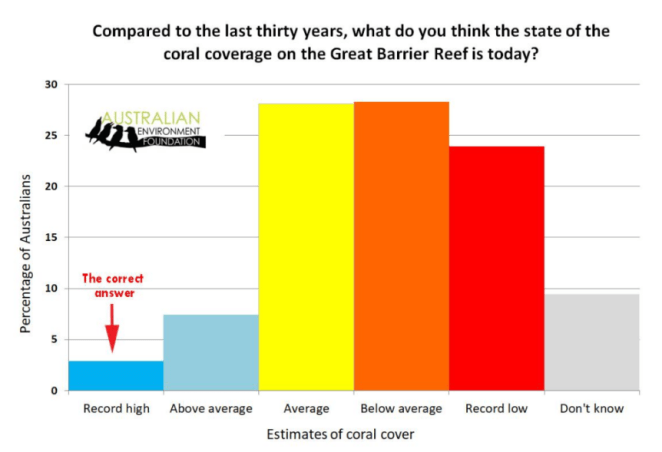
As can be seen, only 3% of Australians know the true state of the coral. Barely 10% knew coral cover was above average, while 80% thought erroneously that the situation was average or worse. Ridd and Niva note that ten years after coral cover hit a record low, half the country still doesn’t realise the reef has recovered. The “phenomenal health” of the GBR is said to be virtually unknown, yet the public are paying half a billion dollars in taxes to save it. In addition the country is “being misled into thinking that expensive low carbon policies and Net Zero targets will help protect the reef, when there is no correlation between CO2 levels and coral cover”.
The authors point some fingers at those responsible for the ignorance about the current condition of the reef among the general population. Four years ago, the State of the Climate report from the national science agency CSIRO and the national weather service the BoM noted that 30% of all coral cover across the entire GBR was lost. “This year, they told us ‘more frequent and severe coral bleaching events are likely’, but did not even mention the excellent health of the reef.” How is that reasonable, they ask. Where are the media, they also ask. “Journalists are supposed to grill professors to make sure they are providing value for taxpayers, not sensationalist, self-serving hyperbole.”
It is often found that those on the Left are more inclined to accept the ‘settled’ climate science narrative, promoting as it does the collectivist Net Zero agenda. A major recent survey in the U.S. found higher levels of belief in the suggested dominant role played by humans in altering the climate among Democrats than Republicans. Nevertheless, the proposition that humans cause all or most global warming has seen general support fall in the U.S. from 60% to 49% in just the last five years. Of course there is lack of sceptical enquiry and there is ignorance, and echo chamber greens seem to score high on both counts.

Record ignorance levels of the true state of the GBR were found among green voters. The populist right of centre One Nation voters recorded much better levels of awareness. Voters for the Liberal party seem to be marginally better informed than Labour.
The AEF results were compiled by a polling company asking 1,004 Australians about the current state of coral coverage on the GBR. The full question and suggested answers are shown in the first graph above. The poll was conducted soon after the news came out of last year’s record high coverage. The authors note that the results largely confirm an earlier similar survey of 1,007 of people in 2022. In that survey, only 7% of voters correctly said that coral cover on the GBR was “well above average”.
Chris Morrison is the Daily Sceptic’s Environment Editor.
Top Five Climate Change Narratives in the Media
Coverage of climate has become more about narrative promotion than news
BY ROGER PIELKE JR. | THE HONEST BROKER |APRIL 28, 2023
I’ve seen a lot over the past three decades. For instance, I’ve seen my own research on climate go from being widely covered in the late 1990s to 2000s, to journalists actively advocating for me to be fired in the 2010s to today, where thankfully my writing exists in this parallel universe called Substack. All this time my work remains pretty much the same — my research remains widely cited in the research community, including most recently by all three working group of the IPCC. It is not me that has changed.
Along the way I’ve been very public with my criticism of parts of the media, as I have watched climate journalism evolve from reporting of news to narrative promotion and protection. I have come to understand that it just so happens that some of my research happens to clash with leading narratives (e.g., disasters, RCP8.5) promoted nowadays by journalists on the so-called “climate beat” — itself a troubling concept.
Below I provide a list of the five most common types of climate stories that I see in the legacy and specialist media. I’ll admit to being a bit cheeky — it is Friday after all, but at the same time I also think there is a lot of truth to the list below. I’m calling out climate journalism because I am seeing its pathological effects on public views (especially among young people), on the research community and in policy discussions, including political advocacy. Climate is too important to be just another cul-de-sac of identity politics.
As ever, I am happy to hear from those on the climate beat, especially those whose work is implicated in the list below. I am happy to publish their responses or views here. I won’t hold my breath — as multiple journalists have told me in conversations that there is no way they can ever be seen to engage with me, as it is a professional hazard. But still, the invitation will remain open.
With that, let’s get to the list!
Climate reductionism
- We can explain everything with climate change
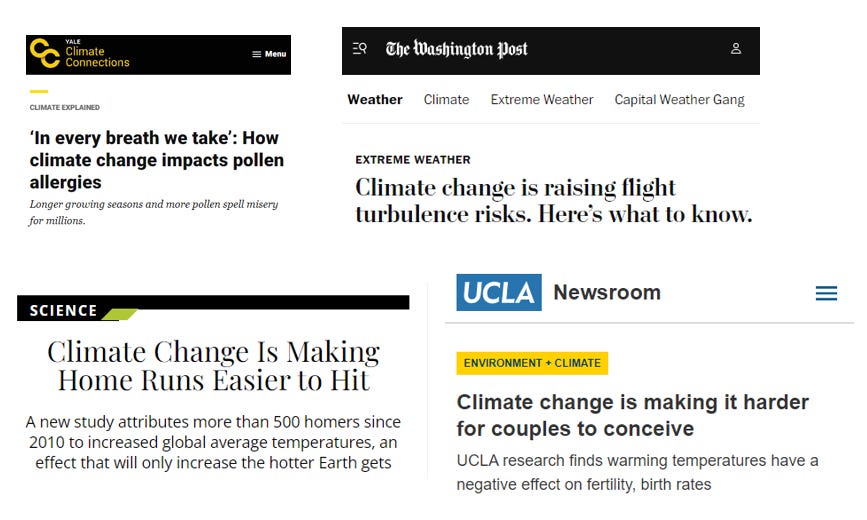
Hay fever? Bumpy fight? Home runs? Infertility? There is probably no phenomena in the world that has not at one time or another been linked to climate change. Part of the ubiquity of this type of article is the presence of so many journalists now on the “climate beat” having to come up with frequent climate-themed stories to satisfy their editors and their niche. This has the knock-on effect of creating incentives for researchers to produce studies with links to climate — no matter how tenuous or trivial. This dynamic has been well described my Mike Hulme as “climate reductionism.”
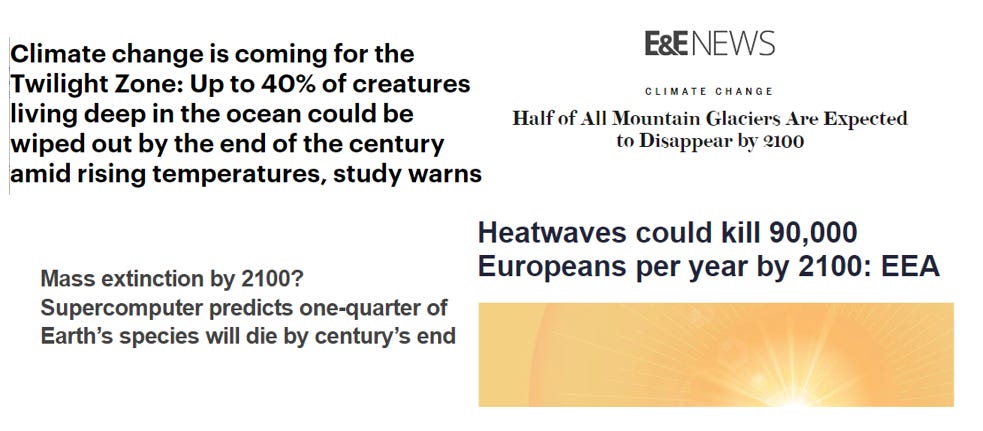
We ❤️ the apocalypse
- The coming apocalypse
If it bleeds, it leads. There is a great market for studies that offer scary predictions of the future, typically employing implausible scenarios (hello RCP8.5). These studies are readily transformed into university and research institute press releases, which are then pretty much reprinted as news. The stories, they write themselves. Stories on our doomed future based on the latest predictions are a staple of the climate beat.
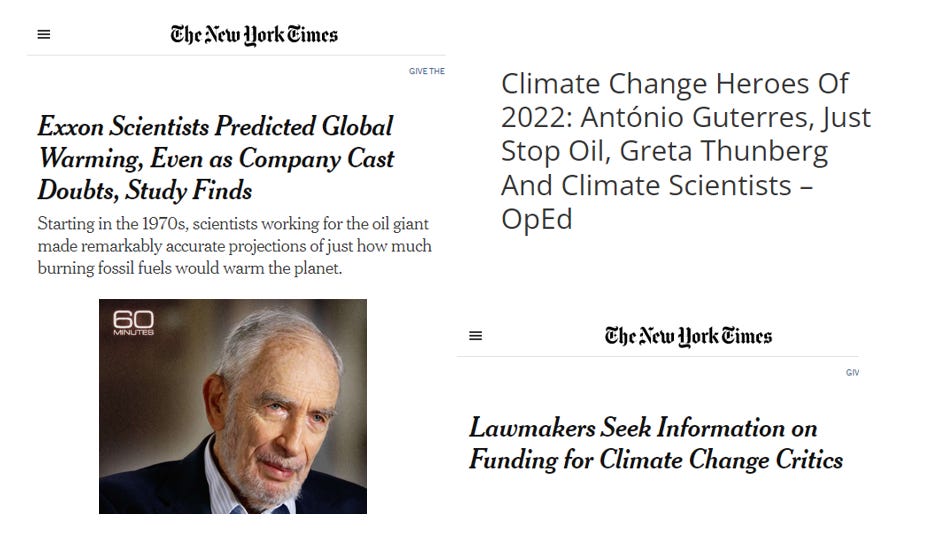
Your guide to the players
- Good guys and bad guys
In any morality tale, it is important to know who the good guys and bad guys are. Usually this is easy, but in climate it is difficult as there are a lot of legitimate experts out there, but only a subset share the proper views. Hence, the media produces a steady stream of articles helping to identify those who are heroes and those who are villains. Associating someone with Republicans or fossil fuels is a tip that this person is a villain, and a similar association with the renewable industry or Democrats means that they are onside.

Extreme weather, we can explain that
- The extreme weather that just happened
Weather is a renewable resource. It happens every day, and somewhere it is extreme. Hurricanes, tornadoes, floods, drought, hail, oh my! It has become fundamental to the climate beat to associate, link, connect — pick your favorite — the extreme event that just happened with climate change. Forget the IPCC and rigorous standards of detection and attribution. There are studies to cherry pick, quotable experts and a new cottage industry of rapid event attribution studies. Extreme weather is no longer about the weather.

Go team!
- Cheerleading for our team
Recently I saw somewhere on Twitter where someone had calculated how many followers good guys and bad guys had gained on Twitter since Elon Musk took it over. Apparently the bad guys saw a big surge. But what I found most interesting was the lumping in of climate reporters at places like The New York Times and The Guardian with activists like Greta Thunberg — clearly indicating that they were viewed to be as being on the same team. A big part of climate reporting these days is simply climate advocacy. For instance, when the Inflation Reduction Act was being debated earlier this year, the media simply cheered its passage, printing the views of those paid to promote it by the renewables industry, and nary a critical voice to be heard. More recently, criticism of the IRA has appeared to become legitimate as part of the cheerleading to go beyond the IRA. Climate reporting is apparently a team sport.
What the China Literature Gets Wrong
By Joseph Solis-Mullen | The Libertarian Institute | May 1, 2023
For more than a decade it’s become expected for books peddling the “China threat” to pop up as best sellers. From Martin Jacques’ When China Rules the World (2009) to Michael Pillsbury’s The Hundred-Year Marathon (2015), the best response has been to just shrug and move on. Talk in serious policy circles and major media were still primarily focused on Beijing’s integration into the “liberal world order” as a “responsible stakeholder,” and of the gains in trade made (and still to be made) in exchange between the United States and China.
The transformation of China from global partner to enemy number one seemed to happen, in Hemingway’s words, gradually, then suddenly. Indeed, despite Donald Trump’s early bellicosity when it came to China, the corporate press didn’t immediately play along with the China threat narrative. Rather, they proclaimed the folly of his trade war and seemed to revel in reporting the losses it was inflicting on American farmers, whose exports to China had been interrupted as a result of retaliatory tariffs.
But in the background the slow, ominous drip of the China threat narrative continued with Graham Allison’s Destined For War (2017). Then, in quick succession, Stealth War: How China Took Over While America’s Elite Slept (2019) by Robert Spalding, Deceiving the Sky: Inside Communist China’s Drive for Global Supremacy (2019) by Bill Gertz, Unrestricted Warfare: China’s Master Plan to Destroy America (2020) by Qiao Liang, Has China Won? (2020) by Kishore Mahbubani, The Long Game: China’s Strategy to Displace American Order (2021) by Rush Doshi, The World According to China (2021) by Elizabeth Economy, War Without Rules: China’s Playbook for Global Domination (2022) by Robert Spalding, No Limits; the Inside Story of China’s War with the West (2022) by Andrew Small, and Red Carpet: Hollywood, China, and the Global Battle for Cultural Supremacy (2022) by Erich Schwartzel.
It was as though even before the COVID pandemic—which exacerbated already strained relations between the United States and China—the movement was underway to translate for the public the policies pursued through multiple U.S. administrations aimed at containing China. It suddenly became normal to pick up one of the so-called “papers of record,” corporate media giants like The Wall Street Journal, The New York Times, or Washinton Post and encounter a headline about China presented as ominous or threatening. Indeed, by the time Hal Brands and Michael Beckley’s Danger Zone: The Coming Conflict With China (2022) hit bookshelves last August, entire opinion pages of the major papers sounded like talking points from the 2017 U.S. National Security Strategy (NSS), the 2018 U.S. National Defense Strategy (NDS), or the 2018 special report from the U.S. Trade Representative (USTR) which all painted China as a direct threat to vital U.S. interests, and one that needed to be vigorously countered and contained militarily, geopolitically, economically, ideologically, and technologically.
While many of the books mentioned above are written in the breathless, alarmed manner of their earliest forerunner, the eponymous China Threat (2000) by Bill Gertz, there have been some notable exceptions which have sought and obtained some measure of balance even when they could not completely escape the China threat paradigm. Kevin Rudd’s The Avoidable War (2022) and James Fok’s Financial Cold War (2021) both do a reasonable job presenting the facts, perspectives of both Washington and Beijing on key issues, and have as their aim deescalating the growing crisis that is the present state and trajectory of U.S.-China relations.
Tellingly, outright dissenters, those that questioned any part of the ascendent China narrative, were few. Red Flags: Why Xi’s China Is In Jeopardy (2018) by George Magnus and Thomas Orlik’s China: The Bubble That Never Pops (2020) both deserve credit for seeing through to the true mess that is China’s economy. Though their critiques of the China threat narrative are incomplete, and scarcely touch on the demographic, environmental, and geostrategic mountains confronting Beijing, China’s economy is central to everything else (the one-party CCP dictatorship included) and an expansion of their critiques is all one needs to cast the prospect of a future “Chinese Century” into serious doubt.
And it is here that a point needs to be clearly parsed. There is a significant difference between China ruling the world in a manner like the United States has for the past three decades, and Beijing enjoying preponderance in its immediate environs and proportional heft for its relative weight where its interests are concerned around the globe. For while it is increasingly unlikely that China’s economy will ever surpass that of the United States—either in total or per capita output—or that it will ever have the military reach enjoyed by Washington, Beijing has grown powerful enough relatively that it can assert and more or less get what it wants in its immediate environs. Trivial, obvious, or realistic though that may seem to the objective observer, to Washington this fact constitutes the whole of the China threat. The existence of an independent China (or Russia, for that matter) is a threat to Washington’s accustomed ability to do more or less whatever it wants wherever it wants. However, the existence of an independent China is already a fact and continued refusal on the part of Washington to accept it will cause more than theoretical problems.
I did not imagine or intend, when I started graduate school several years ago, that any serious amount of my time would be spent reading Chinese history, learning Mandarin, or studying the specifics of the Maoist interpretation of the Marxist dialectic. As a political scientist, economist, and historian with an interest in the emergence of different political and economic structures in Europe from the fourteenth to the nineteenth century, my initial diversion into Sino-American relations, both past and present, came as something of an annoyance.
Writing at the Mises Institute, I’ve done my best to push back against this fake China threat narrative. It’s become clear, however, that a more comprehensive case needs to be made against the ludicrous idea that China is on the cusp of taking over the world. Alas, public fear has been continually stoked and the China threat narrative is worse than ever—hence, The (fake) China Threat (and its very real danger) has taken on book-length form and will be published by the Libertarian Institute in 2023. In the meantime, I will do my bi-weekly best to pour cold water on whatever the latest hawkish nonsense from DC towards China happens to be, as well as inform and contextualize for readers what is going on in China and the wider Indo-Pacific. While I cannot promise readers will always like what I have to say, with no conflicts of interest to declare they can at least be rest assured that I have no reason whatsoever to lie to them—which is (tragically) more than can be said for practically anyone anywhere else.
Joseph Solis-Mullen is a political scientist with degrees from Spring Arbor University and the University of Illinois, and is currently a graduate student in the economics department at the University of Missouri. An independent researcher and journalist, his work can be found at the Ludwig Von Mises Institute, Eurasian Review, Libertarian Institute, Journal of the American Revolution, Antiwar.com, and the Journal of Libertarian Studies. You can contact him through his website http://www.jsmwritings.com or find him on Twitter @solis_mullen
Tucker Carlson Was ‘Trying to Get to the Truth’ Amid ‘Virtually Nonexistent’ US Independent Media
By Svetlana Ekimenko – Sputnik – 29.04.2023
Tucker Carlson’s departure from Fox News comes as independent media appears to have been muzzled in the US, with corporations playing a hefty role in limiting the kind of information that gets out to people, Larry Johnson, retired CIA intelligence officer and State Department official, told Sputnik.
Truthful media coverage of a whole host of issues in the United States is discouraged. It is even frowned upon, Larry Johnson, a former US official, told Sputnik in the wake of the abrupt departure of Tucker Carlson from Fox News.
“Media corporations over the course of the last 30 years have become increasingly concentrated in a small number of organizations. So, the independent media that used to exist is virtually nonexistent now, except for what appears on the Internet and podcasts,” the retired CIA intelligence officer stated.
He pointed out that The Washington Post, owned by Jeff Bezos of Amazon, “has become very much of a political outlet, as opposed to a news outlet”. Similarly, The New York Times, the Los Angeles Times, all previously separate newspapers, have been “consolidated under centralized corporate control.”
“Those corporations play a heavy role in limiting the kind of information that gets out to people. That coupled with reporters who are desperate to keep their jobs, and normally they’ll just play along with whatever the company policies are,” Larry Johnson said.
Several days after Fox News unexpectedly announced on April 24 that its outspoken anchor Tucker Carlson would be parting ways with the cable news network, the pundit himself made a video address telling viewers that media bosses were trying to stifle any form of debate in the industry.
“The people in charge… are hysterical and aggressive. They’re afraid. They’ve given up persuasion – they’re resorting to force… But it won’t work… true things prevail,” Carlson said in a two-minute video clip posted on his Twitter account on Wednesday.
In his monologue, Carlson said that debates on “big topics” like war, corporate power, and civil liberties “are not permitted in American media,” because, “both political parties – and their donors – have reached consensus… to shut down any conversation about it.”
Weighing in on the seasoned journalist’s verbal barrage, Larry Johnson agreed that truthful media coverage in the US is being stifled.
“The corporate media’s normal coverage about economic issues, for example, is always trying to emphasize the positive, even when the actual data points to some very alarming trends. On the foreign policy front this comes down to the concentration of power in the hands of a few corporations, and those corporations are wielding enormous influence. Basically, the defense industry and the pharmaceutical industry in the United States have enormous influence over the public debate, what gets publicized and what is ignored,” he said.
Even attempts in the media to label Tucker Carlson, who was refusing to accept official narratives, as a right-winger, Johnson said, was a “hallmark of censorship.” The journalist was simply somebody who was trying to get to the truth, the one-time State Department official underscored.
“Tucker is really more of a libertarian from the standpoint that he does not subscribe to the positions of the Republican Party or the Democrat Party. But he would take each issue on its own, and ask legitimate questions, such as the protests that took place on January 6, 2021 [which] were described by the regime as an insurrection and [it] characterized anybody who was up there on Capitol Hill as basically a terrorist. In fact, the vast majority of the people out there were peaceful and they were not attacking and destroying the Capitol by any standpoint,” Larry Johnson explained.
He deplored the “tremendous amounts of propaganda” in the United States, adding: “What I see now is there is far more press freedom in Russia than in the United States, or places like Canada.”
What was once an open society, allowing the questioning of issues, with “an aggressive, actually free press,” has transformed into a landscape of “almost state-controlled media,” with “people happily involved with suppressing dissident voices,” the retired CIA intelligence officer stated.
Larry Johnson concluded by urging people to look at multiple sources and listen to as many voices as possible to be able to “make their own judgment.”
US Nuclear Sensors in Ukraine Deployed to Scapegoat Russia
By Ekaterina Blinova – Sputnik – 29.04.2023
The reason behind Washington setting up sensors across Ukraine to detect a potential nuclear blast may involve shifting the blame to Russia if a radioactive weapon is used, or even if it is not used, but only reported in Western media, Karen Kwiatkowski, former US Department of Defense analyst and retired Air Force lieutenant colonel, told Sputnik.
The Nuclear Emergency Support Team (NEST), a group of scientists, technicians, and engineers operating under the United States Department of Energy’s National Nuclear Security Administration, is deploying nuclear sensors throughout Ukraine to both detect bursts of radiation from a nuclear weapon or a dirty bomb and identify the attacker. As per The New York Times, the goal is to verify Moscow’s culpability if Russia detonates a radioactive weapon on Ukrainian soil. The Western media has long disseminated groundless claims that Moscow may resort to the use of nuclear arms if defeated in Ukraine. Russia has resolutely shredded the assumptions, referring to intelligence alleging the Kiev regime’s potential detonation of a so-called “dirty bomb,” a “radiological dispersal device” (RDD) that combines a conventional explosive with radioactive material. The purpose of the possible provocation would be to blame Moscow for the resulting radioactive contamination.
“It makes sense that the secretive NEST team is being deployed to very quickly shift blame to Russia if any radioactive weapon is used (or even if it is not used, but only reported in Western media),” said Karen Kwiatkowski. “The US track record is provocative and the policy players are unwise, almost to a person. There is an argument to be made that this is one more way the US hopes to ‘win’ the narrative, and threaten Russia, by reporting a nuclear release, and immediately blaming Russia (as the story is already structured to do) and protecting the last Ukrainian war enthusiasts from accountability. To this day, despite evidence and logic to the contrary, most of the Western world still believes it was Russians shooting at Zaporozhye [Nuclear Power Plant] last year from Ukrainian territory, while those same Russians were holding and operating the reactor.”
One cannot completely rule out that this preventative deployment is meant to ensure Ukrainians don’t use radioactive weapons in their own last ditch efforts as the war comes to an end, according to the US Air Force veteran. Kwiatkowski suggested that the deployment could serve as a direct message to the remnants of the Ukrainian military and political leaders who could run amok, thus upsetting big Western corporations’ plans to rebuild Ukraine and upending enthusiasm of Western donors. “You can be sure BlackRock intends to profit from rebuilding Ukraine, and cleaning up nuclear contamination is not a profit center,” she stressed. Still, it raises questions how corporations’ interests would correlate with the UK plans to provide the Kiev regime with depleted uranium shells which can contaminate water, soil, and inflict irreparable harm on people’s health in the region. The former Pentagon analyst pointed out that the NEST’s network of sensors must include an array of sensor types to capture and measure the wide variety of radiation types and also be able to collect and test physical samples at the atomic level.
“Radiation from a nuclear plant leak is different from radiation from a radioactive weapon or even a dirty bomb,” Kwiatkowski explained. “The NEST itself is focused on response to radiation events, and there may be innocent explanations for this deployment to Ukraine. For example, looking for radiation leakage from nuclear reactors like at Zaporozhye may be a concern for NATO soldiers and the Ukrainian Army, vis-a-vis rebuilding and infrastructure repair planned for the future. But that is not how the NYT, a state media organ with direct connections to Pentagon intelligence and policy, described it.”
ABC News censors presidential candidate’s vaccine comments
RT | April 28, 2023
ABC News has censored an interview with US presidential candidate Robert F. Kennedy Jr. – Joe Biden’s top challenger for the Democratic Party’s 2024 nomination – by removing his allegedly false assertions about Covid-19 vaccines.
“We should note that during our conversation, Kennedy made false claims about the Covid-19 vaccines,” ABC anchor Linsey Davis said on Thursday after airing her interview with the nephew of former President John F. Kennedy.
She added that Kennedy made “misleading claims” contrary to research findings about a link between certain vaccines and autism. “We’ve used our editorial judgment in not including portions of that exchange in our interview.”
Davis sparred with Kennedy during the interview, saying his past claims about vaccines causing autism had been totally “debunked.” As the candidate began to explain why he believes major public health agencies, such as the US Centers for Disease Control and Prevention (CDC), are “captive,” his comments were cut off. The clip then cuts to Davis pointing out that some of Kennedy’s family members disagree with his views on vaccines.
“I’m just curious, if you’re not able to get your own sisters to vote for you for president, how would you make that appeal to American voters?” the host asked. Kennedy replied that he has a large family with a tradition of openly discussing issues on which they disagree. “That’s something that I think is a lesson we ought to learn for this country. We can disagree with each other without hating each other, without marginalizing each other.” Davis shot back, “I’m just using your family’s words to call you dangerous, rather than saying that’s not like the typical family that might have disagreements around the kitchen table.”
Kennedy noted on Friday that federal law prohibits broadcasters from censoring presidential candidates.
“Instead of journalism, the public saw a hatchet job,” he said. “Instead of information, they got defamation and unsheathed pharma propaganda. Americans deserve to hear the full interview so they can make up their own minds. How can democracy function without a free and unbiased press?”
A Fox News poll released on Thursday showed that although President Biden’s rivals for the Democratic Party’s nomination are longshot candidates, Kennedy is gaining ground. While 62% of Democrat voters want the party to nominate Biden for re-election, 19% favor Kennedy. A previous poll indicated that Kennedy was supported by 14% of Democrats after entering the race earlier this month.
Kennedy is the nephew of John F. Kennedy, who was assassinated in 1963, and the son of presidential candidate Robert F. Kennedy, who was shot dead on the campaign trail in 1968. He has pledged to end the “corrupt merger between state and corporate power” and has spoken out against Washington’s policy of using military power to enforce global hegemony. “The Ukraine war is the final collapse of the neocons’ short-lived ‘American Century,’” he said earlier this month.
Kiev sends media ‘correct terminology’ instructions
RT | April 28, 2023
A list of “correct” phrases, narratives and names emailed to media outlets in Serbia is genuine and came at the instruction of the foreign ministry in Kiev, Ukraine’s embassy in Belgrade confirmed on Friday.
“It’s a recommendation we sent out to the media so that they would use correct terminology in their reporting regarding the war in Ukraine,” the embassy told the daily Novosti. According to RT Balkans, the email was sent to all print and electronic media in Serbia on Thursday.
According to the instructions, reporters should use “Russia’s war of aggression against Ukraine” instead of calling it a crisis, conflict, war, or even “Russian war in Ukraine.” Another guideline insists that “unprovoked full-scale military invasion” should be used instead of “special military operation.”
The Pentagon and multiple US and UK outlets already use this terminology, but it is unclear whether they adopted it on “recommendations” from the Ukrainian Foreign Ministry, or if it was the other way around.
The email comes after the US and the EU demanded Belgrade censor and ban Russian outlets such as RT Balkans and Sputnik, and crack down on ‘Russian narratives’ about Ukraine. While some Western-owned media in Serbia already use Kiev’s preferred phrasing, some outlets were offended by the embassy’s efforts to censor their reporting.
“Who are they to recommend to anyone how to work, or write?” Filip Rodic, the deputy head editor at Pecat magazine, told Novosti. “If they think they can censor the entire world, that’s total insanity.”
There was no explanation why the document sent to Serbian media was entirely in English, either. Some of the politically proscribed phrases in it – “the Ukraine,” for example – are already meaningless in Serbian, whose grammar has no articles. It is also a phonetic language that doesn’t spell, which makes the insistence on using Ukrainian spellings for place names – Horlivka and not Gorlovka, Kharkiv and not Kharkov, Mykolaiv and not Nikolaev, etc. – likewise not applicable.
In places, the document appears to confuse official narratives for recommended phrasing, demanding the use of “Ukraine’s legitimate efforts to de-occupy Crimea, which is a part of Ukraine’s sovereign territory within the internationally recognized borders,” in place of “Ukraine’s attacks on Crimea,” for example.
The government in Kiev has insisted for years on using its preferred phrases and place names, such as imposing “Kyiv” on English speakers. One prominent Ukrainian activist explained last month that language “plays a critical role” in the hybrid war, because it “creates a mental map in our mind which we use to make sense of what’s happening.”
“One of the best ways to support us is using Ukraine-centric terminology,” said Alona Shevchenko of Ukraine DAO.
Featured Video
Anthrax War – CBC The Passionate Eye
or go to
Aletho News Archives – Video-Images
Book Review
Shattered Dreams: The HPV Vaccine Exposed (2019)
By Christina England – 30 Q&As – Book Review & Summary
Lies are Unbekoming | September 4, 2026
… Gardasil received FDA fast-track approval in 2006, Cervarix followed in 2009, and Gardasil 9 was approved in December 2014 with more than double the aluminium adjuvant content of the original. The commercial context is specific. Merck was about to lose patent protection on Zocor and faced $18 billion in Vioxx injury claims from a cardiovascular drug the company had marketed while suppressing its own data showing a five-times increase in heart attacks. Analysts projected the global HPV vaccine market at $4 billion by 2011, contingent on government-funded national programs for teenage girls. The 1986 National Childhood Vaccine Injury Act had already granted manufacturers complete liability immunity. By 2013, Japan had withdrawn its HPV vaccine recommendation after cataloguing severe adverse reactions in hundreds of girls. No Western government followed. The establishment position across the UK, US, Australia, and most of Europe held, and still holds, that the vaccines are safe and effective, that reported injuries are coincidental, and that cervical cancer prevention justifies the program. The book was published into this position, not against a vacuum.
Shattered Dreams sits alongside Mary Holland’s The HPV Vaccine On Trial and Viera Scheibner’s foundational vaccination work as part of the documented record on what has been done to a generation of teenage girls under the banner of cancer prevention. The full summary unpacks three specific findings: that Merck used the aluminium adjuvant itself as the “placebo” control in 92.5% of trial subjects, making it structurally impossible to detect excess reactions from the adjuvant; that Dr. Sin Hang Lee found HPV DNA fragments bound to aluminium in every one of sixteen Gardasil samples tested, and in the blood and spleen of a New Zealand girl six months after her third dose; and that in every country with high vaccination coverage, including Australia, the UK, Norway, and Sweden, cervical cancer rates have stopped declining and started rising specifically in the vaccinated cohort. Martínez-Lavín’s 2017 calculation puts the number needed to seriously harm with Gardasil 9 at 140, and the number needed to vaccinate to prevent one case at 1,757. Thirteen young women are seriously harmed for every one who benefits. The vaccine was approved on the basis of trials that could not detect what the trials were supposed to detect, and it is still being given to twelve-year-olds today. … Read full review
Blog Roll
 Aletho News
- The Five-Year Fuel Crisis: Why the World Economy Is Paying for a War It Thinks Is Ending
- Trump’s Big Bluff on Iran
- Swiss scammed out of millions by Ukraine-linked call centers – media
- Germany facing potential ‘violent conflict’ with Russia – spy chief
- Ukraine’s EU neighbors reject new plea from Kiev – Politico
- British Transport Police Facial Recognition Trial Scanned 926,912 People With Zero Arrests
- House Bill Would Ban Federal Use of Flock ALPR Data
- Can a Spice Rival a Drug? 10 Head-to-Head Trials Put It to the Test.
- The oil routes around Hormuz face their own chokepoints
- The Saudi-Israeli war on Yemen’s resistance: Intelligence sharing, civilian targets & sectarian propaganda
- If Americans Knew
- New IDF Website Frames Slain Gaza Journalists as Terrorists
- Israeli media: After settlers beat him mercilessly, they stuffed dirt into his mouth
- Americans Are Paying the Price to Preserve Israel’s Nuclear Hegemony
- A U.S. Jewish Fund’s Ambitious Bid to Put a Settler Elite in Control of Israel’s Security
- As genocide drags on, “Zionism is racism” becomes official policy in one UK party – Daily Update
- Targeting the rescuers: Inside Israel’s war on paramedics in Lebanon
- No big deal: Israel to halt humanitarian aid to Gaza for 2 days – Daily Update
- Israel is squeezing the life out of Palestinians – Daily Update
- The Israeli Right Portrays Islam as Murderous. It Serves a Political Purpose
- Jordan Has Had Enough: King Abdullah’s Scathing Warning to Israel
- No Tricks Zone
- Latest European Green Energy Debacle; Portugal’s Largest Flagship Solar Park Insolvent!
- Green Energy Debacle: German Expert Professor Fritz Vahrenholt Warns Of Severe Economic And Social Consequences
- Two More Paleo Reconstructions Affirm Meters-Higher Sea Levels Across Ireland, Brazil 7000-6000 Years Ago
- New Study: Earth And Venus Surface Warmth Largely Explained By Convection And Lapse Rate, Not CO2 Or Radiation
- 2025 Nature Paper Claiming Worsening Global Drought Gets RETRACTED …Heavily Flawed
- New Study: ‘Global Drought Shows No Detectable Recent Acceleration Under Climate Warming’
- Economic Masterminds: German Socialists Suggest Taxing Productivity Gains Stemming From Using AI
- The South China Sea Has Not Been Cooperating With The Climate Change Narrative
- Energy Crisis: Germany Enters Heating Season With Historically Low Gas Reserve Fill Levels
- New Study: The Antarctic Ice Sheet Gained Mass From 2020-2024 Due To Staggering Snow And Ice Accumulation

