Nord Stream Sabotage Backfires With Historic Demolition of U.S. Image and Lies Over Ukraine War
Strategic Culture Foundation | February 17, 2023
The Hersh report is a devastating revelation of U.S. and NATO international terrorism as well as Western media complicity. It exposes the lawlessness of U.S. government, the total disregard by Washington for its so-called European allies, the supine nature of European governments, Germany in particular, and the real geopolitical reasons behind the war in Ukraine, and subsequently the shocking servility of Western media in refusing to cover what is an astounding act of criminality.
This is an explosive story in more ways than one and indeed in more ways than we can perhaps even calculate at this stage. Only one week after its publication, the fallout and reverberations continue to amplify. Such is the parlous and pathetic state of Western journalism, Hersh was obliged to publish his account on his resources, knowing that mainstream outlets would not touch it. That systematic media censorship and exposure of propaganda functioning is itself a huge scandal that will grow further. This is while the European Union sanctions and bans Russian media, even though Russian media have been vindicated by Hersh’s revelations while Western media is shown to be an utter disgrace.
On September 26, 2022, the Nord Stream pipelines were blown up. European states have since acknowledged that, albeit with muted reports. For its part, Russia has from the outset blamed Western powers for an act of terrorism. Washington initially made the preposterous claims that Russia had carried out the attacks in revenge against Europe. And Western media went along with the ridiculous ride.
There is no disputing that the damage was deliberate sabotage. The 1,222-kilometer undersea civilian infrastructure was the biggest of its kind in the world, involving a consortium of companies from Russia, Germany, France and the Netherlands. It took more than a decade to construct at an estimated cost of over €12 billion. The enormous loss of natural gas volumes from the explosion could also be monetized in billions of euros.
State-Sponsored Terrorism
So, without even attributing specific culpability, this sabotage constitutes an egregious act of state-sponsored terrorism that violates international law on numerous counts. And yet Western media have acted like the proverbial monkeys who see no evil, hear no evil, and speak no evil.
At the time of the spectacular event, many critical observers immediately suspected foul play. In our Strategic Culture Foundation weekly editorial of September 30, the headline stated: “Blatantly Obvious Who Gains From Nord Stream Sabotage”.
We postulated back then only days after the incident that a plausible cause was “deliberate sabotage” by the United States and its NATO allies.
“If that’s the case, then it is an act of terrorism against civilian infrastructure and a grievous blow to Russia’s national interests. It could be construed as a criminal act of war,” we wrote.
Our editorial cited U.S. President Joe Biden’s own words of warning issued at a White House press conference when he spoke on February 7, 2022. Biden appeared to stray off script and cryptically asserted to reporters that the Nord Stream would be “brought to an end” if Russia were to intervene militarily in Ukraine, as Russia did two weeks later on February 24 (as a result of deadly NATO provocations, we should add).
“His [Biden’s] cryptic assertion, over-riding European governments, suggests that a contingency plan had already been authorized to take out the Nord Stream. And, it seems, the nefarious action duly went ahead this week,” we wrote.
(We modestly take pride in the objective perspicacity of our assessment. And yet this online journal is smeared and banned by the United States and European governments as a Russian propaganda tool.)
Seymour Hersh’s investigative report published last week corroborates what many observers had suspected at an early stage. The irrefutable fact is the Nord Stream gas pipelines were blown up by U.S. military forces. Not only that, but the Americans were aided and abetted by NATO member Norway, and quite possibly by other NATO members including Poland, Denmark and Britain.
This is an earth-shattering scandal. The repercussions are going to keep cascading and cascading. Hersh has followed up with promises of more indicting details in forthcoming articles. Other journalists are now corroborating his details about U.S. navy divers planting explosives under the cover of NATO war games in the Baltic Sea last June. Hersh claims that some of the C4 bombs did not detonate as planned. That means there could still be evidence to be found on the seabed conclusively implicating the United States.
Then there was the earlier report by Swedish divers who had inspected the site in the aftermath of the explosions. Did they try to clean up the crime scene? The Swedish authorities have refused to disclose the contents of their report. They have a case to answer, as do the Danes, the Norwegians, the Brits and most of all the Americans.
Russia has called for a United Nations Security Council meeting to convene next week on the subject, based on the latest investigative report by Seymour Hersh. China has also called for an independent international commission to study the matter.
Questions are also urgently required from the German government on what it knew about the sabotage. As our columnist Martin Jay pointed out this week, Chancellor Olaf Scholz was in the White House on February 7 last year when Biden made his clumsy threat to take out the Nord Stream. The implication is that Scholz knew in advance of the demolition plan.
Western Media’s Damning Silence
We are talking here about multiple malfeasance and cardinal crimes. Terrorism, destruction of sovereign property, aggression and incitement of war, treason and an orchestrated media cover-up involving supposed bastions of Western journalism. The New York Times and Washington Post have so far ignored the Hersh report. Western media have stubbornly refused to investigate this urgent story. How damning is that?
Internationally renowned legal expert Professor Francis Boyle has assessed (in email correspondence with SCF) that a prosecution case can be brought against the United States over the Nord Stream incident under the auspices of the International Criminal Court. The U.S. is not a signatory to the foundational Rome Statute but the incident occurred in territory belonging to European states that are. Whether such a prosecution proceeds and whether the UN Security Council takes action later this week are moot points. But at the very least, the whole scandal is blowing up in the court of international public opinion.
Seymour Hersh (now aged 85) is to be commended for his journalistic service. We may quibble about some details in his report. Has he covered the full picture of all the actors involved? Perhaps not. His report is not a geopolitical analysis and some of his premises suggest he is not critical of the U.S. or NATO involvement in the war in Ukraine. These reservations are relatively minor to his main point of understanding what actually took place.
Those caveats aside, however, one can say that Hersh’s report is a blockbuster. His lifetime work is impeccable. He uncovered the My Lai massacre in Vietnam in 1968 when hundreds of men, women and children were murdered gratuitously by American troops. Hersh also exposed in 2004 the torture practices by the US military in Iraq at the infamous Abu Ghraib prison.
Historic Impact
Hersh’s reporting in the past has had a historic impact. It mobilized public understanding and opinion about the nefarious nature of U.S. wars in Southeast Asia and the Middle East.
As many analysts and our own weekly editorials at SCF have repeatedly pointed out, the war in Ukraine is a bigger geopolitical cause than the absurd narrative put out by Western governments and news media about “defending Ukraine and Western freedom from Russia aggression”. We have consistently analyzed that the expansion of NATO, the weaponization of Ukraine, and the current conflict are all about the American imperialist ambition for hegemonic control. Destroying normal relations between Europe and Russia and most especially destruction of the strategically important energy trade are all part of the objective. Pursuing that objective has created a most dangerous war that could escalate into a nuclear conflagration.
As eminent American commentator Jeffrey Sachs has noted, the criminal conduct of Washington regarding the blowing up of the Nord Stream is totally characteristic of U.S. criminal behavior that has been practiced over many decades since World War Two. The difference now is that this criminality directly impinges on many more people’s lives – from the danger of catastrophic war to the economic misery caused by wanton American aggression.
The Hersh article – despite the Western media shamefully ignoring it thereby exposing their own criminal complicity in U.S. terrorism – has made the world more aware than ever of the rogue state that is the United States and its capitalist, imperialist dynamics.
Inciting war in Europe, antagonizing a nuclear Russia with unprecedented aggression, inflicting mass poverty and hardship on European civilians, and lying about it all the time through its propaganda media. Washington is a war-criminal state par excellence along with its European Quislings.
As Russian President Vladimir Putin remarked several weeks ago, the historic situation is revolutionary.
Media Ignores Evidence That West Opposed Ukraine Peace Deal
BY NOAH CARL | THE DAILY SCEPTIC | FEBRUARY 14, 2023
As I noted in a previous article, the former Israeli Prime Minister Naftali Bennett revealed in a recent interview that in March of last year Western leaders blocked a draft peace deal between Russia and Ukraine.
There seems to be some disagreement over exactly what he said, as the interview was in Hebrew. Based on the English subtitles on YouTube, I quoted him as saying, “They blocked it.” But others insist he said, “They broke off negotiations.” Either way, he clearly implied that the West stymied negotiations that might have led to a peace deal.
What’s more telling is the reason he gave as to why the West did so, namely “to keep smashing Putin”. This tallies closely with Roman Romanyuk’s account of why Western leaders opposed negotiations in April:
Behind this visit and Johnson’s words lies much more than a simple reluctance to engage in agreements with Russia. The collective West, which back in February suggested that Zelenskyi surrender and run away, now felt that Putin is actually not as all-powerful as they imagined him to be. Moreover, right now there was a chance to “press him”. And the West wants to use it.
As Caitlin Johnstone points out, it also lines up with what the Turkish Foreign Minister Mevlut Cavusoglu said on April 20th last year:
Following the NATO foreign ministers’ meeting, it was the impression that … there are those within the NATO member states that want the war to continue, let the war continue and Russia gets weaker. They don’t care much about the situation in Ukraine.
So we now have a NATO Foreign Minister, a journalist with sources “close to Zelensky” and a former Israeli PM all saying that Western leaders opposed a peace deal because they wanted to “weaken”, “press” or “smash” Putin.
These seem like newsworthy revelations, don’t they? Not according to the mainstream media.
I checked whether the revelations have been mentioned by any of the following outlets: the BBC, CNN, the Times, the Guardian, the Telegraph, the New York Times, the Washington Post, or the Wall Street Journal. With the exception of one op-ed in the New York Times which quoted Cavusoglu’s statement, they’ve been completely ignored.
The point here isn’t that there definitely would have been a peace deal if not for the actions of Western leaders. We can’t know that. The point is: there’s credible evidence that Western leaders stymied negotiations which might have led to a peace deal because they wanted to weaken Russia.
With the exception of Tucker Carlson and a few lesser-known outlets, why hasn’t the media covered this? One of the current headlines on the BBC News homepage is ‘Rihanna reveals pregnancy at Super Bowl show’. Which is more newsworthy: Rihanna’s personal life, or the revelation that Western leaders may have sabotaged peace? I’m reminded of this meme:
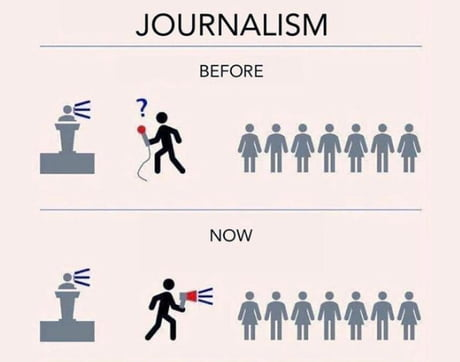
A few days ago, in fact, a BBC Ukraine journalist got up and hugged Zelensky at a press conference. However much you support a particular cause, as a journalist you’re supposed to show a modicum of impartiality. Based on this incident, I wouldn’t expect any dramatic shifts in coverage.
Hersh Blasts US Mainstream Media for Ignoring Nord Stream Blasts Report
Sputnik – 15.02.2023
WASHINGTON – Pulitzer Prize-winning journalist Seymour Hersh on Wednesday criticized US mainstream media for not running a word about his investigative piece on the Biden administration’s alleged sabotage of the Nord Stream pipelines.
Last week, Hersh on his Substack account published an investigative report describing in detail how US deep-water divers had allegedly planted explosives under Russia’s Nord Stream pipelines. Hersh wrote, based on insider information from a source with direct knowledge of the operational planning, that the explosives were detonated remotely on September 26, 2022, on the order of President Joe Biden.
Known for exposing the mass murder of unarmed civilians by US troops during the Vietnam War and reporting on the US military’s torture of prisoners at Abu Ghraib in Iraq, Hersh in an article on Wednesday observed that over the years US administrations from both parties repeatedly tried to obstruct or denigrate what he was writing, labeling him “a known fabricator” and dismissing his stories as “crap.”
Still, the pieces he wrote eventually found their way to mainstream media in the US and around the world, the journalist noted. Hersh worked as a long-time reporter for The New York Times, and The Washington Post ran a long magazine profile of him more than two decades ago.
“Neither paper has run a word at this point about the pipeline story, not even to quote the White House’s denial of my reporting. Similarly, public calls by officials in Russia and China for a full investigation of the pipeline story have been ignored by the US media,” Hersh said.
The White House, Pentagon and State Department deny any US involvement in sabotaging the pipelines.
BBC’s Solar Power Misinformation
By Paul Homewood | Not A Lot Of People Know That | February 10, 2023
More disinformation from the BBC:

https://www.bbc.co.uk/news/science-environment-64553915
Amidst the backslapping about how wonderful solar power is, the BBC present this graph:
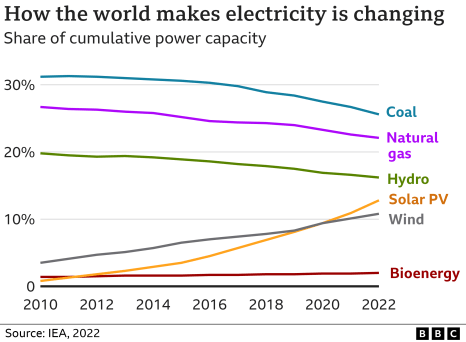
WOW!! Most people reading this would believe that electricity from fossil fuels is declining rapidly, while solar and wind power now claim a share well over 20%.
Most of those same readers would be unaware what the BBC mean by “capacity”, or that “capacity” and “generation” are two totally separate and different things.
And when we look at generation, we can see how badly misled those readers have been:

BP Energy Review
Far from being major players, wind and solar together only supply 10% of the world’s electricity. And since 2010, the increase in fossil fuel generation has exceeded that of wind and solar.
A rather different picture to the one the BBC would like you believe, I think you might agree!
German Lawmaker Condemns Scholz’s Telltale Silence on US Role in Nord Stream Sabotage
Sputnik – 09.02.2023
German Chancellor Olaf Scholz’s silence on the recent revelation by an American investigative journalist that US navy divers blew up Russia’s Nord Stream gas pipeline speaks volumes, Maximilian Krah of the German AfD party told Sputnik.
Seymour Hersh, a Pulitzer Prize-winning journalist who blew the whistle on US atrocities in Vietnam War and more recently on prisoner torture at Abu Ghraib in Iraq, wrote in a blog post on Wednesday that American deep-water divers had planted explosives under three of the four Nord Stream pipelines that were detonated remotely last September at the order of President Joe Biden.
NATO allies said in the wake of what Kremlin said was a “terrorist attack” that the scale of the explosions in the Swedish and Danish waters suggested that a state was involved. Sweden, Denmark along with Germany, the main beneficiary of Russian gas, opened separate probes into the blasts.
Maximilian Krah, a member of the European Parliament, said lack of reaction from Scholz to the breakthrough report suggested that he must have been warned in advance about the covert sea operation, which was conducted under the cover of a NATO Baltic Sea exercise last summer.
“It is certain that the German government was informed of the sabotage beforehand by the Americans. This is the only explanation for Scholz’s awkward silence. With the addition of a woke and irresponsible warmonger like [Foreign Minister Annalena] Baerbock, who declares that Germany is at war with Russia, nothing surprises me,” he said.
Krah argued that the sabotage put an end to what had long been a headache for the Scholz government — the need to justify to Germans why the second leg of the natural gas pipeline had not been pumping cheap gas to his country.
“The problem is that this is tearing the German economy to pieces and significantly impoverishes Germany. Moreover, the billions spent by Germany in this gas project, which ensured us cheap energy, are lost, but the coalition which governs Germany does not care. Officially, Scholz knows nothing. Apparently, we live in a democracy,” he added.
Hersh wrote that cheap Russian gas had been a boon for the German economy, fueling its post-war rise to prosperity while diminishing Europe’s dependence on the United States. He cited a source with direct knowledge of the US operational planning as saying that Norway played a key role in helping the US organize the attack and keep the Swedish and Danish navies in the dark.
Both the United States and Norway dismissed the allegations as lies. Russia said it was no surprise that Hersh’s report was largely overlooked by Western mainstream media despite Biden and Undersecretary of State Victoria Nuland outright warning Russia months before the attack that the pipeline would be dealt with if it launched a military operation in Ukraine.
Krah said it had been obvious to everyone in the German opposition that the sabotage of the crucial energy infrastructure was NATO’s doing. All attempts to point the finger at Russia were ridiculous and did not hold water. Hersh wrote that the White House tried to accuse Russia of self-sabotage in a string of calculated leaks but never suggested a clear motive, beyond retribution.
“The State Department and the White House categorically deny it, but I was in Washington two months ago and all my American political interlocutors, Democrats and Republicans alike, had no doubts: it was the United States that organized or sponsored the action by the British, and it was Biden who personally gave the green light,” Krah said.
“Democrats and Republicans in Congress disagree on everything, except on their willingness to pursue an aggressive foreign policy, especially toward China and Russia,” the lawmaker added.
Kremlin reacts to Nord Stream sabotage claim
Sputnik – 09.02.2023
MOSCOW – The report of investigative journalist Seymour Hersh on Washington’s involvement in the explosions at Nord Streams has once again pointed to the need for an open international investigation into the incidents and punishment for those responsible, Kremlin spokesman Dmitry Peskov said on Thursday.
On Wednesday, Hersh, a Pulitzer Prize winner, published a report saying that US Navy divers during NATO Baltops exercises in the summer of 2022 planted explosives to destroy the Nord Stream pipelines, which Norway activated three months later. According to the report, US President Joe Biden decided to sabotage the Nord Streams after more than nine months of secret discussions with the national security team.
“The appearance of such materials once again shows the need for an open international investigation of this unprecedented attack on critical infrastructure, international critical infrastructure. It is impossible to leave this without revealing the perpetrators and without their punishment,” Peskov told reporters.
Some points of the report can be disputed, some points need proof, but it is remarkable for the depth of analysis, the official said, noting that it would be at least unfair to ignore it, especially for such a country as Germany, which, in fact, as a result of this terrorist act, was deprived of a very important energy facility.
Kremlin spokesman added that the report did not break in Western media, stressing that it is surprising.
“Unfortunately, the article was not widely disseminated in the Western media, which cannot but arouse our surprise,” Peskov rold reporters.
Moscow sees attempts to silently curtail the international investigation into the attacks, but this is a dangerous precedent, as those who committed the attack on the Nord Stream pipelines can repeat it anywhere in the world, the official said.
An Overblown Balloon Headline Inflates False Narrative on China
By Patrick Macfarlane | The Libertarian Institute | February 8, 2023
For several decades the American public has been instilled with an intrinsic fear of and hatred for China.
No singular event in this seemingly inevitable march to war is more emblematic of the American public’s warped psyche than the “Chinese Spy Balloon” narrative—perhaps due, in part, to its facial absurdity. The happening eclipses even similarly nonsensical yarns such as widespread TikTok paranoia (see the NSA’s PRISM program), China’s American farmland purchases (Chinese firms account for <.5% of all foreign-owned land in the U.S.), and the “invasion” of Chinese fentanyl through the Southern border (fentanyl trafficking is illegal in China).
Indeed, even the pervasive use of the term “Chinese Spy Balloon”—an utterly unsupported Pentagon accusation—is emblematic of the absolutely captured state of the American consciousness.
This narrative control is critical to Washington as it manufactures consent for its declared “great power competition” with Beijing.
The saga began on February 2, when an official spokesman announced the Pentagon was tracking the passage of a “high-altitude surveillance balloon” over the continental United States. The spokesman expressed confidence that the “surveillance balloon” belonged to the People’s Republic of China (PRC). In this initial announcement, it was importantly noted “[i]nstances of this kind of balloon activity have been observed previously over the past several years.”
On February 3, a PRC spokesperson confirmed the balloon originated from China, but said it was merely a civilian weather balloon on a research mission. The spokesperson apologized for the intrusion and explained the balloon entered the United States by accident due to unexpected wind currents. The statement stressed continued communication and diplomacy.
On the afternoon of February 4, American forces downed the balloon just off the coast of South Carolina. The next day, the Chinese foreign ministry called the response “a clear overreaction and a serious violation of international practice.”
In its press conference announcing the shootdown, a senior Pentagon official admitted that so-called “PRC government surveillance balloons transited the continental United States briefly at least three times during the prior administration and once that we know of at the beginning of this administration, but never for this duration of time.” Another official admitted that the Pentagon had tracked the balloon since it entered Alaskan airspace on January 28.
Although the Pentagon insists the balloon was a clandestine surveillance device, it has not tendered a shred of evidence to support that assertion.
It would make little sense for the PRC to launch surveillance balloons across the United States because, as stated during the Pentagon’s initial press briefing, “[the balloon] does not create significant value added over and above what the PRC is likely able to collect through things like satellites in Low Earth Orbit.”
As the balloon made its way from Montana to South Carolina, the American people were whipped into predictable histrionics, with most politicians calling for the balloon to be shot down.
Representative Nancy Pelosi (D-CA) stated on February 3, “[i]t wasn’t a good idea to have a spy balloon fly over our country, it must come down.”
Senator Mitt Romney (R-UT) called the balloon a “Potemkin village attempting to conceal [China’s] malign ambitions toward our country and the global order.” He urged the Pentagon to shoot down the balloon, and later quipped “[a] big Chinese balloon in the sky and millions of Chinese Tik Tok balloons on our phones. Let’s shut them all down.”
True to form, the general Republican messaging maligned Joe Biden’s perceived weakness for not shooting the balloon down faster.
Establishment Republican mainstays, Senators Ted Cruz (R-TX), and Marco Rubio (R-FL), and House Intelligence Committee chair, Representative Mike Turner, blasted the Biden administration’s inaction in separate TV interviews.
On February 4, Turner said on Meet the Press, “[t]his [balloon] should never have been allowed to enter the U.S., and it never should have been allowed to complete its mission,” adding “I think this administration lacks urgency.”
The same day Cruz told Face the Nation that Biden gave the PRC “a full week…to conduct spying operations over the U.S., over sensitive military installations,” and that “this entire episode telegraphed weakness.”
On February 5, Rubio betrayed the true intent of accusing Biden of weakness—to give cover for more extreme escalation. He told ABC “[t]hese guys [U.S. leadership] can’t even do anything about a balloon flying over U.S. airspace? How can you possibly count on them if something were to happen in the Indo-Pacific region? How are they gonna come to the aid of Taiwan?”
Rubio’s comments fly in the face of Washington’s long-standing Sino-American policy—that the U.S. acknowledges China’s dominion over Taiwan, but will not say what it would do if China were to use force to reconstitute the wayward island.
While some populist Republicans have bravely departed from the establishment’s support for Ukraine, many led the chorus of voices urging escalation—and not diplomacy.
Senator Josh Hawley (R-MO) issued multiple tweets regarding the balloon. On February 3, he stated “[n]ow #China is OPENLY spying on us and the Biden Admin does nothing. China is trolling us. They know Biden is weak.” He later added, inter alia, “SHOOT IT DOWN.”
Representative Matt Gaetz (R-FL) tweeted on February 3, “[t]he Department of Defense would like to know the Balloon’s pronouns,” a comment that detracts from Washington’s objectively aggressive global posture by suggesting ineptitude. On February 5, he wrote, “I wonder how much the [Chinese Communist Party]-funded Biden Center at UPenn studied Balloon Theory.”
On February 3, Representative Marjorie Taylor Greene issued a lengthy Twitter thread urging the Biden Administration to “SHOOT DOWN THE BALLOON!!” Taylor Greene further called the balloon’s presence “an act of aggression,” that she blamed on the Chinese Communist Party and Joe Biden’s inaction.
Surprisingly, the invective from populist Republicans surpassed even that of the ultra-hawkish architects of Washington’s fortress Taiwan policy, Senators Lindsey Graham (R-SC) and Bob Menendez (R-NJ).
For his part, Bob Menendez neither Tweeted, nor issued a press release about the balloon.
Graham’s statement was much more measured than that of his populist colleagues. February 4, he thanked the military and the Biden administration for shooting down the balloon, but then stated: “[t]he next step is to recover the attached surveillance equipment to determine if the Chinese were lying about the balloons [sic] true purpose…Our intelligence community doubts the Chinese explanation […] but we will only know the true answer when the platform is recovered.”
The universal rejection of diplomacy in favor of an immediate and violent response to the balloon is deeply troubling—from the public to neoliberal Democrats, to the populist right. Surely a collision between U.S. and Chinese vessels in the South China Sea or aircraft in the Taiwan Strait would provoke a similar response. Some popular pundits even called for extreme escalation, such as urging the Pentagon to scramble jets from Guam, ostensibly to attack or threaten mainland China.
The banner narrative favored by mainline Republicans and the populist right alike—that Joe Biden is weak—is insidious, because it implies that Biden should be more aggressive. Furthermore, it excuses Biden’s objectively ultra-hawkish policy against China.
Just in the last few weeks, the Biden administration continued its redoubling of the Asia Pivot launched by Barack Obama and furthered by Donald Trump: the U.S. Marine Corps opened a new base in Guam as the U.S. opened an embassy in the Solomon Islands, furthered diplomatic measures meant to militarize Japan, announced the opening of new military installations in the Philippines and Palau, and furthered a deal that would secure it exclusive military access to Micronesia, an area of the Pacific Ocean as large as the continental U.S.—all with the express and stated aim of confronting China.
Furthermore, any discussion of Chinese surveillance of the United States must necessarily begin with our own surveillance of mainland China. In 2001, “[a] United States Navy spy plane on a routine surveillance mission near the Chinese coast collided with a Chinese fighter jet that was closely tailing it” causing the American plane to crash land in Chinese territory. These surveillance missions continue to this day, along with the at least monthly transit of American warships through the Taiwan Strait, a channel of water that separates Taiwan from mainland China by 110 miles at its widest point.
Meanwhile, the “Biden is weak” narrative enables the Biden administration’s ultra-hawkish policy by drawing attention away from it. While the nation’s imagination was captured by a white balloon, Secretary of State Antony Blinken canceled a rare diplomatic visit to China. That the Pentagon knew the balloon’s trajectory as soon as it entered Alaskan airspace suggests it may have been used as a convenient excuse to cancel the talks. This is further evidenced by the fact that similar balloons have entered the United States without public knowledge.
Furthermore, the timing of the balloon’s transit suggests it wasn’t purposely dispatched by China, as its incentive is likely to preserve Blinken’s visit. The long-planned trip would have seen Blinken meet with his Chinese counterpart and possibly with Chinese leader Xi Jinping. From the PRC perspective, such a visit is an opportunity to negotiate with a country that is encircling it militarily. A high-level meeting might have soothed its offense at yet another diplomatic envoy to Taiwan by an American House Speaker.
Unfortunately, the prevailing narrative won the day—while Americans’ heads were in the clouds, imagining a biowarfare attack, or falsely reporting the balloon carried explosives, Sino-American relations deteriorated even further. Distressingly, the American public exhibited its eagerness to rush to just about any conclusion concerning China.
That rush to judgment—and violent action—should concern us more than the specter of a wayward white spy balloon.
Patrick MacFarlane is the Justin Raimondo Fellow at the Libertarian Institute where he advocates a noninterventionist foreign policy. He is a Wisconsin attorney in private practice. He is the host of the Vital Dissent at http://www.vitaldissent.com, where he seeks to oppose calamitous escalation in US foreign policy by exposing establishment narratives with well-researched documentary content and insightful guest interviews. His work has appeared on antiwar.com, GlobalResearch.ca, and Zerohedge. He may be reached at patrick@libertarianinstitute.org
Featured Video

Anthrax War – CBC The Passionate Eye
or go to
Aletho News Archives – Video-Images
Book Review
Shattered Dreams: The HPV Vaccine Exposed (2019)
By Christina England – 30 Q&As – Book Review & Summary
Lies are Unbekoming | September 4, 2026
… Gardasil received FDA fast-track approval in 2006, Cervarix followed in 2009, and Gardasil 9 was approved in December 2014 with more than double the aluminium adjuvant content of the original. The commercial context is specific. Merck was about to lose patent protection on Zocor and faced $18 billion in Vioxx injury claims from a cardiovascular drug the company had marketed while suppressing its own data showing a five-times increase in heart attacks. Analysts projected the global HPV vaccine market at $4 billion by 2011, contingent on government-funded national programs for teenage girls. The 1986 National Childhood Vaccine Injury Act had already granted manufacturers complete liability immunity. By 2013, Japan had withdrawn its HPV vaccine recommendation after cataloguing severe adverse reactions in hundreds of girls. No Western government followed. The establishment position across the UK, US, Australia, and most of Europe held, and still holds, that the vaccines are safe and effective, that reported injuries are coincidental, and that cervical cancer prevention justifies the program. The book was published into this position, not against a vacuum.
Shattered Dreams sits alongside Mary Holland’s The HPV Vaccine On Trial and Viera Scheibner’s foundational vaccination work as part of the documented record on what has been done to a generation of teenage girls under the banner of cancer prevention. The full summary unpacks three specific findings: that Merck used the aluminium adjuvant itself as the “placebo” control in 92.5% of trial subjects, making it structurally impossible to detect excess reactions from the adjuvant; that Dr. Sin Hang Lee found HPV DNA fragments bound to aluminium in every one of sixteen Gardasil samples tested, and in the blood and spleen of a New Zealand girl six months after her third dose; and that in every country with high vaccination coverage, including Australia, the UK, Norway, and Sweden, cervical cancer rates have stopped declining and started rising specifically in the vaccinated cohort. Martínez-Lavín’s 2017 calculation puts the number needed to seriously harm with Gardasil 9 at 140, and the number needed to vaccinate to prevent one case at 1,757. Thirteen young women are seriously harmed for every one who benefits. The vaccine was approved on the basis of trials that could not detect what the trials were supposed to detect, and it is still being given to twelve-year-olds today. … Read full review
Blog Roll
 Aletho News
- The Five-Year Fuel Crisis: Why the World Economy Is Paying for a War It Thinks Is Ending
- Trump’s Big Bluff on Iran
- Swiss scammed out of millions by Ukraine-linked call centers – media
- Germany facing potential ‘violent conflict’ with Russia – spy chief
- Ukraine’s EU neighbors reject new plea from Kiev – Politico
- British Transport Police Facial Recognition Trial Scanned 926,912 People With Zero Arrests
- House Bill Would Ban Federal Use of Flock ALPR Data
- Can a Spice Rival a Drug? 10 Head-to-Head Trials Put It to the Test.
- The oil routes around Hormuz face their own chokepoints
- The Saudi-Israeli war on Yemen’s resistance: Intelligence sharing, civilian targets & sectarian propaganda
- If Americans Knew
- “We See Our Homes Now From A Satellite, Like Strangers”
- Watch “Gaza: Doctors Under Attack”, originally censored by BBC
- NAZA: Israeli embassies in UK and US promote rival documentary to challenge Gaza genocide allegations
- David Ellison appoints Israeli to lead merged Paramount-Warner studios
- Turkish Red Crescent helps elderly Gaza man walk again after Israel confiscates his prosthetic limb
- Four Palestinians Killed in Israeli Attacks in Gaza
- Two Palestinian youths killed and village razed as Israeli attacks on West Bank continue
- Two more Christian women innocent victims of Gaza raids
- Cruelty, Deprivation, Indignity: A Journalist’s 22 Months in Israeli Prison
- New IDF Website Frames Slain Gaza Journalists as Terrorists
- No Tricks Zone
- Latest European Green Energy Debacle; Portugal’s Largest Flagship Solar Park Insolvent!
- Green Energy Debacle: German Expert Professor Fritz Vahrenholt Warns Of Severe Economic And Social Consequences
- Two More Paleo Reconstructions Affirm Meters-Higher Sea Levels Across Ireland, Brazil 7000-6000 Years Ago
- New Study: Earth And Venus Surface Warmth Largely Explained By Convection And Lapse Rate, Not CO2 Or Radiation
- 2025 Nature Paper Claiming Worsening Global Drought Gets RETRACTED …Heavily Flawed
- New Study: ‘Global Drought Shows No Detectable Recent Acceleration Under Climate Warming’
- Economic Masterminds: German Socialists Suggest Taxing Productivity Gains Stemming From Using AI
- The South China Sea Has Not Been Cooperating With The Climate Change Narrative
- Energy Crisis: Germany Enters Heating Season With Historically Low Gas Reserve Fill Levels
- New Study: The Antarctic Ice Sheet Gained Mass From 2020-2024 Due To Staggering Snow And Ice Accumulation

