The United Nations is in dire need of reform and the Security council must be “democratized” by expanding its representation, Russian foreign ministry official Alexey Drobinin has written in a keynote article published on Wednesday.
Drobinin, the Director of the Department of Foreign Policy Planning, commented on the current state of international relations and came to the conclusion that “more conscious effort and imagination is needed” to reform the UN.
He pointed out that the organization’s current agenda, which is primarily fueled by the West, is not necessarily in line with the interests of the majority of its international members.
Drobinin suggested that for most UN members the most important issues are things like access to cheap energy sources rather than the transition to “green” technologies, socio-economic development rather than human rights “in an ultra-liberal interpretation,” and security and sovereign equality rather than the artificial imposition of electoral democracy according to Western patterns.
He added that another topic that has once-again become relevant is the process of decolonization and ending the neo-colonial practices by transnational corporations in regards to the development of natural resources in developing countries.
However, international organizations such as the UN have essentially been “privatized” by the West, Drobinin points out. He suggests that the UN Secretariat and the offices of special envoys and special representatives of the Secretary General have all been saturated with the West’s own “tested” personnel, and that this also extended to non-UN organizations as well, such as the OPCW.
“The saddest thing is that this rust is eating away at the ‘holy of holies’ of the UN system – the Security Council,” Drobinin writes. “It devalues the meaning of the right of veto, which the founding fathers endowed to the permanent members of the Security Council with one single purpose: to prevent the interests of any of the great powers from being infringed, and thus save the world from a direct clash between them, which in the nuclear age is fraught with catastrophic consequences.”
While there are no “clear and simple recipes for correcting the situation here,” the diplomat continues, “clearly more conscious effort and imagination is needed when it comes to UN reform.” He goes on to suggest that the Security Council needs to be “democratized,” first of all by expanding the representation of African, Asian and Latin American countries.
Drobinin suggests that whatever the fate of international organizations such as the UN, WTO, IMF, World Bank or G20 is, the divisive policies of the West makes it “an absolute imperative for the coming years to form a new infrastructure of international relations.”
“After their frankly perfidious decisions and actions against Russia, its citizens and tangible assets, we simply cannot afford the luxury of not thinking about alternatives. Especially since many of our friends who have lost faith in Western benevolence and decency are thinking about the same thing,” the diplomat surmised.
A Syrian-flagged ship named the Laodicea that docked in the Lebanese port of Tripoli was detained last Saturday, preventing desperately needed flour and barley from reaching people in the Middle East. The move came after Western threats against Beirut and unsubstantiated claims from Kiev that the cargo was stolen from Ukraine. The ship, which has been on a US blacklist since 2015 for allegedly carrying shipments from sanctioned Crimea, is now under investigation.
On Friday, allegations emerged in Western media, citing the Ukrainian embassy in Beirut, that “stolen” flour and barley had been transferred to the Lebanese port of Tripoli and that Kiev had warned the Lebanese government against buying the grain. The news was said to have sparked protests from Western governments “warning” Lebanon’s Foreign Minister, Abdallah Bou Habib, over the allegedly stolen cargo. It later turned out that Kiev possessed no evidence that the flour and barley aboard the ship was from Ukraine. Despite this, Lebanon has now seized the ship and will act according to legal proceedings on the issue, after reported Western pressure.
The Ukrainian embassy in Beirut told Reuters that “the ship has traveled from a Crimean port that is closed to international shipping, carrying 5,000 tonnes of barley and 5,000 tonnes of flour that we suspect was taken from Ukrainian stores,” without presenting evidence to support the claim. An official from a private firm responsible for the import of the grain, Loyal Agro Co LTD, based in Turkey, not only denied that the goods were Ukrainian, but also clarified that the ship was carrying 8,000 tonnes of flour and 1,700 tonnes of barley in total. The vessel was also said to have been seeking private buyers in Lebanon, not a sale to the Lebanese government, and was destined to travel on to Syria after its stop in Tripoli.
Additionally, the Russian embassy in Beirut said that it had “no information regarding the Syrian vessel or a cargo brought to Lebanon by a private company.” An official at the Lebanese port authority also stated that there was “nothing wrong” with the cargo aboard the ship. None of this however, was enough to prevent the issue being pursued and for Lebanon to be threatened.
What makes this issue troubling, is that – without evidence – Western nations and Kiev can openly pressure Lebanon to keep much needed supplies away from its people, in this case potentially forever and for at least 72 hours under detention. The country is currently suffering its worst ever economic collapse, enduring shortages in food, medicine, electricity and essential goods. According to some UN estimates, some 78% of the Lebanese population now live in poverty. The food shortage has led to long queues at bakeries, sometimes resulting in gunfire and brawls between people fighting over the limited supply of bread. The Ukraine crisis has made Lebanon’s predicament even tougher, with a lack of flow of supplies from Ukraine and difficulties bringing in Russian goods due to sanctions. The Western “Caesar Act” sanctions against Syria have also made the situation even worse, as Lebanon has historically benefited greatly from its bigger neighbor.
What Kiev is doing, by threatening the future of bilateral relations between Lebanon and Ukraine over this issue, could be interpreted as blackmail. Ukraine has 20 million tonnes of wheat that it still hasn’t exported and a severing of relations with Beirut would mean that Lebanon could potentially miss out on acquiring it during a food shortage. The Lebanese government is clearly in a weak position and Kiev, backed by the power of NATO, is now attempting to bully Beirut over unsubstantiated claims that are denied by all sides, notwithstanding that officials won’t even state the allegation with certainty.
Another issue here is the double-standard at play, whilst Western nations suffer economically themselves, there is no hesitation at sending billions of dollars in aid to Ukraine every other week. Yet when it comes to simply amending sanctions, after pledging to do so, in order to allow Egypt to send gas to ease the energy crisis in Lebanon, Washington still refuses to allow it, a year later.
Instead, based upon unsubstantiated claims, Lebanon is forced to suffer even more by having basic food supplies dangled over its head. Whilst the West acts holier-than-thou on the issue of unsubstantiated claims of Ukraine’s grain being sold by private firms in Lebanon, it seemingly forgets that the US illegally occupies neighboring Syria’s most fertile agricultural lands, in addition to the majority of its oil and gas fields.
America has repeatedly been accused of smuggling Syrian grain and oil into Iraq, resources which should belong to the Syrian government and could be part of the answer to Lebanon’s current shortage.
Robert Inlakesh is a political analyst, journalist and documentary filmmaker currently based in London, UK. He has reported from and lived in the occupied Palestinian territories and currently works with Quds News. Director of ‘Steal of the Century: Trump’s Palestine-Israel Catastrophe’.
The poverty-stricken Caribbean countries of Guyana and Suriname have hit the jackpot with the discovery of huge offshore oil reserves that are on track to produce revenue for decades.
Opposition from the United Nations and other anti-hydrocarbon entities might hamper the pace of production but won’t stop it. The global need for more crude is too great, and the economic situation of the two South American nations is too dire.
Suriname has been experiencing double-digit inflation for a while now (35 percent in 2020). The inflation rate is now above 50 percent due to the ongoing global energy crunch. Suriname’s economy shrank by 3.5% in 2021. Guyana’s economy is in a similar situation, with 40 percent of Guyana’s 800,000 living in poverty.
All this could change now, thanks to the oil discovery.
Equatorial Guyana and Suriname—situated side-by-side and bounded by the equator and Atlantic Ocean — have combined oil reserves estimated to be 17 billion barrels of oil equivalent. Together this represents the world’s largest oil discovery in the last two decades. Some call it the “the most promising oil discovery hotspot on earth.” Others say it is “the most exciting oil frontier on earth.” In addition, there are gas reserves of more than 30 trillion cubic feet.
According to a Hess Corporation report, the biggest Guyanese oil block—the Stabroek—“is operated by ExxonMobil subsidiary Esso Exploration and Production Guyana” with a 45 percent stake while Hess Guyana Exploration and CNOOC Petroleum Guyana hold 30 and 25 percent stakes, respectively. Guyana will deliver 1 million barrels per day (bpd) in 2027.
In Suriname, TotalEnergies and its partner Apache made discoveries of large oil reserves in what is known as the Block 58 offshore site. Block 58 is “situated on the same petroleum fairway which runs through Guyana’s Stabroek Block.”
Around 2035, the output from Guyana is expected to be around 1.4 bpd and that from Suriname 650,000 bpd, which would put them in the top five oil-producing countries in South America.
Still, analysts believe that output from Guyana could be much higher: “there is every indication, based on the latest developments, that output will be far higher by” 2027. “Government officials in Georgetown [Guyana’s capital] believe crude oil production could reach 1.5 million barrels per day, or more, from as many as 12 Floating Production Storage and Offloading facilities in five years.”
The biggest hurdle to the extraction of these reserves could come from lack of capital. Both Suriname and Guyana have an “underdeveloped capital market with limited financing options” for new projects. These nations will be under severe financial stress if the international climate-industrial complex takes a strong stand against their extraction plans and their own governments acquiesce.
But awareness of this is increasing among leaders who are rushing to cut red tape for foreign investment. Last week, Guyana President Mohamed Irfaan Ali promised that his “government will remove bureaucratic hurdles to smooth the journey for Saudis looking to invest in his country.”
Common sense suggests that the global markets will dictate the development of oil fields in these countries. With a continuing rise in demand for oil forecast by the International Energy Agency, one would expect crude from Guyana and Suriname to sell fast.
This will prove to be a win-win for global supply and the development of local economies. “Suriname’s nascent oil boom is gaining momentum” and will deliver a “significant fiscal and economic windfall,” says Matthew Smith at Oilprice.com.
“Guyana will materialize as a leading global oil exporter with its petroleum output far exceeding domestic demand, while government coffers will swell with annual income expected to be over $10 billion annually in less than a decade,” he says.
The ability of Guyana and Suriname—and their right—to develop economically by utilizing their oil reserves should not be impeded by the climate-frenzied.
Vijay Jayaraj is a Research Associate at the CO2 Coalition, Arlington, VA, and a Contributing Writer with the Cornwall Alliance for the Stewardship of Creation. He holds a master’s degree in environmental sciences from the University of East Anglia, UK, and resides in Bengaluru, India.
If my posting has been a little light for the last month or so, it’s because I’ve been working on a big Report for the Global Warming Policy Foundation on the subject of energy storage as a means to back up electricity generation from wind and solar facilities. The Report is basically finished, and now going through an editing process. It will probably be published some time in September.
In doing the research for the Report, I have had occasion to look carefully into the plans of many countries and U.S. states that claim to be the “leaders” in climate virtue, specifically on the subject of how they intend to reach the goal of Net Zero carbon emissions from generation of electricity. These climate “leaders” include, in Europe, Germany and the UK, and in the U.S., California and New York. One would think that for any jurisdiction pursuing Net Zero ambitions, and seeking to abolish use of fossil fuels, it would be completely imperative that some energy storage solution absolutely must be found to provide back-up for the electricity system when the wind and sun are not producing. But what my research has shown is that every one of these jurisdictions seeking to be the leader toward Net Zero has given astoundingly insufficient consideration to the energy storage problem.
The single most astounding universal failure of all jurisdictions pursuing Net Zero is the failure to pursue any sort of working prototype or demonstration project of a Net Zero electricity system before committing the entire jurisdiction to the project on the basis of a blank check to be paid by the taxpayers and ratepayers. Who has ever heard of such a thing? in the 1880s, when Thomas Edison wanted to start building central station power plants to supply electricity for his new devices like incandescent lightbulbs, he began by building a prototype facility in London under the Holborn Viaduct, and followed that with a larger demonstration plant on Pearl Street in Lower Manhattan that only supplied electricity to customers within a few square blocks. Only after those had been demonstrated as successful did a larger build-out begin. Similarly, the provision of nuclear power began with small government-funded prototypes in the late 1940s and early 1950s, followed by larger demonstration projects in the late 1950s and early 1960s. Only in the late 1960s, twenty years into the effort and after feasibility and cost had been demonstrated, were the first large-scale commercial nuclear reactors built. No competent person would take any other approach.
But somehow our politicians have now become so filled with hubris that they think they can just order up a functioning wind/solar electricity system and assume that backup energy storage devices will magically get invented and it will all work fine and not be financially ruinous, all by some arbitrarily-ordered date in the 2030s.
Today, all the mentioned jurisdictions and many more have embarked on ambitious Net Zero plans, and yet there does not exist anywhere in the world a functioning prototype or demonstration project that has actually achieved Net Zero in electricity generation, or anything even close. Indeed, it’s worse than that. There is a fairly substantial project that set out to achieve Net Zero (although they weren’t using the term at the time, which was 2014), and has fallen remarkably short. That project is on the island of El Hierro, one of the Canary Islands off the coast of Spain. El Hierro installed a collection of wind turbines and a pumped storage/hydro reservoir as back-up to great fanfare, but it struggles to achieve 50% of the electricity from the wind/storage system over the course of a year. The rest comes from a diesel generator. The system operator puts out monthly statistics (with substantial lag), typically with excited verbiage about “tons of carbon emissions saved,” without ever admitting that the system has totally failed in its original goal of getting rid of the fossil fuel piece. Instead they now have three redundant systems for providing the electricity — wind turbines, hydro reservoir and turbines, and the diesel generator — all of which must be paid for, and all to provide the same electricity that the diesel generator was fully capable of providing on its own. The cost has been calculated at about 80 euro cents per KWh, roughly 7 to 8 times average U.S. consumer rates; but the cost is largely hidden from El Hierro ratepayers by subsidies from the EU and government of Spain.
My research also covered in depth the question of how much energy storage would be needed for various jurisdictions to fully back up a predominantly wind/solar generation system without any use of fossil fuels. Credible calculations previously discussed here have included the calculation of Roger Andrews, done in 2018, that either California or Germany would require at least about 25,000 GWh of energy storage to back up a fully wind/solar generation system for a year without use of fossil fuels; and a calculation by Ken Gregory done on very similar methodology in late 2021 showing that the full U.S. (lower 48 states) would require about 250,000 GWh of storage for the same purpose. These are truly huge numbers.
Facing such requirements to reach Net Zero and banish fossil fuels from the electricity system, the plans of these jurisdictions for acquisition of storage are quite shocking. The consultancy Wood Mackenzie reported on April 11, 2022 that Germany had announced plans to acquire all of 8.91 GWh of energy storage by 2031 — a ridiculously puny amount if Germany is actually serious about Net Zero. Utility Dive reported on April 12, 2022 that New York had plans to acquire all of 6 GW of storage (likely corresponding to about 24 GWh, since the batteries are to be of the lithium-ion type that generally have capacity for four hours of discharge at full capacity). This figure is only slightly less puny than Germany’s. Another piece from Utility Dive on April 6, 2022 reported that California’s regulators had ordered utilities to acquire what would be the equivalent of about 42 GWh of storage as part of the Net Zero plans of that jurisdiction. All of these storage acquisition plans are in the range of about 0.1% to 0.2% of the storage that would actually be needed to achieve the Net Zero goal.
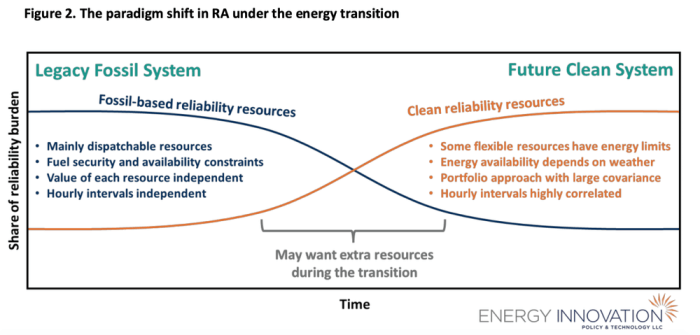
So what will the future of energy usage actually look like in these places as fossil fuels get phased out and wind and solar take over, with woefully insufficient energy storage to cover the intermittencies? To get an idea, let’s take another look at the Report for California put out by consultancy Energy Innovations on May 9, with the title “Achieving an Equitable and Reliable 85 Percent Clean Electricity System by 2030 in California.” Note that this in not actually Net Zero, but only 85% of same. Here are a few tidbits. First, their graphic on the nature of the transition:
We’re going to have a “paradigm shift” in “RA,” which seems to mean “Resource Adequacy.” Check out that list on the right under “clean reliability resources” — “Energy availability depends on weather.” Are you starting to get the picture now?
Read through the report until you get into pages in the mid-30s, where the subject becomes what they euphemistically call “demand response.” It’s a lot of bafflegab to make it seem oh so pleasant. Excerpt:
Demand-side measures can substitute for supply-side resources and therefore contribute to resource diversity; their increased availability hedges against the risk of deploying new clean supply-side resources too slowly (including generators and storage). For example, the technical report finds that deploying Load Shift could reduce load by 1,500 MW in the early evening hours solar output falls, hedging against battery deployment challenges such as supply chain. . . . Demand-side measures also provide complementary reliability, resiliency, and public safety benefits to supply-side solutions or imports, as they lie closest to the affected load. While centralized generators provide the bulk of our power under most system conditions, they can be rendered less effective or useless under certain disaster conditions.
This is bureaucratese meaning “we’ll turn off your electricity at random times when we feel like it.” Get ready for this, California, Germany, et al. I guess New York is on the same path too, but I have my secret escape plans ready.
The WEF is pushing for digital IDs to be sewn into people’s clothes to ‘save the planet’ by transitioning from buying to renting clothes to reduce waste.
“This start-up gives clothes digital IDs to help the planet. EON creates online digital passports for garments enabling brands to sell their clothing, again and again, creating more sustainable business models,” a video from the World Economic Forum begins.
The WEF continues, saying that companies will then be able to actively track the clothing they sell, which brings up innumerable privacy concerns not addressed by the Forum.
“The CircularID also lets rands follow garments over their entire life cycle from production to sale and resale, reuse, or recycling.”
The WEF says this is essential, as “fashion” is apparently “one of the world’s most polluting industries.” Thus, companies should be allowed to track their clothes and the wearers, presumably so they can conduct dumpster dives for thrown-out clothing or provide clothing repair and resale services.
“Textiles generate 10% of the world’s CO2 emissions — more than shipping and aviation combined,” the WEF continues.
They add that in the future, such technology will enable companies to transition from selling an ownable product to a rentable product, simultaneously reducing consumers from owners to renters. As the saying goes, “You will own nothing. And you will be happy.”
“57% of old clothes end up in a landfill. This is because brands depend on sales of new clothing. Once the product is sold, they no longer make any money. But digitally connected products open up new, greener ways of profiting, such as rental, repair, and styling, reducing the production of new garments,” explains the WEF.
“5 of the world’s top 20 brands are on board,” the WEF proclaims. “Working with Microsoft, EON aims to bring billions of garments online by 2025.”
LATELY I have been listening to interviews with Mattias Desmet, the Belgian psychologist who has popularised, if not invented, the term ‘mass formation’, a sort of mass hypnosis, a condition which he says often leads to tyranny. If I understand him correctly mass formation occurs when people feel estranged from each other and the world around them, they lack purpose and feel out of control. Fear is an important factor in this and frightened people are amongst the easiest to hypnotise since they will unquestionably follow an ‘authoritative’ voice. The door is open for someone to come along and offer them a place to belong, make them feel safe and give them a purpose. Thus the tyrant is born. Desmet contends that although this has happened throughout history it has become more common in modern times because we have become increasingly estranged from nature, and he attributes this to the invention of the clock.
As soon as reliable clocks were available, people in their everyday lives were less influenced by the sun and the seasons. Reliable clocks are a symbol of industrialisation, and this has led to movement of people into cities and consequently less in touch with nature. The mechanisation of agriculture gave us the ability to feed large numbers using very little labour. Cheap energy from oil and coal accelerated this industrialisation. Cities and towns have benefits: it’s easier to provide services including education and health, clean water, power and transport, and as someone who lives in a rural area I am well aware of the difference. This has happened in a very short space of time to a species which has evolved over millennia as part of the natural world. In truth we are as much a part of nature as trees, earthworms, bacteria and viruses (although it’s debatable whether or not the current coronavirus is natural).
There’s a wonderful grounding reality about the natural world. Gravity is all too real if you fall out of a window, and rain, wind and sunshine can make you feel wonderful or damage your health. Childbirth is both joyous and potentially fatal. Relationships can be enriching or toxic.
All this may sound obvious, but doesn’t seem to be for many of our fellow citizens who think that bad things shouldn’t and wouldn’t happen if the State took proper care of us which, of course, it promises to do: that voice of authority again.
This detachment from the real leads to living too much in the head. Your ideas, arguments, your emotions become the greater part of your reality. The constantly chattering voice in your brain becomes louder unless you can ground yourself. This is the default position for many and it can be dangerous. The signs are everywhere.
Climate change is one such situation. As we know all too well, this is the idea that a small increase in the atmosphere of a trace gas which is essential to life is responsible for rising global temperatures, storms, mass extinctions, diseases, and I could go on but you’ve heard it all before. Some say that this is proven to be true and the science is settled and isn’t science a really good way of connecting with the real world? Yes, when it isn’t manipulated for political purposes or carried out by people who think that computer models are the real world.
Talking of modelling takes us to Covid. Policy to deal with the virus was largely driven by models which chimed with certain political aims and gave rise to disastrous consequences. For many years the UK had a pandemic policy based on accumulated data and real-world results of public health interventions, yet this policy was thrown out and its proponents, people at the top of their field, were ignored, smeared or insulted and often all three. Vilification of ‘outsiders’ is another aspect of mass formation. The fact of natural immunity was debunked by people who could not admit to the existence of this wonderful example of the interrelationship between us and the rest of nature.
Now we come to woke, perhaps the most glaring example of living in your head instead of the real world. The hallmark of this is a belief in something that defies logic, history and science (the real thing, not the made-up stuff). No amount of education or reasoning permeates the world that is firmly embedded in the head. The transgender issue is an astonishing example. It wouldn’t be so bad if these ideas stayed inside the head but they escape into the real world where they can have serious consequences: men in female prisons and hospital wards, and male athletes competing in women’s sports events for example. I have heard of midwives saying that a man can have a cervix. I suppose the beings in your head can have any anatomy you want. I’m just waiting for the day when gravity is seen as a Western construct and people start walking off cliffs.
When challenged, those who live in their heads can react aggressively because you have challenged their very being. Perhaps the most frightening consequence of this detachment from reality and its subsequent mass formation is illustrated by the thoughts of Dr Yuval Noah Harari, adviser to everyone’s favourite human being, globalist Klaus Schwab. Harari believes that ‘science is replacing evolution by natural selection with evolution by intelligent design’. Not sure how the word ‘intelligent’ belongs in that sentence, but he seems to show a complete lack of understanding of the real world and the way everything in it is connected. Harari suggests that it will be possible to tweak human DNA in the way that we can alter computer coding. Very few processes in the body are controlled by one gene; physiological activity results from the interaction of many genes which may be on different chromosomes. Tinkering with a few genes is likely to have unforeseen consequences. Our DNA is intimately connected to the outside world. We express genes in response to outside stimuli, viruses incorporate themselves into our DNA and our body’s immune history is written in our genes. In short, our DNA is finely tuned to nature and to suggest that manipulating the various molecules in its strands will improve our lot is hubris beyond belief. Perhaps in Harari’s head we are all machines. Maybe he finds that comforting.
Remarkable new scientific evidence has been published that suggests abrupt rises in temperature have been a feature of global climate change going back to the iceless Jurassic period over 150 million years ago. These warming events, in which the temperature rose many degrees centigrade within decades or less, were thought to be a feature of the last ice age up to 100,000 years ago and confined to Greenland and the North Atlantic. This dramatic new evidence suggests they were a feature across the globe going back millions of years.
The findings will give fresh insight into the highly politicised debate around climate science and Net Zero. It is constantly argued that the recent small rise in global temperature, which started over 200 years ago, is unprecedented, and is caused by humans burning fossil fuel. Far from being unprecedented, it seems similar changes in temperature over comparable, and often shorter, time periods were ubiquitous across paleoclimatic history stretching back to the Jurassic era.
A group of French scientists led by Slah Boulila from the Sorbonne carried out extensive research into what are known as Dansgaard-Oeschger (DO) events. These events, named after two paleoclimatologists, track 1,500 year temperature cycles when large rises suddenly occurred followed by a reversion to ice age conditions. The scientists noted warming up to 15°C within a few decades, “pointing to abrupt and severe changes in Earth’s past climate”. Scientists and green activists seeking to downplay the significance of large changes in the paleoclimatic record have suggested that oscillations of northern hemisphere ice sheets and surrounding waters played a part.
But the French scientists now say that paleoclimatic studies have shown that the 1,500-year climate cycle is no longer restricted to the North Atlantic Ocean of the last glacial period. “The 1,500-year cycle is documented in both hemispheres, in other oceans and in continents, such as in lake and river deposits, in pollen fossils, in stalagmite proxy records, and in loess-paleosol deposits,” they add. In conclusion, the scientists note that the analysed paleoclimate records of the late Jurassic “supports the global nature of DO-like event, and in particular that their potential primary cause is independent of ice sheet dynamics”.
Of course, the inconvenient fact that the planet has seen countless significant temperature rises in the past is not unknown. Back in 1999, before global climate hysteria got into its full stride, geographer Mark Maslin from Imperial College co-wrote a paper on “sudden climate transitions” in which he stated: “All the evidence indicates that most long-term climate change occurs in sudden jumps rather than incremental change.” He went on to add that some, and possibly most, large climate changes involving movements of several degrees occurred at most on a timescale of a few centuries, sometimes decades, “and perhaps even a few years”.
These days Maslin is Professor of Earth Systems Science at the politically-named UCL Anthropocene, and tweeting that “Earth is already becoming unliveable”. A frequent guest on BBC programmes, Maslin has explained that the Anthropocene began with European colonisation and mass slavery. The origins of racism and climate emergency “share common causes”. Climate change politics helps build “a new political (and socio economic) system”. In 2018, he was one of a number of eco-activists who signed a letter to the Guardian saying they would no longer “lend their credibility” by debating climate change scepticism.
It would seem that the record of large – often startlingly large – rises in past temperature needs to be downplayed if the command-and-control Net Zero project is to be promoted. Removing fossil fuel from modern lifestyles within less than 30 years demands enormous economic and societal sacrifices, particularly from poorer members of society and across the developing world. It can only be done if enough people and populations believe there is an existential threat to the planet from recent warming and model-projected future warming.
Meanwhile, science continues to produce evidence of major temperature changes in the past. Two recent studies suggesting much higher temperatures are noted by the No Tricks Zone climate science site. A new study is said to have shown that it was warm enough 8,000 to 5,000 years ago for the plant Ceratopteris to have grown at 40°N in northern China. These days, the plant’s limit is 34°N, suggesting that winter temperatures in the past needed to be 7.7°C higher than today. Another warmth threshold species study argues that the Arctic Svalbard needed to have been 6°C warmer than today during the early Holocene. This is because 9,000 years ago, molluscs survived 1,000km north of where they are currently found.
Further details on the work undertaken by the Boulila team, including its scientific methodology, can be accessed here. More details about the two papers can be found on the No Tricks Zone. And further reporting on past global temperature changes by the Daily Sceptic can be found here.
Canadian farmers slammed Justin Trudeau over rising fertilizer costs resulting from his decision to put tariffs on Russian fertilizer.
According to Ryan Koeslag, executive director of Ontario Bean Growers, tariffs on Russian fertilizer are wreaking havoc on the Canadian Agriculture Sector and the ability of farmers to merely keep their heads above water.
“Around one-third [of the 2022 shipments] had not been delivered into Ontario yet when that tariff was applied, and some of those ships were even being told that they would have to turn around,” Koeslag told CBC News in an interview. “… It’s hard to be a green farmer when you’re operating in the red.”
He also wonders why Canadian farmers are being forced to flip the bill for the war in Ukraine, despite other G7 countries abstaining from imposing such tariffs as they knew it would hurt their citizens.
“The United States is not applying a tariff. The U.K. and France are not applying a tariff. Why is it that Canada is the one that’s forcing our farmers to pay for the cost of the war in Ukraine?” asked Koeslag.
Indeed, as noted by Atlantic Grains Council chairman Roy Culberson, “The world needs Canadian farmers to produce our best crop this year. You cannot grow crops without fertilizer, and you cannot produce food without crops. An additional tariff paid by farmers on a global product such as fertilizer just penalizes the farmer. We look forward to working on a resolution with government.”
Earlier this year, Deputy PM and Finance Minister Chrystia Freeland acknowledged that the government’s decision to put tariffs on Russian fertilizer would negatively impact the Agriculture Sector but assured Canadian farmers that it wouldn’t be too bad.
“Tariffs and retaliation and sanctions are the most effective when you can devise policies that have the maximum impact on the counterparty whose attention you are seeking to get and do the minimal damage to yourself,” Freeland said a week after the Russia-Ukraine war kicked off.
How could it not cause more than “minimal damage,” though? According to Grain Farmers of Ontario, “Ontario, Quebec, and Atlantic Canada rely heavily on fertilizer imports. Approximately 660,000 – 680,000 tonnes of nitrogen fertilizer is imported from Russia to Eastern Canada annually, which represents between 85-90 per cent of the total nitrogen fertilizer used in the region.”
Trudeau, of course, hasn’t addressed any of the farmer’s concerns regarding tariffs. Moreover, the rising fertilizer costs come at a time when the Trudeau government is pushing forward with a 30% emissions reduction cap on nitrous oxide from fertilizer.
Indeed, as noted by Fertilizer Canada CEO Karen Proud, farmers are already reducing fertilizer use due to rising costs (resulting in less food and rising prices), and the nitrogen policy will only exacerbate the problem.
“We are talking about the food supply,” said Proud. “Canada is already among the top countries that use nitrogen efficiently. We don’t have much room to go before we start affecting yields.”
Agriculture Ministers from several provinces have also voiced their frustrations over the actions of the Trudeau government, explaining that this has already been the most expensive year for farming in recent memory, and Trudeau’s climate fanaticism is only going to make things worse.
“We’re really concerned with this arbitrary goal,” Saskatchewan Minister of Agriculture David Marit said. “The Trudeau government has apparently moved on from their attack on the oil and gas industry and set their sights on Saskatchewan farmers.”
Alberta Agriculture Minister Nate Horner agreed, adding, “This has been the most expensive crop anyone has put in, following a very difficult year on the prairies. The world is looking for Canada to increase production and be a solution to global food shortages. The Federal government needs to display that they understand this. They owe it to our producers.”
With what appears to be a coordinated attack on Canada’s Agriculture Sector and food supply, it’s no surprise that farmer’s groups speaking to Farmers Forum are wondering if he’s intentionally trying to cause a food shortage — which Trudeau previously told Canadians to prepare for.
Berlin’s policy of trying to give up imports of Russian natural gas is likely to create hardship and spark unrest, seven mayors from the German island of Ruegen wrote in a letter sent to the regional and federal governments on Wednesday. They also urged the federal government to allow gas imports via the Nord Stream 2 pipeline, given the current technical difficulties with Nord Stream 1 – something Berlin has steadfastly rejected.
In the letter addressed to federal economy minister Robert Habeck and Manuela Schwesig, prime minister of Mecklenburg-Vorpommern, the mayors “strongly condemn” the current conflict in Ukraine but urge the government to consider the damage its policy could do to the German population and the economy, according to the news agency DPA.
“We are of the opinion that the path taken by the federal government to disconnect from Russian energy sources is not the right one,” the seven mayors wrote. Initially drafted by the leaders of Bergen, Binz and Sassnitz, the letter was later signed by four more jurisdictions on Ruegen, Germany’s largest island and a popular tourist destination.
Giving up gas imports from Russia would mean an explosion in the cost of living, which would lead to social instability and unrest that could get out of control, the mayors wrote, according to German media. Calls from the federal government to save energy – such as showering less and foregoing hot water – “defy understanding,” they added.
“As the mayors of this island, we don’t want to have to accept any further restrictions,” Sassnitz city manager Frank Kracht told the Mecklenburg-Vorpommern affiliate of the TV station NDR.
Rejecting the proposals to expand the number of wind turbines near residential areas, calling them a health hazard, the mayors advocated “a general rethinking of the solution to the current problems in relations with Russia.”
Among their suggestions was to get additional natural gas via the Nord Stream 2 pipeline. Finished in late 2021, the pipeline from Russia to Germany under the Baltic Sea was just waiting for the operating permit from Berlin – which was suspended indefinitely on February 22, two days before Russia sent troops into Ukraine.
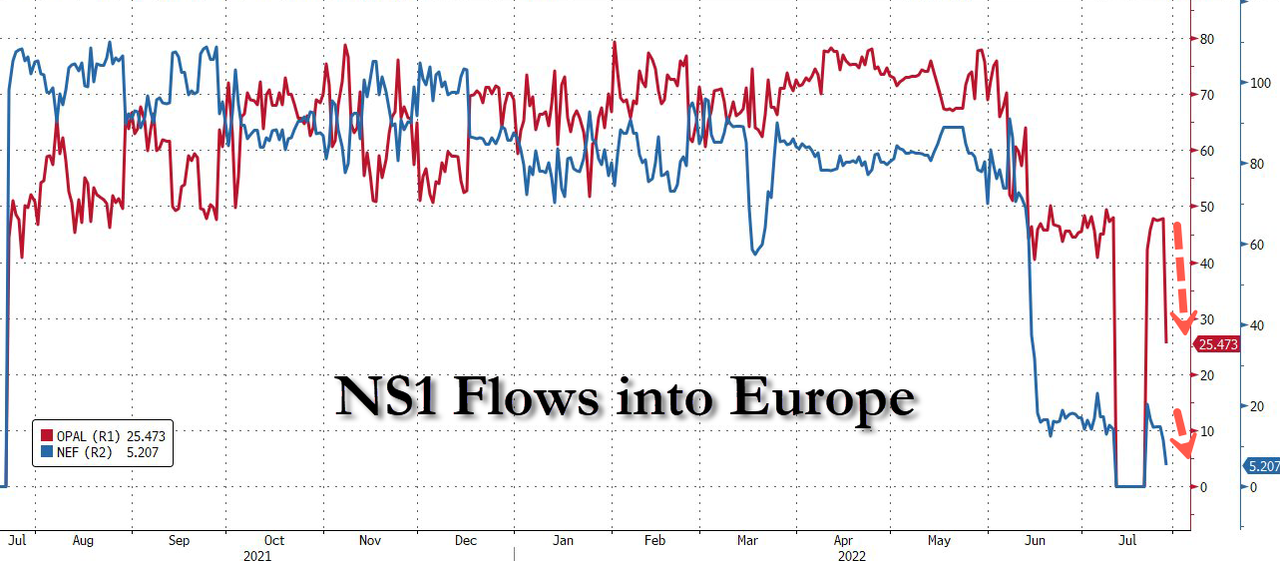
NS2 was supposed to double the volume of Russian gas exports, but was delayed by US sanctions seeking to protect Ukraine’s gas transit earnings. Nord Stream 1, which continues to supply Germany with gas, is currently operating at only 20% capacity, due to maintenance requirements. Its operator, Gazprom, says several turbines at the Portovaya compressor station need servicing to maintain certification. The first one was held up by Canada, citing anti-Russian sanctions over the conflict in Ukraine, until Berlin intervened seeking an exemption. NS2 does not use Siemens turbines, and can be maintained regardless of the sanctions.
Berlin has refused to even consider the possibility of using NS2, however. Economy minister Habeck has said that the pipeline cannot operate without certification. He also accused Russian President Vladimir Putin of trying to damage EU solidarity with Ukraine by driving up the price of gas.
“Putin has the gas, but we have the power,” Habeck said on Tuesday, appealing to Germans to stand together.
Recent polls showed widespread pessimism in German industry regarding future business prospects. Commenting on the turbine delay last week, Foreign Minister Annalena Baerbock said gas shortages could lead to an insurrection.
“If we don’t get the gas turbine, then we won’t get any more gas, and then we won’t be able to provide any support for Ukraine at all, because then we’ll be busy with popular uprisings,” she told the TV outlet RND. Baerbock hastened to add that this may have been “exaggerated” and insisted most Germans supported sending weapons to Ukraine, though.
German chemicals company BASF SE paid an extra 800 million euros ($809.5 million) to keep its plants operating in the second quarter compared with a year earlier amid skyrocketing natural gas prices. The impact of high energy prices has forced the company to make a difficult decision: slash the production of ammonia, which could have potential consequences for farming to the food industry.
“We are reducing production at facilities that require large volumes of natural gas, such as ammonia plants,” BASF Chief Executive Martin Brudermuller said in a conference call after an earnings report.
Brudermuller said BASF would tap external suppliers to fill the deficit as German plants reduced output. He warned about potential supply disruptions that could boost fertilizer costs for farmers.
Reuters details how ammonia plays a critical role in manufacturing nitrogen-based fertilizers, plastic-making, and diesel exhaust fluid. A byproduct of ammonia production is high-purity carbon dioxide (CO2) which is heavily used in the food industry.
The news of BASF reducing ammonia production because of soaring NatGas prices comes as Russian state-owned energy producer Gazprom PJSC is expected to halve supplies via Nord Stream 1 to Europe to about 20% today. EU member states agreed Tuesday to reduce NatGas demand by 15% over the next eight months, though countries like Germany, without any liquefied natural gas (LNG) port terminals to replace Russian pipeline NatGas, might have to make more considerable sacrifices.
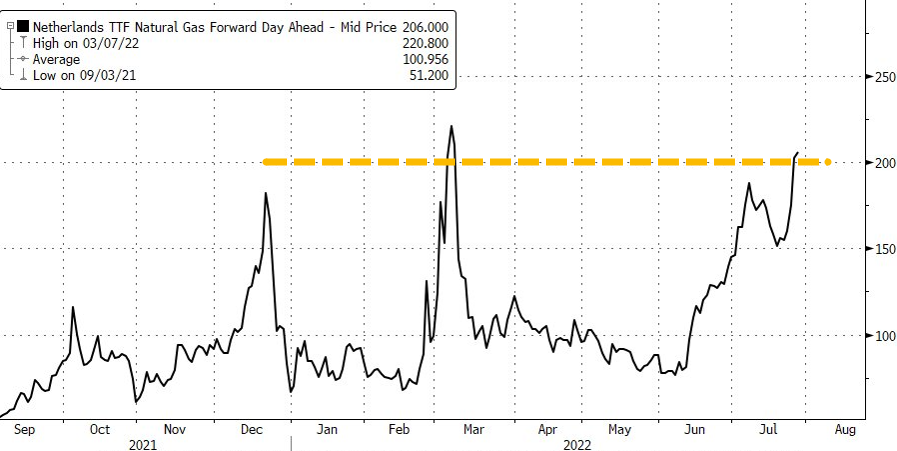
Benchmark NatGas prices in Europe at the Dutch TTF hub hit their highest level since March. Prices have shot up 35% in a week, over 200 euros per megawatt-hour (MWh), as Putin turns the screws on Europe by reducing pipeline capacity to Europe.
“Chemical companies are the biggest industrial natural-gas users in Germany, and ammonia is the single most gas-intensive product within that industry,” Reuters said.
Arne Rautenberg, a fund manager at Union Investment, said ammonia is a prime candidate by chemical companies to cut production first over the NatGas supply squeeze.
“In the northern hemisphere, nitrogen fertilizer is applied primarily during the spring. It can also be produced in the United States and shipped to Europe,” Rautenberg said, adding that the CO2 supply for the food industry could experience disruptions.
The chemical industry lobby VCI indicates German ammonia production has been curbed (some of which began last October) considerably because of soaring energy prices. This could soon impact industries that rely heavily on ammonia and ripple through the economy already facing recession.
A detailed report published by the Guardian newspaper has shown how Britain is massively contributing to Saudi Arabia’s devastating war on Yemen as it suggests that London is not only supplying the bombs that fall on Yemenis, but it provides the personnel and expertise that keep the war going.
The comprehensive report by Arron Merat published on Tuesday showed that Britain was doing much of the killing in Yemen as the country continues to provide Saudi Arabia with everything it needs to turn its southern impoverished neighbor into a graveyard.
“Every day Yemen is hit by British bombs – dropped by British planes that are flown by British-trained pilots and maintained and prepared inside Saudi Arabia by thousands of British contractors,” said Merat in the report. … continue
This site is provided as a research and reference tool. Although we make every reasonable effort to ensure that the information and data provided at this site are useful, accurate, and current, we cannot guarantee that the information and data provided here will be error-free. By using this site, you assume all responsibility for and risk arising from your use of and reliance upon the contents of this site.
This site and the information available through it do not, and are not intended to constitute legal advice. Should you require legal advice, you should consult your own attorney.
Nothing within this site or linked to by this site constitutes investment advice or medical advice.
Materials accessible from or added to this site by third parties, such as comments posted, are strictly the responsibility of the third party who added such materials or made them accessible and we neither endorse nor undertake to control, monitor, edit or assume responsibility for any such third-party material.
The posting of stories, commentaries, reports, documents and links (embedded or otherwise) on this site does not in any way, shape or form, implied or otherwise, necessarily express or suggest endorsement or support of any of such posted material or parts therein.
The word “alleged” is deemed to occur before the word “fraud.” Since the rule of law still applies. To peasants, at least.
Fair Use
This site contains copyrighted material the use of which has not always been specifically authorized by the copyright owner. We are making such material available in our efforts to advance understanding of environmental, political, human rights, economic, democracy, scientific, and social justice issues, etc. We believe this constitutes a ‘fair use’ of any such copyrighted material as provided for in section 107 of the US Copyright Law. In accordance with Title 17 U.S.C. Section 107, the material on this site is distributed without profit to those who have expressed a prior interest in receiving the included information for research and educational purposes. For more info go to: http://www.law.cornell.edu/uscode/17/107.shtml. If you wish to use copyrighted material from this site for purposes of your own that go beyond ‘fair use’, you must obtain permission from the copyright owner.
DMCA Contact
This is information for anyone that wishes to challenge our “fair use” of copyrighted material.
If you are a legal copyright holder or a designated agent for such and you believe that content residing on or accessible through our website infringes a copyright and falls outside the boundaries of “Fair Use”, please send a notice of infringement by contacting atheonews@gmail.com.
We will respond and take necessary action immediately.
If notice is given of an alleged copyright violation we will act expeditiously to remove or disable access to the material(s) in question.
All 3rd party material posted on this website is copyright the respective owners / authors. Aletho News makes no claim of copyright on such material.