Diesel driving ban in Stuttgart provokes Yellow Vest protests
Press TV – February 3, 2019
Hundreds of Germans have donned yellow vests to match protesters in France, demonstrating in the bastion of Germany’s car industry in Stuttgart against a recent driving ban on older diesels.
The protest came after organizers asked people to hit the streets clad in the yellow high-visibility vests that have defined months of protests in France — themselves triggered by an increase in tax on diesel.
“The French are an example to us, because they dared take to the streets to protect their rights,” organizer Vasilos Topalis told Agence France-Presse (AFP).
Stuttgart is home of Mercedes-Benz maker Daimler, Volkswagen subsidiary Porsche and the world’s biggest car parts supplier Bosch.
Since January 1, only diesel vehicles meeting the Euro 5 emissions standard are allowed into Stuttgart, with efforts underway to implement similar driving bans in many German cities.
Topalis said tens of thousands of people are affected by the bans and cannot afford to buy a new car. “What’s happening to people is unjust,” he added.
The protest came as France’s yellow vest protesters returned to the streets Saturday to keep up the pressure on the government and decry the number of people being injured by police during demonstrations.
Multiple protests took place in Paris and other cities to denounce President Emmanuel Macron’s economic policies, which they view as favoring the rich, for the 12th straight weekend of demonstrations.
The government says around 2,000 people have been injured in protests since the movement began Nov. 17 and 10 people have died in traffic accidents related to yellow vest actions.
The protesters paid homage to those injured since the onset of the rallies on November 17.
Protesters and rights groups have denounced the French police’s response to the yellow vests marches as “excessive,” including their use of controversial high-velocity rubber bullets.
France’s Council of State, however, ruled Friday that security forces have a right to use them for crowd control.
Meanwhile, a bill is under debate in the French parliament to strengthen measures against protesters whom they view as troublemakers. Rights groups and opposition lawmakers say the bill goes too far in restricting the right to protest.
The bill would authorize police to prevent people they see as a serious threat to public order from taking part in protests. It would also make it a crime for protesters to conceal their faces during demonstrations.
Labour’s Shadow Chancellor plans to slap new ‘green’ taxes on plane tickets
By Paul Homewood | Not A Lot Of People Know That | January 6, 2019

Labour’s John McDonnell is plotting a tax hike on plane tickets and getting rid of duty free at airports, the Treasury warned last night.
The Shadow Chancellor wants to put up levies on flying and increase rates paid on alcohol in the departure lounge, according to comments made by his team.
The changes could double the cost of a plane ticket – making a summer holiday somewhere sunny abroad out of reach for many hard-working families.
Shadow Treasury Minister Clive Lewis has vowed to crackdown on the ability of Briton fly by plane abroad if Labour are elected.
He said: ‘Growth in demand for UK air travel must be limited.’
He argued that they must ‘control and push down demand for flights’.
He called and a useful ‘lever’ to do this.
The current rate of APD sees the average family already paying £81 per year in ‘holiday tax’.
A new frequent-flyer tax and ending the duty-free status of flights and airport shopping are other options being discussed.
A £238 flight would rocket to £505 if all the measures are introduced, pricing many families out of a holiday completely, according to The Sun.
https://www.dailymail.co.uk/news/article-6561361/Warning-Labour-holiday-tax-families.html
Needless to say, the Labour Party assures us that this is not party policy, but we have heard that one before!
To argue that Air Passenger Duty a ‘fiscally progressive tax’ shows just how out of touch Labour are with their own roots. They seem to have the quaint idea that only rich people can afford to fly. It is working class families who will be hit hardest by APD, as they have kids to pay for as well.
No doubt McDonnell sees this as a nice little earner, but it is Clive Lewis who appears to give the game away. UK air travel must be cut, according to him, and to do so it must be priced out ordinary people’s budgets.
Meanwhile, Beijing’s new Daxing International Airport is due to open this autumn.
With eight runways serving 100 million passengers annually, Daxing International will becoming the world’s largest airport.
And China also aims to open 200 more airports by 2035:

The Civil Aviation Administration of China (CAAC) published a development report on Monday that aims to add 216 new airports by 2035 and develop a number of regional transport hubs.
According to the CAAC, China had 234 civil airports as of October this year and is expected to have around 450 by 2035, China Daily reports. Further, the demand for passenger transport in China will account for a quarter of the world’s total and exceed that of the US by 2035, making China the largest air passenger market in the world.
It also says that world-class airports will be built in the Yangtze River Delta region, the Beijing-Tianjin-Hebei region, the Guangdong-Hong Kong-Macau Greater Bay Area and the Chongqing and Chengdu city cluster.
“Service has improved substantially, but existing airports are far from adequate and are unevenly distributed throughout the country,” said Dong Faxin, director of the administration’s development and planning department.
China’s airports are expected to handle 720 million trips by 2020 – up from 552 million last year – according to the the administration.
https://gbtimes.com/china-aims-to-develop-over-200-new-airports-by-2035
Does Clive Lewis really think stopping working class families from flying to Majorca will make any difference to the world’s climate?
US Geological Survey Discovers in Texas Largest Ever Domestic Oil, Gas Resources
Sputnik – 07.12.2018
WASHINGTON – The US Geological Survey assessed that the Bone Spring Formation in Texas and Wolfcamp Shale in New Mexico contain the largest oil and natural gas potential ever found, the Department of the Interior said in a press release on Thursday.
“[T]he Wolfcamp Shale and overlying Bone Spring Formation in the Delaware Basin portion of Texas and New Mexico’s Permian Basin province contain an estimated mean of 46.3 billion barrels of oil, 281 trillion cubic feet of natural gas, and 20 billion barrels of natural gas liquids,” the release said.
Interior Secretary Ryan Zinke celebrated the assessment by saying that the United States has a lot of energy and the country’s dominance in the energy sector is now proven.
The Wolfcamp shale in the Midland Basin portion of the Texas Permian Basin province has been examined by the US Geological Survey in 2016.
The organization concluded then that the formation contained an estimated mean of 20 billion barrels of oil, 16 trillion cubic feet of associated natural gas and 1.6 billion barrels of natural gas liquids.
The US Geological Survey’s new assessment said that the resources in the two formations are twice larger than those in the Midland Basin. The Interior Department credited the use of modern technologies, such as hydraulic fracturing and directional drilling, for being able to effectuate a greater energy potential.
Macron Sends French Troops to Reunion Island Amid Carbon Tax Hike Unrest
Sputnik – 22.11.2018
On Wednesday, at least 16 police officers were reportedly injured in clashes with “yellow vests”, protesters who oppose rising prices for fuel in Reunion, a French overseas department in the Indian Ocean.
French President Emmanuel Macron has announced the deployment of troops to Reunion to resolve what he described as a ‘complicated situation’ in the French overseas territory.
“The situation, which has been developing in Reunion since Saturday, is serious. We have taken efforts and will continue to do so — our servicemen will be mobilised starting from tomorrow [Thursday] to restore public order. There will be a crackdown because we cannot tolerate the scenes that we have seen [in the past few days],” Macron tweeted.
His remarks came after French government spokesman Benjamin Griveaux said that at least thirty security officers had been injured in five days of clashes with protesters over soaring gasoline prices in Reunion.
“The latest data on Reunion was shared with us by the cabinet. There were 109 arrests; 30 law enforcers were injured, including 16 police officers and 14 gendarmes,” Griveaux pointed out.
The Reunion protests were part of large-scale demonstrations over the rise in fuel prices which kicked off in France last Saturday.
The French Interior Ministry reported that more than 287,000 people attended the Saturday protests, while French Interior Minister Christophe Castaner said that at least 500 people had been injured across in France during the demonstrations.
The past ten months have seen a 23-percent increase in the price of diesel in France, where the price of petrol has soared by 15 percent within the same period.
As of January 1, 2019, prices for petrol and diesel in France are expected to grow by 2.9 eurocents and 6.5 eurocents, respectively.
Anything Goes When You’re Saving the World
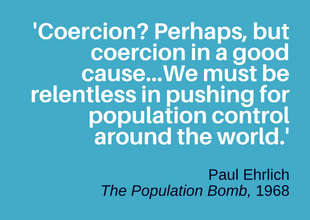
By Donna Laframboise | Big Picture News | May 30, 2018
SPOTLIGHT: Saving the world = barbaric behaviour.
BIG PICTURE: The paperback edition of biologist Paul Ehrlich’s 1968 bestseller, The Population Bomb, was 233 pages long. The first three chapters described a problem.
The final two chapters were titled “What Needs to be Done” and “What Can You Do?” They were followed by an Appendix of examples of letters readers might send to influential individuals. In other words, 83 pages of that book (more than a third) was an unabashedly political discussion.
These pages reiterated that the future was bleak. Overpopulation threatened America, the American way of life, and the “very lives” of US citizens (pp. 135, 138, 172, 180, 182).
The “only hope for survival,” was “drastic worldwide measures” lest civilization itself go “down the drain.” The “time of famines” had arrived (pp. 134, 143, 145, 148, 157-9, 161, 165, 198).
50 years later, we know Ehrlich’s apocalyptic predictions were wildly off target. Half a billion people did not starve to death during the 1970s. Instead, via ingenuity and technology, humanity grew more food and got better at transporting it to wherever it was desperately needed.
Americans weren’t forced to “slaughter” their dogs and cats so that pet food protein could be fed to the “starving masses.” Luxury taxes weren’t placed on diapers, and a powerful new arm of the US government wasn’t created to “take whatever steps are necessary,” in order to bring that country’s birth rate in line with its death rate. In 1968, there were 200 million Americans. Today, there are 326 million (pp. 134, 137-8).
Ehrlich’s fanaticism was on stark display when he described overpopulation as a cancer:
We must shift our efforts from treatment of the symptoms to the cutting out of the cancer. The operation will demand many apparently brutal and heartless decisions. The pain may be intense. But the disease is so far advanced that only with radical surgery does the patient have a chance of survival. (pp. 166-167)
In this regard, he declared that America should have pressured the Indian government to sterilize “all Indian males with three or more children”:
We should have volunteered logistic support in the form of helicopters, vehicles, and surgical instruments. We should have sent doctors to aid in the program…Coercion? Perhaps, but coercion in a good cause. (pp. 165-166)
TOP TAKEAWAY: Fifty years after The Population Bomb appeared, few people remember that it advocated dispatching US helicopters so that Indian peasants could be kidnapped & forcibly sterilized.
Claim: $220 Billion “Family Planning” Equivalent to a Trillion Dollars of Climate Tech Investment

Displaced Rohingya people in Rakhine State. By Foreign and Commonwealth Office – Flickr, OGL, Link
By Eric Worrall | Watts Up With That? | May 22, 2018
Family planning charities suggest helping poor women “control their fertility” will save as much CO2 as a trillion dollars of investment in low carbon technologies. But provision of family planning wrapped around a higher purpose has a long and ugly history.
Worried About Climate Change? Investing in Reproductive Health Must Be Part of the Solution
Monday, 21st May 2018
Chris Turner
…Since the invention of the contraceptive pill in the 1950’s, access to modern contraception has driven some of the key demographic and social changes in history. It has delivered improved health outcomes for mothers and babies as women are able to wait longer between births or delay having their first child. It created demographic shifts, as populations have fewer dependents and a more productive labour force. It has empowered girls and women to stay in school longer, seek higher education and participate in the formal economy. And now recent research has determined that contraception also has a key role to play in addressing climate change.
…
Poverty reduction and strengthening economies
When women can exercise reproductive choice, they are more likely to participate in education and the workforce. In most developing countries, female participation in the formal economy has increased as fertility has fallen. Women’s participation in the economy promotes economic growth and economies that are strong are better able to absorb the disturbances of climate change and recover from climate-related events.
…
Women’s participation and leadership
Women’s participation and leadership is important to climate change preparedness, resilience and action. Enabling women to control their bodies and reproductive health can help create opportunities for women to participate, lead and contribute to the conversation.
As a climate change mitigation strategy, family planning programs are also more cost-effective than other conventional, energy-focused solutions. One study found that $220 billion spent on providing family planning to those with an unmet need would reduce 34 gigatons of global carbon emissions, compared to $1 trillion for a similar outcome if spent on low carbon technologies.
…
Regardless of your position on birth control and abortion, I think we can all feel a sense of unease when efforts to provide “family planning” are offered as part of a larger mission to reduce population, rather than placing the interests of the recipients of the medical aid first.
Provision of birth control to poor people has a long, ugly history. For example, consider this Guardian story about the Bangladesh government’s recent efforts to offer sterilisation services to inconvenient Rohingya refugees displaced by ongoing political turmoil in Burma.
Bangladesh to offer sterilisation to Rohingya in refugee camps
Family planning authorities have asked the government to launch vasectomies and tubectomies for women in Cox’s Bazar, where 1m refugees fight for space.
Bangladesh is planning to introduce voluntary sterilisation in its overcrowded Rohingya camps, where nearly a million refugees are fighting for space, after efforts to encourage birth control failed.
More than 600,000 Rohingya have arrived in Bangladesh since a military crackdown in neighbouring Myanmar in August triggered an exodus, straining resources in the impoverished country.
The latest arrivals have joined hundreds of thousands of Rohingya refugees who fled in earlier waves from Myanmar’s Rakhine state, where the stateless Muslim minority has endured decades of persecution.
Most live in desperate conditions with limited access to food, sanitation or health facilities and local officials fear a lack of family planning could stretch resources even further.
…
Many of the refugees told AFP they believed a large family would help them survive in the camps, where access to food and water remains a daily battle and children are often sent out to fetch and carry supplies.
Others had been told contraception was against the tenets of Islam.
Farhana Sultana, a family planning volunteer who works with Rohingya refugees in the camps, said many of the women she spoke to believed birth control was a sin.
“In Rakhine they did not go to family planning clinics, fearing the Myanmar authorities would give medicine that harms them or their children,” Sultana said.
…
You could reasonably argue that refugee women having 19 children each is unsustainable. But I doubt the first concern of the Bangladeshi authorities is the well-being of the Rohingya. I suspect the Bangladeshi authorities would be overjoyed if the Rohingya refugee problem just quietly disappeared.
Over zealous family planning doesn’t just occur in poor countries. The USA has experienced domestic scandals in the past related to forced sterilisation, and scandals with the practices of organisations like Planned Parenthood, including accusations of medical racism.
My point is I personally have no problem with women having access to the medical services they need to create a better life for themselves and their families. I understand some people likely have different opinions about reproductive issues, what is an is not acceptable, to myself.
But surely we can all agree that mixing family planning with another mission like reducing humanity’s global carbon footprint creates a horrifying risk that the welfare of patients will not be the top priority. There are many ugly historical examples to support this concern.
Remembering Ireland’s Great Famine
A review of Black ’47 a soon to be released film about the famine in Ireland
By Caoimhghin Ó Croidheáin | Dissident Voice | April 13, 2018
Weary men, what reap ye?—Golden corn for the stranger.
What sow ye?— human corpses that wait for the avenger.
Fainting forms, hunger–stricken, what see you in the offing?
Stately ships to bear our food away, amid the stranger’s scoffing.
There’s a proud array of soldiers — what do they round your door?
They guard our masters’ granaries from the thin hands of the poor.
Pale mothers, wherefore weeping— would to God that we were dead;
Our children swoon before us, and we cannot give them bread.”
— “Speranza” (Jane Wilde, mother of Oscar Wilde)
Last Wednesday I attended a preview for a forthcoming Irish film, Black 47 (Director Lance Daly), about the worst year of the catastrophic Irish famine and is set in the west of Ireland in 1847.
The story centers around an Irish soldier, Feeney (James Frecheville), returning from serving the British Army in Afghanistan only to find most of his family have perished in the Famine or An Gorta Mor (the Great Hunger) as it is known in Gaelic.
The English and Irish terms for Ireland’s greatest tragedy are infused with different ideological approaches to the disaster. By emphasising the failure of the potato crop only, the impression is given that there was no food to be had on the island when the opposite was true – there were many other crops which did not fail but were not accessible to the vast majority of the people – hence, the Great Hunger.

Feeney (James Frecheville), Black 47 (Director Lance Daly)
In Black 47, the colonised fight back as Feeney puts the skills he has learned abroad with the British army to effective use in Ireland. He kills or executes the various people involved in the British colonial system he blames for the starvation and death of his family: from the bailiff to the judge to the colonial landlord. Moreover, Feeney goes a step further as he refuses to speak English to those in power before he kills them, reflecting back to them an immediate understanding of the powerlessness of those without the linguistic tools to negotiate compromises (as was seen in the film when a monolingual Irish speaker gets tough justice for ‘refusing’ to speak English in court).
Back in the late 1980s a book entitled ‘The Empire Writes Back: Theory and Practice in Post-Colonial Literatures‘ [1989] showed how the language and literature of the empire, English, was used by colonised peoples in the creation of a radical culture to aid their resistance to the hegemony of imperial power. However, now with many of his family dead, Feeney has ceased to be a Caliban profiting on the language of his masters and becomes a powerfully drawn hero who is uncompromising in his insistence that the Irish language and culture will be a respected equal to the imposed English language and culture of the colonists.
In the film the ruling class and their hierarchy of supporters are flush with food and the army is used to transport harvested crops to the coast and exportation. This fact is displayed symbolically when one of Feeney’s victims is literally ‘drowned’ in food, as he is found head first in a sack of wheat.
The international aspect of the Black 47 narrative hints at the geopolitics of the day with Feeney’s return from Afghanistan and the concurrent mass emigration to the United States from Ireland. Feeney’s indignation at finding out how his masters have treated his own family and compatriots as he risked his life for them abroad is similar to the treatment of the African-American soldiers of the Vietnam war on their return to the United States.
But this is not a black and white, Irish versus the Brits, movie. There is complexity as some of the British show empathy for the desperate Irish and pay the ultimate price or go on the run.
Revenge is a kind of wild justice, which the more a man’s nature runs to, the more ought law to weed it out.
— Francis Bacon
Black 47 is a revenge movie which is cathartic for an audience feeling the utter helplessness of the victims living in a brutal system without real justice, where what should have been their protectors (the law, the state, the army, etc.) became their attackers and betrayed them. In previous food crises, according to Christine Kenealy:
The closure of ports was a traditional, short-term response to food shortages. It had been used to great effect during the subsistence crisis of 1782-4 when, despite the opposition of the grain merchants, ports had been closed and bounties offered to merchants who imported food to the country. During the subsistence crisis of 1799-1800, the government had placed a temporary embargo on the export of potatoes from Ireland. In 1816 and 1821, the British government had organised the shipment of grain into areas in the west of Ireland where there were food shortages. The grain was then sold on at low prices. Similar intervention and market regulation occurred in Britain.
Unfortunately for Ireland, Sir Charles Edward Trevelyan (2 April 1807 – 19 June 1886), a British civil servant and colonial administrator, was put in charge of administering famine relief. Trevelyan was a student of the economist Thomas Malthus and a believer in laissez faire economics and the free hand of the market. Trevelyan described the famine as an “effective mechanism for reducing surplus population” as well as “the judgement of God”.

Famine Memorial in Dublin by artist Rowan Gillespie
With this change in attitude on the part of the British government towards food shortages, the crisis was doomed from the beginning. Kinealy states:
In 1847 alone, the worst year of the Famine, almost 4,000 vessels carried food from Ireland to the major ports of Britain, that is, Bristol, Glasgow, Liverpool and London. Over half of these ships went to Liverpool, the main port both for emigration and for cargo.
Ultimately, one million people starved to death and one million emigrated reducing the population by about 20% – 25%.
Black 47 is an uncompromising film that depicts the harrowing results of a crop failure combined with an ultra exploitative system that knew no moral or legal boundaries. Sure, attempts were made by well-meaning people to alleviate the crisis but the failure of the state to end the crisis on a macro level resulted in an unprecedented disaster for the Irish people. It will go on general release in September.
Further research:
For those interested in finding out more about the Great Hunger, here is a select list of material covering different aspects.
Art
The preview showing of Black 47 was to complement a concurrent exhibtion of art in Dublin Castle showing at the Coach House Gallery until June 30. The exhibition, titled ‘Coming Home: Art and the Great Hunger‘, is an exhibition of the world’s largest collection of Famine-related art.

Belfast mural
Music:
Sinéad O’Connor – ‘Famine‘
Damien Dempsey – ‘Colony‘
Christy Moore – ‘On a Single Day‘
Books:
The Great Hunger by Cecil Woodham-Smith
The Famine Plot: England’s Role in Ireland’s Greatest Tragedy by Tim Pat Coogan
The Graves are Walking by John Kelly
Atlas of the Great Irish Famine edited by J. Crowley, W. J. Smith and M.Murphy.
(Massive hardback volume covering almost all aspects of the famine throughout Ireland, lavishly illustrated.)
National Famine Commemoration Committee
The National Famine Commemoration Committee was first established in 2008 following a Government decision to commemorate the Great Irish Famine with an annual national famine memorial day.
Film
Ireland 1848 – ‘An experimental documentary of the Great Irish Famine. Shot as a film might have been shot in 1848 fifty years before the cinema was invented.’
Caoimhghin Ó Croidheáin is an Irish artist, lecturer and writer. His artwork consists of paintings based on contemporary geopolitical themes as well as Irish history and cityscapes of Dublin. His blog of critical writing based on cinema, art and politics along with research on a database of Realist and Social Realist art from around the world can be viewed country by country at http://gaelart.blogspot.ie/.
The Egypt-Israel gas deal is scandalous and shameless
Dr Amira Abo el-Fetouh | MEMO | February 21, 2018
After Al-Sisi opened the very large Zohr gas field about two weeks ago the newspapers celebrated and announced the news that Egypt will achieve gas self-sufficiency this year by means of the Zohr, North Alexandria, Nawras, and Atoll gas fields. The Egyptian citizens lived this dream until they awoke to a nightmare where Netanyahu is announcing that Israel is celebrating after signing a historical agreement with Egypt that stipulates Egypt will import gas from Israel for 10 years. The imported gas agreement is worth $15 billion and these billions will be added to the Israeli treasury in order to be spent on education, health services, and welfare for Israeli citizens.
Of course it was no coincidence that Netanyahu announced this great news to the Israeli people on the anniversary of President Anwar Sadat’s visit to Jerusalem, as such an agreement poses a new victory for Israel, no less significant than its victory in 1967 and the signing of the peace treaty. In my opinion, they are crowning their victories with this latest victory, as a result of which they control energy in Egypt and the key to the energy tap is placed in their hands. They can turn it off whenever they please. Whoever controls the energy can suffocate the states that live under its mercy and can control the decisions of these states.
This is a major crime committed against Egypt as a state and against its people. This gas is actually Egyptian gas that was seized by Israel either without the ruling government’s knowledge or in collusion with it. Instead of admitting to this crime and being ashamed of it, the government’s mouthpieces and corrupt media came up with justifications and excuses more criminal and shameless than the act itself. Some examples include but are not limited to the claims that the government has nothing to do with the Israeli gas import deal, overlooking the fact that the government facilitated the deal and prepared a draft bill allowing the private sector to import gas from abroad and sell it in the local market. Of course, the corrupt parliament, which does as the government desires and was formed under its watchful eye, approved the bill. It is foolish to make such claims when everyone knows that no private company can import anything without first obtaining government approval. Moreover, where would an unnamed company that has never operated in this field before, come up with $15 billion from to pay the Israelis?
Another justification included claims that economic interests dictate relations between countries and that there is no problem importing gas, even from an enemy, as long as it serves Egypt’s interests. However, those making these claims forgot that a country’s interests cannot be served by their enemy, and that from a purely national security standpoint, it is a strategic mistake to link Egypt’s energy security to Israel, which can stop exporting gas to Egypt if any conflict between the two countries arises.
The most absurd justification is the claim that Egypt is seeking to turn into a regional centre for energy and that the gas market has become available and open to any private company. No one bothered to mention what happened to the natural gas self-sufficiency claims made two weeks ago and ask why Egypt is importing gas when it has one of the largest gas fields, the Zohr gas field, in addition to the fields discovered in Egyptian regional waters and in the western and eastern deserts.
These mouthpieces also failed to mention why Egypt is importing gas specifically from Israel, especially since there are several alternatives, such as Algerian, Iraqi or Russian gas.
However, what is most astounding is the strange silence of the Egyptian government regarding this suspicious agreement, compared to the historical celebrations in Tel Aviv. Of course these celebrations are completely understandable given the financial, strategic, and moral benefits the agreement will grant Israel. Israel never dreamt of such benefits, even during the rule of Hosni Mubarak, their strategic treasure. What we cannot understand or accept is the fact that the corrupt Egyptian media is celebrating this agreement, despite the fact that such an agreement is the most prominent manifestation of betrayal and treachery, and the secret to the link between Egypt’s energy security and Israel’s gas.
A Few More Who Think The Poor Ought To Have Access To Cheap Energy
By Francis Menton | Manhattan Contrarian | October 31, 2017
If you were asked to name the most immoral thing going on in the world today, you would be hard pressed to come up with a better candidate than the campaign to keep the world’s poor in poverty. This campaign usually goes under the banner of “saving the planet” or “sustainability” or something similar. There are times when it feels very lonely out here in the small group pointing out the deep immorality of this campaign. For example, one such time was last April, when some hundreds of thousands of spoiled, wealthy Americans conducted what they called the “March for Science,” demanding that cheap and reliable energy be restricted and that the price of energy be increased to a level to make sure that the poor could never afford it. The entire progressive press and media cheered these people on.
In the camp of people calling out the “sustainability” campaigners for their immorality, I particularly favor the ones who don’t mince their words. These campaigners need to be harshly condemned. So today I’ll give a shout out to a couple of voices that aren’t afraid to say the obvious on this subject.
First, Benny Peiser of the Global Warming Policy Foundation in the UK participated in a debate at Cambridge University on October 26, where the question before the house was “This House would rather cool the planet than warm the economy.” Cambridge, like all elite universities these days, has become a center for advocacy of de-carbonization, of de-industrialization, and of making sure that poor countries cannot get energy that is cheap and reliable and that works. Benny’s full presentation can be found at the link. Here are a few excerpts:
[T]he fact that stopping economic development is even being advocated by some of the world’s most privileged students in Cambridge reveals how far removed this green bubble is from the harsh reality of billions of people who are desperately trying to escape poverty. Let’s not beat about the bush: If today’s motion would ever be implemented by some radical green government, it would lead to the death of millions of poor people in the developing world, astronomical mass unemployment and economic collapse. That’s because poor nations without economic growth have no future and are unable to raise living standards for impoverished populations. . . .
Climate and green energy policies have lead to is the biggest wealth transfer in the history of modern Europe — from the poor to the rich. . . . The proponents of today’s motion argue that economic growth should be sacrificed or at least curtailed in order to cut global CO2 emissions. Denying the world’s poor the very basis on which Britain and much of Europe became wealthy — largely due to cheap coal, oil and gas — amounts to an inhumane and atrocious attempt by green activists to sacrifice the needs of the world’s poor on the altar of climate alarmism.
“Inhumane” and “atrocious.” I could have come up with even more such words, but that’s a pretty good start. Good job, Benny!
And here is another one, this time from reader Mikko Paunio, who sent me a link to his recent (October 30) article discussing why restricting fossil fuels and requiring expensive and intermittent renewables threatens public health in poor countries. The title is “Sustainability Threatens Public Health In The Developing World.”
Paunio points out that good public health requires large amounts of clean water, which in turn requires reliable and affordable power.
We take sanitary practices for granted in wealthier countries but hygienic practices require water in quantity and uninterrupted power to supply that water and related sewage systems.
And it’s not just clean drinking water that is at issue. Good hygiene and sanitation require water not only for drinking, but also for things like laundry, dishes, toilets and sewers.
Painstaking research has shown that the provision of clean drinking water brings down children’s diarrhoea risk by [only] around 20-25 per cent in a developing country setting (31,32). This is partly because purified water is a harsh environment for those enteric pathogenic microbes that would otherwise enter the system. However more importantly, it is because so many water washable diseases remain transmissible under unhygienic conditions. . . . [H]ygienic practices include personal hygiene, household hygiene i.e. linen and other laundry, kitchen hygiene (utensils and food), cleanliness of suitable surface materials especially in bathrooms. These require water in substantial quantities for ensuring hygiene by de-contamination and human-waste disposal, in addition to providing solely drinking water.
And then there’s the question of air pollution, particularly the indoor variety. In countries without cheap and reliable electricity, the people of necessity turn to indoor fires of wood or animal dung for heating and cooking. The result:
Decentralized heating and cooking in homes in the urban areas of the developing world account for most ambient air pollution and perhaps 80-90 % of the WHO estimate of up to 6.5 million annual deaths linked to such air pollution.
So where are our national and international bureaucracies on addressing these critical issues?
Instead of addressing those [water and air pollution] issues in the most practical way possible, the US in 2013 declined multilateral (World Bank) aid to build centralized power plants in the poorest countries – because to be affordable they had to use coal. Instead, the US government sided with WHO and Dr. Margaret Chan and insisted on climate change mitigation for poor countries while giving China unlimited emissions until 2030.
Where did we go wrong? When guiding the “Our Common Future” report, Director General of the World Health Organization Dr. Gro Harlem Brundtland chose to deny crucial infrastructural urban development, such as the provision of fresh water supplies and the installation of sewerage systems, unless it could be done “sustainably”. But the countries that need such infrastructure are often unable to raise capital on their own and need multilateral assistance from rich countries. By mandating they could only have loans if they agreed to build things that would be too expensive, we doomed those countries to failure.
I guess I can understand how the bureaucracies can get involved in these efforts that lead to mass impoverishment and millions of deaths. After all, bureaucracies have an internal dynamic that makes them only interested in increasing their own power and prerogatives; the poor are just collateral damage. But how is it that the faculties and students of all elite universities, and the entire progressive media, have become part of this immoral endeavor? It’s impossible to understand.
Washington’s economic war against Russian gas supplies to Europe unacceptable – Gerhard Schroeder
RT | October 20, 2017
The United States would like to weaken Russia’s energy cooperation with the European Union, said former German Chancellor Gerhard Schroeder, adding it’s unacceptable to create barriers to Russian gas deliveries to the German market.
“It’s wrong if the Americans and the European Union somehow resist each other on this issue. And still there are attempts to create some difficulties for this project [Nord Stream 2 gas pipeline – Ed.],” he told Rossiya 24 news channel.
According to Schroeder, “the fact the Americans will try entering the German market with the help of sanctions and to dominate with its liquefied shale gas is nothing but the signs of an economic war, and such war is unacceptable.”
Germany is interested in gas which it “will receive for sure and which will be cheaper than shale gas,” said Schroeder.
The ex-chancellor said German authorities were right to call the Nord Stream 2 gas pipeline purely an economic project which should not be politicized.
Last week, European Commissioner for Competition Margrethe Vestager said the EU has no legal means to stop the pipeline that will deliver natural gas from Russia to Germany.
The Nord Stream 2 pipeline will double the capacity of the existing Nord Stream pipeline, which goes under the Baltic Sea to Germany. The Gazprom-led project is opposed by the Baltic States and Poland.
During the EU summit on Friday, Polish Prime Minister Beata Szydlo described the Nord Stream 2 pipeline as a threat to European energy security.
Russian President Vladimir Putin said this week Moscow faces obstacles constructing the new route despite the fact that diversification of gas supplies is cost-effective, beneficial to Europe and serves to enhance the security of supplies.
The Kremlin has repeatedly said the pipeline is strictly about business, accusing the United States of trying to thwart the project, as it wants to export its own liquefied natural gas to Europe.
Featured Video

Seyed M. Marandi: Toward Total War in the Middle East
or go to
Aletho News Archives – Video-Images
From the Archives
The Geopolitics behind the War in Yemen (I)
By Mahdi Darius NAZEMROAYA | Strategic Culture Foundation | 30.03.2015
The United States and the Kingdom of Saudi Arabia became very uneasy when the Yemenese or Yemenite movement of the Houthi or Ansarallah (meaning the supporters of God in Arabic) gained control of Yemen’s capital, Sanaa/Sana, in September 2014. The US-supported Yemenite President Abd-Rabbuh Manṣour Al-Hadi was humiliatingly forced to share power with the Houthis and the coalition of northern Yemenese tribes that had helped them enter Sana. Al-Hadi declared that negotiations for a Yemeni national unity government would take place and his allies the US and Saudi Arabia tried to use a new national dialogue and mediated talks to co-opt and pacify the Houthis.
The truth has been turned on its head about the war in Yemen. The war and ousting of President Abd-Rabbuh Manṣour Al-Hadi in Yemen are not the results of «Houthi coup» in Yemen. It is the opposite. Al-Hadi was ousted, because with Saudi and US support he tried to backtrack on the power sharing agreements he had made and return Yemen to authoritarian rule. The ousting of President Al-Hadi by the Houthis and their political allies was an unexpected reaction to the takeover Al-Hadi was planning with Washington and the House of Saudi. … continue
Blog Roll
 Aletho News
- Pakistan-Iran talks secure LNG shipment to Islamabad through Hormuz
- Black Sea grain crisis puts global wheat supplies under pressure
- IRGC air defenses destroy another US MQ-1 drone over Strait of Hormuz
- Imran Khan’s entire immediate family detained in Pakistan ahead of mass protest demanding his release
- EU nation detains former presidential frontrunner
- Leaked: Britain’s Sham Conviction Of Hashim Thaci
- Seyed M. Marandi: U.S. Strike Imminent – Toward Total War in the Middle East
- Russia Voted Under Fire. Washington Is Loading the Tankers.
- 12 Things Your Oncologist Was Trained Not to Tell You
- Anthrax Attacks Paved Way for COVID-Era ‘Junk Drugs and Vaccines’
- If Americans Knew
- Israeli Attacks in Gaza Kill at Least Seven Palestinians Over Three Days, including Woman and Child
- Trump’s militarization of Washington DC as he pursues Israel’s war against Iran
- Why Israel Fears This Searing New Documentary
- Huckabee aide solicited cash gifts from Israelis
- This isn’t sci-fi, AI is already killing people
- ‘The Most Brutal Thing’: Investigation Reveals Execution of Elderly Woman in Rafah
- Inside Israel’s ‘soft’ ethnic cleansing plan for Gaza through the eyes of its victims
- New online database tracks pro-Israel political donations in the United States
- Israeli president pardons soldier convicted for killing wounded Palestinian
- Singer Ed Sheeran says his ‘heart broken’ by Gaza devastation, addresses Macklemore controversy
- No Tricks Zone
- 2025 Nature Paper Claiming Worsening Global Drought Gets RETRACTED …Heavily Flawed
- New Study: ‘Global Drought Shows No Detectable Recent Acceleration Under Climate Warming’
- Economic Masterminds: German Socialists Suggest Taxing Productivity Gains Stemming From Using AI
- The South China Sea Has Not Been Cooperating With The Climate Change Narrative
- Energy Crisis: Germany Enters Heating Season With Historically Low Gas Reserve Fill Levels
- New Study: The Antarctic Ice Sheet Gained Mass From 2020-2024 Due To Staggering Snow And Ice Accumulation
- Study: Ocean Heating Rates From Thousands Of Years Ago ‘Dwarf’ Modern Ocean Heating Rates
- Climate Extremists Target, Attack Large-Scale Power Grid Infrastructure In Germany!
- New Study: Antarctic Ice Melt Has Contributed Less Than 1 Centimeter To Sea Level Rise In The Last 30 Years
- Fear Of Debate: Alarmist German Climate Scientist Calls On Mainstream Media To Discredit Skeptic Voices
 Aletho News