In This House . . .
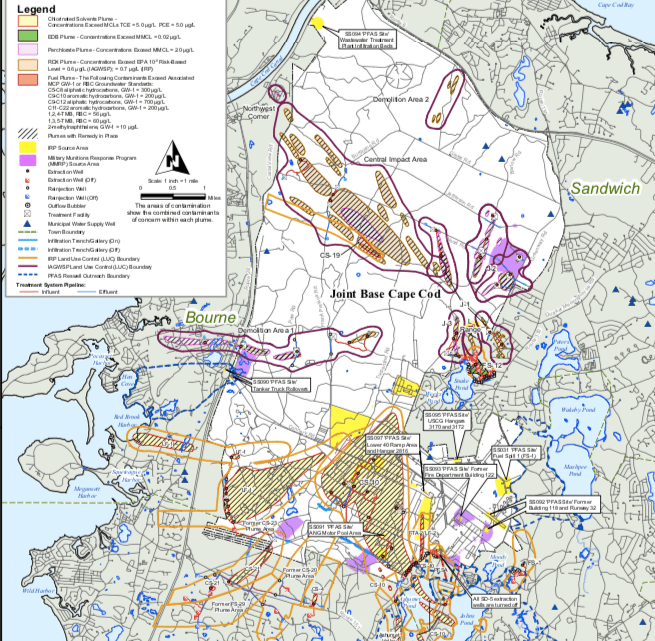
“Joint Base Cape Cod” contaminated groundwater plumes
By Richard Hugus | September 18, 2022
As reported by national news in the US, on September 16, 2022, 50 illegal immigrants from Venezuela were flown from Florida to Martha’s Vineyard, Massachusetts. Officials on the island said they did not have the resources to take care of the immigrants, so they were transported by the Massachusetts National Guard to a military base on Cape Cod. The immigrants were tolerated on Martha’s Vineyard for exactly two days.
The military base they were taken to, with the purposely non-descriptive name, “Joint Base Cape Cod,” is about 30 miles north of the church in Edgartown where the immigrants stayed. The base was formerly known as the Massachusetts Military Reservation, or Otis/Camp Edwards. The base is notorious for being a dump site for the federal government, so it probably seemed to the authorities a logical place to get rid of the immigrants. The 22,000 acre base was designated a Superfund site in 1989 due to massive amounts of fuels and solvents dumped at Otis Air Base into the sandy soil above Upper Cape Cod’s sole-source aquifer. As more and more contaminated groundwater was being discovered on the Air Force side, yet more was discovered from the past dumping of propellants and explosives by the Army at Camp Edwards. At one site on the base in the 1960s, the Air Force dumped up to 6 million gallons of aviation fuel on the ground just to test aircraft emergency release valves. Enough fuel from here and elsewhere got into water supplies in nearby Forestdale to the point that tap water at a kitchen sink could be lit on fire. Meanwhile, the Army was accustomed for years to firing Howitzer and mortar rounds into the base “impact area” whose explosions would shake windows in residential areas all over the Upper Cape. Nearby residents also lived with the frequent sound of machine gun fire from one of many gun ranges. Indeed, the Army National Guard has lately insisted it needs 200 acres of forest clearcut for a new machine gun range, with 5,000 acres reserved for strays and overshoots. For those feigning such concern, this was some place to send a group of helpless refugees. The public has no access to and very little knowledge of this huge area of sunny Cape Cod.
Martha’s Vineyard has had its own episode of Pentagon abuse. A small island called Nomans, just south of the Vineyard, was used as an aerial bombing range for many years, leaving the land littered with unexploded ordnance and contaminated soil. Rather than remediate, the US Navy conveniently handed the land over the Department of Fisheries and Wildlife who simply called it a conservation area, posted No Trespassing signs, and called it a day. The small island, a beautiful gem once inhabited by Wampanoag Indians and early settlers, it is now just a sacrifice zone, like a closed landfill. No one is allowed to set foot on it.
Both Cape Cod and Martha’s Vineyard have a service and tourist economy. Most people who live and work there are not wealthy, but have jobs serving the wealthy in one way or another. They build and repair the homes of the rich, they entertain them, run the restaurants, cook the food, clean the houses, and maintain their boats and cars. Low wage workers and immigrant labor are brought in every year for the summer season as there is evidently not enough money to pay local workers asking for a decent wage. Nor can working people afford houses on local wages. It’s a rentier economy. Poverty is real on both Martha’s Vineyard and the Cape because so many among the rich know very well how to spend as little of their money as possible for the services they receive. While working people there might not be happy about immigrant labor lowering wages and taking jobs, they would not have called the National Guard to come in and remove the strangers from Venezuela. And of course they would not have had the power to do so even if they wanted to. That call had to have come from new world order hopeful Governor Charlie Baker, on orders from Vineyard residents like Barack Obama who don’t want to see the results of the unrestricted immigration that they initiated actually becoming visible in their own neighborhoods. This is why the 50 Venezuelans were brought to eastern Massachusetts’ go-to military dump site, incidentally also home to the Barnstable County Jail — another thing no one wanted to see or hear anywhere else on the Cape.
We might ask why people in Venezuela got to the point of leaving family, home, culture, and country to emigrate in the first place. Obviously, two decades of coup attempts from the Chavez era on, relentless sanctions, and the theft of assets by the US has made life in Venezuela hard for many people. The US government created this problem. The further abuse of Venezuelans in a program of engineered destruction of sovereign countries and cultures, which is what the immigration crisis amounts to worldwide, is the same attack multiplied. Democrats are accusing Republicans of using the 50 immigrants as pawns. Higher powers still are using the Democrats and Republicans as pawns. This is a play inside a play and involves a level of manipulation that is not just cynical, but diabolical.
We’ve all seen the “In This House, We Believe” signs. The signs are displayed by some of the people on Martha’s Vineyard who this past week didn’t mind seeing 50 of the world’s poor carted off to a restricted military base. Between the lines on these cute little emblems of virtue we now read the ugly truth:
In this house, we believe . . .
In complete, shameless hypocrisy
In full totalitarianism, as long as it’s nicely wrapped in self-righteous liberal jargon
Virtue-signaling is better by far (and much easier) than actual virtue
Immigrants are welcome (to mow our lawns and wash our dishes)
Climate change is real (how else do we explain it being sunny one day and cloudy the next?)
All orientations are preferable to heterosexuality — the human race has gone on long enough
We hate humanity
A woman’s rights are human rights (but there is no such thing as a woman, so there is no such thing as “women’s rights”)
Black lives matter (especially when they can be used to create disruption and chaos while we do nothing to actually improve the lives of black people)
No human is illegal (unless he’s too close to my $12 million oceanfront property)
There is no place for hate (unless you’re a white hetero male, a Palestinian, a Muslim, a Christian, a Russian, a ‘right wing extremist’, an anti-vaxxer, a climate ‘denier’, or anyone else on our list)
Science is real (so long as it serves pharmaceutical company profits and ‘great reset’ eugenics)
Love is love, and all other nice-sounding, mystifying, empty tautologies
Kindness is everything (after money, power, and control)
Ukraine sliding into a real war
BY M. K. BHADRAKUMAR | INDIAN PUNCHLINE | SEPTEMBER 14, 2022
A recurring feature of the Cold War was that the United States almost always placed great store on the optics of a Soviet-American affair while Moscow chose to concentrate on the end result. The Cuban Missile Crisis is the best known example where the denouement was about the publicised abandonment of the planned Soviet deployment of missiles in Cuba and a US public declaration and agreement not to invade Cuba again. But it later came to be known that there was also an unpublicised part, namely, the dismantling of all of the Jupiter ballistic missiles that had been deployed to Turkey.
The behavioural pattern remains the same in Ukraine. Per the western narrative, Russia is staring at the abyss of defeat amidst the “rout” in the Kharkov Region. Interestingly, though, at the responsible levels in the Beltway, there is noticeable reticence about beating the drums presumably because of their awareness that the Ukrainian forces simply re-entered the Balakleysko-Izyum direction to occupy areas that Russians had planned to vacate.
Moscow is once again leaving the optics almost entirely to the American journalists while Moscow concentrates on the end result, which has had three dimensions: one, complete the ongoing evacuation from the Balakleysko-Izyum direction without loss of lives; two, exploit the Ukrainian troop movements to target the forces that came out into the open from well-fortified positions in the Kharkov Region; and, three, concentrate on the campaign in Donetsk.
The last part is becoming very sensitive for Moscow, as a significant section of Russian “war correspondents” carried sensational reports that it is apocalypse now. Even senior politicians such as Gennady Zyuganov, General Secretary of the Communist Party, and a powerful voice in the State Duma, feels agitated.
Zyuganov said at the first plenary meeting of the Russian State Duma’s fall session on Tuesday that the “special operation” has grown into a full-fledged war and the situation on the front has “changed drastically” in the past couple of months.
A fragment of the speech, posted in the Communist Party’s website also quoted Zyuganov as saying that “every war requires a response. First and foremost, it requires maximum mobilisation of forces and resources. It demands social cohesion and clear prioritisation.”
Although intended as constructive criticism, Zyuganov’s advice will almost certainly be passed over by the Kremlin. Russian presidential spokesman Dmitry Peskov has responded with alacrity, saying, “At this moment — no, it (full or partial mobilisation) is not on the agenda.”
President Putin’s support base remains as strong as ever. The recent Russian regional and local elections partly turned into a “referendum” on the Ukraine situation. And the fact that the ruling party received one of the best results in its history by winning about 80 percent of the mandates in regional and local parliaments shows a resounding vote of confidence in Putin’s leadership.
That said, the “angry patriots” pose a headache. That is why the latest situation around Bakhmut in Donetsk assumes particular significance. Bakhmut is undoubtedly the lynchpin of the entire fortification that Kiev erected in Donbass in the past 8 years. It is a strategic communication junction with roads in many directions — Lysychansk, Horlivka, Kostiantynivka, and Kramatorsk — and control of the city is vital for establishing full supremacy over the Donetsk Region.
The Russian troops and allied militia groups have been trying since August 3 to break into the Ukrainian defences in the Bakhmut-Soledar direction but with patchy success. Now come reports that the Russians have entered Bakhmut city and taken control of the industrial zone in the northeastern parts.
Some reports say the Russian military contractors known as the Wagner Group have been deployed in Bakhmut. These are highly trained ex-military personnel.
The stakes are exceedingly high. For Kiev, the entire logistics of the operations in Donetsk can unravel if it loses control of Bakhmut. As for the Russians, the breakthrough in the Bakhmut-Soledar direction will clear the main hurdle for the crucial offensive toward the Slavyansk-Kramatorsk axis to the west, the last conglomeration of Ukrainian forces in Donetsk. Bakhmut is only 50 kms from Slavyansk-Kramatorsk.
Speaking about the Ukrainian “counteroffensive” last weekend to National Public Radio, General Mark Milley, US chairman, Chiefs of Staff, had made some interesting points:
- Ukraine has amassed a good amount of combat power. How they use that will now be the determining factor. Things will clarify “in the coming days and weeks.”
- The Ukrainian military so far fought extraordinarily well in defence. Defence has always been the stronger form of war.
- Ukraine is now moving into offensive operations where it is critical to integrate fire power into their maneuver in order to achieve superiority.
- Therefore, “it remains to be seen” what is happening in the next few weeks. “It is a very, very difficult task that the Ukrainians are undertaking” — combining their offence with maneuver.
The Ukrainian offensive in Kharkov was planned as a flank attack to encircle and destroy the Russian groupings in the area of Balakleya, Kupyansk and Izyum. But the Russian command anticipated such an attempt, as its frontline had thinned out lately. The Ukrainian forces outnumbered the Russians by almost 4-5 times.
Interestingly, in anticipation of a Ukrainian offensive, civilians who agreed to leave the region for Russia were evacuated from the threatened settlements in military convoys. Using mobile defence tactics under the cover of specially organised units, Russians finally succeeded in withdrawing their forces.
In effect, the Ukrainian/US/NATO plan to manoeuvre a flank attack and encircle the Russian troops was thwarted with minimal losses. On the other hand, Ukrainians also admit that Russians inflicted significant losses of manpower on their opponents (who included a big chunk of fighters from NATO countries.)
But the Russian military also made mistakes. Thus, their forward positions were not mined — inexplicably enough; frontline intelligence gathering was deficient; and, the residual Russian troops (drawn down to one-third of full strength) were not even equipped with anti-tank weapons.
The single biggest outcome of the past week’s happenings is that the conflict has assumed the nature of a full-fledged war. Zyuganov was not off the mark when he said in his Russian state Duma speech: “The military-political operation… has escalated into a full-fledged war, which has been declared against us by the Americans, NATO members, and a unified Europe.
“A war is fundamentally different from a special operation. A special operation is something you announce — and something you can choose to put an end to. A war is something you can’t stop even if you want to. You have to fight to the end. War has two possible outcomes: victory or defeat.”
Putin has a big decision to make now. For, while the good part for the Russian military may be that the frontline has been straightened and large Russian reserves are being transferred to the battlefields, de facto, a state of war exists now between Russia and NATO.
The recent phone calls to Putin in quick succession by French President Emmanuel Macron and German Chancellor Olaf Scholz, after an interlude of months, signals that an exigency may have arisen to re-engage the Kremlin leader.
Germany to send more weapons to Ukraine despite Russia’s objection
Press TV – September 15, 2022
Germany has vowed to deliver two more rocket launchers to Ukraine despite Russia’s warning against sending weapons to Kiev.
Since Moscow launched a special military operation in eastern Ukraine in February, western countries have provided an abundance of weapons to Kiev, with Germany being a main supplier of arms.
“We have decided to deliver two more MARS II multiple rocket launchers including 200 rockets to Ukraine,” Germany’s Defense Minister Christine Lambrecht said on Thursday.
Berlin also aims to send Kiev heavily armored military MRAP infantry mobility vehicles, Lambrecht said at a Bundeswehr (armed forces) conference.
“On top of this, we will send 50 Dingo armored personnel carriers to Ukraine.”
Furthermore, Berlin would send 40 Marder IFVs to Greece in exchange for Athens delivery of 40 of its Soviet-built BMP-1 IFVs to Ukraine.
Alongside Germany, the United States and other NATO members have been sending weapons to Ukraine.
Ursula von der Leyen, Germany’s former Defense Minister, who is currently the President of the European Commission, insisted later on Thursday that European capitals should also provide the Kiev forces with battle tanks so they can better fight the Russian forces aiming to demilitarize the Donbas region of Ukraine.
Meanwhile, Russia on Thursday warned that if the United States and its allies supply Ukraine with longer-range missiles, it will cross a “red line”.
Russian Foreign Ministry spokeswoman Maria Zakharova said Russia reserves the right to defend its territory and if Washington decides to supply longer-range missiles to Kiev, then it will be crossing a red line.
Russia began its operation on February 24 in Ukraine’ Donbas region which is made up of the Donetsk and Luhansk self-proclaimed republics.
Half of Americans think US will lose superpower status within ten years
Many think “American democracy” is turning into a dictatorship
By Drago Bosnic | September 15, 2022
For over three decades, the United States of America has been chest-thumping about being the world’s “sole remaining superpower.” Some in the US establishment have even claimed that the US has become the world’s first “hyperpower.” And indeed, in the immediate aftermath of the Soviet dismantlement, the US-led political West seemed unbeatable, unilaterally starting wars across the globe, all under various pretexts such as “humanitarianism” and the much-touted “War on Terror.” The US and NATO used both of these excuses to invade dozens of other countries, be it former Yugoslavia, Iraq, Afghanistan, Syria, Libya, etc. The US military seemed unstoppable and able to overcome any opponent, oftentimes by using air power only, with minimal ground engagements, at least until it got bogged down, which in itself was very useful for the ever-profit-hungry Military Industrial Complex.
Although many in the US establishment seemed convinced this will be a perpetual state of affairs, luckily for the world, the last decade proved the power of the belligerent thalassocracy is waning. While the Pentagon could count on hundreds of thousands of battle-ready soldiers during most of the 1990s and early 2000s, in recent years, there has been a significant drop in young Americans’ interest to go die or get maimed for life in one of America’s many pointless invasions and general aggression against the world. Even though the Pentagon found other ways to continue with its imperialist belligerence, primarily through an exponential increase in the use of unmanned combat systems around the globe, indiscriminately targeting civilians under the ever-convenient pretext of the “War on Terror,” most Americans have become aware of the fact that the US power (albeit still significant) is fading away faster than anyone would’ve expected just a decade ago.
A new poll conducted by the YouGov/Economist is the latest proof of this public opinion shift. The project polled Americans about the probability of various “dire political scenarios“ and found that 50% of the US population considers that America will lose its global superpower status within a decade. The poll also found that nearly half (47%) of Americans think that a “total economic collapse“ is inevitable.
“Among 15 potential future scenarios involving instability or political violence, the one that most Americans consider likely in the next decade is that the U.S. ceases to be a global superpower (50% say this), followed by a total collapse of the U.S. economy (47%). Each of the 15 dire scenarios is considered somewhat or very likely in the next decade by at least 20% of Americans. […] 37% of Americans say [a civil war] is at least somewhat likely to occur,“ the YouGov poll found.
The most surprising aspect of the poll must be the staggering nearly 40% of US citizens who consider civil war “at least somewhat likely.“ With a population of approximately 330 million people and being among the world’s most armed nations, such a prospect seems rather terrifying. However, it’s hardly surprising, especially given the sheer level of polarization of the US society, regardless if it’s based on race, religion, sex/gender, identity, ideology or any other parameter which the parties and various interest groups in the US are trying to exploit and use for political, financial and power gain.
“[…] After an end to the U.S.’s global-superpower status and economic collapse, the next scenario is that the U.S. will cease to be a democracy (39%). Democrats believe the U.S. will become a fascist dictatorship (31%), while Republicans think it will be a communist one (21%). Two-thirds of Republicans (65%) believe that total economic collapse is at least somewhat likely, compared to only 38% of Democrats. Around half of Republicans (48%) say it’s likely that the government will confiscate citizens’ firearms; only 17% of Democrats say this. Republicans are also more likely than Democrats to believe there will be a total breakdown of law and order (49% vs. 31%),“ according to the poll.
Although it’s expected to see a larger number of Republicans being more pessimistic about the country’s future under a Democrat president and government, the percentage of Democrats who aren’t particularly optimistic is quite telling. It’s more than clear that many DNC voters themselves are unsatisfied with the policies of the current US government.
“[…] In terms of the possibility of a civil war, Republicans are likelier to believe there will be one between members of each party (45% vs. 35%) or between people from red and blue states (36% vs. 30%). Democrats are slightly more likely to believe there will be a war between the poor and rich (37% vs. 25%) or between cities and rural areas (23% vs. 20%). Democrats and Republicans are equally likely (31%) to expect a civil war between racial groups,“ the poll concluded.
Although the opinions vary significantly based on the ideological/party background, the very fact so many Americans think the US is turning into a dictatorship and that a civil war is a likely scenario speaks volumes of the unflattering state of the much-touted “American democracy” which has often been used as yet another pretext for America’s war against the world.
Drago Bosnic independent geopolitical and military analyst.
Ukraine’s security proposal makes Russian op ‘more urgent’ – Kremlin
Samizdat | September 14, 2022
Moscow should double down on its military offensive in Ukraine after Kiev released a proposal on how the US and its allies could guarantee Ukraine’s security, Kremlin spokesman Dmitry Peskov has said. The document highlights the threat that NATO poses to Russia, he argued.
The Russian official noted on Wednesday that the proposed series of treaties between Ukraine and the US and its allies is specifically meant as a stopgap solution before Ukraine formally joins NATO. Moscow considers Ukraine’s accession to the US-led military bloc unacceptable due to the perceived threat to its national security such a step would entail.
“One of the main threats to our nation remains, which means that one of the main reasons for the special military operation remains, or even becomes more urgent,” Peskov told journalists.
He added that the best path that Ukraine has to ensure its national security under the circumstances was to address Russia’s concern over its cooperation with NATO.
“The leadership of the country must take steps to eliminate the threat posed to Russia. They know well what those steps should be,” Peskov said.
The proposed ‘Kiev Security Compact’ was released on Tuesday by the office of Ukrainian President Vladimir Zelensky. The document was prepared by his chief-of-staff Andrey Yermak and former NATO Secretary General Anders Fogh Rasmussen.
Kiev wants the US and other members of NATO to offer legally binding guarantees of its security and pledge long-term economic assistance. The document explicitly rejects Russia’s demand of a neutral status for Ukraine.
Russian Foreign Ministry spokeswoman Maria Zakharova stated earlier on Wednesday that the proposal was meant to trick European nations into a costly sponsorship of Kiev. They will risk their own economic viability, thus undermining their own political power, which secretly is the goal of Kiev’s puppeteers in Washington, she claimed.
Russia sent troops into Ukraine on February 24, citing Kiev’s failure to implement the Minsk agreements, designed to give the regions of Donetsk and Lugansk special status within the Ukrainian state. The protocols, brokered by Germany and France, were first signed in 2014. Former Ukrainian President Pyotr Poroshenko has since admitted that Kiev’s main goal was to use the ceasefire to buy time and “create powerful armed forces.”
In February 2022, the Kremlin recognized the Donbass republics as independent states and demanded that Ukraine officially declare itself a neutral country that will never join any Western military bloc. Kiev insists the Russian offensive was completely unprovoked.
Europe’s leaders continue to prioritise US interests over citizens’ wellbeing
European protestors demand an end to anti-Russia sanctions to alleviate cost-of-living crisis.
By Ahmed Adel | September 13, 2022
With winter approaching, Europeans are thinking about how their livelihoods will be affected. Rallies, strikes, demonstrations and protests are gaining momentum as the cost-of-living becomes unbearable. Although European media tried to hide this, even paid local propagandists cannot ignore the growing anger amongst Europeans.
Protests have occurred in Prague, Lisbon, London and many other cities, with people belonging to a wide variety of ideologies, including left and right-wing, and even libertarians and anarchists. Although labelled by the media as Putin’s stooges, name-calling is not having the desired effect, especially as people are united by the fear of winter woes, regardless of political affiliation.
Though attempts are being made to blame the continent’s declining economic situation on Russian President Vladimir Putin, Europeans are no longer accepting this excuse. Europeans are realising that anti-Russian sanctions hit them much harder than the Russians.
Forty percent of Austria’s population does not support anti-Russian sanctions, 51 percent of Italians are against them, and 80 percent of Germans believe that Berlin should not send weapons to Ukraine and instead seek a peaceful solution to the conflict in Ukraine. With these ideas, Europeans are rallying across the continent, with people not being deterred despite being accused of serving Putin.
However, it is the US ruining Europe, something which Moscow itself does not want as it would rather see an independent and prosperous continent. None-the-less, the European elite made an unconditional surrender of their countries and peoples to serve the interests of Washington instead.
It is evident that European protestors are completely devoid of common leadership and clear common goals and strategies. These protests are not an organised mass led by a charismatic leader, but small groups of people, and as already mentioned, from varying political ideologies.
Their potential success remains questionable though since citizens cannot change their leaders until the next election cycle. Germans, for example, were outraged when Foreign Minister Annalena Baerbock openly said that she will defend Ukraine’s interests, even against the will of voters. To make matters worse, she made the statement in English, an obvious signalling to Washington. Despite their outrage, Germans cannot remove Baerbock from her post and replace her with another politician until the next election.
Baerbock is hardly alone though when it comes to powerful politicians dismissing the opinion of the people, with only very few exceptions existing in Europe. Hungarian Prime Minister Viktor Orban is one of the few exceptions as he prioritises the welfare of his citizens rather than capitulation to American pressure.
In neighbouring Austria, state leaders are now putting pressure on Vienna and are asking federal authorities to negotiate with Moscow. State leaders have a negative attitude towards sanctions, with Upper Austria Governor Thomas Stelzer saying that “nothing is set in stone”. Austria’s approach to sanctions will have to be changed as “they will cause great damage to our lives”, added Stelzer.
Much will also depend on the results of the Italian elections. It appears that most Italians support Russia-friendly parties. There is a serious chance that at the end of September they will win the election and a coalition of Russia-friendly politicians will appear in the Italian Parliament. Giorgia Meloni of “Brothers of Italy” supported Putin’s re-election as president in 2018, Matteo Salvini of “League” became famous for being photographed in Moscow’s Red Square wearing a t-shirt with an image of Putin, and Silvio Berlusconi is introducing himself as the man to improve European-Russian ties.
More importantly, Europeans are beginning to understand that Washington is not a protector, but a dangerous and unscrupulous state that is prioritising its own interests, not Europe’s. Russia at war, whilst Europe cripples itself by arming Ukraine and imposing anti-Russia sanctions, is an ideal scenario for Washington. In this way, not only is one of Washington’s main adversaries bogged down in the conflict with Ukraine and NATO, but it deepens Europe’s status as nothing more than a submissive protectorate
With frustrations and worries reaching boiling point, and the harsh winter only some weeks away, European leaders need to quickly reach a compromise with Moscow to help alleviate the cost-of-living crisis or else citizens will face a suffering, at least at an economic level, not experienced since World War II.
Ahmed Adel, Cairo-based geopolitics and political economy researcher.
The Specter of Germany Is Rising
By Diana Johnstone | Consortium News | September 12, 2022
The European Union is girding for a long war against Russia that appears clearly contrary to European economic interests and social stability. A war that is apparently irrational – as many are – has deep emotional roots and claims ideological justification. Such wars are hard to end because they extend outside the range of rationality.
For decades after the Soviet Union entered Berlin and decisively defeated the Third Reich, Soviet leaders worried about the threat of “German revanchism.” Since World War II could be seen as German revenge for being deprived of victory in World War I, couldn’t aggressive German Drang nach Osten be revived, especially if it enjoyed Anglo-American support? There had always been a minority in U.S. and U.K. power circles that would have liked to complete Hitler’s war against the Soviet Union.
It was not the desire to spread communism, but the need for a buffer zone to stand in the way of such dangers that was the primary motivation for the ongoing Soviet political and military clampdown on the tier of countries from Poland to Bulgaria that the Red Army had wrested from Nazi occupation.
This concern waned considerably in the early 1980s as a young German generation took to the streets in peace demonstrations against the stationing of nuclear “Euromissiles” which could increase the risk of nuclear war on German soil. The movement created the image of a new peaceful Germany. I believe that Mikhail Gorbachev took this transformation seriously.
On June 15, 1989, Gorbachev came to Bonn, which was then the modest capital of a deceptively modest West Germany. Apparently delighted with the warm and friendly welcome, Gorbachev stopped to shake hands with people along the way in that peaceful university town that had been the scene of large peace demonstrations.
I was there and experienced his unusually warm, firm handshake and eager smile. I have no doubt that Gorbachev sincerely believed in a “common European home” where East and West Europe could live happily side by side united by some sort of democratic socialism.
Gorbachev died at age 91 two weeks ago, on Aug. 30. His dream of Russia and Germany living happily in their “common European home” had soon been fatally undermined by the Clinton administration’s go-ahead to eastward expansion of NATO. But the day before Gorbachev’s death, leading German politicians in Prague wiped out any hope of such a happy end by proclaiming their leadership of a Europe dedicated to combating the Russian enemy.
These were politicians from the very parties – the SPD (Social Democratic Party) and the Greens – that took the lead in the 1980s peace movement.
German Europe Must Expand Eastward
German Chancellor Olaf Scholz is a colorless SPD politician, but his Aug. 29 speech in Prague was inflammatory in its implications. Scholz called for an expanded, militarized European Union under German leadership. He claimed that the Russian operation in Ukraine raised the question of “where the dividing line will be in the future between this free Europe and a neo-imperial autocracy.” We cannot simply watch, he said, “as free countries are wiped off the map and disappear behind walls or iron curtains.”
(Note: the conflict in Ukraine is clearly the unfinished business of the collapse of the Soviet Union, aggravated by malicious outside provocation. As in the Cold War, Moscow’s defensive reactions are interpreted as harbingers of Russian invasion of Europe, and thus a pretext for arms buildups.)
To meet this imaginary threat, Germany will lead an expanded, militarized EU. First, Scholz told his European audience in the Czech capital, “I am committed to the enlargement of the European Union to include the states of the Western Balkans, Ukraine, Moldova and, in the long term, Georgia”. Worrying about Russia moving the dividing line West is a bit odd while planning to incorporate three former Soviet States, one of which (Georgia) is geographically and culturally very remote from Europe but on Russia’s doorstep.
2022 Fall Fund Drive
In the “Western Balkans”, Albania and four extremely weak statelets left from former Yugoslavia (North Macedonia, Montenegro, Bosnia-Herzegovina and widely unrecognized Kosovo) mainly produce emigrants and are far from EU economic and social standards. Kosovo and Bosnia are militarily occupied de facto NATO protectorates. Serbia, more solid than the others, shows no signs of renouncing its beneficial relations with Russia and China, and popular enthusiasm for “Europe” among Serbs has faded.
Adding these member states will achieve “a stronger, more sovereign, geopolitical European Union,” said Scholz. A “more geopolitical Germany” is more like it. As the EU grows eastward, Germany is “in the center” and will do everything to bring them all together. So, in addition to enlargement, Scholz calls for “a gradual shift to majority decisions in common foreign policy” to replace the unanimity required today.
What this means should be obvious to the French. Historically, the French have defended the consensus rule so as not to be dragged into a foreign policy they don’t want. French leaders have exalted the mythical “Franco-German couple” as guarantor of European harmony, mainly to keep German ambitions under control.
But Scholz says he doesn’t want “an EU of exclusive states or directorates,” which implies the final divorce of that “couple.” With an EU of 30 or 36 states, he notes, “fast and pragmatic action is needed.” And he can be sure that German influence on most of these poor, indebted and often corrupt new Member States will produce the needed majority.
France has always hoped for an EU security force separate from NATO in which the French military would play a leading role. But Germany has other ideas. “NATO remains the guarantor of our security,” said Scholz, rejoicing that President Biden is “a convinced trans-atlanticist.”
“Every improvement, every unification of European defense structures within the EU framework strengthens NATO,” Scholz said. “Together with other EU partners, Germany will therefore ensure that the EU’s planned rapid reaction force is operational in 2025 and will then also provide its core.
This requires a clear command structure. Germany will face up to this responsibility “when we lead the rapid reaction force in 2025,” Scholz said. It has already been decided that Germany will support Lithuania with a rapidly deployable brigade and NATO with further forces in a high state of readiness.
Serving to Lead … Where?
In short, Germany’s military buildup will give substance to Robert Habeck’s notorious statement in Washington last March that: “The stronger Germany serves, the greater its role.” The Green’s Habeck is Germany’s economics minister and the second most powerful figure in Germany’s current government.
The remark was well understood in Washington: by serving the U.S.-led Western empire, Germany is strengthening its role as European leader. Just as the U.S. arms, trains and occupies Germany, Germany will provide the same services for smaller EU states, notably to its east.
Since the start of the Russian operation in Ukraine, German politician Ursula von der Leyen has used her position as head of the EU Commission to impose ever more drastic sanctions on Russia, leading to the threat of a serious European energy crisis this winter. Her hostility to Russia seems boundless. In Kiev last April she called for rapid EU membership for Ukraine, notoriously the most corrupt country in Europe and far from meeting EU standards. She proclaimed that “Russia will descend into economic, financial and technological decay, while Ukraine is marching towards a European future.” For von der Leyen, Ukraine is “fighting our war.” All of this goes far beyond her authority to speak for the EU’s 27 Members, but nobody stops her.
Germany’s Green Party foreign minister Annalena Baerbock is every bit as intent on “ruining Russia.” Proponent of a “feminist foreign policy”, Baerbock expresses policy in personal terms. “If I give the promise to people in Ukraine, we stand with you as long as you need us,” she told the U.S. National Endowment for Democracy (NED)-sponsored Forum 2000 in Prague on Aug. 31, speaking in English. “Then I want to deliver no matter what my German voters think, but I want to deliver to the people of Ukraine.”
“People will go on the street and say, we cannot pay our energy prices, and I will say, ‘Yes I know so we will help you with social measures. […] We will stand with Ukraine and this means the sanctions will stay also til winter time even if it gets really tough for politicians.’”
Certainly, support for Ukraine is strong in Germany, but perhaps because of the looming energy shortage, a recent Forsa poll indicates that some 77 percent of Germans would favor diplomatic efforts to end the war – which should be the business of the foreign minister. But Baerbock shows no interest in diplomacy, only in “strategic failure” for Russia – however long it takes.
In the 1980s peace movement, a generation of Germans was distancing itself from that of their parents and vowed to overcome “enemy images” inherited from past wars. Curiously, Baerbock, born in 1980, has referred to her grandfather who fought in the Wehrmacht as somehow having contributed to European unity. Is this the generational pendulum?
The Little Revanchists
There is reason to surmise that current German Russophobia draws much of its legitimization from the Russophobia of former Nazi allies in smaller European countries.
While German anti-Russian revanchism may have taken a couple of generations to assert itself, there were a number of smaller, more obscure revanchisms that flourished at the end of the European war that were incorporated into United States Cold War operations. Those little revanchisms were not subjected to the denazification gestures or Holocaust guilt imposed on Germany. Rather, they were welcomed by the C.I.A., Radio Free Europe and Congressional committees for their fervent anticommunism. They were strengthened politically in the United States by anticommunist diasporas from Eastern Europe.
Of these, the Ukrainian diaspora was surely the largest, the most intensely political and the most influential, in both Canada and the American Middle West. Ukrainian fascists who had previously collaborated with Nazi invaders were the most numerous and active, leading the Bloc of Anti-Bolshevik Nations with links to German, British and U.S. Intelligence.
Eastern European Galicia, not to be confused with Spanish Galicia, has been back and forth part of Russia and Poland for centuries. After World War II it was divided between Poland and Ukraine. Ukrainian Galicia is the center of a virulent brand of Ukrainian nationalism, whose principal World War II hero was Stepan Bandera. This nationalism can properly be called “fascist” not simply because of superficial signs – its symbols, salutes or tatoos – but because it has always been fundamentally racist and violent.
Incited by Western powers, Poland, Lithuania and the Habsburg Empire, the key to Ukrainian nationalism was that it was Western, and thus superior. Since Ukrainians and Russians stem from the same population, pro-Western Ukrainian ultra-nationalism was built on imaginary myths of racial differences: Ukrainians were the true Western whatever-it-was, whereas Russians were mixed with “Mongols” and thus an inferior race. Banderist Ukrainian nationalists have openly called for elimination of Russians as such, as inferior beings.
So long as the Soviet Union existed, Ukrainian racial hatred of Russians had anticommunism as its cover, and Western intelligence agencies could support them on the “pure” ideological grounds of the fight against Bolshevism and Communism. But now that Russia is no longer ruled by communists, the mask has fallen, and the racist nature of Ukrainian ultra-nationalism is visible – for all who want to see it.
However, Western leaders and media are determined not to notice.
Ukraine is not just like any Western country. It is deeply and dramatically divided between Donbass in the East, Russian territories given to Ukraine by the Soviet Union, and the anti-Russian West, where Galicia is located. Russia’s defense of Donbass, wise or unwise, by no means indicates a Russian intention to invade other countries. This false alarm is the pretext for the remilitarization of Germany in alliance with the Anglo-Saxon powers against Russia.
The Yugoslav Prelude
This process began in the 1990s, with the breakup of Yugoslavia.
Yugoslavia was not a member of the Soviet bloc. Precisely for that reason, the country got loans from the West which in the 1970s led to a debt crisis in which the leaders of each of the six federated republics wanted to shove the debt onto others. This favored separatist tendencies in the relatively rich Slovenian and Croatian republics, tendencies enforced by ethnic chauvinism and encouragement from outside powers, especially Germany.
During World War II, German occupation had split the country apart. Serbia, allied to France and Britain in World War I, was subject to a punishing occupation. Idyllic Slovenia was absorbed into the Third Reich, while Germany supported an independent Croatia, ruled by the fascist Ustasha party, which included most of Bosnia, scene of the bloodiest internal fighting. When the war ended, many Croatian Ustasha emigrated to Germany, the United States and Canada, never giving up the hope of reviving secessionist Croatian nationalism.
In Washington in the 1990s, members of Congress got their impressions of Yugoslavia from a single expert: 35-year-old Croatian-American Mira Baratta, assistant to Sen. Bob Dole (Republican presidential candidate in 1996). Baratta’s grandfather had been an important Ustasha officer in Bosnia and her father was active in the Croatian diaspora in California. Baratta won over not only Dole but virtually the whole Congress to the Croatian version of Yugoslav conflicts blaming everything on the Serbs.
In Europe, Germans and Austrians, most notably Otto von Habsburg, heir to the defunct Austro-Hungarian Empire and member of the European Parliament from Bavaria, succeeded in portraying Serbs as the villains, thus achieving an effective revenge against their historic World War I enemy, Serbia. In the West, it became usual to identify Serbia as “Russia’s historic ally”, forgetting that in recent history Serbia’s closest allies were Britain and especially France.
In September 1991, a leading German Christian Democratic politician and constitutional lawyer explained why Germany should promote the breakup of Yugoslavia by recognizing the Slovenian and Croat secessionist Yugoslav republics. (Former CDU Minister of Defense Rupert Scholz at the 6th Fürstenfeldbrucker Symposium for the Leadership of the German Military and Business, held September 23 – 24, 1991.)
By ending the division of Germany, Rupert Scholz said, “We have, so to speak, overcome and mastered the most important consequences of the Second World War … but in other areas we are still dealing with the consequences of the First World War” – which, he noted “started in Serbia.”
“Yugoslavia, as a consequence of the First World War, is a very artificial construction, never compatible with the idea of self-determination,” Rupert Scholz said. He concluded: “In my opinion, Slovenia and Croatia must be immediately recognized internationally. (…) When this recognition has taken place, the Yugoslavian conflict will no longer be a domestic Yugoslav problem, where no international intervention can be permitted.”
And indeed, recognition was followed by massive Western intervention which continues to this day. By taking sides, Germany, the United States and NATO ultimately produced a disastrous result, a half dozen statelets, with many unsettled issues and heavily dependent on Western powers. Bosnia-Herzegovina is under military occupation as well as the dictates of a “High Representative” who happens to be German. It has lost about half its population to emigration.
Only Serbia shows signs of independence, refusing to join in Western sanctions on Russia, despite heavy pressure. For Washington strategists the breakup of Yugoslavia was an exercise in using ethnic divisions to break up larger entities, the USSR and then Russia.
Humanitarian Bombing
Western politicians and media persuaded the public that the 1999 NATO bombing of Serbia was a “humanitarian” war, generously waged to “protect the Kosovars” (after multiple assassinations by armed secessionists provoked Serbian authorities into the inevitable repression used as pretext for the bombing).
But the real point of the Kosovo war was that it transformed NATO from a defensive into an aggressive alliance, ready to wage war anywhere, without U.N. mandate, on whatever pretext it chose.
This lesson was clear to the Russians. After the Kosovo war, NATO could no longer credibly claim that it was a purely “defensive” alliance.
As soon as Serbian President Milosevic, to save his country’s infrastructure from NATO destruction, agreed to allow NATO troops to enter Kosovo, the U.S. unceremoniously grabbed a huge swath territory to build the its first big U.S. military base in the Balkans. NATO troops are still there.
Just as the United States rushed to build that base in Kosovo, it was clear what to expect of the U.S. after it succeeded in 2014 to install a government in Kiev eager to join NATO. This would be the opportunity for the U.S. to take over the Russian naval base in Crimea. Since it was known that the majority of the population in Crimea wanted to return to Russia (as it had from 1783 to 1954), Putin was able to forestall this threat by holding a popular referendum confirming its return.
East European Revanchism Captures the EU
The call by German Chancellor Scholz to enlarge the European Union by up to nine new members recalls the enlargements of 2004 and 2007 that brought in twelve new members, nine of them from the former Soviet bloc, including the three Baltic States once part of the Soviet Union.
That enlargement already shifted the balance eastward and enhanced German influence. In particular, the political elites of Poland and especially the three Baltic States, were heavily under the influence of the United States and Britain, where many had lived in exile during Soviet rule. They brought into EU institutions a new wave of fanatic anticommunism, not always distinguishable from Russophobia.
The European Parliament, obsessed with virtue signaling in regard to human rights, was particularly receptive to the zealous anti-totalitarianism of its new Eastern European members.
Revanchism and the Memory Weapon
As an aspect of anti-communist lustration, or purges, Eastern European States sponsored “Memory Institutes” devoted to denouncing the crimes of communism. Of course, such campaigns were used by far-right politicians to cast suspicion on the left in general. As explained by European scholar Zoltan Dujisin, “anticommunist memory entrepreneurs” at the head of these institutes succeeded in lifting their public information activities from the national, to the European Union level, using Western bans on Holocaust denial to complain, that while Nazi crimes had been condemned and punished at Nuremberg, communist crimes had not.
The tactic of the anti-communist entrepreneurs was to demand that references to the Holocaust be accompanied by denunciations of the Gulag. This campaign had to deal with a delicate contradiction since it tended to challenge the uniqueness of the Holocaust, a dogma essential to gaining financial and political support from West European memory institutes.
In 2008, the EP adopted a resolution establishing August 23 as “European Day of Remembrance for the victims of Stalinism and Nazism” – for the first time adopting what had been a fairly isolated far right equation. A 2009 EP resolution on “European Conscience and Totalitarianism” called for support of national institutes specializing in totalitarian history.
Dujisin explains, “Europe is now haunted by the specter of a new memory. The Holocaust’s singular standing as a negative founding formula of European integration, the culmination of long-standing efforts from prominent Western leaders … is increasingly challenged by a memory of communism, which disputes its uniqueness.”
East European memory institutes together formed the “Platform of European Memory and Conscience,” which between 2012 and 2016 organized a series of exhibits on “Totalitarianism in Europe: Fascism—Nazism—Communism,” traveling to museums, memorials, foundations, city halls, parliaments, cultural centers, and universities in 15 European countries, supposedly to “improve public awareness and education about the gravest crimes committed by the totalitarian dictatorships.”
Under this influence, the European Parliament on Sept. 19, 2019 adopted a resolution “on the importance of European Remembrance for the Future of Europe” that went far beyond equating political crimes by proclaiming a distinctly Polish interpretation of history as European Union policy. It goes so far as to proclaim that the Molotov-Ribbentrop pact is responsible for World War II – and thus Soviet Russia is as guilty of the war as Nazi Germany.
The resolution,
“Stresses that the Second World War, the most devastating war in Europe’s history, was started as an immediate result of the notorious Nazi-Soviet Treaty on Non-Aggression of 23 August 1939, also known as the Molotov-Ribbentrop Pact, and its secret protocols, whereby two totalitarian regimes that shared the goal of world conquest divided Europe into two zones of influence;”
It further:
“Recalls that the Nazi and communist regimes carried out mass murders, genocide and deportations and caused a loss of life and freedom in the 20th century on a scale unseen in human history, and recalls the horrific crime of the Holocaust perpetrated by the Nazi regime; condemns in the strongest terms the acts of aggression, crimes against humanity and mass human rights violations perpetrated by the Nazi, communist and other totalitarian regimes;”
This of course not only directly contradicts the Russian celebration of the “Great Patriotic War” to defeat the Nazi invasion, it also took issue with the recent efforts of Russian President Vladimir Putin to put the Molotov-Ribbentrop agreement in the context of prior refusals of Eastern European states, notably Poland, to ally with Moscow against Hitler.
But the EP resolution:
“Is deeply concerned about the efforts of the current Russian leadership to distort historical facts and whitewash crimes committed by the Soviet totalitarian regime and considers them a dangerous component of the information war waged against democratic Europe that aims to divide Europe, and therefore calls on the Commission to decisively counteract these efforts;”
Thus the importance of Memory for the future, turns out to be an ideological declaration of war against Russia based on interpretations of World War II, especially since the memory entrepreneurs implicitly suggest that the past crimes of communism deserve punishment – like the crimes of Nazism. It is not impossible that this line of thought arouses some tacit satisfaction among certain individuals in Germany.
When Western leaders speak of “economic war against Russia,” or “ruining Russia” by arming and supporting Ukraine, one wonders whether they are consciously preparing World War III, or trying to provide a new ending to World War II. Or will the two merge?
As it shapes up, with NATO openly trying to “overextend” and thus defeat Russia with a war of attrition in Ukraine, it is somewhat as if Britain and the United States, some 80 years later, switched sides and joined German-dominated Europe to wage war against Russia, alongside the heirs to Eastern European anticommunism, some of whom were allied to Nazi Germany.
History may help understand events, but the cult of memory easily becomes the cult of revenge. Revenge is a circle with no end. It uses the past to kill the future. Europe needs clear heads looking to the future, able to understand the present.
Diana Johnstone was press secretary of the Green Group in the European Parliament from 1989 to 1996. In her latest book, Circle in the Darkness: Memoirs of a World Watcher (Clarity Press, 2020), she recounts key episodes in the transformation of the German Green Party from a peace to a war party. Her other books include Fools’ Crusade: Yugoslavia, NATO and Western Delusions (Pluto/Monthly Review) and in co-authorship with her father, Paul H. Johnstone, From MAD to Madness: Inside Pentagon Nuclear War Planning (Clarity Press). She can be reached at diana.johnstone@wanadoo.fr
Resuming of Azeri-Armenian conflict would be quite suitable for the political West
Baku is trying to use the current geopolitical situation to fulfill its long-term goals
By Drago Bosnic | September 13, 2022
Over the last 24 hours, fighting broke out in multiple areas along the Armenia-Azerbaijan border. The conflict has escalated enough for Yerevan to ask its CSTO allies, in particular Russia, to intervene. This has been revealed just hours after Armenian Prime Minister Nikol Pashinyan held a late-night telephone conversation with Russian President Vladimir Putin. The Armenian government has since confirmed it has requested Russian military assistance to repel Azeri aggression and shelling, according to an official statement:
“During the meeting, further steps were discussed to counter the aggressive actions of Azerbaijan against the sovereign territory of Armenia that began at midnight. In connection with the aggression against the sovereign territory of the Republic of Armenia, it was decided to officially appeal to the Russian Federation in order to implement the provisions of the Treaty of Friendship, Cooperation and Mutual Assistance, as well as to the Collective Security Treaty Organization and the UN Security Council.”
Armenia is basing its official request on the Collective Security Treaty Organization military pact it has with Russia and four other former Soviet republics (Belarus, Kazakhstan, Kyrgyzstan and Tajikistan). Within the framework of its military cooperation with Yerevan, Russia previously sent a 2000-strong peacekeeping force to the disputed Nagorno-Karabakh (known as Artsakh to the indigenous Armenians) after the late 2020 war which saw much of the contested region taken by Azeri forces.
This escalation comes approximately a month and a half since the late July/early August clashes in the Nagorno-Karabakh Republic when Azeri forces attacked the remaining Artsakh defenders. After months of tensions, Azerbaijan accused Armenia of allegedly attacking its military units in the disputed region. Azeri Ministry of Defense claimed that Armenian soldiers supposedly opened fire at Azeri troops in Gadabay, Kalbajar and Khojavend. Initially, no casualties or material losses were reported as a result of the alleged attack, although the Azeri MoD later claimed at least one of their soldiers was killed. Azerbaijan then took what it called “retaliatory measures”. The Armenian side denied the accusations and stated that the situation in Nagorno-Karabakh is stable. Since 2020, nearly 2000 Russian peacekeepers have been deployed in Nagorno-Karabakh to enforce a ceasefire agreement signed after the large-scale Azerbaijani attack on Armenian forces late that year.
However, the latest escalation is the first large-scale incident when Azeri forces attacked Armenia proper. This is just one of many instances in which the Azeri side is claiming it’s “only defending” and is accusing Armenia of attacking its troops. Given the rather difficult position of both Armenia proper and the Armenian-populated Nagorno-Karabakh Republic, it would be strategically unwise to even contemplate escalation against Baku, especially when taking into account the clear superiority of Azeri forces in the last several years. In recent times, the oil and gas-rich Azerbaijan has been acquiring large quantities of advanced weapons from various countries, especially Turkey and Israel. At the same time, Armenia, a small landlocked country with scant resources, has been under a virtual blockade by both Turkey and Azerbaijan for over three decades and it cannot match the economic and military power of Azerbaijan alone, to say nothing of the virtually guaranteed support Baku gets from regional powers such as Turkey.
The Azeri side is most likely resuming its offensive in the region since Russia is preoccupied with its counteroffensive against NATO aggression in Europe. Baku is trying to use the current geopolitical situation to fulfill its long-term goals and it may very well be attacking Armenia directly to divert Yerevan’s attention and create an opportunity to capture the entire territory of the already surrounded Nagorno-Karabakh Republic.
However, this would require Azerbaijan to effectively go against Russia’s interests in the Southern Caucasus region. Moscow has repeatedly warned Azerbaijan against escalating the conflict with Armenia any further. Despite the successful geopolitical game Azeri leadership has been playing for years, balancing between Russia, Turkey and the political West, Moscow is unlikely to allow further attacks. Back in March, Russian Defense Minister Sergei Shoigu warned Baku that the Russian military is capable of conducting large-scale operations in multiple theaters, clearly implying that no unilateral Azeri action will be tolerated.
However, Baku seems to have the quiet backing of the EU. According to Radio Free Europe, the same day when the conflict escalated Azerbaijan announced it will increase natural gas exports to Europe this year by 30%. As Brussels is trying to reduce its dependence on Russian energy, the EU is neither willing nor in a position to condemn an Azeri attack on Armenia.
What’s more, the conflict would be quite suitable for the political West, particularly the US. First, it could further undermine relations between Russia and Turkey, which could also spill over to other regions, such as Syria. Second, it would require Russia to send additional troops to Armenia and possibly even Nagorno-Karabakh, which would divert Moscow’s attention and resources from its military operation against the NATO-backed Kiev regime. Either way, Russia is faced with a carefully coordinated destabilization on its entire western and southwestern flank and it will require nothing short of masterful strategic planning to tackle these issues without creating even more problems.
Drago Bosnic is an independent geopolitical and military analyst.
Featured Video

We Don’t Have to Live This Way
or go to
Aletho News Archives – Video-Images
From the Archives
9/11 Was an Israeli Job
How America was neoconned into World War IV
By Laurent Guyénot • Unz Review • September 10, 2018
… 9/11 was made possible by an alliance between secret worshippers of Israel and corrupted American elements. The question is: who, of the two, were the masterminds of this incredibly daring and complex operation, and for what “higher purpose”? … Read full article
Blog Roll
 Aletho News
- Why Benjamin Netanyahu Said 9/11 Was ‘Very Good’ For Israel
- Leaked chemical dossier reveals Israel’s role in Sudan’s civil war: Report
- Is the Noose Tightening on Iran?
- Persian Gulf states to meet in Oman to discuss regional security, Hormuz navigation: Iran
- Araghchi: US acknowledgment of Bahrain damage exposes cost of Israel’s wars
- YAF secure Bab al-Mandab, advance toward Dhubab
- Ansar Allah’s Victory Is A U.S. Defeat
- Insider trading proves 9/11 foreknowledge
- Most Kids Can Fight Measles Naturally — and Having the Virus May Even Make Them Stronger
- We Don’t Have to Live This Way
- If Americans Knew
- Digital Strategists: Washington’s Network of “Manipulation and Influence Projects” for Israeli Propaganda
- Israeli Documentary ‘NAZA’ Exposes ‘System of Killing’ in Gaza From Eyes of Secret Intelligence Unit
- Confessions of an Israeli Army Drone Operator
- Maximum Territory, Minimum Population
- Is the Israel Lobby Doomed?
- Israel kills 9, including family of 4, in Gaza – Daily Update
- Secret systems used by Israel in mass killings of Gaza civilians revealed in new film
- Israel Bombs South Lebanon as Report Documents 23 White Phosphorus Attacks
- Nakba and Gaza: Zionism’s Century-Long History of Genocide
- ISRAELI MEDIA: ‘Baby, an Update: He’s Just Died’: Israeli Prison Guards’ Texts Expose a Routine of Abuse
- No Tricks Zone
- New Study: The Antarctic Ice Sheet Gained Mass From 2020-2024 Due To Staggering Snow And Ice Accumulation
- Study: Ocean Heating Rates From Thousands Of Years Ago ‘Dwarf’ Modern Ocean Heating Rates
- Climate Extremists Target, Attack Large-Scale Power Grid Infrastructure In Germany!
- New Study: Antarctic Ice Melt Has Contributed Less Than 1 Centimeter To Sea Level Rise In The Last 30 Years
- Fear Of Debate: Alarmist German Climate Scientist Calls On Mainstream Media To Discredit Skeptic Voices
- End-Of-August Arctic Sea Ice Extent Hasn’t Fallen In 20 Years, Official Data Show!
- News-Making Nepal Region Has Had As-Warm Or Warmer Periods Than The 2000s In The 1600s, 1700s, 1800s
- 2025 Study: ‘There Exists No Unequivocal Experimental Evidence For The CO2 Greenhouse Effect’
- 2026 Atlantic Cyclone Energy Index Running At 85% Below Normal!
- New Research Shows Soil Respiration And Temperature Drive CO2 Change, Not Humans
 Aletho News
