Afghanistan: A Tragically Stupid War Comes to a Tragic End
By Ron Paul | August 30, 2021
Sunday’s news reports that the Biden Administration mistakenly killed nine members of one Afghan family, including six children, in “retaliation” for last week’s suicide attack which killed 13 US servicemembers, is a sad and sick epitaph on the 20 year Afghanistan war.
Promising to “get tough” on ISIS, which suddenly re-emerged to take responsibility for the suicide attack, the most expensive military and intelligence apparatus on earth appears to have gotten it wrong. Again.
Interventionists love to pretend they care about girls and women in Afghanistan, but it is in reality a desperate attempt to continue the 20-year US occupation. If we leave, they say, girls and women will be discriminated against by the Taliban.
It’s hard to imagine a discrimination worse than being incinerated by a drone strike, but these “collateral damage” attacks over the past 20 years have killed scores of civilians. Just like on Sunday.
That’s the worst part of this whole terrible war: day-after-day for twenty years civilians were killed because of the “noble” effort to re-make Afghanistan in the image of the United States. But the media and the warmongers who call the shots in government – and the “private” military-industrial sector – could not have cared less. Who recalls a single report on how many civilians were just “collateral damage” in the futile US war?
Sadly these children killed on Sunday, two of them reportedly just two years old, have been the ones forced to pay the price for a failed and bloody US foreign policy.
Yes, the whole exit from Afghanistan has been a debacle. Biden, but especially his military planners and incompetent advisors, deserves much of what has been piled onto him this past week or so about this incompetence.
Maybe if Biden’s Secretary of Defense and Joint Chiefs’ Chairman had spent a bit more time planning the Afghan exit and a lot less time obsessing on how to turn the US military into a laboratory for cultural Marxism, we might have actually had a workable plan.
We know that actual experts like Col. Douglas Macgregor did have a plan to get out that would have spared innocent lives. But because this decorated US Army veteran was “tainted” by his service in the previous administration – service that was solely focused on how to get out of Afghanistan safely – he would not be consulted by the Pentagon’s “woke” top military brass.
Trump also should share some of the blame currently being showered on Biden. He wanted to get out years ago, but never had the courage to stand up to the also incompetent generals and “experts” he foolishly hired to advise him.
Similarly, many conservatives (especially neoconservatives) are desperate to attack Biden not for how he got out of Afghanistan, but for the fact that he is getting us out of Afghanistan.
That tells you all you need to know about how profitable war is to the warmongers.
I’ve always said, “we just marched in, we can just march out,” and I stand by that view. Yes, you can “just march out” of these idiotic interventions…but you do need a map!
Copyright © 2021 by RonPaul Institute.
US Drone Strike in Kabul Kills Nine Members of Single Family, Including 6 Kids
by Asya Geydarova – Sputnik – 30.08.2021
The death toll from a US airstrike that targeted a vehicle in the Afghan capital of Kabul on Sunday has gone up to nine, all members of the same family, a relative of those killed told CNN.
A brother of one of the dead told a journalist working with CNN on Sunday that they were “an ordinary family,” not affiliated with Daesh.
There are six children, including his four-year-old sister Armin, 3-year-old brother Benyamin, and two two-year-old sisters Ayat and Sumaya among those killed, the man said, as he reportedly cried.
Earlier, US central command spokesman Capt. Bill Urban said that a drone strike was carried out on Sunday on a vehicle in Kabul, eliminating a Daesh-K threat to the airport.
“We are still assessing the results of this strike,” Urban said, adding that “it is unclear what may have happened,” and the US military is investigating further.
Afghan media reported on Sunday that at least four children were killed in the airstrike that destroyed two vehicles and part of a residential building. CBS said that the size of the secondary explosion suggests that the US strike destroyed a fully loaded car bomb, and did not just kill a suicide bomber riding in the car.
On Saturday, US Army Maj. Gen. William Taylor said that two Daesh-K leaders were killed and another was injured in a US airstrike in the Nangarhar province of Afghanistan.
On Friday, the White House admitted a breakdown in the security process that allowed the Thursday suicide bombing at the Kabul airport, which reportedly killed at least 182, including 13 US troops. The attack, claimed by Daesh-K, comes amid a chaotic US evacuation from Afghanistan following the Taliban’s* takeover of Kabul on August 15.
While the Biden administration has come under fire from both Democrats and Republicans over the evacuation of American forces and Afghans from Kabul, netizens have slammed US media for hypocritical reporting on the situation in Afghanistan.
This comes amid allegations by the media, citing locals, that Afghans killed in the attack on August 26 were shot dead by American soldiers in the panic following the explosion.
US drone operations targeting terrorists in countries have been deemed highly controversial due to reported civilian deaths, which military chiefs define as “collateral damage”. Casualties among civilians became publicly known due to independent investigations and information disclosed by whistleblowers. Last month, ex-US Air Force analyst Daniel Hale was given a prison sentence after leaking classified intel on US drone strikes from his deployment to Afghanistan that reportedly killed innocent people, including children.
Afghanistan Withdrawal Is Hurting Its Profits. It’s Funding a Pro-War Think Tank.
BY SARAH LAZARE | IN THESE TIMES | AUGUST 25, 2021
On August 12, the military contractor CACI International Inc. told its investors that the U.S. withdrawal from Afghanistan is hurting its profits. The same contractor is also funding a think tank that is concurrently arguing against the withdrawal. This case is worth examining both because it is routine, and because it highlights the venality of our “expert”-military contractor feedback loop, in which private companies use think tanks to rally support for wars they’ll profit from.
The contractor is notorious to those who have followed the scandal of U.S.-led torture in Iraq. CACI International was sued by three Iraqis formerly detained in Abu Ghraib prison who charge that the company’s employees are responsible for directing their torture, including sexual assault and electric shocks. (The suit was brought in 2008 and the case is still ongoing.)
In 2019, CACI International was awarded a nearly $907 million, five-year contract to provide “intelligence operations and analytic support” for the U.S. Army in Afghanistan.
During an August 12 earnings call, CACI International noted repeatedly that President Biden’s withdrawal from the 20-year Afghanistan War harmed the company’s profits. John Mengucci, president and CEO of CACI International, said, “we have about a 2 percent headwind coming into FY 2022 because of Afghanistan.” A “headwind” refers to negative impacts on profits.
Afghanistan was mentioned 16 times throughout the call — either in reference to the dent in profits, or to assure investors that other areas of growth were offsetting the losses. For example, Mengucci said, “We’re seeing positive growth in technology and expect it to continue to outpace expertise growth, collectively offsetting the impact of the Afghanistan drawdown.”
Similar themes were repeated in an April 22 earnings call, where the company lamented the “headwinds” posed by the Afghanistan withdrawal. (Industry and defense publications have picked up on this theme, but framed it in the company’s terms, by emphasizing the offsets to its losses.)
Despite CACI International’s clear economic interest in continuing the war, on the August 12 call, company officials were careful not to editorialize about the Biden administration’s decision. The closest they came was a cautious statement from Mengucci: “At least as of today we’ve watched the administration make the decision to completely exit Afghanistan by 9 – 11 and all I can say is they’re executing on that decision.”
But CACI International does not have to broadcast its positions on the war: Instead, it is funding a think tank that has been actively urging the Biden administration not to leave Afghanistan.
CACI International is listed as a “corporate sponsor” of the Institute for Study of War, which describes itself as a “non-partisan, non-profit, public policy research organization.” Dr. Warren Phillips, lead director of CACI International, is on the board of the think tank. (Other funders include General Dynamics and Microsoft.)
When it comes to the U.S. withdrawal from Afghanistan, however, the think tank is extremely partisan. In an August 20 paper, the think tank argued that “Russia, China, Iran, and Turkey are weighing how to take advantage of the United States’ hurried withdrawal.”
Jack Keane, a retired four star general and board member of the Institute for Study of War, meanwhile, has been on a cable news blitz arguing against the U.S. withdrawal from Afghanistan, as reported by Ryan Grim, Sara Sirota, Lee Fang and Rose Adams for The Intercept. (The Intercept noted CACI’s International’s backing of the think tank.)
Kimberly Kagan, founder and president of the Institute for the Study of War, told Fox News on August 17 that the U.S. withdrawal could cause Afghanistan to become the “second school of jihadism.” She warned, “It is not clear that the Taliban, which seeks international recognition and legitimacy, is going to want to tolerate or encourage direct attacks on the U.S. from al Qaeda or other extremist groups based in Afghanistan.”
The think tank’s backing from a military contractor was not discussed in these media appearances.
The case of CACI International is not unique. The Intercept notes, “Among the other talking heads who took to cable news segments or op-ed pages without disclosing their defense industry ties were retired Gen. David Petraeus; Rebecca Grant, a former staffer for the Air Force secretary; Richard Haass, who worked as an adviser to then-Secretary of State Colin Powell; and former Secretary of State Condoleezza Rice.”
This cacophony of voices matters because Biden is facing a media uproar over the withdrawal. Pundits and mainstream press outlets that have been ignoring civilian deaths for years are suddenly expressing moral outrage at their hardships now that the war is ending. While there are legitimate concerns about the fate of Afghans as the Taliban seizes control, the vast majority of the firestorm stems from a reflexively pro-war perspective, in favor of the indefinite extension of an occupation that has proven brutal and lethal for civilians. The overwhelming effect is to send the message to Biden, and any future presidents, that they should think twice before withdrawing from a war, lest they have a media revolt on their hands.
But this outcry didn’t materialize out of nowhere. Think tank “experts,” whose organizations are financed by the very companies profiting from the war, play a key part. They are trotted out in front of cameras and quoted in major media outlets, presented as above-the-fray observers. They are well-financed, polished and groomed precisely for moments like these. And the companies financing them get to launder their own objectives through institutions that are seen as respectable, academic and rigorous. It’s a grotesque system that is functioning as it was designed.
In its August 12 call, CACI International simply acknowledged the company’s economic interests out loud.
THE U.S. HAS SPENT $2.313 TRILLION ON WAR IN AFGHANISTAN SINCE 2001
Watson Institute | August 2021
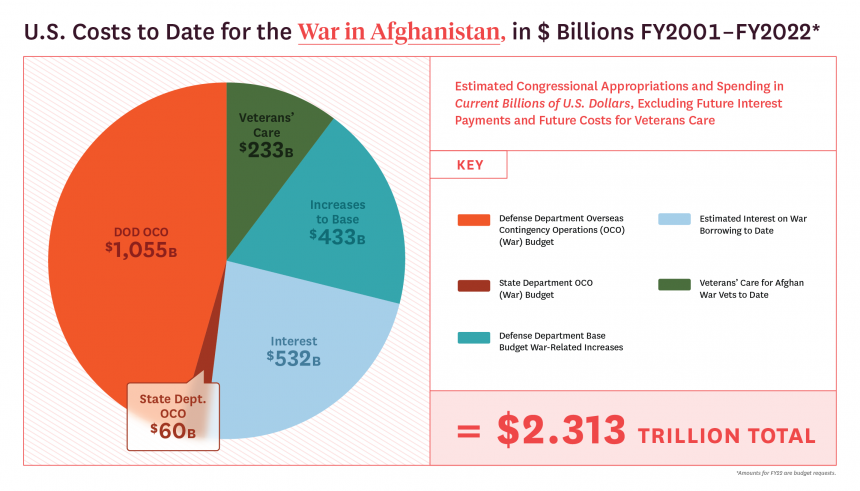
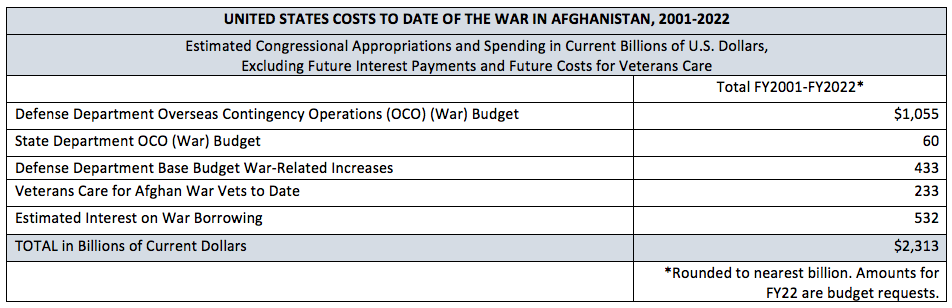
Since invading Afghanistan in 2001, the United States has spent $2.313 trillion on the war, which includes operations in both Afghanistan and Pakistan. Note that this total does not include funds that the United States government is obligated to spend on lifetime care for American veterans of this war, nor does it include future interest payments on money borrowed to fund the war. This $2.313 trillion spent on Afghanistan is a portion of the total estimated cost of the post-9/11 wars.
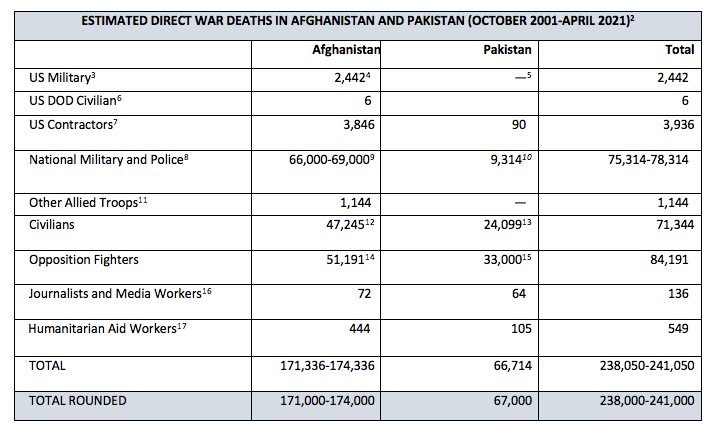
The Costs of War Project also estimates that 241,000 people have died as a direct result of this war. These figures do not include deaths caused by disease, loss of access to food, water, infrastructure, and/or other indirect consequences of the war.
The figures for Afghanistan are part of the larger costs of the U.S. post-9/11 wars, which extend to Iraq, Syria, Yemen, Somalia and elsewhere. The numbers are approximations based on the reporting of several data sources.
Here Come the Terrorists. Again
By Philip Giraldi | Strategic Culture Foundation | August 26, 2021
President Joe Biden is being praised in some circles because he finally ended the war in Afghanistan that in all likelihood should never have begun. President George W. Bush initiated the conflict on a series of lies about 9/11 and the Taliban role in that attack and what followed. After bringing about regime change, he decided to remake the country into a western style democracy. President Barack Obama subsequently allowed a “surge” which actually increased the militarization of the conflict and made things worse. The joint effort produced no free elections but delivered instead tens of thousands of deaths and a huge hole in the US Treasury. Bush and Obama were followed by President Donald Trump who actually promised to end the war but lacked the conviction and political support to do so, handing the problem over to Biden, who has bungled the end game but finally done the right thing by ending the fiasco. Biden also has been right to accede to a withdrawal of the last US combat troops from Iraq by year’s end, a move that will considerably ease tension with the Baghdad government, which has been calling for such a move since last January.
But America’s war on those parts of the world that resist following its self-defined leadership is not about to go away. An interesting recent article in the foreign policy establishment The Hill written by a former senior CIA operations and staff officer Douglas London sees an Orwellian unending war against major adversaries Russia and China. Derived from his own experience, he concludes that sustained and enhanced clandestine actions should now replace conventional military forces confrontation, which has been somewhat outdated as an option due to the development of relatively cheap missile technologies that have undermined classic conventional weapons. Some of the clandestine activity he appears to recommend would undoubtedly fall under cover of classic espionage “plausible denial,” i.e. that the White House could disavow any knowledge of what had occurred, but sabotage and cyber-attacks, particularly if implemented aggressively, would quickly be recognized for what they are and would invite commensurate or even disproportionate retaliation. This would amount to an all-out semi-covert war against powerful adversaries which could easily escalate into a shooting war.
The London article is an interesting insight into the thinking of those in both the Democratic and Republican parties who continue to argue that the United States is threatened by largely asymmetrical warfare being conducted by what are regarded as “autocratic” regimes in Moscow and Beijing as well as by non-governmental terrorist groups that is seeking to undermine confidence in US policymakers, the “democratic” government system and the stability of its other institutions.
That the White House is listening to at least some of the complaints coming from the neoconservatives and neoliberals calling for more “democracy promotion” and “regime change” would appear to be the case as there have been renewed calls for greater engagement in various fora, to include NATO leadership now urging the alliance to stand up to Russian “aggression.” The US has meanwhile also called on “friends” in the Middle East to block any attempts by China to establish “military bases” in that region, with the State Department arguing that “The current assessment is that China has a global strategy of pursuing military installations all over, including in the Middle East.” The United States, by one estimate, has nearly 1100 military bases worldwide while China has only one in Djibouti.
Admittedly this time, the US will have to go about its usual school bully behavior without much in the way of allies. The Europeans will not show up as they are disgusted with American vacillation and inability to anticipate obvious developments, as was the case in Afghanistan. Israel and Saudi Arabia will likely line up, or pretend to, while also continuing their collaboration with radical groups that Washington would prefer to avoid.
To be sure there are many in Washington who would be quite happy to continue the US naval build up in the South China Sea while also sending ships to the Black Sea to cruise defiantly off the Russian coast. And then there is also Iran and its ally Syria, both of which continue to be targets of opportunity for sabotage, covert action and the Israeli Air Force, which last week again attacked Syria after penetrating Lebanese air space. So there are always wars and rumors of wars available, which is precisely what the US military-industrial-congressional complex wants to sustain. And in so doing they know that they will have the mainstream media on board, which has the same objective.
But still, it is important to have a plausible threatening enemy, and China is still somewhat over the horizon in that context. So, you turn to the one-size-fits-all option, which is “international terrorism,” preferably Islamic, to continue to empower the central government and fatten one’s friends in the national security industry. And it doesn’t hurt along the way to label some domestic opponents in the same fashion to guarantee one’s political supremacy for the foreseeable future. It’s a win-win.
So, the Biden Administration is either inadvertently or by design setting up the next chapter in its “America goes to war” narrative even as it has not yet figured out how to extricate the soldiers it has sent to assist in the evacuation of Kabul and who are now potential hostages at the airport surrounded by heavily armed Taliban.
But key figures in the Administration and elsewhere inside and outside the government are already looking beyond that, arguing that the new Afghan state will become a terrorist haven and those radicals will look to the United States for a target, as al-Qaeda reportedly did. Jamil Jaffer, founder and executive director of the National Security Institute at George Mason University argues that “There’s no question that the return of the Taliban opens up space in this new Islamic emirate for al Qaeda to return, rebuild a base, and for other groups associated or previously associated with al Qaeda, like ISIS, to return to the region. Jihadi fighters of all stripes will now once again make Afghanistan their home, as they did in the lead-up to 9/11.”
Indeed, some of those “experts” are seeing the twenty years spent in Afghanistan as a plus as it kept in check those extremists who might have been inclined to act in Europe and the US. That of course ignores the continued existence of many other unsettled parts of the world where terrorists of various kinds have been able to flourish successfully without feeling any need to bomb New York. Senators Lindsey Graham and Mark Warner have warned of a likely resurgence in terrorism, as have both General Mark Milley, Chairman of the Joint Chiefs of Staff and Defense Secretary Lloyd Austin. Graham laments that “The likelihood of an attack coming from Afghanistan now is through the roof.” The Department of Homeland Security has also done its bit, warning that possible Afghanistan-derived attacks from Islamic extremists on or near the 20th anniversary of the 9/11 event “could serve as a catalyst for acts of targeted violence.”
Anyway, you look at it, terrorism with be the national security flavor du jour over the next year or more. The only real question is, “Will it be domestic or foreign?” Either way the seemingly endless wars in Afghanistan and Iraq will be history but the search for new enemies will continue no matter who is president or which party dominates congress.
We will work with the Congress to provide $1bn to Iron Dome, US official says
MEMO | August 26, 2021
US Secretary of Defence Lloyd Austin yesterday pledged to work with Congress to provide $1 billion to Israel’s Iron Dome defence system, the Times of Israel reported.
“We are working closely with Congress to provide all the necessary information to respond positively to your request to provide $1 billion in emergency funding. And it’s going to save more innocent lives,” Austin told Israeli Prime Minister Naftali Bennett.
Speaking to reporters following the meeting, Austin said: “The Department of Defense is also committed to maintaining Israel’s qualitative military edge, and to ensur[ing] that Israel can defend itself against threats from Iran, its proxies, and terrorist groups.”
“Iran must be held accountable for acts of aggression in the Middle East and on international waters,” referring to the attack on Mercer Street tanker off the Omani coast.
“US is committed to strengthening its strategic relationship with Israel,” he said, “the administration is committed to Israel’s security and its right to self-defense.”
When asked about the ten-year memorandum of understanding worth $3.8 billion in defence aid annually that was signed during the Obama administration, he said: “That is unwavering. It is steadfast.”
BOMBS AWAY, APPLEBAUM!
By Paul Robinson | IRRUSIANALITY | August 22, 2021
There’s no war so badly lost, it seems, that someone can’t be found to say that it was all a good idea and the problem was not that the war was fought but that it wasn’t fought hard enough. This was once perhaps the purview of conservatively-minded national security types. But since the end of the Cold War it’s been increasingly the opinion of the keyboard warriors in the democracy-promoting intelligentsia who want nothing more than to bomb the world into oblivion for the sake of liberalism and human rights.
So we should hardly be surprised that the debacle in Afghanistan has brought the liberal interventionists out of their closets to argue that America’s never ending wars aren’t the problem – the real problem is that Westerners are lilly-livered softies who are too decadent to stand up and fight against the forces of evil that surround them, and that if we don’t step up the bombing then democracy, liberalism and all the rest of it will collapse in a tsunami of assaults from the liberty-hating Russians, Chinese and Islamists, who together have formed common front designed to destroy us all.
And so it is that Anne Applebaum (who else?) has stepped up to the plate with a little piece in The Atlantic with the catchy title “Liberal Democracy is Worth a Fight.” Of course, the rotten regime that just fell in Afghanistan was hardly a “liberal democracy,” but I guess it was more liberal and more democratic than the Taliban are likely to be, so we’ll let that one slip. The point is clear: liberal democracy is in peril, and Applebaum wants to issue a call to arms: We must fight. Fight, fight, fight. If not, we’re doomed!
And indeed, her article gets off to a fighting start with the following words:
Of all the empty, pointless statements that are periodically repeated by Western politicians, none is more empty and pointless than this one: “There can be no military solution to this conflict.”
Because, you see, as the Taliban have just shown, there are military solutions. As Applebaum says, “In many conflicts, probably Syria and certainly Afghanistan, there is a military solution: The war ends because one side wins.”
The problem is that it’s the wrong side that keeps on winning. And that bugs Applebaum. She tells us:
The need to prevent this from happening in other places—to prevent violent extremists from invading places where people would prefer to live in peace and in accordance with the rule of law—is precisely why we have armies, weapons, intelligence agencies, and spies of various kinds, despite all of the mistakes they make and the ugly things they sometimes do. The need to prevent violent extremists from creating structures like al-Qaeda or rogue, nuclear-armed regimes is precisely why North Americans and Europeans get involved in distant and difficult conflicts.
That’s also why the phenomenon of liberal internationalism—or “neocon internationalism” if you don’t like it—exists: Because sometimes only guns can prevent violent extremists from taking power. Yet many people in the liberal democratic world, perhaps most people, don’t want to believe this. … They pretend that … that “solidarity” with the women of Afghanistan, without a physical presence to back it up, is a meaningful idea.
Whoa, there, Anne. That’s not actually “why we have armies, weapons,” and all the rest of it. At least, not historically speaking. Historically, we had them to defend our homelands from attack, or, in the more aggressive periods of our past, so that we could attack other peoples’ homelands and take them from them. Armies aren’t social workers whose aim is “to spread solidarity with the women of Afghanistan.” They’re not suited for that sort of thing. What they’re good for is killing people and blowing stuff up. So if there’s a physical threat out there that can be dealt with by killing people and blowing stuff up, then there’s a role for the military. But “building democracy,” “showing solidarity,” and all that guff – not suitable.
Anyway, Applebaum believes that we are in danger. Now Kabul has fallen, our enemies will have others in their sights: South Korea, Germany, Poland, Estonia, Japan, Taiwan – they are all in peril. Applebaum tells us:
Afghanistan provides a useful reminder that while we and our European allies might be tired of “forever wars,” the Taliban are not tired of wars at all. The Pakistanis who helped them are not tired of wars, either. Nor are the Russian, Chinese, and Iranian regimes that hope to benefit from the change of power in Afghanistan; nor are al-Qaeda and the other groups who may make Afghanistan their home again in future. More to the point, even if we are not interested in any of these nations and their brutal politics, they are interested in us. They see the wealthy societies of America and Europe as obstacles to be cleared out of their way. To them, liberal democracy is not an abstraction; it is a potent, dangerous ideology that threatens their power and needs to be defeated wherever it exists, and they will deploy corruption, propaganda, and even violence to do so. They will do it in Syria and Ukraine, and they will do it within the borders of the U.S., the U.K., and the EU.
Yikes!
Let’s unravel this a bit, as it’s kind of silly.
First, it makes no sense to lump Russia, China, and Iran together as if they are all one thing, and even less sense to put them all together with non-state actors like al-Qaeda.
Second, it just isn’t true that the Russians, Chinese, and Iranians see liberal democracy as “A potent, dangerous ideology that … needs to be defeated,” if necessary through violence. I’m no expert on China and Iran, so I’ll leave that to others, though I suspect that their attitude is not dissimilar to that of the Russians. But as far as Russia is concerned, there is precisely no evidence to suggest that the country’s leadership gives a damn about what form of government or political/social/economic system other nations have. What it cares about is that those nations are prepared to be friendly. If they are, then Russia is friendly back. Thus, the Russian Federation has very good relations with a number of liberal democracies. Armenia is a notional liberal democracy; its recent enemy, Azerbaijan, is not. But Russia is an ally of Armenia, not of Azerbaijan.
Simply put, Applebaum is talking out of her hat.
But on she goes. For she’s keen to persuade us that liberal interventionists are just not wooly-eyed idealists. They’re hard-headed realists. It’s their opponents who are naïve and don’t understand the harsh truths of the real world. She tells us:
In the real world, the battle to defend liberal democracy is sometimes a real battle, a military battle, not merely an ideological battle. It cannot always be fought with language, arguments, conferences, or diplomacy, or by deploying human-rights organizations, UN declarations, and fierce EU statements of concern. Or rather, you can try to fight it that way, but you will lose.
Well, here’s the thing, Ms Applebaum my friend, for the past 20 years, Western states, led by the USA, have not been fighting just by using language, arguments, conferences, and all the rest of it, but by invading countries and blasting them from the sky with real hard ordnance. And guess what, they’ve lost that way too!
And here is where the Applebaumian thesis falls down even according to its own internal logic. For even if Applebaum is right that liberal democracy is under threat from extremists, hard experience shows that military power is not an effective way of dealing with the problem. Our militaries are built to fight other militaries. We’re really good at destroying tanks and planes and all the rest of it. But fighting “extremism” – that’s ultimately an ideological problem and bullets and bombs don’t help a lot; indeed, they often make things worse. The proposed solution doesn’t actually solve the alleged problem.
In Applebaum’s world, our repeated failures in the past 20 years are just a matter of a lack of will and insufficient firepower. If only it were so easy. Would another 20 years and double the firepower have made Afghanistan more secure? What reason do we have to imagine that it would? None at all. Did an all-out invasion of Iraq – and let’s admit it, you can’t have a more in-your-face use of massive military power – solve the problem of extremism in Iraq? Or did it sow the seeds that made the rise of ISIS possible? (You know the answer).
So it’s not like Applebaum’s methods haven’t been tried. They have been, and found repeatedly wanting. So why does she think that it will work next time around? And why do the likes of The Atlantic keep giving people such as Applebaum space to write this nonsense? Now, there’s an interesting question. If we could solve that one, we’d all be a lot better off.
The Evil That Men Do Lives After Them
How about some accountability for Afghanistan, Iraq, Libya, Syria and Yemen?
BY PHILIP GIRALDI • UNZ REVIEW • AUGUST 24, 2021
If you want to know how the United States wound up with “government by stupid” one need only look no farther than some of the recent propaganda put out by members of Congress, senior military officers and a certain former president. President George W. Bush, who started the whole sequence of events that have culminated in the disaster that is Afghanistan, is not yet in prison, but one can always hope.
Regarding the current crisis, former FBI special agent and 9/11 whistleblower Coleen Rowley cited Richard W. Behan who mused over “How perverse we have become. We chastise President Biden for a messy ending of the war in Afghanistan and fail to indict George Bush for its illegal beginning.” She then observed, in her own words on Facebook, “So Rehabilitated War Criminal Bush can maintain his legacy as stalwart statesman as he cutely dances with Ellen DeGeneris and Michelle Obama on television screens. Washington is just a big fact-free political show where the blame game winners are the best manipulators.”
I would add to that the hubris of the “Mission Accomplished” banner on the tower of an aircraft carrier as Bush, wearing a flight suit, inaccurately announced victory and an end of combat in Afghanistan, presumably so he could focus on his new war in Iraq. As the Taliban had not attacked or threatened America, had no means of doing so, and were even willing to turn over “their guest” Osama bin Laden to US justice after the bombing of the USS Cole in late 2000, they were hardly a formidable foe. The Bush Administration refused the offer to surrender bin Laden on four occasions before 9/11 and once more five days after the attack because it wanted a war. Given all of that backstory, what Bush and his posse of Cheney, Rumsfeld, Rice, Wolfowitz, Tenet, Feith, Powell and Libby did was indisputably a war crime. And they followed up with fake intelligence to justify a second war against Saddam Hussein, who had also sought to avoid war by offering to go into voluntary exile. The Nuremberg tribunals considered aggressive war against an unthreatening nation to be the ultimate war crime. That would make it an ultimate war crime times two, not to mention the killing of civilians and torture that went along with it. And President Barack Obama added to that toll by subsequently destroying an unthreatening Libya. Unfortunately, many of those war criminals from the Bush and Obama cliques who are still alive are sitting fat and pretty in retirement or in lucrative private sector positions while the only ones who have been punished are the whistleblowers who tried to stop the madness.
George W. Bush is not particularly good at apologies so it is not surprising that he did not deliver one regarding the war he unnecessarily started and even more unnecessarily prolonged through the US occupation. In his view, the US should now remain in Afghanistan and he claims to be worrying about what will happen to Afghan women in particular and to the growing number of refugees, who he opines should be allowed to enter the United States. His statement includes a tip of the hat to the armed forces: “Many of you deal with wounds of war, both visible and invisible… And some of your brothers and sisters in arms made the ultimate sacrifice in the war on terror. Each day, we have been humbled by your commitment and your courage. You took out a brutal enemy and denied Al Qaeda a safe haven while building schools, sending supplies, and providing medical care. You kept America safe from further terror attacks, provided two decades of security and opportunity for millions, and made America proud. We thank you from the bottom of our hearts and will always honor your contributions.”
The delusional Bush makes it all sound like a mission of mercy which inter alia destroyed a ruthless enemy preparing to strike and kept America free of terror, none of which is true but it certainly sounds nice. But what is really interesting is how the fall of Afghanistan is being used by some to hype Bush’s war on terror, making the case that it is now more important than ever to strengthen US counterterrorism efforts. Which is another way of saying, “keep the cash flowing!” Those who have a vested interest in the war on terror are warning that the Taliban’s rapid takeover of Afghanistan has raised concerns relating to a possible resurgence of terror groups that might once again use the country as a home base. The frequently wrong on every issue General Mark Milley, the chairman of the Joint Chiefs of Staff, has said that “the United States could now face a rise in terrorist threats from a Taliban-run Afghanistan.”
Of course, if that were the case, Afghanistan might well face a bout of heavy strategic bombing by the United States, so there is not exactly an incentive for them to do something that provocative. Nor do they have the resources to act outside their own borders and they presumably would not welcome any of their “guests” provoking another US invasion.
Milley’s dumb comments on Afghanistan, to include the astonishingly wrong claim that US intelligence did not report in extenso the sorry state of the Afghan Army and the imminent collapse of the government, demonstrate that ignorance on major issues relating to foreign policy is not limited to those who call themselves Republicans. Secretary of State Tony Blinken insists that the retreat from Kabul is not a replay of Saigon, nor were the withdrawal plans, such as they existed, “botched.” Word in Washington is that Blinken will be the designated fall guy for the disaster to protect his boss.
Apart from the Afghanistan fiasco, stupid extends to how the government operates, particularly in Congress. In a recent memo to supporters and constituents Virginia Democratic Senator Mark Warner, who heads the Senate Intelligence committee described his top priorities. Three of them are quite interesting. They are: “(1) Root out anti-government extremism, including the white nationalist militias who participated in the January 6th insurrection at our Capitol; (2) Rebuild intelligence community agencies and departments that were understaffed and under-resourced in the previous administration, and (3) Depoliticize our intelligence-gathering apparatus, so these tireless and patriotic public servants can stay above the partisan fray and focus on their jobs: defending the American homeland.”
Enough has been said about the Democratic Party’s obsession with putting white Americans in their proper place, which is some deep hole where they can be ignored and berated as necessary. Purges are already taking place at the Pentagon and at the Justice and Homeland Security Departments. But Warner’s stated “priority” to engage in the rebuilding of an intelligence community that has seen its budget grow year after year comes as somewhat of a surprise. Perhaps it needs the extra cash to root-out those pesky whites. And finally, “depoliticizing” intelligence gathering has to be something of a joke, coming as it does from the party that did the most to politicize it in the first place under President Barack Obama working hand-in-hand with the Democratic National Committee and the Hillary Clinton campaign to promote the Trump-Russia collusion hoax. I suppose Senator Warner does not see the party in power using the CIA, NSA and FBI to discredit an opponent and destroy his campaign as politicization. Or you can always blame it on the Russians.
All in all, we have had a fine team working in harmony to protect the American people. Hopefully the time they spend in prison somewhere down the road will not discourage them and they will emerge with their brilliant insights fully intact. With leaders like Bush, Milley, Blinken and Warner, what could possibly go wrong?
Philip M. Giraldi, Ph.D., is Executive Director of the Council for the National Interest, a 501(c)3 tax deductible educational foundation (Federal ID Number #52-1739023) that seeks a more interests-based U.S. foreign policy in the Middle East. Website is https://councilforthenationalinterest.org address is P.O. Box 2157, Purcellville VA 20134 and its email is inform@cnionline.org
Israel’s airstrikes in Syria aren’t newsworthy for Western media, as a consequence civilians continue to suffer
By Eva Bartlett | RT | August 22, 2021
Israel again illegally bombed Syria last week, violating Lebanese airspace to do so and putting at risk the lives of untold numbers of civilians. And following this, crickets in the media, again.
On Thursday, just after 11pm, Israeli missiles targeted the vicinities of Damascus and Homs, according to a statement from the Syrian army. Russia’s Reconciliation Center for Syria said Israel did so via six planes which fired 24 guided missiles at Syria.
In its attack on Syria, Israeli missiles put two passenger airplanes in Syrian and in Lebanese airspace at risk, particularly the 130 civilians and flight crew on a Middle East Airlines flight coming from Abu Dhabi to Beirut. Flight trackers show the plane abruptly changed course to avoid being targeted.
Flashback to 2018, when Israel attacked Syria using the cover of a Russian plane – whose presence was legal in Syria, having been invited by the Syrian government, contrary to the invading Israeli plane. Syrian air defense missiles responded to the threat, downing the Russian plane.
Just last month, Israel attacked Syria on multiple occasions, including during Eid al-Adha, one of the holiest times for Muslims.
The reality is that Israel’s bombings of Syria are so routine that this latest attack is hardly ‘news’ and it is hard to make it newsworthy to write about. I’ve written about such attacks before, including noting (February 2021): “Israel’s military chief of staff boasted earlier about hitting over 500 targets in just 2020 alone.”
But each attack is, in my opinion, newsworthy, because each of them affects, if not kills, civilians.
Surely, it would be newsworthy if the routine bombings of a neighboring sovereign country were committed by, say, Russia or China. The entirety of Western media and all of the internet would be livid and demanding accountability.
Israel’s pretext when bombing Syria is usually that it is, “targeting Iranian-backed fighters,” a charge gleefully reprinted in media and by sources supporting the fall of the Syrian government.
In reality, reports claim, Thursday’s bombings killed four Syrian civilians, including at least one youth.
The psychological terror
British journalist Vanessa Beeley, who lives in a heavily populated suburb on the outskirts of Damascus, tweeted of feeling the impacts of the bombings.
Now imagine all of the people in the vicinity feeling that impact, not knowing if that night they would finally be struck. That’s the thing we don’t hear much of if these attacks even make any media coverage: how they impact on civilians, even those not directly injured but terrorized by them.
I know very well of the terror of being near a site Israel has just bombed. And although I have many anecdotes from my three years of living in Gaza, one rather poignant incident involved me sleeplessly musing on the rooftop of the simple central Gazan home I lived in on a hot August 2011 night. I wrote:
“I am watching sporadic shooting stars when the first F-16 appeared from the direction of the sea. Three more follow. The roar is normal, F-16s are normal, and reading in the news the next day that some part of Gaza was bombed is normal. They continue eastward and a bombing seems imminent. It is. A thick cloud of black smoke blots the dim lights of houses in eastern Deir al Balah where the F-16s have struck.”
I went on to write about the planes attacking the city of Khan Younis to the south, and suddenly, bombing close to me.
“Two massive blasts, the house shakes. They’ve bombed somewhere near the sea, which is only a few hundred meters away. Concrete dust flutters down upon us. There is a sustained honking in Gaza that everyone recognizes as make way, we’ve got another victim here.”
And, if I may dwell on this one simple anecdote, I remarked on how the men in the house tried to appear calm and cool but, while we were all accustomed to such random bombings and either put on a brave face or genuinely stop flinching, they do still affect you deeply.
“Every time one of those f***ing F-16s flies over us, it’s a reminder of the last war, or of previous attacks, or of random bombings, or of friends and family martyred in their sleep, cars, homes… Every time those F-16s intentionally break the sound barrier to create a bomb-like sonic boom, everyone within range instinctively remembers their own personal horror at whichever Israeli war or attacks.”
I have more terrifying, all night long bombing memories, with massive bombs landing nearby, including just tens of meters away. Those were during the 2008/9 war on Gaza. With the above account, I want to emphasize how these terrors occur on any random day, but will never be heard of in the media.
But it isn’t just the already bad enough bombings. The psychological terror aspect includes the near-continuous presence of drones overhead.
After Israel’s latest bombing of Syria, I spoke with Lebanese journalist Marwa Osman. She emphasized how Israel’s violation of Lebanese airspace is an almost daily occurrence.
“All day, you can hear them [Israeli drones]. It causes a nervous breakdown for any human to keep listening to this all day. I can’t even imagine what they feel in Gaza when they have them all the time overhead.”
If you haven’t ever been under one, much less tens, of military drones, you won’t know how deeply disturbing hearing them is. It is hard to concentrate with such an ominous cacophony constantly overhead.
When in early August, in what the Israel army claimed was a “retaliation” attack, Israel fired artillery shells at the Khiam region of southern Lebanon, Osman was at her home less than one kilometer from the bombings. She spoke of the terror of her children. “I found one of them hiding under the sink, I found two of them hiding in my bedroom near the closet because they thought this was the safest place to be.”
Limited condemnations, but continued status quo?
Lebanon’s minister of defense condemned Israel’s recent attack and has, “called on the UN to deter Israel from carrying out airstrikes on Syria using Lebanese airspace.” Russia and Iran have on more than one occasion condemned the attacks, rightly noting they violate international law and Syria’s sovereignty. And of course the Syrian government condemns such attacks every time they occur.
But in spite of this, the condemnations get limited notice and the status quo continues. In a day or two, or a week or month, there will be another such Israeli attack that will, again, be deemed not newsworthy.
Eva Bartlett is a Canadian independent journalist and activist. She has spent years on the ground covering conflict zones in the Middle East, especially in Syria and Palestine (where she lived for nearly four years).
The U.S. Government Lied For Two Decades About Afghanistan
By Glenn Greenwald | August 16, 2021
“The Taliban regime is coming to an end,” announced President George W. Bush at the National Museum of Women in the Arts on December 12, 2001 — almost twenty years ago today. Five months later, Bush vowed: “In the United States of America, the terrorists have chosen a foe unlike they have faced before. . . . We will stay until the mission is done.” Four years after that, in August of 2006, Bush announced: “Al Qaeda and the Taliban lost a coveted base in Afghanistan and they know they will never reclaim it when democracy succeeds. . . . The days of the Taliban are over. The future of Afghanistan belongs to the people of Afghanistan.”
For two decades, the message Americans heard from their political and military leaders about the country’s longest war was the same. America is winning. The Taliban is on the verge of permanent obliteration. The U.S. is fortifying the Afghan security forces, which are close to being able to stand on their own and defend the government and the country.
Just five weeks ago, on July 8, President Biden stood in the East Room of the White House and insisted that a Taliban takeover of Afghanistan was not inevitable because, while their willingness to do so might be in doubt, “the Afghan government and leadership . . . clearly have the capacity to sustain the government in place.” Biden then vehemently denied the accuracy of a reporter’s assertion that “your own intelligence community has assessed that the Afghan government will likely collapse.” Biden snapped: “That is not true. They did not — they didn’t — did not reach that conclusion.”
Biden continued his assurances by insisting that “the likelihood there’s going to be one unified government in Afghanistan controlling the whole country is highly unlikely.” He went further: “the likelihood that there’s going to be the Taliban overrunning everything and owning the whole country is highly unlikely.” And then, in an exchange that will likely assume historic importance in terms of its sheer falsity from a presidential podium, Biden issued this decree:
Q. Mr. President, some Vietnamese veterans see echoes of their experience in this withdrawal in Afghanistan. Do you see any parallels between this withdrawal and what happened in Vietnam, with some people feeling —
THE PRESIDENT: None whatsoever. Zero. What you had is — you had entire brigades breaking through the gates of our embassy — six, if I’m not mistaken.
The Taliban is not the south — the North Vietnamese army. They’re not — they’re not remotely comparable in terms of capability. There’s going to be no circumstance where you see people being lifted off the roof of an embassy in the — of the United States from Afghanistan. It is not at all comparable.
When asked about the Taliban being stronger than ever after twenty years of U.S. warfare there, Biden claimed: “Relative to the training and capacity of the [Afghan National Security Forces] and the training of the federal police, they’re not even close in terms of their capacity.” On July 21 — just three weeks ago — Gen. Mark Milley, Biden’s Chairman of the Joint Chiefs of Staff, conceded that “there’s a possibility of a complete Taliban takeover, or the possibility of any number of other scenario,” yet insisted: “the Afghan Security Forces have the capacity to sufficiently fight and defend their country.”
Similar assurances have been given by the U.S. Government and military leadership to the American people since the start of the war. “Are we losing this war?,” Army Maj. Gen. Jeffrey Schloesser, commander of the 101st Airborne Division, asked rhetorically in a news briefing from Afghanistan in 2008, answering it this way: “Absolutely no way. Can the enemy win it? Absolutely no way.” On September 4, 2013, then-Lt. Gen. Milley — now Biden’s Chairman of the Joint Chiefs of Staff — complained that the media was not giving enough credit to the progress they had made in building up the Afghan national security forces: “This army and this police force have been very, very effective in combat against the insurgents every single day,” Gen. Milley insisted.
None of this was true. It was always a lie, designed first to justify the U.S’s endless occupation of that country and, then, once the U.S. was poised to withdraw, to concoct a pleasing fairy tale about why the prior twenty years were not, at best, an utter waste. That these claims were false cannot be reasonably disputed as the world watches the Taliban take over all of Afghanistan as if the vaunted “Afghan national security forces” were china dolls using paper weapons. But how do we know that these statements made over the course of two decades were actual lies rather than just wildly wrong claims delivered with sincerity?
To begin with, we have seen these tactics from U.S. officials — lying to the American public about wars to justify both their initiation and continuation — over and over. The Vietnam War, like the Iraq War, was begun with a complete fabrication disseminated by the intelligence community and endorsed by corporate media outlets: that the North Vietnamese had launched an unprovoked attack on U.S. ships in the Gulf of Tonkin. In 2011, President Obama, who ultimately ignored a Congressional vote against authorization of his involvement in the war in Libya to topple Muammar Qaddafi, justified the NATO war by denying that regime change was the goal: “our military mission is narrowly focused on saving lives . . . broadening our military mission to include regime change would be a mistake.” Even as Obama issued those false assurances, The New York Times reported that “the American military has been carrying out an expansive and increasingly potent air campaign to compel the Libyan Army to turn against Col. Muammar el-Qaddafi.”
Just as they did for the war in Afghanistan, U.S. political and military leaders lied for years to the American public about the prospects for winning. On June 13, 1971, The New York Times published reports about thousands of pages of top secret documents from military planners that came to be known as “The Pentagon Papers.” Provided by former RAND official Daniel Ellsberg, who said he could not in good conscience allow official lies about the Vietnam War to continue, the documents revealed that U.S. officials in secret were far more pessimistic about the prospects for defeating the North Vietnamese than their boastful public statements suggested. In 2021, The New York Times recalled some of the lies that were demonstrated by that archive on the 50th Anniversary of its publication:
Brandishing a captured Chinese machine gun, Secretary of Defense Robert S. McNamara appeared at a televised news conference in the spring of 1965. The United States had just sent its first combat troops to South Vietnam, and the new push, he boasted, was further wearing down the beleaguered Vietcong.
“In the past four and one-half years, the Vietcong, the Communists, have lost 89,000 men,” he said. “You can see the heavy drain.”
That was a lie. From confidential reports, McNamara knew the situation was “bad and deteriorating” in the South. “The VC have the initiative,” the information said. “Defeatism is gaining among the rural population, somewhat in the cities, and even among the soldiers.”
Lies like McNamara’s were the rule, not the exception, throughout America’s involvement in Vietnam. The lies were repeated to the public, to Congress, in closed-door hearings, in speeches and to the press.
The lies were repeated to the public, to Congress, in closed-door hearings, in speeches and to the press. The real story might have remained unknown if, in 1967, McNamara had not commissioned a secret history based on classified documents — which came to be known as the Pentagon Papers. By then, he knew that even with nearly 500,000 U.S. troops in theater, the war was at a stalemate.
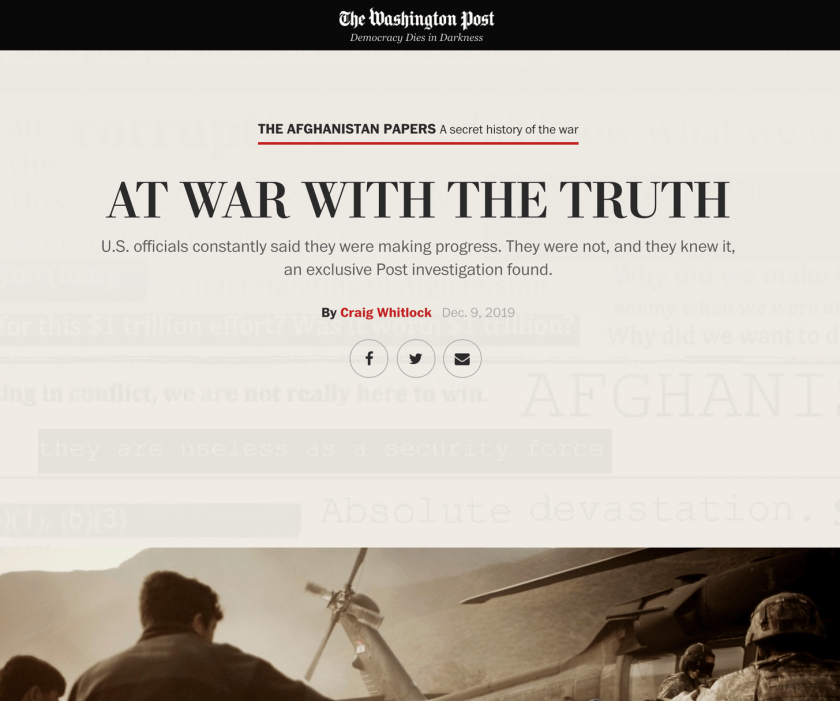
The pattern of lying was virtually identical throughout several administrations when it came to Afghanistan. In 2019, The Washington Post — obviously with a nod to the Pentagon Papers — published a report about secret documents it dubbed “The Afghanistan Papers: A secret history of the war.” Under the headline “AT WAR WITH THE TRUTH,” The Post summarized its findings: “U.S. officials constantly said they were making progress. They were not, and they knew it, an exclusive Post investigation found.” They explained:
Year after year, U.S. generals have said in public they are making steady progress on the central plank of their strategy: to train a robust Afghan army and national police force that can defend the country without foreign help.
In the Lessons Learned interviews, however, U.S. military trainers described the Afghan security forces as incompetent, unmotivated and rife with deserters. They also accused Afghan commanders of pocketing salaries — paid by U.S. taxpayers — for tens of thousands of “ghost soldiers.”
None expressed confidence that the Afghan army and police could ever fend off, much less defeat, the Taliban on their own. More than 60,000 members of Afghan security forces have been killed, a casualty rate that U.S. commanders have called unsustainable.
As the Post explained, “the documents contradict a long chorus of public statements from U.S. presidents, military commanders and diplomats who assured Americans year after year that they were making progress in Afghanistan and the war was worth fighting.” Those documents dispel any doubt about whether these falsehoods were intentional:
Several of those interviewed described explicit and sustained efforts by the U.S. government to deliberately mislead the public. They said it was common at military headquarters in Kabul — and at the White House — to distort statistics to make it appear the United States was winning the war when that was not the case.
“Every data point was altered to present the best picture possible,” Bob Crowley, an Army colonel who served as a senior counterinsurgency adviser to U.S. military commanders in 2013 and 2014, told government interviewers. “Surveys, for instance, were totally unreliable but reinforced that everything we were doing was right and we became a self-licking ice cream cone.”
John Sopko, the head of the federal agency that conducted the interviews, acknowledged to The Post that the documents show “the American people have constantly been lied to.”
Last month, the independent journalist Michael Tracey, writing at Substack, interviewed a U.S. veteran of the war in Afghanistan. The former soldier, whose job was to work in training programs for the Afghan police and also participated in training briefings for the Afghan military, described in detail why the program to train Afghan security forces was such an obvious failure and even a farce. “I don’t think I could overstate that this was a system just basically designed for funneling money and wasting or losing equipment,” he said. In sum, “as far as the US military presence there — I just viewed it as a big money funneling operation”: an endless money pit for U.S. security contractors and Afghan warlords, all of whom knew that no real progress was being made, just sucking up as much U.S. taxpayer money as they could before the inevitable withdraw and takeover by the Taliban.
In light of all this, it is simply inconceivable that Biden’s false statements last month about the readiness of the Afghan military and police force were anything but intentional. That is particularly true given how heavily the U.S. had Afghanistan under every conceivable kind of electronic surveillance for more than a decade. A significant portion of the archive provided to me by Edward Snowden detailed the extensive surveillance the NSA had imposed on all of Afghanistan. In accordance with the guidelines he required, we never published most of those documents about U.S. surveillance in Afghanistan on the ground that it could endanger people without adding to the public interest, but some of the reporting gave a glimpse into just how comprehensively monitored the country was by U.S. security services.
In 2014, I reported along with Laura Poitras and another journalist that the NSA had developed the capacity, under the codenamed SOMALGET, that empowered them to be “secretly intercepting, recording, and archiving the audio of virtually every cell phone conversation” in at least five countries. At any time, they could listen to the stored conversations of any calls conducted by cell phone throughout the entire country. Though we published the names of four countries in which the program had been implemented, we withheld, after extensive internal debate at The Intercept, the identity of the fifth — Afghanistan — because the NSA had convinced some editors that publishing it would enable the Taliban to know where the program was located and it could endanger the lives of the military and private-sector employees working on it (in general, at Snowden’s request, we withheld publication of documents about NSA activities in active war zones unless they revealed illegality or other deceit). But WikiLeaks subsequently revealed, accurately, that the one country whose identity we withheld where this program was implemented was Afghanistan.
There was virtually nothing that could happen in Afghanistan without the U.S. intelligence community’s knowledge. There is simply no way that they got everything so completely wrong while innocently and sincerely trying to tell Americans the truth about what was happening there.
In sum, U.S. political and military leaders have been lying to the American public for two decades about the prospects for success in Afghanistan generally, and the strength and capacity of the Afghan security forces in particular — up through five weeks ago when Biden angrily dismissed the notion that U.S. withdrawal would result in a quick and complete Taliban takeover. Numerous documents, largely ignored by the public, proved that U.S. officials knew what they were saying was false — just as happened so many times in prior wars — and even deliberately doctored information to enable their lies.
Any residual doubt about the falsity of those two decades of optimistic claims has been obliterated by the easy and lightning-fast blitzkrieg whereby the Taliban took back control of Afghanistan as if the vaunted Afghan military did not even exist, as if it were August, 2001 all over again. It is vital not just to take note of how easily and frequently U.S. leaders lie to the public about its wars once those lies are revealed at the end of those wars, but also to remember this vital lesson the next time U.S. leaders propose a new war using the same tactics of manipulation, lies, and deceit.
Biden’s America is back – to Somalia
By Uriel Araujo | August 16, 2021
On July 20, the US carried out an airstrike in Somalia against al Shabaab militants – the first one in Somalia under President Joe Biden. It struck again on July 23 and August 1. Last week, it was reported Biden seeks to host a “Summit for Democracy”. According to a White House statement, this will include civil society figures and political leaders to galvanize initiatives “against authoritarianism”, “corruption”, and also “promoting respect for human rights”.
These two topics are somehow connected. During the cold war, the US espoused the rhetoric of being the “leader of the free world”, although the record shows it backed some of the most ruthless dictators and promoted coup d’etats worldwide. To this day, most of the US “humanitarian interventions” have brought chaos and destabilization, and its attempts at “nation building” have been major humanitarian disasters. One only needs to look at Libya and Iraq or even Afghanistan – and yet Washington insists on being the only player that can deliver stability to Somalia in its counter-terrorism effort.
Amid the narrative wars, this is the one the US has always pushed: they are the champions of freedom, democracy, and now, in Biden’s parlance, human rights. This is the stuff American wars are made of, if we are to believe it – and there usually is a great battle for democracy somewhere. One could in fact argue that Trump was the first US President (since at least Carter) not to lead its own large and long military campaign.
While the Chinese presence in Africa is widely discussed, the US has maintained a kind of “invisible” presence in the African continent for a while, with a network of US special forces and private contractors – and this includes a covert war on the Al-Qaeda connected al-Shabab jihadist organization in Somalia: since 2007, thousands of people have been killed there by US drones and this includes civilians.
Trump removed most of the American troops from Somalia in the final days of his term, relocating them to nearby countries to remotely assist Somali forces against al-Shabab. This move was criticized by some American experts that argued Biden should redeploy the troops back to Somalia, and the Defense Department has been considering doing precisely that, according to a June 29 US Air Force Magazine piece. This is ironic, considering that the troops removal was completed less than 7 months ago, and considering that Biden has just withdrawn troops from Afghanistan – this also makes one wonder how long will it take before discussions about bringing troops back to Afghanistan begin.
In a January piece – published in the US FPRI website – former US Ambassador to Somalia Stephen M. Schwartz argues that the US “hasty exit” from Somalia would open “the door to a greater role for the People’s Republic of China”. According to him, the fight against al-Shabaab is a “classic counter-terrorism” effort, at a time when Washington’s attention is turning to great power competition with Beijing and Moscow. After all, Somalia, he argues, is “more” than al-Shabaab.
Somalia itself is part of the so-called Horn of Africa, a region that historically has been at crossroads and remains one of immense geopolitical importance: one of the main global trade routes lies off its coast and connects the Indian Ocean to the Red Sea and to the Mediterranean region and Europe through the Suez Canal.
It is well known Beijing currently seeks to employ its Belt and Road Initiative to enhance its position as the main investor in Africa. This can be clearly seen in the case of a small but strategic Horn of Africa country, namely, Djibouti – where Beijing also has its own permanent military base.
While Chinese military presence in the region and in the continent cannot rival American presence, China remains the largest investor in Africa and has been so for the last 10 years, according to a report by the Swiss-African Business Circle. For the 2010-2019 period, it has created an average of 18,562 jobs in Africa, while the US has created an average of 12,106. Moreover, according to Deborah Brautigam (Director of the China Africa Research Initiative), Beijing has been building long-term relationships in the continent, while Washington’s approach has a short-term time horizon.
There is yet another issue: Africa has been largely neglected by the US foreign policy – and Biden has not been an exception.
For example, in February 2021, the G5 Sahel held its N’Djamena meeting. While Russian deputy foreign minister Mikhail Bogdanov stayed three days in Burkina Faso (prior to the summit), and French President Emmanuel Macron spoke by video conference, US Secretary of State Anthony Blinken merely sent a pre-recorded five-minutes talk and dispatched no official in his place. In April, Niger celebrated, for the first time, a peaceful transfer of power between elected presidents, and neither President Biden nor Blinken sent a delegation.
Meanwhile, both China and Russia have maintained good diplomatic relations with many African countries since at least the Cold War period, when both powers supported several African independence struggles.
Apparently, for the US, having a presence in Africa is all about bombing insurgent groups with drones, maintaining military bases and special forces in covert undeclared wars, while insisting on its rhetoric of human rights and democracy. If the US wishes to compete with China and Russia for geopolitical influence on the Horn of Africa (as well as on the whole continent), it will need to improve its diplomacy.
Uriel Araujo is a researcher with a focus on international and ethnic conflicts.
Featured Video

Liberty Cannot Exist Inside a Panopticon
or go to
Aletho News Archives – Video-Images
From the Archives
Left-leaning despisers of 9/11 Truth movement: Do you really believe in miracles?
David Ray Griffin | Global Research | 06 Jul 2010
An Open Letter to Terry Allen, Noam Chomsky, Alexander Cockburn, David Corn, Chris Hayes, George Monbiot, Matthew Rothschild, and Matt Taibbi.
[1]According to several left-leaning critics of the 9/11 Truth Movement, some of its central claims, especially about the destruction of the World Trade Center, show its members to be scientifically challenged. In the opinion of some of these critics, moreover, claims made by members of this movement are sometimes unscientific in the strongest possible sense, implying an acceptance of magic and miracles. … Full article
Blog Roll
 Aletho News
- EU sending ‘biased’ observers to interfere in Serbian election – president
- White House envoy declares kinetic action against Yemen ‘fruitless’
- Ukraine deployed thousands of microdrones in Iraqi Kurdistan: Tasnim
- Iran calls for emergency UNSC meeting over Trump’s ‘brazen’ bomb talk, Israeli threats
- Iranian sources reveal details of Russia-China Hormuz proposal
- Plan for more US-Israel integration puts our military tech at risk
- Another Round Against Iran Will Break What Is Left of the Gulf
- SVR Report on Ukraine’s Mexican Drug Gang Links Could Pressure Zelensky, Won’t Change US Policy
- British Government Employees Were Fact-Checking the News at the BBC. Nobody Told You.
- Albania on fire: who’s behind the riots?
- If Americans Knew
- Mysterious bot accounts reportedly spread fake ‘man on the street’ videos for Michigan Senate candidate
- Israeli Defense Minister Katz Says Over 60 Lebanon Villages Have Been Destroyed
- Why Is Israel Running TV Ads in Iowa Ahead of the Midterms?
- Hind Rajab’s Alleged Killer Is in the United States. HRF Demands His Arrest.
- US Officials Face Fresh Pressure After Another American ‘Brutalized’ by Israeli Settlers in West Bank
- Israel-Backed Palestinian Militias Terrorize Displaced Families in Gaza
- FBI subpoenas pro-Palestine activists over Israeli weapons plant disruption
- Fourth winter arrives in wartorn Gaza, too early – Daily Update
- More on how Bari Weiss is using CBS on behalf of Israel
- What the UK Is Doing to Pro-Palestine Novelist Sally Rooney Is an Act of Orwellian Villainy
- No Tricks Zone
- Predictions Made By Renowned Climate Proifessor Over Past Decades Have Been Proven To Be Poor
- New Study Suggests Large Regions Of The Pacific Ocean Have Been Cooling For The Last 80 Years
- Germany’s Green Energy Debacle: High Energy Costs Force Kahla Porzellan to Close After 182 Years!
- New Study: 50 Years Of The Most Aggressive ‘Net Zero’ Policies Can Only Affect The Global Climate By 0.03°C
- US September “Heat” Was No Record…Many Records Set Decades Ago
- Latest European Green Energy Debacle; Portugal’s Largest Flagship Solar Park Insolvent!
- Green Energy Debacle: German Expert Professor Fritz Vahrenholt Warns Of Severe Economic And Social Consequences
- Two More Paleo Reconstructions Affirm Meters-Higher Sea Levels Across Ireland, Brazil 7000-6000 Years Ago
- New Study: Earth And Venus Surface Warmth Largely Explained By Convection And Lapse Rate, Not CO2 Or Radiation
- 2025 Nature Paper Claiming Worsening Global Drought Gets RETRACTED …Heavily Flawed

