Soon after World War II ended, the US military began building massive military bases in Europe and shipped families to Europe to accompany servicemen. These bases grew into American cities that are great fun, but very costly and reduce the readiness of units. Should war occur in Europe, military units there will remain dysfunctional for weeks until their families are safely back in the United States. This assumes children are not killed or maimed by missile or commando attacks since these bases would be the main enemy target during a war. Generals know this, but European tours are too much fun and those who profit from this racket have political clout to derail efforts at reform.
“Germany spent far less than other major allies on cost-sharing for US bases last year”; John Vandiver; Stars and Stripes; March 12, 2021; https://www.stripes.com/news/europe/g…
“Milley is right – the U.S. should reevaluate its military commitments”; Dan DePetris; Defense News; December 10, 2020; https://www.defensenews.com/opinion/2…
For the first time, the US military’s central office for dealing with Hollywood has re-leased internal reports on its operations, revealing how the Department of Defense strong-armed the industry to achieve its propaganda goals.
The reports were obtained via a Freedom of Information Act request and offer a rare glimpse inside the DOD’s main entertainment liaison offices at the Pentagon, which oversees the individual branch offices in Los Angeles run by the Army, Navy, Air Force and others. The reports cover approximately two years of activities and illustrate just how aggressive the DOD can be when dealing with film and TV producers, as well as their involvement with some of the biggest-name filmmakers in Hollywood.
The sheer range of products mentioned in the documents as having gained assistance from the US military is staggering, from Navy-assisted episodes of Cake Boss and the Great Food Truck Race to the Disney sci-fi fantasy A Wrinkle in Time. Numerous other films are listed, including blockbusters like Captain Marvel, Top Gun: Maverick and Transformers: The Last Knight.
On Captain Marvel the DOD and US Air Force provided research trips to military bases, filming access at several military locations, and extensive promotional help including an Air Force recruitment campaign that tied into the film. The documents also reveal how the two co-directors of the movie, Anna Boden and Ryan Fleck, paid a visit to the Pentagon just before the film’s release.
One document notes, “During their visit they attended office calls and had lunch with Air Force leaders. They also participated in a professional development session” for Air Force and DOD public affairs officers, showing just how integrated the military-Hollywood relationship has become.
The files also confirm the military’s support on the final season of Homeland, though only after the “major problems noted in scripts” were resolved by the showrunner making “significant edits to the problematic areas.” The result was a show that preempted the false story that the Russian government had been funding Taliban insurgents in Afghanistan, and played up fears about what will happen when the US finally withdraws from the country.
The Pentagon also worked on smaller films such as The 15:17 to Paris, a Clint Eastwood-directed retelling of how three Americans, including two servicemen, tackled a gunman on a train from Amsterdam to Paris in 2015. One entry in the reports records how they received “a long list of things that the film makers hope to obtain from us” but the DOD only approved support after ensuring that they could “create enough military portrayal to justify use of our assets.”
Beefing up the military’s presence in films, and the role of military characters in the unfolding storylines, is a key aim of the DOD’s Hollywood offices, but they don’t always get what they want. Christopher Nolan approached them about providing Osprey and Chinook aircraft for use in Tenet, and the National Guard and Air Force “indicated interest if military characterizations are rewritten emphasizing military mission.”
A few weeks later, it seems that Nolan simply stopped responding to the military’s phone calls, with one update commenting, “Likely cause is that producer/director were reluctant to make changes needed to gain DOD support.” This echoes what happened on Interstellar, Nolan’s previous sci-fi epic. Reports from the Navy’s Hollywood office record how he approached them about potential support, but the relationship broke down after he refused to share his script with Navy officials, having clearly learned from the extensive rewrites the military demanded on Man of Steel.
At the other end of the Hollywood scale is Tom Hanks, who has worked with different US government agencies throughout his career, from the CIA on Charlie Wilson’s War to Homeland Security on The Terminal, as well as several military-supported productions. Hanks’ name comes up multiple times in the documents, as the DOD provided help to his historical war film Greyhound, as well as his forthcoming post-apocalyptic drama Finch.
The strict criteria that the military apply when deciding whether to support a production results in a high number of rejections, which can have the effect of killing a movie or TV show. Among the rejections detailed in the documents are “documentaries about Vladimir Putin and about the trials at Guantanamo Bay” and a film about the Bermuda Triangle, where the DOD were “Not impressed by the quality of the writing nor the story itself.” Neither the Bermuda Triangle film nor the Gitmo documentary appear to have been made.
Other movies that were turned down include Tom Clancy’s Without Remorse as well as Rob Reiner’s Shock and Awe, in the latter case because “premise is how the WH & DoD (mainly the WH) claimed that Bin Laden and Hussein conspired to create the 9/11 attacks, and fabricated evidence of Saddam collecting materials to fabricate nuclear weapons to use against the U.S. and its allies.”
Likewise, a feature-length documentary about Operation Eagle Claw – the failed attempt by US special forces to rescue some of the hostages held in Iran – was turned down after their request was forwarded to the Undersecretary of Defense for Policy, highlighting how high-up policy wonks are sometimes part of the decision-making process. This documentary also appears to have fallen by the wayside, unable to be produced due to the Pentagon’s censorious approach to pop culture.
However, the most egregious censorship revealed by the new documents came on the 2019 CBS drama series The Code, about Marine Corps lawyers prosecuting and defending cases brought under the Uniform Code of Military Justice. The Code was initially made without any military input, because the producers wanted to explore topics of which the DOD wouldn’t approve.
In the opening episodes the cases handled by the lawyers include a Marine-turned-congressman who is accused of murdering an Iraqi civilian execution-style, and the fallout from a Marine killing a Spanish citizen while drunk driving. Meanwhile, the widow of a murdered Marine decides to sue the Corps and challenge the Ferris Doctrine – a law that prevents people from suing the US military based on events that happened while on active duty.
These are precisely the sort of storylines that the DOD routinely removes from scripts for shows they support, such as NCIS and Hawaii Five-0. The documents record how on an NCIS: New Orleans episode they “Took issue with the latest NCIS NOLA script, in which a team of former U.S. Army rangers are portrayed as ‘killers for hire’.” An update days later reports that, “Filmmakers responded by saying they are working to remove all references to killers having been affiliated with U.S. Army Rangers.”
But this wasn’t possible on The Code, because the producers resisted numerous efforts by the military to get involved and have influence over the scripts. As the reports detail, “The showrunner turned down several offers of assistance by the Marine Corps Entertainment office during production.” An investigation by Task & Purpose found that the Marines kept trying to insert themselves into the production of The Code, but as one official put it, they were “essentially told to f-ck off” by the showrunners.
The documents go on to note that – somehow – Marine Corps leadership got hold of the early episodes of The Code before they’d aired. They were “displeased enough that they communicated what they saw as serious shortcomings in the depiction of the Marines.” The Corps imposed themselves on the production, and as a result, “CBS Television has indicated a desire to correct the problems in future episodes by accepting DoD assistance.”
The upshot of this was that the show took a turn and abandoned the controversial storylines of its earlier episodes, including the lawsuit around the Ferris Doctrine – though the suit is abandoned not due to pressure from the military brass, but so that the widow can embark on a romantic relationship with one of the key witnesses.
A few months later The Code was cancelled, having given up on the only thing that made it stand out in a crowded marketplace of criminal and legal procedurals. In essence, the DOD sabotaged a TV show because they didn’t like its politics.
While the likes of Christopher Nolan are powerful enough to sometimes resist the military’s overtures and manipulations, the DOD’s hostile takeover of Hollywood is gathering pace due to these aggressive, domineering tactics.
Tom Secker is a British-based investigative journalist, author and podcaster. You can follow his work via his Spy Culture site and his podcast ClandesTime.
When the US entered the nuclear age, it did so recklessly. New research suggests that the hidden cost of developing nuclear weapons were far larger than previous estimates, with radioactive fallout responsible for 340,000 to 690,000American deaths from 1951 to 1973.
From 1951 to 1963, the US tested nuclear weapons above ground in Nevada. Weapons researchers, not understanding the risks—or simply ignoring them—exposed thousands of workers to radioactive fallout. The emissions from nuclear reactions are deadly to humans in high doses, and can cause cancer even in low doses. At one point, researchers had volunteers stand underneath an airburst nuclear weapon to prove how safe it was:
The emissions, however, did not just stay at the test site, and drifted in the atmosphere. Cancer rates spiked in nearby communities, and the US government could no longer pretend that fallout was anything but a silent killer.
The cost in dollars and lives
Congress eventually paid more than $2 billion to residents of nearby areas that were particularly exposed to radiation, as well as uranium miners. But attempts to measure the full extent of the test fallout were very uncertain, since they relied on extrapolating effects from the hardest-hit communities to the national level. One national estimate found the testing caused 49,000 cancer deaths.
Those measurements, however, did not capture the full range of effects over time and geography. Meyers created a broader picture by way of a macabre insight: When cows consumed radioactive fallout spread by atmospheric winds, their milk became a key channel to transmit radiation sickness to humans. Most milk production during this time was local, with cows eating at pasture and their milk being delivered to nearby communities, giving Meyers a way to trace radioactivity across the country.
The National Cancer Institute has records of the amount of Iodine 131—a dangerous isotope released in the Nevada tests—in milk, as well as broader data about radiation exposure. By comparing this data with county-level mortality records, Meyers came across a significant finding: “Exposure to fallout through milk leads to immediate and sustained increases in the crude death rate.” What’s more, these results were sustained over time. US nuclear testing likely killed seven to 14 times more people than we had thought, mostly in the midwest and northeast.
A weapon against its own people
When the US used nuclear weapons during World War II, bombing the Japanese cities of Hiroshima and Nagasaki, conservative estimates suggest 250,000 people died in immediate aftermath. Even those horrified by the bombing didn’t realize that the US would deploy similar weapons against its own people, accidentally, and on a comparable scale.
And the cessation of nuclear testing helped save US lives—”the Partial Nuclear Test Ban Treaty might have saved between 11.7 and 24.0 million American lives,” Meyers estimates. There was also some blind luck involved in reducing the number of poisoned people: The Nevada Test Site, compared to other potential testing facilities the US government considered at the time, produced the lowest atmospheric dispersal.
The lingering effects of these tests remain, as silent and as troublesome as the isotopes themselves. Millions of Americans who were exposed to fallout likely suffer illnesses related to these tests even today, as they retire and rely on the US government to fund their health care.
“This paper reveals that there are more casualties of the Cold War than previously thought, but the extent to which society still bears the costs of the Cold War remains an open question,” Meyers concludes.
In a Los Angeles Times editorial predictably hyping up the extreme danger to “national security” arising from the January 6 Capitol protests, the Times quotes Capitol police officer Harry Dunn as saying, “We represent the good side of America, the people who believe in decency.”
Really?
So tell us, Officer Dunn, what is decent about the following actions of the U.S. government:
1. The torture center and prison camp at Guantanamo Bay.
2. The indefinite detention of people at Guantanamo Bay without charges or trial.
3. The denial of trial by jury in terrorism trials at Guantanamo Bay.
4. The use of evidence acquired by torture at Guantanamo Bay.
5. The use of confessions acquired by torture at Guantanamo Bay.
6. The use of hearsay to secure convictions in terrorism “trials” at Guantanamo Bay.
7. The secret monitoring of communications between attorney and detainees at Guantanamo Bay.
8. The torture of people at the hands of U.S. officials in Afghanistan, Iraq, and other parts of the world.
9. The intentional destruction of videotapes depicting the torture of people at the hands of U.S. officials.
10. The invasion, occupation, and war of aggression against Iraq, a country that had never invaded or attacked the United States.
11. The invasion of Afghanistan and the resulting 20-year destruction of life and property.
12. The secret mass surveillance of the American people.
13. The secret illegal surveillance partnerships with American telecoms.
14. The sanctions against the people of Iraq, which contributed to the deaths of hundreds of thousands of Iraqi children.
15. U.S. Ambassador Madeleine Albright’s infamous statement that the deaths of half-a-million Iraqi children from the sanctions, while difficult, were “worth it.”
16. The decades-old embargo against Cuba, which has been a major factor in the suffering of the Cuban people.
17. The sanctions against Iran, North Korea, China, Russia, and other countries, with the aim of causing death and suffering among the citizenry to achieve regime change.
18. Trade wars against China and other nations.
19. MKULTRA.
20. The invasion of Cuba at the Bay of Pigs.
21. Coups and invasions for the purpose of regime change, including against democratically elected foreign presidents and prime ministers.
22. State-sponsored assassinations and executions, including of American citizens, along with cover-ups of such assassinations.
23. Official lies, including under oath.
24. The secret hiring of Nazis to secretly serve the U.S. government.
25. COINTELPRO.
26. The “war on terrorism.”
27. Secret illegal surveillance of American officials and American citizens for the purpose of blackmailing them.
28. The racist war on drugs, along with civil asset forfeiture, mandatory minimum sentences, and deadly no-knock raids.
29. The war on immigrants, which has brought untold death and suffering to countless people.
30. The immigration Berlin Wall along America’s southern border.
31. The immigration police state along America’s southern border, including domestic highway checkpoints, warrantless searches of farms and ranches, boarding of Greyhound buses to check people’s papers, and violent raids on American businesses.
32. The unexplained killing of Ashli Babbit during the January 6 Capitol protests.
33. Soaring federal spending and debt.
34. Waco and Ruby Ridge.
35. The undeclared Vietnam War.
36. The undeclared Korean War.
37. Inciting crises and new official enemies to justify ever-increasing budgets for the national-security establishment and its army of “defense” contractors.
38. The Federal Reserve and decades of monetary debauchery and debasement.
39. The IRS.
40. The persecution and prosecution of people who disclose the evil and sordid dark-side secrets of the U.S. government.
Pray tell, Officer Dunn: Is all this the official “decency” to which you refer?
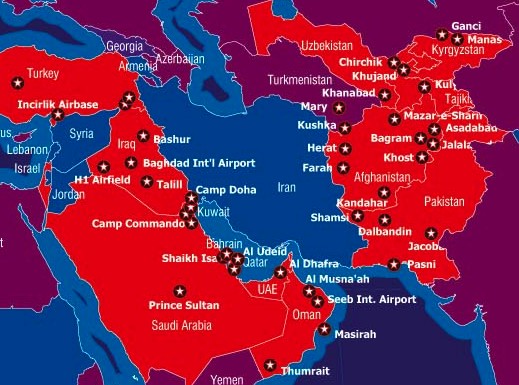
MOSCOW – Russia’s special presidential envoy for Afghanistan, Zamir Kabulov, said on Thursday that nearly half of the US military bases in Afghanistan were used to keep strategic tabs on the wider region.
“Of the 19 [US bases] that we know of, somewhat about seven or eight had nothing to do with Afghanistan and had nothing to do with the situation there”, Kabulov told the Echo of Moscow radio station.
The diplomat emphasised that the American contingents were conveniently placed in Afghanistan to be closer to the Middle East, Russia, Central Asia and China.
“[The US military] kept an eye on the Pakistani and Indian nuclear arsenal”, Kabulov added.
The United States and NATO began pulling their ground forces out of Afghanistan on 1 May. The withdrawal resulted in a flare-up of tensions between the government forces and the Taliban. The radical movement stepped up the territorial advances and is believed to have captured large rural areas in the country’s north.
A number of Iraqi politicians and lawmakers have reacted to recent interventionist remarks by Turkish Interior Minister Suleyman Soylu during his recent visit to the city of Sirnak in southeastern Turkey, vowing a strong response to any infringement of the Iraqi sovereignty and territorial integrity.
According to a report by Rudaw news agency on Thursday, during his visit to Sirnak, the Turkish minister claimed that establishing peace in Muslim countries, including Iraq and Syria, was Turkey’s responsibility.
Soylu’s comment reverberated widely through social media platforms, enraging Iraqi people and politicians.
Ra’ad Hussein, representative of Saairun Alliance affiliated with Iraq’s influential cleric Muqtada al-Sadr, said the sovereignty of Iraq is beyond all considerations and the positions of the Sadr movement in this regard are clear.
“The Sadr movement is totally Iraqi and has no links to foreign countries, and it prefers the interests of Iraq over all interests, and to this end, the head of al-Sadr’s bloc decided to withdraw from the elections,” Hussein said.
“Our position is firm, which means that we will sever ties with any of the neighboring or regional countries if they do not have a positive attitude towards Iraq,” he added.
Hussein underlined that such statements, whether made by Turkish or other officials, are unacceptable and no one will ever be able to encroach on a single inch of Iraqi soil.
Iraqi Shia cleric Ammar al-Hakim took to Twitter on Wednesday, calling on neighboring countries to respect Iraq’s sovereignty.
Hakim, who heads Iraq’s National Wisdom Movement political bloc, said, “Achieving peace in the region and the world comes through the interaction of states among themselves in accordance with international covenants and cooperation based on the foundations of mutual relations and common interest.”
He added, “It is not allowed to compromise the sovereignty of Iraq and for its land to be infringed,” without making any direct reference to Turkey.
Meanwhile, Iraqi MP and member of the Law Coalition, Kadhem Finjan al-Hamami, reacted to Turkish minister’s remarks, saying that the Turkish provocations were not the first of its kind in clear reference to Turkey’s deforestation of Kurdish areas and the continuous attacks on the Iraqi territory under the pretext of fighting Kurdish separatists.
“There have been no reactions from the Iraqi government or the Kurdistan Regional Government (KRG) towards all these attacks on Iraqi lands,” he said, adding that the Turkish government believes that “Iraq and the neighboring countries are a subject of the Ottoman Empire.”
A new investigation has revealed that Britain has exported around three times as much weaponry and military equipment to Saudi Arabia, which is leading a devastating military aggression against Yemen, than previously believed.
According to a report published by British online newspaper The Independent, the British government’s official figures state that British ministers have signed off 6.7 billion pounds (9.28 US dollars) worth of arms, such as bombs, missiles, and aircraft, to the oil-rich kingdom ever since it started its bombardment campaign of neighboring Yemen back in March 2015.
However, researchers say the actual figure is likely to be close to £20 billion (over $27 billion) because the official numbers do not entail sales carried out under an obscure “open license” system.
The investigation further casts doubts on allegations of the British government about having “one of the most robust and transparent export control regimes in the world.”
The probe emphasized that Britain’s operation of the parallel and less transparent “open license” system gives a more open-ended green light to arms manufacturers to sell specific armaments to a specific country without a monetary limit.
It further noted that the United Kingdom operated an open license for bombs and air-to-surface missiles to Saudi Arabia between 2014 and August 2019.
Moreover, an open license has covered Britain’s sales of equipment and components for use in the twin-engine and multi-role Eurofighter Typhoon jets to Saudi Arabia. The warplanes have been used in Saudi airstrikes across Yemen.
The researchers also examined the accounts of companies known to be selling arms to Saudi Arabia, and discovered that the revenues of British multinational arms producer BAE Systems, for instance, totaled nearly 17 billion pounds (23.5 US dollars).
As a result, they estimate that the real value of exports is close to £20 billion ($27 billion).
“The use of open licenses also offers the government a convenient sleight of hand when it comes under pressure over arms sales to a particular country due to events such as wars, military coups, or well-publicized human rights abuses,” the report warns.
Katie Fallon of Campaign Against Arms Trade, which conducted the research, stated, “The use of Open Licenses covers up the real extent of the UK arms trade and makes it impossible to know what quantities of weapons are being sold around the world.”
“UK-made fighter jets, bombs and missiles have had a devastating impact in the ongoing bombardment of Yemen. The fact that the real total of these sales could be so much higher than previously reported emphasizes the central role that the UK government and UK-based companies have played in the war. There must be full transparency about what arms have gone over and in what quantity,” Fallon added.
“So much of the arms industry takes place in secret, and that’s how the arms dealers like it. As long as the widespread use of Open Licenses continues, the true nature and volume of the UK arms trade will remain hidden from scrutiny, and therefore from meaningful control,” Fallon pointed out.
Saudi Arabia, backed by the US and its regional allies, launched the devastating war on Yemen in March 2015, with the goal of bringing the government of former Yemeni president Abd Rabbuh Mansur Hadi back to power and crushing the popular Ansarullah resistance movement.
Yemeni armed forces and allied Popular Committees have, however, gone from strength to strength against the Saudi-led invaders, and left Riyadh and its allies bogged down in the country.
The Saudi war has left hundreds of thousands of Yemenis dead, and displaced millions more. The war has also destroyed Yemen’s infrastructure and spread famine and infectious diseases across the Arab country.
After a year and a half of seeking but not finding SARS-2 in any wildlife anywhere (apart from domesticated or zoo animals that appear to have caught it from humans) is it time to say, yes, it didn’t just escape from a lab. It was created, built, assembled in a lab. Or many labs
Coronavirus scientists have been constructing new viruses out of bits and pieces of other viruses for a long time.
Why did they do it?
One answer is that it was relatively easy to do. Easier than for many other viruses. Scientists like to tinker.
Okay, but after the SARS-1 outbreak in 2002-3, and a series of SARS-1 lab leaks over the ensuing several years in China, Taiwan and Singapore, which killed a few people, especially lab workers, didn’t scientists know it was dangerous to do this?
SARS viruses were designated by the US government as “Select Agents,” meaning they had the potential to cause a deadly pandemic and/or severe economic damage to crops or livestock. Scientists had to handle them in special ways, and get permission to transfer or share them with other labs. Scientists working on SARS coronaviruses had to have been aware of the risks in what they were working on.
I previously cited a statistic from STAT. The statistic is that Fauci’s NIAID has been funding coronavirus research for over twenty years, and at a price of up to $51 million per year, pre-Covid. Until 2002, everyone thought that all coronaviruses did to humans was cause colds: 10-30% of all colds. NIAID doesn’t spend money on colds.
Coronaviruses do cause animal diseases. But still, animal diseases are not in NIAID’s bailiwick. USDA funds research on them.
Some coronavirus research made sense, such as the 2005 CDC study that showed chloroquine killed SARS-1 at achievable human doses, in the test tube. Or the 2014 NIAID study that showed chloroquine killed MERS.
But no new drugs or vaccines came out of the hundreds of millions of dollars in coronavirus research sponsored by NIAID. And when Covid hit, Fauci and his NIAID hid information on the drugs they had found to be effective against coronaviruses in the lab.
So, what were Fauci and NIAID actually doing with all the coronavirus research? What were they looking for?
It seems they were remarkably successful in creating new chimeric, pathogenic coronaviruses. But they buried the research on effective treatments.
Americans need to ask, what in heaven’s name were Fauci and his masters trying to accomplish? Who are his masters? And what other deadly viruses have they created, with or without their friends in Wuhan?
We need to know what they heck they were doing. What did these programs create? Why did these programs exist?
We need to know now, before the fear of the variants wears off, and the next dangerous bug might appear.
Other than circumstantial evidence of zoonotic cases in mink farms in the Netherlands, no cases of natural transmission from wild or domesticated animals have been confirmed. More than 40 million human COVID-19 infections reported appear to be exclusively through human-human transmission. SARS-CoV-2 virus and COVID-19 do not meet the WHO definition of zoonoses. We suggest SARS-CoV-2 should be re-classified as an EID of probable animal origin.
Russian President Vladimir Putin has blasted Ukraine’s apparent lack of interest in striking a deal to resolve the bloody civil war in the east of the country, saying that Kiev politicians are using it to score political points.
In a lengthy article published on the Kremlin’s website on Monday, Russian President Vladimir Putin said that much of modern Ukraine had been formed out of his country’s historical territories, and at Moscow’s expense. Arguing that the two nations shared deep historical and cultural roots, he said that modern conflicts were derived from the fact that Ukraine was “the brainchild of the Soviet era” and effectively an experiment by “Bolsheviks” who drew its borders.
However, Putin said, the implications of ongoing disputes within the Eastern European nation were catastrophic. “According to the UN High Commissioner for Human Rights, the total number of victims associated with the conflict in Donbass has exceeded 13,000 people,” he said. “Among them are elderly people and children. Terrible, irreparable losses.”
“Russia did everything to stop fratricide,” he went on, arguing that Moscow sees no other way out of the bitter dispute than for Kiev to honor the Minsk Agreements that were intended to provide a roadmap to ending the conflict. However, he said, talks with Ukrainian officials have fallen flat because “they prefer to exploit the image of a ‘victim of external aggression’ and trade in Russophobia.”
Insisting that Kiev is using the conflict to its advantage in dealing with the West, Putin also claimed that “they arrange bloody provocations in the Donbass” and, “in a word, are trying to attract the attention of their external patrons and masters by any means necessary.”
“I am more and more convinced that Kiev simply does not need Donbass,” the president went on. “Why? Because, firstly, the inhabitants of these regions will never accept the rule they are trying to impose by force, blockades and threats.” In addition, he said, the Minsk protocols could be readily implemented but, in his words, “contradict the whole logic of the anti-Russia project” and would undermine “the constant cultivation of the image of an internal and external enemy.”
Fighting between Kiev’s forces and those loyal to the two breakaway self-proclaimed Donbass Republics has escalated in recent months, with a number of civilian casualties reported. A tense standoff between Ukrainian forces and Russian soldiers across the frontier sparked concerns of an all-out conflict earlier this year, until Moscow announced that its units would be redeployed and that readiness exercises had been concluded.
Last month, Putin said that he saw little point in meeting with his Ukrainian counterpart, Volodymyr Zelensky, to discuss the situation in the east of Ukraine given, he alleged, that much of the country’s policies were imposed from abroad.
“Why should I meet Zelensky?” the Russian leader asked. “If he has given up his country to full external control, the key issues about life in Ukraine are resolved not in Kiev but in Washington, and, to some extent, in Berlin and Paris. What then would we talk about?”
Historians declare that the American empire began with the Spanish-American war in 1898. It really began decades earlier when the US Navy formed the East India Squadron in 1835 that grew into of the Asiatic Squadron in 1868. American warships deployed to Asia to intimidate and attack whoever interfered with American business interests. This force also established American colonies in China, Hawaii, and Samoa before the Spanish-American war.
Barack Obama, the once US President, member of the Democratic Party, and a Nobel Peace Prize winner, fought four wars.
Republican Donald Trump who succeeded him preferred not to increase the number of war zones and conflicts involving the United States Armed Forces.
It is thus not surprising that some members of the international community began to attentively monitor USA’s foreign policies once Joe Biden became the head of US administration. What steps will he take in relation to armed conflicts that the United States is embroiled in? What regions could the new US President start wars in?
Such concerns stem from the fact that Joe Biden had previously supported military interventions, and in matters of foreign policy, he is probably more of a “hawk”, i.e. a politician who tends to escalate conflicts, than a dove.
For instance, back in the day, he voted for the resolution authorizing military air operations and missile strikes against the Federal Republic of Yugoslavia. In addition, the United States supplied Bosnian majority Muslim fighters with weapons. Thousands of civilians, including 400 children, died as a result of NATO-led bombing.
As Senator, Joe Biden also supported the 2001 US military operation in Afghanistan, arguing that Washington was obliged to attack the Afghanis “whatever the cost”. According to some estimates, the number of people who died during the war in Afghanistan may be as high as 360,000, including 26,000 children.
Since 1998, Joe Biden talked about use of force in Iraq and removing Saddam Hussein from power. In 2003, he was an ardent supporter of the Operation Iraqi Freedom, which resulted in over 200,000 civilians dead, of which about 40% were children. Because uranium containing weapons were used by the United States in Iraq, it has been suggested that there could be a link between cancer incidence (a 17-fold growth compared to 1991!) among the population in Iraq and their use.
In 2011, the then Vice President, Joe Biden followed Obama administration’s policies, including the intervention in Libya. NATO air strikes killed hundreds of civilians, and the Libyan civil war that followed resulted in many more deaths.
After winning the presidential election, Joe Biden “declared his presidency would not be a third Obama term” but a number of reports since then have challenged his assertion. Barack Obama played a crucial role during Joe Biden’s presidential campaign. One could even say that the former’s popularity helped the latter win the presidency.
As regards the US military budget, which was determined back under Barack Obama at a total of $1.3 trillion, Joe Biden promised during his election campaign that he would not dramatically decrease spending on national defense. He also did not hide his satisfaction with the amounts spent on the Barack Obama era nuclear modernization programs. The current President would probably also like to ensure that US armed forces are well-equipped with the latest weapons, equipment and ammunition.
During Barack Obama’s presidency, Joe Biden said he was an advocate for arms control and nonproliferation of nuclear weapons. In fact, he stated that reducing the threat of a nuclear attack was a priority for the administration. Then Vice President expressed his belief that the United States needed to “keep pursuing the peace and security of a world without nuclear weapons”.
Now that Joe Biden has been in his new role as President for approximately six months, there has been an increasing number of signs indicating that his administration intends to return to Barack Obama era policies if possible. Still, it is unquestionably difficult to do so to a full extent because times have changed and so has the geopolitical situation.
According to an article published byThe Spectator, “Joe Biden ordered his first big missile sally, a retaliatory strike in Syria” in early March 2021, during which the US “air forces dropped seven 500-pound Joint Direct Attack Munitions (JDAM) at a crossing used by Iranian-backed militia groups, reportedly killing 17”. At the time, some lawmakers expressed concern about the move as the new President ordered the military operation without congressional authorization.
On June 28, 2021, President Joe Biden directed military forces to conduct defensive precision airstrikes against facilities used by Iran-backed militia groups in the Iraq-Syria border region”, as reported by CNN.
According to an article in the Türkiye newspaper, Joe Biden instructed the US military command to soon step up military activities in Syria and get rid of Iranian presence in the region to appease Israel. Syrian field commanders during in an interview with the publication confirmed the news and gave further details of the American plan. In particular, the United States was in the process of recruiting 30,000 local fighters in order to conduct a large scale operation in Eastern parts of Syria, between the city of Al Bukamal, near the border with Iraq, and Al-Tanf (one of three official border crossings between Iraq and Syria). The military campaign is expected to last at least 8 months and will begin at the same time within the 250-km region between Al Bukamal and Al-Tanf. The publication also claims that US officials have asked their Turkish counterparts for permission to use two of their military bases for training and equipping the mercenaries. Supposedly, these fighters are to be paid $300 while their leaders – $600 to 1,000 depending on their rank.
Joe Biden wrote “a letter to Speaker of the House Rep. Nancy Pelosi and Senate President Pro Tempore Sen. Patrick Leahy” regarding the air strikes in Syria, which was published on the White House website on June 29, 2021. In it, he stated that the United States stood “ready to take further action, as necessary and appropriate, to address further threats or attacks”.
Aside from military operations in the Middle East, the US President has all but declared the start of two cold wars against Russia and the PRC.
The author believes that increasing domestic polarization over a number of years could lead to a major public rift in the United States. In fact, during the 2020 election, “317 retired generals and admirals signed an Open Letter” warning that America was in deep peril and was fighting for survival. At the beginning of May, 2021, over 120 retired US generals and admirals published another open letter, which said that “without fair and honest elections” the Constitutional Republic was lost, and some former military leaders may not be on the side of the current Democratic President. A major rift could thus be brewing within the nation.
And so could external military conflicts, as the US leadership does not know any other ways of dealing with its domestic issues, of which there are as many as during the Civil War, without inciting conflicts in other countries.
Hence, the possibility of escalations in tensions abroad is growing, for instance, between the United States and the PRC in the Taiwan Strait as well as the South China Sea; or in the Korean Peninsula. It is also possible that the US leadership will try to involve other Western nations in its confrontation against Russia and its allies. Still, it is unlikely that such moves will benefit the current US administration. After all, not all Americans would choose to send their children to fight in yet another war. In addition, the current balance of military power has been shifting. China’s and Russia’s growing military clout and stockpiles of cutting edge weapons are indicative of the fact that the United States may not emerge victorious in a confrontation against them.
In the author’s opinion, the Biden administration could consider waging a brief war that the US is capable of winning as an option in order to unite the divided nation and raise levels of patriotism among the populace. It would be even better if fighters from, for instance, Syria, South America or other parts of the world, were to take part in such a conflict instead of US servicemen.
Imagine a massive nuclear exchange between the United States and China. That obviously would not be a pretty sight for the people of either nation. As the mushroom clouds arose over both nations, imagine thinking to yourself: “All this because of a socialist road.”
According to an article in the London Daily Mail, the governments of China and Montenegro entered into an agreement in which China agreed to build a road for Montenegro that would extend to the Serbian capital of Belgrade. The road is only partially built and is now being called the “road to nowhere.”
China financed the road with a $1 billion loan to Montenegro. The first installment on the loan is due this month. But there is a good chance that Montenegro, “whose debt has soared to more than double its GDP,” will have to default.
The loan agreement entitles China to seize land within Montenegro, so long as it isn’t owned by the military or used for diplomatic purposes.
What does all this have to do with a nuclear war between the United States and China?
If Montenegro defaults and, for whatever reason, refuses to permit China to seize its collateral, China might well invade the country to enforce its loan agreement.
What does that have to do with the United States?
In 2017, Montenegro became a member of NATO. Under NATO’s membership rules, NATO members, including the United States, are bound to come to the defense of other NATO members in the event that a non-NATO nation attacks them.
I can’t help but wonder how many Americans realize that they have had their lives and fortunes pledged to the defense of Montenegro. For that matter, the same holds true with respect to all the other members of NATO, which are as follows: Albania, Belgium, Bulgaria, Canada, Croatia, Czech Republic, Denmark, Estonia, France, Germany, Greece, Hungary, Iceland, Italy, Latvia, Lithuania, Luxembourg, Netherlands, North Macedonia, Norway, Poland, Portugal, Romania, Slovakia, Slovenia, Spain, Turkey, and United Kingdom.
What’s amazing is how this process works. No one came to Congress and asked whether the American people were willing to sign a treaty with Montenegro that committed American lives and fortunes to the defense of Montenegro in some future war. My hunch is that if that had happened, enough Americans would have risen up to successfully oppose such a treaty.
Instead, all that had to be done was to have NATO bureaucrats approve Montenegro as a new NATO member. No approval of the American people was needed at all. The lives and fortunes of the American people are determined by bureaucrats in Brussels, Belgium, where NATO headquarters are located.
This is nuts! As recently as 2020, NATO bureaucrats agreed to admit North Macedonia into the organization. North Macedonia? Where the heck is North Macedonia?
Why do the American people continue to go along with this junk? Do they have such low regard for their own lives and fortunes that they are willing to subject themselves, their families, and their money to the whims of faraway foreign bureaucrats? Or do they just feel too helpless to stand up and say no? Or is their passivity just part of the overall deference-to-authority mindset that is inculcated into Americans in public (i.e., government) schools?
Let’s assume that there was no NATO and that China then attacked Montenegro to enforce its road loan agreement. How many Americans would travel to Montenegro to give their lives in the defense of Montenegro?
Answer: None! Not one single American, including the most ardent interventionists and anti-communists and including every member of the Pentagon, the CIA, and the NSA, would go to Montenegro to defend the country,
Why should the United States be part of an organization in which foreign bureaucrats are deciding when and under what conditions the American people are going to war? Why shouldn’t Americans be free to decide which wars to enter on an individual war-by-war basis?
Our nation’s Founding Fathers, including George Washington and Thomas Jefferson, warned against these types of “entangling alliances.” Today’s Americans would be wise to heed their words and withdraw the United States from NATO, that old Cold War dinosaur, before it’s too late.
An Open Letter to Terry Allen, Noam Chomsky, Alexander Cockburn, David Corn, Chris Hayes, George Monbiot, Matthew Rothschild, and Matt Taibbi.
[1]According to several left-leaning critics of the 9/11 Truth Movement, some of its central claims, especially about the destruction of the World Trade Center, show its members to be scientifically challenged. In the opinion of some of these critics, moreover, claims made by members of this movement are sometimes unscientific in the strongest possible sense, implying an acceptance of magic and miracles. … Full article
This site is provided as a research and reference tool. Although we make every reasonable effort to ensure that the information and data provided at this site are useful, accurate, and current, we cannot guarantee that the information and data provided here will be error-free. By using this site, you assume all responsibility for and risk arising from your use of and reliance upon the contents of this site.
This site and the information available through it do not, and are not intended to constitute legal advice. Should you require legal advice, you should consult your own attorney.
Nothing within this site or linked to by this site constitutes investment advice or medical advice.
Materials accessible from or added to this site by third parties, such as comments posted, are strictly the responsibility of the third party who added such materials or made them accessible and we neither endorse nor undertake to control, monitor, edit or assume responsibility for any such third-party material.
The posting of stories, commentaries, reports, documents and links (embedded or otherwise) on this site does not in any way, shape or form, implied or otherwise, necessarily express or suggest endorsement or support of any of such posted material or parts therein.
The word “alleged” is deemed to occur before the word “fraud.” Since the rule of law still applies. To peasants, at least.
Fair Use
This site contains copyrighted material the use of which has not always been specifically authorized by the copyright owner. We are making such material available in our efforts to advance understanding of environmental, political, human rights, economic, democracy, scientific, and social justice issues, etc. We believe this constitutes a ‘fair use’ of any such copyrighted material as provided for in section 107 of the US Copyright Law. In accordance with Title 17 U.S.C. Section 107, the material on this site is distributed without profit to those who have expressed a prior interest in receiving the included information for research and educational purposes. For more info go to: http://www.law.cornell.edu/uscode/17/107.shtml. If you wish to use copyrighted material from this site for purposes of your own that go beyond ‘fair use’, you must obtain permission from the copyright owner.
DMCA Contact
This is information for anyone that wishes to challenge our “fair use” of copyrighted material.
If you are a legal copyright holder or a designated agent for such and you believe that content residing on or accessible through our website infringes a copyright and falls outside the boundaries of “Fair Use”, please send a notice of infringement by contacting atheonews@gmail.com.
We will respond and take necessary action immediately.
If notice is given of an alleged copyright violation we will act expeditiously to remove or disable access to the material(s) in question.
All 3rd party material posted on this website is copyright the respective owners / authors. Aletho News makes no claim of copyright on such material.


 Aletho News
