Biden, Afghanistan and Forever Wars
By Binoy Kampmark | OffGuardian | March 9, 2021
The papers are full of suggestions on what US President Joe Biden should do about his country’s seemingly perennial involvement in Afghanistan.
None are particularly useful, in that they ignore the central premise that a nation state long mauled, molested and savaged should finally be left alone. Nonsense, say the media and political cognoscenti.
The Guardian claims that he is “trapped and has no good choices”. The Wall Street Journal opines that he is being “tested in Afghanistan” with his opposition to “forever wars”. The Washington Post more sensibly suggests that Biden take the loss and “add it to George W. Bush’s record.”
The Afghanistan imbroglio for US planners raises the usual problems. Liberals and Conservatives find themselves pillow fighting over similar issues, neither wishing to entirely leave the field. The imperium demands the same song sheet from choristers, whether they deliver it from the right side of the choir or the left.
The imperial feeling is that the tribes of a country most can barely name should be somehow kept within an orbit of security. To not do so would imperil allies, the US, and encourage a storm of danger that might cyclonically move towards other pockets of the globe.
It never occurs to the many dullard commentators that invading countries such as Afghanistan to begin with (throw Iraq into the mix) was itself an upending issue worthy of criminal prosecution, encouraged counter-insurgencies, theocratic aspirants and, for want of a better term, terrorist opportunists.
The long threaded argument made by the limpet committers has been consistent despite the disasters. Drum up the chaos scenario. Treat it as rebarbative. One example is to strain, drain and draw from reports such as that supplied by the World Bank.
Conflict is ongoing, and 2019 was the sixth year in a row when civilian casualties in Afghanistan exceeded 10,000. The displacement crisis persists, driven by intensified government and Taliban operations in the context of political negotiations.”
The report in question goes on to note the increase in IDPs (369,700 in 2018 to 462,803 in 2019) with “505,000 [additional] refugees returned to Afghanistan, mainly from Iran, during 2019.”
Then come remarks such as those from David von Drehle in the Washington Post. His commentary sits well with Austrian observations about Bosnia-Herzegovina during the latter part of the 19th century.
Nearly 20 years into the US effort to modernize and liberalize that notoriously difficult land, Taliban forces once more control the countryside, and they appear to be poised for a final spring offensive against the parts of the Afghan cities that remain under government control.”
The savages, in short, refuse to heel.
Von Drehle, to his credit, at least suggests that the US take leave of the place, admitting that Washington was unreservedly ignorant about the country. He quotes the words of retired L. General Douglas Lute: “We were devoid of a fundamental understanding of Afghanistan.” Tellingly, the general admitted that, “We didn’t know what we were doing.”
Fears exist as to how the May 2021 deadline for withdrawing all US military forces looms. Anthony H. Cordesman is very much teasing his imperial masters in Washington as to what is best. “Writing off the Afghan government will probably mean some form of Taliban victory.”
This is hardly shocking, but Cordesman prepares the terrain for the hawks.
This will create increased risks in terms of extremism and terrorism, but it is far from clear that these risks will not be higher than the risks of supporting a failed Afghan government indefinitely into the future and failing to use the same resources in other countries to support partners that are more effective.”
This is the usual gilded rubbish that justifies the gold from a US taxpayer. But will it continue to stick?
A few clues can be gathered on future directions, though they remain floated suggestions rather than positions of merit. The Biden administration’s Interim National Security Strategic Guidance waffles and speaks mightily about democracy (how refreshing it would be for him to refer to republicanism) which, in a document on national security, always suggests overstretch and overreach.
“They are those who argue that, given all the challenges we face, autocracy is the best way forward.” But he also inserts Trumpian lingo. “The United States should not, and will not, engage in ‘forever wars’ that have cost thousands of lives and trillions of dollars.”
Afghanistan comes in for special mention, and again, the language of the Trump administration is dragged out for repetition.
We will work to responsibly end America’s longest war in Afghanistan while ensuring that Afghanistan does not again become a safe haven for terrorists.”
Not much else besides, and certainly no express mention of grasping the nettle and cutting losses. And there is that troubling use of the word “responsibly”.
The default position remains the use of force, which the US “will never hesitate to” resort to “when required to defend our vital national interests. We will ensure our armed forces are equipped to deter our adversaries, defend our people, interests, and allies, and defeat the threats that emerge.” Again, the stretch is vast and imprecise.
Given that position, the withdrawal of the remaining 2,500 US troops in the country is bound to become a matter of delay, prevarication and consternation. Quiet American imperialism, at least a dusted down version of it, will stubbornly continue in its sheer, embarrassing futility. The imperial footprint will be merely recast, if in a smaller form.
Dr. Binoy Kampmark was a Commonwealth Scholar at Selwyn College, Cambridge. He lectures at RMIT University, Melbourne. Email: bkampmark@gmail.com
Iran Asks Why Israel Gets Preferential Treatment With IAEA Despite Its Arsenal of Nukes
By Ilya Tsukanov – Sputnik – 06.03.2021
Tel Aviv adheres to a policy of ‘nuclear ambiguity’, meaning that it neither confirms nor denies possessing nuclear weapons. At the same time, the country reserves itself the right to bomb, sabotage or otherwise act to stop activities of any Middle Eastern power it believes could lead to the development of a nuclear weapon.
Israel’s suspected nuclear arsenal poses a threat to the Middle East and the world, and Tehran is concerned by the country’s apparent preferential treatment with the International Atomic Energy Agency despite its status as a non-signatory to the Treaty on the Non-Proliferation of Nuclear Weapons, Kazem Gharibabadi, Iran’s ambassador to international organizations in Vienna, has said.
“Since all [countries] in the Middle East region, except the Israeli regime, are parties to the NPT and have undertaken to accept the Agency’s comprehensive safeguards, development of a clandestine nuclear weapons programme by this regime poses a continuing serious threat not only to the security and stability of the region and the world, but also to the effectiveness and efficiency of the NPT and the Agency’s safeguards regime,” Gharibabadi said, speaking at the meeting of the IAEA border of governors meeting this week.
The diplomat suggested that despite Israel’s censure at the United Nations and the IAEA over its suspected non-proliferation violations, the country has refused to accede to the NPT, or to place its nuclear facilities and activities under the IAEA’s safeguards regime.
“Ironically, Israel is now even enjoying a more preferential treatment as compared with that of the Nuclear Weapons States, since they are members of the NPT and have several obligations specifically under Articles 1 and VI of the Treaty,” Gharibabadi argued. The articles he mentioned relate to the non-transfer of nuclear weapons technologies, and to good-faith talks on the cessation of the nuclear arms race and disarmament.
“It is a clear contradiction that Israel as a non-member to the NPT is enjoying the full rights and privileges due to its membership to the IAEA, while at the same time, it considers itself free from any responsibility, and participates in all deliberations of the Agency related to members of the NPT,” the diplomat said.
It is “an irony” that the IAEA has focused its attentions on Iran and other members of the NPT while making “the chronic strategic mistake” of “overlook[ing] Israel’s nuclear materials and activities in the volatile region of the Middle East,” Gharibabadi suggested, suggesting that this “very serious shortcoming” needs to be addressed.
Otherwise, he asked, “what is the advantage of being both a NPT member and fully implementing the Agency’s safeguards?”
Israel has repeatedly called on the international community to take action against Iran’s nuclear programme and its alleged secret military component. Tel Aviv has also threatened that it would not rule out unilateral military actions to halt this alleged weapons programme. Prime Minister Benjamin Netanyahu has claimed for the better part of the last decade that Iran is on the verge of obtaining nuclear weapons, with the timeframe involved claimed to be either “weeks” or “months.”
Israeli threats of action against Iran come amid multiple reports citing satellite intelligence suggesting that Tel Aviv itself is engaged in major construction activity at the Shimon Peres Negev Nuclear Research Center, the top secret installation thought to have given birth to Israel’s first atomic bomb in the 1960s.
Israel does not confirm nor deny possessing nuclear weapons. Estimates on the size of its nuclear arsenal range from 80 to 400 warheads, with these weapons believed to be deliverable via a number of medium and long-range ground-based missiles, aircraft and cruise missiles launched by subs.
Iran is not known to possess nukes, and its leaders have issued at least two fatwas (religious rulings) banning their development. In the 1980s, one of these fatwas also prohibited Iran from retaliating to Iraqi chemical attacks using Iran’s own chemical weapons arsenal. The country later eliminated these weapons before joining the Chemical Weapons Convention.
In 2015, the Islamic Republic, the United States, Russia, China, Britain, France, Germany and the European Union signed the Joint Comprehensive Plan of Action, a landmark treaty promising Iran relief from sanctions in exchange for restrictions on its peaceful nuclear programme. Washington pulled out of the agreement in 2018, and the Biden administration has yet to live up to its campaign pledge to rejoin it.
U.S.-made HIMARS missile systems in Romania aimed against Russian forces in Transnistria
By Paul Antonopoulos | March 5, 2021
The first batch of U.S.-made HIMARS multi-launch missile systems arrived in the Romanian Black Sea port of Constanța and is now a part of the national army. The first to receive the new missile system is the 81st Tactical Operational Missile Battalion, deployed in Focșani, about 70 kilometers from the border with Moldova.
HIMARS artillery missile systems are designed to attack areas with a concentration of artillery systems, air defenses, transport nodes and other major targets that are within a 300-kilometer range. Considering Romania borders Ukraine, Moldova, Bulgaria, Hungary and Serbia, the country has no enemies within the scope of HIMARS, bringing to question why it purchased such systems. It is difficult to explain why such a powerful weapon is deployed in eastern Romania, 220 kilometers from the Moldovan city of Tiraspol and 270 kilometers from the ammunition depot in Cobasna in the separatist region of Transnistria – which is internationally recognized as a part of Moldova.
It must be noted that the U.S. approved the sale of 20 HIMARS launchers, worth $655 million, to Poland. Romania received 54 launchers, more than double the amount of Poland, showing that the U.S. is prioritizing the Black Sea as a point of pressure against Russia – more so than the Baltics. Whereas the German Navy are present in the Baltics and the British can reach the area with relative ease, the Black Sea is effectively a “Russian lake,” particularly after Russia’s 2014 reunification with Crimea. NATO member states Turkey, Bulgaria and Romania do not have the capabilities to challenge the Russian Navy in the Black Sea, hence why Washington is also cooperating with Moldova, Ukraine and Georgia.
But the question still remains – why would Bucharest need 54 HIMARS launchers, more than the American artillery brigade has, and more than 10% of all such systems in the Pentagon’s arsenal?
It is excessive fire power for an army that has only 70,000, personnel and does not have the means to redeploy heavy weapons at a great distance. According to Firepower, Romania is ranked only 41st globally for their military power.
Hypothetically, in a war situation, the 41st U.S. Artillery Brigade could borrow the Romanian HIMARS systems and transport them to Georgia or Ukraine. At the end of 2020, U.S. ground forces conducted exercises to prepare for a “hi-tech war” in Romania. In a few hours they managed to transport by air two HIMARS systems from Germany to the Kogâlniceanu Air Base and launch several rockets towards the Black Sea – there is little doubt that the imagined target was Russian forces when we consider that it is only 400 kilometers between the Romanian coast and Russia. Although this is 100 kilometers less than the range of the HIMARS system, according to Forbes, the exercises were “a message for Moscow” and a “rocket surprise” for Russian forces in Crimea.
The political-military situation in the region is becoming increasingly tense, with Moldova coming within range of American weapons and soldiers based in Romania. According to the Constitution, the Republic of Moldova is a neutral state, but decisionmakers in the Moldovan capital of Chisinau and their Romanian counterparts in Bucharest concluded a military cooperation agreement in 2013, which de facto subordinates Moldovan troops to the Romanian General Staff and allows Romanian gendarmes to maintain “public order” in the country. With Romania effectively controlling Moldova’s security and President Maia Sandu pivoting her country towards NATO and the European Union, Chisinau could be a willing participant in the West’s sustained campaign to pressure Moscow.
Analysts at the Pentagon-affiliated RAND Corporation are examining how U.S. troops could enter Moldova to participate in military exercises and not leave, using the pretext of the so-called Russian threat. American maneuvers and armament in Eastern Europe not only threatens Russia, but serves to ensure that Romania and Baltic States stay loyal to Washington and against Moscow.
If the U.S. is successful in stationing troops in Moldova, they would effectively have new access to the Black Sea via the Port of Giurgiulești on the Danube River. In addition, U.S. troops would be within touching distance of the 1,500-strong Operational Group of Russian Forces in Transnistria, whose responsibilities include maintaining peace and guarding several tons of military equipment and ammunition in Cobasna.
Although the HIMARS system cannot reach Russia from Romania, it is likely that these missiles are aimed against Russian forces maintaining peace in Transnistria. 54 HIMARS in Romania’s arsenal demonstrates an escalation by Bucharest as it is clear that the excessive number of units is not for defensive purposes, especially considering the country’s cordial relations with its neighbors.
Paul Antonopoulos is an independent geopolitical analyst.
Biden becomes the sixth successive President to bomb Iraqis: how far could this latest round of escalation go?
By Aram Mirzaei for The Saker | March 4, 2021
Another president, another act of aggression. For the past few decades, it’s almost like a mandatory rite of passage for US presidents to bomb Muslim countries. I don’t think many of us are surprised to see that current US President Joe Biden turned out to be no different to his predecessors, when Washington once more bombed Iraqis last week.
Continuing the same policy of terrorism and humiliation from the Trump era, Washington felt the need to show strength against the Resistance forces on the Syrian-Iraqi border area. What angers me most, is not just the terrorist act of killing people who are fighting US occupation and US backed terrorism, but the fact that Washington cannot and will not recognize that there is a growing local resistance to Zionist hegemony, instead resorting to degrading and humiliating legitimate resistance groups such as Hashd al-Sha’abi of Iraq (PMU) or the Houthis of Yemen by labelling them “Iranian backed proxies”.
Everything and everyone that oppose Washington and Zionist hegemony in West Asia are “Iranian backed”. Whether it is a Houthi attack on a Saudi airport, a Taliban attack on a NATO convoy or a suspiciously random rocket attack on a US base in Iraq, it is always Iran’s fault and somehow the Islamic Republic must be held responsible for these attacks. Both Washington and the Zionist entity keep attacking Resistance forces in the very area where ISIS remnants have been re-emergent for the past months, claiming their right to self defense. Self defense?! America is more than 10,000 kilometres away. US troops are occupying Syrian and Iraqi territory and Washington claims the right to self defense? This narrative has been drilled into the minds of so many people in the West that nobody even reacts when one of the Obama gang’s old crude liars, Pentagon Press Secretary John Kirby was telling the press that Washington acted to “de-escalate” the situation when it bombed Resistance forces on the Syrian-Iraqi border.
What Kirby really meant by “de-escalation” was that he believes that Washington sent Iran and its allies a “clear message”, that messing with Washington is unwise. The sad part is that he and the other psychopaths in Washington actually believe that the so called “message” will in any way deter the Resistance forces in West Asia. It is pretty clear what the US is doing with these random attacks on the Resistance forces. Washington knows the realities on the ground and acts in response to them. In Syria, it has become clear for Washington that Damascus won’t fall, that dream came down crashing when Russia entered the war in 2015. So, Washington is acting to deny Syria and her allies their well deserved victory through the occupation and looting of eastern Syria. Washington will act for as long as it takes to starve the Syrian people into submission.
In Iraq, Washington, being well aware that the Iraqi parliament has voted to expel US forces from Iraq, is desperately seeking new reasons to prolong their occupation. Be it through the magical re-emergence of Daesh terrorists in Western Iraq or through suspicious Katyusha rocket attacks on US interests in Baghdad’s green zone, which are then blamed on the Iraqi Resistance forces without any kind of evidence presented, Washington is seeking to undermine the Iraqi parliament’s decision.
In Iraq, Washington has a foothold in Baghdad not seen in Syria’s Damascus. It is through this foothold that Washington wields influence over many Iraqi politicians and thus has the ability to cause great internal disunity and animosity among Iraqis themselves.
Washington has both great influence over the Kurds in northern Iraq and over the Prime Minister’s office. PM Al-Kadhimi is known to be a close associate of Washington’s and is suspected to be cooperating with the US to prolong their stay in Iraq. During his tenure, tensions between Baghdad and the PMU have run high as government forces have made random raids on the PMU headquarters, arresting some members even. Yet even more dangerous is the escalating tension between Washington and the PMU. On Wednesday March 3rd, a new rocket attack on the Ain Al-Assad military base was reported. This is the same military base that was struck by the IRGC last year in retaliation for Washington’s murder of martyrs Soleimani and Al-Muhandis. Previously the PMU had vowed revenge for Washington’s attack last week, which makes it rather obvious that Washington will blame the PMU for this recent strike.
With this latest round of escalation, one wonders what will happen next? Of course I’m just speculating but I see some real dangers with tensions running this high. I believe that Washington could very well seek to push Iraq into a new civil war in a bid to eradicate the Hashd al-Sha’abi. Many of the groups within the PMU have threatened to wage war on US forces if Washington refuses to withdraw. Unfortunately, this threat by the PMU can easily be exploited by the US, giving Washington a casus belli, as they intensify their “defensive” airstrikes while claiming to support Baghdad’s campaign to bring “stability” to Iraq. Such an endeavour could risk dragging several regional countries into the conflict as the Islamic Republic could be forced to intervene on behalf of the Iraqi Resistance forces. It is clear that Washington cannot and will not attack Iran directly, such an adventure would be too risky for the crazies in the White House and Pentagon. However, fighting “Iranian backed” forces and rolling back Iranian influence could serve to both solidify the continued US occupation of Iraq in the short term, and prevent the Resistance forces from achieving complete victory, in the mid-to-long term. In order to manufacture consent, Washington must portray their actions as both “defensive” and in service of “stability and peace”. Having others fight Washington’s wars for them is a speciality for the Empire. This is why I believe the most likely scenario to be one where Washington attempts to pit Baghdad against the PMU, then sweep in to “help” Baghdad “preserve stability”. This strategy has been used in different ways before by the Obama regime when it unleashed the Daesh terrorist group in Iraq, then claimed to fight the same terrorists it had armed and trained, in a bid to continue their occupation of Iraq and pressure pro-Iran PM Nouri Al-Maliki to resign. Obama then did the same thing in Syria with the support of Kurdish militants in a bid to pressure Damascus into concessions. Trump continued on the same path but went even further when his administration began using phony attacks on “US interests” in Iraq as a pretext for direct confrontation with the PMU, a path that ultimately led to the murder of Martyrs Soleimani and Al-Muhandis. The then-secretary of State Mike Pompeo claimed that Washington had acted to “stabilize” Iraq with the murder of these “terrorists” who were “hated among Iraqis”.
Iraq is key to the Resistance Axis and cannot fall into enemy hands. It is however also the most vulnerable of the countries where the Resistance forces are active, as not only does Washington have great influence over Baghdad, but also over the Kurdish autonomous region in the north.
Supporting Kurdish independence is another way that Washington could seek to attack the Resistance Axis. This can be seen in Syria as well where the Kurdish militants are acting as excellent proxy troops for Washington, occupying about a third of the country and helping US forces in the looting of Syrian oil. Kurdish parties also have excellent ties to the Zionist entity in Tel Aviv, as Zionist chieftain Netanyahu has on several occasions been a vocal supporter of Kurdish independence, often likening the Kurdish people’s cause with the Zionist one. The reactionary Kurdish parties, who are too ignorant and too greedy to understand and realize that they are being used as cannon fodder to further US imperial ambitions, will be more than happy to wage war on Syria and Iraq with US support behind them.
It’s been almost 10 years since the war in Syria began, and 18 years since the war in Iraq began, and still there seems to be no peace in sight for any of the Arab countries. Biden has been in office in less than two months, but in my opinion, the next four years seem to be rather clear in terms of Washington’s policies towards the West Asia region- the long wars will continue and more blood is to be expected. Bush bombed Iraq, [Clinton bombed Iraq, Bush Jr bombed Iraq,] Obama bombed Iraq, Trump bombed Iraq, and now Biden bombs Iraq. For our people, it never matters who or what occupies the White House, the bombings and wars will continue. Iraq has a rather young population, more than 60 percent of the population is under 25 years of age. This means that most Iraqis have known nothing else except the US imposed wars on their homeland. It is a tragedy and a shameful moment in human history where most people in the totally “advanced, civilized, democratic, morally superior” West don’t care about what their despicable governments are doing in Iraq or Syria, because they are stupid Muslim terrorists anyway. This is why Iraq cannot and should not rely on Western public opinion. Resistance is the only way, and the US Empire must be kicked out with force in order for Iraqis to finally have some peace.
IMPERIAL WASTE
By Paul Robinson | IRRUSSIANALITY | March 3, 2021
Imperialism is big gigantic waste of money. Let’s start with that.
A couple of news items caught my attention this week that illustrate this point, but before getting on to them, we first need to make a bit of a detour and try to determine imperialism’s roots.
It’s harder than it might seem. For instance, historians have a real problem explaining late nineteenth century imperialism, in which European powers conquered large parts of the globe, most notably in Africa. All sorts of explanations have been generated, but few stand up to a lot of scrutiny.
Particularly implausible are the theories of socialist thinkers, the most famous of which is Lenin’s Imperialism: The Last State of Capitalism. The socialists’ idea was that capitalism generates lots of surplus capital that it can’t get rid of because it is suppressing the wages of its own workers and so denying itself investment opportunities at home. Instead, capitalism exports its surplus, for which it needs colonies – thus imperialism.
The problem was that, like a lot of Lenin’s stuff, the theory was total hogwash. First, capitalist economies had no shortage of investment opportunities at home; and second, they didn’t need colonies to invest abroad. The British, for instance, invested far, far more in Latin America, which they never conquered, than in Africa, which they did.
Furthermore, imperialism was, generally speaking, loss-making. Colonies had to be defended and administered, but they tended to be economically undeveloped, and so didn’t generate much revenue. There was a reason why the Brits were so happy to let the Canadians become self-governing – they were fed up having to pay for a frozen piece of wasteland that only produced some fur and lumber.
So, imperialism doesn’t make a lot of sense from the point of view of the national interest, broadly defined. But it does make sense to certain minority interests within an imperial society. There are medals and promotions to be won by the military; there are contracts for the military industrial complex; and there’s also money to be made by all sorts of other entrepreneurs willing to hang on the imperialists’ coattails. If these people and groups have outsized political influence – through control of the media, financial support to politicians, or whatever – they can distort politicians’ and even the entire population’s understanding of the national interest. And thus the nation gets dragged into foreign endeavours that enrich and empower a few but do nothing at all for the people as a whole.
Which brings me on to this week’s new stories, both of which involve staggering waste of government money on military and imperial adventures.
The first story concerns the Canadian navy’s program to build a new generation of warships. This was originally budgeted as costing $14 billion. Now the parliamentary budget officer has announced that the cost has leapt to a mind-blowing $77 billion, and that the total could go up even more if the project experiences further delays (which, let’s face it, is quite likely).
Going over-budget is hardly unusual in the world of defence procurement, but a leap from $14 to $77 billion is more than a bit off the charts. Imagine what you could do with $77 billion. Apart from putting it back in taxpayer’s pockets, think of what you could do for healthcare, education, or the condition of the country’s indigenous people, many of whom don’t even have access to drinkable water. And then think of what benefits you’re going to get from $77 billion worth of warships. Or rather, think of how you would suffer if you didn’t have those ships. Would anyone invade Canada? Would the world collapse into chaos? Would any of you not directly involved in building or manning them even notice??? No, no, and no.
This is a scandalous and appalling waste of the nation’s wealth. Yet it’s passed almost unnoticed. We live in a world of pandemic economics, in which money appears to grow on trees, budget deficits have ballooned to simply incomprehensible proportions, and the loss of $70-odd billion just slips by without causing so much as a blink of an eye. Clearly, something isn’t right.
And then there’s story number two. This is the latest report from the Special Inspector General for Afghanistan Reconstruction (SIGAR), a person whose work I have mentioned many times before. SIGAR audits the money spent by the United States in Afghanistan, and it’s a litany of waste and corruption on a scale that … well, I’ve already used the word mindblowing, so I won’t say that it blows the mind, but you get the point, it involves a lot, a real, real lot, of money flushed down the toilet of Afghanistan for no obvious benefit.
Anyway, SIGAR’s latest report, which came to me in an email, says the following:
–This report is the result of a congressional request of SIGAR to summarize all capital assets in Afghanistan paid for by U.S. agencies that SIGAR has found in its prior work to be unused, not used for their intended purposes, deteriorated or destroyed.
— The capital assets reviewed for this report were funded by DOD, USAID, OPIC, and the State Department to build schools, prisons, a hotel, hospitals, roads, bridges, and Afghan military facilities.
— Of the nearly $7.8 billion in capital assets reviewed in its prior reports, SIGAR identified about $2.4 billion in assets that were unused or abandoned, had not been used for their intended purposes, had deteriorated, or were destroyed.
— By contrast, SIGAR found that more than $1.2 billion out of the $7.8 billion in assets were being used as intended, and only $343.2 million out of the $7.8 billion in assets were maintained in good condition.
— Most of the capital assets not used properly or in disrepair or abandoned are directly related to U.S. agencies not considering whether the Afghans wanted or needed the facilities, or whether the Afghan government had the financial ability and technical means to sustain them.
— This waste of taxpayer dollars occurred despite multiple laws stating that U.S. agencies should not construct or procure capital assets until they can show that the benefiting country has the financial and technical resources, and capability to use and maintain those assets effectively.
Quote:
— “SIGAR’s work reveals a pattern of U.S. agencies pouring too much money, too quickly, into a country too small to absorb it,” said Special Inspector General John F. Sopko. “The fact that so many capital assets wound up not used, deteriorated or abandoned should have been a major cause of concern for the agencies financing these projects. The lesson of all of this is two-fold. If the United States is going to pay for reconstruction or development in Afghanistan or anywhere else in the world, first make certain the recipient wants it, needs it and can sustain it. Secondly, make certain before you spend the money there is proper oversight to prevent this type of waste.”
I’m a great fan of SIGAR, but there’s something about his work that really frustrates me. He’s been saying this stuff for years, but nothing ever changes. The money keeps flowing, and keeps getting squandered. There should be ‘proper oversight’ SIGAR says, but surely by now he’s got to have woken up to the fact that it’s not going to happen. It’s like all he can say is, ‘do all this stuff better’, but can never bring himself to say, ‘Stop doing it! It’s a gigantic boondoogle.’
To be fair, that’s not an auditor’s job, and I guess that he can’t go beyond his legal remit. But you see what I’m saying. This isn’t something you can solve by introducing better processes. It’s rotten to the core.
Unfortunately, it continues, and continues, and continues. And so it is that our profligate military and imperial adventures impoverish us all, while bringing us absolutely diddly squat in return for our money. Back in the day, I was taught that the essence of democracy is accountability. Judging by this, we’re not democracies at all.
But I’ll give the final word to two-times winner of the Congressional Medal of Honor, General Smedley Butler. ‘War is a racket’, he said.
How very true.
Territorial dispute growing between Guyana and Venezuela
By Lucas Leiroz | March 4, 2021
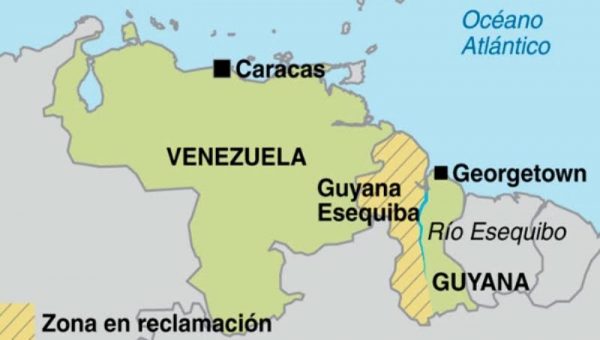
An old territorial dispute in South America is reaching its most tense point in decades. The territory known as Essequibo has been mutually claimed by Guyana and Venezuela since the 19th century when Guyana still belonged to the United Kingdom. In 1897, the Venezuelan and British authorities agreed to submit their dispute to an arbitrary international court in Paris, which ruled that the land belonged to the UK. For decades, the arbitration decision was accepted by Caracas, but in 1948 Venezuelan authorities revealed some irregularities in the trial, which were documented in old government files. As a result, the decision was considered null, and years later, in 1963, Venezuela formally submitted its territorial claim to the United Nations, and the dispute remains unresolved till today, when the interests of foreign oil companies threaten to increase the tensions.
As a region rich in oil, Essequibo has recently entered the map of the large multinationals in this sector, especially the American Exxon Mobil. More than that, the economic sanctions imposed on Venezuela and the political alignment of Guyana with Washington contribute to create an even more controversial scenario. Guyana has the support of the large private oil sector and the American government, while Venezuela remains alone. Last year, the case was filed with the International Court of Justice, but Venezuela did not accept it and remained out of the trial.
However, in a sentence on December 18, 2020, the Court proclaimed its competence to intervene in the dispute, despite Venezuela’s position. It is necessary to highlight that, regardless of any decision taken by the Court over who really has sovereignty in Essequibo, this sentence must be considered null, since the absence of Venezuelan consent prevents the execution of the sentence. The need for consent is one of the most elementary principles of international law and the very fact that the Court declares itself competent already leads us to question whether its judges are really impartial – clearly, the norms of international law are being violated in favor of Guyana.
Guyana has publicly admitted that its expenses for the court case in The Hague were paid by Exxon Mobil. Although the American oil company has been operating in Guyana for decades, its interest has been greatly increased with the recent discoveries of oil reserves and investors are willing to do anything to ensure the exploration of local natural resources. Currently, Exxon Mobil is interested in expanding its facilities over an area of more than 26,000 square kilometers, which not only crosses the disputed territory in Essequibo, but also violates Venezuelan undisputed national territory.
With this scenario of clear attack on Venezuelan national sovereignty and possible collaboration of the International Court with one of the parties, Venezuela is at a disadvantage mainly due to its diplomatic weakness. Venezuela, at this point, lacks sufficient influence to cause the Court to review its decision or judge the case in a really partial way. For that, only strong international alliances can help Caracas. The large nations that are not aligned with Washington and have so far cooperated strongly with Venezuela, Russia and China, might be provoked by the Venezuelan government to incite international pressure in this regard. Only these two countries can mediate a parallel agreement that may be established between Caracas and The Hague in order to choose between two paths: either Venezuela agrees to submit to trial on the condition that there is a partial judgment and without the influence of private companies, or the Court declines jurisdiction. As the first scenario is unlikely and difficult to monitor, the most viable route would be for The Hague to abdicate any form of judgment.
It is important to mention that, in the absence of international judgment, what is in force in Essequibo is the Geneva Agreement of 1966, which did not decide on sovereignty in the region, but, in search of a peaceful solution, defined what activities would be allowed or prohibited in Essequibo. Oil exploration by foreign companies is not allowed, so, in principle, Guyana is violating the agreement and its activities could only become lawful if there was a decision by the International Court on the matter, allowing exploration. As Venezuela does not submit to the Court, the trial is impossible and, therefore, exploration remains prohibited and Guyana is committing an international offense.
However, more worrying than that is the fact that the American military is working in Essequibo, carrying out tests with the aim of intimidating Venezuela and pressuring Caracas to renounce its demands. There are American military ships in Essequibo “protecting” Exxon Mobil facilities and provoking Caracas. In addition, considering that the American company wants to publicly explore areas within Venezuelan territory, what will become of the American presence? If Caracas does not allow the activities of Exxon Mobil, it is the Venezuelan right to control or even destroy the facilities in its territory. And what would be the American reaction to that – considering Biden’s aggressive interventionist policy?
It is for these reasons that, more than ever, countries of greater international relevance must mediate the issue in order to maintain the status of illegality to the Exxon Mobil’s activities. With international pressure, it is possible that the American company will retreat or that at least the American military in the region will leave and with that we would have a reduction in tensions.
Still, it is possible that with international mediation a mutual exploration agreement will be reached that allows both countries to enjoy the local wealth, without, however, allowing companies that violate the Geneva Agreement to operate.
Lucas Leiroz is a research fellow in international law at the Federal University of Rio de Janeiro.
Seven years after Maidan divided country, Ukraine intensifies shelling of Donbass to deafening media silence

By Eva Bartlett | RT | March 2, 2021
While much of the world is focused on Covid-related issues, Ukraine’s seven-year war on the people of Donbass continues. In recent weeks, Kiev’s shelling of civilians has intensified, met by the predictable Western media silence.
Ostensibly, following the Minsk agreements, there was a ceasefire. In reality, Donbass residents in villages bordering peace lines are incessantly subject to Ukrainian shelling.
Ukraine uses heavy weapons in violation of the agreement, including 82mm and 120mm mortar shells, routinely shelling at night when Organization for Security and Cooperation in Europe (OSCE) observers are not patrolling the area.
But Ukrainian forces also shell during the day, and have done so a lot more of late, including allegedly with phosphorus, and shelling further behind the front lines.
Most people could be forgiven for not being aware of events in Ukraine’s breakaway Republics of Donetsk and Lugansk (DPR/LPR) in the Donbass region, with corporate media either not touching the matter or doing so with glasses tinted heavily by the Ukrainian government.
There are in fact journalists and news sites that regularly give updates, but they aren’t as widely known as they should be.
From my own September 2019 reporting from frontline villages of the DPR, I maintain contact with reporters and residents who update on the situation there.
One of these was the mayor of Gorlovka, a city northeast of Donetsk, who on his Telegram channel on February 19 detailed the nearby villages of Zaitsevo and Mine 6/7 being under heavy weapons fire (by Ukraine). On February 20, he wrote of Mine 6/7 and another village being heavily shelled since early morning, with locals saying more than one hundred hits occurred.
The same day, Alexey Karpushev, a resident of the northern city of Gorlovka, wrote, “From about five in the morning until now, there is heavy shelling of the city from the Air Force artillery.”
According to Karpushev – who is a former first secretary of Gorlovka’s committee of the Communist Party of Ukraine – in recent weeks, the number of attacks from the Ukrainian army “increased significantly.” He mentioned that a 22 year old civilian was recently seriously injured in the attacks.
I asked why the increased shelling now.
“Ukraine’s aggression intensified just when Biden came to power in the United States.” It is quite likely that President Volodymyr Zelensky feels more confident with the return of the warmongers to the White House. Not long after Biden took power America resumed illegally bombing Syria.
We’re Not Living, We’re Surviving
In villages northwest and north of Gorlovka, passing many boarded up and destroyed homes (including one still smouldering from the shell-induced fire that gutted it), I met residents who stayed in spite of the nightly shelling and damage to their homes, because they had no other option.
One of these was a 74-year-old woman, whose home was falling apart after having been shelled on multiple occasions. “I’m afraid at night; that’s when they start shelling heavily. My husband is dead. I have nowhere to go.”
In another village I met a man who was about to walk down the lane that I had been cautioned to avoid due to the risk of being shot by Ukrainian snipers. His house was in a district largely unpopulated now because getting there meant being in the line of fire, but like others I met, he had nowhere else to go.
He consented to speak, but off camera, saying Ukraine had shelled his home directly after he did a video interview. He also said he had once been shot in the leg by a sniper and many other times had to drop to the ground when snipers started firing.
Another man in the area wasn’t worried about speaking on camera, although his house had also been damaged by Ukrainian attacks.
“Why do you support Nazis if you remember WW2? Why do you now support the Nazis? Openly Nazis… Why is Europe silent? Everyone comes here and agrees with me, but nothing changes. OSCE shouts, but when they are under fire, they are silent, they don’t say that Ukraine attacks them.”
In Zaitsevo, another frontline village, the head of administration, Irina Dikun, told me of the hell they had been living for the past six years, saying the ceasefires never reached her village.
“Here, we are not living, we’re surviving. Those who could leave, have left. Those who remain are mostly elderly.”
Ambulances couldn’t reach homes close to the front line where Ukraine was shelling, so she learned to drive and took First Aid training in order to help injured residents. In addition to detailing Ukraine’s destruction, “street by street,” of the village, she emphasized that what Western media claims about Russia invading the breakaway republics was false.
“There is no Russian invasion here. Just normal, peaceful people who wanted to live another way. In the beginning, we didn’t want to make a Republic; we just wanted to be autonomous. But we were not listened to. Ukraine moved its armed forces against the people and used their artillery against us.”
I also spoke with numerous DPR soldiers, asking them, among many things, why they had picked up weapons.
“Because of the killing of people in Odessa. That’s what made us join the military, to defend our area,” one soldier said.
Another man said he had initially joined protests against the coup in Kiev, that he “didn’t support the Nazi regime,” and eventually took up arms to defend the DPR.
In those frontline areas, 500 metres from Ukrainian forces, I wore body armour and a helmet. As I listened to various elderly people speak of the near-nightly shelling and heavy machine gun fire they were subject to, it struck me how these brave souls had nothing to protect them, no global body to prevent Ukraine from maiming and killing them, damaging or destroying their homes, year after year.
Meanwhile Ukraine has Western nations whitewashing its crimes and sending it weapons.
Western Ambassadors Get front line Disinfo Tour
On February 11, Ukraine reported that President Zelensky and a gaggle of Western ambassadors visited a front line on the Ukraine-controlled side, with Zelensky waffling on about the importance of his cohorts in disinformation seeing “with their own eyes” what is happening in Donbass.
Yeah, no. They didn’t see anything beyond the sterile visit they were allotted. They certainly would not have heard the anguished accounts I did on the other side of that front line.
They wouldn’t know of the many people, many of whom are elderly, living in shells of homes, or the basement of a school, deprived of electricity, water, cooking gas, reliant on aid for their survival. Nor that Ukraine has reportedly blocked UN and Red Cross aid from entering the DPR, including recently.
On February 24 and 25, Ukrainian forces shelled Yelenovka, south of Donetsk, a point through which humanitarian aid from the UN and Red Cross was to enter, preventing the aid delivery.
Preventing the entrance of aid, on top of continually shelling civilian areas, is the furthest from Ukraine “fulfilling its obligations to establish a ceasefire regime,” as President Zelensky claimed to Western ambassadors.
While Russian officials warn of the dire fate of 4 million people under Ukrainian shelling, Western officials either remain silent or fabricate more accusations against Russia and against Donbass’ defenders.
Western media have predictably remained silent on Ukraine’s crimes, painting defenders of Donbass as “pro-Russian separatists” with no context as to what people in Donbass actually want. From what I heard there, all they want is autonomy from the criminal government in Ukraine, and above all an end to the war.
And while Western officials and media harp on about a supposed “Russian invasion” of the republics, even the chairman of the OSCE Special Monitoring Mission recently emphasized that was untrue.
An aside: one of the soldiers asked me about the reaction of people in the West to Ukraine’s brazen display of Nazi symbols. My reply was that, thanks to Western media, most people don’t know.
Recently, the head of the DPR warned, “We need to be ready for anything” from Ukraine. Indeed, with the pro-war Biden administration, we can surely expect more Western support to Ukraine in further bombing the people of Donbass.
Eva Bartlett is a Canadian independent journalist and activist. She has spent years on the ground covering conflict zones in the Middle East, especially in Syria and Palestine (where she lived for nearly four years). Follow her on Twitter @EvaKBartlett
Biden Digs Up the Hatchet
By Vladimir Danilov – New Eastern Outlook – 02.03.2021
Just one month has passed since the newly elected, 46th US President started his tenure in the White House, and he has clearly shown that his foreign policy strategy for the next four years is by no means dovish. Demonstratively renouncing the “era of the previous Republican president”, which was, incidentally, marked by the fact that Donald Trump was the only US president over the past thirty years who did not start any new wars, Joe Biden decided from his very first days to plunge the US – and the entire world – into the cold world of armed confrontation, something that was a trademark for the 44th US president, Democrat Barack Obama.
It is worth recalling how right when Barack Obama was about to leave office The American Conservative gave an objective assessment for this president (with whom Joe Biden had worked on the same team) who had undeservedly won the Nobel Peace Prize, emphasizing his particular love for the use of brute military force abroad: “Obama [is] … the only president to spend his entire tenure presiding over foreign wars… [T]he US has bombed at least half a dozen countries on his watch, and his administration has assisted other governments in laying waste to one of the poorest countries on earth.” According to Airwars data for that period, during 2014-2016 alone the United States carried out more than 9,600 air raids in Iraq, and about 5,000 in Syria, with dozens of thousands of civilians killed. And in the United States itself, many people died because of Obama’s policies, and therefore it was with good reason that WorldNetDaily back then emphasized that “Obama has been blithely watching coffins float by his entire presidency”.
Having understood from the example set by the 44th President of the United States that the Nobel Peace Prize can be won for efforts that are anything but peaceful, Joe Biden, using a specially chosen slogan: “America is Back”, in his very first days in office started to “intimidate” Russia and China, trying to show everyone “who is in charge in the world.”
Long-suffering Syria (primarily at the hands of the United States itself!) was chosen as the starting point of the “Biden-style” war saga, where the United States launched an airstrike on February 25 on a facility that may have belonged to the Iranian military. According to the American side, the airstrike was a response to a series of attacks that were carried out on US targets in Iraq.
As Assistant to the Secretary of Defense for Public Affairs John Kirby said, the United States executed precision strikes against targets run by pro-Iranian forces in Syria located along the border zone with Iraq. According to US Secretary of Defense Lloyd Austin, the US military allowed the Iraqi side to “develop intelligence” for the operation, and encouraged them to do so. At the same time, Austin stressed that cooperation on the part of the Iraqi side greatly helped to clarify their goals. F-15 fighter jets were involved in executing the US strikes. In its report on Washington’s operation, Reuters emphasized that the order to launch the airstrike was personally given by the head of the White House, Joe Biden.
According to the monitoring group The Syrian Observatory for Human Rights (SOHR), at least three trucks with weapons and ammunition were destroyed in a strike by the US air force in eastern Syria, and at least 17 militants were killed. The militants themselves announced that one person was killed, and that several others suffered minor injuries. The Washington Post also reported on the deaths of people as a result of this airstrike, stressing that before this occurred no US representatives had spoken about eliminating terrorists, or that civilians could have died because of this airstrike.
This strike in Syria by the US Air Force is being fiercely debated in international circles. What was highlighted in particular was that, clearly guided by the “pieces of silver” from the US military-industrial complex that brought Biden to power, the new master in the White House used this attack on Iranian [backed] militias on Syrian territory in an obvious attempt to placate Israel and the Gulf countries, which are afraid of the new American administration sliding towards a pro-Iranian position.
There was emphasis placed on how the consequences of these actions by Washington could be an escalation of military confrontation across the region. Among other risks, what also stands out is the failure of the process charted out to normalize relations between Washington and Tehran on the nuclear deal.
In the telephone conversations between Iranian Foreign Minister Mohammad Javad Zarif and his Syrian counterpart Faisal Mekdad that took place immediately after the US airstrike on the Syrian-Iraqi border, the ministers pointed out the need for the West to adhere to the UN Security Council resolution on Syria, respect the sovereignty and independence of the Arab republic, and not to lend support to terrorist groups. In addition, they stressed their commitment to the process of settling the situation in Syria as agreed upon during the talks in Astana. The airstrikes that the US Air Force carried out in Syrian territory near the border with Iraq are a manifestation of “American aggression”, the state-run TV channel Al-Ikhbariyah Syria emphasizes. The Syrian government-run TV channel Al-Surya stressed that “the United States took aggressive action against Syria, attacking ground targets in the eastern Deir ez-Zor Governorate”.
As the chair of the Russian Federation Council Foreign Affairs Committee Konstantin Kosachev pointed out, despite the fact that four states are involved in the situation – the United States, Iraq, Iran, and Syria – the United States is the only one overtly using military force, in violation of international law. According to him, the American authorities are again assigning themselves the right to “conduct an investigation, pass sentence, and execute it out of court.”
Discussing the airstrike on Syria carried out by the United States under the leadership of Democrat Joe Biden, even American observers (in particular, the conservative FOX News channel) highlight that his predecessor, Donald Trump, was criticized for taking the same actions by Jen Psaki, the current White House press secretary. For example, users pointed to Psaki’s Twitter post after the 2017 airstrikes, where she questioned the legitimacy of the attacks and stressed that Syria is a sovereign state, even if President Bashar al-Assad is a “brutal dictator.”
After the most recent airstrike, Psaki’s remarks were cited by both social media users and politicians in the United States. For example, Muslim House Representative Ilhan Omar posted a short response to an old Psaki tweet: “Good question.”
US Foreign Policy: War Is Peace
By Stephen Lendman | March 1, 2021
A permanent state of war on invented enemies is longstanding US policy.
It’s been this way throughout most of the post-WW II period.
Terror-bombing Syria last Thursday was one of many examples — escalating US aggression against the nation and people by Biden.
The Syrian Arab Republic threatens no one. President Assad is supported by most Syrians.
Yet Obama/Biden launched preemptive war on the country in March 2011.
US forces illegally occupy northern and southern areas.
The Pentagon and CIA use ISIS and likeminded jihadists as proxy forces to advance US imperial aims in Syria and elsewhere.
Washington under both right wings of its war party intends permanent occupation of the country.
Sergey Lavrov noted the diabolical scheme, saying:
Washington is “making the decision to never leave Syria, even to the point of destroying this country” — more than already he should have added.
Lavrov also stressed the US forces occupy “Syrian territory illegally, in violation of all norms of international law, including Security Council Resolutions on reconciliation in the Syrian Arab Republic.”
“They continue to play the separatism card.”
“They continue to block, using their levers of pressure on other states, any supply even of humanitarian aid, not to mention equipment and materials necessary to restoring the economy in the territories controlled by the government, and in every way possible force their allies to invest in territories outside Damascus’s control.”
“At the same time, they illegally exploit Syria’s hydrocarbon resources” by stealing them.
Longstanding US plans call for partitioning Syria and other regional countries for easier control.
According to former Global Policy Forum director James Paul, partitioning Syria “is the Israeli solution,” adding:
The Jewish state’s “overarching goal is to weaken every Arab state by bringing religion and ethnicity into the equation.”
The plan for Syria is partitioning it into Kurdish, Alawite and Sunni states.
Balkanization of Middle East countries is also longstanding US policy.
Regional expert Mahdi Nazemroaya earlier explained that “(r)egime change and balkanization in Syria is very closely tied to the objective of dismantling the ‘resistance bloc’ formed by Iran, Syria, Hezbollah, the Palestinians, and various Iraqi groups opposed to the US and Israel.”
US/NATO/Israeli regional aggression aims to achieve this objective — what failed so far and won’t likely fare better ahead, but continues anyway.
In cahoots with Israeli interests, Obama/Biden launched preemptive war on Syria in 2011.
For hardliners in both countries, the road to Tehran runs through Damascus.
Control over the Syrian Arab Republic is seen as a way to weaken and isolate Iran and Lebanon’s Hezbollah.
According to Algerian academic Abdelkrim Dekhakhena, Bush/Cheney’s 2003 aggression against Iraq “metamorphosed into an apocalypse that swept the core nations of the region.”
“Chaos and destruction” followed with no end of it in prospect.
Washington’s notion of democracy building is suppressing its emergence everywhere and eliminating it wherever it exists.
Endless US Middle East wars created instability and human misery.
US regional aggression is aided by ISIS and other terrorist groups — created by the CIA to advance Washington’s control over regional countries, their resources and populations.
According to Biden’s doublespeak through his press secretary Psaki — paid to lie for her boss — he OK’d escalated US aggression in Syria to “protect Americans (sic),” adding:
Further aggression will aim to “deescalate tensions.”
The above doublespeak mumbo jumbo defines Washington’s war is peace policy.
Endless US wars by hot and/or other means have nothing to do with democracy building, pursuing peace, or protecting Americans.
They have everything to do with advancing Washington’s diabolical imperial agenda that prioritizes unchallenged global dominance.
Psaki also defied reality by claiming that preemptive terror-bombing of Syria on Thursday underwent a “thorough legal process (sic).”
There’s nothing remotely legal about naked aggression in Syria or anywhere else.
A decade of US war against the Syrian Arab Republic and its long-suffering people perhaps will continue in perpetuity.
The same diabolical agenda continues in Afghanistan, Yemen, and Libya, along with war by other means against numerous invented US enemies — notably China, Russia and Iran.
Washington’s rage to dominate other countries by brute force defines what the scourge of imperialism is all about.
There’s no end of it in prospect.
Biden’s longstanding support for wars on invented enemies suggests further escalation of hostilities on his watch.
Confrontation by belligerence and other means will likely be prioritized over pursuing peace and cooperative relations with other countries.
It’s the diabolical American way — addicted to warmaking, abhorring peace and stability.
Biden’s Syria Attack: An Actual Impeachable Offense
By Ron Paul | March 1, 2021
Last Thursday [proclaimed] President Biden continued what has sadly become a Washington tradition: bombing Syria. The President ordered a military strike near the Iraqi-Syrian border that killed at least 22 people. The Administration claims it struck an “Iranian-backed” militia in retaliation for recent rocket attacks on US installations in Iraq.
As with Presidents Obama and Trump before him, however, Biden’s justification for the US strike and its targets is not credible. And his claim that the US attack would result in a “de-escalation” in the region is laughable. You cannot bomb your way toward de-escalation.
Biden thus joins a shameful club of US leaders whose interventions in the Middle East, and Syria specifically, have achieved nothing in the US interest but have contributed to the deaths of many thousands of civilians.
President Trump attacked Syria in 2018 in what he claimed was retaliation for the Assad government’s use of chemical weapons against its own citizens. The Trump Administration never proved its claim. Logic itself suggests how ridiculous it would have been for the Syrian president to have used chemical weapons in that situation, where they achieved no military purpose and would almost certainly guarantee further outside attacks against his government.
Trump’s 2018 attack only added to the misery of the Syrian people, who suffered under US sanctions and then suffered President Obama’s “Assad must go” intervention that trained and armed al-Qaeda affiliated groups to overthrow the government.
Trump’s airstrike on Syria did nothing to further real American interests in the region. But sending in 100 Tomahawk missiles to blow up a few empty buildings did a great deal to further the bottom line of missile-maker Raytheon.
Interestingly, Biden’s Secretary of Defense came to the Administration straight from his previous position on the board of, you guessed it, Raytheon. Libertarian educator Tom Woods once quipped that no matter who you vote for you get John McCain. Perhaps it’s also fair to say that no matter who you vote for you get to enrich Raytheon.
The Democrats wasted four years trying to remove Trump from office under the bogus “Russiagate” lie and then the equally ridiculous and discredited claim that Trump led an insurrection against the government on January 6th. Yet when Trump started raining bombs down on Syria with no Congressional declaration of war or even authorization, most Democrats stood up and cheered. Left-wing CNN talking head Fareed Zakaria swooned, “I think Donald Trump became president of the United States last night.”
In fact, initiating a war against a country that did not attack and does not threaten the United States without Congressional authority is an impeachable offense. But both parties – with a few exceptions – are war parties.
President Biden should be impeached for his attack on Syria, as should have Trump and Obama before him. But no one in Washington is going to pursue impeachment charges against a president who recklessly takes the United States to war. War greases Washington’s wheels.
Isn’t it strange how we’ve heard nothing about ISIS for the past couple of years, but suddenly the mainstream media tells us the ISIS is back and on the march? When President Biden says “America is back,” what he really means is “the war party is back.” As if they ever left.
This is who they are: Biden’s Syria strike is a stark reminder it’s American Empire that’s back
By Nebojsa Malic | RT | February 27, 2021
Only someone who hasn’t been paying attention could have been surprised by the US airstrike on Syria, now that an establishment committed to a globalist Empire rather than a constitutional republic is back in charge in Washington.
Democrats love proclaiming one can’t “turn back the clock,” usually to argue against even attempting to undo whatever domestic policies they’ve rammed through when in power. Yet everything about the Joe Biden administration has been about just that: erasing the past four years of Donald Trump and picking up where Barack Obama left off.
Trump also bombed Syria, mind you – launching cruise missiles on two occasions, spurred by spurious reports of “chemical attacks” – as well as the “Iranian-backed militias” in Iraq. Just over a year ago, he ordered the drone assassination of Iranian General Qassem Soleimani outside the Baghdad airport.
However, he was denounced at the time by congressional Democrats, Biden himself, and his now-spokeswoman Jen Psaki, as well as nearly all US media outlets – the same ones now praising Biden’s bombardment. It’s literally different when they do it, the narrative goes.
That may seem baffling. After all, the American Empire isn’t a partisan thing. The Obamas, Bidens and Clintons have eagerly been on board as much as the Bushes and the Cheneys. That is, until Trump came along and mocked the “endless wars,” spoke of “America first” and rejected the pompous platitudes used to sell overseas imperialism to the rapidly declining American heartland.
For that ‘crime’ he was denounced and rejected by the US establishment, which has repeatedly demonstrated it doesn’t give a damn for the little guy in “flyover country” but prefers the globalist agendas of coastal elites and the military-industrial complex.
One can’t blame Americans for not remembering that the only time Congress overrode Trump’s veto was to keep troops overseas forever, when the media they rely on for their opinions, feelings and values hardly bothered to mention that bit. Make no mistake, though, endless foreign wars is what Biden meant when he said last week that “America is back” and promised a crusade on behalf of “democracy,” whatever that may be.
Also back is the manufacturing of consent. When Trump bombed someone, he just tweeted about it. The “new” administration acts just like the ones of yore, first leaking the talking points to the media. Instead of Trump’s “cowboy” language, Biden’s people use carefully selected propaganda terms, such as “defensive precision strike” and “proportionate military response” that “aims to de-escalate” the situation. The media dutifully follow along, stenographers all.
This kind of smoke-and-mirrors perception management is how war has become normalized for Americans. Trump’s rejection of it – whatever his motivation – is one of the reasons he was so hated by the establishment. Biden was sold to the American people as a return to normal – and for the establishment, this is precisely what “normal” looks like.
This normalization of behavior that ought to be illegal, immoral and unacceptable is, frankly, quietly horrifying. Almost no one seems to care that the US has no legal right to be in Syria, or bomb Syria, or even keep troops in Iraq anymore.
Legal concerns? How quaint. The US bombing whomever, whenever and wherever has become the “dog bites man” of the old journalism joke – that’s not news, editors would say, come to me when “man bites dog.”
Instead, we have otherwise serious people dispassionately describing the strike as “solid persuasion” and noting – correctly – that it “probably doesn’t matter” who gets attacked.
There is another disturbing dimension to the “Obama restoration” the US establishment is so bent on effecting. It was the Obama-Biden administration that backed “moderate rebels” – many of whom turned out to be Al-Qaeda affiliates – in Syria in hopes of regime change in Damascus, kicking off a war there almost ten years ago.
Trump focused instead on defeating Islamic State (IS, formerly ISIS) terrorists, letting the same people who lied to him about troop numbers deceive him about abandoning (but not really) the regime change agenda.
If someone with a solid predictive record who claims to have sources within the Biden-Harris administration is to be believed, they want Syrian President Bashar Assad “gone by any means necessary and have no concern for the consequences.”
After all, those consequences are almost always borne by the foreigners that get bombed and the ‘flyover’ Americans who end up in the military – including the very same “underprivileged communities” the Democrats claim to be so concerned about – and not the powerful.
This obviously leaves those Americans who hoped for $2,000 stimulus checks, universal healthcare or higher minimum wage – those who believed the “that’s not who we are” Obama-era hype about empathy and decency – holding the empty bag and scratching their heads.
Which is why perception managers will no doubt feed them another manufactured outrage as a distraction, any moment now. Because that is who they are. Always have been.
Nebojsa Malic is a Serbian-American journalist, blogger and translator, who wrote a regular column for Antiwar.com from 2000 to 2015, and is now senior writer at RT. Follow him on Telegram @TheNebulator
Biden Bombs Syria: A New World Record?
By Daniel McAdams | Ron Paul Institute | February 25, 2021
According to breaking news reports, including by Reuters, [proclaimed] President Biden has ordered and the Pentagon has carried out military airstrikes on Syria, attacking a structure inside the country that the US government claims houses “Iranian-backed” militia.
US missiles struck tonight near the Syrian town of Al-Bukamal, on the Iraqi border. The strike is said to be in retaliation for recent rocket attacks against US facilities in Iraq. After another rocket attack earlier this month, the US State Department pointed the finger at Iran and threatened a US military response.
The Iraqi parliament voted in January, 2020, to expel US troops from the country after then-President Trump ordered the assassination of Iranian General Qasem Soleimani. The US government ignored the vote of the democratically-elected Iraqi parliament, however Trump later announced his decision to pull US troops out of Iraq.
President Biden wasted no time in reversing Trump’s disengagement strategy for the Middle East. After just over a month in office, President Biden is re-igniting the failed US intervention launched in 2014 against Syria under the Obama Administration.
Within 24 hours of Biden being inaugurated commander-in-chief, US military convoys began pouring into northern Syria. His Administration, from Secretary of State Tony Blinken on down, enthusiastically supported the US “regime change” policy for Syria under President Obama – a policy that only benefitted al-Qaeda and its affiliates in the region.
Earlier this month it was reported that the US was building a new military base in Syria, near the Iraq and Turkey borders. New military bases carry with them new missions, so there is plenty of reason to believe that Biden plans to return the US to the “Assad must go” policy of his former boss.
Biden coming out of the gate with bombs blazing should be of little surprise to those who have watched his early foreign policy appointments. For example, he tapped noted neocon and aggressive interventionist Dana Stroul to head his Middle East Desk at the Pentagon and no doubt this airstrike at least indirectly reflects her influence and that of many others like her who have taken up positions in the Biden Administration.
Stroul hails from the AIPAC-founded “think tank,” the Washington Institute for Near East Policy (WINEP), where, as former CIA official Phil Giradi writes, “she has been the Shelly and Michael Kassen Fellow in the Institute’s Beth and David Geduld Program on Arab Politics.” She is an extreme Iran hawk and has advocated and worked for regime change in Syria and US retention of large areas of Syrian territory.
So within a month of assuming office, President Biden looks to be on the cusp of launching a new Middle East war.
Featured Video
From Anthrax to Iraq
or go to
Aletho News Archives – Video-Images
Book Review
New paperback: Butchered by “Healthcare”
Lies are Unbekoming | October 20, 2026
 Butchered by “Healthcare” is Robert Yoho’s plain-spoken account of how American medicine stopped being a profession and became an industry. 341 pages. Over a thousand references. Thirty-eight chapters.
“Screening Tests Are Useless”, on tests that find diseases that would never have hurt you. “The FDA Protects the Big Drug Companies”, on an agency funded by the companies it regulates. “The Journals’ Sins Are the Editors’ Sins”, on ghostwritten studies and captured peer review. “Opioids and ‘Pain Management’”, on how a generation was prescribed its way into addiction. “Prozac and Relatives” and “Antipsychotics Are Disastrous”, on what psychiatry does to adults and children. “Surgery: Money Before Patients”. “Failed Cancer Treatments”. “Futile CPR and Overprescribing”. “Billing Scams & Specialty Warfare”. “Hospitals Are Sharks”. Each with a Patient Tips section at the end on how to survive it.
If you have ever walked out of a doctor’s office with a prescription you didn’t ask for, or watched a parent put through a treatment that made them worse, this is the book you want on your shelf before the next appointment. … Full review
Butchered by “Healthcare” is available on Lulu now.
Blog Roll
 Aletho News
- EU sending ‘biased’ observers to interfere in Serbian election – president
- White House envoy declares kinetic action against Yemen ‘fruitless’
- Ukraine deployed thousands of microdrones in Iraqi Kurdistan: Tasnim
- Iran calls for emergency UNSC meeting over Trump’s ‘brazen’ bomb talk, Israeli threats
- Iranian sources reveal details of Russia-China Hormuz proposal
- Plan for more US-Israel integration puts our military tech at risk
- Another Round Against Iran Will Break What Is Left of the Gulf
- SVR Report on Ukraine’s Mexican Drug Gang Links Could Pressure Zelensky, Won’t Change US Policy
- British Government Employees Were Fact-Checking the News at the BBC. Nobody Told You.
- Albania on fire: who’s behind the riots?
- If Americans Knew
- Mysterious bot accounts reportedly spread fake ‘man on the street’ videos for Michigan Senate candidate
- Israeli Defense Minister Katz Says Over 60 Lebanon Villages Have Been Destroyed
- Why Is Israel Running TV Ads in Iowa Ahead of the Midterms?
- Hind Rajab’s Alleged Killer Is in the United States. HRF Demands His Arrest.
- US Officials Face Fresh Pressure After Another American ‘Brutalized’ by Israeli Settlers in West Bank
- Israel-Backed Palestinian Militias Terrorize Displaced Families in Gaza
- FBI subpoenas pro-Palestine activists over Israeli weapons plant disruption
- Fourth winter arrives in wartorn Gaza, too early – Daily Update
- More on how Bari Weiss is using CBS on behalf of Israel
- What the UK Is Doing to Pro-Palestine Novelist Sally Rooney Is an Act of Orwellian Villainy
- No Tricks Zone
- Predictions Made By Renowned Climate Proifessor Over Past Decades Have Been Proven To Be Poor
- New Study Suggests Large Regions Of The Pacific Ocean Have Been Cooling For The Last 80 Years
- Germany’s Green Energy Debacle: High Energy Costs Force Kahla Porzellan to Close After 182 Years!
- New Study: 50 Years Of The Most Aggressive ‘Net Zero’ Policies Can Only Affect The Global Climate By 0.03°C
- US September “Heat” Was No Record…Many Records Set Decades Ago
- Latest European Green Energy Debacle; Portugal’s Largest Flagship Solar Park Insolvent!
- Green Energy Debacle: German Expert Professor Fritz Vahrenholt Warns Of Severe Economic And Social Consequences
- Two More Paleo Reconstructions Affirm Meters-Higher Sea Levels Across Ireland, Brazil 7000-6000 Years Ago
- New Study: Earth And Venus Surface Warmth Largely Explained By Convection And Lapse Rate, Not CO2 Or Radiation
- 2025 Nature Paper Claiming Worsening Global Drought Gets RETRACTED …Heavily Flawed

