Turkey has perfected a new, deadly way to wage war, using militarized ‘drone swarms’
By Scott Ritter | RT | November 29, 2020
From Syria to Libya to Nagorno-Karabakh, this new method of military offense has been brutally effective. We are witnessing a revolution in the history of warfare, one that is causing panic, particularly in Europe.
In an analysis written for the European Council on Foreign Relations, Gustav Gressel, a senior policy fellow, argues that the extensive (and successful) use of military drones by Azerbaijan in its recent conflict with Armenia over Nagorno-Karabakh holds “distinct lessons for how well Europe can defend itself.”
Gressel warns that Europe would be doing itself a disservice if it simply dismissed the Nagorno-Karabakh fighting as “a minor war between poor countries.” In this, Gressel is correct – the military defeat inflicted on Armenia by Azerbaijan was not a fluke, but rather a manifestation of the perfection of the art of drone warfare by Baku’s major ally in the fighting, Turkey. Gressel’s conclusion – that “most of the [European Union’s] armies… would do as miserably as the Armenian Army” when faced by such a threat – is spot on.
What happened to the Armenian Army in its short but brutal 44-day war with Azerbaijan goes beyond simply losing a war. It was more about the way Armenia lost and, more specifically, how it lost. What happened over the skies of Nagorno-Karabakh – where Azerbaijan employed a host of Turkish- and Israeli-made drones not only to surveil and target Armenian positions, but shape and dominate the battlefield throughout – can be likened to a revolution in military affairs. One akin to the arrival of tanks, mechanised armoured vehicles, and aircraft in the early 20th century, that eventually led to the demise of horse-mounted cavalry.
It’s not that the Armenian soldiers were not brave, or well-trained and equipped – they were. It was that they were fighting a kind of war which had been overtaken by technology, where no matter how resolute and courageous they were in the face of the enemy, the outcome was preordained – their inevitable death, and the destruction of their equipment; some 2,425 Armenian soldiers lost their lives in the fighting, and 185 T-72 tanks, 90 armored fighting vehicles, 182 artillery pieces, 73 multiple rocket launchers, and 26 surface-to-air missile systems were destroyed.
A new kind of warfare
What happened to Armenia was not an isolated moment in military history, but rather the culmination of a new kind of warfare, centered on the use of unmanned aerial vehicles (UAVs, or drones). Azerbaijan’s major ally in the war against Armenia – Turkey – has been perfecting the art of drone warfare for years, with extensive experience in full-scale modern conflict gained in recent fighting in Syria (February-March 2020) and Libya (May-June 2020.)
Over the course of the past decade, Turkey has taken advantage of arms embargoes imposed by America and others which restricted Ankara’s access to the kind of front-line drones used by the US around the world, to instead build from scratch an indigenous drone-manufacturing base. While Turkey has developed several drones in various configurations, two have stood out in particular – the Anka-S and Bayraktar.
While the popular term for the kind of drone-centric combat carried out by Turkey is “drone swarm,” the reality is that modern drone warfare, when conducted on a large scale, is a deliberate, highly coordinated process which integrates electronic warfare, reconnaissance and surveillance, and weapons delivery. Turkey’s drone war over Syria was managed from the Turkish Second Army Command Tactical Command Center, located some 400km away from the fighting in the city of Malatya in Turkey’s Hatay Province.
It was here that the Turkish drone operators sat, and where they oversaw the operation of an integrated electromagnetic spectrum (EMS) warfare capability designed to jam Syrian and Russia air-defense radars and collect signals of military value (such as cell phone conversations) which were used to target specific locations.
For every $1 in losses suffered by Turkey, Syria lost approximately $5
The major systems used by Turkey in this role are the KORAL jamming system and a specially configured Anka-S drone operating as an airborne intelligence collection platform. The Anka-S also operated as an airborne command and control system, relaying targeting intelligence to orbiting Bayraktar UAVs, which would then acquire the target visually before firing highly precise onboard air-to-surface rockets, destroying the target. When conducted in isolation, an integrated drone strike such as those carried out by Turkey can be deadly effective; when conducted simultaneously with four or more systems in action, each of which is capable of targeting multiple locations, the results are devastating and, from the perspective of those on the receiving end, might be likened to a deadly “swarm.”
The fighting in Syria illustrated another important factor regarding drone warfare – the disparity of costs between the drone and the military assets it can destroy. Turkish Bayraktar and Anka-S UAV’s cost approximately $2.5 million each. Over the course of fighting in Syria’s Idlib province, Turkey lost between six and eight UAVs, for a total replacement cost of around $20 million.
In the first night of fighting in Syria, Turkey claims (and Russia does not dispute) that it destroyed large numbers of heavy equipment belonging to the Syrian Army, including 23 tanks and 23 artillery pieces. Overall, Turkish drones are credited with killing 34 Syrian tanks and 36 artillery systems, along with a significant amount of other combat equipment. If one uses the average cost of a Russian-made tank at around $1.2 million, and an artillery system at around $500,000, the total damage done by Turkey’s drones amounts to some $57.3 million (and this number does not include the other considerable material losses suffered by the Syrian military, which in total could easily match or exceed that number.) From a cost perspective alone, for every $1 in losses suffered by Turkey, the Syrians lost approximately $5.
Turkey was able to take the lessons learned from the fighting in Idlib province and apply them to a different theater of war, in Libya, in May 2020. There, Turkey had sided with the beleaguered forces of the Government of National Accord (GNA), which was mounting what amounted to a last stand around the Libyan capital of Tripoli. The GNA was facing off against the forces of the so-called Libyan National Army (LNA), based out of Benghazi, which had launched a major offensive designed to capture the capital, eliminate the GNA, and take control of all of Libya.
How to capture half a country
The LNA was supported by the several foreign powers, including Egypt, the United Arab Emirates, and Russia (via Wagner Group, a private military contractor.) Turkey’s intervention placed a heavy emphasis on the integrated drone warfare it had perfected in Syria. In Libya, the results were even more lop-sided, with the Turkish-backed GNA able to drive the LNA forces back, capturing nearly half of Libya in the process.
Both the LNA and Turkish-backed GNA made extensive use of combat drones, but only Turkey brought with it an integrated approach to drone warfare. Observers have grown accustomed to the concept of individual US drones operating freely over places such as Iraq, Yemen, and Afghanistan, delivering precision strikes against terrorist targets. However, as Iran demonstrated this past May, drones are vulnerable to modern air-defense systems, and US drone tactics would not work over contested airspace.
Likewise, the LNA, which made extensive use of Chinese-made combat drones flown by UAE pilots, enjoyed great success until Turkey intervened. Its electronic warfare and integrated air-defense capabilities then made LNA drone operations impossible to conduct, and the inability of the LNA to field an effective defense against the Turkish drone operations resulted in the tide of battle rapidly shifting on the ground. If anything, the cost differential between the Turkish-backed GNA and the LNA was greater than the $1-to-$5 advantage enjoyed by Turkey in Syria.
The big players – the US, Russia & China – are playing catch-up
By the time Turkey began cooperating with Azerbaijan against Armenia in September 2020, Turkish drone warfare had reached its zenith, and the outcome in Nagorno-Karabakh was all but assured. One of the main lessons drawn from the Turkish drone experiences in Syria, Libya and Nagorno-Karabakh is that these conflicts were not fought against so-called “poor countries.”
Rather, the Turks were facing off against well-equipped and well-trained forces operating equipment which closely parallels that found in most small- and medium-sized European countries. Indeed, in all three conflicts, Turkey was facing off against some of the best anti-aircraft missile defenses produced by Russia. The reality is that most nations, if confronted by a Turkish “drone swarm,” would not fare well.
And the multiple deployment of drones is only going to expand. The US Army is currently working on what it calls the “Armed, Fully-Autonomous Drone Swarm,” or AFADS. When employed, AFADS will – autonomously, without human intervention – locate, identify, and attack targets using what is known as a “Cluster Unmanned Airborne System Smart Munition,” which will dispense a swarm of small drones that fan out over the battlefield to locate and destroy targets.
China has likewise tested a system that deploys up to 200 “suicide drones” designed to saturate a battlespace and destroy targets by flying into them. And this past September, the Russian military integrated “drone-swarm” capabilities for the first time in a large-scale military exercise.
The face of modern warfare has been forever altered, and those nations that are not prepared or equipped to fight in a battlefield where drone technology is fully incorporated in every aspect of the fight can expect outcomes similar to that of Armenia: severe losses of men and equipment, defeat, humiliation and the likely loss of their territory. This is the reality of modern warfare which, as Gustav Gressel notes, should make any nation not fully vested in drone technology “think – and worry.”
Scott Ritter is a former US Marine Corps intelligence officer and author of ‘SCORPION KING: America’s Suicidal Embrace of Nuclear Weapons from FDR to Trump.’ He served in the Soviet Union as an inspector implementing the INF Treaty, in General Schwarzkopf’s staff during the Gulf War, and from 1991-1998 as a UN weapons inspector. Follow him on Twitter @RealScottRitter
NATO’s Attempted Infringement Of Russia’s Airspace & Maritime Borders Is Very Dangerous
By Andrew Korybko | One World | November 27, 2020
It seems like almost every week that Russian media reports on NATO’s attempted infringement of Russian airspace and maritime borders, but two ultra-dangerous developments occurred over the past week which signify that this trend will intensify. The Russian Navy threatened to ram the USS John McCain after it aggressively passed into the country’s territorial waters near Peter the Great Bay off Vladivostok, after which it thankfully reversed its course. The second incident involved the US launching rockets into the Black Sea from Romania that are capable of reaching Crimea in a wartime scenario. These two events deserve to be discussed more in detail because of their significance to NATO’s grand strategy.
The transatlantic alliance intends to provoke the Eurasian Great Power into reacting in a way that could then be manipulated as the “plausible pretext” for imposing further pressure upon it. It amounts to de-facto brinksmanship and is therefore incredibly dangerous since both parties are nuclear powers. Furthermore, it’s the definition of unprovoked aggression since Russia doesn’t partake in symmetrical provocations against NATO. If anything, every time that it’s been dishonestly accused of such was just the country carrying out military exercises within its own borders which just so happen to abut several NATO states after the bloc extended its frontiers eastward following the end of the Old Cold War.
It’s the eastern expansion of NATO and the alliance’s recent activities in the Arctic Ocean that represent the greatest threat to peace between the two. On the eastern front, the US is once again provoking Russia in order to craft the false impression among the Japanese that Moscow is a military threat to their interests. Washington is greatly perturbed by their past couple years of technically fruitless but nevertheless highly symbolic talks over signing a peace treaty to end the Second World War and resolve what Tokyo subjectively regards as the “Northern Territories Dispute”. Moscow’s reclamation of control over the Kuril Islands following that conflict was agreed to by the Allies, but then America went back on its word in order to divide and rule the two.
Their mutual intent to enter into a rapprochement with one another could in theory occur in parallel with a similar rapprochement between Japan and China, which might altogether reduce Tokyo’s need to retain as robust of an American military presence on its islands. That in turn would weaken the US’ military posturing and therefore reduce the viability of its grand strategic designs to “contain” both multipolar countries in that theater. As regards the Arctic and Eastern European fronts, these are also part of the same “containment” policy, albeit aimed most directly against Russia and only tangentially against China’s “Polar Silk Road”.
It’s understandable that the US will continue to compete with these two rival Great Powers, but such competition must be responsibly regulated in order to avoid the unintended scenario of a war by miscalculation. It’s for that reason that the world should be alarmed by American brinksmanship against them, especially the latest developments with respect to Russia that were earlier described. All that it takes is one wrong move for everything to spiral out of control and beyond the point of no return. Regrettably, while Biden might ease some pressure on China, he’ll likely compensate by doubling down against Russia.
Trump should also take responsibility for this as well since it’s occurring during his presidency after all, even if it might possibly be in its final months if he isn’t able to thwart the Democrats’ illegal seizure of power following their large-scale defrauding of this month’s elections. He capitulated to hostile “deep state” pressure early on into this term perhaps out of the mistaken belief that “compromising” with his enemies in the permanent military, intelligence, and diplomatic bureaucracies would result in them easing their pressure upon him on other fronts, but this gamble obviously failed since it only emboldened them to pressure him even more.
It’s unfortunate that Trump was never able to actualize his intended rapprochement with Russia for the aforementioned reasons, but he could have rebelliously defied the “deep state” after this month’s fraudulent elections by reversing his currently aggressive policy against Moscow if he truly had the political will to do so. He doesn’t, though, and this might nowadays be due more to his support of the military-industrial complex than any “deep state” pressure like it initially was. After all, war is a very profitable business, and artificially amplifying the so-called “Russia threat” by provoking Moscow into various responses could pay off handsomely.
It’s therefore extremely unlikely that this dangerous trend will change anytime in the coming future. To the contrary, it’ll likely only intensify and get much worse under a possible Biden Administration. Nevertheless, Russia doesn’t lack the resolve to defend its legitimate interests and will always do what’s needed in this respect, albeit responsibly (so long as it’s realistic to react in such a way) in order to avoid falling into the Americans’ trap. The ones who should be the most worried, then, are the US’ NATO and other “allied” vassals who stand to lose the most by getting caught in any potential crossfire for facilitating American aggression.
Here’s why European leaders are swooning like giddy submissives over Biden’s warmongering ‘back to normal’ team
By Finian Cunningham | RT | November 25, 2020
The EU is trembling in anticipation at the prospect of a Joe Biden administration, like Ana Steele in Christian Grey’s Red Room of Pain, despite the policies he espouses being precisely the cause of their problems.
Their rushing to congratulate him, even before the presidential result is certified, speaks volumes of their delight that ‘daddy’ is back in the White House.
European Commission President Ursula von der Leyen could barely contain her joy over what she said was a “new beginning in EU-US global partnership.”
Charles Michel, the European Council president, said it was time to “rebuild a strong EU-USA alliance” and he hastily invited Biden to a European summit in Brussels in the new year, even though the American election has not yet been formally concluded.
Other European national leaders had already congratulated Biden two weeks ago, only days after the November 3 ballot, despite the controversy of incumbent Donald Trump vowing legal challenges over alleged voting fraud.
European elation grew this week with the unveiling of Biden’s would-be cabinet picks. Which seems incredible, given that the incoming White House team is made up of people associated with the Obama administrations (2008-16) for which Biden had served as vice president. Incredible, because several of Europe’s contemporary pressing problems stem from wars in North Africa and the Middle East that the Obama administration fomented.
Appearing defensive about that, Biden in his first in-depth interview as president-elect asserted that “this is not a third Obama administration.” The fact remains, though, that his cabinet nominees are Obama-era holdovers, with names like Antony Blinken for Secretary of State and Jake Sullivan as national security adviser who advocated wars or destructive interventions in Libya, Syria and Ukraine. These conflicts and others in Iraq and Afghanistan, which Biden personally endorsed as a senior senator or exacerbated while vice president to Obama, have led to myriad problems in Europe, from blowback jihadist terrorism to racial tensions with Muslim communities, to straining of resources dealing with a massive influx of refugees from war zones.
This week, while European leaders were cooing over the next Biden administration, French police caused shocking headlines by brutally forcing hundreds of mainly Afghan refugees from a makeshift encampment in the heart of Paris. Such problems stem directly from the illegal wars that were the handiwork of Obama, Biden and his reprised team of warmongers.
Thus, the question is why are European politicians so craven in welcoming the return of conventional American imperialists? Forget all the Biden team hype about “working with allies” and “multilateralism is back”. The Europeans will be treated as they always have been: adjuncts to Washington’s pursuit of its own “interests.”
It’s the political equivalent of “Who’s your daddy?” The European leaders are rolling over for more abuse and gladly doing so, too.
But why?
There are several factors. A deluded nostalgia for “normalcy” after four years of fraught and nerve-fraying relations with maverick Trump. The personal umbrage of Germany’s Angela Merkel, France’s Emmanuel Macron and other European leaders from being antagonized by boorish Trump over NATO expenditures and trade tariffs is part of the relief they are feeling at getting rid of him. Also, European politicians and diplomats will see Biden and his team as people they are reconnecting with in career paths going back several years. Unlike the shambolic and confusing Trump administration, a Biden one will bring coherence and continuity – regardless of the legacy of wars – which makes for smoother personal, political interaction. Better the devil you know.
Don’t forget, too, that there are plenty of European Atlanticists who, from an ideological conviction, truly believe in the strategic benefits of an US-EU axis. These kind of European deep-state politicians and bureaucrats are credulous believers in NATO and American claims of “leading the free world” against, formerly, the Soviet Union and Red China, and now Russia and Belt & Road China. So, when they hear Biden declaring “America’s back” and “renewing alliances” it is music to their ears.
One specific upside is talk from President-elect Biden of returning the US to the Iran nuclear deal. Trump’s trashing of the 2015 accord cost European states a lot of business and investment hopes with Iran. Also, their image of presumed independence was dented from Trump wielding secondary sanctions against Europeans doing business with Iran, humiliating them to toe his line. With Biden, the Europeans see an opening for resuming economic interests in Iran. That remains to be seen, however.
Another possible upside under Biden is his seeming willingness to enter into arms-control talks with Russia. In particular, renewing the New START treaty curbing strategic nuclear weapons. Trump’s reckless walking away from arms-control conventions, including the Intermediate-range Nuclear Forces (INF) treaty and the Open Skies Treaty, caused much anxiety across Europe of a new arms race and a threat to continental security. Biden, therefore, may bring some stability on arms control, even though he and his team have made numerous aggressive sounds towards Russia.
But perhaps the most appealing thing that European leaders see in Biden is that the removal of Trump from office is a harbinger for countering the rise in European populism which has been gravely undermining the EU project. The European liberal establishment refers to the various movements as “far-right” which is an unfair broad brush. Some are rightwing, some leftwing, but generally there is a popular sentiment of alienation from the EU and national political establishments over issues related to neoliberal capitalist failure and seemingly uncontrolled immigration which is connected to endless American wars aided and abetted by European NATO powers.
Former European Council President Donald Tusk expressed this view: “Trump’s defeat can be the beginning of the end of the triumph of far-right populisms in Europe. Thank you, Joe.”
Trump was detested by European establishment politicians because they saw him as a mentor for populist, nationalist parties across Europe. His outspoken support for Brexit rankled the EU. Trump’s former ambassador to Germany, Richard Grenell, openly advocated for Germany’s Eurosceptic AfD party. Steve Bannon, Trump’s former political aide, tried to rally a populist revolt across Europe.
In short, Trump and his America First policy was seen as a malign influence corroding the pillars of the EU bloc.
Biden, however, is a return to conventional trans-Atlanticism, where European nations are at least treated with a modicum of respect – albeit in reality subordinates who will be told by Washington when, where and how high to jump. That’s a degrading relationship but, for the European establishment, they see it as the best way to preserve their order by taking the political oxygen away from populists. Never mind the wars, the refugees, the multicultural tensions, the economic austerity, being a sub for Uncle Sam is a comfort of sorts.
The tragic irony is this not-so “new beginning” in EU-US relations will inevitably lead to more internal contradictions down the road because Biden’s politics are predicated on more interventionism and imperialism under the banner of “leading the free world,” which is the root cause of Europe’s instability.
Finian Cunningham is an award-winning journalist. For over 25 years, he worked as a sub-editor and writer for The Mirror, Irish Times, Irish Independent and Britain’s Independent, among others.
The Great Pretext… for Dystopia
In their World Economic Forum treatise Covid-19: The Great Reset, economists Klaus Schwab and Thierry Malleret bring us the voice of would-be Global Governance.

Viewing the virtual-reality film “Collisions” at a session of the World Economic Forum in Davos, Switzerland, January 2016. (World Economic Forum, Flickr, CC BY-NC-SA 2.0)
By Diana Johnstone | Consortium News | November 24, 2020
By titling their recently published World Economic Forum treatise Covid-19: The Great Reset, the authors link the pandemic to their futuristic proposals in ways bound to be met with a chorus of “Aha!”s. In the current atmosphere of confusion and distrust, the glee with which economists Klaus Schwab and Thierry Malleret greet the pandemic as harbinger of their proposed socioeconomic upheaval suggests that if Covid-19 hadn’t come along by accident, they would have created it (had they been able).
In fact, World Economic Forum founder Schwab was already energetically hyping the Great Reset, using climate change as the triggering crisis, before the latest coronavirus outbreak provided him with an even more immediate pretext for touting his plans to remake the world.
The authors start right in by proclaiming that “the world as we knew it in the early months of 2020 is no more,” that radical changes will shape a “new normal.” We ourselves will be transformed. “Many of our beliefs and assumptions about what the world could or should look like will be shattered in the process.”
Throughout the book, the authors seem to gloat over the presumed effects of widespread “fear” of the virus, which is supposed to condition people to desire the radical changes they envisage. They employ technocratic psychobabble to announce that the pandemic is already transforming the human mentality to conform to the new reality they consider inevitable.
“Our lingering and possibly lasting fear of being infected with a virus … will thus speed the relentless march of automation…” Really?
“The pandemic may increase our anxiety about sitting in an enclosed space with complete strangers, and many people may decide that staying home to watch the latest movie or opera is the wisest option.”
“There are other first round effects that are much easier to anticipate. Cleanliness is one of them. The pandemic will certainly heighten our focus on hygiene. A new obsession with cleanliness will particularly entail the creation of new forms of packaging. We will be encouraged not to touch the products we buy. Simple pleasures like smelling a melon or squeezing a fruit will be frowned upon and may even become a thing of the past.”
This is the voice of would-be Global Governance. From on high, experts decide what the masses ought to want, and twist the alleged popular wishes to fit the profit-making schemes they are peddling. Their schemes center on digital innovation, massive automation using “artificial intelligence,” finally even “improving” human beings by endowing them artificially with some of the attributes of robots: such as problem-solving devoid of ethical distractions.
Engineer-economist Klaus Schwab, born in Ravensburg, Germany, in 1938, founded his World Economic Forum in 1971, attracting massive sponsorship from international corporations. It meets once a year in Davos, Switzerland – last time in January 2020 and next year in May, delayed because of Covid-19.
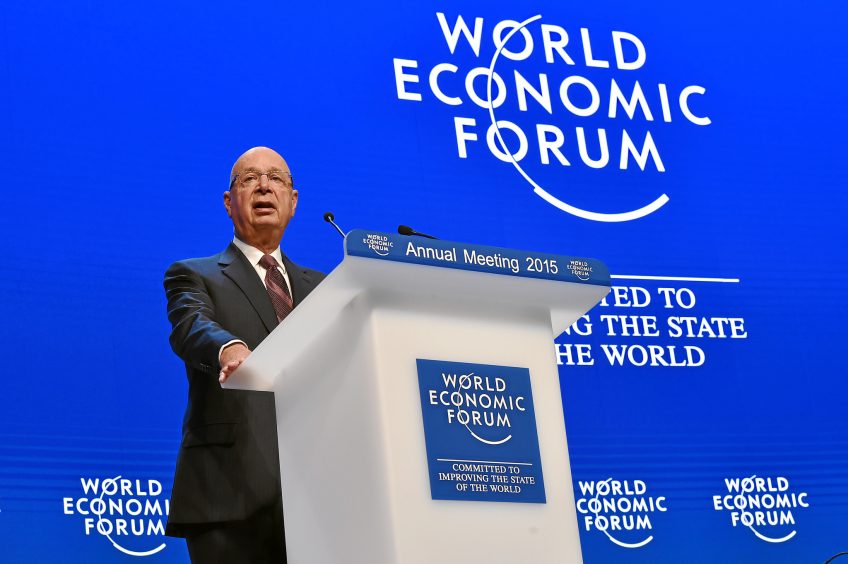
Klaus Schwab, founder and executive chairman, World Economic Forum, on Jan. 21, 2015. (World Economic Forum, Flickr, CC BY-NC-SA 2.0)
A Powerful Lobby
What is it, exactly? I would describe the WEF as a combination capitalist consulting firm and gigantic lobby. The futuristic predictions are designed to guide investors into profitable areas in what Schwab calls “the Fourth Industrial Revolution (4IR)” and then, as the areas are defined, to put pressure on governments to support such investments by way of subsidies, tax breaks, procurement, regulations and legislation. In short, the WEF is the lobby for new technologies, digital everything, artificial intelligence, transhumanism.
It is powerful today because it is operating in an environment of State Capitalism, where the role of the State (especially in the United States, less so in Europe) has been largely reduced to responding positively to the demands of such lobbies, especially the financial sector. Immunized by campaign donations from the obscure wishes of ordinary people, most of today’s politicians practically need the guidance of lobbies such as the WEF to tell them what to do.
In the 20th century, notably in the New Deal, the government was under pressure from conflicting interests. The economic success of the armaments industry during World War II gave birth to a Military-Industrial Complex, which has become a permanent structural factor in the U.S. economy.
It is the dominant role of the MIC and its resulting lobbies that have definitively transformed the nation into State Capitalism rather than a Republic.
The proof of this transformation is the unanimity with which Congress never balks at approving grotesquely inflated military budgets. The MIC has spawned media and Think Tanks which ceaselessly indoctrinate the public in the existential need to keep pouring the nation’s wealth into weapons of war. Insofar as voters do not agree, they can find no means of political expression with elections monopolized by two pro-MIC parties.
The WEF can be seen as analogous to the MIC. It intends to engage governments and opinion manufacturers in the promotion of a “4IR” which will dominate the civilian economy and civilian life itself.
The pandemic is a temporary pretext; the need to “protect the environment” will be the more sustainable pretext. Just as the MIC is presented as absolutely necessary to “protect our freedoms,” the 4IR will be hailed as absolutely necessary to “save the environment” – and in both cases, many of the measures advocated will have the opposite effect.

Public street art on 6th Street in Austin, Texas, depicting the impact of Covid-19 closings. (Leah Rodgers, CC BY 4.0, Wikimedia Commons)
So far, the techno-tyranny of Schwab’s 4IR has not quite won its place in U.S. State Capitalism. But its prospects are looking good. Silicon Valley contributed heavily to the Joe Biden campaign, and Biden hastened to appoint its moguls to his transition team.
But the real danger of all power going to the Reset lies not with what is there, but with what is not there: any serious political opposition.
Can Democracy Be Restored?
The Great Reset has a boulevard open to it for the simple reason that there is nothing in its way. No widespread awareness of the issues, no effective popular political organization, nothing. Schwab’s dystopia is frightening simply for that reason.
The 2020 presidential election has just illustrated the almost total depoliticization of the American people. That may sound odd considering the violent partisan emotions displayed. But it was all much ado about nothing.
There were no real issues debated, no serious political questions raised either about war or about the directions of future economic development. The vicious quarrels were about persons, not policy. Bumbling Trump was accused of being “Hitler,” and Wall Street-beholden Democrat warhawks were described by Trumpists as “socialists.” Lies, insults and confusion prevailed.
A revival of democracy could stem from organized, concentrated study of the issues raised by the Davos planners, in order to arouse an informed public opinion to evaluate which technical innovations are socially acceptable and which are not.
Cries of alarm from the margins will not influence the intellectual relationship of forces. What is needed is for people to get together everywhere to study the issues and develop well-reasoned opinions on goals and methods of future development.
Unless faced with informed and precise critiques, Silicon Valley and its corporate and financial allies will simply proceed in doing whatever they imagine they can do, whatever the social effects.
Serious evaluation should draw distinctions between potentially beneficial and unwelcome innovations, to prevent popular notions from being used to gain acceptance of every “technological advance,” however ominous.
Redefining Issues
The political distinctions between left and right, between Republican and Democrat, have grown more impassioned just as they reveal themselves to be incoherent, distorted and irrelevant, based more on ideological bias than on facts. New and more fruitful political alignments could be built through confrontation with specific concrete issues.
We could take the proposals of the Great Reset one by one and examine them in both pragmatic and ethical terms.

(Bob Mical, Flickr, CC BY-NC-SA 2.0)
No. 1 – Thanks to the pandemic, there has been a great increase in the use of teleconferences, using Skype, Zoom or other new platforms. The WEF welcomes this as a trend. Is it bad for that reason? To be fair, this innovation is positive in enabling many people to attend conferences without the expense, trouble and environmental cost of air travel. It has the negative side of preventing direct human contact. This is a simple issue, where positive points seem to prevail.
No. 2 – Should higher education go online, with professors giving courses to students via internet? This is a vastly more complicated question, which should be thoroughly discussed by educational institutions themselves and the communities they serve, weighing the pros and cons, remembering that those who provide the technology want to sell it, and care little about the value of human contact in education – not only human contact between student and professor, but often life-determining contacts between students themselves. Online courses may benefit geographically isolated students, but breaking up the educational community would be a major step toward the destruction of human community altogether.
No. 3 – Health and “well-being”. Here is where the discussion should heat up considerably. According to Schwab and Malleret: “Three industries in particular will flourish (in the aggregate) in the post-pandemic era: big tech, health and wellness.” For the Davos planners, the three merge.
Those who think that well-being is largely self-generated, dependent on attitudes, activity and lifestyle choices, miss the point. “The combination of AI [artificial intelligence], the IoT [internet of things] and sensors and wearable technology will produce new insights into personal well-being. They will model how we are and feel […] precise information on our carbon footprints, our impact on biodiversity, on the toxicity of all the ingredients we consume and the environments or spatial contexts in which we evolve will generate significant progress in terms of our awareness of collective and individual well-being.”
Question: do we really want or need all this cybernetic narcissism? Can’t we just enjoy life by helping a friend, stroking a cat, reading a book, listening to Bach or watching a sunset? We better make up our minds before they make over our minds.

User being monitored in a biometrics lab. (Grish068, CC BY-SA 4.0, Wikimedia Commons)
No. 4 – Food. In order not to spoil my healthy appetite, I’ll skip over this. The tech wizards would like to phase out farmers, with all their dirty soil and animals, and industrially manufacture enhanced artificial foods created in nice clean labs – out of what exactly?
The Central Issue: Homo Faber
No. 5 – What about human work?
“In all likelihood, the recession induced by the pandemic will trigger a sharp increase in labor-substitution, meaning that physical labor will be replaced by robots and ‘intelligent’ machines, which will in turn provoke lasting and structural changes in the labor market.”
This replacement has already been underway for decades. Along with outsourcing and immigration, it has already weakened the collective power of labor. But clearly, the tech industries are poised to go much, much further and faster in throwing humans out of work.
The Covid-19 crisis and social distancing have “suddenly accelerated this process of innovation and technological change. Chatbots, which often use the same voice recognition technology behind Amazon’s Alexa, and other software that can replace tasks normally performed by human employees, are being rapidly introduced. These innovations provoked by necessity (i.e. sanitary measures) will soon result in hundreds of thousands, and potentially millions, of job losses.”
Cutting labor costs has long been the guiding motive of these innovations, along with the internal dynamic of technology industry to “do whatever it can do.” Then socially beneficial pretexts are devised in justification. Like this:
“As consumers may prefer automated services to face-to-face interactions for some time to come, what is currently happening with call centers will inevitably occur in other sectors as well.”
“Consumers may prefer…”! Everyone I know complains of the exasperation of trying to reach the bank or insurance company to explain an emergency, and instead to be confronted with a dead voice and a choice of irrelevant numbers to click. Perhaps I am underestimating the degree of hostility toward our fellow humans that now pervades society, but my impression is that there is a vast unexpressed public demand for LESS automated services and MORE contact with real persons who can think outside the algorithm and can actually UNDERSTAND the problem, not simply cough up preprogrammed fixes.

“Corporate agility in the Fourth Industrial Revolution” session held in Tianjin,China, September 2018. (World Economic Forum, Faruk Pinjo, CC BY-NC-SA 2.0)
There is a potential movement out there. But we hear nothing of it, being persuaded by our media that the greatest problem facing people in their daily lives is to hear someone exhibit confusion over someone else’s confused gender.
In this, I maintain, consumer demand would merge with the desperate need of able-minded human beings to earn a living. The technocrats earn theirs handsomely by eliminating the means to earn a living of other people.
Here is one of their great ideas. “In cities as varied as Hangzhou, Washington DC and Tel Aviv, efforts are under way to move from pilot programs to large-scale operations capable of putting an army of delivery robots on the road and in the air.” What a great alternative to paying human deliverers a living wage!
And incidentally, a guy riding a delivery bicycle is using renewable energy. But all those robots and drones? Batteries, batteries and more batteries, made of what materials, coming from where and manufactured how? By more robots? Where is the energy coming from to replace not only fossil fuels, but also human physical effort?
At the last Davos meeting, Israeli intellectual Yuval Harari issued a dire warning that:
“Whereas in the past, humans had to struggle against exploitation, in the twenty-first century the really big struggle will be against irrelevance… Those who fail in the struggle against irrelevance would constitute a new ‘useless class’ – not from the viewpoint of their friends and family, but useless from the viewpoint of the economic and political system. And this useless class will be separated by an ever-growing gap from the ever more powerful elite.”
No. 5 – And the military. Our capitalist prophets of doom foresee the semi-collapse of civil aviation and the aeronautical industry as people all decide to stay home glued to their screens. But not to worry!
“This makes the defense aerospace sector an exception and a relatively safe haven.” For capital investment, that is. Instead of vacations on sunny beaches, we can look forward to space wars. It may happen sooner rather than later, because, as the Brookings Institution concludes in a 2018 report on “How artificial intelligence is transforming the world,” everything is going faster, including war:
“The big data analytics associated with AI will profoundly affect intelligence analysis, as massive amounts of data are sifted in near real time … thereby providing commanders and their staffs a level of intelligence analysis and productivity heretofore unseen. Command and control will similarly be affected as human commanders delegate certain routine, and in special circumstances, key decisions to AI platforms, reducing dramatically the time associated with the decision and subsequent action.”
So, no danger that some soft-hearted officer will hesitate to start World War III because of a sentimental attachment to humanity. When the AI platform sees an opportunity, go for it!
“In the end, warfare is a time competitive process, where the side able to decide the fastest and move most quickly to execution will generally prevail. Indeed, artificially intelligent intelligence systems, tied to AI-assisted command and control systems, can move decision support and decision-making to a speed vastly superior to the speeds of the traditional means of waging war. So fast will be this process especially if coupled to automatic decisions to launch artificially intelligent autonomous weapons systems capable of lethal outcomes, that a new term has been coined specifically to embrace the speed at which war will be waged: hyperwar.”
Americans have a choice. Either continue to quarrel over trivialities or wake up, really wake up, to the reality being planned and do something about it.
The future is shaped by investment choices. Not by naughty speech, not even by elections, but by investment choices. For the people to regain power, they must reassert their command over how and for what purposes capital is invested.
And if private capital balks, it must be socialized. This is the only revolution – and it is also the only conservatism, the only way to conserve decent human life. It is what real politics is about.
Diana Johnstone lives in Paris. Her latest book is Circle in the Darkness: Memoirs of a World Watcher and is also the author of Fools’ Crusade: Yugoslavia, NATO, and Western Delusions. Her lates book is Queen of Chaos: the Misadventures of Hillary Clinton. The memoirs of Diana Johnstone’s father Paul H. Johnstone, From MAD to Madness, was published by Clarity Press, with her commentary. She can be reached at diana.johnstone@wanadoo.fr .
Trump throws shade at ‘overrated general’ Mattis after ex-Pentagon chief says ‘America First’ must be ELIMINATED from policy
RT | November 24, 2020
US President Donald Trump has heaped scorn on his former Defense Secretary Jim Mattis, after the general called on Joe Biden to ditch Trump’s “America First” foreign policy in favor of a “network of solid alliances.”
The president lamented not having “fired [Mattis] sooner,” insisting his administration did their “best work after he was gone” in a Tuesday tweet responding to a Fox News story about Mattis’ latest outburst of armchair-policymaking.
That says it all about Mattis. Obama fired him. I should have fired him sooner. Did best work after he was gone. World’s most overrated general! https://t.co/2i4jPWAAPA
— Donald J. Trump (@realDonaldTrump) November 24, 2020
Trump even spared a rare note of praise for his predecessor Barack Obama, admitting the Democrat had done at least one thing right – namely, firing Mattis, whom the incumbent president called the “world’s most overrated general.”
Mattis, who resigned from his post as Trump’s Pentagon chief in protest against the president’s efforts to bring troops home from Syria, had called on a Biden administration to “eliminate ‘America First’ from [the US national security strategy’s] contents” in an op-ed published Monday in Foreign Affairs. The piece was co-written with two of his Hoover Institute peers and a third think-tanker hailing from the right-wing American Enterprise Institute.
Rather than trying to wind down what even the Biden campaign and other Democrats have begun referring to as “forever wars,” Mattis argued, Washington should view the never-ending conflicts in “Afghanistan, Iraq, and elsewhere” as providing “support to friendly governments struggling to exert control over their own territory.”
“It is in the United States’ interests to build the capacity of such governments to deal with the threats that concern Americans,” the general continued, glossing over the part where US taxpayer dollars are repeatedly used to arm and otherwise fund those same “threats.” From the mujahideen in Afghanistan to the “moderate rebels” in Syria, the US has a lengthy track record of funding terrorist groups it later either fights, or leaves for others to deal with.
Instead of ending wars and shifting spending focus to rebuilding America’s decaying infrastructure, Mattis and his co-writers argued, an incoming Biden administration should “expand the cooperative space in which all countries supporting a rules-based order can work together to advance shared interests.” The term “rules-based order” has become something of a dog-whistle for NATO supremacy and a cudgel to be wielded against the US’ rivals, though Washington itself has never had a problem flagrantly violating international norms and NATO itself has a habit of demanding concessions of non-members that member countries need not submit to – such as unilateral nuclear disarmament.
While Mattis urged Biden and his team to strengthen their alliances with China’s Asian neighbors in order to keep Beijing on a tight leash, the former defense secretary also suggested the incoming president find “opportunities to cooperate with China in areas of overlapping interests, such as pandemic response, climate change, and nuclear security.” The Trump administration has torn up multiple nuclear arms treaties with Russia and is expected to let another one, the New START Treaty signed by Obama, expire next year as Moscow is unwilling to sign it on Trump’s questionable terms.
However, Mattis also stressed the importance of couching the US’ bloated military apparatus in a civilian framework, noting that “militarizing US national security can dim the attractiveness of the American model, the appeal of which makes it easier for other countries to support US policies.” Given the hundreds of US bases peppering the globe, it’s not clear how US ‘national security’ could get any more militarized, but, the general formerly known as ‘Mad Dog’ complained, alleged US isolationism was “undermining the foundations of an international order manifestly advantageous to US interests.”
“In practice, ‘America first’ has meant ‘America alone.’”
In addition to opposing the president’s efforts to put an end to war in Syria, Mattis has been one of the many establishment critics of Trump’s eleventh-hour efforts to bring troops home from Afghanistan. The US military has been deployed in that particular quagmire for close to two decades, making it the longest war in American history – but Republicans and Democrats alike are loath to call it quits and miss out on all the natural resources [or the attraction of having airbases adjacent to Iran] to be had in central Asia. Meanwhile, Biden has signaled he’s ready to resume regime-change business as usual, tapping an array of Obama-era hawks to staff his cabinet.
Under Biden, expect more bombing and regime change. Tony Blinken’s record speaks for itself
By George Szamuely | RT | November 24, 2020
A US foreign policy run by Antony J. Blinken and Jake Sullivan, the likely next secretary of state and national security adviser, will mean more global interventions and regime-change operations, Clinton and Obama style.
Blinken played a prominent foreign policy role in both the Bill Clinton and Barack Obama administrations, while Sullivan was part of the Obama one.
The Democrat-boosting media are, not surprisingly, excited by media-anointed President-elect Joe Biden’s choice of Blinken, his long-time national security adviser, as his secretary of state. Along with his pick of Jake Sullivan, another close aide, as his national security adviser, these appointments supposedly signal restoration of “internationalism” and “globalpartnerships” as guiding principles of US foreign policy.
Media fawns for fake ‘internationalism’
Blinken, a “defender of global alliances,” in the soothing words of the New York Times, will “help calm American diplomats and global leaders alike after four years of the Trump administration’s ricocheting strategies and nationalist swaggering.” To the Washington Post, Blinken’s appointment would be fulfillment of Biden’s “vows to reassemble global alliances and insert the United States into a more prominent position on the world stage.” The Guardian purred that the appointees are:
“… committed internationalists, in strong contrast to the Trump era, which saw a bonfire of foreign treaties and agreements, and abrasive relations with traditional allies under the banner of ‘America First’, which Biden said during the campaign had led to ‘America alone’.”
That’s the message then: The foreign policy professionals are back, and US allies can rest assured that the United States will once again treat them with courtesy and respect. Such talk is delusional, if not downright deceptive. Blinken’s outlook is that of a career US interventionist, as is that of Sullivan. The opinions of other countries are worth considering only if they coincide with the views of US policymakers. If they don’t coincide, then they can be discounted.
The war on Serbia
Never was this axiom as vividly illustrated as during the Clinton administration’s protracted war against the Serbs during the 1990s. The Clinton administration, of which Blinken was an important member, had facilitated the arrival into Bosnia of international jihadi terrorists, including one Osama bin Laden. No one among Washington’s supposedly closest allies was asked what he or she thought of this policy of introducing Islamic terrorism into Europe. Richard Holbrooke, former assistant secretary of state for European and Canadian affairs in the Clinton administration, subsequently boasted about the efficacy of this policy. For him, shipping mujahedin fighters into Bosnia brought to mind “Winston Churchill’s famous comments about why Britain made common cause with Stalin against Hitler… [It] was a legitimate decision for Churchill and he knew full well the consequences. Here at a much smaller scale, this was done.”
Subsequently, the Clinton administration helped arm and train the Kosovo Liberation Army. The hope was that a KLA terrorist campaign in Yugoslavia would provoke the Belgrade authorities into overreacting. The expected humanitarian disaster could then be used to launch a NATO bombing campaign against Yugoslavia. When Belgrade refused to take the bait, the Clinton administration – in which Blinken was at that time special assistant to President Clinton and senior director for European affairs at the National Security Council – had to invent a pretext for bombing. That was provided by the Yugoslav government’s refusal to sign a Kosovo peace package at Rambouillet, France. The Yugoslav government had been issued with an ultimatum: accept the US-drafted package or face NATO bombing. Included within this package was the notorious Appendix B, which gave NATO unrestricted rights to move anywhere it wished throughout the territory of Yugoslavia, and to enjoy total immunity from prosecution.
The Clinton administration had deceitfully kept from the US public the details of Appendix B, as well as the take-it-or-leave-it ultimatum it had issued at Rambouillet. Later, when NATO’s bombing triggered the entirely foreseeable refugee flow from Kosovo, the Clinton administration claimed – again deceitfully – that NATO had launched its bombing campaign in response to Serb attempts to drive out Kosovo’s Albanian population. The claim made no sense. The refugee flight from Kosovo took place only after the start of NATO’s attack; the flight couldn’t therefore have been the pretext for NATO’s bombing.
Blinken played an integral role in orchestrating NATO’s bombing campaign, and has continued to tout his role in NATO’s legerdemain. Revealingly, Blinken appears untroubled by the Clinton administration’s refusal to seek UN Security Council authorization for the use of force against Yugoslavia. He evidently shared Secretary of State Madeleine Albright’s contempt for the legalistic concerns raised by UK Foreign Secretary Robin Cook. Told that international law experts were advising a UN Security Council resolution was necessary, Albright scoffed, “Get new lawyers!”
‘Protecting civilians’ in Libya
Blinken’s disdain for international institutions was very much in evidence during the Obama administration’s 2011 bombing of Libya. Blinken, at the time Biden’s national security adviser, was an enthusiastic advocate of the bombing campaign. There was a problem though. The bombing was undertaken ostensibly in order to save the residents of Benghazi who were supposedly under threat from the forces of President Muammar Gaddafi. However, Resolution 1973, which the US and NATO used to justify the attack, only instructed UN member states “to take all necessary measures… to protect civilians and civilian populated areas under threat of attack.” It didn’t say that such “measures” should include bombing. Still less did the resolution authorize the US and NATO to use the bombing in order to topple Gaddafi. Yet, long after any conceivable threat to the residents of Benghazi had disappeared, NATO governments continued to justify their refusal to call a halt to the bombing by invoking the purported threat Gaddafi posed to Libya’s civilians. NATO didn’t let up on the bombing until the brutal execution of Gaddafi, a war crime in which NATO took an active part.
‘Doing too little’ in Syria
No sooner was Gaddafi overthrown and Libya thrown into chaos than the Obama administration shifted its attention to Syria, seeking there also to topple the legal government. The tools it deployed were familiar. Under Operation Timber Sycamore, the CIA was authorized to work with Arab intelligence services to arm and train rebels seeking to overthrow the government of President Bashar Assad. The weapons, needless to say, in no time found their way into the hands of the worst and most fanatical of the jihadi killers. Syria seemed to be on the brink of falling under the sway of Islamic State (IS, formerly ISIS). Strangely enough, Blinken’s only regret about his activities in Syria is that the Obama administration didn’t do more to ensure the overthrow of Assad.
In an article last year that he co-authored with leading neocon publicist Robert Kagan, he argued that in Syria, the US made the “error of doing too little. Without bringing appropriate power to bear, no peace could be negotiated, much less imposed. Today we see the consequences, in hundreds of thousands of civilians dead, in millions of refugees who have destabilized Europe and in the growing influence of Russia, Iran and Hezbollah.”
In an interview earlier this year, Blinken made clear that regime-change in Syria was still on his agenda. He ruled out returning Syria’s oil fields to government control because the US needed leverage.
“That’s a point of leverage because the Syrian government would love to have dominion over those resources. We should not give that up for free.… And we should also use what leverage we have to insist that there be some kind of political transition that reflects the desires of the Syrian people.”
All the Russia tropes
Same old, same old is what we should also expect when it comes to Russia. Blinken repeats by rote all of the familiar Democratic Party talking points: Russia interfered in the 2016 elections, President Donald Trump is smitten with Russian President Vladimir Putin, Trump “took the word of Mr. Putin over our own intelligence community,” Russia put a bounty on the heads of US soldiers in Afghanistan, Russia invaded Ukraine. Blinken has advocated sending lethal weapons to Ukraine. “A President Biden would be in the business of confronting Mr. Putin for his aggressions, not embracing him,” Blinken has said. “Not trashing NATO, but strengthening its deterrence.”
A Blinken-run foreign policy will unquestionably mean abundant use of the familiar regime-change weapons in the US armory: bombs, cruise missiles, weapons shipments to jihadist and neo-Nazi groups to wage proxy wars, economic sanctions, fake “civil society” projects. As for the vaunted “international organizations” that Blinken supposedly champions, their role will be to sign off on US projects. If the organizations support US policy, including “regime change” operations, so much the better; if they don’t, they can safely be ignored. The “allies” who are now cheering the return of the “professionals” may soon have cause to regret their enthusiasm as the refugee flows from the Middle East return to 2015 levels in response to the Biden administration’s policy of relaunching the regime-change war in Syria. Should conflict with Russia escalate over Ukraine or the Baltics or the Caucasus, these “allies” may look back with nostalgia to the Trump era when the US largely preoccupied itself with its own national interests.
George Szamuely is a senior research fellow at Global Policy Institute (London) and author of Bombs for Peace: NATO’s Humanitarian War on Yugoslavia. Follow him on Twitter @GeorgeSzamuely
Biden signals US return to full-on globalism and foreign meddling by picking interventionist Anthony Blinken as secretary of state
RT | November 23, 2020
Joe Biden has named Anthony Blinken – an advocate for isolating Russia, cozying up to China and intervening in Syria – as secretary of state, cementing a foreign policy built on military forays and multi-national motivations.
Biden, the nominal president-elect, announced his selection of Blinken along with other members of his foreign-policy and national-security team, which is filled with such veteran Washington insiders as John Kerry, the new climate czar and formerly secretary of state in the Obama-Biden administration.
Blinken, a long-time adviser to Biden and deputy secretary of state under President Barack Obama, has been hailed by fellow Democrats and globalists, such as retired General Barry McCaffrey, as an experienced bureaucrat with “global contacts and respect.” Enrico Letta, dean of the Paris School of International Affairs, called Biden’s choice the “right step to relaunch transatlantic ties.”
He was even praised for a 2016 appearance on the Sesame Street children’s television program, where he explained to the show’s ‘Grover’ character the benefits of accepting refugees.
While some critics focused on how Blinken “got rich working for corporate clients” during President Donald Trump’s term in office, the new foreign-affairs chief’s neoconservative policy recommendations might be cause for greater concern. He advocated for the Iraq War and the bombings of such countries as Libya and Yemen.
Blinken is still arguing for a resurgence in Washington’s military intervention in Syria. He lamented in a May interview that the Obama-Biden administration hadn’t done enough to prevent a “horrific situation” in Syria, and he faulted Trump for squandering what remaining leverage the US had on the Bashar Assad regime by pulling troops out of the country.
“Our leverage is vastly even less than it was, but I think we do have points of leverage to try to effectuate some more positive developments,” Blinken said. For instance, US special forces in northeast Syria are located near Syrian oil fields. “The Syrian government would love to have dominion over those resources. We should not give that up for free.”
Blinken also sees Biden strengthening NATO, isolating Russia politically and “confronting Mr. [President Vladimir] Putin for his aggressions.”
As for China, Blinken has said Washington needs to look for ways to cooperate with Beijing. Reinvesting in international alliances that were weakened by Trump will help the Biden administration deal with China “from a position of strength” as it pushes back against the Chinese Communist Party’s human-rights abuses, he said.
The 4-year (neoliberal) radicalisation of US media & Bidenites’ ‘unradical radicalism’
By Ramin Mazaheri | PressTV | November 22, 2020
For four years The New York Times editorial page has been unreadable because into every column – no matter the subject – an anti-Trump diatribe was inserted. For the world’s many billions who think there actually are issues other than the president of the United States, their obsession was incredibly tedious.
It reminded me of how the World Socialist Web Site ends every column with a reminder that the only solution – no matter the subject – is Trotskyist revolution. At least they keep that at the bottom, so you can avoid it if you want.
The difference between the two is that one is openly opposed to neoliberalism and neo-imperialism, while the other censors any discussion of these enormously crucial and socially-devastating concepts.
Joe Biden recently made waves for snapping at a reporter asking a difficult question, and it reminded us of how very coddled he was during the presidential campaign. But a possible change from Sleepy Joe to Cranky Joe may or may not be a problem – that depends on if his apparent election win survives the judicial oversight of the vote, something which is supported by 46% of America (per a poll by The Economist) but 0% of their mainstream media.
The bigger potential issue – and it’s a global one, because foreign journalists often ape the US, in what Iranians have called for 75 years “Westoxification” (being intoxicated by Westernism) – is what the US media actually evolves into post-Trump (if he loses).
In one of the many positive unintended consequences of Donald Trump, the US media went from the slavish sucking up to power during the Dubya Bush era of “wars without bodybags”, to “everybody loves Obama (even though in 2012 he beat Mitt Romney just 51% to 47%), to rediscovering that the press is not actually merely the public relations team of the government.
If Biden wins, will the US mainstream media quickly revert to sucking up to power? Will it be still only softball questions for President Biden?
Or does four years of decent reporting – sadly combined with a concurrent journalistic era of hysterical fear-mongering, Russophobia, urging hatred of one’s differently-voting neighbour and a moral outrage which rested upon a wilful ignorance regarding what Trump supporters really believe – actually have an impact?
The question reminded of an ancient Chinese aphorism: “The murder of a ruler by his minister, or of a father by his son, is not the result of events of one morning or one evening.”
The radicalisation of fake-leftists into faker fake-leftists? Or will the US truly reform its imperialist ways?
The larger point of that aphorism is that actions have consequences, and that if we allow things to go too far down the wrong road an unjust ruler gets murdered, or a country becomes as incredibly internally divided as the US now is.
Journalists are supposed to be combative and even provocative, but the problem here is entirely with the never-stated ideology of Bidenism. (Please note that is entirely different from me writing: the problem is with the rabidity of the never-Trumper ideology.)
Because actions have consequences, we should grasp that Bidenism is not just a “return to (the 2015) normal” but also includes a vindictive, ever-more flaming evangelical insistence that US-led Westernism (neoliberalism and neo-imperialism) is the one true religion, which Donald Trump was heretically and treasonously wrong to even partially call into question.
Who are these unreadable new and old columnists of The New York Times? I can tell you what they are not: they are not journalists who openly denounce imperialism, the Israeli occupation of Palestine, the oppression of the Wall Street high finance class or the other key ideas which differentiate leftism from centrism and rightism.
No, the loudest Bidenites are people who are upset that Trump is now trying to pull out of Afghanistan and Iraq; are upset that Trump did not bomb Syria; could not care less about the famine in Yemen; and who would not have expressed outrage at all for the assassination of Iranian anti-terror hero Qasem Soleimani if Barack Obama had killed him.
The idea that Biden’s foreign policy is going to be less belligerent than Trump’s is something based only on hope and not on the past four years (nor Biden’s 47 years in public service). Just look at how Bidenites are preparing to deal with Trumpers and ask yourself: is the neo-imperial hegemon really going to treat foreigners – especially Muslims in oil-rich areas – better than their very own neighbors?
Bidenites essentially want to criminalise working for Trumpism, censor Trumpist analyses, and make Trump the very first president to ever be prosecuted (what happened to the outrage of Trump’s calls to prosecute “crooked Hillary”?). These are all “radical” in the very worst sense of the word. The obstacle in implementing such radical policies is that Trumpism won at every level on November 3rd except the presidency, in a total concretisation and not repudiation of Trumpism, whether one likes that or not; the problem is that Bidenites at this time in 2016 were, incredibly, already talking publicly about impeaching the then-president-elect Trump, gutting their credibility.
These do not seem like the people who are going to herald a new era of tolerance for non-American ideas because they can’t even tolerate half of America’s ideas. Bidenism may turn out to be “Western universal values” on steroids because Bidenites realise there truly is a threat to the 2015 status quo, which they are obviously hell-bent on suppressing.
These do not seem like the people who are going to become more tolerant of those who do not accept America’s fake-leftist and divisive identity politics, which are entirely based around one thing: distracting from opposition to and the discussion of both neo-imperialism and neoliberalism.
Like Obama, will Biden get a Nobel Peace Prize for his election campaign?
Many of us are old enough to have seen the failure of this idea, currently held by many non-Americans, that the switching from a Republican to a Democrat will herald an entirely new era free from American belligerence.
The younger class may not remember the intense hatred Democrats had for George W. Bush, but the proof of it is in that shocking, totally unmerited Nobel. In 2013 Obama would be credibly quoted as saying, “Turns out I’m really good at killing people. Didn’t know that was gonna be a strong suit of mine.”
If things really do change for the better if Biden wins, journalists will have to have changed as well. Of course, we cannot expect their publishers and editors to allow them to be towards Biden but a fraction of how oppositional they were with Trump, but the younger generation of reporters have now been weaned on journalistic ideas which may prove hard for neoliberal and neo-imperialist forces to rein in.
However, the problem of their essential fake-leftism – of Bidenism – remains, no?
And this is a problem for journalists worldwide, who often read the US mainstream media and are so proud that they can understand a foreign language so well that they may fail to realise they are also imbibing Biden’s latent, never-stated neoliberalism and neo-imperialism; they are so happy Trump is gone they forget the corruption and anti-“universal values” stances which got him elected in the first place.
The worry is that instead of a genuine move away from American rightism, journalists in the US and abroad only imbibe a key hallmark of Bidenism: intolerance for dissent and the refusal to engage in dispassionate conversation about vital societal issues. The worry is that they become accepting of Bidenism’s flaming insistence that Western liberalism is the only acceptable form of human society worldwide – this is all adds up to the “unradical radicalism” of Bidenism.
Journalists must be skeptical, but they must be accurate – refusing to report on the reality of American Trumpism is as bad as those Americans whose family relations have become frozen because of their inability to tolerate their relative’s right to vote as they wish.
That’s an American problem, but the idea that Bidenism is actually an anti-imperial and anti-neoliberal movement, or that it will continue Trump’s relative drawdown of American forces worldwide – that’s something you’ve never actually heard from Bidenites.
Think you will (if Biden wins)?
Open Skies no more: US pulls out of Cold War-era deal that provided global security in diplomatic row with Russia
RT | November 22, 2020
President Donald Trump’s administration has on Sunday withdrawn from an international treaty that allows countries to monitor military hardware build-ups from afar, accusing Moscow – without evidence – of breaking its terms.
The Open Skies Treaty was first considered by the US and the Soviet Union in the 1950s as a possible way to increase transparency around troop movements and the deployment of nuclear weapons. It allows signatories to conduct a limited number of mutually beneficial aerial reconnaissance missions in the countries that are party to the deal, which includes the US, Canada, Russia and most of Europe.
In May, US Secretary of State Mike Pompeo pointed the finger at Moscow when he announced his country would seek to end its involvement in the treaty, claiming without evidence that Russia violated it. President Vladimir Putin’s government was presented with a set of new demands by US diplomats but refused them, calling them ultimatums.
As a result of the decision, the Americans will now no longer be able to operate unarmed spy plane flights over Russian territory, or that of the other signatory countries. They will also, in theory, be unable to benefit from intelligence gained from the program. However, there are concerns that the US will request aerial photographs of Russia taken by allies, while barring equivalent Russian flights over US military installations.
On Sunday, the Russian Foreign Ministry called that situation “unacceptable.” It added in a statement that Moscow “will seek firm guarantees that the states remaining in the treaty will fulfill their obligations, firstly, to ensure there are no barriers to observing their territory and, secondly, to ensure that the photographs from reconnaissance flights are not transferred to third countries that are not signed up to the deal.”
Open Skies is the latest international treaty that the US has pulled out of over tensions with Russia. Last year, Trump’s White House tore up the Reagan-era Intermediate-Range Nuclear Forces Treaty that had banned a number of highly destructive weapons with ranges of between 500 and 5,500km. At the time, Washington also accused Russia of breaking the conditions of the pact, while Moscow strongly denied the allegations.
The presumptive winner of the disputed US presidential elections, former vice president Joe Biden, has been critical of Trump’s approach to these Cold War-era treaties in the past. He has called the move to pull out of Open Skies short-sighted, and implied he would look to re-join the deal. However, this may prove challenging as the US might be forced to sign up to any and all new provisions of the Treaty that were made in their absence.
The fascist neo-left and the Trump Factor
By Ghassan Kadi for the Saker Blog | November 21, 2020
Nearly three weeks after the American elections, Americans and the world in general, are still none-the-wiser; not knowing who really won and if the votes have all been legitimate or otherwise.
And the man who is supposedly trying to make America respectable again, yes, Joe Biden, started his ‘tenure’ ironically by presenting his own disrespect by breaking the law and declaring himself as ‘president elect’ and establishing an illegal entity in the name of the ‘Office of President-Elect’.
There are serious accusations that allege that dead people have voted, that boxes of late illegal ballots (all voting for Biden) suddenly appeared from no-where, that the Dominion machines have been deliberately rigged in a manner that favoured Biden, that ballot observers from the Trump camp were not allowed to scrutineer, and much more.
Whilst all of the above points are considered allegations from the legal point of view, the Democrat camp should not be concerned at all if it has nothing to hide. If anything, if it is serious about restoring America’s respect in the eyes of the world, it should encourage transparency and investigations that prove without a single speck of doubt that they are all false. But that same camp that refused the legitimate results of a Trump win four years ago and then fabricated stories like Russiagate and others, is now urging the whole world to believe that the alleged Biden win is legitimate and that there was no interference.
Apart from allegations, what each of us knows for fact is that the media, especially social media, especially Facebook and Twitter have been instrumental in restricting and censoring posts and comments that favour Trump. At the same time, they implemented a blackout relating to the serious allegations of corruption about Biden and his family. If this is not interference in the election results, then what is?
Given the reach and power of social media, and given that most people are not interested in fact-finding, Facebook and Twitter have been engaged in a deliberate campaign of choosing what they allowed to be published and preventing others based on and only on their political views vis-à-vis the American elections.
Once the dust settles one way or the other, if there is any justice left in this world, social media personnel who have forged and implemented those policies must face trial.
What is most ironic about this whole new world that is everything but brave, is that the filthy rich and corrupt are cloaking themselves with the attire of the Left. There is really nothing left of the original Left in today’s Left.
Many, if not most of today’s ”Lefties” are inclined towards the current version of the political Left without really discerning that much has changed since the days of Castro and Guevara.
Today’s Left does not represent the working class.
Today’s Left is not concerned with achieving social justice.
Today’s Left is not concerned with ending capitalism and feudalism.
Today’s Neo-Left, is the consortium of globalists who own sweat shops in developing countries. They are the war-mongers, the arms dealers, the foot soldiers of thought police and they insist that your six-year-old children and grandchildren must learn about subjects like gender fluidity instead of learning history.
The devolution of the former political Left has been taking place for at least three decades, since the collapse of the USSR perhaps and the emergence of the so-called ‘New World Order’. But the 2016 Trump election has fast-tracked the process. George Soros who has an axe to grind with Communism became overnight the principle benefactor of most post-USSR Left movements. For better or for worse, it was as if he wanted to make sure that he contained the Left in a manner that deviates it from its original ideology. But he is not alone, and he is probably not doing this only because of political conviction. His ‘bigger’ partners, whether he is aware of their presence or not, have got a much bigger fish to fry; the fish of global control.
But is globalism what it appears to mean or is it a new form of hegemony? Let us not get into this herein. This will be the subject of the next article. Enough to say that what seems to surface from the actions and agendas of globalists is that they are adamant about destroying Western values; including democracy.
When my wife and I were in Russia on the 70th Anniversary of Victory over Nazi Germany, we were in total awe watching the Eternal Regiment on Nevski Prospect in St. Petersburg. Men and women proudly, silently and dignifiedly marching carrying photos of family members who perished fighting the Nazi malice. What was most amazing was seeing young boys and girls giving flowers to the elderly as a mark of respect. This is because students in Russia study history. The young generations must never take for granted the privileges they have. If they do not understand and respect the sacrifices of their forebears, they will never be able to realize what their own obligations are for today and the future. Many Americans do not know what the 4th of July stands for any more than they know how many States there are in the Union. Children growing up in the West have no idea, no idea at all, how and why they live in affluent countries with public services and government-financed welfare.
And when the million man/woman march was over many hours after it started, we could not see a single empty drink can dumped on the street, not even cigarette butts. And then we remembered that a few days earlier when we were in Moscow admiring among other things, the subway/metro stations, we did not witness any evidence of vandalism or graffiti either on the carriages or in the stations.
A far cry from what we see in the West, because to be proud of who one is has become taboo in the West; courtesy the neo-Left and their henchmen.
Personally, I used to feel concerned of what the armed Right-wing Evangelicals might do if they have it their way. But despite their heavy public display of weapons, I didn’t see any evidence to show that they have taken to the streets for the purpose destroying shops and looting. In saying this, and I am not saying that the pro-Trump militias are incapable of perpetrating organized violence, but recently thus far they haven’t. If anything, with all the BLM-associated violence and the attacks Trump supporters have recently faced, the armed conservatives have thus far displayed a huge degree of self-control and abidance by the rules of the law. They argue that their presence is to protect private and public property, and evidence seems to stack up in their favour.
On the other hand, and despite the bias of mainstream media, videos have emerged showing BLM supporters not only looting, but also terrorizing those who disagree with them and refuse to put their fist up in show of support.
Today’s Neo-Left activists are the ones using Nazi tactics; not the other way around. They are the controlled opposition and the foot soldiers of the thought-police; and these are undeniable facts. If anything, the Trump factor has enhanced their exposure.
And if you resurrect Guevara and catapult him into today’s political world without giving him a crash refresher course, he would not know which side of the political divide is which. If anything, he may think that it is the other way around.
In the event of a Biden win that Trump’s supporters may see as unfair, they may be driven to become violent, I don’t know. What I do know is that I have seen serious and concerning rowdy violent behaviour from the Left that makes me now feel that I am more fearful of organizations such as Extinction Rebellion than I am from the armed Evangelicals.
When the late and great Martin Luther King Jr. made his historic ‘I have a dream’ speech, he did not dream of a day when angry mobs would use the excuse of human rights in order to loot and pillage, gang attack supporters of their political opponents, and break the law and Constitution.
And when John Lennon sang ‘Give Peace a Chance’ and ‘Imagine’, he was hoping that one day political leaders would take heed and start putting their hearts before what they can achieve militarily.
Among other things, the thing with Trump is that he is/was not a politician. What drove him from being a profiteering tycoon to a man who wants to end American wars in the world is not something I can explain or understand. Clearly though, even if he is merely running America as a corporation, he must realize that it is not in America’s interests to be constantly engaged in expensive wars that do not have any benefit for America itself. If this is pragmatism from a profit-and-loss business perspective, then I don’t have any problems with this. I want to see American troops pulling out of conflict regions in the world. They have no business in Japan, South Korea, Afghanistan, Iraq and my beloved Syria to name a few places.
The thing about Trump is that he is not even a typical die-hard Republican. The archetypal Republicans are not a bunch of ‘nice guys’ either. How can anyone forget the legacy of the GOP? How can we forget George W Bush’s war on Iraq and his lies about the alleged Iraqi WMD’s? And what about his gang of infamous neo-cons; Perle, and Wolfowitz; not to forget Cheney, McCain, and many more from the gung-ho Republican Right that invaded both Afghanistan and Iraq, killed at least a million civilians and only ended up creating more problems than the ones they claimed they needed to resolve?
Whether Trump wins or loses the legal battle against what looks like a huge body of evidence of electoral fraud at different levels, between now and January the 20th 2021, unlike what the social media brainwashers want people to think and believe, he is not a ‘presidential candidate’, he remains to be the President of the United States of America and he remains to be the Commander in Chief.
To this effect, in as much as the POTUS is domestically building up a huge legal case against the alleged win of Biden, he equally seems to be preparing for the worst-case scenario on international matters. He is working on the contingencies of losing by seemingly making serious efforts into ending wars and the presence of American troops overseas. May he be successful doing this if he is true to his word.
But Mr. President, if you really want to clean up the slate as much as possible in case you lose the legal battle against the corrupt who serve the Deep State, you must then remember that partial withdrawals do not end wars. A drawdown is not a withdrawal. Stand by your promise and let history festoon you as the man who ended all of America’s wars overseas. For even if you leave one soldier, yes Mr. President, one single American soldier on the soil of Iraq, Syria, Afghanistan, or any other place on earth where his presence is not legitimately requested by the people of that land, then you will be remembered in history as the man who faked withdrawals of American troops; and you despise fake actions Mr. President, don’t you?
Last but not least Mr. President, you must at least stop the oil theft from Syria, repeal the Caesar Act, and pardon Assange.
Assange, Mr. President, is the victim of your enemies. His ‘crime’ was to expose the dirty works of Hillary. How can you not drop all charges against him?
And Mr. President, should you win the legal battle and prove that your opponents have cheated the public, you MUST then clean up the swamp with an iron fist and a high pressure hose. Zuckerberg, the Clintons, the Bidens, CNN, as well as officials that helped fabricate stories about you. The whole gamut of filthy lying manipulators must face justice and the next four years will be a case of now or never.
The electoral issues are something for the American legal system to decide; provided that the system continues to have the power to reach a decision that is lawful and not dictated by the party machine of the Democrats, their cohorts and henchmen with Facebook, Twitter and Google being on the top of the list.
Martin Luther King Jr. would now be saying I’m having a nightmare, I am having a nightmare because in the name of social justice, in my name, protestors are attacked, shops are looted and elections are getting rigged.
The failings of the Neo-Left do not mean that the neo-Right, Trumpism, is always or even necessarily sometimes right by default. What is pertinent is that the choice between the former and traditional Right and Left has now morphed into a choice of discerning right from wrong, and it is the Neo-Left activists who are behaving like Fascists, courtesy the Trump factor.
Beijing Sends Biden a Warning
By Pat Buchanan • Unz Review • November 20, 2020
Because of Donald Trump, Vice President Joe Biden thundered during the campaign, the U.S. “is more isolated in the world than we’ve ever been … America First has made America alone.”
Biden promised to repair relations with America’s allies. And he appears to have gone some distance to do so in the congratulatory phone call he received from Prime Minister Yoshihide Suga of Japan.
According to Suga, during the brief call, Biden said Article V of the U.S.-Japan Mutual Security Treaty of 1960 covers the Senkaku Islands in the East China Sea, islands Japan controls but China claims as its own.
“President-elect Biden gave me a commitment that Article 5 of the US-Japan security treaty applies to the Senkaku Islands,” said a delighted Suga. And what does Article V commit us to?
“Each Party recognizes that an armed attack against either Party in the territories under the administration of Japan would be dangerous to its own peace and safety and declares that it would act to meet the common danger…”
Message: The U.S. will treat a Chinese attempt to take the Senkakus, tiny rocky outcroppings in the East China Sea, as an attack on the USA, and America will fight China to secure Japan’s right to keep the islands.
Biden has removed any ambiguity that may have existed and given Tokyo a U.S. war guarantee that covers the Senkakus.
The response of China’s foreign ministry was to angrily lay claim to the islands they call the Diaoyus as “inherently Chinese” and to dismiss the U.S.-Japan security treaty as a “product of the Cold War.”
This diplomatic clash comes as Henry Kissinger was warning the Bloomberg Economic Forum: “America and China are now drifting increasingly toward confrontation, and they’re conducting their diplomacy in a confrontational way. … The danger is that some crisis will occur that will go beyond rhetoric into actual military conflict.”
Kissinger continued: “Unless there is some basis for some cooperative action, the world will slide into a catastrophe comparable to World War I.”
World War I was the worst calamity in Western civilization — until the next war to which it led inexorably: World War II.
Last week, we also learned that during Chinese military exercises in August, the People’s Liberation Army fired two missiles thousands of kilometers from the mainland that struck a targeted merchant ship sailing in the South China Sea. The missiles were the DF-21D and DF-26B.
Both missiles are known as “aircraft carrier killers.”
The U.S. routinely moves its carriers through these waters to underscore our contention that neither the South China Sea nor the Paracel and Spratly Islands within belong to China as Beijing claims.
Consistent with China’s toughening policies toward its neighbors, four members of the opposition in the Hong Kong legislature were ousted last week, which led to wholesale resignations that have left Hong Kong’s governing council under the total control of pro-Beijing hardliners.
The era of “one country, two systems” for Hong Kong, dating to the transfer of sovereignty by Great Britain, appears to be over. The dissidents and demonstrators who filled the streets just months ago appear to have been routed, and the city’s future looks less like the Hong Kong of yesterday than the Beijing of tomorrow.
These actions are consistent with the hard lines Beijing has taken on its “reeducation camps” for Uighurs in Xinjiang and its border dispute with India in the Himalayas.
While Secretary of State Mike Pompeo has lately sought to round up like-minded nations to stand up to China — Japan, Australia, India — there appears to be a reluctance, rooted in uncertainty as to whether Communist China or democratic America represents the future of Asia.
Trump’s “America First” policy asked the most basic of questions:
Are all these half-century old alliances, these commitments to go to war for Japan, South Korea, Taiwan and the Philippines, as in Joe Biden’s estimation, assets to be nurtured and even expanded to cover more territories like the Senkakus? Or are they liabilities that could drag us into wars the American people do not want to fight?
While we reject China’s claim to all the reefs, rocks and islets in the South China Sea and her claim to the Senkakus in the East China Sea, should we be obligated to go to war over these tiny parcels of land, especially when their legitimate owners are unwilling to fight for them?
Biden repudiates an “America First” foreign policy that puts U.S. security, sovereignty, liberty and vital interests above the interests of any other nation.
But what is it, then, that Biden puts first?
Globalism. A New World Order. A Crusade for Global Democracy.
Been there, done that.
Sixty years ago when Richard Nixon and John F. Kennedy faced off, the foreign policy debate was over whether the U.S. should fight Mao’s China to defend the tiny offshore islands of Quemoy and Matsu.
Kennedy thought not. Kennedy won.
Copyright 2020 Creators.com.
Biden’s Deep State
By Steve Brown | Ron Paul Institute | November 18, 2020
Philosopher Hannah Arendt once wrote about the banality of evil, and there’s never been a more banal bunch than the foreign policy and security state crew Barak Obama surrounded himself with for eight years beside the possible exception of Bush’s own Neocons.
Now after three years screaming about “Russian collusion” it appears the Evil Empire is about to regain its lost ground, championing new wars and more interventionist expansionism with a much greater role for the US military in the world.
Let’s name names.
Pentagon
For the defense chief post, the Washington Post has portrayed the banal face of Michele Flournoy as the pick to ‘restore stability’ to the Pentagon, an entirely false assertion. Recall that Fluornoy promotes unilateral global US military intervention, and advocated the destruction of Libya in 2011. By the military-industrial revolving door, Flournoy enabled many Corporate weaponry contracts amounting to tens of millions. Likewise Fluornoy is on the Booz-Hamilton board, where the swamp cannot get any deeper. As if this wretched example of an agent-provocateur for war and destruction were not bad enough, Biden is reportedly considering Lockheed-Martin banal kingpin Jeh Johnson for the DoD position, too.
Lockheed director Johnson was employed by Rob Reiner and Atlantic editor arch-Neocon David Frum to run the Committee to Investigate Russia which mysteriously blew up as soon as the Mueller Report was released. Jeh Johnson has continued to warn of “Russian interference” in the US presidential election until now. Biden’s anointing as president-elect has ended that. As Homeland Security head, Johnson authorized cages for holding immigrant children. He also supported the assassination of General Suleimani, and has voiced support for US wars in Syria, Iraq, and Afghanistan.
State
From Libya to Syria, Yemen, Ukraine and beyond, the banality of evil is perhaps best personified by Susan Rice – apparently Biden’s premiere pick for Secretary. Rice was an abject failure at the United Nations, but all seems forgiven, probably at the behest of Biden’s donors. After her failure at the UN, Obama kicked Rice upstairs to be his National Security Advisor, a position that does not require Senate approval.
An obvious war hawk in the mold of the Democrat’s donor class, a Rice appointment could reinforce the liberal mantra that women can be just as good at interventionism as men, and ensure full re-establishment of the Neoliberal agenda in Washington. John Kerry has been flagged as a potential for State (again) too, but at age 77 and subsequent to the failure of the JCPOA Kerry is an unlikely pick.
Another potential pick among the banal Daughters of Darkness is Victoria Kagan-Nuland, architect of the 2014 debacle in Ukraine (among other things). Outed at State in an embarrassing act of what she called impressive statecraft and other embarrassing incidents, Nuland seems an unlikely choice. But Kagan-Nuland is as banal as banal can be, and Biden may somehow wish to reinforce his solidarity with the JTF and his donor class, on Israel.
National Security Advisor
Banality is certainly the mark of the beast here, in the form of Tony Blinken. Well in with Michele Flournoy (above) Blinken typifies the type of banality the Deep State engages in to promote its evil, with Blinken as successful as any other Deep State actor. A major hawk on Russia and war hawk in general, Blinken is an apologist for Israel. Blinken is a war hawk on Afghanistan and Syria too, and Blinken was directly involved in CIA operation Timber Sycamore. Oh, the banality.
Another model of banality is Leon CIA Panetta who so far claims that cruising the Monterey peninsula is more fun that being in Washington. But we know that’s false and Panetta would be a logical pick. Besides being a hawk on everything, and laughing about the fact he has no idea how many wars Obama’s America was fighting – because he lost count – Panetta is simply another sycophant for evil like Hannah Arendt portrayed in her study of Adolf Eichmann.
CIA
Banal of the banal is of course Mike Morell. This incredibly vacuous excuse for a human being has been hate-mongering for years. Beside his blatant pandering support for another banal and brutal warmonger – Hillary Clinton – Mike Morell is one Neoliberal who still maintains that Saddam Hussein actively aided and abetted al Qaeda with regard to the 911 attacks. But Morell simply and ultimately represents the banality of evil, just as Arendt depicted Adolf Eichmann, but in Morell’s case succinctly summarized here by Ray McGovern.
United Nations
Outing the banality of the banal would be incomplete without mentioning Jen Psaki. Although a potential pick for White House Communications Director, why not promote an accomplished liar to a venue where accomplished lying really matters?
Conclusion
There is no indication that the United States as an entrenched warfare state will ever change its course until forced to. Mr Trump was incapable of enforcing that change. Sidelined by Russiagate psychosis, as a Beltway Neophyte and his own worst enemy at times, that sank Trump’s agenda.* The actions of Mr Trump now – to end the wars in Syria, Iraq, Afghanistan and Yemen — should have been undertaken in earnest and without compromise years ago. Point being that Mr Trump’s new appointments to the Pentagon – and let’s hope CIA – will hopefully blunt the efficacy of Biden’s bad actors going forward.
Regardless, characters the same or similar to the ones listed above will definitely infest Washington’s infernal Beltway cesspool once again via Joe Biden … make no mistake. …And they will be meaner and nastier than ever before! Guaranteed.
*Beside his appointment of dreadful characters like John Bolton, Mike Pompeo and Elliott Abrams, apparently at the behest of his own donor class!
Follow Steve Brown on twitter @newsypaperz
Copyright © 2020 by RonPaul Institute.
Featured Video
From Anthrax to Iraq
or go to
Aletho News Archives – Video-Images
Book Review
New paperback: Butchered by “Healthcare”
Lies are Unbekoming | October 20, 2026
 Butchered by “Healthcare” is Robert Yoho’s plain-spoken account of how American medicine stopped being a profession and became an industry. 341 pages. Over a thousand references. Thirty-eight chapters.
“Screening Tests Are Useless”, on tests that find diseases that would never have hurt you. “The FDA Protects the Big Drug Companies”, on an agency funded by the companies it regulates. “The Journals’ Sins Are the Editors’ Sins”, on ghostwritten studies and captured peer review. “Opioids and ‘Pain Management’”, on how a generation was prescribed its way into addiction. “Prozac and Relatives” and “Antipsychotics Are Disastrous”, on what psychiatry does to adults and children. “Surgery: Money Before Patients”. “Failed Cancer Treatments”. “Futile CPR and Overprescribing”. “Billing Scams & Specialty Warfare”. “Hospitals Are Sharks”. Each with a Patient Tips section at the end on how to survive it.
If you have ever walked out of a doctor’s office with a prescription you didn’t ask for, or watched a parent put through a treatment that made them worse, this is the book you want on your shelf before the next appointment. … Full review
Butchered by “Healthcare” is available on Lulu now.
Blog Roll
 Aletho News
- Undersea Internet cables could be targeted in retaliation for attacks on Iran: IRGC deputy chief
- EU sending ‘biased’ observers to interfere in Serbian election – president
- White House envoy declares kinetic action against Yemen ‘fruitless’
- Ukraine deployed thousands of microdrones in Iraqi Kurdistan: Tasnim
- Iran calls for emergency UNSC meeting over Trump’s ‘brazen’ bomb talk, Israeli threats
- Iranian sources reveal details of Russia-China Hormuz proposal
- Plan for more US-Israel integration puts our military tech at risk
- Another Round Against Iran Will Break What Is Left of the Gulf
- SVR Report on Ukraine’s Mexican Drug Gang Links Could Pressure Zelensky, Won’t Change US Policy
- British Government Employees Were Fact-Checking the News at the BBC. Nobody Told You.
- If Americans Knew
- Christiane Amanpour exits CNN with a legacy shaped by the debate over Israel
- Israel’s war on Iran is the final move in a decades-old strategy
- Israel Denies Entry to French Journalist, U.S. Researcher Amid Rise in Entry Denials
- Gaza’s hospitals are running out of life-saving fuel – Daily Update
- Mysterious bot accounts reportedly spread fake ‘man on the street’ videos for Michigan Senate candidate
- Israeli Defense Minister Katz Says Over 60 Lebanon Villages Have Been Destroyed
- Why Is Israel Running TV Ads in Iowa Ahead of the Midterms?
- Hind Rajab’s Alleged Killer Is in the United States. HRF Demands His Arrest.
- US Officials Face Fresh Pressure After Another American ‘Brutalized’ by Israeli Settlers in West Bank
- Israel-Backed Palestinian Militias Terrorize Displaced Families in Gaza
- No Tricks Zone
- E-Cars Reduce CO2 Emissions By Only 41% Compared To Internal Combustion Engine Vehicles
- Predictions Made By Renowned Climate Professor Over Past Decades Have Been Proven To Be Poor
- New Study Suggests Large Regions Of The Pacific Ocean Have Been Cooling For The Last 80 Years
- Germany’s Green Energy Debacle: High Energy Costs Force Kahla Porzellan to Close After 182 Years!
- New Study: 50 Years Of The Most Aggressive ‘Net Zero’ Policies Can Only Affect The Global Climate By 0.03°C
- US September “Heat” Was No Record…Many Records Set Decades Ago
- Latest European Green Energy Debacle; Portugal’s Largest Flagship Solar Park Insolvent!
- Green Energy Debacle: German Expert Professor Fritz Vahrenholt Warns Of Severe Economic And Social Consequences
- Two More Paleo Reconstructions Affirm Meters-Higher Sea Levels Across Ireland, Brazil 7000-6000 Years Ago
- New Study: Earth And Venus Surface Warmth Largely Explained By Convection And Lapse Rate, Not CO2 Or Radiation

