A Simple Democratic Transition Framework For Venezuela: End All Sanctions
By Nino Pagliccia | One World | April 4, 2020
Here is an idea how the US can help a real democratic transition framework in Venezuela: end all “sanctions” unconditionally, return to Venezuela all properties seized so Venezuelans can get on with their productive lives to restart the economy, and call on the radical Venezuelan opposition to peacefully and democratically participate in the political life of the country.
On March 31, the US Secretary of State issued a press statement proposing a “pathway” by which all Venezuelans would live happily ever after, at least that is what Mike Pompeo seems to wish. He “call[s] on all Venezuelans, whether military or civilian, young or old, of all ideological tendencies and party affiliations, to consider this framework carefully and seriously.” The 13-point document was posted on the US State Department website with the title “Democratic Transition Framework for Venezuela”. Let’s take a serious look at it.
General Observations
An initial major observation can be made even before reading the 13 paragraphs. If this is a proposal meant as a recommendation to resolve an impasse between parties, it will not accomplish its goal because no “serious” proposal can be made unilaterally and much less by a non-friendly government. In the recent past, attempts at international mediation have been flatly dismissed by Washington, suggesting US preference for unilateral political and other interests vis-à-vis Venezuela.
A second related general observation – that shouldn’t even need to be explained – must be made about the fact that Venezuela is a sovereign country. All other governments should stay out unless the legitimate government of the country makes a specific request. More than 120 governments recognise the Maduro government as legitimate, including the United Nations.
The title is also controversial. Unless what’s meant by “transition” is peacefully resolving a conflict, which is what the Maduro government has been asking of the extreme right-wing opposition for years, there is no other transition to be considered. As for “democratic”, the notion used by Washington has lost its real meaning over time, especially when it comes to regime change aspirations.
Those three observations alone would have been enough to suggest that this plan was a foolish decision to make. In fact, it is a non-starter, but for the sake of completion, let’s take a look at some of the 13 points.
After a review, we noticed that there are seven mentions of lifting “sanctions” at different steps if they are followed according to the “framework”. The author has already referred to the inappropriate use of the word “sanctions” in general. Its use in this context confirms that they are intended to be “a penalty for disobedience”. The preferred denomination is unilateral coercive measures.
What is Venezuela supposed to do in order for the US administration to remove the “penalty for disobedience”? In short, Venezuela is asked to break its 1999 constitution while it is trampled upon during the “transition”, accept the Monroe Doctrine, open its doors to neoliberal policies, and give up its self-determination.
The “Democratic Transition” Breaks The Constitutional Order
For instance, the first point in part asks for, “Full return of the National Assembly (AN)…National Constituent Assembly (ANC) is dissolved.” This is basically asking a) to legitimise an AN that was in contempt for forcing illegal membership; b) to reinstate Juan Guaidó as the speaker disregarding the election that took place last January when he refused to participate; and c) break the constitution by dissolving the constitutionally elected ANC.
Point number 5 requires the AN to approve a “Council of State” Law, “which creates a Council of State that becomes the executive branch”. But this is already being done. In fact, on March 31, President Nicolas Maduro attended the constitutional Council of State in order to deal with “a new imperial onslaught in the middle of the combat with the Covid-19” and to provide advice to the national government according to Articles 251 and 252 of the Venezuelan Constitution.
Point number 6 gives another example where the constitutional order must be broken during the “transition”. It states, “All of the powers assigned to the President by the Constitution will be vested exclusively in the Council of State.” Article 251 establishes, “The Council of State is the highest consulting body of the Government and the National Public Administration.” It does not take on the powers of the president.
The “Democratic Transition” Enforces The Monroe Doctrine
This is made clear in a very short paragraph as the third point of the plan. “All foreign security forces depart immediately unless authorized by 3/4 vote of the AN.” US President James Monroe of 19th-century “Monroe Doctrine” fame must have applauded from his tomb together with all other US presidents that followed who have made similar requests to all Latin American countries at one time or another. This is a reference to the presence of Cuban security advisors and health professionals, but also likely to the close Moscow-Caracas relationship since Hugo Chavez was president to this day with President Maduro. Russian military personnel have been engaged in training of Venezuelan Armed Forces in the use and maintenance of weapons, as well as joint military exercises.
The “Democratic Transition” Opens The Door To Neoliberal Policies
Here we quote point 9 in full: “The international community provides humanitarian, electoral, governance, development, security, and economic support, with special initial focus on medical care system, water and electricity supply. Existing social welfare programs, now to be supplemented with international support, must become equally accessible to all Venezuelan citizens. Negotiations begin with World Bank, IMF, and Inter-American Development Bank for major programs of support.” This does not require any further explanation except to emphasise that Venezuela’s self-determination will be lost.
The happy ending according to Washington’s script of this political play or farce to be performed in Caracas is that “presidential and AN elections are held” in 6-12 months, but this is a play that is not produced in Venezuela. In fact, Venezuelans will not be participants and protagonists in this play, as is their constitutional right now. They will be reduced to performing minor roles in a corner of the US’ “backyard” of Latin America.
The Venezuelan government has predictably rejected the US plan. Foreign Minister Jorge Arreaza stated publicly to Mike Pompeo, “decisions in Venezuela are made in Caracas.” The US must have been ready for that reaction because the day after making the “democratic transition” plan public, it deployed warships off the coast of Venezuela supposedly to “protect American people” from the scourge of illegal drugs coming from Venezuela. Never mind that the United Nations Office on Drug and Crime reports that 84% of cocaine arrives to the US via Guatemala by the Eastern Pacific and not by the Caribbean.
Here is an idea how the US can help a real democratic transition framework in Venezuela: end all “sanctions” unconditionally, return to Venezuela all properties seized so Venezuelans can get on with their productive lives to restart the economy, and call on the radical Venezuelan opposition to peacefully and democratically participate in the political life of the country.
Nino Pagliccia is a Venezuelan-Canadian freelance writer and activist.
US Sends Navy Ships to Caribbean in ‘Anti-Drug’ Mission Targeting Venezuela
By Ricardo Vaz and Lucas Koerner | Venezuelanalysis | April 2, 2020
Mérida – The Trump administration is dispatching US Navy warships to the Caribbean Sea in an effort to turn up the pressure on Venezuela.
The initiative was announced by President Donald Trump and other high ranking officials in a press conference Wednesday.
The move is allegedly part of a wider “anti-narcotics” operation in the region, which in addition to Navy destroyers will reportedly involve AWAC surveillance aircraft and on-ground special forces units. The Associated Press reported that the operation is one of the largest in the region since the 1989 invasion of Panama.
“We must not let malign actors exploit the [coronavirus] situation for their own gain,” Trump said.
The military deployment came on the heels of the Department of Justice (DoJ) levying “narco-terrorism” charges against top-ranking Venezuelan officials, as well as a “democratic transition” plan unveiled by the State Department.
On March 26, the DoJ accused President Nicolas Maduro, National Constituent Assembly Diosdado Cabello and several other officials of conspiring with FARC rebels to “flood” the US with cocaine.
Critics have pointed to the dearth of concrete evidence implicating top Venezuelan leaders and to the fact that data from US agencies shows that only a small fraction of drug routes pass through Venezuela, with most cocaine entering US territory via Central America and Mexico.
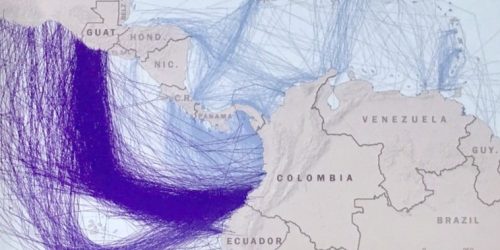
A map produced by the US Southern Command shows the main drug-smuggling routes connecting Colombia and Ecuador with Guatemala and Mexico via the Pacific Ocean.
On Tuesday, the State Department unveiled a “framework for a peaceful democratic transition in Venezuela,” calling for Maduro’s resignation and the establishment of a transition government headed by opposition and Chavista officials to oversee new elections.
The Trump administration pledged to lift sanctions against Venezuelan individuals and key economic sectors, but only after Maduro left office and all security agreements with Russia and Cuba were terminated.
The US has vowed to ramp up unilateral sanctions until the Maduro administration accepts the deal.
For its part, the Venezuelan government blasted the military deployment, with Communications Minister Jorge Rodriguez calling it “an attempt to attack Venezuela with lies and threats.”
Rodriguez added that Venezuela has “robust” anti-narcotics policies and would be ready to “coordinate” actions against drug trafficking in the region.
Washington’s naval operation comes days after the controversial sinking of a Venezuelan coast guard boat off the coast of the Caribbean island of La Tortuga.
According to the Venezuelan Ministry of Defense, the patrol ship “Naiguata” located a Portuguese cruise ship, the “RCGS Resolute,” in Venezuelan territorial waters and ordered the vessel to accompany it to port. The “Resolute” allegedly refused the instructions and proceeded to ram the “Naiguata,” which subsequently sank as a result of the impact.
The cruise ship owner, Columbia Cruise Services, has disputed this account, insisting that the “Resolute” was “subject to an act of aggression by the Venezuelan Navy in international waters,” while carrying no passengers.
On Wednesday, Venezuelan President Nicolas Maduro suggested the ship “was being used to transport mercenaries.” He also claimed that “someone from the north called” to prevent Dutch authorities from inspecting the “Resolute” at its current mooring in the Curacao port of Willemstad.
Portuguese Foreign Minister Augusto Santos Silva, for his part, has pledged to collaborate with Venezuela and Holland in the investigation of the “unfortunate” incident.
Ansurullah calls on Saudi-led alliance to consider Yemen’s mediation proposal
Press TV – April 2, 2020
Yemen’s popular Houthi Ansarullah movement has called on the Saudi-led coalition of aggressors to consider its proposal for 12-party mediation aimed at ending the bloody war on the impoverished Arab state.
In a tweet on Wednesday, Mohammed Ali al-Houthi, the chairman of the Supreme Revolutionary Committee of Yemen, proposed that twelve countries, including Russia, as well as the United Nations mediate to end the Yemen conflict.
The top Houthi official suggested that four Arab countries, four Muslim countries, three Asian nations, Russia as well as the UN be included in the group of mediators.
He referred to Algeria, Tunisia, Egypt, Iraq, Pakistan, Malaysia, Indonesia, Sierra Leone, Russia, China, South Korea and Japan as his proposed countries.
The proposal comes a week after United Nations Secretary General Antonio Guterres called for a ceasefire in all conflicts worldwide amid a global fight against the coronavirus pandemic.
Guterres warned that in war-torn countries health systems have collapsed and the small number of health professionals left were often targeted in the fighting.
The world body has been trying to mediate an end to conflicts in countries including Syria, Yemen and Libya, while also providing humanitarian assistance to millions of civilians.
Ansarullah has welcomed the call, saying an aerial and maritime blockade imposed on Yemen by the Saudi regime and its coalition allies should be lifted to facilitate the adoption of preventive measures against the coronavirus outbreak.
While Yemen has not recorded any COVID-19 cases to date, the possibility of an outbreak threatens the war-ravaged country’s already fragile healthcare system.
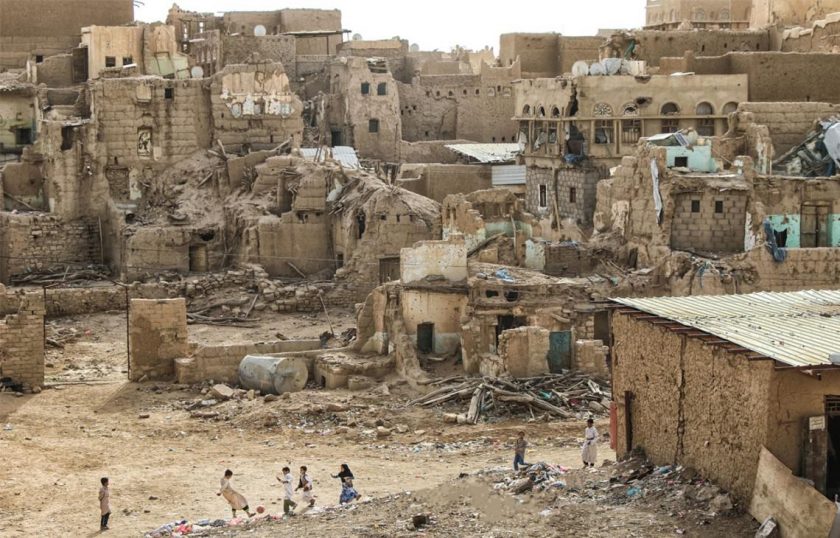
Tens of thousands of Yemenis have died since the beginning of the war that Saudi Arabia and its allies launched in 2015 to restore power to Yemen’s former Riyadh-allied officials. The aggression has also brought entire Yemen to the edge of famine.
The United States and many of its allies have been providing political, military, logistical, and advisory support for the war.
Can the United States decline peacefully?
By Kevin Barrett | Press TV | March 31, 2020
Professor Atta-ur-Rahman from Pakistan recently in an interview argued that this coronavirus pandemic may have originated as a US bioweapon. He’s not just any doctor, but he’s the chairman of (Pakistani Prime Minister) Imran Khan’s National Task Force on Science and Technology. And Pakistan’s former UN Ambassador Abdullah Hussain Haroon said the same thing.
This is very interesting. The US, of course, has been very close to Pakistan in the past. And today Pakistan is trying to balance between the US and China. Hearing this kind of statement from high level people in Pakistan is a wakeup call that the world needs to take this seriously.
I think that the context is such that anybody who’s seriously paying attention to contemporary history has to admit that from the circumstantial evidence alone, it seems very likely that we should see this as a deliberate US biological attack on China, and perhaps on Iran or perhaps the Israelis did that.
The reason for this is that the US has entered into a period of great power competition with a rising China, not just a rising China but with a very rapidly rising China, if we listen to serious geostrategic analysts such as John Mearsheimer, a very brilliant man who tries to tell the truth as he sees it, as we all know, from his analysis with, with Walt on the Israel lobby here in the United States.
In October 2014, just about six years to the day before the US military sports team came to Wuhan, China, perhaps bringing that virus and while at the same time an exercise was being run, “Event 201”, mimicking exactly what would happen in the case of this kind of pandemic, John Mearsheimer published an article called, Can China Rise Peacefully? His answer was no.
John Mearsheimer is an American political scientist and international relations scholar. And he argued that the United States is going to take extraordinary measures to kill Chinese economic growth, which has been averaging 10% since 1980, and which is still up at 7%, putting China on a course to grossly eclipse the United States in economic and enhanced technological and military power within a decade or two at the very most.
Mearsheimer says the United States will undoubtedly do what it takes to stop this no matter what. Here’s a quote from his article he said,
“All of this tells us the United States has a profound interest in seeing Chinese economic growth slowed considerably in the years ahead. That outcome might not be good for American prosperity, much less for global prosperity, but it would be good for American security, which is what matters most.”
So that prediction was that the US would be willing to kill not only the global economy, but the American economy as well in order to stop this precipitous Chinese ascendance in the world. That’s what’s happened obviously.
If China’s growing at over 7% and the US is growing at a couple of percent at most, that differential leads to quick Chinese dominance of its region and then the world, whereas if the whole world’s growth is killed, and China’s dives down to a percent or two, and even if the US growth goes a little bit negative, this change doesn’t happen, the US maintains its current global military supremacy or so it may think.
So clearly, from the background, the historical background in the context everybody in the world who knows anything about history needs to be talking about, this as a US bioweapon attack on China just as the Chinese are saying, just like the Iranian government’s saying just like the Russian government’s saying and now just like the top people in Pakistan are saying.
Kevin Barrett is an American author, journalist and radio host with a Ph.D. in Islamic and Arabic Studies.
Second US Aircraft Carrier Is Facing A COVID-19 Outbreak Among Crew
By Tyler Durden – Zero Hedge – 03/30/2020
After late last week the USS Theodore Roosevelt diverted from its mission in the Western Pacific in order for its 5,000 crew to disembark in Guam to be quarantined due to coronavirus outbreak among sailors, now at at least 38 cases, a second Navy aircraft carrier is dealing with a potential outbreak in its midst.
Over the weekend Fox News cited unnamed US officials to report that the USS Ronald Reagan aircraft carrier has two sailors who have recently tested positive for Covid-19.
This as a major naval station in Japan has already gone on lockdown over cases on the base itself.
Military newspaper Stars & Stripes, which also reported the two cases aboard the USS Ronald Reagan, on Monday noted the base spent the weekend on lockdown:
The Yokosuka base entered a third day of lockdown Monday to mitigate spread of the virus following the three positive test results announced last week. Base commander Capt. Rich Jarrett instructed non-essential personnel to stay home and instructed residents to shelter in place “until further notice.”
The Reagan is permanently forward deployed out of the base, US Fleet Activities Yokosuka.
Few details were given over the USS Ronald Reagan and its two reported cases, also as the Navy has begun a policy of restricting its coronavirus numbers to only publicly reporting branch-wide cases.
But the Reagan could be the next disaster in the making, given the Roosevelt sent Navy top brass scrambling for a solution, which was to drastically divert the ship to US bases at Guam in order to isolate and test all 5,000 crew members.
Of that massive and disruptive effort the the Daily Beast reported: “But in Guam on Wednesday, both Navy and Marine Corps service members set up roughly 140 military beds in a basketball gymnasium.”
The report continued: “To squeeze more troops into the gym, Navy medical professionals recommended measuring the six-foot distance per guidance from the CDC from the center of the bed rather than from the outer edges, meaning, that the beds are actually 3-feet apart.”
Only a week prior to Sunday’s report of 38 USS Roosevelt crew being positive, merely three had been confirmed for Covid-19. The numbers are expected to rise as the Navy awaits testing on all crew members, and as another potential outbreak looms for the USS Ronald Reagan.
Theodore Roosevelt Strike Group stricken in the Philippines

© Reuters / Kham
RT | March 24, 2020
Three US Navy sailors aboard aircraft carrier USS Theodore Roosevelt tested positive for coronavirus, the acting Naval Secretary has revealed. They will be airlifted off the ship, which hosts 5,000 troops in the Philippine Sea.
The three servicemembers are the first coronavirus cases discovered on board a deployed Navy ship, Acting Navy Secretary Thomas Modly told reporters at a Pentagon briefing on Tuesday. Currently in quarantine, the sick trio will be flown off the ship later today.
The USS Theodore Roosevelt was in Vietnam earlier this month. Last week, the Theodore Roosevelt Strike Group performed Expeditionary Strike Force maneuvers along with the America Expeditionary Strike Group and the 31st Marine Expeditionary Unit for three days in the South China Sea.
Pentagon officials diverged from President Donald Trump’s narrative during Tuesday’s briefing, which was conducted virtually, warning that the outbreak could occupy the nation for as long as three months. “I think we need to plan for this to be a few months long at least and we’re taking all precautionary measures to do that,” Defense Secretary Mark Esper told reporters. The Pentagon has reported 321 cases of coronavirus, including 174 active-duty personnel, 59 civilians, 61 dependents, and 27 contractors, as of Tuesday. A single contractor at the Defense Security Cooperation Agency died on Saturday after testing positive for the virus.
Trump, meanwhile, has declared he wants the US economy back up and running by Easter Sunday, less than three weeks away. The US has 50,206 confirmed cases of coronavirus, according to Johns Hopkins University, and 606 deaths.
Also on rt.com:
Yemen’s Ansarullah welcomes UN call for global ceasefire to tackle coronavirus pandemic
Press TV – March 24, 2020
Yemen’s Houthi Ansarullah movement has welcomed a call by United Nations Secretary General Antonio Guterres for a ceasefire in all conflicts worldwide amid a global fight against the coronavirus pandemic.
Mohammed Ali al-Houthi, the chairman of the Supreme Revolutionary Committee of Yemen, said in a tweet on Monday that Sana’a welcomes the UN chief’s call and supports a halt in attacks by the US, Britain, Saudi Arabia, the United Arab Emirates and their allies against Yemen.
The movement, he said, also seeks the lifting of an aerial and maritime blockade imposed on Yemen by the Saudi regime and its coalition allies since early 2015, to facilitate the adoption of preventive measures against the coronavirus outbreak.
The United States and Britain are not part of the Saudi-led alliance but have been providing all sorts of support to the bloody war.
Speaking to reporters from the UN headquarters in New York on Monday, Guterres called for “an immediate global ceasefire in all corners of the world,” adding, “It is time to put armed conflict on lockdown and focus together on true fight of our lives, pull back from hostilities and put aside mistrust & animosities.”
The United Nations has been trying to mediate an end to conflicts in countries including Syria, Yemen and Libya, while also providing humanitarian assistance to millions of civilians.
Guterres warned that in war-torn countries health systems have collapsed and the small number of health professionals left were often targeted in the fighting.
While Yemen has not recorded any COVID-19 cases to date, the possibility of an outbreak threatens the war-ravaged country’s already fragile healthcare system.
Last week, Houthi warned that the Saudi-led coalition of aggressors will be responsible for a possible spread of the virus to Yemen, citing the negative impacts of the siege.
Houthi’s comments come as Yemen is preparing to mark, on March 26, the fifth anniversary of the military campaign, which the Saudi regime and a number of its vassal states launched to reinstall a Riyadh-backed former regime in Yemen.
The Western-backed offensive, coupled with a naval blockade, has destroyed the country’s infrastructure.
The aggression has also led to the world’s worst humanitarian crisis in Yemen, where over 1,000 people, including many kids, were killed and hundreds of thousands afflicted by cholera, diphtheria, measles and dengue fever in 2019, according to the World Health Organization.
A Year after the North Korea–United States Hanoi Summit: Expectations for the Next One
By Konstantin Asmolov – New Eastern Outlook – 23.03.2020
Just over a year has gone by since US President Donald Trump met with Chairman of the DPRK State Affairs Commission Kim Jong-un in Hanoi. It was the second North Korean-American summit to be held, following on from the first 2018 North Korea–United States Singapore Summit. Many were surprised that the meeting ended without any concrete agreements being made, due to a variety of reasons. The primary disagreements between the two sides were made more difficult to resolve due to actions taken by American conservatives and domestic politics in the United States at the time, which prevented Trump from making any concessions.
The talks which followed between working groups and high-level officials also ended without any visible results. A brief meeting between the Supreme leader of the DPRK and the US President on the sidelines of Trump’s visit to South Korea was little more than a media photo op, and the working-level talks in Stockholm got off to a bad start: North Korea demanded that Washington come up with a new plan by the end of 2019 if the US wants denuclearization talks.
Towards the end of 2019, the North Korean leader gave a clear delineation of relations between the two countries, yet Kim Jong-un did not keep his promise to deliver a “Christmas gift”, by which he meant a demonstration of North Korea’s new strategic weapons. As it was put at the time, “the door is closed, but not locked.” There are several different explanations given for this. Pro-Pyongyang experts say Kim made a gesture of goodwill. Others believe that China used its leverage to make North Korea call off the demonstration and avoid exasperating the situation. We would like to add that given the increased attention the DPRK was receiving during this period (due to its satellites, constant use of reconnaissance aircraft, etc.), it would not have made sense for Pyongyang to “show its cards” at the time.
Failed efforts to impeach Donald Trump did not help them make any progress either, and the DPRK conducted a planned short-range missile launch which almost coincided with the anniversary of the summit. This missile test and others have yet to quell discussions over whether North Korea’s defense industry is modern, or whether its rusty missiles have been cobbled together using stolen technologies from Ukraine, China or Russia.
The outcome has been summed up in the South Korean media: “One year on since the meeting in Hanoi, the North Korean situation seems to have reverted back to its former state”. Given the current situation, I would like to discuss the prospects for this dialog between the United States and North Korea based on a series of quotes made on March 4-6, 2020.
Let’s start with Trump, who was posed a question on his 2020 presidential campaign trail about what he would do with North Korea if re-elected. The question sparked an enthusiastic response: the US President stressed that his relationship with Kim is “very good,” but insisted that he has not given anything to the communist regime and that sanctions have not been lifted. At the same time, Donald Trump reiterated that the policies being put forward by his opponents would lead to a big war with the DPRK, and also took credit for the beginning of inter-Korean rapprochement.
The US President actually dismissed the fact that a short-range missile was launched: “No reaction,” was what he had to say. Unlike at previous events, he did not even try to play this card in the UN Security Council. On March 5, the Security Council discussed this issue, but the North Korean issue was raised in a separate category for additional topics at a meeting about Syria. Immediately after the meeting, the United Kingdom, France, Germany, Belgium and Estonia adopted a joint statement condemning the actions of the DPRK and calling on Pyongyang to resume negotiations on denuclearization, but it should be noted that this statement is meaningless from a legal point of view, and the United States did not participate in it.
Interestingly, the South Korean authorities took a more right-wing position. During a speech at South Korea’s Air Force Academy on March 4, President Moon Jae-in pointed out the unpredictability of the security situation on the Korean Peninsula and underlined the importance of an impregnable defense. The South Korean media also rebuked Trump. They say the US President “brushed off North Korea’s missile tests, even though they are prohibited by U.N. Security Council resolutions” and instead took credit for Pyongyang’s suspension of its long-range missile tests and nuclear tests.
Meanwhile, US Secretary of Defense Mark Esper said North Korea’s ballistic missile capabilities pose an “increasingly complicated” threat, as the regime seeks to modernize its missile systems. When asked whether North Korea’s long-range ballistic missiles pose a threat to the United States, his answer was affirmative.
But on a tactical level, the United States “stands ready to resume denuclearization negotiations with North Korea as soon as possible and hopes to hear back from the regime.” Assistant Secretary of State for International Security and Non-Proliferation Christopher Ford made this comment on March 5: “From a State Department perspective, it remains true that we are ready and willing and prepared for the beginning of working-level discussions with North Korea – in which they will, one hopes, implement the commitments made in Singapore.”
Lastly, we will consider the public opinion on this issue in the United States. A recent poll conducted by the Chicago Council on Global Affairs found that 52% of Americans view North Korea’s nuclear weapons program as a critical threat. That is a large amount of people, but this figure had been 75% at the height of tensions in 2017.
When asked which country poses the greatest threat to the United States, 13% of respondents chose North Korea. The DPRK came in behind Iran (34%), Russia (28%) and China (16%). In 2017, North Korea ranked the highest among these four countries at 59%.
Out of the list of options on how to deal with the North’s nuclear program, tighter economic sanctions received the most support, with 73%.
According to Chicago Council on Global Affairs who conducted the poll, these results are not so much a reflection of the lack of progress that has been made on the diplomatic front, but rather stem from the prolonged absence of noticeable tension and a weakening of the perception of North Korea as a threat.
What can we expect? According to the information the Chicago think tank has gleaned from respondents, there is a sort of informal directive being followed in Washington: make no sudden movements in any direction before the November elections. Amid the race for the White House, fussing over the relations between the United States and North Korea would hardly have a positive effect on Trump’s approval ratings, and certainly should not see them fall.
It became clear to both sides during the working talks that with the time that has passed since Hanoi, the DPRK is prepared to make a certain number of concessions, but Pyongyang is demanding that they are met with proportionate actions in return. Washington is not prepared to take these steps, because the idea of easing sanctions flies in the face of American dogma, and according to this dogma, Kim Jong-un did not cooperate as a gesture of goodwill, but because he was pressured into doing so by an unprecedented level of sanctions. The belief is therefore that this is the main leverage America has to force North Korea into negotiations, and they cannot let up on it.
In the run-up to the election, it is therefore very important “not to get on Kim Jong-un’s nerves”, because any sort of tough response from North Korea will hurt Trump’s campaign, who is still selling his electorate the idea that relations between Washington and Pyongyang would be much worse under any other American president.
Of course, Trump could hardly say no to another photo-op meeting, but both sides know that they can only hold so many of these purely symbolic events, and they have already reached their limit, now they must have something to show for all those handshakes, posing in front of flashing cameras.
This is where we should note the debate among experts regarding the motives of each side. One theory is that Kim and Trump would both like to get more out of the talks, but are prepared to settle for a minor victory, where no answer can be found, but the search for one can continue once the process is put on pause. The view other experts take is that Trump believes the denuclearization of North Korea is a real possibility, but it has been put on hold while he is busy with his re-election campaign, and he is working according to his belief that during the next ten years, something could happen that could change North Korea’s position. However, we must not forget that nuclear weapons are seen in Pyongyang as an unambiguous guarantee of the regime’s survival. This is not only a lesson for Libya, but Iran should also take note (be it the American actions on the Iran nuclear deal or the assassination of General Soleimani).
The pause is likely to go on until the US presidential election is held, but then what? If Trump wins, American political analysts have two theories. One is that Kim will continue the “period of peaceful respite”, devoting his energy to making a few final arrangements so that the economy will be more prepared if it is hit with another round of sanctions. The moratorium will remain abandoned, especially given that it had only ever been a verbal promise, and it was the ultimate failure of the summit in Hanoi that prevented it from being transformed into a written commitment.
The second theory is that North Korea is truly disappointed with the strategic prospects of the dialog. Kim had hoped that it could lead to sanctions being lifted, but it turned out that the materials from the December 2019 plenum ruled this out as something he cannot even dream about, and he now sees the need to move as quickly as possible to increase the country’s military might with nuclear weapons and missiles, in order to ensure a guaranteed level of deterrence. In this context, we can expect to hear about ICBM launches with missiles fired on a flat trajectory, or the hypothetical Hwasong-20, which is said to have no problem reaching anywhere on US territory.
The long-awaited North Korean Navy’s Sinpo class submarine is no less likely to make an appearance, capable of carrying 3-4 missiles with nuclear warheads. We believe it could be revealed as North Korea’s “new strategic weapon”.
What if the Democrats win? There may not necessarily be a radical change of course under a slogan like “anything but what Trump did.” A large number of officials from the Democratic Party who write the bills that are then signed by politicians in government are gradually coming around to the idea that we will have to live with a nuclear North Korea.
Therefore, after weighing up the best and worst options in comparison with the current status quo, we hope that the dialog will continue after November 2020, or that the two sides will finally meet again by the next anniversary of the Hanoi summit.
Konstantin Asmolov, PhD in History, is a Leading Research Fellow at the Center for Korean Studies of the Institute of Far Eastern Studies of the Russian Academy of Sciences.
NATO Exercises Defying Coronavirus Reveal Desperation
By Paul Antonopoulos | March 23, 2020
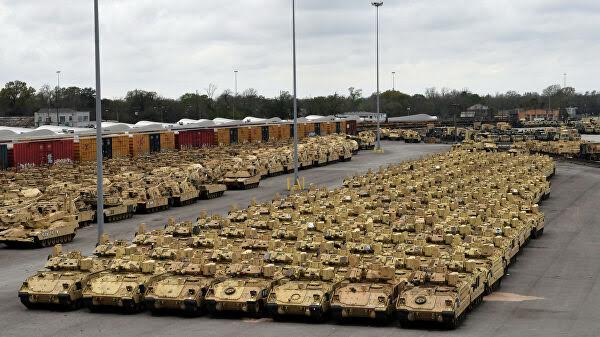
The planned NATO military exercise in Europe, “Defender 2020,” will be held on a reduced scale because of the coronavirus pandemic. Defender 2020 will have the participation of 18 NATO countries, cover 4,000 kilometers of convoy routes and rely on 10 European countries to host exercise activities, with the U.S. originally sending a total of 37,000 soldiers and officers to the exercises. The NATO exercises are a demonstration of power against Russia, and the fact that the coronavirus pandemic will not cancel the military drills is also indicating its power against Russia at a time when the world is going into lockdown.
The Alliance’s official website states that the scope of the exercise is shrinking due to a pandemic and that the movement of personnel and equipment from the U.S. to Europe is being halted. But many have already arrived in Europe. Media reports quoted Manilo Dinuchi, an Italian journalist for Manifest, claimed soldiers were exempted from the coronavirus protocol in an exercise, something recorded in a video showing the first 200 U.S. Army soldiers arriving in Bavaria on March 6, without masks on their faces, and shaking hands and kissing with German authorities and soldiers.
So why then did this exercise have to take place at all when everything else was put off?
The goal is without a doubt to have a show of force against Russia, the main target of these massive exercises by NATO. Although this may seem like a simple reason, NATO needs to show Russia that they can organize such exercise in a demonstration of aggression even in times of uncertainty and crisis. The exercises could easily have been cancelled, because there is no reason for them to be held right now and in such conditions, but conducting them during a pandemic shows greater strength by NATO – or so they think.
NATO Secretary General Jens Stoltenberg presented his Annual Report for 2019 on Thursday and announced “Our forces remain ready and our work goes on, including in our multinational battlegroups in the east of the Alliance, NATO Air Policing, our maritime deployments, and our missions from Afghanistan to Kosovo.” Although the coronavirus pandemic is plaguing NATO alliance countries, especially Italy with over 60,000 cases, the United States with over 33,000 cases, Spain with over 30,000, Germany with over 25,000 and the United Kingdom with over 6,000 cases, with thousands of deaths between these countries, Russia has only 438 confirmed cases and has been sending doctors and medical aid to Italy. As Russia weathers the pandemic comfortably compared to the major NATO countries, the Alliance feels that the cancellation of the Defender 2020 exercises will show major weakness and has therefore decided to continue with the military drills despite the non-necessity of it.
Although NATO is buckling down to continue the exercises, the grander scheme of the liberal world order is beginning to collapse under pressure from the coronavirus. The European Union has shown incompetence in dealing with the pandemic and has left each country to fend for itself, and rather it has been ‘enemies’ of the liberal world order, China, Russia and Cuba, who have mobilized to help countries severely affected. It is unlikely that Italy and Spain, both NATO and European Union members, will quickly forget the significant help they have received from Russia. This soft power play by Russia is likely to change public opinion in Italy and Spain and create deeper divisions in NATO in regards to hostile policies against Russia. As the Atlanticist states of the United Kingdom and the United States want to maintain hostility towards Russia, it is likely that southern European NATO members will not want to continue hostilities, remembering who was there to help them in their greatest crisis since World War Two.
It is for this very reason that some NATO members may begin turning against Alliance orders with Atlanticist interests and open friendlier relations with Russia. Meanwhile coronavirus is far from peaking in Europe and is only beginning to strangle the United States. It cannot be overlooked that the virus is changing the world order at a faster pace than anyone could have anticipated. When the world has moved on and overcome the coronavirus pandemic, we will have entered a new world order and shifting European loyalties from the United States to greater cooperation with Russia and China. Therefore, the continuation of Defender 2020 shows desperation to maintain the global status quo.
Paul Antonopoulos is a Research Fellow at the Center for Syncretic Studies.
COVID-USA: Targeting Italy and South Korea?
By Larry Romanoff | Global Research | March 21, 2020
A high-level Italian virologist, Giuseppe Remuzzi, has published papers in the Lancet and other articles in which he states facts not hitherto known. (1)
The doctor stated that Italian physicians now recall having seen:
“a very strange and very severe pneumonia, particularly in old people in December and even November [2019]. This suggests that the virus was circulating, at least in Lombardy, and before we were aware of this outbreak occurring in China.“(2)
Chinese medical authorities have determined the same underlying phenomenon, that the virus had been circulating among the population for perhaps two months before it finally broke out into the open.
Further, according to the Italian National Health Service (ISS):
“It is not possible to reconstruct, for all patients, the chain of transmission of infection. Most cases reported in Italy report an epidemiological link with other cases diagnosed in Lombardy, Emilia Romagna and Veneto, the areas most affected by the epidemic.” [translation from Italian] (3)
The above statement is of crucial importance since it supports in itself the assertion of several simultaneous infection clusters and several ‘patients zero’. There are cases in Lombardy that could not be placed in an infection chain, and this must also be true for other areas. (see below) Given that the virus broke out separately in disparate regions of Italy, we can expect the identification of independent infectious clusters in those regions as well. That would mean Italy was hit by at least several individual ‘seedings’ of the virus.
China’s outbreak of consequence was primarily in the city of Wuhan but with multiple sources in the city and multiple patients zero, with a minor outbreak in Guangdong that was easily contained. China had multiple clusters in Wuhan. There was no single source, and no patient zero has been identified which is similar to those of Italy.
The mystery of Italy’s “Patient No. 4”
Was the Italian outbreak caused by infections from China? Yes, and no.
Before February 20, 2020, there were only three cases of coronavirus infection in Italy, two tourists from Wuhan, China, confirmed on January 30th, and an Italian man who returned to Rome from Wuhan on February 6th. These were clearly imported cases with Italy experiencing no new infections during the next two weeks.
Then suddenly there appeared new infections that were unrelated to China. On February 19, the Lombardy Health Region issued a statement that a 38-year-old Italian man was diagnosed with the new coronavirus, becoming the fourth confirmed case in Italy. The man had never traveled to China and had no contact with the confirmed Chinese patients.
Immediately after this patient was diagnosed, Italy experienced a major outbreak. In one day, the number of confirmed cases increased to 20 and, after little more than three weeks, Italy had 17,660 confirmed cases.
The Italians were not idle in searching for their patient zero. They renamed the “patient 4” “Italian No. 1”, and attempted to learn how he became infected. The search was apparently fruitless, the article stating that “America’s pandemic of the century has become the subject of suspicion by Italians“.(4)
The mystery of South Korea’s “Patient No. 31”
South Korea’s experience was eerily similar to that of Italy, and also to that of China. The country had experienced 30 imported cases which began on January 20, I believe all of which were traceable to contact with Hubei and/or Wuhan.
But then South Korea discovered a “Patient No. 31”, a 61 year-old South Korean woman diagnosed with the new coronavirus on February 18. This ‘local’ patient had no ties to China, had had no contact with any Chinese, and no contact whatever with any of the infected South Koreans. Her infection was a South Korean source.
Just as with Italy, the outbreak in South Korea exploded rapidly after the discovery of Patient 31. By the next day, February 19 (Italy was February 21, for comparison), there were 58 confirmed cases in South Korea, reaching 1,000 in less than a week. After little more than three weeks, South Korea had 8,086 confirmed cases. It would now seem likely (yet to corroborated) that South Korea and Italy could have been ‘seeded’ at approximately the same time.
Like the Italians, South Korea performed a massive hunt for the source of the infection of their “Korean No. 1”, combing the country for evidence, but without success. They discovered the confirmed cases in South Korea were mainly concentrated in two separate clusters in Daegu and Gyeongsang North Road, most of which – but not all – could be related to “Patient 31”. As with Italy, multiple clusters and multiple simultaneous infections spreading like wildfire – and without the assistance of a seafood market selling bats and pangolins.
For both Italy and South Korea, I could also add that there is no supposed “bio-weapons lab” anywhere within reach (as was claimed for China), but that wouldn’t be accurate. There are indeed bio-weapons labs easily within reach of the stricken areas in both Italy and South Korea – but they belong to the US Military.
Korea is particularly notable in this regard because it was proven likely that MERS resulted from a leak at the American military base at Osan. The official Western narrative for the MERS outbreak in South Korea was that a Korean businessman became infected in the Middle East then returned to his home in Gyeonggi Province and spread the infection. But there was never any documentation or evidence to support that claim, and to my best knowledge it was never verified by the South Korean Government.
Pertinent to this story is that according to the Korean Yonhap News Service, at the onset of the outbreak about 100 South Korean military personnel were suddenly quarantined at the USAF Osan Air Base. The Osan base is home to the JUPITR ATD military biological program that is closely related to the lab at Fort Detrick, MD, both being US military bio-weapons research labs.
There is also a (very secretive) WHO-sponsored International Vaccine Institute nearby, which is (or at least was) managed by US military biological weapons personnel. At the time, and given the quarantine mentioned above, the event sequence accepted as most likely was that of a leak from a JUPITR biowarfare project. (5) (6)
The Korean path is similar with that of Italy. If we look at a map of the virus-stricken areas of Italy, there is a US military base within almost a stone’s throw of all of them. This is of course merely a case of circumstance arousing suspicion, and by no means constitutes proof of anything at all.
However, there is a major point here which cannot be overlooked, namely the fact of simultaneous eruptions of a new virus in three different countries, and in all three cases no clear epidemiology, and an inability to identify either the original source or a patient zero.
Multiple experts on biological weapons are in unanimous agreement that eruptions in a human population of a new and unusual pathogen in multiple locations simultaneously, with no clear idea of source and cases with no proven links, is virtually prima facie evidence of a pathogen deliberately released, since natural outbreaks can almost always be resolved to one location and one patient zero. The possibility of a deliberate leak is as strong in Italy and South Korea as in China, all three nations apparently sharing the same suspicions.
Larry Romanoff is a retired management consultant and businessman. He has held senior executive positions in international consulting firms, and owned an international import-export business. He has been a visiting professor at Shanghai’s Fudan University, presenting case studies in international affairs to senior EMBA classes. Mr. Romanoff lives in Shanghai and is currently writing a series of ten books generally related to China and the West.
He is a Research Associate of the Centre for Research on Globalization (CRG).
He can be contacted at: 2186604556@qq.com
Notes
(A) This is an aside, but Italy has experienced a fatality rate nearly twice that of Wuhan, but there may be an external contributing factor. Observations were made that, in most cases especially among the elderly in Italy, ibuprophen was widely used as a painkiller. The Lancet published an article demonstrating that the use of ibuprophen can markedly facilitate the ability of the virus to infect and therefore to increase the risk of serious and fatal infection. (YY)
https://www.thelancet.com/journals/lanres/article/PIIS2213-2600(20)30116-8/fulltext
(B) “The mean age of those who died in Italy was 81 years and more than two-thirds of these patients had . . . underlying health conditions, but it is also worth noting that they had acute respiratory distress syndrome (ARDS) caused by . . . SARS-CoV-2 pneumonia, needed respiratory support, and “would not have died otherwise.”
(3) https://www.iss.it/web/guest/primo-piano/-/asset_publisher/o4oGR9qmvUz9/content/id/5293226
(4) http://dy.163.com/v2/article/detail/F7N756430514G9GF.html
(5) https://www.21cir.com/2015/06/south-korea-mers-emerged-out-of-the-pentagons-biowarfare-labs-2/
(6) https://www.businessinsider.com/almost-200-north-korean-soldiers-died-coronavirus-2020-3
Copyright © Larry Romanoff, Global Research, 2020
Featured Video
Iran’s Next Strike May Not Explode. It Could Shut You Down
or go to
Aletho News Archives – Video-Images
Book Review
New paperback: Butchered by “Healthcare”
Lies are Unbekoming | October 20, 2026
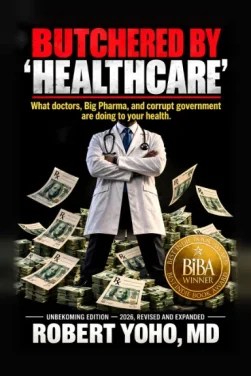 Butchered by “Healthcare” is Robert Yoho’s plain-spoken account of how American medicine stopped being a profession and became an industry. 341 pages. Over a thousand references. Thirty-eight chapters.
“Screening Tests Are Useless”, on tests that find diseases that would never have hurt you. “The FDA Protects the Big Drug Companies”, on an agency funded by the companies it regulates. “The Journals’ Sins Are the Editors’ Sins”, on ghostwritten studies and captured peer review. “Opioids and ‘Pain Management’”, on how a generation was prescribed its way into addiction. “Prozac and Relatives” and “Antipsychotics Are Disastrous”, on what psychiatry does to adults and children. “Surgery: Money Before Patients”. “Failed Cancer Treatments”. “Futile CPR and Overprescribing”. “Billing Scams & Specialty Warfare”. “Hospitals Are Sharks”. Each with a Patient Tips section at the end on how to survive it.
If you have ever walked out of a doctor’s office with a prescription you didn’t ask for, or watched a parent put through a treatment that made them worse, this is the book you want on your shelf before the next appointment. … Full review
Butchered by “Healthcare” is available on Lulu now.
Blog Roll
 Aletho News
- Iran’s Next Strike May Not Explode. It Could Shut You Down /Col Doug Macgregor
- Iran: US political targets legitimate if assassinations return
- Iraq shuts key border crossing with Iran under US pressure: Report
- Undersea Internet cables could be targeted in retaliation for attacks on Iran: IRGC deputy chief
- EU sending ‘biased’ observers to interfere in Serbian election – president
- White House envoy declares kinetic action against Yemen ‘fruitless’
- Ukraine deployed thousands of microdrones in Iraqi Kurdistan: Tasnim
- Iran calls for emergency UNSC meeting over Trump’s ‘brazen’ bomb talk, Israeli threats
- Iranian sources reveal details of Russia-China Hormuz proposal
- Plan for more US-Israel integration puts our military tech at risk
- If Americans Knew
- Americans at National Conservatism Conference held in Israel this year criticize Israel
- Christiane Amanpour exits CNN with a legacy shaped by the debate over Israel
- Israel’s war on Iran is the final move in a decades-old strategy
- Israel Denies Entry to French Journalist, U.S. Researcher Amid Rise in Entry Denials
- Gaza’s hospitals are running out of life-saving fuel – Daily Update
- Mysterious bot accounts reportedly spread fake ‘man on the street’ videos for Michigan Senate candidate
- Israeli Defense Minister Katz Says Over 60 Lebanon Villages Have Been Destroyed
- Why Is Israel Running TV Ads in Iowa Ahead of the Midterms?
- Hind Rajab’s Alleged Killer Is in the United States. HRF Demands His Arrest.
- US Officials Face Fresh Pressure After Another American ‘Brutalized’ by Israeli Settlers in West Bank
- No Tricks Zone
- E-Cars Reduce CO2 Emissions By Only 41% Compared To Internal Combustion Engine Vehicles
- Predictions Made By Renowned Climate Professor Over Past Decades Have Been Proven To Be Poor
- New Study Suggests Large Regions Of The Pacific Ocean Have Been Cooling For The Last 80 Years
- Germany’s Green Energy Debacle: High Energy Costs Force Kahla Porzellan to Close After 182 Years!
- New Study: 50 Years Of The Most Aggressive ‘Net Zero’ Policies Can Only Affect The Global Climate By 0.03°C
- US September “Heat” Was No Record…Many Records Set Decades Ago
- Latest European Green Energy Debacle; Portugal’s Largest Flagship Solar Park Insolvent!
- Green Energy Debacle: German Expert Professor Fritz Vahrenholt Warns Of Severe Economic And Social Consequences
- Two More Paleo Reconstructions Affirm Meters-Higher Sea Levels Across Ireland, Brazil 7000-6000 Years Ago
- New Study: Earth And Venus Surface Warmth Largely Explained By Convection And Lapse Rate, Not CO2 Or Radiation

