Toxic femininity: ‘Badass’ US women demand right to torture and kill for Empire… just like men

© Global Look Press / Marvel Studios
By Michael McCaffrey | RT | January 25, 2019
Thanks to a new wave of feminism and its call for equality, it isn’t just toxic men who can kill, torture and surveil in the name of US militarism and empire, women can now do it too!
This past weekend was the third annual Women’s March, which is a protest originally triggered by Donald Trump’s defeat of Hillary Clinton in the 2016 presidential election that encourages women across America to rise up against misogyny and patriarchy.
As sincere as these women are in their outrage, in their quest for power they are inadvertently reinforcing the immoral and unethical system that they claim to detest. This is most glaringly apparent when this new feminism boldly embraces the worst traits of the patriarchy in the form of militarism and empire.
The rise of #MeToo, Time’s Up and the anti-Trump Women’s Movement, has brought forth a new wave of politically and culturally active neo-feminists. This modern women’s movement and its adherents demand that “boys not be boys”, and in fact claim that the statement “boys will be boys” is in and of itself an act of patriarchal privilege and male aggression. The irony is that these neo-feminists don’t want boys to be boys, but they do want girls to be like boys.
The inherent contradiction of that ideology was on full display recently when the American Psychological Association (APA) put out a guide to treating men and boys. In the guide’s summary the APA makes the extraordinary claim that “traditional masculinity – marked by stoicism, competitiveness, dominance and aggression – is, on the whole, harmful.”
These APA guidelines blatantly turn “traditional masculinity” and “toxic masculinity” into synonyms, and never once mention testosterone, revealing a staggering ignorance of male biology. The APA is in essence blaming the bull for his horns.
Further diminishing their credibility, how can anyone look at the mess that is the current emotional state of our world and think we need less stoicism and not more?
The hypocrisy of the APA guidelines are glaringly evident because everywhere you look nowadays girls and young women are constantly being urged to be more competitive, dominant and aggressive. I guess when women do it, it is empowering, but when men do it, it is dangerous.
Women, and some men, often tell me that if women were in power, the world would be a better and safer place. But that old trope, which obviously animates the feminist movement of today, is foolishness. I mean have none of these people ever heard of that pernicious beast Margaret Thatcher? And does anyone think that Hillary Clinton’s proposed no-fly zone over Syria or her tough talk about Russia would have led to more peace and less war?
Another example of the vacuity of this ideology is the group of Democratic women with military and intelligence backgrounds who won seats in Congress in 2018. These women, who have dubbed themselves “The Badasses”, how toxically masculine of them, are being touted as the “antidote to Trump.”
No doubt these former military and intelligence “badasses” will be so much less toxic than their male counterparts when they demand the US “get tough” by militarily intervening across the globe to further American interests. This sort of star-spangled belligerence is no less toxic in a pantsuit than a three-piece suit, and will only lead to more victims of America’s “competitiveness, dominance and aggression” around the world.
Other toxically-masculine women in government are also being hailed as great signs of women’s empowerment.
Gina Haspel is the first female director of the CIA and women now also hold the three top directorates in that agency. Ms. Haspel proved herself more than capable of being just as deplorable as any man when she was an active participant in the Bush-era torture program. No doubt the pussy-hat wearing brigade would cheer her “competitiveness, dominance and aggression” when torturing prisoners… most especially the traditionally masculine ones.
Hypocritical Hollywood has long been a haven for toxic masculinity, be it in the form of depraved predators like Harvey Weinstein or Woody Allen or counterfeit tough guys like John Wayne. Hollywood has also long been the propaganda wing of the US military machine. It is well established that for decades Hollywood and the Department of Defense have worked hand in hand in creating movies that tout muscular American militarism and empire.
Now Hollywood and the Department of Defense (DoD) are using the social justice calling card of “diversity and inclusion” to take the next step in indoctrinating young people with the noxious ideology of American exceptionalism and aggression… but this time they are targeting girls and young women.
The latest product of the Hollywood and DoD propaganda machine is the Disney/Marvel movie, Captain Marvel, which comes out this March. The film, which has a budget worth $150 million and stars one of the leading feminist voices in Hollywood, Academy Award winner Brie Larson, tells the story of Carol Danvers, a former Air Force pilot who “turns into one of the galaxy’s mightiest heroes.”
With Robert Downey Jr. and Chris Evans set to potentially leave their roles as Iron Man and Captain America respectively, Disney is positioning itself to replace them as the face of the multi-billion dollar Marvel Cinematic Universe with Brie Larson’s Captain Marvel, who is described as a “badass superheroine”… one more flag-waving, badass lady for the girls to look up to!
The movie has been described as “the recruiting tool of the Air Force’s dreams”, and will no doubt be a huge boost to female recruitment, much like Tom Cruise and Top Gun boosted male military recruitment in the 1980’s.
The DoD has reportedly been partnered with Marvel since 2008’s Iron Man. The DoD and Air Force demand that any film project with which they assist “portrays the Air Force and military in an accurate way and that it is in the service’s interest to partner on the project.”
It is good to know that feminist Brie Larson is cashing in by partnering with the Air Force to make a movie that indoctrinates millions of US kids, specifically girls, with the dream of being able to bomb innocent people across the globe from miles up in the sky and look really “badass” while doing it.
I’m sure Ms. Larson, a public and outspoken advocate for abuse victims here in America, has meticulously weighed the pros and cons of being a recruitment tool for the US military, which in recent years has aided and abetted, or been directly responsible for, the murder of women and children in Yemen, Iraq, Afghanistan, Syria, Libya and elsewhere.
The cacophony of feminist voices in the public sphere has effectively challenged some minds about some things, but not the right minds about the right things. The mendacious US establishment and its virulent military industrial complex have co-opted this current feminist moment and are using it to further solidify their deadly stranglehold on the American consciousness and Brie Larson is now an accomplice to that crime.
Is this what the new wave of feminism is all about, putting lipstick on the pig of American empire and militarism and calling it a victory for equality? If so, I’ll pass on that toxic femininity.
I’ll stick with traditional masculinity, you know, the stoic kind, whose adherents, principled men like Martin Luther King Jr., Cesar Chavez, Daniel Ellsberg, Pat Tillman and Edward Snowden, among many others, all did the right thing in the face of enormous opposition, and who didn’t tout themselves as “badass,” didn’t start fights but finished them, didn’t torture, didn’t spy and didn’t bomb innocent women and children into oblivion.
The bottom line is this, I fervently believe that men and women should be equal in their rights and opportunities, but I believe just as fervently that regardless of gender, no one has the right to kill, maim and torture for the American empire.
Michael McCaffrey is a freelance writer, film critic and cultural commentator. He currently resides in Los Angeles where he runs his acting coaching and media consulting business. mpmacting.com/blog/
Read more:
The Pentagon & Hollywood’s successful and deadly propaganda alliance
Justifying the 17-Year War
By Jacob G. Hornberger | FFF | January 25, 2019
When I first learned about the Thirty Years War in a history class in college, I was both fascinated and amazed. How in the world could a war go on for 30 years? That just seemed incomprehensible to me.
Not anymore. The U.S. war on Afghanistan has now been going on for 17 years. And if the American people follow the advice of Michael E. O’Hanlon, a senior fellow at the Brookings Institution, it’s a virtual certainty that the United States will easily surpass the Thirty Years War and, maybe, the Hundred Years War, which needless to say, also amazed and fascinated me when I learned about its existence.
I can just see Americans 83 years from now breaking the 100-year-war record and exclaiming in celebration, “We’re Number One! We’re Number One! KAG! KAG! Keep America Great!”
O’Hanlon’s advice comes in the form of an op-ed in yesterday’s New York Times. It’s entitled “Our Longest War Is Still an Important War.” In his op-ed, O’Hanlon says that it is important that U.S. troops remain occupying Afghanistan, perhaps even in perpetuity.
Why does O’Hanlon feel this way? The thrust of his piece is a variation on the theme that has guided the so-called war on terrorism ever since the 9/11 attacks way back in 2001— that it’s better for U.S. forces to kill the terrorists over there before they come over here to get us.
Not surprisingly, O’Hanlon ignores a very important point about this “war on terrorism” — that it is U.S. interventionism that is the cause of anti-U.S. terrorism.
Why is that important? Because the continued and perhaps perpetual interventionism that he is endorsing produces the very thing that he’s using to justify the continued interventionism.
When U.S. forces kill five “terrorists” over there, they bring into existence ten more terrorists. Those ten new terrorists then become the justification for remaining over there instead of coming home after killing those original five terrorists. Then, once they kill the ten, twenty more come into existence, which is then used to justify staying over there so that they can kill the twenty.
That’s how the “war on terrorism” has become perpetual, which President George W. Bush even suggested would happen way back in 2001.
Interventionists, of course, hate it when we libertarians point out this obvious fact. Recall that famous Republican presidential debate when Ron Paul pointed out that “they” came over here to kill us because the feds were over there killing them. His Republican opponents went ballistic, as did the mainstream press. No one is supposed to say that.
You see, the official position is that the terrorists just spring up and strike a nation, sort of like the flu. Or that they just hate America for its “freedom and values.” I suppose they would say that the Swiss, whose government simply minds its own business, are just plan lucky to have been spared the terrorist flu.
The reality is that the cause of anti-American terrorism is U.S. interventionism. Thus, if you stop the interventionism, the anti-American terrorism stops.
But that’s the last thing interventionists want. Interventionists don’t have any problems with the militarism, the national-security statism, the massive spending, the empire of domestic and foreign military bases, the invasions, the occupations, the CIA, the NSA, the assassinations, coups, partnerships with dictatorial regimes, secret surveillance, and the installing of pro-U.S. regimes around the world.
Interventionists and the national-security establishment always need official enemies. Recall that throughout the Cold War, the official enemy was Russia and the rest of the Soviet Union, along with “godless communism” and the supposed worldwide communist conspiracy to take over the world, which, they said, was based in Moscow.
When they ostensibly lost their official enemy in 1989 with the end of the Cold War, that’s when they began killing people in the Middle East, including during their invasion of Iraq and the subsequent killing of Iraqi children with sanctions. That’s when Iraqi dictator Saddam Hussein because the official enemy. He was coming to get us, they said, with WMDs.
Then after the blowback of the 9/11 attacks, it was the terrorists, who morphed into the Muslims, who, we learned, were engaged in a centuries-long conspiracy to make the United States a part of a worldwide caliphate based on Sharia law.
Most recently, we’ve come full circle with Russia being made once again into an official enemy, along with terrorists and Muslims and, well, also illegal immigrants and drug dealers.
I wish that I could tell you that was all. If you really want to get scared, read O’Hanlon’s article. It turns out that there are so many more bugaboos out there, which have caused him to embrace a continuation of the 17-year war in Afghanistan. Apparently, there’s al-Qaeda, the Islamic State, “related groups,”and, get this — even ISIS-K! According to O’Hanlon, that stands for ISIS-Khorasan. I’ll bet you hadn’t heard of that last one. Scary!
How can any American citizen buy into this nonsense? Bring the troops home, now. All of them. And discharge them. Interventionists have done enough damage to our nation and to the people of Afghanistan (and Iraq, Syria, Libya, and so many other countries). It’s time to return to founding principles, especially America’s founding principle of non-interventionism.
Trump, Pull Them Out of Syria Now, Not Later
By Jacob G. Hornberger | FFF | January 24, 2019
In December, President Trump announced that he was finally ordering an immediate withdrawal of all U.S. troops from Syria. Almost immediately, under pressure from the interventionist crowd, including the national-security branch of the U.S. government, Trump reversed course and announced that he intended to delay the pullout by another four months. Today, it’s not clear that he even intends to abide by that deadline.
Meanwhile, while Trump dawdled with the withdrawal, four more Americans were killed in a suicide-bombing attack carried out by ISIS in Syria. They included two U.S. soldiers, a former U.S. soldier serving as a contractor, and an interpreter. Three other Americans were wounded in the attack.
What did those Americans die for? Nothing. All four died for nothing.
They died for nothing because the U.S. government has no business being in Syria. It never has had any business being in Syria. Those 2,000 U.S. troops don’t belong in Syria. Those four Americans deserve to be alive today. So do all other Americans who are killed in Syria the longer that Trump delays the pullout of all U.S. troops from the country.
Interventionists, not surprisingly, are saying that the ISIS attack instead shows that Trump needs to keep U.S. troops in Syria. They’re saying that the attack shows that ISIS hasn’t really been “defeated,” as Trump claimed when he was justifying his original withdrawal order.
But whether ISIS has been defeated or not is quite besides the point. The point is that the U.S., government has no business in Syria, ISIS or no ISIS.
Moreover, let’s not forget something important: It is interventionists who are responsible for the rise of ISIS. The organization did not exist prior to the U.S. invasion and occupation of Iraq. Never mind that Iraq had never attacked the United States or even threatened to do so. What mattered was that interventionists felt that Iraq’s dictator, who had partnered with the U.S. government in the 1980s, now had to go and be replaced with another pro-U.S. dictator.
Interventionists cheered as U.S. forces were invading and occupying the country for many years. But while they were celebrating the destruction of Iraq and the killing and torturing of tens of thousands of Iraqis (none of whom had ever attacked the United States), interventionists were refusing to take personal responsibility for what their interventionism had brought into existence — ISIS, which consisted largely of people who opposed the U.S. interventionist war against Iraq.
So, ISIS, which was a direct result of the U.S. intervention in Iraq, become the new official enemy, which now, interventionists said, required even more interventionism. The idea was that if the U.S. government didn’t now stop ISIS , ISIS would supposedly establish a worldwide Muslim caliphate that would end up conquering the United States and taking over the federal government, much like Iraqi dictator Saddam Hussein, with whom U.S. officials had partnered in the 1980s, was supposedly going to do if the U.S. government didn’t intervene against him.
The notion was ridiculous from the get-go. ISIS was never coming to get us, any more than Saddam was coming to get us. It was just one more of a series of official bugaboos that interventionists have used to justify their forever foreign interventions and ever-increasing tax-funded largess for the military-industrial complex, the CIA, and the NSA.
Trump and the U.S. national-security establishment have used SIS to justify the stationing of those 2000 troops in Syria. But it’s been a lie from the beginning. The real reason those troops are there is to attempt to achieve regime change in Syria, just like they got regime change in Iraq. That’s ultimately what those four Americans died for—regime change, which is the same thing as dying for nothing. That’s because the U.S. government has no business engaging in the business of regime change. It is not a legitimate role of the U.S. government to be deciding who should be in power in foreign countries and engaging in actions to buttress or remove foreign regimes.
Of course, that’s not the mindset of interventionists, including those who pressured Trump into immediately modifying his withdrawal order on Syria. What we hear from them is classic imperialism. “If we get out, there will be a power vacuum that will be filled by Russia, which is our rival.” “We need to counterbalance Iran.” “We need to block our NATO ally Turkey.” “ISIS could become a regional hegemon.”
All that is Empire Talk 101. After all, do you see Switzerland, a country whose government is limited to defense of the country, talking like that? Do you see Swiss officials referring to rivals, counterbalancing, blocking, or the rise of regional hegemons?
Meanwhile, while Trump dawdles with his withdrawal from Syria, he’s now stating that US. military intervention is a possibility for Venezuela, on top of the interventionist sanctions that Trump has already imposed on that country. Just more interventionism from America’s interventionist-in-chief.



‘Western journalists have become cheerleaders for war’ – analyst on Estonian ‘bomb Russia’ article
RT | January 23, 2019
A recent Estonian op-ed calling for capability to shell St.Petersburg and sink Russian ships in case of conflict may be hypothetical, but the pressure on Tallinn to buy missiles from NATO is real, a British journalist told RT.
“Just several limited strikes” on St. Petersburg could be enough to change Russia’s mind if it ever decides to attack Estonia, an opinion piece in Delfi, one of the top online news outlets in the Baltics, suggested. Its author, Estonian journalist Vahur Koorits, also urged the country to become capable of sinking or hijacking Russia ships in order to disrupt trade in the Baltic Sea.
Koorits’s article is part of a wider trend that signals “a sad decline in journalism” in Europe and the US, according to UK journalist Neil Clark.
“A lot of journalists in the West have become cheerleaders for military confrontations and wars… Instead of being skeptical, looking at issues objectively and actually trying to hold power to account, they’re doing the opposite. This is very worrying,” he said.
The publication in Delfi was “the latest in a number of similar articles, basically calling for aggression against Russia,” Clark noted. He recalled another example in the Washington Examiner last year, in which US political commentator Tom Rogan advised Ukrainian authorities to bomb the newly built 19km bridge connecting Crimea with mainland Russia.
“Just imagine a Russian writer saying a similar thing about America or Britain, saying that infrastructure in the US should be bombed. It would be seen as outrageous… hailed as evidence that Russia is aggressive; threatening the West,” Clark said.
However, when a Western journalist is calling for the use of force against the countries that have been labeled as “bad guys” by Washington and London, “there is silence,” he added.
Moscow, of course, has “zero reasons” to attack Estonia and Tallinn would never dare to attack Russia, so the op-ed by Koorits should be treated with “a smile,” the British journalist stated.
However, he warned that Estonia and its Baltic neighbors in Latvia and Lithuania “are very crucial actors of this new Cold War against Russia.”
“Think tanks working for the Western arms companies are promoting this narrative of a Russian threat to the Baltics in order to sell weapons. It could well be that Estonia does come under pressure to buy missiles that could threaten St. Petersburg,” Clark said.
READ MORE:
‘Russians will die in Tallinn if they invade’: Estonian commander launches bizarre rant
House passes bill preventing Trump from leaving NATO, tells allies to start pulling weight
RT | January 23, 2019
The US House of Representatives has passed a bill to prevent President Donald Trump from withdrawing the country from NATO, but called on European allies to pay their dues – just like Trump has demanded.
The bipartisan NATO Support Act was passed on Tuesday in a 357-22 vote that reiterated US commitment to the military bloc and included a provision that rejects any effort made by the president to withdraw from it, banning funding for such actions.
“It’s crazy that we have to be introducing this bill. But it is, unfortunately, both necessary and urgent,” said Rep. Tom Malinowski, one of the Democratic co-sponsors of the bill. “I believe it’s necessary that I take the president of the United States seriously. President Trump has made no secret of his disdain for NATO and his willingness to consider leaving it.”
On the campaign trail and during his presidency, Trump repeatedly criticized NATO, saying the organization allowed other members to take advantage of American generosity and enjoy protection it offers without sharing the burden. The US is by far the biggest contributor to the alliance in terms of finances and soldiers carrying out its missions.
Among other NATO allies, few meet the benchmark two percent of GDP that they are required to spend on defense, which is a commitment that all members made. On many occasions, Trump demanded that this slight was addressed.
The new bill makes the same demand, but Rep. Jimmy Panetta, who spearheaded the legislation, insists it is not like those made by the president.
“What we have to realize is that NATO is not just a transactional relationship,” he said, adding that the focus “can’t just be on who pays what and who gets what. Being a member of NATO is not like being a member of a country club.”
In their statements on the bill, several lawmakers stressed NATO’s role in defending Europe from ‘aggression by Russia.’ This perceived threat has been used to justify an increased military presence of NATO troops close to Russia’s border and regular exercises on a scale unseen since the Cold War. Russia is responding with additional deployments of troops in the west of the country and exercises of its own.
NATO’s uncontrolled expansion eastwards, contrary to verbal assurances made to Soviet leader Mikhail Gorbachev, made Moscow increasingly suspicious of the West’s actions and caused it to spend a lot of resources modernizing its armed forces and boosting its nuclear deterrence over the past two decades.
This policy is now cited as the reason why NATO is necessary. Retired US four-star general David Petraeus recently called it “the greatest gift” the bloc could receive.
Russia rejects US demand to destroy new missile system
Press TV – January 21, 2019
Russia has rejected a US demand for Moscow to destroy a new cruise missile system, a weapon Washington alleges is in violation of the landmark Intermediate-range Nuclear Forces (INF) Treaty.
Russian Deputy Foreign Minister Sergei Ryabkov said Monday it was unacceptable for Washington to demand Moscow destroy its SSC-8/9M729 cruise missile, denying the missile system is in breach of INF.
INF was a Cold-War era treaty signed in 1987 that eliminated all nuclear and conventional missiles with ranges of 1,000–5,500 km (620–3,420 mi).
Ryabkov also said Russia has proposed putting on a demonstration of the missile for the United States, the Interfax news agency quoted him as saying.
“We are ready to show unprecedented transparency on the 9M729 missile, which alarms the Americans so much. We offered them a presentation and a briefing on the missile, which absolutely does not follow from the content of the treaty itself,” he said.
“But at the same time, we insist that the Americans take practical steps to alleviate our concerns on the Aegis Ashore systems, deployed in Romania, whose deployment is also scheduled in Poland soon.”
The statement comes after earlier in the day US disarmament ambassador Robert Wood called on Russia to “verifiably destroy” the missiles in order to save the INF treaty and accused Moscow of destabilizing global security.
Wood said the system was capable of carrying both conventional and nuclear warheads and represented a “potent and direct threat to Europe and Asia” as it had a range of 500 to 1,500 kilometers (310-620 miles).
“Unfortunately, the United States increasingly finds that Russia cannot be trusted to comply with its arms control obligations and that its coercive and malign actions around the globe have increased tensions,” Wood told the UN-sponsored Conference on Disarmament.
US President Donald Trump’s administration last week rejected an offer by Moscow to save the INF treaty, claiming it could not be properly verified, setting the stage for Washington to withdraw from the pact next month.
Moscow has refuted the US allegations, pointing out that Washington has provided no proof that Russia has, in fact, violated the treaty by deploying the missiles.
Russian Foreign Minister Sergei Lavrov said Friday that Washington’s stance on the INF jeopardizes further nuclear disarmament and the sustainability of the non-proliferation treaty.
Ties between Moscow and Washington have plummeted to levels not seen since the Cold War due to the two countries’ disputes over the crises in Ukraine and Syria and after US officials accused Russia of meddling in the 2016 US presidential election.
Western countries have levied broad economic sanctions against Moscow over its support for pro-Russia forces in eastern Ukraine and Crimea’s reunification with Russia.
US intelligence agencies allege that Russia had influenced the US presidential election in November that year to help Trump get elected, an allegation that the US president and Russia have strongly denied.
Israel seeking Africa foothold with renewed Chad ties
Press TV – January 21, 2019
Israel has for some time been trying to expand its influence across the African continent. Prime Minister Benjamin Netanyahu’s recent visit to Chad is being viewed as a step in this direction. The two sides have now announced the normalization of their diplomatic ties amid reports of Israel supplying the Central African state with weapons.
Netanyahu, and Chadian President Idriss Deby have “announced the renewal of diplomatic relations between Chad and Israel,” a statement from Netanyahu’s office said Sunday.
Relations between Tel Aviv and the Muslim-majority country were cut in 1972.
Speaking at a joint press conference in N’Djamena on Sunday, Deby told Netanyahu that the purpose of the visit was to bring the two sides closer and to cooperate.
For his part, Netanyahu said that Israel was announcing “a renewal of diplomatic ties with Chad and making a breakthrough for the Arab and Muslim world.”
He said the restoration of diplomatic ties was “a result of strenuous work of recent years.”
Deby, who won a disputed fifth term in April 2016, visited the occupied Palestinian territories and met with Netanyahu in November, becoming the first Chadian leader to visit Israel, 47 years after the two sides severed ties.
Back then, Israeli media cited sources in N’Djamena as saying that Deby’s visit was focused on “security” and that Tel Aviv had already been supplying weapons and other military equipment to Chad.
Over the past two years, Netanyahu has been seeking to secure a foothold in Africa. He has traveled to several African states in a bid to convince them to stop voting against the Israeli regime at the United Nations in favor of Palestinians.
Amid warming relations with Chad, Israel is seeking to normalize relations with Sudan, among other African states.
Israel is also said to be seeking to take advantage of insurgency and Takfiri militancy gripping parts of Africa to sell advanced military equipment to conflict-ridden states in the continent.
Tel Aviv and the Persian Gulf Arab governments have also taken further steps towards normalization.
Only two Arab states, Egypt and Jordan, have open diplomatic relations with Israel. Tel Aviv has recently stepped up its push to make clandestine ties with other Arab governments public and establish formal relations with them.
Rebranding MLK: How the Establishment Blackened His Dream and Whitewashed His Legacy

By Teodrose Fikre | The Ghion Journal | January 19, 2019
First, the ruling class kill messengers and then co-opt their messages. It’s a ploy that dates back to biblical times; Pharisees dispatch prophets and then whitewash their legacies in a concerted campaign to appropriate their movements. Truth tellers are twice victimized, once by assassins and the second time around by propaganda. Their likeness and their teachings are then cunningly marketed by the same powers they spoke against to reinforce the status quo.
This same playbook—which has been used to silence dissenters throughout the ages—was unleashed with ruthless efficiency against Martin Luther King Jr. Lost in the chorus of politicians, pundits and media personalities who are praising MLK is the core message that he was pushing before he was felled on the balcony of the Lorraine Motel. King evolved in his thinking; instead of seeking Civil Rights for “African-Americans”, he made the fatal decision to fight for economic justice for all.
King realized that the infringements against “black” folks in America were interconnected to the injustices felt by marginalized people throughout the world. That awakening is the reason he traveled to Memphis, by standing up for striking sanitation workers, he was hoping to form a bridge between poor folks irrespective of their skin color. The establishment love people who lead sectional movements—those who seek exclusive justice are doing the work of the status quo—what they will not abide are those who try to unify the oppressed and inspire collective actions.
King paid with his life for having the courage to pursue inclusive justice. After he was murdered, institutions of power—from government, academia to mainstream media and beyond—kicked in, stealthily erased King’s legacy and replaced it with disinformation. What has taken place over the past fifty years is a systematic and coordinated effort to blacken his narrative and dilute the power of his message.
I must pause here and explain what I mean by blackening Martin Luther King. What MLK fought for, and ultimately died on behalf of, was for equality and fairness for all. By narrowing the scope of his cause and containing his sacrifice to only as a struggle for “black” people, opinion leaders successfully ghettoized him in an effort to lessen his appeal to a broader constituency.
This is one of the main reasons why I reject racial labels and disavow constructs that were imposed by the very racists who shattered humanity. When you see me using quote marks around “black” and “white” in describing people, it’s because I know the true intentions behind these designations. Terms that we have come to embrace are actually insidious conventions used to dehumanize people, reduce us into abstractions and induce tribalism. As I make clear in this video below, it is vital for us to understand where these epithets come from and why bigots imposed these insidious labels on us to begin with.
Labels are insidious forms of reductionism, they are so subtle that most of us don’t understand how malicious they are. Martin Luther King is described as a “black leader” or an “African-American hero”, the adjectives in front of the title being used to depreciate the worth of the people they are describing. Nobody ever says Mozart was a European pianist or that Michelangelo was an Italian painter, yet when it comes to “black” folk, that descriptor is always attached to them—like a Scarlet letter used to insinuate that we are 3/5th human. Martin Luther King is not a black hero, he is a hero who spoke on behalf of all oppressed people.
To hide this truth and marginalize King, instigators and impostors are being propagated by mainstream media and moneyed interests. The profound message behind Martin Luther King’s “I have a dream” speech is continually transmuted by opportunists who use identity politics to advance their own agendas. “I have a dream that my four little children will one day live in a nation where they will not be judged by the color of their skin, but by the content of their character.” These words were eloquently spoken by King in order to free us from the shackles of imposed identities. We are creeping further and further away from MLK’s dream as we let demagogues lead us into the wasteland of sectarianism.
“One unfortunate thing about [the slogan] Black Power is that it gives priority to race precisely at a time when the impact of automation and other forces have made the economic question fundamental for blacks and whites alike. In this context a slogan ‘Power for Poor People’ would be much more appropriate than the slogan ‘Black Power.’”
This was a quote from King in August of 1967, eight months before he was executed. After spearheading the Civil Rights movement from the 50’s into the early 60’s, it dawned upon King that the struggle for equality was greater than being able to sit at lunch counters and riding at the front of buses. He realized that the only way to overcome oppression was to stitch together the pains felt by the proletariat in ways that would attract anyone who felt disenfranchised.
King articulated his apprehension about the movement he organized and expressed how he might have unwittingly directed his people into a quagmire. During a conversation he shared with Harry Belafonte and his inner-circle, King detailed the flaws of fighting racism’s symptoms without addressing the system that gives rise to inequalities.
“I’ve come upon something that disturbs me deeply. We have fought hard and long for integration, as I believe we should have, and I know we will win, but I have come to believe that we are integrating into a burning house. I’m afraid that America has lost the moral vision she may have had, and I’m afraid that even as we integrate, we are walking into a place that does not understand that this nation needs to be deeply concerned with the plight of the poor and disenfranchised. Until we commit ourselves to ensuring that the underclass is given justice and opportunity, we will continue to perpetuate the anger and violence that tears the soul of this nation. I fear I am integrating my people into a burning house.”
Martin Luther King was not disregarding the plight of “black” folks, nor was he giving short shrift to the struggles faced by “African-Americans”. What he recognized is that the struggles being borne by “minorities” would never be alleviated unless a majority of humanity formed a broad coalition to defend their common interests. Martin Luther King was not alone in this realization; Malcolm X came around to this same viewpoint once he visited Mecca and saw that the only way to attain justice was through mass-movements. Do you think it was an accident that both met the same gruesome fate?
Gone are the days of moral giants like Malcolm and Martin, we are firmly entrenched in the era of charlatans who profit from our disunion. What is truly sad is that so many hypocrites readily praise Martin Luther King while they get paid by the same powers that he was speaking against. Proving that treachery is truly bipartisan, on the day Martin Luther King is being celebrated, the King Center is commemorating warmonger emeritus John McCain. What better way to remember Dr. King than by praising the man who vehemently fought against honoring him and as the King Center dismantles his memory.
Meanwhile, Kamala Harris, California’s junior Senator—who was one of the biggest proponents of the prison-industrial complex—is expected to announce her presidential campaign on Martin Luther King Day. This is the same Kamala Harris whose office argued against early release of inmates on the grounds that it would hurt the labor supply [slave workers] of for-profit prisons. It is truly an affront that someone who reserved draconian measures for poor and working Californians— while giving a pass to banking executives like Steven Mnuchin—is going to use Martin Luther King day to hide the fact that she made a name for herself by being a staunch advocate of penal plantations. Kamala Harris 2020: chains you can believe in!
As always, the way to unravel conspiracies is to follow the money. Martin Luther King was sent to his grave because he connected the dots between wars overseas and economic inequalities in America. The hundreds of billions of dollars that were being spent to perpetuate the Vietnam War and conflicts around the world prevented investments in programs that could have alleviated suffering and lifted millions of people out of crushing poverty. That’s why King decided to come out against the Vietnam War, this brave stance made MLK radioactive and shortly led to his assassination.
Every politician, pundit and/or media personality who is “praising” Martin Luther King and leaving out King’s harsh criticism of wars and economic inequalities are the worst kind of hypocrites, They are erasing his legacy while pretending to honor King’s memory #RebrandingMLK
— Teodrose Fikre ✒ (@TeodroseFikre) January 20, 2019
What is lost in all the pageantry and the pomp surrounding King’s holiday is the fact that he was once savagely attacked by the very establishment that is now lionizing him. Not only was his character maligned by opinion leaders, the FBI targeted him and terrorized King and his family to such an extent that they drove him into a period of deep depression. COINTELPRO was a program launched by J. Edgar Hoover to identify and neutralize, by any means necessary, the Civil Rights icons who dared speak truth to power. A generation later, the same power structure that extinguished their flames is now lighting candles on their behalf while annulling their true stories—they’ve turned a martyr into a merchandise.
As hard as the “elites” try to commandeer King’s narrative to suit their purposes, the harsh truth is that King was murdered because he threatened the hustle of capital gangsters. If this sounds very familiar, that is because currency traders have a way of exterminating anyone who speaks against their pyramid schemes. As noted earlier, those who defy profiteers are given death sentences only for their memories to be raised to further the very greed they crusaded against. King died standing against wars and economic inequalities; notice how these themes are rarely mentioned by politicians, pundits and media personalities who cry crocodile tears for him. #RebrandingMLK Click To Tweet
There is a biblical poetry to it all, the same way Jesus was sold out by his own people, crucified by imperial enforcers and had his teachings inverted to advance the evils he died fighting against, these modern day Judases are embracing King while working for the very institutions he courageously took on. Goes to show, change agents will never be found amidst supposed activists who cast their lot with the same powers they pretend to speak against. True revolutionaries are either ignored by the establishment or silenced by bullets.
“For there is nothing hidden that will not be revealed, and nothing concealed that will not be known and brought into the light.” ~ Luke 8:17
Teodrose Fikre is the editor and founder of the Ghion Journal. A published author and prolific writer, a once defense consultant was profoundly changed by a two year journey of hardship and struggle.
Venezuela’s supreme court declares all acts of opposition-led National Assembly illegal
RT | January 21, 2019
Venezuela’s Supreme Court has declared all acts of the country’s National Assembly null and void, days after the opposition-held assembly declared President Nicolas Maduro’s election illegitimate.
The National Assembly is a 167-seat legislature, currently headed by Juan Guaidó of the Popular Will party – a fierce opponent of Maduro, who had been taking part in protests against him and has called for the country’s military to depose the president.
Maduro already declared the National Assembly illegitimate in 2017, and created a new legislature – the Constituent National Assembly – to replace it, where all seats are currently held by pro-Maduro parties. As Maduro lacks the Constitutional power to outright dissolve the National Assembly, both houses have functioned alongside each other since 2017, with the CNA given power to overrule legislation passed by the National Assembly.
Maduro was sworn in last week after winning re-election last May. The opposition-led assembly and a coalition of neighboring countries declared Maduro’s election illegitimate.
US Secretary of State Mike Pompeo called Maduro’s election “illegitimate” and a “sham,” and vowed to keep up diplomatic pressure on the Venezuelan government.
Guaidó was briefly detained by secret police en route to a rally last week. Maduro insisted that Guaidó’s arrest was not government-ordered, and may have been staged for the media.
The Supreme Court’s announcement comes amid news of anti-government demonstrations in the country’s capital, as well as a mutiny by a National Guard unit stationed in a slum neighborhood near the Presidential Palace. Government forces arrested 40 National Guardsmen and fired tear gas at protesters in the early hours of Monday morning.
Defense Minister Vladimir Padrino Lopez said on Twitter that the rogue soldiers will “be punished with the full weight of the law.”
Video footage from the neighborhood shows protesters lighting fires and blocking the streets with barricades.
The ongoing crisis in Venezuela is being closely followed by US media and politicians, the majority of whom are openly anti-Maduro. Vice President Mike Pence has expressed support for Guaidó, calling the National Assembly the “only legitimate body in the country,” while Florida Senator Marco Rubio has repeatedly called Maduro’s government “illegitimate” and pressed for regime change in the Latin American country.
Venezuela has been mired by hyperinflation, starvation, and a refugee crisis that has seen almost three million Venezuelans flee the country. Washington has blamed the socialist economic policies of Maduro and his mentor Hugo Chavez for the deepening crisis, while passing sanctions against the Maduro government officials. The latest major batch of sanctions was in September signed by President Donald Trump, who once announced he is “not going to rule out a military option” in addressing the crisis in Venezuela.
Docs: US trained UAE pilots for combat in Yemen, signaling deeper involvement in conflict
RT | January 19, 2019
The American military has trained UAE fighter pilots for combat missions in Yemen, indicating Washington’s deeper involvement into the ongoing conflict, a recent report citing US Air Force documents claims.
The papers were obtained through a Freedom of Information Act request by Yahoo News. They appear to show how United Arab Emirates (UAE) pilots and crew were prepared for the Yemen conflict by US instructors under the UAE’s “F-16 pilot training program.”
It was completed at the USAF’s Warfare Center in Al Dhafra, just south of the UAE capital, Abu Dhabi.
The training which, according to the documents, took place between January 1, 2016 and December 31, 2017, resulted in four new instructors and 29 combat wingmen prior to their immediate deployment “for combat operations in Yemen.”
Also revealed was the escorting of four UAE F-16s to the USAF’s Red Flag exercises in the Nevada desert. The two-week advanced aerial combat training oversaw 150 Emirati personnel participate in “challenging exercises” with the goal to “prepare” them for combat action in Yemen.
The UAE has been involved in Yemen’s civil war as part of a Western-backed, Saudi-led coalition battling Houthi rebels who rose up against the government in 2015.
While Saudi Arabia’s bombing campaign in the country has garnered the most international criticism, the UAE’s role has received less coverage. However, it has been an active partner in the coalition, contributing both troops on the ground in addition to planes in the sky.
When pressed for comment on the UAE training by Yahoo News, both a US Central Command (CENTCOM) spokesperson and a second CENTCOM official, Lt. Col. Josh Jacques, repeatedly denied the claims of prepping pilots for Yemen sorties.
“We do not conduct exercises with members of the [Saudi-led coalition] to prepare for combat operations in Yemen,” Jacques said.
US officials have long been coy regarding the true extent of their support for the coalition, insisting that arm sales, air-to-air refueling, as well as intelligence training and sharing constitute the extent of their involvement.
However, in November, the US government said it would end mid-air refueling of coalition aircraft in response to growing outrage that the Saudi-led bombing campaign was unlawfully targeting civilians and putting the country on the brink of famine. For its part, Riyadh has repeatedly denied targeting civilians and not military related infrastructure on purpose.
In December, top US military brass reiterated Washington’s lack of involvement. Speaking at a Washington Post event, General Joseph F. Dunford, chairman of the Joint Chiefs of Staff, insisted that the US was not participating in the civil war, “nor are we supporting one side or the other.”
READ MORE:
Life in fear: Report says 1 in 3 US drone-strike deaths in Yemen are civilians, including children
Dismantling the Doomsday Machines
By John V. Walsh • Unz Review • January 19, 2019
“From a technical point of view, he (Stanley Kubrick) anticipated many things. … Since that time, little has changed, honestly. The only difference is that modern weapons systems have become more sophisticated, more complex. But this idea of a retaliatory strike and the inability to manage these systems, yes, all of these things are relevant today. It (controlling the systems) will become even more difficult and more dangerous.” (Emphasis, jw)
Vladimir Putin commenting on the film, Dr. Strangelove: or How I Learned to Stop Worrying and Love the Bomb, in an interview with Oliver Stone, May 11, 2016. Putin had not seen the movie and did not know of it before Stone showed it to him.
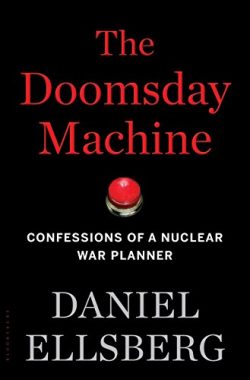
The Doomsday Machine, the title of Daniel Ellsberg’s superb book is not simply an imaginary contraption from a movie masterpiece. A Doomsday Machine uncannily like the one described in Dr. Strangelove exists right now. In fact, there are two such machines, one in US hands and one in Russia’s. The US seeks to hide its version, but Ellsberg has revealed that it has existed since the 1950s. Russia has quietly admitted that it has one, named it formally, “Perimetr,” and also tagged it with a frighteningly apt nickname “Dead Hand.” Because the US and Russia are the only nations with Doomsday Machines to date we shall restrict this discussion to them.
The Doomsday Machine was published just a little more than a year ago, but its terrifying message has failed to provoke action. And Daniel Ellsberg is a man who knows whereof he speaks; the subtitle of the book is “Confessions of a Nuclear War Planner,” which is how Ellsberg spent the early part of his career. What follows on this first anniversary of the book’s publication is a brief restatement of the main argument of the book and then a summary of Ellsberg’s plan of action. (Not included are memoirs and personal experiences of this remarkable, very intelligent and moral man, which are found in the book and which I recommend to flesh out the line of thought presented herein.) Ellsberg’s plan is to be considered a stop gap measure to remove the nuclear sword of Damocles hanging over our heads and allow time to move to total abolition of nuclear weapons, a much more arduous task. Hopefully this essay will serve as a reminder of Ellsberg’s warnings and as a call to act on them.
How Do the Doomsday Machines Work? – Two components:
What is the essence of a “Doomsday Machine”? The first component is a mechanism of launching nuclear weapons that is on hair trigger alert and not always in the hands of the Presidents of Russia or the US. The fact well concealed from the US public is that the US President or those in the line of Constitutional succession are not the only ones with a finger on the nuclear button, and the same is true in Russia. The second component of a Doomsday Machine is a weapon of such destructive force that it can kill billions in the immediate aftermath of an attack and then the entire human race and perhaps all animal life on earth.
The Launch Mechanism – Command and Control
Russia and the US each have a First Strike capability, that is the ability to strike the other with great force, destroy the other’s cities and industrial and military base – and knock out the other’s nuclear deterrent. The essence of a First Strike capacity is this ability to wipe out the deterrent of the other side or weaken it sufficiently that the remaining force could be intercepted for the most part. How can a targeted nation prevent the use of a First Strike? It must convince the adversary that such a strike is futile and will not destroy the deterrent of the targeted nation. The attacker must understand that he will not escape retribution, because the nuclear force of the targeted nation, its nuclear deterrent, will survive.
Launch on Warning – Hair Trigger Alert. The first measure to prevent the loss of deterrence in the event of a First Strike is to put the nuclear force on Launch on Warning or Hair Trigger Alert status. Most of us have heard about this, but we ought to quake in our boots every time the thought of it crosses our minds. Since the time to respond to a First Strike is only tens of minutes for an ICBM (Intercontinental Ballistic Missile) attack, which takes about 30 minutes to travel between the US and Russia, and even less time for a short or intermediate range missile, a targeted country must have its nuclear force loaded onto delivery vehicles and capable of being launched on warning of a nuclear attack. The weapons must be ready to go and launched before the country is struck. This is called “Launch on Warning” and the weapons are sometimes said to be on “Hair Trigger Alert.” (There is some imprecision to the terminology surrounding nuclear weapons, partly due the obfuscation used by the US in negotiations. Steven Starr gives an account of this imprecision and a brief glossary here. I will use terms that are easily understood and common sensical. And I will define them when necessary.)
Nuclear warheads that are loaded onto delivery vehicles are said to be “deployed,” and there were roughly 1600 such warheads loaded onto long range delivery vehicles, each, in Russian and U.S. hands in 2018. They are ready to be launched in minutes. (There are several thousand more warheads in reserve on each side but not “deployed.”) It is easy to see the danger inherent in this situation. The decision to launch must be made in minutes to prevent destruction of the nuclear deterrent and it would be hard to decide with certainty whether the warning of an attack was genuine or due to a technical malfunction. In fact, the signal that an attack is coming is always likely to be ambiguous. Even if the attack is real, the attacker will seek to hide it and so even then the signal will be ambiguous. Thus, even an ambiguous warning caused due to a technical malfunction must always be treated with seriousness and a decision to respond made within minutes.
That a decision of such moment must be made so quickly, under the gun if you will, is a disaster waiting to happen. A mistake is bound to occur with the passage of sufficient time. And it nearly did during the Cuban Missile crisis and again in 1983 when the Soviets detected an attack coming from the United States. According to established protocol the warning was sufficient for the Soviet officer in charge to inform the leadership that a nuclear attack on the U.S. should be ordered. But that officer, Lieutenant Colonel Stefan Petrov, refused to follow protocol and instead interpreted the warning of an attack as a false alarm, which it was. So, a launch of Soviet weapons did not occur. In Russia, Stefan Petrov who died recently is hailed as “the man who saved the world.” This is the nuclear powder keg on which we all sit.
Decapitation and Delegation – Unknowns have their finger on “the button.” The second measure to prevent loss of deterrence is Delegation. This is not widely known or understood. One aspect of a First Strike would be an attempt to knock out known command centers so that a retaliatory strike could not be ordered. This is known as Decapitation. The antidote to Decapitation is Delegation, that is others besides the Presidents and their immediate successors are authorized to press “the button.” It works this way. These “others” are located in secret command centers far from Washington or the Strategic Air Command Base in Colorado, both of which will be targeted in a Decapitation strike. If these secret centers find themselves cut off from communication with Washington or Moscow, then the assumption is made that a decapitating nuclear strike has occurred. In that event these “others” removed from the centers of power are authorized to the press the nuclear button!! (One can see why the Russians call their system of delegation, Perimetr.) These others are not elected officials and in fact we do not know who they are! What Ellsberg discovered is that some of these “others,” military men, were concerned that they too could be hit in a decapitating strike. So they had delegated authority to still others!! In fact, no one, perhaps not even the President and his circle of advisors, knows who can send off the nuclear weapons. Is it possible that one of them might be like the fictional General Jack D. Ripper, the psychotic and delusional man who gives the launch order in Dr. Strangelove – or a similar individual lusting after the Rapture?
It does not take much imagination to see the multiple ways in which things could go wrong; a launch due to a false alarm of attack and a lack of time to make a thoughtful check and decision; a failure of communication that puts the perimeter out of touch with the center although no decapitation has in fact occurred; or a mad man or woman or a crazed ideologue who becomes one of the Delegated. A terrorist attack with a nuclear weapon on Moscow or Washington could also mimic a Decapitating attack and set in motion the fast Delegation to the delegatee. The appropriateness of the term “Dead Hand” for this arrangement is striking.
It is true that so far as we know the probability of a mistake or a rogue element gaining control of nuclear weapons is small. (But the fact is we do not know what the situation is – it is hidden from us and perhaps even from elected officials.) The weapons are protected from rogue use by safety locks called Permissive Action Links (PALs) but these are not perfect, and they must be capable of activation by someone in the “perimeter” in the event of Delegation. And they are no protection against a false alarm of an attack. Despite how low the probability of an error might be, the dice are thrown every moment of every day, and with the passage of time, inevitably something will go wrong.
In summary, First Strike Capability is the source of the problem. It leads to Launch on Warning and Delegation by a targeted nation. The U.S. pioneered and maintains a First Strike Capability and refuses to adopt a “No First Strike” policy. Another response to a first strike capability is that the targeted nation will build up the numbers in its nuclear force so that some will always survive an attack. That is precisely what happened in the first Cold War until it reached insane levels as shown graphically here.
The Nuclear Weapon. The First Strike Arsenal.
Obliteration of Russia and the U.S. The second component of a Doomsday Machine is the weapon itself. What is the destructive power of the ensemble of nuclear weapons as used in a First Strike? I know of no such quantitative estimates released by the Pentagon for the present day. They are badly needed. But in 1961 when Ellsberg was among those working on nuclear war fighting strategy for the Kennedy administration, he asked for an estimate from the Pentagon of the deaths due to a First Strike as the generals and their civilian war planners had mapped it out at the time. To his surprise the estimate came back at once – the Pentagon had made it and kept it hidden. Launching of the nuclear weapons planned for use in a First Strike by the U.S. would result in the deaths of 1.2 billion from explosions, radiation and fire. That number was the number of deaths and did not include injuries. And it was only the result of US weapons; it did not include deaths from a response from the Soviet side if they managed one. 1.2 billion people was the toll at a time when the population of the earth was about 3 billion! (Note that this toll does NOT include the effects of nuclear winter which was unknown at that time. More on that below.) And of course, such deaths would be concentrated in the targeted countries which in these times would be the US and Russia. Ellsberg was stunned to learn that the Pentagon would coolly make plans for such a gargantuan and immediate genocide. And so should we all be. What kind of mindset, what kind of ethics, what kind of morality has allowed for such a thing!
Nuclear Winter and the Destruction of Humanity. But the damage does not stop there. This is the surprise that the Pentagon did not understand at the time. The ash from the fires of burning cities would be cast up into the stratosphere so high that it would not be rained out. There it would remain for at least a decade, blocking enough sunlight that no crops would grow for ten years. That is sufficient to cause total starvation and wipe out the entire human race with only a handful at most able to survive. This is Nuclear Winter. It is eerily reminiscent of Kubrick’s Doomsday Machine which resulted in a cloud of radioactivity circling the earth and wiping out all life. Nuclear Winter was first understood in the 1980s, but at that time careful assessment of the existing computer models seemed to indicate that it was not likely and so many “stopped worrying.” Now with the interest in Global Warming, new and better computer models have been developed. When the results of a nuclear first strike are put into these models, Nuclear Winter again makes its appearance as Brian Toon, Alan Robock and others have shown. The TED talks of Toon and of Robock describing their findings are worth watching; they are brief and well-illustrated. We are confronted with a genocide of all or nearly all humanity, an “Omnicide.”
The launch of the 1600 “deployed” warheads of either the US or Russia is sufficient to give us nuclear winter. So we in the US have put in place a weapon system on hair trigger alert commanded by we know not whom which can kill virtually all Americans – along with most everyone else on the planet. We have on hair trigger alert a weapon which is in fact suicidal. Use the weapon and we lose our very existence. We should also be clear that even if we prescind from the effects of nuclear winter, the nuclear attacks would be concentrated on Russia and the US. So most of us would be consumed. Thus MAD (Mutual Assured Destruction) is replaced with SAD (Self-Assured Destruction).
Disarming the Doomsday Machine
What is Ellsberg’s plan to disarm the Doomsday Machines? He does not suggest total abolition of nuclear weapons, a worthy and ultimate goal, as a first step. He suggests intermediate steps, which can be accomplished much more quickly and remove the present danger.
From what was said above, it is clear that the Doomsday Machine with its massive nuclear force, Launch On Warning and system of Delegation all grows out of a need to protect from a First Strike. The solution to the problem does not demand giving up all nukes or even a deterrent which many are loathe to do. And that is not hard to understand when we compare the fate of Kim Jong-un to that of Muammar Gaddafi or Saddam Hussein. Nor is it difficult to understand in the U.S. given the current intense Russophobia, or in Russia given the alarm caused by NATO’s drive to the East. This is one reason that total abolition of nuclear weapons or even abolition of a nuclear deterrent will be quite difficult. However, dismantling the Doomsday Machines, the immediate danger to humanity, does not demand giving up nuclear deterrence.
Abandoning First Strike Policy and Capacity. Dismantling the Doomsday Machine with its Hair Trigger Alert and Delegation does mean abandoning a First Strike policy and capacity. And right now, only two countries have such First Strike capacity and only one, the U.S., refuses to take the right to use it “off the table” even when not under attack. What does the elimination of First Strike Capacity mean in practice; how can it be achieved? This turns out to involve two basic steps for the US.
Dismantling the Minuteman III. First, the land-based ICBMs, the Minuteman III, must be entirely dismantled, not refurbished as is currently being undertaken at enormous cost. These missiles, the land-based part of the Strategic Triad, are highly accurate but fixed in place, “sitting ducks”; they are only good for a First Strike, for they will be destroyed in a successful First Strike by an adversary. Former Secretary of Defense William Perry and James E. Cartwright, formerly head of the Strategic Air Command and Vice Chair of the Joint Chiefs of Staff, have both called for dismantling the Minuteman III. We would thereby also save a lot of money.
Reducing the SLBM Force. The second step in dismantling the First Strike capacity is to reduce the Trident Submarine-Launched Ballistic Missile (SLBM) force to the level where it cannot destroy the entire Russian land-based missile force. With these two measures in place the US would no longer have a First Strike Capability, and so Launch on Warning and Delegation upon apparent Decapitation would both be unnecessary. It is that simple.
Of course, the Russians would also need to take similar measures that take into account the specifics of its arsenal. And that is where negotiations, treaties and verification come in. That in turn cannot take place in the current atmosphere of Russiagate and Russophobia, which is why both are existential threats and must be surmounted. We must talk despite our differences, real or perceived.
However, were the US and Russia to abandon their First Strike capacity, a reasonable deterrent could be preserved. Such a deterrent should be far below the threshold for a nuclear winter. When Herbert York, one of the original nuclear war planners and strategists, was asked how many nuclear weapons it would take to guarantee deterrence, he suggested somewhere between one and one hundred, closer to one, perhaps ten. Of course, such a small number demands giving up on a missile defense system which has been a will-o’-the-wisp since the 1950s. But would a leader of any nation, even one equipped with an Anti-Ballistic Missile system, when confronted with 100 nuclear warheads facing him or her, be willing to risk ten getting through and demolishing 10 cities?
But there is a deep problem here. The US at least has not built its nuclear forces with the simple object of deterrence. It has had the policy of being able to strike first and destroy or sufficiently degrade the Russian force so that there would be no retaliation. Ellsberg establishes that definitively based on his own experience in his days as a nuclear war planner. But this is also a will-o’-the-wisp. With Launch on Warning and Delegation both sides would be destroyed. So, this path must be abandoned. However, it is a path that has been trod for a long time. It has acquired many adherents and become embedded in the thinking of our “strategic war planners.” It will be hard to abandon this way of thinking which is what will make the simple steps outlined above politically difficult although technically and logistically quite simple. Moreover, in the mind of the public there is no clear distinction between First Strike and simple deterrence. And many favor a nuclear deterrent. So the movement for total abolition of nuclear weapons has a long way to go to reach its destination.
An additional measure – Eliminating launch on warning, aka “hair trigger alert,” that is, “De-alerting.” An additional measure has also been proposed. All nuclear warheads should be removed from deployed status by Russia and the US. (The oft-used term for this is “De-alerting.”). That is, the warheads should be removed from their delivery vehicles and stored in a way that would take days or even weeks to deploy – that is to remount. This has been proposed by the Global Zero Commission on Nuclear Risk Reduction which says of itself:
As world leaders descended on the United Nations in New York for the 2015 Non-Proliferation Treaty (NPT) Review Conference, the Global Zero Commission on Nuclear Risk Reduction — led by former U.S. Vice Chairman of the Joint Chiefs of Staff General James E. Cartwright and comprised of international military experts — issued a bold call for ending the Cold War-era practice of keeping nuclear weapons on hair-trigger alert.
The Commission’s extensive report calls for (1) an urgent agreement between the United States and Russia to immediately eliminate “launch-on-warning” from their operational strategy, and to initiate a phased stand down of their high-alert strategic forces….; and (2) a longer-term global agreement requiring all nuclear weapons countries to refrain from putting their nuclear weapons on high alert.
Urgent action is needed, according to the Commission, because of heightened tensions between the United States and Russia, ongoing geopolitical and territorial disputes involving other nuclear countries that could escalate, and an emerging global trend toward placing nuclear weapons on high alert.
The proposal, backed by more than 75 former senior political officials, national security experts and top military commanders, makes the case that a multinational de-alerting agreement could greatly mitigate the many risks of nuclear weapons use, including from computer error, cyber launch, accidental detonations, unauthorized “insider” launch, false warning of enemy attack, and rushed nuclear decision-making.
The full report is here.
Such an arrangement must be solidly negotiated and verifiable. It would seem that the US President could do this by executive order and at little cost. For submarines the nuclear warheads would be stored on shore in a way that makes it impossible to reload for the period of delay that is negotiated. This arrangement means that no decisions about nuclear warfare need be taken at a moment’s notice, no launch on warning is possible or even relevant any longer and the possibility of Decapitation and the consequent necessity of Delegation disappear. And when either nuclear state feels existentially threatened by conventional forces, its first response need not be to fire a nuclear weapon. Its first response could be to deploy its warheads (that is, reload the launch vehicles) while it negotiates over the threat. That along with Ellsberg’s suggestions would greatly stabilize the world and lessen to almost zero the probability of nuclear war based on misjudgment or accident. From there the work on ever greater levels of reduction leading eventually to total abolition of nuclear weapons could go forward.
The Work Ahead to Win Support for Dismantling the Doomsday Machines
To be able to get Congress or the Executive to move toward these changes, a number of things will be necessary. First is information. As a very basic example, Ellsberg learned in 1961 that a US First Strike at that time would produce 1.2 billion deaths as an immediate result of Nuclear War, excluding any effects of nuclear winter and excluding a Soviet response. We deserve to know what those numbers are now. Here, Ellsberg argues, both public pressure and the work of whistle blowers will be needed. As another example, we need to know from the Pentagon and the National Academy of Sciences whether the result of a US First Strike of the magnitude now on hair trigger alert would lead to nuclear winter – as it seems almost certain it would.
But far more than that would be needed. There must be some form of pressure to wake up the politicians and force them to dismantle the Doomsday Machines. But this is missing. In part with the end of the First Cold War, many thought that the danger had disappeared. Clearly it has not. A movement to abolish the Doomsday Machine is a threat to the Military Industrial Complex and so the MIC and its media acolytes would prefer silence or opposition to such efforts. It may be that the generations which lived through the first Cold War and went through its terrors, from “duck and cover” drills to mushroom cloud nightmares, to the Cuban Missile Crisis may have a special role to play. Their psyches have been most affected by nuclear horrors and they may be the best ones to convince succeeding generations of the dangers. But the strategy and tactics for such an effort have yet to be outlined. It is a task that lies before us.
The first step to sanity is to eliminate launch on warning and the second step would be to rid ourselves and the Russians of a First Strike policy and capacity and negotiate a stable deterrent, small enough that it does not threaten nuclear winter. That is something that the nuclear powers and the broad public can easily accept despite the opposition of a small number of nuclear war fighters. Here the idea of negotiations is not to make the other side more vulnerable but to give the “adversary” and oneself a small, stable nuclear deterrent. Such a win-win approach to negotiations is in fact necessary for survival while we take the more difficult road to total nuclear abolition.
Total abolition should be the ultimate goal because no human hand should be allowed to wield species-destroying power. But it seems that an intermediate goal is not only needed to give us the breathing space to get to zero nuclear weapons. An intermediate and readily achievable goal can call attention to the problem and motivate large numbers of people. The Nuclear Freeze movement of the 1980s is a very successful example of this sort of effort; it played a big role in making the Reagan-Gorbachev accords possible. The effort to kill the Doomsday Machines might well be called something like Step Away From Doomsday or simply Step Away. The time may be ripe for such an effort. Getting to zero will require a breakthrough in the way countries deal with one another, especially nuclear armed countries! Let us give ourselves the breathing space to accomplish that.
John V. Walsh can be reached at john.endwar@gmail.com He writes about issues of war, peace and empire, and about health care, for Consortium News, DissidentVoice.org, Unz Review and other outlets. Now living in the East Bay, he was until recently Professor of Physiology and Cellular Neuroscience at a Massachusetts Medical School.
Featured Video

Iran’s Next Strike May Not Explode. It Could Shut You Down
or go to
Aletho News Archives – Video-Images
From the Archive
Zionism’s Violent Legacy
By Donald Neff | Washington Report On Middle East Affairs | January 1996
On January 4, 1948, Jewish terrorists drove a truck loaded with explosives into the center of the all Arab city of Jaffa and detonated it, killing 26 and wounding around 100 Palestinian men, women and children.[1] The attack was the work of the Irgun Zvai Leumi – the “National Military Organization,” also known by the Hebrew letters Etzel – the largest Jewish terrorist group in Palestine. The Irgun was headed by Revisionist Zionist Menachem Begin and had been killing and maiming Arabs, Britons and even Jews for the previous ten years in its efforts to establish a Jewish state.
This terror campaign meant that at the core of Revisionist Zionism there existed a philosophical embrace of violence. … continue
Blog Roll
 Aletho News
- Trump’s Iran war is on an Israeli leash
- Saudi oil boss issues global supply warning
- Riyadh Says Its Oil System Is Intact. The Numbers Say Otherwise.
- Trump and Netanyahu Want to “Finish the Job” on Iran
- US ‘one-sided dictation’ not Iran’s beliefs makes rational talks impossible: Baghaei
- Iran’s Next Strike May Not Explode. It Could Shut You Down /Col Doug Macgregor
- Iran: US political targets legitimate if assassinations return
- Iraq shuts key border crossing with Iran under US pressure: Report
- Undersea Internet cables could be targeted in retaliation for attacks on Iran: IRGC deputy chief
- EU sending ‘biased’ observers to interfere in Serbian election – president
- If Americans Knew
- The Israel Lobby’s Changing Fortunes
- AIPAC has become such a political liability that it’s shifting to a more “nimble” approach to buying politicians
- At least 160 Israeli settler attacks in 2 weeks
- Will Gaza’s Ancient Christian Community Disappear Forever?
- Israel’s vision of regional security rests on keeping Arab states weak
- Heidi Levine recounts how Palestinian youths helped save her in settler attack
- DAILY UPDATE: Latest essential news on Palestine, Israel, & region
- Trump’s Intensifying Sabotage of the ICC, for Israel’s Sake
- Israeli military detain US and UK volunteers in West Bank including Democratic NY politician Brad Lander
- Americans at National Conservatism Conference held in Israel this year criticize Israel
- No Tricks Zone
- E-Cars Reduce CO2 Emissions By Only 41% Compared To Internal Combustion Engine Vehicles
- Predictions Made By Renowned Climate Professor Over Past Decades Have Been Proven To Be Poor
- New Study Suggests Large Regions Of The Pacific Ocean Have Been Cooling For The Last 80 Years
- Germany’s Green Energy Debacle: High Energy Costs Force Kahla Porzellan to Close After 182 Years!
- New Study: 50 Years Of The Most Aggressive ‘Net Zero’ Policies Can Only Affect The Global Climate By 0.03°C
- US September “Heat” Was No Record…Many Records Set Decades Ago
- Latest European Green Energy Debacle; Portugal’s Largest Flagship Solar Park Insolvent!
- Green Energy Debacle: German Expert Professor Fritz Vahrenholt Warns Of Severe Economic And Social Consequences
- Two More Paleo Reconstructions Affirm Meters-Higher Sea Levels Across Ireland, Brazil 7000-6000 Years Ago
- New Study: Earth And Venus Surface Warmth Largely Explained By Convection And Lapse Rate, Not CO2 Or Radiation

