‘Someone will make money by stoking fears’ – Ron Paul on new US missile doctrine
RT | January 18, 2019
The new US missile defense strategy is a boondoggle for the military-industrial complex, which will drive the US into more debt and can bring misery upon multiple nations by fueling an arms race, ex-US Congressman Ron Paul said.
Plans to weaponize space with a new layer of sensors unveiled by Trump as part of his administration’s Missile Defense Review is an unnecessary and hard-to-implement project that is sure to enrich the military-industrial lobby, Paul told RT.
“The biggest issue here is someone is going to make a lot of money on it. It reminds me of Star Wars. They’ve never really developed it, but people got excited about it,” Paul said, drawing parallels between President Donald Trump’s new endeavor and former President Ronald Reagan’s Strategic Defense Initiative program.
Addressing the Pentagon on Thursday, Trump said that the goal of deploying ground-based interceptors to Alaska and sensors in space is to stop missile launches by hostile powers over their own territory.
Paul says the scale of the threat to US security has been overblown and does not warrant such extravagant means, which might not end up being efficient.
“I’m all for having defensive weapons if necessary, but I can’t quite see the danger that they are talking about that we have to now go much further into debt on something that can take many, many years and there are questions on how well it would work,” he said.
The mammoth project is another way of throwing more money at the military, Paul said, noting that the US is “already running a trillion-dollar debt every year” and will have to borrow money to pay for the futuristic missile defense shield.
National debt stands at over $21 trillion and continues to surge, with the federal deficit projected to top $1 trillion by 2020.
While it remains to be seen if Congress approves the major increase in funding that would be required to implement Trump’s plan, Paul says it’s unlikely to be nearly as contentious as Trump’s $5bn border wall that triggered a record-breaking government shutdown.
“But it seems like the money they spend on the military-industrial complex never gets the same scrutiny as some of these political issues,” Paul said.
Defense, unlike other political issues, tends to transcend party lines, as it “is more involved with money than anything else.”
“Fiscal conservatives are big spenders as much as liberals,” he said.
Of course, it also comes in handy to have the “usual scapegoats, the countries that they are able to stir animosity towards.”
The US will inevitably whip up an arms race if it adopts the new strategy, since no country singled out in the review – such as Russia, China, and ‘rogue nations’ Iran and North Korea – are going to ignore the US military beef-up. Those who will suffer the most from this are ordinary people who will have to carry the burden of the defense costs.
“Often these arguments get carried away to the point when one side is up-betting another side, building more and more and the only people that seem be really hurt from this are the people of the countries whose finances are drained,” Paul said.
And to consent to such massive spending, people have to be intimidated, the ex-congressman believes – thus, the negative media response to Trump’s announced withdrawal from Syria or thawing relations with North Korea.
“As if we’ve just created WWIII by suggesting they are not going to stay there,” Paul said, adding that the military-industrial complex profiteers and pro-war politicians appear to be in control of the propaganda machine.
US House Armed Services Committee Objects to Investment in Space Interceptors
Sputnik – 18.01.2019
WASHINGTON – US House Armed Services Committee Chairman Adam Smith in a statement on Thursday objected to plans in the new Missile Defense Review (MDR) to invest in cost-prohibitive space-based interceptors and warned that the new strategy may drive Russia and China to boost their nuclear arsenal.
“I am concerned that this missile defense review could lead to greater investment in areas… such as a space-based interceptor layer that has been studied repeatedly and found to be technologically challenging and prohibitively expensive,” Smith said.
Smith also warned that the United States must avoid creating missile defense policies that will fuel a nuclear arms race.
“Strategic stability is an important part of US national security, but missile defense policies that incentivize Russia and China to increase their nuclear arsenals will not serve the best long-term interest of the United States,” Smith added.
Earlier today, the Trump administration rolled out its 2019 Missile Defense Review which presents a new strategy and posture that will set the path to strengthen the United States’ current missile defense capabilities and make the case for urgent investment into new ones.
In particular, the US Missile Defense Agency (MDA) will study the possibility of investing in a space-based missile intercept layer capable of boost-phase defense. The MDA is tasked with delivering the assessment within the next six months.
The defense system is reportedly designed to destroy missiles before they re-enter the Earth’s atmosphere. In 2016, an interceptor rocket and its ground-based targeting system successfully completed the tests in a program to develop a missile defense capable of hitting targets on the edge of outer space, according to various media reports.
Debris of INF treaty will fall far and wide
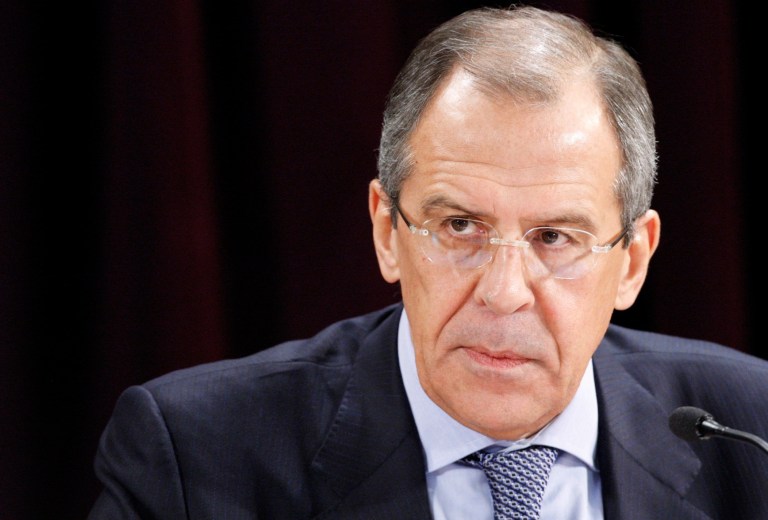
By M. K. BHADRAKUMAR | Indian Punchline | January 17, 2019
The US-Russia talks in Geneva regarding the 1987 Intermediate-range Nuclear Forces (INF) treaty have ended in failure. In a final call to salvage the treaty, Moscow offered that American experts could inspect a new suspect Russian missile, which Washington has been citing as the alibi for its decision to quit the treaty, but the US point-blank rejected the offer and instead went on to reconfirm that it intends to suspend observance of the cold-war era pact with effect from February 2.
We are entering uncharted waters in regional and international security. Russia anticipates increased US deployments near its borders. In an interview with government-daily Rossiyskaya Gazeta, Russia’s Security Council Secretary Nikolai Patrushev said on Tuesday, “In general, our analysis shows that the American presence near our borders will grow… As for Russia’s western borders, we note the course for the growth of military presence of the US and other NATO members in their vicinity. In 2019, placement of multinational battalion tactical groups in Latvia, Lithuania, Estonia and Poland will continue. At the same time, Brussels does not hide the fact that its main goal is to contain our country. The strengthening of the European segment of the US global missile defense system continues. The inauguration of the missile defense complex in Poland in addition to the already functioning one in Romania is expected in 2020.”
Equally, new faultlines are appearing. Moscow anticipates further US missile deployments to Northeast Asia – specifically, Japan. Moscow estimates that it is unrealistic to expect Japan to adopt an independent foreign policy. This geopolitical reality in Northeast Asia is in turn casting shadows on the recent improved climate in Russo-Japanese relations. (See my blog Russia tamps down the Kuril hype.)
Following the foreign-minister level talks in Moscow on Monday between Russian Foreign Minister Sergey Lavrov and his Japanese counterpart Taro Kono, the latter showed reluctance to hold a joint press conference, underscoring the rapidly changing climate of ties between the two countries. Lavrov’s remarks to the media later signaled a marked toughening of the Russian stance on the territorial dispute over Kuril Islands.
Lavrov demanded an outright Japanese recognition of Russian sovereignty over all the islands in the Kuril chain as part of the outcome of World War 2, as accepted under international treaties and by the UN – “Japan’s indisputable recognition of the entirety of results of World War 2, including Russia’s sovereignty over all of the islands of the southern Kuril chain,” as Lavrov put it.
Lavrov said Japanese domestic legislation must accordingly be changed in consultation with Russia. He added, “This is our base position and without steps in this direction it is very difficult to expect movement forward on other issues (such as peace treaty).”
Evidently, in the developing post-INF treaty scenario, Japan’s security alliance with the US now becomes a major hurdle in Russo-Japanese relations. Lavrov specifically pointed a finger at this: “The 1956 Declaration was signed when Japan did not have a military alliance treaty with the US. The treaty was signed in 1960, after which our Japanese colleagues departed from the 1956 Declaration. Now that we are resuming talks on the basis of this declaration, we must consider the drastic change that has taken place in Japan’s military alliances since then. At today’s talks we devoted attention to the US efforts to develop a global missile defence system in Japan with a view to militarising that part of the world and also to the actions that the US formally justifies by citing the need to neutralise the North Korean nuclear threat. In reality, these actions are creating security risks for Russia and China.”
Interestingly, Lavrov brought in the common concern of Russia and China with regard to the US-Japan security alliance and the American missile deployments to Japan. This is a snub to Tokyo inasmuch as recently, Abe’s aide in the ruling Liberal Democratic Party (which Abe heads) had made a provocative statement that the US should be interested in concluding a treaty between Russia and Japan, as this would “strengthen the bloc” to contain China. Lavrov called it an “outrageous statement” and put across as bluntly as he could the Russian indignation over any Japanese ploy to create misperceptions regarding Russia-China relations:
“The problem is that the president of the Liberal Democratic Party is Prime Minister Shinzo Abe. We have issued a serious warning about how inappropriate such statements are. We have also inquired more broadly about how independent Japan can be in addressing any issues at all with such heavy dependence on the United States. We were assured that Japan would make decisions based on its national interests. We would like it to be that way.” (See a detailed report by China Daily titled Russia tells Japan retaking Pacific islands not on horizon.)
As much as in regard of Russia’s western borders with Europe, the Asia-Pacific also becomes a region where Moscow’s policies will be significantly influenced by the new climate in international security. This holds good for other regions, too.
Most certainly, Russia will be even more wary of any open-ended US-NATO occupation of Afghanistan. The Russian-American contestation over Turkey will become more complex. (The US missile deployment in Turkey was a core issue during the Cuban missile crisis of 1962.) Again, there are reports that a massive expansion of the US bases in Qatar is unfolding (where the US Central Command is headquartered.) Qatar is a potential site for the deployment of US missile systems. Indeed, in the circumstances, Russia’s relations with Iran assume a highly strategic character. Iran’s strategic autonomy is of vital interest to Russia.
The Balkans is another region that Russian strategies will prioritize. Putin is embarking today on a visit to Serbia, which is a key ally, but where conditions may arise for a potential standoff between the West and Russia as had happened in 2014 in Ukraine. In an interview with the Serbian media, Putin came down heavily on the NATO expansion policy, which he condemned as “a misguided, destructive military and political strategy.” He accused the Alliance of “trying to strengthen its presence in the Balkans.” No doubt, a period of heightened tensions in international security lies ahead with the US decision to abandon the INF treaty.
There’s More to Russia than Meets the Eye
By James V. DeLong | American Thinker | January 15, 2019
While I have only a concerned citizen’s knowledge of foreign affairs, I am baffled by the hysterical Russophobia of the MSM and the Democratic Party since the 2016 election.
As far as I can tell, there should be no real issues between Russia and the U.S. Ukraine or Crimea is freighted with questions of local ethnicity and brutal history and should be sorted out by the parties, or at most by Europe. We have no stake. As for the defense of Europe, it is not credible that Russia has designs on an entity that so outweighs it in population and wealth. Trump was right to point out that the Europeans themselves do not believe in the threat, since they are happy to shortchange defense while relying on Russia for natural gas. Why would the Russians send tanks when shutting a valve would cripple Germany?
I do not really understand why either nation is in Syria, and any Russian intervention in the 2016 election was trivial. In any case, of course the Russians want to influence our elections. We are the world’s 800-pound gorilla (or bull in the china shop), so everyone wants to influence our elections, and who can blame these people? People all over the world live and die depending on the self-centered whims of whoever holds power in the U.S. – just ask Moammar Gaddafi (“we came, we saw, he died“). Saudis, Israelis, Europeans, Brits, and many others have been meddling for decades and will continue to do so. So grow up, MSM.
Irritated by the repetitive triviality of the press, I began searching for sources that would broaden and deepen my perspective. Indeed, I found an avalanche of web material that rarely makes it through the gatekeepers in the U.S. The quality and honesty of these varies greatly, but, to help out readers who share my unease about the information they are getting from the MSM, or even from many U.S. conservative sites, I will list a few that are worth your attention because, in my estimation, they are intelligent observers who know what they are talking about and who are trying to tell their readers the truth as they see it.
Russia Observer is the site of Patrick Armstrong, a former analyst in the Canadian Department of National Defense. He writes a column on some current issue every week or so, plus a useful biweekly “SitRep” covering many issues in terse style. His orientation as follows:
[T]he predominant theme of my career was that we had a great opportunity when the USSR disappeared to make a more cooperative world. Instead, we have steadily turned Russia into an enemy – and a much more capable one than we casually assumed in the 1990s.
So here we are today. Paying for our arrogance, incompetence and maybe worse.
But I haven’t given up hope.
Everything Armstrong does is first-rate. His work also appears at Strategic Culture, a Russophile site that publishes dozens of authors of multifarious perspectives, but with a commonality that none is a fan of the U.S.
Irrussianality is the work of Paul Robinson, another Canadian, who teaches at the University of Ottawa. He writes every few days on “the relationship between Russia and the West; and the apparently irrational decision making processes which dominate much of international relations.” Again, everything he does is worthwhile. He also has an interesting blog roll, which I have only begun to explore.
Stephen F. Cohen is professor emeritus of Russian Studies at NYU and Princeton. He has been working the Russian beat at The Nation for several years, warning that something has gone seriously askew, and his new book of columns, War with Russia: From Putin & Ukraine to Trump & Russiagate, demands attention. To recommend the lefty Nation seems a bit droll, but virtue is where you find it.
What will you learn from these? Not long ago, Patrick Armstrong said, in Back to the USSR: How to Read Western News:
[H]as any Western news outlet reported, say, these ten true statements?
- People in Crimea are pretty happy to be in Russia.
- The US and its minions have given an enormous amount of weapons to jihadists.
- Elections in Russia reflect popular opinion polling.
- There really are a frightening number of well-armed nazis in Ukraine.
- Assad is pretty popular in Syria.
- The US and its minions smashed Raqqa to bits.
- The official Skripal story makes very little sense.
- Ukraine is much worse off, by any measurement, now than before Maidan.
- Russia actually had several thousand troops in Crimea before Maidan.
- There’s a documentary that exposes Browder that he keeps people from seeing.
I typed these out as they occurred to me. I could come up with another ten pretty easily. There’s some tiny coverage, far in the back pages, so that objectivity can be pretended, but most Western media consumers would answer they aren’t; didn’t; don’t; aren’t; isn’t; where?; does; not; what?; never heard of it.
Recently, at “The Blob Strikes Back,” Paul Robinson discussed Trump’s plan to withdraw from Syria:
The most recent [defense policy story] … could be well titled ‘The Blob Strikes Back’ – the ‘Blob’ being a derogatory term for the American security establishment, an amorphous being which defies easy definition and is decidedly hard to pin down, but which exerts enormous power and which seems to be impervious to outside realities, continuing along its chosen path regardless of all the disasters it confronts, and causes, along the way. … Starting wars is something the American security establishment can cope with; ending them is something which causes it real difficulties.
Stephen Cohen’s most recent column asks, “Do Russiagate Promotors Prefer Impeaching Trump to Avoiding War with Russia?“:
In large part due to … media malpractice, and despite the escalating dangers in US-Russian relations, in 2018 there continued to be no significant anti-Cold War opposition anywhere in mainstream American political life – not in Congress, the major political parties, think tanks, or on college campuses, only a very few individual dissenters. Accordingly, the policy of détente with Russia, or what Trump has repeatedly called “cooperation with Russia,” still found no significant supporters in mainstream politics, even though it was the policy of other Republican presidents, notably Eisenhower, Nixon, and Reagan. Trump has tried, but he has been thwarted, repeatedly again in 2018.
Agree or disagree, the points made by these authors are serious, and they deserve attention and discussion, not oblivion. They are not made in the MSM.
For those who wish to delve, here is one more recommendation.
Vladimir Putin has a website that prints English transcripts of his torrent of speeches, communiqués, and meetings. Putin is quite available; he meets frequently with groups of all stripes and holds news conferences that last for three or four hours. As with all politicians, total candor is improbable, but, on the other hand, he must use these events to communicate with Russia’s many constituencies, so one learns at least what he wants people to think he thinks, whether or not it is what he really thinks.
The Putin of these materials is not at all the thug of the MSM. One can read his remarks at the 2017 dedication of the Wall of Sorrow, a memorial to the victims of political repression, which, with other statements, expresses a clear understanding of need to keep green the memory of the Bolshevik tragedy.
Here one can read his 2018 Presidential Address to the Federal Assembly. Like a U.S. State of the Union address, it genuflects to multifarious interest groups, but it also places great emphasis on the importance of civil society. Putin is on the same page as the American conservatives who keep saying politics is downstream from culture. The speech also contains Putin’s view of the military balance, explaining why he thinks Russia can forestall any aggression by the U.S. while spending a tenth as much.
As stated above, agree or disagree, but it is better to read Putin’s own words than to have his thoughts filtered through the MSM. His speeches are far more substantive than what one gets from our own politicians. (In any case, whom are you going to believe – Chuck Schumer and Nancy Pelosi or Vladimir Putin? It’s not even close.)
Like Patrick Armstrong, I am appalled at the direction taken by Russian-American relations, but neither have I given up hope. Reading Armstrong and his confreres may help lead to a path out of this potentially deadly slough of misinformation.
James V DeLong is a retired lawyer, government official, and think-tank analyst.
Pyongyang Urges End of Foreign Military Exercises on Korean Peninsula – Envoy
Sputnik – 15.01.2019
Pyongyang calls for abandoning military exercises involving foreign forces on the Korean Peninsula, North Korean Ambassador to Russia Kim Hyun Joong said Tuesday.
“In order to eliminate military hostility between North and South Koreas in a fundamental way and turn the Korean Peninsula into a lasting and eternal peace zone, it is necessary to abandon conducting military exercises with foreign forces because North and South Korea agreed to follow the path of peace and prosperity,” Joong said at a dinner marking the occasion of the New Year at the Embassy of the Democratic People’s Republic of Korea in Moscow.
Joong went on saying that it was also necessary to abandon foreign strategic weapons on its territory.
The ambassador stressed that multilateral negotiations should be conducted with the aim to establish a system of peace on the Korean Peninsula through close cooperation with the countries that had signed an armistice agreement.
Pyongyang was ready to establish new relations with the United States in accordance with the spirit of the era and wishes of the people, the diplomat noted.
He further added that North Korean leader Kim Jong Un in his New Year’s speech declared his readiness to meet with US President Donald Trump once again.
The situation on the Korean Peninsula has improved since the beginning of this year. During this time, North Korean leader Kim Jon Un and South Korean President Moon Jae-in have held several meetings, while Kim even had a historic summit with US President Donald Trump. This summit yielded an agreement stipulating that North Korea would make efforts to promote the complete denuclearization of the peninsula in exchange for the United States and South Korea freezing their military drills as well as the potential removal of US sanctions.
READ MORE:
Trump Sends Letter to North Korean Leader Amid Preparations for Summit — Reports
‘NATO Has Outlived Its Usefulness & Should Go Into Dustbin of History’ – Scholar
Sputnik – January 15, 2019
On Monday, The New York Times cited unnamed senior administration officials as saying that US President Donald Trump has ostensibly questioned US membership in NATO and expressed a wish to withdraw the country from the bloc.
Radio Sputnik has discussed the report with Dr Joseph Cheng, Professor of Political Science at the City University of Hong Kong.
Sputnik: What are your thoughts on the report that US President Trump repeatedly expressed his wish to withdraw the country from NATO?
Dr. Joseph Cheng: Well, Trump as a businessman has approached this from the point of view of finances and of course until very recently only four other members of NATO paid the 2 percent of GDP — Britain, Poland, Greece, and Estonia — which he found unsatisfactory. But I believe there are other reasons why NATO has outlived its usefulness, including that, instead of serving as a defensive organisation against a no longer extent Soviet Union, it’s being used for wars of aggression such as the slaughter in Libya, which was orchestrated by Hillary Clinton with the approval of Barack Obama and John Brennan. It was a great atrocity of one of the most humane societies ever realised on the face of Earth.
And now I think the fact that there has been an encroachment on the Eastern Bloc nations [that] Ronald Reagan had solemnly agreed with Mikhail Gorbachev that they would not be weaponised, westernised, no attempt to be made become NATO nations that the United States has grossly violated, beginning with Bill Clinton. And therefore, I believe that withdrawing from NATO and allowing NATO to fall apart would be a good thing for the world, for Europe, for the United States altogether.Sputnik: Professor, the report by The New York Times details Trump’s alleged words dating back to last summer. Why is the media outlet reporting about this now?
Dr. Joseph Cheng: Well, that’s a great question. There has been a massive assault on Trump by the mainstream media and the Democrats because he is being far more successful than they had ever imagined. He has strengthened the American economy prior to the midterms, for example. He had a 50 percent approval rating according to the Rasmussen Poll. He even had a 40 percent approval rating from black Americans. This is devastating potentially to Democrats because if they lose the black vote on which they count having 90 to 95 percent, they are going to have great difficulty winning elections. This is another reason why they are opposing the wall. They want immigrants to come into the United States because they expect they are going vote Democratic. So I believe this is part of an ongoing effort to trash Trump, where the media is reporting only the Democratic version of events, which we know of course, was long since infiltrated by the CIA, in Operation Mockingbird beginning in the 1950s.
Sputnik: Professor, can Donald Trump actually withdraw the United States from NATO, like he withdrew from various other organisations?
Dr. Joseph Cheng: Well, of course, if the president the suggested that might be possible I would have to look at the legalities involving it, but certainly, some of his decisions of the past have been poor ones, withdrawing from the Iran agreement, for example, was not well founded. That was very-very troubling because it made it appear as though he was following an Israeli foreign policy rather than American. The three reasons he gave, namely that the treaty would expire in 2025 was meaningless because it could be renegotiated; that it didn’t cover Iranian military bases that would have been appropriate because it was only concerned with Iran’s nuclear programme and the fact that it didn’t cover Iran’s ballistic missile development was also inappropriate because every sovereign nation is entitled to its own self-defence. So he made a blunder with regard to the Iran deal. My personal opinion is, however, is that NATO has long since outlived its usefulness and should go into the dustbin of history.
Sputnik: How badly does Europe need the US in the bloc? Could they move to be more independent from the US?
Dr. Joseph Cheng: Well, I think that there are many reasons why Europe is growing more independent and, in fact, I think that there is a much more natural reliance between Europe and Russia for example than between Europe and the United States at this point in time; particularly on commercial and economic grounds. The Iran sanctions, for example, have threatened to cost Europe tens of billions of dollars in trade and commerce. So that is all very bad, detrimental to Europe to pursue a policy of sanctions on Iran that was not justified in the first place; where even American intelligence agencies as early as 2007 have concluded that Iran was not pursuing a nuclear weapons programme, which they reaffirmed in 2011 and D-D from the Mossad came on board in 2012 that Iran was not pursuing nuclear weapons, which means these sanctions which are harmful to Europe and to the rest of the world are a bad idea. And of course, pulling out of the Iran deal was not justified from the beginning. So, hopefully, he will display more wisdom in foreign policy than he has heretofore.
Washington in Panic Mode as Trump Reportedly Mulled Withdrawal From NATO
Sputnik – 15.01.2019
Since taking office in 2017, Donald Trump has on a multitude of occasions slammed NATO member states for failing to meet their annual defence spending obligations and insisted on fair burden-sharing.
Over the course of 2018, US President Donald Trump repeatedly expressed a willingness to withdraw from NATO, The New York Times reported, citing current and former senior administration officials.
Although the unnamed sources said that they were not sure if Trump was serious, they allegedly feared that POTUS would return to his threat as other alliance member states failed to boost their military donations to NATO and reach the spending target set by the bloc.
Days ahead of a NATO summit in Brussels last summer, Trump purportedly questioned the alliance’s raison d’être while speaking to senior national security officials, describing it as an exhausting burden on the United States.
The New York Times report suggests that Trump complained about Europe’s failure to meet defence spending goals, thus leaving the US to “carry an outsize burden”.
POTUS was allegedly frustrated with the fact that his transatlantic allies would not, on the spot, pledge to donate more. But at another leaders meeting during the same summit, NATO Secretary-General Jens Stoltenberg praised Washington’s example and suggested that European member states follow suit — Trump was allegedly taken by surprise.
Trump was purportedly annoyed, in particular, with German Chancellor Angela Merkel and her country’s military spending of 1 percent of its GDP.
At the time, then-Defence Secretary Jim Mattis and White House National Security Adviser John Bolton struggled to stick to American strategy without mentioning the potential withdrawal that would inevitably undermine Washington’s influence in Europe and embolden Russia, the newspaper wrote.
According to The New York Times, national security advisers are increasingly concerned over a possible pullout from NATO, as well as Trump’s purported efforts to keep his encounters with Russian President Vladimir Putin secret from his own aides, and an ongoing investigation into the alleged collusion between the Trump campaign and the Kremlin.
“It would destroy 70-plus years of painstaking work across multiple administrations, Republican and Democratic, to create perhaps the most powerful and advantageous alliance in history. And it would be the wildest success that Vladimir Putin could dream of”, Michèle A. Flournoy, an under-secretary of defence under President Barack Obama, told the media outlet.
The newspaper further cited retired Adm. Gen. James G. Stavridis, the former supreme allied commander of NATO, who said that “even discussing the idea of leaving NATO — let alone actually doing so — would be the gift of the century for Putin”.
After The New York Times reached the White House for comment, a senior administration official cited Trump’s remarks in July 2018, when he described Washington’s commitment to the military alliance as “very strong”, with the bloc itself being “very important”.
The insiders, who spoke to the newspaper on condition of anonymity, assumed that with a weakened NATO, President Putin would have “more freedom to behave as he wishes”, thus setting up Russia as a “counterweight” to the United States and Europe.
Although President Trump has not publicly threatened to leave the transatlantic alliance, relations between the US and Europe have hit their lowest point since he blasted other NATO members for not complying with their obligations to boost defence spending.
Trump has on numerous occasions emphasised that the other members of the bloc should pay their “fair share” and stressed that only five of the 29 member states were spending two percent of their GDP to defence, which was “insufficient to close gaps in modernising, readiness and the size of forces”.
On the sidelines of a NATO summit in Brussels in July, the allies agreed to start spending two percent of their GDP by 2024, with Trump pointing out that he was convinced that they would increase defence expenditures in line with their commitments.
At the same time, the US president suggested raising the military spending commitment up to four percent of GDP – that proposal, however, failed to find support.
US atomic bomb and missile tests crowded them onto Ebeye. Now their former Marshall Islands paradise is “the Slum of the Pacific.”

Photo by Vlad Sokhin shows North Camp, one of the most populated areas on Ebeye. Ebeye is the second most densely populated city in the world, home to at least 15,000.
By Vlad Sokhin | Beyond Nuclear International | November 25, 2018
The tiny island of Ebeye in Kwajalein Atoll, Marshall Islands, has a total area of 0.36 square kilometres and is home to over 15,000 people, most of whom were moved there from nearby islands because of a US Army missile range-testing program that was launched in the late 1940s. Overcrowding, poverty, outbreaks of infectious diseases and a high level of unemployment has led some to refer to Ebeye as the ‘ghetto of the Pacific’. Until the 1940s, the island’s population was negligible. During the Second World War, Japan occupied the Marshall Islands and moved some 1,000 settlers there and when the US captured the islands in 1944, a new naval base and the movement of people from other parts of the Atoll rapidly augmented Ebeye’s population.
In preparation for ‘Operation Crossroads’, an extensive missile testing programme that would eventually comprise 67 blasts, the US military decided to move all non-US personnel from around the Kwajalein Atoll onto Ebeye, which lies around five kilometres north of Kwajalein Island, the largest in the Atoll. On 1 March 1954, under the code name of ‘Castle Bravo’, the US military detonated a dry fuel hydrogen bomb on Bikini Atoll, in the north of the island chain, which was to be the most powerful nuclear device ever exploded by the United States. Though the Bikini Islanders had been persuaded to relocate to a neighbouring island in 1946, where they had suffered shortages and malnutrition, members of other nearby communities on Rongelap island were not evacuated until 3 days after the blast, causing many to suffer the effects of radiation sickness and birth defects.
Keen to return to their ancestral lands, Bikini islanders were tentatively allowed to come back to their homes three years after ‘Castle Bravo’ but had to be moved again after many developed leukaemia and thyroid tumours.
Over the coming decades, some islanders continued to return and try to reestablish their old communities but periodic tests of the soil, water and plant life on Bikini islands consistently suggested that the place had been so polluted by the nuclear fallout of ‘Castle Bravo’ and other tests that it was unsafe to live on the Atoll any longer. Many Bikini Islanders ended up on Ebeye, now the most densely populated of the Marshall islands, with the help of Greenpeace which in 1985 organised a mass evacuation from areas affected by fallout.
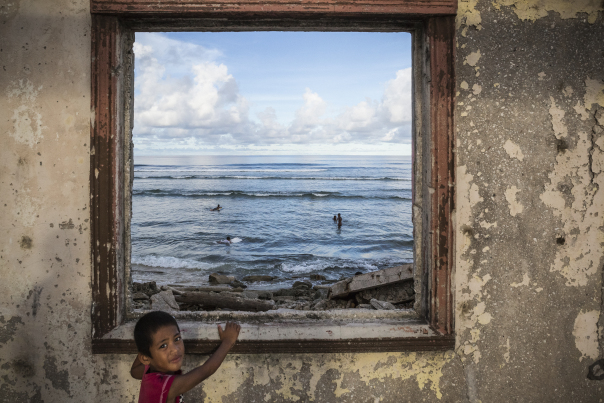
A child stands at the window opening in one of the many derelict houses on the island.
As the US nuclear testing programme developed and grew in the 1950s, most of the people living around the Kwajalein Atoll, where various US military installations that assist the nuclear test sites are based, were relocated from their homes and into a planned settlement on Ebeye. After they were joined by the ‘nuclear migrants’ from Bikini and other northern atolls, the poorly constructed settlements on Ebeye became increasingly crowded, leading to a polio outbreak in 1963, a measles outbreak in 1978 and regular occurrences of cholera, tuberculosis and other diseases up to the present day. The most overcrowded settlement of Northern Camp is a large shanty town without water supply or sewage system. Since much of the population is dependent on the service industry at US installations, unemployment is a major problem.
According to George Junior, a health worker at Ebeye’s hospital, ongoing missile testing around Kwajalein Atoll continues to impact on the health of local people. ‘When the Americans test their missiles and then the rain comes, the entire population of Ebeye gets sick. We have diarrhoea, flu and conjunctivitis. Such symptoms continue for 10 to 15 days and then everyone gets better until the next tests’ he says. And while US personnel enjoy excellent health care in places like Kwajalein Hospital, the majority of Ebeye residents who need emergency care are often referred to hospitals in Majuro, the administrative capital of the Marshall Islands, or to Manila or Hawaii since they do not have clearance to enter military installations.
Vlad Sokhin (Russia/Portugal) is a documentary photographer, videographer and multimedia producer. He covers social, cultural, environmental, health and human rights issues around the world, including post-conflict and natural disaster zones.
New Poll: US Military Occupations Supported By Far More Democrats Than Republicans
By Caitlin Johnstone | Medium | January 10, 2019
A new Politico/Morning Consult poll has found that there is much more support for ongoing military occupations among Democrats surveyed than Republicans.
To the question “As you may know, President Trump ordered an immediate withdrawal of more than 2,000 U.S. troops from Syria. Based on what you know, do you support or oppose President Trump’s decision?”, 29 percent of Democrats responded either “Somewhat support” or “Strongly support”, while 50 percent responded either “Somewhat oppose” or “Strongly oppose”. Republicans asked the same question responded with 73 percent either somewhat or strongly supporting and only 17 percent either somewhat or strongly opposing.
Those surveyed were also asked the question “As you may know, President Trump ordered the start of a reduction of U.S. military presence in Afghanistan, with about half of the approximately 14,000 U.S. troops there set to begin returning home in the near future. Based on what you know, do you support or oppose President Trump’s decision?” Forty percent of Democrats responded as either “Somewhat support” or “strongly support”, with 41 percent either somewhat or strongly opposing. Seventy-six percent of Republicans, in contrast, responded as either somewhat or strongly supporting Trump’s decision, while only 15 percent oppose it to any extent.
These results will be truly shocking and astonishing to anyone who has been in a coma since the Bush administration. For anyone who has been paying attention since then, however, especially for the last two years, this shouldn’t come as much of a surprise.
This didn’t happen by itself, and it didn’t happen by accident. American liberals didn’t just spontaneously start thinking endless military occupations of sovereign nations is a great idea yesterday, nor have they always been so unquestioningly supportive of the agendas of the US war machine. No, Democrats support the unconscionable bloodbaths that their government is inflicting around the world because they have been deliberately, methodically paced into that belief structure by an intensive mass media propaganda campaign.
The anti-war Democrats, after Barack Obama was elected on a pro-peace platform in 2008, went into an eight-year hibernation during which they gaslit themselves into ignoring or forgiving their president’s expansion of George W Bush’s wars, aided by a corporate media which marginalized, justified, and often outright ignored Obama’s horrifying military expansionism. Then in 2016 they were forced to gaslight themselves even further to justify their support for a fiendishly hawkish candidate who spearheaded the destruction of Libya, who facilitated the Iraq invasion, who was shockingly hawkish toward Russia, and who cited Henry Kissinger as a personal role model for foreign policy. I recall many online debates with Clinton fans in the lead up to the 2016 election who found themselves arguing that the Iraq invasion wasn’t that bad in order to justify their position.
After Clinton managed to botch the most winnable election of all time, mainstream liberal America was plunged into a panic that has been fueled at every turn by the plutocratic mass media, which have seized upon unthinking cultish anti-Trumpism to advance the cause of US military interventionism even further with campaigns like the sanctification of John McCain and the rehabilitation of George W Bush. Trump is constantly attacked as being too soft on Moscow despite having already dangerously escalated a new cold war against Russia which some experts are saying is more dangerous than the one the world miraculously survived. Trump’s occasional positive impulses, like the agenda to withdraw US troops from Syria and Afghanistan, are painted as weakness and foolishness by the intelligence veterans who now comprise so much of corporate liberal media punditry. And their audience laps it up because by now mainstream liberals have been trained to have far more interest in opposing Trump than in opposing war.
And how sick is that? Obviously Trump has advanced a lot of toxic agendas which need to be ferociously opposed, but how warped does your mind have to be to make a religion out of that opposition which is so all-consuming that it eclipses even the natural impulse to avoid inflicting death and destruction upon your fellow man? How viciously has the psyche of American liberals been brutalized with mass media psyops to drive them into this psychotic, twisted reality tunnel?
There was one group in the aforementioned survey which was not nearly as affected by the propaganda as armchair liberals. To the statement “The U.S. has been engaged in too many military conflicts in places such as Syria, Iraq and Afghanistan for too long, and should prioritize getting Americans out of harm’s way,” military households responded 54 percent that this statement aligns with their view. Turns out when it’s your own family’s blood and limbs on the line, people are a lot less willing to commit to endless violence. Sixty percent of Republicans agreed with this statement, while only 41 percent of Democrats did.
Could these statistics have something to do with the fact that younger veterans are statistically much more likely to be Republicans than Democrats? Is it possible that a major reason Trump beat Hillary Clinton, and a major reason Republicans are now far less bloodthirsty than Democrats, is because mothers, fathers, sisters and brothers are tired of flag-draped coffins being shipped home containing bodies which were ripped apart for no legitimate reason in senseless military entanglements on the other side of the world? Seems likely. And it also seems likely that the mass media propaganda machine is having a harder time steering people toward war once they’ve personally tasted its true cost.
Featured Video

Iran’s Next Strike May Not Explode. It Could Shut You Down
or go to
Aletho News Archives – Video-Images
From the Archive
Zionism’s Violent Legacy
By Donald Neff | Washington Report On Middle East Affairs | January 1996
On January 4, 1948, Jewish terrorists drove a truck loaded with explosives into the center of the all Arab city of Jaffa and detonated it, killing 26 and wounding around 100 Palestinian men, women and children.[1] The attack was the work of the Irgun Zvai Leumi – the “National Military Organization,” also known by the Hebrew letters Etzel – the largest Jewish terrorist group in Palestine. The Irgun was headed by Revisionist Zionist Menachem Begin and had been killing and maiming Arabs, Britons and even Jews for the previous ten years in its efforts to establish a Jewish state.
This terror campaign meant that at the core of Revisionist Zionism there existed a philosophical embrace of violence. … continue
Blog Roll
 Aletho News
- Trump’s Iran war is on an Israeli leash
- Saudi oil boss issues global supply warning
- Riyadh Says Its Oil System Is Intact. The Numbers Say Otherwise.
- Trump and Netanyahu Want to “Finish the Job” on Iran
- US ‘one-sided dictation’ not Iran’s beliefs makes rational talks impossible: Baghaei
- Iran’s Next Strike May Not Explode. It Could Shut You Down /Col Doug Macgregor
- Iran: US political targets legitimate if assassinations return
- Iraq shuts key border crossing with Iran under US pressure: Report
- Undersea Internet cables could be targeted in retaliation for attacks on Iran: IRGC deputy chief
- EU sending ‘biased’ observers to interfere in Serbian election – president
- If Americans Knew
- The Israel Lobby’s Changing Fortunes
- AIPAC has become such a political liability that it’s shifting to a more “nimble” approach to buying politicians
- At least 160 Israeli settler attacks in 2 weeks
- Will Gaza’s Ancient Christian Community Disappear Forever?
- Israel’s vision of regional security rests on keeping Arab states weak
- Heidi Levine recounts how Palestinian youths helped save her in settler attack
- DAILY UPDATE: Latest essential news on Palestine, Israel, & region
- Trump’s Intensifying Sabotage of the ICC, for Israel’s Sake
- Israeli military detain US and UK volunteers in West Bank including Democratic NY politician Brad Lander
- Americans at National Conservatism Conference held in Israel this year criticize Israel
- No Tricks Zone
- E-Cars Reduce CO2 Emissions By Only 41% Compared To Internal Combustion Engine Vehicles
- Predictions Made By Renowned Climate Professor Over Past Decades Have Been Proven To Be Poor
- New Study Suggests Large Regions Of The Pacific Ocean Have Been Cooling For The Last 80 Years
- Germany’s Green Energy Debacle: High Energy Costs Force Kahla Porzellan to Close After 182 Years!
- New Study: 50 Years Of The Most Aggressive ‘Net Zero’ Policies Can Only Affect The Global Climate By 0.03°C
- US September “Heat” Was No Record…Many Records Set Decades Ago
- Latest European Green Energy Debacle; Portugal’s Largest Flagship Solar Park Insolvent!
- Green Energy Debacle: German Expert Professor Fritz Vahrenholt Warns Of Severe Economic And Social Consequences
- Two More Paleo Reconstructions Affirm Meters-Higher Sea Levels Across Ireland, Brazil 7000-6000 Years Ago
- New Study: Earth And Venus Surface Warmth Largely Explained By Convection And Lapse Rate, Not CO2 Or Radiation

