Pentagon: Turkish Unilateral Action in Northeast Syria Would Be ‘Unacceptable’
Sputnik – 13.12.2018
WASHINGTON – A Turkish unilateral military operation in northeast Syria if launched would be unacceptable and Ankara should consult with the United States to address the security situation, Defense Department spokesperson Cmdr. Sean Robertson told Sputnik.
Earlier, Ankara announced that the Turkish military would launch an operation against Kurdish forces.
“Unilateral military action into northeast Syria by any party, particularly as US personnel may be present or in the vicinity, is of grave concern,” Robertson said on Wednesday when asked about Turkey’s announcement. “We would find any such actions unacceptable… coordination and consultation between the US and Turkey is the only approach to address issues of security concern in this area.”
The United States believes that the High Level Working Group on Syria with its Turkish partners is the only way to secure the northeastern border area in a sustainable manner, Robertson said.
Uncoordinated military operations will undermine the shared US-Turkish interests in Syria, Robertson said. As a NATO ally and key partner in the Global Coalition against Daesh terrorist group*, both countries have solemn obligations to each other’s security, he added.
The United States remains committed to Turkey’s border security, he said.
US-Turkish relations have suffered a setback amid Ankara’s concerns over US support for the Kurdish People’s Protection Units (YPG). Ankara has also repeatedly accused Washington of failing to fulfil its promises regarding the withdrawal of the YPG from Syria’s Manbij.
Ankara regards YPG as an affiliate of the Kurdistan Workers’ Party (PKK), outlawed in Turkey.
US erects ‘observation posts’ on Syria-Turkey border despite Ankara’s dissent
Press TV – December 12, 2018
The US military says it has established “observation posts” in northern Syria with the purported aim of preventing clashes between Turkish forces and US-backed Kurdish militants, despite Ankara’s strong opposition to the plan.
“At the direction of Secretary (James) Mattis, the US established observation posts in the northeast Syria border region to address the security concerns of our NATO ally Turkey,” Department of Defense spokesman Rob Manning said in a press release on Tuesday.
This is while Turkish Defense Minister Hulusi Akar had, during a Friday meeting with US Special Envoy to Syria James Jeffrey in Ankara, called on Washington to lift the so-called observation posts in northern Syria, along parts of Turkey’ border.
Akar also said earlier that Turkey had expressed its concerns about US plans to set up several observation posts in Syria, a move, which according to him, could lead to a perception that Washington is “somehow protecting terrorist YPG [Kurdish People’s Protection Units] members.”
Turkey’s Foreign Minister Mevlut Cavusoglu this month lambasted as a “big mistake” the US support for the YPG militants in Syria, a thorny issue in ties between the two allies.
Cavusoglu made the remark while meeting with Turkish citizens at the Turkish consulate in New York.
The YPG forms the backbone of the so-called Syrian Democratic Forces (SDF), an anti-Damascus alliance of predominantly Kurdish militants supported by the US.
Ankara views the YPG as a terrorist organization and the Syrian branch of the outlawed Kurdistan Workers’ Party (PKK), which has been fighting for an autonomous region inside Turkey since 1984.
The Pentagon’s Tuesday release further said that the US military would coordinate with Turkey its security efforts in the border region.
“We take Turkish security concerns seriously and we are committed to coordinating our efforts with Turkey to bring stability to northeastern Syria,” Manning said in the press release.
Washington infuriated Ankara by announcing a plan for the formation of a Kurdish militant force in Syria near the Turkish border.
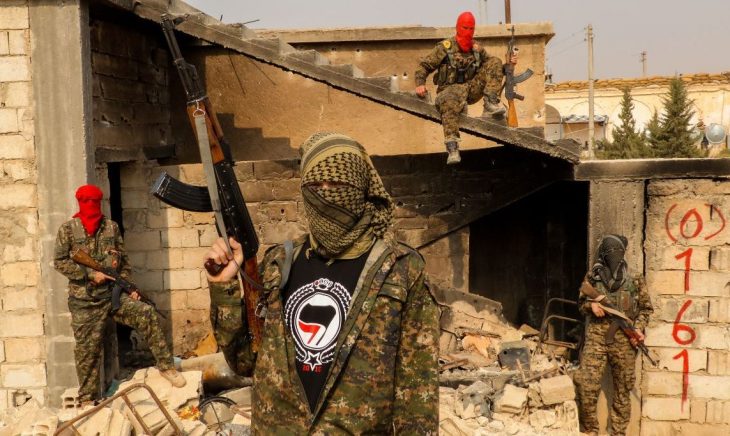
The plan prompted Turkey to launch a cross-border military operation on January 20 inside the Arab country, code-named Operation Olive Branch, with the declared aim of eliminating the YPG militants from northern Syria, particularly the Afrin region.
Turkish troops captured Afrin in March, and threatened to take the battle to nearby Manbij. Ankara and Washington agreed a roadmap on Manbij, which would see the city cleansed of US-backed Kurdish militants.
Turkey’s Defense Minister Hulusi Akar has expressed indignation at photos showing US troops dining with Kurdish militants near the Turkish border in Syria.
Mattis said last month that Washington wanted the so-called observation posts to help minimize tensions between the Turks and US-backed SDF forces in the purported fight against the Daesh terrorist group.
The Syrian government has given a degree of authority to Kurdish regions to run their own affairs. The US, however, has used the power vacuum to establish a foothold in those regions with the help of militants.
Ankara, one of Washington’s key allies in the region, has repeatedly questioned the US deployment of heavy weapons in Syria despite the defeat of Daesh in much of the Arab country.
Syria has strongly denounced the presence of both Turkish and US troops around Manbij.
War Over Ukraine?
By Sheldon Richman | The Libertarian Institute | December 7, 2018
Today, the United States and Allies conducted an extraordinary flight under the Open Skies Treaty. The timing of this flight is intended to reaffirm U.S. commitment to Ukraine and other partner nations.
The United States is resolute in our support for the security of European nations.
–Department of Defense news release, Dec. 6, 2018
Who wants to go to war against Russia in defense of Ukraine over the Kerch Strait, which lies between the Black and Azov seas and between Russia’s Taman Peninsula and Russian-annexed Crimea?
A show of hands, please.
But careful: don’t misconstrue my question. I’m not asking who wants the “United States” to go to war. I’m asking, rather: who is personally willing to fight the Russian military over the strait? Or: who is willing to see his or her sons and daughters fight, kill, and die in that cause?
Now, again, a show of hands, please. Anyone? No one? I didn’t think so.
Who could blame you? Are Americans supposed to be eager to drop everything to go wherever the U.S. government decides they should go to kill and die in its Nineteen Eighty-Four-ish geopolitical games? And short of fighting personally, must they pay the economic price — the taxes surrendered and opportunities forgone — that is required to maintain a military establishment capable of playing those games throughout the world?
What does individual freedom amount to if Americans are subject to a regime’s orders to enlist — one way or another — in whatever crusade that may catch the polite elite’s and commentariat’s fancy? Considering that Russia, like “us,” is a nuclear power, this is not hyperbole. American and Russian rulers, should they clash, wouldn’t have to intend to go nuclear. Accidents happen. Miscalculations born of bravado, brinkmanship, or mere uncertainty could not be ruled out.
All those pundits and politicians who are egging Donald Trump on to face down Vladimir Putin in his conflict with Ukraine are playing recklessly with the lives of Americans and many others. It’s damn serious business, so they’d better stop and think about what they’re doing before it’s too late.
True, in a week or two, we noninterventionists may look as though we overreacted to the Kerch Strait “crisis.” But who knows? Why take a chance? War would be a catastrophe, maybe the biggest the world has ever seen. I’d rather overreact now than regret not having said anything later.
The U.S. government has no businesses policing relations between Ukraine and Russia. Even if that role were appropriate for some party, the U.S. government would not be the one because it hardly has clean hands in the matter. Since the 1990s after the peaceful fall of the Soviet Union, Democratic and Republican presidents have threatened Russia by moving the anti-Soviet NATO alliance — which at the latest, should have ended with the fall — right up to Russia’s border, contrary to late President George H. W. Bush’s assurances, by incorporating former Soviet allies and republics.
Were the Russians supposed to assume that those obviously aggressive moves were benign? Or were they bound to see them as a systematic encroachment, an affront to their long-standing and not unreasonable security concerns? (Russia was invaded from the west three times in the last century.) You didn’t have to be a wise man like George Kennan to see NATO expansion in the post-Soviet era as “crazy.”
And let’s not forget that major foreign-policy players in the United States favor even more expansion to include, yes, former Soviet republics Ukraine and Georgia, both of which have provoked Russia in recent years while assuming the U.S. government would back them up. If Ukraine were a member of NATO, the U.S. could be treaty-bound to defend it.
Most relevantly, the Obama administration, with John Kerry running a State Department staffed with predecessor Hillary Clinton’s appointees, supported a coup in Kiev, in which neo-Nazis had a hand, that drove a democratically elected and Russia-friendly president from office. Spooked by this threatening move, Putin annexed Crimea, which had figured in Russia’s security architecture for hundreds of years. A NATO that included Crimea would have jeopardized Russia’s long-time Black Sea naval base at Sevastopol. The annexation had the support of most of the inhabitants of Crimea. (Yes, Crimea had been part of Ukraine, but of course Ukraine had been part of the Soviet Union.)
The U.S. foreign-policy establishment likes to portray Trump as soft on Russia, but that’s a joke in light of what he has done. NATO has continued to expand under Trump, and he — unlike Barack Obama — has sent and plans to continue sending weapons to the Ukrainian government, which contains neo-Nazis and which is repressing the separatist-minded people of eastern Ukraine. (Candidate Trump’s opposition to arming Ukraine was once Exhibit A for those contending he was Putin’s lackey. Strangely, his change of heart apparently hasn’t altered that judgment.)
Now, with the Kerch Strait incident, the illiberal, martial-law-imposing president of Ukraine, Petro Poroshenko, has done something that looks suspiciously like a provocation intended to shore up his sinking political fortunes and to keep the West agitated about the alleged Putin threat. (See Ted Galen Carpenter’s discussion “Ukraine Doesn’t Deserve America’s Blind Support.”) Poroshenko brazenly tried to send ships through the Kerch Strait without abiding by Russia’s declared procedures. As a result, ships were seized and some sailors injured. Did Poroshenko not know how Russia would react? Or did he want such a reaction?
Regardless of the merits of Poroshenko’s claims and even assuming Putin is up to no good, we must ask why this is something Americans should have to sweat over. Russia has an economy and military far smaller than America’s. It is no threat to Americans who simply want to live their lives free of government impositions. It’s also not a threat to Europe. Putin did not try to annex eastern Ukraine when he annexed Crimea. For one thing, it would be an economic burden that Russia is in no position to handle.
But Russia, like the United States, has lots of hydrogen bombs. But that means the threat to Americans comes, not from Russia, but from the U.S. government, which is in a position to start a world war with Putin. Therefore, Trump should tell the New McCarthyite warmongers to keep quiet.
The foreign policy appropriate to a free society is nonintervention. These days, that’s more obvious than ever.
Kremlin blasts Pompeo’s ‘squandering’ remark, says US military budget ‘enough to support all Africa’
RT | December 11, 2018
Mike Pompeo is in no position to claim that sending two strategic bombers to Venezuela was a “squandering” of public funds, Moscow countered, saying half of the US military budget is enough “to support all of Africa.”
The US Secretary of State produced a lengthy tirade on Twitter on Tuesday, claiming the arrival of two Russian Tu-160 bombers was an example of “two corrupt governments squandering public funds, and squelching liberty and freedom while their people suffer.” Later in the day, the remark was met with a sharp rebuke from the Kremlin.
“This is indeed very undiplomatic,” Kremlin spokesman Dmitry Peskov told journalists, adding, “we think it was an utterly inappropriate comment.” US President Donald Trump might “give his own assessment” of Pompeo’s statement as he did in the past, he said.
Saying that, Peskov made a veiled reference to President Trump’s inflammatory tweet in which he accused Rex Tillerson, Pompeo’s predecessor, of lacking the “mental capacity” to do his job. “He was dumb as a rock and I couldn’t get rid of him fast enough. He was lazy as hell,” Trump tweeted.
“As far as the ‘squandering’ is concerned, we don’t agree with that,” Peskov stated, noting that half of the bulky US military budget “would be enough to support all of Africa.”
The exchange happened a day after a pair of Tu-160s touched down at Venezuela’s Simon Bolivar International Airport on Monday. The bombers, nicknamed the ‘White Swans’ in the Russian military, had flown over 10,000 kilometers to reach the South American country. Their visit was part of “combined operational flights” with the Venezuelan Air Force, according to the Russian military.
That aside, it has recently emerged that Donald Trump has committed to a $750bn military budget, despite earlier labeling the $716bn previously allocated for defense ‘crazy’.
Above all, the mammoth US military budget has long been the largest in the world. According to the reputed Stockholm International Peace Research Institute (SIPRI), it dwarfs the defense expenditure of Russia, China, India, the UK, France, and Germany combined.
Trump commits to record $750bn defense budget days after saying $716bn was too much – reports
RT | December 10, 2018
Despite tweeting just last week that a $716bn defense budget was ‘crazy’, US President Donald Trump has reportedly reversed course and instead committed to the highest budget in history.
Trump’s unexpected decision to agree to Defense Secretary James Mattis’ request and propose an increased budget, relayed to several media outlets by anonymous officials, appears to stem from a meeting last Tuesday between Trump, Mattis and the chairmen of the House and Senate Armed Services committees.
It appears to have had an effect, considering that the day before the meeting, Trump tweeted that the previous year’s $716bn was “crazy” and a product of “a major and uncontrollable Arms Race” with China and Russia.
“It’s 750. Secretary Mattis secured that over lunch with the president,” an administration official told Politico, who first released the information, although an official announcement is yet to be made.
It’s unclear what exactly changed Trump’s mind. He had been floating a 5% reduction in defense spending, from the originally proposed (and already record-breaking) $733bn to $700bn – but defense officials had told him on Friday that anything less was “a risk”, and could have “disastrous consequences”.
“The Department is committed to ensuring our military remains the most lethal force in the world. We are working with OMB (Office of Management and Budget) to determine the department’s topline number,” a Defense Department spokesman told CNN.
The historically unprecedented numbers further inflate the US’ already world-largest defense budget. Washington is spending as much as the next 7 countries combined, according to the Stockholm International Peace Research Institute (SIPRI). Last year, defense was one of the few increases in a budget which saw cuts to the EPA, Health and Human Services and education departments, to name just a few.
US Arm Sales Turning Middle East into ‘Tinderbox’: Zarif
Al-Manar | December 8, 2018
Iran’s Foreign Minister Mohammad Javad Zarif said on Saturday that the United States is selling arms into the Middle East which were beyond the region’s needs, turning it into a “tinderbox”.
“The level of arms sales by the Americans is unbelievable and much beyond regional needs and this points to the very dangerous policies followed by the Americans,” IRNA reported Zarif as saying on the sidelines of the 2nd Speakers’ Conference with participation of Iran, Afghanistan, Turkey, Pakistan, China and Russia in Tehran.
He added that the US policy has brought many modern destructive weapons to the region, which have given no help to establishment of regional peace and security.
Asked about US accusations against Iran regarding missiles, the foreign minister said that the American officials spare no effort to interrupt relations between Iran and Europe, “so they resort to baseless allegations these days.”
“They [American officials] try to distort the regional issues.”
“We’ve read in the American media that the US arms are in hands of Al Qaeda in Yemen and ISIL in Syria, and this is a danger threatening our region,” Zarif said.
The top Iranian diplomat stressed meanwhile, that the US has been isolated in the world.
The US “has entered [trade] war with China and even arrested a senior Huawei executive. This indicates US frustration rather than its power.”
Lebanese FM Orders Filing Compliant against Zionist Entity
Al-Manar | December 7, 2018
Lebanese Caretaker Foreign Minister Gebran Bassil ordered on Thursday the preparation of a complaint to the United Nations Security Council on the Israeli violations of Lebanese sovereignty.
National News Agency reported that Bassil has instructed Lebanon’s permanent representative to the UN, Ambassador Amal Mudallali, to submit a complaint against the Zionist entity on this matter.
The Lebanese complaint “comes in light of Israeli political and diplomatic campaign in preparation for a military aggression on Lebanon,” NNA quoted a statement by Lebanese Foreign Ministry as saying.
The statement also referred to Israeli violations of Lebanese Mobile network in which the Israeli occupation army sent voice messages to residents of southern town of Kfar Kela warning them of explosions in the Lebanese territory, according to the Lebanese agency.
The Foreign Ministry’s order follows an operation launched by Israel Tuesday to ‘cut off’ what it called ‘attack tunnels’ allegedly dug by Hezbollah in a bid to infiltrate into the Palestinian occupied territories.
In addition to the latest development on the southern border, the Zionist entity has been violating Lebanese airspace and territorial waters for years. A Lebanese Army official previously said that 162 Israeli violations were recorded in south Lebanon in September, including land and maritime infringements, as well as wall-building works, according to a Defense Ministry statement in October.
The Nobel Peace Prize in Support of War
By Terje Maloy | OffGuardian | December 6, 2018
On December 10, the 2018 Nobel Peace Prize Award Ceremony will be held in Oslo, the capital of Norway. This analysis will try to look at how the prize fits in the bigger picture, but first, some general background is appropriate:
Norway is a member of NATO and has close ties to the United States and Great Britain. The political, economic and bureaucratic elites are firmly integrated in transatlantic networks, a nexus of economic connections, think tanks, international institutions, media and a thousand other ties that bind. They tend to identify with the liberal wing of the empire, (i.e. the Democrats, not the Republicans), but will work with any US administration. The members of the Norwegian Nobel Committee are selected by the Norwegian parliament, and the Committee is nominally independent.
Despite being considered – and where the population considers itself – a ‘peace nation’, there are few countries that have eagerly joined more wars than Norway, from the attack on Yugoslavia in 1999, Afghanistan 2001, the occupation of Iraq, Mali, Libya 2011 and the ongoing occupation of Syria. Norway spends large sums of money supporting the joint Western effort to control the rest of the world through comprador intermediaries in non-governmental organizations.
This analysis will discuss some (overlapping) points about the Nobel Peace Prize:
- The prize reinforces certain grand narratives, the most important one being We are the good, and thus have the right to decide the fate of the rest of the world.
- It creates symbols for regime change operations. It beatifies modern day ‘good natives’ complaining about cruel treatment and pleading for the West to do something to liberate them (but are often remarkably unable to see Western abuses).
- It reinforces general reasons to start wars, by making specific themes very important at the same time they are being used to justify military action.
- It reinforces the narrative that enemy fights with illegal and cruel weapons. The focus on chemical weapons, as opposed to napalm or sanctions, is one example.
- It sanctifies peace treaties that are more like unilateral surrenders, advantageous to Western imperialism and capitalist interests.
- For a bunch of peaceful people, the prize winners are remarkably eager for war and bloody interventions.
- Some other points + Conclusion.
1. WE ARE THE GOOD, AND THUS HAVE THE RIGHT TO DECIDE THE FATE OF THE REST OF THE WORLD
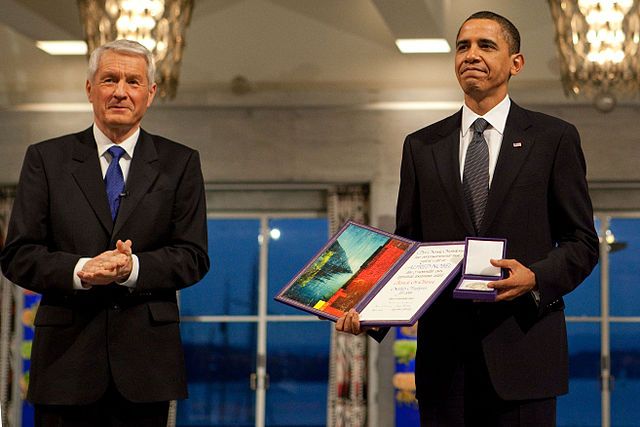
(Photo: / White House, Samantha Appleton /Public Domain)
The Nobel Peace Prize gets its prestige and press coverage because it reinforces several big narratives. If it should deviate too much from what the powerful want, it would be ignored. Of prime importance is the notion that we are the good, and we have a monopoly on interpreting reality and to decide what is important. (‘We’ in this context being people in the West, and by extension their governments and leaders). During the Cold War, the prize had a similar function. It would be interesting to take a closer look at it, but for practical purposes this analysis will mostly be limited the last 30 years. Once you start to notice certain basic themes, they are rather obvious. To put it pointedly, the Nobel Peace Prize tries to aid regime changes to achieve the Empire’s aims where it is possible to avoid direct war, but it will aid in confirming the narrative that our troops are good guys.
This explains why Western leaders so often get the prize. The point is creating an impression that there exists a more humane possibility within our current unjust world system. When they receive it, what they have actually done is not an issue. Hence the award to people like Jimmy Carter (winner 2002); as president he instigated several bloody covert interventions in Central-America, Africa and of course the Islamist fighters in Afghanistan, but has since then opposed direct US wars; or Al Gore (winner 2007), who when he was vice president didn’t shy away from using the military as a foreign policy tool (see part 7). The prize to Barack Obama (winner 2009) can be placed here.
But the main use of the prize is to create support in Western liberal opinion for interventions that would otherwise be naked imperialistic aggression.
2. A FOCUS FOR REGIME CHANGE OPERATIONS
Where a Nobel Peace Prize is awarded to a dissident of a non-western country, the CIA or the Pentagon (see point 3) often has a task force working on cracking the exact same country.
The winners have varying degrees of internal appeal in the targeted country, but the main purpose in choosing these people is not to boost their standing internally, but to justify attempts at regime change to Western liberal public opinion. Without the focus on these martyrs, these operations would look suspiciously like old style colonial domination.
Hence the beatification of Aung San Suu Kyi (winner 1991) coincided with a concerted campaign to get control over a recalcitrant, but very strategic country. Suu Kyi is in many ways typical of the people the Committee prefers. She is a known entity, having conspicuously strong personal connections to the former colonial power – Oxford educated, married to a British citizen, her children are British citizens, etc. Signaling in which direction her political compass was oriented, she asked the world to use the old colonial name Burma instead of Myanmar. She asked for harsh measures against her own country (for its own good) fitting hand in glove with the US strategy actually used. In fact, all means would be permissible to use against this regime imprisoning a modern day saint.
The Nobel Prize to Suu Kyi played an invaluable role in creating huge support, especially on the liberal left, for the draconian economic sanctions against an otherwise fairly obscure country. And maybe many of her Western supporters actually did believe that the US and UK could fund her with large sums of money and create entire NGO-networks for her with the expressed goal of subverting a sovereign nation’s government, and her intentions to still be pure and progressive.
Myanmar is immensely rich in natural resources and is positioned between China and the Indian Ocean, and China and India. Any significant land connection between these two 21st century great powers would have to go through Myanmar to avoid the Himalayas. It is also of great Chinese interest as a transit country to the Indian Ocean. Therefore, the country was targeted with a multi-approach regime change operation.
A massive press campaign was arranged over several decades, a plethora of NGOs financed, whilst “former” CIA-agents now turned missionaries were working with the ethnic guerilla forces to create military pressure. In the usual attempt to concentrate all opposition into a joint force, extreme right wing religious fanatics became the spearhead in this campaign. The sanctions imposed on Myanmar, precluded any economic development and doomed the population to a life of crushing poverty.
One could interpret the recent calls to take the prize back from Suu Kuy as disappointed buyers not getting what they paid for.
We can go forward to 2010, when a Chinese citizen, Liu Xiaobo, won the prize. There were no surprises for what future was envisaged for China:
It took Hong Kong 100 years to become what it is. Given the size of China, certainly it would need 300 years of colonisation for it to become like what Hong Kong is today. I even doubt whether 300 years would be enough.”
The lines between creating justification for a covert regime change operation and next step, a direct war, is blurry. But when required, the Prize Committee can step in to keep the focus of world opinion on the right narrative.
3. CREATING REASONS FOR WAR: WOMEN’S RIGHTS
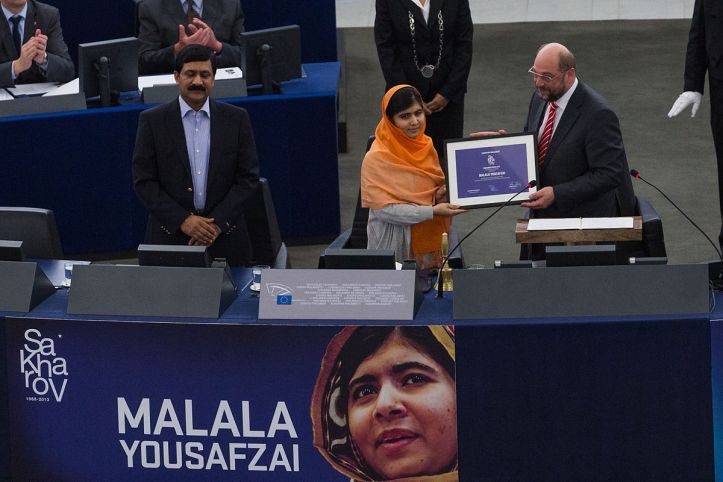
Malala Yoysafzai receives the Sakharov prize © Claude Truong-Ngoc / Wikimedia Commons
In 2003, just after the blitzkrieg on Iraq and at the very height of the George Bush’s talk of continuing the offensive to a few more countries, the committee chose to give the prize to Shirin Ebadi. By beatifying an Iranian at that time, the committee very well knew that they increased the danger of war.
Ebadi is a champion of women’s rights, a recurrent theme in NATO’s efforts to justify their wars. We know that targeting women in the West with this type of messaging has been a major effort for the organization for a long time. By giving the prize to her, they in effect created support in Western (female) public opinion for a war/regime change that would kill an untold number of Iranian women and destroy the lives of the rest, a repeat on a larger scale of what happened in Iraq.
The 2018 prize went to the fight against sexual violence in war. This happens to coincide with the very image NATO wants to promote of itself – who can forget Angelina Jolie and NATO’s General Secretary Jens Stoltenberg writing a joint article in 2017 titled “Why NATO Must Defend Women’s Rights,” where they point out that “NATO has the responsibility and opportunity to be a leading protector of women’s rights” and “can become the global military leader in how to prevent and respond to sexual violence in conflict”. How convenient that the Nobel Committee shares the same view.
A more analytic approach would point out such facts that US/NATO-interventions have made the situation for women infinitely worse in places such as Iraq, Libya and Afghanistan. An intervention to topple the legal government in Syria would certainly have created the same result.
In addition, a bit broader view would point out how allegedly stopping sexual violence against women has justified many wars of aggression. The stereotypes of cruel foreigners have not advanced noticeably from depictions of swarthy Spaniards groping blonde women in the Spanish-American war, to the claim that Gaddafi was handing out Viagra to mercenaries to rape women, as Susan Rice, the US Permanent Representative at UN told the Security Council. Amnesty International, later reported it had “not found any evidence or a single victim of rape or a doctor who knew about somebody being raped.”
Other notorious examples of how this has been used in war propaganda include Serbian rape camps during the Yugoslav wars. Allegations of mass rape were a key element of NATO’s propaganda campaign during the 1999 bombing of Yugoslavia. Clare Short, Britain’s international development secretary, claimed that the rapes were “deliberately performed in front of children, fathers and brothers.” After the war was over, there were some retractions, including from the Washington Post, which reported that “Western accusations that there were Serb-run rape camps […] all proved to be false.”
Malala Yousafzai (winner 2014), the young Pakistani girl who became a symbol of the war against the Taliban, is another figure that fits this pattern. The indefinite occupation of Afghanistan is, among plenty of other vicarious reasons, justified by improving women’s rights. This overlooks the fact that no improvement can be made under a government installed with the help of foreign bayonets. The situation for Afghan women has not improved since the occupation, but then again, the claim was only meant to create support for the war in public opinion.
The importance of creating the perception of fighting for women’s rights has long been realized in military circles.
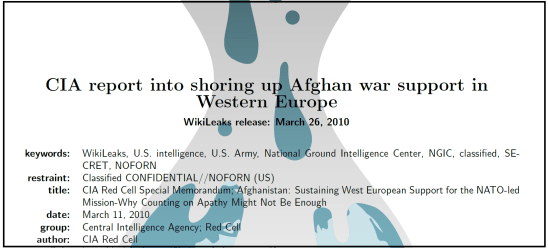
An internal CIA-document from 2010 (a few years before Malala received the prize from the Nobel Institute for her struggle against the Taliban), published by WikiLeaks, discusses how to best market the war in Afghanistan, To show how similar the Nobel Committee and the military/intelligence apparatus think, it is worth quoting the following passage:
Afghan women could serve as ideal messengers in humanizing the ISAF role in combating the Taliban because of women’s ability to speak personally and credibly about their experiences under the Taliban, their aspirations for the future, and their fears of a Taliban victory. Outreach initiatives that create media opportunities for Afghan women to share their stories with French, German, and other European women could help to overcome pervasive skepticism among women in Western Europe toward the ISAF mission.
4. THE ENEMY FIGHTS WITH ILLEGAL AND INHUMANE WEAPONS, AND IT IS IMPERATIVE TO STOP THEM
By highlighting certain themes, in this case ‘illegal weapons’, they reinforce the narrative in Western public opinion that certain things are very urgent and real problems, when in fact they are of relatively minor significance.
Poison gas is a clear example. The OPCW won the prize in 2013. Given the general situation in the Middle East, several million dead in Iraq after the US invasion and at least 400.000 dead in the covert invasion of Syria, gas is a minor factor, and even if we take the frequent claims of ‘gas massacres’ at face value (which of course we shouldn’t), is only responsible for an infinitesimal fraction of these dead.
But to reinforce a false narrative, this focus has been invaluable. The prize creates acceptance for the narrative that gas is a uniquely important and evil weapon, where it is fully justified to do anything necessary, including attacking countries, to stop the possible use of it. At the moment of writing this, Nov 24, 2018, the US just accused Iran of hiding a chemical weapons program.
Some weapons that are killing far more people in far more gruesome ways than poison gas, like napalm, would never be put on this list. And we could compare gas to sanctions, the West’s favorite and most effective weapon of mass destruction, killing the weakest, the sick, children and old people slowly, while destroying entire peoples’ right to a decent life. No other or weapon of mass destruction has killed as many people since WW2.
5. SANCTIFYING PEACE TREATIES THAT ARE NEGOTIATED SURRENDERS TO WESTERN INTERESTS

Yasser Arafat receives the prize in 1994, together with Israeli Foreign Minister Shimon Peres, Israeli Prime Minister Yitzhak Rabin CC BY-SA 3.0 File:Flickr – (GPO)
The most noticeable feature when the prize goes to creators of peace treaties, is that the treaties are more like a negotiated surrender than a just peace.
Colombia’s president Juan Manuel Santos (winner 2016) received the prize for victoriously having put the finishing touches to a long US-led counter-insurgency campaign against leftist guerilla forces. Now the reactionary oligarchy has a safe grip on the country, and can continue their neoliberal agenda, which isn’t that different from the old reactionary order. The death squads murdering leftist and human rights activist continue their activities with impunity.
The country had an extremely tarnished image in human rights issues and needed a quick touch-up to make it palatable. The most conspicuous thing the 2016-award is that the president got the prize just before Colombia became a global partner of NATO. The planning of the PR-requirements for this to happen smoothly must have been already well under way when the prize winner was decided. Remember the prize is directed at Western public opinion, and has little to do with an actual just peace in Colombia.
Yasser Arafat (co-winner 1993) got the prize so he would be tied to a peace plan with a chimerical two-state solution the Israeli side had no intention of honoring. The peace offer didn’t even include a stop in construction of Israeli settlements. No clearer signal of Israeli intentions could have been given. This is a continuation of the joint prize to Sadat and Begin in 1978, for the peace treaty between Egypt and Israel, where Israel succeeded in making a separate peace with the biggest Arab country, and could thereafter concentrate on consolidating its grip on the West Bank.
While Nelson Mandela (co-winner 1994) undoubtedly was a worthy winner, the transition deal the ANC negotiated for South Africa only transferred formal political power, and left unjust economic power structures intact. The assets of multinational companies were guaranteed, and the neoliberal policies implied in the deal doomed the large majority of the population to continued poverty.
Michail Gorbachev (winner 1990) got the prize for a unilateral and wholesale surrender of every Soviet position, both economic and political; he didn’t even keep them as bargaining cards. Trusting Western oral promises, this naiveté is unprecedented in a leader of a great power. His bad decisions made a managed transition to a mixed system impossible and abandoned the former socialist states to Western looting and a social collapse they still haven’t recovered from. No wonder he still is so popular in the West that gave him the medal as a sign of appreciation.
Finnish Martti Ahtisaari got the prize in 2008, «for his efforts on several continents and over more than three decades, to resolve international conflicts». This is very true. Left out is what should be added to the sentence, to resolve international conflicts – as a total Western victory.
Ahtisaari is directly linked to the creation of the NATO-protectorate of Kosovo. By 1999, NATO had decided to splinter Yugoslavia one more time. A 78 day aerial bombing campaign had little effect, so they sent in the diplomats. It was suggested that an envoy from a ‘neutral’ country would be more efficient. Here is how Ahtisaari handled the situation, telling the Serbs what ‘we’ would do (my emphasis):
Ahtisaari opened the meeting by declaring, “We are not here to discuss or negotiate,” […]. Ahtisaari says that Milosevic asked about the possibility of modifying the plan, to which he replied, “No. This is the best that Viktor and I have managed to do. You have to agree to it in every part.” [..] As Milosevic listened to the reading of the text, he realized that the “Russians and the Europeans had put us in the hands of the British and the Americans.”
Milosevic took the papers and asked, “What will happen if I do not sign?” In answer, “Ahtisaari made a gesture on the table,” and then moved aside the flower centerpiece. Then Ahtisaari said, “Belgrade will be like this table. We will immediately begin carpet-bombing Belgrade.” Repeating the gesture of sweeping the table, Ahtisaari threatened, “This is what we will do to Belgrade.” A moment of silence passed, and then he added, “There will be half a million dead within a week.”
The Serbians signed the treaty.
6. NOT A PEACEFUL VERY BUNCH OF PEOPLE
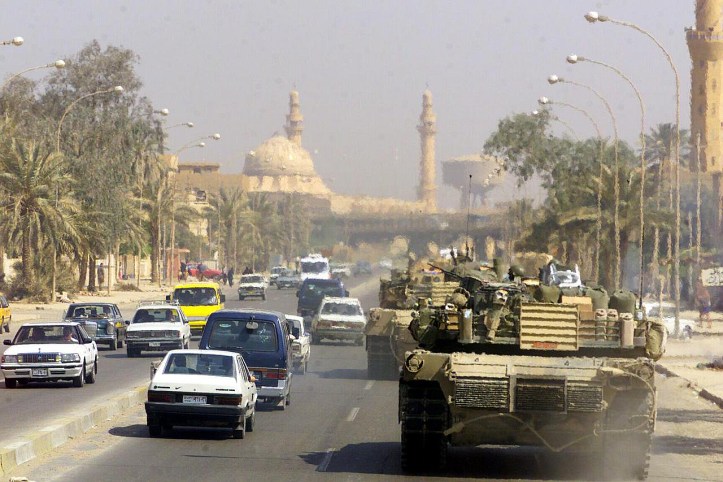
US Marine Corps tank in Baghdad, 2003 (Photo: USMC/ Public Domain)
For recipients of a peace prize, a remarkable number of them support wars.
The invasion of Iraq in 2003 was a war of aggression under the trumped up pretext of disarming Iraq of Weapons of mass destruction. It was a blatant breach of both international law and the United Nations Charter. What did the Nobel Prize Winners think of it?
Here we have Elie Wiesel (winner 1986): “I now know I was wrong, but better that than to have stood idly by”.
Jose Ramos-Horta (winner 1996) claimed approvingly that the only truly effective means of pressure on the Iraqi dictator [is] the threat of the use of force.
Liu Xiaobo (winner 2010) was clear, the “decision by President Bush is right!”. But then again, Liu had the remarkable opinion that “the major wars that the US became involved in are all ethically defensible,” including the wars in Afghanistan and Vietnam.
Former vice president Al Gore (winner 2009) had argued aggressively in favor of war in Iraq in 1991 and 1998, Bosnia in 1995 and Kosovo in 1998, and believed the 2003 Iraq war was legal based on earlier UN resolutions.
The Cold War winner Lech Walesa (1983) was an opponent of the invasion, but at least he knew where to put the blame: “It’s not the United States that is to blame for the war, but rather the EU, and in particular Germany and France. They knew the war was coming and they failed to prevent it.”
The Dalai Lama (winner 1989) was wily enough to hedge his bets, but decidedly did not condemn the war: “it’s too early to say, right or wrong”, He also supported the US/NATO military intervention in Afghanistan and the attack on Yugoslavia.
There is a similar level of support among prize winners for a direct intervention in the ‘civil’ war in Syria, a US/NATO regime change plan on the drawing board for at least 10 years before it started. The push for a no-fly zone in Syria on a Libyan model, which could then be used as a fig leaf for a full-scale assault, was immense for several years. What did the Nobel Prize winners think of this possibility?
(Keep in mind that the ‘action’ they call for, can only be either an aerial bombing or ground troops.)
Kailash Satyarthi (winner 2014) did not say anything about the fact that it was the 3 Western powers on the Security Council which started this war by spending billions of dollars arming and financing armed Islamist gangs. Stopping this support would seem to be the obvious way to stop the war, but instead we get: “The UN Security Council (UNSC) has the military power to bring this unceasing genocide to a halt.”
His co-winner Malala Yousafzai who seems to have envisaged a similar future for Syria as for Afghanistan, a Western intervention: “When I look at Syria, I see the Rwandan genocide. When I read the desperate words of Bana Alabed in Aleppo, I see Anne Frank in Amsterdam… We must act. The international community must do everything they can to end to this inhumane war”
This was echoed by former UN-leader Kofi Annan (winner 2001). Defining Aleppo as only the small part of the city occupied by Islamist gangs, he called for ‘action’. How this ‘action’ would differ from what he describes, is not clear: “The assault on Aleppo is an assault on the whole world. When hospitals, schools and homes are bombed indiscriminately, killing and maiming hundreds of innocent children, these are acts that constitute an attack on our shared, fundamental human values. Our collective cry for action must be heard, and acted upon, by all those engaged in this dreadful war.”
This wish was supported by Medecins sans Frontiers, recipient of the 1999 Nobel Peace Prize. It was the first to report the alleged gas attack in Ghouta on 21. August 2013, which the Obama-administration wanted to use as a pretext for a military assault. As it admitted, the MSF’s decision to issue a press release on the incident—which had not taken place in an MSF hospital, but in its “silent partner” facilities in rebel-controlled areas—was highly political.
MSF was well aware that their announcement of chemical weapons use would be immediately seized upon by the US to claim that Syrian President Assad had crossed a red line, and to start a bombing campaign.
The organization was here true to its roots, as the civilian part in the French military/intelligence effort to support an independent state in the oil producing parts of Nigeria, in the Biafran war of independence in 1967-1970.
Amnesty International, (winner 1977) was not much better, with its call for unspecified ‘action’: “The international community’s catastrophic failure to take concrete action to protect the people of Syria has allowed parties to the conflict, most notably the Syrian government, to commit war crimes and crimes against humanity with complete impunity, often with assistance of outside powers, particularly Russia… the international community had said ‘never again’ after the government devastated Eastern Aleppo with similar unlawful tactics. But here we are again.”
Anyway, Amnesty has a soft spot for endless NATO-interventions. In 2012, after 11 years of dismal occupation, the organization paid for advertising posters in the US applauding NATO’s actions in Afghanistan — “Keep the progress going”, purportedly doing something for women’s rights.
Tawakkol Abdel-Salam Karman is a Yemeni journalist and human rights activist that won the prize in 2009 wanted ‘protection’, writing: “Instead of protecting residents in Aleppo from brutalities of Russia, Iran and Bashar Al Assad’s regime, the world tended to mediate to provide safe corridors for the displacement of civilians,” adding, “these also are partners in crime.”
Colombian President Juan Manuel Santos (2016) voiced support for the missile attacks on Syria in March 2018.
Such bellicosity (or just as often, coy bellicosity) is nothing new in the type of people selected as winners. Henry Kissinger (winner 1973) was the most infamous war hawk to win the prize during the Cold War, but as long as it was the right side doing the fighting, plenty of others identified with this one sided world view. We can recognize all the themes mentioned above in Michael Parenti’s description of the 1975 Peace Prize winner:
Andrei Sakharov was a darling of the U.S. press, a Soviet dissident who regularly sang praises to corporate capitalism. Sakharov lambasted the U.S. peace movement for its opposition to the Vietnam War. He accused the Soviets of being the sole culprits behind the arms race and he supported every U.S. armed intervention abroad as a defense of democracy. Hailed in the west as a «human rights advocate,» Sakharov never had an unkind word for the horrific human rights violations perpetrated by the fascist regimes of faithful U.S. client states, including Pinochet’s Chile and Suharto’s Indonesia, and he aimed snide remarks at the «peaceniks» who did. He regularly attacked those in the West who opposed U.S. repressive military interventions abroad.
7. Some other points + Conclusion
You don’t have to be an prop for US/NATO power projection to win the prize, but it helps.
The prize was originally intended to be given to the person who has done most to foster peace between nations. In a subtle twist, in many cases it has changed to banning aspects of warfare, barely ever addressing war itself. Broaching such a subject honestly would be impossible without addressing the elephant in the room, US/Western imperialism. The award has had many winners who are variants of this year’s theme, sexual violence in war (which also touches on point 3, the NATO-narrative of defense of women). The focus here is on a more civilized form of war, not abolishing war as such as a means of settling disputes.
No one (apart from some military brass) is actually pro-landmines, but the Peace prize to the Campaign Against Land Mines in 1997 coincided with the increased Western interventions in places where these weapons would be a hindrance to the success of the occupation It was not in the interest of NATO forces to have their opponents using these ‘poor man’s weapons’, creating the casualties so feared by the military in modern wars, which again might increase opposition at home to war. The coalition suffered most of their casualties from IEDs, a sort of land mine, in Iraq, while having limited use of mines themselves.
There is a certain unpredictability as to who the prize will be awarded to, making it not as obviously beholden to the immediate needs of the powerful, even though the long term trend is clear. For example, there has been no Russian winner for quite a while now, and the White Helmets have not yet got the award, maybe as they are too obviously only a PR-front.
When Jean-Paul Sartre declined the Nobel Prize in Literature, he said that the prize ‘is for Western writers or Eastern rebels’. On a similar note, we might say that the Nobel Peace Prize is for Western elites or Eastern rebels.
That the selection of winners conforms to US views does not mean that there is a direct influence, although some recommendations to the Committee probably weigh heavier than others. Rather this pattern is a sign of how well socialized the Norwegian Nobel Committee members are in the transatlantic world view, where ‘our’ requirements override any genuine wish for peace.
Ex-Pentagon Analyst: US INF Ultimatum Part of Plan to Boost Nuke Arms Industry
Sputnik – 06.12.2018
WASHINGTON – The Trump administration’s decision to suspend its obligations under the 1987 Intermediate Nuclear Forces (INF) Treaty is designed to open the way for a new tidal wave of spending to satiate the US military-industrial complex, former Defense Department analyst Chuck Spinney told Sputnik.
“The [US] Military-Industrial —Congressional Complex (MICC) [is] driving the nuclear arms race that is now locking the world into a new Cold War while lowering the threshold for a hot nuclear war,” Spinney said.
US leaders want to use the withdrawal from the INF to launch even more nuclear weapons armament programs, Spinney suggested.
“What is missing from this reincarnation of past Strangelovian madness? In terms of offensive capabilities, two stand out: A new ground launched cruise missile (GLCM) and a nuclear follow-on to the Pershing II medium range ballistic missile — precisely the weapons banned by the INF treaty,” Spinney said.
However this massive nuclear modernization program was setting in motion a money stream that would continue through 2060 or perhaps even 2080, Spinney warned.
“Jobs and money will be flooding into over 400 of congressional districts as the political engineers in the MICC target the political vulnerabilities of the system of checks and balances in the United States and those of our allies with a torrent of contracts and subcontracts,” he said.
From the Russian perspective, Spinney added, the United States is sharpening its nuclear sword while strengthening is nuclear shield, which is a formula for war-fighting.
US policymakers believed they could increase the military options for fighting and winning a nuclear war by increasing the precision of their capabilities to execute and control the escalation of limited nuclear strikes, Spinney explained.
Such thinking, he added, is a return to the discredited nuclear war-fighting theories of the 1970s.
“Only this time we are sleepwalking into the same old mad theory of nuclear war-fighting without a major strategy debate,” he concluded.
The INF Treaty was signed by the Soviet Union and the United States in 1987, and prohibited either country from possessing, producing or testing ground-launched ballistic and cruise missiles with a range of between 300 to 3,300 miles.
On Wednesday, Russian President Vladimir Putin said if the United States develops weapons currently banned by the INF, Moscow would follow suit. The State Department on Tuesday said US INF obligations will be suspended in 60 days unless Russia comes into compliance. Putin said the United States has still provided zero evidence to support allegations of noncompliance.
US’s INF Move Could Prove Fatal for Arms Control Treaties – Int’l Law Assoc.
Sputnik – December 6, 2018
WASHINGTON – The US ultimatum to leave the INF Treaty within 2 months if fulfilled threatens the survival of all such arrangements including the New Strategic Arms Reduction Treaty (New START), Director of the UN Office of the International Association of Lawyers Against Nuclear Arms, John Burroughs, told Sputnik.
“Final US withdrawal from the INF Treaty threatens to unravel all arms control arrangements, and the stability and predictability they provide between the United States and Russia,” Burroughs said. “The INF Treaty… was a foundation for subsequent agreements on reduction of long-range nuclear forces. If that foundation is removed, it is unclear whether New START and control and reduction of long-range nuclear forces generally can be sustained.”
Burroughs pointed out, however, that Washington and Moscow still have time to hold talks to save the treaty because a US withdrawal would not take effect until six months after the ultimatum period.”
This all means that there is a long period — eight months — for the US and Russia to resolve their disputes about claimed violations of the INF Treaty,” he said. “And it can be done, through negotiations and transparency measures, [and] visits in person to the installations in question.”
What was really needed was the creation of a multilateral process for reductions of nuclear arms leading to zero, Burroughs advised, although setting up such a mechanism would be even more challenging.
The International Association of Lawyers against Nuclear Arms is an international non-governmental organization headquartered in Berlin. It was founded in 1988 and seeks to build and strengthen international legal efforts to ban the use and threat of use of nuclear weapons.
The INF Treaty, signed by the Soviet Union and the United States in 1987, bans ground-launched ballistic and cruise missiles with a range of between 300 to 3,300 miles. The New START Treaty, which expires in 2021, limits the number of deployed intercontinental and submarine-launched ballistic missiles, nuclear-armed bombers, and nuclear warheads.
On Tuesday, the State Department said it would suspend US obligations under the INF in 60 days unless Russia comes into compliance. On Wednesday, Russian President Vladimir Putin told reporters the United States has still provided zero evidence to support allegations of violating the accord. Putin also said if Washington wants to develop weapons banned under the INF treaty, Moscow would follow suit.
See Also:
Russia in Full Compliance With INF Treaty, US Side Knows Well About It – Moscow
Ex-Pentagon Analyst: US INF Ultimatum Part of Plan to Boost Nuke Arms Industry
US Navy sends ship to Russia’s Far East, reportedly prepares to enter Black Sea
RT | December 5, 2018
An American destroyer sailed off the Russian coast, near the Pacific Fleet base in Vladivostok, in a first such stunt since the Cold War. Another US ship is expected in the Black Sea soon, amid tensions between Russia and Ukraine.
The USS MCCampbell (DDG-85) went into the vicinity of Peter the Great Bay to “challenge Russia’s excessive maritime claims and uphold the rights, freedoms, and lawful uses of the sea” enjoyed by the US and others, Lieutenant Rachel McMarr, a spokesperson for the US Pacific Fleet, said in a statement.
The US Navy calls such stunts “Freedom of Navigation Operations” (FONOP). The last time a FONOP was conducted in this area was 1987, at the peak of Cold War tensions with the Soviet Union.
“These operations demonstrate the United States will fly, sail and operate wherever international law allows,” McMarr said. “That is true in the Sea of Japan, as in other places around the globe.”
Peter the Great Bay was named after the first emperor of Russia, and is dotted with bases of the Russian Pacific Fleet. The presence of a US destroyer in the area is comparable to a Russian sail-by of San Diego, California or Pearl Harbor, Hawaii.
Washington does not recognize Russia’s territorial claims in the Sea of Japan, with a Navy official telling CNN they far exceed the 12 nautical mile limit guaranteed by the UN Convention on the Law of the Sea (UNCLOS). While Russia has ratified the convention, the US has not.
That is not all, however. The US Navy could also be planning to send a warship into the Black Sea in the near future. CNN reported that the State Department has notified Turkey of the intent to send a warship through the Bosporus and the Dardanelles, which requires a 15-day notice under the terms of the 1936 Montreux Convention.
The 1936 treaty also limits the presence of ships from nations that don’t border the Black Sea to a maximum of 21 days. The US last had a ship in the area back in October.
Anonymous US officials told CNN the move was a response to last month’s incident between Russian coast guard ships and three Ukrainian vessels in the Kerch Strait, which connects the Sea of Azov to the Black Sea.
“We routinely conduct operations to advance security and stability throughout the US 6th Fleet area of operations to include the international waters and airspace of the Black Sea,” fleet spokesman Commander Kyle Raines told CNN.
The US has also repeatedly sent ships to the parts of East China Sea claimed by Beijing, drawing repeated protests from China – most recently last week, when the guided missile cruiser USS Chancellorsville (CG-62) sailed through the area.
Featured Video

Death Spikes & Rising Cancer In Our Youth Explained
or go to
Aletho News Archives – Video-Images
From the Archives
Politicians lie
By Mazin Qumsiyeh | Popular Resistance | August 18, 2013
There is no way to say this truth nicely: Politicians lie. That includes Japanese, American, Egyptian, Israeli, and Palestinian politicians! Is there something more common sense than that? Yet, so many citizens around the world believe their own politicians or wistfully acknowledge lies but think it is part of the job needed to run things. They believe even when politicians contradict themselves blatantly. This phenomenon is rather remarkable. It is a dissonance and disconnect from reality that many seem oblivious to. It is very dangerous because it can lead to accepting rationales for going to war. These can be deadly wars that lead to millions of lives lost as happened in what was called World War 1 and WW2. Even when incredible and declassified evidence abound, politicians continue to lie and old mythologies refuse to die. Here are just a few of the countless lies told to us over the past few decades… continue
Blog Roll
 Aletho News
- Turkish parliament to review Saudi-Pakistan defense pact next month
- DEATH SPIKES & RISING CANCER IN OUR YOUTH EXPLAINED
- Iran offers Trump deal before US election
- Merz regime wants ‘secret police’ – opposition
- Israeli settlers terrorize West Bank Palestinians with state-provided drones: Report
- They see them, then kill them: Israeli quadcopters track, deliberately target civilians in Gaza
- Debunked: Trump’s egregious UNGA claims on war against Iran crumble under scrutiny
- Europe was part of the infrastructure of US aggression against Iran: Deputy FM
- New evidence on the Bucha Massacre
- Italy and France debunk reports CIA issued ‘Russian drone threat’ warning
- If Americans Knew
- An error has occurred; the feed is probably down. Try again later.
- No Tricks Zone
- New Study: Earth And Venus Surface Warmth Largely Explained By Convection And Lapse Rate, Not CO2 Or Radiation
- 2025 Nature Paper Claiming Worsening Global Drought Gets RETRACTED …Heavily Flawed
- New Study: ‘Global Drought Shows No Detectable Recent Acceleration Under Climate Warming’
- Economic Masterminds: German Socialists Suggest Taxing Productivity Gains Stemming From Using AI
- The South China Sea Has Not Been Cooperating With The Climate Change Narrative
- Energy Crisis: Germany Enters Heating Season With Historically Low Gas Reserve Fill Levels
- New Study: The Antarctic Ice Sheet Gained Mass From 2020-2024 Due To Staggering Snow And Ice Accumulation
- Study: Ocean Heating Rates From Thousands Of Years Ago ‘Dwarf’ Modern Ocean Heating Rates
- Climate Extremists Target, Attack Large-Scale Power Grid Infrastructure In Germany!
- New Study: Antarctic Ice Melt Has Contributed Less Than 1 Centimeter To Sea Level Rise In The Last 30 Years

