Pro-war ‘Trump circus’: Veteran reporter quits NBC with biting critique of corporate newsroom
RT | January 3, 2019
NBC News has given endless war and ‘destructive’ intelligence agencies a free pass, all while fixating on around-the-clock Trump hysteria, a veteran national security reporter wrote in a biting farewell message to his colleagues.
William M. Arkin had a number of pointed words to share with his fellow reporters before his last day of work at NBC on Friday – 2,228, to be exact. In his farewell memo – which reads more like a manifesto than a goodbye –the veteran muckraker accused NBC of peddling “ho-hum reporting” that “essentially condones” endless American military presence in the Middle East and North Africa. He also took the network to task for not reporting “the failures of the generals and national security leaders,” essentially becoming “a defender of the government against Trump” and a “cheerleader for open and subtle threat mongering.”
Arkin expressed concern that NBC’s infatuation with the “Trump circus” has distracted journalists from pressing stories that need to be told.
“I’m more worried about how much we are missing. Hence my desire to take a step back and think why so little changes with regard to America’s wars,” he wrote.
He continued by questioning the media’s fanatical opposition to Trump’s desire to improve relations with Russia, denuclearize North Korea, and withdraw from Syria.
“I’m alarmed at how quick NBC is to mechanically argue the contrary, to be in favor of policies that just spell more conflict and more war. Really? We shouldn’t get out Syria? We shouldn’t go for the bold move of denuclearizing the Korean peninsula? Even on Russia, though we should be concerned about the brittleness of our democracy that it is so vulnerable to manipulation, do we really yearn for the Cold War? And don’t even get me started with the FBI: What? We now lionize this historically destructive institution?” he quipped.
If anyone is qualified to critique NBC’s military and national security reporting, it would be Arkin. The veteran journalist has worked for the network intermittently for the last 30 years, and co-authored a seminal Washington Post investigation revealing the dangerous rise of America’s security state.
Arkin has also been a vocal critic of America’s wars in the Middle East, and distinguished himself as one of the few mainstream journalists to question the fictitious WMD rolled out to justify war with Iraq.
Many on social media expressed their gratitude to Arkin for shining a light on the media’s complacency – and complicity – as America’s military and national security apparatus operate with near impunity both at home and abroad.
“Very useful to have all our well known suspicions confirmed from inside. there’s a reason revolutions make a priority to take over the tv stations,” one Twitter user noted.
Arkin finished his farewell roast by detailing some of his writing projects currently in the works, including an “extended essay about national security and why we never seem to end our now perpetual state of war.”
“There is lots of media critique out there, tons of analysis of leadership and the Presidency. But on the state of our national security? Not so much. Hopefully I will find myself thinking beyond the current fire and fury and actually suggest a viable alternative. Wish me luck.”
US Military Apologizes For Posting Uncomfortably Honest Tweet
By Caitlin Johnstone | January 1, 2019
U.S. Strategic Command (or “Stratcom” if you’re trying to make a nuclear-capable arm of the U.S. Defense Department sound cool) has issued an apology for a poorly received New Year’s Eve tweet which has since been deleted.
“#TimesSquare tradition rings in the #NewYear by dropping the big ball… if ever needed, we are #ready to drop something much, much bigger,” the offending tweet read, with an attached video featuring B-2 stealth bombers flying all stealth bombery and causing gigantic explosions with bunker buster bombs while words like “STEALTH”, “READY”, and “LETHAL” flashed across the screen. The tweet concluded with the ostensibly unironic hashtag “#PeaceIsOurProfession”.
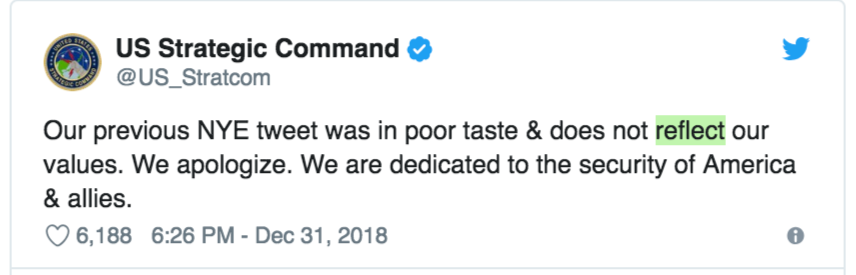
“Our previous NYE tweet was in poor taste & does not reflect our values,” Strategic Command tweeted. “We apologize. We are dedicated to the security of America & allies.”
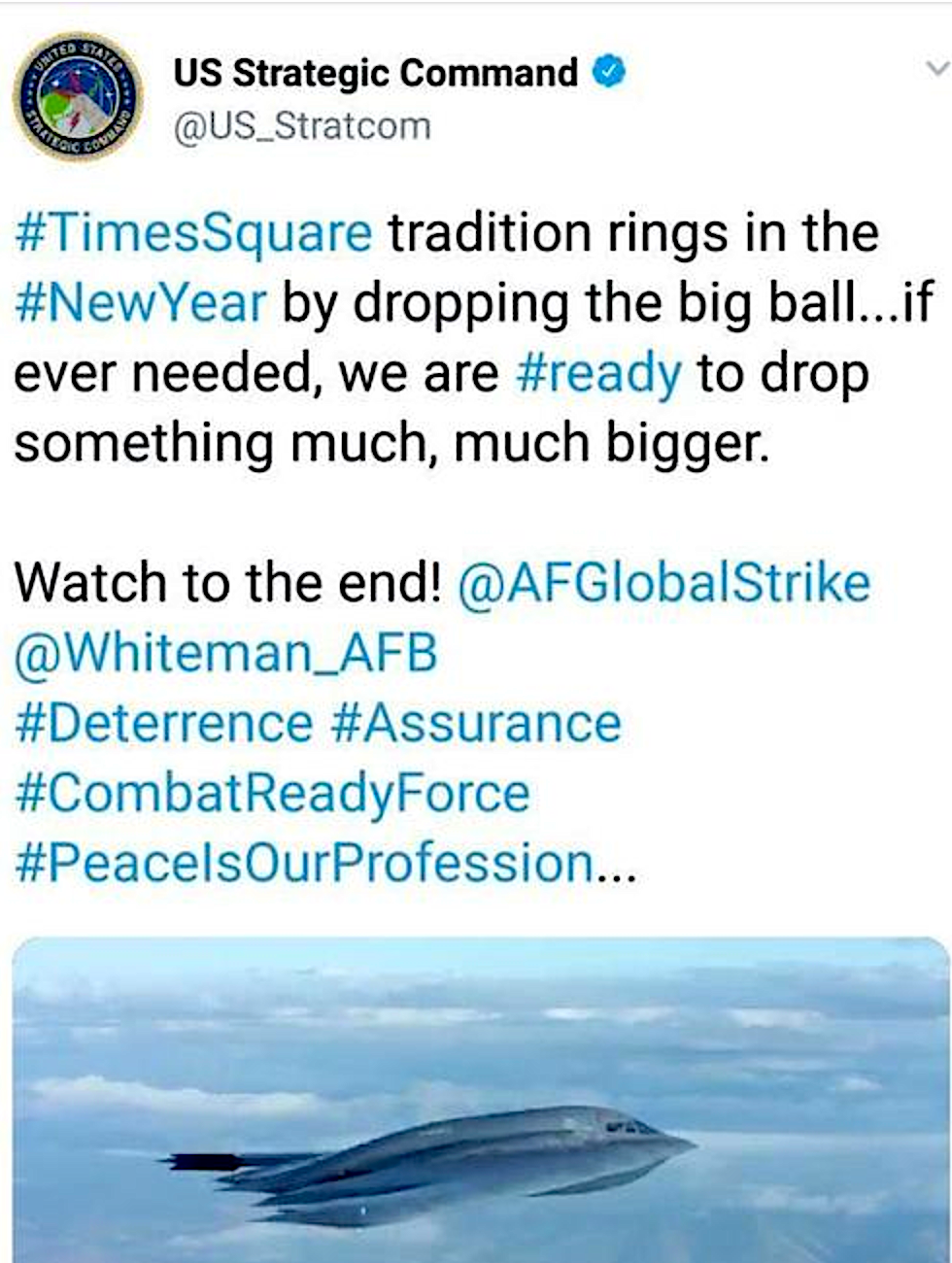
This statement is, obviously, a lie. The part about “security” of course, because dominating the globe with nonstop military violence and aggression has nothing to do with security, but also the “does not reflect our values” part. The U.S. military deleted the post and apologized for it because it received an angry backlash from hundreds of commenters and was circulated virally on Twitter for its jarringly creepy message, not because it did not reflect their values. It reflected their values perfectly.
The only way you could possibly encapsulate the U.S. military’s values in a 42-second video clip more perfectly than cramming it full of footage of $2,000,000,000 war planes cruising around dropping $3,500,000 GBU-57 bombs would be to also show the human bodies they land on being ripped to pieces. Inflicting death and destruction using unfathomably expensive machinery is the U.S. military’s whole job. Of course it reflects their values.
The real issue here was not values but perception. The U.S. war machine pours an immense amount of energy into perception management, making sure that ordinary Americans either (A) ignore the horrific things that are being done in their name or (B) think that those things are awesome and patriotic. The offending post was clearly attempting to accomplish (B). A team of paid social media propagandists simply did not understand that ordinary human beings wouldn’t resonate with a message that amounts to “Hey I see you’re all preparing to bring in the new year, so watch how good we are at killing large numbers of people!”, and some damage control became necessary when everyone got freaked out. Can’t have people opening their eyes to how insane America’s relentless military expansionism has gotten, after all.
Watching the propaganda arm of the U.S.-centralized war machine is a lot like watching a manipulative sociopath learning how to function in normal society. Sometimes they’ll slip up and fail to react the way someone with a healthy sense of empathy would respond to the death of a pet or someone’s emotions or whatever, and they risk alienating whoever’s around them and losing access to the resources they could exploit them for if they can’t manipulate them out of the creeped-out feeling people get when they’re around someone who doesn’t empathize like a normal human being. I suspect many of the commenters who flooded in telling Stratcom to delete its tweet were not so much interested in eliminating a violent social media post from the internet, but in eliminating that creeped-out feeling you get when the sociopath’s mask slips a bit.
And that’s understandable. One of the biggest obstacles in getting people to realize how deeply propagandized they are is the cognitive dissonance which comes rushing in when one considers the implications of viewing the world free from the lens of military psychological manipulations. Without the lies about how beneficent and necessary and awesome the military is, all you’ve got is trillions of dollars worth of instruments of death circling the globe to facilitate the daily slaughter of men, women and children to advance agendas of power and profit while ordinary people struggle just to get by in your own country. It can be deeply psychologically uncomfortable to grapple with the reality of what that means for your beliefs about your nation, your society and your very identity, in much the same way realizing you married a manipulative sociopath can be an uncomfortable truth one might feel tempted to compartmentalize away from.
A lot of people got upset about that tweet, but they really shouldn’t have. The tweet was not the problem; it was just a few perception managers for the U.S. military being more honest and straightforward than usual. The problem is that money is being stolen from ordinary Americans to murder strangers on the other side of the planet to advance agendas of power and profit, and everyone’s being propagandized into accepting that as normal. The sociopathic propaganda engine slipping up and stirring the populace from their slumber a bit is nothing to complain about, the actual reality of our actual situation is.
Caitlin Johnstone is a rogue journalist, poet, and utopia prepper who publishes regularly at Medium.
Is there an Upside to the US Military Presence in the Southeast Asia?

By Jean Perier – New Eastern Outlook – 30.12.2018
As of today the Southeast Asian and Asia-Pacific region have found themselves at the center of a complex international process of establishing a new regional architecture. As states carry on fighting for control over strategic sea routes that run across the region, numerous security and transitional threats would appear seemingly out of the blue.
Unsurprisingly, the United States is trying to exercise as much influence over the region as it possibly can, even in spite of the fact that over the past decades the influence that Washington exercises in Southeast Asia has significantly diminished. Speaking about the evolution of the US approach to Southeast Asia in the post-bipolar period of global composition, it should be noted that the initial goal of containing the spread of communism that Washington used to pursue has evolved into attempts of ensuring American military and economic dominance in this part of the world. These days the US couldn’t care less about communism, as it’s dead set on opposing the rise of China and Russia and their regional allies. Washington’s new approach to its global strategy became evident after the release of America’s National Defense Strategy and the Nuclear Posture Review, in which China and Russia were designated as primary geopolitical opponents of the US.
To achieve these goals, the Trump administration would concentrate its efforts on creating a 400,000 man strong force in the Asia-Pacific region to ensure that at least 50 large military bases across the region remain fully operational at all times. It goes without saying that the absolute majority of those are located in Japan.
Among the tools that allow Washington to advance its agenda in the Asia-Pacific region are large carrier strike groups. For the first time since the days of WWII, the Pentagon keeps a total of two carrier groups stationed in the Western Pacific. Additionally, the US Air Force would use strategic bombers on patrol duty over the Pacific, as Washington believes this practice to be a good demonstration of force.
The Pentagon is also actively deploying its anti-air capabilities in the Asia-Pacific region, thus provoking an arms race across the region. At present, it has 20 ships capable of bringing down both missiles and aircraft, two THAAD batteries, three PAC-3 missile battalions along with five mobile radars stationed in the region.
To ensure its primacy in the region, Washington would place a particular emphasis on expanding its cooperation with Japan and South Korea. This results in those states holding an ever increasing number of joint military exercises, with their total exceeding 30 large military games over the last 18 months.
However, as inter-Korean relations begin reaping results of goodwill shown by both Pyongyang and Seoul, along with the progress that Russia and Japan have made in resolving their territorial disputes, Southeast Asian political analysts have begun discussing the issue of Washington maintaining such a leviathanian scale of American military presence in the region and the rationale behind it.
As for the prospects of a continuous US military presence on the Korean peninsula, it’s being addressed by China that which recently began insisting on the complete withdrawal of US armed forces from South Korea as a precondition for the complete denuclearization of the DPRK. Chinese authorities are persistent in convincing Pyongyang that this should be the first demand made, since there will be no way to force Washington into leaving once a peace treaty is signed. In turn, Washington is pursuing the goal of maintaining as many troops in South Korea as possible, as those remain an important element of its China containment plan.
As for the US military presence in Japan, the public pressure applied by various civil activist groups on Japanese authorities is almost palpable. Although Tokyo hasn’t faced a massive public uproar demanding the complete withdrawal of all American servicemen from the country, the number of civil protests demanding this course of action is increasing annually. In addition, the advances that Japan and Russia made in resolving their differences on questions over the Kuril Islands may vanish overnight, should it be announced that American servicemen are here to stay in Japan. As a matter of fact, this presence contradicts the terms of the 1956 agreement between the USSR and Japan, and ever since the day it was signed any further progress has been derailed by the presence of foreign servicemen in Japanese territory. Back in the day, this fact resulted in the USSR abandoning any discussions with Tokyo over the possibility of transferring a part of the Kuril Islands to Japan, as Tokyo signed the Treaty of Mutual Cooperation and Security with Washington back in 1960. After all, in accordance with this treaty, the Pentagon is allowed to build its naval bases all across the territory of Japan. Should it decide to build one on the Kuril Islands once they are handed over to Japan, it will trap the Russian navy in its harbors. It is quite understandable that Moscow will never allow this scenario to occur.
To get a better understanding of this deadlock, it is enough to recall the Caribbean crisis of 1962 and the deployment of Soviet ballistic missiles in Cuba. Back then, Washington reacted vigorously to Moscow’s attempt to create a direct military threat to the United States in the immediate vicinity of its borders, which brought the world toward the brink of WWIII. So what reaction should we expect from Moscow should Washington build a naval base on the Kuril Islands? Therefore, without Tokyo demanding the Pentagon to pack up and leave, no further progress in the disputes that exist between Russia and Japan can be achieved.
Of course, both Moscow and Beijing in their approach to the question of the lingering US military presence in the immediate vicinity of their shores are driven by their strategic interests. This means that Beijing is going to use any leverage it has to persuade North Korea to abandon its nuclear program in exchange for a US withdrawal, while Russia would never go as far as to consider handing over the Kuril Islands without Japan sending American servicemen home.
As for the position of today’s political elite of South Korea and Japan on this issue, it is clear that they follow the instruction of their overseas masters in addressing these issues, as both of these states have launched massive media campaigns to persuade their population that the presence of US forces is somehow not a bad thing. Washington has even given them cues as to what their media should advertise. In particular, they try to convince the world that:
- a certain part of the population of South Korea and Japan is still supporting the strengthening of military cooperation with the United States.
- the withdrawal of American troops will be accompanied by a substantial increase in defense spending. In particular, it is said that in South Korea in order to prevent the weakening of its combat potential, Seoul will be bound to spend no less than 30-35 billion dollars.
- both Japan and South Korea will lose jobs should they decide to close US military bases. It’s stated that South Korea will lose more than 10,000 jobs that were created by the fact that American soldiers needed services that the Pentagon was willing to pay for. It’s estimated that Washington would spend 800 million dollars on those and thus the withdrawal of American troops is going to somehow affect the overall economic growth rates of South Korea. Should those media sources be believed, Japan with its massive industrial potential is going to suffer even greater financial losses due to the withdrawal of US forces from Japan.
Under these circumstances, the ruling political circles of South Korea and Japan have to decide whether the costs and the lost income associated with persistent tensions those two states have with their neighbors are worth the pay Washington is providing them with. It goes without saying that neither nation can hope to secure full political independence without sending American troops home. Moreover, the signing of peace treaties with their neighbors will eliminate the need to carry on the arms race that Washington initiated, as both Japan and South Korea are bound to buy expensive outdated weapons produced by the United States to the detriment of their national interests. For sure, the final word on this matter should not be left to the political elites of South Korea and Japan who are closely tied to Washington, but to the population of these countries, since they are being described as democracies by the Western media.
Guns or Butter: Neocons Want More Weapons less Government Services
By Philip Giraldi | American Herald Tribune | December 30, 2018
It is one of the great ironies that the United States, which is not actually threatened by any foreign power, maintains a ruinously expensive and globally destructive national security policy that is based on fear. It can be argued that Washington was at least briefly a force for stability and good governance in the aftermath of the Second World War when much of Europe and Asia were in ruins, but America’s interference in the internal politics of other nations has, most particularly in the past twenty years, borne bitter fruit. The argument being made that the U.S. national security mandates “forward defense” by maintaining a string of overseas bases and outdated alliances has been proven wrong again and again as allies have proven feckless and countries that would otherwise be friendly have chafed and then rebelled under America’s imposed leadership role.
President and General Dwight D. Eisenhower famously warned in 1961 about the developing military-industrial-complex (MIC), which he had originally dubbed the military-industrial-congressional complex before accepting that he would need legislative help if he were to reverse the seemingly inexorable spending on weapons and expansion of overseas military bases. In the event, Ike’s warning went unheeded and, more recently, the expected “peace dividend” that might have developed from the end of the Cold War in 1991 was wasted when the Clinton Administration recklessly enabled the looting of the former Soviet Union’s natural resources while also expanding the no longer needed NATO alliance up to the Russian border.
Many politicians and industrialists who directly benefit from the spending on the military are largely to blame for propagating the myth that the United States is vulnerable to enemy attack. One only has to recall the panic when Moscow launched a satellite into orbit in 1957 and then there was the essentially fraudulent “Soviet Estimate” by the intelligence community which persisted in overrating Russian military capabilities and the strength of the Soviet Union’s economy. Having a powerful enemy was a sine qua non for those who wished to profit from “defense” spending.
The situation currently is somewhat different than that which prevailed during most of the post-World War 2 era. To be sure, the spending on weapons has continued at a ruinous level but the enemy has changed. Russia is back as a major threat due to the seemingly endless investigations into the 2016 election that have been dubbed “Russiagate,” but it has been joined by China, which is being seen at the major “over the horizon” enemy. And there is also the ubiquitous non-state player “Islamic terrorism” as well as Iran for good measure to keep the money flowing.
It would not be completely fatuous to suggest that the list of all of America’s presumed enemies is at least somewhat contrived. And it is also important to note that the identification of enemies for most Americans depends on the mainstream media, which is now closely linked to corporate and government interests so as to be incapable of independent inquiry or investigation. The impact of a tame media is significant: during the Vietnam War the press was highly critical and hammered the Lyndon B. Johnson Administration. Since then, reporters are embedded and the stories they are allowed to write, are generally puff pieces because to report the truth would make them lose their access.
A recent article that appeared in The Washington Post perfectly illustrates how the newspaper is selling a product that fearmongers to sustain more military spending. It is entitled Wake up. America’s military isn’t invincible, written by regular columnist Robert J. Samuelson.
The article begins with “The most uncovered story in Washington these days is the loss of U.S. military power — a lesson particularly important in light of recent events: the resignation of Defense Secretary Jim Mattis; President Trump’s rash decision to withdraw U.S. troops from Syria; North Korea’s announcement that it will keep nuclear weapons after all; and alleged massive computer hacking by Chinese nationals.”
Now, right off the bat, Samuelson’s argument can be challenged. “Loss of U.S. military power” if it can be quantified at all has nothing to do with Mattis or Syria, nor with North Korea or China. Or even with Donald Trump, who has increased the armed services budget, though one should presume that the president is the ultimate target of the article given that it has appeared in the Post.
Samuelson makes his case by citing defense modernization programs in China and Russia and “advances” in Iran and North Korea that undercut U.S. military capabilities. He refers to a recent report of the congressional National Defense Strategy Commission (NDSC), which identifies specific areas in which Russia and China have upgraded their capabilities and quotes “If the United States had to fight Russia in a Baltic contingency or China in a war over Taiwan . . . Americans could face a decisive military defeat.” The report concludes that “America has reached the point of a full-blown national security crisis.”
The possible armed conflicts cited by Samuelson are, of course, carefully chosen to produce a desired result. Confronting Russia or China in their home waters thousands of miles away from the U.S. gives all the advantage to the defense, which will be able to operate on interior lines and maximize available land, sea, and air forces. And the NDSC report itself is suspect, designed to promote a certain point of view. Its authors are top heavy with retired senior military officers and defense industry “experts” who have a personal interest in more spending on weapons.
Samuelson also cites fellow Post columnist Max Boot, writing that he had “done a great favor by publicizing the report.” He quotes Boot: “Air superiority, which the United States has taken for granted since World War II, is no longer assured. And, without control of the skies, U.S. ships and soldiers would be [highly] vulnerable.” Boot, sometimes referred to as the Man Who Has Never Been Right About Anything is, of course, a neocon mouthpiece who is in favor of war all the time and nearly everywhere, particularly if Israel is involved. He characteristically, like Samuelson, fancies himself as an expert on national security even though he has never served in the armed forces. His “air superiority” mantra is ridiculous as it would seem to suggest that the U.S. should be able to “control the skies” everywhere simultaneously, which is impossible. And he ignores the fact that the United States uniquely has 19 aircraft carriers which can project air power to anywhere in the world.
Samuelson goes on to condemn what he calls “unwise cuts in defense spending” and cites a 12% decline in spending on the military between 2010 and 2015 as well as a decline in the “defense” share of the GDP from 1960 until 2017. Both figures come from the NDSC report. He does not, however, mention that the current defense budget is larger than the military spending of the next eight countries combined, to include both China and Russia.
Samuelson, doing a great impersonation of ex-Speaker of the House Paul Ryan, blames the lack of money for the Pentagon on “the American welfare state — Social Security, Medicare, Medicaid, food stamps and the like.” He advocates cutting “welfare” to buy more and better weapons. He then goes on to liken the current situation to that existing before World War 2, when Adolph Hitler’s Germany rearmed while England and France did nothing. The analogy is not exactly correct as, when war broke out, France alone fielded an army greater than Germany’s, but it’s always reassuring to have Hitler cited yet again in a neocon op-ed.
Samuelson concludes with the obligatory slap at Trump: “We need to keep our commitments — Trump’s abrupt withdrawal from Syria devalues our word. And we need to repair our alliances,” but one might well opine that there is something seriously wrong with that kind of thinking, where guns always take precedence over butter. Government exists to benefit the citizens that together make up the state, not to meddle in the affairs of other nations and peoples worldwide.
The selling of America the All-Powerful is a bit of a con job promoted by neocons like Samuelson and Boot but we do not need to send tens of thousands of young Americans overseas to give “value to our word.” We do not need to enter into pointless wars in places like Afghanistan, Iraq, Libya, and Syria. We do need an America that is at peace with itself and which is willing to be strong and brave enough to realize that real security will come when the United States is no longer the world’s designated bully. Let’s consider a New Year’s wish to see a 2019 where the soldiers, sailors, marines, and airmen finally come home and where scribblers like Samuelson and Boot find themselves unemployed.
Notes On The Withdrawals
By Michael Tracey | Medium | December 23, 2018
Trump announced the withdrawal of US troops from two warzones, which prompted the resignation (and now, firing) of James Mattis. It’s one of the most consequential weeks of the presidency thus far, so rather than try to come up with a grand cohesive Take on it all, here are some scattered thoughts.
- The media doesn’t know how to grapple with an event that genuinely does represent Trump contending with an intractable establishment, which is partially understandable given recent overheated bleating about the Deep State — a phenomena that does plainly exist but has been misrepresented by the dumber portion of MAGA boosters. “Establishment,” likewise, is a fuzzy buzzword, and almost nobody ever claims to be part of it. Trump himself can reasonably be said to be The Establishment considering he is the President. However, this is a specific instance in which Trump really is in direct confrontation with very particular “establishment,” namely the institutional national security apparatus, which exists largely unfettered across administrations. Survey the scene and there’s not a single person in this entire apparatus who apparently supports the Syria withdrawal.
- So what does the media do? They act, essentially, as vehicles for the grievances of said national security apparatus. Take a look at some of the coverage from the major outlets: NYT, WaPo, AP, etc.
- OK, who exactly is “outraged,” and why does their sentiment justify featured placement in an Associated Press headline? It’s the national security establishment figures who are outraged, for them Mattis is a patron saint. These are the people AP, NYT, and WaPo reporters rely on to inform their natsec coverage. This NYT example is less subtle, and far more egregious:
- Really? Robert Kagan, to the uninformed reader, might just be some innocuous “expert” offering his wisdom, but Kagan is one of the most significant neoconservative foreign policy luminaries ever, competing ignominiously for that distinction with Bill Kristol. And it’s his ideology which is being transmitted to unwitting readers by way of the NYT. People who hate Trump will be susceptible to the message, because what he’s saying portrays Trump in a very negative light, but they’re also consuming loads of stubborn interventionist pablum along with the typical anti-Trump dopamine hit.
- Collectively, the theme of all mainline media coverage in reaction to the withdrawals is some combination of “chaos,” “disarray,” “tumult,” etc. Never is it ever considered that the very fact of multiple endless military deployments in hot warzones is also “chaotic.” And destructive. And insanely expensive. And unpopular with the wider public. None of these facts amount to “chaos” in the minds of fretting journalists, because what they’re being informed by is the sentiments of the “natsec” apparatus Trump has just acted against. (Oh yeah BTW the Syria deployment is also illegal and unauthorized, and has been since Obama launched it on false pretenses, but again, that’s definitely not chaotic.)
- On a slightly different note, it’s also worth harkening back to the time, earlier this year, when John Bolton was appointed National Security Advisor. I joined in the dismay, considering Bolton is one of the most fervent unreconstructed hawks in the entire country, and has *even today* not stopped defending the Iraq invasion. I attended a speech of his in DC about a month before the appointment when he did so, once again… in 2018. His Iran antagonism is a virulent obsession, and he called for a first strike on North Korea in February.
- But what happened subsequently? Bolton’s wishes have been totally overruled at every turn, most notably at two spectacular junctures. The first was Trump’s Korea diplomacy initiative, when Bolton was made to sit meekly at the negotiating table with Kim’s generals, whom he’d not long before declared should be wiped out with a preemptive strike. Then this week, the Syria withdrawal is among the most epic humiliations conceivable, as Bolton has specifically and publicly declared that US troops would not be leaving Syria until Iranian influence was repelled (i.e., essentially never).
- So those are crucial facts to consider about Bolton’s influence in the administration. I still think it’s dangerous to have him anywhere near the locus of military power, because who knows what leverage he might wield in the event of some unforeseen crisis. But he’s clearly not anywhere close to calling the shots, or the last 9 months of the Trump presidency would have gone much differently. (If he had any personal pride he’d resign in the wake of the Syria withdrawal, but Bolton’s principal priority is proximity to power, not personal consistency or pride. Unlike, evidently, Mattis.)
- In sum: the initial freakout when Bolton was appointed at least had basis, because he’s a dangerous person, but the freakout over the policies which he’s (ironically) presided over have engendered an even greater freakout, by several orders of magnitude. And those policies have tended to be dramatically less belligerent and militaristic than what you’d expect from an Administration in which Bolton resides. (The two leading examples again being Korea and Syria/Afg withdrawals.) So you have to wonder what the freakout is really about then. Maybe it’s just simple knee-jerk Trump hatred. (Yeah, it’s that.)
- There’s a running fight in certain Online Circles about whether Trump is a “non-interventionist.” My point was always that Trump clearly evinced greater non-interventionist tendencies than Hillary Clinton, but that 2016-specific observation has been exaggerated by certain bad faith agitators into a bogus charge that I claimed Trump is some pure, peace-loving anti-war voice. Obviously that’s NEVER been the claim. Any assessment of Trump’s scatter-shot “non-interventionism” has to coexist alongside the acknowledgment that Trump has dropped large quantities of bombs in pre-existing warzones, and killed lots of civilians in the process. That’s bad. At the same time, Trump has now declared his intention to end two wars that were started by previous administrations, and has not started any new ones. He’s done so over the strident objections of his own staff, advisors, and 95% of his own party. Clearly the “instincts” I noted, and then was ruthlessly ridiculed for noting, had some basis in reality, or we would not be where we are.
- Trump, during the campaign, frequently complained about the trillions squandered in the Middle East. Hillary Clinton never did (because she was partly responsible for it). Therefore, the comparative assessment was warranted. Nobody ever assumed Trump’s complaint would automatically translate into a swift, seamless change in US policy, or that the US would now become a beacon of wholesome anti-interventionism. It took two years, but Trump has now taken tangible steps to actualize those complaints, at significant political risk.
Afghanistan: Negotiations or a US Military Defeat?
By Salman Rafi Sheikh – New Eastern Outlook – 24.12.2018
While the Trump administration may think otherwise and even take the credit for initiating dialogue with the Taliban on an unprecedented level with a view to pulling the US out of Afghanistan, there can hardly be any doubt that negotiations, after 17 years of continuous war, are nothing short of an uncomfortable acceptance of their inability to defeat the Taliban militarily. How else do we define a military defeat? In the very act of negotiations is implicit an American admission of the ultimate fact that it has become impossible for it to retain its politico-military hold on Afghanistan through its planted government in Kabul and the US-raised and trained Afghan security forces, despite the continued huge financial support and the support of the US/NATO high-tech military forces in the country. It is for this reason that the US had even to drop its previously adamant refusal to hold direct talks with the Afghan Taliban.
If there is no military defeat for the US and even if the US still has got forces on the ground, the question of holding direct talks with the Taliban points to the increasing inability of the US forces to force the Taliban into submission. Importantly enough, the current phase of talks has been initiated by the US, not the Taliban. The Taliban had repeatedly refused to endorse Kabul’s offers of talks, and only agreed to do talks if the US was willing to engage directly. Therefore, with the US now fully engaged in “peace dialogue”, the US military’s self-proclaimed notion of invisibility stands fully exposed.
While some may argue that dialogue is necessary to end the war through non-military means, it is hard to miss the point that the US military still remains deeply entrenched in the war. For example, apart from the fact that there are thousands of soldiers on the ground, the US air force dropped more bombs on Afghanistan in 2018 than in any other year of the war in 17 years. The number of bombs dropped do not only show that the war basically remains intense, but also that the US military is desperate to change the course of the war to its advantage, an ambition highly unlikely to materialise; hence, the ever more emphasis on dialogue with the Taliban.
And while the US can’t avoid a military defeat, it can still hope to avoid humiliation in Afghanistan. And, for this purpose it is prepared to utilise all available means, including asking Pakistan for help. Even though the Trump administration, ever since it came into power, has cut all military aid and coalition support fund to Pakistan and bi-lateral relations have never been so frosty ever since the beginning of ‘war on terror’, the ever-increasing helplessness against the Taliban has once again forced the US to ‘ask’ for help.
Pakistan, fully aware as it is of the ground realities of Afghanistan and the way the US has already lost the war, is unlikely to ‘help’ the US in turning the table in its favour. In fact, in response to president Trump’s letter to Pakistan’s prime minister, Imran Khan, Khan was quick to rebut Pakistani involvement in any relationship with the US “where Pakistan is treated like a hired gun — given money to fight someone else’s war. We should never put ourselves in this position again.”
The request for help came only two weeks after president Trump had actually accused Pakistan of ‘not doing a damn thing’ in Afghanistan for the US. But the letter he wrote only two weeks after this blatant accusation signified increasing US desperation in Afghanistan and its willingness to still cast Pakistan in a friendly role even though it, as the US claims, never did a damn thing for the US. How wise it is for the US to ‘ask’ for help from a country that it thinks has worked against it through-out the war? How else to explain this wayward and self-contradictory approach than by placing it in the context of an imminent military defeat and US desperation to somehow avoid it by making a face-saving deal with the Taliban?
All this proves that no matter how powerful the US military might be, or how hard it might have worked, or how many years it might have committed to building an Afghan army in its own image, and no matter how much air and logistical support that army might have received, it has failed to militarily defeat the Taliban, who are currently directly and indirectly controlling about 44 per cent of the districts and have even established, as reports have shown, a parallel system of governance and administration in many parts where the Afghan officials work in close cooperation with the Taliban.
More than anything else, this reality exhibits another defeat in terms of the failure of its so-called ‘counter-insurgency’ program’s ability to roll back and replace the Taliban networks on the ground. It also means that the US-planted socio-political governance system in Afghanistan has almost reached the brink of a “political defeat”, much like the imminent defeat of the US military and its trained Afghan forces, which are losing more troops every year than the government can recruit, presenting yet another dilemma which the US forces have failed to resolve even after years of training and advising the Afghan security forces.
All this comes down to a single and indisputable reality: the US must withdraw and let the Afghans decide their future. Instead of finding a way to impose its demands on the Afghans, the best course for the US would be to liaise with other regional countries, including Pakistan, Russia and China, to develop such power sharing formula as would ensure an inclusive political system. Of course, any platform of negotiations and any peace plan that is developed without the Afghans themselves directly involved in its making would be meaningless in terms of reconciling the warring factions within the country. The sooner the US accepts this eventuality, the fewer of the US forces, the Afghan troops and innocent lives would be lost.
Trump’s Holiday Gift to America: Hope for a Little More Peace on Earth?
By Thomas L. Knapp | Garrison Center | December 27, 2018
In March, US president Donald Trump promised the American public that US troops would be leaving Syria “very soon.”
Nine months later, he threw Washington’s political establishment into turmoil by finally ordering the withdrawal he’d promised. Politicians like US Senator Lindsey Graham (R-SC), who’d never once in four years bestirred themselves to authorize the previous president’s decision to go to war there in the first place, railed against Trump’s decision to bring the bloody matter to a close.
Instead of backing down in the face of opposition, Trump doubled down. Or, rather, decided to draw down the 17-year-long US military presence in Afghanistan.
Then he jetted off for a surprise Christmas visit to Iraq … eliciting, with his usual theatrics, calls from Iraqi lawmakers for US withdrawal from THAT country. I suspect he may concede to that demand as well.
Nothing’s written in stone, and both US foreign policy and Donald Trump are prone to sudden and unexpected turns. But the holiday season is a time of hope. Maybe, just maybe, nearly three decades of US war in the Middle East are coming to the beginning of their end.
Adding to that hope, let’s turn an eye further east.
After significant saber-rattling and then a sudden turn toward personal diplomacy, Trump stood back and let events on the Korean peninsula take their course even as he continued the bellicose rhetoric and sanctions noises demanded of him by Graham and company.
As a result, North and South seem on the brink of ending a 68-year war. They’ve begun removing land mines and guard posts along the Demilitarized Zone. They’ve broken ground on a railway connecting the two countries.
Is it possible that Trump, as some of his supporters like to say, has been playing 4D chess while the rest of us distracted ourselves with checkers?
I’d really like to think so, and I do hope so.
As an advocate for ending US military adventurism, I’ve doubted Trump every step of the way. During his presidential campaign, he alternated between talking peace and pronouncing himself the most militaristic of the GOP’s presidential aspirants.
I’ve generally found it safer to believe the worst, rather than the best, things politicians say about themselves. But at moments like these, his bizarre zigs and zags on the global 4D chess board suddenly seem in retrospect to have taken American foreign policy in the right direction.
If he brings home substantial numbers of the American fighting men and women now in harm’s way around the globe, he will have secured his legacy and deserve the thanks of a grateful nation. I wish him every success in that endeavor.
Peace on Earth, goodwill toward men, and Happy New Year.
Why Mattis’ exit is a defining moment in US foreign policy
By M. K. BHADRAKUMAR | NewsClick | December 24, 2018
Within the week, President Trump’s sudden announcement of “total” troop withdrawal from Syria has ripped apart the American political system and exposed its fault lines. Trump’s decision is intrinsically a sound one. He didn’t start the Syrian conflict and he has been on record repeatedly that the US had no business to intervene in it militarily. But his writ as president and commander-in-chief didn’t run large. Astoundingly enough, we know now that the Pentagon defied the president who is also the commander-in-chief.
We also know that Trump’s defence secretary James Mattis set the scale and scope of the US intervention in Syria. From what was meant to be a limited intervention, Mattis turned it into an open-ended military occupation of Syria. This was despite the fact that the US carries no UN mandate to send forces to Syria. The repeated protests by Damascus, including at the UN, were ignored.
Indeed, the military mission that was originally geared to fight the ISIS morphed into a geopolitical one to counter Iran (and Russia’s) presence in Syria. Above all, the US military virtually occupied one-third of Syrian territory and declared it an exclusive region that even Syrian government forces were barred from entering and imposed a “no-fly zone” there. All this constituted a gross violation of international law and UN Charter.
While resigning in protest, Mattis took care to turn it into a first-rate political scandal. This has put Trump’s back up. If Mattis was hoping to keep his job till end-February with an intention to continue to undermine the president’s foreign policies, an unforgiving Trump has other plans. Trump has announced the appointment of an acting defence secretary w.e.f. Jan 1, which defangs Mattis overnight. Trump thereby ensures that his decision on troop withdrawal in Syria will be implemented on the ground.
The really stunning part is that the bulk of America’s political class, think tanks and the media have rallied to support Mattis in an astounding display of defiance and spite toward their elected president. Suffice to say, there has been an insurrection against Trump’s foreign policy agenda and Mattis was a key figure in that enterprise. Quintessentially, the established American political system – what Trump calls the “Swamp” – refuses to make way for the elected president, his mandate from the people for his political platform notwithstanding. Isn’t it a sham that the US claims to have a government “of the people, by the people, for the people”?
Quite obviously, Syria is only the tip of the iceberg. Looking back, Mattis had a virtual free run through the past two-year period, to undermine Trump’s foreign policy agenda across the board. Mattis had the great advantage of serving at NATO Headquarters as Supreme Allied Commander Transformation. His president, on the other hand, was a novice in alliance politics. Mattis knew precisely how consensus opinion is forged in Brussels around decisions taken in Washington, how those decisions get formally adopted by alliance partners and how Washington’s projects invariably get implemented. Thus, Trump’s role got incrementally reduced to ranting and raving about the NATO budget. Trump talks no longer about NATO being “obsolete”.
Simply put, Mattis has brilliantly revived the NATO. He did this knowing fully well that a transatlantic alliance raring to go cannot do without an “enemy”. And Mattis also knew that that “enemy” has to be Russia. Thus, the reboot of NATO and the ratcheting up of tensions with Russia became mutually reinforcing endeavors. The result is plain to see: NATO has come closer to Russia’s borders than at anytime before and is creating threatening military infrastructure there. Moscow is in a quandary because it is well aware that the NATO project is a de facto Pentagon project and Trump himself probably had little to do with it.
Moscow keeps hoping that a Russian-American summit would help matters, but then, Trump’s plans for meeting with Vladimir Putin runs into strong headwinds whenever the idea surfaces. The “Russia collusion” inquiry keeps Trump off balance (although Robert Mueller has so far failed to produce a shred of evidence that Moscow promoted Trump’s candidacy in the 2016 election.) Put differently, for the “Swamp” the Robert Mueller inquiry becomes critically important precisely for the reason that Trump is prevented from making any concerted attempt to improve US-Russia relations.
Syria and Afghanistan are only illustrative examples of how the Pentagon has a corporate interest in fighting open-ended wars. In both cases, a military victory is no longer regarded as feasible, and it is the hidden geopolitical agenda that matters to the Pentagon. Equally, cascading tensions with Russia or the open-ended wars translate as bigger budgetary allocation for the Pentagon, which of course largely goes to fund the military-industrial complex. One can take a safe bet that it is a matter of time before Mattis himself gets re-employed in the corporate board of some big arms manufacturing enterprise. The passion with which he has been advocating Saudi Arabia’s cause in the downstream of the Jamal Khashoggi affair speaks volumes about the unholy nexus at work involving the sheikhs, the Pentagon and the arms vendors – and the US lawmakers.
This sort of nexus has spawned a powerful coalition of interest groups who are viscerally opposed to a “demilitarization” of the US foreign policies, which is at the core of Trump’s agenda. Their favorite candidate in the 2016 election was Hillary Clinton. Their focus today is on debilitating the Trump presidency in any whichever way they can and to work toward ensuring that Trump doesn’t win a second term.
In this holding operation, Mattis played a stellar role by systematically undermining the Trump agenda. Mattis is a skilled operator in the military bureaucracy and his departure leaves a void for the Swamp. But his exit is not going to be the end of the vicious struggle going on in American politics. The good part is that Trump seems to understand that it will be a downhill slope ahead of him unless he took a last-ditch stance and dug in now to assert his constitutional prerogative as the president to push his foreign policy agenda. The point is, that agenda also happens to be linked to Trump’s campaign platform for the 2020 election.
Syria Withdrawal Enrages the Chickenhawks
A Christmas present for the American and Syrian people
By Philip Giraldi • Unz Review • December 25, 2018
President Donald Trump’s order to withdraw from Syria has been greeted, predictably, with an avalanche of condemnation culminating in last Thursday’s resignation by Defense Secretary James Mattis. The Mattis resignation letter focused on the betrayal of allies, though it was inevitably light on details, suggesting that the Marine Corps General was having some difficulty in discerning that American interests might be somewhat different than those of feckless and faux allies like Israel and Saudi Arabia that are adept at manipulating the levers of power in Washington and in the media. Mattis clearly appreciates that having allies is a force multiplier in wartime but fails to understand that it is a liability otherwise as the allies create an obligation to go to war on their behalf rather than in response to any actual national interest.
The media was quick to line up behind Mattis. On Friday, The New York Times featured a lead editorial entitled “Jim Mattis was right” while neocon twitter accounts blazed with indignation. Prominent chickenhawk mouthpieces David Frum and Bill Kristol, among many others, tweeted that the end is nigh.
During the day preceding Mattis’s dramatic announcement, the press went to war against the Administration over Syria and also regarding other reports that there would be troop reductions in Afghanistan. The following headline actually appeared on a Reuters online article the day after the announcement by the president: “In Syria retreat, Trump rebuffs top advisers and blindsides U.S. commanders.” It would be difficult to imagine stuffing more bullshit into one relatively short sentence. “Retreat,” “rebuffs” and “blindsides” are not words that are intended to convey any sort of even-handed assessment of what is occurring in U.S. policy towards the Middle East. They are instead meant to imply that “Hey, that moron in the White House has screwed up again!”
Consider for a moment the agenda that Reuters is apparently pushing. It is supporting an illegal and unconstitutional invasion of Syria by the United States that has a stated primary objective of removing a terrorist organization which is already mostly gone and a less frequently acknowledged goal of regime change for the legitimate government in Damascus and the expulsion of that government’s principal allies. Reuters is asserting that staying in Syria would be a good thing for the United States and also for its “allies” in the region even though there is no way to “win” and no exit strategy.
Reuters is presumably basing its assessment on the collective judgments of a group of “top advisers” who are warmongers that the rest of the world as well as many Americans consider to be psychopaths or possibly even insane. And then there are the preferences of the “blindsided” generals, like Mattis, who have a personal interest in career terms for maintaining a constant state of warfare. If you want to really know how what the military thinks about an ongoing war ask a sergeant or a private, never a general. They will tell you that they are sick of endless deployments that accomplish nothing.
The New York Times lead story headline on Thursday also let you know that its Editors were not pleased by Trump’s move. It read “U.S. Exit Seen as a Betrayal of the Kurds, and a Boon for ISIS.” They also editorialized “Trump’s Decision to Withdraw From Syria Is Alarming. Just Ask His Advisers.”
The Washington Post was not far behind. It immediately ran an op-ed by the redoubtable neocon chickenhawk Max Boot, whom Caitlin Johnstone has dubbed “The Man Who Has Been Wrong About Everything.” The piece was entitled Trump’s surprise Syria pullout is a giant Christmas gift to our enemies making a twofer with an incredible “Fuck the EU” Victoria Nuland’s piece entitled “In a single tweet Trump destroys U.S. policy in the Middle East,” which appeared simultaneously. That anyone would regard Boot and Nuland as objective authorities on the Middle East given their ultimate and prevailing loyalty to Israel has to be wondered at, but then again Fred Hiatt is the editorial/opinion page editor and he is of the same persuasion, both ethnically and philosophically. They are all, of course, devoted Zionists and the big lie about what is going on in the region is apparently always worth repeating. As Joseph Goebbels put it in 1941 “… when one lies, one should lie big, and stick to it… even at the risk of looking ridiculous.”
Comments relating to the articles, op-eds and editorials in the Post and Times bordered on the hysterical, sometimes suggesting that readers actually believe that Trump was following orders from Russian President Vladimir Putin. And what was stirring at Reuters, The Times, and the Post was only the tip of the iceberg. The mainstream television news providers united in condemning the audacity of a president who might actually try to end a war while the only favorable commentary on Trump’s having taken a step that is long overdue came from the alternative media.
One might profitably recall how Trump has only been praised as “presidential” by the Establishment twice – when he staged cruise missile attacks on Syria based on faulty intelligence. The Deep State wants blood, make no mistake about it and it is not interested in “retreat.” And Trump will also get almost no support from Congress, with only longtime critics of Syrian policy Senators Rand Paul and Mike Lee as well as Congresswoman Tulsi Gabbard praising the move initially.
The arguments being made to criticize the Trump initiative were essentially cookie cutter neocon soundbites. The Reuters piece in its first few lines of text asserts that the reversal of policy “stunned lawmakers and allies with his order for U.S. troops to leave Syria, a decision that upends American policy in the Middle East. The result, said current and former officials and people briefed on the decision, will empower Russia and Iran and leave unfinished the goal of erasing the risk that Islamic State, or ISIS, which has lost all but a sliver of territory, could rebuild.” The article goes on to quote an anonymous Pentagon source who opined that “… Trump’s decision was widely seen in the Pentagon as benefiting Russia as well as Iran, both of which have used their support for the Syrian government to bolster their regional influence. Iran also has improved its ability to ship arms to Lebanese Hezbollah for use against Israel. Asked who gained from the withdrawal, the defense official, who spoke on condition of anonymity, replied: ‘Geopolitically Russia, regionally Iran.’”
Another so-called expert Charles Lister of the Middle East Institute was also cited in the article, saying “It completely takes apart America’s broader strategy in Syria, but perhaps more importantly, the centerpiece of the Trump administration policy, which is containing Iran.”
Israel is also turning up the heat on Trump, claiming that the move will make it more insecure. Prime Minister Benjamin Netanyahu pledged to increase air attacks on Iranian targets in Syria as an added security measure to make up for the American betrayal. Normally liberal American Jews have joined the hue and cry against Trump on behalf of Israel. Filmmaker Rob Reiner tweeted on Thursday that the president is a “childish moronic mentally unstable malignant narcissist” who is “committing Treason” against the United States.
The real story, lost in the wailing and gnashing to teeth, is that even after conceding that Donald Trump’s hyperbolic claim that the United States had defeated ISIS as the motive for the withdrawal is nonsense, there is still no good reason for Washington to continue to keep troops in Syria. The U.S. in reality did far less in the war against the terrorist groups infesting the region than did the Russians, Iranians or the Syrians themselves and, as a result, it will have less say in what kind of Syria emerges from the carnage. That is almost certainly a good thing for the Syrian people.
But let’s assume for sake of argument that the U.S. invasion really was about ISIS. Well, ISIS continues to hold on to a small bit of territory near the Euphrates River and is reported to have between one and two thousand remaining fighters. There are other estimates suggesting that between 10,000 and 20,000 followers have dispersed and gone underground awaiting a possible resurgence by the group. The argument that ISIS will reorganize and re-emerge as a result of the American withdrawal assumes that it is the 2,000 strong U.S. armed forces that are keeping it down, which is ridiculous. The best remedy against an ISIS recovery is to support a restored and re-unified Syria, which will have more than enough resources available to eliminate the last bits of the terrorist groups remaining in its territory.
So we go to fallback argument B, which is “containing Iran.” “Containment” was a U.S. policy devised by George Kennan in 1947 to inhibit the expansion of a powerful and sometimes aggressive soon-to-be nuclear armed Soviet Union, which was rightly seen as a serious threat. Iran is a second world country with a small military and economy with no nuclear arsenal and it neither threatens the United States nor any of its neighbors. But Israel supported by Saudi Arabia does not like Iran and has induced Washington to follow its lead. Withdrawing from Syria recognizes that Iran is no threat in reality. Positioning American military forces to “counter” Iran does not reduce the threat against the United States because there was no threat there to begin with.
And then there is the argument that the U.S. departure empowers Iran and Russia. Staying in Syria is, on the contrary, a drain on both those countries’ limited resources. The more money and manpower they have to commit to Syria the less they have to become engaged elsewhere and it is hard to imagine how either country would exploit the “victory” in Syria to leverage their involvement in other parts of the world. Both would be delighted if a final settlement of the Syrian problem could be arrived at so they can get out.
And as for the United States, the military should only be deployed anywhere to defend the U.S. itself or vital interests. There is nothing like that at stake in Syria. So, is American national security better or worse if the U.S. leaves? As Russian and American soldiers only confront each other directly in Syria, U.S. national security would in fact be greatly improved because the danger of igniting an accidental war with Russia would be dramatically reduced. There have reportedly already been a dozen incidents between U.S. and Russian troops, including some involving shooting. That has been a dozen too many. Even the possibility of starting an unintended war with Iran would potentially be disastrous for the United States as well as for everyone else in the region, so it is far better to put some distance between the two sides.
And finally, it is necessary to go to the argument for disengagement from Syria that is too little heard in the western media or from the usual bonehead politicians named Graham and Rubio who pronounce on foreign policy. How has American intervention in the Middle East and south and central Asia benefited the people in the countries that have been invaded or bombed? Not at all. By some estimates four million Muslims have been killed as a consequence of the wars since 2001 and millions more displaced. More than eight thousand U.S. military have died in the process in wars that had no purpose and no exit strategy. And the wars have been expensive – $6 trillion and counting, much of it borrowed. War without end means killing without end and it has to stop.
Withdrawing from Syria is the right thing to do, though one has to be concerned that there might be some secret side deals with Israel or Turkey that could actually result in more attacks on Syria and on the Kurds. Donald Trump is already under extreme pressure coming from all directions to reverse his decision to leave Syria and it is quite possible that he will either fold completely or bend at least a bit. It is to be hoped that he will not do so as a Christmas present to the American people. And he might want to think of a Christmas present for 2019. One might suggest a complete withdrawal from Afghanistan.
Philip M. Giraldi, Ph.D., is Executive Director of the Council for the National Interest, a 501(c)3 tax deductible educational foundation that seeks a more interests-based U.S. foreign policy in the Middle East. Website is www.councilforthenationalinterest.org, address is P.O. Box 2157, Purcellville VA 20134 and its email is inform@cnionline.org.
Featured Video

Iran’s Next Strike May Not Explode. It Could Shut You Down
or go to
Aletho News Archives – Video-Images
From the Archive
Zionism’s Violent Legacy
By Donald Neff | Washington Report On Middle East Affairs | January 1996
On January 4, 1948, Jewish terrorists drove a truck loaded with explosives into the center of the all Arab city of Jaffa and detonated it, killing 26 and wounding around 100 Palestinian men, women and children.[1] The attack was the work of the Irgun Zvai Leumi – the “National Military Organization,” also known by the Hebrew letters Etzel – the largest Jewish terrorist group in Palestine. The Irgun was headed by Revisionist Zionist Menachem Begin and had been killing and maiming Arabs, Britons and even Jews for the previous ten years in its efforts to establish a Jewish state.
This terror campaign meant that at the core of Revisionist Zionism there existed a philosophical embrace of violence. … continue
Blog Roll
 Aletho News
- Trump’s Iran war is on an Israeli leash
- Saudi oil boss issues global supply warning
- Riyadh Says Its Oil System Is Intact. The Numbers Say Otherwise.
- Trump and Netanyahu Want to “Finish the Job” on Iran
- US ‘one-sided dictation’ not Iran’s beliefs makes rational talks impossible: Baghaei
- Iran’s Next Strike May Not Explode. It Could Shut You Down /Col Doug Macgregor
- Iran: US political targets legitimate if assassinations return
- Iraq shuts key border crossing with Iran under US pressure: Report
- Undersea Internet cables could be targeted in retaliation for attacks on Iran: IRGC deputy chief
- EU sending ‘biased’ observers to interfere in Serbian election – president
- If Americans Knew
- The Israel Lobby’s Changing Fortunes
- AIPAC has become such a political liability that it’s shifting to a more “nimble” approach to buying politicians
- At least 160 Israeli settler attacks in 2 weeks
- Will Gaza’s Ancient Christian Community Disappear Forever?
- Israel’s vision of regional security rests on keeping Arab states weak
- Heidi Levine recounts how Palestinian youths helped save her in settler attack
- DAILY UPDATE: Latest essential news on Palestine, Israel, & region
- Trump’s Intensifying Sabotage of the ICC, for Israel’s Sake
- Israeli military detain US and UK volunteers in West Bank including Democratic NY politician Brad Lander
- Americans at National Conservatism Conference held in Israel this year criticize Israel
- No Tricks Zone
- E-Cars Reduce CO2 Emissions By Only 41% Compared To Internal Combustion Engine Vehicles
- Predictions Made By Renowned Climate Professor Over Past Decades Have Been Proven To Be Poor
- New Study Suggests Large Regions Of The Pacific Ocean Have Been Cooling For The Last 80 Years
- Germany’s Green Energy Debacle: High Energy Costs Force Kahla Porzellan to Close After 182 Years!
- New Study: 50 Years Of The Most Aggressive ‘Net Zero’ Policies Can Only Affect The Global Climate By 0.03°C
- US September “Heat” Was No Record…Many Records Set Decades Ago
- Latest European Green Energy Debacle; Portugal’s Largest Flagship Solar Park Insolvent!
- Green Energy Debacle: German Expert Professor Fritz Vahrenholt Warns Of Severe Economic And Social Consequences
- Two More Paleo Reconstructions Affirm Meters-Higher Sea Levels Across Ireland, Brazil 7000-6000 Years Ago
- New Study: Earth And Venus Surface Warmth Largely Explained By Convection And Lapse Rate, Not CO2 Or Radiation

