Troops Out of Syria and Afghanistan? That’s a Good Start!
By Ron Paul | December 24, 2018
We all had a big shock this week when, seemingly out of the blue, President Trump announced that he was removing US troops from Syria and would draw down half of the remaining US troops in Afghanistan. The president told us the troops were in Syria to fight ISIS and with ISIS nearly gone the Syrians and their allies could finish the job.
All of a sudden the Trump haters who for two years had been telling us that the president was dangerous because he might get us in a war, were telling us that the president is dangerous because he was getting us out of a war! These are the same people who have been complaining about the president’s historic efforts to help move toward peace with North Korea.
There was more than a little hypocrisy among the “never Trump” resistance over the president’s announcement. Many of the talking heads and politicians who attacked George W. Bush’s wars, then were silent for President Obama’s wars, are now attacking President Trump for actually taking steps to end some wars. It just goes to show that for many who make their living from politics and the military-industrial complex, there are seldom any real principles involved.
Among the neoconservatives, Sen. Lindsey Graham’s reaction was pretty typical. Though it seems Sen. Graham is never bothered when presidents violate the Constitution to take the US into another war without authorization, he cannot tolerate it when a president follows the Constitution and removes US troops from wars they have no business being involved in. Sen. Graham is now threatening to hold Congressional hearings in attempt to reverse the President’s decision to remove troops from Syria.
Neoconservatives are among the strongest proponents of the idea that as a “unitary executive,” the president should not be encumbered by things like the Constitution when it comes to war-making. Now all of a sudden when a president uses his actual Constitutional authority to remove troops from a war zone the neocons demand Congressional meddling to weaken the president. They get it wrong on both fronts! The president does have Constitutional authority to move US troops and to remove US troops; Congress has the power and the obligation to declare war and the power of the purse to end wars.
Most of the Washington establishment – especially the “resistance” liberals and the neocons – are complaining that by removing US troops from these two war zones President Trump has gone too far. I would disagree with them. I call President Trump’s announcement a good start. Americans are tired of being the world’s policemen. The United States does not “lose influence” by declining to get involved in disputes oceans away. We lose influence by spending more on the military than most of the rest of the world combined and meddling where we are not wanted. We will lose a whole lot more influence when their crazy spending makes us bankrupt. Is that what they want?
We should pay attention to Washington’s wild reaction to Trump’s announcement. The vested interests do not want us to have any kind of “peace dividend” because they have become so rich on the “war dividend.” Meanwhile the middle class is getting poorer and we’re all less safe. Let’s hope President Trump continues these moves to restore sanity in our foreign policy. That would really make America great again!
Trump made the right decision to quit Syrian conflict
Despite the criticism, there is a strong argument that the US president has done the right thing by withdrawing his forces from Syria
By M.K. Bhadrakumar | Asia Times | December 21, 2018
If 700 days out of US President Donald Trump’s 1,461 days of presidency seem a wasteland of unfulfilled promises and expectations in foreign policy – except, perhaps, on the Korean Peninsula – things dramatically changed on December 19 when he announced the troop withdrawal from Syria.
Taken together with Washington’s hurry to negotiate with the Afghan Taliban, it appears that Trump is, finally, on the move as a man of peace, fulfilling the pledge of Candidate Trump to prioritize nation-building over extravagant military adventures in faraway lands.
However, the big question remains: Is the Washington establishment ready for Trump’s action plan? The signs so far are very discouraging. The resignation of US Defense Secretary James Mattis raises the stakes incalculably.
Russian President Vladimir Putin echoed on Thursday the widespread skepticism whether Trump’s decision will be enforced by Pentagon commanders. Yet the odds are that they just might. This needs explaining.
Admittedly, Trump is still a quintessential “outsider” in the Washington Beltway, but then, he also enjoys the backing of a good majority of the American people who are tired of the United States’ endless wars abroad. And that becomes a decisive factor in Trump’s political calculus. This is one thing.
A proxy war
Indeed, a coalition of disgruntled elements and assorted interest groups is forming to debunk Trump. Simply put, they are unhappy that the US military is pulling out of Syria. For many, a gravy train is running while for some others, the issue is Trump – not even Syria.
For the Cold Warriors in the strategic community, Syria is a proxy war against Russia.
Evidently, there is a sophistry in their campaign against Trump’s decision. Principally, three phony arguments are being advanced – that Trump’s decision “baffles” the United States’ allies; that he has thrown the Kurds under the bus; and that a US pullout from Syria harms the anti-ISIS fight.
To take the last argument first – what will be the impact on the Syrian situation? To be sure, ISIS is down, but not quite out. But then, ISIS is today only residual terrorism, after the huge defeat in Iraq.
At any rate, the brunt of the fight against the ISIS was borne by the Syrian government forces and their allies – remember Aleppo? Their grit to finish the job has never been in doubt and there is no reason to fear any let-up.
In fact, their interest lies in stabilizing the security situation in the quickest possible way so the political process leading to a post-conflict Syrian order can be sped up.
Ironically, the departure of the US forces could help matters, since in many ways the US military presence only impeded the anti-ISIS fight in Syria. It is well known that terrorist groups took shelter in the US-led security zones in eastern Syria.
The Al-Tanf base and its 50-square-kilometer security perimeter was only the most glaring example. Again, the “no-fly zones” prevented Syrian and Russian jets from hunting down the ISIS cadres and de facto amounted to US air cover for terrorists.
National security
Succinctly put, the Americans are laboring under an illusion that they alone “won” the war against the ISIS in Syria, or Iraq. This illusion must be purged.
No, without the 2,000 American troops, Syria isn’t about to collapse like a sack of potatoes or become the revolving door for international terrorists. Trust the Russians and Iranians to eliminate the scourge of terrorism from Syrian soil, because it directly affects their own national security.
Therefore, isn’t it the smart thing to do to let “others” do the job, as Trump put it? However unpalatable the thought might be, a tragedy like the attack on the US Marine Corps barracks in Beirut in 1983 is waiting to happen in Syria once the Turkish military crushes and scatters the Kurdish militia, leaving the 2,000 US troops stranded like sitting ducks in 12 bases in the middle of nowhere spread over a vast territory about one-third the size of all Syria.
Wouldn’t Trump know he’s skating on thin ice? For if body bags were to come home, the political cost would be his – not Mattis’.
Equally, Trump can no longer take for granted the Saudi willingness generously to bankroll the United States’ war in Syria, especially if the self-styled humanists on the Hill proceed with their foreign-policy agenda to wreak vengeance on Crown Prince Mohammad bin Salman for the killing of Jamal Khashoggi. You can’t have the cake and eat it too, can you?
The ground reality is that Saudi Arabia, the United Arab Emirates, Qatar and Jordan have exited the Syrian conflict. Egypt has no stomach to get involved and Turkey, of course, has turned hostile. So who are these “allies” that the agitated folks in the US are talking about? The frank answer is: a clutch of British and French operatives and a horde of Western mercenaries. Isn’t this a macabre joke?
The Americans have been acting as “spoilers” in Syria, locked in a geopolitical struggle that has very little to do with fighting terrorism and has only impeded the stabilization of the Syrian situation. Thus it is no coincidence that Trump unveiled his considered decision just as the announcement was made in Geneva that the pan-Syrian committee for the drafting of a new constitution has been set up, which will work under United Nations supervision to galvanize a political process leading to elections and the formation of a new government enjoying the mandate of the people.
Turkey and the Kurds
Finally, the Kurdish factor. The alliance with the Kurdish militia in Syria has severely damaged US-Turkish relations. Turkey will never allow the creation of a Kurdish homeland on its borders, and it has a congruence of interests with Iraq and Iran – and even Syria – in this regard.
On the other hand, without a strong partnership with Turkey, a “swing” state overlooking several regions, American strategies not only in the Greater Middle East but also in the Eastern Mediterranean, the Balkans, the Black Sea and the Caucasus will be at a serious disadvantage. Now, is that something the US can afford?
The US has done a great injustice to the Kurds by giving them false hopes. Leave them alone. They will reconcile with Damascus, availing of the good offices of Russians who have dealt with them from time immemorial.
Plainly put, the Pentagon’s trainers and Special Forces “embedded” with Kurdish men and women fighters helped develop romantic notions of creating an independent country for their partners. This should never have happened.
Endless War Has Been Normalized and Everyone Is Crazy
By Caitlin JOHNSTONE | Medium | December 22, 2018
Since I last wrote about the bipartisan shrieking, hysterical reaction to Trump’s planned military withdrawal from Syria the other day, it hasn’t gotten better, it’s gotten worse. I’m having a hard time even picking out individual bits of the collective freakout from the political/media class to point at, because doing so would diminish the frenetic white noise of the paranoid, conspiratorial, fearmongering establishment reaction to the possibility of a few thousands troops being pulled back from a territory they were illegally occupying.
Endless war and military expansionism has become so normalized in establishment thought that even a slight scale-down is treated as something abnormal and shocking. The talking heads of the corporate state media had been almost entirely ignoring the buildup of US troops in Syria and the operations they’ve been carrying out there, but as soon as the possibility of those troops leaving emerged, all the alarm bells started ringing. Endless war was considered so normal that nobody ever talked about it, then Trump tweeted he’s bringing the troops home, and now every armchair liberal in America who had no idea what a Kurd was until five minutes ago is suddenly an expert on Erdoğan and the YPG. Lindsey Graham, who has never met an unaccountable US military occupation he didn’t like, is now suddenly cheerleading for congressional oversight: not for sending troops into wars, but for pulling them out.
“I would urge my colleagues in the Senate and the House, call people from the administration and explain this policy,” Graham recently told reporters on Capitol Hill. “This is the role of the Congress, to make administrations explain their policy, not in a tweet, but before Congress answering questions.”
“It is imperative Congress hold hearings on withdrawal decision in Syria — and potentially Afghanistan — to understand implications to our national security,” Graham tweeted today.
In an even marginally sane world, the fact that a nation’s armed forces are engaged in daily military violence would be cause for shock and alarm, and pulling those forces out of that situation would be viewed as a return to normalcy. Instead we are seeing the exact opposite. In an even marginally sane world, congressional oversight would be required to send the US military to invade countries and commit acts of war, because that act, not withdrawing them, is what’s abnormal. Instead we are seeing the exact opposite.
A hypothetical space alien observing our civilization for the first time would conclude that we are insane, and that hypothetical space alien would be absolutely correct. Have some Reese’s Pieces, hypothetical space alien.
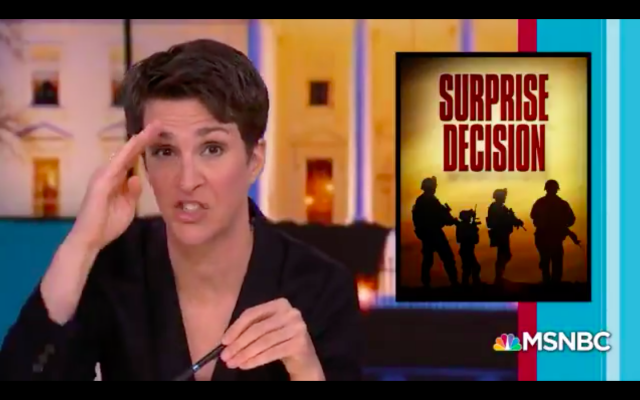
It is absolutely bat shit crazy that we feel normal about the most powerful military force in the history of civilization running around the world invading and occupying and bombing and killing, yet are made to feel weird about the possibility of any part of that ending. It is absolutely bat shit crazy that endless war is normalized while the possibility of peace and respecting national sovereignty to any extent is aggressively abnormalized. In a sane world the exact opposite would be true, but in our world this self-evident fact has been obscured. In a sane world anyone who tried to convince you that war is normal would be rejected and shunned, but in our world those people make six million dollars a year reading from a teleprompter on MSNBC.
How did this happen to us? How did we get so crazy and confused?
I sometimes hear the analogy of sleepwalking used; people are sleepwalking through life, so they believe the things the TV tells them to believe, and this turns them into a bunch of mindless zombies marching to the beat of CIA/CNN narratives and consenting to unlimited military bloodbaths around the world. I don’t think this is necessarily a useful way of thinking about our situation and our fellow citizens. I think a much more useful way of looking at our plight is to retrace our steps and think about how everyone got to where they’re at as individuals.
We come into this world screaming and clueless, and it doesn’t generally get much better from there. We look around and we see a bunch of grownups moving confidently around us, and they sure look like they know what’s going on. So we listen real attentively to what they’re telling us about our world and how it works, not realizing that they’re just repeating the same things grownups told them when they were little, and not realizing that if any of those grownups were really honest with themselves they’re just moving learned concepts around inside a headspace that’s just as clueless about life’s big questions as the day it was born.
And that’s just early childhood. Once you move out of that and start learning about politics, philosophy, religion etc as you get bigger, you run into a whole bunch of clever faces who’ve figured out how to use your cluelessness about life to their advantage. You stumble toward adulthood without knowing what’s going on, and then confident-sounding people show up and say “Oh hey I know what’s going on. Follow me.” And before you know it you’re donating ten percent of your income to some church, addicted to drugs, in an abusive relationship, building your life around ideas from old books which were promoted by dead kings to the advantage of the powerful, or getting your information about the world from Fox News.
For most people life is like stumbling around in a dark room you have no idea how you got into, without even knowing what you’re looking for. Then as you’re reaching around in the darkness your hand is grasped by someone else’s hand, and it says in a confident-sounding voice, “I know where to go. Come with me.” The owner of the other hand doesn’t know any more about the room than you do really, they just know how to feign confidence. And it just so happens that most of those hands in the darkness are actually leading you in the service of the powerful.
That’s all mainstream narratives are: hands reaching out in the darkness of a confusing world, speaking in confident-sounding voices and guiding you in a direction which benefits the powerful. The largest voices belong to the rich and the powerful, which means those are the hands you’re most likely to encounter when stumbling around in the darkness. You go to school which is designed to indoctrinate you into mainstream narratives, you consume media which is designed to do the same, and most people find themselves led from hand to hand in this way all the way to the grave.
That’s really all everyone’s doing here, reaching out in the darkness of a confusing world and trying to find our way to the truth. It’s messy as hell and there are so many confident-sounding voices calling out to us giving us false directions about where to go, and lots of people get lost to the grabbing hands of power-serving narratives. But the more of us who learn to see through the dominant narratives and discover the underlying truths, the more hands there are to guide others away from the interests of the powerful and toward a sane society. A society in which people abhor war and embrace peace, in which people collaborate with each other and their environment, in which people overcome the challenges facing our species and create a beautiful world together.
People aren’t sleepwalking, they are being duped. Duped into insanity in a confusing, abrasive world where it’s hard enough just to get your legs underneath you and figure out which way’s up, let alone come to a conscious truth-based understanding of what’s really going on in the world. But the people doing the duping are having a hard time holding onto everyone’s hand, and their grip is slipping. We’ll find our way out of this dark room yet.
States that stood up for INF Treaty have now ‘de facto blessed’ US for scrapping it – Moscow
RT | December 22, 2018
The very same nations that blasted the White House for deciding to pull out of the landmark 1987 INF Treaty have now helped to defeat the UN resolution calling for its support, the Russian Foreign Ministry pointed out.
Russia expressed “disappointment” as a resolution in support of the Intermediate-Range Nuclear Forces Treaty was voted down by a narrow margin in the UN General Assembly on Friday.
Forty-three states, including China and South American countries, voted for the document drafted by Russia.
Forty-six voted against the resolution, with 78 abstaining. The US’ allies in NATO and the EU voted ‘No’ despite previously speaking in favor of keeping the arms agreement intact, the Russian Foreign Ministry noted.
These countries, especially the NATO members – contrary to their own statements about the importance of the INF Treaty – acted as its opponents.
Friday’s vote shows how the US’ allies “de facto blessed” Washington for violating the INF deal, the foreign ministry stressed.
Moscow’s envoy to the UN, Vasily Nebenzya told Rossiya 1 TV channel that prior to the vote his American counterpart, Nikki Haley, sent out a letter urging everyone to vote down the Russian draft.
As the US announced its willingness to ditch the landmark INF Treaty back in October, many European politicians defended the need to keep the existing agreement and hailed its role in nuclear disarmament. German Foreign Minister Heiko Maas called Washington’s decision “regrettable” as the treaty is “hugely important” to the European continent.
EU foreign affairs chief, Federica Mogherini referred to the embattled treaty as the “key” and “a fundamental pillar” to European security architecture and urged for it to be “preserved and fully implemented.”
The INF Treaty bans Moscow and Washington from developing and deploying ground-based missiles with ranges from 500 to 5,500 kilometers. Both sides accuse each other of violating its terms, and likewise deny any wrongdoing.
Two weeks ago, US Secretary of State Mike Pompeo threatened to pull the US from the deal in 60 days “unless Russia returns to compliance.”
Russia, in turn, warned that the US withdrawal from the INF Treaty will trigger an arms race across the globe.
Trump Syria Withdrawal Decision Requires Congressional Hearings – Senator Graham
Sputnik – December 21, 2018
WASHINGTON – President Donald Trump’s plan to pull all American forces out of Syria needs to be examined by Congress to determine the impact on US national security, Senator Lindsey Graham said on Friday.
“It is imperative Congress hold hearings on withdrawal decision in Syria — and potentially Afghanistan — to understand implications to our national security,” Graham said on Twitter.
Any hearings, as suggested by Graham, would likely be held when the new Congress convenes in January.
Trump announced plans this week to pull 2,000 US troops out of northern Syria, where they have been backing Kurdish rebels in the US-allied Syrian Democratic Forces (SDF). The president has also ordered the withdrawal of about half of the 14,000 US forces in Afghanistan, according to media reports.
The planned withdrawals – which are opposed by many Republicans and Democrats in Congress — prompted the resignation of Defense Secretary James Mattis on Thursday.
More: ‘Trump Plunging Country Into Chaos’: GOP, Dems Slam Trump for Mattis Resignation
Ex-Diplomat: US Elites Alarmed That Trump May Accomplish Promised Foreign Policy
Sputnik – 21.12.2018
WASHINGTON – The US troop withdrawal from Syria and the resignation of Defense Secretary James Mattis has the establishment fearful that President Donald Trump might finally implement the foreign policy he campaigned on, former diplomat Jim Jatras told Sputnik.
“Terror has again gripped the establishment that the Trump who was elected president in 2016 might actually start implementing what he promised,” Jatras, who was also once a US Senate foreign policy adviser, said on Thursday.
Trump needed to also overhaul the rest of his top-tier defense and national security advisers and chiefs, Jatras said.
“This will be a critical time for the Trump presidency. If he can get the machinery of the Executive Branch to implement his decision to withdraw from Syria, and if he can pick a replacement to General Mattis who actually agrees with [his own] views,” Jatras said. “It is imperative that he pick someone for the Pentagon — and frankly, clear out the rest of his national security team — and appoint people he can trust and whose views comport with his own.”
Trump in a tweet earlier in the day commenting on his decision to withdraw US troops from Syria, said it was “time to come home and rebuild.”
On Thursday, Mattis stepped down citing the fact his views no longer aligned with Trump’s a day after the White House announced that US troops were leaving Syria.
Earlier on Thursday, the Wall Street Journal reported that Trump has ordered the US military to withdraw some 7,000 troops from Afghanistan in the coming weeks.
The president made promises during his campaign to stop expending money and lives on foreign wars to rebuild the United States.
Syria Insanity Must Continue, Sez Washington Establishment & Media
By James Bovard | December 20, 2018
The Washington Post front page today is in full panic mode over Trump’s decision on Syria. Reading the Post, one would think that US intervention had achieved something aside from getting vast numbers of Syrians pointlessly killed. Washington’s laptop bombardiers are hysterically opposed to Trump’s withdrawal of US troops from Syria. But the “Combat Veterans for Continued Carnage” lobby is almost nonexistent. I slammed Trump’s Syria policy last year in USA Today as his “worst foreign policy folly” but his decision to exit Syria is one of his best decisions yet.
Here’s a link to a USA Today oped I did five years ago on why Americans couldn’t trust Obama on Syria. In a 2014 blog on “Obama’s Great Syrian Bombing Scam,” I groused: “Obama loves to preen as if he is spreading peace, freedom, and democracy with his bombs. But there is no reason to presume that bombing Syria is not as idiotic as it appears. Thus far, the Establishment media is largely playing a lapdog role.” The media’s response to Trump’s withdrawal announcement vivifies how the pro-war bias continues.
When Trump denounced “trigger-happy Hillary” on the campaign trail in 2016, crowds roared. Hopefully exiting Syria is the start of a sea change in U.S. intervention abroad.
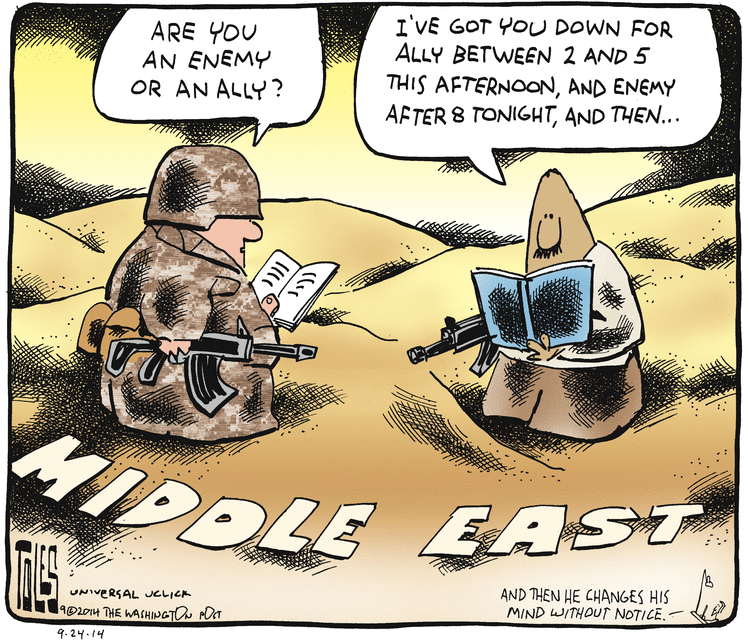
Cartoonist Tom Toles beautifully captured the idiocy of U.S. policy in this 2014 cartoon. Two years later, CIA-backed Syrian rebels were fighting Pentagon-backed Syrian rebels. What could possible go wrong?
A
Ukraine plans another incursion into Kerch Strait, hopes NATO ships will join in – top official
RT | December 20, 2018
Kiev is considering sending its Navy ships through the Kerch Strait again, a high-ranked official said weeks after a tense standoff between Russian and Ukrainian vessels in the area.
Another passage by Ukrainian Navy ships through the Kerch Strait which connects Black and Azov Seas might take place very soon, according to Alexander Turchinov, head of Ukraine’s National Security and Defense Council. “I think that this issue cannot be delayed,” he told BBC News Ukraine on Wednesday.
Turchinov, who briefly served as interim president after the Western-backed 2014 Euromaidan coup in Kiev, didn’t mince his words while explaining the rationale between the action. To him, Russia is after “seizing the Azov Sea,” install new maritime borders and “legitimize the occupation of Crimea.”
The only antidote to the plan is “to show to the entire world that Ukraine has not lost its position in the Azov Sea.” Turchinov was speaking several weeks after three Ukrainian ships attempted to break through the strait which Russia had closed on safety reasons.
On November 25, three Ukrainian Navy vessels, including two combat-ready gunboats, entered the Kerch Strait without getting proper clearance first, according to Moscow. After ignoring multiple warnings and demands to stop, they were fired upon and seized by the Russian coast guard, while the sailors were taken to custody.
This time, the official said he hopes Ukraine will not be left alone in the next endeavor. “It would be very logical if NATO ships which we invited [to visit] the Azov Sea ports make sure that Russia complies with international law,” he said, lamenting the military bloc provided no response yet.
Nevertheless, Turchinov hopes that “during the next passage of Ukrainian warships through the Kerch Strait they will at least send their observers to us.” Kiev had also invited officials from OSCE and other international bodies to be on board Ukrainian ships to prove “that Ukraine and its sailors do not violate any laws and international rules.”
The latter phrase sounds odd given that Moscow had accused Ukrainian sailors of deliberately violating Russia’s maritime borders in the Kerch Strait and breaking specific rules of passing through the narrow, complex water area. Top Russian officials maintained that this was a premeditated and provocative act plotted by the Ukrainian government.
Turchinov’s BBC interview was predictably met with little praise in Moscow. “This was just an announcement of another provocation,” Foreign Ministry spokeswoman Maria Zakharova said on Wednesday, calling it “utterly irresponsible.” She noted the inflammatory remark came at the time when “many Ukraine’s partners try to defuse tensions in this situation and seek ways of de-escalation.”
It also comes several days after the UN General Assembly passed a Ukrainian resolution, condemning the presence of the Russian military in the Crimean Peninsula and the surrounding waters of the Black Sea and the Azov Sea. 66 countries supported the non-binding resolution but 72 abstained from voting altogether.
Do you believe it’s OUR goal? Putin says he knows ‘very well’ who seeks to rule the world
RT | December 20, 2018
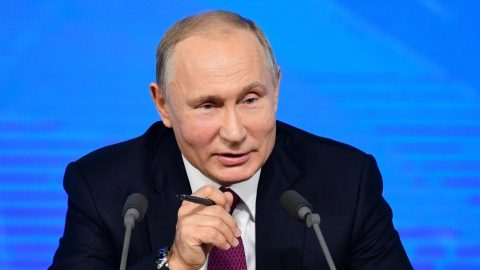
Russia does not aim to rule the world, and such assumptions are part of an “imposed mentality” used to distract people, Vladimir Putin told a WSJ reporter when asked about Russia’s supposed ambitions for world domination.
Faced with a rather provocative question from the WSJ Moscow Bureau Chief, Ann Maria Simmons, Putin said that “when it comes to ruling the world we know very well where the headquarters [of those], who are trying to do exactly that,” is located. “And it’s not in Moscow,” the president added, speaking at an annual Q&A session in Moscow.
Although the Russian leader has never openly accused Washington of having some global ambitions, he still said that the ongoing contest of influence in the international arena is linked to “the US leading role in the world economy” and its enormous defense spending amounting to “more than $700 billion,” which Washington apparently seeks to translate into some political power.
Russia’s defense spending amounts to just $46 billion, the president said, noting that the total population of the NATO countries accounts for some 600 million people while Russia has just about 140 million.
“Do you really believe that it is our goal to rule the world?” Putin asked rhetorically.
All the speculation about Russia’s supposed aspirations for the world dominance are nothing but a “mentality imposed by some to achieve internal goals,” the president said.
US preparing for complete military withdrawal from Syria – reports
RT | December 19, 2018
Washington is planning to “rapidly” pull out all its troops from Syria, various media outlets have reported, citing US officials
The decision was allegedly taken by President Donald Trump himself, who had repeatedly expressed his intent to get out of the Arab Republic earlier. However, the Pentagon apparently opposes the move. The potential withdrawal would upend assumptions about the long-term US presence in the war-ravaged country, which was particularly backed by the Defense Secretary James Mattis.
The schedule, as well as the details of the alleged withdrawal, are yet unknown. While the Pentagon and the White House did not issue any official statements on the issue, Trump said in a Twitter post that Islamic State (IS, formerly ISIS/ISIL), which he called “the only reason for [the US troops] being there [in Syria],” has been defeted, apparently signaling that there was no reason for the US to stay on the ground in Syria any longer.
According to some reports, the withdrawal might primarily affect the US troops on the ground working together with an alliance of Arab and Kurdish militias, known as the Syrian Democratic Forces (SDF). The US has a total of 2,000 servicemen there, who are particularly involved in training the local militias. The news come as the SDF are reportedly on the verge of retaking one of the terrorist group’s last major strongholds – the town of Hajin, located east of the Euphrates.
Featured Video

Iran’s Next Strike May Not Explode. It Could Shut You Down
or go to
Aletho News Archives – Video-Images
From the Archive
Zionism’s Violent Legacy
By Donald Neff | Washington Report On Middle East Affairs | January 1996
On January 4, 1948, Jewish terrorists drove a truck loaded with explosives into the center of the all Arab city of Jaffa and detonated it, killing 26 and wounding around 100 Palestinian men, women and children.[1] The attack was the work of the Irgun Zvai Leumi – the “National Military Organization,” also known by the Hebrew letters Etzel – the largest Jewish terrorist group in Palestine. The Irgun was headed by Revisionist Zionist Menachem Begin and had been killing and maiming Arabs, Britons and even Jews for the previous ten years in its efforts to establish a Jewish state.
This terror campaign meant that at the core of Revisionist Zionism there existed a philosophical embrace of violence. … continue
Blog Roll
 Aletho News
- Trump’s Iran war is on an Israeli leash
- Saudi oil boss issues global supply warning
- Riyadh Says Its Oil System Is Intact. The Numbers Say Otherwise.
- Trump and Netanyahu Want to “Finish the Job” on Iran
- US ‘one-sided dictation’ not Iran’s beliefs makes rational talks impossible: Baghaei
- Iran’s Next Strike May Not Explode. It Could Shut You Down /Col Doug Macgregor
- Iran: US political targets legitimate if assassinations return
- Iraq shuts key border crossing with Iran under US pressure: Report
- Undersea Internet cables could be targeted in retaliation for attacks on Iran: IRGC deputy chief
- EU sending ‘biased’ observers to interfere in Serbian election – president
- If Americans Knew
- The Israel Lobby’s Changing Fortunes
- AIPAC has become such a political liability that it’s shifting to a more “nimble” approach to buying politicians
- At least 160 Israeli settler attacks in 2 weeks
- Will Gaza’s Ancient Christian Community Disappear Forever?
- Israel’s vision of regional security rests on keeping Arab states weak
- Heidi Levine recounts how Palestinian youths helped save her in settler attack
- DAILY UPDATE: Latest essential news on Palestine, Israel, & region
- Trump’s Intensifying Sabotage of the ICC, for Israel’s Sake
- Israeli military detain US and UK volunteers in West Bank including Democratic NY politician Brad Lander
- Americans at National Conservatism Conference held in Israel this year criticize Israel
- No Tricks Zone
- E-Cars Reduce CO2 Emissions By Only 41% Compared To Internal Combustion Engine Vehicles
- Predictions Made By Renowned Climate Professor Over Past Decades Have Been Proven To Be Poor
- New Study Suggests Large Regions Of The Pacific Ocean Have Been Cooling For The Last 80 Years
- Germany’s Green Energy Debacle: High Energy Costs Force Kahla Porzellan to Close After 182 Years!
- New Study: 50 Years Of The Most Aggressive ‘Net Zero’ Policies Can Only Affect The Global Climate By 0.03°C
- US September “Heat” Was No Record…Many Records Set Decades Ago
- Latest European Green Energy Debacle; Portugal’s Largest Flagship Solar Park Insolvent!
- Green Energy Debacle: German Expert Professor Fritz Vahrenholt Warns Of Severe Economic And Social Consequences
- Two More Paleo Reconstructions Affirm Meters-Higher Sea Levels Across Ireland, Brazil 7000-6000 Years Ago
- New Study: Earth And Venus Surface Warmth Largely Explained By Convection And Lapse Rate, Not CO2 Or Radiation

