‘More wars in the pipeline: Bannon exit bodes ill for US aggression opponents’
RT | August 19, 2017
With the firing of anti-globalist Steve Bannon, neo-conservatives and hawks may take complete control of US foreign policy, says investigative journalist Rick Sterling, adding that it’s not a good sign when hawkish Senator John McCain is smiling.
US President Donald Trump’s chief strategist, Steve Bannon – viewed as a key figure in Team Trump – has left the White House.
After the firing, Bannon, 63, resumed his role as head of conservative website Breitbart News, and announced that he was “going to war” for Trump.
“If there’s any confusion out there, let me clear it up: I’m leaving the White House and going to war for Trump against his opponents – on Capitol Hill, in the media, and in corporate America,” he told Bloomberg News Friday.
The departure is just the latest in a series of shake-ups since Trump took office.
What will Bannon’s firing mean for the Trump administration and how it could affect policymaking? RT discussed with investigative journalist Rick Sterling.
“Bannon was an anti-globalist strongly opposed by hawkish senators like John McCain… While liberals and neo-conservatives may be cheering, it may bode ill for those who oppose US aggression and think the US should not be the world’s policeman,” he said.
The now-former White House chief strategist was in favor of a trade war with China and “ratcheting up economic contention,” but he was against conflict with North Korea, Sterling said.
Just a couple of days before his exit, Bannon said in an interview that there is no military solution to the North Korean problem. The comment was rebuffed by both Secretary of State Rex Tillerson and Defense Secretary Jim Mattis.
Bannon’s stance was also in “sharp contrast with National Security Advisor H.R. McMaster, who said that North Korea poses a direct military threat,” Sterling said. “The very dangerous thing right now is that neo-conservatives and the hawks take complete control of US foreign policy… we are going to see a lot more war coming down the pipeline.”
The Democratic National Committee (DNC) reacted to the decision by saying in a statement: “there is one less white supremacist in the White House.”
Commenting on the matter, Sterling opined that “they’ve manipulated the situation where Breitbart and Steve Bannon were allied with right-wing nationalist forces within the US.”
Ironically, he went on to say, “these forces are much more resistant to US wars of aggression.”
“So, we’ve got key issues coming up now. In the coming period, we’re going to have decisions on whether the US is going to escalate the troop involvement and the intervention in Afghanistan; we’ve got the situation with North Korea; the situation with Syria is coming to a head. Steve Bannon, as an anti-globalist, was arguing against the US escalating military intervention and now the situation seems to be controlled by the generals in the White House, and it’s not a good sign when hawkish Senator John McCain is smiling and very happy,” Sterling said.
The Neocons Are Pushing the USA and the Rest of the World Towards a Dangerous Crisis
The Saker | Unz Review | August 18, 2017
First, my writing on the wall
In October of last year a wrote an analysis I entitled The USA are about to face the worst crisis of their history and how Putin’s example might inspire Trump and I think that this is a good time to revisit it now. I began the analysis by looking at the calamities which would befall the United States if Hillary was elected. Since this did not happen (thank God!), we can safely ignore that part and look at my prediction of what would happen if Trump was elected. Here is what I wrote:
Trump wins. Problem: he will be completely alone. The Neocons have a total, repeat total, control of the Congress, the media, banking and finance, and the courts. From Clinton to Clinton they have deeply infiltrated the Pentagon, Foggy Bottom, and the three letter agencies. The Fed is their stronghold. How in the world will Trump deal with these rabid “crazies in the basement“? Consider the vicious hate campaign which all these “personalities” (from actors, to politicians to reporters) have unleashed against Trump – they have burned their bridges, they know that they will lose it all if Trump wins (and, if he proves to be an easy pushover his election will make no difference anyway). The Neocons have nothing to lose and they will fight to the very last one. What could Trump possibly do to get anything done if he is surrounded by Neocons and their agents of influence? Bring in an entirely different team? How is he going to vet them? His first choice was to take Pence as a VP – a disaster (he is already sabotaging Trump on Syria and the elections outcome). I *dread* the hear whom Trump will appoint as a White House Chief of Staff as I am afraid that just to appease the Neocons he will appoint some new version of the infamous Rahm Emanuel… And should Trump prove that he has both principles and courage, the Neocons can always “Dallas” him and replace him with Pence. Et voilà!
I went on to suggest that Trump’s only option would be to follow Putin’s example and do to the Neocons what Putin did to the oligarchs. Clearly that did not happen. In fact, one month after the election of Trump I wrote another analysis entitled “The Neocons and the “deep state” have neutered the Trump Presidency, it’s over folks!“.
Less than a month ago I warned that a ‘color revolution’ was taking place in the USA. My first element of proof was the so-called “investigation” which the CIA, FBI, NSA and others were conducting against President Trump’s candidate to become National Security Advisor, General Flynn. Tonight, the plot to get rid of Flynn has finally succeeded and General Flynn had to offer his resignation. Trump accepted it. Now let’s immediately get one thing out of the way: Flynn was hardly a saint or a perfect wise man who would single handedly saved the world. That he was not. However, what Flynn was is the cornerstone of Trump’s national security policy. (…) The Neocon run ‘deep state’ has now forced Flynn to resign under the idiotic pretext that he had a telephone conversation, on an open, insecure and clearly monitored, line with the Russian ambassador. And Trump accepted this resignation. Ever since Trump made it to the White House, he has taken blow after blow from the Neocon-run Ziomedia, from Congress, from all the Hollywood doubleplusgoodthinking “stars” and even from European politicians. And Trump took each blow without ever fighting back. Nowhere was his famous “you are fired!” to be seen. But I still had hope. I wanted to hope. I felt that it was my duty to hope. But now Trump has betrayed us all. Again, Flynn was not my hero. But he was, by all accounts, Trump’s hero. And Trump betrayed him. The consequences of this will be immense. For one thing, Trump is now clearly broken. It took the ‘deep state’ only weeks to castrate Trump and to make him bow to the powers that be. Those who would have stood behind Trump will now feel that he will not stand behind them and they will all move back away from him. The Neocons will feel elated by the elimination of their worst enemy and emboldened by this victory they will push on, doubling-down over and over and over again. It’s over, folks, the deep state has won.
I then concluded that the consequences of this victory would catastrophic for the United States:
In their hate-filled rage against Trump and the American people (aka “the basket of deplorables”) the Neocons have had to show their true face. By their rejection of the outcome of the elections, by their riots, their demonization of Trump, the Neocons have shown two crucial things: first, that the US democracy is a sad joke and that they, the Neocons, are an occupation regime which rules against the will of the American people. In other words, just like Israel, the USA has no legitimacy left. And since, just like Israel, the USA are unable to frighten their enemies, they are basically left with nothing, no legitimacy, no ability to coerce. So yes, the Neocons have won. But their victory is removes the last chance for the US to avoid a collapse.
I think that what we are seeing today are the first signs of the impending collapse.
The symptoms of the agony
- Externally, the US foreign policy is basically “frozen” and in lieu of a foreign policy we now only have a long series of empty threats hurled at a list of demonized countries which are now promised “fire and brimstone” should they dare to disobey Uncle Sam. While this makes for good headlines, this does not qualify as a “policy” of any kind (I discussed this issue at length during my recent interview with SouthFront). And then there is Congress which has basically stripped Trump from his powers to conduct foreign policy. This bizarre, and illegal, form of a “vote of no-confidence” further hammers in the message that Trump is either a madman, a traitor, or both.
- Internally, the latest riots in Charlottesville now being blamed on Trump who, after being a Putin agent is now further demonized as some kind of Nazi (see Paul Craig Roberts’ first and second warnings about this dynamic)
- Organizationally, it is clear that Trump is surrounded by enemies as illustrated by the absolutely outrageous fact that he can’t even talk to a foreign head of state without having the transcript of his conversation leaked to the Ziomedia.
I believe that these all are preparatory steps to trigger a major crisis and use it to remove Trump, either by a process of impeachment, or by force under the pretext of some crisis. Just look at the message which the Ziomedia has been hammeing into the brains of the US population.
The psychological preparation for the forthcoming coup: scaring them all to death
Here are three very telling examples taken from Newsweek’s front page:

Ask yourself, what is the message here?
Trump is a traitor, he works for Putin, Putin wants to destroy democracy in the United States and these two men together are the most dangerous men on the planet. This is a “plot against America“, no less!
Not bad, right?
“They” are clearly out there go get “us” and “we” are all in terrible danger: Kim Jong-un is about to declare nuclear war on the US, Xi and Putin are threatening the world with their armies, and “our” own President came to power courtesy of the “Russian KGB” and “Putin’s hackers”, he now works for the Russians, he is also clearly a Nazi, a White supremacist, a racist and, possibly, a “new Hitler” (as is Putin, of course!).
And then, there are those truly scary Mooslims and Aye-rabs who apparently want only two things in life: destroy “our way of life” and kill all the “infidels”. This is why we need the TSA, 16 intelligence agencies and militarized police SWAT teams everywhere: in case the terrorists come to get us where we live.
Dangerous international consequences
This would all be rather funny if it was not also extremely dangerous. For one thing, the US is really poking at a dangerous foe when it constantly tries to scare Kim Jong-un and the DPRK leadership. No, not because of the North Korean nukes (which are probably not real nuclear capable ICBMs but a not necessarily compatible combination of nuclear ‘devices’ and intermediate range ballistic missiles) but because of the huge and hard to destroy conventional North Korean military. The real threat are not missiles, but a deadly combination of conventional artillery and special forces which present very little danger to the US or the US military, but which present a huge threat for the population of Seoul and the northern section of South Korea. Nukes, in whatever form, are really only an added problem, a toxic “icing” on an already very dangerous ‘conventional cake’.
[Sidebar – a real life nightmare: Now, if you *really* want to terrify yourself and stay awake all night then consider the following. While I personally believe that Kim Jong-un is not insane and that the main objective of the North Korean leadership is to avoid a war at all costs, what if I am wrong? What if those who say that the North Korean leaders are totally insane are right? Or, which I think is much more likely, what if Kim Jong-un and the North Korean leaders came to the conclusion that they have nothing to lose, that the Americans are going to kill them all, along with their families and friends? What could they, in theory, do if truly desperate? Well, let me tell you: forget about Guam; think Tokyo! Indeed, while the DPRK could devastate Seoul with old fashioned artillery systems, DPRK missiles are probably capable of striking Tokyo or the Keihanshin region encompassing Kyoto, Osaka and Kobe including the key industries of the Hanshin Industrial Region. The Greater Tokyo area (Kanto region) and the Keihanshin region are very densely populated (37 and 20 million people respectively) and contain an immense number of industries, many of which would produce an ecological disaster of immense proportions if hit by missiles. Not only that, but a strike on the key economic and financial nodes of Japan would probably result in a 9-11 kind of international economic collapse. So if the North Koreans wanted to really, really hurt the Americans what they could do is strike Seoul, and key cities in Japan resulting in a huge political crisis for the entire planet. During the Cold War we used to study the consequences of a Soviet strike against Japan and the conclusion was always the same: Japan cannot afford a war of any kind. The Japanese landmass is too small, too densely populated, too rich in lucrative targets and a war would lay waste to the entire country. This is still true today, only more so. And just imagine the reaction in South Korea and Japan if some crazy US strike on the DPRK results in Seoul and Tokyo being hit by missiles! The South Koreans have already made their position unambiguously clear, by the way. As for the Japanese, they are officially placing their hopes in missiles (as if technology could mitigate the consequences of insanity!). So yeah, the DPRK is plenty dangerous and pushing them into their last resort is totally irresponsible indeed, nukes or no nukes]
What we are observing now is positive feedback loop in which each move by the Neocons results in a deeper and deeper destabilization of the entire system. Needless to say, this is extremely dangerous and can only result in an eventual catastrophe/collapse. In fact, the signs that the US is totally losing control are already all over the place, here are just a few headlines to illustrate this:
- Iran could quit nuclear deal in ‘hours’ if new U.S. sanctions imposed: Rouhani
- Israel: Netanyahu declares support for a Kurdish state
- Syrian forces take 3 more towns en route to Deir ez-Zor in first airborne operation
- Maduro calls for nationwide ‘anti-imperialist’ drills after Trump’s threat of ‘military option’
- Soldiers of the 201st (Russian) base in Tadjikistan have been put on high alert as part of a military exercise
- Confirmed: Turkey to end support for anti-government terrorists in Syria
- Russia Plans Huge Zapad 2017 Military Exercises With Belarus
A French expression goes “when the cat is gone, the mice dance”, and this is exactly what is happening now: the US is both very weak and basically absent. As for the Armenians, they say “The mouse dreams dreams that would terrify the cat”. Well, the “mice” of the world are dancing and dreaming and simply ignoring the “cat”. Every move the cat makes only makes things worse for him. The world is moving on, while the cat is busy destroying himself.
Dangerous domestic consequences
First on my list would be race riots. In fact, they are already happening all over the United States, but they are rarely presented as such. And I am not talking about the “official” riots of Black Lives Matter, which are bad enough, I am talking about the many mini-riots which the official media is systematically trying to obfuscate. Those interested in this topic should read the book Don’t Make the Black Kids Angry by Colin Flaherty which shows that racist attacks on Whites by Blacks (aka “polar bear hunting”) are on the rise pretty much all over the county. Likewise, anybody who stubbornly persists in ignoring the strong correlation between race and crime ought to read Ron Unz’s seminal analysis Race and Crime in America. Now, before some self-appointed thought police volunteer accuses me as a racist, I am not saying anything at all about the causes of the racial problems in the United States. I am only saying that racial violence in the US is severe and rapidly getting much worse.
The second problem which I see threatening the US society is an extremely rapid delegitimization of the entire US political system and, especially, of the Federal government. For decades now Americans have been voting for ‘A’ and each time what they ended up with is ‘not-A’. Examples of that include the famous “read my lips, no new taxes”, of course, but also Obama promises to stop stupid wars and now Trump’s promise to “drain the swamp”. Americans have been lied to for decades and they know it. There is a widening chasm between the so-called “American values” taught in schools and the reality of power. While officially the US is supposed to stand for democracy, freedom and all the other good things advocated by the Founding Fathers, the disgusting reality is that the US is in bed with Wahabis, Nazis and Zionists. The all-prevailing hypocrisy of it all now threatens to bring down the entire US political system just as the no less prevailing hypocrisy of the Soviet system brought down the USSR (if interested, you can read more about this topic here). The simple truth is that no regime can survive for too long when it proactively supports the exact opposite of what it officially is supposed to stand for. The result? I have yet to meet an adult American who would sincerely believe that he/she lives in the “land of the free and the home of the brave”. Maybe infants still buy this stuff, but even teenagers know that this is a load of bull.
Third, for all the encouraging statistics about the Dow Jones, unemployment and growth, the reality is that the US society is rapidly transforming itself into a three-tired one: on top, a small number of obscenely rich people, under them, a certain amount of qualified professionals who service the filthy rich and who struggle to maintain a lifestyle which in the past was associated with the middle-class. And then the vast majority of Americans who basically are looking at making “minimal wage plus a little something” and who basically survive by not paying for health insurance, by typically working two jobs, by eating cheap and unhealthy “prolefeed” and by giving up on that which every American worker could enjoy in the 1950s and 1960s (have one parent at home, have paid holidays, a second vacation home, etc.). Americans are mostly hard workers and, so far, most of them are surviving, but they are mostly one paycheck away from seriously bad poverty. A lot of them only make ends meet because they get help from their parents and grand-parents (the same is true of southern Europe, by the way). A large segment of the US population now survives only because of Walmart and the Dollar Store. Once that fails, food stamps are the last option. That, or jail, of course.
Combine all this and you get a potentially extremely explosive situation. No wonder that when so many Americans heard Hillary’s comment about the “basket of deplorables” they took that as declaration of war.
And how do the Neocons plan to deal with all this?
By cracking down on free speech and dissent, of course! What else?
Their only response – repression of course!
YouTube, Google, Facebook, Twitter – they are all cracking down on “bad” speech which includes pretty much any topic a garden variety self-described ‘liberal’ frowns upon. GoDaddy and Google are even going after domain names. Oh sure, nobody gets thrown in jail for, say, defending the 2nd Amendment, but they get “demonetized” and their accounts simply closed. It’s not the cops cracking down on free speech, it’s “Corporate America”, but the effect is the same. Apparently, the Neocons do not realize that censorship is not a viable strategy in the age of the Internet. Or maybe they do, and they are deliberately trying to trigger a backlash?
Then there is the vilification campaign in the media: unless you are some kind of ‘minority’ you are assumed to be nefarious by birth and guilty of all the evils on the planet. And your leader is Trump, of course, or maybe even Putin himself, vide supra. Christian heterosexual White males better run for cover…
Whatever may be the case, by their manic insistence, on one hand, to humiliate and crush Trump and, on the other, to repress millions of Americans the Neocons are committing a double mistake. First, they are showing their true face and, second, they are subverting the very institutions they are using to control and run this country. That, of course, only further weaken the Neocons and the United States themselves and that further accelerates the positive feedback loop mentioned above which now threatens the entire international system.
Us and Them
What makes the gradual collapse of the AngloZionist Empire so uniquely dangerous is that it is by far the biggest and most powerful empire in world history. No empire has ever had the quasi monopoly on power the USA enjoyed since WWII. By any measure, military, economic, political, social, the US came out of WWII as a giant and while there were ups and downs during the subsequent decades, the collapse of the USSR only reaffirmed what appeared to be the total victory of the United States. In my admittedly subjective opinion, the last competent (no, I did not say ‘good’, I said ‘competent’) US President was George Herbert Walker Bush who, unlike his successors, at least knew how to run an Empire. After that, it is all downhill, faster and faster. And if Obama was probably the most incompetent President in US history, Trump will be the first one to be openly lynched while in office. As a result, the AngloZionist Empire is now like a huge freight train which has lost its locomotive but still has an immense momentum pushing it forward even though there is nobody in control any more. The rest of the planet, with the irrelevant exception of the East Europeans, is now scrambling in horror to get out of the path of this out of control train. So far, the tracks (minimal common sense, political realities) are more or less holding, but a crash (political, economic or military) could happen at any moment. And that is very, very scary.
The US has anywhere between 700 to 1000 military bases worldwide, the entire international financial system is deeply enmeshed with the US economy, the US Dollar is still the only real reserve currency, United States Treasury securities are held by all the key international players (including Russia and China), SWIFT is politically controlled by the US, the US is the only country in the world that can print as much money as it wants and, last but not least, the US has a huge nuclear arsenal. As a result, a US collapse would threaten everybody and that means that nobody would want to trigger one. The collapse of the Soviet Union threatened the rest of mankind only in one way: by its nuclear arsenal. In contrast, any collapse of the United States would threaten everybody in many different ways.
So the real question now is this: can the rest of the planet prevent a catastrophic collapse of the AngloZionist Empire?
This is the irony of our situation: even though the entire planet is sick and tried of the incompetent arrogance of the AngloZionists, nobody out there wants their Empire to catastrophically collapse. And yet, with the Neocons in power, such a collapse appears inevitable with potentially devastating consequences for everybody.
This is really amazing, think of it: everybody hates the Neocons, not only a majority of the American people, but truly the entire planet. And yet that numerically small group of people has somehow managed to put everybody in danger, including themselves, due to their ugly vindictiveness, infinite arrogance and ideology-induced short-sightedness. That this could ever have happened, and at a planetary scale, is a dramatic testimony to the moral and spiritual decay of our civilization: how did we ever let things get that far?!
And the next obvious question: can we still stop them?
I honestly don’t know. I hope so, but I am not sure. My biggest hope with Trump was that he would be willing to sacrifice the Empire for the sake of the US (the opposite of what the Neocons are doing: they are willing to sacrifice the US for the sake of their Empire) and that he would manage a relatively safe and hopefully non-violent transition from Empire to “normal country” for the US. Clearly, this is ain’t happening. Instead, the Neocons are threatening everybody: the Chinese, the Russians, the North Koreans and the Venezuelans of course, but also the Europeans (economically), the entire Middle-East (via the “only democracy in the Middle-East”), all the developing countries and even the American people. Heck, they are even threatening the US President himself, and in not-so-subtle ways!
So what’s next?
Truly, I don’t know. But my overwhelming sense is that Trump will be removed from office, either for “high crimes and misdemeanors” or for “medical reasons” (they will simply declare him insane and unfit to be the President). Seeing how weak and spineless Trump is, he might even be “convinced” to resign. I don’t see them simply murdering him simply because he is no Kennedy either. After that, Pence comes to power and it will all be presented like a wonderful event, a group-hug of the elites followed by an immediate and merciless crackdown on any form of political opposition or dissent which will immediately be labeled as racist, homophobic, anti-Semitic, terrorist, etc. The evil hand of the “Russian KGB” (yes, I know, the KGB was dissolved in 1991) will be found everywhere, especially amongst US libertarians (who will probably be the only ones with enough brains to understand what is taking place). The (pseudo-) “Left” will rejoice. Should this course of action result in an unexpected level or resistance, either regional or social, a 9-11 false flag followed by a war will be the most likely scenario (why stray away from something which worked so well the first time around?!). Unless the US decides to re-invade Grenada or give Nauru a much deserved thrashing, any more or less real war will result in a catastrophic failure for the US at which point the use of nukes by the Neocon crazies might become a very real risk, especially if symbolic US targets such as aircraft carriers are hit (in 1991 when the US sent the 82nd AB to Iraq there was nothing standing between this light infantry force and the Iraqi armored divisions. Had the Iraqis attacked the plan was to use tactical nuclear weapons. Then this was all quickly forgotten).
There is a reason why the Neocons thrive in times of crisis: it allows them to hide behind the mayhem, especially when they are the ones who triggered the mayhem in the first place. This means that as long as the Neocons are anywhere near in power they will never, ever, allow peace to suddenly break out, lest the spotlight be suddenly shined directly upon them. Chaos, wars, crises – this is their natural habitat. Think of it as the by-product of their existence. Eventually, of course, they will be stopped and they will be defeated, like all their predecessors in history. But I shudder when I think of the price mankind will have to pay this time around.
America refuses to pause military drills in South Korea
By Adam Garrie | The Duran | August 17, 2017
A day after Donald Trump praised North Korean leader Kim Jong-Un for his “wise and well-reasoned” response to the current crisis, the chairman of the US Joint Chiefs of Staff Joseph Dunford, has said something that is both unwise and unreasonable.
While in Beijing working on establishing a communications hotline with China in order to avoid future conflicts, Dunford said something which demonstrates that the United States is continuing to ignore China and Russia’s joint request to cease all military drills and missile tests in and around South Korea.
When asked if the US still intends to go through with its scheduled drill in South Korea, Dunford stated, “My advice to our leadership is that we not dial back our exercises. The exercises are very important to maintaining the ability of the alliance to defend itself. As long as the threat in North Korea exists, we need to maintain a high state of readiness to respond to that threat”.
This patently uncooperative statement came hours after the Chinese Foreign Ministry issued the following statement, “China believes that dialogue and consultations are the only effective avenue to resolve the peninsula issue, and that military means cannot become an option”.
The US will doubtlessly always be on alert in the region and so too will North Korea always be prepared to defend itself against the kind of US aggression that destroyed the country during the Korean War between 1950 and 1953.
However, Dunford’s remarks demonstrate that the US still has both of its proverbial feet firmly on a military footing, although for the sake of cooperation, every one ought to be walking towards diplomatic engagement. Until Washington and Pyongyang speak directly as China and Russia have been imploring them both to do, the conflict will remain in a tense, however frozen state.
Korea and Venezuela: Flip Sides of the Same Coin
By Jacob G. Hornberger | Future of Freedom Foundation | August 14, 2017
By suggesting that he might order a U.S. regime-change invasion of Venezuela, President Trump has inadvertently shown why North Korea has been desperately trying to develop nuclear weapons — to serve as a deterrent or defense against one of the U.S. national-security state storied regime-change operations. In fact, I wouldn’t be surprised to see Venezuela and, for that matter, other Third World countries who stand up to the U.S. Empire, also seeking to put their hands on nuclear weapons. What better way to deter a U.S. regime-change operation against them?
Think back to the Cuban Missile Crisis. The U.S. national-security establishment had initiated a military invasion of the Cuba at the Bay of Pigs, had exhorted President Kennedy to bomb Cuba during that invasion, and then had recommended that the president implement a fraudulent pretext (i.e., Operation Northwoods) for a full-scale military invasion of Cuba.
That’s why Cuba, which had never initiated any acts of aggression against the United States, wanted Soviet nuclear missiles installed in Cuba. Cuba’s leader Fidel Castro knew that there was no way that Cuba could defeat the United States in a regular, conventional war. Everyone knows that the military establishment in the United States is so large and so powerful that it can easily smash any Third World nation, including Cuba, North Korea, Iraq, Afghanistan, and Venezuela.
Castro’s strategy worked. The Soviet nuclear missiles installed in Cuba drove Kennedy to reject the Pentagon’s and CIA’s vehement exhortations to bomb and invade Cuba. The way the Pentagon and the CIA saw the situation was that Kennedy now had his justification for effecting a violent regime-change operation in Cuba. The way Kennedy saw the situation was that a violent regime-change operation through bombing and invasion could easily result in all-out nuclear war between the United States and Russia.
It turned out that Kennedy was right. What the Pentagon and the CIA didn’t realize at the time is that Soviet commanders on the ground in Cuba had fully armed tactical nuclear weapons at their disposal and the battlefield authority to use them in the event of a U.S. bombing or invasion of the island. If Kennedy had complied with the dictates of the Pentagon and the CIA, it is a virtual certainty that the result would have been all-out nuclear war between the Soviet Union and the United States. To his ever-lasting credit, Kennedy struck a deal in which he vowed that the United States would cease and desist from invading Cuba in return for the Soviet Union’s withdrawal of its nuclear missiles from Cuba.
The point is this: If the Pentagon and the CIA had not been trying to get regime-change in Cuba, Cuba would never have felt the need to get those Soviet missiles. It was the Pentagon’s and CIA’s commitment to regime change in Cuba that gave us hte the Cuban Missile Crisis.
Equally important, the resolution of the crisis showed that if an independent, recalcitrant Third World regime wants to protect itself from a U.S. national-security-state regime-change operation, the best thing it can do is secure nuclear weapons. Thus, the current crisis over North Korea’s quest to get nuclear weapons to deter a U.S. regime-change operation is rooted in how Cuba deterred the U.S. national security establishment’s regime-change efforts in 1962.
Americans would be wise to regime change operations in North Korea and Venezuela in the context of the U.S. government’s overall foreign policy of military empire and interventionism.
Recall, first of all, that the U.S. government has a long history of interventionism in Latin America, where it has brought nothing but death, destruction, suffering, misery, and tyranny. Nicaragua, Guatemala, Chile, Brazil, Panama, and Grenada come to mind.
In fact, the situation in Chile that resulted in U.S. intervention was quite similar to today’s situation in Venezuela. In Chile, a socialist was democratically elected and began adopting socialist policies, which caused economic chaos and crisis. The CIA and Pentagon intentionally and secretly did everything they could to makes matters worse. U.S. officials even engaged in bribery, kidnapping, and assassination in Chile. They incited and encouraged a coup that succeeded in ousting the democratically elected socialist and replaced by a “pro-capitalist” military general, whose forces proceeded to round up, kidnap, torture, rape, or execute tens of thousands of people, including the murder of two Americans, all with the support and complicity of the Pentagon and the CIA.
Haven’t we seen the same types of results with the U.S. regime-change operations in Iraq, Afghanistan, Libya, Yemen, Syria, and elsewhere? Death, destruction, and chaos, not to mention a gigantic refugee crisis for Europe.
And look at what the pro-empire, interventionist system has done to the American people. Constant, never-ending crises and chaos, with North Korea being just the latest example. Out of control federal spending and debt that are threatening the nation with financial bankruptcy and economic and monetary crises. Totalitarian-like powers being exercised by the president and his national-security establishment, including assassination, torture, and indefinite detention. Weird, bizarre random acts of violence that reflect the same lack of regard for the sanctity of human life that U.S. officials display in faraway countries.
None of this is necessary. It’s entirely possible for Americans to live normal, healthy, free lives. All it takes is a change of direction — one away from empire and interventionism and toward a limited-government republic and non-interventionism in the affairs of other nations. That’s the way to achieve a free, prosperous, harmonious, and friendly society.
Ukraine Hosts US Military to Be Permanently Stationed on Its Soil
By Alex GORKA | Strategic Culture Foundation | 14.08.2017
United States Naval Construction Battalions, better known as the Seabees (C.B. – construction battalion), of the Naval Construction Force held a groundbreaking ceremony for a maritime operations center on Ochakov Naval Base, Ukraine, July 25. According to the Navy.mil, the official website of the US Navy, the maritime operations center is one of three projects that are currently planned to be executed by the Seabees in Ochakov and will serve as a major planning and operational hub during future military exercises hosted by Ukraine. The Seabees arrived in Ochakov in April to establish contracts, obtain construction permits and perform other logistical tasks for the maritime operations center project.
Maritime operations centers are the operational-level warfare command and control organizations designed to deliver flexible maritime capabilities throughout the full range of military operations. The future Seabee projects in Ochakov include a boat maintenance facility and entry control points with perimeter fencing.
«Our ability to maximize European reassurance initiatives in Ukraine holds strategic importance, and will ultimately improve host nation defense capacity and infrastructure, strengthen relations, and increase bilateral training capabilities», said Lt. j.g. Jason McGee, officer in charge of Det. Ukraine.
In July, several US missile warships, including the USS Hue City Ticonderoga-class guided-missile cruiser and the USS Carney Arleigh Burke-class guided-missile destroyer, a P-8A Poseidon patrol aircraft and a Navy SEALs team took part in the 12-day Sea Breeze 2017 NATO naval exercise held in the northwestern part of the Black Sea, near the port city of Odessa. 17 nations took part in the training event.
The drills were conducted in the ‘free game’ format in the Odessa and Nikolayev regions and the northwestern areas of the Black Sea. The practice scenarios cover amphibious warfare. The only country the forces could be training to assault is Russia.
During the exercise, US Secretary of State Rex Tillerson made his first visit to Ukraine (July 9) to demonstrate the political support of Kiev’s policy aimed at integration with the United States and NATO. He was accompanied by Kurt Volker, the newly appointed US Special Representative to the Minsk peace process, who is known as a hawk against Moscow.
The US political support is not gratuitous. In late June, the Ukrainian government took a decision to buy American coal from Pennsylvania, which is said to be almost twice as expensive as locally sourced in the Donbass – Ukraine’s traditional supplier of energy needs.
In July, Ukrainian President Petro Poroshenko signed the Law of Ukraine «On Amendments to Certain Laws of Ukraine Regarding the Foreign Policy of Ukraine», which determines membership of the Alliance as one of the country’s foreign policy priorities. Poroshenko said that a referendum on NATO membership would be held by 2020.
Ukraine takes part in a host of NATO exercises: Operation Fearless Guardian, Exercise Sea Breeze, Saber Guardian/Rapid Trident, Safe Skies and Combined Resolve. It became the first non-member country to contribute its troops to the NATO Response Force.
On June 8, Ukraine’s parliament adopted a bill called «On Amending Certain Legislative Acts of Ukraine (on Foreign Policy Course of Ukraine), setting NATO membership as Ukraine’s foreign policy goal, replacing the country’s non-aligned status.
The United States will deliver lethal weapons to Ukraine. The Joint Staff is working with US European Command to determine what the lethal defensive aid to Ukraine would look like. The House version of the 2018 National Defense Authorization Act (NDAA) cuts military aid to Ukraine from the initial $300 million to $150 million, but it provides permission for lethal arms supplies. The idea is strongly supported in the Senate. If the legislation goes through, the weapons could be legally sent to Ukraine starting October 1. The money could be used to deliver over 900 FGM-148 Javelin anti-tank missiles designed to strike armored vehicles, fortified ground installations and low flying aerial targets at a distance of 50-2,500 meters.
Former President Barack Obama was unconvinced that granting Ukraine lethal defensive weapons would be the right decision in view of corruption widespread in Ukraine. Skepticism about sending weapons to Ukraine is common in Europe. German President Frank-Walter Steinmeier opposed the idea. NATO Military Committee Chairman Petr Pavel has spoken against lethal arms deliveries to Kiev.
A recently published RAND study says that the country faces deeply embedded problems which cannot easily be solved by foreign-provided assistance.
A US military facility near Russia’s borders is a very serious threat to regional security. The Black Sea region is turning into a hot spot. US destroyers and cruisers visit the Black Sea regularly to provide NATO with long-range first strike capability. The Romania-based Aegis Ashore BMD system uses the Mk-41 launcher capable of firing Tomahawk long-range precision-guided missiles against land assets.
Romania has worked energetically to increase US and NATO force presence in the region. The US has recently taken the decision to send an additional 500 forces to the Romanian Mihail Kogalniceanu (MK) forward operating base. A brigade-size multinational NATO force is based in Craiova, Romania. Nations which have pledged to contribute include Canada, Germany, the Netherlands, Poland, Turkey and the United States. The unit is intended to facilitate the deployment of reinforcements. Georgia and Ukraine will be fully involved in the plans.
Romania calls for a regular trilateral format of joint naval exercises in the Black Sea, along with Turkey and Bulgaria, with the eventual participation of non-littoral NATO members.
The United Kingdom has decided to deploy four Typhoon aircraft to Mihail Kogalniceanu in 2017. Deveselu, Romania, is home for Aegis Ashore ballistic missile defense site and a target for the Russian military.
Bulgaria has offered to participate in the Multinational Framework Brigade stationed in Romania with 400 troops. In September, about 150 US Marines, part of the Black Sea Rotational Force, are due at Novo Selo, Bulgaria. This will be the first of three six-month rotations of about 150 US Marines, part of the Black Sea Rotational Force. Under the 2006 defense cooperation agreement, the United States has access to three Bulgarian military bases.
The US plans to deploy up to 2,500 troops at Novo Selo; the base can hold as many as 5,000 during joint-nation exercises with NATO allies. The facility’s upgrade is finished to add a helicopter landing zone and an air operations building. The base is expected to host US heavy tanks. A NATO maintenance support area is to be built in Sliven or Plovdiv. This is a serious military build-up turning Bulgaria into springboard to attack Russia or a target for the Russia’s armed forces.
It’s hardly a wise decision to militarize the country against Russia when 80 percent of Bulgarian exports and imports transit the Black Sea and tourism contributes heavily to the country’s economy, increased maritime militarization could have a widespread negative economic impact in case of heightened tensions, accidents or clashes.
Since September, 2016 US and Bulgarian aircraft conduct patrol flights in the Black Sea. The patrolling mission greatly increases the risk of an accident, especially with the Russian S-400 long range systems stationed in Crimea. Russian aircraft deployed in the Northern Caucasus and Rostov region are capable of controlling the whole Black Sea. President Putin has warned NATO about the consequences such a policy would lead to.
Non-Black Sea NATO members cannot stay in the Black Sea for more than 21 days, according to the Montreux Convention. NATO has three members with Black Sea ports in Romania, Bulgaria and Turkey, as well as two more aspiring members in Ukraine and Georgia. Bulgarian, Romanian, Ukrainian and Georgian navies have limited capabilities. Handing over to them some of other NATO members’ warships is an option under consideration. The ships could be reflagged to beef up permanent naval capabilities in the theater. US warships frequent the Black Sea to provide NATO with long-range first strike capability.
The Romania-based missile defense system as well as NATO air bases and headquarters will be targeted by Russian Kalibr sea- and air-based medium-range cruise missiles successfully tested in Syria some time ago. The active phase array antenna-based radar, located in Romania, can be countered by Russian ground and air-based electronic warfare systems.
In response to NATO growing presence, Russia has deployed S-400 long-range air-defense systems and Bastion-P (K-300P) anti-ship coastal defense missile systems equipped with Onyx missiles. These Mach 2.6 supersonic missiles are highly maneuverable, difficult to detect and have a range of nearly 300 kilometers. With the help of the Monolith-B radar station, the system is capable of obtaining over-the-horizon target designation many miles beyond the horizon. The long-range cruise missile capable Su-24 supersonic attack aircraft are already deployed in Crimea.
Russia has to react in view of massive militarization of the region against the background of high tensions. An accident may spark a big fire. The US military presence in Ukraine is a highly provocative step, which will very negatively affect the situation. Nothing justifies the whipping up of tensions in the Black Sea region, but the United States keeps on doing it with great vigor.
Crying Wolf on Iran’s ‘Radical Empire’
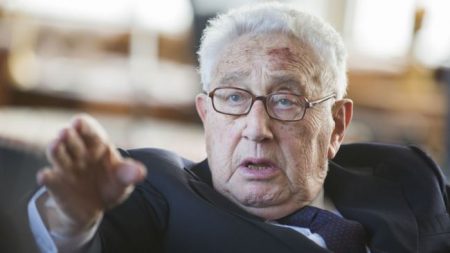
By David Macilwain | American Herald Tribune | August 10, 2017
At 94, Kissinger is living proof that bad spirit doesn’t mellow with age, yet still finds a market. Speaking at a forum alongside others with similarly dubious credentials in June – the “Margaret Thatcher Conference on Security 2017”, Dr Kissinger talked of his admiration for the “Iron Maiden”, and of how they shared a similar vision of a world controlled by London and Washington; an Atlanticist NATO vision.
Unlike Thatcher, Kissinger’s appraisal of “Putin’s Russia” reflected a certain sympathy for Russia’s position, and evident approval of Russia as a “vital element of European security”, but his view is hopelessly myopic:
“Is the wisest course to pressure Russia, and if necessary to punish it, until it accepts Western views of its internal and global order? Or is scope left for a political process that overcomes, or at least mitigates, the mutual alienation in pursuit of an agreed concept of world order?
Is the Russian border to be treated as a permanent zone of confrontation, or can it be shaped into a zone of potential cooperation, and what are the criteria for such a process? These are the questions of European order that need systematic consideration. Either concept requires a defence capability which removes temptation for Russian military pressure.”
I guess he means a THAAD capability… and the “agreed concept of World Order” means Russia should submit to the US world order. The deployment of the US missile defence system in Poland and Romania has already destroyed the possibility of any such agreement with Russia, just as the current deployment in South Korea has pre-empted any honest agreement with China over North Korea.
It was however Kissinger’s presentation of the crisis over Syria and Iraq which is of most interest. In common with much of the US establishment as well as that of Israel and Saudi Arabia, Kissinger sees Iran’s hands all over the region, while being blind to those of the US and its allies. Iraq has not been destroyed as a result of America’s “intervention”, motivated by a ruthless quest for oil and strategic control; by removing Saddam Hussein, America inadvertently facilitated Iranian influence on Baghdad, which is now a puppet of Tehran.
Even the “rise of ISIS” can be blamed on Iran, as a reaction to the alleged sectarian policies of the Baghdad government, in the same way that President Assad has been blamed for “allowing” IS to take over part of Syria. It’s necessary to point out that both assertions are egregious lies.
Into this fog of misinformation coming from the heart of Imperial power in London however, Kissinger inadvertently shone some light, exposing the workings of the “North Atlantic” deep state.
In a remark that might have been dismissed as the musings of a senescent Iranophobe still hoping to outlive the Islamic Republic, Kissinger claimed that the destruction of ISIS could lead to “the emergence of a radical Iranian empire” – stretching from Tehran to Beirut. He framed it like this:
“The outside world’s war with Isis can serve as an illustration. Most non-Isis powers—including Shia Iran and the leading Sunni states—agree on the need to destroy it. But which entity is supposed to inherit its territory? A coalition of Sunnis? Or a sphere of influence dominated by Iran? The answer is elusive because Russia and the Nato countries support opposing factions. If the Isis territory is occupied by Iran’s Revolutionary Guards or Shia forces trained and directed by it, the result could be a territorial belt reaching from Tehran to Beirut, which could mark the emergence of an Iranian radical empire.”
Leaving aside some details, such as his failure to mention that the “territory” to be “inherited” already belongs to Syria, so the answer to his disingenuous question is anything but “elusive”, we might notice that this is hardly a new idea. Not only has the threat of an “Iranian empire” been the excuse for Israeli belligerence and unprovoked aggression in Lebanon and Syria for decades, but there is convincing evidence that the creation of the “Islamic State” and the covert support for Da’esh/IS forces was a conspiracy specifically aimed at Iran.
The DIA document from 2012 that described this conspiracy, whose veracity was confirmed by former DIA chief Lt. Gen. Michael Flynn, has been quoted so often that it hardly needs repeating:
“8.C. If the situation unravels (following the movement of AQI into Syria) there is the possibility of establishing a declared or undeclared salafist principality in Eastern Syria (Hasaka and Deir al Zour), and this is exactly what the supporting powers to the opposition want, in order to isolate the Syrian Regime, which is considered the strategic depth of the Shia expansion (Iraq and Iran)”
Some useful extra analysis on this conspiracy – and what else could we call it? – is provided by Nafeez Ahmed here, and of course by Flynn himself in his August 2015 interview with Mehdi Hasan on Al Jazeera.
Well now the situation IS “unravelling” for the US and its co-conspirators, as the forces that came in the Da’esh Trojan Horse are nearly routed and Syria’s Russian and Iranian allies decide how to deal with their increasingly desperate back-up crew. With Syrian forces advancing on Deir al Zour from the North and West, and Iraqi forces closing in from the East, the years of planning and billions invested in the American project to cut off Iran look set to be wasted.
Crying wolf on Tehran’s “radical empire” just isn’t going to work again!
Israel to occupy Africa

Israeli Prime Minister Benjamin Netanyahu greets people during his arrival at James Spriggs Payne Airport in Monrovia, Liberia on 4 June 2017 [Prime Ministry of Israel/Anadolu Agency]
By Helmi Al-Asmar | Al-Araby Al-Jadeed* | August 10, 2017
With the exception of the popular efforts made by the Conference for Palestinians Abroad to hinder the rabid Israeli efforts to hold a major conference next October entitled the Israeli-African Summit in Togo, we have barely seen any official or popular Arab efforts in this direction. This is despite the great danger posed by convening such a summit, which Israel has been laying the foundations for for several years, in light of the almost complete absence of the Arabs, which is an unprecedented development in Israel’s tireless efforts to bypass the wide wall of isolation and moral rejection it faces in Africa. It aims to present itself as a trusted partner for the continent’s nations.
The Conference for Palestinians Abroad viewed this summit, rightly so, as an insult to the struggles of the African nations and a disregard for their generations’ fair fight for liberation from colonisation and racism. It is also an attempt on the occupation government’s part to portray itself as a trusted partner for the African countries in order to fabricate its reality. It is not coming to Africa in order to spread love and unity, but instead aims to make Africa a market for the lethal products it produces and a place to export its mercenaries to help the dictators of the continent.
This is despite the fact that the African nations’ true interests and their efforts towards sustainable development, prosperity and growth do not align with the colonial racist occupation government in Palestine, given its record of hostility and terrorism. This is documented by several international and independent reports, including the ESCWA report regarding the escalations of the Israeli apartheid policies issued this year.
In addition to this, Israel, which commits war crimes, mass killings, flagrant violations and intimidation methods, as well as confiscates the Palestinian people’s land and resources and sponsors illegal extremist settler gangs, does not have the right to be a partner to developing nations seeking advancement, prosperity and the combat of terrorism.
The efforts of the Conference for Palestinians Abroad are focused on mobilising governments, official and popular institutions, parties, civil society organisations, public figures, community leaders and the media across Africa and the entire world, in order to rally the efforts against the Israeli government’s actions. These actions are an attempt on Israel’s part to promote itself in the continent in a misleading manner, ignoring the principles of justice, the peoples’ rights and international laws and conventions. The conference summoned its efforts and began taking action, contacting concerned parties, especially the influential forces in the African nations in order to confront Israel’s attempts of exploitation and deception.
These are commendable efforts but of course they are not enough to stop this hateful and racist emergence in Africa. Putting an end to the conference is the duty of all African countries, organisations, committees, and people specifically, and generally the duty of the Arab and Muslim countries. This is because Israel’s presence in the continent will not be in the best interest of the African people, but rather in Israel’s interest as it exports death, mercenaries and tyranny to all the countries of the world. It also supports the totalitarian regimes that commit the ugliest forms of aggression, looting and pillage. Therefore, resisting this conference and sabotaging it by all means available is the duty of all nations on Earth.
It is worth mentioning in this regard that the only Arab action against the convention of this summit was by the President of the Palestinian Authority, Mahmoud Abbas, during his visit to Khartoum in July 2016. In his meeting with Sudanese President Omar Al-Bashir, Abbas raised the issue of developing the Arab strategy in the African continent and cooperating in order to stop Israel’s attempts to achieve a breakthrough in Africa.
We do not expect Sudan or the PA to do anything now, as it is too late and their political/diplomatic capabilities are limited. Moreover, their problems and misfortunes are too many to count, according to the former Egyptian Ambassador to Angola, Sao Tome and Niger, Belal Al-Masry, who, in an important article published on the Democratic Arab Centre website, listed five reasons why the Israeli summit in Africa is dangerous. These points should be considered and reflected upon, the most important of which is the fact that the conference’s purpose is to restore and develop the African voting bloc in order to use it to support Israel’s international status.
Israel views the countries of the African continent as a voting bloc consisting of at least 50 votes. This was confirmed by the Israeli Prime Minister Benjamin Netanyahu to seven African leaders with whom he met in Rwanda in July 2016. He also reiterated this in his speech to the Economic Community of West African States (ECOWAS) Summit in Monrovia in June 2017. Hence, his statement regarding Israel having a bright future in the UN during his speech before the UN General Assembly at its regular session in September 2016, wasn’t too far from the truth. He also stated that his main diplomatic goal was to stop the African states from automatically voting against Israel at the UN and that the day he would achieve this isn’t too far. Therefore, holding the Israeli summit in Africa will mark the end of the Egyptian and Arab role, in general, in Africa and Israel will join the international forces competing for influence in the African continent. These countries include China, the United States, France, India, Russia, Iran and recently, Turkey.
It is not an overstatement to say that the Israeli conference in Togo will pave the way for Israel to reoccupy Africa, or at least a large part of it, politically, economically and militarily. This will further strengthen Israel’s international and regional standing and increase the suffering of the Palestinian people, who are paying the price for the fragmentation of the Arab system and their preoccupation with resisting the effects of the Arab Spring revolutions.
*Translation by MEMO
‘Africans will be biggest losers after letting foreign military into their continent’
RT | August 9, 2017
Africa has become a staging ground where foreign countries can show off their military capabilities against one another away from their country of origin at the expense of Africans, says African affairs expert Ayo Johnson.
Turkey is gearing to open its largest overseas military base in Somalia.
The United Arab Emirates are building a military base at the port of Berbera, in the self-declared Republic of Somaliland.
Africa is an attraction to foreign militaries: China opened its first overseas military base on August,1 in Djibouti on the Horn of Africa. Djibouti is also currently housing Americans, Japanese and French troops.
RT discussed why Africa has become so popular with the foreign military with Africa affairs expert Ayo Johnson who believes the world powers are turning the continent into the latest theater of military confrontation.
“Back in colonial days, we saw Africa being cut up and carved up by the Western nations. Now we are seeing Africa again being the center ground for the new verge of a proxy war because all these different countries which are founding military bases on the African continent. It is a huge worry,” Ayo Johnson told RT.
In Johnson’s opinion, “it is showing that Africans can’t protect themselves and it is also showing that Africans can’t control their own affairs and ultimately it is finders keepers.”
“We have China who already has a military base of its own, the excuse is that it ultimately wants to protect its own investment which we know it has on the African continent. Also, it says it wants to prevent piracy and to be able to launch against such events,” Johnson said.
“The Americans have similar bases, not to mention the Europeans. So, on the ground itself, ultimately the African continent is becoming the staging ground for the next possibly violent confrontation between the superpowers of the world in their so-called proxy battles,” he continued.
According to Johnson, such interest in the continent might be explained by its strategic location.
“The Horn of Africa is the gateway for many shipping lanes, the protection of that area because of long term standing piracy issues. But others would say it is about land grab, control; it is about influence.”
“The Americans, the British and other Europeans, not to mention the Chinese most recently, all seem to have a huge stake and might show their muscles and their military capabilities against one another. Africa has now become a staging ground from which they can exploit those opportunities away from their own individual countries, a place where they can prowess their military might at the expense of Africans,” Johnson noted.
Despite the increased foreign military presence, the problem of piracy in the region remains unsettled.
“One thing for sure is that piracy still exists and it will continue and is unlikely to stop or to be slowed down.”
“Again in terms of terrorism, Al-Qaeda and ISIS still have strongholds and control, influence in that part of the world and the military bases that are physically positioned there. If they are there to prevent such attacks, I think in the short term or more long term it could create antagonism, create a problem for locals who may want to join those organizations to attack the military powers that are there. So the protection of Africa becomes the reverse, becomes an area where everyone wants to show each other what they are capable of doing and that is the worry, be it terrorist or be it an American, European or even most recently the Turks are also considering having bases there,” he told RT.
Johnson claimed “that comes at the expense of every single African nation – ultimately the biggest losers will be every single individual on the African continent.”
German Bombshell Bestseller Exposing CIA Media Control Blocked in US
Americans are being prevented from reading an important book by a hero who made a huge difference

By Charles Bausman | Russia – Insider | August 10, 2017
Udo Ulfkotte is near and dear to our hearts, because we wrote about him in October of 2014, (Top German Editor: CIA Bribing Journalists) a few weeks after our founding, and these articles were some of our first to go viral, getting hundreds of thousands of views, despite the fact that we were practically unknown.
His book caused a sensation in Germany, was a best-seller despite being completely ignored by the same media he was implicating, and was a major factor in turning German public opinion against the Ukraine war.
Ulfkotte’s book was extraordinary because it named names in the German establishment, a sure-fire path to massive libel lawsuits. We were the first English language publication to write about Ulfkotte, and he gave us an exclusive interview shortly after we ran the above article.
We were in touch with Ulfkotte after writing about him, and followed his story. He told us at the time that he wasn’t afraid of any lawsuits, because he was near death due to complications from gas poisoning he suffered while reporting on the Iran-Iraq war in the 1980s (ironically it was German manufactured gas), another story suppressed in Germany.
Sure enough, he passed away in January 2017, at the age of 56.
Perhaps the English translation of his book has been taken out of circulation because of libel threats?
R.I.P. Mr. Ulfkotte, you are a hero, and remembered by millions, and not just in Germany.
We quote in its entirety below an excellent article which recently appeared at Global Research, who noticed that the English translation is being stymied.
The English translation of German journalist Udo Ulfkotte’s best-selling book, Gekaufte Journalisten (Bought Journalists) appears to have been suppressed throughout North America and Europe. On May 15, 2017 Next Revelation Press, an imprint of US-Canadian-based publisher Tayen Lane, released the English version of Bought Journalists, under the title, Journalists for Hire: How the CIA Buys the News.
Tayen Lane has since removed any reference to the title from its website. Correspondingly Amazon.com indicates the title is “currently unavailable,” with opportunities to purchase from independent sellers offering used copies for no less than $1309.09. The book’s subject matter and unexplained disappearance from the marketplace suggest how powerful forces are seeking to prevent its circulation.
Gekaufte Journalisten was almost completely ignored by mainstream German news media following its release in 2014. “No German mainstream journalist is allowed to report about [my] book,” Ulfkotte observed. “Otherwise he or she will be sacked. So we have a bestseller now that no German journalist is allowed to write or talk about.”[1]
Along these lines, publication of the English translation was repeatedly delayed. When this author contacted Ulfkotte in early December 2015 to inquire on the book’s pending translation, he responded, “Please find the link to the English edition here,”
http://www.tayenlane.com/bought-journalists
The above address once providing the book’s description and anticipated publication date now leads to an empty page.[2] Tayen Lane has not responded to emails or telephone calls requesting an explanation for the title’s disappearance.
When a book publisher determines that it has acquired a politically volatile or otherwise “troublesome” title it may embark on a process recognized in the industry as “privishing.” “Privishing is a portmanteau meaning to privately publish, as opposed to true publishing that is open to the public,” writes investigative journalist Gerald Colby.
It is usually employed in the following context: “We privished the book so that it sank without a trace.” The mechanism used is simple: cut off the book’s life-support system by reducing the initial print run so that the book “cannot price profitably according to any conceivable formula,” refuse to do reprints, drastically slash the book’s advertising budget, and all but cancel the promotional tour.”[3]
Privishing often takes place without the author knowing, simply because it involves breach of contract and potential liability. Tayen Lane will likely not face any legal challenge in this instance, however. Ulfkotte died of a heart attack on January 13, 2017, at age 56.[4]
Udo Ulfkotte was a prominent European journalist, social scientist, and immigration reform activist. Upon writing Gekaufte Journalisten and becoming one of the most significant media industry and deep state whistleblowers in recent history, Ulfkotte complained of repeated home searches by German state police and expressed fear for his own life. He also admitted previous health complications stemming from witnessing a 1988 poisoned gas attack in Iraqi Kurdistan.
Ulfkotte’s testimony of how intelligence agencies figure centrally in Western journalism is especially compelling because he for many years functioned in the higher echelons of mainstream newsworkers. The German journalist explains how he was recruited during the 1980s to work in espionage. This began through an invitation proffered by his graduate school advisor for an all-expense-paid trip to attend a two-week seminar on the Cold War conflict in Bonn.
After Ulfkotte obtained his doctorate he was given a job as a reporter at “the leading conservative German newspaper, the Frankfurter Allgemeine Zeitung, oddly appointed despite no journalistic training and hundreds of other applicants. Serving as a correspondent throughout the Middle East, Ulfkotte eventually became acquainted with agents from the CIA, German intelligence agency Bundesnachrichtendienst (BND), Britain’s MI6, and Israel’s Mossad, all of whom valued his ability to travel freely in countries largely closed to the West. His editors readily collaborated in such intelligence gathering operations,”[5] for which journalist possess “non-official cover” by virtue of their profession.
“Non-official cover” occurs when a journalist is essentially working for the CIA, but it’s not in an official capacity,” Ulfkotte explains. “This allows both parties to reap the rewards of the partnership, while at the same time giving both sides plausible deniability. The CIA will find young journalists and mentor them. Suddenly doors will open up, rewards will be given, and before you know it, you owe your entire career to them. That’s essentially how it works.”[6] He likewise ruefully admits to “publishing articles under my own name written by agents of the CIA and other intelligence services, especially the German secret service.”[7]
Ulfkotte’s insider knowledge of the relationship between mainstream media and the intelligence community has special relevance in terms of informing the CIA’s antipathy toward Wikileaks, as well as the media campaign centering on the Trump administration’s alleged “ties to Russia,” while also lending credence to Trump’s frequent claims of the US media’s political biases and deep state ties. Indeed, Ulfkotte “Tweeted” about these very subjects just two days before he passed.
Ulfkotte’s explosive revelations still have the potential to further intensify the much-deserved scrutiny corporate news media presently face. In a society that pays more than lip service to freedom of thought and expression Journalists for Hire would be required reading for college students—and particularly those studying in journalism programs intending to seek employment in the media industries.
In fact, journalism professors, some of whom have migrated to the academy following long careers at renowned news outlets, possess similar insider knowledge of the relationships Ulfkotte readily explains. As both journalists and educators they have a twofold burden of responsibility. This is the case more so than ever because the entire professional and intellectual enterprise they are engaged in (and one directly linked to the nation’s accelerating civic deterioration) has been made a farce. Journalists for Hire’s suppression suggests how Ulfkotte’s posthumous censors refuse for this important examination and cleansing to proceed.
Notes
[1] Ralph Lopez, “Editor of Major German Newspaper Says He Planted Stories for CIA,” Reader Supported News, February 1, 2015.
[2] Udo Ulfkotte to James Tracy, email correspondence, December 6, 2015. In author’s possession.
[3] Gerard Colby, “The Price of Liberty,” in Into the Buzzsaw: Leading Journalists Expose the Myth of a Free Press, Kristina Borjesson, ed., Amherst NY: Prometheus Books, 2002, 15-16.
[4] Former US military intelligence officer L. Fletcher Prouty relates a similar experience of how publication of his book, The Secret Team: The CIA and Its Allies in Control of the United States and the World, was greeted in 1972. “Then one day a business associate in Seattle called to tell me that the bookstore next to his office building had had a window full of books the day before, and none the day of his call. They claimed they had never had the book. I called other associates around the country. I got the same story from all over the country. The paperback had vanished. At the same time I learned that Mr. Ballantine had sold his company. I traveled to New York to visit the new ‘Ballantine Books’ president. He professed to know nothing about me, and my book … The campaign to to kill the book was nationwide and worldwide. It was removed from the Library of Congress and from College libraries as letters I received attested all too frequently.” Prouty, The Secret Team: The CIA and Its Allies in Control of the United States and the World, New York: SkyHorse Publishing, 2008, xii.
[5] Ronald L. Ray, “Reporter Admits Most Media Work for CIA, MI6, Mossad,” American Free Press, October 26, 2014. See also Tyler Durden, “German Journalist Blows Whistle on How CIA Controls the Media,” Zerohedge, October 9, 2014; Udo Ulfkotte, “German Politicians Are US Puppets,” Center for Research on Globalization, November 9., 2014.
[6] Durden, “German Journalist Blows Whistle on How CIA Controls the Media.”
[7] Lopez, “Editor of Major German Newspaper Says He Planted Stories for CIA.”
Featured Video

“Historic Russia”: The Land Putin Will Not Give Back
or go to
Aletho News Archives – Video-Images
From the Archive
How Ukraine Tortured and Slaughtered Donbass
By Kit Klarenberg | Al Mayadeen | July 11, 2024
Almost immediately after the proxy war erupted, ISIS-tier footage of the torture and murder of Russians in Ukrainian custody emerged.
On July 6th, the New York Times published an astonishing investigation: In Ukraine, Killings of Surrendering Russians Divide an American-Led Unit. The article documents in grim detail how Chosen Company, an international volunteer battalion for Kiev, routinely executes Russian prisoners of war. It is the very first mainstream admission that this practice – a brazen breach of the Geneva Conventions, and a grave war crime – is widespread among Ukraine’s fighters, both foreign and homegrown. … continue
Blog Roll
 Aletho News
- Burnham tackles Britain’s poverty with aggression in Yemen
- Peace in Ukraine: the easy way – or the hard way
- Trump & the Rrrrussians
- US taxpayer money laundered back through Ukraine – Musk
- Before COVID, an NIH lab chief proposed making a SARS-like bat virus more infectious
- Gates, Bourla on Trial in Netherlands Accused of ‘Great Reset’ Scheme at Vaccine Injury Hearing
- BRITAIN’S WARNING: PREPARE FOR WAR
- “Historic Russia”: The Land Putin Will Not Give Back
- How the Cambridge Analytica scandal still haunts Mark Zuckerberg
- The Ongoing Cancellation Campaign Against a Dissenting Academic in Norway
- If Americans Knew
- DAILY UPDATE: Latest essential news on Palestine, Israel, & region
- Damning report shows the media must confront its failures on Gaza
- BBC senior broadcaster speaks out on Gaza coverage
- Netanyahu vows vast West Bank invasion in response to 20-minute skirmish that left 2 Israeli soldiers and 2 Palestinian fighters dead
- Tied up and tortured: Israel using US-made electroshock weapons on Palestinian detainees
- The outsourced risk: how newsrooms rely on Gaza’s freelancers without protecting them
- Gaza bakeries forced to shut as Israel blocks flour shipments
- Gaza’s breast cancer patients face a deadly wait for treatment amid Israel’s genocide
- DAILY UPDATE: Latest essential news on Palestine, Israel, & region
- The Israel Lobby’s Changing Fortunes
- No Tricks Zone
- Two New Studies Find Thwaites Glacier Melt Cannot Be Driven By Human Activity Or A Warming Ocean
- E-Cars Reduce CO2 Emissions By Only 41% Compared To Internal Combustion Engine Vehicles
- Predictions Made By Renowned Climate Professor Over Past Decades Have Been Proven To Be Poor
- New Study Suggests Large Regions Of The Pacific Ocean Have Been Cooling For The Last 80 Years
- Germany’s Green Energy Debacle: High Energy Costs Force Kahla Porzellan to Close After 182 Years!
- New Study: 50 Years Of The Most Aggressive ‘Net Zero’ Policies Can Only Affect The Global Climate By 0.03°C
- US September “Heat” Was No Record…Many Records Set Decades Ago
- Latest European Green Energy Debacle; Portugal’s Largest Flagship Solar Park Insolvent!
- Green Energy Debacle: German Expert Professor Fritz Vahrenholt Warns Of Severe Economic And Social Consequences
- Two More Paleo Reconstructions Affirm Meters-Higher Sea Levels Across Ireland, Brazil 7000-6000 Years Ago

