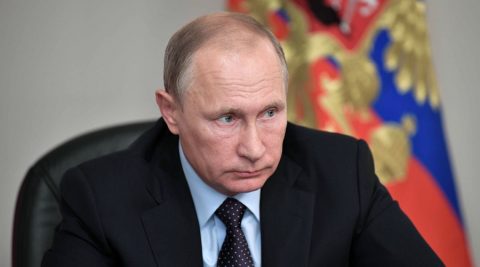
Attempts to pressure North Korea into stopping its nuclear missile program through sanctions are “misguided and futile,” Russian President Vladimir Putin warned, adding that threats and provocations would only add more fuel to the fire.
“The situation on the Korean Peninsula, where tensions have grown recently, is balancing on the brink of a large-scale conflict. Russia believes that the policy of putting pressure on Pyongyang to stop its nuclear missile program is misguided and futile,” Putin, who is due to attend a summit of the BRICS nations in China next week, wrote ahead of his trip.
“The region’s problems should only be settled through a direct dialogue of all the parties concerned without any preconditions. Provocations, pressure and militarist and insulting rhetoric are a dead-end road,” he noted.
Russia and China have created a roadmap for a settlement on the Korean Peninsula that is designed to promote the gradual easing of tensions and the creation of a mechanism for lasting peace and security, the Russian leader added.
The Russian-Chinese initiative of “double freezing,” put forward by the Russian and Chinese foreign ministers on July 4, is designed to cease any missile launches and nuclear tests by Pyongyang, as well as large-scale military exercises by Washington and Seoul.
Last month, the UN Security Council unanimously agreed to impose more restrictive measures on Pyongyang, banning exports of coal, iron, lead, and seafood. The move came in response to North Korea’s missile launches in July, which it, as well as South Korea and the US, claimed were intercontinental ballistic missile (ICBM) tests. Moscow has questioned the claim, arguing North Korea was testing intermediate range rockets.
China announced a full ban on imports of coal, iron, and seafood, among other goods from North Korea as of August 15, thus cutting key export revenues for Pyongyang.
Russian Foreign Minister Sergey Lavrov said on Friday that all conceivable and unimaginable sanctions against North Korea have already been imposed, to no avail.
“All possible sanctions aimed at preventing North Korea from using a map of external relations for the development of missile and nuclear programs banned by the [UN] Security Council, all conceivable and even unimaginable sanctions, which have little to do directly with these areas of DPRK’s [the Democratic People’s Republic of Korea] activities, have already been adopted by the Security Council. In addition, unilateral sanctions have been adopted, which we consider illegitimate,” Lavrov said.
In a bid to ease tensions, Moscow will seek the resumption of six-party talks on the situation on the Korean Peninsula, the Russian Foreign Minister noted.
“We will still seek to resume these talks,” he said, adding that “we know that Americans are talking with representatives of Pyongyang via some semi-secret, semi-official, semi-academic channel.”
Moscow will be happy “if they agree on some de-escalation, so that all parties cool down, sit down at the negotiating table and start talking.”
“We have a common goal – denuclearization of the Korean Peninsula, so that neither the North nor the South, the US and us [Russia] have nuclear weapons,” Lavrov said.
September 1, 2017
Posted by aletho |
Militarism | North Korea, Russia, South Korea, United States |
Leave a comment
Solving the Korean Peninsula crisis through diplomacy is in everyone’s interests, geopolitical experts have told RT, citing potential scenarios of South Korea being turned “into a desert,” or other states, not directly involved, being severely affected by a “stray missile.”
If the current situation in East Asia is not resolved, a number of countries “will be living under a threat of a nuclear volcano erupting,” Russian diplomat and an expert in Asian studies, professor Georgy Toloraya told RT.com.
“Everyone understands perfectly well that for North Korea, if it initiates an aggressive strike, a military conflict will mean a complete and immediate destruction, because no one can deny the US military might,” Toloraya said.
“However, for the US, attempts to solve this problem militarily also bring on a retaliatory strike by North Korea that would turn South Korea into a desert,” he warned, saying the North doesn’t even need nuclear weapons for that.
While Pyongyang’s artillery is able to reach Seoul, the entire territory of South Korea will also “be no good for life,” as Pyongyang’s missiles – even without nuclear warheads – might hit nuclear facilities in the South, he explained. He said there are some 30 such sites close to North Korea’s border.
“Japan will suffer damage too, as well as the US military bases there,” the expert added. Toloraya emphasized that “diplomacy and negotiations” are the only way out of the crisis.
“All kinds of pressure [on Pyongyang] have been tested over the years, including sanctions. But none led to any change in North Korea’s position,” he said.
“No one in their right mind can be really thinking about the doomsday scenario. In my opinion, Americans are bluffing when they scare not so much Pyongyang but rather China with a possibility of a military conflict.”
Pointing out that Moscow has been long insisting on diplomatic channels to ease tensions in the region by listening to all sides, Toloraya underlined that “it’s in everyone’s interests to diminish the threat,” as the possibility of an accidental and irreversible mistake can never be excluded.
“The thing is, the most bloody wars sometimes begin by accident or by mistake, this has happened in history. The higher the level of armament and the hotter the tensions in the Korean Peninsula, the bigger a chance of an accidental turn of events, with the subsequent escalation,” he said.
Another expert in military history, international relations and conflict resolution studies, Colonel-General Leonid Ivashov also spoke about the threat of such “accidental” scenarios.
“There is always danger, especially when such imperfect missiles as the ones used by North Korea are involved. There is a risk that a missile might veer off course, that it won’t reach its destination,” he told RT.com.
A military conflict in the region will affect not only North Korea, South Korea and Japan, but also Russia and China, he said. Beijing, he said, “might not to be harmed military-wise, but will suffer in other respects.”
“Certain forces in the US are striving to de-stabilize the situation in the region, in the same way that they have destabilized it in the Middle East,” Ivashov suggested, saying that diplomatic initiatives should be aimed at both Washington and Pyongyang, “for the first not to conduct military games, and the other to stop test launches.”
“We should treat North Korea with understanding too. What North Koreans are asking for is a guarantee of their security, which no one gives them. They are a pariah-state. They want to save their regime, which does exist – whether people like it or not. They don’t like [the] joint US and South Korean drills being held near their borders. This can all be solved, if only there is a will from the US before all.”
Moscow, together with Beijing, have long been advocating a “double freeze” strategy which would see Pyongyang suspend its missile launches in exchange for an end to the military exercises near its borders. The proposal has been rejected by Washington, with the State Department categorically stating that the US, along with its ally South Korea, are within their rights and will continue their joint military maneuvers.
August 31, 2017
Posted by aletho |
Environmentalism, Militarism, Timeless or most popular | North Korea, South Korea, United States |
Leave a comment
In the UK, parliament may still be in summer recess, but government ministers aren’t resting. Defense Minister Michael Fallon jetted to Oman August 28 to cement a number of military agreements with the Sultanate’s leaders. The inking represents a continuation of a longstanding and rarely examined “special relationship” between the two countries.
During his two day visit, Fallon met with Sayyid Badr bin Saud bin Harub Al Busaidi, Oman’s Minister Responsible for Defense Affairs, in Muscat. The pair signed a “Memorandum of Understanding and Services Agreement” that secures UK use of naval facilities at Duqm Port — a multi-million dollar joint venture between the two countries.
An official statement issued by the Foreign & Commonwealth Office said the “booming” Port complex would provide “significant opportunity” for the two countries’ “defense, security and prosperity agendas,” and serve as a home from home for the UK’s flagship aircraft carrier, HMS Queen Elizabeth.
“This agreement ensures British engineering expertise will be involved in developing Duqm as a strategic port for the Middle East, benefiting the Royal Navy and others. Oman is a longstanding British ally and we work closely across diplomatic, economic and security matters. Our commitment to the Duqm project highlights the strength of our relationship,” Fallon said.
The Defense Minister’s visit gained virtually no recognition in the UK media — while the traditional paucity of official government business to report on over the summer arguably makes the story a prime candidate for press coverage, radio silence on UK-Oman relations is a seemingly enduring mainstream editorial policy.
Declassified British government files reveal the oil-rich Gulf state’s leader Sultan Qaboos bin Said al Said — one of the longest serving unelected rulers in the world — was brought to power in a 1970 palace coup planned by UK foreign intelligence service MI6, and sanctioned by then-Prime Minister Harold Wilson. The Sultan has absolute power in governance, and is also the country’s Prime Minister and Minister of Defense, with total authority over Oman’s judicial and legal systems.
Ever since the coup, Oman has proven a most faithful ally to the UK, hosting a number of major British intelligence and military operations.
For example, UK spying agency GCHQ has three separate bases in the country — codenamed Timpani Guitar and Clarinet — that feed off various undersea cables passing through the Strait of Hormuz to the Arabian Gulf. In the process, the bases intercept and process a vast volume of emails, telephone calls and web traffic generated in the region, which is then shared with the US’ National Security Agency.
Moreover, UK troops have long trained Omani armed forces, and in May 2016 it was announced the UK would increase its number of training teams in Oman from 34 to 45 in 2017.
August 30, 2017
Posted by aletho |
Illegal Occupation, Militarism | Duqm, Middle East, Oman, UK |
Leave a comment
Guam will soon be the site of a US military live-firing range to support Marines relocating from Okinawa, following an $87 million contract that was awarded to Black Construction Corp last week.
Between 2022 and 2026 there are plans for about 4,100 Marines to relocate from Okinawa to Guam. This drawdown is part of a 2013 agreement between Japan and the US for Washington to reduce its footprint on Okinawa, which houses most of the United States’ military bases in Japanese territory.
Andersen Air Force Base will situate the complex near what community members say is the last pristine area on the island: a wildlife refuge that will have to be partially closed when the range is in use.
Col. Brent Bien, who oversees US Marine activity in Guam, said in a statement, “We are committed to Guam, and our forward presence here will play an essential role in strengthening the military’s ability to maintain regional security and protect the nation’s interests in the Pacific.”
One of the groups opposing the range’s construction is Prutehi Litekyan, who has been reaching out to local political leaders to put a halt to what spokeswoman Sabina Perez called a “toxic legacy.”
Guam congresspeople Sen. Fernando Esteves (R-Yona), Speaker Benjamin Cruz (D-Tumon) and Vice Speaker Therese Terlaje (D-Yona) have expressed support for the group.
“No amount of money can compensate for the permanent destruction, loss of access and other adverse impacts to Guam’s historic sites,” Terlaje said on Friday. “One hundred eighty-seven acres of limestone forests, endangered species and fishing areas that are part of this particular live-fire training range project.”
“The Department of Defense has not kept its promises to avoid these adverse impacts to Guam and in fact continues to expand its control over lands and waters of Guam and the Marianas,” she added, according to AP.
Perez said the group is trying to schedule meetings with military officials, and Terlaje is appealing to Gov. Eddie Calvo to meet with federal officials to try and avoid the range’s potential impact
The complex is expected to be complete by November 2020.
August 30, 2017
Posted by aletho |
Environmentalism, Illegal Occupation, Militarism | United States |
Leave a comment
The US has carried out a second flight test of a newly upgraded nuclear free-fall bomb in five months at the Tonopah Test Range in the state of Nevada which it says is designed to “meet national security requirements.”
The test of the B61-12 bomb, which was the second of the upgraded B-61 variant, was dropped by an F-15E Fighting Falcon jet on August 8. The second qualification flight test for the nuclear weapon was completed by the US Air Force and the National Nuclear Security Administration (NNSA), with the first one having been successfully conducted in March.
“The B61-12 life extension program is progressing on schedule to meet national security requirements,” acting NNSA deputy administrator for defense programs Phil Calbos said in a statement on Tuesday.
“These realistic flight qualification tests validate the design of the B61-12 when it comes to system performance.”
According to an NNSA statement, during the test, the bomb’s non-nuclear components, such as the arming and fire control system, radar altimeter, rocket motors and weapons control computer, as well as the aircraft’s capability to deliver the weapon were reviewed.
The first production of the bomb is scheduled for March 2020.
The US military’s recent test came amid simmering tensions between the US and North Korea over Pyongyang’s nuclear tests.
The second test of the nuclear bomb could indicate that Washington is speeding up its rearmament program the editor-in-chief of National Defense magazine, Igor Korotchenko, warned.
“The fact of the test of this modification of the nuclear bomb indicates that the US continues an accelerated rearmament program of its tactical nuclear arsenal in Europe, as well as that both Washington and Brussels are considering the scenario of a limited nuclear war in Europe,” Korotchenko said.
Back in April, the US Air Force announced that it had test-dropped an upgraded gravity nuclear bomb to see whether its aircraft can carry the deadly weapon.
US President Donald Trump has called for the US to “greatly strengthen and expand its nuclear capability,” though he criticized former President Barack Obama administration’s costly modernization program during the election campaign.
Back in February, the US Navy test-fired four Trident ll D nuclear-capable ballistic missiles from a submarine in the Pacific Ocean.
August 29, 2017
Posted by aletho |
Militarism | United States |
Leave a comment
Former career diplomat in the Indian Foreign Service, Bhadrakumar Melkulangara, underscored the need for a peaceful, rather than military, solution to the crisis in Afghanistan, while London is reportedly mulling covert operations in the country.
Mr. Melkulangara said that now that all Western attempts to defeat the Taliban have failed, the conflicting sides should start looking for a negotiated end to the 16-year-old conflict.
“What have the US and Britain really achieved by fighting this war for 16 years? I believe that what we need are inter-Afghan negotiations to end the conflict now that the Western powers have completely failed even to explain what they are going to do,” Bhadrakumar Melkulangara wondered.
Meanwhile, the United Kingdom is contemplating waging more covert operations in Afghanistan that will target jihadists groups, The Sunday Times reported.
“In his speech on Washington’s new Afghan strategy, President Trump said that special operations were needed [to fight Daesh terrorists] and I believe that, in a sense, they could be quite effective,” Bhadrakumar Melkulangara said.
He added that the British would clearly fall in line with Washington’s new strategy.
“However, I think that it would be extremely relevant for the British to explain how Daesh figures in the US strategy in the light of the experience of Iraq and Syria. This is what the region is mostly concerned about and there is total silence about this,” Melkulangara pointed out.
The British move comes amid concerns that Afghanistan could be lost to the Taliban if the US troops pull out.
When asked how justified these concerns really are, Bhadrakumar Melkulangara said that it was essentially a propagandistic stunt.
“The Americans want to show that they are irreplaceable, that they have done a marvelous job and that they should continue doing this. Trump didn’t say why the US military bases in Afghanistan should stay on.”
When queried about how the UK special operations could help improve the situation in Afghanistan, Bhadrakumar Melkulangara said that with the 120,000-strong US military contingent still in place in Afghanistan, the several hundred troops London is going to send there will only be playing a secondary role assisting US military and CIA operations.
Regarding widespread fears that British special operations in Afghanistan could result in human rights abuses by Special Air Service (SAS) commandos, Bhadrakumar Melkulangara said that “this is going to be an extremely violent period.” He also mentioned the likelihood of military contractors coming in.
“This is exactly what former Afghan President Hamid Karzai had in mind when he said that there is a very dangerous situation arising because once again we’ll see landing parties, bombings, etc.,” Melkulangara warned.
He added that there would be no lasting peace in Afghanistan unless some of the Taliban’s demands are met and that the terms and conditions of the Taliban’s integration is something everyone should now focus on.
“The thesis that the Taliban would eventually be degraded and brought to the negotiating table is an old tale we have heard under President Barack Obama. The problem is, however, that the Taliban adamantly insists that there must be an end to the country’s foreign occupation.”
Bhadrakumar Melkulangara added that US military bases are the main stumbling block on the way to a peaceful resolution of the Afghan conflict because, with the exception of those in Afghanistan who have vested interests in the continued Western presence in the country, the majority of the Afghan people want the US military bases to leave.
“I think that regional powers should speak up and insist that there is no military solution to this conflict,” he concluded.
The UK is expected to deploy Special Air Service and Special Boat Service operatives to assess what kinds of troops are needed for a new Afghan deployment.
The intentions to introduce special operations in Afghanistan come as UK intelligence agencies warn that the Central Asian country could be lost to the Taliban if the US were to withdraw its troops.
According to The Sunday Times, intelligence agencies have played a crucial role in convincing President Trump to increase the military presence in Afghanistan. There are 500 British troops currently stationed in the country.
The ongoing war has cost UK taxpayers over 40 billion pounds. Nearly 500 military personnel have died in the conflict.
August 29, 2017
Posted by aletho |
Illegal Occupation, Militarism, Timeless or most popular | Afghanistan, CIA, UK |
Leave a comment
US President Donald Trump appeared to adopt two very different public persona this week, when first he delivered a stern speech announcing a new military strategy toward Afghanistan; and then the next day he regaled supporters at a rally in Arizona with his characteristic blustering style.
American news channel CNN called the differing styles the «Two Trumps». In the first one, there was «teleprompter Trump» in which the president outlined a «sobering» plan for renewed military intervention in Afghanistan. By contrast, in the second appearance, there was «free-wheelin’ Trump», when he fired up his support base at a rally in Phoenix, Arizona, with verbal broadsides against the «sick» US media, illegal immigration, and a vow to build the border wall with Mexico – even if that meant shutting down the federal government in Washington.
CNN didn’t proffer an explanation for its observation of diverging Trump behavior. The implication was hinted that the president was simply being erratic, perhaps with some kind of personality disorder.
But here is a possible explanation for the «Two Trumps». On the issue of Afghanistan, Trump was indeed delivering a serious message on behalf of the US military and foreign policy establishment. His adherence to the teleprompter text was a sign that the president is taking orders from the Deep State when it comes to matters of paramount imperialist objective.
At the other event, when Trump reverted to his barnstorming form, it was just the president throwing his voter base a bit of rhetorical meat to keep them happy. In that rambling, impromptu-style, Trump hit all the populist buttons to the delight of the crowd. That demagogic bravura performance was required because the day before Trump had executed a startling U-turn on his campaign promises, when he declared that US forces would return to Afghanistan.
All during his election campaign for the presidency last year, Trump had whipped up support among blue-collar workers by slamming the wasteful overseas wars of the Bush and Obama administrations. He condemned his Democrat rival Hillary Clinton for fueling these wars as Secretary of State for Obama.
What a staggering U-turn! It’s hard to believe Trump has the chutzpah to do it.
On Monday, addressing troops at Fort Meyer, Arlington, Virginia, President Trump gave notice that the US military would be returning in large numbers to Afghanistan. That 16-year American war – the longest US war in history – was henceforth going to continue for an indefinite number of years. Trump made a cringing attempt to excuse the shameless U-turn as an informed decision made with the responsibility of president on his shoulders as opposed to the callow views of a campaigning candidate.
However, there was no disguising the fact that President Trump was taking orders from the Pentagon. The Joint Chiefs of Staff and numerous other US generals – three of whom are now in senior positions in Trump’s White House – have been pushing for a re-escalation of American military involvement in Afghanistan.
Trump got elected on the back of electoral promises to shut down overseas wars and vowing instead to focus economic resources on reviving the blue-collar Rust Belt states, which have been struggling with industrial decline for decades. His sudden embrace of the Pentagon’s designs on Afghanistan are a stark repudiation of his own «America First» manifesto. In short, a betrayal of voters.
It is no coincidence that Trump’s about-turn on Afghanistan came on the heels of the ouster of his chief strategist, Stephen Bannon last Friday. Bannon had been vehemently against the policy of foreign military adventurism. In particular, he was reportedly against any resumption of large-scale deployment in Afghanistan. According to media reports, it was the military top brass who prevailed on Trump to get rid of Bannon. The White House Chief of Staff, former Marine General John Kelly, and Trump’s National Security Advisor, General HR McMaster were the two main voices calling for Bannon’s exit. That Trump would dump Bannon – supposedly a close ally – with such alacrity shows that the generals are the real power behind the desk in the Oval Office.
So, the «Two Trumps» phenomenon is thus explained: On one hand, the president is being ordered by the Pentagon and the generals in his White House on what the all-important foreign policy agenda is. Afghanistan is a priority. But note also, the increased US military intervention in Syria, Iraq, Yemen, Ukraine, and towards North Korea, Iran, Venezuela, China and Russia – the latter under the auspices of NATO’s eastwards expansion. All of this blatantly contradicts what candidate Trump had been wooing voters with.
The American business of military imperialism is serious. Hence President Trump is told in no uncertain terms by the military-industrial complex to stick to the teleprompter text. No winging it. No deviation from the plan. Just do it.
The debasement of Trump to being a stooge of the Deep State thereby necessitates that Trump, the supposed maverick populist, must go out on occasion to rally the base with barnstorming tirades to let off some steam. (The irony here is that Trump is accused by the Deep State of being a stooge for Russia, when in much more realistic ways he is evidently a stooge for the American Deep State.)
If ordinary Americans were permitted to focus on their betrayal by Trump to the criminal overseas adventurism of the Pentagon and the military-industrial complex, then that could be a cause of dangerous social revolt at home. It is imperative therefore to keep the masses riled up over chauvinistic populist issues like slamming illegal immigration, «sick» news media, and «liberals» trying to erase American history and heritage by removing Civil War statues.
Like a quack doctor, Trump is prescribing nostrums to conceal the real disease, which is that American democracy has now been supplanted by a military cabal in league with Wall Street and Big Business. Trump is nothing but a puppet who – at least so far – is being allowed to «play at being president». Who knows how much longer he will be allowed to sit in the Oval Office.
So degenerated is American politics that even prominent news media like the New York Times are actually welcoming with editorials on the control exerted over an elected president by the military generals «to stop him going off the rails».
Why Afghanistan is such a priority for the American ruling cabal is no doubt manifold. Recent reports highlight the vast but untapped mineral wealth of the country. Another reason is to secure the lucrative heroin drug trade that financially underpins so much of American covert CIA operations around the world. Also, Afghanistan’s war gives Washington cover for pursuing its strategy of engendering conflict and chaos in a vital region. Contrary to official US assertions, Washington doesn’t want the war to end. It wants war-without-end so that it can destabilize Russia on its southern flank, as well as Iran, and to prevent China from galvanizing Eurasian economic integration.
As American political analyst Randy Martin points out: «Afghanistan is a redux of covert US strategy that has been used in Syria and other parts of the Middle East. The United States claims to be fighting terrorism when in actual fact it is covertly sponsoring terror groups to incite sectarian conflict. In that way, Washington gives itself a license to wreak havoc in order to thwart geopolitical rivals».
President Trump is simply following the imperative orders assigned to him by the Deep State. Outrageous as it might seem, we are witnessing a soft military coup against Trump and his earlier vows to promote America First in the interests of ordinary citizens. In other words, American democracy has been subverted in an audacious assertion of the perennial needs of US imperialism – the profiteering lust of the military industrial complex, Wall Street and Big Business.
Of course, the broader context of «Russia-gate» should be mentioned here. For nearly eight months since his presidential inauguration, Trump has been subjected to a relentless media campaign orchestrated by the Deep State vilifying him as a Russian agent and a beneficiary of alleged Russian meddling in the US election. That pressure over a baseless narrative has inevitably led to Trump capitulating to the Deep State to become a willing tool for its strategic objectives. Trump’s capitulation is nevertheless a coup against an elected president, enforcing the Deep State’s geopolitical agenda.
Analyst Randy Martin puts it succinctly with an oblique reference to the CIA’s assassination of President John F Kennedy in 1963. «This time, they didn’t need a bullet».
August 25, 2017
Posted by aletho |
Militarism, Timeless or most popular | Afghanistan, United States |
Leave a comment
For the first time ever, the US and South Korea will be conducting war games meant to prepare their militaries for the possibility of a nuclear war, according to a South Korean Defense Ministry official. North Korea has previously called the planned military exercises a provocation that could lead to nuclear war.
No other details were given by the Defense Ministry spokesperson, who was speaking to South Korean newspaper Chosun Ilbo. However, the war game does come in the wake of North Korea’s first-ever test of a long range intercontinental ballistic missile in July, as well as reports that the country might be capable of fitting a nuclear payload onto it.
Ulchi Freedom Guardian, a 10-day military exercise that this summer involves 17,500 American and 50,000 South Korean soldiers (as well as contingents from seven other US allies), has been an annual event for 41 straight years. The focus of the exercises is to defend South Korea from a mock invasion from the North.
Michelle Thomas, a US military spokeswoman, said of the exercises: “It’s to prepare if something big were to occur and we needed to protect [South Korea].”
North Korea traditionally condemns the drills as provocative, and this year is no different. State news agency KCNA called Ulchi Freedom Guardian an exercise “aimed to ignite a nuclear war on the Korean Peninsula at any cost.”
South Korean President Moon Jae-in said that the exercises were not meant “at all to heighten military tension on the Korean Peninsula as these drills are held annually and are of a defensive nature. North Korea should not exaggerate our efforts to keep peace nor should they engage in provocations that would worsen the situation, using [the exercise] as an excuse.”
China chimed in to the contrary, with Foreign Ministry spokeswoman Hua Chunying criticizing the drills during a regular press conference. Hua called them “not helpful to the de-escalation of the current tensions and the efforts made by all relevant parties to promote peace talks.” She added that the situation on the peninsula was “highly complex, sensitive and delicate” and that South Korea and the US shouldn’t “add fuel to the fire.”
Despite tensions with North Korea at their highest in decades, US Forces Korea has downsized American participation in the exercise from 2016: 17,500 American soldiers are participating in the 2017 exercises, down from 25,000 the previous year.
Hua urged both sides to focus on more “constructive actions” instead, such as accepting China’s proposal of “suspension for suspension.” The solution, proposed by Beijing in March, calls for North Korea to stop all missile tests in exchange for the US and South Korea stopping all military exercises.
Pyongyang welcomed the plan, while Washington and Seoul rejected it. American military experts called the deal overwhelmingly advantageous for North Korea, as they get to continue their own military exercises and thus better prepare for offensive or defensive warfare.
“It is hard to imagine why the United States would accept [suspension for suspension], because of the vulnerability it would create,” said Bruce Bennett, a senior defense researcher at Rand Corp., to the Charlotte Observer.
Hua also added that the “tense situation on the Korean Peninsula has shown a slight sign of abatement recently.” This may have been a reference to General Joe Dunford, the United States’ highest ranking military officer and the chairman of the Joint Chiefs of Staff, visiting China earlier in August to meet with President Xi Jinping.
During his visit, the US and China agreed to strengthen military ties and the lines of communication to help find a resolution to the North Korean crisis.
August 23, 2017
Posted by aletho |
Militarism | North Korea, United States |
Leave a comment
You may like Donald Trump or not but he will go down in history as the President who made decisions of fundamental importance for his country and the world. Nobody else but Donald Trump will determine the configuration of US future nuclear arsenal, which is to go through massive modernization. Modernizing the US’s entire nuclear arsenal would cost $400 billion by 2026, according to a figure released by the Congressional Budget Office. The United States will modernize nearly every part of its nuclear arsenal, including replacement warheads, upgraded command-and-control systems, and other improvements across the strategic triad. Kicked off in April to be finished by the end of the year, the Nuclear Posture Review is underway and the final decisions are to be taken during the Donald Trump’s tenure.
The issue is being debated, with new visions presented and new proposals put forward. Concerned over America «fallen behind on nuclear weapon capacity», the Supreme Commander-in-Chief wants the US to stay at the «top of the pack». The US Air Force is studying the options for «variable yield» bombs – nukes that can be dialed down to blow up an area as small as a neighborhood, or dialed up for a much larger punch.
Air Force Gen. Paul Selva, the Vice Chairman of the Joint Chiefs of Staff, believes that the future of nuclear deterrence lies, at least in part, in smaller nuclear weapons that the United States might actually use. «Whether we do it with a ballistic missile or re-entry vehicle or other tool in the arsenal, it’s important to have variable-yield nukes,» he said. Speaking at the Air Force Association’s Mitchell Institute at the Capitol Hill Club on August 3, the US number two military leader confirmed that as part of the Pentagon’s ongoing nuclear posture review, it is looking at a new generation of low-yield «mini-nukes» in order to ensure that the threat from America’s nuclear arsenal remains credible.
He thinks a conventional response to a nuclear strike would not be sufficient to deter the attacker. It’s not tactical or battlefield weapons the general is talking about but rather munitions with explosive force increased or reduced electronically through a dial-a-yield (variable yield) system. This combination of accuracy and low-yield will make them the most usable nuclear weapons in America’s arsenal to ensure global domination.
The threat of mutually assured destruction doesn’t work against smaller nations, such as North Korea and Iran, in the way that it used to against Russia or China. The US needs to be able launch a nuclear attack on an adversary without global consequences.
In practical terms, accurate munitions with low yield can destroy any specific target without devastation indiscriminate killing of civilians through explosive force or radioactive fallout. According to some estimates, a US counterforce strike against China’s intercontinental ballistic missile (ICBM) silos using high-yield weapons detonated at ground blast would kill approximately 3-4 million people. Using low-yield weapons and airbursts, the figure drops to just 700 fatalities.
In December, the Defense Science Board urged the Pentagon to incorporate low-yield and variable-yield reentry vehicles into future ICBM designs. The Air Force had not yet made a final decision on that. Discriminate employment options could be provided by a suite of low-yield, special-effects warheads (enhanced radiation, earth penetration, electromagnetic pulse, and others), including a shorter-range cruise missile that could be delivered by F-35s.
Variable yield with in combination with great accuracy means less destruction. But there is the reverse side of the medal. The smaller yields and better targeting can make the arms more tempting to use — even to use first, rather than in retaliation. Gen. James E. Cartwright, former Vice Chairman of the Joint Chiefs of Staff, believes that «what going smaller does,» he acknowledged, «is to make the weapon more thinkable». The Federation of American Scientists, has also argued that the high accuracy and low destructive settings meant military commanders might press to use the bomb in an attack, knowing the radioactive fallout and collateral damage would be limited.
So, the introduction of low yield accurate weapons (the nuclear utilization target selection – NUTS) asserts that such a thing as a limited nuclear war does exist and it is possible for a limited nuclear exchange to occur. So, the door is open for introducing nuclear warfare into local conflicts, such as Syria, Iraq, Yemen, you name it. But a tiny nuke still has a larger impact than any conventional massive ordnance air blast (MOAB). The temptation to use more here and there will be irresistible to gradually turn the planet into a wasteland. Mutual mass destruction would occur at a slower rate, but it would still happen as mini-nukes gradually create the same amassed yield as normal nukes.
Congressional critics say the proliferation of such weapons would bring less, not more security. «I have no doubt the proposal to research low-yield nuclear weapons is just the first step to actually building them», Sen. Dianne Feinstein, D-Calif., told Roll Call in February. «I’ve fought against such reckless efforts in the past and will do so again, with every tool at my disposal».
There is another aspect of the problem. The introduction of variable yield weapons will provoke Russia, China and other nuclear powers into taking similar measures. Uncontrolled arms race will start. The plans to equip the delivery means with variable yield munitions never mention the problem of arms control, probably because the process is uncontrollable. Small size, variable yield warheads could be installed on a wide range of delivery means to make verification impossible. It will put an end to all hopes for saving the arms control regime which is being eroded to put the world back to the brink of nuclear war where it had been before the Partial Nuclear Test Ban Treaty was signed in 1963. All the efforts applied to make the world safer will go down the drain. President Trump can prevent that from happening.
August 23, 2017
Posted by aletho |
Militarism, Timeless or most popular | United States |
Leave a comment
© Nukewatch UK / Facebook
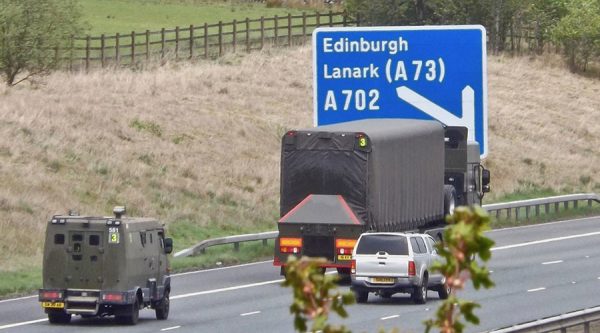
Nuclear warheads surrounded by explosives are regularly transported on British roads, yet authorities are “wholly unprepared” to handle an accident, a damning report has revealed.
A “critical gap” in the protection of Britons has been identified by Nukewatch UK, amid claims public safety is being put at risk by the Scottish Government.
The report, ‘Unready Scotland’, reveals weapons of mass destruction (WMDs) are driven across the country around eight times every year, without police accompanying them and without public knowledge.
The convoys travel with a potentially-deadly cocktail of explosives and nuclear weapons packed inside – yet those traveling alongside the huge trucks remain blissfully unaware of the dangerous cargo.
Scottish councils have failed to carry out individual assessments of the routes taken by the massive convoys. This means vital evacuation time could be lost and the number of casualties could rise rapidly should there be an incident.
The potential contamination zone for an accident involving nukes is 24 miles, according to some experts, meaning entire villages and towns could be engulfed.
“The radioactive material in the warheads includes both plutonium and uranium, with a potential dispersal range of at least 5km,” Nuke Watch reports. “In addition to this, warhead materials include a number of toxic and hazardous substances.”
Unready Scotland suggests there is “no evidence” that authorities would be able to cope with a disaster on the route between the Aldermaston and Burghfield atomic weapon plants in Berkshire and RNAD Coulport on Loch Long.
In the event of nuclear fallout, the Ministry of Defence (MoD) would prioritize the mobilization of troops to secure the weapons – and the safety of the public would fall squarely on the shoulders of local authorities and emergency responders.
Yet the frightening report shows that those who would be first on the scene would be “unprepared” and unable to launch into action.
The researchers warn that police, paramedics and the Scottish Government, who would need to handle a mass evacuation, are “wholly unprepared to discharge that responsibility.”
Although some claim an accident involving a convoy is unlikely, there have already been underreported incidents. In May, a military convoy of nuclear warhead carriers was left stranded on the side of the M40 motorway when the escort broke down. Fortunately in this instance there were no live warheads onboard.
Despite authorities claiming potential terrorist plots make it impossible for them to reveal details of the convoys to the public, activists claim the information is already in the public domain.
The report claims there is “no justification for not informing the public about the existence of the convoy traffic and its attendant risks.”
“The simple fact that these trucks carry nuclear bombs on public roads is enough to cause very serious concern, amounting to alarm,” said Nuke Watch. The report says the police officers manning the convoy “very frequently” have no idea what they are protecting – and would be unable to react in an emergency, the report says.
Astonishingly, some authorities “rely on generic risk assessments conducted within their Resilience Partnerships.”
Practice runs have been carried out on a small scale, according to Local Authority and Emergency Services Information (LAESI) reports, but nowhere close to the scale of the potential damage.
In 1990 it was predicted by nuclear engineer John Large that an accident involving nuclear warheads could spread contamination “at least 40 kilometres.”
Nuke Watch has called for an urgent review into the country’s response to a nuclear accident.
It claims since community safety is wholly devolved to the Scottish Parliament at Holyrood, the Scottish National Party (SNP) Government has failed in its duty to put adequate plans in place.
RT has contacted the SNP for comment.
August 22, 2017
Posted by aletho |
Deception, Environmentalism, Militarism | UK |
Leave a comment
By Sophie Mangal | Inside Syria Media Center | August 21, 2017
On August 18, during a regular briefing, the Spokesperson for the U.S. State Department, Heather Nauert, stated that the United States doesn’t intend to extend its stay in Syria after the Islamic State is defeated.
“That is our intent, to defeat ISIS and not do anything more than that. Syria must be governed by its own people and not by the United States or other forces,” Nauert added.
Thus, Ms Nauert commented on the statement of the Syrian Democratic Forces (SDF) official Talal Silo, who in interview with Reuters noticed that the U.S. military will remain in northern Syria long after the jihadists are defeated, predicting enduring ties with the Kurdish-dominated region.
According to Silo, Washington has a strategic interest in staying in the country following the defeat of terrorism for another several decades.
Actually, such a statement by the U.S. officials sounds a little bit strange and slightly hypocritical. Reuters correspondents have previously found out that seven American military bases are deployed on the territory of Syrian Kurdistan, which is located near the Syrian-Turkish border. However, the exact location of the bases is not revealed by the military command of the coalition, referring to security requirements.
Meanwhile, Reuters journalists witnessed how American military helicopters (Blackhawk and Apache) took off from the territory of a concrete plant to the southeast of the city of Kobani – where allegedly the largest American airbase in Syria is located. At the same time, the spokesman for Central Command Colonel John Thomas confirmed in April this year that this base is an additional location to launch aircraft to support U.S. and other anti-ISIS forces in the campaign to recapture the city of Raqqa.
After setting up the military bases in the northern part of Syria, Washington will unlikely hand over them to the Kurdish militia and moreover to the Syrian authorities. Most likely, even after theoretical victory over ISIS, the U.S. will reserve these areas as dividends for ‘fighting terrorism’.
Reserving vast territories in Syria, Washington will continue to wreak havoc and instability in the region by supporting the Kurds and attempting to dissect Syria and create several independent quasi-states on its territory.
The participation of Americans in military campaigns (Iraq, Libya and Afghanistan) shows us that if Washington comes into conflict it rarely leaves. But this pathological pattern can be broken in new geopolitical conditions.
August 21, 2017
Posted by aletho |
Illegal Occupation, Militarism, Timeless or most popular, Wars for Israel | Middle East, Syria, United States |
Leave a comment
I am a lawyer. My pro bono clients are often those who offer nonviolent resistance to wrongs committed by our own government.
I read that, this week past, some nonviolent resisters entered a nuclear weapons storage facility in Germany.
Damn if it is not a list of many of my clients. These people are incorrigible. Next time at sentencing I will argue jail is a waste of time and public money for those sorts; you just cannot deter some people from a life of “crime.”
What a world, in which those acting peaceably for peace are criminals while those in power ordering the killing of people “for their own good” are not.
I still subscribe to law professor Francis Boyle’s view; nuclear weapons and related materiel are not property–property rights attach to legitimate things, not to criminal instrumentalia that have no use but criminal annihilation.
I’ve argued all this a few times with success and many other times not. As to the juries in cases of nonviolent resistance to injustice or in defense of higher laws, I trust them if they are allowed to hear all germane facts.
In one case in which I argued that the nonviolent defendants—who had used hand tools to dismantle a portion of a US nuclear Navy command facility—did not interfere with the defense of the USA because technical experts—whose published work the defendants had read—those defendants were innocent of sabotage charges.
We won this case in great part because of Captain James Bush’s (Ret.) testimony; the members of that jury were fully informed. Bush told the jury of 12 that as he commanded a United States nuclear submarine loaded with ‘city-busting’ weapons that he was also earning a graduate degree in International Relations and that he came to understand that he was in violation of the law every day. Hearing that from a retired commander made quite an impression. The jury rose to the occasion and acquitted, even with a hostile judge.
But it’s degenerating. The recent Espionage Act prosecutions have prevented defendants such Kiriakou et al. from even saying the word “whistleblower.” Reality Winner will be so shackled in her defense.
I have experienced this abuse of the law in nuke protest cases in US federal court–to the point I conclude such trials are Soviet Mock Potemkin Trials (back in the US, back in the US, back in the USSR).
In my judgment the jury is the 4th branch of government. The Founders knew power corrupts, and that sooner or later, the Congress, the President and the judges would abandon the Constitution for power and that only fully informed juries could stem the tide of corruption.
The Federal judges who issue orders in limine so jurors do not hear all the evidence (as to both the law and the facts) are complicit in destroying the check and balance the jury must be–as all others involved, i.e., Congress, President, judges, are beholden to the system.
In the case to which I referred above, the State Court Judge had some residual fidelity to the Constitution and we kind of boxed him in to allowing Bush to testify as he did–though I expect the Judge did not think a “military man” would have such a complicated mind, capable of rational thought and a moral code superior to his willingness to “just follow orders.”
Kinda tricky of me, I guess. But my oath is to the Constitution, not Congress, White House, or Judge–all of whom are creatures of the Constitution deserving of no respect nor obedience when they violate same (as is the ordinary course of all branches these days.)
Despite many disappointments, I still have faith in juries of ordinary people when fully informed to make “just” decisions even if necessitating deviation from the law. Thus, government fears the people so long as there is trial by jury.
This is as it should be. A government making unjust laws as ours does ought to fear its ability to convict when justice is not served by conviction. The three branches have become unmoored from being “bound down in the chains of the Constitution”–with the result it is a lawless beast.
Ultimately it will be up to the people: a nation of law, or a nation of beasts? Our “leaders” have no interest in curbing their own abuse of power. As victims of such abuse, the people are responsible, for the sake of their progeny and the future of liberty.
Kary Love is a Michigan attorney.
August 19, 2017
Posted by aletho |
Civil Liberties, Militarism, Solidarity and Activism, Timeless or most popular, War Crimes | United States |
Leave a comment

 Aletho News
