Philippines DENIES reports that US may intervene in Marawi against ISIS
By Adam Garrie | The Duran | August 8, 2017
Defence officials in Philippines deny reports from the United States that American military contingents are examining the possibility of a military intervention in the country due to the war with ISIS aligned terrorists and other insurgents on the southern Philippine island of Mindanao and specifically the besieged city of Marawi.
US based NBC news earlier reported that Pentagon spokesman Capt. Jeff Davis stated that the US will shortly make an announcement on whether US bombers will commence military strikes in Philippines.
This recent development would imply that the US is considering and indeed may be planning a strike on targets in Philippines that may be illegal according to international law.
Sputnik reports,
“According to Philippine Star media outlet, the country’s Defense Secretary Delfin Lorenzana and Armed Forces Chief of Staff Eduardo Ano said that US Air Force engagement in military operations in the Philippines was impossible, and that Washington’s direct involvement in the Marawi siege was beyond discussion.
The military officials stressed that the 1951 US-Philippines Mutual Defense Treaty entails direct military support only in the case of a military invasion by a third party country. However, they also expressed their gratitude toward the United States for backing the Philippines in their fight against terrorism.
In late July, the United States supplied the Philippines with two new Cessna 208B Grand Caravan intelligence, surveillance and reconnaissance (ISR) aircraft, 1,040 rocket motors and 992 rockets to fight against terror. In addition, Manila is expected to receive 250 rocket-propelled grenade launchers from Washington.
The so-called Marawi siege started on May 23, when the Philippine security forces stormed the city seeking to prevent two IS-affiliated groups from meeting, which sparked up a full-scale armed conflict. On May 25, Philippine President Rodrigo Duterte declared martial law on the southern island of Mindanao, which is often subjected to attacks by IS-linked terror groups. So far, over 500 militants and 122 government forces servicemen have been killed in the Marawi battle”.
Existing treaties between Manila and Washington explicitly prohibit unauthorised US military action under the present circumstances. If the US does conduct illegal strikes in Philippines, this will be the second time in recent months that the US has acted unilaterally in its former colony.
In June of 2017, it was reported that Philippines had requested assistance from the United States in its battle against terrorists, but this claim was later totally refuted by President Rodgiro Duterte.
Duterte’s relationship with America has been a tenuous one ever since his election in July of 2016. Duterte has embarked an independent foreign policy that seeks to build historically good relations with both China and Russia. Duterte also has engaged cooperatively with China over the disputes in the South China Sea, a policy that is at odds with the provocative US policy of molesting Chinese water rights, a policy that Washington misleadingly calls ‘freedom of navigation’.
Meanwhile, Duterte has refused to travel to the United States in response to members of the US Congress questioning his war on drugs which remains popular among the vast majority of Filipinos.
Many in the US are eager to retain a foothold in Philippines at a time when Philippine public opinion is strongly with the independence minded President Duterte.
Over 100 Trucks With US Supplies Cross Into Kurdish-Controlled Syrian Territory
Sputnik – 08.08.2017
The United States delivered 112 trucks with supplies, including military equipment, to the Kurdish-controlled areas of northeastern Syria, Turkish media reported Tuesday.
The Anadolu news agency reported that the media outlet’s correspondent had seen the convoy crossing into the territory of the Syrian Hasakah province on Monday night.
The news outlet added that the convoy included trucks, fuel tankers and low-loaders transporting Humvee vehicles and aimed to support the Syrian Kurdish Democratic Union Party (PYD), which Ankara considers to be a branch of the Kurdistan Workers’ Party (PKK), outlawed in Turkey.
This is not the first batch of US aid to the Kurdish groups, as over 900 trucks were already sent to the Kurdish-held areas of Syria on Monday, the news agency added.
Within the framework of the Syrian civil war, the Kurdish groups have been controlling vast parts of Syria in such provinces as Hasakah and Raqqa, after driving jihadists from those areas.
On May 9, US President Donald Trump approved a plan to arm Kurdish groups fighting the Daesh (outlawed in Russia). The Turkish government has protested the move as Ankara believes the Kurdish fighters can use the weapons against Turkey.
The Unsung Summit of Putin and Trump
From Hiroshima To Hamburg
By John V. Walsh | Dissident Voice | August 8, 2017
This week marks the 72nd anniversary of the criminal US bombing of Hiroshima and Nagasaki. And as is the case each year, there is much discussion and lamenting over this atrocity, as there well should be. For the bombing of Hiroshima and Nagasaki was not necessary for victory; Japan had already sued for peace. It was the opening salvo, a brutal one, in the first Cold War in which the world was nearly incinerated during the Cuban missile crisis.
This week is also the one month anniversary of the first in-person meeting of Presidents Trump and Putin at Hamburg on July 7 in the shadow of the G20 meetings. This comes at a time when we find ourselves years into a New Cold War. Given the tensions between Russia and the US, the leading nuclear powers, one would think that there would be rejoicing over the prospect of relieving the tensions between the nuclear superpowers. For that was the agenda of the Trump-Putin summit, as such meetings were called during the first Cold War. Unfortunately, such rejoicing was not to be heard, quite the opposite – with a few rare exceptions
This is lamentable, to say the least, because as tensions grow between the superpowers, the chance for nuclear war increases. During his lengthy interviews with Vladimir Putin, Oliver Stone showed him the movie “Dr. Strangelove” which Putin had never before seen. Putin commented that the movie captured, among other things, a technical truth with its depiction of the Doomsday Machine. That is, said Putin, nuclear weapons grow increasingly harder to control with every passing day. Given this, the failure to applaud the Trump-Putin on the part of those who were full of praise for the UN vote on denuclearization made me wonder whether there was any thought behind their chatter. Hatred of Trump and Putin seemed to blot out a rational concern for human survival. Are we living in a mad house? Did we not learn our lesson when we narrowly escaped Armageddon in Cold War 1?
In the face of such madness, let us take the time to offer full-throated, unmistakable praise for the Trump-Putin summit meeting. The parley was a long time coming because of the relentless attack on Trump over Russiagate, a Big Lie blared out relentlessly these many months and only now collapsing for want of so much as a smidgen of evidence. Although Trump had promised to hold this summit with Putin even before he was inaugurated, he could not do so because of the intense Russia-gate related pressure against it – from the Elite of both Parties but with the Democrats far in the lead. But Trump pushed ahead with the meeting anyway; as we learned during the 2016 campaign, this is not a guy who gives up despite the odds.
To begin, the summit was undeniably a success with solid achievements and follow-ups. Stephen F. Cohen, Professor Emeritus of Russian History at Princeton and NYU, and one of the few to offer praise for the meeting, summed up the meeting’s four main accomplishments thus:
… formalizing and symbolizing the new détente partnership* between the American and Russian presidents; agreement to cooperate in Syria against terrorist forces there, not only in the limited ways announced, but in more expansive ways, which meant agreeing with Moscow that Syrian President Assad must remain at least until ISIS is fully defeated; creating a bilateral US-Russian channel for negotiating a settlement of the Ukrainian civil and proxy war, thereby bypassing, or reducing, the role played thus far by Germany and France, which has largely failed; and agreeing to discuss ways to limit the dangers of cyber technology in international affairs. Though Trump was forced to talk back this agenda item, no doubt it remains on the US-Russian agenda, a subject of negotiation, as it should be, considering the ways in which cyber attacks could undermine nuclear security on both sides.
To these I would add the cease-fire in southwest Syria which was arranged in the run-up to the meeting and announced there. This cease-fire is still holding, and Russian FM Lavrov has announced that more ceasefire zones are in the works in Syria. Any time that the guns fall silent, the killing stops and people can return to their homes, there should be jubilation – especially in the outlets devoted to peace. Sadly that has been far from the case in the progressive press or the MSM.
The cooperation on Syria continued with a thunderbolt in the form of a Trumpian tweet on Monday night, July 24:
“The Amazon Washington Post fabricated the facts on my ending massive, dangerous, and wasteful payments to Syrian rebels fighting Assad…..”
A superb assessment of this tweet marking Trump’s order to end the CIA’s regime change op and its de facto support for jihadis in Syria comes from David Stockman here:
Occasionally one of Trump’s tweets slices through Imperial Washington’s sanctimonious cant. Indeed, Monday evening’s 140 characters cut right to the bone. Needless to say, we are referencing not the dig at the empire of Bezos, but the characterization of Washington’s anti-Assad policy as “massive, dangerous and wasteful”.
No stouter blow to the neocon/Deep State “regime change” folly has ever been issued by an elected public official. Yet there it is – the self-composed words of the man in the Oval Office.
Stockman follows with a brief history of the U.S.’s covert war on Syria and Syria’s historical mistreatment at the hands of earlier Western Empires. (It is to the credit of Antiwar.com for publishing Stockman’s piece – in contrast to the far more widely published feverish denunciation by John McCain: “If these reports are true, the administration is playing right into the hands of Vladimir Putin.” Thus, is any initiative for peace greeted from the two wings of the War Party.)
On top of this there is Secretary Tillerson’s statement that cooperation on Syria is continuing and developing, mirroring the statement of FM Lavrov.
I fully expect that this evaluation will bring a storm of condemnation. Some will accuse the author of parroting the “Kremlin line,” or being a Putin puppet, dead giveaways for the old Cold War mindset. But I would offer one word of advice to such naysayers. Support the good in what Trump does and oppose the bad. Very simple. And certainly, the good includes New Détente with Russia since it may well mean the survival of humanity. We might not get another shot at it. No other major national political figure, other than Rand Paul, is calling for it, which means we are in very deep trouble, perhaps mortal trouble.
* The symbolism of the two Presidents meeting, shaking hands and “getting along,” to use a phrase often invoked by Trump in the 2016 campaign, should not be underestimated. It can have a great effect on public opinion and show people that to feel friendly toward Russia and Putin is legit. After all the President feels that way. jw
John V. Walsh can be reached at john.endwar@gmail.com.
Dozens Reported Killed in US Airstrike on Iraqi Paramilitary Anti-Terror Force
Sputnik – August 8, 2017
The US air force has carried out an airstrike on an Iraqi militia unit called Seyid Suheda, which belongs to Iraq’s Popular Mobilization Units (PMU). The airstrike took place in Anbar province, close to Iraq’s border with Syria, Rudaw reports.
According to reports, 35 fighters were killed and 25 were injured in the airstrike on Monday night. PMU commanders are reportedly among the dead.
PMU commander Ali Hasim Huseyni confirmed the incident in conversation with Sputnik Turkiye.
“US planes bombed fighters of the Seyid Suheda unit. The wounded have been taken to various hospitals in Iraq for treatment. Some of them are in a serious condition. The region in which they were attacked is located on the Iraqi-Syrian border, 20 km from the city of El Baac. We strongly condemn this deliberate attack.”
The recent airstrike is not the first time that US forces have bombed pro-government fighters in Iraq. In October, an airstrike conducted by the US-led coalition in Iraq “most likely” killed around 20 pro-government Sunni tribal fighters south of Mosul, a defense official told AFP.
Iraq’s Popular Mobilization Units, or Hashd al Sha’ abi, comprise approximately 100,000 fighters who are mostly Shia. They have played a vital role in anti-terrorist operations in Mosul and elsewhere.
In November 2016, the Iraqi parliament gave the PMU the power of law enforcement agencies, which basically provides the militia with the same powers as the government army and police.
Last week, the PMU assisted the Iraqi army in launching an operation to retake the northwestern city of Tal Afar. Mostly populated by Sunni Turkmen, the city is the Daesh terrorist group’s last remaining stronghold in the country.
The US has also bombed militia fighting Daesh in neighboring Syria. On June 8, the US-led coalition bombed pro-Assad militia near al-Tanf in the area of a deconfliction zone following an alleged attack by a combat drone resulting in no coalition forces’ casualties. It was the third attack by the coalition on Damascus’ allies in the area. The coalition targeted a drone and trucks with weapons.
US Push for Scrapping Nuclear Forces Treaty With Russia ‘Menace for Europe’
Sputnik – August 6, 2107
US media reported that Congress is preparing several bills, the provisions of which would require the Pentagon to violate the 1987 Intermediate-Range Nuclear Forces (INF) Treaty between the United States and Russia.
According to Politico, the Senate will soon debate a provision in its version of the defense policy bill, which would set aside $65 million and also require the military to reintroduce a missile with a range of between 500 and 5,500 kilometers.
The bill in the House of Representatives will point out that while the new missiles would be conventional, they, along with nuclear missiles, would still be considered banned under the nuclear disarmament agreement.
“Encouraged by the signing of the new anti-Russian sanctions, American lawmakers are going straight ahead. It was earlier reported that the State Department and the Pentagon are planning to supply Kiev with lethal arms. But the new initiative [concerning the INF Treaty] is going to have record-breaking negative consequences,” political commentator and analyst Ilya Kharlamov wrote in an op-ed for RIA Novosti.
The INF Treaty is an unlimited duration agreement signed between the US and the Soviet Union. It was signed by US President Ronald Raegan and Soviet leader Mikhail Gorbachev in December 1987 and came into effect on June 1, 1988.
The treaty prohibits the production, tests and deployment of ground-based ballistic and cruise missiles, with ranges of 500-1,000 km (short-range) and 1,000-5,000 (medium-range). It also eliminated all launchers and ground-based missiles with a range of 500-5,500 km. By summer 1991, the USSR eliminated 1,846 missiles systems while the US – 846 systems. The treaty was implemented in 1991 with inspections carrying on until 2001.
According to Kharlamov, the agreement marked the first real disarmament step by the two powers and contributed a lot to global stability and security. But now the US establishment wants to jeopardize this milestone achievement for the sake of immediate political gains and in the interests of the American defense industry.
“If this is aimed at making America great again then it looks menacing for the whole world, especially for Washington’s allies in Europe. The White House has not endorsed the initiative so far. But Congress will push Trump to take new measures to ‘deter’ Russia. If he refuses to do so this may be interpreted as evidence of Trump’s alleged ties to the Russian government,” Kharlamov suggested.
Meanwhile, commenting on the report, the Kremlin said that Russia remains committed to the INF Treaty and expects the same from its partner.
“Russia remains committed to its obligations under this treaty, despite some claims which were voiced before. Of course, we expect that our partners under this agreement will adhere to their international obligations in this context,” Kremlin Spokesperson Dmitry Peskov told journalist, adding that the president of the two countries did not discuss the issue.
The US announced an initiative on revising the INF Treaty for the first time in February in order to stop alleged Russian violations of the agreement. The Intermediate-Range Forces Treaty Preservation Act was proposed by Republican Senators Tom Cotton, Ron Johnson and Marco Rubio and supported by Republican members of the House of Representatives, Ted Poe and Mike Rogers, who introduced the bill to the lower chamber.
In turn, Russia has repeatedly said that Moscow remains committed to the deal and that Moscow has never violated the agreement.
Moreover, in February, Trump expressed doubt that the key strategic deals between the US and Russia, including the INF Treaty and the New Strategic Arms Reduction Treaty (START), are profitable for Washington.
In an interview with Reuters, Trump said, “I am the first one that would like to see everybody – nobody have nukes, but we’re going to fall behind any country even if it’s friendly country, we’re never going to fall behind on nuclear power.”
According to Politico, advocates of the new bill believe that the move would be a response to Russia’s alleged violations of the bilateral accord. At the same time, opponents say that it could increase the chance of a nuclear confrontation at a time when relations between Washington and Moscow are at their lowest level since the end of the Cold War.
Plekhanov suggested that despite the opposition to the initiative in Washington the majority of US lawmakers advocate for a more hardline approach on Russia.
In addition, the US eyes developing a next-generation intercontinental ballistic missile (ICBM), which costs an estimated $85 billion.
“Of course, this would be a honeypot for American defense companies. The current geopolitical situation also favors this idea. The defense industry would have lucrative contracts while Washington policymakers would have the chance to drag Russia into a new arms race,” Kharlamov concluded.
READ ALSO:
Killing INF Treaty to Unleash New Nuclear Arms Race – Ex-Pentagon Official
Trump Would Engage With Russia on Arms Control, Maintain Nuclear Superiority – Adviser
Russia, China call for freeze on both N. Korea launches & South’s drills with US – Lavrov
RT | August 6, 2017
Moscow and Beijing are against any missile launches carried out by North Korea and are at the same time calling on the US to halt military drills in the region, Russian Foreign Minister Sergey Lavrov says.
The statement comes following Lavrov’s meeting with his Chinese counterpart, Wang Yi, in the Philippines capital, Manila on Sunday. The ministers discussed the situation in the Korean Peninsula following the adoption of new sanctions on North Korea by the UN Security Council.
Lavrov said Russia and China have already suggested a roadmap to resolve the Korean crisis.
“Our joint initiative includes support of Russia’s proposal to create a roadmap for gradual restoration of trust and provide conditions for the resumption of the Six-Party talks. We have agreed to promote this concept in practice, including in the UN,” Lavrov said after the meeting with US Secretary of State Rex Tillerson in Manila.
Previously, Wang called the new restrictive measures against Pyongyang “a necessary response” aimed at “blocking North Korea’s nuclear missile development,” as cited by the South China Morning Post. He added that sanctions are not the “ultimate goal” and called for the resumption the so-called six party talks, as the situation on the Korean Peninsula “has come to a very critical juncture.”
“Sanctions are needed but are not the ultimate goal. The purpose is to pull the peninsula nuclear issue back to the negotiating table, and seek a final solution to realize the peninsula’s denuclearization and long-term stability,” Wang said.
Lavrov reiterated the joint Russian-Chinese initiative for “double freezing” which had previously been rejected by the US. The initiative, put forward by the Russian and Chinese foreign ministers on July 4, would freeze “any missile launches and any nuclear tests in North Korea,” as well as “large-scale military exercises by the United States and South Korea,” Lavrov said.
The Russian foreign minister also said that the new resolution seeks to bring the North Korean leadership to the negotiating table – the six-party talks – while the restrictive measures are designed to make Pyongyang curb its missile and nuclear programs in accordance with UN resolutions.
On Saturday night, the UN Security Council unanimously agreed to impose more restrictive measures on Pyongyang, banning exports of coal, iron, lead, and seafood. The move came in response to North Korea’s latest missile launches in July, which it, as well as South Korea and the US, claimed were intercontinental ballistic missile (ICBM) tests.
ON THE BEACH 2017. THE BECKONING OF NUCLEAR WAR.

Gregory Peck in a scene from the 1959 movie, “On the Beach,” showing how a nuclear war ends life on the planet.
By John Pilger | August 4, 2017
The U.S. submarine captain says, “We’ve all got to die one day, some sooner and some later. The trouble always has been that you’re never ready, because you don’t know when it’s coming. Well, now we do know and there’s nothing to be done about it.”
He says he will be dead by September. It will take about a week to die, though no one can be sure. Animals live the longest.
The war was over in a month. The United States, Russia and China were the protagonists. It is not clear if it was started by accident or mistake. There was no victor. The Northern Hemisphere is contaminated and lifeless now.
A curtain of radioactivity is moving south towards Australia and New Zealand, southern Africa and South America. By September, the last cities, towns and villages will succumb. As in the north, most buildings will remain untouched, some illuminated by the last flickers of electric light.
This is the way the world ends
Not with a bang but a whimper
These lines from T.S. Eliot’s poem The Hollow Men appear at the beginning of Nevil Shute’s novel On the Beach, which left me close to tears. The endorsements on the cover said the same.
Published in 1957 at the height of the Cold War when too many writers were silent or cowed, it is a masterpiece. At first the language suggests a genteel relic; yet nothing I have read on nuclear war is as unyielding in its warning. No book is more urgent.
Some readers will remember the black and white Hollywood film starring Gregory Peck as the U.S. Navy commander who takes his submarine to Australia to await the silent, formless specter descending on the last of the living world.
I read On the Beach for the first time the other day, finishing it as the U.S. Congress passed a law to wage economic war on Russia, the world’s second most lethal nuclear power. There was no justification for this insane vote, except the promise of plunder.
Aiming Toward a Hot War
The “sanctions” are aimed at Europe, too, mainly Germany, which depends on Russian natural gas and on European companies that do legitimate business with Russia. In what passed for debate on Capitol Hill, the more garrulous senators left no doubt that the embargo was designed to force Europe to import expensive American gas.
Their main aim seems to be war – real war. No provocation as extreme can suggest anything else. They seem to crave it, even though Americans have little idea what war is. The Civil War of 1861-65 was the last on their mainland. War is what the United States does to others.
The only nation to have used nuclear weapons against human beings, they have since destroyed scores of governments, many of them democracies, and laid to waste whole societies – the million deaths in Iraq were a fraction of the carnage in Indochina, which President Reagan called “a noble cause” and President Obama revised as the tragedy of an “exceptional people.” He was not referring to the Vietnamese.
Filming last year at the Lincoln Memorial in Washington, I overheard a National Parks Service guide lecturing a school party of young teenagers. “Listen up,” he said. “We lost 58,000 young soldiers in Vietnam, and they died defending your freedom.”
At a stroke, the truth was inverted. No freedom was defended. Freedom was destroyed. A peasant country was invaded and millions of its people were killed, maimed, dispossessed, poisoned; 60,000 of the invaders took their own lives. Listen up, indeed.
A lobotomy is performed on each generation. Facts are removed. History is excised and replaced by what Time magazine calls “an eternal present.” Harold Pinter described this as “manipulation of power worldwide, while masquerading as a force for universal good, a brilliant, even witty, highly successful act of hypnosis [which meant] that it never happened. Nothing ever happened. Even while it was happening it wasn’t happening. It didn’t matter. It was of no interest.”
Those who call themselves liberals or tendentiously “the left” are eager participants in this manipulation, and its brainwashing, which today revert to one name: Trump.
Trump is mad, a fascist, a dupe of Russia. He is also a gift for “liberal brains pickled in the formaldehyde of identity politics,” wrote Luciana Bohne memorably. The obsession with Trump the man – not Trump as a symptom and caricature of an enduring system – beckons great danger for all of us.
A Narcissistic Media
While they pursue their fossilized anti-Russia agendas, narcissistic media such as the Washington Post, the BBC and the Guardian suppress the essence of the most important political story of our time as they warmonger on a scale I cannot remember in my lifetime.
On 3 Aug., in contrast to the acreage the Guardian has given to drivel that the Russians conspired with Trump (reminiscent of the far-right smearing of John Kennedy as a “Soviet agent”), the paper buried, on page 16, news that the President of the United States was forced to sign a Congressional bill declaring economic war on Russia.
Unlike every other Trump signing, this was conducted in virtual secrecy and attached with a caveat from Trump himself that it was “clearly unconstitutional.”
A coup against the man in the White House is under way. This is not because he is an odious human being, but because he has consistently made clear he does not want war with Russia.
This glimpse of sanity, or simple pragmatism, is anathema to the “national security” managers who guard a system based on war, surveillance, armaments, threats and extreme capitalism. Martin Luther King called them “the greatest purveyors of violence in the world today.”
They have encircled Russia and China with missiles and a nuclear arsenal. They have used neo-Nazis to install an unstable, aggressive regime on Russia’s “borderland” – the way through which Hitler invaded, causing the deaths of 27 million people. Their goal is to dismember the modern Russian Federation.
In response, “partnership” is a word used incessantly by Vladimir Putin – anything, it seems, that might halt an evangelical drive to war in the United States. Incredulity in Russia may have now turned to fear and perhaps a certain resolution. The Russians almost certainly have war-gamed nuclear counter strikes. Air-raid drills are not uncommon. Their history tells them to get ready.
The threat is simultaneous. Russia is first, China is next. The U.S. has just completed a huge military exercise with Australia known as Talisman Sabre. They rehearsed a blockade of the Malacca Straits and the South China Sea, through which pass China’s economic lifelines.
The admiral commanding the U.S. Pacific fleet said that, “if required,” he would nuke China. That he would say such a thing publicly in the current perfidious atmosphere begins to make fact of Nevil Shute’s fiction.
Silencing Dissenting Journalists
None of this is considered news. No connection is made as the bloodfest of Passchendaele a century ago is remembered. Honest reporting is no longer welcome in much of the media. Windbags, known as pundits, dominate: editors are infotainment or party-line managers. Where there was once sub-editing, there is the liberation of axe-grinding clichés. Those journalists who do not comply are defenestrated.
The urgency has plenty of precedents. In my film, The Coming War on China, John Bordne, a member of a U.S. Air Force missile combat crew based in Okinawa, Japan, describes how in 1962 – during the Cuban missile crisis – he and his colleagues were “told to launch all the missiles” from their silos.
Nuclear armed, the missiles were aimed at both China and Russia. A junior officer questioned this, and the order was eventually rescinded – but only after they were issued with service revolvers and ordered to shoot at others in a missile crew if they did not “stand down.”
At the height of the Cold War, the anti-communist hysteria in the United States was such that U.S. officials who were on official business in China were accused of treason and sacked. In 1957 – the year Shute wrote On the Beach – no official in the State Department could speak the language of the world’s most populous nation. Mandarin speakers were purged under strictures now echoed in the Congressional bill that has just passed, aimed at Russia.
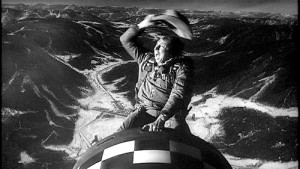 The bill was bipartisan. There is no fundamental difference between Democrats and Republicans. The terms “left” and “right” are meaningless. Most of America’s modern wars were started not by conservatives, but by liberal Democrats.
When Obama left office, he presided over a record seven wars, including America’s longest war and an unprecedented campaign of extrajudicial killings – murder – by drones.
In his last year, according to a Council on Foreign Relations study, Obama, the “reluctant liberal warrior,” dropped 26,171 bombs – three bombs every hour, 24 hours a day. Having pledged to help “rid the world” of nuclear weapons, the Nobel Peace Laureate built more nuclear warheads than any president since the Cold War.
Trump is a wimp by comparison. It was Obama – with his Secretary of State Hillary Clinton at his side – who destroyed Libya as a modern state and launched the human stampede to Europe. At home, immigration groups knew him as the “deporter-in-chief.”
One of Obama’s last acts as president was to sign a bill that handed a record $618 billion to the Pentagon, reflecting the soaring ascendancy of fascist militarism in the governance of the United States. Trump has endorsed this.
Buried in the detail was the establishment of a “Center for Information Analysis and Response.” This is a ministry of truth. It is tasked with providing an “official narrative of facts” that will prepare us for the real possibility of nuclear war – if we allow it.
Follow John Pilger on twitter @johnpilger
US Congress to Undermine INF Treaty and Entire Existing Arms Control Architecture
By Andrei AKULOV | Strategic Culture Foundation | 05.08.2017
The House and Senate are currently considering defense authorization legislation which, if passed into law, would start dismantling some of the bedrock agreements of US-Russian arms control – the 1987 Intermediate-Range Nuclear Forces Treaty (INF Treaty), as well as longstanding US–Russia arms control efforts. The treaty eliminated all ground-based nuclear and conventional missiles, as well as their launchers, with ranges of 500–1,000 kilometers (310–620 mi) (short-range) and 1,000–5,500 km (620–3,420 mi) (intermediate-range). Signed in December 1987 by President Ronald Reagan and Soviet leader Mikhail Gorbachev, the INF deal is accredited with significantly reducing the threat of nuclear confrontation and accelerating the end of the Cold War.
The landmark deal for the first time eliminated an entire class of missiles in Europe and set up a new framework for verifying compliance. Russia and the US have recently exchanged accusations of breaching the treaty but there have been no substantive talks on the issue.
Both versions of the National Defense Authorization Act for 2018 require the development of medium-range missiles the INF Treaty bans. They authorize programs of development on a new US mobile ground-based cruise missile (GLCM) with a range of between 500 and 5,500 kilometers.
Politico cites the Office of Management and Budget, saying it «unhelpfully ties the Administration to a specific missile system, which would limit potential military response options». Legal experts are also criticizing the legislation as congressional overreach, saying the Senate can only ratify treaties and the president alone can negotiate or pull out of them. The House has no role whatsoever in approving treaties, Politico notes.
The House version states that if Russia failed to comply with the INF terms within 15 months of the bill’s enactment, the US would no longer be legally bound by the treaty as a matter of domestic law. A similar provision could be inserted into the Senate version of the bill.
Russia’s alleged violations serve as a pretext for deploying shorter and intermediate range weapons to strike other countries, like North Korea. The US Army is believed to lack sufficient firepower in a large-scale conflict, such as missiles that can hit targets hundreds of miles away. David Johnson, a military analyst at the Center for Strategic and Budgetary Assessment, believes that «the lack of long-range firepower in the Army [is] a problem that could haunt land forces in a war in Eastern Europe».
Army Deputy Chief of Staff Lt. Gen. John Murray told lawmakers about the need for a «long-range precision fires» program to develop a powerful new missile that can reach targets 499 kilometers out, or about 310 miles. The range has to stay below 500 kilometers to comply with the INF treaty. If it’s not in force anymore, then the Army will get what it wants.
Mark Gunzinger of the Center for Strategic and Budgetary Assessments (CSBA) thinks that pulling out from the treaty is the right thing to do. He believes that future ground-based strike systems could help the US suppress Russia’s advanced integrated air defense systems and freedom of action in the event of a conflict. The intermediate range missiles could help the American military gain more advantage over China and North Korea. «Perhaps the time is right for a serious debate over the US withdrawing from the INF Treaty», Gunzinger says. Michaela Dodge of the Heritage Foundation affirms that, the Treaty is no longer relevant, and the US should withdraw.
Launching a program to develop a new ground-based cruise missile would add to the fact that some missiles to be eliminated under the terms of the INF Treaty are used as targets for ballistic missile defense tests, while Aegis Ashore systems use the launching pads that can be used to fire medium range Tomahawks. The Senate version of the bill says the US has no intention to tear up the treaty but the need to close the capability gap opened by Russia is given as a reason for launching the program. The two things contradict each other. The sum of these factors make the US actually abandon the agreement while not leaving it officially.
The same thing applies to Iran. Formally, the United States has not torn up the Joint Comprehensive Plan of Action (JCPOA) with Iran. At the same time, imposing sanctions on Tehran over its ballistic missile program makes the agreement deprived of any substance. No matter what pretext is used, the fact is that punitive measures against Iran are in place. It makes Iranians put into doubt the need to further comply with the JCPOA.
The US-Russian relations under ex-President Obama left much to be desired but the issue of violating the INF Treaty was not on the agenda. If the medium-range missile development program had been launched, the Congress would have been in violation of the international agreement. It did not occur then, but it is happening now under President Trump.
This would put into doubt the reputation of the United States as a reliable partner. If one international agreement is breached by the Congress, any other treaty can be abrogated, too.
Other defense programs would suffer, with money directed to implement the program in violation of the INF. The defense budget already includes funding to develop a fleet of nuclear air-launched cruise missiles. The more, the better?
No European ally has given consent to have the weapon on its soil. Would Europeans agree to have nuclear weapons on their soil? It makes the 1983 protests leap to memory.
The US will not benefit greatly if it withdraws from the treaty. It does not have an intermediate-range ballistic missile, and developing a new one will take time and effort. The bill does not mention intermediate ballistic capability anyway. Land-based cruise missiles would not tip the balance into US favor because they are too slow to effectively knock out critical infrastructure sites in a first unexpected strike. The US military need ballistic missiles with short flight times to decapitate the enemy but the Congress wants a cruise, not a ballistic, missile.
If Europe-based cruise missiles are fired, Russia will have enough time for a launch-upon-attack against those European states, which host the weapons, and the United States.
With the INF Treaty effective no more, Moscow will be free to deploy intermediate-range missiles without restriction. In theory, its Iskander-M systems could be armed with ballistic and cruise missiles with extended range, while the American military has nothing to respond with.
The House version has a provision that would prohibit the use of funds to extend New START until Russia complies with the INF treaty. But the conclusion, whoever makes it, about Russia’s compliance can be biased or outright wrong. Signed into law, the bill would undermine the whole architecture of arms control. The New START and the INF are the only two treaties still in place. Without them, the way to uncontrolled arms race would be unhindered.
The Congress would exceed its authority. It actually forces the administration to abandon an international treaty. The Senate can ratify international treaties, not abrogate them. The House does not vote on them. Both versions of the bill encroach on the president’s foreign policy prerogatives the same way the Countering America’s Adversaries through Sanctions Act does.
The bill includes provisions to undermine the treaty while the opportunities offered by the Special Verification Commission (SVC) envisioned by the INF treaty are far from being exhausted. The parties could use the SVC venue to consider additional confidence-building measures and information exchanges that take into account technological and political developments that have occurred recently.
The bill wants the Open Skies Treaty that could be used for INF verification to be deprived of funds. The observation capabilities could be upgraded. The NATO-Russia Council could serve as another mechanism to address specific security concerns. A lot of things could be done to preserve arms control regime and prevent its crisis. The world is facing the most serious and comprehensive crisis in the fifty-year history of nuclear arms control with almost every channel of negotiation deadlocked and the entire system of existing arms control agreements in jeopardy. The US Congress appears to be adamant in its desire to make things even worse.
US ‘Constitutional Shift’: Powerless President and Omnipotent Congress
Sputnik – August 4, 2017
What the international community is observing now in Washington could be called a sluggish constitutional shift, Russian political analyst Andrei Suzdaltsev told RIA Novosti in a reference to Congress twisting Donald Trump’s arm. Meanwhile, Congress is about to stir up new frictions with Trump over the INF Treaty with Russia.
The world is witnessing what could be called a constitutional shift with Congress de facto obtaining more power than the US president, Moscow-based political analyst and academic Andrei Suzdaltsev told RIA Novosti.
On Wednesday US President Donald Trump signed into law a US sanctions bill aimed against Russia, Iran and North Korea. The sanctions target Russia’s defense, intelligence, mining, shipping and railway industries and restrict dealings with Russian banks and energy companies.
To make matters even more complicated, the new law limits the US president’s ability to lift or ease sanctions on Russia, as Congress’s approval to reconsider the restrictions will now be required.
In an apparent reference to the bill, Trump tweeted Thursday that the US-Russian relationship is at a “very dangerous” low.
”Our relationship with Russia is at an all-time & very dangerous low. You can thank Congress, the same people that can’t even give us HCare!” Trump wrote.
Incredible as it may seem, the president of the country has turned out to be powerless, Suzdaltsev said, adding that one now has to hold a dialogue with Congressional representatives.
“In fact, we are witnessing a sluggish constitutional shift in the US political system. Being a presidential republic where the head of executive power had a solid mandate America always looked at the reaction of Congress. But there was a counterweight system. Now the American elite is divided,” Suzdaltsev told RIA Novosti.
The Russian academic drew attention to the fact that the internal political crisis, which started during the election campaign in autumn 2016, is still raging on.”By forcing Trump into signing a new sanctions bill into law Congress… implemented a constitutional shift,” Suzdaltsev stressed.
“Trump is now a powerless figure incapable of conducting a political dialogue,” he said. “If one wants to hold negotiations, one needs to do this with congressmen in both houses. Actually, there is no president.”
“We are entering a period that may even be harder than the years of the Cold War,” the academic remarked.
Meanwhile, Politico reported Thursday that the US Congress continues to discuss the bill which implies America’s de facto withdrawal from the INF Treaty by suggesting developing medium-range missiles banned by the document.
The INF Treaty, concluded in 1987, envisaged the reduction of non-strategic weapons by prohibiting all nuclear and conventional missiles and their launchers with a range between 310 and 3,420 miles.
“Congress is moving to force the Pentagon to violate a nuclear arms treaty with Russia — in yet another effort to box in President Donald Trump on relations with Moscow,” the media outlet noted, adding that “the legislation is also likely to stir up new friction between lawmakers and Trump, who has already accused Congress of illegally meddling in his dealings with Russia.”
Commenting on the matter, Kremlin spokesman Dmitry Peskov highlighted that Russian President Vladimir Putin and US President Donald Trump did not discuss the issue of the INF Treaty during their meeting. He stressed that Moscow remains committed to its obligations under the agreement and expects the same from its partners.
“Russia remains committed to its obligations under this treaty, despite some claims which were voiced before. Of course, we expect that our partners under this agreement will adhere to their international obligations in this context,” Peskov told reporters.
Citing legal experts Politico remarked that the proposed legislation could be regarded as congressional overreach. “The Senate can only ratify treaties and the president alone can negotiate or pull out of them,” it argues.
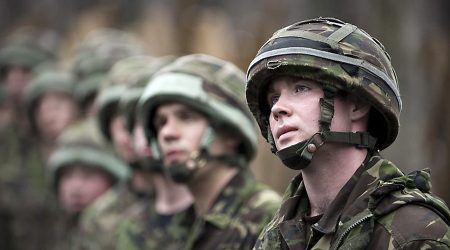
British Army must stop recruiting child soldiers, veteran tells RT
© defenceimagery.mod.uk
By Claire Gilbody-Dickerson | RT | August 4, 2017
Britain should raise the military recruitment age from 16 to 18 because joining the services at such a tender age can cause irreversible psychological damage, a British Army veteran has told RT.
Wayne Sharrocks, who joined the army when he was 17, has spoken out against current military regulations, which allow recruiters to accept under 18s, who are effectively children based on international standards.
Sharrocks is calling for the recruitment age to be raised following a recent report published by Veterans for Peace (VFP) UK, which sheds light on the detrimental effects of army training on soldiers in general, and young people in particular.
Twenty-two out of every 100 British soldiers are under the age of 18. However, they are exempt from combat operations until they reach adulthood.
The 72-page report, ‘The First Ambush? Effects of army training and employment,’ says military training alone increases violent offending among recruits, with the rate of offenses rising again once they return from the front line.
The report, assembled through the testimonies of army veterans and more than 200 separate studies, also found recruits are twice as likely to drink heavily – all factors which may in turn lead to unemployment and homelessness.
Regardless of recruitment age, Sharrocks believes “military training and culture is damaging and not healthy for a person to go through.” But because young people’s minds are more “malleable” than those of adults, the effects of training are far worse for them.
It emerged last month that the British Army is actively trying to fill its ranks with young people from households with a £10,000 (US$13,000) annual income.
In a document for the British Army’s ‘This Is Belonging’ campaign, seen by the Independent and Child Soldiers International, the military says it is deliberately targeting 16 to 24-year-olds from social classes known as C2DEs – denoting the three lowest ranks of society.
The VFP report says the British Army “strategically” targets such youngsters from deprived neighborhoods by presenting a “romanticized” image of the soldier.
Members of the Scottish Parliament have backed a petition calling for further research into military recruitment of youth.
There have also been calls by the Scottish National Party (SNP) Youth for a review of the policy on military recruitment age, but a motion to raise it was opposed by senior MPs in December last year.
Sharrocks, who twice served in Afghanistan and left the army after being severely injured by an improvised explosive device (IED), said more information should be made available to young people so they know what they are signing up for.
Jay Sutherland, a Scottish 16-year-old student who has founded a campaign group against “militarism” in schools, said advertisements are “glossed over, with the military not even showing important regulations such as when you sign up you are locked in until 18 and the fact that younger recruits are twice as likely to be killed in Afghanistan than older recruits.”
An MoD spokesperson told RT it rejects claims it is targeting youth only, but said it is “proud” of offering young people in the Armed Forces opportunities that “aren’t always available elsewhere, from basic literacy education and support for postgraduate degrees, to high-quality accredited training and unique employment prospects.”
The spokesperson added that the Armed Forces allows for everyone, regardless of their background, the opportunity to reach their full potential, before adding it is encouraging young people to “aim higher” while “teaching them valuable skills”.
Dehumanizing training
Sharrocks claims military training requires soldiers to “follow orders without questioning them,” so that their “natural aversion” to killing is also “altered.”
The report itself reads: “To ensure that recruits will follow all orders and kill their opponents in war, army training indoctrinates unconditional obedience, stimulates aggression and antagonism, overpowers a healthy person’s inhibition to killing, and dehumanizes the opponent in the recruit’s imagination.”
Such practices can lead to long-lasting psychological issues such as post-traumatic stress disorder (PTSD), which can lead to suicide.
VFP UK describes the case of Dan, who joined the army at 18 and developed PTSD after training and service in Iraq.
When he returned to Britain, he served time in a military prison for assaulting a warrant officer.
“After the conviction the army wouldn’t support me, my mental health deteriorated and I was left feeling isolated and alone.
“I resorted to alcohol abuse and became homeless for a year, and I have suffered with chronic PTSD.
“I really believe that underlying all my problems was the effect of the training I was put through when I joined the army.”
Sharrocks accused the army of turning its back on soldiers, who are “pushed aside” once they are deemed no longer “useful.”
Because they have been in the army for so many years, Sharrocks says some veterans lack fundamental qualifications to get a decent job in civilian life, as they have the same skill-set of a 16-year-old who has “just left school.”
Many find themselves in manual, low-skill factory jobs.
Rather than leaving charities to pick up the pieces, Sharrocks appealed for more to be done to smooth the transition from soldiering to civilian life.
Writing for the ForcesWatch website, Douglas Beattie, a member of VFP UK, said soldiers are dehumanized right from the start, regardless of their age.
“This [process] begins with isolation – for the first few weeks trainees, heads shaved and in uniform, have no right to see family or friends; they are not allowed to leave base and cannot terminate their contract.”
He also said soldiers become targets of “beastings” – humiliating treatment involving both verbal and physical violence, aimed at the individual’s utter debasement.
Read more:
Is Trump’s Russia Policy Being Hijacked?
By Pat Buchanan • Unz Review • August 4, 2017
In crafting the platform in Cleveland on which Donald Trump would run, America Firsters inflicted a major defeat on the War Party.
The platform committee rejected a plank to pull us deeper into Ukraine, by successfully opposing new U.S. arms transfers to Kiev.
Improved relations with Russia were what candidate Trump had promised, and what Americans would vote for in November.
Yet, this week, The Wall Street Journal reports:
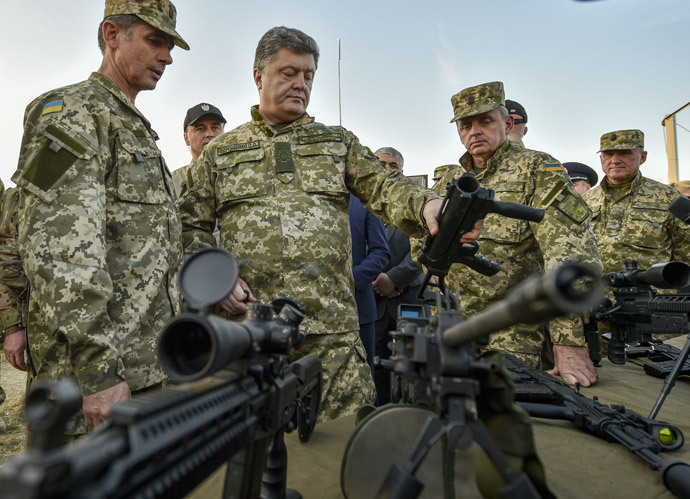
“The U.S. Pentagon and State Department have devised plans to supply Ukraine with antitank missiles and other weaponry and are seeking White House approval … as Kiev battles Russia-backed separatists … Defense Secretary Mattis has endorsed the plan.”
As pro-Russia rebels in East Ukraine have armored vehicles, Kiev wants U.S. tank-killing Javelin missiles, as well as antiaircraft weapons.
State and Defense want Trump to send the lethal weapons.
This is a formula for a renewed war, with far higher casualties in Ukraine than the 10,000 dead already suffered on both sides.
And it is a war Vladimir Putin will not likely allow Kiev to win.
If Ukraine’s army, bolstered by U.S. weaponry, re-engages in the east, it could face a Moscow-backed counterattack and be routed, and the Russian army could take permanent control of the Donbass.
Indeed, if Trump approves this State-Defense escalation plan, we could be looking at a rerun of the Russia-Georgia war of August 2008.
Then, to recapture its lost province of South Ossetia, which had seceded in 1992, after Georgia seceded from Russia, Georgia invaded.
Putin sent his army in, threw the Georgians out, and recognized South Ossetia, as John McCain impotently declaimed, “We are all Georgians now!”
Wisely, George W. Bush ignored McCain and did nothing.
But about this new arms deal questions arise.
As the rebels have no aircraft, whose planes are the U.S. antiaircraft missiles to shoot down? And if the Russian army just over the border can enter and crush the Ukrainian army, why would we want to restart a civil war, the only certain result of which is more dead Ukrainians on both sides?
The Journal’s answer: Our goal is to bleed Russia.
“The point of lethal aid is to raise the price Mr. Putin pays for his imperialism until he withdraws or agrees to peace. … The Russians don’t want dead soldiers arriving home before next year’s presidential election.”
Also going neocon is Mike Pence. In Georgia this week, noting that Russian tanks are still in South Ossetia, the vice president not only declared, “We stand with you,” he told Georgians the U.S. stands by its 2008 commitment to bring them into NATO.
This would mean, under Article 5 of the NATO treaty, that in a future Russia-Georgia clash the U.S. could find itself in a shooting war with Russia in the South Caucasus.
Russia’s security interests there seem clear. What are ours?
Along with Trump’s signing of the new sanctions bill imposed by Congress, which strips him of his authority to lift those sanctions without Hill approval, these developments raise larger questions.
Is President Trump losing control of Russia policy? Has he capitulated to the neocons? These are not academic questions. For consider the architect of the new arms package, Kurt Volker, the new U.S. Special Representative for Ukraine Negotiations.
A former CIA agent, member of the National Security Counsel, and envoy to NATO, Volker believes Russian troops in Transnistria, Abkhazia, South Ossetia, Crimea, Donetsk and Luhansk are all there illegally — and U.S. policy should be to push them out.
A former staffer of Sen. McCain, Volker was, until July, executive director of the neocon McCain Institute. He has called for the imposition of personal sanctions on Putin and his family and European travel restrictions on the Russian president.
In the Journal this week, “officials” described his strategy:
“Volker believes … that a change in Ukraine can be brought only by raising the costs for Moscow for continued intervention in Ukraine. In public comments, he has played down the notion that supplying weapons to Ukraine would escalate the conflict with Russia.”
In short, Volker believes giving antitank and antiaircraft missiles to Ukraine will bring Putin to the negotiating table, as he fears the prospect of dead Russian soldiers coming home in caskets before his 2018 election.
As for concerns that Putin might send his army into Ukraine, such worries are unwarranted.
Volker envisions a deepening U.S. involvement in a Ukrainian civil war that can bleed and break Russia’s Ukrainian allies and convince Putin to back down and accept what we regard as a just settlement.
Does Trump believe this? Does Trump believe that confronting Putin with rising casualties among his army and allies in Ukraine is the way to force the Russian president to back down and withdraw from Crimea, Luhansk and Donetsk, as Nikita Khrushchev did from Cuba in 1962?
What if Putin refuses to back down, and chooses to confront?
Copyright 2017 Creators.com.
Featured Video

AIDS Inc. by Gary Null (2007)
or go to
Aletho News Archives – Video-Images
From the Archives
Clash of Civilization, Iran Part II
By Jamal Kanj – Intifada-Palestine.com – January 14, 2011
Israel’s survival kit is: perpetuate conflict, insecurity to rationalize collective hate and finally playing victim.
Devoid of conflict, Israel implodes internally; without hate, Zionism loses its justification; and playing eternal victim to continue blackmailing the West. Absence of this holy trinity, Israel ceases to exist.
From its inception, the house of Zion has mastered exploiting adversarial powers to advance Israel’s cause. For instance, their influence over the Democratic Party in the US began with President Truman’s bid for 2nd term election in 1948.
Responding to strong opposition from Secretary of State General George Marshall and Department experts urging against recognition of Israel, President Truman replied: “I’m sorry gentlemen but I have to answer to hundreds of thousands [Jewish voters] who are anxious for the success of Zionism. I do not have hundreds of thousands of [voting] Arabs among my constituents”
Zionists influence over liberal American politics was matched with the doctrinal school of Conservative theoreticians aligning the Republican Party’s platform with Israel’s objectives. The Neoconservative Zionists, coined Zioncons, invented the “Clash of Civilization” concept to fight Israel’s wars. … continue
Blog Roll
 Aletho News
- Merck Virologists Admitted to Falsely Certifying Vaccine Efficacy
- Mandatory Folic Acid for every man, woman & child
- Pro-Palestine protesters arrested outside UK’s ruling Labour Conference in Liverpool
- Mauritius denies landing permit to flight from Israel, forcing cancellation: Tour operator
- Israeli finance minister calls for genocidal war on West Bank, annexation of south Lebanon
- 12 Things Your Psychiatrist Was Trained Not to Tell You
- From Unipolar Universalism to Multipolar Civilizational Distinctiveness
- RSF military group defects, joins Sudanese army: State media
- Ireland goalkeeper refuses to play ‘Israel’ as squad weighs boycott
- China pushes back against US on Cuba, Iran
- If Americans Knew
- Israel forces Gazans to live in constant peril – Daily Update
- Deconstructing Netanyahu’s pants-on-fire UN rant – Daily Update
- Trump betrayed voters with his campaign lies and prioritized a foreign country once he took office
- Netanyahu calls Israel’s war in Gaza ‘opposite of genocide’ in UN speech to near-empty hall
- Settler Kidnappings: Torture, Sexual Abuse and Terrorisation of Palestinian Abductees as Israel Deepens Annexation of West Bank
- Gaza winter nears as 162,000 tents become unusable, raising fears of humanitarian crisis
- Netanyahu says, “It’s the opposite of genocide”; UN says Gaza economy is world’s ‘most severe crisis on record’ – Daily Update
- Israel’s US-Backed Assault on Gaza Has Created the ‘World’s Most Severe Economic Crisis on Record’: UN
- ‘Protecting U.S. Citizens’… From Israel
- ‘This is where I live now, the back of a truck’: a day in the life of a grandmother in Gaza
- No Tricks Zone
- New Study: Earth And Venus Surface Warmth Largely Explained By Convection And Lapse Rate, Not CO2 Or Radiation
- 2025 Nature Paper Claiming Worsening Global Drought Gets RETRACTED …Heavily Flawed
- New Study: ‘Global Drought Shows No Detectable Recent Acceleration Under Climate Warming’
- Economic Masterminds: German Socialists Suggest Taxing Productivity Gains Stemming From Using AI
- The South China Sea Has Not Been Cooperating With The Climate Change Narrative
- Energy Crisis: Germany Enters Heating Season With Historically Low Gas Reserve Fill Levels
- New Study: The Antarctic Ice Sheet Gained Mass From 2020-2024 Due To Staggering Snow And Ice Accumulation
- Study: Ocean Heating Rates From Thousands Of Years Ago ‘Dwarf’ Modern Ocean Heating Rates
- Climate Extremists Target, Attack Large-Scale Power Grid Infrastructure In Germany!
- New Study: Antarctic Ice Melt Has Contributed Less Than 1 Centimeter To Sea Level Rise In The Last 30 Years

