America’s Fragile Future
By Gilbert Doctorow | Consortium News | September 14, 2017
Does the United States have a future as a great power?
Twenty years ago posing this question would have seemed absurd. The United States was fully self- confident about its position as the sole surviving superpower in the world. It faced virtually no obstacles or objections to its performance on behalf of the “public good,” a process that supposedly brought order to the world either through the liberal international institutions that it helped to create after World War Two and dominated, or through unilateral action when necessary via “coalitions of the willing” aimed at bringing down one or another disruptive malefactor on a regional stage.
From many voices abroad it heard “amen” to its claims of exceptionalism and farther-seeing vision that came from its standing taller, as Secretary of State Madeleine Albright put it. The “indispensable nation.”
Fourteen years ago, when America prepared for its ill-conceived invasion of Iraq and encountered loud resistance from France and Germany, backed up by Russia, it became possible to wonder whether U.S. global hegemony could last. The disaster that the Iraqi adventure quickly became within a year of George W. Bush declaring “mission accomplished” rolled on and progressively diminished the enthusiasm of allies and others hitherto on the U.S. bandwagon for each new project to re-engineer troublesome nations, to overthrow autocrats and usher in an age of “liberal democracy” across the globe.
Still, the doubts were discussed sotto voce. Governments tended to conform to what the Russians colorfully call “giving someone the finger in your pocket.” Observers spoke their piece privately against the violations of international law and simple decency that the United States was perpetrating — and against the swathe of chaos that followed American intervention across the Greater Middle East. But such persons were on the fringes of political life and drew little attention.
What has happened over the past couple of years is that doubts about the competence of the United States to lead the world have been compounded by doubts about the ability of the United States to govern itself. The dysfunction of the federal government has come out of the closet as an issue and is talked about fairly regularly even by commentators and publications that are quintessentially representative of the Establishment.
In this connection, it is remarkable to note that the September-October issue of Foreign Affairs magazine carries an essay entitled “Kleptocracy in America” by Sarah Chayes. This takes us entirely away from the personality peculiarities of the 45th President into the broader and more important realm of the systemic flaws of governance, namely the extraordinary political power wielded by the very wealthy and the self-serving policies that they succeed in enacting, all at the expense of the general public that has stagnated economically for decades now, setting the stage for the voter revolt that brought Trump to power.
And in an op-ed essay in The Washington Post on Sept. 1, which was remarkable precisely for its identification of the failing political culture in Washington, Sen. John McCain, R-Arizona, says the following:
“Congress will return from recess next week facing continued gridlock as we lurch from one self-created crisis to another. We are proving inadequate not only to our most difficult problems but also to routine duties. Our national political campaigns never stop. We seem convinced that majorities exist to impose their will with few concessions and that minorities exist to prevent the party in power from doing anything important.”
McCain himself was until now a major contributor to the poisonous political climate in Washington, to partisanship that tramples patriotism under foot. One thinks of his unprecedented attack on fellow Republican Sen. Rand Paul several months ago whom he accused of “working for Putin” because the senator from Kentucky refused to vote for the accession of Montenegro to NATO.
Permanent Gridlock
Gridlock in the federal government is nothing new. In the past decade, work of the federal government came to a standstill when Congress and the President could not agree to the conditions under which the federal debt ceiling would be raised. Such an eventuality was just narrowly averted in the past few days.
Public exposure and ridicule of a sitting president for personal failings, such as the case of Bill Clinton’s sexual transgressions, have been exploited for political gain by his opponents whatever the cost to national prestige. We have lived through that crisis of the political elites and the Republic survived.
What is new and must be called out is the loss of civility in public discourse at all levels, from the President, from the Congress and down to the average citizen. The widely decried unsubstantiated personal attacks that otherwise would be called defamation during the 2016 presidential electoral campaign were symptomatic of this all-encompassing phenomenon. It signifies a dramatic decline in American political culture that the whole world sees and is beginning to act upon in self-defense.
Let us start with President Donald Trump, who is attacked daily by the liberal media that represents the lion’s share of all television programming and print publications, media that vehemently opposes Trump’s domestic and foreign policy positions. In their determination to ensure either his impeachment or effectively to strip him of powers, they speak of Trump the way cheaply printed caricatures for the masses lampooned Louis XVI and Marie Antoinette before the French Revolution.
The President is publicly described by his compatriots as an imbecile, a rabid racist, a misogynist, a volatile and impulsive narcissist whose finger on the nuclear button gives us all goose pimples: this cannot be ignored by the wider world outside U.S. borders and it is not ignored.
To be sure, Donald Trump has brought a good deal of this ignominy on himself by his intemperate comments on daily events, particularly at home but also abroad, where silence or a nod to conventional verities would be the better part of valor. He keeps his own counsel on foreign affairs and erroneously believes that his instincts are superior to the advice of experts.
In his kitchen cabinet, there are no experts. In the official cabinet, he has for his own reasons assembled a group consisting mostly of neoconservatives and liberal interventionists, who made it easy for him to get their confirmations in the Senate but who are all pulling in the direction opposite to the America First concepts of nonintervention in the affairs of other states that he set out in his electoral campaign.
Trump changes direction daily, even on matters as critical as the likely U.S. response to the ongoing crisis on the Korean peninsula. The tactic of unpredictability was an approach he said in the campaign he would use against enemies, in particular against terrorist groups, not to tip them off about U.S. intentions in advance and weaken the effect of eventual U.S. military strikes. But it makes no sense when applied to all other current business, which requires a firm hand on the tiller and sense of continuity and predictability, not constant disruption.
Undoing Bonds
The net result of Donald Trump’s first six months in office has been to undo the bonds of mutual confidence with America’s allies and friends, and to put America’s competitors on notice that America’s role in the world is up for grabs.
Foreign policy has opened up as a topic for discussion here in Europe ever since Donald scattered the chickens by his loose talk about NATO and America’s commitment or non-commitment to the Article 5 provision of “all for one and one for all.” This has given impetus to the long-spluttering plans to create a European Union army as an alternative to NATO, and as a rallying point for federalists in what will be a two-speed Europe.
During the two terms of Obama, meddling in the internal politics of China and Russia, repeated hectoring over their alleged human rights and rule of law violations, but still more importantly the wrong-headed policy of simultaneous containment of these two giants through construction of military alliances and bases at their borders put in motion a strategic partnership between them that was once improbable but is now flourishing. The Russia-China axis is underpinned by vast joint investments and promises to remake the global power balance in the decades to come.
Now, with Trump, the damage to American power in the Pacific region is spreading. His ripping up free trade accords and his incautious rhetoric regarding possible military strikes against North Korea have pushed both Japan and South Korea to explore actively and urgently how Russia can be befriended, at a minimum, for the sake of greater leverage against the big ally in North America. This has been demonstrated with perfect clarity by the meetings of Vladimir Putin with Japanese premier Shinzo Abe and South Korean president Moon Jae-in at the Eastern Economic Forum in Vladivostok over the past couple of days.
Russia’s evolving political entente with both South Korea and Japan is providing support for the launch of ambitious foreign investment projects in its Far East as announced at the Forum. These include one which has the potential to re-shape the imagination of regional populations for a generation to come: revival of plans to build a $50 billion rail-auto bridge linking Hokkaido with the Russian island of Sakhalin, thus uniting Japan with the continent and facilitating freight shipments across Russia to Europe.
For its part, South Korea announced infrastructure investments for the Northern sea route linking South Korea with European markets through sea lanes kept open by Russian icebreakers. Like the Chinese One Belt One Road, these plans all dramatically reduce the importance to world trade of the long-standing U.S.-policed sea lanes off Southeast Asia up to and through the Suez Canal.
Of course, the low point in America’s image in the world today under Trump is not entirely new. By the end of his two terms in office, George W. Bush had driven American prestige to what were then all time lows even among Europeans. There was a brief resurgence of American popularity at the start of Barack Obama’s tenure in office. But that was quickly dissipated by his failure to deliver on the pledges of his campaign and inaugural address, as the Guantanamo Bay prison remained open, as the wars in Iraq and Afghanistan continued, and as drone strikes proliferated.
Opening a Void
But Donald Trump has shaken up the world order by repeatedly questioning the public good that the United States claimed to be delivering these past decades, opening a void without projecting a new vision of global governance. In the meantime, the unique value of America’s commitment to the public good is being eroded as other countries step forward with infrastructure and other plans that provide practical improvements in the public sphere.
It is commonplace today within the United States to put all blame for the shocking decline in political culture at the door of President Trump with his boorish language and behavior. However, as we noted from the outset in citing Senator John McCain’s recent op-ed, Congress has contributed mightily to the erosion of civic values by its vicious and counterproductive partisanship.
And yet a still greater threat to American democracy and to the sustainability of America’s great power status has come from the inverse phenomenon, namely the truly bipartisan management of foreign policy in Congress. The Republican and Democratic leaderships have maintained strict discipline in promotion of what are nearly identical neoconservative (Republican) and liberal interventionist positions on virtually every foreign policy issue before Congress.
Committees on security and foreign affairs invite to testify before them only those experts who can be counted on to support the official Washington narrative. Debate on the floor of the houses is nonexistent. And the votes are so lopsided as to be shocking, none more so that the votes in August on the “Countering America’s Adversaries through Sanctions Act.” This measure moved sanctions on Iran, North Korea and Russia from the category of Executive Order to federal law. In the Senate, the bill passed 98 to 2. In the House, the vote was 419 for, 3 against. Such results remind us of the rubber-stamp legislature of the USSR, the Supreme Soviet, in its heyday.
That particular vote was still more scandalous for its being drafted and passed without any consultation with U.S. allies and friends, though its intent is to control their commercial and credit policies with respect to the target countries under sanction.
For Europeans, in particular, this puts into question their ability to pursue what they see as great economic benefits from trade and investment with Russia and Iran. In this sense, Congress demonstrated that it is pursuing a still more radical program of America First than the President. This in-your-face unilateralism works directly to the detriment of America’s standing in global forums.
The New McCarthyism
It would be comforting if the problems of our political culture began and ended with the elites operating in Washington, D.C. However, that is patently not the case. The problem exists across the country in the form of stultifying conformism, or groupthink that is destroying the open marketplace for ideas essential for any vital democracy.
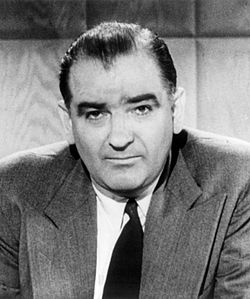
Senator Joseph McCarthy
Some of us have called this the new McCarthyism, because the most salient aspect of groupthink is the ongoing hysteria over alleged Russian “meddling” in U.S. domestic politics. The denunciations of “stooges of Putin” and the blacklisting from both mass and professional media of those known to deliver unconventional, heterodox views on Russia and other issues of international affairs is reminiscent of what went on during the witch hunt for Communists in government and in the media during the early 1950s.
However, no one is being hounded from office today. There are no show trials, as yet, for treasonous collusion with Russia. So, it would be safer to speak of an atmosphere of intimidation that stifles free debate on the key security issues facing the American public. Absence of debate equates to a dumbing-down of our political elites as intellectual skills atrophy and results in poor formulation of policy. The whole necessarily undermines America’s soft power and standing in the world.
Groupthink in America today did not come from nowhere. Debilitating conformism was always part of our DNA, as is the case in a great many countries, though its emergence has been episodic and in varying degrees of severity. The present acute manifestation in the United States goes back to the mass paranoia which followed the 9/11 terrorist attacks when the George W. Bush administration introduced the Patriot Act, gutting our civil rights in exchange for the promise of security.
Though the revelations of Edward Snowden have shown the extent and potency of the instruments of surveillance over the general population that were introduced by the Bush administration after 9/11, there was enough of state control exposed in the Patriot Act text to silence anyone with doubts about U.S. government policies at home and abroad. When the harsh personalities of President Bush’s immediate entourage were replaced by the liberal-talking officials of Barack Obama, people breathed easier, but the instruments of surveillance remained in place, as did the neocon middle and senior officials in the State Department, in the Pentagon, and in the intelligence agencies.
Thus, for a whole generation the Washington narrative remained unchanged, giving encouragement in communities across the land to neocon-minded administrators and professors of American universities, publishers and owners of our mainstream newspapers, and other arbiters of public taste. That is quite sufficient to explain the current atmosphere of intimidation and groupthink.
It is improbable that any Humpty-Dumpty successor to Donald Trump can put the pieces back together again and restore American dominance to where it was at the close of Bill Clinton’s first term as president. Given American hubris, will our political class accept an equal seat at the global board of governors or just walk away from the table?
Gilbert Doctorow is an independent political analyst based in Brussels. His latest book Does Russia Have a Future? was published in August 2015. His forthcoming book Does the United States Have a Future? will be published in September 2017.
US Accelerates Afghanistan Bombing Campaign With Questionable Effectiveness
Sputnik – 14.09.2017
The US Air Force dropped an average of 16 bombs per day in August in the wake of US President Donald Trump’s plan to attack “America’s enemies” in the country, according to the most recent Pentagon data on munitions delivered in the country.
US Air Force warplanes including the F-16 “Viper,” the MQ-9 Reaper drone, and the B-52 Stratofortress bomber deployed 1,984 bombs from January to July of this year, according to US Air Force Central Command data published August 31.
Sputnik News therefore calculates that in the first seven months of the year, US jets dropped an average of 227 bombs per month. In August, more than twice as many bombs struck Afghani soil than an average month, at 503 munitions.
Increasing the frequency of bombing raids hasn’t required mobilizing extra aircraft assets to Afghanistan because “we’ve never come back” after arriving so many years ago, US Air Force Chief of Staff Gen. David Goldfein told Military.com, noting he doesn’t envision a “significant plus-up” in the number of US warplanes stationed there.
In a May 20, 2016 Wall Street Journal op-ed, retired US Army general and former CIA director David Petraeus and Brookings Institution senior fellow Michael E. O’Hanlon wrote: “We have a real fight on our hands in Afghanistan, but not a hopeless one … Even a modest US and NATO military contributions have the potential to make a considerable difference … Some might reasonably ask, after 15 years of war in Afghanistan, why do we need to keep at it? The answer is simple – because Afghanistan, effectively the eastern bulwark in our broader Middle East fight against extremist forces, still matters.”
The duo went on to say “air power in particular represents an asymmetric Western advantage, relatively safe to apply, and very effective against massed (or even individual) enemy forces and assets.”
Since O’Hanlon and Petraeus wrote the column, the US has consistently delivered more and more payloads each month to target insurgents in Afghanistan, Pentagon data shows.
The most recent publicly available report on the status of the fight in Afghanistan was released July 30 by the Special Inspector General for Afghanistan Reconstruction (SIGAR) and sheds light as to just how effective the bombs have been. It turns out the situation has given policymakers few reasons for optimism.
“The [US Intelligence Community] assesses that the political and security situation in Afghanistan will almost certainly deteriorate through 2018 even with a modest increase in military assistance by the United States and its partners,” Daniel Coats, Director of National Intelligence, is quoted as saying in the SIGAR report.
Israeli Media Begs US to Prepare For War With Syria, Russia, Iran
By Andrew Illingworth | Al Masdar News | September 9, 2017
BEIRUT, LEBANON – Israeli media has reached the new moral low of openly begging the United States to prepare for war in Syria even if it means coming into direct confrontation with major Syrian allies like Russia and Iran.
In a recent article titled “Why Israel needs to prepare America for the upcoming conflict in Syria,” Jerusalem Post writer Eric R. Mandel (an American Zionist) proposes that the US government and people must be made war-willing partners of Israel in the event of any future attack by the Israeli Defense Forces against Syrian, Russian and/ or Iranian military targets.
The article by Mandel is an outstanding example of how Israeli pro-war interest groups – speaking through right-wing Zionists in top American military and foreign policy circles – try to entice the US government and population into participating in wars that only benefit the hegemonic ambitions of Israel’s deep state.
At a time when violence in the Syrian conflict has reached an all time low due to the patient diplomatic efforts of Russia and Iran in establishing de-escalation zones, Mandel delivers a well-placed lie in his article that is designed to scare American audiences into supporting military actions that would effectively destroy such hard earned achievements towards peace.
The myth claimed by Mandel to be fact is that the Lebanese rebel movement Hezbollah completely controls the Lebanese government as well as a number of (unnamed) South American governments and that its own puppet master in this insidious conspiracy against Israel is Iran.
Indeed, Mandel’s lie is highly reminiscent of the now proven-to-be-nonsense ‘axis of evil’ conspiracy theory (in which Ba’athist Iraq, North Korea, Iran and Al-Qaeda were all in cahoots with one another) that was pushed by US politicians, and reverberated by the Western media, in order to justify the invasion of Iraq.
Sweden: Giving Up Neutrality Against People’s Will
By Peter KORZUN | Strategic Culture Foundation | 13.09.2017
Sweden, a non-NATO nation, has launched its largest military exercise in over 20 years. The drills are being conducted at Russia’s doorstep amid rising military activity in the Baltic Sea region. The timing (Sept. 11-29) is outright provocative as Aurora 2017 is taking place at about the same time (Sept. 14-20) as Zapad 2017, a major Russian exercise in Belarus.
The three-week Aurora 17 is held across Sweden, including the strategic Baltic Sea island of Gotland, not far from the Russian exclave of Kaliningrad, and the areas around Stockholm and Goteborg. It is conducted in the air, on land and at sea. About 20,000 servicemen, and over 40 Swedish civil authorities, will take part in the drills across the country, including around 1435 troops from the US, Denmark, Norway, France, Estonia, Lithuania and non-NATO Finland. It strikes the eye that Finland, a non-NATO state, has significantly larger participation (270 servicemen) than other European NATO members. For instance, France sent 120 soldiers Denmark, Norway, Lithuania and Estonia sent between 40-60 each.
«They haven’t done something like this in 25, 30 years», said Ben Hodges, commanding general, United States Army, Europe. The United States has sent a Patriot missile battery, helicopters and a National Guard tank company. This is the first time ever American armored vehicles and air defenses were deployed on Swedish soil. In June, the Swedish military also announced its intention to replace all of its aging air defense systems and potentially buy US-made Patriot missiles, citing an alleged threat from Russian Iskander-M missile systems stationed in Kaliningrad.
The war games have also raised the possibility of Sweden joining NATO to formally end its traditional neutrality that kept it out of military conflicts since 1814. The issue will be debated in the country’s 2018 election – if the three centre-right allies get their way, the country will join the alliance.
Sweden has been a member of the NATO program «Partnership for Peace» since 1994. It has taken part in NATO missions in Afghanistan, Balkans and Libya.
Since 2009, Sweden has been committed to the defense of EU members – another breach of neutrality. Mainly EU members are also parties to NATO, it’s impossible to separate them in war. In fact, Stockholm has committed itself to comply with Article 5 of the Washington Treaty regarding European members of the North Atlantic Alliance. Swedish troops and equipment have been used in the EU operation in Mali.
In May 2016 the Swedish parliament ratified the Host Nation Support Agreement with NATO, allowing the pact to store equipment in Sweden and be able to use the country for transport and transit of forces if a crisis should occur in the region. The agreement does not mention nuclear weapons. With the document in force, there is no guarantee that nuclear weapons will not be deployed on Swedish soil. Aurora 2017 is the first time the Host Country Agreement has been used.
In June 2016, Sweden signed a treaty with the US that aims to increase military capability and interoperability between the parties. Specifically, the two nations will conduct training and exercises with an eye to the «distinct political signal» that combined operations will send. Armament cooperation and research and development of future technologies will focus on undersea warfare and air defense, the document notes.
In late 2016, Sweden’s civil protection agency organized under the Ministry of Defense issued an official letter to country’s local authorities to prepare for a possible war with Russia. Sweden is increasing defence spending, and plans to reintroduce conscription from January 2018. Four thousand men and women will be drafted into the defense forces.
Though not formally a member, Sweden is also a part of NATO Rapid Reaction Force. It participates in the joint NATO air transport fleet to be used in conflicts anywhere in the world.
Two top defense officials – Micael Bydén, Supreme Commander of the Swedish Armed Forces, and Chief of Defence Staff Dennis Gyllensporre, have recently supported the idea of changing the military stance to ‘treaty-bound’ defense commitments, in effect meaning full-fledged membership in NATO. They were backed by Allan Widman, Chairman of the Swedish parliament’s defense committee. Visiting Washington in May, Prime Minister Peter Hultqvist said: «We are building a security network of defence cooperation». No doubt that Aurora 2017 is part of this effort.
Seven out of eight Swedish parliamentary parties believe that Aurora 17 will strengthen the country’s capacity to deal with a potential attack and will deepen its military cooperation with other countries, while the Left Party and peace organizations have warned of a spiraling arms race.
Despite media efforts and statements by politicians and officials, the Swedish people oppose the idea of NATO membership. According to a June survey published by Svenska Dagbladet newspaper, public support for the idea of Sweden becoming a NATO member has dropped from 41 to 33 percent in less than a year. Forty-nine percent of Swedes, who took part in the survey published by the Svenska Dagbladet newspaper, said they don’t want their country to join the US-led military bloc. Thirty-three percent supported the possible NATO bid, while 18 percent said that they were undecided. In 2015, 41 percent said that they were in favor of Sweden applying for NATO membership, with 39 percent rejecting the move and 20 percent undecided. Social Democrats, the Greens and Left Party voters showed the strongest opposition to NATO accession.
Politicians may say one thing and do another but one cannot change reality. In practice, Sweden has become a full-fledged NATO member and it has been done against the people’s will. With the defense commitment within the framework of EU and the bilateral agreement with the United States mentioned above in the article, Sweden is no different from other states of the alliance. Moreover, it’s one of the most active participants in the bloc’s military activities with a contribution exceeding by far some founding members. It is Sweden, a non-NATO, country who organized Aurora 2017, openly challenging Russia, which will conduct Zapad exercise under surveillance of Western observers according to the provisions of Vienna Document. Despite the obvious facts, Sweden is saying it’s not a NATO event once it was organized by a non-member nation.
It’s easy to predict that the US air defense systems will be stationed in Gotland to be guarded by American personnel. Instructors will also be there. Then reasons will be found to justify the presence of US military in other areas on Swedish soil under the pretext of «rotation» to hold exercises like it is done in Norway where American Marines are stationed permanently in breach of tried-and-true foreign policy principle excluding the stationing of foreign military on Norwegian soil.
No doubt, the policy does not make Sweden safer as Russia will deliberate an appropriate response. In June, Russian President Vladimir Putin warned that «If Sweden joins NATO; it will negatively affect our relations because it will mean that NATO facilities will be set up in Sweden so we will have to think about the best ways to respond to this additional threat».
This neutrality policy was, and still is, hugely popular in Sweden. But to call a spade a spade, Sweden is no longer neutral in practice. It has become a leading NATO nation, whose official non-alignment does not reflect reality. One should believe deeds not words. Aurora 2017 is a good example of the fact that the Swedish neutral status has become a thing of the past.
Syrian conflict is ending but US stays put
By M K Bhadrakumar | Indian Punchline | September 11, 2017
The Syrian government forces have broken through the ISIS’ 3-year long siege of the air base in the eastern city of Dier Ezzor. The dramatic developments in the weekend signifies for all purposes the end of the conflict in Syria. The capture of the city itself is now a forgone conclusion and with that ISIS becomes a spent force in Syria.
The covert US operation to evacuate by helicopter the ISIS commanders in Dier Ezzor last week suggests that the Pentagon accepts that the ISIS saga is ending in Syria, finally. Presumably, the ISIS and its “advisors” will now be reassigned to new theatres – such as Afghanistan. The lingering question will be: Is the US winding up business in Syria? A Russian commentary seems to think so.
On the other hand, there are reports that the rebel forces supported by the US Special Forces (with air cover) are making a dash from northern Syria to take a piece of Dier Ezzor, leaving behind the unfinished business of capturing Raqqa, ISIS’ “capital”. This risks a potential flashpoint involving them and the Russia-supported government forces in a struggle for supremacy in eastern Syria. (Reuters )
At stake are two things – one, seizure of the vast oil fields that lie to the east and north of Dier Ezzor that are the jewel in the crown of the Syrian economy; two, control of the Syrian-Iraqi border along the Euphrates and down south across which a “land bridge” could potentially connect Damascus with Tehran via Baghdad. Thus, both in economic terms as well as for geopolitical reasons, the US (encouraged by Israel) is racing against time in the final phase of the conflict to establish a military presence in the eastern and south-eastern regions of Syria.
The geopolitical reasons are three-fold: a) US would seek a “say” in any Syrian settlement; b) US hopes to challenge Iran’s cascading influence in Syria and Lebanon; and, c) US feels obliged to be a provider of security for Israel. All three factors are inter-connected. The point is, as a report in the Times of Israel underscores, Israel understands its limitations in taking on the Iranian militarily on its own steam. Gen. Yair Golan, former deputy chief of staff in the Israeli military has been quoted as saying in a stunning speech at the Washington Institute of Near East Policy last Thursday,
- We (Israel) live in a world where we cannot operate alone not just because we have no expeditionary forces in Israel… And while we can achieve decisive victory over Hezbollah… and while we can defeat any Shia militia in Syria … we cannot fight Iran alone… So, all right, they could affect us, we could affect them. But it’s all about attrition… If you want to gain something which is deeper, we cannot do it alone. And this is a fact of life. It’s better to admit that. We need to know our limitations.
Suffice to say, Israel will not allow the Trump administration to countenance a total US troop withdrawal from Syria. Put differently, some sort of US presence along the eastern banks of the Euphrates is on the cards on Israel’s insistence. Read an opinion piece titled Trump’s Big Decision in Syria by David Ignatius in the Washington Post last week on the debate in Washington.
Will Russia accept such an outcome? Arguably, it may suit Russia if the US is present in the region in some token form, necessitating, in turn, some sort of continued engagement with Russia, which has always been Moscow’s strategic priority. What about Turkey? Indeed, continued US alliance with the Syria Kurdish militia can only lead to the eventual consolidation of a Kurdistan in northern Syria, which Ankara abhors. But on the other hand, Turkey takes care not to collide with the US in Syria. Equally, Iran’s approach also may not be to simply “sidestep” the token American presence of a few hundred soldiers from the Special Forces and concentrate instead on the serious business of expanding its regional influence in Syria and Lebanon. Indeed, the US is unlikely to directly challenge Russia or Iran in eastern Syria, either.
What matters will be the new facts on the ground. The Syrian government forces (backed by Iranian and Hezbollah militia and Russian air power) have an edge over the US-led thrust from the north of Dier Ezzor. The highway connecting Damascus with Dier Ezzor is open for the first time in years. The Syrian forces are occupying the strategic heights in the region. On the contrary, the US has no reliable local ally other than the Syrian Kurdish militia, who from now onward will be fighting in regions inhabited by Sunni Arab tribes that are even further beyond the borders of their traditional homeland in northern Syria.
In the final analysis, therefore, at some point wisdom will dawn on the Pentagon that it is foolhardy to dream about carving out a “zone of influence” within Syria. With Saudi Arabia Qatar closing shop in Syria, and Jordan coming to terms with the Syrian regime, the US is finding that it is pretty much alone in that desolate region in the middle of nowhere. Some Iranian reports suggest that even the British bulldog is pulling out.
Democrats Getting Ready to Lose in 2020

By Daniel Haiphong | American Herald Tribune | September 10, 2017
The New York Times reported on Labor Day weekend that top Democrats are already preparing for the 2020 election. Countless Democratic Party officials have been busy on the fundraising trail, making visits to wealthy donors in their popular vacation destinations. This includes popular names such as Kamala Harris and Elizabeth Warren. The Times notes that the Democratic Party’s preparations are unprecedented this early into Donald Trump’s presidency. What the preparations reveal is both desperation and opportunism as the Democrats seek to position themselves for the next election campaign.
Democratic Party efforts to develop a campaign strategy for 2020 have focused primarily on fundraising rather than the issues affecting poor and working people. The Times article describes in great detail the excursions to Martha’s Vineyard taken by potential Presidential candidates Elizabeth Warren and Kamala Harris. Warren has lamented in the past about the Democratic Party’s reliance on Wall Street money yet has spent much of the summer courting wealthy donors. Kamala Harris, meanwhile, has emulated Warren and has spent ample time studying the online fundraising methods used by Bernie Sanders.
Some of the wealthy donors seeking to line Harris and Warren’s pockets include Boston real estate developer Richard Friedman and Oakland Athletics owner Guy Saperstein. The courtship of wealthy, capitalist donors places the Democratic Party on a losing path. Even as figures such as Harris try to learn how to appeal to Sanders voters, their fundraising activities repeat the very mistake Hillary Clinton made in her 2016 campaign. It was Clinton’s ties to Wall Street that made Bernie Sanders attractive to Democratic Party voters who found themselves in Wall Street-facilitated debt and poverty. WikiLeaks struck the final blow to Clinton’s campaign when it revealed that Hillary Clinton had used her influence over the Democratic National Committee to rig the primaries against Sanders.
The fact that Warren and Harris have not learned from Clinton’s mistakes should come as no surprise. It really isn’t up to them. The Democratic Party has long been a wholly owned political subsidiary of the corporate oligarchy. During the 2016 campaign, Bernie Sanders criticized Hillary Clinton’s financial ties to Wall Street hedge funds, military contractors, and energy conglomerates through the Clinton Foundation. However, the corporate ownership of the Democratic Party didn’t start with Hillary Clinton. This has been a decades long trend that reached its pinnacle under the presidencies of Bill Clinton and Barack Obama.
A quick look into the Democratic Party’s top donors gives a clear picture as to why its top brass cannot break from the corporate oligarchy. Top Democratic Party donor Tom Steyer is a billionaire hedge fund investor who owns stock in the Corrections Corporation of America. Other top donors include Hedge Fund magnate Donald Sussman and co-owner of Facebook Dustin Moskovitz. These elements of the ruling class only skim the surface of the corporate patronage involved in the numerous PACs that donate to the Democratic Party in exchange for favorable political policy. Under these conditions, trips to Martha’s Vineyard and the Hamptons are just part of the job of being a prospective Democratic Party presidential nominee.
But business as usual will be the death of the Democratic Party. The Clinton-Obama wing of the party remains dominant. That means opposition to universal healthcare remains the consensus in the party despite over eighty percent of Democratic voters supporting the measure. It also means that the Democratic Party will continue to support policies that simply make life harder for poor and working people. This is not to mention how establishment Democrats have taken the lead in waging endless war around the planet at the expense of all of humanity.
The Democratic Party elite hope that figureheads such as Kamala Harris and Elizabeth Warren can hide these inconvenient truths. For all of their branding as guardians of a mythical “middle class,” neither Harris or Warren possess a clean record. Warren is a staunch defender of Israel even when it conducts genocide against Palestinians in Gaza. She is also a strong supporter of sanctions against Iran. So while she gives lip service to reducing military spending and student loan debt, Warren has been historically unwilling to challenge the military machinery that contradicts her domestic policy positions.
Then there is Kamala Harris. Harris was once called the “best looking” Attorney General by none other than Barack Obama. But looks can be deceiving. Harris has defended both banks and prisons from punishment. She failed to prosecute OneWest Bank in 2013 despite ample evidence that it violated the law in over 1,000 foreclosures. The year before, Harris defended the right of prisons to inflict cruel and unusual punishment by fighting federal court supervision in the aftermath of the Supreme Court’s ruling in Brown V. Plata.
So even in the midst of Trump’s chaotic Presidency, his opponents fare little better. The system of US capitalism and empire is in crisis. Neither political party has any solutions. The broad masses of poor and working people in the US will have to look toward independent forms of political organization to achieve their interests. In the meantime, it appears the Democratic Party is preparing for another losing corporate campaign in 2020.
Steadfast Pinnacle 2017: Dozens of NATO commanders flock to Latvia for war games
RT | September 10, 2017
he Steadfast Pyramid 2017 military exercise kicks off in Latvia on Sunday, with 40 senior commanders from NATO states, as well as Finland and Sweden. They are expected to train how to “plan and conduct operations” amid the bloc’s buildup in the region.
Steadfast Pyramid 2017 and Steadfast Pinnacle 2017, involving more than 40 senior officers from NATO member states, plus Finland and Sweden, will take place at the Riga-based Latvian Defense Academy, the country’s national news agency LETA reported on Sunday.
Steadfast Pyramid, the first part of the exercise, will last until September 15. It is reportedly “to improve the ability of top-level officers and commanders to plan and lead joint operations,” according to LETA.
Steadfast Pinnacle, the next stage of the drill, will last from September 17 until September 22. Steadfast Pyramid and Steadfast Pinnacle were first held in Latvia in 2011.
British General James Everard, the NATO Deputy Supreme Allied Commander Europe, is expected to arrive in Latvia to oversee both stages of the exercise, Latvia’s Defense Ministry said, according to LETA.
Not much is known so far about the war games. A NATO fact sheet says Steadfast Pyramid and Steadfast Pinnacle are focused on “further developing the abilities of commanders and senior staff to plan and conduct operations through the application of operational art in decision making.”
Latvia, a former Soviet republic, has seen a major NATO buildup over the past months. Recently, NATO deployed four multinational battlegroups in Estonia, Latvia, Lithuania, and Poland as part of Enhanced Forward Presence (EFP). These combat-ready battlegroups, led by the UK, Canada, Germany, and the US respectively, are meant to demonstrate “the strength of the transatlantic bond.”
A 1,100-strong battlegroup led by Canada is stationed in Latvia, comprising a number of mechanized infantry units as well as a tank company and some support elements, according to NATO.
Poland and the Baltic states are calling for a stronger military presence in their countries, claiming it is necessary to deter “assertive” Russia.
Lithuania, another Baltic state, has suggested developing a “military Schengen project that would facilitate the movement of troops in Europe.”
Earlier this week, Lithuanian Defense Minister Raimundas Karoblis said the Benelux countries – Belgium, the Netherlands, and Luxembourg – as well as Finland and Estonia, support the plan, which includes “simplifying procedures and investing in infrastructure.”
Moscow has consistently said the ongoing buildup threatens Russian and European security. In mid-July, Russian envoy to NATO Alexander Grushko said the alliance is pushing forward for “an intensive mastering of the potential theater of military operations, accompanied by the development of the necessary infrastructure.”
From July to November, NATO will hold 15 drills complementing each other, “which are held in the same operative field and aimed at providing a vast range of support measures,” Grushko added.
Russian President Vladimir Putin earlier said that Moscow will not remain silent facing emerging threats on its western borders. NATO’s saber-rattling leaves Russia no other choice than to “give a suitable response to all of these actions,” he said, noting that Moscow’s countermeasures will be “much cheaper,” if not quite as technologically advanced, Putin told award-winning filmmaker Oliver Stone.
READ MORE:
Russia will respond to NATO expansion to keep strategic balance – Putin
Lithuania proposes ‘military Schengen’ plan for easier movement of troops in Europe
US to boost air & troop presence in Lithuania during Russia-Belarus drills
Russia’s UN Peacekeeper Plan Anticipates US-Backed Kiev Offensive
By Finian CUNNINGHAM | Strategic Culture Foundation | 10.09.2017
Russia’s proposed deployment of a UN peacekeeping force in eastern Ukraine makes sense in the light of recent reports that the US is stepping up its supply of lethal weaponry to the Kiev regime. The war is set to explode.
It is therefore prudent to deploy international monitors to try to restrain the violence, or at least offset the undoubted propaganda war which will ensue. The move to involve the UN is also a damning reflection of how ineffective the already-in-place monitors from the OSCE have been.
The Organization for Security and Cooperation in Europe has stationed hundreds of international members in eastern Ukraine since March 2014, yet the OSCE has done little to restrain the offensive actions by the Kiev-controlled Ukrainian Armed Forces against the breakaway regions of Donetsk and Luhansk. The lack of restraint stems from the OSCE being evidently biased towards the Kiev regime and its reluctance to issue public criticism of Kiev’s daily violations of the Minsk Accord. In other words, despite claims of impartiality, the OSCE serves as a propaganda tool for the US-backed regime.
Earlier, Russian President Vladimir Putin warned that increased American military support to the Kiev regime will result in an escalation of violence. When US defense secretary James Mattis was in Kiev last month, he said Washington was «considering» sending lethal weapons to the regime’s forces. As part of the public relations exercise, Mattis called the weapons «defensive» lethal weapons. Those «defensive» arms include Javelin anti-tank missiles.
Reliable reports say that lethal US weaponry has already begun arriving, including grenade launchers and the high-powered Barrett M-82 sniper rifles with a range of 1.8 kilometers. According to sources in the self-proclaimed Donetsk People’s Republic (DPR), the American military supplies are being delivered through private US firms, which obscures Washington’s official involvement.
Over the past week, DPR military chief Eduard Basurin has cited as many as 200 violations of the ceasefire supposedly in place under the 2015 Minsk Accord. Those violations were carried with heavy artillery and mortars, hitting 25 locations in the Donetsk province. The DPR also claims that Kiev forces are moving up heavy weapons, including Howitzers, to the Contact Line, in another breach of Minsk.
Meanwhile, a check on the OSCE Special Monitoring Mission’s latest reporting on the ground indicates «fewer ceasefire violations». Typical of the OSCE reporting, those violations that are noted are worded in vague fashion in such a way that it is not clear which party is committing the attacks. The OSCE reports cite explosions and artillery fire, but rarely assign blame or details that might allow readers to ascertain who is firing at who. The lack of details strongly suggests a deliberate effort by the OSCE authorities to obfuscate. Yet, it claims to be a frontline source for journalists to file reports on what is happening in Ukraine. No wonder Western media in particular are so vacant about the conflict, if this is their source.
Given the Pentagon’s move to openly step up lethal weapons to the Kiev regime, the implications for worsening violence in eastern Ukraine are ominous. Kiev’s forces, which include Neo-Nazi battalions, have been waging an «Anti-Terror Operation» (ATO) on the ethnic Russian population of Donetsk and Luhansk since April 2014. Up to 10,000 have died in the conflict. The ATO was originally launched at the same time that then CIA chief John Brennan visited the Kiev regime – two months after the CIA backed the coup that brought the regime to power.
The violence has continued despite the signing by Kiev and the separatists of the two-year-old Minsk Accord – brokered by Russia, France and Germany. The Kiev regime headed up by President Petro Poroshenko claims that the separatists are «terrorists» supported by Russian «aggression». The separatists view the Kiev regime as illegitimate having violently and illegally seized power from an elected government in February 2014.
Washington backs the illogical position of Kiev and its evident repudiation of the Minsk Accord in spite of its signature. Yet, perversely, the US imposes sanctions on Russia for allegedly not implementing the Minsk deal.
This week, Germany’s Foreign Minister Sigmar Gabriel gave his support to the proposal announced by Vladimir Putin for a UN peacekeeping force. The Donetsk and Luhansk separatists have also voiced their support for the initiative. Russia is putting the matter before the United Nations Security Council. But it is not clear if the US will scupper the proposal.
The Kiev regime and US government-owned Radio Free Europe quickly poured scorn on Russia’s proposal. Cynically, it is claimed that the deployment of UN peacekeepers on the Contact Line would bolster the separatists’ territorial claims. Instead, Kiev wants UN troops to be deployed all across the breakaway republics and on the border with Russia.
But this is the point. The Kiev regime cannot be trusted to uphold any ceasefire agreement or commitments to recognize autonomy in Donetsk and Luhansk, as it is obligated to do under Minsk. Having UN blue helmets stationed all over the breakaway republics would most likely give Kiev a cover to infiltrate its forces. Just a quick indicator of bad faith was the routine breaching of the so-called «schools truce» called on August 25 by Poroshenko. That truce was called at the same time that Pentagon chief James Mattis was visiting Kiev, suggesting it was a public relations stunt to ease the announced supply of «defensive» lethal weapons by Washington.
Thus, the Russian proposal for UN monitors at the interface between Kiev troops and the separatists is a reasonable move. It may not be effective in stemming the violence especially in light of US stepping up weapons supplies. But, at least, it is worth giving a chance. The other potentially positive effect is that the UN peacekeepers might be able to account more accurately on which side is stoking the violence. This is all the more important since the OSCE has shown itself to be totally ineffectual, or worse, complicit in giving the Kiev regime a cover for its depredations.
The OSCE comprises 57 participating nations, including the US, Russia and European states. But its membership is dominated by 29 countries belonging to the US-led NATO military alliance. Russia has long complained that the OSCE needs reforming to allow for more balanced representation.
In his 2007 landmark speech to the Munich Security Conference, Putin warned, among many global issues, that Washington and its NATO allies were «trying to transform the OSCE into a vulgar instrument to promote Western foreign policy interests».
Like many other multilateral institutions, including the UN, the European Union and the Parliamentary Assembly of the Council of Europe (PACE), the OSCE has demonstrated a subservience to Washington’s geopolitical dominance.
This is clearly the case in Ukraine. The OSCE has never issued an unequivocal condemnation of Kiev forces, even though the latter have carried out countless violations and are the main obstacle to implementing a peaceful settlement.
In a must-read revealing interview, one former American member of the OSCE said that the organization routinely distorts the nature of the conflict in Ukraine and is «highly biased in favor of the Kiev regime». He said that field reports from rank-and-file OSCE officers were often suppressed by their superiors based in Kiev.
Alexander Hug, the ex-Swiss army chief of the OSCE operation in Ukraine, has in the past written opinion articles for the Kyiv Post, a news outlet that is stridently pro-regime and openly anti-Russian. In one of Hug’s articles, it bore the tagline «Russia’s war against Ukraine». Ironically, the OSCE chief introduced that article with the words: «The first casualty of war is the truth». For the OSCE chief to show such flagrant bias is contemptible and brings the so-called monitor into disrepute.
All the signs indicate that the war in Ukraine is set to escalate – especially given the increased supply of American weaponry to Kiev regime forces. Washington is acting recklessly. It is tacitly declaring war in Ukraine, with grave implications for US-Russia relations.
The deployment of UN peacekeepers to the conflict zone may not be sufficient to prevent the US-backed regime going on the offensive. But at least the presence of more international monitors might allow for more critical information on which side is pushing the violence.
Certainly, the OSCE monitors already in place are totally unreliable despite their claims of impartiality. Indeed, the OSCE as presently formulated and deployed is part of the problem for why a peaceful settlement in Ukraine is continually confounded.
Russia’s proposal for UN peacekeepers is being viewed cynically in the West as a hollow gesture. Such Western views are contorted and laced with their usual Russophobia instead of being objective.
The Russian proposal is simply due to the fact of the OSCE being hopelessly derelict in its duties, and in need of being sidelined by some other more effective monitoring mechanism. The war-footing of the US-backed Kiev regime amid OSCE silence is testament to its dereliction.
Mexican Standoff Goes Nuclear
By Frank Lee | OffGuardian | September 10, 2017
In the red corner…

Russian Defense Minister Sergei Shoigu
… And in the blue corner…

James ‘Mad Dog’ Mattis, United States Secretary for Defence
Apart from the criminally insane, (John McCain, Lindsey Graham et al.) nobody wants war, particularly nuclear war. Unfortunately, however, war happens, sometimes by accident sometimes by design. The present standoff between the US/NATO and Russia and China is a case in point. The United States ever present hegemonic ambitions are hardly secret and have been displayed in their most virulent and openly aggressive forms since the collapse of the USSR.
This latter event was a key moment in the present historical conjuncture. During the 1990s Russia was prostrate and the US/NATO juggernaut was able to take full advantage of the situation. The war against what used to be called the third world, had always been a feature of US foreign policy, however now with the disappearance of the one geopolitical bloc which could hold the US in check, the US imperial leviathan was able to extend its aggression to both Russia and more lately China. Ex-soviet satellites, and even ex-Soviet republics in Europe were sucked into the voracious maw of NATO, which was to double in size and expand right up to Russia’s western frontier. In passing, we may note that the collapse of communism also had the effect of an abject surrender of the centre-left/social democratic currents in Europe, and their conversion to both neoliberalism and neoconservatism.
NATO membership meant that the US effectively controlled Europe’s foreign policy and this policy fait accompli was ratified in the Lisbon Treaty which meant that Europe’s defence and security policy was outsourced to a non-member of the EU, i.e. the United States, who control NATO. In short, the EU became a civilian wing of NATO. These events were of course a naked provocation as was the dismemberment of Yugoslavia in the 90s.
The continued policy of provocation became the order of the day. In 2008 NATO announced boldly that Georgia and Ukraine “will become members of NATO.” Thereupon Georgia’s comical President Mikheil Saakasvili bombarded Tskhinvali, capital of the self-declared Republic of South Ossetia that had resisted integration into the current Republic of Georgia since the break-up of the Soviet Union in 1991. In this instance Russia defended South Ossetia, invading Georgia. It then recognized the independence, both of South Ossetia and of the Republic of Abkhazia, from Georgia. (This may be a tit-for-tat response to the U.S.’s decision to recognize Kosovo’s independence from Serbia six months earlier.) Then in 2014 came the ultimate provocation: the American backed coup in Ukraine which resulted in the ongoing and open-ended Ukrainian imbroglio 2014-2017. This resulted inter alia in the referendum and defection of the Crimea into the Russian Federation, and a nasty little war in the Russian-speaking Don Bass which chose to secede from the Ukraine.
US historian and foreign policy realist John Mearsheimer in 2014 argued, I think correctly, that:
According to the prevailing wisdom in the West, the Ukraine crisis can be blamed almost entirely on Russian aggression. Russian President Vladimir Putin, the argument goes, annexed Crimea out of a long-standing desire to resuscitate the Soviet empire, and he may eventually go after the rest of Ukraine, as well as other countries in eastern Europe. In this view, the ouster of Ukrainian President Viktor Yanukovych in February 2014 merely provided a pretext for Putin’s decision to order Russian forces to seize part of Ukraine.
But this account is wrong: the United States and its European allies share most of the responsibility for the crisis. The taproot of the trouble is NATO enlargement, the central element of a larger strategy to move Ukraine out of Russia’s orbit and integrate it into the West.
At the same time, the EU’s expansion eastward and the West’s backing of the pro-democracy movement in Ukraine — beginning with the Orange Revolution in 2004 — were critical elements, too. Since the mid-1990s, Russian leaders have adamantly opposed NATO enlargement, and in recent years, they have made it clear that they would not stand by while their strategically important neighbour turned into a Western bastion.
For Putin, the illegal overthrow of Ukraine’s democratically elected and pro-Russian president — which he rightly labelled a “coup” — was the final straw. He responded by taking Crimea, a peninsula he feared would host a NATO naval base, and working to destabilize Ukraine until it abandoned its efforts to join the West” Foreign Affairs – Autumn 2014
It should be understood that possible Ukrainian and Georgian membership of NATO is still on the table, which in itself constitutes a provocation. This much was made clear by the NATO Secretary-General – the wretched Jens Stoltenberg – who recently visited Kiev and held discussions with the Kiev Junta boss Poroshenko. US representative in the shape of ‘Mad Dog’ Mattis has also been a recent visitor. The issue of supplying lethal US arms to the Kiev Junta was certainly discussed but no definitive judgement has been made – yet.
 So where is all this leading? To the fabled Mexican standoff that’s where. Regarding the issue of lethal arms. The Ukrainians already have these – they have been and were supplied covertly through the Baltics and Poland (naturally Poland) during the earlier period of the war 2014-2016. The Ukrainian Army (UAF) has been trained and equipped by NATO and has 200,000 men under arms, mostly wretched conscripts, who would rather be somewhere else, but with some more effective punitive neo-Nazi units. At present, there are all sorts of rumours circulating of a supposedly imminent invasion of the Don Bass by a rejuvenated Ukrainian military. Maybe, but in the past these rumours have generally come to nothing. But be sure that if this turns out to be the case it will be an American decision, not Poroshenko’s who is a US/NATO puppet. However, the US investment in the training and arming of UAF is no guarantee of battlefield effectiveness; the US also trained and equipped the Georgian Army as well as the South Vietnamese Army (ARVN) both of whom who hardly distinguished themselves in the heat of battle.
If such an invasion does occur the relevant questions would seem to be how will Russia react. Putin is on record as saying he will ‘not allow’ a Ukrainian army to annihilate the people of the Don Bass, this is said to be a Red Line for Putin. As in previous clashes Russia did at least covertly intervene in the fighting; there were also Russian (and other national) volunteers who fought on the side of the Don Bass militias. As for the ethnic Russian population of the Don Bass they want under no circumstances to be reintegrated with their hated enemies in the west and central Ukraine. Too much blood has been split for an implementation of the Minsk agreements, which in any case the Kiev Junta has shown no interest in implementing.
Trying to force the Don Bass into a Ukraine governed by the same oligarch/Nazi coalition Junta ensconced in Kiev, would be like trying to force Protestant Northern Ireland into the Catholic Irish Republic. This would simply lead to a continuation of the war – albeit in a different form.
In the event of renewed hostilities and the Don Bass being in danger of being over-run, can Russia stand by and do nothing? In this case it would mean the neo-Nazi battalions will be right on Russia’s border less than 100 km from the city of Rostov-on-Don. Should Putin be taken at face value when he said he would not contemplate this eventuality?
In the event that the DPR/LPR do fall this would mean a massive victory for the NATO-backed UAF proxies and a strategic disaster for Russia who will then be seen as a paper tiger, thereby emboldening the Anglo-Zionist empire in its programme for the destruction of Russia as an independent sovereign state. If Putin does stand firm – as he must – what then will be the reaction of the US/NATO and what would be the political repercussions in Ukraine itself? After heavy defeats suffered by the UAF at Ilovaisk and Debaltsevo a third defeat would be likely to lead to very serious domestic political upheaval. In this scenario, I think both US/NATO would simply turn their backs on the whole failing project, particularly the EU. Who knows?
Ultimately Ukraine is of extreme strategic interest to Russia, but of negligible interest to the United States. Risking a nuclear war with Russia over a tin-pot regime in Ukraine and thereby exposing the US homeland to nuclear decimation over a war they don’t have to fight seems very unlikely. And as for the notion of winning (whatever that means) a nuclear war, I doubt any sane person believes that is possible. See below.
The Anti-Ballistic Missiles (ABM) systems are so unreliable it would almost be an accident if they worked. They’ve never been tested under real conditions and they can be defeated by very basic countermeasures.”
Ted Postol, a professor at MIT and a former scientific advisor for the Pentagon.
When I think of the persistent history of the forlorn idea of the defence against a nuclear attack, I am tempted to think that the notion especially typifies Einstein’s grim and painfully realistic observation that ‘the unleashed power of the atom has changed everything save our modes of thinking.’ It has certainly been normal in history to think of fashionable defences against evolving military threats. But nuclear weapons unleashed in a large-scale attack bring a sure destruction, one so massive as to rule out any successful defence. Defence in conflict, a traditional mode of thinking, is here no longer plausible. In a nuclear war, the long-standing ‘norm’ of reliance on defence has become a self-deception, a most human and understandable one, and one that is rooted in an aversion to the new reality.”William J Perry – Secretary of State for Defence for the United States 1994-1997.
(‘My Journey at the Nuclear Brink’)
Defending the United States against a major Russian or Chinese ballistic missile attack is currently not feasible. A reliable and affordable defence that could protect America against a Russian ICBM and SLBM force that could launch some 1,500 ballistic missile warheads simply does not exist. While the Chinese force is much smaller, numbering several dozen ICBMs, it probably includes countermeasures that would seriously complicate disruption by missile defines systems…
For the foreseeable future, offense wins the offense-defence relationship. Offensive ballistic missile technology is far more mature than that of missile defence, and cost considerations favour the offense. Adding fourteen more GMD interceptors by 2017 will require the Pentagon to spend about $1 billion. The Russians and Chinese can each add fourteen more warheads to their strategic offensive forces at considerably less cost. One reason that the Russians are building a replacement for their heavy SS-18 ICBM is to have a missile that can carry ten-fifteen warheads as a means of overwhelming a future American missile defence.
It is important to remember that the other side may not sit passively as the U.S. military develops missile defences. Other nuclear powers may choose to build up their strategic offensive forces in response, increasing the number of nuclear weapons targeted at the United States (China comes to mind). Indeed, it was concern that the ABM systems of the 1960s would spark an uncontrollable strategic offensive arms race that led to negotiation of the 1972 ABM Treaty.
None of this is to say that a future technological breakthrough might not produce a change in the offense-defence equation. Some new technology could be developed that would make defence against ballistic missiles far more lethal, cost-effective and attractive, tilting the equation to favour defence instead of offense. But that breakthrough does not appear to be on the horizon, at least not for the next fifteen-twenty years. And a key lesson of the past thirty-two years is that technology in the missile defence area often does not deliver on its potential—at least not as rapidly, or as inexpensively, as originally thought.” The National Interest. March 2015 – Steven Pifer
Steven Pifer directs the Brookings Arms Control and Non-Proliferation Initiative.
And Finally, from The National Interest 14-08-2017:
Technology, in effect, made Russia America’s insufferable but inescapable Siamese twin. The strategic reality is even more horrific. However demonic, however destructive, however devious, however deserving of being strangled Russia is, the brute fact is that we cannot kill this bastard without committing suicide.” Graham Allison
Setting aside the usual American self-righteous, messianic, ‘indispensable nation’, bombast, – vide supra – the central core of the above statements makes the realist-realpolitik argument very forcefully. (1) The US is not invulnerable and (2) It would suffer massive damage, possibly terminal, in a nuclear exchange, as would the whole world. Ideologues, fools, journalists and mountebanks may wish to assert otherwise but the truth is self-evident and sobering. The media, deep-state, Tweedledum-Tweedledee two party cartel and the MIC, national security state, are pushing America and the rest of the world towards this precipice hoping Russia will surrender. This is, to say the least, an extremely risky strategy. But what if Russia chooses not to surrender? Will any US President be willing to sacrifice New York for Moscow, or Los Angeles for St. Petersburg? I somehow doubt it. Sticking my neck out I think the whole thing is a bluff; to be sure a dangerous one, but I think the realist argument will trump (sorry about the pun) the ideological one. One thing we can be sure of is that appeasement has not worked with the Anglo-Zionist empire and it never will.
To quote Kipling;
He who pays the Dangeld never gets rid of the Dane.”
Featured Video

“Historic Russia”: The Land Putin Will Not Give Back
or go to
Aletho News Archives – Video-Images
From the Archive
How Ukraine Tortured and Slaughtered Donbass
By Kit Klarenberg | Al Mayadeen | July 11, 2024
Almost immediately after the proxy war erupted, ISIS-tier footage of the torture and murder of Russians in Ukrainian custody emerged.
On July 6th, the New York Times published an astonishing investigation: In Ukraine, Killings of Surrendering Russians Divide an American-Led Unit. The article documents in grim detail how Chosen Company, an international volunteer battalion for Kiev, routinely executes Russian prisoners of war. It is the very first mainstream admission that this practice – a brazen breach of the Geneva Conventions, and a grave war crime – is widespread among Ukraine’s fighters, both foreign and homegrown. … continue
Blog Roll
 Aletho News
- Peace in Ukraine: the easy way – or the hard way
- Trump & the Rrrrussians
- US taxpayer money laundered back through Ukraine – Musk
- Before COVID, an NIH lab chief proposed making a SARS-like bat virus more infectious
- Gates, Bourla on Trial in Netherlands Accused of ‘Great Reset’ Scheme at Vaccine Injury Hearing
- BRITAIN’S WARNING: PREPARE FOR WAR
- “Historic Russia”: The Land Putin Will Not Give Back
- How the Cambridge Analytica scandal still haunts Mark Zuckerberg
- The Ongoing Cancellation Campaign Against a Dissenting Academic in Norway
- Yemen and ‘the Houthis’: Challenging Sami Hamdi’s Narrative
- If Americans Knew
- DAILY UPDATE: Latest essential news on Palestine, Israel, & region
- Damning report shows the media must confront its failures on Gaza
- BBC senior broadcaster speaks out on Gaza coverage
- Netanyahu vows vast West Bank invasion in response to 20-minute skirmish that left 2 Israeli soldiers and 2 Palestinian fighters dead
- Tied up and tortured: Israel using US-made electroshock weapons on Palestinian detainees
- The outsourced risk: how newsrooms rely on Gaza’s freelancers without protecting them
- Gaza bakeries forced to shut as Israel blocks flour shipments
- Gaza’s breast cancer patients face a deadly wait for treatment amid Israel’s genocide
- DAILY UPDATE: Latest essential news on Palestine, Israel, & region
- The Israel Lobby’s Changing Fortunes
- No Tricks Zone
- Two New Studies Find Thwaites Glacier Melt Cannot Be Driven By Human Activity Or A Warming Ocean
- E-Cars Reduce CO2 Emissions By Only 41% Compared To Internal Combustion Engine Vehicles
- Predictions Made By Renowned Climate Professor Over Past Decades Have Been Proven To Be Poor
- New Study Suggests Large Regions Of The Pacific Ocean Have Been Cooling For The Last 80 Years
- Germany’s Green Energy Debacle: High Energy Costs Force Kahla Porzellan to Close After 182 Years!
- New Study: 50 Years Of The Most Aggressive ‘Net Zero’ Policies Can Only Affect The Global Climate By 0.03°C
- US September “Heat” Was No Record…Many Records Set Decades Ago
- Latest European Green Energy Debacle; Portugal’s Largest Flagship Solar Park Insolvent!
- Green Energy Debacle: German Expert Professor Fritz Vahrenholt Warns Of Severe Economic And Social Consequences
- Two More Paleo Reconstructions Affirm Meters-Higher Sea Levels Across Ireland, Brazil 7000-6000 Years Ago

