Court rules Britain’s arms sales to Saudi Arabia are ‘lawful’, despite destruction of Yemen
RT | July 10, 2017
London’s High Court has ruled that UK arms sales to the Saudi Arabian regime are “lawful” in response to a judicial review brought by the Campaign Against the Arms Trade (CAAT).
The case hinged on the question of whether the UK failed to suspend sales in line with legal obligations, given the Saudi’s current war in neighboring Yemen, which has been waged in part using British manufactured military equipment.
Documents cited in court showed that civil servants had, in fact, recommended that sales should no longer go ahead, but ministers had ignored the advice.
“This is a very disappointing verdict, and we are pursuing an appeal,” Andrew Smith of Campaign Against Arms Trade said.
“If this verdict is upheld then it will be seen as a green light for government to continue arming and supporting brutal dictatorships and human rights abusers like Saudi Arabia that have shown a blatant disregard for international humanitarian law.”
CAAT’s lawyer, Rosa Curling, said: “Nothing in the open evidence, presented by the UK government to the court, suggests this risk does not exist in relation to arms to Saudi Arabia.
“Indeed, all the evidence we have seen from Yemen suggests the opposite: the risk is very real. You need only look at the devastating reality of the situation there.”
CAAT, who have said they will appeal, had argued that the UK’s continued sales are a breach of international law while the EU’s common council also insists that sales to nations where violations of the law might occur must be halted.
In the last two years, the UK has licensed the sales of £3 billion (US$3.86 billion) worth of arms to the Saudi government, with which Britain is a longstanding ally.
Arm sales have included Typhoon and Tornado jets and the UK has had military personnel embedded in Saudi headquarters throughout the Yemen conflict, which has raged since 2015.
The British government maintains that the personnel are there to support adherence to international law and advice on rules of engagement.
Both Royal Air Force (RAF) and Royal Artillery (RA) personnel have been deployed to train the Saudi military during the war.
The conflict – which has been accompanied with a blockade of major ports – has drastically worsened the humanitarian situation in the already-impoverished gulf nation.
The UN says 17 million people in Yemen are at imminent risk of famine, while dwindling medical supplies and lack of trained medical personnel have led to epidemics.
Leading humanitarian organizations, including the Red Cross, have named the aerial bombing campaign and blockade as the main causes behind the ongoing cholera epidemic in the capital, Sanaa, that has already claimed some 200 lives, while over 11,000 cases of the disease have been registered.
Iran Deputy FM: US-Russia Deal Could Be Extended to All Syria
Al-Manar | July 10, 2017
Iran’s Foreign Ministry Spokesman Bahram Qasemi here on Monday described the US-Russia agreement to declare truce in some regions in Syria as ‘ambiguous’.
Speaking in his weekly press conference, Qasemi underscored that the US should stop bombarding Syria if Washington is keen on stabilizing ceasefire in the Arab county.
‘If the US-Russia agreement could be extended to all Syria and pave the way for stabilizing ceasefire, it will be definitely fruitful, he said, adding that there is ambiguity in the agreement regarding recent US measures in Syria,’
Commenting on the executive guarantee of the agreement for achieving truce in the regions which have not been discussed during Syrian peace talks in the Kazakh capital, Astana, he said, ‘Iran neither assures the deal nor has a comment in this respect.’
Qasemi reiterated that Iran, Russia and Turkey enjoy active presence in Astana meeting on Syria.
Qasemi underscored that Iran and the Russian federation have special relations and are constantly negotiating the Syrian issue.
The Syrian Test of Trump-Putin Accord
By Ray McGovern | Consortium News | July 8, 2017
The immediate prospect for significant improvement in U.S.-Russia relations now depends on something tangible: Will the forces that sabotaged previous ceasefire agreements in Syria succeed in doing so again, all the better to keep alive the “regime change” dreams of the neoconservatives and liberal interventionists?
Or will President Trump succeed where President Obama failed by bringing the U.S. military and intelligence bureaucracies into line behind a cease-fire rather than allowing insubordination to win out?
These are truly life-or-death questions for the Syrian people and could have profound repercussions across Europe, which has been destabilized by the flood of refugees fleeing the horrific violence in the six-year proxy war that has ripped Syria apart.
But you would have little inkling of this important priority from the large page-one headlines Saturday morning in the U.S. mainstream media, which continued its long obsession with the more ephemeral question of whether Russian President Vladimir Putin would confess to the sin of “interference” in the 2016 U.S. election and promise to repent.
Thus, the headlines: “Trump, Putin talk election interference” (Washington Post) and “Trump asks Putin About Meddling During Election” (New York Times). There was also the expected harrumphing from commentators on CNN and MSNBC when Putin dared to deny that Russia had interfered.
In both the big newspapers and on cable news shows, the potential for a ceasefire in southern Syria – set to go into effect on Sunday – got decidedly second billing.
Yet, the key to Putin’s assessment of Donald Trump is whether the U.S. President is strong enough to make the mutually agreed-upon ceasefire stick. As Putin is well aware, to do so Trump will have to take on the same “deep-state” forces that cheerily scuttled similar agreements in the past. In other words, the actuarial tables for this cease-fire are not good; long life for the agreement will take something just short of a miracle.
Secretary of State Rex Tillerson will have to face down hardliners in both the Pentagon and CIA. Tillerson probably expects that Defense Secretary James “Mad-Dog” Mattis and CIA Director Mike Pompeo will cooperate by ordering their troops and operatives inside Syria to restrain the U.S.-backed “moderate rebels.”
But it remains to be seen if Mattis and Pompeo can control the forces their agencies have unleashed in Syria. If recent history is any guide, it would be folly to rule out another “accidental” U.S. bombing of Syrian government troops or a well-publicized “chemical attack” or some other senseless “war crime” that social media and mainstream media will immediately blame on President Bashar al-Assad.
Bitter Experience
Last fall’s limited ceasefire in Syria, painstakingly worked out over 11 months by Secretary of State John Kerry and Russian Foreign Minister Sergey Lavrov and approved personally by Presidents Obama and Putin, lasted only five days (from Sept. 12-17) before it was scuttled by “coalition” air strikes on well-known, fixed Syrian army positions, which killed between 64 and 84 Syrian troops and wounded about 100 others.
In public remarks bordering on the insubordinate, senior Pentagon officials a few days before the air attack on Sept. 17, showed unusually open skepticism regarding key aspects of the Kerry-Lavrov agreement – like sharing intelligence with the Russians (an important provision of the deal approved by both Obama and Putin).
The Pentagon’s resistance and the “accidental” bombing of Syrian troops brought these uncharacteristically blunt words from Foreign Minister Lavrov on Russian TV on Sept. 26:
“My good friend John Kerry … is under fierce criticism from the U.S. military machine. Despite the fact that, as always, [they] made assurances that the U.S. Commander in Chief, President Barack Obama, supported him in his contacts with Russia … apparently the military does not really listen to the Commander in Chief.”
Lavrov specifically criticized Joint Chiefs of Staff Chairman, Gen. Joseph Dunford for telling Congress that he opposed sharing intelligence with Russia despite the fact, as Lavrov put it, “the agreements concluded on direct orders of Russian President Vladimir Putin and U.S. President Barack Obama [who] stipulated that they would share intelligence.” Noting this resistance inside the U.S. military bureaucracy, Lavrov added, “It is difficult to work with such partners.”
Putin picked up on the theme of insubordination in an Oct. 27 speech at the Valdai International Discussion Club, in which he openly lamented:
“My personal agreements with the President of the United States have not produced results. … people in Washington are ready to do everything possible to prevent these agreements from being implemented in practice.”
On Syria, Putin decried the lack of a “common front against terrorism after such lengthy negotiations, enormous effort, and difficult compromises.”
Lavrov’s Foreign Ministry spokeswoman, meanwhile, even expressed sympathy for Kerry’s quixotic effort, giving him an “A” for effort after then-Defense Secretary Ashton Carter dispatched U.S. warplanes to provide an early death to the cease-fire so painstakingly worked out by Kerry and Lavrov for almost a year.
For his part, Kerry expressed regret – in words reflecting the hapless hubris befitting the chief envoy of the world’s “only indispensible” country – conceding that he had been unable to “align” all the forces in play.
With the ceasefire in tatters, Kerry publicly complained on Sept. 29, 2016: “Syria is as complicated as anything I’ve ever seen in public life, in the sense that there are probably about six wars or so going on at the same time – Kurd against Kurd, Kurd against Turkey, Saudi Arabia, Iran, Sunni, Shia, everybody against ISIL, people against Assad, Nusra [Al Qaeda’s Syrian affiliate]. This is as mixed-up sectarian and civil war and strategic and proxies, so it’s very, very difficult to be able to align forces.”
Admitting Deep-State Pre-eminence
Only in December 2016, in an interview with Matt Viser of the Boston Globe, did Kerry admit that his efforts to deal with the Russians had been thwarted by then-Defense Secretary Ashton Carter – as well as all those forces he found so difficult to align.

Former U.S. Defense Secretary Ashton Carter
“Unfortunately we had divisions within our own ranks that made the implementation [of the ceasefire agreement] extremely hard to accomplish,” Kerry said. “But it … could have worked. … The fact is we had an agreement with Russia … a joint cooperative effort.
“Now we had people in our government who were bitterly opposed to doing that,” he said. “I regret that. I think that was a mistake. I think you’d have a different situation there conceivably now if we’d been able to do that.”
The Globe’s Viser described Kerry as frustrated. Indeed, it was a tough way for Kerry to end nearly 34 years in public office.
After Friday’s discussions with President Trump, Kremlin eyes will be focused on Secretary of State Tillerson, watching to see if he has better luck than Kerry did in getting Ashton Carter’s successor, James “Mad Dog” Mattis and CIA’s latest captive-director Pompeo into line behind what President Trump wants to do.
As the new U.S.-Russia agreed-upon ceasefire goes into effect on Sunday, Putin will be eager to see if this time Trump, unlike Obama, can make a ceasefire in Syria stick; or whether, like Obama, Trump will be unable to prevent it from being sabotaged by Washington’s deep-state actors.
The proof will be in the pudding and, clearly, much depends on what happens in the next few weeks. At this point, it will take a leap of faith on Putin’s part to have much confidence that the ceasefire will hold.
Ray McGovern works with Tell the Word, a publishing arm of the ecumenical Church of the Saviour in inner-city Washington. As a CIA analyst for 27 years, he led the Soviet Foreign Policy Branch and, during President Ronald Reagan’s first term, conducted the early morning briefings with the President’s Daily Brief. He now serves on the Steering Group of Veteran Intelligence Professionals for Sanity (VIPS).
Multi-polar World Arrives: Russia, China Face Down US Bully
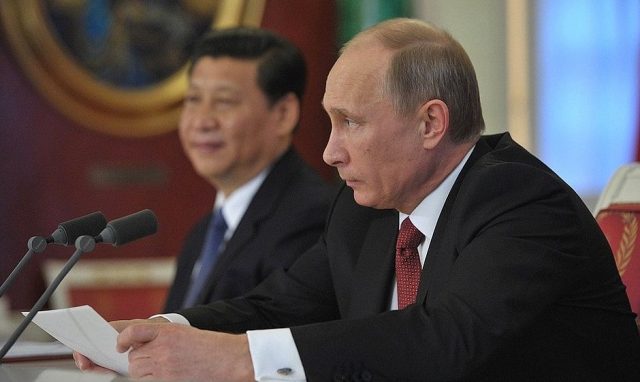
By Finian CUNNINGHAM | Strategic Culture Foundation | 07.07.2017
The United States’ hegemonic dominance in the world is heading to the exits. The decline in US uni-polar power has been underway for several years, in line with the emergence of a multi-polar world. This week, Russia and China showed important resolve to face down American bully tactics over North Korea. The confrontation suggests a turning point in the transition from American world dominance to a multi-polar one.
US President Donald Trump reiterated the possibility of military attack on North Korea while in Poland this week. This was also while Washington was hectoring China and Russia to join in a tougher response to North Korea over its ballistic missile launch days before – the former two nations themselves having recently been sanctioned anew by the US. Talk about American audacity and double think.
However, the crass arrogance shown by the US seems to have hit a new limit of tolerance in Moscow and Beijing. Both are beginning to demonstrate a loss of patience with the bumptious, insufferable Americans.
Reacting to North Korea’s breakthrough ballistic missile launch, Washington deployed its typical conceit, casually threatening to carry out a «retaliatory» military strike. Trump said he was considering «severe» options over Pyongyang’s «very, very dangerous behavior».
But Russia and China’s stance this time to the Americans had significantly stiffened. Both explicitly warned the US against taking military action against North Korea.
Moreover, Russia and China said that they would oppose Washington imposing further sanctions on the government of Kim Jong-un. The latter has already been subjected to six rounds of US-led sanctions.
In short, the American bully is finding that it is no longer able to dictate its unilateral way.
Addressing an emergency session of the United Nations Security Council, the Russian and Chinese ambassadors rejected the shrill American call for «global action to a global threat». Russian envoy Vladimir Safronkov stood firmly with his Chinese counterpart, saying that threatened American military action was simply not an option, and that a different policy was needed from the failed American one of slapping ever-more sanctions on North Korea.
One can imagine the exasperation felt within Washington of being bluntly told «no» to its invariable, self-anointed belligerence.
The alternative route being proposed by Russia and China was the «radical» one – radical from the American point of view – of diplomacy. It has perhaps taken the Russians and Chinese overdue time to reach this point. But what is remarkably apparent now is that they are asserting themselves against the US with increased confidence. And what they are asserting in this case is an eminently reasonable solution to the Korean crisis. They are calling for a freeze on Pyongyang’s nuclear weapons program in conjunction with the US freezing its constant military exercises on the peninsula, as well as withdrawing its anti-missile THAAD system. The next step is to then hold multilateral negotiations for a comprehensive peaceful settlement, without preconditions.
Such an eminently reasonable approach is anathema to the Americans. Because it negates their unilateral arrogance and self-righteousness to dictate terms.
This is a significant development, one that portends a new determination by Russia and China to confront the American bully head-on. For too long, Washington has gotten away with outrageous aggression, lawlessness, hypocrisy and absurd hubris, not just over Korea but on countless other international issues. On the world stage it behaves like a schoolyard bully, or perhaps more accurately that should be a street thug. Going around beating up other people, usually the weak, as it likes. Then when Washington feels particularly affronted about some perceived slight, it invokes international law and righteousness.
This week, what we saw over the North Korea missile launch and the typical American over-reaction was Russia and China saying to Washington: your days of self-licensing aggression and abusing international law are over; your American uni-polar hegemony is redundant.
Welcome to the multi-polar world forged largely by Russia and China where all nations must abide by international norms and law, principally the paramount pursuit of diplomacy.
Oh the shock to American arrogance to receive such a rude awakening.
The lawlessness of American «exceptionalism» is a theme that Russian President Vladimir Putin has been constantly hammering over the past decade. But it seems now that Russia and China are strong enough politically, economically and militarily to begin asserting and acting on the conviction that the days of American arrogance and lawlessness are indeed over. It is no coincidence that the firm Russian-Chinese opposition to American aggression over North Korea came at the same time that Putin was hosting his counterpart President Xi Jinping in Moscow, where both leaders hailed an even deeper Sino-Russian strategic alliance.
Moscow and Beijing censured North Korea over its 11th missile launch so far this year. They said it violated UN sanctions imposed on Pyongyang since it first exploded a nuclear warhead in 2006. Still, they sought to put a proper perspective on the event, rather than reflexively demonizing North Korea as the Americans never cease to do.
The intercontinental ballistic missile (ICBM) launched this week by North Korea was not armed with a warhead but Pyongyang said it now has the capability to do so and to strike anywhere on the globe. The trajectory of the ICBM indicates that North Korea could now hit the US state of Alaska. That heralds a major breakthrough in North Korea’s military capability. Earlier this year, President Trump claimed that North Korea would never be allowed to reach that point. Well, it just did this week.
Nevertheless, Russia and China realize that the Korean crisis is a complex issue, not the simplistic narrative put out by Washington about a «rogue regime» threatening world peace. Moscow and Beijing are well aware that Washington is very much part of the problem, with its relentless military exercises and provocative threats to North Korea’s sovereignty.
Russia and China understand that the only reasonable solution is not reckless escalation, but a negotiated engagement by all sides, including North Korea, South Korea, the US, Japan, China and Russia. Past multilateral negotiations have come unstuck largely because of Washington’s high-handed imperious attitude. Winding down conflict on the Korean Peninsula necessitates the winding down of military forces by all sides, and a primary responsibility for that lies with the US, the external protagonist in the region.
As the Russia-China strategic alliance grows ever stronger heralding a «post-West» world order, as Russian foreign minister Sergey Lavrov put it, one which was dominated by American capitalism, the US petrodollar and its military machine, it seems unmistakable that both Russia and China have reached a practical limit of tolerance to Washington’s lawless arrogance.
In recent weeks, Washington has slapped more sanctions on both Russia and China, conducted provocative military incursions into their territorial domains, and continued to disparage them with media distortions. Washington possesses thousands of ICBMs, test-fires them all the time, and installs missile systems around Russian and Chinese territory. Washington has waged or covertly sponsored criminal wars across the Middle East over the past two decades, resulting in millions of innocent deaths and spawning of terror groups.
North Korea has attacked no-one, has an arsenal of perhaps 10 nuclear weapons and conducts its missile tests far from any of its neighbor’s territory.
Yet the lawless, mass-murdering Americans – the only nation to have actually dropped nuclear weapons on civilian populations – have the audacity to declare North Korea a threat to world peace and insist on the «right» to preemptively attack Pyongyang. And if Russia and China do not acquiesce to this American demand then Washington threatens to increase more sanctions on them.
The American bully is patently beyond itself from its own megalomanic despotism. But the big, crucial difference now is that Russia and China are moving to finally put this bully in its place. The multi-polar world has arrived. And the only «radical» thing that Russia and China are insisting on is that the US behaves like everyone else and abides by international law. That basic requirement is an indication of how lawless the Americans are.
Addressing bused-in supporters in Poland’s Warsaw Square this week, Trump declared with bravado that «the West [that is, the US] will never back down».
Well, we’ll see about that. As noted, the multi-polar world has arrived and America is being compelled to back down by an ascendant Russia and China who also happen to have world opinion on their side.
US rejects Russo-Chinese proposal to suspend drills in South Korea
RT | July 6, 2017
The US rejects a proposal by Russia and China to suspend joint drills with South Korea in exchange for North Korea freezing its nuclear weapons programs, the State Department said, adding that Washington does not see the activities as equivalent.
US drills with South Korea are not the same as North Korea’s missile and nuclear tests, State Department spokeswoman Heather Nauert told reporters Thursday.
“These are all things that have taken place since the 1950s. So that wouldn’t change,” Nauert said, describing the drills as lawful and longstanding.
“We do these kinds of exercises and have relationships like this all over the globe. If China and Russia decide to come out against that, that is not going to change our position,” she added.
Moscow and Beijing have called on Washington and Seoul to freeze large-scale military exercises in an attempt to calm tensions on the Korean peninsula after Pyongyang test-fired a missile it said could reach the US mainland.
The US diplomatic offensive to pressure and isolate North Korea is still in its early stages, according to the State Department spokeswoman.
“We continue to believe that China can do a whole lot more to try to bring additional pressure to North Korea,” Nauert said, adding that China has “unique leverage” with Pyongyang because of the “strong trade relationship” between two countries.
One of the measures the US has proposed to other countries is to drastically scale back the number of North Korean guest-workers, Nauert said.
She also referenced last week’s decision by the US Treasury Department to sanction a Chinese bank that did business with Pyongyang, although she declined to say whether more such sanctions were in the works.
US ‘Can’t Get Facts Straight’ in Threats to Sanction China, Russia Over N. Korea
Sputnik – 06.07.2017
US officials say China has betrayed Washington in efforts to contain North Korea, citing a nearly 40% growth in trade between the two Asian countries. Chinese and Russian observers say the US doesn’t have its facts straight, and that Washington must work with, rather than ignore, Russian and Chinese initiatives on ensuring peace in the peninsula.
US UN Ambassador Nikki Haley has warned that Washington might use its “considerable military forces” against North Korea if necessary, and called on Russia and China to cut trade ties with the Asian country.
Speaking at an emergency meeting of the UN Security Council on Wednesday, a day after North Korea carried out its first test of its new intercontinental ballistic missile, the US ambassador accused Russia and China of failing to fully implement UN-mandated sanctions, and warned that the countries wouldn’t be able to maintain their trade arrangements with the US if the trade with Pyongyang didn’t stop.
Russia and China used the emergency meeting to present their own joint initiative aimed at reducing tensions on the Korean Peninsula, and urged Washington and Seoul to immediately suspend and abolish the deployment of THAAD missile defense on South Korean soil. The two countries also stressed that the US’s apparent willingness to consider the use of military force to stop North Korea’s nuclear and missile programs was “unacceptable.”
At the meeting, Haley proposed tightening the sanctions regime against Pyongyang, adding that the US would “go our own path” if the Security Council didn’t approve the proposal. Russian officials responded by saying that a tightening of sanctions would only “lead to a dead end” in attempts to arrange a diplomatic and political settlement to the crisis. Chinese UN Ambassador Liu Jieyi called on all parties to “exercise restraint, avoid provocative actions and belligerent rhetoric, demonstrate the will for unconditional dialogue and work actively together to defuse the tension.
In addition to threats of unilateral action, including more sanctions, US officials have also warned that Washington might sanction Chinese companies, including banks, which continue to do business with North Korea.
At Wednesday’s Security Council meeting, Haley accused China of failing to enforce sanctions, noting that the country accounted for 90% of North Korea’s total trade volume, and that trade has gone up. The ambassador stressed that the Trump administration would continue to work with China and other countries on the North Korean problem but would not repeat the “inadequate approaches of the past.”
Also Wednesday, President Donald Trump tweeted that trade between China and North Korea had grown “by almost 40%” in the first quarter of 2017. “So much for China working with us – but we had to give it a try!” he wrote.
Guo Yanjun, deputy director of Center for Asian Studies at the Chinese Diplomatic Academy, said that the US was deliberately distorting the facts on Chinese-North Korean trade statistics, and their relation to UN sanctions resolutions.
“Such so-called warnings are not based on objective data,” the expert told Sputnik.
“It is common knowledge that for the sake of implementing UN Security Council Resolution 2321 on sanctions against North Korea, China approved and strictly enforces the list of items prohibited under the resolution from start to finish,” Guo added.
“I suppose that such warnings against Beijing could be based on the fact that Washington has paid attention only to the 37.4 overall increase in trade between China and the DPRK in the first quarter of this year. At the same time, Washington should have seen that during this same period, China’s imports of coal amounted to 267.8 million tons, a drop of 51.6% compare to the same period last year,” the expert noted.
China, Guo stressed, “strictly and unfailingly implements the trade embargo against Pyongyang, but it is necessary to take into account the economic situation in the country and the living conditions of North Korea’s population. China’s trade embargo does not affect bilateral trade which serves the spheres of vital activity of the population. Doing otherwise would lead North Korea to face a humanitarian crisis. This is a threat to China as well, and one that would be difficult to avoid.”
Accordingly, the analyst noted, “on the one hand, we strictly implement the resolutions of the UN Security Council; on the other, we see the warnings and accusations from the US to be unreasonable. In this regard, I would like to stress once again that we should not confuse facts with speculation.”
Commenting on the fact that the US and its allies have ignored the Chinese and Russian proposals – including regarding North Korea’s economic strangulation and the THAAD deployment, Russian military observer Vladimir Evseev told Sputnik that Washington was doing so because these ideas do not fit its own scenario on how to respond to the North Korean nuclear and missile threat.
It’s “perfectly clear,” the expert noted, that what the US was doing now was “only an imitation” of defense against North Korean missiles via the THAAD missile defense system. THAAD, he stressed, is ineffective, and cannot realistically defend against the group launch of North Korean missiles. Furthermore, he noted, Tuesday’s test brings Pyongyang closer to being able to strike Hawaii.
“In these conditions, the US might decide on carrying out a strike to disarm North Korea. Pyongyang’s response to such a decision would not be a nuclear strike against South Korea, but the deployment of special forces troops on South Korean territory. The strength of this well-trained force is at least 50,000 troops, and according to some sources 80,000. They will pass through the demilitarized zone; special tunnels have already been created for this purpose. Passing through the DMZ will not present a serious problem for them. After that, they will carry out sabotage activities in South Korean territory, destroying chemical and nuclear industries, as a result of which the possibility of life on the Korean peninsula will be put under question.”
This, Evseev warned, would also “create serious environmental consequences for Russia, Japan and all other nearby states, including China. Such a scenario, unfortunately, is becoming more and more possible. It is absolutely clear that the policy of the Trump administration is not only completely hopeless, but also reckless, because it is factually leading to a war being unleashed on the Korean peninsula.”
“And the fact that the US does not notice the efforts by Russia and China to deescalate the situation in the region factually pushes Moscow and Beijing to joint efforts to prevent the implementation of the US military scenario,” the analyst added.
Following this week’s events, Russia and China have called for an end to the belligerent rhetoric, and for practical steps to implement the join Russian-Chinese plan to address the North Korean missile and nuclear programs. At the same time, both countries have urged Pyongyang to strictly comply with the demands of UN Security Council resolutions.
Should UK attack Syria? What Parliament might say
By Tim Hayward | July 6, 2017
Has President Assad used chemical weapons in Syria? In 2013, UK parliamentarians were not convinced. Asked to vote on military action, our representatives decided against.
Today, the same question arises again, but this time they may not get a chance to debate it.[1] We face the profoundly worrying possibility that this government could commit us to warfare without seeking or getting democratic approval.
So I want to highlight some points made by our representatives in 2013. [2] If they were true then, they could be as true or even truer now.
On 29th August 2013, UK parliament was recalled early from summer recess to vote on authorising military intervention in Syria. It was alleged that Syria had crossed President Obama’s ‘red line’ by using chemical weapons. Prime Minister David Cameron came to the House of Commons to seek approval for military action.[3]
Cameron told parliament of a report from the Joint Intelligence Committee (JIC), and he presented a two page summary of it. The first question put to him, by Caroline Lucas, was why the full report was not made available.[4] He replied that the case for action ‘is not based on a specific piece or pieces of intelligence.’ He added, ‘intelligence is part of this picture, but let us not pretend that there is one smoking piece of intelligence that can solve the whole problem. This is a judgment issue…’
In the JIC Chair’s judgement it was ‘highly likely that the Syrian regime was responsible.’
Cameron stated that he had ‘consulted the Attorney-General and he has confirmed that the use of chemical weapons in Syria constitutes both a war crime and a crime against humanity.’ The standard of proof in criminal investigations involves eliminating reasonable doubt, and can be tested with respect to such matters as motive, means and opportunity. MPs were minded to test it because they thought they were being expected to take a lot on trust. What does ‘highly likely’ mean, what is it based on, how is that judged, and is reasonable doubt eliminated?
Motive was a matter that bothered MPs. Peter Bone saw ‘no logic to this chemical attack and that is what is worrying some people.’ Julian Lewis noted ‘the JIC is baffled to find a motive for Assad having done this’, adding, ‘as well it might be’, given that it would have been ‘the height of irrationality for him to do the one thing that might get the west intervening against him.’ Like Mr Godsiff, too, David Davis pointed out that ‘even the JIC says that this is an irrational and incomprehensible act’. George Galloway asked what reason Assad could have to ‘launch a chemical weapons attack in Damascus on the very day on which a United Nations chemical weapons inspection team arrives there’.
Neither Cameron nor the JIC could answer on motive. By contrast, a clear motive could be attributed to Assad’s enemies, as David Davis pointed out: ‘it could have been done by the Syrian rebels with the direct aim of dragging the west into the war.’ He noted that ‘JIC discounted that last possibility’, but he worried it was not clear why.
It was on the grounds of means, not motive, that JIC judged it could rule out rebel responsibility. The JIC’s chair stated that there is ‘no credible intelligence or other evidence’ that the opposition possessed chemical weapons, so it is ‘not possible for the opposition to have carried out a CW attack on this scale’. Yet there were MPs who believed this claim to be false. David Davis noted that ‘the UN representative for human rights for Syria thought there was concrete evidence of rebels having sarin gas. There were reports that the Turkish authorities arrested 12 al-Nusra fighters with 2 kg of sarin gas, and other reports that Hezbollah fighters are in Beirut hospitals suffering from the effects of sarin gas.’ George Galloway was forthright in stating that ‘the Syrian rebels definitely had sarin gas’ and he highlighted the relative ease with which improvised forms of sarin can be produced without sophisticated lab equipment.[5]
On this point I think it is important to note that now, in 2017 a similar claim is asserted by UK government: there is ‘no evidence to suggest that any party to the conflict in Syria, other than the Syrian Government, has access to a complex nerve agent such as sarin.’[6] I am sure there would be MPs with concerns that this could be misleading. Certainly, the reference to complexity suggests they are thinking of how military grade Sarin could perhaps only be produced by the Government; yet the actual evidence suggests the chemicals involved are other grades of sarin that can be made by rebels. Given that the OPCW report is vague on precisely this point – whether it is sarin a ‘sarin-like substance’ that has been found where and by whom – the MPs could rightly pose some challenging questions. Those who had followed some of the debate by independent researchers would know to ask that information be released from the UK’s own labs on both the 2013 and the 2017 samples. The UK scientists would presumably know the chemical profiles of those samples, as would those in USA and Russia too.[7]
The fact is, that if rebels were understood to have Sarin in 2013, they would still have it now. Unless, of course, they had used it all, in which case a major premise of the UK’s government’s stance would be directly kicked away. Furthermore, it is reasonable to assume that with supply lines continuing to operate since 2013 they could have a great deal more by now. In light of all this, would MPs, if allowed to debate, agree that rebel capability is ruled out?
But even if the opposition could have had the means, did they really have the opportunity? MPs would be aware that the incidents of both 2013 and 2017 occurred in areas over which the opposition were in complete control. Evidence could be managed and produced by them to a great extent without external interference or observation.[8] This means that if they had sought to construct a ‘false flag’ operation, they could have had the opportunity. Exactly how they would have done it involves considering some very horrific possibilities.[9] But if a possible account sounds ‘too horrific to believe’ MPs might still be wary of underestimating the horrors that some of those involved might be capable of.
So where might our elected representatives think evidence concerning motive, means and opportunity points today? Would they be inclined to accept the view of the government that it is so likely Assad was responsible for the chemical attacks that we’d be justified in engaging in acts of war against Syria?
I don’t claim to know how the debate would go today, but we can reflect on how it went in 2013. Andrew Mitchell offered his ‘strong advice to the Government’, in view of doubts about whether the use of chemical weapons is unequivocally the work of Assad, ‘to publish in full the evidence’. Julian Lewis argued that even if not all members could see the full report, at least The Intelligence and Security Committee should be allowed to, given that it had sufficient security clearance. Ed Milliband found that evidence against Assad was not compelling, and John McDonnell agreed that ‘to say that “highly likely” and “some evidence” are not good enough’. Richard Ottaway complained that all they’d been given was ‘bare bones’ with ‘no depth’. He endorsed the proposal that ‘the Intelligence and Security Committee could look at the JIC analysis, report to the House on the veracity of the intelligence and confirm that it agrees with the opinion in the JIC intelligence letter before us.’ Alasdair McDonnell expressed concern about acting ‘on the basis of uncertain or confused intelligence, particularly in view of possible consequences of action for the Syrian people, something Galloway urged the house to think about: ‘Every religious minority in Syria—there are 23 of them—is petrified at the thought of a victory for the Syrian rebels, whom the British Prime Minister and Foreign Secretary have been doing their utmost to supply with weapons and money over the last two years.’
So much hinges on the reliability of intelligence, and yet so little, in truth, is really known about it by those who uphold democracy in our country. Surely, if we have learned anything at all from the recent history of UK intervention in the Middle East, it is that our leaders’ summary judgements about indirect reports of evidence can let us down, and very badly.

Notes
[1] See the worrying discussion of the use of the ‘Enabling Act’ to authorize military action without express approval http://www.bbc.co.uk/news/uk-politics-40496773
[2] Source of Hansard references: http://www.parliament.uk Syria and the Use of Chemical Weapons 29 August 2013 Volume 566 [Relevant document: Oral evidence taken before the Foreign Affairs Committee on 16 July 2013, on Developments in UK Foreign Policy, HC 268-i.]
[3] In the event, of course, Obama himself drew back from the direct confrontation with Syria. Did he know the evidence did not in fact support a justification for it, and congress could expose this fact?
[4] The Greens’ Caroline Lucas: asks ‘why he has refused to publish the Attorney-General’s full advice? Why has he instead published just a one-and-a-half-side summary of it, especially when so many legal experts are saying that without explicit UN Security Council reinforcement, military action simply would not be legal under international law?’ And the SNP’s Angus Robertson says ‘we have been recalled to Parliament because of potential imminent military action by UK and other forces. We have been called back four days before Parliament was to reconvene anyway, so it is not unreasonable to conclude that there was a high probability that intervention would take place before Monday. The UK Government expected that we should vote for a blank cheque that would have allowed UK military action before UN weapons inspectors concluded their investigations and before their detailed evidence was provided to the United Nations—or, indeed, Members of this House. Following our having been misled on the reasons for war in Iraq, the least the UK Government could have done was to provide detailed evidence. Frankly, they have not, as was underlined in my intervention on the Prime Minister earlier. … Surely we must have definitive evidence that the Syrian regime or opposition was responsible for the use of these weapons—with the greatest respect, that means not just two pages of A4 paper.’
[5] Galloway: ‘The Syrian rebels have plenty of access to sarin. It is not rocket science. A group of Shinto obscurantists in Japan living on Mount Fuji poisoned the Tokyo underground with sarin gas less than 20 years ago. One does not have to be Einstein to have one’s hands on sarin gas or the means to distribute it.’
[6] Statement by H.E. Ambassador Sir Geoffrey Adams, UK Permanent Representative to the Organisation for the Prohibition of Chemical Weapons. 5th July 2017 https://www.gov.uk/government/speeches/55th-special-session-of-opcw-executive-council
[7] According to a technically well-informed blogger, ‘There is ample evidence that (1) the Nusra Front was producing sarin, and (2) that the sarin used in Syria in 2013 was kitchen sarin that did not match the synthetic pathway used for Syrian military stocks. Mokhtar Lamani, the UN Special Representative in Damascus, had reported to the UNSG in March 2013 that Nusra was bringing nerve agents into Syria through the border at Azaz. The Russian lab that analysed environmental samples from the Khan-al-Assal attack in March 2013 reported that the sarin had been produced under “cottage industry” conditions. It’s likely that Porton Down had obtained similar results from their own analysis of a sarin sample from Uteybah, and were able to compare the Russian findings with their own (very helpful when trying to interpret mass spectrometry results on a complex mixture). This would have helped to establish the credibility of the Russian in this matter.
The phone transcripts of the Nusra team arrested in Turkey in May 2013 showed that they were buying sarin precursors in quantities of hundreds of kilos, including white phosphorus. The OPCW labs reported that the sarin used in Ghouta contained hexafluorophosphate. This indicates that the synthesis started with phosphorus trichloride or elemental phosphorus, and that intermediate reaction products were not purified at each step. The Syrian government’s sarin production started with trimethyl phosphite, bought in large quantities from the UK and India during the 1980s. Finally, Seymour Hersh has reported that the US, which fitted out the ship Cape Ray as a sarin disposal facility, obtained samples of the sarin binaries given up by the Syrian government and determined that their chemical profile did not match the Ghouta sarin.’ ‘On 29 August, just before the House of Commons met to debate the resolution for war on Syria, the UK Joint Intelligence Committee released a report to the Prime Minister stating that there was “no evidence for an opposition CW capability” and therefore “no alternative to a regime attack scenario”. Yet only one day later, Obama had been informed that both these statements were false. It’s clear that the UK defence lab scientists and defence intelligence officials were well aware that the JIC was misleading the House of Commons (a crime against the constitution) and that they resorted to passing information via the military chain of command.’ http://pundita.blogspot.co.uk/2016/08/ghouta-sarin-gas-story-i-think-this-is.html
[8] The 2017 incident occurred at (or around) the time of a Syrian bombing raid at the area in question, and some MPs would surely ask how the rebels could have arranged for this. But, apparently, it would not have been as difficult as one might imagine. Given that air raids within a certain radius and timeframe could be known in advance, and given that various elements of testimony could also be prepared ahead, then mobilizing some key parts of material evidence on the day would not be logistically impossible. In fact, there are unresolved discrepancies in accounts of the timing of events on the ground in relation to the bombing from the air as well as surprising vagueness about locations of victims at key times. Independent researchers have discussed at great length every aspect of the reported incidents and seem to be coming towards the sort of view that became a consensus among them regarding the 2013 incidents.
[9] Attentive researchers have examined these and come to some extremely disturbing conclusions about these. Anyone interested is recommended to consult the collective findings and analysis of A Closer Look On Syria: http://acloserlookonsyria.shoutwiki.com/wiki/Special:AllPages. I find this rather more exhaustive and realistic than Bellingcat’s recent hasty attempt to set out a reductio ad absurdum of what would need to be believed https://www.bellingcat.com/resources/articles/2017/07/04/khan-sheikhoun-false-flag-conspiracy-actually-mean/.
Military Action Should Be Excluded as Response to N. Korea – Russian Envoy to UN
Sputnik – 05.07.2017
Military action should not be an option considered in possible responses to North Korea’s recent launch of an ICBM and its continued work on a nuclear program, Russia’s Deputy Envoy to the United Nations Vladimir Safronkov said during a UN Security Council meeting on Wednesday.
“The possibility of taking military measures to resolve the problems of the Korean peninsula should be excluded,” Safronkov stated.
He also said any attempt to economically strangle North Korea in response to its missile test would be unacceptable.
“Attempts to economically strangle North Korea are equally unacceptable, as millions of people are in humanitarian need,” Safronkov said, after warning the Security Council countries against pursuing any military option.
Instead, the situation around the recent missile launch by North Korea requires close examination, he argued.
“The situation requires a thorough investigation and clarification,” Safronkov said.
He acknowledged that Pyongyang’s most recent missile launch is unacceptable and violated the relevant UN Security Council resolutions.
“We find this action from the DPRK to be inadmissible and to be running counter to relevant Security Council resolutions,” Safronkov said. “Russia and China have urged the DPRK to firmly comply with the provisions of set resolutions. We share the concern regarding the evolving situation in the Korean peninsula and escalation of military and political tensions on the peninsula.”
Featured Video
“Historic Russia”: The Land Putin Will Not Give Back
or go to
Aletho News Archives – Video-Images
From the Archive
How Ukraine Tortured and Slaughtered Donbass
By Kit Klarenberg | Al Mayadeen | July 11, 2024
Almost immediately after the proxy war erupted, ISIS-tier footage of the torture and murder of Russians in Ukrainian custody emerged.
On July 6th, the New York Times published an astonishing investigation: In Ukraine, Killings of Surrendering Russians Divide an American-Led Unit. The article documents in grim detail how Chosen Company, an international volunteer battalion for Kiev, routinely executes Russian prisoners of war. It is the very first mainstream admission that this practice – a brazen breach of the Geneva Conventions, and a grave war crime – is widespread among Ukraine’s fighters, both foreign and homegrown. … continue
Blog Roll
 Aletho News
- Record Oil, Empty Tanks: The UAE’s Miracle Recovery
- Burnham tackles Britain’s poverty with aggression in Yemen
- Peace in Ukraine: the easy way – or the hard way
- Trump & the Rrrrussians
- US taxpayer money laundered back through Ukraine – Musk
- Before COVID, an NIH lab chief proposed making a SARS-like bat virus more infectious
- Gates, Bourla on Trial in Netherlands Accused of ‘Great Reset’ Scheme at Vaccine Injury Hearing
- BRITAIN’S WARNING: PREPARE FOR WAR
- “Historic Russia”: The Land Putin Will Not Give Back
- How the Cambridge Analytica scandal still haunts Mark Zuckerberg
- If Americans Knew
- DAILY UPDATE: Latest essential news on Palestine, Israel, & region
- Damning report shows the media must confront its failures on Gaza
- BBC senior broadcaster speaks out on Gaza coverage
- Netanyahu vows vast West Bank invasion in response to 20-minute skirmish that left 2 Israeli soldiers and 2 Palestinian fighters dead
- Tied up and tortured: Israel using US-made electroshock weapons on Palestinian detainees
- The outsourced risk: how newsrooms rely on Gaza’s freelancers without protecting them
- Gaza bakeries forced to shut as Israel blocks flour shipments
- Gaza’s breast cancer patients face a deadly wait for treatment amid Israel’s genocide
- DAILY UPDATE: Latest essential news on Palestine, Israel, & region
- The Israel Lobby’s Changing Fortunes
- No Tricks Zone
- Two New Studies Find Thwaites Glacier Melt Cannot Be Driven By Human Activity Or A Warming Ocean
- E-Cars Reduce CO2 Emissions By Only 41% Compared To Internal Combustion Engine Vehicles
- Predictions Made By Renowned Climate Professor Over Past Decades Have Been Proven To Be Poor
- New Study Suggests Large Regions Of The Pacific Ocean Have Been Cooling For The Last 80 Years
- Germany’s Green Energy Debacle: High Energy Costs Force Kahla Porzellan to Close After 182 Years!
- New Study: 50 Years Of The Most Aggressive ‘Net Zero’ Policies Can Only Affect The Global Climate By 0.03°C
- US September “Heat” Was No Record…Many Records Set Decades Ago
- Latest European Green Energy Debacle; Portugal’s Largest Flagship Solar Park Insolvent!
- Green Energy Debacle: German Expert Professor Fritz Vahrenholt Warns Of Severe Economic And Social Consequences
- Two More Paleo Reconstructions Affirm Meters-Higher Sea Levels Across Ireland, Brazil 7000-6000 Years Ago

