Newly-deployed US rocket launchers may target Syrian army: Russia
Press TV – June 15, 2017
Russia says the US has deployed the M142 High Mobility Artillery Rocket System (HIMARS) launchers from Jordan to its base in southern Syria, warning that the equipment could be used against Syrian government forces.
“The United States has moved two HIMARS multiple rocket launchers from Jordan to the At-Tanf US special forces base,” the Russian Defense Ministry said in a statement released on Thursday.
It also accused the US, which is purportedly fighting terrorists, of having “repeatedly issued strikes on Syrian government forces fighting Daesh near the Jordanian border.”
Thus, the ministry said, “it’s not hard to guess that similar strikes will be continued against contingents of the Syrian army in the future using HIMARS.”
The deployment of any type of foreign weaponry on Syrian soil “must be approved by the government of the sovereign country,” it pointed out.
The statement further said Moscow is closely monitoring the situation on the Syrian-Jordanian border.
On Wednesday, an intelligence source first reported the US relocation of the HIMARS from Jordan to Syria.
The town of At-Tanf, home to a US base, is located in Syria’s Homs Province near a Syria-Iraq border crossing on the main Baghdad-Damascus highway.
On June 6, US warplanes attacked a Syrian military position on the road to At-Tanf, killing an unspecified number of people and causing some material damage.
The US claimed that the Syrian forces who came under the attack posed a threat to its forces and their terrorist allies in Syria.
On May 18, the US carried out a similar strike on a Syrian military convoy near At-Tanf.
The Syrian army has denounced the attacks, saying they demonstrate US support for terrorism, at a time when the Syrian army and its allies are making gains against Daesh militants.
The US and its allies have been bombarding what they call Daesh positions inside Syria since September 2014 without any authorization from the Damascus government or a UN mandate.
They have been accused of targeting and killing civilians, while failing to fulfill their pronounced goal of destroying Daesh.
How Vladimir Putin Sees the World
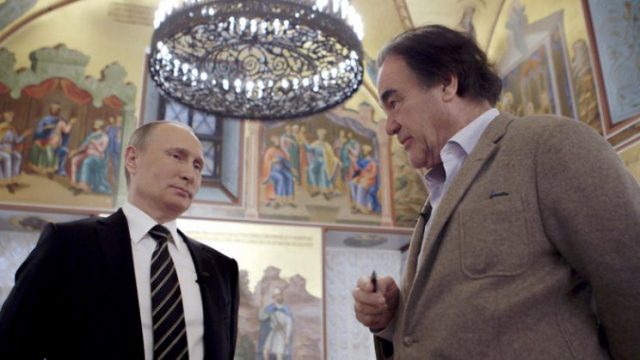
Oliver Stone interviewing Russian President Vladimir Putin in Showtime’s “The Putin Interviews.”
By Robert Parry | Consortium News | June 13, 2017
There was a time when I thought that it was the responsibility of an American journalist to hear all sides of a dispute and then explain the issue as fairly as possible to the American people, so they would be armed with enough facts to make their own judgments and act as the true sovereigns in a democracy.
I realize how naïve that must sound today as American journalism has shifted to a new paradigm in which the major news outlets view it as their duty to reinforce whatever the establishment narrative is and to dismiss or discredit any inconvenient facts or alternative analyses.
Today, The New York Times, The Washington Post and the rest of the mainstream media permit only the narrowest of alternative views to be expressed or they just pile into the latest groupthink whole hog.
So, that is why director Oliver Stone’s four-part series of interviews with Russian President Vladimir Putin on “Showtime” will surely draw near-universal outrage and ridicule from the big U.S. media. How dare anyone let Putin explain how he views the challenges facing the world? Can you believe that any right-thinking American would treat the Russian leader with civility and – god forbid – respect?
The new American media paradigm requires either endlessly insulting Putin to his face or aggressively blacking out his explanations, especially if they are based on information that puts the U.S. government in a negative light. The American people must be protected from this “Russian propaganda and disinformation.”
In other words, with the mainstream “guardians of truth” forewarning the American people not to watch Stone’s “The Putin Interviews,” the series will probably draw a relatively small viewership and the demonizing of Putin and Russia will continue unabated.
The American public can thus be spared some disturbing historical revelations and the unsettling vertigo that comes from hearing information that disrupts “what everyone knows to be true.”
In the “director’s cut” or long-form version of the four-part series that I watched, Stone does allow Putin to offer detailed explanations of his thinking on current crises, but also draws from Putin acknowledgements that might be surprising coming from a Russian leader. He also puts Putin in some uncomfortable binds.
–Regarding the Soviet Union’s development of the nuclear bomb in the late 1940s, Putin said Russian and German scientists were working on the project but got help from participants in the U.S. nuclear program:
“Our intelligence also received a lot of information from the United States. Suffice it to remember the Rosenberg spouses who were electrocuted. They didn’t acquire that information, they were just transferring that information. But who acquired it? The scientists themselves – those who developed the atomic bomb.
“Why did they do that? Because they understood the dangers. They let the genie out of the bottle. And now the genie cannot be put back. And this international team of scientists, I think they were more intelligent than the politicians. They provided this information to the Soviet Union of their own volition to restore the nuclear balance in the world. And what are we doing right now [with the U.S. withdrawal from the Anti-Ballistic Missile Treaty]? We’re trying to destroy this balance. And that’s a great mistake.”
–Regarding the origins of modern Islamist terrorism, Putin said: “Al Qaeda is not the result of our activities. It’s the result of the activities of our American friends. It all started during the Soviet war in Afghanistan [in the 1980s] when the American intelligence officers provided support to different forms of Islamic fundamentalism, helping them to fight the Soviet troops in Afghanistan.
“So the Americans themselves nurtured both Al Qaeda and [Osama] bin Laden. But it all spun out of control. And it always happens. And our partners in the United States should have known about that. So they’re to blame.”
Stone noted how President Reagan’s CIA Director William Casey sought to exploit Islamic fundamentalism to destabilize Muslim parts of the Soviet Union and to achieve regime change in Moscow.
Putin added: “Those ideas are still alive. And when those problems in Chechnya and the Caucasus emerged [after the collapse of the Soviet Union in 1991], the Americans, unfortunately, supported those processes. We [Russians] assumed the Cold War was over, that we had transparent relations, with the rest of the world, with Europe and the U.S. And we certainly counted on support, but instead, we witnessed that the American Intelligence services supported terrorists.
“I’m going to say something very important, I believe. We had a very confident opinion back then, that our American partners in words were talking about support to Russia, the need to cooperate, including fighting terrorism, but in reality they were using those terrorists to destabilize the internal political situation in Russia.”
–Regarding NATO expansion into Eastern Europe,” Putin said, “There was a deal not to expand NATO eastward. [But] this deal was not enshrined in paper. It was a mistake made by Mr. Gorbachev [the last president of the Soviet Union]. In politics, everything must be enshrined in paper.
“My impression is that in order to justify its existence, NATO has a need of an external foe, there is a constant search for the foe, or some acts of provocation to name someone as an adversary.”
–Regarding NATO missile bases being installed in Eastern Europe, Putin said: “And what are we supposed to do. In this case we have to take countermeasures. We have to aim our missile systems at facilities that are threatening us. The situation becomes more tense. …
“There are two threats for Russia. The first threat, the placement of these anti-ballistic missiles in the vicinity of our border in the Eastern European countries. The second threat is that the launching pads of these anti-ballistic missiles can be transformed within a few hours into offensive missile launching pads. Look, if these anti-ballistic missiles are placed in Eastern Europe, if those missiles are placed on water, patrolling the Mediterranean and Northern Seas, and in Alaska, almost the whole Russian territory would be encircled by these systems.
“As you can see, that is another great strategic mistake made by our partners [a word that Putin uses to refer to the United States]. Because all these actions are going to be adequately answered by Russia. And this means nothing else but a new cycle of an arms race. …
“When the Soviet Union collapsed, they [American leaders] were under the illusion that the U.S. was capable of anything, and they could [act] with impunity. That’s always a trap, because in this situation the person or the country begins to commit mistakes. There is no need to analyze the situations, or think about the consequences. And the country becomes inefficient. One mistake follows another. And I think that is the trap the U.S. has found itself in.”
–Regarding the prospect of nuclear war, Putin said, “I don’t think anyone would survive such a conflict.” Regarding U.S. plans for creating a missile shield, he said, “There is a threat deriving from the illusion of being protected, and this might lead to more aggressive behavior. That is why it is so important to prevent unilateral actions. That is why we propose to work jointly on the anti-ballistic missile system.”
–Regarding the American neoconservatives who now dominate the U.S. foreign policy establishment and the major news media, Stone described “the neoconservative element as being so hungry to make their point, to win their case that it’s dangerous.” Putin responded, “I fear them too.”
–In an interview on Feb. 16, 2016, Stone asked about the U.S. presidential campaign to which Putin replied, “We are going to be ready to work with whoever gets elected by the people of the United States. I said that on several occasions and that’s the truth. I believe nothing is going to change no matter who gets elected. … The force of the United States bureaucracy is very great. And there are many facts that are not visible to the candidates until they become President. And the moment one gets to real work, he or she feels the burden. …
“My colleague, Barack Obama, promised to close Guantanamo. He’s failed to do that. But I’m convinced that he sincerely wanted to do that. … Unlike many partners of ours, we never interfere within the domestic affairs of other countries. That is one of the principles we stick to in our work.”
–In a February 2017 interview, which was added amid the escalation of charges that Russia interfered in the U.S. election, Stone noted that Donald Trump is “your fourth president” and asked, “what changes?”
“Almost nothing,” Putin said with a wry smile. “Life makes some changes for you. But on the whole, everywhere, especially in the United States, the bureaucracy is very strong. And bureaucracy is the one that rules the world.”
Asked about alleged Russian interference to help Trump, Putin responded: “You know, this is a very silly statement. Certainly, we liked President Trump and we still like him because he publicly announced that he was ready to restore American-Russian relations. … Certainly, we’ve got to wait and see how, in reality, in practice, the relations between our two countries are going to develop. …”
Stone: “So why did you bother to hack the election then?”
Putin: “We did not hack the election at all. It would be hard to imagine any other country – even a country such as Russia would be capable of seriously influencing the electoral campaign or the outcome of an election. … any talk about our influencing the outcome of the U.S. election is all lies. They are doing it for a number of reasons.
“First, they are trying to undermine the legitimacy of President Trump, create conditions that must preclude us from normalizing our relations, and they want to create additional instruments to wage an internal political war. And Russia-U.S. relations in this context are just a mere instrument in the internal political fight in the U.S. … We know all their tricks.”
–Regarding cyber-war and the possibility that U.S. intelligence planted malware and back-doors in software sold to Russia, Putin said, “Well, you will probably not believe me, but I’m going to say something strange. Since the early 1990s, we have assumed that the Cold War is over. We thought there was no need to take any additional protective measures because we viewed ourselves as an integral part of the world community.
“We didn’t have any equipment of our own. Our companies, our state institutions and administrative departments, they were buying everything – hardware and software. And we’ve got much equipment from the U.S., from Europe, and equipment is used by the Intelligence Services and by the Defense Ministry. But recently we certainly have become aware of the threat that all of that poses.
“Only during recent years, have we started to think about how we can ensure technological independence, as well as security. Certainly we give it much thought, and we take appropriate measures. … We had to catch up with others.”
In an aside to Putin’s translator within earshot of Putin, Stone remarked: “He’s acting funny about this story, like he’s guilty a bit.”
–Regarding the dangers to Russia from U.S. cyber-warfare, Putin said: “It is almost impossible to sow fear among the Russian citizens. … And secondly, the economies that are more sophisticated, in technological terms, they are more vulnerable to this type of attack. But in any case, this is a very dangerous trend. A very dangerous avenue for competition to pursue and we need some rules to be guided by.”
When Stone raised the possibility of a treaty, Putin said, “I don’t want to say that, but you are simply drawing this information from me. You make me say that. One and a half years ago, in Autumn 2015, we came up with a proposal that was submitted to our American counterparts. We suggested that we should work these issues through and arrive at a treaty, an agreement on the rules to be guided by in this field. The Americans didn’t respond, they kept silence, they didn’t give us any reply.”
–Regarding allegations of Putin’s wealth, Stone asked, “Is there someway you could make your personal wealth clearer?”
Putin responded indirectly: “I remember when I moved to Moscow from St. Petersburg [in the 1990s], I was astounded and shocked by how many crooks had gathered here in Moscow and their behavior was so astounding, I couldn’t get used to it for a very long time. Those people didn’t have any scruples at all. … My task was to differentiate between power and money.”
Stone: “So there are no bank accounts in Cyprus?”
Putin: “No, and never have been. That’s just nonsense, and if that were the case we would have had to face it a long time ago.”
–Although Putin remained disciplined and controlled during the long sit-downs with Stone, the Russian president appeared most uncomfortable when Stone pressed him about his future plans and the risk of a leader viewing himself as indispensable to a nation.
Citing the possibility that Putin would have been in power – as either prime minister or president – for 24 years if he were to run for president again and win, Stone asked, “Do you feel that Russia needs you that badly?”
Putin: “The question you have asked whether Russia needs anyone that bad – Russia itself will decide. An alteration in power certainly has to exist. … In the end, let me reiterate – the citizens of Russia are going to make the final decision. Concerning the 2018 elections, I’d like to say there are things, things that should have some intrigue and mystery. So I am not going to answer that part of the question.”
Stone: “I said if…”
Putin: “We shouldn’t speak in the subjunctive mood.”
Stone then suggested more transparency in the next election.
A stern Putin responded: “Do you think our goal is to prove anything to anyone? Our goal is to reinforce our country.”
Stone: “That is a dangerous argument. It works both ways. Those who abuse power always say it’s a question of survival.”
Putin: “We are not talking about survival and we are not trying to justify ourselves. Certainly taking into account all the negative tendencies you’ve been talking about – the Soviet legacy, the Imperialist legacy, it’s something in the past. But we also have to think about the positive legacy. Russia has been built for a thousand years; it has its own traditions. We have our notions of what is just and unjust, we have our own understanding of what defines an efficient government.
“This is not a question of helping someone cling to power or to claim it for myself. This is about ensuring economic growth and sustaining it, improving our defense capabilities, and not just during periods of crisis and difficulties.”
Stone: “Mr. Putin, I don’t doubt for one moment your pride in serving Russia or that you are a son of Russia to me, and you have done very well by her. We all know the price of power. When we’re in power too long no matter what, the people need us but at the same time we’ve changed and we don’t even know it.”
Putin: “Indeed, this is a very dangerous state. If a person in power feels that they have lost it, this bond connecting this person to the country and to the rank-and-file citizens of the country, then it’s time for them to go.”
Britain’s Real Terror Apologists
By Finian Cunningham | Sputnik | June 11, 2017
Despite a vicious smear campaign to denigrate Britain’s Labour leader as a “terrorist sympathizer,” Jeremy Corbyn still pulled off an amazing achievement in the general election.
Hardly has a politician in any Western state been so vilified with character assassination, and yet he has proven to be most popular Labour leader in Britain since the Second World War.
After weeks of trailing his Conservative rival Theresa May in the polls, Corbyn’s socialist manifesto appealed to a record number of voters – closing the gap between the parties to only two percentage points behind the Tories.
This was in spite of a concerted media campaign to destroy Corbyn in the eyes of the British public as a “terrorist stooge.” The irony here is that the Conservative party is forming a governing coalition with a little-known Northern Ireland party whose history is steeped in British state terrorism. (More on that in a moment.)
For Corbyn, the election outcome was a stunning moral victory. For Prime Minister May it was a humiliating defeat. The Conservatives lost their overall majority in the British parliament and now they have to rely on this reactionary fringe party from Northern Ireland to form a government.
May called the snap election because she thought her party would increase its majority and also because she calculated that Corbyn’s socialist direction of Labour would be wiped out. Many Blairite naysayers in his own party thought so too.
The opposite happened. The British public largely rejected May and her neoliberal capitalist, pro-austerity, pro-NATO policies. They instead rallied behind Corbyn. Granted, the Tories still won the election – only narrowly – but the surge in support for Labour under Corbyn means that he has galvanized a party that stands a strong chance of winning if another election is called. And that could be soon, perhaps in the coming months owing May’s shaky ad hoc government collapsing.
Another riveting factor in all this is that Corbyn’s success came amid a torrential Tory and right-wing media campaign to denigrate him as a terrorist sympathizer. The propaganda onslaught was conducted for months since May called the election back in April. And it grew to a frenzy as election day approached last Thursday, especially when the opinion polls showed Labour steadily whittling away the earlier Conservative support.
The day before the public went to the polling booths, the Daily Mail ran the front page headline: “Apologist for terror,” with Jeremy Corbyn’s photo below. It looked like a “wanted poster” from the Wild West. The only thing missing was the subhead with the words: “Wanted dead or alive.”
The scurrilous allegation pounded over and over by the largely pro-Conservative British media that Corbyn is “soft on terrorism” stems from his otherwise principled history of campaigning on international justice and peace.
Over his 35 years as an MP, he has voiced consistent support for Palestinian rights under illegal Zionist occupation; he has supported Hezbollah resistance against Israeli and American aggression; and during the conflict in Northern Ireland, Corbyn gave a voice to Irish Republicans who were being assailed by British military violence.
Many other international causes could be mentioned, such as Corbyn opposing British government weapons dealing with the despotic Saudi regime which is propagating terrorism in Syria, Iraq and Yemen.
He has also campaigned to abandon nuclear weapons and is critical of NATO’s reckless expansion in Europe, which have earned him the jingoistic pillorying by the British establishment of “being soft on Russia.”
Corbyn has never condoned terrorism. Rather he has always sought to properly put it in a wider context of other parties also, unaccountably, using terrorism and thus fueling conflict.
This brings us to so-called Democratic Unionist Party (DUP) from Northern Ireland whose 10 MPs Theresa May’s Tories are now relying on to form a government. This party was formed in the early 1970s by the firebrand Protestant preacher Ian Paisley. While Paisley mellowed in later years before his death in 2014, he spent most of his career preaching vile hatred against Catholics and Irish Republicans, whom he saw as a threat to the political union between Northern Ireland and the rest of Britain. In British-run Northern Ireland, it wasn’t acceptable to have a democratic aspiration for an independent Ireland. You were either a pro-British unionist or a “threat.” So much for British democracy.
Senior members of Paisley’s pro-British party played a crucial role in smuggling massive caches of weapons into Northern Ireland during the 1980s to illegally arm unionist paramilitaries. These paramilitaries went on to murder hundreds of innocent people simply because they were Catholics, who tended to be Republican. A favored tactic of these paramilitaries was to storm into pubs and homes and indiscriminately mow people down with assault rifles.
One notorious pro-British killer was Gusty Spence who belonged to the Ulster Volunteer Force paramilitary. He later expressed remorse and deplored Ian Paisley, the DUP founder, as the person who incited him to murder innocent Catholics due to his sectarian hate speech.
The paramilitary murder gangs were not just supported covertly by members of the DUP. The British government of Margaret Thatcher – Theresa May’s predecessor and political heroine – orchestrated these same death squads in a covert policy of “dirty war.”
British military intelligence colluded with the pro-unionist militants to assassinate Republican politicians and ordinary Catholics alike in a covert policy of state-sponsored terrorism. The objective was to terrorize people in submitting to British rule over Northern Ireland, rather than allowing the island country to become united and independent.
The British government provided intelligence and cover for the death squads and the unionist politicians had helped supply the AK-47 assault rifles and Browning handguns smuggled from Apartheid South Africa.
This secret dirty war policy of the British government and their unionist proxies in Northern Ireland has been uncovered by investigative journalists such as Paul Larkin (see his groundbreaking book “A Very British Jihad: Collusion, Conspiracy and Cover-up in Northern Ireland”); as well as human rights campaign groups like Belfast-based Relatives for Justice and Pat Finucane Centre.
Not even the present government of Theresa May can deny this murderous legacy in Ireland, although there is a determined silence now as she fights for her political survival in the wake of the British election disaster.
It is a proven fact that May’s Conservative party and the unionist politicians whom she is now partnering with to govern Britain were complicit in terrorism.
Northern Ireland has since gained a peace settlement in which unionist and republican politicians have been able to work together to form a local governing administration. The Irish peace process was possible partly because of the courageous and principled intervention by British politicians like Jeremy Corbyn.
Corbyn has never apologized for terrorism. He has sought to overcome it by making politics work. The same cannot be said for Theresa May’s Conservative party. It was an accomplice and an apologist for a covert policy of state-sponsored terrorism during Northern Ireland’s recent 30-year conflict.
The very party whom she is now allied with for governing Britain – the DUP – were also apologists for paramilitaries who routinely smashed their way into family homes and slaughtered victims in cold blood in front of their loved ones.
The ongoing muted policy of May’s government and her unionist proxies about their murderous legacy in Ireland is a testimony to who the real apologists for terror are.
Trudeau Ramps Up Military
By Yves Engler | CounterPunch | June 12, 2017
It’s no wonder the Trudeau government has moved to ramp up military outlays. Even “left” commentators/politicians are calling for increased spending on Canada’s ecologically and socially destructive war machine.
Recently Defence Minister Harjit Sajjan announced a more than 70 per cent increase in military spending over the next decade. Canada’s new defence policy includes a significant increase in lethal fighter jets and secretive special forces, as well as enhancing offensive cyber-attack capabilities and purchasing armed drones.
A Globe and Mail story about the defence policy yesterday quoted David Perry, an analyst with the unabashedly militarist Canadian Global Affairs Institute, and UBC Professor Michael Byers, who has been described as the “angry academic voice of Canadian foreign policy” to denote his purportedly critical stance. In the story titled “Canada’s new defence spending must come quickly, experts say,” the paper reported:
“Byers said the Forces are currently in a state of ‘extreme crisis,’ with the Royal Canadian Navy running out of functioning ships and the Royal Canadian Air Force still years away from getting its new fleet of fighter jets. ‘The government has inherited a badly broken Canadian Forces and it clearly has a monumental task ahead that is only beginning,’ he said.”
Despite his affiliation with a peace organization, Byers supports increased military spending. The Rideau Institute board member has repeatedly expressed support for Canada’s war machine.
In 2015 the UBC professor published “Smart Defence: A Plan for Rebuilding Canada’s Military” which begins:
“Canada is a significant country. With the world’s eleventh largest economy, second largest landmass and longest coastline, one could expect it to have a well-equipped and capable military. However, most of this country’s major military hardware is old, degraded, unreliable and often unavailable. When the Harper government came to power in 2006, it pledged to rebuild Canada’s military. But for nine long years, it has failed to deliver on most of its promises, from new armoured trucks and supply ships to fighter jets and search-and-rescue planes.”
The Rideau Institute/Canadian Centre for Policy Alternatives report was partly an attack against the Stephan Harper government’s supposed lack of military commitment. In “Smart Defence,” Byers writes, “Prime Minister Stephen Harper has reduced defence spending to just 1.0 per cent of GDP — the lowest level in Canadian history.”
Byers has long called for increased military spending. In a chapter in Living with Uncle: Canada-U.S. relations in an age of Empire, edited by then CCPA leaders Bruce Campbell and Ed Finn, Byers notes that “the defence budget, roughly 1.2 per cent of GDP, is a bit low by comparable standards.” He describes writing a 2004 paper for NDP Defence Critic Bill Blakey that called for a $2- to 3-billion-per-year increase in military spending. “A defence budget increase,” it noted, “essentially repairs some of the damage that was done by a decade and a half of neglect.” But the military budget was about $15 billion and represented 10 per cent of federal government outlays at the time.
A former NDP candidate and adviser to Tom Mulcair, Byers’ position is similar to that of the social democratic party’s leadership. After the federal budget in March the NDP Leader criticized the Liberals for not spending enough on the military. “Canadians have every right to be concerned,” Mulcair said. “We are in desperate need of new ships for our Navy, we’re in desperate need of new fighter aircraft for our Air Force, and there’s no way that with the type of budget we’ve seen here that they’re going to be getting them.”
The NDP has staunchly defended Canadian militarism in recent years. During the 2011 and 2015 federal elections the party explicitly supported the Harper government’s large military budget. In 2011 party leader Jack Layton promised to “maintain the current planned levels of Defence spending commitments” and the 2015 NDP platform said the party would “meet our military commitments by maintaining Department of National Defence budget allocations.”
In addition to backing budget allocations, the NDP has criticized base closures and aggressively promoted the National Shipbuilding Procurement Strategy, a $60-billion effort to expand the combat fleet over three decades (over its lifespan the cost is expected to top $100 billion).
I’ve yet to come across a formal party statement about yesterday’s announcement. What do those currently vying for NDP leadership think of the Trudeau’s new defence policy and how will they respond?
Corbyn’s victory is greater than the keys to Number 10
By Nasim Ahmed | MEMO | June 9, 2017
Britain underwent the most important general election of this century. For the second time in a row, Conservative leaders scored the most spectacular own goal ever to be seen. Twice within the period of two years, British prime ministers gambled with the lives of the British people and lost; on both occasions Conservative leaders put their self-interest above the national interest and the electorates punished them for it.
It has now become resoundingly clear that the electorate does not like being taken for granted. Former Prime Minister David Cameron and current Prime Minster Therese May have learnt this the hard way. Cameron paid the highest political price in gambling to hold an EU referendum for no reason other than to please his own backbenchers. May too will most likely pay the same price for her humiliating defeat in calling a snap general election for no reason other than to inflict a crushing defeat on the Labour party.
But it is the Conservatives that have suffered a great defeat, even though they have won the election and are still in power. Hubris and opportunism assured their humiliation. They imagined they would have a landslide victory and increase their control of the Commons. With more Conservative MPs May was confident – to the point of carelessness – in being able to ease through a hard Brexit. She underestimated the opposition leader, Jeremy Corbyn. Believing him to be weak and unpopular, a caricature from bygone years, she was certain of attaining absolute power.
That we are now talking about the triumph of Corbyn over May is one of the more remarkable stories in British politics. Rarely has another leader had to take on so many enemies. He wrestled against the Tory war machine while fending off foes within his own party. The vast majority despised everything he represented culminating in172 Labour MPs voting against him in a no confidence motion. Labour MPs at one point were talking about going through an ongoing cycle of leadership contests until they forced him out. With such a desire to sabotage his campaign it would be naïve to assume that some Labour MPs were not secretly collaborating with the Tory party to see his downfall.
While the major parties in Westminster were gunning for him, the mainstream media stooped to levels unseen in British politics. For long periods, the entire mainstream media undermined him, mocked him, ridiculed him and constructed a narrative that would have totally damaged any other candidate. The traditional so called left wing media were nowhere to be seen, in fact they cheered for his public execution. Even his so called friends defected saying “I’d find it hard to vote for Corbyn”.
The inability of the Labour MP’s and the mainstream media to see what was happening was further proof that the entire establishment was really out of touch. They lived in their own little bubble inside an enormous echo chamber, thoroughly convinced of the lies and propaganda they propagated.
Faced against such challenges the achievement of Jeremy Corbyn in the last two years has been nothing short of remarkable. What this has shown more than anything else is the growing appetite for social justice; even socialism shall we say. He has turned Labour into a socialist party with the largest membership in Europe. Public ownership, and civic and community pride have all been returned to the political agenda. Corbyn has also succeeded where many before him have failed; to empower large sections of the population that were living in self-imposed political alienation. There’s a younger generation who have spoken for the first time and they have turned their back on austerity and having to settle for the crumbs left behind from the Chancellor’s budget.
The triumph of Corbyn is likely to see a push back against decades of unhindered neo-liberal economic policy which has been responsible for unprecedented levels of inequality not just here in the UK but also around the globe. This victory, as many believe, is substantial.
Corbyn has not won the election but his triumph has been to bring back into public ownership, not-for-profit utility companies, and investment in the health service, the police and public services back on the agenda. Privatisation, free market fundamentalism, and bankers’ greed at everyone else’s expense is now blown out of the water.
The Labour leader achieved wide popularity because of his ethical foreign policy. His years in the back benches have been spent defending human rights across the world and fighting against imperialism and political domination of all kind. In his manifesto he promised to block the sale of weapons to repressive regimes and pushed for a more ethical exports policy. The rights of the Palestinian people are very close to his heart. It was, telling that despite the mudslinging against him over his track record in the Middle East he has come through unscathed if not stronger.
No coming election can ignore the issues raised by Corbyn over the past few years. He may not have won the election but the victory he has achieved is more than just the keys to number ten. Equality, social justice and ethical foreign policy are back on the agenda and the mainstream media can go on mulling over them by eating some humble pie.
25,000 troops to take part in largest US-led Black Sea drills in July
RT | June 7, 2017
The largest US-led drills in the Black Sea area this year will see 25,000 American and allied troops gather in Bulgaria, Hungary and Romania this July for the annual ‘Saber Guardian 2017’ exercises.
The fifth edition of the annual Saber Guardian war-games, scheduled for July 10-20, will be “larger in both scale and scope” compared to previous years, the US European Command said in a statement.
It will amass around 25,000 servicemen from the US and 23 other nations, making it “the largest of the 18 Black Sea region exercises this year.”
According to the US European Command, the drills will focus on “participant deterrence capabilities, specifically, the ability to mass forces at any given time anywhere in Europe.”
The participating forces will also engage in an array of live fire exercises, river crossings and a mass casualty exercise.
The European-based 3rd Armored Brigade Combat Team, 4th Infantry Division and 2nd Cavalry Regiment are to represent the US military during the drills.
The Saber Guardian drills will be preceded and followed by a number of smaller exercises, in what the Americans calls “deterrence in action.”
Also on Wednesday, the US European Command announced the arrival of “several” B-1B heavy bombers from Ellsworth Air Force Base in South Dakota to the Fairford Airbase in the UK.
The bombers will support the separate Saber Strike and BALTOPS exercises to take place in the Baltics, and elsewhere in Europe this June.
Saber Strike is an annual exercise which was first staged in 2010 to improve cooperation among allies, while promoting regional stability and security, the US European Command said.
The current chapter of the so-called BALTOPS multinational drills will involve 4,000 navy personnel, 50 ships and submarines and more than 50 aircraft.
On Tuesday, Russia scrambled jets to intercept a nuclear-capable US B-52 strategic bomber which was flying in neutral airspace over the Baltic Sea along the Russian border.
NATO used the Ukrainian conflict and Crimea’s reunion with Russia in 2014 as a pretext to boosting its military presence in Eastern Europe, which it says is necessary to reassure allies in the face of the “Russian threat.”
The US-led military alliance is regularly staging drills near Russia’s borders, involving troop numbers and hardware unseen since the Cold War.
Russia denies having any aggressive designs on Eastern Europe and believes that NATO is vilifying Moscow to justify increased defense spending among the nations in the military alliance.
Moscow sees NATO’s relentless military buildup in neighboring countries as a security threat, and has responded by strengthening its own forces in the western part of Russia.
On Tuesday, Russian Foreign Minister, Sergey Lavrov, blamed NATO of returning to “the policy of dividing lines In Europe” as he commented on the inclusion of Montenegro as the bloc’s 29th member.
READ MORE: Montenegro’s accession to NATO a purely geopolitical project, won’t boost security – Lavrov
South Korea suspends deployment of more THAAD pieces
Press TV – June 7, 2017
South Korea suspends any further deployment of a controversial US missile system to the country until an environmental impact assessment ordered by President Moon Jae-in is completed.
The president’s office said in a statement on Wednesday that Moon had called for the suspension of the deployment of the Terminal High Altitude Area Defense (THAAD) system to the country.
The office also said that the environmental impact assessment could take a year to complete.
“We do not view the deployment process as urgent enough to bypass the whole environmental impact assessment,” said a senior office at the presidential office whose name was not mentioned in reports.
The “additional deployment (of the THAAD) should be carried out only after the environmental impact assessment is over,” the official added.
The official said, however, that Seoul saw “no need to withdraw” the two launchers that have already been deployed.
South Korea decided to host the missile system last year under ousted president Park Geun-hye to deter perceived threats from North Korea. The first pieces of the missile system started arriving at the Osan Air Base in South Korea in March with the approval of Seoul’s then-caretaker administration.
The new president ordered a “proper” investigation into the potential environmental impact of the missile system on Monday.
A battery of the THAAD is capable of firing up to 48 interceptor missiles and consists of six truck-mounted launchers, fire control and communication equipment as well as a powerful X-band radar.
The president had also ordered an investigation into an unauthorized deployment of four more launchers that have arrived recently in the South and are currently being stored at a US army base in the country. According to Moon’s office, top military officials had deliberately withheld information from the president. Moon removed Deputy Minister for Defense Policy Wee Seung Ho on Monday over the matter.
The Defense Ministry cited a confidentiality deal with the US military as the reason to withhold the information from South Korea’s new commander-in-chief, who seems not to be in agreement with Washington over the deployment. But it was not clear why the country’s highest authority could be kept in the dark by lower-ranking officials based on a deal with a foreign country.
The US opposes North Korea’s missile and military nuclear activities, which Pyongyang says act as deterrence against a potential invasion by its adversaries.
China, which has long opposed the deployment of the missile system so close to its borders, has called on Washington and Seoul to remove the system. But China is also concerned by the North Korean nuclear activities and has banned imports of North Korean coal over the issue. But it has repeatedly promoted dialog to resolve the issue and urged all sides to exercise restraint.
Lavrov: Deconfliction zones in Syria announced without Damascus’ consent illegitimate
RT | June 7, 2017
Russia considers the US-led coalition airstrike against pro-Damascus fighters in Syria an act of aggression and rejects the justification for the attack issued by the Pentagon, Russian Foreign Minister Sergey Lavrov said.
The Tuesday airstrike near the town of At Tanf in eastern Syria “was an aggressive act, that violated the sovereignty and territorial integrity of the Syrian Arab Republic and – deliberately or not – targeted the forces which are most effective in fighting terrorists on the ground,” the minister said on Wednesday.
The Pentagon justified the attack by saying that the pro-government forces “advanced inside the well-established deconfliction [sic] zone in southern Syria.”
The US claimed that it attacked the pro-Damascus convoy because it posed threat to “partner forces” based in At Tanf. The US military earlier stated that an area within 55km from the town was a designated “deconfliction zone,” where forces not allied with the US are apparently not allowed to enter.
Lavrov rejected that reasoning, saying that he is not familiar with the term.
“I don’t know anything about such zones. This must be some territory, which the coalition unilaterally declared [deconfliction zones] and where it probably believes to have a sole right to take action. We cannot recognize such zones,” he said.
Lavrov said Russia, Turkey and Iran have signed a deal, which has been endorsed by the UN Security Council, to establish so-called “de-escalation zones” in several parts of Syria. Damascus agreed to this approach and the exact borders and mechanisms for observing a truce inside those zones are currently being negotiated.
“This approach was agreed to by Syria. We consider illegitimate any unilateral declaration of ‘deconfliction zones’ not endorsed by Damascus. We hope the coalition will adhere to the agreement it has reached with us, which states that the de-escalation zones must be agreed to in detail by all stakeholders,” he said.
He added that, according to some reports, the force attacked by the coalition was being deployed to prevent Islamic State (IS, formerly ISIS) fighters from destroying two bridges and a road connecting Syria with Iraq, and that the intervention had allowed the terrorists to carry out their plan.
Someone has just declared war on Iran
By Adam Garrie | The Duran | June 7, 2017
Terrorist acts of brutality and terrorist attacks in the service of traditional war are two different things.
Differences between an act of terrorism and a terrorist act which serves as a declaration of war carry an important distinction.
Attacks throughout the west from 9/11 to the recent Salafist/ISIS attack on London are dictionary definitions of terrorism (false flag or otherwise). This means that they are acts of bestial savagery designed to kill as many as possible, sow fear into a civilian population and force governments into a state of either infighting or panic. The terrorists behind every major attack on the US or Europe over the last decades did not intend to overthrow any one let alone several regimes. They simply wanted to cause as much chaos and carnage as possible given the weapons at their disposal.
In this sense, the terrorists won and no amount of virtue signalling hashtags can refute this. They wanted to kill, sow terror and discord, and they manifestly succeeded.
The wars in Syria and Libya by contrast, are wars spearheaded by terrorist groups who technically do not represent a state but are funded by and serve the foreign policy objectives of states ranging from Saudi Arabia, Qatar, Israel the United States, Britain, France and Turkey. The assaults on Syria and Libya saw terrorists who perhaps are better described as NGO’s with heavy weapons, working with major regional and world powers with the clear objective of conquest and regime change.
In Libya, the result was mission accomplished. In Syria, the move has largely failed as the Syrian government remains in power and its allies Russia, Iran and other non-state groups have helped Syria in this respect.
In Iran, while things are not yet entirely clear, it would appear that today’s attack was an opening salvo in a wider war to destroy the very government and society of the Islamic Republic of Iran.
Although a few terrorists with guns and bombs cannot overthrow any nation, the objectives of regional players ranging from Saudi Arabia to Israel are well known. It is difficult to believe that this attack was not orchestrated at some level by at least one state actor which openly seeks illegal regime change in Iran.
Iran is a vast state with incredibly powerful and well equipped armed forces, so much so that it would still seem unlikely that any state, including the US would actually attempt to wage open war on Iran.
That being said, today’s terrorist atrocity, aimed at two important centres in Tehran has a clear message.
Those who seek war on Iran will not resist stooping to terrorist means in order to attempt to accomplish their goal.
Iran will almost certainly not end up like Syria or Libya, but the attack on Iran, at least at an ideological level, seeks that which was done in Libya and what many are still attempting to do in Syria.
This was not the act of lone loonies and of course unlike the west which funds Salafism, this was not blow-back. It was the opposite. Iran fights Salafism and Iran opposes Saudi Arabia and Israel. This was a terroristic declaration of war, one that Iran may not have necessarily expected but one which it is entirely prepared for.
Qatar is about to fall in one way or another. If others seek to change the government in Iran… get ready for regime change blow-back.
If this piece isn’t automatically censored in Riyadh, it ought to be read with seriousness.
Environmental Check May Suspend THAAD Deployment in S Korea
Sputnik – June 6, 2017
The deployment of the US Terminal High Altitude Area Defense (THAAD) anti-missile defense system in South Korea may be put on hold because of a new environmental assessment that will be launched by the country’s Defense Ministry, the head of the ministry said on Tuesday.
“The order to conduct an environmental impact assessment is a guideline to enhance the procedural legitimacy of the deployment, so the defense ministry will review ways to conduct such a study,” South Korean Defense Minister Han Min-koo said, as quoted by the Yonhap news agency.
Conducting a complete assessment may delay or even suspend the deployment of THAAD for as long as a year, the agency added.
This roadblock comes just one day after South Korean Deputy Defense Minister for Policy Wee Seung-ho was relieved from duty over intentionally omitting a section regarding four launchers that were to be delivered to the country from a report on THAAD before the final draft was sent to the president’s office. According to Yonhap, the official aimed, among other things, to keep the program free from South Korean environmental requirements.
Following the probe, South Korean President Moon Jae-in ordered a thorough investigation into the environmental impact the THAAD system will have.
The agreement between the United States and South Korea upon the deployment of the THAAD system was signed in July 2016, and the first components of the system arrived to South Korea in March. According to the agreement, Seoul provides a total of 690,000 square meters (170.5 acres) of land for the system in two stages, while Washington pays for the installation and maintenance of the system.
‘The BBC Has Betrayed Its Own Rules Of Impartiality’: Yemen, Saudi Arabia And The General Election
Media Lens – June 5, 2017
A key function of BBC propaganda is to present the perspective of ‘the West’ on the wars and conflicts of the world. Thus, in a recent online report, BBC News once again gave prominence to the Pentagon propaganda version of yet more US killings in Yemen. The headline stated:
US forces kill seven al-Qaeda militants in Yemen, says Pentagon
Seven ‘militants’ killed is the stark message. A veneer of ‘impartiality’ is provided by the weasel words, ‘says Pentagon’. BBC News then notes blandly, and without quotation marks:
The primary objective of the operation was to gather intelligence.
Nowhere in the short article was there any attempt to provide an alternative view of who had been killed and why. Were they really all ‘militants’? How is a ‘militant’ distinguished from a ‘civilian’, or from a soldier defending his country against foreign invaders? There was not even a cautious statement to the effect that the Pentagon’s claims could not be verified, as one might expect of responsible journalism.
Instead, we have to turn to Reprieve, an international human rights organisation founded in 1999 by the British lawyer Clive Stafford Smith. The group reports that five of the ‘militants’ were civilians, including a partially blind 70-year-old man who was shot when he tried to greet the US Navy Seals, mistaking them for guests arriving in his village.
But their civilians are mere ‘collateral damage’ in war. Since January 2017, the US has launched 90 or more drone strikes in Yemen, killing around 100 people, according to the Bureau of Investigative Journalism. This death toll includes 25 civilians, among whom were 10 children, killed in the village of al Ghayil in the Yemeni highlands during a US raid that was described by President Trump as ‘highly successful’.
Mentions of such atrocities were notable by their absence in ‘mainstream’ media coverage of Trump’s recent trip to Saudi Arabia where he signed trade deals worth around $350 billion. This included an arms deal of $110 billion which the White House described as ‘the single biggest in US history.’ It would not do for the corporate media, including BBC News, to dwell on the implications for Yemen where at least 10,000 people have been killed since the start of the Saudi-led bombing campaign in 2015. 14 million Yemenis, more than half the population, are facing hunger with the Saudis deliberately targeting food production.
The World Health Organisation recently warned of the rising numbers of deaths in Yemen due to cholera, saying that it was ‘unprecedented’. Save the Children says that at the current rate, more than 65,000 cases of cholera are expected by the end of June. The cholera outbreak could well become ‘a full blown-epidemic’. Moreover:
The upsurge comes as the health system, sanitation facilities and civil infrastructure have reached breaking point because of the ongoing war.
As US investigative journalist Gareth Porter observes via Twitter:
World leaders are silent as #Yemen faces horrible cholera epidemic linked to #Saudi War & famine. Politics as usual.
Iona Craig, formerly a Yemen-based correspondent for The Times, notes that ‘more than 58 hospitals now have been bombed by the coalition airstrikes, and people just do not have access to medical care in a way that they did before the war.’ As if the bombing was not already brutal, Saudi Arabia has imposed a cruel blockade on Yemen that is delaying, or even preventing, vital commodities from getting into the country. Grant Pritchard, interim country director for Save the Children in Yemen, says:
These delays are killing children. Our teams are dealing with outbreaks of cholera, and children suffering from diarrhoea, measles, malaria and malnutrition.
With the right medicines these are all completely treatable — but the Saudi-led coalition is stopping them getting in. They are turning aid and commercial supplies into weapons of war.
As one doctor at the Republic teaching hospital in Sanaa commented:
We are unable to get medical supplies. Anaesthetics. Medicines for kidneys. There are babies dying in incubators because we can’t get supplies to treat them.
The doctor estimated that 25 people were dying every day at the hospital because of the blockade. He continued:
They call it natural death. But it’s not. If we had the medicines they wouldn’t be dead.
I consider them killed as if they were killed by an air strike, because if we had the medicines they would still be alive.
None of this grim reality was deemed relevant to Trump’s signing of the massive new arms deal with Saudi Arabia. BBC News focused instead on inanities such as Trump ‘to soften his rhetoric’, ‘joins Saudi sword dance’ and ‘no scarf for Melania’. But then, it is standard practice for the BBC to absolve the West of any blame for the Yemen war and humanitarian disaster.
British historian Mark Curtis poses a vital question that journalists fear to raise, not least those at the BBC: is there, in effect, collusion between the BBC and UK arms manufacturer BAE Systems not to report on UK support for the Saudi bombing of Yemen, and not to make it an election issue? Curtis also notes that the BBC has not published any online article about UK arms being sold to the Saudis for use in Yemen since as far back as January. This, he says, is ‘misinforming the public, a disgrace’. He also rightly points out that the BAE Systems Chairman, Sir Roger Carr, was also Vice-Chair of the BBC Trust until April 2017 (when the Trust was wound up at the end of its 10-year tenure). The BBC Trust’s role was to ensure the BBC lived up to its statutory obligations to the public, including news ‘balance’ and ‘impartiality’. How could Sir Roger’s dual role not suggest a major potential conflict of interest?
On the wider issue of ‘mainstream’ media coverage of foreign policy, the political journalist Peter Oborne notes that:
Needless to say, the British media (and in particular the BBC, which has a constitutional duty to ensure fair play during general elections) has practically ignored Corbyn’s foreign policy manifesto.
Oborne writes that the manifesto:
is radical and morally courageous.
He explains that, pre-Corbyn:
Foreign policy on both sides was literally identical. The leadership of both Labour and the Conservatives backed the wars in Iraq, Libya and Afghanistan, the alliance with Saudi Arabia and the Sunni states in the Gulf.
London did what it was told by Washington. […] This cross-party consensus has been smashed, thanks to Jeremy Corbyn, the current Labour leader. Whatever one thinks of Corbyn’s political views (and I disagree with many of them), British democracy owes him a colossal debt of gratitude for restoring genuine political debate to Britain.
And of course his extremely brave and radical decision to break with the foreign policy analysis of Blair and his successors explains why he is viewed with such hatred and contempt across so much of the media and within the Westminster political establishment.
But, as Oborne notes, this important change has not been fairly represented in media coverage. In particular, on Yemen and Saudi Arabia:
It is deeply upsetting that the BBC has betrayed its own rules of impartiality and ignored Corbyn’s brave stand on this issue.
We challenged Andrew Roy, the BBC News Foreign Editor, to respond to Oborne’s observations. He ignored us (here and here). Roy’s silence is especially noteworthy given that he had once promised:
If there is a considered detailed complaint to something we’ve done, I will always respond to it personally.
Perhaps Oborne’s challenge to the BBC was not deemed sufficiently ‘considered’ or ‘detailed’ by the senior BBC News editor. Likewise, our own challenges over many years in numerous media alerts addressing BBC foreign coverage have been ignored or, at best, brushed away.
It was noteworthy that Corbyn’s considered response to the most recent terrorist attack in London was selectively reported, arguably censored, by BBC News. Corbyn said:
We need to have some difficult conversations, starting with Saudi Arabia and other Gulf states that have funded and fuelled extremist ideology.
It is no good Theresa May suppressing a report into the foreign funding of terrorist groups. We have to get serious about cutting off the funding to these terror networks, including Isis here and in the Middle East.
Sky News broadcast Corbyn’s comments, but they do not appear to have been covered by BBC News. Certainly, as far as we can see, there is no mention of them in their ‘Live’ blog on the London attack or in Laura Kuenssberg’s analysis, ‘Election 2017: Impact of London terror attack on campaign’. And nothing about the Saudi link with terrorism appears in the BBC’s online report on Corbyn’s speech, focusing instead on the issue of May’s cuts to police numbers while Home Secretary. Even this issue alone, if properly and fully addressed by the media, should be a resigning matter for May as Prime Minister. Responding to the London attacks, Peter Kirkham, a former Senior Investigating Officer with the Metropolitan police, accused the government of lying over police numbers on UK streets. And a serving firearms officer says that:
The Government is wrong to claim police cuts have nothing to do with recent attacks.
Despite her denials, Theresa May’s cuts to police numbers have made attacks like London and Manchester much more likely.
Kuenssberg’s piece included passing mention of ‘the Tories’ record on squeezing money for the police’. But she gave no figures showing a reduction in the number of armed police; crucial statistics which she could have easily found from the Home Office.
Mark Curtis gives a damning assessment of BBC reporting on foreign affairs, particularly during the general election campaign. Noting first that:
One aspect of a free and fair election is “nonpartisan” coverage by state media.
He continues:
Yet BBC reporting on Britain’s foreign policy is simply amplifying state priorities and burying its complicity in human rights abuses. The BBC is unable to report even that Britain is at war – in Yemen, where the UK is arming the Saudis to conduct mass bombing, having supplied them with aircraft and £1 billion worth of bombs, while training their pilots.
Curtis then provides some telling statistics:
From 4 April to 15 May, the BBC website carried only 10 articles on Yemen but 97 on Syria: focusing on the crimes of an official enemy rather than our own. Almost no BBC articles on Yemen mention British arms exports. Theresa May’s government is complicit in mass civilian deaths in Yemen and pushing millions of people to the brink of starvation; that this is not an election issue is a stupendous propaganda achievement.
Indeed, our newspaper database searches reveal that, since the election was called on April 18, there has been no significant journalistic scrutiny of May’s support of Saudi Arabia’s bombing campaign in Yemen. The subject was even deemed radioactive during a public meeting in Rye, Sussex, when Amber Rudd, standing for re-election, appeared to shut down discussion of arms sales to Saudi Arabia. Electoral candidate Nicholas Wilson explains what happened:
At a hustings in Rye on 3 June, where I am standing as an independent anti-corruption parliamentary candidate, a question was asked about law & order. Home Secretary Amber Rudd, in answering it referred to the Manchester terrorist attack. I took up the theme and referred to UK arms sales to Saudi Arabia & HSBC business there. She spoke to and handed a note to the chairman who removed the mic from me.
The footage of this shameful censorship deserves to be widely seen. If a similar event had happened in Russia or North Korea, it would have received intensive media scrutiny here. Once again, we note the arms connection with the BBC through BAE Systems Chairman, Sir Roger Carr. Wilson has also pointed out a potential conflict of interest between HSBC and the BBC through Rona Fairhead who was a non-executive director of HSBC while serving as Chair of the BBC Trust.
These links, and Theresa May’s support for the Saudi regime, have gone essentially unexamined by the BBC. And yet, when BBC political editor Laura Kuenssberg responded to Corbyn’s manifesto launch, her subtle use of insidious language betrayed an inherent bias against Corbyn and his policies on foreign affairs. She wrote: ‘rather than scramble to cover up his past views for fear they would be unpopular’, he would ‘double down… proudly’. Kuenssberg’s use of pejorative language – ‘scramble’, ‘cover up’, ‘unpopular’ – delivered a powerful negative spin against Corbyn policies that, in fact, as Oborne argues, are hugely to his credit.
When has Kuenssberg ever pressed May over her appalling voting record on Afghanistan, Iraq, Libya, Syria and Yemen? In fact, there is no need for May to ‘scramble’ to ‘cover up’ her past views. Why not? Because the ‘mainstream’ media rarely, if ever, seriously challenge her about being consistently and disastrously wrong in her foreign policy choices; not least, on decisions to go to war.
Featured Video

AIDS Inc. by Gary Null (2007)
or go to
Aletho News Archives – Video-Images
From the Archives
Clash of Civilization, Iran Part II
By Jamal Kanj – Intifada-Palestine.com – January 14, 2011
Israel’s survival kit is: perpetuate conflict, insecurity to rationalize collective hate and finally playing victim.
Devoid of conflict, Israel implodes internally; without hate, Zionism loses its justification; and playing eternal victim to continue blackmailing the West. Absence of this holy trinity, Israel ceases to exist.
From its inception, the house of Zion has mastered exploiting adversarial powers to advance Israel’s cause. For instance, their influence over the Democratic Party in the US began with President Truman’s bid for 2nd term election in 1948.
Responding to strong opposition from Secretary of State General George Marshall and Department experts urging against recognition of Israel, President Truman replied: “I’m sorry gentlemen but I have to answer to hundreds of thousands [Jewish voters] who are anxious for the success of Zionism. I do not have hundreds of thousands of [voting] Arabs among my constituents”
Zionists influence over liberal American politics was matched with the doctrinal school of Conservative theoreticians aligning the Republican Party’s platform with Israel’s objectives. The Neoconservative Zionists, coined Zioncons, invented the “Clash of Civilization” concept to fight Israel’s wars. … continue
Blog Roll
 Aletho News
- Merck Virologists Admitted to Falsely Certifying Vaccine Efficacy
- Mandatory Folic Acid for every man, woman & child
- Pro-Palestine protesters arrested outside UK’s ruling Labour Conference in Liverpool
- Mauritius denies landing permit to flight from Israel, forcing cancellation: Tour operator
- Israeli finance minister calls for genocidal war on West Bank, annexation of south Lebanon
- 12 Things Your Psychiatrist Was Trained Not to Tell You
- From Unipolar Universalism to Multipolar Civilizational Distinctiveness
- RSF military group defects, joins Sudanese army: State media
- Ireland goalkeeper refuses to play ‘Israel’ as squad weighs boycott
- China pushes back against US on Cuba, Iran
- If Americans Knew
- Israel forces Gazans to live in constant peril – Daily Update
- Deconstructing Netanyahu’s pants-on-fire UN rant – Daily Update
- Trump betrayed voters with his campaign lies and prioritized a foreign country once he took office
- Netanyahu calls Israel’s war in Gaza ‘opposite of genocide’ in UN speech to near-empty hall
- Settler Kidnappings: Torture, Sexual Abuse and Terrorisation of Palestinian Abductees as Israel Deepens Annexation of West Bank
- Gaza winter nears as 162,000 tents become unusable, raising fears of humanitarian crisis
- Netanyahu says, “It’s the opposite of genocide”; UN says Gaza economy is world’s ‘most severe crisis on record’ – Daily Update
- Israel’s US-Backed Assault on Gaza Has Created the ‘World’s Most Severe Economic Crisis on Record’: UN
- ‘Protecting U.S. Citizens’… From Israel
- ‘This is where I live now, the back of a truck’: a day in the life of a grandmother in Gaza
- No Tricks Zone
- New Study: Earth And Venus Surface Warmth Largely Explained By Convection And Lapse Rate, Not CO2 Or Radiation
- 2025 Nature Paper Claiming Worsening Global Drought Gets RETRACTED …Heavily Flawed
- New Study: ‘Global Drought Shows No Detectable Recent Acceleration Under Climate Warming’
- Economic Masterminds: German Socialists Suggest Taxing Productivity Gains Stemming From Using AI
- The South China Sea Has Not Been Cooperating With The Climate Change Narrative
- Energy Crisis: Germany Enters Heating Season With Historically Low Gas Reserve Fill Levels
- New Study: The Antarctic Ice Sheet Gained Mass From 2020-2024 Due To Staggering Snow And Ice Accumulation
- Study: Ocean Heating Rates From Thousands Of Years Ago ‘Dwarf’ Modern Ocean Heating Rates
- Climate Extremists Target, Attack Large-Scale Power Grid Infrastructure In Germany!
- New Study: Antarctic Ice Melt Has Contributed Less Than 1 Centimeter To Sea Level Rise In The Last 30 Years

