A spook comes out of the woodwork to attack Brad Pitt’s ‘War Machine’
Netflix drama strikes a nerve …
By David Walsh | WSWS | June 21, 2017
Does art have social consequences? Does it matter which attitude filmmakers or novelists, for example, adopt toward the big events of the day?
Here’s a case that may help settle the argument or at least provides strong circumstantial evidence.
Three weeks ago we reviewed War Machine, the Netflix satire about Gen. Stanley McChrystal and the bloody, neo-colonial American war effort in Afghanistan.
We noted its unusually biting character. This is not a film that makes obeisance to the greatness of the US military. It presents the war in Afghanistan as “a debacle, presided over by lunatics and egomaniacs,” the WSWS review noted.
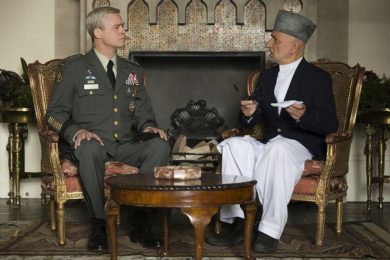
Brad Pitt and Ben Kingsley in War Machine
Written and directed by Australian David Michôd, and based on the 2012 non-fiction book, The Operators: The Wild and Terrifying Inside Story of America’s War in Afghanistan, by the late American journalist Michael Hastings, War Machine sarcastically hails the US in its opening moments, “Ah, America. You beacon of composure and proportionate response. You bringer of calm and goodness to the world.”
The WSWS noted that for once a film reflected some of the widespread hostility toward a quarter century of brutal war and toward the politicians and generals who have conducted it.
It was only fitting that a spokesperson for those war criminals would respond.
Whitney Kassel, late of the Defense Department, Special Operations in Afghanistan and Pakistan, a former member of McChrystal’s “team,” and an associate in private business of a long-time leading figure in the CIA, has written a denunciation of War Machine in Foreign Policy magazine, “Screw Brad Pitt and the ‘War Machine’ he rode in on.”
The unusually frank language of the headline presumably provides some sense of Kassel’s disapproval. Indeed, she acknowledges that her initial “eye-rolling quickly gave way to expletives.”
The character of Kassel’s objectivity in regard to Gen. McChrystal makes itself evident early on when she notes that Hastings (whose Rolling Stone article, later expanded into the book on which War Machine is based, essentially ended the general’s career) “took down a man I worked with during the time in question and deeply respected—one near-universally viewed as an American hero of integrity and intelligence.”
McChrystal was a ruthless practitioner of counterinsurgency warfare, responsible for the killing of thousands of Iraqis. His entourage in Afghanistan, according to Hastings, was “a handpicked collection of killers, spies, geniuses, patriots, political operators and outright maniacs.” A staffer neatly describes in Hasting’s book the now infamous Gen. Michael Flynn, one of McChrystal’s toadies, as a “rat on acid.”
Kassel presents the 16-year US-led intervention in Afghanistan as “a war effort that, while certainly replete with absurdities and mistakes, was and continues to be fought by men and women who are dedicated to improving the security of the United States and its allies by helping to build an Afghanistan that will not provide safe haven for al Qaeda or, more recently, the Islamic State.”

War Machine
This is a pack of lies. The US is not in Afghanistan to protect American lives, but to advance its interests in a geopolitically strategic area. The war has led to nothing but death, destruction and misery on a vast scale.
Kassel is particularly concerned that War Machine casts doubt on the legitimacy of the entire “war on terror,” the code phrase with which American imperialism has justified its drive for global hegemony since 2001.
She goes on: “Likewise—and this is the part that matters today—the portrayal of the U.S. and NATO’s very presence in the country since 2001 as rooted in fantasy and an inflated sense of American prowess is disingenuous and dangerous in its mischaracterization of a war that remains, particularly in the face of escalating violence and instability, an important part of reducing global terrorism.”
Kassel seems unaware that this last sentence contains an obvious contradiction. The longest war in US history has ostensibly been carried out in the name of “reducing global terrorism,” yet there is “escalating violence and instability.”
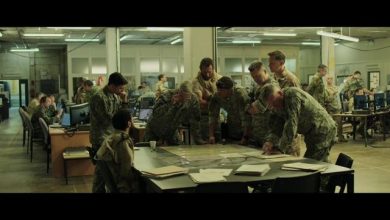
War Machine is not a primer in anti-imperialist politics, but it does make clear that the war in Afghanistan is a doomed project. The film’s narrator asks in the opening moments, “What do you do when the war you’re fighting just can’t possibly be won in any meaningful sense?”
The narrator further explains that the US military’s “counterinsurgency” strategy runs up against basic political realities: “When … you’ve just gone and invaded a place that you probably shouldn’t have, you end up fighting against just regular people in regular-people clothes. These guys are what are called insurgents. Basically, they’re just guys who picked up weapons ’cause … so would you, if someone invaded your country. Funnily enough … insurgencies are next to impossible to defeat.”
But Kassel inhabits a different political and moral universe. Her writing has the ghastly quality of the “democratic” military bureaucrat or intelligence agent, the muffled, perpetually disingenuous tone of the individual who plots bombings and murders and mass repression, but refers to such activities as “strategic options” and “the tools available for trying to turn around what was considered an urgent national security priority,” and half-believes her own obscurantism.
She presents a glowing picture of the same crowd among whom Hastings placed “killers … and outright maniacs.” Kassel writes: “I found McChrystal and his team to be respectful, thoughtful … McChrystal spent endless hours with the members of the assessment team [which included Kassel]—very few of whom had direct military experience—exploring the strategic options available to the United States and NATO.”
Toward the end of her tirade, Kassel once again expresses anxiety about the impact of War Machine and points to “a particular hazard,” that the film will reinforce “a view of the war in Afghanistan as this generation’s Vietnam, led by men … who care only about protecting their own egos and reputations, with no sense of the sacrifices inherent in war and no strategic vision or logic behind their decisions.”
She expresses nervousness about the “reworking” of the US approach to Afghanistan that Trump administration officials may be considering and asserts that “it is critical that they, and the American public to whom they report, understand how we got here, and the reasons why some elements of a counterinsurgency strategy may remain valid moving forward.”
Kassel, according to the Huffington Post, for whom she writes occasionally, “spent four years at the Office of the Secretary of Defense where she focused on Special Operations, Counterterrorism, and Pakistan policy. During this time she spent a year in Pakistan working for the Office of the Defense Representative and Special Operations Command Forward. She also served as the representative of the Secretary of Defense to General Stanley McChrystal’s Strategic Assessment Team in Afghanistan in 2009.”
This is someone up to her neck in imperialist violence and intrigue. At one point, Kassel served “as Assistant for Counterterrorism Policy in the Office of the Assistant Secretary of Defense for Special Operations, Low Intensity Conflict, and Interdependent Capabilities (ASD SO/LIC&IC) within the Office of the Under Secretary of Defense for Policy (OSD-Policy).”
Kassel, a Democratic Party supporter apparently, often tweets about women’s rights and racism—and Russian aggression! Of course, how could it be otherwise?
A special mention must be made of her association with the Arkin Group, the private intelligence firm, where she “served as a senior director focused on strategic analysis and risk management.”
A founding partner of the Arkin Group is Jack Devine, according to the company’s website, “a 32-year veteran of the Central Intelligence Agency (‘CIA’). Mr. Devine served as both Acting Director and Associate Director of CIA’s operations outside the United States from 1993-1995, where he had supervisory authority over thousands of CIA employees involved in sensitive missions throughout the world. In addition, he served as Chief of the Latin American Division from 1992-1993 and was the principal manager of the CIA’s sensitive projects in Latin America.”
In fact, Devine’s first foreign assignment was in Chile, where he arrived in August 1970. Even before being physically assigned there, he writes in his autobiography, Good Hunting: An American Spymaster’s Story, “I had worked the night shift for the Chile Task Force in Langley, synthesizing cables from Santiago into a morning intelligence report for the bosses.” Devine was present in Santiago in September 1973 when the Nixon administration and the CIA organized a coup, along with the Chilean military, that brought the brutal Pinochet dictatorship to power, which tortured and murdered tens of thousands of political opponents, trade unionists and young people.
The Arkin website also notes, “From 1985-1987, Mr. Devine headed the CIA’s Afghan Task Force, which successfully countered Soviet aggression in the region. In 1987, he was awarded the CIA’s Meritorious Officer Award for this accomplishment.”
In other words, Devine is one of the figures criminally responsible for arming and fomenting Islamic fundamentalism in Afghanistan as part of the effort to undermine the Soviet Union. In his own words, Devine moved “guns and ammunition across the border into Afghanistan,” aiding “the Afghan mujahideen and their determined opposition to the Soviet Union’s occupation of their country in the 1980s. I ran the last, and largest, cover operation of the Cold War.” The career of Osama bin Laden, Al Qaeda, the 9/11 terrorist attacks and ISIS itself all emerge, directly or indirectly, from this operation.
Devine and Kassel have co-authored numerous articles, including “Afghanistan: Withdrawal Lessons,” in the World Policy Journal, 2013. This cynical morsel of realpolitik offered advice to the Obama administration on the best policy to pursue “in protecting U.S. interests” in the region. “Robust covert action” remained high on the list. Should the Pakistani government, for example, turn down US aid, “we should respond with appropriate covert action. This would include paramilitary activities as well as psychological operations, propaganda, and political and economic influence.”
Devine also acknowledges Kassel’s assistance in the preparation of his autobiography.
Devine and Kassel continued to do at Arkin what they did at the CIA and the Defense Department, respectively, defend the interests of American corporate and financial interests.
The Arkin website, in its “Case Studies” section, offers the example of the work it did for an investor, “concerned about instability and uncertain about prospects for South African agriculture.” The firm “initiated a political risk analysis and market intelligence project, and also completed an investigation of political, legal, and regulatory events that could impact foreign investors, agriculture operations, and the industry of interest.” Arkin “uncovered no evidence indicating that South Africa’s leaders would reverse foreign investment-friendly policies.”
In Vietnam, Arkin assessed “the future of pro-privatization initiatives” and also laid out “incentives and road blocks associated with privatization and elucidated the process by which entities become eligible for consideration.”
This background has provided Ms. Kassel with the moral and intellectual high ground from which to criticize the anti-war satire, War Machine, which lifts the lid on the lethal madness of the US military and dares to call into question American foreign policy.
It is entirely to the film’s credit that it has provoked an angry response from this trusted agent of American imperialism.
Roll of Shame
By Craig Murray | June 24, 2017
These are the 15 countries which shamefully voted against a UN General Assembly Resolution on Thursday which proposed to seek an opinion from the International Court of Justice on Britain’s continued colonial possession of the Chagos Islands. In the most absolute example of ethnic cleansing in modern history, less than 50 years ago the UK deported by force the entire population of the Chagos Islands to make way for the US military base on Diego Garcia, and to this day refuses to allow them to return.
The Dirty 15
USA
UK
Israel
Australia
New Zealand
The above are of course arguably the five countries in the world most profoundly implicated in the usurpation and destruction of native populations
Afghanistan
Albania
Bulgaria
Croatia
Hungary
Japan
Lithuania
Maldives
Montenegro
South Korea
This second small group is dominated by countries with a particularly close security relationship with the United States on which they place particular reliance in relation to a perceived threat.
It must however be heartening that the US and UK could round up so very few supporters for their utterly immoral stance. It is particularly worth noting that none of the major players within the EU backed the UK.
The US and UK are also remarkably silent on the blockade of Qatar by their ally Saudi Arabia. The release of Saudi demands including the closing down of Al Jazeera TV and other media outlets including the excellent Middleeasteye.net show the Saudis’ true motives. Frankly I am shocked by the failure of the mainstream media in the West seriously to question the ludicrous Saudi claim that this attack on Qatar is over support for terrorism.
Mohammed Bin Salman was appointed by his father the King as Crown Prince in Saudi Arabia on 21 June. Bin Salman has been directing the major affairs of the state for the last three years. The ferocity of the prosecution of the war in Yemen is very much his baby. Bin Salman’s master plan, which he has driven through with much skill, is for a far more aggressive Saudi Arabia leading the conservative forces in the Middle East, above all in fierce opposition to Iran and Shia interests. To this end he has forged a conservative alliance incorporating Saudi Arabia, Israel, Egypt and the United States.
US and UK involvement in the war in Yemen goes beyond the enthusiastic supply of the bombs and aircraft which have killed thousands of children. Both have had special forces on the ground, and the CIA has yet again been deeply implicated in the detention, extreme torture and murder of opponents.
The Bin Salman plan is dressed up as “pro-Western” and media hacks paint him as a “reformer” because he wishes to expand a network of McDonalds in the Kingdom. But as Iran slowly does reform, and sticks meticulously to the terms of the internationally guaranteed nuclear agreement, Saudi paranoia towards its regional “rival” becomes ever more dangerous. The Iranians deserve respect for the moderation with which they reacted to the Saudi sponsored terror attack on their parliament itself. But such provocations will increase.
Saudi support for ISIL, Al Qaeda, Al Nusra and the numerous other jihadist groups will only increase as Saudi Arabia seeks to deploy them in its sectarian war against the Shia and their allies. For that reason there is no prospect of terrorist violence in Syria declining. Indeed the United States shooting down of a Syrian jet in “self-defence” was almost certainly an indication that the Syrians were at the time targeting jihadist forces reinforced by US special forces. Israeli bombing and missile sorties against Syrian regime targets in support of jihadist rebels are finally being regularly reported in mainstream media.
I do not hold up Qatar or its ruling aristocracy as a paragon of virtue. But it seeks a more pacific relationship with Iran, and has more developed economic relationships including on shared offshore fields. Qatar has also consistently shown greater interest in the plight of the Palestinians, and more scepticism towards Israel, than Bin Salman is happy with. Qatar also has problems with the brutal military dictatorship of Egypt.
Most worryingly to Saudi Arabia, these slightly more liberal attitudes are closer to the views of the “arab street”, where there is disquiet at Saudi Arabia’s obvious but officially denied relationship with Israel. Qatar also has a media which can reflect these views to a wider Arab audience. Even though, following previous Saudi threats, al Jazeera’s content has been toned down, the Saudis see the station as an intolerable direct threat.
There is public fatigue in the West with regard to the affairs of the Middle East. This is a mistake as the situation is more dangerous than ever. The UK and USA both look likely to support the Saudis and Israel in their determination for conflict with Iran. The EU and Russia – and anybody not harbouring a death wish – will be working to keep the Iranian nuclear deal together. Bin Salman has chosen his time well, with slightly crazed right wing regimes in Washington, London and Tel Aviv willing to back his adventurism. The blockade of Qatar is but a symptom of something much more dangerous.
A warrior prince rises in Arabia as the monarch of all he surveys
By M K Bhadrakumar | Indian Punchline | June 22, 2017
The royal decree of June 21 by Saudi Arabia’s King Salman appointing his son Mohammed bin Salman as the Crown Prince and next in line to the throne is a watershed event in Middle East politics. Such a development has been expected for some time, but when it actually happened, it still looks momentous and somewhat awesome.
For a start, 31-year old MbS, whom many tend to deride as the “warrior prince”, has earned a reputation for being rash in the use of force. The extremely brutal war in Yemen is his signature foreign-policy project. Saudi Arabia, famous for its caution and its glacial pace of decision-making, has changed remarkably since MbS trooped in alongside King Salman to the centre stage of the Saudi regime in January 2015.
Considering King Salman’s age and health condition, MbS is being positioned in advance so that there will be no succession struggle. MbS has been steadily tightening his grip on the key instruments of power through the past 2-year period – national security apparatus and intelligence, armed forces and oil industry – in a grim power struggle with the Crown Prince Mohammed bin Nayef, who has now lost the game and is retiring from the arena.
With the vast powers of patronage vested in MbS as the Crown Prince, make no mistake, the winner takes it all. In short, the Persian Gulf’s – nay, Middle East’s – power house is about to get a new ruler who is only 31 and he may lead Saudi Arabia for decades.
The timing of the shift in the power fulcrum cannot but be noted. It is exactly one month since US President Donald Trump visited Saudi Arabia. Trump’s visit revived the Saudi-American alliance, which was adrift during the second term of President Barack Obama. MbS has emerged as the Trump administration’s number one interlocutor in the Saudi regime, superseding Nayef who used to be the favorite of the Obama administration.
MbS has forged links at personal level with Trump’s son-in-law Jared Kushner. In a rare gesture, the Prince invited Kushner and wife Ivanka Trump to his residence for a private meal during father-in-law Trump’s visit to Riyadh. So, Saudi-US relations from now onward will be a cozy, exclusive, secretive family affair imbued with a “win-win” spirit – as it used to be in the halcyon days when the Bush family was holding power in the US.
Trump’s visit to Riyadh signalled that Saudi Arabia has regained its stature as the US’ number one partner in the Muslim Middle East. Trump has publicly endorsed the Saudi stance in their standoff with Qatar, which, incidentally, is widely attributed to MbS.
MbS is widely regarded as the mastermind of the tough policy policy to isolate Qatar to make it submissive and has personally identified with the virulently anti-Iran thrust in the Saudi regional strategies. Therefore, MbS’ ascendancy impacts Middle East politics along the following fault lines:
· The war in Yemen;
· The standoff with Qatar;
· The Saudi-Iranian tensions;
· The nascent Saudi-Israeli regional axis;
· Situation in Syria and Gaza and/or Lebanon; and,
· The crackdown in Bahrain.
It remains to be seen whether the unity of the Gulf Cooperation Council (GCC) can be preserved. MbS enjoys personal rapport with Sheikh Mohammed bin Zayed, the crown prince of Abu Dhabi in the United Arab Emirates. But other GCC states — Kuwait, Oman and Qatar — will have a profound sense of unease about the “warrior prince” and this may lead to some major realignments in the Persian Gulf.
On the one hand, MbS may advance a normalization of relations between Saudi Arabia and Israel. If that happens, Israel breaks out of isolation and the Arab-Israeli conflict can never be the same again. Again, it is conceivable that MbS may throw the Palestinians under the bus. On the other hand, Iran too may finally succeed in breaching the GCC cordon that Saudi Arabia had erected, which in turn, may somewhat blur the sectarian divide in the Muslim Middle East and bring about a convergence of interests with Qatar and Turkey as regards perceived Saudi hegemony.
MbS is a man in a hurry. He has radical ideas to transform Saudi society and its economy under the rubric of Vision 2030. He has brought in western-educated technocrats into the governmental apparatus, replacing the Old Guard. How the conservative religious establishment views these winds of change remains the big ‘unknown unknown’ — especially MbS’ management style such as his openness to out-of-the-box thinking, his uniquely public profile in a deeply conservative country, his risk-taking character and his willingness to break conventions.
There is indeed a lot of pent-up disaffection within Saudi Arabia, which makes the period of reform and transition very tricky. The example of Shah’s Iran readily comes to mind. In the ultimate analysis, therefore, the big question is Who is the real MbS?
Clearly, his conduct so far cannot be the yardstick to fathom his personality, since it was primarily a swift, decisive action plan to elbow out the incumbent Crown Prince and take his job. Now that MbS’ actual hold over the levers of power is going to be unchallenged, his priorities can also change. Indeed, there are intriguing sides to his personality – his personal role in forging Saudi Arabia’s working relationships with Moscow, his determination to reduce the economy’s dependence on oil, his appeal to the Saudi youth as the harbinger of “change” and so on. The bottom line is that social and political stability in the country is vital for the success of Vision 2030, in which MbS has staked his prestige, envisaging wide-ranging structural reforms, geo-economic restructuring and the infusion of massive investments.
King Salman’s recent visit to China underscored that MbS understands the potential linkage between his Vision 2030 and China’s Belt and Road Initiative. Of course, China is highly receptive to the idea, too. Deals worth $65 billion were signed in Beijing during King Salman’s visit. Similarly, MbS has been a frequent visitor to the Kremlin and enjoys some degree of personal rapport with President Vladimir Putin. The OPEC decision on cut in oil production has been a joint enterprise in which Putin had a “hands-on” role. Rosneft has signalled interest in acquiring shares in Aramco when its “privatisation” begins next year, and at the recent meet of the St. Petersburg International Economic Forum, the two countries agreed to set up a joint energy investment fund.
MbS, who is Saudi Defence Minister, has also intensified his country’s military cooperation with Russia and China. A notable project will be the Chinese drone factory to be set up in Saudi Arabia. Again, Russia is in talks currently for the sale of T-80 battle tanks to Saudi Arabia, among other weaponry.
Suffice to say, MbS is quite aware of the seamless possibilities that the multipolar world setting offers. It is useful to remember that MbS is a unique Saudi prince who never attended a western university. He is far from a greenhorn in the world of politics either, having begun as fulltime advisor to the council of ministers in 2007.
Indeed, his trademark is his assertiveness in foreign policies that stands in sharp contrast with the traditional Saudi style, and, which, therefore, looks aggressive. But then, it needs to be factored in that the war in Yemen and the strident anti-Iran outlook are immensely popular in the domestic opinion in terms of the surge of Saudi nationalism. The big question, therefore, will be how he deploys the surge of nationalism — amongst the youth, in particular — in his hugely ambitious plan to reform and modernise the country. Traditionally, Saudi rulers used to derive legitimacy from the approval of the Wahhabist religious establishment. (Read an Al Jazeera write-up on MbS’s profile here.)
Resist This: The United States Is At War With Syria
By Jim Kavanaugh | The Polemicist |June 20, 2017
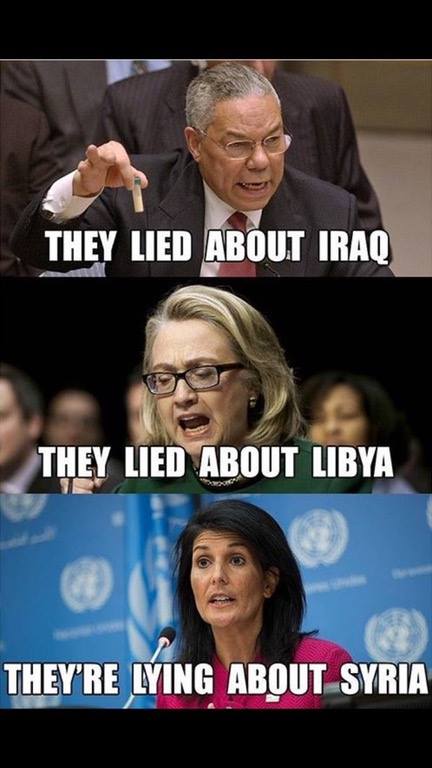
The United States is at war with Syria. Though few Americans wanted to face it, this has been the case implicitly since the Obama administration began building bases and sending Special Ops, really-not-there, American troops, and it has been the case explicitly since August 3, 2015, when the Obama administration announced that it would “allow airstrikes to defend Syrian rebels trained by the U.S. military from any attackers, even if the enemies hail from forces loyal to Syrian President Bashar al-Assad.” With the U.S. Air Force—under Trump, following Obama’s declared policy—shooting down a Syrian plane in Syrian airspace, this is now undeniable. The United States is overtly engaged in another aggression against a sovereign country that poses no conceivable, let alone actual or imminent, threat to the nation. This is an act of war.
As an act of war, this is unconstitutional, and would demand a congressional declaration. The claim, touted by Joint Chiefs’ Chairman, Gen. Dunford, that the 2001 Authorization for the Use of Military Force (AUMF) against al-Qaeda provides constitutional justification for attacking the Syrian government is patently false and particularly precious. In the Syrian conflict, it’s the Syrian government that is the enemy and target of al-Qaeda affiliates; it’s the U.S. and its allies who are supporting al Qaeda. The authorization to fight al-Qaeda has been turned into an authorization to help al-Qaeda by attacking and weakening its prime target!
Will President Trump ask for a relevant congressional authorization? Will any Democratic or Republican congresscritter demand it? Is the Pope a Hindu?
Would it make any difference? Why should Trump bother? Obama set the stage when he completely ignored the War Powers Act, the Constitution, Congress, and his own Attorney General and legal advisers, and went right ahead with a war on Libya, under the theory that, if we pretend no American troops are on the ground, it isn’t really a war or “hostilities” at all. Which I guess means if the Chinese Air Force starts shooting down American planes in American airspace in defense of Black Lives Matter’s assault on the White House, it wouldn’t really be engaging in an act of war.
It’s impossible to overstate the danger in these executive war-making prerogatives that Obama normalized—with the irresponsible connivance of his progressive groupies, who pretend not to know where this would lead. In 2012, referring to the precedent of Obama’s policies, Mitt Romney said: “I don’t believe at this stage, therefore, if I’m president that we need to have a war powers approval or special authorization for military force. The president has that capacity now.” Following Obama, for Trump, and every Republican and Democratic president, it now goes without saying.
In terms of international law, as an aggressive, unprovoked aggression against a country that makes no threat of attack on the U.S., it is also patently illegal, and all the political and military authorities undertaking it are war criminals, who would be prosecuted as such, if there were an international legal regime that had not already been undermined by the United States.
Syria is now under explicit attack by the armed forces of the U.S., Turkey, and other NATO states. Sixteen countries have combat aircraft buzzing around Syrian airspace under the effective command of the United States, and a number of them have attacked Syria’s army.
Americans, and certainly self-identified “progressives,” have to be crystal clear about this: American armed forces have no right to be in Syria, have no right to restrict the Syrian government from using any of its airspace, or to prevent it from regaining control of any of its own territory from foreign-backed jihadi armies.
The Syrian state and its allies (Iran and Russia), on the other hand, are engaged in the legitimate self-defense of a sovereign state, and have the right to respond with full military force to any attack on Syrian forces or any attempt by the United States to balkanize or occupy Syrian territory, or to overthrow the Syrian government. Whether and how they do respond will depend on their own military/political calculus, about which they have so far been quite careful and restrained. It would be the height of foolishness, as well as arrogance, for Americans to presume they can bully these actors into submission with an infinite series of discrete aggressions, with no sharp counterattack. Unfortunately, the world has not yet seen the limits of American arrogance.
So please, do not pretend to be shocked, shocked, if Syria and its allies fight back, inflicting American casualties. Don’t pose as the morally superior victim when Americans are killed by the people they are attacking. And don’t be preaching about how everyone has to support our troops in a criminal, unconstitutional, aggressive attack on a country that has not threatened ours in any way. American soldiers and pilots executing this policy are not heroes, and are not fighting to protect America or advance democracy; they are the international equivalent of home invaders, and as such are legitimate targets with no claim to “self-defense.” The only heroic act they could do is refuse their superiors’ illegitimate orders to engage in this aggression.
In response to American attacks, the Syrian Army has every right to strike back at the American military apparatus, everywhere. Every casualty of this war, however big it gets, is the ethico-political responsibility of the attacking party – US. The first responsibility of every American is not to “support our troops,” but to stop this war. Right now. Before it gets worse.
It’s quite obvious, in fact, that the United States regime is deliberately making targets of its military personnel, in the hopes of provoking a response from Syrian or allied armed forces that will kill some Americans, and be used to gin up popular support for exactly the kind of major military attack on Syria and/or Russia and/or Iran that the American people would otherwise reject with disgust. Anyone who professes concern for “our troops” should be screaming to stop that.
It’s also quite clear now that the War on ISIS is a sham, that ISIS was always just a pretext to get the American military directly involved in attacking the Syrian army and destroying the coherence of the Syrian state. If the U.S. wanted to defeat ISIS, it could do so easily by coordinating their actions with, and not against, the forces who have been most effectively fighting it: the Syrian Arab Army, Russia, Iran, and Hezbollah.
Instead, it’s attacking the Syrian army precisely because it has been defeating ISIS and other jihadi forces, and regaining its own territory and control of its own border with Iraq. The U.S. does not want that to happen. At the very least—if it cannot immediately engender that massive offensive to overthrow the Baathist government—the U.S. wants to control part of the border with Iraq and to occupy a swath of eastern Syria. It wants to establish permanent bases from which to provision and protect jihadi armies, achieving a de facto partitioning of the Syrian state, maintaining a constant state of armed attack against the Damascus government, and reducing Syria to a weakened, rump state that can never present any effective resistance to American, Israeli, or Saudi designs on the region.
This is extremely dangerous, since the Syrians, Russians, and Iranians seem determined not to let this happen. Consistent with his own incompetence and his admiration for tough guys, Trump seems to have abrogated authority to his generals to make decisions of enormous political consequence. Perhaps that’s why aggressive actions like the shoot-down of the Syrian plane have been occurring more frequently, and why it’s not likely they’ll abate. There’s a dynamic in motion that will inevitably lead each side to confront a choice of whether to back down, in a way that’s obvious, or escalate. Generals aren’t good at backing down. A regional or global war is a real possibility and becomes more likely with every such incident.
Though most American politicians and media outlets do not want to say it (and therefore, most citizens cannot see it clearly enough), such a war is the objective of a powerful faction of the Deep State which has been persistent and determined in seeking it. If the generals are loath to back down in a battle, the neocons are adamant about not backing down on their plans for the Middle East. They will not be stopped by anything less than overwhelming popular resistance and international pushback.
The upside of these attacks on Syrian forces is that they wipe the lipstick off the pig of the American project in Syria. It’s a regime-change, nation-destroying war that has nothing to do with democracy or human rights, and everything to do with the anti-democratic, chaos-creating designs of the most nefarious regimes in the region and the world. Everyone—European countries who profess concern for international law and stability, and the American people who are fed up with constant wars that have no benefit for them—can see exactly what kind of blatant aggression is unfolding, and decide whether they want to go along with it.
In that regard, any self-identified “liberal” or “progressive” American—and particularly any such American politician—who spent (and may still spend) their political energy attacking Bush, et. al., for that crazy war in Iraq, and who goes along with, or hesitates to immediately and energetically denounce this war, which is already underway, is a political hypocrite, resisting nothing but the obvious.
Spoiling for a Wider War in Syria
By Robert Parry | Consortium News | June 20, 2017
The U.S. mainstream media’s near universal demonization of Syrian President Bashar al-Assad and Russian President Vladimir Putin – along with similar hatred directed toward Iran and Hezbollah – has put the world on a path toward World War III.
Ironically, the best hope for averting a dangerous escalation into a global conflict is to rely on Assad, Putin, Iran and Hezbollah to show restraint in the face of illegal military attacks by the United States and its Mideast allies inside Syria.
In other words, after the U.S. military has bombed Syrian government forces on their own territory and shot down a Syrian warplane on Sunday – and after Israel has launched its own strikes inside Syria and after Saudi Arabia and its Gulf allies have financed and armed jihadists to overthrow Assad – it is now up to the Syrian government and its allies to turn the other cheek.
Of course, there is also a danger that comes from such self-control, in that it may encourage the aggressors to test the limits even further, seeing restraint as an acceptance of their impunity and a reason to ignore whatever warnings are issued and red lines drawn.
Indeed, if you follow The New York Times, The Washington Post, The Wall Street Journal and other big U.S. news outlets, perhaps the most striking groupthink that they all share is that the U.S. government and its allies have the right to intervene militarily anywhere in the world. Their slogan could be summed up as: “International law – that’s for the other guy!”
In this upside-down world of American hegemony, Assad becomes the “aggressor” when he seeks to regain control of Syrian territory against armed insurgents, dominated by Al Qaeda and Islamic State (ISIS), or when he protests the invasion of Syrian territory by foreign forces.
When Assad legally seeks help from Russia and Iran to defeat these foreign-armed and foreign-backed jihadists, the U.S. mainstream media and politicians treat his alliances as improper and troublemaking. Yet, the uninvited interventions into Syria by the United States and its various allies, including Turkey and Israel, are treated as normal and expected.
Demanding Escalation
The preponderance of U.S. media criticism about U.S. policy in Syria comes from neoconservatives and liberal interventionists who have favored a much more ambitious and vigorous “regime change” war, albeit cloaked in prettier phrases such as “safe zones” and “no-fly zones.”
So, you have Tuesday’s Wall Street Journal editorial, which praises Sunday’s U.S. shoot-down of a Syrian military plane because it allegedly was dropping bombs “near” one of the U.S.-backed rebel groups – though the Syrians say they were targeting an Islamic State position.
Although it was the U.S. that shot down the Syrian plane over Syria, the Journal’s editorial portrays the Russians and Syrians as the hotheads for denouncing the U.S. attack as a provocation and warning that similar air strikes will not be tolerated.
In response, the Journal’s neocon editors called for more U.S. military might hurled against Syria and Russia:
“The risk of escalation is real, but this isn’t a skirmish the U.S. can easily avoid. Mr. Assad and his allies in Moscow and Tehran know that ISIS’s days are numbered. They want to assert control over as much territory as possible in the interim, and that means crushing the SDF [the U.S.-backed Syrian Democratic Forces].
“The Russian threat on Monday to target with anti-aircraft missiles any U.S. aircraft flying west of the Euphrates River in Syria is part of the same intimidation strategy. Russia also suspended a hotline between the two armed forces designed to reduce the risk of a military mistake. Iran, which arms and assists Mr. Assad on the ground, vowed further Syrian regime attacks against SDF, all but daring U.S. planes to respond amid the Russian threat.
“The White House and Pentagon reacted with restraint on Monday, calling for a de-escalation and open lines of communication. But if Syria and its allies are determined to escalate, the U.S. will either have to back down or prepare a more concerted effort to protect its allies and now U.S. aircraft.
“This is a predicament President Obama put the U.S. in when his Syrian abdication created an opening for Vladimir Putin to intervene. Had the U.S. established a no-fly or other safe zone to protect refugees, the Kremlin might have been more cautious.”
As senior U.S. commanders have explained, however, the notion of a sweet-sounding “no-fly or other safe zone” would require a massive U.S. military campaign inside Syria that would devastate government forces and result in thousands of civilian deaths because many air defenses are located in urban areas. It also could lead to a victory for Al Qaeda and/or its spinoff, Islamic State, a grisly fate for most Syrians.
Propaganda Value
But the “safe zone” illusion has great propaganda value, essentially a new packaging for another “regime change” war, which the neocons lusted for in Syria as the follow-on to the Iraq invasion in 2003 but couldn’t achieve immediately because the Iraq War turned into a bloody disaster.
Instead, the neocons had to settle for a proxy war on Syria, funded and armed by the U.S. government and its regional allies, relying on violent jihadists to carry out the brunt of the fighting and killing. When Assad’s government reacted clumsily to this challenge, the U.S. mainstream media depicted Assad as the villain and the “rebels” as the heroes.
In 2012, the Defense Intelligence Agency, then under the direction of Lt. Gen. Michael Flynn, warned that the U.S. strategy would give rise to “a declared or undeclared Salafist principality in eastern Syria.”
Flynn went further in a 2015 interview when he said the intelligence was “very clear” that the Obama administration made a “willful decision” to back these jihadists in league with Middle East allies. (Flynn briefly served as President Trump’s national security adviser but was ousted amid the growing Russia-gate “scandal.”)
Only in 2014, when Islamic State militants began decapitating American hostages and capturing cities in Iraq, did the Obama administration reverse course and begin attacking ISIS while continuing to turn a blind-eye to the havoc caused by other rebel groups allied with Al Qaeda’s Nusra Front, including many outfits deemed “moderate” in the U.S. lexicon.
But the problem is that almost none of this history exists within the U.S. mainstream narrative, which – as the Journal’s neocon editors did on Tuesday – simply depicts Obama as weak and then baits President Trump to show more military muscle.
What U.S. National Interests?
The Journal editorial criticized Trump for having no strategy beyond eradicating ISIS and adding: “Now is the time for thinking through such a strategy because Syria, Russia and Iran know what they want. Mr. Assad wants to reassert control over all of Syria, not a country divided into Alawite, Sunni and Kurdish parts. Iran wants a Shiite arc of influence from Tehran to Beirut. Mr. Putin will settle for a Mediterranean port and a demonstration that Russia can be trusted to stand by its allies, while America is unreliable. None of this is in the U.S. national interests.”
But why isn’t this in U.S. national interests? What’s wrong with a unified secular Syria that can begin to rebuild its shattered infrastructure and repatriate refugees who have fled into Europe, destabilizing the Continent?
What’s the big problem with “a Shiite arc of influence”? The Shiites aren’t a threat to the United States or the West. The principal terror groups – Al Qaeda and ISIS – spring from the extremist Saudi version of Sunni Islam, known as Wahhabism. I realize that Israel and Saudi Arabia took aim at Syria in part to shatter “the Shiite arc,” but we have seen the horrific consequences of that strategy. How has the chaos that the Syrian war has unleashed benefited U.S. national interests?
And so what that Russia has a naval base on the Mediterranean Sea? That is no threat to the United States, either.
But what is the alternative prescription from the Journal’s neocon editors? The editorial concludes: “The alternative would be to demonstrate that Mr. Assad, Iran and Russia will pay a higher price for their ambitions. This means refusing to back down from defending U.S. allies on the ground and responding if Russia aircraft or missiles attempt to take down U.S. planes. Our guess is that Russia doesn’t want a military engagement with the U.S. any more than the U.S. wants one with Russia, but Russia will keep pressing for advantage unless President Trump shows more firmness than his predecessor.”
So, rather than allow the Syrian government to restore some form of order across Syria, the neocons want the Trump administration to continue violating international law, which forbids military invasions of sovereign countries, and keep the bloodshed flowing. Beyond that, the neocons want the U.S. military to play chicken with the other nuclear-armed superpower on the assumption that Russia will back down.
As usual, the neocon armchair warriors don’t reflect much on what could happen if U.S. warplanes attacking inside Syria are shot down. One supposes that would require President Trump to authorize a powerful counterstrike against Russian targets with the possibility of these escalations spinning out of control. But such craziness is where a steady diet of neocon/liberal-hawk propaganda has taken America.
We are ready to risk nuclear war and end all life on the planet, so Israel and Saudi Arabia can shatter a “Shiite arc of influence” and so American politicians don’t have to feel the rhetorical lash of the neocons and their liberal-hawk sidekicks.
Investigative reporter Robert Parry broke many of the Iran-Contra stories for The Associated Press and Newsweek in the 1980s.
US police arrest anti-nuclear weapons activists at UN
Press TV – June 20, 2017
A number of anti-nuclear weapons activists have been arrested in New York during a protest against Washington’s decision to boycott negotiations on a nuclear weapons ban treaty.
The arrests were made after the activists chanting slogans such as “US join the talks, ban the bomb,” blocked the entrances to the US mission to the United Nations.
The protesters sat in front of the doors before the police moved in. police said they warned the demonstrators that they would be arrested if they did not leave the place.
In March, US Ambassador to the United Nations Nikki Haley announced that the United States, Britain and France had decided not to join talks on a nuclear weapons ban treaty.
The United Nations is currently holding a second round of negotiations about the issue.
The world body adopted a resolution in December to negotiate a legally binding instrument to prohibit nuclear weapons, leading toward their total elimination and encouraged all member states to participate.
A total of 113 nations voted in favor of the resolution but 35 countries, including the United States, Britain and France, voted against it. Thirteen countries abstained.
According to the US military’s recent declaration, the United States has 806 deployed ICBMs (intercontinental ballistic missile), SLBMs (submarine-launched ballistic missile), and heavy bombers as well as 1,722 deployed nuclear warheads.
The Pentagon is also equipped with a multiple independently targetable reentry vehicle (MIRV), a highly advanced version of the intercontinental nuclear missile carrying several independent warheads.
US Risks Wider War by Downing Syrian Plane
By Gilbert Doctorow | Consortium News | June 19, 2017
The Pentagon’s announcement that the U.S. military had shot down a Syrian warplane inside Syrian territory merited only inside-the-paper treatment at The New York Times and The Washington Post on Monday, but it became the featured article on the Russian version of Google News citing a Moscow newspaper reporting a warning from Russia’s Federation Council that “the USA can receive a return blow in Syria.”
The article in Moskovsky Komsomolets and several similar accounts in other leading Russian print media recounted the warning issued by the Deputy Chairman of the Committee on International Affairs in Russia’s upper house, Vladimir Jabarov, that the shoot-down of the Syrian SU-22 bomber on Sunday by the U.S.-led coalition can lead to “a major conflict.” The Senator noted that Syrian air space is protected both by a Syrian operated S-300 ground to air defense system and by Russian-operated state-of-the-art S-400 missiles.
Jabarov called for diplomats of the interested parties to meet as soon as possible to discuss the incident. And he warned, in dark tones, that the plane’s destruction could lead to a return attack from the Syrian armed forces. The article also quotes the first deputy chairman of Russia’s Committee on Defense and Security in the upper chamber, Frants Klintsevich, describing the shoot-down as “a provocation directed against Russia.”
The Syrian government said its bomber was operating against Islamic State forces near Raqqa, though the U.S. coalition claimed Syrian forces and the plane had attacked rebels, called the Syrian Democratic Forces and operating under the guidance of U.S. Special Forces.
It perhaps should go without saying that under international law the Syrian government has the right to operate inside Syrian airspace and that the U.S. military has no legal right to have personnel inside Syria (since they lack the Syrian government’s permission) let alone to attack the Syrian military or its allied forces. Another curious feature about this situation is that the U.S. mainstream media sees nothing illegal or unusual about the U.S. military operating inside another country uninvited and shooting down government aircraft.
That assumption that the U.S. military has the right to intervene in any conflict of its choosing was reflected in the decision by the Times and Post to minimize coverage of the shoot-down of the Syrian bomber and accept uncritically the Pentagon’s explanation that the shoot-down was in response to Syrian government attacks on U.S.-backed forces. (The Wall Street Journal did lead its Monday print edition with a story about the shoot-down of the Syrian plane, but also acted as if the U.S. military was within its rights in doing so.)
Given the potential for a dangerous U.S. military showdown with Russia, whose forces have been invited into Syria by the internationally recognized government, the Kremlin initially tamped down concern about the clash. Russian state television on Sunday night and into Monday paid almost no attention to the shoot-down, apparently awaiting a decision on a suitable response to the American “provocation.”
That response came on Monday when the Russian military command once again declared that the deconflicting hotline between U.S.-allied and Russian forces on air movements over Syria has been severed. That is to say the Russians reinstated the response they made following Donald Trump’s Tomahawk missile attack on a Syrian air base in April. In effect, this Russian action halts all flights into the area from the U.S. aircraft carrier that launched the plane that shot down the Syrian bomber. In line with that decision, the Kremlin warned that all allied air operations near where the Russian air force is flying will be targeted and destroyed.
U.S. Reactions
Only then did The New York Times and The Washington Post begin to react to the seriousness of the confrontation. The former produced an analytical article entitled “Russia Warns U.S. After Downing of Syrian Warplane,” published Monday at its Web site. The Post did the same under the heading “Russia threatens to treat U.S. coalition aircraft as targets over Syria.”
These articles are unusual in one respect: they quote extensively from official Russian sources, including the accusation that the U.S. actions in Syria are in violation of international law. They also mention the dynamism of the Syrian armed forces in bringing the fight to the east of the country even if this means pushing against U.S.-assisted rebels.
What these newspapers do not explain is how and why the Syrian army has been energized to pursue national unification: namely it is the direct result of freeing up Syrian forces, which had been tied down in the west, through the implementation of “deconfliction” settlements that Iran, Turkey and Russia hammered out in the so-called Astana talks earlier this spring. Those settlements never received U.S. approval, though Moscow hoped they would become a platform for a broader U.S.-Russian understanding regarding possible areas of cooperation before the first meeting between Presidents Putin and Trump.
Instead, the U.S. shoot-down of the Syrian bomber, the first direct U.S. attack on a Syrian aircraft in the six-year conflict, signals a return to the Pentagon’s actions undermining the accommodating policies of a U.S. president in Syria. Last September, when Secretary of State John Kerry and Russian Foreign Minister Sergei Lavrov reached agreement on a partial cease-fire in Syria with the support of President Obama, a U.S. air attack killing Syrian troops in the besieged eastern outpost of Deir Ezzor scuttled the arrangement.
Now it appears that the Pentagon may be sabotaging another possibility of accommodation between Putin and Trump by escalating the U.S. military intervention in Syria at a time when the Syrian government has been consolidating its control over large swaths of Syria. The latest clash also heightens the possibility that Russian air defenses may shoot down a U.S. warplane and push tensions to even a higher level.
Gilbert Doctorow is an independent political analyst based in Brussels. His latest book Does Russia Have a Future? was published in August 2015. His forthcoming book Does the United States Have a Future? will be published on 1 September 2017.
CONFIRMED: Kurdish forces are now the enemy of Syria
By Adam Garrie | The Duran | June 19, 2017
Those who said that Kurdish forces did not mean Syria harm have been proved manifestly incorrect.
Many have long suspected that Kurdish forces fighting ISIS in Syria are doing so in pursuit of a uniquely self-interested goal, that of carving out a large autonomous region from legal Syrian territory or otherwise unilaterally proclaiming an independent state on sovereign Syrian soil.
Now, the Kurdish dominated and strongly US backed SDF has confirmed that it will “retaliate” against any incursions of the Syrian Arab Army into what it now considers its territory.
This is proto-annexation in all but name. The only troops who have the ultimate right to move anywhere they want within Syria and attack any and all targets that the government feels are a threat to Syrian security and sovereignty are the forces of the Syrian Arab Army and their allies.
Any ally who acts unilaterally is de-facto no longer an ally but an aggressor and a security risk.
According to SDF spokesperson Talal Selowas,
“Since June 17, 2017, the regime’s forces…have mounted large-scale attacks using planes, artillery, and tanks in regions liberated by our fighters during battles for the city of Tabqa and the Euphrates Dam three months ago”.
Selowas furthermore promised “retaliation” for Syrian troops moving as they see fit In Syria.
The statement from the SDF makes it abundantly clear that they intend to keep the territory they have “liberated”. From the Syrian perspective, an occupational force of Syrian territory which refuses to allow Syria free movement of its forces on its own territory is acting as an aggressor. Any state in the world would view this in the same manner, just ask any US historian of the American Civil War.
As Kurdish forces are now unambiguously American proxies, this development has confirmed once and for all that American mission creep has led to attempts by US proxies to do what ISIS have been doing for years: illegally occupying Syrian territory with the goal of annexation.
Featured Video
BRITAIN’S WARNING: PREPARE FOR WAR
or go to
Aletho News Archives – Video-Images
From the Archive
How Ukraine Tortured and Slaughtered Donbass
By Kit Klarenberg | Al Mayadeen | July 11, 2024
Almost immediately after the proxy war erupted, ISIS-tier footage of the torture and murder of Russians in Ukrainian custody emerged.
On July 6th, the New York Times published an astonishing investigation: In Ukraine, Killings of Surrendering Russians Divide an American-Led Unit. The article documents in grim detail how Chosen Company, an international volunteer battalion for Kiev, routinely executes Russian prisoners of war. It is the very first mainstream admission that this practice – a brazen breach of the Geneva Conventions, and a grave war crime – is widespread among Ukraine’s fighters, both foreign and homegrown. … continue
Blog Roll
 Aletho News
- Israel Demolishes Home Of Lebanese Journalist Whose Viral Film Exposed Pager Attack
- Record Oil, Empty Tanks: The UAE’s Miracle Recovery
- Burnham tackles Britain’s poverty with aggression in Yemen
- Peace in Ukraine: the easy way – or the hard way
- Trump & the Rrrrussians
- US taxpayer money laundered back through Ukraine – Musk
- Before COVID, an NIH lab chief proposed making a SARS-like bat virus more infectious
- Gates, Bourla on Trial in Netherlands Accused of ‘Great Reset’ Scheme at Vaccine Injury Hearing
- BRITAIN’S WARNING: PREPARE FOR WAR
- “Historic Russia”: The Land Putin Will Not Give Back
- If Americans Knew
- An error has occurred; the feed is probably down. Try again later.
- No Tricks Zone
- Two New Studies Find Thwaites Glacier Melt Cannot Be Driven By Human Activity Or A Warming Ocean
- E-Cars Reduce CO2 Emissions By Only 41% Compared To Internal Combustion Engine Vehicles
- Predictions Made By Renowned Climate Professor Over Past Decades Have Been Proven To Be Poor
- New Study Suggests Large Regions Of The Pacific Ocean Have Been Cooling For The Last 80 Years
- Germany’s Green Energy Debacle: High Energy Costs Force Kahla Porzellan to Close After 182 Years!
- New Study: 50 Years Of The Most Aggressive ‘Net Zero’ Policies Can Only Affect The Global Climate By 0.03°C
- US September “Heat” Was No Record…Many Records Set Decades Ago
- Latest European Green Energy Debacle; Portugal’s Largest Flagship Solar Park Insolvent!
- Green Energy Debacle: German Expert Professor Fritz Vahrenholt Warns Of Severe Economic And Social Consequences
- Two More Paleo Reconstructions Affirm Meters-Higher Sea Levels Across Ireland, Brazil 7000-6000 Years Ago

