Syria, Iran and N. Korea: Will Trump Attempt to Finish the Neocon Hitlist?
By Steven MacMillan – New Eastern Outlook – 16.06.2017
In Donald Trump’s short time in office, he has already shown his propensity to use military force. From dropping the largest non-nuclear bomb ever used on Afghanistan, to launching 59 Tomahawk cruise missiles at Iraq (oh wait, Syria), there is no doubt that the Trump administration has a prominent militaristic streak.
But is this just for starters? If Trump stays in power for the duration of his term, is there a major war, or even multiple wars, on the horizon? Judging by the rhetoric and actions already taken by the Trump administration, it will be a miracle if the US does not start a major war in the near future. Coincidentally, the main countries in the sights of the Trump administration just happen to be the three countries that the neoconservatives pinpointed for regime change 17 years ago, but have not yet been dealt with.
1997 marked the birth of the Project for the New American Century (PNAC), a neoconservative think tank of catastrophic proportions. It was founded by William Kristol, the longtime editor of the Weekly Standard, who also served as the chief of staff to Vice President Dan Quayle, and Robert Kagan, a former State Department official who is now a Senior Fellow at the Brookings Institute. A long list of neocons belonged to the group, including Dick Cheney, Donald Rumsfeld and Paul Wolfowitz.
PNAC’s stated objectives included the desire to “shape a new century favourable to American principles and interests,” “increase defense spending significantly,” and challenge “regimes hostile to US interests and values.” In September 2000, the PNAC group released a report titled: ‘Rebuilding America’s Defenses – Strategy, Forces and Resources for a New Century.’ The introduction to the report clearly expressed PNAC’s desire to maintain US supremacy in the world:
“At present, the United States faces no global rival. America’s grand strategy should aim to preserve and extend this advantageous position as far into the future as possible…Preserving the desirable strategic situation in which the United States now finds itself requires a globally preeminent military capability both today and in the future.”
In order to maintain this supremacy, the report called for the Defense Department to be at the forefront of experimenting with transformative technologies, a move that would require a dramatic increase in defense spending.
Curiously, the report – published one year prior to 9/11 – argued that this transformation would likely be a “long one” unless an event on the scale of “Pearl Harbor” occurred:
“To preserve American military preeminence in the coming decades, the Department of Defense must move more aggressively to experiment with new technologies and operational concepts, and seek to exploit the emerging revolution in military affairs… The effects of this military transformation will have profound implications for how wars are fought, what kinds of weapons will dominate the battlefield and, inevitably, which nations enjoy military preeminence…
The Pentagon [however], constrained by limited budgets and pressing current missions, has seen funding for experimentation and transformation crowded out in recent years. Spending on military research and development has been reduced dramatically over the past decade… Any serious effort at transformation must occur within the larger framework of U.S. national security strategy, military missions and defense budgets… The process of transformation, even if it brings revolutionary change, is likely to be a long one, absent some catastrophic and catalyzing event – like a new Pearl Harbor” (p.50-p.51).
Under the guise of missile capability, the report then pinpointed five countries that the neocons, in conjunction with the CIA, considered “deeply hostile” to the US:
“Ever since the Persian Gulf War of 1991… the value of the ballistic missile has been clear to America’s adversaries. When their missiles are tipped with warheads carrying nuclear, biological, or chemical weapons, even weak regional powers have a credible deterrent, regardless of the balance of conventional forces. That is why, according to the CIA, a number of regimes deeply hostile to America – North Korea, Iraq, Iran, Libya and Syria – ‘already have or are developing ballistic missiles’ that could threaten U.S allies and forces abroad. And one, North Korea, is on the verge of deploying missiles that can hit the American homeland. Such capabilities pose a grave challenge to the American peace and the military power that preserves that peace” (p.51-p.52).
This report was published approximately three years prior to the invasion of Iraq, and approximately 11 years prior to both the war in Libya and the start of the proxy war in Syria. The central point I am getting at here is that the wars we have seen unfold, and the wars to come, are not just short-term actions taken by the administration who happens to be in power at that particular time. They are planned years and sometimes decades prior to the first shot being fired. Regardless of which party the President belongs to – George Bush invaded Iraq with a blue tie on, whilst Barack Obama bombed Libya with a red one on – the same regime-change-agenda continues.
Two Down, Three to Go
Although there were other reports that marked more countries that the neocons considered ‘hostile’ to the US, or more accurately, hostile to US (Western) imperial ambitions, the September 2000 report focused on five countries. With Iraq and Libya already ‘liberated,’ three countries are still on the hitlist: Syria, Iran and North Korea. Coincidentally (or not), these are some of the main countries that the Trump administration is targeting, and we are only a few months into Trump’s reign.
Syria: Trump has already bombed Syrian government forces – or forces fighting on the side of the Syrian government – on multiple occasions since being elected. After Trump bombed Syria back in April, both Kagan and Kristol praised him, yet demanded more blood. Even though they claimed not to be major supporters of Trump during the campaign, many Bush-era hawks were – including Rumsfeld, the former Defense Secretary. The Trump administration has also admitted sending hundreds of US troops – which includes Marines – into Syria, officially in order to fight against ISIS (through training and advising rebel forces), yet it’s clear the move has as much to do with the Syrian and Iranian governments than anything else.
Iran: Throughout Trump’s campaign for the White House, he repeatedly criticized both Iran and North Korea. Trump has always been a severe critic of the Iranian nuclear deal, and a loyal supporter of the state of Israel, meaning war with Iran seems more probable that not. In fact, Iran has claimed that Trump and Saudi Arabia are behind the recent terror attacks in Tehran, which ISIS has claimed responsibility for.
During his trip to Saudi Arabia last month, Trump took the opportunity to take another jab at Iran. In February, the US Defence Secretary, James “Mad Dog” Mattis, called Iran the “biggest state sponsor of terrorism in the world,” completely ignoring the role Saudi Arabia plays in exporting terrorism. It appears as though the Trump administration is in the process of deciding which path to Persia it thinks is going to be the most effective.
North Korea: In relation to North Korea, the Trump administration has essentially backed the country into a corner, producing the obvious response from North Korea: an (attempted) show of strength. A country that the US carpet bombed during the Korean war – which included using napalm – it hardly seems likely that North Korea is just going to give in to US threats, considering the resentment many in the country still feel towards America.
This is not a defense of North Korea, but the Trump administration making one provocative statement after another has hardly reduced tensions in the region. In March, Mattissaid that “reckless” North Korea has “got to be stopped.” The following month, Trump said North Korea is a problem that “will be taken care of.” Although Mattis has acknowledged that a conflict with North Korea would be “catastrophic,” the Trump administration appears to be willing to ratchet up tensions regardless.
In contrast, both Russia and China have emphasised that dialogue and diplomacy trump threats. Speaking in May, the Russian President, Vladimir Putin, said that “we have to stop intimidating North Korea” and “return to dialogue” with them, after affirming that Russia “is against expanding the pool of nuclear powers, including North Korea.” Also in May, the Chinese Foreign Ministry called for the US and North Korea to “stop irritating each other,” and advocated “dialogue and negotiation.”
It also important to note that the North Korean issue is really about a lot more than just North Korea. As Paul Craig Roberts has highlighted, the North Korean ‘crisis’ has everything to do with Russia and China. Similar to how the US used the Iranian ‘threat’ to put anti-ballistic missile systems close to Russia’s borders, the North Korean crisis can be used to deploy anti-ballistic missiles systems next to the eastern borders of Russia and China. In a positive development however, the South Korean government has just announced (at the time of writing anyway) that it will halt the deployment of the US anti-ballistic missile system – known as the Terminal High Altitude Area Defense (THAAD) – on its territory for potentially up to a year, citing environmental concerns.
If the Trump administration and the neocons are actually reckless enough to try and force regime change in all three countries in the near future, this brings the US into direct confrontation with both Russia and China. And if a hot war between these three nuclear powers erupts, this would mark the end of human civilization as we know it.
‘US House & Senate at war with President Trump over foreign policy’
RT | June 15, 2017
Trump needs to sit down with House Republicans and get them to stop delegitimizing his power by conceding to Democrats that the Russians somehow put him in office, Daniel McAdams, executive director of the Ron Paul Institute, told RT America.
New anti-Russian sanctions were approved by the US Senate in a 97-2 vote on Tuesday. The measures target Russia’s energy sector, individuals accused of cyberattacks, and companies supplying arms to the Assad government in Syria.
The bill also turns Obama-era sanctions against Russia into law. That means President Trump will not be able to rescind them without a vote in Congress.
RT: These sanctions would restrict the White House from easing sanctions without congressional approval. Do you see this as ironic, since Obama passed so many executive orders?
DM: I certainly think it is an attempt to strip the president of his legitimate constitutional foreign-policy making powers. I am certainly not one to cheer the executive branch practice of hogging power from the rest of the other two branches. But this is a case of a brazen grab. What is amazing, this is not a divided government. These are a Republican-controlled House and Senate at war with their own president, attacking his stated foreign policy, the centerpiece of his own policy as a candidate, i.e. improving relations with Russia. There is a deep, deep problem with the congressional Republicans on this.
RT: These sanctions are in relation to Moscow’s so-called interference in the 2016 US elections. Do we have any substantial to prove to back up these allegations?
DM: That is the amazing thing – if you say something, if you repeat a lie, or at least something non-proven often enough, apparently it’s supposed to become conventional wisdom, but nobody has yet said what the Russians actually did. Did they monitor the elections? Well every country monitors the elections of other countries. Did they actually do something to affect the results, or attempt to affect the results? Nobody has said that. The supposed 17 intelligence agencies that came to that conclusion – it is an absolute canard. It was at most – and [former CIA chief] John Brennan admitted this in May – at most it was three agencies, and it was not an international agency, intelligence community full assessment. It was, as he put it, ‘handpicked analysts’ who went through some of the data. And where does some of this data come from? It came from CrowdStrike – a discredited company with ties to the very biased anti-Russian Atlantic Council. They are the only organization that did the forensic analysis of the DNC computers. The FBI didn’t even have a chain of evidence control; they never even looked at the computers. So where is the evidence? I am willing to accept it, if there is some, but there hasn’t been any presented.
RT: Is this due to bipartisanship in Congress? It seems we have the NeverTrumpers, like Lindsey Graham, threatening the president basically to pass this or he’ll be ‘betraying democracy.’ What are your thoughts, shouldn’t we be focused more on fixing healthcare and passing tax reform at this point?
DM: This is certainly not what he [Trump] ran on. He almost ran on a non-interventionist foreign policy. At least he certainly seems to have borrowed some points form Ron Paul even. But the thing is now that he is in power – he has got to go down; he has got to go to the House, where these measures are slightly less popular than in the Senate. That is where sanctions will go to next. He needs to sit down with House Republicans and he needs to set them straight on this. They have to stop conceding this point of the Democrats that the Russians somehow put him into office, completely delegitimizing his presidency. He needs to find a way through the strength of his ability to persuade people to end this Republican-led congressional war on his foreign policy.
Newly-deployed US rocket launchers may target Syrian army: Russia
Press TV – June 15, 2017
Russia says the US has deployed the M142 High Mobility Artillery Rocket System (HIMARS) launchers from Jordan to its base in southern Syria, warning that the equipment could be used against Syrian government forces.
“The United States has moved two HIMARS multiple rocket launchers from Jordan to the At-Tanf US special forces base,” the Russian Defense Ministry said in a statement released on Thursday.
It also accused the US, which is purportedly fighting terrorists, of having “repeatedly issued strikes on Syrian government forces fighting Daesh near the Jordanian border.”
Thus, the ministry said, “it’s not hard to guess that similar strikes will be continued against contingents of the Syrian army in the future using HIMARS.”
The deployment of any type of foreign weaponry on Syrian soil “must be approved by the government of the sovereign country,” it pointed out.
The statement further said Moscow is closely monitoring the situation on the Syrian-Jordanian border.
On Wednesday, an intelligence source first reported the US relocation of the HIMARS from Jordan to Syria.
The town of At-Tanf, home to a US base, is located in Syria’s Homs Province near a Syria-Iraq border crossing on the main Baghdad-Damascus highway.
On June 6, US warplanes attacked a Syrian military position on the road to At-Tanf, killing an unspecified number of people and causing some material damage.
The US claimed that the Syrian forces who came under the attack posed a threat to its forces and their terrorist allies in Syria.
On May 18, the US carried out a similar strike on a Syrian military convoy near At-Tanf.
The Syrian army has denounced the attacks, saying they demonstrate US support for terrorism, at a time when the Syrian army and its allies are making gains against Daesh militants.
The US and its allies have been bombarding what they call Daesh positions inside Syria since September 2014 without any authorization from the Damascus government or a UN mandate.
They have been accused of targeting and killing civilians, while failing to fulfill their pronounced goal of destroying Daesh.
How Vladimir Putin Sees the World
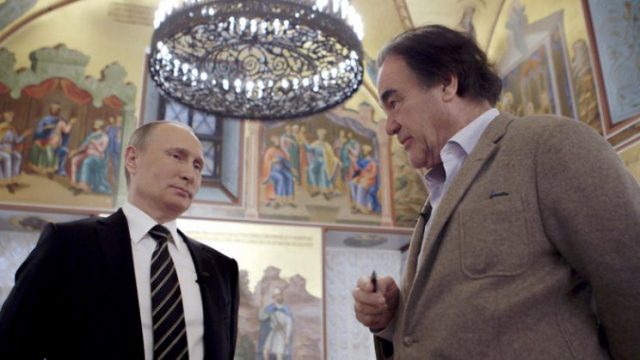
Oliver Stone interviewing Russian President Vladimir Putin in Showtime’s “The Putin Interviews.”
By Robert Parry | Consortium News | June 13, 2017
There was a time when I thought that it was the responsibility of an American journalist to hear all sides of a dispute and then explain the issue as fairly as possible to the American people, so they would be armed with enough facts to make their own judgments and act as the true sovereigns in a democracy.
I realize how naïve that must sound today as American journalism has shifted to a new paradigm in which the major news outlets view it as their duty to reinforce whatever the establishment narrative is and to dismiss or discredit any inconvenient facts or alternative analyses.
Today, The New York Times, The Washington Post and the rest of the mainstream media permit only the narrowest of alternative views to be expressed or they just pile into the latest groupthink whole hog.
So, that is why director Oliver Stone’s four-part series of interviews with Russian President Vladimir Putin on “Showtime” will surely draw near-universal outrage and ridicule from the big U.S. media. How dare anyone let Putin explain how he views the challenges facing the world? Can you believe that any right-thinking American would treat the Russian leader with civility and – god forbid – respect?
The new American media paradigm requires either endlessly insulting Putin to his face or aggressively blacking out his explanations, especially if they are based on information that puts the U.S. government in a negative light. The American people must be protected from this “Russian propaganda and disinformation.”
In other words, with the mainstream “guardians of truth” forewarning the American people not to watch Stone’s “The Putin Interviews,” the series will probably draw a relatively small viewership and the demonizing of Putin and Russia will continue unabated.
The American public can thus be spared some disturbing historical revelations and the unsettling vertigo that comes from hearing information that disrupts “what everyone knows to be true.”
In the “director’s cut” or long-form version of the four-part series that I watched, Stone does allow Putin to offer detailed explanations of his thinking on current crises, but also draws from Putin acknowledgements that might be surprising coming from a Russian leader. He also puts Putin in some uncomfortable binds.
–Regarding the Soviet Union’s development of the nuclear bomb in the late 1940s, Putin said Russian and German scientists were working on the project but got help from participants in the U.S. nuclear program:
“Our intelligence also received a lot of information from the United States. Suffice it to remember the Rosenberg spouses who were electrocuted. They didn’t acquire that information, they were just transferring that information. But who acquired it? The scientists themselves – those who developed the atomic bomb.
“Why did they do that? Because they understood the dangers. They let the genie out of the bottle. And now the genie cannot be put back. And this international team of scientists, I think they were more intelligent than the politicians. They provided this information to the Soviet Union of their own volition to restore the nuclear balance in the world. And what are we doing right now [with the U.S. withdrawal from the Anti-Ballistic Missile Treaty]? We’re trying to destroy this balance. And that’s a great mistake.”
–Regarding the origins of modern Islamist terrorism, Putin said: “Al Qaeda is not the result of our activities. It’s the result of the activities of our American friends. It all started during the Soviet war in Afghanistan [in the 1980s] when the American intelligence officers provided support to different forms of Islamic fundamentalism, helping them to fight the Soviet troops in Afghanistan.
“So the Americans themselves nurtured both Al Qaeda and [Osama] bin Laden. But it all spun out of control. And it always happens. And our partners in the United States should have known about that. So they’re to blame.”
Stone noted how President Reagan’s CIA Director William Casey sought to exploit Islamic fundamentalism to destabilize Muslim parts of the Soviet Union and to achieve regime change in Moscow.
Putin added: “Those ideas are still alive. And when those problems in Chechnya and the Caucasus emerged [after the collapse of the Soviet Union in 1991], the Americans, unfortunately, supported those processes. We [Russians] assumed the Cold War was over, that we had transparent relations, with the rest of the world, with Europe and the U.S. And we certainly counted on support, but instead, we witnessed that the American Intelligence services supported terrorists.
“I’m going to say something very important, I believe. We had a very confident opinion back then, that our American partners in words were talking about support to Russia, the need to cooperate, including fighting terrorism, but in reality they were using those terrorists to destabilize the internal political situation in Russia.”
–Regarding NATO expansion into Eastern Europe,” Putin said, “There was a deal not to expand NATO eastward. [But] this deal was not enshrined in paper. It was a mistake made by Mr. Gorbachev [the last president of the Soviet Union]. In politics, everything must be enshrined in paper.
“My impression is that in order to justify its existence, NATO has a need of an external foe, there is a constant search for the foe, or some acts of provocation to name someone as an adversary.”
–Regarding NATO missile bases being installed in Eastern Europe, Putin said: “And what are we supposed to do. In this case we have to take countermeasures. We have to aim our missile systems at facilities that are threatening us. The situation becomes more tense. …
“There are two threats for Russia. The first threat, the placement of these anti-ballistic missiles in the vicinity of our border in the Eastern European countries. The second threat is that the launching pads of these anti-ballistic missiles can be transformed within a few hours into offensive missile launching pads. Look, if these anti-ballistic missiles are placed in Eastern Europe, if those missiles are placed on water, patrolling the Mediterranean and Northern Seas, and in Alaska, almost the whole Russian territory would be encircled by these systems.
“As you can see, that is another great strategic mistake made by our partners [a word that Putin uses to refer to the United States]. Because all these actions are going to be adequately answered by Russia. And this means nothing else but a new cycle of an arms race. …
“When the Soviet Union collapsed, they [American leaders] were under the illusion that the U.S. was capable of anything, and they could [act] with impunity. That’s always a trap, because in this situation the person or the country begins to commit mistakes. There is no need to analyze the situations, or think about the consequences. And the country becomes inefficient. One mistake follows another. And I think that is the trap the U.S. has found itself in.”
–Regarding the prospect of nuclear war, Putin said, “I don’t think anyone would survive such a conflict.” Regarding U.S. plans for creating a missile shield, he said, “There is a threat deriving from the illusion of being protected, and this might lead to more aggressive behavior. That is why it is so important to prevent unilateral actions. That is why we propose to work jointly on the anti-ballistic missile system.”
–Regarding the American neoconservatives who now dominate the U.S. foreign policy establishment and the major news media, Stone described “the neoconservative element as being so hungry to make their point, to win their case that it’s dangerous.” Putin responded, “I fear them too.”
–In an interview on Feb. 16, 2016, Stone asked about the U.S. presidential campaign to which Putin replied, “We are going to be ready to work with whoever gets elected by the people of the United States. I said that on several occasions and that’s the truth. I believe nothing is going to change no matter who gets elected. … The force of the United States bureaucracy is very great. And there are many facts that are not visible to the candidates until they become President. And the moment one gets to real work, he or she feels the burden. …
“My colleague, Barack Obama, promised to close Guantanamo. He’s failed to do that. But I’m convinced that he sincerely wanted to do that. … Unlike many partners of ours, we never interfere within the domestic affairs of other countries. That is one of the principles we stick to in our work.”
–In a February 2017 interview, which was added amid the escalation of charges that Russia interfered in the U.S. election, Stone noted that Donald Trump is “your fourth president” and asked, “what changes?”
“Almost nothing,” Putin said with a wry smile. “Life makes some changes for you. But on the whole, everywhere, especially in the United States, the bureaucracy is very strong. And bureaucracy is the one that rules the world.”
Asked about alleged Russian interference to help Trump, Putin responded: “You know, this is a very silly statement. Certainly, we liked President Trump and we still like him because he publicly announced that he was ready to restore American-Russian relations. … Certainly, we’ve got to wait and see how, in reality, in practice, the relations between our two countries are going to develop. …”
Stone: “So why did you bother to hack the election then?”
Putin: “We did not hack the election at all. It would be hard to imagine any other country – even a country such as Russia would be capable of seriously influencing the electoral campaign or the outcome of an election. … any talk about our influencing the outcome of the U.S. election is all lies. They are doing it for a number of reasons.
“First, they are trying to undermine the legitimacy of President Trump, create conditions that must preclude us from normalizing our relations, and they want to create additional instruments to wage an internal political war. And Russia-U.S. relations in this context are just a mere instrument in the internal political fight in the U.S. … We know all their tricks.”
–Regarding cyber-war and the possibility that U.S. intelligence planted malware and back-doors in software sold to Russia, Putin said, “Well, you will probably not believe me, but I’m going to say something strange. Since the early 1990s, we have assumed that the Cold War is over. We thought there was no need to take any additional protective measures because we viewed ourselves as an integral part of the world community.
“We didn’t have any equipment of our own. Our companies, our state institutions and administrative departments, they were buying everything – hardware and software. And we’ve got much equipment from the U.S., from Europe, and equipment is used by the Intelligence Services and by the Defense Ministry. But recently we certainly have become aware of the threat that all of that poses.
“Only during recent years, have we started to think about how we can ensure technological independence, as well as security. Certainly we give it much thought, and we take appropriate measures. … We had to catch up with others.”
In an aside to Putin’s translator within earshot of Putin, Stone remarked: “He’s acting funny about this story, like he’s guilty a bit.”
–Regarding the dangers to Russia from U.S. cyber-warfare, Putin said: “It is almost impossible to sow fear among the Russian citizens. … And secondly, the economies that are more sophisticated, in technological terms, they are more vulnerable to this type of attack. But in any case, this is a very dangerous trend. A very dangerous avenue for competition to pursue and we need some rules to be guided by.”
When Stone raised the possibility of a treaty, Putin said, “I don’t want to say that, but you are simply drawing this information from me. You make me say that. One and a half years ago, in Autumn 2015, we came up with a proposal that was submitted to our American counterparts. We suggested that we should work these issues through and arrive at a treaty, an agreement on the rules to be guided by in this field. The Americans didn’t respond, they kept silence, they didn’t give us any reply.”
–Regarding allegations of Putin’s wealth, Stone asked, “Is there someway you could make your personal wealth clearer?”
Putin responded indirectly: “I remember when I moved to Moscow from St. Petersburg [in the 1990s], I was astounded and shocked by how many crooks had gathered here in Moscow and their behavior was so astounding, I couldn’t get used to it for a very long time. Those people didn’t have any scruples at all. … My task was to differentiate between power and money.”
Stone: “So there are no bank accounts in Cyprus?”
Putin: “No, and never have been. That’s just nonsense, and if that were the case we would have had to face it a long time ago.”
–Although Putin remained disciplined and controlled during the long sit-downs with Stone, the Russian president appeared most uncomfortable when Stone pressed him about his future plans and the risk of a leader viewing himself as indispensable to a nation.
Citing the possibility that Putin would have been in power – as either prime minister or president – for 24 years if he were to run for president again and win, Stone asked, “Do you feel that Russia needs you that badly?”
Putin: “The question you have asked whether Russia needs anyone that bad – Russia itself will decide. An alteration in power certainly has to exist. … In the end, let me reiterate – the citizens of Russia are going to make the final decision. Concerning the 2018 elections, I’d like to say there are things, things that should have some intrigue and mystery. So I am not going to answer that part of the question.”
Stone: “I said if…”
Putin: “We shouldn’t speak in the subjunctive mood.”
Stone then suggested more transparency in the next election.
A stern Putin responded: “Do you think our goal is to prove anything to anyone? Our goal is to reinforce our country.”
Stone: “That is a dangerous argument. It works both ways. Those who abuse power always say it’s a question of survival.”
Putin: “We are not talking about survival and we are not trying to justify ourselves. Certainly taking into account all the negative tendencies you’ve been talking about – the Soviet legacy, the Imperialist legacy, it’s something in the past. But we also have to think about the positive legacy. Russia has been built for a thousand years; it has its own traditions. We have our notions of what is just and unjust, we have our own understanding of what defines an efficient government.
“This is not a question of helping someone cling to power or to claim it for myself. This is about ensuring economic growth and sustaining it, improving our defense capabilities, and not just during periods of crisis and difficulties.”
Stone: “Mr. Putin, I don’t doubt for one moment your pride in serving Russia or that you are a son of Russia to me, and you have done very well by her. We all know the price of power. When we’re in power too long no matter what, the people need us but at the same time we’ve changed and we don’t even know it.”
Putin: “Indeed, this is a very dangerous state. If a person in power feels that they have lost it, this bond connecting this person to the country and to the rank-and-file citizens of the country, then it’s time for them to go.”
Britain’s Real Terror Apologists
By Finian Cunningham | Sputnik | June 11, 2017
Despite a vicious smear campaign to denigrate Britain’s Labour leader as a “terrorist sympathizer,” Jeremy Corbyn still pulled off an amazing achievement in the general election.
Hardly has a politician in any Western state been so vilified with character assassination, and yet he has proven to be most popular Labour leader in Britain since the Second World War.
After weeks of trailing his Conservative rival Theresa May in the polls, Corbyn’s socialist manifesto appealed to a record number of voters – closing the gap between the parties to only two percentage points behind the Tories.
This was in spite of a concerted media campaign to destroy Corbyn in the eyes of the British public as a “terrorist stooge.” The irony here is that the Conservative party is forming a governing coalition with a little-known Northern Ireland party whose history is steeped in British state terrorism. (More on that in a moment.)
For Corbyn, the election outcome was a stunning moral victory. For Prime Minister May it was a humiliating defeat. The Conservatives lost their overall majority in the British parliament and now they have to rely on this reactionary fringe party from Northern Ireland to form a government.
May called the snap election because she thought her party would increase its majority and also because she calculated that Corbyn’s socialist direction of Labour would be wiped out. Many Blairite naysayers in his own party thought so too.
The opposite happened. The British public largely rejected May and her neoliberal capitalist, pro-austerity, pro-NATO policies. They instead rallied behind Corbyn. Granted, the Tories still won the election – only narrowly – but the surge in support for Labour under Corbyn means that he has galvanized a party that stands a strong chance of winning if another election is called. And that could be soon, perhaps in the coming months owing May’s shaky ad hoc government collapsing.
Another riveting factor in all this is that Corbyn’s success came amid a torrential Tory and right-wing media campaign to denigrate him as a terrorist sympathizer. The propaganda onslaught was conducted for months since May called the election back in April. And it grew to a frenzy as election day approached last Thursday, especially when the opinion polls showed Labour steadily whittling away the earlier Conservative support.
The day before the public went to the polling booths, the Daily Mail ran the front page headline: “Apologist for terror,” with Jeremy Corbyn’s photo below. It looked like a “wanted poster” from the Wild West. The only thing missing was the subhead with the words: “Wanted dead or alive.”
The scurrilous allegation pounded over and over by the largely pro-Conservative British media that Corbyn is “soft on terrorism” stems from his otherwise principled history of campaigning on international justice and peace.
Over his 35 years as an MP, he has voiced consistent support for Palestinian rights under illegal Zionist occupation; he has supported Hezbollah resistance against Israeli and American aggression; and during the conflict in Northern Ireland, Corbyn gave a voice to Irish Republicans who were being assailed by British military violence.
Many other international causes could be mentioned, such as Corbyn opposing British government weapons dealing with the despotic Saudi regime which is propagating terrorism in Syria, Iraq and Yemen.
He has also campaigned to abandon nuclear weapons and is critical of NATO’s reckless expansion in Europe, which have earned him the jingoistic pillorying by the British establishment of “being soft on Russia.”
Corbyn has never condoned terrorism. Rather he has always sought to properly put it in a wider context of other parties also, unaccountably, using terrorism and thus fueling conflict.
This brings us to so-called Democratic Unionist Party (DUP) from Northern Ireland whose 10 MPs Theresa May’s Tories are now relying on to form a government. This party was formed in the early 1970s by the firebrand Protestant preacher Ian Paisley. While Paisley mellowed in later years before his death in 2014, he spent most of his career preaching vile hatred against Catholics and Irish Republicans, whom he saw as a threat to the political union between Northern Ireland and the rest of Britain. In British-run Northern Ireland, it wasn’t acceptable to have a democratic aspiration for an independent Ireland. You were either a pro-British unionist or a “threat.” So much for British democracy.
Senior members of Paisley’s pro-British party played a crucial role in smuggling massive caches of weapons into Northern Ireland during the 1980s to illegally arm unionist paramilitaries. These paramilitaries went on to murder hundreds of innocent people simply because they were Catholics, who tended to be Republican. A favored tactic of these paramilitaries was to storm into pubs and homes and indiscriminately mow people down with assault rifles.
One notorious pro-British killer was Gusty Spence who belonged to the Ulster Volunteer Force paramilitary. He later expressed remorse and deplored Ian Paisley, the DUP founder, as the person who incited him to murder innocent Catholics due to his sectarian hate speech.
The paramilitary murder gangs were not just supported covertly by members of the DUP. The British government of Margaret Thatcher – Theresa May’s predecessor and political heroine – orchestrated these same death squads in a covert policy of “dirty war.”
British military intelligence colluded with the pro-unionist militants to assassinate Republican politicians and ordinary Catholics alike in a covert policy of state-sponsored terrorism. The objective was to terrorize people in submitting to British rule over Northern Ireland, rather than allowing the island country to become united and independent.
The British government provided intelligence and cover for the death squads and the unionist politicians had helped supply the AK-47 assault rifles and Browning handguns smuggled from Apartheid South Africa.
This secret dirty war policy of the British government and their unionist proxies in Northern Ireland has been uncovered by investigative journalists such as Paul Larkin (see his groundbreaking book “A Very British Jihad: Collusion, Conspiracy and Cover-up in Northern Ireland”); as well as human rights campaign groups like Belfast-based Relatives for Justice and Pat Finucane Centre.
Not even the present government of Theresa May can deny this murderous legacy in Ireland, although there is a determined silence now as she fights for her political survival in the wake of the British election disaster.
It is a proven fact that May’s Conservative party and the unionist politicians whom she is now partnering with to govern Britain were complicit in terrorism.
Northern Ireland has since gained a peace settlement in which unionist and republican politicians have been able to work together to form a local governing administration. The Irish peace process was possible partly because of the courageous and principled intervention by British politicians like Jeremy Corbyn.
Corbyn has never apologized for terrorism. He has sought to overcome it by making politics work. The same cannot be said for Theresa May’s Conservative party. It was an accomplice and an apologist for a covert policy of state-sponsored terrorism during Northern Ireland’s recent 30-year conflict.
The very party whom she is now allied with for governing Britain – the DUP – were also apologists for paramilitaries who routinely smashed their way into family homes and slaughtered victims in cold blood in front of their loved ones.
The ongoing muted policy of May’s government and her unionist proxies about their murderous legacy in Ireland is a testimony to who the real apologists for terror are.
Trudeau Ramps Up Military
By Yves Engler | CounterPunch | June 12, 2017
It’s no wonder the Trudeau government has moved to ramp up military outlays. Even “left” commentators/politicians are calling for increased spending on Canada’s ecologically and socially destructive war machine.
Recently Defence Minister Harjit Sajjan announced a more than 70 per cent increase in military spending over the next decade. Canada’s new defence policy includes a significant increase in lethal fighter jets and secretive special forces, as well as enhancing offensive cyber-attack capabilities and purchasing armed drones.
A Globe and Mail story about the defence policy yesterday quoted David Perry, an analyst with the unabashedly militarist Canadian Global Affairs Institute, and UBC Professor Michael Byers, who has been described as the “angry academic voice of Canadian foreign policy” to denote his purportedly critical stance. In the story titled “Canada’s new defence spending must come quickly, experts say,” the paper reported:
“Byers said the Forces are currently in a state of ‘extreme crisis,’ with the Royal Canadian Navy running out of functioning ships and the Royal Canadian Air Force still years away from getting its new fleet of fighter jets. ‘The government has inherited a badly broken Canadian Forces and it clearly has a monumental task ahead that is only beginning,’ he said.”
Despite his affiliation with a peace organization, Byers supports increased military spending. The Rideau Institute board member has repeatedly expressed support for Canada’s war machine.
In 2015 the UBC professor published “Smart Defence: A Plan for Rebuilding Canada’s Military” which begins:
“Canada is a significant country. With the world’s eleventh largest economy, second largest landmass and longest coastline, one could expect it to have a well-equipped and capable military. However, most of this country’s major military hardware is old, degraded, unreliable and often unavailable. When the Harper government came to power in 2006, it pledged to rebuild Canada’s military. But for nine long years, it has failed to deliver on most of its promises, from new armoured trucks and supply ships to fighter jets and search-and-rescue planes.”
The Rideau Institute/Canadian Centre for Policy Alternatives report was partly an attack against the Stephan Harper government’s supposed lack of military commitment. In “Smart Defence,” Byers writes, “Prime Minister Stephen Harper has reduced defence spending to just 1.0 per cent of GDP — the lowest level in Canadian history.”
Byers has long called for increased military spending. In a chapter in Living with Uncle: Canada-U.S. relations in an age of Empire, edited by then CCPA leaders Bruce Campbell and Ed Finn, Byers notes that “the defence budget, roughly 1.2 per cent of GDP, is a bit low by comparable standards.” He describes writing a 2004 paper for NDP Defence Critic Bill Blakey that called for a $2- to 3-billion-per-year increase in military spending. “A defence budget increase,” it noted, “essentially repairs some of the damage that was done by a decade and a half of neglect.” But the military budget was about $15 billion and represented 10 per cent of federal government outlays at the time.
A former NDP candidate and adviser to Tom Mulcair, Byers’ position is similar to that of the social democratic party’s leadership. After the federal budget in March the NDP Leader criticized the Liberals for not spending enough on the military. “Canadians have every right to be concerned,” Mulcair said. “We are in desperate need of new ships for our Navy, we’re in desperate need of new fighter aircraft for our Air Force, and there’s no way that with the type of budget we’ve seen here that they’re going to be getting them.”
The NDP has staunchly defended Canadian militarism in recent years. During the 2011 and 2015 federal elections the party explicitly supported the Harper government’s large military budget. In 2011 party leader Jack Layton promised to “maintain the current planned levels of Defence spending commitments” and the 2015 NDP platform said the party would “meet our military commitments by maintaining Department of National Defence budget allocations.”
In addition to backing budget allocations, the NDP has criticized base closures and aggressively promoted the National Shipbuilding Procurement Strategy, a $60-billion effort to expand the combat fleet over three decades (over its lifespan the cost is expected to top $100 billion).
I’ve yet to come across a formal party statement about yesterday’s announcement. What do those currently vying for NDP leadership think of the Trudeau’s new defence policy and how will they respond?
Corbyn’s victory is greater than the keys to Number 10
By Nasim Ahmed | MEMO | June 9, 2017
Britain underwent the most important general election of this century. For the second time in a row, Conservative leaders scored the most spectacular own goal ever to be seen. Twice within the period of two years, British prime ministers gambled with the lives of the British people and lost; on both occasions Conservative leaders put their self-interest above the national interest and the electorates punished them for it.
It has now become resoundingly clear that the electorate does not like being taken for granted. Former Prime Minister David Cameron and current Prime Minster Therese May have learnt this the hard way. Cameron paid the highest political price in gambling to hold an EU referendum for no reason other than to please his own backbenchers. May too will most likely pay the same price for her humiliating defeat in calling a snap general election for no reason other than to inflict a crushing defeat on the Labour party.
But it is the Conservatives that have suffered a great defeat, even though they have won the election and are still in power. Hubris and opportunism assured their humiliation. They imagined they would have a landslide victory and increase their control of the Commons. With more Conservative MPs May was confident – to the point of carelessness – in being able to ease through a hard Brexit. She underestimated the opposition leader, Jeremy Corbyn. Believing him to be weak and unpopular, a caricature from bygone years, she was certain of attaining absolute power.
That we are now talking about the triumph of Corbyn over May is one of the more remarkable stories in British politics. Rarely has another leader had to take on so many enemies. He wrestled against the Tory war machine while fending off foes within his own party. The vast majority despised everything he represented culminating in172 Labour MPs voting against him in a no confidence motion. Labour MPs at one point were talking about going through an ongoing cycle of leadership contests until they forced him out. With such a desire to sabotage his campaign it would be naïve to assume that some Labour MPs were not secretly collaborating with the Tory party to see his downfall.
While the major parties in Westminster were gunning for him, the mainstream media stooped to levels unseen in British politics. For long periods, the entire mainstream media undermined him, mocked him, ridiculed him and constructed a narrative that would have totally damaged any other candidate. The traditional so called left wing media were nowhere to be seen, in fact they cheered for his public execution. Even his so called friends defected saying “I’d find it hard to vote for Corbyn”.
The inability of the Labour MP’s and the mainstream media to see what was happening was further proof that the entire establishment was really out of touch. They lived in their own little bubble inside an enormous echo chamber, thoroughly convinced of the lies and propaganda they propagated.
Faced against such challenges the achievement of Jeremy Corbyn in the last two years has been nothing short of remarkable. What this has shown more than anything else is the growing appetite for social justice; even socialism shall we say. He has turned Labour into a socialist party with the largest membership in Europe. Public ownership, and civic and community pride have all been returned to the political agenda. Corbyn has also succeeded where many before him have failed; to empower large sections of the population that were living in self-imposed political alienation. There’s a younger generation who have spoken for the first time and they have turned their back on austerity and having to settle for the crumbs left behind from the Chancellor’s budget.
The triumph of Corbyn is likely to see a push back against decades of unhindered neo-liberal economic policy which has been responsible for unprecedented levels of inequality not just here in the UK but also around the globe. This victory, as many believe, is substantial.
Corbyn has not won the election but his triumph has been to bring back into public ownership, not-for-profit utility companies, and investment in the health service, the police and public services back on the agenda. Privatisation, free market fundamentalism, and bankers’ greed at everyone else’s expense is now blown out of the water.
The Labour leader achieved wide popularity because of his ethical foreign policy. His years in the back benches have been spent defending human rights across the world and fighting against imperialism and political domination of all kind. In his manifesto he promised to block the sale of weapons to repressive regimes and pushed for a more ethical exports policy. The rights of the Palestinian people are very close to his heart. It was, telling that despite the mudslinging against him over his track record in the Middle East he has come through unscathed if not stronger.
No coming election can ignore the issues raised by Corbyn over the past few years. He may not have won the election but the victory he has achieved is more than just the keys to number ten. Equality, social justice and ethical foreign policy are back on the agenda and the mainstream media can go on mulling over them by eating some humble pie.
25,000 troops to take part in largest US-led Black Sea drills in July
RT | June 7, 2017
The largest US-led drills in the Black Sea area this year will see 25,000 American and allied troops gather in Bulgaria, Hungary and Romania this July for the annual ‘Saber Guardian 2017’ exercises.
The fifth edition of the annual Saber Guardian war-games, scheduled for July 10-20, will be “larger in both scale and scope” compared to previous years, the US European Command said in a statement.
It will amass around 25,000 servicemen from the US and 23 other nations, making it “the largest of the 18 Black Sea region exercises this year.”
According to the US European Command, the drills will focus on “participant deterrence capabilities, specifically, the ability to mass forces at any given time anywhere in Europe.”
The participating forces will also engage in an array of live fire exercises, river crossings and a mass casualty exercise.
The European-based 3rd Armored Brigade Combat Team, 4th Infantry Division and 2nd Cavalry Regiment are to represent the US military during the drills.
The Saber Guardian drills will be preceded and followed by a number of smaller exercises, in what the Americans calls “deterrence in action.”
Also on Wednesday, the US European Command announced the arrival of “several” B-1B heavy bombers from Ellsworth Air Force Base in South Dakota to the Fairford Airbase in the UK.
The bombers will support the separate Saber Strike and BALTOPS exercises to take place in the Baltics, and elsewhere in Europe this June.
Saber Strike is an annual exercise which was first staged in 2010 to improve cooperation among allies, while promoting regional stability and security, the US European Command said.
The current chapter of the so-called BALTOPS multinational drills will involve 4,000 navy personnel, 50 ships and submarines and more than 50 aircraft.
On Tuesday, Russia scrambled jets to intercept a nuclear-capable US B-52 strategic bomber which was flying in neutral airspace over the Baltic Sea along the Russian border.
NATO used the Ukrainian conflict and Crimea’s reunion with Russia in 2014 as a pretext to boosting its military presence in Eastern Europe, which it says is necessary to reassure allies in the face of the “Russian threat.”
The US-led military alliance is regularly staging drills near Russia’s borders, involving troop numbers and hardware unseen since the Cold War.
Russia denies having any aggressive designs on Eastern Europe and believes that NATO is vilifying Moscow to justify increased defense spending among the nations in the military alliance.
Moscow sees NATO’s relentless military buildup in neighboring countries as a security threat, and has responded by strengthening its own forces in the western part of Russia.
On Tuesday, Russian Foreign Minister, Sergey Lavrov, blamed NATO of returning to “the policy of dividing lines In Europe” as he commented on the inclusion of Montenegro as the bloc’s 29th member.
READ MORE: Montenegro’s accession to NATO a purely geopolitical project, won’t boost security – Lavrov
Featured Video
BRITAIN’S WARNING: PREPARE FOR WAR
or go to
Aletho News Archives – Video-Images
From the Archive
How Ukraine Tortured and Slaughtered Donbass
By Kit Klarenberg | Al Mayadeen | July 11, 2024
Almost immediately after the proxy war erupted, ISIS-tier footage of the torture and murder of Russians in Ukrainian custody emerged.
On July 6th, the New York Times published an astonishing investigation: In Ukraine, Killings of Surrendering Russians Divide an American-Led Unit. The article documents in grim detail how Chosen Company, an international volunteer battalion for Kiev, routinely executes Russian prisoners of war. It is the very first mainstream admission that this practice – a brazen breach of the Geneva Conventions, and a grave war crime – is widespread among Ukraine’s fighters, both foreign and homegrown. … continue
Blog Roll
 Aletho News
- Israel Demolishes Home Of Lebanese Journalist Whose Viral Film Exposed Pager Attack
- Record Oil, Empty Tanks: The UAE’s Miracle Recovery
- Burnham tackles Britain’s poverty with aggression in Yemen
- Peace in Ukraine: the easy way – or the hard way
- Trump & the Rrrrussians
- US taxpayer money laundered back through Ukraine – Musk
- Before COVID, an NIH lab chief proposed making a SARS-like bat virus more infectious
- Gates, Bourla on Trial in Netherlands Accused of ‘Great Reset’ Scheme at Vaccine Injury Hearing
- BRITAIN’S WARNING: PREPARE FOR WAR
- “Historic Russia”: The Land Putin Will Not Give Back
- If Americans Knew
- DAILY UPDATE: Latest essential news on Palestine, Israel, & region
- Damning report shows the media must confront its failures on Gaza
- BBC senior broadcaster speaks out on Gaza coverage
- Netanyahu vows vast West Bank invasion in response to 20-minute skirmish that left 2 Israeli soldiers and 2 Palestinian fighters dead
- Tied up and tortured: Israel using US-made electroshock weapons on Palestinian detainees
- The outsourced risk: how newsrooms rely on Gaza’s freelancers without protecting them
- Gaza bakeries forced to shut as Israel blocks flour shipments
- Gaza’s breast cancer patients face a deadly wait for treatment amid Israel’s genocide
- DAILY UPDATE: Latest essential news on Palestine, Israel, & region
- The Israel Lobby’s Changing Fortunes
- No Tricks Zone
- Two New Studies Find Thwaites Glacier Melt Cannot Be Driven By Human Activity Or A Warming Ocean
- E-Cars Reduce CO2 Emissions By Only 41% Compared To Internal Combustion Engine Vehicles
- Predictions Made By Renowned Climate Professor Over Past Decades Have Been Proven To Be Poor
- New Study Suggests Large Regions Of The Pacific Ocean Have Been Cooling For The Last 80 Years
- Germany’s Green Energy Debacle: High Energy Costs Force Kahla Porzellan to Close After 182 Years!
- New Study: 50 Years Of The Most Aggressive ‘Net Zero’ Policies Can Only Affect The Global Climate By 0.03°C
- US September “Heat” Was No Record…Many Records Set Decades Ago
- Latest European Green Energy Debacle; Portugal’s Largest Flagship Solar Park Insolvent!
- Green Energy Debacle: German Expert Professor Fritz Vahrenholt Warns Of Severe Economic And Social Consequences
- Two More Paleo Reconstructions Affirm Meters-Higher Sea Levels Across Ireland, Brazil 7000-6000 Years Ago

