Most European Nations Act More Like US Colonies Than Sovereign States
By Stephen Lendman | June 5, 2016
Instead of declaring their independence, most European nations let Washington pressure, bully and bribe them to go along with its imperial agenda, harming their own national security.
Economic powerhouse Germany remains occupied since WW II ended, permitting numerous US bases on its territory, some jointly operated, harming its security, not protecting it.
Instead of normalizing relations with Russia, a reliable ally, Die Welt newspaper said a new Defense Ministry White Paper near completion lists it as one of Germany’s 10 major threats, despite no credible evidence suggesting it – plenty proving otherwise.
Other threats include international terrorism – without explaining it is US created and Berlin supported. Terrorist groups can’t exist without state sponsors.
According to sources quoting what the report says, Russia is Germany’s key rival, using “hybrid instruments to blur the boundaries between war and peace… undermin(ing) other states.”
Moscow’s military strength (almost entirely on its own territory, solely for defense and fighting terrorism in Syria), technological capability, nonexistent “aggression,” reunification with Crimea, and ability to influence public opinion are contrived reasons for considering Moscow a key rival and threat, not a partner – despite Putin urging cooperative relations with all nations, the world’s preeminent peacemaker.
Germany’s Merkel is polar opposite. So are most other European leaders, allied with Washington’s killing machine, humanity’s greatest threat.
She urges greater militarism, not less, at a time demilitarization and all-out efforts for world peace are desperately needed.
The alternative is endless war, European nations threatened because of allying with Washington’s imperial agenda instead of firmly opposing it for their own self-interest.
Stephen Lendman lives in Chicago. He can be reached at lendmanstephen@sbcglobal.net.
His new book as editor and contributor is titled Flashpoint in Ukraine: US Drive for Hegemony Risks WW III.
NATO Baltic wargames have ‘political, economic & military motives’
RT | June 5, 2016
The US strategy in Europe is aimed at strengthening its control over EU and NATO states, selling more military equipment to its European allies to make super-profits for its military-industrial complex and to isolate Russia, political author Diana Johnstone told RT.
NATO is holding major sea drills in the Baltic Sea. The BALTOPS exercises, which kicked off on Friday in Estonia and will continue until June 19, involve 15 member states of the military alliance as well as Finland and Sweden.
RT: NATO is conducting major drills across the Baltic. Is there a bigger political message here or is it just an exercise?
Diana Johnstone: Yes, they have been doing exercises like this for quite a while and the pretext changed. At least this time they are not pretending like with the missile shield that it is to protect Europe from Iran. The line has changed now, because the US is coming right out with their aggressive actions toward Russia. You have to see the political, economic and military motives for this. The economic motive is obviously to sell more US military equipment to European allies, who don’t need it and can’t afford it. But that is important for the US military-industrial complex. Politically this is the strengthening of US control of EU countries and NATO countries, and to isolate Russia – to carry out this famous [Zbigniew] Brzezinski strategy of separating Russia from Europe to promote US hegemony over the Europe and the world.
RT: A lot of people in Eastern Europe oppose this kind of strategy. The general public is not particularly happy about this, are they?
DJ: Of course those Baltic States, whose governments by the way are satellite governments of the US. The top officials studied in the West, in the US and Canada. These have gone from being Russian satellites to be American satellites. They pretty much follow the US direction. But that is not the case of the rest of Europe, which is simply ignoring this, like it is not happening. The Czechs are aware of it, so they are protesting. But for instance, here in France nobody mentions this, because frankly people wouldn’t be in favor of it at all. This is destroying defense of Europe. It is just turning into an instrument of US policy.
RT: Last week, NATO Secretary General Jens Stoltenberg announced plans to strengthen defenses, particularly against Russian foreign policy calling it “a defensive and proportionate response to Russia’s actions in Crimea and Eastern Ukraine.” At the same time recently he said that they strived “for a more constructive relationship with Russia.” Shouldn’t it be more talking going on, rather than deploying troops and hardware?
JS: We are used to now seeing the US – in the Middle East they say one thing and do the opposite. It’s just amazing to me that people can say things like that. It is totally absurd. Obviously there is nothing offensive about the people of Crimea going back to Russia, to which they belonged before… There is not tiny bit of an aggressive move of Russia towards the West. That is a total fiction… So these people are just lying. They cannot know that.
Russia questions “artificial” delay in Syrian peace talks
The BRICS Post | June 5, 2016
Russian Foreign Minister Sergey Lavrov, in a phone conversation with his US counterpart John Kerry, has expressed concern over “artificial” delays in the Syrian peace talks.
The UN-backed parties have not set a date for the resumption of the peace talks after the High Negotiations Committee suspended its participation over the intensifying of regime air strikes in recent weeks.
“They have discussed the situation in Syria in development of the telephone conversation they had a day earlier,” the Russian Foreign Ministry said. “Besides stressing the urgent task to separate the “moderate” opposition from Jabhat Al-Nusra, as the U.S. has promised earlier, Lavrov has expressed concern of the attempts to delay resuming of political talks for various artificial reasons, which was seen clearly during the UN Security Council briefing on Syria on June 3,” said a Russian Foreign Ministry statement.
The phone call was initiated by the US side.
Lavrov’s comments came amid a major Russian-backed offensive against the de-facto home of the Islamic State that aided the Syrian army’s push into Raqqa province on Saturday.
The Syrian army had made territorial gains and inflicted heavy casualties on the militants, state media reports said.
The UK-based Syrian Observatory for Human Rights said on Saturday at least 26 Islamic States militants had been killed along with nine from the Syrian and allied forces.
Meanwhile, more than 1,000 militants have begun an offensive against Syrian army positions southwest of Aleppo, the Russian ceasefire monitoring centre in Syria said in a statement on Saturday.
The chief peace negotiator of Syria’s main opposition bloc said last week that he was resigning over the failure of the UN-backed Geneva peace talks to bring a political settlement to the Syria crisis.
Hillary Comes Out as the War Party Candidate

By Diana Johnstone | CounterPunch | June 3, 2016
On June 2, a few days before the California primary, Hillary Clinton gave up trying to compete with Bernie Sanders on domestic policy. Instead, she zeroed in on the soft target of Donald Trump’s most “bizarre rants” in order to present herself as experienced and reasonable. Evidently taking her Democratic Party nomination for granted, she is positioning herself as the perfect candidate for hawkish Republicans.
Choosing to speak in San Diego, home base of the U.S. Pacific Fleet, on a platform draped with 19 American flags and preceded by half an hour of military marching music, Hillary Clinton was certain of finding a friendly audience for her celebration of American “strength”, “values” and “exceptionalism”. Cheered on by a military audience, Hillary was already assuming the role to which she most ardently aspires: that of Commander in Chief of the Armed Forces.
Whenever Hillary speaks, one must look for the lies. The biggest lies in this speech were lies of omission. No mention of her support for the invasion of Iraq, no mention of the disaster she wrought in Libya, no mention of her contribution to pursuing endless death and destruction in the Middle East.
But she also lied in claiming partial credit for the Iran nuclear deal, which she had tended to block, and most profoundly in presenting herself as a champion of diplomacy. As Secretary of State, she blocked diplomacy that would have prevented or ended conflict, most notoriously concerning Libya, where even senior U.S. military officers were told to cut off their contacts with Gaddafi agents seeking a peaceful compromise.
The Washington Post reported prior to the speech that her campaign “hopes there are many more national-security-minded Republicans and independents who would vote for her, even grudgingly, rather than see Trump win the White House.”
The Washington Post noted that the state of California’s “defense industry and military bases lend a backdrop for her speech.” Indeed! Hillary Clinton is quite simply catering to the military-industrial complex, as she has been doing throughout her career. She is catering to the arms industry, which needs to keep the American people scared of various “threats” in order to continue draining the nation’s wealth into their profitable enterprises. She needs the support of military men and women who believe in all those threats invented by intellectuals in think tanks and editorial offices.
This is the core of the “national-security-minded” electorate that Hillary is targeting. She warned that Trump would jeopardize the wonderful bipartisan foreign policy that has been keeping us great and safe for decades.
In reality, such “national-security-minded” leaders as Dick Cheney and Clinton herself have led the United States into wars that create chaos, inspire enemies and endanger everybody’s national security. Despite the geographically safe position of the United States, it is that bipartisan War Party that has created genuine threats to U.S. national security by prodding the hornets’ nest of religious fanaticism in the Middle East and provoking nuclear-armed Russia by aggressive military exercises right up to its borders.
The basis of Hillary Clinton’s world view is that notorious “American exceptionalism” which Obama has also celebrated. If we don’t rule the world, she suggested, “others will rush in to fill the vacuum”. She clearly cannot conceive of dealing respectfully with other nations. The United States, she proclaimed, is “exceptional – the last best hope on earth.”
Not all people on earth feel that way. So they must be brought to heel. In practice, this “exceptionalism” means acting above the law. It means a unipolar world policed by U.S. armed forces. In practice, Hillary’s devotion to “our allies” means fighting wars in the Middle East for the benefit of Israel and of Saudi Arabia, whose arms purchases are indispensable for our military industrial complex. It means bombing countries and overthrowing foreign governments, from Honduras to Syria and beyond, in order to help them conform to “our values”.
Trump is groping clumsily, at times idiotically, toward a major shift in US foreign policy. He is ill-prepared for the task. If ever elected, he would have to fire the neocons and take on a whole new team of experts to educate and guide him. That would be something of a miracle.
But some of Hillary’s reproaches aimed at Trump’s “reckless, risky” foreign policy statements are not as self-evident as she assumes. For example, his statement that he would sit down to negotiate with North Korean dictator Kim Jong Un. Is that really such a crazy idea?
North Korea is a small country, whose leaders call themselves “communist” but who are essentially a dynasty that emerged from the resistance against Japanese invaders in World War II. Their quarrel with South Korea stemmed from the domination of Japanese collaborators in that part of the country. That is practically ancient history, and today North Korea feels threatened – and is indeed threatened – by the everlasting U.S. military presence on its borders. A small isolated country like North Korea is not a real “threat” to the world. Even with nuclear weapons. Its much-vaunted nuclear weapons are clearly meant both to defend itself from attack and as a bargaining chip.
So would it be so terrible to sit down and find out what the bargain might be? Basically, North Korean leaders would like to make a deal to lessen the U.S. threat and bring their country out of isolation. Why not discuss this, since it could lead to the end of the “North Korean threat” which is artificial anyway?
Hillary’s reaction is typical. She boasts that her solution is to build up an expensive missile defense shield in Japan and increase everybody’s military buildup in the region. As usual, she goes for the military solution, ridiculing the notion of diplomacy.
Hillary Clinton’s speech will certainly sound convincing to the “national security minded” because it is so familiar. The same as George W. Bush but delivered with much greater polish. America is good, America is great, we must remain strong to save the world. This is the road to disaster.
Hillary Clinton is the clear candidate of the War Party.
 Diana Johnstone is the author of Fools’ Crusade: Yugoslavia, NATO, and Western Delusions. Her new book is Queen of Chaos: the Misadventures of Hillary Clinton. She can be reached at diana.johnstone@wanadoo.fr
The Lazy Pundit’s Guide to Which Candidate’s Lies You Shouldn’t Care About
By Jim Naureckas | FAIR | June 1, 2016
Thomas Friedman kicks off the summer punditry season with a column (New York Times, 6/1/16) explaining that while “lying is serious business,” some candidates’ lies are more serious than others. For example, “Hillary’s fibs or lack of candor are all about bad judgments she made on issues that will not impact the future of either my family or my country,” whereas “Trump and Bernie Sanders have been getting away with some full Burger King Double Whoppers that will come crashing down on the whole country if either gets the chance to do what he says.”
The Donald Trump portion of the column mainly illustrates the laziness of a wealthy pundit looking forward to beach season. Friedman explains to Trump why “we can’t carpet-bomb the terrorists without killing all the civilians around them”—forgetting, or not caring, that carpet-bombing terrorists was Ted Cruz’s line, not Trump’s.
He demands an explanation from Trump: “On Mexico, please tell me why it would pay for a multibillion-dollar wall on our border and how we would compel our neighbor to do so.” Trump has been claiming since last year, at least, that he could force Mexico to pay for the wall by blocking immigrant workers from sending home money—but Friedman seems not to have heard about it.
His attack on Sanders doesn’t display much more enterprise:
He is promising to break up the big banks. Under what legal authority? What would be the economic fallout? And how would this raise stagnant incomes for middle-class Americans? Bernie mumbles on these questions.
Here Friedman picks the most obvious target, the issue that corporate media—following the lead of the Clinton campaign—most concertedly beat up Sanders over. The problem is that many of those same outlets, when they filed follow-up stories about the controversy (e.g. New York Times, 4/6/16; Washington Post, 4/7/16; Politico, 4/14/16), walked back the criticism, acknowledging that, as the Times’ Peter Eavis put it, “Bernie Sanders probably knows more about breaking up banks than his critics give him credit for.”
Friedman also cites the Tax Policy Center’s figures for increased federal spending under Sanders’ proposals—which mostly come from the Urban Institute’s estimates for the cost of his single-payer plan, which have come under heavy criticism from experts on single-payer financing. Without rehashing the entire argument, it’s worth noting, as the Urban Institute does in its defense of its report, that the bulk of the huge numbers thrown about do not reflect new spending:
Of the $32.0 trillion in additional federal costs, only $6.6 trillion reflects new health spending in the system; the remaining $25.4 trillion is produced by shifting existing state and local government spending and private spending to the federal government.
As for why every other wealthy country can provide healthcare to all citizens and pay considerably less per capita to do so, but single-payer would supposedly raise and not lower costs in the US, the Urban Institute report offers this: “Political compromises with the entire panoply of health care stakeholders would be necessary to make the plan acceptable.” In other words, it’s impossible to do anything that would significantly change the distribution of income in the United States (other than to make it more unequal, as we have already done)—an assumption that not only the Sanders campaign but millions of Americans would certainly reject.
So those are the lies being told by Sanders and Trump, according to Thomas Friedman. What about Hillary Clinton’s “struggles with the whole truth on certain issues”? Not important. “Private email servers? Cattle futures? Goldman Sachs lectures? All really stupid, but my kids will not be harmed by those poor calls.”
Let’s put aside the issue that Goldman Sachs, the benefactor that Clinton won’t come clean about, was intimately involved in the economic crisis that certainly harmed millions of kids, though maybe not Friedman’s. Isn’t there anything else—something that even a low-information pundit like Thomas Friedman might have heard of?
Well, yeah. There is that. “Debate where she came out on Iraq and Libya, if you will, but those were considered judgment calls, and if you disagree don’t vote for her.”
Judgment calls? “I believe the facts that have brought us to this fateful vote are not in doubt,” Clinton said in her October 10, 2002, speech on the Senate floor explaining her vote for war:
In the four years since the inspectors left, intelligence reports show that Saddam Hussein has worked to rebuild his chemical and biological weapons stock, his missile delivery capability, and his nuclear program…. If left unchecked, Saddam Hussein will continue to increase his capacity to wage biological and chemical warfare, and will keep trying to develop nuclear weapons…. Now this much is undisputed.
Not only were those facts very much disputed and in doubt, they were flat-out wrong. It’s not clear why questioning cost estimates for your programs qualifies as “lying,” but maintaining that there was no debate about issues that were in fact intensely debated is merely a “judgment call.” But there’s another part of her speech that deals with events that she must have witnessed first hand—and she misrepresents those events:
When Saddam blocked the inspection process, the inspectors left. As a result, President Clinton, with the British and others, ordered an intensive four-day air assault, Operation Desert Fox, on known and suspected weapons of mass destruction sites and other military targets.
This sequence is precisely backwards: President Clinton decided to bomb Iraq, the inspectors left to facilitate that bombing, and subsequently Saddam Hussein refused to allow back in the inspectors who had been used as a pretext for bombing.
These events were reported accurately at the time; presumably Hillary Clinton observed them at close range. Her willingness to reinvent them for political purposes just four years later is a graphic example of how lies can “come crashing down on the whole country”—and why lying is, indeed, serious business.
Jim Naureckas can be followed on Twitter: @JNaureckas.
You can send a message to the New York Times at letters@nytimes.com (Twitter:@NYTimes). Please remember that respectful communication is the most effective.
Skynet: UK to upgrade war satellites to expand global drone kill operations
RT | June 3, 2016
Britain’s military plans to replace its ageing Skynet war satellites to meet the bandwidth demands of its expanding Special Forces and drone operations.
It is the first sign of the UK’s ambitions to create the next generation of military space satellites to replace the Skynet A5, the original version of which came into service in the 1960s.
It is now considering how to proceed with its Future Beyond Line of Sight (FBLOS) program.
Given the shadowy nature of the project, the Ministry of Defence (MoD) has been vague about the specifics, telling Defence News : “We continue to consider a range of options for the FBLOS project and aim to submit the initial business case this summer.”
The existing system was produced by arms giant Airbus. Upgrades are required to increase bandwidth to support the UK’s increasingly clandestine operations using special forces, the forthcoming F-35 combat aircraft and, perhaps most significantly, its expanding drone fleet.
The forthcoming assessment of military requirements will be carried out from the early 2020s to the end of that decade.
The upgrade is indicative of emerging trends in warfare, at a time when public resistance to the Afghanistan and Iraq wars has made large-scale troop deployments politically untenable.
Chris Cole, of the NGO Drone Wars, wrote on the possibility of a connection between Skynet and British military drones as long ago as 2010.
However, in a blog on the topic he pointed out: “Skynet 5 however is not owned by the Ministry of Defence, but by a private company called Paradigm Secure Communication.”
This would render Skynet virtually impervious to freedom of information (FoI) requests regarding its links with drone warfare, which can only be put to public bodies.
Speaking to RT on Friday, Cole said that as well as “doubling the UK’s current armed drone fleet and investing heavily in the development of future drones” the UK is working quietly to install “secret communication systems to enable the UK to use its armed drones right around the globe.”
He warned: “The continuing development of Skynet is an integral part of the government’s strategy to follow the US down the path of being able to target those it considers to be a threat, anywhere in the world.”
The Bigger Nuclear Risk: Trump or Clinton?
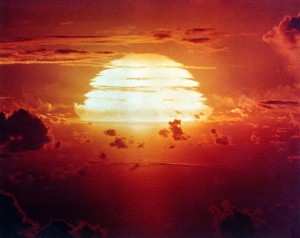
A U.S. government photograph of Operation Redwing’s Apache nuclear explosion on July 9, 1956.
By Robert Parry | Consortium News | June 2, 2016
Hillary Clinton made a strong case for why handing the nuclear codes over to a President Donald Trump would be a scary idea, but there may be equal or even greater reason to fear turning them over to her. In perhaps the most likely area where nuclear war could break out – along Russia’s borders – Clinton comes across as the more belligerent of the two.
In Clinton’s world view, President Vladimir Putin, who has been elected multiple times and has approval ratings around 80 percent, is nothing more than a “dictator” who is engaged in “aggression” that threatens NATO following the U.S.-backed “regime change” in Ukraine.
“Moscow has taken aggressive military action in Ukraine, right on NATO’s doorstep,” she declared. But stop for a second and think about what Clinton said: she sees Russia responding to an unconstitutional coup in Ukraine – which installed a virulently anti-Russian regime on Russia’s border – as Moscow acting aggressively “on NATO’s doorstep.”
That’s the same NATO, whose job it was to protect Western Europe from the Soviet Union, that — following the Soviet Union’s collapse — added country after country right up to Russia’s border. In other words, NATO muscled its way into Russia’s face and has announced plans to incorporate Ukraine as well, but when Russia reacts, it’s the one doing the provoking.
Clinton’s neoconservative interpretation of what’s happening in Eastern Europe is so upside-down and inside-out that it could ultimately become the flashpoint for a nuclear war between Russia and the West.
While she sees Russia as the “aggressor” against NATO, the Russians see NATO moving troops up to its borders and watch the deployment of anti-ballistic-missile systems in Romania and Poland, thus making a first-strike nuclear attack against Russia more feasible. Russia has made clear that it views these military deployments, just kilometers from major Russian cities, as an existential threat.
In response, Russia is raising its alert levels and upgrading its strategic forces. Yet, Hillary Clinton believes the Russians have no reason to fear NATO’s military encirclement and no right to resist U.S.-supported coups in countries on Russia’s periphery. It is just such a contradiction of viewpoints that can turn a spark into an uncontrollable inferno.
What might happen, for instance, if Ukraine’s nationalist — and even neo-Nazi — militias, which wield increasing power over the corrupt and indecisive regime in Kiev, received modern weaponry from a tough-talking Clinton-45 administration and launched an offensive to exterminate ethnic Russians in eastern Ukraine and to reclaim Crimea, where 96 percent of the voters opted to secede from Ukraine and rejoin Russia?
A President Hillary Clinton would have talked herself into a position of supporting this “liberation” of “Russian-occupied territory” and her clever propagandists would surely present this “heroic struggle” as a war of good against evil, much as they justified bloody U.S. invasions of Iraq and Libya which Clinton supported as U.S. senator and Secretary of State, respectively.
What if the Ukrainian forces then fired missiles striking Russia’s naval base at Sevastopol in Crimea, killing some of the 20,000 Russian troops stationed there and inflicting damage on Russia’s Black Sea fleet? What if Kremlin hardliners finally got their way and unleashed the Russian army to launch a real invasion of Ukraine, crushing its military, rumbling through to Kiev and accomplishing their own “regime change”?
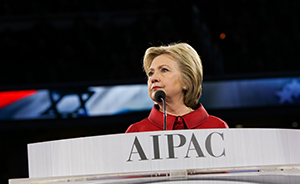
(Photo credit: AIPAC)
How would President Hillary Clinton respond? Would she put herself in the shoes of Russia’s leaders and search for some way to de-escalate or would she get high-and-mighty and escalate the crisis by activating NATO military forces to counter this “Russian aggression”?
Given what we know about Clinton’s tough-talking persona, the odds are good that she would opt for an escalation – and that could set the stage for nuclear war, possibly starting because the Russians would fear the imminence of a NATO first strike, made more possible by those ABM bases in Romania and Poland.
Clinton’s Non-Nuclear Wars
There are other areas in the world where a President Hillary Clinton would likely go to war albeit at a sub-nuclear level. During the campaign, she has made clear that she intends to invade Syria once she takes office, although she frames her invasions as humanitarian gestures, such as creating “safe zones” and “no-fly zones.”
In other words, although she condemns Russian “aggression,” she advocates aggressive war herself, seemingly incapable of recognizing her hypocrisies and only grudgingly acknowledging her “mistakes,” such as her support for the invasion of Iraq.
So, on Thursday, even as she made strong points about Trump’s mismatched temperament for becoming Commander-in-Chief, she flashed a harsh temperament of her own that also was unsettling, although in a different way.
Trump shoots from the lip and has a thin skin, while Clinton is tightly wound and also has a thin skin. Trump lets his emotions run wild while Clinton is excessively controlled. Trump engages in raucous give-and-take with his critics; Clinton tries to hide her decision-making (and emails) from her critics.
It’s hard to say which set of behaviors is more dangerous. One can imagine Trump having free-form or chaotic diplomatic encounters with allies and adversaries alike, while Clinton would plot and scheme, insisting on cooperation from allies and demanding capitulation from adversaries.
Clinton sprinkled her speech denouncing Trump with gratuitous insults aimed at Putin and undiplomatic slaps at Russia, such as, “If Donald gets his way, they’ll be celebrating in the Kremlin. We cannot let that happen.”
In short, there is reason to fear the election of either of these candidates, one because of his unpredictability and the other because of her rigidity. How, one might wonder, did the two major political parties reach this juncture, putting two arguably unfit personalities within reach of the nuclear codes?
[For more on this topic, see Consortiumnews.com’s “Yes, Hillary Clinton Is a Neocon” and “Would a Clinton Win Mean More Wars?’]
Investigative reporter Robert Parry broke many of the Iran-Contra stories for The Associated Press and Newsweek in the 1980s. You can buy his latest book, America’s Stolen Narrative, either in print here or as an e-book (from Amazon and barnesandnoble.com).
Diseases killed 10,000 Yemeni children in past year: UN
Press TV – June 2, 2016
The United Nations says some 10,000 of Yemeni children, all under five years of age, have lost their lives during the past year alone.
The deaths were caused by “totally avoidable and preventable diseases” such as diarrhea and pneumonia, UN spokesman Stephane Dujarric said Wednesday.
Yemen has been under Saudi military attacks almost on a daily basis since March 2015, which have killed thousands and destroyed the country’s civilian infrastructure, including hospitals, schools, and factories.
Dujarric said the heavy loss was due to the closure of hundreds of health centers and the total collapse of the healthcare system in the war-torn country.
“The overall healthcare system throughout Yemen has all but collapsed, over 600 health facilities closing their doors due to the lack of financial resources to procure medicine, supplies and fuel for generators,” he said, adding thousands of medical staff have gone unpaid or left Yemen.
“This suffering should, however, turn into an incentive to reach a rapid and comprehensive solution as we approach the month of Ramadan,” he said.
UN special envoy Ismail Ould Cheikh Ahmed also said reports from several cities showed the horrifying magnitude of the suffering that the Yemeni people are going through because of shortages in basic services.
In a March report, the UN Children’s Fund said a year of Saudi war on Yemen had left 934 children dead and 1,356 more injured, with an average of six children suffering casualties every day.
The report said some 320,000 children faced acute malnutrition, a serious case which can leave a child vulnerable to deadly respiratory infections, pneumonia and water-borne diseases.
In a similar report in March, Save the Children, a non-governmental organization, said about 90 percent of children in Yemen needed emergency humanitarian aid.
More than 9,400 people have been killed and at least 16,000 others injured since Saudi Arabia launched its attacks on Yemen. The kingdom launched the offensive in a bid to bring former president Abd Rabbuh Mansur Hadi back to power.
Hadi’s loyalists are fighting an all-out war against Houthis who have taken the control of Sana’a and some other areas to prevent them from falling to Takfiri extremists.
Saudi Arabia has been supporting Hadi forces from the air, ground and sea with attacks which, some analysts say, have helped Takfiris expand their foothold in Yemen.
Airstrikes have continued despite a ceasefire put in place since April, scuttling efforts to end the conflict.
Dujarric urged the warring parties to make concessions and put the interests of Yemen and Yemenis above all.
Cluster Bombs or Not, Washington Still Helps Saudis to ‘Wreck Yemen’
Sputnik – June 1, 2016
Washington has apparently decided to stop selling cluster munitions to Saudi Arabia as Riyadh’s is waging its devastating military campaign in Yemen with US-made weapons, however the long overdue measure will come too late, if it is implemented at all, Daniel Larison wrote for the American Conservative.
“There have been credible reports of the Saudi use of cluster bombs in civilian areas for more than a year, so the administration’s action is inexcusably tardy,” he observed.
The latest attack involving cluster munitions in Yemen took place less than five months ago. The Saudi military unleashed CBU-105 sensor fused weapons on a cement factory in the Amran governorate on February 15, Human Rights Watch reported. The Saudis have used cluster bombs in six assaults in total since launching an offensive on the poorest Arab country in the world in March 2015.
Saudi Arabia purchased as many as 1,300 CBU-105s from the US in August 2013. The weapons were supposed to be delivered by December 2015, but the shipments could take longer. It remains unclear whether Washington’s decision covers the existing agreement or is only meant to prevent future deals from taking place.
“The fact that it has taken the administration more than a year of indiscriminate coalition attacks on civilian areas to take even this first step shows how thoroughly the US has been enabling the Saudi-led war on Yemen,” Larison observed. “For the most part, the US is still enabling that war.”
Cluster bombs are air-dropped ground-launched explosive weapons that disperse over a large area and leave smaller bombs behind. If their remnants do not explode on impact, they turn into landmines. Cluster munitions have been banned by a treaty that more than 110 countries signed in 2008, but Saudi Arabia and the US are not among them.
If Washington’s decision to stop selling cluster munitions to the oil kingdom is an isolated step, it will change nothing.
“We shouldn’t let this small bit of good news make us forget that the US still provides weapons, fuel, and intelligence to assist the Saudis and their allies in wrecking Yemen, and Washington backs the coalition blockade that is starving Yemen to death,” the analyst noted.
Amnesty International warned earlier this month that the Saudi-led coalition has essentially turned civilian areas in Yemen into minefields.
Locals “cannot live in safety until contaminated areas in and around their homes and fields are identified and cleared of deadly cluster bomb submunitions and other unexploded ordnance,” Senior Crisis Advisor at Amnesty International Lama Fakih asserted.
Tim Canova’s Statements Are Even More Pro-Israel than Wasserman Schultz
By Sam Husseini | May 31, 2016
Congressional candidate Tim Canova, a professor of law and public finance, is widely depicted as being a progressive challenger to Rep. Debbie Wasserman Schultz. Wasserman Schultz of course chairs the Democratic National Committee and has rightly come in for lots of criticism on a host of issues.
Canova was recently endorsed by Bernie Sanders. Sanders, at the New York debate with Hillary Clinton in April had showed some minimal concern for rights of Palestinians, rare in U.S. politics, saying that Israel’s attack on Gaza was “disproportionate.”
Recently however, on MSNBC, Canova criticized Wasserman Schultz for being unreliable on a host of issues, then added: “even support for Israel, people don’t know where she stands.”
The subject of Israel doesn’t come up in many pieces on Canova, including his lengthy interview with Glenn Greenwald early this year.
As the Jewish Daily Forward recently noted: “when it comes to Israel and the Middle East, Canova is trying to take on Wasserman Schultz from the right.”
Canova’s website states he “visited Israel many times … returning to his former kibbutz as a volunteer time and again, and participating in workshops on citizenship, war, and counter-terrorism at Tel Aviv University.”
He’s also adopted an extremely anti-Iran position. Writes AP : “Despite the big fundraising haul, Canova faces a daunting task to defeat a strong Jewish Democratic incumbent in a district dominated by Jewish and Hispanic voters, where U.S. relations with Israel and Cuba are debated as often as jobs and the economy. … Canova supports ending the U.S. embargo on Cuba but believes it must be done ‘in stages.’ He said ‘trade liberalization needs political liberalization.’ He thinks the landmark Iran nuclear agreement was filled with ‘holes’ and that it was wrong to give Iran access to $100 billion in frozen assets.”
Canova has said: “I would like to see a Palestinian state, [but] to me, I don’t see how you have one as long as all of these neighbors of Israel still don’t recognize its right to exist … as long as Iran is still funding Hamas, [as long as] Saudi Arabia has telethons for families of suicide bombers!”
In contrast, apparently Saudi Arabia’s misogyny, authoritarianism, blood soaked interventions and invasions and fine with Canova. Well, the same would seem to be true regarding Israel’s bigotry and carnage.
I should note I use the term “pro-Israel” with implied scare quotes. An increasingly aggressive Israel could be “successful” in perpetuating oppression. And it could be disastrous for many, including many of the Jewish citizens of Israel.
The funny part is that I’ve promoted Canova on Institute for Public Accuracy news releases. But then again, unlike lots of folks, I try not to have a litmus test for people. I try to put people on news releases for what they’re best at. And Canova seems sharp and good on financial issues, so I use him on that without prejudice for how he is when it comes to Israel.
It often doesn’t work the other way. I’ve had odd looks for working with “rightwingers” on some issues. I find that there’s often a whole series of double standards associated with that. If you only want to work with people who agree with you across the board, fine. Do that. If you’re flexible about who you work with, fine, do that. But there’s something really wrong when people have a litmus test sometimes, but not others.
Featured Video

Dan Dicks with James Corbett on Solutions Watch
or go to
Aletho News Archives – Video-Images
From the Archives
Secret document reveals plans for civil war in Lebanon, Israeli false flags, and invasion
By Randi Nord | Geopolitics Alert | April 5, 2019
Beirut – During his visit with US Secretary of State, Mike Pompeo, Lebanese President Michael Aoun reportedly received a US-Israeli document detailing plans for creating a civil war in Lebanon with covert false flag operations and possible Israeli invasion.
Although the source of the document is Israeli and created in partnership with Washington, no one knows who presented it to Aoun. The Lebanese TV station, Al-Jadeed, initially reported the document on Lebanese TV and a video on its website. Geopolitics Alert translated the report for this article. … continue
Blog Roll
 Aletho News
- Sheikh al-Asadi warns of Iraqi government compliance with US demands
- How to MAKE THE CONSPIRATORS PAY for their crimes! Dan Dicks with James Corbett on Solutions Watch
- There’s a drought in academia: A drought in honest research on the subject of drought and other weather extremes
- Department of War Awards $20.7 Billion Contract to Raytheon for Air-to-Air Missiles
- ‘Distance yourselves from Israel’: IRGC urges US population to question govt policies
- America’s Greenland deal has a radioactive backstory
- The RAF Fairford ‘terror plot’: Unpacking escalation in the UK echo-chamber
- EU Council Advances Chat Control 2.0 Scanning Proposal
- Ex-Greek MEP files complaint against Israeli spyware firm over alleged Pegasus surveillance
- Troubling ideas throughout the Torah, Talmud, Mishneh Torah and Tanya
- If Americans Knew
- New Report: “Scholasticide and Genocide in Gaza: Assessment, Testimonies and Legal Analysis”
- Ex-Biden officials are desperate for a Gaza scapegoat
- Israeli “settlers” Invade Al-Aqsa; Pour Boiling Water on 75-Year-Old
- Israel Has Kidnapped Another American Teenager
- US arms sales to Israel worth $21.6 billion in 20 months
- Three Palestinians Killed in Israeli Attacks on Gaza
- Revealed: German “Anti-Semitism Expert” Driving Crackdown on Palestine Solidarity is Former Israeli Spy
- Egypt’s Warning to Israel Before Oct 7
- Israel’s siege signals another cruel winter for 1.8 million Gazans – Daily Update
- Netanyahu Asked UAE Leader to Deny Report on Oct. 7 Warning in Secret Visit, Sources Say
- No Tricks Zone
- Two More Paleo Reconstructions Affirm Meters-Higher Sea Levels Across Ireland, Brazil 7000-6000 Years Ago
- New Study: Earth And Venus Surface Warmth Largely Explained By Convection And Lapse Rate, Not CO2 Or Radiation
- 2025 Nature Paper Claiming Worsening Global Drought Gets RETRACTED …Heavily Flawed
- New Study: ‘Global Drought Shows No Detectable Recent Acceleration Under Climate Warming’
- Economic Masterminds: German Socialists Suggest Taxing Productivity Gains Stemming From Using AI
- The South China Sea Has Not Been Cooperating With The Climate Change Narrative
- Energy Crisis: Germany Enters Heating Season With Historically Low Gas Reserve Fill Levels
- New Study: The Antarctic Ice Sheet Gained Mass From 2020-2024 Due To Staggering Snow And Ice Accumulation
- Study: Ocean Heating Rates From Thousands Of Years Ago ‘Dwarf’ Modern Ocean Heating Rates
- Climate Extremists Target, Attack Large-Scale Power Grid Infrastructure In Germany!

