Libya: How to Bring Down a Nation
By Patrick Howlett-Martin | CounterPunch | May 31, 2016
More than 30,000 Libyans died during seven months of bombing by an essentially tripartite force – France, Great Britain, United States – which clearly favored the rebels. “The most successful mission in NATO’s history”, in the imprudent words of NATO Secretary General, Anders Fogh Rasmussen, a Dane, in Tripoli in October 2011[1].
French president Nicolas Sarkozy’s eagerness to support a military intervention with the purported aim of protecting the civilian population contrasts with the reception offered to the Libyan president, Muammar Gaddafi, when he visited Paris in December 2007 and signed major military agreements worth some 4.5 billion euros along with cooperation agreements for the development of nuclear energy for peacetime uses. The contracts that Libya seemed no longer willing to pursue focused on 14 Dassault Rafale multirole fighter jets and their armament (the same model that France sold or is trying to sold to Egypt´s General Abdel Fattah al-Sisi, the self-proclaimed marshal), 35 Eurocopter helicopters, six patrol boats, a hundred armored vehicles, and the overhaul of 17 Mirage F1 fighters sold by Dassault Aviation in the 1970s[2].
The major oil companies (Occidental Petroleum, State Oil, Petro-Canada…) working in Libya helped Libya pay the 1.5 billion dollars in compensation that the Libyan regime had agreed to pay to the families of the victims of Pan Am flight 103[3]. At the time, the compensation was intended to be one of the conditions for Libya to be reaccepted into the community of international relations.
The principal Libyan investment funds (LAFICO-Libyan Arab Foreign Investment Company; LIA-Libyan Investment Authority) were shareholders in many Italian and British corporations (Fiat, UniCredit, Juventus, the Pearson Group, owner of the Financial Times, and the London School of Economics, where Gaddafi was addressed as “Brother Leader” during a video conference in December 2010 and his son Saif was awarded a PhD in 2008). The New York investment bank Goldman Sachs was sued in 2014 by a Libyan fund (Libyan Investment Authority) which had lost more than 1.2 billion dollars between January and April 2008 after the American firm took a commission of 350 million dollars for investing their money in highly speculative derivatives[4].
Muammar Gaddafi had been received with full honors by the major powers some months earlier: in addition to the reception in grand style in Paris, where he was a guest for five days in 2007, he was received in Spain in December 2007, in Moscow in October 2008, and in Rome in August 2010, two years after accepting the Italian gift of 5 billion dollars as compensation for the Italian occupation of Libya from 1913 to 1943. And also of note are the five trips to Tripoli in three years by former British Prime Minister Tony Blair, a paid senior advisor to the investment bank JPMorgan Chase[5]. Former French president Nicolas Sarkozy was received in Tripoli in July 2007, where he announced the beginning of a partnership for the installation of a nuclear power plant in Libya. The European Union was ready to facilitate access to the European market for Libyan agricultural exports[6]. Libya was invited by the NATO Chiefs of Defense to the Maritime Commanders’ Meeting (MARCOMET) in Toulon on May 25-28, 2008.
A policy that recalls the one towards the Iraqi leader, Saddam Hussein. The Iraqi leader was invited to Paris in June 1972 and September 1975; an agreement was signed in June 1977 for the sale to Baghdad of 32 Mirage F1 combat aircraft. A coincidence that didn’t do either of them any good in the long run.
Arab military leaders (veterans of Afghanistan and members of the Libyan Islamic Fighting Group, with ties to Al-Qaeda) helped overthrow Gaddafi. One of the principal military leaders of the rebellion, Abdel Hakim Belhadj (a.k.a. Abu Abdullah al-Sadik), then Tripoli Security Chief and today the main leader of the conservative Islamist al-Watan Party had been arrested in Bangkok in 2004, tortured by CIA agents, and delivered to Gaddafi’s Abu Salim prison. He is now the main ISIL leader in Lybia. Jaballah Matar was kidnapped from his home in Cairo by the CIA in 1990 and then handed over to Libyan officials[7] Documents seized after the death of Gaddafi reveal close cooperation between Libyan, American (CIA), and British (MI6) intelligence services[8].
Under Gaddafi, Islamic terrorism was virtually non-existent. Prior to the U.S. led bombing campaign in 2011, Libya had the highest Human Development Index, the lowest infant mortality and the highest life expectancy in all Africa. Today Lybia is a wrecked state.
In January 2012, three months after the end of hostilities, the United Nations High Commissioner for Human Rights, Navi Pillay, reported the widespread use of torture, summary executions, and rape in Libyan prisons. At the same time, the organization Doctors Without Borders decided to withdraw from the prisons in Misrata because of the ongoing torture of detainees[9].
The NATO intervention in Libya, involving most member countries under a humanitarian pretext, set an unfortunate precedent for efforts to resolve the Syrian crisis: the attack by French and British warplanes on the Warfallah tribe, who remained faithful to Muammar Gaddafi, and on the convoy carrying the Libyan leader and one of his sons, leading directly to Gaddafi’s death under deplorable circumstances. The images by videographer Ali Algadi and journalist Tracey Sheldon provide a graphic account of the Libyan leader being dragged from a drain pipe on October 20, 2011 and killed shortly thereafter. These circumstances belie the pseudo-humanitarian nature of the military intervention and tarnish the image of the “Libyan Spring”[10].
The death of U.S. Ambassador to Libya, J. Christopher Stevens and one of his aides in a fire set in the U.S. Consulate in Benghazi in September 2012, revealing the breadth of CIA activities, in which the Consulate served as a façade. The recruitment by the CIA on its Benghazi base[11] of combatants from the city of Derna for the conflict in Syria, fief of the Islamists (Al-Bittar brigade), against President Bashar al-Assad, has inescapable parallels with the recruitment in 1979, again by the CIA, of the mujahedeen against the Soviet Union in Afghanistan, with all the consequences that we are well familiar with, and particularly the birth of Sunni jihadism.
The car bomb attack on the French Embassy in Tripoli in April 2013; the escape of 1,200 detainees from the Benghazi prison; the murder of the human rights lawyer Abdel Salam al-Mismari in July; and the attack on the Swedish Consulate in Benghazi in October 2013 all highlighted the inability of the authorities to gain control over the security situation in Libya as it was overrun by heavily armed militias. In July 2013, Libyan Prime Minister Ali Zeidan threatened to bomb Libyan ports in the Benghazi region that were in the hands of militias who were profiting by exporting the oil now under their control. In October, the Prime Minister was kidnapped by 150 armed men in the center of Tripoli and held for six hours to protest the abduction on Libyan soil of Abu Anas al-Libi in a secret American airport operation. Al-Libi was accused of being one of the leaders of Al-Qaeda and later died while in custody in the United States.
The year 2015 began with Libya bereft of all institutions. It is ruled by a motley group of coalitions vying for power, based in Tripoli (Farj Libya, which controls the central bank), Benghazi (Shura Council, consisting of Ansar al-Sharia, facing off against the Libyan National Army of the renegade general Khalifa Hiftar), and in Tobruk-Bayda (offshoot of the National Transition Council, enjoying international diplomatic recognition after the June 2013 elections).
The security and health situation for the civil population is near disastrous. When I visited the country in 1994 it was a model for public health and education, and boasted the highest per capita income in Africa. It was clearly the most advanced of all Arab countries in terms of the legal status of women and families in Libyan society (half of the students at the university of Tripoli were women). The aggression against the presenter Sarah Al-Massalati in 2012, the poet Aicha Almagrabi in February 2013, and the women’s rights activist Magdalene Ubaida, now in exile in London, bear grim testimony to their legal status in post-Gaddafi Libya. The city of Benghazi is now semi-destroyed; schools and universities are mostly closed[12].
It is the theatre of fratricidal clashes between rival factions financed and armed by a series of sorcerer’s apprentices A general who has been stationed in the United States for 27 years commands a motley coalition with military backing from Egypt, the United Arab Emirates and Saudi Arabia while Islamist groups claiming allegiance to ISIL and well entrenched in Sirte and Derna are able to spread their influence thanks to the institutional crisis. and, Qatar, Turkey, and Sudan supporting Farj Libya on the other.
Gaddafi, leader of the Libyan revolution, the Jamahiriya, in power from 1969 to 2011, gave a warning to Europe in an interview with French journalist Laurent Valdiguié of the Journal du Dimanche on the eve of the NATO intervention, in words that now seem prophetic:
“If one seeks to destabilize [Libya], there will be chaos, Bin Laden, armed factions. That is what will happen. You will have immigration, thousands of people will invade Europe from Libya. And there will no longer be anyone to stop them. Bin Laden will base himself in North Africa […]. You will have Bin Laden at your doorstep. This catastrophe will extend out of Pakistan and Afghanistan and reach all the way to North Africa”[13].
Libya has become a hub for illegal trafficking, particularly of African emigrants under conditions reminiscent of the slave trade. According to Global Initiative Against Transnational Organized Crime, the refugee smuggling market in Libya was worth 323 million dollars in 2014. In the first five months of 2015, more than 50,000 undocumented immigrants have reached Italy from sub-Saharan Africa via Libya; 1,791 of them lost their lives at sea[14]. Prior to the initiation of hostilities, 1.5 million sub-Saharan Africans worked in Libya in generally menial jobs (oil industry, agriculture, services, public sector). Darker days at sea are still to come.
Notes.
[1] “NATO chief Rasmussen ‘proud’ as Libya mission ends”, BBC News, October 31, 2011.
[2]. Agence France Presse, December 11, 2007.
[3]. International Herald Tribune, March 24, 2011.
[4] Jeremy Anderson, “Goldman to reveal income linked to Libyan lawsuit”, International New York Times, November 25, 2014.
[5]. The Telegraph, March 23, 2012.
[6]. O´Globo, July 26, 2007.
[7] Souad Mekhennet, Eric Schmitt, “Libyan rebels seek to shed El Qaeda past”, International Herald Tribune, July 19, 2011.
[8]. Rod Nordland, “Files note close CIA ties with Qaddafi spy unit”, International Herald Tribune, September 5, 2011.
[9]. International Herald Tribune, January 28-29, 2012.
[10]. Borzou Daragahi, “Call for probe into Libyan Civilian Deaths”, Financial Times, May 14, 2012.
[11] Seymour Hersh, “U.S. Effort to Arm Jihadis in Syria. The Scandal Behind the Benghazi Undercover CIA Facility”, Global Research, Washington’s Blog, April 15, 2014.
[12] Abdel Sharif Kouddous, “Report from the Front: Libya’s Descent Into Chaos”, The Nation, February 25, 2015.
[13] Journal du Dimanche, March 5, 2011 (www.lejdd.fr)
[14] Source: International Organization for Migration and the European Commission.
Patrick Howlett-Martin is a career diplomat living in Paris.
Fake “Humanitarians” and Fake “Leftists” taking Canada down the wrong path

Special Envoy of the UNHCR addresses the Security Council meeting on the continuing conflict in Syria. Credit: UN Photo/ Mark Garten/ flickr
By Mark Taliano | American Herald Tribune | May 30, 2016
There’s really no excuse for supporting the NATO/terror position. We’ve seen the destruction of Iraq, Libya, Ukraine, now Syria, all built on lies, all beneath the guise of “humanitarian interventions”. Since people with any sense of historical memory can not legitimately plead ignorance, supporters of the terrorist invasion of Syria fall into the category of “fake humanitarians”. They aren’t “progressive” or “left” when they support the criminal violation of Syria’s sovereignty and territorial integrity.
Canadian peace activist Ken Stone, recently returned from Syria, expresses similar sentiments in his newly released book, Defiant Syria|dispatches from the Second Tour of Peace to Syria. He explains,
“The point for me is to ask why otherwise intelligent people can fall for such shit (referring to a 2015 New Internationalist magazine article: “The forgotten revolution of Syria”), and not once but repeatedly. It’s not as if Syria is the very first government targeted for regime change by the USA. It’s not that people are unaware of the fact that the first casualty of war is the truth … there is never a shortage of “leftists” in the West who can be either bought or convinced through incredible naivété, warped political outlook, or Eurocentric arrogance, that the motives of Empire are good.”
People such as Ken, who have visited Syria and have seen with their own eyes the devastation wrought by Western-supported terrorists against civilization, have less tolerance for the lies, the propaganda and the “fake humanitarians” who enable it all.
Stone doesn’t mince words when he describes some of his on-the-ground observations of Homs, Syria; observations fortified by his historical memory of NATO’s imperial destruction elsewhere:
To their detriment, the fake “humanitarians” and pseudo “leftists” are shielded from such on-the-ground realities.
In a later chapter, “Palmyra: Bride Of The Desert”, Stone also bemoans the self-proclaimed “leftists” who cast the Russians as “imperialists” and as guilty as the West in the war against Syria – conveniently forgetting that Russia is legally in Syria, while NATO is not:
“It’s true,” he writes, “that Russia is unfortunately no longer a socialist country. However, it doesn’t act like an imperialist country either. Mr. Putin consistently respects the sovereignty of other countries, such as Syria, and speaks up at the United Nations for the observance of international law, which the USA, priding itself as “the exceptional country” and the “sole indispensable country”, tramples on almost every day.”
This resonates with the author’s earlier piece, “Western Hegemony vs Russian Sanity”, and the “Saker’s” observations of the differences between the “Anglo-Zionist Unipolar Imperial Model” and the “Russian Multi-polar Model”.
Sustainable evidence demonstrates, for example, that the current Russian multi-polar model respects the rule of international law, ideological and cultural pluralism, and the use of military force as a last resort.
The illegal Western war of aggression against Syria, on the other hand, is consistent with the “Anglo-Zionist Unipolar Imperial Model” which defies the rule of international law, negates ideological and cultural pluralism, and uses military violence as a first resort.
The West’s invasion contradicts the rule of international law: Russia is in Syria legally, whereas the West is not; it negates Syria’s ideological and cultural pluralism and seeks to replace it with a Wahhabist stooge government or an assortment of stooge governments in balkanized states; and it demonstrates the West’s propensity to use military violence as a first resort – the invasion, after all, was planned well in advance.
Given the fact of the West’s criminality, consistent with the “Anglo-Zionist Unipolar Imperialist Model”, and the concurrent failures of the “fake humanitarians” and the fake “left” to reconcile themselves to evidence-based findings and historical memory, Stone reiterates some concrete steps that should be taken by those of us who support foreign policy trajectories consistent with peace and the rule of international law, rather than the current reality of war and barbarism.
Important steps would include normalizing diplomatic relations with Syria, ending illegal sanctions, withdrawing from all criminal military interventions against Syria, and withdrawing from NATO.
Canada needs to assert an independent foreign policy, and it needs to reject the current barbarity implicit in its status as a vassal appendage of the Anglo-Zionist Unipolar Imperial Model. This is what Real Change would look like.
Mark is a retired high school teacher.
Over 6,300 Houses Destroyed in Turkey’s Southeast Amid Hostilities
Sputnik — 30.05.2016
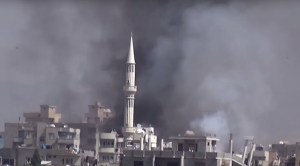 A total of 6,320 houses have been destroyed in five Turkish southeastern districts during an operation against the Kurdistan Workers’ Party (PKK), Turkish Deputy Prime Minister Numan Kurtulmus said Monday.
Kurtulmus said at a briefing that the number of destroyed houses in the areas of Sur, Silopi, Cizre, Idil and Yuksekova amounts to 6,320.
“It is about 11,000 flats. The projected cost of restoration of these buildings is about 855 million Turkish liras [$294 million],” He said.
Tensions between Ankara and the Kurds escalated in July 2015 as fighting between the PKK, considered to be terrorist by Ankara, and the Turkish army resumed. Ankara has imposed several round-the-clock curfews in Kurdish-populated towns, preventing civilians from fleeing the regions where the military operations are taking place.
Turkish President Recep Tayyip Erdogan alleges over 5,000 Kurdish insurgents have been killed in the campaign since mid-December, a figure that pro-Kurdish officials contend includes hundreds of civilians.
US Accuses Russia of Militarizing Space While Doing the Same for Years
Sputnik | May 28, 2016
Washington is set to start deterring Russia in space. President Barack Obama in a letter notified Congress that in “accordance with section 1613 of the National Defense Authorization Act for Fiscal Year 2016” he had submitted a classified report on deterring “adversaries in space.”
The US brought up the idea of deterrence in space last year, citing Russia and China among the possible rivals. According to the Pentagon, Moscow and China are building up their presence in space while the US is lagging behind.
US Deputy Defense Secretary Frank Kendall urged to boost spending on space in a bid to catch up to Russia and China.
Recently, Barack Obama recalled the “Russian threat in space” in the light of fierce debates on the 2017 defense budget. According to draft bill, US defense spending for the next fiscal year estimates at $582 billion. Debates over the budget once again showed contradictions between the Republicans and the Democrats. The Republicans have insisted on boosting defense spending, including costly modernization programs, particularly in rocket technologies and nuclear arms.
Space technologies are the hottest topic of the debates. Recently, the House Armed Services Committee discussed the purchase of 18 Russian-made RD-180 rocket engines. They are required for the Atlas-5 space program, including delivering military satellites into orbit. The Russian engines are also part of the X-37B Orbital Test Vehicle (OTV).
American analysts suggest that the OTV reusable suborbital surveillance aircraft designed in cooperation with NASA will be used to practice destroying satellites, Space.com reported.
After Washington imposed sanctions against Russia a group of US congressmen called for the cancellation of the RD-180 deliveries. However, the Pentagon opposed, saying that the US would not be capable to develop its own analogue to until 2021. Probably, the classified report would include measures to cut reliance on the Russian-made engines.
It is also possible that the US would further develop its traditional space technologies.
“Military space technologies can be divided into two segments – offensive and information. The US is not developing offensive space weapons because such programs are too expensive. Washington is interested in information technologies, particularly space intelligence,” Ivan Moiseyev, head of the Institute of Space Politics, told the Russian online newspaper Vzglyad.
Currently, 40 percent of the satellites orbiting Earth are American satellites. In addition to financial benefits, the use of satellites is crucial for defense needs. The Outer Space Treaty bars states from placing weapons of mass destruction in orbit. But the treaty does not prohibit the use of conventional weapons in space.
As a result, the US wants to secure its satellites via military dominance in space.
In 2008, the Russian and Chinese governments proposed an international agreement to prevent the deployment of weapons in outer space but the US government under Presidents George W. Bush and Barack Obama consistently rejected launching negotiations to conclude such a treaty.
The US is likely to further block the initiative, the article read. It is possible that in the near future Washington would include information systems into the military segment.
“What the US is seriously developing is missile defense. And missile defense system can be used to hit satellites. China also has such a program. In turn, Russia is not developing such plans,” Moiseyev said.
For example, back in 2008, the malfunctioning USA-193 reconnaissance military satellite was intentionally destroyed by a SM-3 missile fired from the USS Lake Erie, at an altitude of 246 km.
According to the analyst, the fire was aimed at demonstrating the US capabilities in the field.
However, the US has accused Russia of using anti-satellite missiles. This refers to the launch of a Nudol missile from the Plesetsk Cosmodrome. The launch was allegedly detected by a US satellite. However, neither Moscow nor Washington officially confirmed the launch.
Probably, the missile may have been the A-235 Nudol missile defense system which is expected to replace A-135 Amur missile defenses deployed around Moscow. However, the A-235 is incapable of destroying satellites in orbit while the US ship-based SM-3 can do this.
Remembering All the Deaths From All of Our Wars
By Gary G. Kohls and S. Brian Willson | Consortium News | May 30, 2016
Introduction by Gary G. Kohls
One of the many heroes of the peace movement who came out of the Vietnam War was Vietnam veteran S. Brian Willson. Just like millions of other draft-age Americans, law student Willson had been drafted into that illegal and genocidal war – against his will – and came back disturbed and angry.
For reasons discussed below, he joined the anti-war movement after witnessing the Reagan/Bush Central American war after he traveled to Nicaragua and saw peasants being murdered by US-backed Contras (aka “freedom fighters”). Willson joined the antiwar movement in 1986 and has protested vigorously against America’s aggressive war policies ever since.
But his real life change came on Sept. 1, 1987, in Concord, California, where Willson was part of a gathering of antiwar protestors that were symbolically trying to stop the transport of weapons from a U.S. Navy munitions base. The weapons were destined for Nicaragua and El Salvador as part of the U.S.-backed war in Central America.
As a Vietnam veteran, Willson understood well the satanic nature of America’s perpetual wars against peasants, campesinos and other poor people in Third World countries who were unjustly accused of being “communists” as they were seeking relief from the tyranny of their ruling classes. He also knew about the poisonous realities of military toxins that are used in war that regularly poison innocent civilians, children, babies, villages, farm fields, water supplies and all the future inhabitants of the warzone.
Willson felt so strongly about the criminality of his country’s foreign policy against militarily inferior countries, that he put himself directly in harm’s way that day by lying down in front of the weapons supply train, expecting the engineer to stop. Instead of stopping, the engineer actually increased its speed above the speed limit and ran over him, severing both legs. The engineer later testified that he had only been obeying orders on how to deal with antiwar protesters.
Willson survived his near-fatal injuries, and he became a universally celebrated near-martyr for peace. He has vowed to spend the rest of his life speaking out against war. The piece below was written on May 27, 2016, and published in CounterPunch.
The Vietnam War radically changed him from a conservative Republican who had been raised in a Christian fundamentalist household. In Willson’s autobiography, titled Blood on the Tracks: The Life and Times of S. Brian Willson, he wrote about his war experience:
“in April 1969, I witnessed the incredible destruction that had just been inflicted (by aerial bombing and napalm ‘practice’) … on a typically defenseless village about the size of a large baseball stadium. With smoldering ruins throughout, the ground was strewn with bodies of villagers and their farm animals, many of whom were motionless and bloody, murdered from bomb shrapnel and napalm. Several were trying to get up on their feet, and others were moving ever so slightly as they cried and moaned. Most of the victims I witnessed were women and children.
“At one dramatic moment I encountered at close range a young wounded woman lying on the ground clutching three young disfigured children. I stared, aghast, at the woman’s open eyes. Upon closer examination, I discovered that she, and what I presumed were her children, all were dead, but napalm had melted much of the woman’s facial skin, including her eyelids. As the Vietnamese lieutenant and I silently made the one-plus hour return trip to our airbase in my jeep, I knew that my life was never going to be the same again.”
An eyewitness to Willson’s 1987 act of resistance to the US War Machine wrote that Brian questioned “the lessons of ‘patriotism’ with which we so proudly indoctrinate our children, especially our boy children. … Nearly twenty years later, I stood just behind Brian on a California train track in a well-publicized effort to block munitions trains carrying American weapons to kill other poor villagers in El Salvador and Nicaragua, thinking about the words he had spoken that morning, before one of those trains ripped his legs from his body. He said, ‘…each train that gets by us is going to kill people, people like you and me. … And the question that I have to ask on these tracks is: am I any more valuable than those people?’”
Here is the latest, very powerful testimony about what he thinks of Memorial Day from the American antiwar hero, S. Brian Willson:
Remembering All the Deaths From All of Our Wars
Celebration of Memorial Day in the US, originally Decoration Day, commenced shortly after the conclusion of the Civil War. This is a national holiday to remember the people who died while serving in the armed forces. The day traditionally includes decorating graves of the fallen with flowers.
As a Viet Nam veteran, I know the kinds of pain and suffering incurred by over three million US soldiers, marines, sailors, and airmen, 58,313 of whom paid the ultimate price whose names are on The Vietnam Wall in Washington, DC. The Oregon Vietnam Memorial Wall alone, located here in Portland, contains 803 names on its walls.
The function of a memorial is to preserve memory. On this US Memorial Day, May 30, 2016, I want to preserve the memory of all aspects of the US war waged against the Southeast Asian people in Viet Nam, Laos, and Cambodia – what we call the Viet Nam War – as well as the tragic impacts it had on our own people and culture. My own healing and recovery requires me to honestly describe the war and understand how it has impacted me psychically, spiritually, and politically.
Likewise, the same remembrance needs to be practiced for both our soldiers and the victims in all the other countries affected by US wars and aggression. For example, the US incurred nearly 7,000 soldier deaths while causing as many as one million in Afghanistan and Iraq alone, a ratio of 1:143.
It is important to identify very concretely the pain and suffering we caused the Vietnamese – a people who only wanted to be independent from foreign occupiers, whether Chinese, France, Japan, or the United States of America. As honorably, and in some cases heroically, our military served and fought in Southeast Asia, we were nonetheless serving as cannon fodder, in effect mercenaries for reasons other than what we were told. When I came to understand the true nature of the war, I felt betrayed by my government, by my religion, by my cultural conditioning into “American Exceptionalism,” which did a terrible disservice to my own humanity, my own life’s journey. Thus, telling the truth as I uncover it is necessary for recovering my own dignity.
I am staggered by the amount of firepower the US used, and the incredible death and destruction it caused on an innocent people. Here are some statistics:
–Seventy-five percent of South Viet Nam was considered a free-fire zone (i.e., genocidal zones)
–Over 6 million Southeast Asians killed
–Over 64,000 US and Allied soldiers killed
–Over 1,600 US soldiers, and 300,000 Vietnamese soldiers remain missing
–Thousands of amputees, paraplegics, blind, deaf, and other maimings created
–13,000 of 21,000 of Vietnamese villages, or 62 percent, severely damaged or destroyed, mostly by bombing
–Nearly 950 churches and pagodas destroyed by bombing
–350 hospitals and 1,500 maternity wards destroyed by bombing
–Nearly 3,000 high schools and universities destroyed by bombing
–Over 15,000 bridges destroyed by bombing
–10 million cubic meters of dikes destroyed by bombing
–Over 3,700 US fixed-wing aircraft lost
–36,125,000 US helicopter sorties during the war; over 10,000 helicopters were lost or severely damaged
–26 million bomb craters created, the majority from B-52s (a B-52 bomb crater could be 20 feet deep, and 40 feet across)
–39 million acres of land in Indochina (or 91 percent of the land area of South Viet Nam) were littered with fragments of bombs and shells, equivalent to 244,000 (160 acre) farms, or an area the size of all New England except Connecticut
–21 million gallons (80 million liters) of extremely poisonous chemicals (herbicides) were applied in 20,000 chemical spraying missions between 1961 and 1970 in the most intensive use of chemical warfare in human history, with as many as 4.8 million Vietnamese living in nearly 3,200 villages directly sprayed by the chemicals
–24 percent, or 16,100 square miles, of South Viet Nam was sprayed, an area larger than the states of Connecticut, Vermont, and Rhode Island combined, killing tropical forest, food crops, and inland forests
–Over 500,000 Vietnamese have died from chronic conditions related to chemical spraying with an estimated 650,000 still suffering from such conditions; 500,000 children have been born with Agent Orange-induced birth defects, now including third generation offspring
–Nearly 375,000 tons of fireballing napalm was dropped on villages
–Huge Rome Plows (made in Rome, Georgia), 20-ton earthmoving D7E Caterpillar tractors, fitted with a nearly 2.5-ton curved 11-foot wide attached blade protected by 14 additional tons of armor plate, scraped clean between 700,000 and 750,000 acres (1,200 square miles), an area equivalent to Rhode Island, leaving bare earth, rocks, and smashed trees
–As many as 36,000,000 total tons of ordance expended from aerial and naval bombing, artillery, and ground combat firepower. On an average day US artillery expended 10,000 rounds costing $1 million per day; 150,000-300,000 tons of UXO remain scattered around Southeast Asia: 40,000 have been killed in Viet Nam since the end of the war in 1975, and nearly 70,000 injured; 20,000 Laotians have been killed or injured since the end of the war
–7 billion gallons of fuel were consumed by US forces during the war
–If there was space for all 6,000,000 names of Southeast Asian dead on the Vietnam Wall in Washington, DC, it would be over 9 sobering miles long, or nearly 100 times its current 493 foot length
I am not able to memorialize our sacrificed US soldiers without also remembering the death and destroyed civilian infrastructure we caused in our illegal invasion and occupation of Viet Nam, Laos and Cambodia. It has been 47 years since I carried out my duties in Viet Nam. My “service” included being an eyewitness to the aftermath of bombings from the air of undefended fishing villages where virtually all the inhabitants were massacred, the vast majority being small children. In that experience, I felt complicit in a diabolical crime against humanity. This experience led me to deeply grasping that I am not worth more than any other human being, and they are not worth less than me.
Recently I spent more than three weeks in Viet Nam, my first trip back since involuntarily being sent there in 1969. I was struck by the multitudes of children suffering from birth defects, most caused presumably by the US chemical spraying some 50 years ago. I experienced deep angst knowing that the US is directly responsible for this genetic damage now being passed on from one generation to the next. I am ashamed that the US government has never acknowledged responsibility or paid reparations. I found myself apologizing to the people for the crimes of my country.
When we only memorialize US soldiers while ignoring the victims of our aggression, we in effect are memorializing war. I cannot do that. War is insane, and our country continues to perpetuate its insanity on others, having been constantly at war since at least 1991. We fail our duties as citizens if we remain silent rather than calling our US wars for what they are – criminal and deceitful aggressions violating international and US law to assure control of geostrategic resources, deemed necessary to further our insatiable American Way Of Life (AWOL).
Memorial Day for me requires remembering all of the deaths and devastation of our wars, and it should remind all of us of the need to end the madness. If we want to end war, we must begin to directly address our out-of-control capitalist political economy that knows no limits to profits for a few at the expense of the many, including our soldiers.
 S. Brian Willson, as a 1st lieutenant, served as commander of a US Air Force combat security police unit in Viet Nam’s Mekong Delta in 1969. He is a trained lawyer who has been an anti-war, peace and justice activist for more than forty years. His psychohistorical memoir, “Blood On The Tracks: The Life and Times of S. Brian Willson” was published in 2011 by PM Press. A long time member of Veterans For Peace, he currently resides in Portland, Oregon
Ticking Closer to Nuclear Midnight
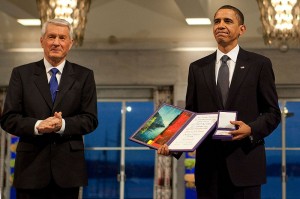
President Barack Obama uncomfortably accepting the Nobel Peace Prize from Committee Chairman Thorbjorn Jagland in Oslo, Norway, Dec. 10, 2009. (White House photo)
By Jonathan Marshall | Consortium News | May 27, 2016
Even if you’ve never won an office raffle, a sports pool or a lottery, consider yourself supremely lucky. Unlike the atomic bomb victims who were recognized by President Barack Obama’s visit to Hiroshima, you’ve never experienced the horrors of nuclear war.
That’s nothing any of us should take for granted, says former Defense Secretary William Perry. On at least three occasions, he noted recently, the U.S. military received false alarms of a Soviet nuclear attack. At least twice the Soviet military went on high alert from similar alarms. And anyone who lived through the Cuban Missile Crisis in 1962 survived “as much by good luck as by good management,” he added.
The consequences of an accidental nuclear war would be staggering. Thousands of U.S. and Russian warheads, some of them orders of magnitude larger than the one that wiped out Hiroshima, are primed for launch on warning. Besides wiping out tens or hundreds of millions of people in urban centers, they would put a large fraction of the world’s population at risk from starvation.
A 2013 report by Physicians for Social Responsibility concluded that even a limited regional nuclear exchange — say between India and Pakistan — could “cause significant climate disruption worldwide” and jeopardize food supplies to as many as two billion people.
Many authorities believe the threat of accidental war is even greater today than during most of the Cold War. Last year, the Science and Security Board of the Bulletin of Atomic Scientists moved its famous Doomsday Clock forward to three minutes to midnight, its “direst setting” since the nuke-rattling days of the early Reagan era.
The group cited continued bluster and brinkmanship between NATO and Russia, including the shooting down of a Russian warplane by Turkey, as indicators of today’s risky nuclear environment.
Getting Lucky
National security experts and reporters such as Eric Schlosser, author of Command and Control (2014), have compiled long lists of nuclear accidents and near-misses, some of which might have cost millions of lives but for a few quick-thinking heroes. Here’s a small sample:
–In 1958, a B-47 dropped a 30 kiloton Mark 6 atomic bomb into a family’s backyard in Mars Bluff, South Carolina. Its high-explosive trigger blasted the home and left a 35-foot crater. A few months later, another B-47 dropped a Mark 39 hydrogen bomb near Abilene, again setting off its high explosives but not a nuclear blast.
–In 1961, a B-52 exploded over North Carolina, dropping two Mark 39 hydrogen bombs. One of them nearly detonated after five of its six safety devices failed. The Air Force never did recover the uranium trigger.
–In October 1962, at the height of the Cuban Missile Crisis, a Soviet submarine thought it was under attack from U.S. warships, which were practicing dropping depth charges in the Sargasso Sea. The submarine commander ordered a launch of nuclear missiles, but was persuaded to stop by his second-in-command.
Other near misses during that mother of all nuclear crises in 1962 included a reckless U.S. spy plane over-flight of Siberia, the explosion of a Soviet satellite that U.S. authorities interpreted as the start of a Soviet missile attack, American test launches of two nuclear-capable ICBMs, and a screw-up at a Minuteman site that allowed a single operator to launch a fully armed missile.
–In 1966, a B-52 bomber collided with a refueling tanker over Palomares, Spain and broke apart, dropping its four hydrogen bombs. Two of them partially detonated, contaminating a wide region with radiation.
–Two years later, a B-52 crashed in Greenland, losing three hydrogen bombs and contaminating nearly a quarter million cubic feet of ice and snow.
–In 1979, a technician mistakenly confused NORAD’s computers with a war games simulation, triggering signals of a Soviet nuclear launch. The Strategic Air Command scrambled its bombers before learning of the false alarm.
–A year later, a defective computer chip prompted the Pentagon to waken President Jimmy Carter’s national security adviser with reports of a massive launch of Soviet missiles from submarines and land-based silos.
–In 1985, a glint of sunlight confused a Soviet early-warning satellite, which reported that the United States had launched five intercontinental ballistic missiles. Fortunately, the watch commander risked his career by not reporting the alarm, saving the day.
–In 1995, Russia’s early-warning system confused a small Norwegian weather rocket with an incoming U.S. Trident missile. The Russian military went on high alert, notifying President Boris Yeltsin and preparing a possible counter-attack before recognizing the mistake.
Tensions Reduce the Odds
As MIT nuclear expert Theodore Postol noted last year, “Had the false alert of 1995 occurred instead during a political crisis, Russian nuclear forces might have been launched. American early warning systems would have immediately detected the launch, and this might then have led to the immediate launch of US forces in response to the Russian launch.”
Recent years have brought us accounts of missing nuclear missiles, drug use by Minuteman missile crews, shocking security breaches, crew commanders falling asleep, computer failures, a silo fire that went undetected by smoke alarms, and much more.
And just this week we were reminded by the Government Accountability Office that the Pentagon’s “Strategic Automated Command and Control System” uses 8-inch floppy disks and 1970s-vintage computers.
The Pentagon insisted in 2014 that the system “is extremely safe and extremely secure” — after all, how many hackers know how to operate such ancient technology? — but Princeton University’s Bruce Blair, a former Air Force ICBM launch-control officer, said this week, “The floppy disks are associated with a nuclear-communications system that was unreliable even when the system was upgraded in the 1970s.”
No doubt the odds of any one of these accidents triggering a war or mass catastrophe were low. But odds increase with the number of incidents. If the probability of a disaster from one incident is only one in 100, the odds of ruin from 20 such incidents rise to nearly one in five. Those are not comforting numbers.
That’s why it’s critical that the United States and Russia get serious about promoting world security by eliminating first-use and “launch on warning” policies that heighten the risk of accidental wars. They must also sharply reduce the size of nuclear arsenals that are difficult to track, safeguard and maintain.
Instead, President Obama has embarked on a trillion dollar program of nuclear modernization and a dangerous policy of confrontation with Russia in Eastern Europe. (Russia is not blameless in these matters, of course.) Such policies are, in turn, prompting China’s military to pursue a nuclear expansion program of its own — including a dangerous shift to hair-trigger alerts and a launch-on-warning policy.
Former Defense Secretary Perry warns that all of this is putting the world “on the brink of a new nuclear arms race.” That’s not what we expected from the President who was awarded a Nobel Peace Prize in part for his call to reduce the threat of nuclear weapons. Let’s hope Obama’s visit to Hiroshima rekindles his commitment to helping create a safer world.
Jonathan Marshall is author or co-author of five books on international affairs, including The Lebanese Connection: Corruption, Civil War and the International Drug Traffic (Stanford University Press, 2012).
Poroshenko appoints former NATO chief Rasmussen ‘non-staff adviser’
RT | May 28, 2016
A former NATO Secretary General has been chosen as a new “non-staff” adviser to Ukrainian President Petro Poroshenko, according to a decree bearing his signature. However, the document implies that the ex-chief is yet to agree to the appointment.
“Appoint Anders Fogh Rasmussen as adviser to the President of Ukraine outside the official staff (subject to his consent),” says the decree also published on the Ukrainian president’s official website.
Rasmussen was the twelfth Secretary General of NATO in the period from August 2009 to September 2014. He was also Danish Prime Minister from 2001 to 2009. In 2014, Poroshenko awarded Rasmussen, who still was NATO Secretary General at that time, with the Order of Freedom – the highest Ukrainian award for foreign citizens – for his “significant personal contribution to the development of cooperation between Ukraine and NATO as well as for considerable support for Ukraine’s sovereignty, independence and territorial integrity.”
Rasmussen is yet to comment and either confirm or deny his appointment. Last year, US Senator John McCain, also appointed by Kiev to a similar position, eventually turned down the proposal claiming that the US constitution prohibited him from getting on board.
The assignment of the role to Rasmussen comes soon after Ukrainian National Security and Defense Council adopted a program for the reorganization of Ukraine’s defense industry as well as military in line with NATO standards on May 20.
“We are beginning real reorganization of the defense and security sector in order to join NATO,” Poroshenko said at the time, commenting on this decision. He stressed that Ukraine had not been directly making steps for immediate accession to the Alliance but called the move “The Rubicon” that Ukrainian armed forces and the defense industry would have to “pass” to adapt to NATO standards, as reported by TASS.
The deputy head of the Russian parliament’s defense committee, Sergey Zhigarev, called Rasmussen’s appointment to the position of the presidential adviser a sign of the Ukrainian president’s mistrust of his own people.
“This is a very bad sign. It shows that he [Poroshenko] does not trust his own citizens that entrusted him with leading their country,” Zhigarev told Sputnik.
In the meantime, Rasmussen is not the first foreign citizen in Ukraine’s Presidential Administration as some foreigners even held ministerial posts in the Ukrainian government. In 2014, Poroshenko appointed Natalie Ann Jaresko, an American-born Ukrainian investment banker, as Ukraine’s Minister of Finance, while former Georgian Health Minister Alexander Kvitashvili took the post of the head of the Ukrainian Health ministry and Aivaras Abromavicius, a Lithuanian businessman, became Ukraine’s Minister of Economy and Trade. They held their posts till the new government was installed in April 2016.
Leszek Balcerowicz, Poland’s former deputy prime minister, now serves as Poroshenko’s representative in the Ukrainian government while former Slovakian Finance Minister Ivan Miklos is now the head of a group of Ukrainian prime minister’s advisers.
Meanwhile, former Georgian President Mikhail Saakashvili, wanted for trial on corruption charges at home, was granted Ukrainian citizenship so that he could take the post of the Ukrainian Odessa region.
Saakashvili was appointed as governor of Ukraine’s Odessa Region in May of 2015, after which he brought in several members of his old Georgian team, including Ukraine’s current national police chief Khatia Dekanoidze, who was Georgia’s education minister; Deputy Interior Minister Eka Zguladze, who held a similar position in the Georgian government; Deputy General Prosecutor David Sakvarelidze, who held a similar position in the Georgian government as well, and was also Saakashvili’s lawyer; and Gizo Uglava, Ukraine’s current Head of the Anticorruption Bureau and Georgia’s former deputy general prosecutor.
Trucks Carrying Weapons For al-Nusra Front Arrive From Turkey Daily
Sputnik – 27.05.2016
Head of the Russian General Staff told journalists that trucks carrying weapons for the al-Nusra Front cross from Turkey into Syria daily. This allows the terrorist group to continue attacking local targets.
Lt. Gen. Sergey Rudskoy said in his press briefing on Friday that weapons and ammunition are continuously being delivered to the al-Nusra Front terrorists in Syria, allowing them to engage Syrian government forces and hindering the fight against Daesh in the country.
“The never-ending flow of large trucks from Turkey carrying weapons and ammunition crosses the Turkish-Syrian border. This constant feed of live forces and weapons allows terrorists from the Nusra Front to continue their provocative shelling and make advances on Syrian government forces, which diminishes [government military] activity against Islamic State terrorists in other areas,” Rudskoy said during a briefing.
Rudskoy also added that the US has acknowledged that the heaviest fighting is centered around areas where the al-Qaeda affiliated al-Nusra Front is most active.
“Everyone knows, and our US partners admit that the biggest hot spots of active military operations are those parts of the Syrian Republic where the al-Qaeda-affiliated terrorists from the al-Nusra Front run rampant.”
So far, according to Rudskoy, the US has refused to conduct joint operations against terrorist groups in Syria, which has led to an escalation of the conflict.
The al-Nusra Front terrorist group hampers the ceasefire efforts in northern areas of Syria, the Russian General Staff said Friday.
“It is very clear that the terrorist group Jabhat al-Nusra, active in the regions of Aleppo and Idlib, is the main obstacle to expanding the ceasefire regime to northern areas of Syria,” Sergey Rudskoy, chief of the Main Operational Directorate of the Russian General Staff, said.
Moreover, the Al-Nusra Front has used the ‘period of silence’ to partly restore its combat capability. Rudskoy told reporters.
Earlier, Russian Defense Minister Sergey Shoigu offered to conduct joint air strikes against terrorist groups in Syria, but the Pentagon declined the offer. However, The Russian Foreign Affairs Ministry says Moscow hasn’t ruled out a possible joint operation in the future.
Featured Video

Dan Dicks with James Corbett on Solutions Watch
or go to
Aletho News Archives – Video-Images
From the Archives
Secret document reveals plans for civil war in Lebanon, Israeli false flags, and invasion
By Randi Nord | Geopolitics Alert | April 5, 2019
Beirut – During his visit with US Secretary of State, Mike Pompeo, Lebanese President Michael Aoun reportedly received a US-Israeli document detailing plans for creating a civil war in Lebanon with covert false flag operations and possible Israeli invasion.
Although the source of the document is Israeli and created in partnership with Washington, no one knows who presented it to Aoun. The Lebanese TV station, Al-Jadeed, initially reported the document on Lebanese TV and a video on its website. Geopolitics Alert translated the report for this article. … continue
Blog Roll
 Aletho News
- Sheikh al-Asadi warns of Iraqi government compliance with US demands
- How to MAKE THE CONSPIRATORS PAY for their crimes! Dan Dicks with James Corbett on Solutions Watch
- There’s a drought in academia: A drought in honest research on the subject of drought and other weather extremes
- Department of War Awards $20.7 Billion Contract to Raytheon for Air-to-Air Missiles
- ‘Distance yourselves from Israel’: IRGC urges US population to question govt policies
- America’s Greenland deal has a radioactive backstory
- The RAF Fairford ‘terror plot’: Unpacking escalation in the UK echo-chamber
- EU Council Advances Chat Control 2.0 Scanning Proposal
- Ex-Greek MEP files complaint against Israeli spyware firm over alleged Pegasus surveillance
- Troubling ideas throughout the Torah, Talmud, Mishneh Torah and Tanya
- If Americans Knew
- New Report: “Scholasticide and Genocide in Gaza: Assessment, Testimonies and Legal Analysis”
- Ex-Biden officials are desperate for a Gaza scapegoat
- Israeli “settlers” Invade Al-Aqsa; Pour Boiling Water on 75-Year-Old
- Israel Has Kidnapped Another American Teenager
- US arms sales to Israel worth $21.6 billion in 20 months
- Three Palestinians Killed in Israeli Attacks on Gaza
- Revealed: German “Anti-Semitism Expert” Driving Crackdown on Palestine Solidarity is Former Israeli Spy
- Egypt’s Warning to Israel Before Oct 7
- Israel’s siege signals another cruel winter for 1.8 million Gazans – Daily Update
- Netanyahu Asked UAE Leader to Deny Report on Oct. 7 Warning in Secret Visit, Sources Say
- No Tricks Zone
- Two More Paleo Reconstructions Affirm Meters-Higher Sea Levels Across Ireland, Brazil 7000-6000 Years Ago
- New Study: Earth And Venus Surface Warmth Largely Explained By Convection And Lapse Rate, Not CO2 Or Radiation
- 2025 Nature Paper Claiming Worsening Global Drought Gets RETRACTED …Heavily Flawed
- New Study: ‘Global Drought Shows No Detectable Recent Acceleration Under Climate Warming’
- Economic Masterminds: German Socialists Suggest Taxing Productivity Gains Stemming From Using AI
- The South China Sea Has Not Been Cooperating With The Climate Change Narrative
- Energy Crisis: Germany Enters Heating Season With Historically Low Gas Reserve Fill Levels
- New Study: The Antarctic Ice Sheet Gained Mass From 2020-2024 Due To Staggering Snow And Ice Accumulation
- Study: Ocean Heating Rates From Thousands Of Years Ago ‘Dwarf’ Modern Ocean Heating Rates
- Climate Extremists Target, Attack Large-Scale Power Grid Infrastructure In Germany!

