With the U.S. economy in the tank and governments at all levels facing massive budget shortfalls, politicians left and right are seeking ways to curb spending. Wisconsin Gov. Scott Walker wants to eliminate collective bargaining rights and the decent pay that goes with them. President Barack Obama’s budget includes halving the home-heating oil subsidy poor households depend on.
As Republicans and Democrats propose cuts in programs that actually benefit their increasingly impoverished constituents, though, they agree there’s one area of the budget that’s not to be touched: the annual $3 billion subsidy U.S. taxpayers provide to the Israeli military.
One of the biggest defenders of the handout is House Foreign Affairs Committee Chairwoman Ileana Ros-Lehtinen. “There will be no cuts to security assistance to the Jewish State of Israel,” her chief of staff declared in a recent letter to House Republicans. The rest of the U.S. foreign aid budget, including assistance for Iraqi refugees and food aid to the world’s poorest people, is fair game. But the Florida congresswoman insists we must help Israel maintain its “Qualitative Military Edge.”
And congressional Democrats have her back.
Illinois Democrat Jan Schakowsky, for instance – a leading member of the Congressional Progressive Caucus – has drafted a letter, cosigned by California Democrat Anna Eshoo, warning that the revolutions in Egypt and Tunisia “have the potential to add to the very real security challenges faced by Israel.” Reducing or “otherwise endangering aid to our ally” would be “unproductive,” she adds, encouraging her colleagues to tell Obama they “strongly support … providing $3.075 billion in assistance to Israel.” (For those shivering at home, that’s more assistance than Obama is proposing to offer Americans trying to keep their houses warm.)
This liberal appeal for Israeli military aid, meanwhile, is being sent out under the auspices of J Street, a group that positions itself as a left-leaning answer to AIPAC. But J Street staff we spoke with at their recent conference were hard-pressed to explain why U.S. taxpayers should fund a right-wing Israeli government that continues to build settlements and maintains an inhumane siege of Gaza.
So it’s left to folks like libertarian Congressman Ron Paul and his son, Kentucky Senator and Tea Party favorite Rand Paul, to call for ending aid to Israel. In a February 4 interview with ABC News, Rand Paul said of Israel, “I think that their per capita income is greater than probably three-fourths of the rest of the world. Should we be giving free money or welfare to a wealthy nation? I don’t think so.”
Indeed, Israel has the 24th largest economy in the world, and ranks 15th among 169 nations on the UN Human Development Index, which makes it a “very highly developed” nation.
Yet what thanks did Senator Paul get for his call to save the U.S. taxpayers billions of dollars? A torrent of criticism, even from J Street, which called on Republicans – and their donors – “to repudiate his comments and ensure American leadership around the world is not threatened by this irresponsible proposal.”
Paul’s fellow Tea Partiers aren’t any better. Of the 87 freshmen House Republicans elected on platforms of cut-baby-cut, at least three-fourths have now signed a letter declaring that, “As Israel faces threats from escalating instability in Egypt” – where have we heard that line of argument before? – “security assistance to Israel … has never been more important.” Subsidies are for militaries, you see, not poor people.
But even without U.S. funding, Israel would still spend $11 billion-plus on its military, more than all but 20 other nations in the world spend on their armed forces – and hundreds of millions of dollars more than the Islamic Republic of Iran, despite having just 1/10th the population. Throw in a couple – as in, couple hundred – little things called nuclear weapons, and, for better or worse, the Jewish state’s “Qualitative Military Advantage” isn’t going anywhere.
But you wouldn’t know that listening to the folks at J Street or to liberals like Jan Schakowsky, who hysterically cite the specter of Arab democracy to advocate billions in subsidies for a government that openly flouts international law. So much for their concern about human rights. And so much for being progressive. Indeed, with liberals like these, the Netanyahu government and its allies at AIPAC are likely asking themselves: who needs the Tea Party?
“This is a massacre,” the frantic Libyan woman, speaking by telephone while cowering in her apartment in Tripoli, told CNN’s Anderson Cooper.
“I hope you know that people around the world are watching and praying and wanting to do something,” Anderson told her, as if he were a stage prompter hinting at a performer’s next line. Whether or not she had been given a copy of the script, the caller performed as expected: “[T]he first step [is to] make Libya a no-fly zone. If you make Libya a no-fly zone, no more mercenaries can come in…. There needs to be action. How much more waiting, how much more watching, how much more people dying?”
It’s entirely possible, perhaps even likely, that the subject of Cooper’s interview was simply a terrified but resolute woman who risked her life to describe the violence devouring her country amid the death throes of Khadaffy’s police state.
It’s likewise possible that her call for international action to impose a no-fly zone was a desperate plea from a victim, rather than an act of media ventriloquism in which an anonymous figure endorsed the first plank of a military campaign proposed by the same neo-conservative kriegsbund that manipulated us into Iraq.
Surely it was a coincidence that the “Cry in the Night” from Libya was echoed on the same network a few nights later by Iraq war architect, former World Bank president, and accused war criminal Paul Wolfowitz, who several days prior to Cooper’s dramatic broadcast called for a NATO-enforced “no fly zone” over Libya.
In fact, the day following that interview, an ad hoc group calling itself the Foreign Policy Initiative, which coalesced from the remnants of the Project for a New American Century, published an “open letter” to Mr. Obama demanding military intervention – beginning with a no-fly zone – in Libya. The neo-con framework for managing the Libyan crisis would create a regional protectorate administered by NATO on behalf of the “international community.” This would nullify any effort on the part of Libyans, Egyptians, Tunisians, and others to achieve true independence.
On previous experience with media campaigns on behalf of humanitarian conquest, my incurable cynicism leads me to hear in Cooper’s “Cry in the Night” a faint but unmistakable echo of the tearful, palpably earnest testimony of “Nayirah” – the wide-eyed Kuwaiti girl who, using an assumed name to “protect her family,” described what had befallen her country in the wake of the Iraqi invasion.
Bravely composing herself as she recounted horrors no human eyes should behold, the precociously self-possessed 15-year-old volunteer nurse related to the Congressional Human Rights Caucus how Iraqi soldiers stormed into the al-Addan Hospital, tore newborn infants from incubators, and hurled them to the floor. A short time later this testimony was “confirmed” by others who offered similarly anguished testimony before the UN Security Council.
During the three-month build-up to the January 1991 attack on Baghdad, the image of Kuwaiti “incubator babies” was endlessly recycled as a talking point in media interviews, presidential speeches, and debates in Congress and the UN. A post-war opinion survey found that the story of the “incubator babies” was the single most potent weapon deployed by the Bush administration in its campaign to build public support for the attack on Iraq.
This atrocity account was particularly effective in overcoming the skepticism of people espousing a progressive point of view.
“A pacifist by nature, my brother was not in a peaceful mood that day,” recalled Christian Science Monitor columnist Tom Regan, describing his sibling’s reaction to “Nayirah’s” testimony. “We’ve got to go and get Saddam Hussein – now,” Regan’s brother insisted.
“I completely understood his feelings,” Regan pointed out. After all, “who could countenance such brutality? The news of the slaughter had come at a key moment in the deliberations about whether the U.S. would invade Iraq. Those who watched the non-stop debates on TV saw that many of those who had previously wavered on the issue had been turned into warriors by this shocking incident. Too bad it never happened.”
“Nayirah” was not a traumatized ingénue who had witnessed an act of barbarism worthy of the Einsatzgruppen; she was actually the daughter of Saud Nasi al-Sabah, Kuwait’s ambassador to the United States (and a member of the emirate’s royal family). Her script had been written by the Washington-based PR firm Hill & Knowlton, which – under the supervision of former Bush administration Chief of Staff Craig Fuller – had put together a campaign to build public support for the impending war.
It wasn’t difficult to convince the public that Saddam was a hideous thug. Selling the idea of a major war in the Middle East was a more daunting proposition. In late 1990, Hal Steward, a retired Army propaganda officer, defined the problem for the administration: “If and when the shooting starts, reporters will begin to wonder why American soldiers are dying for oil-rich sheiks. The U.S. military had better get cracking to come up with a public relations plan that will supply the answers the public can accept.”
The image of newborn Kuwaiti infants being ripped from incubators was an updated riff on a classic war propaganda theme performed by British intelligence – and its American fellow travelers – in their efforts to provoke U.S. intervention in World War I.
The WWI-era equivalent of the Kuwaiti “incubator babies” were the Belgian infants who were supposedly spitted on bayonets by hairy-knuckled Huns in Pickelhaube helmets. German soldiers did this to amuse themselves once they could no longer sate their prurient interests by raping Belgian women and then amputating their breasts. So the American public was told, in all seriousness, by people working on behalf of a secretive British propaganda committee headed by Charles Masterman.
In 1915, an official Commission headed by Viscount James Bryce, a notable British historian, “verified” those atrocity stories without naming a specific witness or victim. This didn’t satisfy Clarence Darrow, who offered a reward of $1,000 to anyone who could produce a Belgian or French victim who had been mutilated by German troops. That bounty went unclaimed.
“After the war,” recounts Thomas Fleming in his book Illusion of Victory, “historians who sought to examine the documentation for Bryce’s stories were told that the files had mysteriously disappeared. This blatant evasion prompted most historians to dismiss 99 percent of Bryce’s atrocities as fabrications.”
War emancipates every base and repulsive impulse to which fallen man is susceptible. So it’s certain that some German troops (like their French, Belgian, British, and American counterparts) exploited opportunities to commit individual acts of depraved cruelty. But the purpose of the war propaganda peddled by the Anglo-American elite, as Fleming observes, was to create a widespread public image of Germans as “monsters capable of appalling sadism” – thereby coating an appeal to murderous collective hatred with a lacquer of sanctimony.
The trick is to leave the target audience at once shivering in horror at a spectacle of sub-human depravity, panting with a visceral desire for vengeance, and rapturously self-righteous about the purity of its humane motives. People who succumb to it are easily subsumed into a hive mind of officially sanctioned hatred, and prepared to perpetrate crimes even more hideous than those that they believe typify the enemy.
Rhetoric of that kind abounded during the French Revolution, particularly the Jacobin regime’s war to annihilate the rebellious Vendee. It also figured prominently in the Lincoln regime’s war to conquer the newly independent southern states. However, it’s difficult to find a better expression of that mindset than the one offered in an editorial published in 1920 by Krasni Mech (The Red Sword), a publication of the Soviet Cheka secret police:
“Our morality has no precedent, and our humanity is absolute, because it rests on a new ideal. Our aim is to destroy all forms of oppression and violence. To us, everything is permitted, for we are the first to raise the sword not to oppress races and reduce them to slavery, but to liberate humanity from its shackles … Blood? Let blood flow like water … for only through the death of the old world can we liberate ourselves forever.” (Emphasis added.)
In pursuing his Grand Crusade for Democracy, Woodrow Wilson was squarely in that tradition, extolling the supposed virtue of “Force without stint or limit … the righteous and triumphant Force which shall make Right the law of the world and cast every selfish dominion in the dust.” To fortify the American “war will” through a steady diet of atrocity porn, the Wilson administration created a Department of Public Information that liaised with its British equivalent, as well as quasi-private British propaganda fronts such as the Navy League. That organization, Fleming points out, included “dozens of major bankers and corporate executives, from J.P. Morgan Jr. to Cornelius Vanderbilt.”
Through absolutely no fault of his own, Anderson Cooper is a great-great-grandson of Cornelius Vanderbilt. Of considerably greater interest is the fact that as a student at Yale, Cooper spent two summers as an intern at Langley in a CIA program designed to cultivate future intelligence operatives.
When asked about Cooper’s background with the CIA, a CNN spokeswoman insisted that he chose not to pursue a job with the Agency after graduating from Yale. The same can be said, however, of many of the CIA’s most valuable media assets.
As Carl Bernstein documented decades ago, the CIA “ran a formal training program in the 1950s to teach its agents to be journalists. Intelligence officers were ‘taught how to make noises like reporters,’ explained a high CIA official, and were then placed in major news organizations with help from management. ‘These were the guys who went through the ranks and were told, ‘You’re going to be a journalist,’ the CIA official said. Relatively few of the 400-some [media] relationships described in Agency files followed that pattern, however; most involved persons who were already bona fide journalists when they began undertaking tasks for the Agency.”
By way of an initiative called “Operation Mockingbird,” the CIA built a large seraglio of paid media courtesans. This was carried out through the Office of Policy Coordination, which was created by Allen Dulles and Frank Wisner – the latter being the official who went on to organize coups (and the attendant propaganda campaigns) against governments in Iran and Guatemala. (Wisner’s son and namesake, incidentally, was a vice chairman at AIG – the CIA’s favorite global insurance conglomerate – until 2009; more recently he was tapped by the Obama administration to serve as a back-channel contact with Hosni Mubarak and Omar Suleiman.)
The tendrils of “Operation Mockingbird” extended through every significant national media organ, from the Washington Post and Newsweek to the Time-Life conglomerate, from the New York Times to CBS. As a result, according to former CIA analyst Ray McGovern, the Fourth Estate “has been captured by government and corporations, the military-industrial complex, the intelligence apparatus.” It is, in everything but name, an appendage of the Regime. This is clearly seen every time the Regime decides the time has come to mount another campaign of humanitarian bloodshed abroad.
Having “learned nothing from the horrors that they cheer-led like excitable teenage girls over the past 15 years, these bohemian bombers, these latte-sipping lieutenants, these iPad imperialists are back,” sighs a wearily disgusted Brendan O’Neill in the London Telegraph. “This time they’re demanding the invasion of Libya.”
On O’Neill’s side of the Atlantic, the Fleet Street Samurai are peddling “rumors of systematic male rape” in Libya. Others insist that the prospective war in Libya would in no way resemble “the foolishness of the Iraq invasion” – just as similar self-appointed sages promised that the ongoing wars in Iraq and Afghanistan, each of which has lasted at least as long as the Vietnam War, would not be “another Vietnam.”
For some reason, this brings to mind the image of Bullwinkle repeatedly trying to pull a rabbit from his hat, blithely batting aside Rocky’s complaint that the trick “never works” by exclaiming, “This time for sure!” This time, we’re supposed to believe – or at least, pretend to believe – that the atrocity accounts are true, that military action sanctified by the “international community” is a moral obligation, that warlust and hatred are virtuous, and that the impending bloodshed will be a cleansing stream.
As is the case, one supposes, with any other variety, war pornography is nothing if not predictable. However, unlike Bullwinkle’s inept attempts at thaumaturgy, war porn is a trick that seems to work every time.
~
“All war is based on Deception” – “in war, the first casualty is truth“; Sun Tzu’s Art of War
The reports of Libya mobilizing its air force against its own people spread quickly around the world. However, Russia’s military chiefs say they have been monitoring from space — and the pictures tell a different story. According to Al Jazeera and BBC, on February 22 the Libyan government inflicted airstrikes on Benghazi — the country’s largest city — and on the capital Tripoli. However, the Russian military, monitoring the unrest via satellite from the very beginning, says nothing of the sort was going on on the ground:
What if you went to a restaurant and found it rather pricey? Still, you ordered your meal and, when done, picked up the check only to discover that it was almost twice the menu price.
Welcome to the world of the real U.S. national security budget. Normally, in media accounts, you hear about the Pentagon budget and the war-fighting supplementary funds passed by Congress for our conflicts in Iraq and Afghanistan. That already gets you into a startling price range — close to $700 billion for 2012 — but that’s barely more than half of it. If Americans were ever presented with the real bill for the total U.S. national security budget, it would actually add up to more than $1.2 trillion a year.
Take that in for a moment. It’s true; you won’t find that figure in your daily newspaper or on your nightly newscast, but it’s no misprint. It may even be an underestimate. In any case, it’s the real thing when it comes to your tax dollars. The simplest way to grasp just how Americans could pay such a staggering amount annually for “security” is to go through what we know about the U.S. national security budget, step by step, and add it all up.
So, here we go. Buckle your seat belt: it’s going to be a bumpy ride.
Fortunately for us, on February 14th the Obama administration officially released its Fiscal Year (FY) 2012 budget request. Of course, it hasn’t been passed by Congress — even the 2011 budget hasn’t made it through that august body yet — but at least we have the most recent figures available for our calculations.
For 2012, the White House has requested $558 billion for the Pentagon’s annual “base” budget, plus an additional $118 billion to fund military operations in Iraq and Afghanistan. At $676 billion, that’s already nothing to sneeze at, but it’s just the barest of beginnings when it comes to what American taxpayers will actually spend on national security. Think of it as the gigantic tip of a humongous iceberg.
To get closer to a real figure, it’s necessary to start peeking at other parts of the federal budget where so many other pots of security spending are squirreled away.
Missing from the Pentagon’s budget request, for example, is an additional $19.3 billion for nuclear-weapons-related activities like making sure our current stockpile of warheads will work as expected and cleaning up the waste created by seven decades of developing and producing them. That money, however, officially falls in the province of the Department of Energy. And then, don’t forget an additional $7.8 billion that the Pentagon lumps into a “miscellaneous” category — a kind of department of chump change — that is included in neither its base budget nor those war-fighting funds.
So, even though we’re barely started, we’ve already hit a total official FY 2012 Pentagon budget request of:
$703.1 billion dollars.
Not usually included in national security spending are hundreds of billions of dollars that American taxpayers are asked to spend to pay for past wars, and to support our current and future national security strategy.
For starters, that $117.8 billion war-funding request for the Department of Defense doesn’t include certain actual “war-related fighting” costs. Take, for instance, the counterterrorism activities of the State Department and the U.S. Agency for International Development. For the first time, just as with the Pentagon budget, the FY 2012 request divides what’s called “International Affairs” in two: that is, into an annual “base” budget as well as funding for “Overseas Contingency Operations” related to Iraq and Afghanistan. (In the Bush years, these used to be called the Global War on Terror.) The State Department’s contribution? $8.7 billion. That brings the grand but very partial total so far to:
$711.8 billion.
The White House has also requested $71.6 billion for a post-2001 category called “homeland security” — of which $18.1 billion is funded through the Department of Defense. The remaining $53.5 billion goes through various other federal accounts, including the Department of Homeland Security ($37 billion), the Department of Health and Human Services ($4.6 billion), and the Department of Justice ($4.6 billion). All of it is, however, national security funding which brings our total to:
$765.3 billion.
The U.S. intelligence budget was technically classified prior to 2007, although at roughly $40 billion annually, it was considered one of the worst-kept secrets in Washington. Since then, as a result of recommendations by the 9/11 Commission, Congress has required that the government reveal the total amount spent on intelligence work related to the National Intelligence Program (NIP).
This work done by federal agencies like the CIA and the National Security Agency consists of keeping an eye on and trying to understand what other nations are doing and thinking, as well as a broad range of “covert operations” such as those being conducted in Pakistan. In this area, we won’t have figures until FY 2012 ends. The latest NIP funding figure we do have is $53.1 billion for FY 2010. There’s little question that the FY 2012 figure will be higher, but let’s be safe and stick with what we know. (Keep in mind that the government spends plenty more on “intelligence.” Additional funds for the Military Intelligence Program (MIP), however, are already included in the Pentagon’s 2012 base budget and war-fighting supplemental, though we don’t know what they are. The FY 2010 funding for MIP, again the latest figure available, was $27 billion.) In anycase, add that $53.1 billion and we’re at:
$818.4 billion.
Veterans programs are an important part of the national security budget with the projected funding figure for 2012 being $129.3 billion. Of this, $59 billion is for veterans’ hospital and medical care, $70.3 billion for disability pensions and education programs. This category of national security funding has been growing rapidly in recent years because of the soaring medical-care needs of veterans of the Iraq and Afghan wars. According to an analysis by the Congressional Budget Office, by 2020 total funding for health-care services for veterans will have risen another 45%-75%. In the meantime, for 2012 we’ve reached:
$947.7 billion.
If you include the part of the foreign affairs budget not directly related to U.S. military operations in Iraq and Afghanistan, as well as other counterterrorism operations, you have an additional $18 billion in direct security spending. Of this, $6.6 billion is for military aid to foreign countries, while almost $2 billion goes for “international peacekeeping” operations. A further $709 million has been designated for countering the proliferation of weapons of mass destruction, combating terrorism, and clearing landmines planted in regional conflicts around the globe. This leaves us at:
$965.7 billion.
As with all federal retirees, U.S. military retirees and former civilian Department of Defense employees receive pension benefits from the government. The 2012 figure is $48.5 billion for military personnel, $20 billion for those civilian employees, which means we’ve now hit:
$1,034.2 billion. (Yes, that’s $1.03 trillion!)
When the federal government lacks sufficient funds to pay all of its obligations, it borrows. Each year, it must pay the interest on this debt which, for FY 2012, is projected at $474.1 billion. The National Priorities Project calculates that 39% of that, or $185 billion, comes from borrowing related to past Pentagon spending.
Add it all together and the grand total for the known national security budget of the United States is:
$1,219.2 billion. (That’s more than $1.2 trillion.)
A country with a gross domestic product of $1.2 trillion would have the 15th largest economy in the world, ranking between Canada and Indonesia, and ahead of Australia, Taiwan, the Netherlands, and Saudi Arabia. Still, don’t for a second think that $1.2 trillion is the actual grand total for what the U.S. government spends on national security. Former Secretary of Defense Donald Rumsfeld once famously spoke of the world’s “known unknowns.” Explaining the phrase this way: “That is to say there are things that we now know we don’t know.” It’s a concept that couldn’t apply better to the budget he once oversaw. When it comes to U.S. national security spending, there are some relevant numbers we know are out there, even if we simply can’t calculate them.
To take one example, how much of NASA’s proposed $18.7 billion budget falls under national security spending? We know that the agency works closely with the Pentagon. NASA satellite launches often occur from the Air Force’s facilities at Vandenberg Air Force Base in California and Cape Canaveral Air Force Station in Florida. The Air Force has its own satellite launch capability, but how much of that comes as a result of NASA technology and support? In dollars terms, we just don’t know.
Other “known unknowns” would include portions of the State Department budget. One assumes that at least some of its diplomatic initiatives promote our security interests. Similarly, we have no figure for the pensions of non-Pentagon federal retirees who worked on security issues for the Department of Homeland Security, the State Department, or the Departments of Justice and Treasury. Nor do we have figures for the interest on moneys borrowed to fund veterans’ benefits, among other national security-related matters. The bill for such known unknowns could easily run into the tens of billions of dollars annually, putting the full national security budget over the $1.3 trillion mark or even higher.
There’s a simple principle here. American taxpayers should know just what they are paying for. In a restaurant, a customer would be outraged to receive a check almost twice as high as the menu promised. We have no idea whether the same would be true in the world of national security spending, because Americans are never told what national security actually means at the cash register.
~
Christopher Hellman is communications liaison at the National Priorities Project in Northampton, Massachusetts. He was previously a military policy analyst for the Center for Arms Control and Non-Proliferation, a Senior Research Analyst at the Center for Defense Information, and spent 10 years on Capitol Hill as a congressional staffer working on national security and foreign policy issues. He is a TomDispatch regular and a frequent media commentator on military planning, policy, and budgetary issues. To listen to Timothy MacBain’s latest TomCast audio interview in which Hellman explains how he arrived at his staggering numbers, click here, or download it to your iPod here.
[Note on Sources: The press release from the Office of The Director of National Intelligence disclosing the Fiscal Year 2010 $53 billion intelligence budget consists of 138 words and no details, other than that the office will disclose no details. It can be found by clicking here (.pdf file). An October 2010 analysis by the Congressional Budget Office entitled “Potential Costs of Veterans’ Health Care” projects rapid cost growth for Veterans Administration services over the next decade as a result of spiraling health care costs. To read the full report, click here (.pdf file). To see all the federal agencies that contribute to homeland security funding, click here (.pdf file)]
Bahrain–Eyewitnesses have reported seeing an estimated 30 tanks being transported into Bahrain from Saudi Arabia on Monday night at around 6:45pm local time. The tanks were sighted along the King Fahd causeway, which links the small island-nation of Bahrain to Saudi Arabia.
Commuters traveling along the 25-km causeway were held up due to the presence of “15 tank carriers carrying two tanks each heading towards Bahrain.” Civilian eyewitnesses could not, however, confirm whether the tanks belonged to the Saudi military.
The presence of Saudi military hardware in Bahrain is considered highly unusual.
The development comes on the eve of yet another scheduled anti-government demonstration organized by the Bahraini opposition and protesters in Manama’s Pearl Roundabout.
Fears of Saudi intervention in the ongoing Bahraini uprising first came to the fore last week when unconfirmed reports emerged on Wednesday that Saudi officials had told US authorities that they were “prepared to intervene” in Bahrain should such a move prove necessary to protect Bahrain’s embattled government.
Tomorrow’s mass protest will be the first to take place since the arrival to the country of controversial Shia opposition leader Hassan Mosheima from self-imposed exile.
Mosheima arrived on Saturday, using his first speech to call for national unity and to urge protesters to step up demands for the ouster of Bahrain’s prime minister of 40 years, Sheikh Khalifa Al Khalifa.
US State Department Spokesman Philip Crowley has defended Washington’s military aid to Yemen despite the use of the American weaponry by Sana’a regime in brutal crushing of pro-democracy uprisings.
In response to a question by a Press TV reporter at a Thursday news briefing for the foreign press, Crowley defended continued lethal US military aid to Yemen’s autocratic government as a necessary measure to combat ‘terrorism.’
“That itself justifies the ongoing cooperation that we have,” he said.
Crowley said the US has no plans to sever its military ties to Yemen even though US military aid is being used to suppress the pro-democracy uprising there.
The majority of Yemenis are unhappy with the expanding US military ties with their despotic government, especially in view of its harsh crackdown on protesters in recent days.
This has led to an uneasy alliance between the two governments, facing an uncertain future.
In recent days, thousands of Yemeni protesters have taken to the streets across the country, calling for the ouster of President Abdullah Saleh.
The Yemeni president has described the pro-democracy protesters as “elements of a coup.”
Saleh, in power for 33 years, said that he would leave power after his term expires in 2013. He has also promised not to hand power to his son.
The Yemeni incumbent president has also pledged to raise wages of government employees and to provide 60,000 job opportunities for university graduates.
The Yemeni government crackdown on protesters, inspired by revolutions in Egypt and Tunisia, has so far left at least 24 people dead.
The US also occasionally carries out drone attacks in Yemen. Despite such extraordinary measures, the country has grown increasingly unstable.
President Obama and the Congress have taken 66% of discretionary spending in the federal budget off the table – the Security Budget – while proposing a freeze to the rest of the budget and deep cuts to some programs that provide necessities for the American people. His budget crystalizes a choice that U.S. presidents have been making since President Eisenhower warned of the military-industrial complex – investment in the military vs. investment in the civilian economy.
The bloated and sacrosanct security budget – the military, domestic security and intelligence budgets –all saw rapid growth under President Bush when the DoD doubled its budget. Under President Obama the trend has continued with record military, intelligence and domestic security budgets. And, while the so-called recovery has only been a recovery for Wall Street and big business, the administration and congress are focused more on the deficit than on re-starting the economy for the rest of us. But there is more talk of cutting Social Security and Medicare than cutting the security budget. In fact, these two items are called entitlements because they are a contract with working Americans who pay for them in every paycheck. For this reason they should not even be considered part of the deficit. Payroll taxes fund these two programs that are essential for older Americans in their retirement years. Both face budget challenges but can be fixed, indeed Social Security has more than $2.5 trillion in Treasury Notes in reserve.
President Obama has proposed the largest DoD budget since World War II, $553 billion (not including war funding or nuclear weapons funding in the Department of Energy). Much attention has been shined on Secretary of Defense Gates’ proposal to “cut” $78 billion in the Pentagon budget. Those “cuts” take place over five years with reductions taking place after the 2012 election in 2014 and 2015. And, the “cuts” do not include the cost of wars. The Afghanistan war alone could eat up projected “savings” and if the CIA’s war in Pakistan escalates that will be an even bigger budget item. Further, we have not seen what the continuing U.S. military footprint in Iraq will cost. These projected cuts are more image than reality.
How does military spending impact Americans? President Reagan’s former assistant secretary of defense Lawrence Korb describes the military budget as “an annual tax of more than $7,000 on every household in the country.” While increasing the security budget, Obama and the Democrats have proposed widespread cuts to critical programs from a 50% cut in low-income heating assistance to nearly a 30% cut to the clean drinking water fund. They have also proposed a 25% cut ($1.3 billion) to the community development block grants used to fund local community development including affordable housing, anti-poverty programs, and infrastructure development. These are essential services needed for Americans health, safety and economic security. Of course, Republican cuts in the House budget are even more extreme but Obama set the table for them by making the debate about deficits and both parties will not touch the security budget. Military analyst, William Hartung, writes “These cuts will be painful, and they will be felt in every middle- and lower-income household in America.”
Cities and states are cutting essential services to balance their budgets. U.S. taxpayers will spend $737 billion for Pentagon spending for FY2011 including war funding). To get a sense of what this means, for the same amount of money tax payers could provide funding for 11.3 million elementary school teachers for one year or 93.5 million scholarships for university students for one year… Instead all these programs face cutbacks, while military spending grows. […]
Cutting $1 trillion from the federal budget is the goal of the Obama administration deficit plan. All of these cuts could come from military spending and still leave the U.S. militarily dominant. In fact, since the administration has projected an increase in spending of $6.5 trillion from 2011 to 2020, even a trillion would be a slowing of growth more than a real cut. Lawrence Korb lays out a five point plan to reduce military spending by $1 trillion without jeopardizing national security and thereby protecting U.S. economic security.
He is not alone, the Sustainable Defense Task Force provides specific cuts without harming U.S. national security including:
•The $238 billion Joint Strike Fighter program: Canceling the program and relying instead on upgraded versions of current aircraft would save almost $50 billion over ten years.
•The MV-22 Osprey: Replacing this dangerous, overpriced, and under-performing aircraft with cheaper alternatives would save over $10 billion over ten years.
•Reducing the number of U.S. troops in Europe and Asia to 100,000 from current levels of 150,000 would save $80 billion over a decade.
•Reforming Pentagon health care systems so that retirees pay modest, reasonable premiums could save $60 billion over a decade.
•Scaling back missile defense and space weapons programs could save over $50 billion over a decade.
•Further reductions in the U.S. nuclear arsenal, including deployment of fewer ballistic-missile launching submarines, could save over $100 billion in a ten year period, much of it in operating costs
•Reducing the size of the Navy from 286 to 230 ships would save over $125 billion over ten years.
If you combine these recommendations of the five point plan of Lawrence Korb, which includes items like bringing home 50,000 of the 150,000 troops stationed in Asia and Europe, reducing the size of the Army and Marine Corps to their pre-Iraq invasion level and reducing nuclear weapons from 1,968 to the 311 the Military War College says is needed for defense, the U.S. would save another $200 billion.
For many, these would only be the starting points of correctly prioritizing military spending. President Eisenhower warned about the military industrial complex 50 year ago. During that time, U.S. spending on the military adjusted for inflation has more than doubled and we have moved to a permanent war state. Columbia University’s Seymour Melman, a professor of industrial engineering, pointed out that “Industrial productivity, the foundation of every nation’s economic growth, is eroded by the relentlessly predatory effects of the military economy.” In fact, we have seen – as we see in the Obama budget – a constant conflict between the military economy and the civilian economy. The civilian economy is losing that battle.
Thomas Woods, Jr. recently wrote in the American Conservative that military spending is parasitic as it feeds off the economy rather than grows it. The scale of resources used by the military is exorbitant, Woods writes: “To train a single combat pilot, for instance, costs between $5 million and $7 million. Over a period of two years, the average U.S. motorist uses about as much fuel as does a single F-16 training jet in less than an hour. The Abrams tank uses up 3.8 gallons of fuel in traveling one mile. Between 2 and 11 percent of the world’s use of 14 important minerals, from copper to aluminum to zinc, is consumed by the U.S. military, as is about 6 percent of the world’s consumption of petroleum. The Pentagon’s energy use in a single year could power all U.S. mass transit systems for nearly 14 years.”
To get a sense of the competition between the civilian and military economy, the Department of Commerce estimated the value of the nation’s plants, equipment, and infrastructure (capital stock) at just over $7.29 trillion in 1985; and from 1947 to 1987 the military spent the equivalent, $7.62 trillion in capital resources.
With the long record of the ascendency of military spending it is not surprising to see the U.S. economy in collapse, industry disappearing and the infrastructure crumbling. Not only has the U.S. failed to win a major war since World War II, but the cost of the standing army has become a burden on all of us and a drag on the economy. Some describe the U.S. Empire in decline and others see a collapse as possible at any moment.
The failure of President Obama to confront military spending in this time of economic collapse and perceived deficit crisis, when tax dollars are needed to restart the domestic economy, is not only a short term budget failure but does not face up to the long-term damaging economic impact of the American military empire.
-###-
Kevin Zeese is executive director of Prosperity Agenda (www.ProsperityAgenda.US) and Voters for Peace (www.VotersForPeace.US) and an editor of the book ComeHomeAmerica.US (visit ComeHomeAmerica.US for more information and to purchase the book).
The Futenma air base is in an urbanized area on Okinawa island
Japanese activists have gathered in front of the US embassy in Tokyo to protest against a planned heliport near the village of Takae, northern Okinawa.
The demonstrators shouted slogans against the American military base on Okinawa, demanding the removal of the base from the island, The Japan Times reported on Sunday.
They tried to submit a letter to Washington’s Ambassador in Japan John Victor Roos, but they were prevented from reaching the embassy by a wall of Japanese police.
Futenma airbase, hosting about half the US troops in Japan, is extremely unpopular with locals who associate it with crime and pollution.
Futenma has provoked a wave of anger in the country, urging Tokyo to remove US military installations from the country.
Tens of thousands of people have held several rallies against the American military engagement in the country over the past months.
The relocation of the air station is not the only unbearable issue for Okinawans, as Tokyo has agreed to construct six helipads (each 75 meters in diameter) for the US Marine Corps’ Bell-Boeing V-22 Ospreys around the village.
Noise pollution from Ospreys is said to be beyond human tolerance. The citizens of Brewton, Alabama, also staged a protest against Osprey maneuvers in the region last month.
Earlier this week, Japanese people staged another street protest against the trans-Pacific free trade pact, which broadens relationships with the United States.
People from political left and right gave speeches and rallied in the streets on Wednesday, saying that the so-called Trans-Pacific Partnership (TPP) is aimed at strengthening the US-Japan military alliance and has political purposes.
The Indian Air Force and the Israeli weapons manufacturer Rafael Advanced Defense Systems are set to sign a major contract in March 2011, which will outfit India’s Tejas fighter jets with Rafael’s Derby missile.
The Derby air-to-air missile system will be fitted on some 200 jets, said P.S. Subramanya, director of India’s Aeronautical Development Agency.
This is not the Indian Air Force’s first deal with Rafael, a former sub-division of the Israeli Defense Ministry, now considered a governmental firm that develops and produces fighting-technologies for the Israel Defense Forces as well for exporting abroad.
The Indian Army purchased $270 million worth of Spyder anti-aircraft missile systems in 2008.
In 2009, Rafael agreed to supply the Indian Army with advanced anti-aircraft systems with a range of up to 45 kilometers. The deal was worth $1 billion.
“Israel’s homeland security systems are very advanced and India can benefit from your experience. We are friendly countries and strategic partners based on sound fundamental principles. We have to cooperate to the fullest extent to combat the menace of terror,” Minister of State for Commerce and Industry, Jyotiraditya Scindia said in February 2010.
Israel’s defense exports to India have now reached around $3 billion, making it the largest arms supplier to India, reported the BDS movement
Israel and India are enhancing cooperation in other areas as well.
“We have outlined several areas of cooperation but will be mainly focusing in the area of renewable energy and computer sciences in the coming years where we see tremendous potential for both the countries”, India’s Minister for Science and Technology, Prithviraj Chavan said on a three day visit to Israel in March 2010.
“The leading Israeli institutions have shown a keen interest in working with our IITs on exchange and collaboration of research, faculty and students. I think this will be an important step in enhancing scientific cooperation between the two countries”, Mr. Chavan said.
Bilateral trade between India and Israel has grown from around $200 million in 1992 when the diplomatic relations were established to most recently around $4 billion.
Israel is now working on winning the minds of Indians as well, in order to add the very populous country to Israel’s list of supporters.
Most recently, The Israel Project (TIP), a non-profit, non-government organization that “works tirelessly to help protect Israel by improving Israel’s image”, launched a new campaign in India to strengthen relations between the two countries.
“As relations between Israel and India, the world’s largest democracy and a growing economic power strengthen, The Israel Project is proud to announce the formation of our new India program,” TIP said in a January press release.
The new initiative will target Indian policymakers, journalists and the public “to spread awareness about Israel and help strengthen ties with India, especially in the fields of trade, tourism and technology,” reported India’s SIFY News.
Obama’s new budget is a continuation of Wall Street’s class war against the poor and middle class. Wall Street wasn’t through with us when the banksters sold their fraudulent derivatives into our pension funds, wrecked Americans’ job prospects and retirement plans, secured a $700 billion bailout at taxpayers’ expense while foreclosing on the homes of millions of Americans, and loaded up the Federal Reserve’s balance sheet with several trillion dollars of junk financial paper in exchange for newly created money to shore up the banks’ balance sheets. The effect of the Federal Reserve’s “quantitative easing” on inflation, interest rates, and the dollar’s foreign exchange value are yet to hit. When they do, Americans will get a lesson in poverty.
Now the ruling oligarchies have struck again, this time through the federal budget. The U.S. government has a huge military/security budget. It is as large as the budgets of the rest of the world combined. The Pentagon, CIA, and Homeland Security budgets account for the $1.1 trillion federal deficit that the Obama administration forecasts for fiscal year 2012. This massive deficit spending serves only one purpose–the enrichment of the private companies that serve the military/security complex. These companies, along with those on Wall Street, are who elect the U.S. government.
The U.S. has no enemies except those that the U.S. creates by bombing and invading other countries and by overthrowing foreign leaders and installing American puppets in their place.
China does not conduct naval exercises off the California coast, but the U.S. conducts war games in the China Sea off China’s coast. Russia does not mass troops on Europe’s borders, but the U.S. places missiles on Russia’s borders. The U.S. is determined to create as many enemies as possible in order to continue its bleeding of the American population to feed the ravenous military/security complex.
The U.S. government actually spends $56 billion a year, that is, $56,000 million, in order that American air travelers can be porno-scanned and sexually groped so that firms represented by former Homeland Security Secretary Michael Chertoff can make large profits selling the scanning equipment.
With a perpetual budget deficit driven by the military/security complex’s desire for profits, the real cause of America’s enormous budget deficit is off-limits for discussion.
The U.S. Secretary of War-Mongering, Robert Gates, declared: “We shrink from our global security responsibilities at our peril.” The military brass warns of cutting any of the billions of aid to Israel and Egypt, two functionaries for its Middle East “policy.”
But what are “our” global security responsibilities? Where did they come from? Why would America be at peril if America stopped bombing and invading other countries and interfering in their internal affairs? The perils America faces are all self-created.
The answer to this question used to be that otherwise we would be murdered in our beds by “the worldwide communist conspiracy.” Today the answer is that we will be murdered in our airplanes, train stations, and shopping centers by “Muslim terrorists” and by a newly created imaginary threat–”domestic extremists,” that is, war protesters and environmentalists.
The U.S. military/security complex is capable of creating any number of false flag events in order to make these threats seem real to a public whose intelligence is limited to TV, shopping mall experiences, and football games.
So Americans are stuck with enormous budget deficits that the Federal Reserve must finance by printing new money, money that sooner or later will destroy the purchasing power of the dollar and its role as world reserve currency. When the dollar goes, American power goes.
For the ruling oligarchies, the question is: how to save their power.
Their answer is: make the people pay.
And that is what their latest puppet, President Obama, is doing.
With the U.S. in the worst recession since the Great Depression, a great recession that John Williams and Gerald Celente, along with myself, have said is deepening, the “Obama budget” takes aim at support programs for the poor and out-of-work. The American elites are transforming themselves into idiots as they seek to replicate in America the conditions that have led to the overthrows of similarly corrupt elites in Tunisia and Egypt and mounting challenges to U.S. puppet governments elsewhere.
All we need is a few million more Americans with nothing to lose in order to bring the disturbances in the Middle East home to America. With the U.S. military bogged down in wars abroad, an American revolution would have the best chance of success.
American politicians have to fund Israel as the money returns in campaign contributions.
The U.S. government must fund the Egyptian military if there is to be any hope of turning the next Egyptian government into another American puppet that will serve Israel by continuing the blockade of the Palestinians herded into the Gaza ghetto.
These goals are far more important to the American elite than Pell Grants that enable poor Americans to obtain an education, or clean water, or community block grants, or the low income energy assistance program (cut by the amount that U.S. taxpayers are forced to give to Israel).
There are also $7,700 million of cuts in Medicaid and other health programs over the next five years.
Given the magnitude of the U.S. budget deficit, these sums are a pittance. The cuts will have no effect on U.S. Treasury financing needs. They will put no brakes on the Federal Reserve’s need to print money in order to keep the U.S. government in operation.
These cuts serve one purpose: to further the Republican Party’s myth that America is in economic trouble because of the poor: The poor are shiftless. They won’t work. The only reason unemployment is high is that the poor had rather be on welfare.
A new addition to the welfare myth is that recent middle class college graduates won’t take the jobs offered them, because their parents have too much money, and the kids like living at home without having to do anything. A spoiled generation, they come out of university refusing any job that doesn’t start out as CEO of a Fortune 500 company. The reason that engineering graduates do not get job interviews is that they do not want them.
What all this leads to is an assault on “entitlements”, which means Social Security and Medicare. The elites have programmed, through their control of the media, a large part of the population, especially those who think of themselves as conservatives, to conflate “entitlements” with welfare. America is going to hell not because of foreign wars that serve no American purpose, but because people, who have paid 15 per cent of their payroll all their lives for old age pensions and medical care, want “handouts” in their retirement years. Why do these selfish people think that working Americans should be forced through payroll taxes to pay for the pensions and medical care of the retirees? Why didn’t the retirees consume less and prepare for their own retirement?
The elite’s line, and that of their hired spokespersons in “think tanks” and universities, is that America is in trouble because of its retirees.
Too many Americans have been brainwashed to believe that America is in trouble because of its poor and its retirees. America is not in trouble because it coerces a dwindling number of taxpayers to support the military/security complex’s enormous profits, American puppet governments abroad, and Israel.
The American elite’s solution for America’s problems is not merely to foreclose on the homes of Americans whose jobs were sent offshore, but to add to the numbers of distressed Americans with nothing to lose the sick and the dispossessed retirees, and the university graduates who cannot find jobs that have been sent to Chine and India.
Of all the countries in the world, none need a revolution as bad as the United States, a country ruled by a handful of selfish oligarchs who have more income and wealth than can be spent in a lifetime.
~
Paul Craig Roberts was an editor of the Wall Street Journal and an Assistant Secretary of the U.S. Treasury. His latest book, HOW THE ECONOMY WAS LOST, has just been published by CounterPunch/AK Press. He can be reached at: PaulCraigRoberts@yahoo.com
The United States currently has 200 nuclear warheads in six bases in five European countries without an all-out accord from Europe, a report says.
According to the Bulletin of the Atomic Scientists, the Netherlands, Belgium and Germany host 10 to 20 US nuclear weapons each, while a total of over 100 US warheads are stocked in Italy and Turkey.
Some European countries, including the Netherlands and Germany, are calling for an end to the storage of the US weapons in the continent.
Germany brought up the issue in the NATO Summit meetings of Heads of State and Government in Lisbon, Portugal, last November, but no result was achieved then.
On the other hand, the NATO members have laid down a condition that Russia should cut down on its tactical nuclear weapons in an attempt to decrease the number of their own warheads.
Russia and the United States, following the new START Treaty early February, agreed on reducing only their strategic nuclear weapons; whereas, nothing concerning tactical nuclear weapons was agreed on.
The United States, in 1952, started storing tactical weapons in Europe, the number of which reached 7,300 in 1971. Ever since, however, there has been a gradual decrease in the number of them.
In the night of February 13-14, 1945, the ancient and beautiful capital of Saxony, Dresden, was attacked three times, twice by the RAF and once by the USAAF, the United States Army Air Force, in an operation involving well over 1,000 bombers. The consequences were catastrophic, as the historic city centre was incinerated and between 25,000 and 40,000 people lost their lives.[1] Dresden was not an important industrial or military centre and therefore not a target worthy of the considerable and unusual common American and British effort involved in the raid. The city was not attacked as retribution for earlier German bombing raids on cities such as Rotterdam and Coventry, either. In revenge for the destruction of these cities, bombed ruthlessly by the Luftwaffe in 1940, Berlin, Hamburg, Cologne and countless other German towns big and small had already paid dearly in 1942, 1943, and 1944. Furthermore, by the beginning of 1945, the Allied commanders knew perfectly well that even the most ferocious bombing raid would not succeed in “terrorizing [the Germans] into submission,”[2] so that it is not realistic to ascribe this motive to the planners of the operation. The bombing of Dresden, then, seems to have been a senseless slaughter, and looms as an even more terrible undertaking than the atomic obliteration of Hiroshima and Nagasaki, which is at least supposed to have led to the capitulation of Japan.
In recent times, however, the bombing of countries and of cities has almost become an everyday occurrence, rationalized not only by our political leaders but also presented by our media as an effective military undertaking and as a perfectly legitimate means to achieve supposedly worthwhile objectives. In this context, even the terrible attack on Dresden has recently been rehabilitated by a British historian, Frederick Taylor, who argues that the huge destruction wreaked on the Saxon city was not intended by the planners of the attack, but was the unexpected result of a combination of unfortunate circumstances, including perfect weather conditions and hopelessly inadequate German air defenses.[3] However, Taylor’s claim is contradicted by a fact that he himself refers to in his book, namely, that approximately 40 American “heavies” strayed from the flight path and ended up dropping their bombs on Prague instead of Dresden.[4] If everything had gone according to plan, the destruction in Dresden would surely have been even bigger than it already was. It is thus obvious that an unusually high degree of destruction had been intended. More serious is Taylor’s insistence that Dresden did constitute a legitimate target, since it was not only an important military centre but also a first-rate turntable for rail traffic as well as a major industrial city, where countless factories and workshops produced all sorts of militarily important equipment. A string of facts, however, indicate that these “legitimate” targets hardly played a role in the calculations of the planners of the raid. First, the only truly significant military installation, the Luftwaffe airfield a few kilometres to the north of the city, was not attacked. Second, the presumably crucially important railway station was not marked as a target by the British “Pathfinder” planes that guided the bombers. Instead, the crews were instructed to drop their bombs on the inner city, situated to the north of the railway station.[5] Consequently, even though the Americans did bomb the station and countless people perished in it, the facility suffered relatively little structural damage, so little, in fact, that it was again able to handle trains transporting troops within days of the operation.[6] Third, the great majority of Dresden’s militarily important industries were not located downtown but in the suburbs, where no bombs were dropped, at least not deliberately.[7]
It cannot be denied that Dresden, like any other major German city, contained militarily important industrial installations, and that at least some of these installations were located in the inner city and were therefore wiped out in the raid, but this does not logically lead to the conclusion that the attack was planned for this purpose. Hospitals and churches were also destroyed, and numerous Allied POWs who happened to be in the city were killed, but nobody argues that the raid was organized to bring that about. Similarly, a number of Jews and members of Germany’s anti-Nazi resistance, awaiting deportation and/or execution, were able to escape from prison during the chaos caused by the bombing,[8] but no one claims that this was the objective of the raid. There is no logical reason, then, to conclude that the destruction of an unknown number of industrial installations of greater or lesser military importance was the raison d’être of the raid. The destruction of Dresden’s industry – like the liberation of a handful of Jews – was nothing more than an unplanned “by-product” of the operation.
It is frequently suggested, also by Taylor, that the bombing of the Saxon capital was intended to facilitate the advance of the Red Army. The Soviets themselves allegedly asked their western partners during the Yalta Conference of February 4 to 11, 1945, to weaken the German resistance on the eastern front by means of air raids. However, there is no evidence whatsoever that confirms such allegations. The possibility of Anglo-American air raids on targets in eastern Germany was indeed discussed at Yalta, but during these talks the Soviets expressed the concern that their own lines might be hit by the bombers, so they requested that the RAF and USAAF would not operate too far to the east.[9] (The Soviets’ fear of being hit by what is now called “friendly fire” was not unwarranted, as was demonstrated during the raid on Dresden itself, when a considerable number of planes mistakenly bombed Prague, situated about as far from Dresden as the Red Army lines were.) It was in this context that a Soviet general by the name of Antonov expressed a general interest in “air attacks that would impede enemy movements,” but this can hardly be interpreted as a request to mete out to the Saxon capital – which, incidentally, he did not mention at all – or to any other German city the kind of treatment that Dresden received on February 13-14. Neither at Yalta, nor at any other occasion, did the Soviets ask their Western Allies for the kind of air support that presumably materialized in the form of the obliteration of Dresden. Moreover, they never gave their approval to the plan to bomb Dresden, as is also often claimed.[10] In any case, even if the Soviets would have asked for such assistance from the air, it is extremely unlikely that their allies would have responded by immediately unleashing the mighty fleet of bombers that did in fact attack Dresden.
In order to understand why this is so, we have to take a close look at inter-Allied relations in early 1945. In mid- to late January, the Americans were still involved in the final convulsions of the “Battle of the Bulge,” an unexpected German counter-offensive on the western front which had caused them great difficulties. The Americans, British, and Canadians had not yet crossed the Rhine, had not even reached the western banks of that river, and were still separated from Berlin by more than 500 kilometers. On the eastern front, meanwhile, the Red Army had launched a major offensive on January 12 and advanced rapidly to within 100 kilometers of the German capital. The resulting likelihood that the Soviets would not only take Berlin, but penetrate deep into Germany’s western half before the war ended, greatly perturbed many American and British military and political leaders. Is it realistic to believe that, under those circumstances, Washington and London were eager to enable the Soviets to achieve even greater progress? Even if Stalin had asked for Anglo-American assistance from the air, Churchill and Roosevelt might have provided some token assistance, but would never have launched the massive and unprecedented combined RAF-USAAF operation that the bombing of Dresden revealed itself to be. Moreover, attacking Dresden meant sending hundreds of big bombers more than 2,000 kilometers through enemy airspace, approaching the lines of the Red Army so closely that they would run the risk of dropping their bombs by mistake on the Soviets or being fired at by Soviet anti-aircraft artillery. Could Churchill or Roosevelt be expected to invest such huge human and material resources and to run such risks in an operation that would make it easier for the Red Army to take Berlin and possibly reach the Rhine before they did? Absolutely not. The American-British political and military leaders were undoubtedly of the opinion that the Red Army was already advancing fast enough.
Towards the end of January 1945, Roosevelt and Churchill prepared to travel to Yalta for a meeting with Stalin. They had asked for such a meeting because they wanted to make binding agreements about postwar Germany before the end of the hostilities. In the absence of such agreements, the military realities in the field would determine who would control which parts of Germany, and it looked very much as if, by the time the Nazis would finally capitulate, the Soviets would be in control of most of Germany and thus be able to unilaterally determine that country’s political, social, and economic future. For such a unilateral course of action, Washington and London themselves had created a fateful precedent, namely when they liberated Italy in 1943 and categorically denied the Soviet Union any participation in the reconstruction of that country; they did the same thing in France and Belgium in 1944.[11] Stalin, who had followed his allies’ example when he liberated countries in Eastern Europe, obviously did not need or want such a binding inter-allied agreement with respect to Germany, and therefore such a meeting. He did accept the proposal, but insisted on meeting on Soviet soil, namely in the Crimean resort of Yalta. Contrary to conventional beliefs about that Conference, Stalin would prove to be most accommodating there, agreeing to a formula proposed by the British and Americans and highly advantageous to them, namely, a division of postwar Germany into occupation zones, with only approximately one third of Germany’s territory – the later “East Germany” – being assigned to the Soviets. Roosevelt and Churchill could not have foreseen this happy outcome of the Yalta Conference, from which they would return “in an exultant spirit.”[12] In the weeks leading up to the conference, they expected the Soviet leader, buoyed by the recent successes of the Red Army and enjoying a kind of home-game advantage, to be a difficult and demanding interlocutor. A way had to be found to bring him down to earth, to condition him to make concessions despite being the temporary favourite of the god of war.
It was crucially important to make it clear to Stalin that the military power of the Western Allies, in spite of recent setbacks in the Belgian Ardennes, should not be underestimated. The Red Army admittedly featured huge masses of infantry, excellent tanks, and a formidable artillery, but the Western Allies held in their hands a military trump which the Soviets were unable to match. That trump was their air force, featuring the most impressive collection of bombers the world had ever seen. This weapon made it possible for the Americans and the British to launch devastating strikes on targets that were far removed from their own lines. If Stalin could be made aware of this, would he not prove easier to deal with at Yalta?
It was Churchill who decided that the total obliteration of a German city, under the noses of the Soviets so to speak, would send the desired message to the Kremlin. The RAF and USAAF had been able for some time to strike a devastating blow against any German city, and detailed plans for such an operation, known as “Operation Thunderclap,” had been meticulously prepared. During the summer of 1944, however, when the rapid advance from Normandy made it seem likely that the war would be won before the end of the year, and thoughts were already turning to postwar reconstruction, a Thunderclap-style operation had begun to be seen as a means to intimidate the Soviets. In August 1944, an RAF memorandum pointed out that “the total devastation of the centre of a vast [German] city…would convince the Russian allies…of the effectiveness of Anglo-American air power.”[13]
For the purpose of defeating Germany, Thunderclap was no longer considered necessary by early 1945. But towards the end of January 1945, while preparing to travel to Yalta, Churchill suddenly showed great interest in this project, insisted that it be carried out tout de suite, and specifically ordered the head of the RAF Bomber Command, Arthur Harris, to wipe out a city in Germany’s east.[14] On January 25 the British Prime Minister indicated where he wanted the Germans to be “blasted,” namely, somewhere “in their [westward] retreat from Breslau [now Wroclaw in Poland].”[15] In terms of urban centres, this was tantamount to spelling D-R-E-S-D-E-N. That Churchill himself was behind the decision to bomb a city in Germany’s east is also hinted at in the autobiography of Arthur Harris, who wrote that “the attack on Dresden was at the time considered a military necessity by much more important people than myself.”[16] It is obvious that only personalities of the calibre of Churchill were able to impose their will on the czar of strategic bombing. As the British military historian Alexander McKee has written, Churchill “intended to write [a] lesson on the night sky [of Dresden]” for the benefit of the Soviets. However, since the USAAF also ended up being involved in the bombing of Dresden, we may assume that Churchill acted with the knowledge and approval of Roosevelt. Churchill’s partners at the top of the United States’ political as well as military hierarchy, including General Marshall, shared his viewpoint; they too were fascinated, as McKee writes, by the idea of “intimidating the [Soviet] communists by terrorising the Nazis.”[17] The American participation in the Dresden raid was not really necessary, because the RAF was undoubtedly capable of wiping out Dresden in a solo performance. But the “overkill” effect resulting from a redundant American contribution was perfectly functional for the purpose of demonstrating to the Soviets the lethality of Anglo-American air power. It is also likely that Churchill did not want the responsibility for what he knew would be a terrible slaughter to be exclusively British; it was a crime for which he needed a partner.
A Thunderclap–style operation would of course do damage to whatever military and industrial installations and communications infrastructure were housed in the targeted city, and would therefore inevitably amount to yet another blow to the already tottering German enemy. But when such an operation was finally launched, with Dresden as target, it was done far less in order to speed up the defeat of the Nazi enemy than in order to intimidate the Soviets. Using the terminology of the “functional analysis” school of American sociology, hitting the Germans as hard as possible was the “manifest function” of the operation, while intimidating the Soviets was its far more important “latent” or “hidden” function. The massive destruction wreaked in Dresden was planned – in other words, was “functional” – not for the purpose of striking a devastating blow to the German enemy, but for the purpose of demonstrating to the Soviet ally that the Anglo-Americans had a weapon which the Red Army, no matter how mighty and successful it was against the Germans, could not match, and against which it had no adequate defenses.
Many American and British generals and high-ranking officers were undoubtedly aware of the latent function of the destruction of Dresden, and approved of such an undertaking; this knowledge also reached the local commanders of the RAF and USAAF as well as the “master bombers.” (After the war, two master bombers claimed to remember that they had been told clearly that this attack was intended “to impress the Soviets with the hitting power of our Bomber Command.”)[18] But the Soviets, who had hitherto made the biggest contribution to the war against Nazi Germany, and who had thereby not only suffered the biggest losses but also scored the most spectacular successes, e.g. in Stalingrad, enjoyed much sympathy among low-ranking American and British military personnel, including bomber crews. This constituency would certainly have disapproved of any kind of plan to intimidate the Soviets, and most certainly of a plan – the obliteration of a German city from the air – which they would have to carry out. It was therefore necessary to camouflage the objective of the operation behind an official rationale. In other words, because the latent function of the raid was “unspeakable,” a “speakable” manifest function had to be concocted.
And so the regional commanders and the master bombers were instructed to formulate other, hopefully credible, objectives for the benefit of their crews. In view of this, we can understand why the instructions to the crews with respect to the objectives differed from unit to unit and were often fanciful and even contradictory. The majority of the commanders emphasized military objectives, and cited undefined “military targets,” hypothetical “vital ammunition factories” and “dumps of weapons and supplies,” Dresden’s alleged role as “fortified city,” and even the existence in the city of some “German Army Headquarters.” Vague references were also frequently made to “important industrial installations” and “marshalling yards.” In order to explain to the crews why the historical city centre was targeted and not the industrial suburbs, some commanders talked about the existence there of a “Gestapo headquarters” and of “a gigantic poison gas factory.” Some speakers were either unable to invent such imaginary targets, or were for some reason unwilling to do so; they laconically told their men that the bombs were to be dropped on “the built-up city centre of Dresden,” or “on Dresden” tout court.[19] To destroy the centre of a German city, hoping to wreak as much damage as possible to military and industrial installations and to communication infrastructures, happened to be the essence of the Allied, or at least British, strategy of “area bombing.”[20] The crew members had learned to accept this nasty fact of life, or rather of death, but in the case of Dresden many of them felt ill at ease. They questioned the instructions with respect to the objectives, and had the feeling that this raid involved something unusual and suspicious and was certainly not a “routine” affair, as Taylor presents things in his book. The radio operator of a B-17, for example, declared in a confidential communication that “this was the only time” that “[he] (and others) felt that the mission was unusual.” The anxiety experienced by the crews was also illustrated by the fact that in many cases a commander’s briefing did not trigger the crews’ traditional cheers but were met with icy silence.[21]
Directly or indirectly, intentionally or unintentionally, the instructions and briefings addressed to the crews sometimes revealed the true function of the attack. For example, a directive of the RAF to the crews of a number of bomber groups, issued on the day of the attack, February 13, 1945, unequivocally stated that it was the intention “to show the Russians, when they reach the city, what our Bomber Command is capable of doing.”[22] Under these circumstances, it is hardly surprising that many crew members understood clearly that they had to wipe Dresden from the map in order to scare the Soviets. A Canadian member of a bomber crew was to state after the war to an oral historian that he was convinced that the bombing of Dresden had aimed to make it clear to the Soviets “that they had to behave themselves, otherwise we would show them what we could also do to Russian cities.”[23]
The news of the particularly awful destruction of Dresden also caused great discomfort among British and American civilians, who shared the soldiers’ sympathy for the Soviet ally and who, upon learning the news of the raid, likewise sensed that this operation exuded something unusual and suspicious. The authorities attempted to exorcize the public’s unease by explaining the operation as an effort to facilitate the advance of the Red Army. At an RAF press conference in liberated Paris on February 16, 1945, journalists were told that the destruction of this “communications centre” situated close to “the Russian front” had been inspired by the desire to make it possible for the Russians “to continue their struggle with success.” That this was merely a rationale, concocted after the facts by what are called “spin doctors” today, was revealed by the military spokesman himself, who lamely acknowledged that he “thought” that it had “probably” been the intention to assist the Soviets.[24]
The hypothesis that the attack on Dresden was intended to intimidate the Soviets explains not only the magnitude of the operation but also the choice of the target. To the planners of Thunderclap, Berlin had always loomed as the perfect target. By early 1945, however, the German capital had already been bombed repeatedly. Could it be expected that yet another bombing raid, no matter how devastating, would have the desired effect on the Soviets when they would fight their way into the capital? Destruction wreaked within 24 hours would surely loom considerably more spectacular if a fairly big, compact, and “virginal” – i.e. not yet bombed – city were the target. Dresden, fortunate not to have been bombed thus far, was now unfortunate enough to meet all these criteria. Moreover, the British American commanders expected that the Soviets would reach the Saxon capital within days, so that they would be able to see very soon with their own eyes what the RAF and the USAAF could achieve in a single operation. Although the Red Army was to enter Dresden much later than the British and the Americans had expected, namely, on May 8, 1945, the destruction of the Saxon capital did have the desired effect. The Soviet lines were situated only a couple of hundred of kilometers from the city, so that the men and women of the Red Army could admire the glow of the Dresden inferno on the nocturnal horizon. The firestorm was allegedly visible up to a distance of 300 kilometers.
If intimidating the Soviets is viewed as the “latent,” in other words the real function of the destruction of Dresden, then not only the magnitude but also the timing of the operation makes sense. The attack was supposed to have taken place, at least according to some historians, on February 4, 1945, but had to be postponed on account of inclement weather to the night of February 13-14.[25] The Yalta Conference started on February 4. If the Dresden fireworks had taken place on that day, it might have provided Stalin with some food for thought at a critical moment. The Soviet leader, flying high after the recent successes of the Red Army, would be brought down to earth by this feat of his allies’ air forces, and would therefore turn out to be a less confident and more agreeable interlocutor at the conference table. This expectation was clearly reflected in a comment made one week before the start of the Yalta Conference by an American general, David M. Schlatter:
I feel that our air forces are the blue chips with which we will approach the post-war treaty table, and that this operation [the planned bombing of Dresden and/or Berlin] will add immeasurably to their strength, or rather to the Russian knowledge of their strength.[26]
The plan to bomb Dresden was not cancelled, but merely postponed. The kind of demonstration of military potency that it was supposed to be retained its psychological usefulness even after the end of the Crimean conference. It continued to be expected that the Soviets would soon enter Dresden and thus be able to see firsthand what horrible destruction the Anglo-American air forces were able to cause to a city far removed from their bases in a single night. Afterwards, when the rather vague agreements made at Yalta would have to be put into practice, the “boys in the Kremin” would surely remember what they had seen in Dresden, draw useful conclusions from their observations, and behave as Washington and London expected of them. When towards the end of the hostilities American troops had an opportunity to reach Dresden before the Soviets, Churchill vetoed this: even at that late stage, when Churchill was very eager for the Anglo-Americans to occupy as much German territory as possible, he still insisted that the Soviets be allowed to occupy Dresden, no doubt so they could benefit from the demonstration effect of the bombing.
Dresden was obliterated in order to intimidate the Soviets with a demonstration of the enormous firepower that permitted bombers of the RAF and the USAAF to unleash death and destruction hundreds of kilometers away from their bases, and the subtext was clear: this firepower could be aimed at the Soviet Union itself. This interpretation explains the many peculiarities of the bombing of Dresden, such as the magnitude of the operation, the unusual participation in one single raid of both the RAF and USAAF, the choice of a “virginal” target, the (intended) enormity of the destruction, the timing of the attack, and the fact that the supposedly crucially important railway station and the suburbs with their factories and Luftwaffe airfield were not targeted. The bombing of Dresden had little or nothing to do with the war against Nazi Germany: it was an American British message for Stalin, a message that cost the lives of tens of thousands of people. Later that same year, two more similarly coded yet not very subtle messages would follow, involving even more victims, but this time Japanese cities were targeted, and the idea was to direct Stalin’s attention to the lethality of America’s terrible new weapon, the atomic bomb.[27] Dresden had little or nothing to do with the war against Nazi Germany; it had much, if not everything, to do with a new conflict in which the enemy was to be the Soviet Union. In the horrible heat of the infernos of Dresden, Hiroshima and Nagasaki, the Cold War was born.
Notes
[1] Frederick Taylor. Dresden: Tuesday, February 13, 1945, New York, 2004, pp. 354, 443-448; Götz Bergander, Dresden im Luftkrieg. Vorgeschichte, Zerstörung, Folgen, Weimar, 1995, chapter 12, and especially pp. 210 ff., 218-219, 229;
[2] See for example the comments made by General Spaatz cited in Randall Hansen, Fire and fury: the Allied bombing of Germany, 1942-45, Toronto, 2008, p. 243.
[8] Eckart Spoo, “Die letzte der Familie Tucholsky,” Ossietzky, No. 11/2, June 2001, pp. 367-70.
[9] Taylor, p. 190; Groehler, pp. 400-401. Citing a study about Yalta, the British author of the latest study of Allied bombing during World War II notes that the Soviets “clearly preferred to keep the RAF and the USAAF away from territory they might soon be occupying,” see C. Grayling, Among the Dead Cities: Was the Allied Bombing of Civilians in WWII a Necessity or a Crime?, London, 2006, p. 176.
[10] Alexander McKee. Dresden 1945: The Devil’s Tinderbox, London, 1982, pp. 264-265; Groehler, pp. 400-402.
[11] See e.g. Jacques R. Pauwels, The Myth of the Good War: America in the Second World War, Toronto, 2002, p. 98 ff.
[12] Ibid., p. 119.
[13] Richard Davis, “Operation Thunderclap,” Journal of Strategic Studies, 14:1, March 1991, p. 96.
[14] Taylor, pp. 185-186, 376; Grayling, p. 71; David Irving. The Destruction of Dresden, London, 1971, pp. 96-99.
[15] Hansen, p. 241.
[16] Arthur Travers Harris, Bomber offensive, Don Mills/Ont., 1990, p. 242.
[17] McKee, pp. 46, 105.
[18] Groehler, p. 404.
[19] Ibid., p. 404.
[20] The Americans preferred “precision bombing,” in theory if not always in practice.
[21] Taylor, pp. 318-19; Irving, pp. 147-48.
[22] Quotation from Groehler, p. 404. See also Grayling, p. 260.
[23] Cited in Barry Broadfoot, Six War Years 1939-1945: Memories of Canadians at Home and Abroad, Don Mills, Ontario, 1976, p. 269.
[24] Taylor, pp. 361, 363-365.
[25] See e.g. Hans-Günther Dahms, Der Zweite Weltkrieg, second edition, Frankfurt am Main, 1971, p. 187.
[26] Cited in Ronald Schaffer. “American Military Ethics in World War II: The Bombing of German Civilians,” The Journal of Military History, 67: 2, September 1980, p. 330.
[27] A. C. Grayling, for example, writes in his new book on Allied bombing that “it is recognized that one of the main motives for the atomb-bomb attacks on Hiroshima and Nagasaki was to demonstrate to the Russians the superiority in weaponry that the United States had attained…In the case of Dresden something similar is regrettably true.”
Afghan President Hamid Karzai has confirmed US plans to set up permanent bases in his country, enabling its troops to stay in Afghanistan beyond the 2014 deadline.
The decision comes after negotiations between Karzai and US officials and senators on a range of strategic issues, including the establishment of permanent military bases in Afghanistan, DPA reported.
“Yes they want this (permanent bases) and we have been negotiating with them,” Karzai said at a press conference in his presidential palace on Tuesday.
“We believe that a long-term relationship with the United States is in the interest of Afghanistan,” Karzai added, expressing hope for the establishment of a relationship that brings security and economic prosperity to Afghanistan and an end to violence.
The Afghan president did not give a date for finalizing the deal, but said any long-term partnership would need to be approved by the parliament and the grand tribal council known as the Loya Jirga.
Karzai also emphasized that long-term US bases would not be “used as base against other countries and that Afghanistan is not a place from where our neighbors could be threatened.”
If an agreement is reached on permanent bases, the US troops will remain on the Afghan soil beyond the planned transfer of security responsibilities by the end of 2014 — a process scheduled to start in the spring this year.
NEW YORK — For nearly two decades, one of the most overlooked and little known arrests made in the aftermath of the September 11 attacks was that of the so-called “High Fivers,” or the “Dancing Israelis.” However, new information released by the FBI on May 7 has brought fresh scrutiny to the possibility that the “Dancing Israelis,” at least two of whom were known Mossad operatives, had prior knowledge of the attacks on the World Trade Center. … continue
This site is provided as a research and reference tool. Although we make every reasonable effort to ensure that the information and data provided at this site are useful, accurate, and current, we cannot guarantee that the information and data provided here will be error-free. By using this site, you assume all responsibility for and risk arising from your use of and reliance upon the contents of this site.
This site and the information available through it do not, and are not intended to constitute legal advice. Should you require legal advice, you should consult your own attorney.
Nothing within this site or linked to by this site constitutes investment advice or medical advice.
Materials accessible from or added to this site by third parties, such as comments posted, are strictly the responsibility of the third party who added such materials or made them accessible and we neither endorse nor undertake to control, monitor, edit or assume responsibility for any such third-party material.
The posting of stories, commentaries, reports, documents and links (embedded or otherwise) on this site does not in any way, shape or form, implied or otherwise, necessarily express or suggest endorsement or support of any of such posted material or parts therein.
The word “alleged” is deemed to occur before the word “fraud.” Since the rule of law still applies. To peasants, at least.
Fair Use
This site contains copyrighted material the use of which has not always been specifically authorized by the copyright owner. We are making such material available in our efforts to advance understanding of environmental, political, human rights, economic, democracy, scientific, and social justice issues, etc. We believe this constitutes a ‘fair use’ of any such copyrighted material as provided for in section 107 of the US Copyright Law. In accordance with Title 17 U.S.C. Section 107, the material on this site is distributed without profit to those who have expressed a prior interest in receiving the included information for research and educational purposes. For more info go to: http://www.law.cornell.edu/uscode/17/107.shtml. If you wish to use copyrighted material from this site for purposes of your own that go beyond ‘fair use’, you must obtain permission from the copyright owner.
DMCA Contact
This is information for anyone that wishes to challenge our “fair use” of copyrighted material.
If you are a legal copyright holder or a designated agent for such and you believe that content residing on or accessible through our website infringes a copyright and falls outside the boundaries of “Fair Use”, please send a notice of infringement by contacting atheonews@gmail.com.
We will respond and take necessary action immediately.
If notice is given of an alleged copyright violation we will act expeditiously to remove or disable access to the material(s) in question.
All 3rd party material posted on this website is copyright the respective owners / authors. Aletho News makes no claim of copyright on such material.
 The Futenma air base is in an urbanized area on Okinawa island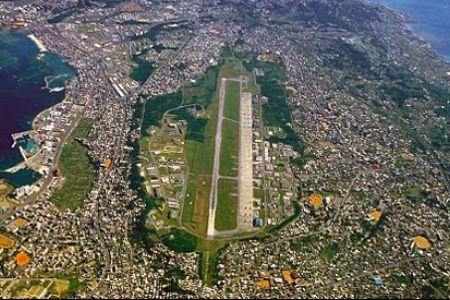


 Aletho News
