Costa Rica’s Opposition Rejects Entry Of US Naval Forces
Inside Costa Rica | July 3, 2010
As is customary, the US asks for authorization of Costa Rica’s legislature before entry of any US warship and soldiers in Costa Rican waters. And as customary, the Costa Rica legislature grants its permission, as was the case on Friday.
The permission allows the entry of 46 US war ships and 7.000 Marines for the balance of the year (July 1 to December 31, 2010).

The permission granted by the Costa Rica legislature could include docking of the USS Freedom (pictured above) on Costa Rica’s shores. Opposition parties say the decade old agreement was to allow entry of US coast guard vessels and not war ships.
Costa Rica’s opposition, however, see it different, describing the permission as illegal and in violation of national sovereignty.
The main opponents to the granting of the authority is the Partido Acción Cuidadana (PAC), the Frente Amplio (FA) and the Partido Unidad Social Cristiana (PUSC), arguing that the destructive force of the ships and manpower, that includes helicopters, is disproportianate to the threat caused by drug traffickers.
The 46 ships carry some 200 helicopters and war planes and includes the USS Freedom, combat submarines and a hospital ship.
Luis Fishman, head of the PUSC party and presidential candidate in the past elections, said the legislative approval was like handing over a “blank cheque”.
“We cannot support the illegal, we cannot allow our Constitution to be trampled”, said Fishman.
The PAC and the FA recalled that the bilateral agreement signed 10 years ago allowed the entry of coast guard vessels, but not war ships that have the capacity for military confrontations and war.
FA legislator José María Villalta questioned the conditions under which the permission was granted, since US personnel “will enjoy freedom of movement and the right to carry out the activities needed to fulfill their mission”.
The FA also urged consideration of the geopolitical situation in which naval forces will be allowed to enter a region considered by Washington as part of its sphere of influence.
The legislator recalled that the US applies in the region a “strategy of complete dominance”, which includes offensive actions such as the coup d’etat in Honduras and the installation of military bases in Colombia.
Opposition Deputies said they may take action, that could include an appeal with the Constitutional Court, against the decision of the Legislative Assembly since the permission for the ships, airships, helicopters and marines to enter the country violates the agreement reached a decade ago.
The bombs that remain
By Eva Bartlett | IPS | July 7, 2010
|

GAZA CITY – At precisely 12 noon on a Thursday afternoon, among the rolling sandy hills in southern Gaza, a controlled explosion destroys another round of white phosphorous shells left in Gaza following the 2008-2009 Israeli war on Gaza.
Explosives experts from the Mines Advisory Group (MAG) and the United Nations Mine Action Team (UNMAT) are working together to eliminate the remainders of a deadly Israeli attack. The Israeli bombings from land, sea and air left behind large amounts of unexploded ordnance (UXO) in civilian areas.
In a precise, technical routine which takes into account all possible dangers to the MAG and UNMAT workers as well as Palestinian residents living in Gaza, the explosives experts are, detonation by detonation ridding Gaza of the remaining white phosphorous shells.
In order to deprive them of oxygen, shells are first sealed in plaster casts, then moved into large sand-filled containers, until their day of detonation.
Controlled detonations occur twice weekly, coordinated with the Hamas government and the Israeli army, whose war planes fly over the detonation site during the afternoon.
On the day of the seventh round of UXOs to be detonated, there are eight shells to destroy. Two are completely full and six are broken open but unexploded.
Inside each shell are 122 sponges soaked with the lethal chemical, designed to scatter far upon explosion.
“Some white phosphorous shells can be only liquid,” explains Mark Buswell, MAG’s technical director. “But the kind used in Gaza were sponges, more difficult to get rid of.”
The use of sponge-filled white phosphorous shells by Israel’s in its attack on Gaza 18 months back also meant that the probability of injuring civilians was greater.
The controlled detonations stop these shells harming civilians in the future and allow the lethal chemical weapon to burn off in containment pits in the ground, far enough away from the nearest houses to cause harm.
Twenty minutes after the first detonation, when the majority of the thick, white smoke has burned off and dissipated, MAG technicians prowl for stray sponges, move them to the pit, and re-ignite them together.
A solitary clump burns in five to ten minutes, although if covered by sand it can lie dormant for days, re-igniting with the poke of a child’s stick or kick of a shoe.
Jim Hill, a Canadian medic working with MAG in Gaza, explains their work. “We are here in case there are injuries from white phosphorous burns, smoke inhalation or unexpected detonations resulting in injuries.”
Hill and other medics accompany the team as it slowly safeguards sites where the rubble clearance has finally begun, well over a year after the destruction.
With over 4,000 houses completely destroyed and 16,000 houses partially or badly damaged, the risk of UXOs is huge.
Buswell says their work is only just beginning.
Israel’s 23-day-war on Gaza December-January 2008-2009 killed more than 1,500 Palestinians, and left more than 5,320 wounded. Among the casualties were those hit or affected by white phosphorous bombings.
“When white phosphorus lands on skin it burns deeply through muscle and into the bone, continuing to burn until deprived of oxygen,” says Amnesty International.
Dr. Nafez Abu Shaban, head of the Burns Unit in Al-Shifa Hospital of Gaza City, told the Palestinian Centre for Human Rights (PCHR) that he was seeing patients “who sustained severe burns due to which the muscles and body cells are completely destroyed.”
Among Israeli soldiers’ targets were homes, schools where thousands of Palestinians were taking refuge, UN buildings storing humanitarian aid, and hospitals. Over half of Gaza’s 27 hospitals and 44 medical centres were destroyed or damaged.
The Al-Quds hospital in Gaza City and the Al-Wafa Rehabilitation Centre east of Sheyjayee — housing over 50 patients, the majority invalid and dependent on life-support machinery — suffered multiple bombings, including direct white phosphorous hits.
Israeli officials first denied using white phosphorous but later admitted and justified its use as a smokescreen for soldiers.
The International Committee of the Red Cross (ICRC) says its use among a concentration of civilians is “simply prohibited”, and notes that white phosphorous can spread up to several hundred square metres, with the “potential to cause particularly horrific and painful injuries or slow painful death.”
Over a year after the Israeli war on Gaza, the risk of UXO poses as real a threat as the fresh bombings.
These UXOs may detonate even decades later, MAG notes. In rural areas farmers ploughing or workers scavenging stones and steel can inadvertently set the bombs off. The anti-tank mines used by Israeli soldiers to demolish houses, and several of which remain, pose a risk to workers removing rubble or to families returning to their homes to sift for belongings.
As of August 2009, the UN reported 12 people killed from UXO explosions, six of who were children. Twenty-three were reported injured, including four children.
In March 2010, UNMAT and MAG began to destroy the 343 UXOs collected so far, including white phosphorous shells.
Mark Buswell compared the threat of an explosion in Gaza to “an explosion which could damage a city centre area the size of the City of London (2.6 square kilometres)”.
Welcome to smart bombs
Ramzy Baroud | 6 July 2010
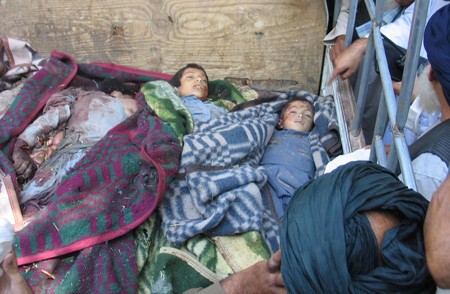
Cluster bombs are in the news again, thanks to a recent report from Amnesty International. The human rights agency has confirmed that 35 women and children were killed following the latest US attacks on an alleged al-Qaeda hideout in Yemen.
Initially, there were attempts to bury the story, and Yemen officially denied that civilians were killed as a result of the December 17 attack in southern Yemen. However, it has been impossible to conceal what is now considered the largest loss of life in one single US attack in the country. If the civilian casualties were indeed a miscalculation on the part of the US military, there should no longer be any doubt about the fact that cluster munitions are far too dangerous a weapon to be utilised in war. And they certainly have no place whatsoever in civilian areas. The human casualties are too large to justify. Yemen is not alone. Gaza, Lebanon and Afghanistan are also stark examples of the untold loss and suffering caused by cluster bombs.
Meanwhile, the unrepentant Israeli army will not consider dropping the use of cluster bombs in civilian areas altogether. Instead it is pondering ways to make them ‘safer’. The Jerusalem Post reported on July 2 that the army “has carried out a series of tests with a bomblet that has a specially designed self-destruct mechanism which dramatically reduces the amount of unexploded ordnance.” During the Israeli onslaught in Lebanon in 2006, Israel fired millions of bomblets. Aside from the immediate devastation and causalities, unexploded ordnance continues to victimise Lebanon’s civilians, most of whom are children. Dozens of lives have been lost since the end of this war.
In Gaza, the same terrible scenario was repeated between 2008 and 2009. Unlike Lebanon, however, trapped Palestinians in Gaza had nowhere to go. Now Israel is anticipating another war with the Lebanese resistance. In preparation for this, an Israeli PR campaign is already underway. It seeks to convince public opinion that Israel is doing its utmost to avoid civilian casualties. “Ahead of a potential new conflict with Hezbollah, the IDF has decided to evaluate the M85 bomblet manufactured by the Israeli Military Industries,” reports the Jerusalem Post. Of course, Israel’s friends will be pleased by the initial successes of the Israeli army testing.
Under pressure to ratify the agreement, these countries are only too eager to offer a ‘safer’ version of current cluster bomb models. This would help not only to maintain the huge profits generated from this morally abhorrent business, it would also hopefully quell growing criticism by civil society and other world governments.
In December 2008, the United States, Russia and China, among others, sent a terrible message to the rest of the world. They refused to take part in the historic signing of the treaty that banned the production and use of cluster bombs.
In a world that is plagued by war, military occupation and terrorism, the involvement of the great military powers in signing and ratifying the agreement would have signaled – if only symbolically — the willingness of these countries to spare civilians’ unjustifiable deaths and the lasting scars of war. Fortunately, the refusal didn’t completely impede an international agreement. The incessant activism of many conscientious individuals and organisations came to fruition on December 3 and 4 in Oslo, Norway, when ninety-three countries signed a treaty banning the weapon.
Not surprisingly, the US, Russia, China, Israel, India and Pakistan – a group that includes the biggest makers and users of the weapon — neither attended the Ireland negotiations of May 2008, and nor did they show any interest in signing the agreement in Oslo.
Most countries that have signed the accords are not involved in any active military conflict. They are also not in any way benefiting from the lucrative cluster munition industry.
But without the involvement of the major producers and active users of the weapon, the Oslo ceremony remained largely symbolic. However, there is nothing symbolic about the pain and bitter losses experienced by the many victims of cluster bombs.
According to the group Handicap International, a third of cluster-bomb victims are children.
Equally alarming, 98 per cent of the weapon’s overall victims are civilians. The group estimates that about 100,000 people have been maimed or killed by cluster bombs around the world since 1965.
Unlike conventional weapons, cluster bomblets survive for many years, luring little children with their attractive appearance. Children often mistake the bomblets for candy or toys.
Recently, some encouraging news emerged from the Netherlands. Maxime Verhagen, Minister of Foreign Affairs, urged his country’s House of Representative to ratify the Convention, which bans the production, possessions and use of such munitions. The ban leaves no room for any misguided interpretations and does not care for the Israeli army’s experimentations. In his speech, Verhagen claimed, “Cluster munitions are unreliable and imprecise, and their use poses a grave danger to the civilian population…Years after a conflict has ended, people – especially children – can fall victim to unexploded submunition from cluster bombs.”
To date, the agreement has been signed by 106 countries and ratified by 36 – and will enter into force on August 1, despite the fact that the big players refuse to take part. The Netherlands’ push is certainly a step in the right direction. But much more remains to be done.
The onus is also on civil societies in countries that are yet to ratify the agreement or sign it in the first place. “All that is necessary for evil to triumph is for good men (and women) to do nothing.” This holds as true in the issue of cluster bombs, as in any other where human rights are violated and ignored.
Ramzy Baroud is a distinguished Arab American commentator and author, most recently, of ‘My father was a freedom fighter’ published by Pluto Press
France probes US submarine link to fishing boat sinking
BBC | July 2, 2010
An investigation into claims that a US nuclear submarine accidentally sank a French fishing boat in 2004, killing five sailors, is to be reopened.
A French appeals court appointed two magistrates to relaunch a probe into the loss of the Bugaled Breizh off the Cornish coast in January 2004.
In particular, they have been asked to try and identify what US submarines were in the vicinity at the time.
The sinking happened a day before Nato military exercises began in the area.
Submarine expert Dominiques Salles said in May the sinking could have been caused by a US nuclear attack submarine.
He suggested the sub may have been spying on a top secret consignment of military grade plutonium, shipped from the French port of Cherbourg to Japan on board a British nuclear transport vessel.
An inquiry in 2008 concluded a nuclear submarine snagging the boat’s trawl was the “highly probable cause” of the sinking, but the judges recommended the investigation be wound up, with no guilty party traced.
Mr Salles’ findings were submitted in a report that had been commissioned by appeal judges in Rennes last November.
The 72ft (23m) Bugaled Breizh, which means “child of Brittany” in Breton, was based at the small port of Loctudy.
The war Israel can’t win
By Paul Woodward on July 6, 2010
At The Daily Beast, historian Thaddeus Russell writes:
When Israeli Prime Minister Benjamin Netanyahu visits the White House Tuesday, President Obama will have the chance to be the first American president since the founding of Israel to ask The Question.
The Question is never addressed by Israel’s supporters and rarely raised by Israel’s detractors. But for those of us who are taxpayers in a nation that has been the state of Israel’s chief benefactor for 42 years — or those of us with Jewish ancestry — it is becoming the only question to ask. It is simple, self-interested, and fundamental: Does the existence of Israel make Americans and Jews safer?
And here is the paradox: Though support for Israel among Americans, and especially Jewish Americans, remains high according to recent Gallup polls, historical evidence says the answer to The Question is “no.”
The history of Israel and its relationship with the U.S. is infinitely complex, but there’s one damning fact that’s ignored as often as The Question: There was not a single act of Arab terrorism against Americans before 1968, when the U.S. became the chief supplier of military equipment and economic aid to Israel. In light of this fact, it’s difficult to credibly sustain the argument that Arab terrorism is spawned by Islam’s alleged promotion of violence and antipathy toward American culture or by a “natural” Arab anti-Semitism. It also suggests that no matter what policies Israel enacts to protect itself — even a withdrawal from the occupied territories or a two-state “solution” — it must be a perpetual wartime state.
Very few Americans today are aware that the question of American and Jewish self-interest was first raised at the time of Israel’s founding by officials in the highest levels of the U.S. government. In 1948, several members of Harry Truman’s Cabinet predicted that the creation of a Jewish state in the Middle East would spur Arab violence against Jews and Americans, advising the president to shun Israel.
These included Secretary of State George Marshall, Defense Secretary James Forrestal, and George Kennan, then the leading policy strategist in the State Department. They argued that if the United States helped to set up an independent Jewish nation it would provoke terrorist attacks on Americans and inaugurate an endless war between Arabs and Jews. “There are 30 million Arabs on one side and about 600,000 Jews on the other,” Forrestal told those in the administration who favored recognizing Israel. “Why don’t you face up to the realities?”
Israel apologists will plead that Thaddeus Russell’s commentary is one more instance among international efforts — rapidly gaining steam — to delegitimize Israel.
Strangely, in response to what is perceived as a campaign of degitimization, there is, as far as I’ve seen, no Israel legitimization campaign. Those mounting a defense, do nothing more than attack their critics — and usually do so with an unbridled viscousness.
For instance, Robin Shepherd, writing in the Jerusalem Post about a decision last week by the Methodist Church of Britain to launch a boycott against goods emanating from settlements in the West Bank and East Jerusalem, says:
Overall, a church that behaves in the manner of the Methodists has buried its credibility under a gigantic dunghill of intransigence, pedantry, lies and distortions.
But let us not allow this matter to rest with a mere recognition of whom and what they have chosen to become.
If the Methodist Church is to launch a boycott of Israel, let Israel respond in kind: Ban their officials from entering; deport their missionaries; block their funds; close down their offices; and tax their churches.
If it’s war, it’s war. The aggressor must pay a price.
While it’s often said that attack is the best form of defense, that principle does not hold in the art of persuasion (and rarely for that matter in national security). The ranks cheering an attack such as Shepherd’s are small and shrinking. Indeed, the more venomous Israel and its supporters become, the less sympathy the Jewish state will evoke and the closer we will move to a critical juncture: where the world has given up on Israel and Israel has given up on the world. At that point, Israel’s isolation becomes the world’s nuclear peril.
Recalling the ‘successful’ counterinsurgency
July 6, 2010 – Kuala Lumpur
Do we not care about the massacres of our lifetime?
December 1948 was just six months into a 12-year campaign to crush communists, who were trying to drive British occupiers out of the Malay Peninsula.
From 1874 to mid 1950s, the British struggled to suppress resistance to occupation. The brutality of some British forces in the Malay Peninsula drove many ethnic Chinese to communism. People who supported communists were literally fenced in. People who opposed communism were co-opted and their communities offered food, medicine and protection. The guerrillas were starved out in the jungle with the gorillas.
Survivors recall
“Did the soldiers bring you outside all at once or in groups?”
“I cannot remember, I fainted. The spirits pushed me. They shot us.”
He was not well in his 70s. He went to the spot where he fainted and fell from British bullets that killed 24 of his fellow workers 55 years before. The rubber trees these deceased tapped were felled long ago. Only stumps remain of the “rumah kongsi” that was once their communal home. His wife had throat cancer. She could eat only un-spiced fish and vegetables. She remembered the brutalities. She was 16 then, a fiance to the man. Another survivor, in her 80s, could recall seeing her husband, the estate supervisor, led out and shot in cold blood with the others.
“The British said that the man who had a receipt for fruit was supplying communists with food. ” “They shot him.” “I wanted to stay and die with them.”
“So cruel those British, so cruel.”
The British soldiers came in trucks and accused the villagers of helping communists. The men and women of the village were separated. The women were loaded onto trucks to be taken away. The younger woman asked where the men were. The soldiers said the men would have to be shot. She remembered watching as the men were led out in groups of four and five, told to turn around by the waiting troops and shot in the back. After two days, she returned to look for her fiance. The bodies had been mutilated, heads hacked off and genitals smashed.
This was 8 months after the massacre of 250 Palestinians on 9th April, 1948 in the village of Deir Yassin in the district of Jerusalem in British-occupied Palestine. The soldiers who made Batang Kali into a killing field in December 1948 were not illegal illegitimate immigrant thugs of the Haganah, Vladimir Jabutinsky’s Irgon, Abraham Stern’s the Stern gang, Palmach and Golani supported and funded by Anglo-American Zionists in the premeditated and systematic ethnic cleansing of Palestinians. They were British Scots Guards struggling to hold on to imperialism, colonialism and may be even Zionism in the face of widespread resentment and resistance. This killing field in the Malay Peninsular as brutal as the Sharpeville massacre of 69 young demonstrators in apartheid South Africa in March 1960 was not unlike so many killing fields made by Americans up north in late 1960s. It was worse with the massacre of 150 unarmed Vietnamese at My Lai on 16th March 1968. It was so much worse with the massacre of at least 1000 unarmed Palestinian refugees in September 1982 at Sabra and Shatila camps in Lebanon ordered by Ariel Sharon as Israeli defense minister conspiring with Elie Hobeike’s Lebanese Forces militia, and another Israeli proxy, Major Saad Haddad’s South Lebanon Army after the American-backed invasion of West Beirut.
Justice was never seen to have been done about these massacres and many more. The killers are still at it in Palestine, Afghanistan, Iraq and Sudan.
Are we not weaklings held to account for indifference or inaction?
These, our deceased, had the right of resistance; they might be labeled communists or terrorists, but they were our people, dead or alive; anytime anywhere they were braver than those people who shot them in the back.
Cut Social Security to Fund the War?
By DEAN BAKER | July 2, 2010
In a remarkable interview with the Pittsburgh Tribune-Review, House Republican Leader John Boehner explicitly called for cutting Social Security in order to pay for the war in Afghanistan. The article reports:
“Ensuring there’s enough money to pay for the war will require reforming the country’s entitlement system, Boehner said. He said he’d favor increasing the Social Security retirement age to 70 for people who have at least 20 years until retirement, tying cost-of-living increases to the consumer price index rather than wage inflation and limiting payments to those who need them.”
In principle Boehner gave the Democrats as much ammunition as a serious political party could want. After all raising the retirement age and cutting Social Security benefits to pay for the war in Afghanistan is an idea that consistently polls in the high single decimals. We should expect every Democratic politician in the country to be jumping up and down demanding to know whether the Republican leader speaks for all Republicans.
That would be the case, unless of course the Democrats actually hold similar views. After all, several prominent Democrats have been saying in public recently that we will have to cut Social Security benefits (benefits workers have already paid for). These prominent Democrats also support the war in Afghanistan.
So, they may not use the same words as Mr. Boehner, but it seems that many Democrats may effectively agree that we have to cut Social Security to pay for the war in Afghanistan. It would be nice if they would insist that this is not true.
Dean Baker is the co-director of the Center for Economic and Policy Research (CEPR). He is the author of Plunder and Blunder: The Rise and Fall of the Bubble Economy
Obama renews call for civilian expeditionary force
By Aletho News | July 1, 2010
President Obama Thursday at a town hall meeting called for a civilian expeditionary force as large as the military, while the Department of Defense issued Defense Directive 1404.10 which describes the workforce deployments as support for combat operations including restoration of order, drug interdiction and contingencies. This while having already raised US military spending by double digits to the highest level of any nation in history.
Having bet on being able to subdue the Afghan people by force and failed, Obama seems to be doubling down. The present military force which costs the nation nearly half of the federal budget is described as “overburdened.”
No indication was offered as to where the funds for the new force would come from as other areas of federal spending are being cut.
European counterparts in the UK and Germany meanwhile are reining in military spending as part of a balanced reduction of deficit spending.
Over recent years various Democratic party leaders have proposed a compulsory service for American youth including basic [military] training. Some proposals call for full military conscription.
Campaigning in 2008, Obama also called for a civilian “national security” force, we can expect to see action moving these plans forward so long as the American public continues to tolerate wars of choice and endless occupations.
June deadliest month yet for NATO in Afghanistan, 310 killed
DPA | June 27, 2010
Kabul – Two NATO soldiers were killed in an attack in eastern Afghanistan on Sunday, while the British Defence Ministry said a British soldier had died of wounds he sustained in an attack earlier this month.
The NATO-led International Security Assistance Force (ISAF) said in a statement that two foreign soldiers had died following a small- arms attack in the eastern region. It did not reveal the nationalities of the deceased.
Most of the NATO troops in the eastern provinces are from the United States, while small units of French and Polish military forces are also based in the restive region.
The British soldier died of wounds he had sustained during a blast in the Nahre Saraj district of the southern province of Helmand on June 10, the Defence Ministry said. The soldier died in hospital in Birmingham, the ministry said in a statement posted at its website.
Meanwhile, the Canadian Defence Ministry said two of the six soldiers killed in separate attacks in Afghanistan on Saturday were Canadians. In a statement the ministry said a female Canadian soldier and her male comrade were killed in the Panjwayi district of the southern province of Kandahar when their vehicle was struck by a roadside bomb.
At least 310 international soldiers have been killed in Afghanistan in June, the deadliest month for NATO troops in the country since the ouster of the Taliban regime in late 2001.
Both Taliban and NATO-led troops are preparing for major battles this summer, when the total number of foreign troops is set to peak at 150,000 from the more than 130,000 currently based in the country.
Shalit, for example
By Uri Avnery | June 26, 2010 | Excerpt
[Gilad] Shalit has become a living symbol – a symbol of Israeli reality, of the inability of our leaders to make decisions, of their moral and political cowardice, of their inability to analyze a situation and draw conclusions.
If there had been an opportunity to free Shalit through military action, the Israeli government would have seized it eagerly.
So much is obvious, because the Israeli public always prefers solving a problem by force than doing anything that might be interpreted as weakness. The rescue of the hostages at Entebbe in 1976 is considered one of the most glorious exploits in the history of Israel, even though there was only a hair’s breadth between success and failure. It was a gamble with the lives of the 105 hostages and the soldiers, and it was successful.
In other cases, though, the gamble did not succeed. Not in Munich in 1972, when they gambled with the lives of the athletes, and lost. Not in Ma’alot in 1974, when they gambled with the lives of the schoolchildren, and lost. Not in the attempt to free the captured soldier Nachschon Wachsman in 1994, when they gambled with his life, and lost.
If there had been any chance of freeing Shalit by force, they would have risked his life, and probably lost. Fortunately for him, there has been no such chance. So far.
Actually, this is quite remarkable. Our security services have hundreds of secret collaborators in the Gaza Strip, in addition to high tech surveillance. Yet it seems that no reliable information about Shalit’s whereabouts has been obtained.
How has Hamas succeeded in this? Among other measures, by not allowing any contact with the captive – no meetings with the Red Cross or foreign dignitaries, just two short videos, almost no letters. They simply cannot be pressured. They refuse all requests of this nature.
This problem could possibly be overcome if our government had been ready to give assurances that no attempt would be made to free him by force, in return for a Hamas undertaking to let him meet with the Red Cross. To be credible, such an undertaking would probably need a guarantee by a third party, perhaps the US.
Absent such an arrangement, all the sanctimonious speeches by foreign statesmen about “letting the Red Cross meet with the soldier” are just so many empty words.
No less hypocritical are the demands of foreign personalities to “free the kidnapped soldier.”
Such demands are music to the Israeli ear, but completely disregard the fact that the subject has to be an exchange of prisoners.
Shalit is alive and breathing, a young man whose fate arouses strong human emotions. But so are the Palestinian prisoners. They are alive and breathing, and their fate, too, arouses strong human emotions. They include young people, whose lives are being wasted in prison. They include political leaders, who are being punished for simply belonging to one or another organization. They include people who, in Israeli parlance, “have blood on their hands,” and who, in Palestinian parlance, are national heroes who have sacrificed their own freedom for their people’s liberation.
The price demanded by Hamas may seem exorbitant – a thousand for one. But Israel has already paid such a price for other prisoners in the past, and that has become the standard ratio. Hamas could not accept less without losing face.
The 1,000 Palestinian prisoners have families – fathers, mothers, husbands, wives and children, brothers and sisters. Exactly like Gilad Shalit. They, too, cry out, demand, exert pressure. Hamas cannot ignore them.
The whole affair is shocking evidence of the inability of our government – both the previous and the present one – to take decisions and even to think logically.
Hamas already fixed the price four years ago, according to past precedents. Their demand has not changed since then… Full article
2 bodies pulled from bombed Gaza tunnel
Ma’an – 26/06/2010

Gaza: Medics pulled two bodies from a Rafah-area tunnel following overnight airstrikes launched by Israeli fighter jets Friday.
Officials said the young men were inside the tunnels during the strike and were crushed by falling rock and sand.
One was identified by medics as Amer Abu Hadid, 23, while the second remains unnamed. A third was said to have been injured. All three were taken to the Abu Yousef An-Najjar Hospital in Rafah.
No injuries were reported on the strikes in northern Gaza, but severe damage to buildings was recorded.
The deaths mark the first resulting from Israeli fire since commandos boarded an aid ship in international waters and commandeered the vessels, killing eight Turkish nationals and one dual Turkish-US citizen.
Featured Video

Houthis Don’t Have to Conquer Saudi Arabia to Make It Pay
or go to
Aletho News Archives – Video-Images
From the Archives
Newly Released FBI Docs Shed Light on Apparent Mossad Foreknowledge of 9/11 Attacks
By Whitney Webb | MintPress News | May 17, 2019
NEW YORK — For nearly two decades, one of the most overlooked and little known arrests made in the aftermath of the September 11 attacks was that of the so-called “High Fivers,” or the “Dancing Israelis.” However, new information released by the FBI on May 7 has brought fresh scrutiny to the possibility that the “Dancing Israelis,” at least two of whom were known Mossad operatives, had prior knowledge of the attacks on the World Trade Center. … continue
Blog Roll
 Aletho News
- MEP blasts ‘Euro-Gestapo’ for lecturing Russia on democracy
- Syria May Send Troops to Saudi Arabia Amid War with Ansar Allah
- UK whines about losing billions to ‘Putin tax’
- Baghaei to Rubio: Distorted narratives cannot erase US record of broken commitments
- Houthis Don’t Have to Conquer Saudi Arabia to Make It Pay
- MOE: Nearly 22,000 Students and Education Workers Killed
- Guterres in Islamabad: Genocide, cowardice, and the cage of Imran Khan
- Johnson, Marandi say Yemen holds upper hand over Saudi Arabia
- False flags won’t save aggressors, Iran FM spokesman says
- The Makkah Pact Enters Into Force: The End of American Dominance or Its New Form?
- If Americans Knew
- Report claimed Mark Levin used by Israeli government to influence Trump
- Over 2,000 Gazans have died awaiting medical evacuation amid Israel’s continued siege
- How a U.S. Diplomat Suppressed and Altered Reports Critical of Israel
- 5 Palestinians Die from Israeli Strikes in Gaza as Relentless Attacks Continue
- Report: Ceasefire Slows Killing but Leaves Devastation Intact
- Country Music Singer Zach Bryan Breaks Attendance Record at Robert Kraft’s Gillette Stadium While Wearing ‘Free Palestine’ Shirt for Second Night in a Row
- Three years of death and devastation: Israel’s war on Gaza in pictures
- Why Hamas believed the status quo was more dangerous than its 7 October gamble
- Debunking Israel’s latest list of ‘terrorist’ journalists in Gaza
- In Gaza, focus is on survival, “every step is a struggle” – Daily Update
- No Tricks Zone
- New Study: 50 Years Of The Most Aggressive ‘Net Zero’ Policies Can Only Affect The Global Climate By 0.03°C
- US September “Heat” Was No Record…Many Records Set Decades Ago
- Latest European Green Energy Debacle; Portugal’s Largest Flagship Solar Park Insolvent!
- Green Energy Debacle: German Expert Professor Fritz Vahrenholt Warns Of Severe Economic And Social Consequences
- Two More Paleo Reconstructions Affirm Meters-Higher Sea Levels Across Ireland, Brazil 7000-6000 Years Ago
- New Study: Earth And Venus Surface Warmth Largely Explained By Convection And Lapse Rate, Not CO2 Or Radiation
- 2025 Nature Paper Claiming Worsening Global Drought Gets RETRACTED …Heavily Flawed
- New Study: ‘Global Drought Shows No Detectable Recent Acceleration Under Climate Warming’
- Economic Masterminds: German Socialists Suggest Taxing Productivity Gains Stemming From Using AI
- The South China Sea Has Not Been Cooperating With The Climate Change Narrative

