118 UN members reaffirm support for Iran’s N-program
Press TV – March 3, 2010

The Non-Aligned Movement (NAM) logo
As the West pushes for new sanctions against Iran, the Non-Aligned Movement (NAM) moves to issue a new statement, voicing its support for Iran’s peaceful nuclear program.
Egypt’s envoy to the International Atomic Energy Agency (IAEA) read the newly-issued NAM statement in a Wednesday meeting of nuclear watchdog’s board of governors.
“NAM confirms the basic and inalienable right of all states to the development, research, production and use of atomic energy for peaceful purposes, without any discrimination and in conformity with their respective legal obligations,” the statement said.
“Therefore, nothing should be interpreted in a way as inhibiting or restricting the right of states to develop atomic energy for peaceful purposes,” it added.
“States’ choices and decisions including those of the Islamic Republic of Iran in the field of peaceful uses of nuclear technology and its fuel cycle policies must be respected,” the 118-member movement said in its statement.
“NAM reaffirms the inviolability of peaceful nuclear activities and that any attack or threat of attack against peaceful nuclear activities, operational or under construction, poses a serious threat to human beings and the purposes of the Charter of the United Nation and of the regulations of the IAEA,” it said.
The statement comes as the West is weighing new sanctions on Iran in an effort to force the country into meeting its demands over its nuclear program.
Meanwhile, China — a veto-wielding member of the UN Security Council — has shrugged off Washington’s call for harsher sanctions against Iran over its nuclear activities, arguing that diplomatic efforts have not yet been exhausted.
Tehran has repeatedly declared that sanctions will not force it to give up the Iranian nation’s legitimate right to access nuclear technology for peaceful purposes.
Joe Lieberman and Lindsay Graham plotting to revive “climate” bill
Gas Tax Proposal to Provide More Funding for Nuclear Plants

FILE: Sen. Joe Lieberman, I-Conn., left, talks as Sen. Lindsey Graham, R-S.C., listens during a press conference at the Saban Forum in Jerusalem, Monday Nov. 16, 2009. (AP Photo/Tara Todras-Whitehill)
Susan Ferrechio,Chief Congressional Correspondent | Washington Examiner | March 2, 2010
A group of senators are trying to resuscitate global warming legislation, but the potential inclusion of a new gas tax threatens to keep action on one of President Obama’s signature initiatives stalled.
Sens. John Kerry, D-Mass., Lindsey Graham, R-S.C., and Joe Lieberman, I-Conn., have pushed aside the politically unpopular idea of passing a “cap and trade” system for regulating most emissions and would instead go after power plants, motor vehicles and manufacturers with targeted taxes and caps.
The lawmakers are hoping to get a bill together in the “coming weeks,” according to a Kerry aide, and then find a way to fit it in the already jammed Senate calendar, where the jobs agenda and now health care reform are the priorities.
“Unlike past pieces of legislation, we are taking a careful look at different sectors of the economy to determine the most appropriate policy to reduce emissions in each sector,” Kerry spokeswoman Whitney Smith said. “Based on input from all stakeholders, the idea is to take a reasonable, responsive approach to each sector to accomplish an economywide goal.”
Even without creating a cap and trade system, such a proposal would face opposition among Republicans and Democrats in the Senate, particularly those who will not support any bill that threatens to raise prices or impose a fuel tax, which could happen under this proposal.
“No bill that collides with the urgent imperative of job creation has a chance right now and to the extent that a climate bill has that feature or is seen as having that feature, it can’t go anywhere,” said William Galston, a political scholar at the Brookings Institution.
Senate proponents of the bill are up against a daunting deadline, with a little more than six months left to tackle legislative business before the chamber adjourns for 2010 campaigning. Few, if any, endangered Democrats will be willing to vote on a bill that could be unpopular among economically struggling constituents.
“I think they are all in denial,” Sen. James Inhofe, R-Okla., a global warming skeptic, told The Examiner on Monday. “They are going to be trying to impose a huge tax on Americans without any positive results. And we’re going to be there to remind everybody.”
Proponents of the plan believe it can succeed by using the piecemeal approach, which will make it easier to craft a bill that could attract the 60 votes needed for passage. And with Graham already on board, Democrats would only have to round up all 59 Democratic-controlled votes. The proposal would increase domestic oil and gas drilling and would provide federal funding for nuclear energy plants, which could attract moderate votes.
“I don’t think the climate and energy issue is dead in the Senate,” Eileen Claussen, president of the Pew Center on Global Climate Change, told The Examiner. “The real question is what kind of bill can you put together that can pass.”
sferrechio@washingtonexaminer.com
Further nuclear power subsidies are wrongheaded
By Mark Cooper | 2 December 2009
It is ironic that as the nation continues to suffer from the misallocation of risk by companies in the financial sector, some of the strongest supporters of free markets and critics of government action are urging a massive federal subsidy for nuclear power.
Most recently, the nuclear industry and its supporters want any climate bill that comes out of Congress to include more subsidies for the nuclear industry. Both the House-passed American Clean Energy and Security Act and the Senate energy bill, the American Clean Energy Leadership Act PDF, would potentially allow for billions of dollars to be handed out for the development of new nuclear plants in the United States. The Senate bill would literally give the nuclear industry a limitless blank check. This is in addition to $18.5 billion in loan guarantees and a production tax credit of 1.8 cents per kilowatt-hour that the federal government already has allocated for nuclear energy in the 2005 Energy Policy Act. PDF All the while, the projected cost of nuclear reactor construction has escalated dramatically (almost tripling in less than a decade), demand for electricity has declined, and the cost of natural gas has plummeted.
Considering these challenges, private capital markets, not surprisingly, have refused to extend loans to the nuclear industry. In fact, they have lowered the financial ratings of utilities that are pursuing nuclear projects, which is why the industry is seeking further government support. In particular, the industry would like new rules that allow it to gobble up funds earmarked for clean energy technologies; elimination of conditions that protect taxpayers in the event of loan defaults; dramatic increases in tax and insurance subsidies; and accelerated and assured recovery of construction costs from ratepayers authorized by state regulators.
These direct subsidies would total in the hundreds of billions of dollars. Yet believe it or not, the stakes for consumers would be still higher. Nuclear subsidies would induce utilities to choose high capital-cost nuclear reactors that expand their rate base and forego much lower-cost alternatives, such as greater energy efficiency and renewable energy, imposing excessive costs on consumers that eventually could run into the trillions of dollars. In an attempt to circumvent the sound judgment of capital markets, nuclear advocates erroneously claim that subsidies lower the financing costs for nuclear reactors and are good for consumers. (For a more lengthy analysis of these risks see my full report. PDF)
However, shifting risk does not eliminate it, and subsidies induce utilities and regulators to take greater risks that will cost taxpayers and ratepayers dearly. These risks include:
- When utilities skip over the lower-cost option, such as greater efficiency, wind power, and/or natural gas, costs rise, dramatically in the case of nuclear reactors.
- Subsidies encourage risky behaviors that would leave taxpayers and ratepayers to pay associated costs when and if those unwise projects go bad and are abandoned.
- Pre-approval for loan guarantees and/or construction work in progress reduces scrutiny over cost escalation and overruns.
- Large, high-risk projects, such as nuclear plants, can have adverse impacts on utility financial ratings, which result in high interest charges on utility debt and substantial increases in rates.
The recent efforts by the nuclear industry call to mind the previous U.S. nuclear construction boom that resulted in what Forbes called the “largest managerial failure in business history” in the mid-1980s. In that boom, one-half of all orders for nuclear plants were cancelled, reactors that were completed cost double their original estimates, four-fifths of utilities suffered large financial downgrades, and several firms went bankrupt.
Policy makers should refuse to hand out billions of dollars more to the nuclear power industry for widespread deployment of a costly technology and limit any such subsidies, if they are deemed necessary, for specific and narrow tasks of research, development, and demonstration. To prevent history from repeating itself they should subject any projects that are funded by subsidies to rigorous fiscal, technological, and administrative oversight and make sure that projects are structured with maximum taxpayer protections and transparency built into the conditions of the loan guarantees.
Furthermore, states should reject guarantees (and accelerated recovery) for nuclear construction costs, demand binding fixed-cost contracts before construction begins, and impose strong incentive and penalty mechanisms to control cost overruns.
The financial difficulties facing nuclear power projects are not a market failure, but are a market success–the capital markets correctly understand the grim economic realities of nuclear power. If policy makers override the judgment of the free market and force taxpayers and ratepayers to subsidize new reactors, consumers and the economy will pay a heavy price.
Mainstreaming Nuclear Waste
Top 25 Censored Stories for 2009
Radioactive materials from nuclear weapons production sites are being dumped into regular landfills, and are available for recycling and resale. The Nuclear Information and Resource Service (NIRS) has tracked the Department of Energy’s (DOE) release of radioactive scrap, concrete, equipment, asphalt, chemicals, soil, and more, to unaware and unprepared recipients such as landfills, commercial businesses, and recreation areas. Under the current system, the DOE releases contaminated materials directly, sells them at auctions or through exchanges, or sends the materials to processors who can release them from radioactive controls. The recycling of these materials—for reuse in the production of everyday household and personal items such as zippers, toys, furniture, and automobiles, or to build roads, schools, and playgrounds—is increasingly common.
The NIRS report, “Out of Control on Purpose: DOE’s Dispersal of Radioactive Waste into Landfills and Consumer Products,” tracks the laws, methods, and justifications used by the DOE to expedite the mandatory cleanup of the environmental legacy being created by the nation’s nuclear weapons program and government-sponsored nuclear energy research. One of the largest and most technically complex environmental cleanup programs in the world, the effort includes cleanup of 114 sites across the country to be completed by the end of 2008.
The DOE has unilaterally chosen allowable radioactive contamination and public exposure levels to facilitate “clean-up” of these sites. Pressure is increasing to allow clearing radioactivity from control in order to legalize the dispensing and disbursing of nuclear waste.
In 2000, the Secretary of Energy banned the commercial recycling of potentially radioactive metal. However, the ban does not apply to the disposal, reuse, or recycling of metal equipment, components, and pipes, or of other materials.
Seven sites of importance were investigated for the NIRS report: Oak Ridge, Tennessee; Rocky Flats, Colorado; Los Alamos, New Mexico; Mound and Fernald, Ohio; West Valley, New York; and Paducah, Kentucky. Of these, Tennessee is said to be the main funnel that pours nuclear weapon and power waste from around the country into landfills and recycling facilities without public knowledge. “People around regular trash landfills will be shocked to learn that radioactive contamination from nuclear weapons production is ending up there, either directly released by DOE or via brokers and processors,” says author Diane D’Arrigo, NIRS’s Radioactive Waste Project director.
EnergySolutions, the company that operates the only private low-level radioactive waste disposal business in the US, disposes of more than 90 percent of the low-level radioactive waste generated in the US. It operates waste processing and disposition facilities in Tennessee, South Carolina, and Utah. The company also operates low-level radioactive waste disposal facilities, vaults, and landfills on the DOE Oak Ridge Reservation in Tennessee.
Amazingly, as the DOE struggles through desperate and irresponsible measures to “disappear” this nation’s nuclear waste by the end of 2008, EnergySolutions has applied for a license in Tennessee to process nuclear waste from Italy.
This application marks the first time in the history of the Nuclear Regulatory Commission that a company has asked to dispose of large amounts of foreign-generated low-level radioactive waste in the United States.
In February 2008, Bart Gordon, the Tennessee Democrat who chairs the House Committee on Science and Technology, asked the Northwest Interstate Compact of Low-Level Radioactive Waste Management to withhold licensing that he says would put the US on a path to becoming “the world’s nuclear garbage waste dump.”
In an understatement, Gordon argued, “The US already faces capacity issues and other challenges in treating and disposing of radioactive waste produced domestically. We should be working on solving this problem at home before taking dangerous waste from around the world.”
UPDATE BY DIANE D’ARRIGO
The nuclear power and weapons industry and the government agencies that promote, oversee, and regulate nuclear activities are trying to save money by allowing large amounts of man-made, radioactively contaminated materials and property to be redefined as not radioactive. They don’t want to pay to try to isolate nuclear waste, including metal, concrete, asphalt, plastic, soil, equipment, and buildings, so they have developed ways to send the waste to regular landfills or even into commercial recycling that could end up in daily-use items the public makes contact with regularly.
This story is increasingly important as old nuclear weapons sites and power reactors close and the companies seek relief from responsibility and liability for the long-lasting nuclear waste they generated. It is especially dangerous as new nuclear power and weapons facilities are proposed, which will dramatically increase the amount of waste generated that could get into the public realm.
Although the US federal agencies have not generally allowed nuclear waste to be released from controls, they are still working on it. The Environmental Protection Agency and the Nuclear Regulatory Commission (NRC) have proposed rules in the wings, likely to emerge at any time. NRC is encouraging case by case releases of nuclear waste. The DOE has procedures to allow some radioactive waste out of controls but claims to be preventing radioactive metal from getting into the commercial metal market. A programmatic environmental review could overturn that prohibition, and internally DOE has many loopholes to let nuclear wastes out.
The story wasn’t covered much in the mainstream news. One notable exception was the investigative team led by Demetria Kalodimos on Channel 4 WSMV, Nashville’s NBC affiliate, who reported on the story and did over twenty follow-ups in the Nashville area (see http://www.nirs.org for links). Public awareness led to legislative attention and a commitment by the landfill operator who was taking nuclear waste to stop taking it. Kalodimos received three journalism awards for reporting and following up on the story herself.
The community is not satisfied with this voluntary commitment, because the Tennessee State Department of Environment and Conservation (TDEC) still allows nuclear waste to be released from controls. TDEC licenses companies to import nuclear waste from around the country and world for “processing,” including incineration and metal melting and reuse.
The report identified TDEC and Tennessee as leaders in releasing nuclear waste out of control.
The situation has worsened since last year. One of the processors is proposing to import a huge portion of Italy’s nuclear power waste to burn, process, melt and dump in the US (Tennessee and Utah).
Action against this can be taken by contacting your state governors to oppose it and by supporting federal legislation that would prohibit the US from importing foreign nuclear waste.
Citizens can also contact their state officials to find out if their state is allowing nuclear waste into the solid waste streams in their communities.
###
Sources:
Nuclear Information and Resource Service, May 14, 2007
Title: “Nuclear Waste in Landfills”
Author: Diane D’Arrigo
Environment News Service, May 14, 2007
Title: “US Allows Radioactive Materials in Ordinary Landfills”
Author: Sunny Lewis
Environment News Service, February 4, 2008
Title: “US Company Seeks Permit to Import Nuclear Waste”
Author: Sunny Lewis
Student Researchers: Derek Harms and Cedric Therene
Faculty Evaluator: Noel Byrne, PhD
dianed@nirs.org for more information.
Another Corporate Bailout: Obama Goes Nuclear
By Glen Ford | Black Agenda Radio | February 24, 2010
Opponents of nuclear power have now joined the ranks of those who are bitterly disappointed with President Obama, who is proposing to triple loan guarantees to the nuclear power industry. Barack Obama has long been allied with nuclear power, as have his two closest confidants, political advisor David Axelrod and White House chief of staff Rahm Emanuel. The Chicago-based Exelon corporation, the biggest nuclear power operator in the United States, was a major Obama campaign contributor. Obama’s support for nuclear power has never been a secret. If environmentalist Obamites were surprised by their president’s all-out push for nukes, they have only their own self-delusions to blame.
 Back during the campaign, when Obama was getting huge checks from Big Nukes and Big Coal, environmentalists were giving him a political blank check for no other reason than Obama wasn’t George Bush. But it turns out that regarding nuclear power, Obama is worse than George Bush – three times worse. By boosting federal loan guarantees for new nuclear reactors from $18.5 to $54 billion, Obama is attempting to bring back to life an industry that has been all but dead for almost three decades. More than just a bailout, Obama is determined to pull off a nuclear resurrection.
The demise of U.S. nuclear power is generally dated to the partial meltdown at Pennsylvania’s Three Mile Island plant in March, 1979. But nuclear power has always been a failed business model in the U.S. Construction costs consistently run amok, at three, four and five times advertised. The Congressional Budget Office estimates that loans for nuclear plant construction have a more than fifty percent chance of never being repaid. Environmental opposition to nuclear power is not the reason the industry has been moribund for 30 years. Nuclear power was all but dead because private capital saw the industry as a bad risk. So Wall Street helped elect a president who would put up the people’s money. With public dollars reviving the industry, Chicago-based Exelon’s stock should shoot through the roof. Wall Street can prepare to process billions of dollars in new loans, knowing it doesn’t stand to lose one cent because the public is taking all the financial risk.
The public is also taking all the risk for the health hazards of nuclear power. Private industry will not insure against accidents, which could amount to hundreds of billions of dollars in damages. The public will ultimately pay for any cleanup.
Late-stage finance capitalism, like nuclear power, can only exist as a parasite on the larger society. The people pay all the costs: financial, safety, and health. The investment class puts up no money unless guaranteed a payback plus big profits. This isn’t about the environment. It’s about Wall Street stealing the people blind, through their bought-and-paid-for servants in the Congress and the White House. It’s really a crime story.
NRC confirms 2005 tritium leak at Vermont Yankee
By Susan Smallheer | Rutland Herald | February 23, 2010
The Nuclear Regulatory Commission confirmed Monday that a whistleblower told the truth last week when he told a member of the Vermont Legislative Oversight Panel there was an earlier radioactive leak of tritium at the Vermont Yankee plant in the same area that is the focus of the current leak.
The confirmation by Donald Jackson, branch chief of reactor projects for NRC’s Region One, again raised the question of why Entergy Nuclear executives repeatedly told Vermont regulators last year there were no underground pipes at the Vernon reactor carrying radionuclides. Jackson said the leak was in 2005, not two years ago, as the whistleblower had originally told Arnie Gundersen, a member of the oversight panel and a consultant to the Vermont Legislature.
Entergy Nuclear spokesman Larry Smith said late Monday he could not discuss the 2005 tritium leak, saying he was still waiting for a letter from Entergy attorneys before talking about the issue.
Entergy Nuclear is excavating the area near the advanced off-gas building, in particular an underground pipe tunnel connected to the building, which is the same area the whistleblower pointed to. The whistleblower said the area in question was in a “high-radiation” area and involved a “radioactive steam leak” which drained into a drain pit.
Jackson said that the exact location of the current leak is still not known, although the advanced off-gas pipe tunnel is of strong interest, so it was impossible to say the two tritium leaks came from the same spot.
Jackson said that the NRC makes no distinction between “underground” and “buried” pipes, something that Entergy has made several times in the past couple of weeks. In Entergy’s words, buried pipes are in direct contact with dirt, while underground pipes are in tunnels or vaults, carrying pipes.
Jackson said the 2005 leak was under investigation, but he said it was a steam leak and the steam contained tritium and potentially other radionuclides.
He said Entergy did list the problem in the advanced off-gas pipe tunnel or vault as one of several corrective actions in 2005.
According to the whistleblower, whom Gundersen said seemed credible and well-informed about the inner workings at Vermont Yankee, the company used a temporary plug to fix the leak, rather than shut down the plant and make a permanent fix.
The whistleblower even went so far as to list the type of material, Furmanite, that Entergy used to temporarily plug the leak.
The whistleblower said that a tent and HEPA filter was set up to catch any radioactive gas during the 2005 case, and that workers used protective clothing.
Gundersen on Monday refused to say whether he had heard again from the whistleblower. Gundersen had turned the information from the whistleblower over to the Department of Public Service and the Vermont Attorney General’s office last week, both of which are investigating the case.
Jackson’s disclosure confirming the whistleblower came during a conference call with reporters, giving an update on the current leak. Neil Sheehan, NRC spokesman, said that Entergy would be issuing a press release about the 2005 leak later in the day.
Entergy Nuclear only started monitoring for tritium leaks in 2007, after an industry-wide suggestion from the NRC. Entergy drilled three monitoring wells on the banks of the Connecticut River, with one revealing elevated levels of tritium in November, which was reconfirmed in January.
Entergy revealed the current tritium leak on Jan. 7, and has been working since then to find the source of the leak.
Entergy, in its daily update about the search for the leak, said it was taking one of its own drinking water wells, which is near the leak’s plume, out of service as a precautionary measure.
That well, the construction office building well, is one of several wells that provide drinking water to the company, and is more than 350 feet deep in bedrock, the company said. The contaminated monitoring wells are relatively shallow, about 35 feet.
Sheehan said that the NRC was able to talk about the whistleblower allegations in 2005 because the whistleblower did not file a report with the NRC. Usually, the NRC won’t discuss whistleblower issues.
Jackson said that it was unknown whether the 2005 tritium leak, which was found in the underground pipe tunnel, had “transmitted” to the ground.
He said that there is a possibility that the tritium-laden steam did escape to the outside environment. “We’re still determining that,” he said. Jackson said the 2005 leak was inside a part of the reactor complex, and should have been maintained in the concrete pipe vault.
Most of the conference call with the reporters dealt with the NRC emphasizing that the current tritium leak currently posed no health risk to Vermonters, since it had not reached any private wells and that while it was reaching the Connecticut River, it was in very low levels, between 200 to 600 picocuries per liter.
While the plant is licensed to release some amounts of radioactivity into the environment, according to Steven Garry, a senior health physicist, they are well within NRC limits.
Garry said that there had been “essentially zero dose” to the general public from the current tritium leak, and he said that any tritiated water that did reach the Connecticut River would be diluted substantially to eliminate any health threat.
Tritium, which is a form of radioactive hydrogen, can cause cancer, but only when ingested in large, concentrated doses. One well at Vermont Yankee has tested for 2.6 million picocuries per liter, although that concentration has dropped to 1.8 million picocuries. Other wells show various other levels of tritium, with the next highest close to 1 million, according to the Vermont Department of Health.
susan.smallheer@rutlandherald.com
© 2010 Rutland Herald – Source
A closer look at what Obama’s energy priorities really are
The U.S. Department of Energy’s FY 2011 Budget Request
By Robert Alvarez | Institute for Policy Studies | February 12, 2010
When President Obama rolled out his proposed budget to Congress for the coming year, he said it would build “on the largest investment in clean energy in history.” But Obama’s definition of “clean energy” includes a commitment to help companies garner billions of dollars in loans for nuclear reactor construction. And, unfortunately, nuclear energy isn’t safe or clean and it’s too costly for the nation.
The Energy Department faces a brave new world in which, for the first time, it’s being called on to employ millions of Americans to create a new energy future for the United States. But it doesn’t appear that the Obama administration will meet this challenge. Instead, more of the nation’s tapped-out treasure is going for costly nuclear power, and nuclear weapons we don’t need and could never use.

Despite Obama’s rhetoric about reshaping America’s energy future, he’s asking for a budget that would have the Energy Department continue to spend 10 times more on nuclear weapons than energy conservation. More than 65 percent of our energy budget covers military nuclear activities and the cleanup of weapons sites. Its single largest expenditure maintains some 9,200 intact nuclear warheads. Even though the department hasn’t built a new nuclear weapon for 20 years, its weapons complex is spending at rates comparable to that during the height of the nuclear arms race in the 1950s. Even with economic stimulus funding, the department’s actual energy functions comprise only 15 percent of its total budget and continue to take a backseat to propping up the nations’ large and antiquated nuclear weapons infrastructure. In fact, the Energy Department’s proposed budget for the 2011 fiscal year, minus stimulus money, looks a whole lot like it did in the Bush administration, and as it has during several presidents’ tenures.
Obama’s atomic blunder
By Harvey Wasserman | Online Journal | February 18, 2010
As Vermont seethes with radioactive contamination and the Democratic Party crumbles, Barack Obama has plunged into the atomic abyss.
In the face of fierce green opposition and withering scorn from both liberal and conservative budget hawks, Obama has done what George W. Bush could not — pledge billions of taxpayer dollars for a relapse of the 20th century’s most expensive technological failure.
Obama has announced some $8.3 billion in loan guarantees for two new reactors planned for Georgia. Their Westinghouse AP-1000 designs have been rejected by the Nuclear Regulatory Commission as being unable to withstand natural cataclysms like hurricanes, tornadoes and earthquakes.
The Vogtle site was to originally host four reactors at a total cost of $600 million; it wound up with two at $9 billion.
The Southern Company which wants to build these two new reactors has cut at least one deal with Japanese financiers set to cash in on American taxpayer largess. The interest rate on the federal guarantees remains bitterly contested. The funding is being debated between at least five government agencies, and may well be tested in the courts. It’s not clear whether union labor will be required and what impact that might have on construction costs.
The Congressional Budget Office and other analysts warn the likely failure rate for government-backed reactor construction loans could be in excess of 50 percent. Energy Secretary Stephen Chu has admitted he was unaware of the CBO’s report when he signed on to the Georgia guarantees.
Over the past several years the estimated price tag for proposed new reactors has jumped from $2-3 billion each in some cases to more than $12 billion today. The chair of the NRC currently estimates it at $10 billion, well before a single construction license has been issued, which will take at least a year.
Energy experts at the Rocky Mountain Institute and elsewhere estimate that a dollar invested in increased efficiency could save as much as seven times as much energy than one invested in nuclear plants can produce, while producing 10 times as many permanent jobs.
Georgia has been targeted largely because its regulators have demanded ratepayers put up the cash for the reactors as they’re being built. Florida and Georgia are among a small handful of states taxing electric consumers for projects that cannot come on line for many years, and that may never deliver a single electron of electricity.
Two Florida Public Service commissioners, recently appointed by Republican Governor Charlie Crist (now a candidate for the US Senate), helped reject over a billion dollars in rate hikes demanded by Florida Power & Light and Progress Energy, both of which want to build double-reactors at ratepayer expense. The utilities now say they’ll postpone the projects proposed for Turkey Point and Levy County.
In 2005, the Bush administration set aside some $18.5 billion for reactor loan guarantees, but the Department of Energy has been unable to administer them. Obama wants an additional $36 billion to bring the fund up to $54.5 billion. Proposed projects in South Carolina, Maryland and Texas appear to be next in line.
But the NRC has raised serious questions about Toshiba-owned Westinghouse’s AP-1000 slated for Georgia’s Vogtle site, as well as for South Carolina and Turkey Point. The French-made EPR design proposed for Maryland has been challenged by regulators in Finland, France and Great Britain. In Texas, a $4 billion price jump has sparked a political upheaval in San Antonio and elsewhere, throwing the future of that project in doubt.
Taxpayers are also on the hook for potential future accidents from these new reactors. In 1957, the industry promised Congress and the country that nuclear technology would quickly advance to the point that private insurers would take on the liability for any future disaster, which could by all serious estimates run into the hundreds of billions of dollars. Only $11 billion has been set aside to cover the cost of such a catastrophe. But now the industry says it will not build even this next generation of plants without taxpayers underwriting liability for future accidents. Thus the “temporary” program could ultimately stretch out to a full century or more.
In the interim, Obama has all but killed Nevada’s proposed Yucca Mountain nuclear waste dump. He has appointed a commission of nuclear advocates to “investigate” the future of high-level reactor waste. But after 53 years, the industry is further from a solution than ever.
Meanwhile, the Nuclear Regulatory Commission has reported that at least 27 of America’s 104 licensed reactors are now leaking radioactive tritium. The worst case may be Entergy’s Vermont Yankee, near the state’s southeastern border with New Hampshire and Massachusetts. High levels of contamination have been found in test wells around the reactor, and experts believe the Connecticut River is at serious risk.
A furious statewide grassroots campaign aims to shut the plant, whose license expires in 2012. A binding agreement between Entergy and the state gives the legislature the power to deny an extension. US Senator Bernie Sanders (D-VY) has demanded the plant close. The legislature may vote on it in a matter of days.
Obama has now driven a deep wedge between himself and the core of the environmental movement, which remains fiercely anti-nuclear. While reactor advocates paint the technology green, the opposition has been joined by fiscal conservatives like the National Taxpayer Institute, the Cato Institute and the Heritage Foundation.
Reactor backers hailing a “renaissance” in atomic energy studiously ignore France’s catastrophic Olkiluoto project, now $3 billion over budget and three years behind schedule. Parallel problems have crippled another project at Flamanville, France, and are virtually certain to surface in the US.
The reactor industry has spent untold millions lobbying for this first round of loan guarantees. There’s no doubt it will seek far more in the coming months. Having failed to secure private American financing, the question will be: In a tight economy, how much public money will Congress throw at this obsolete technology?
The potential flow of taxpayer guarantees to Georgia means nuclear opponents now have a tangible target. Also guaranteed is ferocious grassroots opposition to financing, licensing and construction of this and all other new reactor proposals, as well as to continued operation of leaky rust bucket reactors like Vermont Yankee.
The “atomic renaissance” is still a very long way from going tangibly critical.
Chernobyl: Consequences of the Catastrophe for People and the Environment
A book review

By Dr. Rosalie Bertell | Global Research | February 12, 2010
This new publication of the Annals of the New York Academy of Sciences (Volume 1181), by Alexey Yablokov, Vassily Nesterenko, and Alexey Nesterenko, is the elucidation many of us have been waiting for since the 1986 disaster at the failed nuclear reactor in Ukraine. Until now we have read about the published reports of limited spotty investigations by western scientists who undertook projects in the affected territories. Even the prestigious IAEA, WHO and UNSCEAR reports have been based on about 300 such western research papers, leaving out the findings of some 30,000 scientific papers prepared by scientists working and living in the stricken territories and suffering the everyday problems of residual contamination with nuclear debris and a contaminated food supply.
Chernobyl: Consequences of the Catastrophe for People and the Environment is wrtitten by Alexey Yablokov, Vassily Nesterenk and Alexey Nesterenko. The senior author, Alexey Yablokov was head of the Russian Academy of Science under Gobachev – since then he receives no support. Vassily Nesterenko, head of the Ukrainian Nuclear establishment at the time of the accident, flew over the burning reactor and took the only measurements. In August 2009, he died as a result of radiation damage, but earlier, with help from Andrei Sakarov, was able to establish BELRAD to help children of the area.
The three scientists who assembled the information in the book from more than 5000 published articles and research findings, mostly available only within the former Soviet Union or Eastern block countries and not accessible in the West, are prestigious scientists who present objective facts clearly nuanced with little or no polemics. They were not encumbered by a desire to promote or excessively blame a failed technology.
The book was expertly translated into readable English by Janette Sherman, Medical Toxicologist and Adjunct Professor in the Environmental Institute at Western Michigan University.
Professor Dr. of Biology, Dimitro Grodzinsky, Chair of the Department of Biology of the Ukraine National Academy of Sciences, and member of the National Commission wrote the Forward to the book. His statement relative to Western reporting of the accident is illuminating:
“For a long time I have thought that the time has come to put an end to the opposition between technocracy advocates and those who support objective scientific efforts to estimate the negative risks for people exposed to the Chernobyl fallout. The basis for believing that these risks are not minor is very convincing.”
The government of the former Soviet Union previously classified many documents now accessible to the authors. For example, we now know that the number of people hospitalized for acute radiation sickness was more than a hundred times larger than the number recently quoted by the IAEA, WHO and UNSCEAR. Unmentioned by the technocrats were the problems of “hot particles” of burning uranium that caused nasopharyngeal problems, and the radioactive fallout that resulted in general deterioration of the health of children, wide spread blood and lymph system diseases, reproductive loss, premature and small infant births, chromosomal mutations, congenital and developmental abnormalities, multiple endocrine diseases, mental disorders and cancer.
The authors systematically explain the secrecy conditions imposed by the government, the failure of technocrats to collect data on the number and distribution of all of the radionuclides of major concern, and the restrictions placed on physicians against calling any medical findings radiation related unless the patient had been a certified “acute radiation sickness” patient during the disaster, thus assuring that only 1% of injuries would be so reported.
This book is a “must read” for all of those bureaucrats currently promoting nuclear power as the only “solution” for climate change. Those who seek information on the disaster only from the official documentation provided by the IAEA, WHO and UNSCEAR need to broaden their reading to include the reality check from those scientists who have access to local findings and are simply telling the truth, with no hidden propaganda agenda.
I was impressed by the simple message of the cover of this volume, which shows a number of felled logs with clearly distinguishable colors of wood: before and after Chernobyl. The reader will find that the environment, living plants and animals all suffered ill effects from this experience, as did the human population. It should be a sobering read for all those who have believed the fiction that “low doses of radiation are harmless”, or that a severe nuclear accident is easily contained within the human environment.
Below is the New York Academy of Sciences site for the book. Unfortunately, its selling price is now about $150, which may limit its distribution.
http://www.nyas.org/Publications/Annals/Detail.aspx?cid=f3f3bd16-51ba-4d7b-a086-753f44b3bfc1
Jordanians sue Israel over Dimona nuclear plant
Press TV – February 16, 2010
A Jordanian human rights group is set to sue Israel for the damage its nuclear facility in Dimona has caused to the environment and the residents in south Jordan.
The al-Jisr al-Arabi center has accused Israel of causing death, cancer and other afflictions among the Jordanian population residing in the area adjacent to the nuclear plant and thus prone to the toxic gases and radiation the facility emits.
The Amman-based human rights group has reportedly taken the preliminary steps necessary ahead of filing a legal lawsuit against Israel in the coming month with Jordanian legal bodies.
The center met with a number of the reactor’s victims and “collected evidence and proof that attest to a rise in the number of cancer cases, especially among residents of the southern region, which is adjacent to the reactor.”
“This is an ongoing and deliberate crime on Israel’s part, which still causes cases of death and injury in large numbers among the Jordanians,” said the center’s General Manager Attorney Amjad Shammout.
He went on to add that he was optimistic the complaint will be accepted in accordance with the constitution and international treaties on human rights, which Jordan has recently adopted.
Vermont’s Radioactive Nightmare
By Harvey Wasserman | February 11, 2010
Like a decayed flotilla of rickety steamers, at least 27 of America’s 104 aging atomic reactors are known to be leaking radioactive tritium, which is linked to cancer if inhaled or ingested through the throat or skin.
The fallout has been fiercest at Vermont Yankee, where a flood of cover-ups has infuriated and terrified near neighbors who say the reactor was never meant to operate more than 30 years, and must now shut.
In 2007 one of Yankee’s 22 cooling towers simply collapsed due to rot.
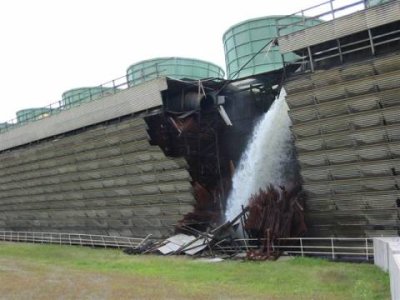
Now the Nuclear Regulatory Commission has confirmed tritium levels in a monitoring well at Vernon to be 3.5 times the federal safety standard. The leaks apparently came from underground pipes whose very existence was recently denied by VY officials in under-oath testimony at a public hearing. Vermont’s pro-nuclear Republican Governor Jim Douglas has termed the event “a breach of trust that cannot be tolerated.”
Yankee is owned by Entergy, a Mississippi-based consortium that also owns New York’s Indian Point reactor, which suffered an internal gusher of radioactive water in May, 2009. Another leak has just been found at Oconee in South Carolina. Illinois’ Braidwood leaked so many millions of gallons of tritium-laced water that its owner, Exelon, was forced to buy a new municipal water system for a nearby town.
Entergy says none of Yankee’s tritium has been found in local drinking water or in the Connecticut River, which supplies the plant’s cooling water. Vernon sits near Vermont’s southeast border with Massachusetts, across the river from New Hampshire. “The existence of tritium in such low levels does not present a risk to public health or safety whatsoever,” says the company’s Robert Williams.
But VY is just the latest of more than two dozen U.S. nuclear plants—many built in the 1960s and ’70s—to be found with leaking tritium.
Last year at New Jersey’s Oyster Creek, tritium was reported leaking a second time shortly after Exelon got it a 20-year license extension. Entergy’s Pilgrim reactor, at Plymouth, Massachusetts, has recently leaked tritium into the ground.
The NRC’s Neil Sheehan has confirmed leaks involving 27 of 104 licensed US reactors, and says that probably doesn’t account for all of them. At Yankee, Oyster Creek and elsewhere, rotting pipes are the likeliest culprit, but no one is 100% certain.
The epidemic has escalated public dismay. Vermont state Representative Tony Klein, chair of House Natural Resources and Energy Committee, says that “when you have public officials that the public depends on for their health and welfare making casual statements that a radioactive substance is not harmful to you, I think that’s ludicrous.”
For decades the Encylopedia Britannica, National Academy of Sciences and other primary scientific bodies have confirmed that no dose of radiation, no matter how small, can ever be deemed perfectly safe. “There is no threshold of exposure below which low levels of ionizing radiation can be demonstrated to be harmless or beneficial,” says Richard R. Monson, associate dean for professional education and professor of epidemiology at the Harvard School of Public Health.
Thus far the NRC has granted a series of license renewals to aging reactors. But by virtue of a long-standing agreement with Entergy, the Vermont Legislature can deny Yankee’s request for a 20-year extension. In the 1990s local groups like the Citizen’s Awareness Network (http://www.vtcitizen.org/) helped force down the Yankee Rowe plant on the Deerfield River in Massachusetts, about 25 miles southwest of Vernon. The root cause was concern over embrittlement of the elderly reactor’s core, a key to the future of all other aging nukes.
In Vermont, angry debate has also arisen over Entergy’s dwindling decommissioning fund, which has been slashed by a declining stock market. Entergy has proposed spinning off plant ownership to a shell corporation whose assets may be even more dubious. But area residents also fear Entergy may be pushing Yankee operations in an attempt to find the source of its leaks.
With VY operating under duress, Katz and others report an increasing wave of concern among local citizens starting to think seriously about how they might evacuate if Entergy keeps pushing. “This plant appears to be leaking from its reactor piping, but they don’t really know where,” she says. “They don’t want to shut down because they’re afraid they’ll never get back up. Entergy is choosing to protect its bottom line rather than the health and safety of our community.”
Indeed, a desperate national industry now pushing for massive federal subsidies to build new reactors may not survive a flood of elderly clunkers being forced to close by the weight of their own contamination. “This is an industry trying to build a new fleet of Titanics while the old ones are sinking,” says Katz.
Amidst the gusher of tritium leaks, Governor Douglas wants to postpone the legislature’s vote on VY’s license extension. But his term expires in November, and all five Democratic gubernatorial candidates are pledged to a Yankee shutdown.
What happens next will be defined by fierce grassroots activism crashing into a flood of corporate money in support of a rickety old reactor being operated with increasing recklessness.
The highly hyped “reactor renaissance”—and much more—may hang in the balance. Stay tuned.
Featured Video

BRITAIN’S WARNING: PREPARE FOR WAR
or go to
Aletho News Archives – Video-Images
From the Archive
How Ukraine Tortured and Slaughtered Donbass
By Kit Klarenberg | Al Mayadeen | July 11, 2024
Almost immediately after the proxy war erupted, ISIS-tier footage of the torture and murder of Russians in Ukrainian custody emerged.
On July 6th, the New York Times published an astonishing investigation: In Ukraine, Killings of Surrendering Russians Divide an American-Led Unit. The article documents in grim detail how Chosen Company, an international volunteer battalion for Kiev, routinely executes Russian prisoners of war. It is the very first mainstream admission that this practice – a brazen breach of the Geneva Conventions, and a grave war crime – is widespread among Ukraine’s fighters, both foreign and homegrown. … continue
Blog Roll
 Aletho News
- Israel Demolishes Home Of Lebanese Journalist Whose Viral Film Exposed Pager Attack
- Record Oil, Empty Tanks: The UAE’s Miracle Recovery
- Burnham tackles Britain’s poverty with aggression in Yemen
- Peace in Ukraine: the easy way – or the hard way
- Trump & the Rrrrussians
- US taxpayer money laundered back through Ukraine – Musk
- Before COVID, an NIH lab chief proposed making a SARS-like bat virus more infectious
- Gates, Bourla on Trial in Netherlands Accused of ‘Great Reset’ Scheme at Vaccine Injury Hearing
- BRITAIN’S WARNING: PREPARE FOR WAR
- “Historic Russia”: The Land Putin Will Not Give Back
- If Americans Knew
- An error has occurred; the feed is probably down. Try again later.
- No Tricks Zone
- Two New Studies Find Thwaites Glacier Melt Cannot Be Driven By Human Activity Or A Warming Ocean
- E-Cars Reduce CO2 Emissions By Only 41% Compared To Internal Combustion Engine Vehicles
- Predictions Made By Renowned Climate Professor Over Past Decades Have Been Proven To Be Poor
- New Study Suggests Large Regions Of The Pacific Ocean Have Been Cooling For The Last 80 Years
- Germany’s Green Energy Debacle: High Energy Costs Force Kahla Porzellan to Close After 182 Years!
- New Study: 50 Years Of The Most Aggressive ‘Net Zero’ Policies Can Only Affect The Global Climate By 0.03°C
- US September “Heat” Was No Record…Many Records Set Decades Ago
- Latest European Green Energy Debacle; Portugal’s Largest Flagship Solar Park Insolvent!
- Green Energy Debacle: German Expert Professor Fritz Vahrenholt Warns Of Severe Economic And Social Consequences
- Two More Paleo Reconstructions Affirm Meters-Higher Sea Levels Across Ireland, Brazil 7000-6000 Years Ago

