Cancer in US Navy Nuclear Powered Ships
By Chris Busby | CounterPunch | March 6, 2020
Here is a good one. In 2011, the nuclear-powered aircraft carrier USS Ronald Reagan was about 100km off the coast of Japan at the time of the Tsunami and the subsequent Fukushima reactor explosions. It was directed by the US government to ride to the rescue in what was later called Operation Tomodachi (friendship)–to provide assistance to the victims of the floods. What no-one on board was told was that the reactors had exploded and a plume of highly radioactive material was blowing east from the site into the path of the vessel. Of course, when this arrived, all the radiation monitors on the boat started screaming, and the planes and helicopters that had flown the rescue sorties were contaminated.
In 2014 I was engaged by some California attorneys to advise on a court case being taken against the Japanese company TEPCO and the US reactor makers GEC on behalf of the sailors who served on the aircraft-carrier. A significant number of the Ronald Reagan crew were reporting a wide range of weird illnesses including cancers, all of which they were attributing to their radiation exposures. Between 2014 and now, the court arguments were all about procedure: whether the cases should be heard in Japan or in the California where the vessel’s home port of San Diego was. There was a lot of publicity [1]. Eventually, and recently, the California judge decided that the case had to be heard in Japan. This is (in passing) monstrously unjust since Japanese law is different and the sailors cannot afford to go to Japan and hire Japanese lawyers. But this is not the story here.
In 2014, following all the publicity about the cancers, a number of US Senators and important people were asking pertinent questions—the Navy had to do something to answer the accusations that the Fukushima radiation was killing those who sailed on Operation Tomodachi. They panicked. A big report was prepared by the US Defense Threat Reduction Agency (DTRA), entitled: Final Report to the Congressional Defense Committees in Response to the Joint Explanatory Statement Accompanying the Department of Defense Appropriations Act, 2014, page 90, “Radiation Exposure” [2]. Never use one word when ten will do.
This report rambled on about how low the Fukushima doses were, how everyone acted wonderfully and how all the radioactivity was rapidly cleaned up. The dose reconstruction showed no one got more than a fraction of the Natural Background dose and so forth. We have been here regularly. (The methodology for the dose reconstruction has since disappeared from the link given in the report). Since no-one believes any of this dose bullshit any more, to prove that there was no cancer excess, the Navy took one step too far. They reported the results of their own epidemiology study which they carried out on the Ronald Reagan sailors. This compared the illness yield (including cancers) of the 4,843 RR sailors with a matched control group of 65,269 sailors on nuclear powered ships that were not anywhere near Fukushima. The period of analysis was from 2011 to 2013, about 3 years. This showed that there were more cancers in the control group over that period. The idea clearly was to knock on the head any suggestion that the radiation from Fukushima was the cause of the cancers and other stuff that was the basis of the court case. And this it apparently did.
Their move was to compare the matched “unexposed” control group with the Ronald Reagan group. There were 30% more cancers in the control group after adjusting for age. But what I did was to compare the control group with the National population, using data on cancer rates by age group from the SEER database [3]. The result showed an astonishing 9.2-fold excess of cancer in the sailors on nuclear-powered vessels. There were 121 cancers predicted on the basis of the national rates, and 1119 reported by the DTRA study. For the Reagans it was about 6-fold with 46 reported and 7.76 expected. Now this result is astonishing. I wrote my study up for a good scientific peer reviewed journal, and it was published last week [4]. You can find it on academia.edu if you can’t afford the journal cost.
What I discuss in the paper to explain the result is my usual argument about how the radiation protection legislation is wildly incorrect when dealing with internal contamination from radionuclides. The legal limits in USA and the West are based on the comparison of cancers in those exposed to acute external gamma ray doses to the Japanese A-Bomb populations and cannot apply to internal exposures to substances which target DNA (Uranium, Strontium-90) or which provide huge local ionisation to some living cells but nothing at all to others (DU particles, reactor discharge particles).
But this time it really is a big deal. Nine times the expected rates? What are they going to do? It is their own data which they stupidly released. It shows that all the sailors on nuclear powered Navy ships are dying from cancer. You can bet the telephone lines are hot, and that we won’t see any coverage of this in the Theatre newspapers and media. But the sailors themselves and the veterans? What will they think when they find this online but not reported?
Studies of nuclear workers have been the new battleground for this Chess game since it became apparent in the last few years that the Japanese A-Bomb studies were dishonestly manipulated and ignored internal exposures to fallout and rainout [5]. We have seen a number of attempts to kill the argument about low dose radiation and health using nuclear worker studies. There was the Lancet publication in year 2015 [6]. There was the desperate and disgraceful Royal Society publication last year [7]. The late Alexei Yablokov and I wrote to the Lancet Editor on behalf of the Independent WHO [8] asking if we could point out in the journal that the Lancet articles reassuring everyone that the science of radiation risk was secure were written by nuclear industry scientists and were unsafe. The Lancet refused. I wrote to the Royal Society. They also refused to publish anything. What is Truth—says Pilate—waits for no answer.
Nuclear workers work outside at a nuclear site where the discharges get dispersed. Nuclear sailors live in a tin box that also contains the reactors. Nuclear worker studies are based on data that is provided by the nuclear industry to show there are no cancers. The DTRA study had to show more cancers in order to swamp the Ronald Reagan sailors’ cancers. But to do this, they brought out their Queen. And it was taken.
Anyway, let’s not walk further into the What is Truth swamp and discuss the News Theatre. Thankfully this story shows that in this truth argument there are two last frontiers. These are the scientific peer-review literature and the courts. I am representing the widow of a UK nuclear submariner, a man who was a reactor servicing technician and who died from cancer. Let’s see what the Scottish court makes of this paper. Read it yourself and have a laugh. If you are a Navy sailor on a nuclear-powered ship, be very frightened. Write to your Senator. Kick up a fuss.
Notes.
1) https://www.courthousenews.com/us-sailors-face-grim-diagnoses-after-fukushima-mission/
3) https://seer.cancer.gov/data/
4) https://www.tandfonline.com/doi/abs/10.1080/07357907.2020.1731526?journalCode=icnv20
5) https://www.genetics.org/content/204/4/1627
6) https://royalsocietypublishing.org/doi/10.1098/rspb.2017.1070
7) https://royalsocietypublishing.org/doi/10.1098/rspb.2017.1070
8) https://independentwho.org/en/our-demands-to-who/
Dr Chris Busby is the Scientific Secretary of the European Committee on Radiation Riskand the author of Uranium and Health – The Health Effects of Exposure to Uranium and Uranium Weapons Fallout (Documents of the ECRR 2010 No 2, Brussels, 2010). For details and current CV see chrisbusbyexposed.org. For accounts of his work see greenaudit.org, llrc.org and nuclearjustice.org.
Back to Fukushima. Former residents weigh up returning to nuclear ghost town of Okuma
RT Documentary • December 12, 2019
In March 2011, an earthquake hit Japan, setting off a tsunami that caused an accident at the Daiichi nuclear power station in Fukushima prefecture. Radioactive contamination settled on the surrounding area, and the authorities decided to evacuate the population living within a 20km radius around the power station.
Watch full video here: https://rtd.rt.com/023wp
Eight years later, inhabitants of the town closest to the nuclear disaster, Okuma, were allowed to move back to some of its territory. RTD takes a bittersweet tour of the nuclear ghost town with former residents considering whether to return to their hometown, and meets those who have already moved into new homes built in a less-contaminated part of town. Torn between loyalty to their roots and the desire to build a future for themselves, the people of Fukushima now have an agonising choice to make.
Japan’s Nuclear Watchdog Approves Decommissioning 2 Reactors at Oi Plant – Reports
Sputnik – 11.12.2019
TOKYO – Japan’s Nuclear Regulation Authority on Wednesday approved plans to decommission two reactors at the Oi nuclear power plant in Fukui Prefecture, the Kyodo news agency reported.
According to the Japanese news agency, Kansai Electric Power, which operates the Oi plant, decided to spend about $1.1 billion to dismantle the two most powerful reactors — namely No. 1 and No. 2 — by 2049 rather than shoulder the high cost of implementing additional safety measures.
Given that the reactors were commissioned in 1979, their lifespan is set to expire soon. In anticipation of this, Kansai submitted a decommissioning plan to the authorities in November 2018. In particular, the company said that in order to shut down the reactors it needed to utilize over 20,000 tonnes of low-level radioactive waste with over 10,000 tonnes of non-radioactive waste.
The plant’s two other reactors were commissioned much later — in 1991 and 1993 — so they will remain active.
After the 2011 Fukushima Daiichi disaster, Japan’s nuclear watchdog introduced a 40-year limit on the lifespan of nuclear reactors in the country, but added the possibility of a 20-year extension if the stringent safety measures were met.
All of Japan’s 54 operating nuclear reactors were shut down in March 2011 after a 9.0 magnitude earthquake and subsequent tsunami led to a leakage of radioactive material from the Fukushima Daiichi plant. Before the disaster, 30 percent of Japan’s electricity came from nuclear power.
Norway Opens Up for Nuclear-Powered Allied Submarines’ Port Calls Despite Local Resistance
Sputnik – 08.11.2019
According to local media, the presence of international submarines in Norwegian waters has tripled. In 2018 alone, 27 port calls by US and UK nuclear-powered submarines were registered in Norway.
Soon, nuclear-powered submarines will become commonplace near the centre of Norway’s largest Arctic city of Tromso, Norwegian Defence Minister Frank Bakke-Jensen confirmed to the military newspaper Forsvarets Forum.
According to the minister, work is currently underway to prepare for port calls by allied nuclear-powered vessels at the Grotsund industrial port in Tonsnes. No exact time frame has been given, but it is assumed that the work will be completed over the next few months.
This means that warships of all calibre calling in for maintenance, logistics, or to rest their crews may become a common sight for the inhabitants of Tromso.
“Grotsund industrial port has been chosen as a port of call in Northern Norway because of a suitable dock and and good infrastructure in the area. This will be a permanent offering to our allies”, Bakke-Jensen said, describing the arrival of nuclear-powered submarines as part of the allied activity in Norway and surrounding areas.
Bakke-Jensen estimated the future number of calls at four to five a year. According to him, this will not entail any change in policy or approach to dealing with allied activity. This implies that Norway’s time-tested Bratelli Doctrine of 1975 that explicitly prohibits the arrival of foreign warships with nuclear weapons on board will stand.
“The Bratteli Doctrine has been established as Norwegian policy for over 40 years and has served Norway well”, the minister said.
However, these calls are not without controversy, and the project has met local opposition, among others from the Tromso Municipal Council. Local politicians and activists question the safety measures and are concerned over the consequences if anything goes wrong.
Bakke-Jensen stressed that regional actors have always been involved in the plans. He stressed that no call will be granted unless the Directorate of Radiation Protection and Nuclear Safety is sure that security is adequately safeguarded, and alleged that no accidents with western nuclear-powered vessels have occurred.
Meanwhile, the presence of international submarines in the waters outside of Norway has tripled, according to the daily newspaper Aftenposten. In 2018 alone, 27 port calls by US and UK nuclear-powered submarines were registered in Norway.
Childish Fantasies vs Real World Energy Needs
By Donna Laframboise | Big Picture News | October 2, 2019
Certain politicians are making promises about carbon dioxide emissions and the year 2050 – three full decades from now. Certain adults are telling elementary school children that transforming the world’s energy system is easy peasy.
But that’s not the case. In an article titled Net-Zero Carbon Dioxide Emissions By 2050 Requires A New Nuclear Power Plant Every Day, Roger Pielke Jr. delivers the harsh, mathematical truth. Even if every person in the world thought abandoning fossil fuels made sense, even if every last government was committed to such a plan, the sheer size of the task would remain. In Pielke’s words: “The scale…is absolutely, mind-bogglingly huge.”
In an entire year, a nuclear power plant is capable of producing 1 “million tons of oil equivalent” of energy – or 1 mtoe for short. Says Pielke:
In 2018 the world consumed 11,743 mtoe in the form of coal, natural gas and petroleum… there are 11,051 days left until January 1, 2050. To achieve net-zero carbon dioxide emissions globally by 2050 thus requires the deployment of >1 mtoe of carbon-free energy…every day, starting tomorrow and continuing for the next 30+ years. Achieving net-zero also requires the corresponding equivalent decommissioning of more than 1 mtoe of energy consumption from fossil fuels every single day.
Let us be honest and grownup here. The chances of this happening are remote.
Now let’s remember that many people insist nuclear power is off the table. We’re supposedly in the midst of a climate crisis caused by CO2 emissions, yet low-emissions nuclear power is forbidden.
Such people think we should rely on wind power, instead. According to Pielke’s calculations, that would require the construction of 1,500 wind turbines every single day from now until 2050.
Currently, the US consumes approximately 20% of the energy used across the globe. Its share of the 1,500 new wind turbines required daily would therefore be 300.
Despite years of massive subsidies designed to encourage wind energy investment, fewer than 10 turbines are currently installed in the US each day. Surely even a child understands that ramping up from 10 turbines a day to 300 is a massive challenge that couldn’t possibly happen overnight. Even in an affluent country with a booming economy.
And please, let us also put aside fairy tales about wind power being environmentally friendly. As Mark P. Mills explained recently in the Wall Street Journal :
Building one wind turbine requires 900 tons of steel, 2,500 tons of concrete and 45 tons of nonrecyclable plastic. Solar power requires even more cement, steel and glass…
Those who “dream of powering society entirely with wind and solar farms” says Mills, are actually demanding “the biggest expansion in mining the world has seen.”
Fukushima Disaster Puts Japan in ‘Nuclear Limbo’ Ahead of 2020 Tokyo Olympics – Pundit
Sputnik – September 14, 2019
On 10 September, Japanese authorities announced that Tokyo Electric Power (TEPCO), the operator of the Fukushima Daiichi power plant which in 2011 experienced the worst nuclear disaster since Chernobyl, currently has no technology to clear its wastewater from radioactive waste, and is instead discharging it into the sea.
More than a million tonnes of wastewater is reportedly stored in tanks at the Fukushima NPP (nuclear power plant). The facility is reportedly running out of available space and expects to exhaust its capacity by summer 2022. Japanese Environment Minister Yoshiaki Harada admitted earlier that “we have no way but to release it [into the sea] and dilute it”.
Local residents reportedly have deep concerns about the potential damage this move can inflict, especially to the fishing industry, which is essential for Japan.
Christina Consolo, a nuclear expert, has shared her view on the issue.
Sputnik: It’s been reported that there’s enough room to keep the liquid (1 million tons of contaminated water) through summer 2022, but after that, there will be no space left?
Christina Consolo: It was somewhat surprising at how quickly the Environmental Ministry in Japan made a decision to release the contaminated water once their official meeting convened. I am not surprised at all however by their decision.
The situation is very serious. There is no other option then to release the contaminated water, but under the control of TEPCO’s time and choosing, or it may be released for them. An earthquake could release it, a tsunami could release it, a typhoon could release it.
But releasing the water goes far beyond just a ‘storage issue’ alone; the tanks are also under duress for a number of reasons. If you recall, at the beginning of the original water storage, the tanks were not assembled properly. Concrete slabs were hastily poured without rebar reinforcement.
TEPCO workers had to drill holes in the tops of them to release hydrogen build-up, or risk explosion and collapse of the tanks themselves.
There have also been a series of leaks, due to miles of pipes and flushing radioactive water great distances through sometimes ducted-taped hoses, with at least one reaching the official scale of a Level 3 Nuclear Accident in and of itself, in July of 2015.
And the longer this radioactive water sits in these giant metal tanks, the matrix of the metal itself at the atomic level is undergoing acceleration of entropy, known as “The Wigner Effect” – named after Professor Eugene Wigner, who discovered it at the Oak Ridge Laboratory while doing research for the US Government during World War II.
Metal exposed to radiation creates embrittlement issues and acceleration of corrosion, the same problem that caused 16,000 cracks in the nuclear reactors in Belgium.
This is problematic for the biggest reason of them all: if any of these tanks leak or break open outside of the control of TEPCO and prevents workers from being able to continue the myriad of daily maintenance involved due to spillage of radioactive water, creating no-go zones within the site itself, then TEPCO can have yet another very serious situation on their hands, on top of everything else happening over there. Anything and everything must be done to assure that workers can continue with the tremendous daily management of what is still an ongoing Level 7 Nuclear Accident.
They can not risk waiting for the tanks to empty themselves.
Sputnik: What is going to happen next? Do you think this liquid is a real threat to the ecological situation?
Christina Consolo: Any radiation released to the environment is always going to have detrimental effects… the question is how much and how far will those effects extend from the site of the release. Without knowing what exactly is in those tanks, that question is impossible to answer.
I personally have issue believing the radioactive water contained within them only contains Tritium, as I have followed this story for over eight years, and I can say without a doubt that every machine brought in to ‘filter out’ radioactive substances has failed miserably, as has every camera, robot, robot claw, robot snake, robot on rollers, etc.
TEPCO also has a history of withholding important facts that also make them very untrustworthy.
But more importantly from an ecological perspective, and a far bigger issue though which is rarely discussed, is the groundwater that moves through the Fukushima site because of the geology of the surrounding features.
The plant was built on a riverbed, where the volcanic spine of Japan funnels water down from the mountains. Groundwater experts estimate that every single day somewhere between 5-15,000 tonnes of groundwater flow underneath the plant, and out to the Pacific ocean.
Keep in mind, the only remnant of the cumulative 450 tonnes of corium or melted nuclear fuel that has been found is splatter on the insides of the reactors, or pebble-like material and drips.
TEPCO still has not located the 3 melted cores after 8 years of looking, leaving a looming question of how far these cores travelled as they melted, and how much groundwater is making contact with these cores before pouring into the Pacific each day. They are concerned enough that they are still pouring 300 tonnes of water through them daily.
Is it 10 percent – 50 percent – 80 percent? How much of this natural groundwater flow is making contact with the cores, under the plant? We have no idea. If indeed this is occurring, which some Fukushima experts believe that it is, then the 1000 tanks are a ‘drop in the bucket’ in comparison to what may be pouring into the Pacific each and every day.
We need answers to these questions. It is abhorrent and inexcusable that with today’s known technology, TEPCO does not know where the cores are, 8 years after the accident. We have powerful ground penetrating radar that could likely tell, so why are they not telling us?
Sputnik: It’s been 8 years since the Fukushima disaster. How have Japanese authorities adapted to this situation?
Christina Consolo: The Japanese authorities that were in charge at the beginning of this disaster, such as former Prime Minister Kan, have expressed a tremendous amount of regret, and even guilt, over mistakes they made withholding information about how dangerous the situation was from the Japanese people in the early part of the accident.
The fact TEPCO outright lied that meltdowns had occurred from Day 1, even though every nuclear physicist in the world was aware they had, due to the presence of neutron beams occurring in 13 different locations on the site (which indicated at least one reactor was breached), is difficult to forgive considering the US had an entire fleet of Navy ships offshore providing humanitarian aid that were getting absolutely blasted by nuclear fuel including MOX and plutonium.
PM Abe is very pro-nuclear but his wife is not, making for an ongoing and very publicized drama in Japanese news, and the pushback from massive demonstrations by the Japanese people continue to this day on a weekly basis.
The people are fighting any and all attempts at restarting reactors, in a very hardcore way. The authorities are pretending everything is fine, focusing on the Olympics in 2020, and I am certain the water will be dumped long before then.
But the tanks are going to just get filled right back up again, after some unfortunate TEPCO workers climb inside and test them for metal fatigue issues.
Sputnik: What has changed in nuclear safety since Fukushima has occurred?
Christina Consolo: In Japan a majority of the reactors still remain shutdown, which is good considering they never should have been built there in the first place.
An article in The Japan Times predicted the Fukushima disaster in 2004, and there are no guarantees that TEPCO will always be able to keep the Fukushima site under control, or another earthquake and tsunami will cause a similar, or even larger disaster at another site, as there are so many littering Japan.
Japan sits in a highly unstable zone of 4 intersecting tectonic plates and the island has an enormous amount of earthquake and volcanic activity.
The US did review some of its safety measures after 3/11 but the problem is it keeps re-issuing licenses to old plants, with ageing infrastructure.
And many plants in the US, and worldwide, are also prone to earthquakes, tsunamis, flooding, hurricanes, even tornadoes and lightning strikes.
We have been playing with this very dangerous technology despite having no safe way to dispose of the waste, and many studies done over decades that prove that illnesses and cancer are extremely high the closer that you live to a nuclear plant.
Sputnik: Despite the Fukushima explosion, the Japanese government didn’t abandon its nuclear energy program. How do you explain this decision?
Christina Consolo: I can not answer that question. There is no logical answer for it, except to decommission a plant is outrageously expensive.
TEPCO announced in the past month it will be decommissioning the Fukushima Daini plant to the south, which also sustained damage in 2011.
Right now Japan is in a nuclear limbo of sorts, with the water tank problem, the fishery pushback, the Olympics in 2020, and the somewhat surreal efforts of the Japanese government to assure the world it can handle the Olympic athletes and crowds without making them sick.
There are always economic issues to consider, and the costs of decommissioning of two huge nuclear plants, one with 3 melted cores that have never been found.
Japan has a lot of convoluted issues surrounding nuclear and there is always the dark cloud over what is truth or fiction when it comes to TEPCO, and the nuclear industry in general. I really can not explain this decision at all.
Who is Woods Hole Oceanographic Institution? Oceanographer or defense contractor?
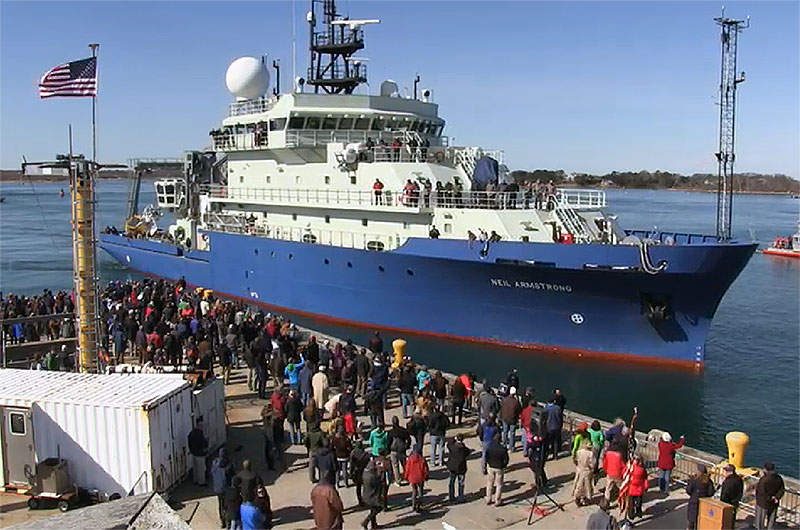
R/V Neil Armstrong arrives at Woods Hole Oceanographic … collectspace.com
By Richard Hugus | August 28, 2019
WHOI is the acronym for the ‘Woods Hole Oceanographic Institution’, based on Cape Cod, Town of Falmouth, village of Woods Hole, Massachusettts. On August 2, 2019 WHOI applied to the town of Falmouth for the clearing of 2.7 acres of woodland and the construction of a 3 story, 50,000 square foot building on what it calls its Quissett Campus, about a mile north of Woods Hole village. Woods Hole residents, the town of Falmouth, and a regulating authority called the Cape Cod Commission are now in the position of having to evaluate the proposed project and decide on approving it. Documentation and promotion of the project provided by WHOI to the Falmouth Planning Department, and summarized by the Falmouth Enterprise, says its new building — the New Quissett Facility — “is proposed as a ‘technology accelerator . . . by creating this facility the NQF will become the epicenter of autonomous vehicle, sensor, and technology innovation at WHOI and around the world and could lead to a net increase in regional economic activity.”
Mention of “autonomous vehicle and sensor technology” brings up the question of military research into and use of underwater drone and warfare technology and WHOI’s role in developing that technology. Though operating for years in the midst of a pleasant residential and tourist area, few people are aware that WHOI is a defense contractor. The Institution was created in 1930 and was devoted solely to defense work during World War II. In all available documents submitted to the Cape Cod Commission for its recent building projects, and in all currently available representations of its activities to the public, WHOI describes itself as a scientific and educational institution dedicated solely to studying the ocean. In its documentation for the Quissett project, WHOI calls itself “the world’s largest non-profit dedicated to ocean research.” The omission by WHOI of its significant military research and development amounts to deception. WHOI receives major funding from the Office of Naval Research, which “coordinates, executes, and promotes the science and technology programs of the United States Navy and Marine Corps.” These programs are highly unlikely to be peaceful and benevolent. The US Navy and Marines are, afterall, in the business of war.
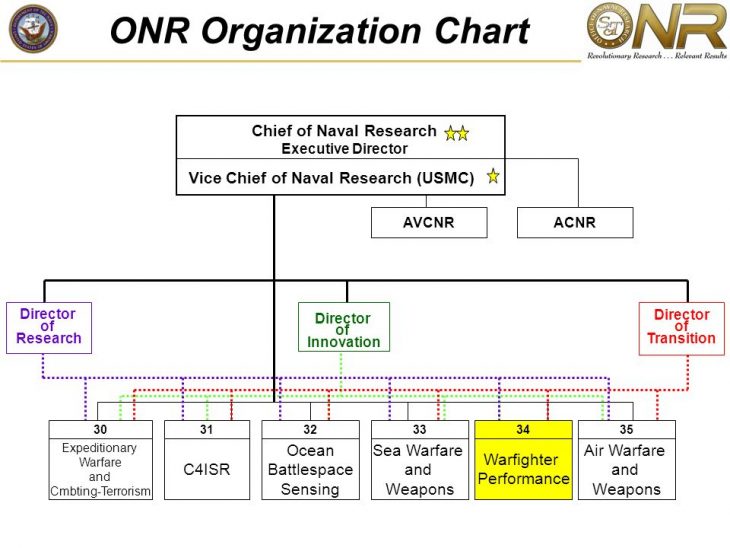
Source: slideplayer.com (C4ISR-Command, Control, Communications, Computers, Intelligence, Surveillance and Reconnaissance)
A July 20, 2018 Department of Defense listing of Navy/Office of Naval Research contracts states: “Woods Hole Oceanographic Institution, Woods Hole, Massachusetts, is awarded a $7,719,478 cost-plus-fixed-fee contract for development and demonstration of advanced ocean battlespace capabilities . . . This contract was competitively procured . . . for science and technology projects for advancement and improvement of Navy and Marine Corps operations, including Ocean Battlespace Sensing . . . The Office of Naval Research, Arlington, Virginia, is the contracting activity . . .”
Ocean Battlespace Sensing has to do with submarine and mine warfare. There is no information on WHOI’s web site about this nearly $8 million grant, or about what it is doing in the area of ocean battlespace sensing and submarine warfare. On April 7, 2016 when the new research vessel Neil Armstrong first arrived in Woods Hole, Dr. Frank Herr, head of the U.S. Navy’s Ocean Battlespace Sensing department (so-called “code 32” above), was among the notables addressing a gathered crowd. WHOI Director Mark Abbott also spoke, telling him and others, “We’re very proud to have been selected by the Office of Naval Research to operate the Neil Armstrong.” Navy-owned ships and advanced ocean battlespace work are not what we normally associate with a “non-profit organization dedicated to ocean research, exploration, and education” — WHOI’s stated activities. Defense-related activities are clearly a part of WHOI’s operations, but they are consistently edited out of the public image WHOI promotes.
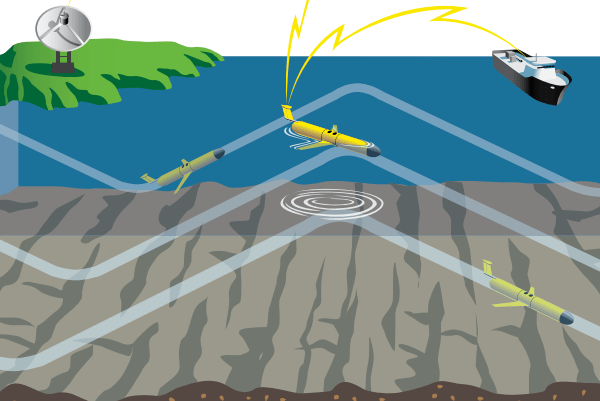
The Next Level – Drone Wars, breakfornews.com
As another example: according to an April 22, 2019 report by the DoD Defense Logistics Agency: “Woods Hole Oceanographic Institution, Woods Hole, Massachusetts, is awarded an $8,421,581 cost-plus-fixed-fee contract for the research effort entitled, “Project Sundance.” Except for the announcement of this contract, there is no information available anywhere on the web, or at WHOI’s own web site, about what Project Sundance is, leaving one to wonder if the project is classified — i.e., something the public is not entitled to know about.
Finally, in 1985, WHOI achieved fame when one of its scientists, Robert Ballard, discovered the wreckage of the Titanic. It wasn’t until years later that we got the full story. According to The National Geographic (November 21, 2017), the Titanic discovery only happened by the way in what was actually a top secret military operation to find two wrecked US Navy nuclear submarines. Remote sensing technology and an underwater submersible vehicle developed in Woods Hole and used aboard the WHOI research vessel, Knorr, was used in the discovery. National Geographic tells us the Knorr’s true mission: “the military wanted to know the fate of the nuclear reactors that powered the ships . . . this knowledge was to help determine the environmental safety of disposing of additional nuclear materials in the oceans.”
Ballard held the rank of Commander in the US Navy and was working as a liason to WHOI from the Office of Naval Research at the time of the discovery. Research on disposal of nuclear waste in the ocean is hardly in keeping with WHOI’s stated mission, “to advance knowledge about our planet, but also to ensure society’s long-term welfare and to help guide human stewardship of the environment.” Moreover, by making it look like this was just a fun adventure undertaken by WHOI to solve the mystery of the Titanic, a hoax was perpetrated on the public.
WHOI, the proponent of this new building project, is not being fully honest in the descriptions it gives of its mission and operations in Woods Hole. This calls WHOI’s credibility and full disclosure into question, and prompts further questions about the military-related role of the proposed new facility — “the epicenter of autonomous vehicle, sensor, and technology innovation.” The mentioned technology may well have uses in oceanographic research, but it may equally well have to do with “ocean battlespace sensing” — i.e., marine warfare. WHOI advertises itself as a humanitarian scientific institution without mentioning the clearly relevant fact that a significant part of its funding and research is from and for the US Department of Defense. It is not possible to fully evaluate a building proposal from an institution that is involved in secret projects because Cape Cod residents have no way of knowing if they are being given all the facts. Indeed, they have good reason to believe they are not being given all the facts,
The US military and its supporting contractors are the main source of wars of aggression and misery in the world today. It would be unethical to support expensive new facilities, paid for with our tax dollars and with what is left of our open space, for one of those contractors on Cape Cod. Yet war and militarization are so normalized in the American landscape, it is as if this is not even an issue.
Russia set to air TV series that reveals US role in Chernobyl nuclear disaster
Press TV – June 8, 2019
Russia is set to air a TV series based on the Chernobyl nuclear disaster that implicates the United States as playing a role in the worst nuclear accident in history.
Currently in post-production, the series by the Russian company NTV tells the story of the 1986 explosion that ripped through reactor Number 4 at the Chernobyl Nuclear Power Plant in the then Ukrainian Soviet Socialist Republic.
The explosion led to a huge radioactive leak, which permanently affected areas in places across three quarters of Europe. Thirty workers and firemen were killed in the immediate aftermath of the explosion and rescue operations. Most of them died of severe radiation-related illnesses.
The plot revolves around a CIA agent dispatched to Pripyat — the town inhabited by Chernobyl workers — to gather intelligence on the nuclear power plant.
The series will follow KGB officers in their attempts to hunt the espionage operation.
Director Aleksey Muradov said that his version, filmed in Belarus, will show “what really happened back then.”
“There is a theory that the Americans had infiltrated the Chernobyl nuclear power plant,” he said. “Many historians do not deny that on the day of the explosion an agent of the enemy’s intelligence services was present at the station.
This is while a five-part “Chernobyl” series produced by American premium cable and satellite television network HBO has recently triggered worldwide debate as some experts have challenged its credibility.
Russia’s most popular newspaper, Komsomolskaya Pravda (KP), has dismissed the show as “a caricature and not the truth.”
“If Anglo-Saxons film something about Russians, it definitely will not correspond to the truth,” said Russian journalist Anatoly Vasserman.
Russian newspaper The Moscow Times, also wrote this week that the HBO production was biased against the Soviet Union and provided a “caricature”’ of the nation.
Featured Video

“Historic Russia”: The Land Putin Will Not Give Back
or go to
Aletho News Archives – Video-Images
Book Review
Why the War on Conspiracy Theories Is Bad Public Policy
By Kevin Barrett • Unz Review • February 1, 2019
 A Review of Conspiracy Theories and Other Dangerous Ideas by Cass Sunstein (based on an earlier paper co-authored with Adrian Vermeule); In Defense of Troublemakers: The Power of Dissent in Life and Business by Charlan Nemeth; and Conspiracy Theories and the People Who Believe Them, edited by Joseph E. Uscinski
On January 25 2018 YouTube unleashed the latest salvo in the war on conspiracy theories, saying “we’ll begin reducing recommendations of borderline content and content that could misinform users in harmful ways—such as videos promoting a phony miracle cure for a serious illness, claiming the earth is flat, or making blatantly false claims about historic events like 9/11.”
At first glance that sounds reasonable. Nobody wants YouTube or anyone else to recommend bad information. And almost everyone agrees that phony miracle cures, flat earthism, and blatantly false claims about 9/11 and other historical events are undesirable.
But if we stop and seriously consider those words, we notice a couple of problems. First, the word “recommend” is not just misleading but mendacious. YouTube obviously doesn’t really recommend anything. When it says it does, it is lying. … continue
Blog Roll
 Aletho News
- “Historic Russia”: The Land Putin Will Not Give Back
- How the Cambridge Analytica scandal still haunts Mark Zuckerberg
- The Ongoing Cancellation Campaign Against a Dissenting Academic in Norway
- Yemen and ‘the Houthis’: Challenging Sami Hamdi’s Narrative
- No, Christians did not invent Zionism
- AIPAC-led lobbying network opens branches in Cypriot, Greek parliaments
- Araghchi blasts ‘parasitic’ alliance as US taxpayers pay for Israel’s war on Iran
- Easy fix for Europe’s chaos? Stop fueling war against Russia
- Putin’s key remarks on peace talks and Europe’s ‘schizophrenia’
- Trita Parsi: Israel Set a Trap for Total War in the Region
- If Americans Knew
- An error has occurred; the feed is probably down. Try again later.
- No Tricks Zone
- Two New Studies Find Thwaites Glacier Melt Cannot Be Driven By Human Activity Or A Warming Ocean
- E-Cars Reduce CO2 Emissions By Only 41% Compared To Internal Combustion Engine Vehicles
- Predictions Made By Renowned Climate Professor Over Past Decades Have Been Proven To Be Poor
- New Study Suggests Large Regions Of The Pacific Ocean Have Been Cooling For The Last 80 Years
- Germany’s Green Energy Debacle: High Energy Costs Force Kahla Porzellan to Close After 182 Years!
- New Study: 50 Years Of The Most Aggressive ‘Net Zero’ Policies Can Only Affect The Global Climate By 0.03°C
- US September “Heat” Was No Record…Many Records Set Decades Ago
- Latest European Green Energy Debacle; Portugal’s Largest Flagship Solar Park Insolvent!
- Green Energy Debacle: German Expert Professor Fritz Vahrenholt Warns Of Severe Economic And Social Consequences
- Two More Paleo Reconstructions Affirm Meters-Higher Sea Levels Across Ireland, Brazil 7000-6000 Years Ago

