Rooting Out the North Korean Nuclear Crisis: the Past and Present U.S. Role
By Christine Hong and Paul Liem | CounterPunch | September 15, 2016
North Korea’s nuclear test of September 9, 2016, the fifth and largest measuring twice the force of previous blasts, prompted a predictable round of condemnations by the United States and its allies along with calls for China to step up its enforcement of sanctions on North Korea. Yet few “expert” analyses suggest that China will risk destabilizing North Korea or that further United Nations resolutions and international sanctions will succeed in deterring North Korea from pursuing its nuclear weapons and missile programs.
The Obama administration’s reliance on China to rein in North Korea is at odds with its efforts to contain China’s influence in Asia, a quixotic goal in itself. It reflects an unrealistic desire for China to be influential just enough to do the bidding of the United States but not powerful enough to act in its own interests. North Korea is, after all, China’s strategic ally in the region, and it is in South Korea that the United States plans to deploy THAAD, a defense system with radar capable of tracking incoming missiles from China. It is simply not in China’s interest to risk losing an ally on its border only to have it replaced by a U.S.-backed state hosting missile-tracking systems and other military forces targeting it. And China knows it is not the target of North Korea’s nukes. If the United States cannot punt the problem of North Korea’s nuclear weapons to China it must deal with North Korea directly.
Indeed, in response to U.S. Secretary of Defense Ashton Carter’s recent condemnation of China’s “role” and “responsibility” in failing to restrain North Korea’s nuclear pursuits, the Chinese Foreign Ministry issued a statement calling on the United States to take a long hard look at its own foreign policy:
The cause and crux of the Korean nuclear issue rest with the US rather than China. The core of the issue is the conflict between the DPRK and the US. It is the US who should reflect upon how the situation has become what it is today, and search for an effective solution. It is better for the doer to undo what he has done. The US should shoulder its due responsibilities.[1]
In equally unmincing terms, the Global Times, an offshoot of the People’s Daily, charged the United States with “refusing to sign a peace treaty with Pyongyang” in a September 11, 2016 editorial. Alluding to a long history of U.S. nuclear threats against North Korea, the editorial elaborated: “The Americans have given no consideration to the origin and the evolution of North Korea’s nuclear issue or the negative role Washington has been playing over the years.” It further clarified: “Without the reckless military threat from the US and South Korea and the US’s brutal overthrow of regimes in some small countries, Pyongyang may not have developed such a firm intent to develop nuclear weapons as now.”[2]
Despite President Barack Obama’s efforts over his two terms in office to “pivot” or “rebalance” U.S. foreign policy to Asia and the Pacific and his repeated identification of the United States as a Pacific power, the memory of nuclear ruin in the region is shadowed by the history of the United States as a first-user of atomic weapons against civilian populations in Japan at the close of World War II and as a tester of devastating nuclear technology, including human radiation experiments, in the Marshall Islands during the Cold War. Moreover, it has not gone unnoticed that President Obama, despite his professed commitment to nuclear de-escalation, has refused to issue an “unequivocal no-first-use pledge.”[3]
In Korea, the one place on the planet where nuclear conflagration is most likely to erupt, given the current state of affairs, President Obama can still end the threat of nuclear warfare. This would require what few in his administration appear to have entertained, namely, the elimination of the demand for North Korea to agree to irreversible denuclearization as a precondition for bilateral talks. This rigid goal makes it virtually impossible for the United States to respond positively to any overture from North Korea short of a fantastic offer by that country to surrender all its nuclear weapons. The premise that the denuclearization of North Korea is necessary to ensure peace and stability on the Korean peninsula needs to be shelved, and all possibilities for finding common ground upon which to negotiate the cessation of hostilities on the Korean peninsula should be explored.
It should be recalled that possibly no country, including Japan, has greater fear of overbearing Chinese influence than North Korea. Arguing for the relevance of past U.S. negotiations with North Korea, Stanford scholar Robert Carlin points out that North Korea in 1996 opposed President Clinton’s notion of Four-Party talks involving China because they “went counter to a basic Pyongyang policy goal; that is, to limit Chinese influence by improving U.S.-DPRK relations.”[4] More recently, former CNN journalist Mike Chinoy, similarly observed: “[North Koreans] hate the idea that the Chinese can come in and tell them what to do. And the reality is the Chinese can’t.”[5]
At this juncture, given the demonstrated failure of President Obama’s “strategic patience” or non-negotiation policy with North Korea, the unthinkable must be seriously considered. Could an alliance between the United States and North Korea preserve U.S. influence in the region, albeit along avowedly peaceful lines, provide North Korea with a hedge against infringement of its sovereignty by China and eliminate the rationale for deploying THAAD in South Korea, thus alleviating a major sore point between China and the U.S.-South Korea alliance?
Let us also recall that North Korea offered to halt testing of its nuclear weapons if the United States agreed to put an end to the annual U.S.-South Korea war games.[6] Combining live artillery drills and virtual exercises, these war games, as of this year, implemented OPLAN 5015, a new operational war plan that puts into motion a preemptive U.S. nuclear strike against North Korea and the “decapitation” of its leadership. Unsurprisingly, North Korea considers this updated operational plan to be a rehearsal for Libya-style regime change. In January of this year, the United States turned down North Korea’s offer before the start of the spring U.S.-South Korea war games, and did so again in April.[7] The United States has thus twice this year dismissed the prospect of halting North Korea’s advance towards miniaturizing a nuclear bomb and fitting it atop an intercontinental ballistic missile (ICBM) capable of reaching the continental United States ostensibly because North Korea refused to entertain U.S. insistence on its complete denuclearization as part of the package.
President Obama should prioritize any and all possibilities for achieving a halt to North Korea’s nuclear programs by diplomacy, over the goal of achieving an illusory agreement for complete denuclearization. As an achievement, halting North Korea’s nuclear advances is far short of the peace treaty needed to bring an end to the Korean War and a lasting peace to Korea. It is far short of creating international conditions for the Korean people to achieve the peaceful reunification of their country. And it is a far cry from achieving nuclear disarmament on a global scale. Yet, as a redirection of U.S. policy towards engagement with North Korea, it would be the greatest achievement in U.S. Korea policy of the last fifteen years, and a concrete step towards achieving denuclearization in the region, and worldwide.
Notes.
[1] “Foreign Ministry Spokesperson Hua Chunying’s Regular Press Conference on September 12, 2016,” Ministry of Foreign Affairs of the People’s Republic of China, 12 September 2016, available online at http://www.fmprc.gov.cn/mfa_eng/xwfw_665399/s2510_665401/t1396892.shtml.
[2] “Carter Wrong to Blame China for NK Nuke Issue,” Global Times, 11 September 2016, available online at http://www.globaltimes.cn/content/1005942.shtml.
[3] David E. Sanger and William J. Broad, “Obama Unlikely to Vow No First Use of Nuclear Weapons,” The New York Times, 5 September 2016, available online at http://www.nytimes.com/2016/09/06/science/obama-unlikely-to-vow-no-first-use-of-nuclear-weapons.html.
[4] Robert Carlin, “Negotiating with North Korea: Lessons Learned and Forgotten,” Korea Yearbook: Politics, Economy and Society, eds. Rüdiger Frank et al. (Leiden and Boston: Brill, 2008), 241.
[5] Qtd. in James Griffiths, “What Can China Do about Nuclear North Korea,” CNN, 7 January 2016, available online at http://www.cnn.com/2016/01/07/asia/north-korea-china-nuclear-test/.
[6] See “North Korea Says Peace Treaty, Halt to Exercises, Would End Nuclear Tests,” Reuters, 16 January 2016, available online at http://www.reuters.com/article/us-northkorea-nuclear-usa-idUSKCN0UT201.
[7] See “Obama Rejects North Korea’s Offer to Ease Nuclear Tests if U.S. Stops War Exercises with South,” Association Press,24 April 2016, available online at http://news.nationalpost.com/news/world/obama-rejects-north-koreas-offer-to-cease-nuclear-tests-if-u-s-stops-war-exercises-with-south.
Corruption and waste in Afghanistan: Role of US government exposed in new report
RT |September 14, 2016
A new report examining widespread corruption and waste in Afghanistan found that the practice blossomed following the US invasion in 2001. The problem was fed by its slowness to recognize the problem and exacerbated by the injection of tens of billions dollars into the economy with very little oversight.
“Corruption in Conflict: Lessons from the U.S. Experience in Afghanistan” examined how from 2001 to 2014 the US government, through the Department of Defense, State, Treasury and Justice and the US Agency for International Development (USAID) understood the risks of corruption in Afghanistan, how the US evolved its understanding, and the effectiveness of that response.
SIGAR was created by Congress to provide independent and objective oversight of Afghan reconstruction projects and activities.
The report released on Wednesday had five main findings: 1) corruption undermined the US mission in Afghanistan by fueling grievances against the Afghan government and channeling material support to the Taliban; 2) the injection of tens of billions of dollars into the Afghan economy was governed by flawed oversight and contracting practices and “partnering with malign powerbrokers”; 3) the US was slow to recognize the problem; 4) when it did recognize the depth of corruption “security and political goals” trumped anti-corruption efforts; 5) in areas where it was successful it was only “in the absence of sustained Afghan and US political commitment.”
The report defined corruption as “the abuse of entrusted authority for private gain,” and placed in the context of Afghanistan’s kinship-based society where the gains from corruption often benefited not just an individual but a family, clan, tribe or ethnic group.
Corruption is the system of governance
According to SIGAR about $113.1 billion has been appropriated for Afghanistan relief and reconstruction since 2002. The funds were used by the Afghan National Security Forces to promote good governance, conduct development assistance, and engage in counter-narcotics and anti-corruption efforts.
In a 2010 US Embassy Kabul report on a meeting with senior US officials and the Afghan National Security Adviser, Dr. Rangin Dadfar Spanta said “corruption is not just a problem for the system of governance in Afghanistan; it is the system of governance.”
The report referred to a 2015 UK research that showed there was weak separation of the private and public spheres which resulted in widespread private appropriation of public resources, vertical- and identity-based relationships had primacy over horizontal, i.e. citizen-to-citizen relationships, and politics was centered around a centralization of power and patron-client relations replicated throughout society.
Opportunities for corruption expanded after 2001 as the amount of money in the economy grew from millions to billions of dollars with the Department of Defense budget at time equivalent to the entire Afghan economy and sometimes quadruple the amount.
“Many of the funds were licit, arriving via civilian and military contracts. At their peak in fiscal year 2012, DOD contract obligations for services in Afghanistan including transportation, construction, base support, translation/interpretation, an private security total approximately $19 billion, just under the Afghanistan’s 2012 gross domestic product of $20,5 billion,” stated the report. “From 2007 to 2014 those contract obligation totaled more than 89 billion.”
Billions worth scandals
During the years of the Obama administration, Afghanistan was rocked by two corruption scandals: The Salehi arrest and the Kabul Bank losing $1 billion.
Salehi was involved in the New Ansari Money Exchange, a money transfer firm that moved money into and out of Afghanistan. The exchange was suspected of moving billions of dollars out of Afghanistan for Afghan government officials, drug traffickers and insurgents. US law enforcement and intelligence investigators estimated that as much as $2.78 billion was taken out of Afghanistan between 2007 and 2010.
“A wiretap recorded an aide to Karzai, Mohammad Zia Salehi, soliciting a bribe in exchange for obstructing the investigation into New Ansari. Reportedly, after US officials played some of the wiretaps for an adviser to Karzai, the adviser approved Salehi’s arrest,” stated the report.
Salehi was arrested in July 2010, but was released within hours on the orders of President Karzai and the case was dropped. The New York Times reported Salehi had once worked for notorious warlord Rashid Dostum and was also “being paid by the CIA.”
“If true, this would suggest a US intelligence agency was paying an individual as an intelligence asset even as US law enforcement agencies were building a major corruption case against him,” stated the report.
The other corruption scandal involved the Kabul Bank, which was used among other things to pay the salaries of the Afghan military and police, was found in 2010 to have lost nearly $1 billion of US taxpayer’s funded foreign assistance to Afghanistan. The bank’s deposits had seemingly vanished into Dubai and off-shore locations and unknown offshore bank accounts and tax havens, through Ponzi schemes, fraudulent loans, mass looting and insider loans to fake and bogus companies by less than 12 people who were apparently linked to President Karzai.
Lack of oversight and slow response
Against this the DOD and USAID vetted contractors and implemented contracting guidance to reduce opportunities for corruption and while they were somewhat successful, “they were not unified by an overarching strategy or backed by sustained, high-level US political commitment,” stated the report.
During this time, from mid-2011 to March 2012, the US also sought to explore political reconciliation with the Taliban and to do so the US had to preserve a working relationship with President Karzai to ensure an Afghan government buy-in.
“The US government showed a lack of political commitment. When it became clear the Afghan government was not willing to undertake true reform – because it involved taking action against people connected to the highest levels of political power – the US government failed to use all of its available tools to incentivize steps towards resolution,” stated the report.
Another weakness in tackling corruption was the high turnover of US civilian and military staff “meant US institutional memory was weak and efforts were not always informed by previous experience.”
“One Afghan anticorruption expert noted that US agencies often hosted workshops and training that lasted only a few days, with limited follow-up. He suggested that a more fruitful approach might have been to establish a standing institute to train auditors, attorneys, investigative police and others for year, rather than days,” stated the report.
SIGAR’s report quoted Ryan Crocker, who re-opened the US Embassy in Kabul soon after the September 11, 2001 attacks and served again as ambassador in 2011-2012 as saying that “the ultimate point of failure for our efforts wasn’t an insurgency. It was the weight of endemic corruption.”
The report comes with recommendations for addressing corruption risks to US strategic objectives for future missions. It recommended that Congress pass legislation to make clear “that anticorruption is a national security priority in a contingency operation” and required strategies, benchmarks and “annual reporting on implementation.” It also recommended that Congress consider sanctions and the DOD, State and USAID should establish a joint vetting unit to better vet contractors and subcontractors in the field.
The recommendations for the executive branch level are that interagency task force should formulate policy and lead strategy on anticorruption during an operation and the intelligence community should analyze links between host government officials, corruption, criminality, trafficking and terrorism and provide regular updates.
“In Afghanistan today, corruption remains an enormous challenge to security, political stability, and development,” SIGAR said.
Obama’s Ungraceful Exit from Air Force One, America’s Ungraceful Exit from Asia
By Joseph Thomas – New Eastern Outlook – 13.09.2016
When US President Barack Obama attempted to leave Air Force One upon arriving at Hangzhou, China, just southwest of Shanghai, he found that no staircase or red carpet awaited him. Instead, he and his staff were forced to use an alternative exit from the aircraft, only to find additional restrictions placed upon them on the tarmac.
The New York Times in its article, “Bumpy Beginning for Obama in China, Starting on the Tarmac,” would note:
There was no staircase for Obama to exit the plane and descend on the red carpet. Obama used an alternative exit.
On the tarmac, a quarrel broke out between a presidential aide and a Chinese official who demanded the journalists traveling with Obama be prohibited from getting anywhere near him. It was a breach of the tradition observed whenever the American president arrives in a foreign place.
When the White House official insisted the U.S. would set the rules for its own leader, her Chinese counterpart shot back.
“This is our country! This is our airport!” the Chinese official yelled.
Rather than accept and adapt to the conditions set forth by their Chinese hosts, the President’s staff quarrelled with them, marking yet another ungraceful bout of American exceptionalism where even in another’s country, America’s will is expected to be fulfilled.
Reflecting on the event, President Obama made cryptic comments seemingly both attempting to downplay the event as a mere oversight, but alluding to the fact that it was more than a mere oversight by their Chinese hosts.
And in fact, it was no oversight. It was a clear message to America that the age of American exceptionalism, particularly in Asia, is over.
America’s Ungraceful Exit from Asia
In and of itself, President Obama’s ungraceful exit from Air Force One may seem like an insignificant event. When added together with a general decline of American influence and regarding the respect it had once commanded across Asia, it is highly symbolic of a global hegemon being pushed from an entire corner of the globe.
It was just recently that the US concluded a lengthy and costly public relations campaign, dressed up as an “international tribunal” conducted at The Hague in the Netherlands that predictably concluded that China held no legitimate claims in the South China Sea.
The “ruling” was allegedly made in favour of the Philippines, despite the legal team being headed by an American, Paul S. Reichler of Foley Hoag. Despite what Washington believed would be a crushing rhetorical blow to Beijing, not only did Beijing dismiss the entire proceeding out of hand, the Philippines itself refused to capitalise on the transparently politically-motivated and provocative ruling.
US pressure on the Philippines, until recently considered a stalwart ally, even a subordinate functionary of Washington, eventually resulted in Philippine President Rodrigo Duterte directly mocking America’s ambassador to the nation, denouncing him as an effeminate meddler.
The previous year, the US had been pressuring Thailand to allow Chinese terror suspects to travel onward to Turkey despite an extradition request from China. Thailand ignored US demands and returned the suspects to face justice in China.
In both cases terrorism struck shortly after, with a bomb striking in the centre of Bangkok killing 20 and maiming many more, and just recently a bomb exploding in the Philippine city of Davao, where President Duterte had previously served as mayor.
In Cambodia, the nation’s Prime Minister Hun Sen has openly accused the US of attempting to subvert political stability around the globe. This was in reference to opposition groups the US State Department is now using to pressure the Cambodian government after its decisive shift away from US interests toward Beijing.
In essence, while the US announced its “pivot” toward Asia, Asia itself appears to be pivoting away from the US. Thus, the incident on the tarmac in Hangzhou is a microcosm of what is taking place across Asia, an unwillingness of locals to further capitulate to American exceptionalism, and an ungraceful America unable to recognise or adapt to this shifting geopolitical reality.
In the end, America with its hegemonic hubris will ensure that it is fully pushed out of Asia, missing what is perhaps a final opportunity to readjust its relationship with the region away from adversarial domination toward something more equitable, proportional and constructive.
Joseph Thomas is chief editor of Thailand-based geopolitical journal, The New Atlas .
North Korea’s Understandable Fears
By James Bradley | Consortium News | September 10, 2016
‘Near the ceasefire line’ (Photo by Pete Souza)
North Korea carried out its fifth nuclear test on Friday, drawing condemnation from President Obama and a charge from the Pentagon that the test was a “serious provocation.” Ho-hum, here we go again.
Every year, America pays its vassal-state South Korea huge sums of U.S. taxpayer money to mount 300,000-man-strong military “games” that threaten North Korea. North Koreans view images that never seem to make it to U.S. kitchen tables: hundreds of millions of dollars’ worth of U.S. armaments swarming in from the sea, hundreds of tanks and thousands of troops – their turrets and rifles pointed north – and nuclear-capable U.S. warplanes screaming overhead.
But when a young dictator straight out of central casting responds to U.S. threats with an underground test on North Korea’s founding day, it’s the number-one story on the front page of the New York Times.
Let’s connect some dots. Washington and their note takers in the American press constantly tell us that crazies in Pyongyang and Tehran are nuclear threats. The misplaced, but easily sold, fears of the “North Korean missile threat” and the “Iran missile threat” allows the Pentagon to install “defensive” missile systems in South Korea and Eastern Europe which actually amount to offensive systems targeting Beijing and Moscow (by making first strikes against China and Russia more feasible).
We need to look beyond the simplistic, race-based cartoon-like scaremongering to see that far more reality-based and frightening is the nuclear threat posed by the United States.
President Obama — the Nobel Prize winner who pledged to lead a nuclear-free world — has committed over $1 trillion dollars to modernize America’s nuclear arsenal. Almost unreported by the press, we have been spending a bundle to make nukes “usable,” by miniaturizing them. And to top it off, Obama has maintained a “first use” option for the U.S. nuclear arsenal.
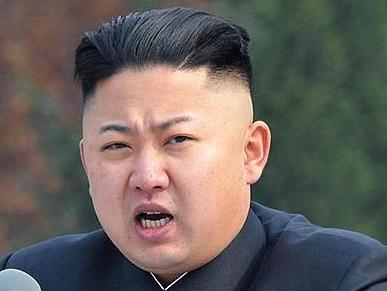
North Korean leader Kim Jong Un
Forget the tin-pot dictator with a bad crew-cut who leads an impoverished country. Here’s for some really scary reading:
Obama’s Trillion-Dollar Nuclear-Arms Train Wreck
Obama plans to retain first-use nuclear option
New U.S. Nuclear Bomb Moves Closer to Full-Scale Production
THAAD: A Major Security Risk for the ROK
James Bradley is author of several bestsellers including Flyboys and Flags of Our Fathers. His most recent book is The China Mirage: The Hidden History of American Disaster in Asia.
Demonize and Distract: Sanitizing Syria for the Masses
By Jason Hirthler | CounterPunch | September 9, 2016
Summoning the Humanitarian Pretext
The arch pragmatist Machiavelli once wrote that, “If you watch the ways of men, you will see that those who obtain great wealth and power do so either by force or fraud, and having got them they conceal under some honest name the foulness of their deeds.” You couldn’t pen a better description of the relationship between the imperial corporate state and its supplicant media. Once the coffers of vulnerable nations are ransacked by American wars of aggression, it is the media that sweeps the crimes of state beneath a carpet of piety. The truth may come out in due time, although it is always ex post facto. Thanks to the the coordination between the corporate sector, the state, and the media, the American doctrinal system is largely a self-contained narrative. It comes complete with a smooth internal logic. Corporations set priorities, the state produces a storyline that rationalizes the pursuit of those priorities, and the media distributes and reifies the storyline until it is gospel. This is no surprise, since the corporations own the politicians and the presses. Yet one way to examine the functioning of this kind of systemic propaganda is by looking at some of the keywords on which the stories hinge.
The foul deeds Machiavelli mentioned now principally occur in the Middle East, where vast resources lie and where power may be usefully projected deep into Eurasia. The Syrian proxy war between forces east and west is a nice example of how the dissimulations initiated in Washington are disseminated through the MSM. For instance, The New York Times, and its deputies in the vast clearinghouses of state propaganda, would have us believe that the White House is supporting freedom-loving rebels in Syria who are politically moderate and fighting for their lives in a civil war against a despotic regime led by an evil optometrist, Bashar al-Assad.
But we know that the entire Syrian fiasco was engineered by the CIA with cash, guns, and training, and unceasing support from the Gulf Cooperation Council (GCC) at our behest. It is a long-standing neoconservative plan to break the so-called Shia Crescent that runs from Lebanon through Syria to Iran. These are, of course, the independent-minded states that have thus far refused to accept either Israeli colonization of Palestinian land or permit Western-backed energy projects to take shape on their territory. Hence the need to dismember them into tiny, feckless statelets that pose no challenge to either Tel Aviv or Washington.
But this is hidden behind the fog of war and a domestic haze of media nuance. This entire conflict could reasonably be said to hinge on a single phrase: “moderate rebels.” The words “moderate” and “rebel” make all the difference in the telling of this fable. The truth is that we have hijacked Arab Spring discontent and festooned it with brigades of terrorist mercenaries procured from around the Middle East and Asia, all with the singular mandate to take down the Assad government. Tens of thousands of jihadists have been injected by NATO into a multi-confessional state governed by an elected leader who won a larger percentage of the electorate than our liberal messiah Barack Obama.
But this more truthful interpretation of events is unacceptable. To concede that the White House is now backing al-Qaeda terrorists in an effort to capsize a Middle Eastern democracy would implode the religion of American exceptionalism on which elite power depends. Thus the media cannot point out that the Pentagon’s recent admission of having troops in Syria violates the Nuremberg Principles on wars of aggression as well as the United Nations Charter. Omissions of this kind are what prevent average Americans from a) knowing what we’re really doing; and b) resisting it.
Demonize and Distract
But it isn’t enough to simply cloak our own crimes in the holy cloth of exceptionalism. We must defame our enemies. We must plant false flags in their soil now so that we can bury bombs in them later. It happens the same way every time. ‘Shocking’ discoveries are made about one of our most reviled enemies, usually provided by a defector with a farcical alias (think “Curveball”). Instantaneous mainstream reports issue a coordinated condemnation of the country in question. Each media outlet chooses a particular keyword to drive home the horror. Popular terms include “crimes against humanity”, “war crimes”, the words “industrial scale” in front of any noun or verb, the word “mass” in front of any noun or verb, “brutal crackdown”, “regime”, and so on. Grisly images are plastered across the front pages of the MSM. Often the images are fakes or are from unrelated incidents.
Once the reader has been stupefied, at least one columnist or politician will draw a deep breath, and then ‘draw comparisons’ to either Hitler and Auschwitz or Slobodan Milosevic and mass graves. (Recently Milosevic was declared innocent of all genocidal charges by the International Criminal Tribunal on Yugoslavia, albeit years after he died in prison after being denied medical treatment by his civilized captors. This process of posthumous exoneration is now practiced on an “industrial scale” by Obama’s drone assassination when various innocents are discovered to have been innocent after they’ve been “terminated”.)
Not only is the supposedly noble Syrian uprising a fraud, but so is our equally principled goal of wiping ISIS from the face of the earth, if the facts on the ground are of any import. Washington has gone after ISIS in a strangely half-hearted way. Why hasn’t it provided air cover for Syrian Arab Army when its helicopters were rendered useless by terrorist TOW missiles? Missiles sold by the United States to Saudi Arabia, likely for the express purpose of funneling them to al Nusrah and other rogue bandits in Syria. Why did the U.S. not immediately attack ISIS-controlled oil wells and oil trading routes–ISIS’ chief source of funding–as Russia did on its entry into the conflict? Why did the Obama administration produce a record-setting arms deal with the Saudis, the leading proselytizer of Wahhabism in the world? Why do we refuse to work with Moscow or the SAA or Iran? Why do we not share grids and intelligence and join their joint operations room in Baghdad?
Isn’t it obvious? We have different goals. We want Assad out and a daft, pliant puppet in charge, presiding over a vast arsenal of domestic police, ready to crush resistance on contact. Of course, any such resisters would be legitimate freedom fighters, as are the Palestinians. But the media takes care to call Palestinians “terrorists” and called citizens resisting the Iraqi occupation “insurgents”. Words matter. They shade the story and bring neutral readers over to the side of empire. They blame the victim for the violence that victimized them.
The dissimulation becomes even clearer when you realize that ISIS emerged from an American interrogation camp in Iraq, in a way that suggests CentCom was more than happy to release radicalized Islamists into the wild. To what purpose? The failed state in Libya and the collapsing scenery of the Syrian state provide plenty of fodder for speculation.
The Wages of Propaganda
Thanks to years of conditioning by the media, the population will do little to resist the escalation to come. Eventually the Syrian “regime” to be eventually overthrown by relentless American-backed violence. Hillary Clinton will win the election and gain control of the Oval Office. As Glen Ford wrote at Black Agenda Report, Clinton will “… ride into the White House on a warhorse”. She is the thinking man’s neocon, unlike President Bush, who represented the anti-intellectual strain of the American character, and Barack Obama, whose reluctance to pour troops into Arab prairie fires was widely predictably condemned as a sign of weakness.
Hillary is neither stupid nor soft. She will doubtless find a useful pretext by which to declare a no-fly zone in Syria, which would inhibit the efficacy of Russia’s campaign against various terrorist clans. (A House resolution is already afoot to lay the groundwork.) She will move more troops into the polder of northern Syria, violating all kinds of charters and conventions and declarations with an icy mixture of contempt and indifference. (See the UN Charter, Geneva Conventions, and the Universal Declaration of Human Rights for the bootless scraps of paper she will trample.) Perhaps most importantly, she will green light the transport of more arms, ammunition, and psychopaths into Syria to make a push for Damascus in the hopes of repeating the Libyan calamity.
Should that project succeed, Hillary will quite possibly ‘discover’ that Iran has been violating its bogus nuclear agreement with the P5 +1. Anonymous administration sources will be “troubled” by the development. This isn’t idle speculation. For lack of a better title, the long-term strategy for the “new world order,” as George H.W. Bush put it, is contingent on splitting the Shia Crescent, removing Iran as a regional antagonist, then moving farther into Eurasia to control Sino-Russian development. And we know how a confrontation with Tehran would play out. With rabid spittle cresting his white beard, Wolf Blitzer will escort numberless brigadier generals through The Situation Room to reassure Americans that the bearded mullahs in Qom are indeed a fearsome clan. Hillary will threaten, and perhaps use, tactical nuclear weapons (B-61s) on Iranian nuclear sites, backed by either a UN Security Council resolution of dubious authority or a coalition of the bullied, bought, and willing. As the mushroom cloud envelops the region in radioactive waste, Israel will be seen fastidiously colonizing more West Bank land, Benjamin Netanyahu rubbing his hands in frenzied anticipation, a dogeared copy of the Yinon plan stuffed in his jacket pocket. Saudi Arabia’s Deputy and Crown Princes will celebrate the fall of their hated rivals. Laconic onlookers in Washington and Europe will shrug and say nothing. CIA plants in D.C. will fastidiously distance Hillary’s bombs from Hiroshima’s, and Tel Aviv will move against Hezbollah in a final confrontation, since the Shia Crescent will by then be nothing more than a few shards of Mesopotamian culture atop a flaming midden.
With the Middle East finally brought “to heel,” as Hillary once proposed doing to young black boys, the ground will have been cleared for the pulse-racing showdown with Russia itself, the greatest thorn in Washington’s side. With Assad out of the way and Tehran chastened, the Kremlinologists and conspiracy theorists can be set loose to harrow the public into a state of high anxiety about the “expansionist” state to the East. NATO will inch closer to Russian borders and shout that Russia is moving closer to NATO. Destabilization will proceed apace. It will be called “democracy promotion” and will be paid for by fronts called “endowments”. Sanctions will tighten the economic screws. Verbal salvos will hit targets on either side of the water. New proxy wars will be touched off. Only a giant peace movement or stray asteroid could prevent something like this from happening. Perhaps the BRICS will halt the spread of empire with a collective stance, but Washington is agile if not artful at executing its core strategy to destabilize, divide, and rule its rivals. Until then, if you want to know what contempt looks like, look at this picture of Barack Obama and Vladimir Putin meeting at the G20 in China last week. The tenor of tomorrow is written all over their faces.
Jason Hirthler is a veteran of the communications industry and author of The Sins of Empire: Unmasking American Imperialism. He lives in New York City and can be reached at jasonhirthler@gmail.com.
Obama Flinches at Renouncing Nuke First Strike
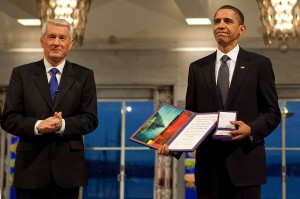
President Barack Obama uncomfortably accepting the Nobel Peace Prize, Dec. 10, 2009. (White House photo)
By Jonathan Marshall | Consortium News | September 8, 2016
Time is running short for President Obama to make good on his 2009 promise “to seek the peace and security of a world without nuclear weapons,” for which he won the Nobel Peace Prize. Yet as both the Wall Street Journal and New York Times recently reported, Obama’s advisers may have just nixed the single most important reform advocated by arms control advocates: a formal pledge that the United States will never again be the first country to use nuclear weapons in a conflict.
Ever since President Truman ordered two atomic bombs dropped on Japan in 1945, the United States has reserved the right to initiate nuclear war against an overwhelming conventional, chemical or biological attack on us or our allies. But peace advocates — and more than a few senior military officers — have long warned that resorting to nuclear weapons would ignite a global holocaust, killing hundreds of millions of people.
In a talk to the annual meeting of the Arms Control Association on June 6, Deputy National Security Advisor Benjamin Rhodes promised that President Obama would continue to review ways to achieve his grand vision of a nuclear-free world during his last months in office. Obama was reportedly considering a “series of executive actions” to that end, including a landmark shift to a “no first use” policy.
Two-thirds of adult Americans surveyed support such a policy. So do 10 U.S. senators who wrote President Obama in July, proposing a no-first-use declaration to “reduce the risk of accidental nuclear conflict” and seeking cut-backs in his trillion dollar plan for nuclear modernization over the next 30 years.
But Secretary of Defense Ashton Carter, Secretary of Energy Ernest Moniz (who oversees the nuclear stockpile), and Secretary of State John Kerry all warned during a National Security Council meeting in July that declaring a policy of “no first use” would alarm America’s allies, undercut U.S. credibility, and send a message of weakness to the Kremlin at a time of tense relations with Russia.
Yet until they took charge of giant bureaucracies whose funding depends on keeping the threat of nuclear war alive, both Carter and Moniz were on record supporting “a new strategy for reducing nuclear threats” and achieving security “at significantly lower levels of nuclear forces and with less reliance on nuclear weapons in our national security strategy.”
In a 2007 manifesto, Carter, Moniz, and other centrist Democratic foreign policy experts rejected the old claim that nuclear weapons are still needed to deter non-nuclear attacks.
“Nuclear weapons are much less credible in deterring conventional, biological, or chemical weapon attacks,” they wrote. “A more effective way of deterring and defending against such non-nuclear attacks – and giving the President a wider range of credible response options – would be to rely on a robust array of conventional strike capabilities and strong declaratory policies.”
They also gave strong implicit support to a no-first-use doctrine, stating that “nuclear weapons must be seen as a last resort, when no other options can ensure the security of the U.S. and its allies.”
Risk of Overreaction
Why does a no-first-use policy matter? In a New York Times column last month, Gen. James Cartwright, former vice chairman of the Joint Chiefs of Staff and head of the United States Strategic Command, emphasized the folly of introducing nuclear weapons into any conflict.
“Using nuclear weapons first against Russia and China would endanger our and our allies’ very survival by encouraging full-scale retaliation,” he and a colleague wrote. “Such use against North Korea would be likely to result in the blanketing of Japan and possibly South Korea with deadly radioactive fallout.”
A policy of no first use, backed up by a reconfiguration of U.S. nuclear forces to reduce their offensive capabilities, would lower the chance of a rival nuclear power rushing to launch early in a crisis and unleashing World War III. Today some nuclear powers like Russia have their forces on hair-trigger alert for fear of being wiped out by a U.S. surprise attack; as a result, the world is just one false alarm away from all-out nuclear war.
As two senior officials at the Arms Control Association observed recently in the Bulletin of the Atomic Scientists, “Among other advantages, a clear US no-first-use policy would reduce the risk of Russian or Chinese nuclear miscalculation during a crisis by alleviating concerns about a devastating US nuclear first-strike.
“Such risks could grow in the future as Washington develops cyber offensive capabilities that can confuse nuclear command and control systems, as well as new strike capabilities and strategic ballistic missile interceptors that Russia and China believe may degrade their nuclear retaliatory potential.”
They also discounted the claim that U.S. allies such as Japan or Korea would rebel against such a change of policy: “They are highly likely to accept such a decision, since no first use will in no way weaken US military preparedness to confront non-nuclear threats to their security. . . Many US allies, including NATO members Germany and the Netherlands, support the adoption of no-first-use policies by all nuclear-armed states.”
Warnings by nuclear hawks that a common-sense doctrine of no-first-use would undercut U.S. “credibility” or project “weakness” are simply business-as-usual attempts by national security bureaucrats to inflate threats and keep the war machine in high gear. If they succeed in blocking reform, America and the rest of the world will remain at real risk of annihilation through accidental nuclear escalation.
The question now is whether President Obama will listen to the fear-mongers in his cabinet, or remember what he said in May at the Hiroshima Peace Memorial: “Among those nations like my own that hold nuclear stockpiles, we must have the courage to escape the logic of fear and pursue a world without them.”
Jonathan Marshall is author or co-author of five books on international affairs, including The Lebanese Connection: Corruption, Civil War and the International Drug Traffic (Stanford University Press, 2012). Some of his previous articles for Consortiumnews were “Risky Blowback from Russian Sanctions”; “Neocons Want Regime Change in Iran”; “Saudi Cash Wins France’s Favor”; “The Saudis’ Hurt Feelings”; “Saudi Arabia’s Nuclear Bluster”; “The US Hand in the Syrian Mess”; and “Hidden Origins of Syria’s Civil War.”
US expands list of sanctioned Russian firms
RT | September 7, 2016
The US Department of Commerce is expanding its blacklist of Russian companies and individuals over their alleged links to the Ukrainian conflict.
The list was published on the Federal Register’s website on Tuesday, and identifies “entities and other persons reasonably believed to be involved in, or that pose a significant risk of being or becoming involved in, activities that are contrary to the national security or foreign policy of the United States.”
The blacklist consists of 75 Russian companies and up to 37 individuals. Among the sanctioned companies are 11 Russian and international electronics firms including one of the largest Eastern European manufacturers of integrated circuits Angstrem Group, Foreign Economic Association, radio and microelectronics manufacturer Mikron.
Seven sanctioned companies are said to be directly involved in the construction of the 19 kilometer (11.8 miles) road and rail connection across the Kerch Strait, which connects the Black and the Azov Seas.
Last week, the US Treasury Department introduced sanctions related to the conflict in eastern Ukraine against 18 construction, transportation and defense entities operating in the Crimea, as well as dozens of Gazprom and Bank of Moscow subsidiaries. The list also included an additional 11 Crimean officials.
Gazprom said the new sanctions will not affect its business.
The US and EU imposed sanctions on Russia in 2014 after accusing Moscow of involvement in the conflict in eastern Ukraine and of annexing Crimea. The Kremlin has denied the accusations and responded with counter-measures, banning imports from the EU, US and others.
There has Never Been Anyone Less Qualified than Killary to be President
By Steven MacMillan – New Eastern Outlook – 07.09.2016
“There has never been a man or a women – not me, not Bill, nobody – more qualified than Hillary Clinton to serve as the President of the United States of America” – Barack Obama speaking at the Democratic National Convention.
There he goes… the liar in chief is at it again: inverting reality and spouting some of the most transparent BS in modern history. The fact that Obama can stand up there and give such an outlandish endorsement of Killary is truly emblematic of his main strength: his ability to deceive.
Killary should be immediately disqualified from being eligible to run for President, considering the fact she had highly classified information on multiple unsecured private servers. Killary should be in jail, not running for the highest office in one of the most powerful countries on earth.
Even the thought of a Killary presidency should terrify everyone not only in the US, but everyone on the planet. Make no mistake about it: she is a neocon and a war hawk. Killary is not just a puppet of Wall Street, but of the military-industrial complex. She has received over $300,000 from war contractors in her presidential bid so far, the second highest amount (after Bernie Sanders) out of all the candidates who initially ran for President.
Killary was instrumental in NATO’s 2011 war in Libya, which resulted in the ousting of Muammar al- Qaddafi and the complete destruction of Libya – a country that previously had the highest standard of living on the African continent. She famously remarked after Qaddafi was murdered that “we came, we saw, he died” (before demonically laughing). I would question the mental sanity of anyone who paraphrases Julius Caesar in such circumstances.
With Killary at the helm, we can expect the total escalation of the Syrian conflict in addition to the very real potential of war with Iran. Killary is also a zealous supporter of Israel (along with Trump), and we can expect the continued support for Israel’s genocidal policies against the people of Palestine no matter who is elected.
Would the World Survive a Killary Presidency?
And now for the most dangerous aspect of a Killary administration: the very real danger of nuclear war with Russia. Although Vladimir Putin and the Russian leadership will try to work with Clinton in a bid to reduce tensions, her close relationship with the neocons and her warmongering attitude would most probably drive the world towards war.
In 2014, when referring to the Ukrainian conflict, Killary actually compared Putin to Hitler in one of the most disrespectful and ludicrous remarks that a Western politician has made in recent years. It becomes even more absurd when you consider the fact that the West overthrew the Ukrainian government, using and supporting neo-Nazis in the process.
A Clinton administration staffed with neocons and war hawks would continue the policy of encircling Russia, and of putting missile facilities in Eastern Europe. With tensions between NATO and Russia already great, the last thing the world needs is a Killary administration.
Putin: “The World is Being Pulled in an Irreversible Direction”
I will leave you with the warning Putin issued to foreign journalists at the end of the Saint Petersburg International Economic Forum on the 17th of June, regarding how NATO and the US are driving the world towards nuclear war, yet the Western public is absolutely oblivious to this reality considering the complete blackout in the mainstream media:
“The Iranian threat does not exist but the NATO missile defense system is being positioned in Europe… Now the system is functioning and being loaded with missiles… So, these are being loaded with missiles that can penetrate territories within a 500km range; but we know that technologies advance, and we even know in which year the US will accomplish the next missile. This missile will be able to penetrate distances of up to 1000km, and then even further; and from that point on, they will start to directly threaten Russia’s nuclear potential.”
Putin continues:
“We know year by year what’s going to happen, and they know that we know; it’s only you [the journalists] that they tell tall-tales too and you buy it, and spread it to the citizens of your countries. Your people in turn do not feel the sense of impending danger – this is what worries me. How do you not understand that the world is being pulled in an irreversible direction? While they pretend that nothing’s going on. I don’t know how to get through to you anymore.”
Featured Video
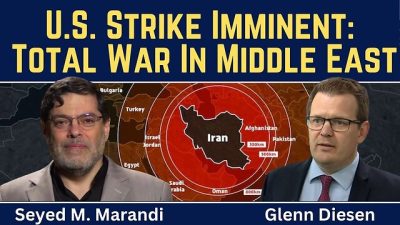
Seyed M. Marandi: Toward Total War in the Middle East
or go to
Aletho News Archives – Video-Images
From the Archives
The Geopolitics behind the War in Yemen (I)
By Mahdi Darius NAZEMROAYA | Strategic Culture Foundation | 30.03.2015
The United States and the Kingdom of Saudi Arabia became very uneasy when the Yemenese or Yemenite movement of the Houthi or Ansarallah (meaning the supporters of God in Arabic) gained control of Yemen’s capital, Sanaa/Sana, in September 2014. The US-supported Yemenite President Abd-Rabbuh Manṣour Al-Hadi was humiliatingly forced to share power with the Houthis and the coalition of northern Yemenese tribes that had helped them enter Sana. Al-Hadi declared that negotiations for a Yemeni national unity government would take place and his allies the US and Saudi Arabia tried to use a new national dialogue and mediated talks to co-opt and pacify the Houthis.
The truth has been turned on its head about the war in Yemen. The war and ousting of President Abd-Rabbuh Manṣour Al-Hadi in Yemen are not the results of «Houthi coup» in Yemen. It is the opposite. Al-Hadi was ousted, because with Saudi and US support he tried to backtrack on the power sharing agreements he had made and return Yemen to authoritarian rule. The ousting of President Al-Hadi by the Houthis and their political allies was an unexpected reaction to the takeover Al-Hadi was planning with Washington and the House of Saudi. … continue
Blog Roll
 Aletho News
- Pakistan-Iran talks secure LNG shipment to Islamabad through Hormuz
- Black Sea grain crisis puts global wheat supplies under pressure
- IRGC air defenses destroy another US MQ-1 drone over Strait of Hormuz
- Imran Khan’s entire immediate family detained in Pakistan ahead of mass protest demanding his release
- EU nation detains former presidential frontrunner
- Leaked: Britain’s Sham Conviction Of Hashim Thaci
- Seyed M. Marandi: U.S. Strike Imminent – Toward Total War in the Middle East
- Russia Voted Under Fire. Washington Is Loading the Tankers.
- 12 Things Your Oncologist Was Trained Not to Tell You
- Anthrax Attacks Paved Way for COVID-Era ‘Junk Drugs and Vaccines’
- If Americans Knew
- Israeli Attacks in Gaza Kill at Least Seven Palestinians Over Three Days, including Woman and Child
- Trump’s militarization of Washington DC as he pursues Israel’s war against Iran
- Why Israel Fears This Searing New Documentary
- Huckabee aide solicited cash gifts from Israelis
- This isn’t sci-fi, AI is already killing people
- ‘The Most Brutal Thing’: Investigation Reveals Execution of Elderly Woman in Rafah
- Inside Israel’s ‘soft’ ethnic cleansing plan for Gaza through the eyes of its victims
- New online database tracks pro-Israel political donations in the United States
- Israeli president pardons soldier convicted for killing wounded Palestinian
- Singer Ed Sheeran says his ‘heart broken’ by Gaza devastation, addresses Macklemore controversy
- No Tricks Zone
- 2025 Nature Paper Claiming Worsening Global Drought Gets RETRACTED …Heavily Flawed
- New Study: ‘Global Drought Shows No Detectable Recent Acceleration Under Climate Warming’
- Economic Masterminds: German Socialists Suggest Taxing Productivity Gains Stemming From Using AI
- The South China Sea Has Not Been Cooperating With The Climate Change Narrative
- Energy Crisis: Germany Enters Heating Season With Historically Low Gas Reserve Fill Levels
- New Study: The Antarctic Ice Sheet Gained Mass From 2020-2024 Due To Staggering Snow And Ice Accumulation
- Study: Ocean Heating Rates From Thousands Of Years Ago ‘Dwarf’ Modern Ocean Heating Rates
- Climate Extremists Target, Attack Large-Scale Power Grid Infrastructure In Germany!
- New Study: Antarctic Ice Melt Has Contributed Less Than 1 Centimeter To Sea Level Rise In The Last 30 Years
- Fear Of Debate: Alarmist German Climate Scientist Calls On Mainstream Media To Discredit Skeptic Voices
 Aletho News