Turkish Delight in Washington’s Patronage
By Brian Cloughley | CounterPunch | April 15, 2016
On March 26 President Erdogan of Turkey “harshly criticized” foreign diplomats for being present at the trial of two journalists in Istanbul. At a meeting of businessmen he erupted in fury and expostulated that “The consul-generals in Istanbul attended the trial. Who are you? What business do you have there? Diplomacy has a certain propriety and manners. This is not your country. This is Turkey.”
President Erdogan had made it clear that “this is Turkey” by declaring, before the trial even began, that the accused journalists will “pay a heavy price” for reporting that his National Intelligence Agency (MİT) had been smuggling weapons to rebel groups in Syria. Naturally, there was international interest in such a judicial process and, as is usual around the world, foreign diplomats attended the hearing in order to report to their governments the facts of the case as presented in court.
But the President of Turkey informed the world that diplomats accredited to his country are not expected to be present in his country’s law courts to witness judicial proceedings. He went even further by telling foreign diplomats in Istanbul that they “can move inside the Consulate building and within the boundaries of the Consulate. But elsewhere is subject to permission.”
Mr Erdogan is telling the world that international law means nothing to him. He rejects with contempt the Vienna Convention on Diplomatic Relations which lays down that in all countries foreign diplomats are to be granted “freedom of movement and travel” provided, of course that these should be “subject to laws and regulations concerning zones, entry into which is prohibited or regulated for reasons of national security.”
Prohibited zones do not include courts of law. And the trial of the journalists, who had been in solitary confinement for half their 90-day detention, has nothing to do with national security — only national dishonesty.
Western media reporting of Mr Erdogan’s violation of international rules and values has been low-key to the point of self-induced evaporation and there has been little condemnation of his open scorn for the basic principles of diplomatic conduct — and none at all from the Consul General of the United States in Istanbul, Mr Charles F Hunter, on whose website on the day of Mr Erdogan’s abusive outburst the main headline was:
WORLD ERUPTS OVER
RUSSIA’S UNJUST SENTENCE
OF UKRAINIAN PILOT
Mr Hunter wrote that “the global community has been quick to condemn the 22-year sentence handed out by a Russian court to Ukrainian pilot and parliamentarian Nadiya Savchenko,” which was absolute nonsense, because even the western media had not given the trial much cover. Not only that, but Mr Hunter omitted to mention that Savchenko’s status as a “parliamentarian” had been granted by the Ukrainian government after the prosecution had begun. Ms Savchenko had never set foot in Ukraine’s parliament, but Wikipedia, an easily manipulated online information site, describes her as “a Ukrainian politician and former Army aviation pilot in the Ukrainian Ground Forces.”
As part of the anti-Russian propaganda campaign about Savchenko, US State Department spokesman John Kirby stated that Russia has “blatant disregard for the principles of justice,” which is an absurd declaration, coming from the nation that for fifteen years has maintained a prison camp in a colonial enclave in Cuba in which not a single wretched captive has been permitted access to the process of international law. It’s a bit much, too, coming from a nation that refuses to release the thousands of photographs that were taken of torture by its soldiers.
Some photos were published in the media, but the really horrible ones have never been seen, except by some selected Senators and Members of Congress who were sworn to secrecy.
The US Supreme Court agreed with the “the judgment of the President and the Nation’s highest-ranking military officers that disclosure of the photographs at issue here would pose a substantial risk to the lives and physical safety of United States and allied military and civilian personnel in Iraq and Afghanistan.”
Given the policy of the US Establishment — the President, the Congress and the Supreme Court — concerning the importance of concealing disgusting and potentially embarrassing facts it is not surprising that there has been no criticism in Washington of President Erdogan for his persecution of journalists who revealed embarrassing facts about his illegal action in supplying Syrian-based terrorist groups with weapons, or about his insulting diatribe concerning the presence of a US diplomat at their trial.
On March 18 the UK’s Independent newspaper reported that “the President of Turkey has said democracy and freedom have ‘absolutely no value’ in the country after calling for journalists, lawyers and politicians to be prosecuted as terrorists.” But this means nothing to the US or British governments which both support President Erdogan without demur. While at the recent (and totally useless) summit on nuclear security in Washington on March 31, five days after he insulted their country, Mr Erdogan met with both the president and vice president of the United States.
Following the meetings, the Voice of America reported that President Obama “assured his Turkish counterpart of American commitment to the security of Turkey” and “extended condolences to Erdogan for a terrorist attack earlier in the day in the Kurdish-majority south-eastern city of Diyarbakir.” And Vice President Biden “reaffirmed the close alliance between the United States and Turkey . . [and] discussed ways to further deepen our military cooperation.” So Mr Erdogan felt free to continue his anti-democratic diatribes after he returned home.
Like many national leaders who have managed to get to a rank and position whose demands vastly exceed their modest capabilities, Mr Erdogan continued to justify his erratic behaviour by abusing “those who attempt to give us lessons in democracy and human rights.” On April 4 he said that the press was free in Turkey and claimed that some publications had branded him a “thief” and a “killer” without being shut down and that “Such insults and threats are not permitted in the West.”
Then he said that Turkey’s Constitutional Court had ‘betrayed its very existence’ because it had ordered release from pre-trial custody of the two journalists who, as noted above, he had declared would “pay a heavy price” for reporting that his Intelligence operatives had been smuggling weapons to rebel groups in Syria.
Turkey is in chaos. As Human Rights Watch records, its ruler “ has demonstrated a growing intolerance of political opposition, public protest, and critical media. Government interference with the courts and prosecutors has undermined judicial independence and the rule of law.”
When they met with President Erdogan, neither President Obama nor Vice President Biden offered the mildest criticism of him for his hysterical outbursts rejecting democracy and international law.
Perhaps their advisers pointed out to them that Mr Erdogan had a reasonable point to make, in that “those who attempt to give us lessons in democracy and human rights must first contemplate their own shame.”

US Nuclear Rearmament Under Guise of World Peace
By Finian CUNNINGHAM – Strategic Culture Foundation – 12.04.2016
This week US Secretary of State John Kerry visited Hiroshima, where nearly 71 years ago the US dropped the first ever atomic weapon killing 140,000 people. It was the first visit by a senior American official to the Japanese city owing to immense sensitivity surrounding that notorious event.
However, the occasion this week was said to underscore US President Obama’s vision of a nuclear weapons free world, said Kerry’s State Department.
The Japanese government of Shinzo Abe also got some good public relations value out of Kerry’s landmark visit to the Hiroshima peace memorial. As Voice of America noted, the occasion «helps to soften its global image» as Abe’s government steps up its military posture in recent years.
Obama is due to go to Japan in May to attend a G7 summit. It is being mooted that he too may pay respects to Hiroshima victims of the US atomic bombing, which occurred on August 6, 1945.
By the time Obama arrives in Japan, a shipment of Japanese radioactive plutonium is due to land on the US east coast. The highly dangerous cargo of 331 kilograms of weapons-grade plutonium reportedly left Japan on March 22 onboard an armed ship as part of an agreement with the US to act as a depository for the radioactive material. The cargo is reportedly sufficient material for the production 50 nuclear warheads.
The two-month seaborne transfer is a highly classified matter, the itinerary kept secret for security reasons. It is reportedly the first major transport of weapons-grade material from Japan since 1992. The plutonium is intended to be disembarked at a nuclear facility in Savannah, South Carolina.
The intake of plutonium from Japan by the US is supposedly part of a 2010 accord between the US and Russia which calls on both parties to begin disposal of highly enriched plutonium for the purpose of aiding weapons non-proliferation. Both sides are obligated to dispose of 34 tons of weapons-grade plutonium. Notwithstanding, on the US side the commitment has been largely unfulfilled, according to Professor Peter Kuznick, director of the Nuclear Studies Institute at American University in Washington DC.
Kuznick «estimates that on Obama’s watch little more than a ton of nuclear materials has been removed», reported the Guardian. Kuznick even went as far as accusing the American president of espousing the «height of hypocrisy» in light of his famous speech in Prague 2009 when he pledged to rid the world of nuclear weapons, and for which he was awarded the Nobel Peace Prize.
Further anomaly is in the fact that the Obama administration has committed Washington to spend $1 trillion over the next three decades in upgrading the country’s entire nuclear arsenal. A central part of the task is to replace the plutonium cores in all warheads – of which the US has roughly 1,500, on parity with Russia’s stockpile.
Therefore, it is very hard to see how Washington is implementing «Obama’s vision» of a nuclear-weapons-free world. The opposite is more to the point.
At the end of last month, Obama hosted 50 world leaders in Washington for a nuclear security summit. It was the fourth such event under his nearly eight-year presidency. Just before the gathering, Obama wrote an op-ed piece in the Washington Post which headlined: «How we can make our vision of a world without nuclear weapons a reality».
Notably, Russian President Vladimir Putin skipped the conference in Washington. The Kremlin said that was because the US side did not consult beforehand with Russian counterparts on what the agenda of the summit would be.
In his op-ed piece, Obama appeared to re-write his «Prague vision» by saying now that the «central pillar» is «preventing terrorists from obtaining and using a nuclear weapon». The president went on to say: «We’ll review our progress, such as successfully ridding more than a dozen countries of highly enriched uranium and plutonium».
So Obama deftly shifts the focus from international disarmament by nuclear powers – and his own county’s tardiness in particular to implement the nearly 50-year-old Non-Proliferation Treaty – to one of «preventing terrorists obtaining nuclear weapons».
This is where the shipment of plutonium from Japan comes into good public relations effect. As noted above, the cargo left Japan about a week before Obama’s nuclear security summit was held in Washington. That shipment tends to bolster the narrative that the US is «ridding more than a dozen countries of highly enriched uranium and plutonium» – thus ostensibly contributing to non-proliferation.
Obama also plugged the P5+1 accord with Iran in the same self-serving vein. He wrote: «We’ve succeeded in uniting the international community against the spread of nuclear weapons, notably in Iran. A nuclear-armed Iran would have constituted an unacceptable threat to our national security and that of our allies and partners. It could have triggered a nuclear arms race in the Middle East and begun to unravel the global non-proliferation regime».
Again, the intended effect is that Nobel Laureate Obama is seen to be doing his bit for world peace and nuclear disarmament. But with a trillion-dollar upgrade of the US nuclear arsenal underway, as designated by Obama, it should be evident that the exact opposite is the case.
Japan has reportedly accumulated about 50 tons of plutonium over several decades, with supplies sent there from Britain, France and the US, supposedly for the purpose of research and use as reactor fuel. There are apparently security concerns that such nuclear material could be hijacked by terror groups. And so the US has presented itself as stepping up to the plate to receive this stockpile from Japan on to its territory for «safe disposal».
But the alleged disposal of weapons-grade plutonium in the US does not stand up to scrutiny. Waste facilities in the US for nuclear storage have reached critical capacity limits. Major sites at Hanford, Washington, Lawrence Livermore, California, Rocky Flats, Colorado, and Oak Ridge, Tennessee, have been plagued for years with radioactive leakages. The main disposal facility at Savannah is straining at full capacity. South Carolina’s Governor Nikki Haley is threatening to sue the US Department of Energy in a multi-million-dollar lawsuit over delays in relieving the Savannah site from its toxic load.
Environmentalists in New Mexico state are alarmed that the federal government is now planning to shunt highly radioactive plutonium to an existing underground storage facility there as a contingency measure. The New Mexico site has been operating for 16 years and is the US’s only underground nuclear waste facility. However, the Waste Isolation Pilot Plant (WIPP) near Carlsbad is suitable solely for low-level nuclear waste.
It’s not only local environmentalists who are anxious. Former Secretary of Energy Bill Richardson has expressed concerns that the New Mexico site is being recklessly lined up to take the nuclear waste load off the site in Savannah.
«This is not a good idea for a variety of reasons, but mainly that WIPP is not suitable to be a high-level waste dump and New Mexico has done its share of accepting nuclear waste», wrote Richardson in an op-ed for the Las Cruces Sun News.
The obvious conclusion is that the US is in no position to «safely dispose» of weapons-grade plutonium from Japan, or anywhere else for that matter, since it doesn’t even have storage capacity for its own Cold War legacy of nuclear waste.
Taking in Japanese nuclear waste is dangerously adding more environmental burden to US communities. Tragically, the population of New Mexico appears to be set for a precarious experiment in disposing highly toxic nuclear material that it is not equipped to deal with.
It was 71 years ago, on July 16, 1945, that the US first tested its atomic weapon in the desert of New Mexico at the Trinity explosion site. Three weeks later the bomb was dropped on Hiroshima.
History appears to be turning full circle as New Mexico is once again being used to expand US nuclear weapons – under the guise of «disposing» plutonium. But the real reason for the «disposal» is to give the US the international image of working towards non-proliferation, when in reality it is scaling up its own nuclear arsenal – in complete violation of the Non-Proliferation Treaty that was first signed all the way back in 1968. Nearly half a century on, the US is paving the way for extending its weapons of mass destruction, not eliminating them.
Kerry’s «historic» visit to Hiroshima this week thus seems to be part of a carefully choreographed and ultimately cynical public relations exercise by the US government. Solemn words for the victims of America’s nuclear holocaust and lofty visions of disarmament jar with Washington’s conduct of rearming itself to the teeth.
Location Location Location: The Unintended Symbolism of the White House Haft-Sîn
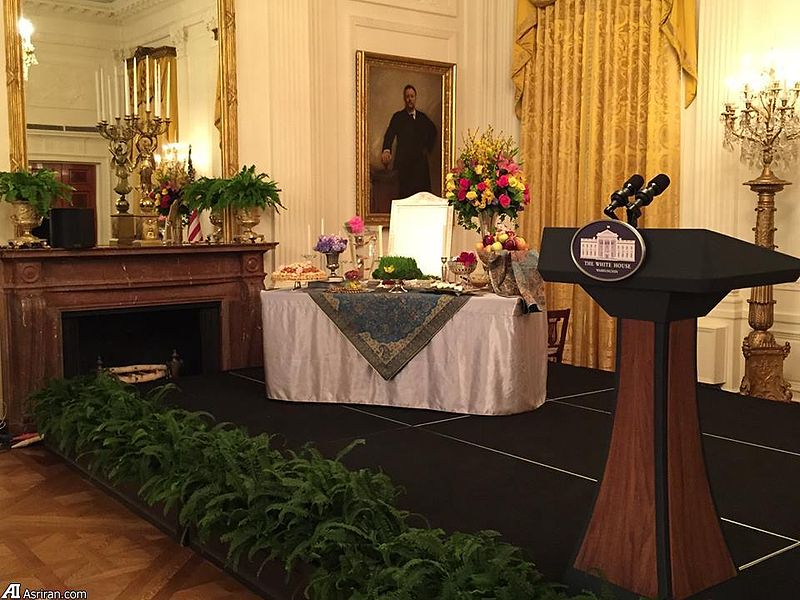
White House Nowruz, 2015
By Nima Shirazi | Wide Asleep In America | April 8, 2016
This week, Michelle Obama hosted the second annual White House Nowruz, a celebration of the Iranian New Year. Though a relatively apolitical affair, the placement of the reception’s traditional haft-sîn, however, should have raised some eyebrows.
Nowruz, which literally means “new day” in Farsi, is an ancient festival of new beginnings, deeply rooted in Zoroastrianism, celebrating the first day of Spring and the Persian calendar.
Of the myriad traditions and festivities associated with Nowruz, the most universally recognizable may be that of the haft-sîn (هفت سین), a table arrangement decorated with seven (haft) items – each beginning with the Persian letter S (sîn) – and symbolizing renewal, reconciliation, good luck, and prosperity.
The shindig, MC’ed by comedian Maz Jobrani and catered by renowned Persian chef Najmieh Batmanglij, was held on April 6 – a few days after the official holiday season (which lasts roughly 13 days) had actually ended.
The White House, naturally, had its own haft-sîn on display at its Nowruz party. However, its location in the East Room, where the celebration has been held both years, was a bit curious and (probably) unintentionally laden with symbolism all its own.
Nowruz-sevelt
The table containing such traditional items as wheat grass (sabzeh), garlic (sīr), vinegar (serkeh), apple (seeb), wheat germ pudding (samanu), sumac berries (somaq), and dried fruit (senjed) was placed – as it was last year as well – right beneath John Singer Sargent’s 1903 presidential portrait of Theodore Roosevelt.

A haft-sîn in the White House’s East Room, on April 6, 2016.
One of the principal promoters of American imperialism at the end of the 19th century and in the first decade of the 20th, Roosevelt once wrote, “I should welcome almost any war, for I think this country needs one.” It is said he carried around a list of six target nations on three continents.

In December 1904, Roosevelt issued his official Corollary to the Monroe Doctrine, declaring that the United States would not hesitate to use what he called its “international police power” to destroy and replace regimes deemed hostile to American interests. Though initially used to justify military intervention, invasion and occupation of Western Hemisphere nations such as Cuba, Nicaragua, Honduras, Haiti, and the Dominican Republic, Roosevelt sent a similar message to the entire world in late 1907, when he deployed the nation’s Great White Fleet to circumnavigate the globe in a show of power. The fleet consisted of 16 battleships and support vessels, crewed by 14,000 sailors. It sailed for 14 months, covering over 43,000 miles and made twenty port calls on six different continents.
Just as it is common practice today for U.S. presidents to deliver Nowruz remarks to the people, and sometimes leaders, of Iran, in the late 19th and early 20th centuries “American presidents were encouraged to exchange telegrams with the Shah of Iran on the occasion of the Persian New Year’s Day.”
“In 1902,” note scholars Kamran Scot Aghaie and Afshin Marashi, “President Theodore Roosevelt even presented the Shah of Iran, Muzaffar al-Din, and his brother, Zill al-Sultan, with a copy of his book, Hunting Trips of a Ranchman, recognizing that hunting was a favorite pastime of the Persian royal family as well.”
At the time, Iranian leaders saw the United States – which had no imperial presence in the Middle East at that point – as a potential non-interventionist ally against persistent Russian and British encroachment on Iranian sovereignty. Following the Iranian Constitutional Revolution in 1906, Russia and Britain both occupied Iran in 1907 in an effort to dissolve the parliament and prop up the waning Qajar dynasty, dividing the country between them until 1911. Roosevelt remained neutral, however, a position subsequently maintained by Taft and all successive U.S. administrations through World War II, when Russia and the United Kingdom again invaded and occupied Iran to secure wartime supply routes for the Allied Powers and replaced the then Shah, Reza Pahlavi, with his son, Mohammad Reza Pahlavi.
Kermit’s Coup
On August 19, 1953, Iranian Prime Minister Mohammad Mossadegh was overthrown in a military coup planned and orchestrated by the United States and Britain after nationalizing Iran’s oil industry. Pro-Shah riots were staged, hundreds were killed, newspapers supportive of Mossadegh were ransacked and shuttered, and the prime minister was arrested and tried for treason.
The main architect of the coup, executed at the behest of British petroleum interests and under the guise of pro-active anti-communism, was the chief of the CIA’s Near East and Africa division, Kermit Roosevelt, Jr. – grandson of President Teddy Roosevelt.
The ouster of Mossadegh, and the reinstallation of the Shah, by American intelligence operatives is a seminal moment in Iranian history and political consciousness, setting the stage for a quarter-century of tyrannical dictatorship propped up by torture, corruption and U.S. military aid, as well as establishing the United States as an interventionist power in the region. Popular backlash against the Shah, and his American backers, culminated in his overthrow by the Iranian Revolution, and the establishment of an Islamic Republic in 1979.
Roosevelt’s Shadow
By honoring Iranian culture with a haft-sîn table set under the watchful gaze of Teddy Roosevelt – the godfather of American military intervention and the grandfather of the man responsible for Operation Ajax in 1953 – the White House is unwittingly sending a message of continued hostility and imperial hubris toward Iran.
In his annual Nowruz message, delivered right before his historic trip to Cuba, President Obama said that, “even after decades of mistrust, it is possible for old adversaries to start down a new path.” At a time when Iran is fully upholding its end of the nuclear accord, while the residual effects of U.S. sanctions continue to cause problems for Iranians, optics remain important.
One possible step on the path to better relations would be to move the haft-sîn to the other side of the room.
US drone strikes kill 17 Afghan civilians: Paper
Press TV – April 8, 2016
US airstrikes in Afghan province of Paktika have killed at least 17 civilians, local officials and elders say, rejecting official American and Afghan claims that only militants had been killed.
They were killed during three drone strikes carried out by the US in the area of Nematabad on Wednesday, former Afghan senator Hajji Muhammad Hasan said, quoted by The New York Times.
The first raid struck a vehicle carrying a local elder, Hajji Rozuddin, who was on his way to mediate a land dispute in a tribe with four bodyguards and seven other people, the report said.
“Hajji Rozuddin was strongly anti-Taliban,” said Hasan. “He carried bodyguards because the Taliban were trying to kill him.”
“The car was completely destroyed, and there was little of the bodies left,” he said.
Soon after the attack, another strike killed two people who had come to help recover the bodies from the truck after the first attack, said Hasan.
A third attack also killed three other civilians on top of a small hill. They were trying “to see what had happened and why the previous two men had not returned already,” he explained.
Governor Shaista Khan Akhtarzada also confirmed that an investigation team had determined that “the people killed were civilians.”
The US military had said on Thursday that two Wednesday airstrikes in Paktika killed 14 militants.
“There was no evidence to indicate that there were any civilian casualties at all,” Charles Cleveland, a spokesman for the United States military in Afghanistan, said.
Cleveland claimed that most of the “just under a hundred” US strikes in Afghanistan from January 1 to March 31 were focused on Daesh militants in eastern Nangarhar Province.
Officials and residents said that such airstrikes have been relatively rare in Paktika in recent months, even as the United States has intensified its air operations elsewhere in the country.
In January, US President Barack Obama authorized American forces to target Daesh terrorists emerging in Nangarhar.
Although Taliban leaders have warned Daesh against “waging a parallel insurgency in Afghanistan,” the Takfiri group has been trying to expand its outreach there and is reported to have between 1,000 to 3,000 terrorists on its payroll.
Afghanistan is gripped by insecurity 14 years after the United States and its allies attacked the country as part of Washington’s so-called war on terror.
White House to Syrians: Don’t Dare Vote For Assad!
By Daniel McAdams | Ron Paul Institute | March 30, 2016
US backing for the overthrow of Syrian president Bashar al-Assad was supposed to be all about democracy. As Washington tells it, the people took to the street demanding democratic reforms and Assad did not listen, so he lost his legitimacy and needed to be overthrown. The US helped facilitate that overthrow by shipping in tons of weapons (much of which ended up in the hands of al-Qaeda and ISIS).
What Syrians were supposed to get in Assad’s place was a bright new future where they could vote for whoever they pleased to lead their government. That is what Washington told us was the noble goal of its regime change operation in Syria.
But just as in other US “democratization” operations overseas, that turns out to be not the case at all.
Syrians are free to choose their leaders as long as they choose the leaders Washington has chosen for them.
Over and over again the White House has reiterated its position that the Syrian people are forbidden from choosing Assad as their president after ISIS and al-Qaeda are defeated. The latest example of Washington’s anti-democratic “democracy promotion” came today, after Assad signaled his flexibility in forming a transitional government that might include the opposition, independents, and loyalists.
Obama’s spokesman flatly rejected any such proposal, saying, “I don’t know whether (Assad) envisioned himself being a part of that national unity government. Obviously that would be a non-starter for us.”
So Syrians, your “democracy” is being given to you by a United States deeply opposed to the idea of allowing any vote that is not pre-approved by Washington’s regime-changers.
Shorter Washington to Syrian people: “OK, you can vote, but we will hand you the approved candidate list.”
Hmmm…don’t they do that in US-condemned Iran?
Obama Campaigned on Peace, But Brought Death and War Worldwide
Sputnik – 02.04.2016
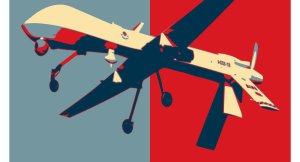 Barack Obama campaigned on a promise to scale back US military engagement in the Middle East and to keep America’s soldiers from getting bogged down in never-ending regional civil wars. President Obama has kept park of that campaign promise, with America’s troop presence abroad reduced. But US military engagement, as a whole, has increased significantly, through the use of unmanned drones and the deployment of troops in combat and security situations in more countries than in 2009.
Obama’s White House ended the previous administration’s Operation Iraqi Freedom and Operation Enduring Freedom — combat missions in Iraq and Afghanistan that continued to fester following George W. Bush’s attempts at regime change in Baghdad and the bombing of mountains into submission around Kabul. Today, despite recent reports that the Defense Department has understated the US troop presence in Iraq, troop levels in each country are down.
Nonetheless, Obama followed up his acceptance of the Nobel Peace Prize by expanding US military actions to nearly every country in the Middle East and North Africa, while reviving a Cold War posture toward Russia and China.
For instance, during the so-called Arab Spring, the US undertook a military campaign against Libyan dictator Muammar al-Qaddafi, leading to the leader being deposed and killed in the streets. The ousting of Qaddafi turned the once thriving country into a hotbed for Daesh extremists and today Libya is largely considered a failed state.
Under Obama, the US has expanded drone wars in Pakistan, Somalia, Yemen, Afghanistan, Libya and Syria with limited results and many civilian deaths.
Reports by the Bureau of Investigative Journalism suggest that the majority of US drone strikes result in civilian casualties, but under Obama these casualties have been defined away by invoking a macabre redefining of the “kill box” – anybody within a certain proximity to targeted victim is deemed a combatant.
The US today now finds itself performing aggressive joint military exercises with the South Koreans, seen as dress rehearsals for a full-scale invasion of North Korea — a nuclear capable country. American and NATO forces are posted along the Russian border in Norway to prepare for potential offensive actions against Moscow justified by the fantasy of Russian military aggression in Europe. US forces are now fighting in not only Iraq and Afghanistan, but also in Syria, Libya, and Yemen.
The paradox of the Obama Administration is how a president who campaigned on getting us out of war in Iraq and Afghanistan has now committed the US to the escalation of several recent wars.
Obama is no dove, and the world is no safer. With unmanned drone use increasing overseas, perpetual war has never been rebranded so effectively.
How US-Backed War on Syria Helped ISIS
By Daniel Lazare | Consortium News | March 31, 2016
Why are Islamic militants wreaking havoc from Brussels to Lahore? The best way to answer this question is by taking a close look at how The New York Times covered this weekend’s liberation of Palmyra from Abu Bakr al-Baghdadi’s Islamic State.
The article, entitled “Syrian Troops Said to Recapture Historic Palmyra From ISIS,” began on a snide note. While the victory may have netted Bashar al-Assad “a strategic prize,” reporters Hwaida Saad and Kareem Fahim wrote that it also provided the Syrian president with “something more rare: a measure of international praise.”
The article noted that “Mr. Assad’s contention that his government is a bulwark against the transnational extremist group” has been bolstered, but added that “his foes and some allies argue that he must leave power as part of a political settlement to end the war in Syria” – without, of course, specifying who those allies might be.
Then it offered a bit of background: “Lost in the celebrations was a discussion of how Palmyra had fallen in the first place. When the Islamic State captured the city in May [2015], the militants faced little resistance from Syrian troops. At the time, residents said officers and militiamen had fled into orchards outside the city, leaving conscripted soldiers and residents to face the militants alone.”
Since the Times claims to have “several hundred” surreptitious contacts inside Syria, the charge that Assad’s troops fled without a fight may conceivably be correct. But it’s hard to square with reports that the Islamic State (also known as ISIS, ISIL and Daesh) had to battle for seven or eight days before entering the city and then had to deal with a counter-offensive on the city’s outskirts. But even if true, it’s only part of the story and a small one at that.
The real story began two months earlier when Syrian rebels launched a major offensive in Syria’s northern Idlib province with heavy backing from Turkey and Saudi Arabia. Led by Al Nusra, the local Al Qaeda affiliate, but with the full participation of U.S.-backed rebel forces, the assault proved highly successful because of the large numbers of U.S.-made optically guided TOW missiles supplied by the Saudis. [See Consortiumnews.com’s “Climbing into Bed with Al-Qaeda.”]
The missiles gave the rebels the edge they needed to destroy dozens of government tanks and other vehicles according to videos posted on social media websites. Indeed, one pro-U.S. commander told The Wall Street Journal that the TOWs completely “flipped the balance of power,” enabling the rebels to dislodge the Syrian army’s heavily dug-in forces and drive them out of town. Although the government soon counter-attacked, Al Nusra and its allies continued to advance to the point where they posed a direct threat to the Damascus regime’s stronghold in Latakia province 50 or 60 miles to the west.
Official Washington was jubilant. “The trend lines for Assad are bad and getting worse,” a senior official crowed a month after the offensive began. The Times happily observed that “[t]he Syrian Army has suffered a string of defeats from re-energized insurgents … [which] raise newly urgent questions about the durability of President Bashar al-Assad’s rule.”
Assad was on the ropes, or so everyone said. Indeed, ISIS thought so as well, according to the Associated Press, which is why it decided that the opportunity was ripe to launch an offensive of its own 200 miles or so to the southeast. Worn-out and depleted after four years of civil war, the Syrian Arab Army retreated before the onslaught.
But considering the billions of dollars that the U.S. and Saudis were pouring into the rebel forces, blaming Damascus for not putting up a stiffer fight is a little like beating up a 12-year-old girl and then blaming her for not having a better right hook.
So the U.S. and its allies helped Islamic State by tying down Assad’s forces in the north so that it could punch through in the center. But that’s not all the U.S. did. It also helped by suspending bombing as the Islamic State neared Palmyra.
As the Times put it at the time: “Any airstrikes against Islamic State militants in and around Palmyra would probably benefit the forces of President Bashar al-Assad. So far, United States-led airstrikes in Syria have largely focused on areas far outside government control, to avoid the perception of aiding a leader whose ouster President Obama has called for.”
The upshot was a clear message to ISIS to the effect that it had nothing to worry about from U.S. jet bombers as long as it engaged Assad’s troops in close combat. The U.S. thus incentivized ISIS to press forward with the assault. Although residents later wondered why the U.S. had not bombed ISIS forces “while they were traversing miles of open desert roads,” the answer, simply, is that Washington had other things on its mind. Rather than defeating ISIS, it preferred to use it to accomplish its primary goal, which was driving out Assad.
The Blowback
But what does this have to do with Brussels and Lahore? Simply that America’s fundamental ambivalence toward ISIS, Al Qaeda, and similar groups — its policy of battling them on one hand and seeking to make use of them on the other — is what allows Sunni terrorism to fester and grow.
The administration is shocked, SHOCKED, when Islamists kill innocent people in Belgium but not when they kill innocent people in Syria. This is why the White House long regarded ISIS as a lesser threat: because it thought its violence would remain safely contained.
“Where Al Qaeda’s principal ambition is to launch attacks against the West and U.S. homeland,” Deputy National Security Adviser Ben Rhodes explained in August 2014, “ISIL’s primary focus is consolidating territory in the Middle East region to establish their own Islamic State.”
Since the only people in harm’s way were Syrians, there was no cause for alarm. The rest of the world could relax.
Hence the confusion when ISIS did the unexpected by striking out at Western targets after all. As the Times observed in a major takeout this week on Islamic State’s Western operations, officials were slow to connect the dots because Euro-terrorism was not supposed to be ISIS’s thing: “Even as the group began aggressively recruiting foreigners, especially Europeans, policymakers in the United States and Europe continued to see it as a lower-profile branch of Al Qaeda that was mostly interested in gaining and governing territory.”
Turkish officials made essentially the same point last week in response to widespread complaints that they have done little to prevent Sunni terrorists from making their way to Syria. Not so, they countered. When they tried to return the jihadis from whence they came, they found that members of the European Union were none too eager to have them.
“We were suspicious that the reason they want these people to come is because they don’t want them in their own countries,” a senior Turkish security official told the London Guardian. Instead, they preferred to see them continue on their way. And why not? At home, they would only cause trouble, whereas in Syria they would advance Western interests by waging war against Assad’s Baathist government.
Thus, Brussels was unresponsive when Turkish officials informed it that they had detained a Belgian citizen named Ibrahim el-Bakraoui in the border town of Gaziantep on suspicion of traveling to Syria to join the jihad. The Turks deported him anyway, but the Belgians remained unconcerned until El-Bakraoui turned up among the suicide bombers at Zaventem airport.
The same thing happened when the Turks intercepted a Syria-bound French national named Omar Ismail Mostefai. Paris was also unresponsive until Mostefai wound up among the ISIS militants who stormed the Bataclan concert hall last November, at which point its attitude turned distinctly less blasé.
In June 2014, Turkish security officers in Istanbul intercepted a Norwegian citizen traveling to Syria with a camouflage outfit, a first-aid kit, knives, a gun magazine and parts of an AK-47, all of which E.U. customs officials had somehow overlooked.
Two months later, they intercepted a German citizen with a suitcase containing a bulletproof vest, military camouflage and binoculars that customs had also failed to notice. When they apprehended a Danish-Turkish dual citizen on his way to Syria, they sent him back to Copenhagen. But the Danes gave him another passport regardless so he could continue on his way. Everyone figured that what happens in Syria stays in Syria, so why worry?
Now, of course, everyone is worried big time. With the AP reporting that Islamic State has armed and trained 400 to 600 fighters for its European operations, talk of ISIS sleeper cells is ubiquitous. Referring to the Brussels district where the March 22 bombing plot was hatched, Patrick Kanner, the French social-democratic minister of youth, warned ominously: “There are today, as is well known, hundreds of neighborhoods in France that present potential similarities to what happened in Molenbeek.”
The implication was that the state of emergency should not only continue but deepen. As hundreds of neo-Nazis descended on Brussels chanting anti-immigrant slogans, paranoia took a giant leap forward as did its handmaidens racism and Islamophobia.
But as much everyone would like to blame it all on Donald Trump, Marine Le Pen and others of that ilk, none of this is really their fault. To the contrary, the West’s disastrous Syria policy is entirely the creation of nice-guy liberals like Barack Obama. Desperate to appease both Israel and the Sunni oil sheiks, all of whom for various reasons wanted Assad to go, he signed on to a massive Sunni jihad that has turned Syria into a charnel house.
With death estimates now running as high as 470,000, which is to say one person in nine, the idea that massive violence like this could remain confined to a single country was absurd to begin with. Yet Obama went along regardless.
Indeed, the administration is still unwilling to back down despite all that has happened since. When a reporter asked point-blank at a State Department press briefing, “Do you want to see the [Damascus] regime retake Palmyra or would you prefer that it stays in Daesh’s hands,” spokesman Mark Toner hemmed and hawed before finally admitting that a takeover was preferable because “we think Daesh is probably the greater evil in this case.” (Exchange starts at 1:05.)
But the next day he walked back even that mealy-mouthed statement. Refusing to endorse Palmyra’s fall at all, he declared: “I’m not going to laud it because it’s important to remember that one of the reasons Daesh is in Syria is because Assad’s brutal crackdown on his own people created the kind of vacuum, if you will, that has allowed a group like ISIL or Daesh to flourish. Just because he’s now, given the cessation of hostilities, willing and-or able to divert his forces to take on Daesh doesn’t exonerate him or his regime from the gross abuses that they’ve carried out against the Syrian people.”
Since Assad is the only one to blame, the U.S. doesn’t have to ponder its own contribution to the problem. Instead, it gives itself a clean bill of health and moves on. Rather, it would like to move on if only ISIS would let it.
But the more aid the U.S. and its allies funnel into the hands of Sunni terrorists, the more groups like ISIS and Al Qaeda will grow and the farther their reach will extend. The upshot will be more bombings and shootings in Paris, Brussels, and who knows where else. Racism and Islamophobia will continue to surge regardless of what bien-pensant liberals do to talk it down.
The liberal center is engineering its own demise.
Daniel Lazare is the author of several books including The Frozen Republic: How the Constitution Is Paralyzing Democracy (Harcourt Brace).
A ‘Silent Coup’ for Brazil?
By Ted Snider | Consortium News | March 30, 2016
Brazil keeps its coups quiet (or at least quieter than many other Latin American countries). During the Cold War, there was much more attention to overt military regime changes often backed by the CIA, such as the overthrow of Guatemala’s Jacobo Arbenz in 1954, the ouster of Chile’s Salvador Allende in 1973 and even Argentina’s “dirty war” coup in 1976, than to Brazil’s 1964 coup that removed President João Goulart from power.
Noam Chomsky has called Goulart’s government “mildly social democratic.” Its replacement was a brutal military dictatorship.
In more modern times, Latin American coups have shed their image of overt military takeovers or covert CIA actions. Rather than tanks in the streets and grim-looking generals rounding up political opponents – today’s coups are more like the “color revolutions” used in Eastern Europe and the Mideast in which leftist, socialist or perceived anti-American governments were targeted with “soft power” tactics, such as economic dislocation, sophisticated propaganda, and political disorder often financed by “pro-democracy” non-governmental organizations (or NGOs).
This strategy began to take shape in the latter days of the Cold War as the CIA program of arming Nicaraguan Contra rebels gave way to a U.S. economic strategy of driving Sandinista-led Nicaragua into abject poverty, combined with a political strategy of spending on election-related NGOs by the U.S.-funded National Endowment for Democracy, setting the stage for the Sandinistas’ political defeat in 1990.
During the Obama administration, this strategy of non-violent “regime change” in Latin America has gained increasing favor, as with Secretary of State Hillary Clinton’s decisive support for the 2009 ouster of Honduran President Manuel Zelaya who had pursued a moderately progressive domestic policy that threatened the interests of the Central American nation’s traditional oligarchy and foreign investors.
Unlike the earlier military-style coups, the “silent coups” never take off their masks and reveal themselves as coups. They are coups disguised as domestic popular uprisings which are blamed on the misrule of the targeted government. Indeed, the U.S. mainstream media will go to great lengths to deny that these coups are even coups.
The new coups are cloaked in one of two disguises. In the first, a rightist minority that lost at the polls will allege “fraud” and move its message to the streets as an expression of “democracy”; in the second type, the minority cloaks its power grab behind the legal or constitutional workings of the legislature or the courts, such as was the case in ousting President Zelaya in Honduras in 2009.
Both strategies usually deploy accusations of corruption or dictatorial intent against the sitting government, charges that are trumpeted by rightist-owned news outlets and U.S.-funded NGOs that portray themselves as “promoting democracy,” seeking “good government” or defending “human rights.” Brazil today is showing signs of both strategies.
Brazil’s Boom
First, some background: In 2002, the Workers’ Party’s (PT) Luiz Inacio Lula da Silva came to power with 61.3 percent of the vote. Four years later, he was returned to power with a still overwhelming 60.83 percent. Lula da Silva’s presidency was marked by extraordinary growth in Brazil’s economy and by landmark social reforms and domestic infrastructure investments.
In 2010, at the end of Lula da Silva’s presidency, the BBC provided a typical account of his successes: “Number-crunchers say rising incomes have catapulted more than 29 million Brazilians into the middle class during the eight-year presidency of Luiz Inacio Lula da Silva, a former trade unionist elected in 2002. Some of these people are beneficiaries of government handouts and others of a steadily improving education system. Brazilians are staying in school longer, which secures them higher wages, which drives consumption, which in turn fuels a booming domestic economy.”
However, in Brazil, a two-term president must sit out a full term before running again. So, in 2010, Dilma Rousseff ran as Lula da Silva’s chosen successor. She won a majority 56.05 percent of the vote. When, in 2014, Rousseff won re-election with 52 percent of the vote, the right-wing opposition Brazilian Social Democratic Party (PSDB) went into a panic.
This panic was not just because democracy was failing as a method for advancing right-wing goals, nor was the panic just over the fourth consecutive victory by the more left-wing PT. The panic became desperation when it became clear that, after the PT had succeeded in holding onto power while Lula da Silva was constitutionally sidelined, he was likely returning as the PT’s presidential candidate in 2018.
After all, Lula da Silva left office with an 80 percent approval rating. Democracy, it seemed, might never work for the PSDB. So, the “silent coup” playbook was opened. As the prescribed first play, the opposition refused to accept the 2014 electoral results despite never proffering a credible complaint. The second move was taking to the streets.
A well-organized and well-funded minority whose numbers were too small to prevail at the polls can still create lots of noise and disruption in the streets, manufacturing the appearance of a powerful democratic movement. Plus, these protests received sympathetic coverage from the corporate media of both Brazil and the United States.
The next step was to cite corruption and begin the process for a constitutional coup in the form of impeachment proceedings against President Rousseff. Corruption, of course, is a reliable weapon in this arsenal because there is always some corruption in government which can be exaggerated or ignored as political interests dictate.
Allegations of corruption also can be useful in dirtying up popular politicians by making them appear to be only interested in lining their pockets, a particularly effective line of attack against leaders who appear to be working to benefit the people. Meanwhile, the corruption of U.S.-favored politicians who are lining their own pockets much more egregiously is often ignored by the same media and NGOs.
Removing Leaders
In recent years, this type of “constitutional” coup was used in Honduras to get rid of democratically elected President Zelaya. He was whisked out of Honduras through a kidnapping at gunpoint that was dressed up as a constitutional obligation mandated by a court after Zelaya announced a plebiscite to determine whether Hondurans wanted to draft a new constitution.
The hostile political establishment in Honduras falsely translated his announcement into an unconstitutional intention to seek reelection, i.e., the abuse-of-power ruse. The ability to stand for a second term would be considered in the constitutional discussions, but was never announced as an intention by Zelaya.
Nevertheless, the Supreme Court declared the President’s plebiscite unconstitutional and the military kidnapped Zelaya. The Supreme Court charged Zelaya with treason and declared a new president: a coup in constitutional disguise, one that was condemned by many Latin American nations but was embraced by then-Secretary of State Hillary Clinton.
This coup pattern reoccurred in Paraguay when right-wing Frederico Franco took the presidency from democratically elected, left-leaning Fernando Lugo in what has been called a parliamentary coup. As in Honduras, the coup was made to look like a constitutional transition. In the Paraguay case, the right-wing opposition opportunistically capitalized on a skirmish over disputed land that left at least 11 people dead to unfairly blame the deaths on President Lugo. It then impeached him after giving him only 24 hours to prepare his defense and only two hours to deliver it.
Brazil is manifesting what could be the third example of this sort of coup in Latin America during the Obama administration.
Operation Lava Jato began in Brazil in March of 2014 as a judicial and police investigation into government corruption. Lava Jato is usually translated as “Car Wash” but, apparently, is better captured as “speed laundering” with the connotation of corruption and money laundering.
Operation Lava Jato began as the uncovering of political bribery and misuse of money, revolving around Brazil’s massive oil company Petrobras. The dirt – or political influence-buying – that needed washing stuck to all major political parties in a corrupt system, according to Alfredo Saad Filho, Professor of Political Economy at the SAOS University of London.
But Brazil’s political Right hijacked the investigation and turned a legitimate judicial investigation into a political coup attempt.
According to Boaventura de Sousa Santos, Professor of Sociology at the University of Coimbra in Portugal and Distinguished Legal Scholar at the University of Wisconsin-Madison, although Operation Lava Jato “involves the leaders of various parties, the fact is that Operation Lava Jato – and its media accomplices – have shown to be majorly inclined towards implicating the leaders of PT (the Workers’ Party), with the by now unmistakable purpose of bringing about the political assassination of President Dilma Rousseff and former President Lula da Silva.”
De Sousa Santos called the political repurposing of the judicial investigation “glaringly” and “crassly selective,” and he indicts the entire operation in its refitted form as “blatantly illegal and unconstitutional.” Alfredo Saad Filho said the goal is to “inflict maximum damage” on the PT “while shielding other parties.”
Neutralizing Lula
The ultimate goal of the coup in democratic disguise is to neutralize Lula da Silva. Criminal charges — which Filho describes as “stretched” — have been brought against Lula da Silva. On March 4, he was detained for questioning. President Rousseff then appointed Lula da Silva as her Chief of Staff, a move which the opposition represented as an attempt to use ministerial status to protect him from prosecution by any body other than the Supreme Court.
But Filho says this representation is based on an illegally recorded and illegally released conversation between Rousseff and Lula da Silva. The conversation, Filho says, was then “misinterpreted” to allow it to be “presented as ‘proof’ of a conspiracy to protect Lula.” De Sousa Santos added that “President Dilma Rousseff’s cabinet has decided to include Lula da Silva among its ministers. It is its right to do so and no institution, least of all the judiciary, has the power to prevent it.”
No “presidential crime warranting an impeachment has emerged,” according to Filho.
As in Honduras and Paraguay, an opposition that despairs of its ability to remove the elected government through democratic instruments has turned to undemocratic means that it hopes to disguise as judicial and constitutional. In the case of Brazil, Professor de Sousa Santos calls this coup in democratic disguise a “political-judicial coup.”
In both Honduras and Paraguay, the U.S. government, though publicly insisting that it wasn’t involved, privately knew the machinations were coups. Less than a month after the Honduran coup, the White House, State Department and many others were in receipt of a frank cable from the U.S. embassy in Honduras calling the coup a coup.
Entitled “Open and Shut: the Case of the Honduran Coup,” the embassy said, “There is no doubt that the military, Supreme Court and National Congress conspired on June 28 in what constituted an illegal and unconstitutional coup.” The cable added, “none of the . . . arguments [of the coup defenders] has any substantive validity under the Honduran constitution.”
As for Paraguay, U.S. embassy cables said Lugo’s political opposition had as its goal to “Capitalize on any Lugo missteps” and “impeach Lugo and assure their own political supremacy.” The cable noted that to achieve their goal, they are willing to “legally” impeach Lugo “even if on spurious grounds.”
Professor de Sousa Santos said U.S. imperialism has returned to its Latin American “backyard” in the form of NGO development projects, “organizations whose gestures in defense of democracy are just a front for covert, aggressive attacks and provocations directed at progressive governments.”
He said the U.S. goal is “replacing progressive governments with conservative governments while maintaining the democratic façade.” He claimed that Brazil is awash in financing from American sources, including “CIA-related organizations.” (The National Endowment for Democracy was created in 1983, in part to do somewhat openly what the CIA had previously done covertly, i.e., finance political movements that bent to Washington’s will.)
History will tell whether Brazil’s silent coup will succeed. History may also reveal what the U.S. government’s knowledge and involvement may be.
The Myth of America’s War on Terrorism
By Stephen Lendman | March 31, 2016
It’s a complete hoax – a phony pretext for waging endless imperial wars, wanting whole continents carved up for profit and dominance.
Fictitious enemies are created. Premeditated wars of aggression follow. Rules of engagement are changed from rule of law observance to anything goes.
America declared war on humanity, the greatest threat to life on earth, using terrorist groups to do much of its dirty work.
Their names don’t matter. Earlier US supported anti-Soviet Afghan mujahadeen forces became opposition Taliban fighters.
ISIS, Al Qaeda, Jabhat al-Nusra and likeminded groups are similar. Names and faces change, not methods of operation other than access to more modern weapons and new funding sources.
Obama’s vow to degrade and destroy ISIS (and by implication likeminded terrorist groups) is a complete fabrication, the public willfully deceived to believe otherwise.
Washington backs the scourge it claims to oppose – along with rogue allies providing ISIS and other terrorist groups with arms, munitions, training, funding, direction and other material support. They couldn’t exist without it.
Media scoundrels front for power and privilege, perpetuating the Big Lie about America combating terrorism instead of explaining what news consumers need to know – The New York Times as willfully deceptive as Fox News.
Its editors say “America needs frank talk on ISIS,” never explaining it created and supports the group.
They lied, claiming “Obama authorized…airstrikes in Iraq and Syria in 2014 to curb the rise of the Islamic State.”
Syrian intervention was and continues to be flagrantly illegal without Security Council or Damascus authorization. Baghdad was pressured to let Washington to maintain the fiction of combatting ISIS.
In both countries, infrastructure and government sites are struck, ISIS and other terrorists aided. Thousands of US combat forces are in Iraq, likely more coming, limited numbers in Syria.
Russia alone along with Syrian ground forces achieved significant victories against ISIS and likeminded groups.
The Obama administration lied, claiming US warplanes cut ISIS revenues by striking its oil trucks and other targets. It says “intensif(ied) airstrikes and raids” are coming.
America’s air campaign in Iraq and Syria have been ongoing for over 18 months. ISIS advanced steadily until Russia intervened in Syria.
Instead of exposing Obama’s phony war on terror, his lawless aggression, using ISIS and other terrorist groups as imperial foot soldiers, The Times perpetuates the myth of combating a scourge America supports.
Stephen Lendman lives in Chicago. He can be reached at lendmanstephen@sbcglobal.net.
His new book as editor and contributor is titled “Flashpoint in Ukraine: US Drive for Hegemony Risks WW III.”
Trump and Clinton: Censoring the unpalatable
By John Pilger | March 29, 2016
A virulent if familiar censorship is about to descend on the US election campaign. As the cartoon brute, Donald Trump, seems almost certain to win the Republican Party’s nomination, Hillary Clinton is being ordained both as the “women’s candidate” and the champion of American liberalism in its heroic struggle with the Evil One.
This is drivel, of course; Hillary Clinton leaves a trail of blood and suffering around the world and a clear record of exploitation and greed in her own country. To say so, however, is becoming intolerable in the land of free speech.
The 2008 presidential campaign of Barack Obama should have alerted even the most dewy-eyed. Obama based his “hope” campaign almost entirely on the fact of an African-American aspiring to lead the land of slavery. He was also “antiwar”.
Obama was never antiwar. On the contrary, like all American presidents, he was pro-war. He had voted for George W. Bush’s funding of the slaughter in Iraq and he was planning to escalate the invasion of Afghanistan. In the weeks before he took the presidential oath, he secretly approved an Israeli assault on Gaza, the massacre known as Operation Cast Lead. He promised to close the concentration camp at Guantanamo and did not. He pledged to help make the world “free from nuclear weapons” and did the opposite.
As a new kind of marketing manager for the status quo, the unctuous Obama was an inspired choice. Even at the end of his blood-spattered presidency, with his signature drones spreading infinitely more terror and death around the world than that ignited by jihadists in Paris and Brussels, Obama is fawned on as “cool” (the Guardian).
On March 23, CounterPunch published my article, “A World War has Begun: Break the Silence”. As has been my practice for years, I then syndicated the piece across an international network, including Truthout.com, the liberal American website. Truthout publishes some important journalism, not least Dahr Jamail’s outstanding corporate exposes.
Truthout rejected the piece because, said an editor, it had appeared on CounterPunch and had broken “guidelines”. I replied that this had never been a problem over many years and I knew of no guidelines.
My recalcitrance was then given another meaning. The article was reprieved provided I submitted to a “review” and agreed to changes and deletions made by Truthout’s “editorial committee”. The result was the softening and censoring of my criticism of Hillary Clinton, and the distancing of her from Trump. The following was cut:
Trump is a media hate figure. That alone should arouse our scepticism. Trump’s views on migration are grotesque, but no more grotesque than David Cameron. It is not Trump who is the Great Deporter from the United States, but the Nobel Peace Prize winner Barack Obama … The danger to the rest of us is not Trump, but Hillary Clinton. She is no maverick. She embodies the resilience and violence of a system … As presidential election day draws near, Clinton will be hailed as the first female president, regardless of her crimes and lies– just as Barack Obama was lauded as the first black president and liberals swallowed his nonsense about “hope”.
The “editorial committee” clearly wanted me to water down my argument that Clinton represented a proven extreme danger to the world. Like all censorship, this was unacceptable. Maya Schenwar, who runs Truthout, wrote to me that my unwillingness to submit my work to a “process of revision” meant she had to take it off her “publication docket”. Such is the gatekeeper’s way with words.
At the root of this episode is an enduring unsayable. This is the need, the compulsion, of many liberals in the United States to embrace a leader from within a system that is demonstrably imperial and violent. Like Obama’s “hope”, Clinton’s gender is no more than a suitable facade.
This is an historical urge. In his 1859 essay “On Liberty,” to which modern liberals seem to pay unflagging homage, John Stuart Mill described the power of empire. “Despotism is a legitimate mode of government in dealing with barbarians,” he wrote, “provided the end be their improvement, and the means justified by actually effecting that end.” The “barbarians” were large sections of humanity of whom “implicit obedience” was required.
“It’s a nice and convenient myth that liberals are the peacemakers and conservatives the warmongers,” wrote the British historian Hywel Williams in 2001, “but the imperialism of the liberal way may be more dangerous because of its open ended nature – its conviction that it represents a superior form of life [while denying its] self righteous fanaticism.” He had in mind a speech by Tony Blair in the aftermath of the 9/11 attacks, in which Blair promised to “reorder this world around us” according to his “moral values”. The carnage of a million dead in Iraq was the result.
Blair’s crimes are not unusual. Since 1945, some 69 countries — more than a third of the membership of the United Nations – have suffered some or all of the following. They have been invaded, their governments overthrown, their popular movements suppressed, their elections subverted and their people bombed. The historian Mark Curtis estimates the death toll in the millions. With the demise of the European empires, this has been the project of the liberal flame carrier, the “exceptional” United States, whose celebrated “progressive” president, John F Kennedy, according to new research, authorised the bombing of Moscow during the Cuban crisis in 1962.
“If we have to use force,” said Madeleine Albright, US secretary of state in the liberal administration of Bill Clinton and today a passionate campaigner for his wife, “it is because we are America. We are the indispensable nation. We stand tall. We see further into the future.”
One of Hillary Clinton’s most searing crimes was the destruction of Libya in 2011. At her urging, and with American logistical support, NATO, launched 9,700 “strike sorties” against Libya, according to its own records, of which more than a third were aimed at civilian targets. They included missiles with uranium warheads. See the photographs of the rubble of Misurata and Sirte, and the mass graves identified by the Red Cross. Read the UNICEF report on the children killed, “most [of them] under the age of ten”.
In Anglo-American scholarship, followed slavishly by the liberal media on both sides of the Atlantic, influential theorists known as “liberal realists” have long taught that liberal imperialists – a term they never use – are the world’s peace brokers and crisis managers, rather than the cause of a crisis. They have taken the humanity out of the study of nations and congealed it with a jargon that serves warmongering power. Laying out whole nations for autopsy, they have identified “failed states” (nations difficult to exploit) and “rogue states” (nations resistant to western dominance).
Whether or not the targeted regime is a democracy or dictatorship is irrelevant. In the Middle East, western liberalism’s collaborators have long been extremist Islamists, lately al-Qaeda, while cynical notions of democracy and human rights serve as rhetorical cover for conquest and mayhem — as in Iraq, Afghanistan, Libya, Syria, Yemen, Haiti, Honduras. See the record of those good liberals Bill and Hillary Clinton. Theirs is a standard to which Trump can only aspire.
Follow John Pilger on Twitter @johnpilger and on Facebook
Featured Video
HE SAVED LIVES. NOW HE FACES PRISON.
or go to
Aletho News Archives – Video-Images
From the Archives
NATO Sanctions and the Coming Global Diesel Fuel Disaster
By F. William Engdahl – New Eastern Outlook – 11.04.2022
Amid the ongoing global inflation crisis, NATO heads of state and mainstream media repeat a mantra that high energy prices are a direct result of Putin’s actions in Ukraine since end of February. The reality is that it is the western sanctions that are responsible. Those sanctions including cutting SWIFT interbank access for key Russian banks and some of the most severe sanctions ever imposed, are hardly having an impact on the military actions in Ukraine. What many overlook is the fact that they are increasingly impacting the economies of the West, especially the EU and USA. A closer look at the state of the global supply of diesel fuel is alarming. But Western sanctions planners at the US Treasury and the EU know fully well what they are doing. And it bodes ill for the world economy.
While most of us rarely think about diesel fuel as anything other than a pollutant, in fact it is essential to the entire world economy in a way few energy sources are. The director general of Fuels Europe, part of the European Petroleum Refiners Association, stated recently, “… there is a clear link between diesel and GDP, because almost everything that goes into and out of a factory goes using diesel.” … continue
Blog Roll
 Aletho News
- Trita Parsi: Middle East Unraveling — Are We on the Path to World War?
- Iran FM meets with US envoy on UN meeting’s sidelines at American side’s insistence: Report
- Qatar PM calls for Gulf security framework with Iran, says war must be ‘wake-up call’
- China condemns US extortion of Iranian airlines, rejects Washington’s ‘illegal’ sanctions threats
- Italy to move military personnel from Taif base after missile strike
- Finland’s Stubb tells European leaders to calm down
- Defeating Russia on battlefield impossible – Fico
- Finland’s Gender Clinic Reversal
- Massachusetts Wants Mental Health Visits, Why Does Government Use ‘Health’ to Enter Our Homes & Families?
- US lawmaker admits American people footing bill for Trump’s failed aggression against Iran
- If Americans Knew
- Sanctions are collective punishment: immoral and self-defeating
- Phosphorus Munitions Fired by Israel Burn Groves, Orchards in Southern Lebanon
- Israel Carries Out New Ceasefire Violations Across Gaza
- AI – Emphasis on the ‘I’: Israel Is Funding AI Chatbot Propaganda
- Israel Blocking Hundreds of Wheelchairs for Injured Children From Entering Gaza
- Israel Is Expanding and Upgrading Compounds for Palestinian Militias in Gaza
- The Palestinian-American Residents of This West Bank Town Are Wondering: Where Is Trump?
- Gaza desperately needs tents, wheelchairs, fuel… and everything else (Israel blocks it all) – Daily Update
- Israeli Attacks in Gaza Kill at Least Seven Palestinians Over Three Days, including Woman and Child
- Trump’s militarization of Washington DC as he pursues Israel’s war against Iran
- No Tricks Zone
- New Study: Earth And Venus Surface Warmth Largely Explained By Convection And Lapse Rate, Not CO2 Or Radiation
- 2025 Nature Paper Claiming Worsening Global Drought Gets RETRACTED …Heavily Flawed
- New Study: ‘Global Drought Shows No Detectable Recent Acceleration Under Climate Warming’
- Economic Masterminds: German Socialists Suggest Taxing Productivity Gains Stemming From Using AI
- The South China Sea Has Not Been Cooperating With The Climate Change Narrative
- Energy Crisis: Germany Enters Heating Season With Historically Low Gas Reserve Fill Levels
- New Study: The Antarctic Ice Sheet Gained Mass From 2020-2024 Due To Staggering Snow And Ice Accumulation
- Study: Ocean Heating Rates From Thousands Of Years Ago ‘Dwarf’ Modern Ocean Heating Rates
- Climate Extremists Target, Attack Large-Scale Power Grid Infrastructure In Germany!
- New Study: Antarctic Ice Melt Has Contributed Less Than 1 Centimeter To Sea Level Rise In The Last 30 Years

