Sanctioning Dr. Shaaban Assaults US Values
By Franklin Lamb – Al-Manar – September 5, 2011
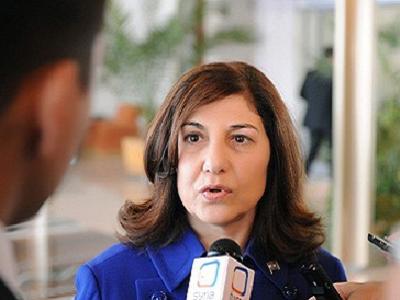 As part of its 7th set of US sanctions against Syria, which began in June, 2011, the Obama administration has targeted a messenger, a sometime spokeswoman, a positive image of Syria, someone people of all religions and cultures have easily identified with over the past several years, Dr. Bouthainia Shaaban. The US administration acted thus for the sole purpose of pressuring the government of Syrian President Bashar Assad, but has succeeded in undermining American values of freedom of expression much more.
On August 28, 2011, the US Treasury and State Departments targeted Dr. Bouthainia Shaaban, and froze any assets she might have in the US.
According to State Department spokesman, Victoria Nuland, who two US Senate Foreign Relations Committee staffers speculate may view Dr. Shaaban as a rival of sorts given their job descriptions, and Dr. Shaaban’s stellar performances during meeting with US officials both in the US and Syria, the explanation for blacklisting a Syrian nationalist and media advisor remains: “She (Dr. Shaaban) has served as the public mouthpiece for the repression of the regime.”
No US official to date has stepped forward to defend the sanctions against Dr. Shaaban with any more substantive or detailed complaint or supporting evidence.
Theodore Kattouf, former US ambassador to Syria was reportedly astonished to see Dr. Shaaban’s name on the latest sanctions list and he expressed on television his regret for such a bad decision. Former Ambassador Kattouf explained that sanctioning Dr.Shaaban was a serious mistake because Dr. Shaaban is well known of her positive and constructive attitudes and positions against wars and injustices and bloodshed.
True, Dr. Shaaban, among several others, is a trusted advisor to the Syrian administration. She presumably offers counsel and insights; perhaps much like Theodore Sorenson did for President John Kennedy, and Bill Moyers for Lyndon Johnson. But she is not and has never been a decision maker. Presumably her advice is considered, but who knows to what degree. Which advisor is also a key decision maker?
Surely the Obama administration knows well that when any person occupies a position as media advisor or even press secretary, he/she speaks for and explains the policy of the administration he’s working for. To sanction them violates American notions and values of freedom of expression and immunity from harassment for performing a vital job that benefits all by way of clear understanding and communication of a country’s position on political, social, and economic issues of the day.
Dr. Shaaban’s background is well known to recent US administrations and also much appreciated according to Washington sources. She is known as an independent thinker, reformer, writer, University Professor (she taught in Eastern Michigan for two years and earned her PhD from Warwick University in the UK and was a Fulbrighter at Duke University (1990 – 1991) and got the prestigious McCandless professorship at Easter Michigan University for 2000. She is known for her ability and willingness to take a minority position, if her evaluation of the facts of a case or issue leads her there, and is never reluctant to speak truth to power. Her writings, many of which have appeared in the left of center Counterpunch (counterpunch.org) always advance positions against wars, violence and occupation.
The Obama administration knows that Dr. Shaaban has no account in the US, earns a modest salary, is the wife of the manager of the Syrian Establishment for Food Industry, and this ‘sanction’ is designed solely to harm her excellent reputation that she has earned during the past couple of decades. When pressed for details of her assets both the US Treasury, and State Department spokeswoman Nuland only offered: “Let’s just leave it at that.”, whatever that is supposed to mean.
Dr. Shaaban’s office avers that she has very few assets at all and certainly none in the US.
“Bouthainia connects with people” according to a US Senate Foreign Relations Committee staffer who has met with her: “Whether with Hamas or Saudi Princes, and both know her views on full rights for women and justice for Palestinians, and with American officials too she is effective.”
For some of these reasons the US treasury and State departments have targeted her and the Obama administration, largely it appears, out of ignorance, according to Congressional sources, said, “Ok, if you think is a good idea go ahead.”
It was not a good idea. Attacking Mrs. Shabaan is a low blow and disgraceful by any standards and especially for one who is a very positive force helping bridge several divides between East and West.
President Obama erred in signing off on this mistake.
The White House attacked a friend of America and of all people of good will. It needlessly assaulted a symbol of the great country of Syria, the great Syrian people, their history, culture, resistance values, profound dignity, and their decency.
In so doing the Obama Administration sullied American values and doubtless does not represent American values or the will of the American people. It did undermine American values of freedom of expression and compromised American notions of fair play and American legal norms of substantial justice.
Would that President Obama will immediately reverse this ill-considered action.
– Franklin Lamb is the author of The Price We Pay: A Quarter-Century of Israel’s Use of American Weapons Against Civilians in Lebanon.
Obama Orders Sweeping Sanctions and Regime Change in Syria Without Congress
Activist Post | September 5, 2011
Once again President Obama has used the authority vested in him in the International Emergency Economic Powers Act and the National Emergencies Act to impose sweeping sanctions against a sovereign nation without Congressional approval.
On August 18th, 2011, Obama signed Executive Order 13582: Blocking Property of the Government of Syria and Prohibiting Certain Transactions With Respect to Syria, which authorizes the seizure of all Syrian-owned property and interests in property in the United States. It also bans exports of U.S. services to Syria, the import of petroleum from Syria, and any new investment in Syria or those who support them.
The following actions are now prohibited:
(a) new investment in Syria by a United States person, wherever located;
(b) the exportation, re-exportation, sale, or supply, directly or indirectly, from the United States, or by a United States person, wherever located, of any services to Syria;
(c) the importation into the United States of petroleum or petroleum products of Syrian origin;
(d) any transaction or dealing by a United States person, wherever located, including purchasing, selling, transporting, swapping, brokering, approving, financing, facilitating, or guaranteeing, in or related to petroleum or petroleum products of Syrian origin; and
(e) any approval, financing, facilitation, or guarantee by a United States person, wherever located, of a transaction by a foreign person where the transaction by that foreign person would be prohibited by this section if performed by a United States person or within the United States.
The sweeping unilateral sanctions also permit the President to seize property without notice of those who sponsor or provide material assistance to Syria. In the case that such a person should have Constitutional protections, Obama declared “there need be no prior notice of a listing or determination” because of his powers during a national emergency.
At the time of the signing, the White House called for Syrian President Bashar al-Assad to step aside, “For the sake of the Syrian people, the time has come for President Assad to step aside,” indicating an official policy of regime change in Syria.
This action follows Executive Order 13572 from April called Blocking Property of Certain Persons With Respect to Human Rights Abuses in Syria which gave Obama the broad power to seize assets of Syrians suspected of being complicit in human rights abuses.
Previously, President Obama bypassed Congress when he imposed sanctions and seized property from the Libyan government by Executive Order 13566 in February of this year. Less than a month later, the United States and NATO began policing the no-fly zone in Libya, also without debate in the Congress. Now the U.S. and NATO are engaged in a civil war in Libya where billions are being spent, again without Congressional approval or oversight.
These new sanctions, along with recent EU sanctions, combined with calls for regime change in Syria, seem to be following the same pattern as the Libya invasion. Thus, it is reasonable to assume that if Syrian President al-Assad resists, he will be forced out one way or the other. It’s also apparent that Obama believes he needn’t consult Congress or abide by the Constitution about these matters because of powers vested in him under national and international emergency. If the pattern is any indication, America may be headed for another undeclared war.
Obama/Solyndra Reaction: “Should government pick winners/losers? Qualified Yes!”
By Tim Cavanaugh | Reason | September 2, 2011
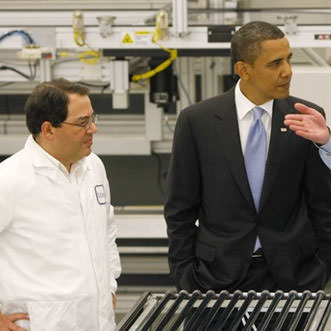
An L.A. Times editorial boils the scandal over Solyndra – a Fremont, California solar panel maker backed by an important Obama fundraiser that is bankrupt after burning through a taxpayer-guaranteed loan of more than half a billion dollars – down to two questions:
Should the government be in the business of picking winners and losers by providing loan guarantees to risky energy ventures? And is Obama using stimulus funds to reward his political contributors?
To the first, the answer is a qualified yes. Solar and wind projects aren’t the first to benefit from loan guarantees; Washington has been offering them to nuclear power plants for decades. Research and development of alternative forms of energy are expensive and often need more support than private investors are willing to provide, but such investment is worthwhile not only because it stimulates job growth during a downturn, but also because in an era of climate change and worldwide turmoil over oil and other fossil fuels, it’s in the national interest. Moreover, competing countries, notably China, are outspending the U.S. on clean-energy subsidies, and falling behind will only cede the future market to them.
In reverse order, these arguments are: missile gap; global warming; jobz; that the market’s disinterest creates a compelling public concern; and that the nuclear power industry is now a model worth emulating.
I’m especially concerned about this last, as I recall one long midsummer morning in the boardroom in 2007, during which editorialist Dan Turner slowly sucked all the oxygen from the room and left the rest of us to die one by one or agree to his all-out denunciation of nuclear power, a piece that put the verdict right in the title: “No to nukes.” Some of Dan’s arguments, including the one that the industry has never existed without massive public subsidies and shows no glide path away from public subsidies, I even found compelling.
Why the switcheroo now? I would have thought lingering questions about whether Fukushima is in fact under control would at least give pause to proponents of all-or-nothing behemoth energy policies that are constructed in spite of rather than in response to market conditions.
I also can’t imagine any number of qualifications that would square the notion that government should choose private-sector winners and losers with a rudimentary understanding of fair play or individual liberty. Is the logic that because in this case the winner turned out to be a loser anyway, we shouldn’t pay too much attention?
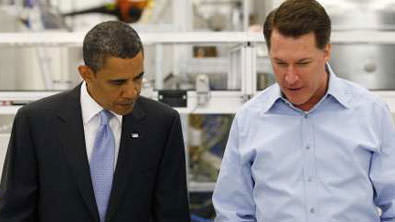
Finally I think the ed board is thinking wishfully when it claims the Solyndra debacle just raises “two important questions.” I can think of a few others: What did Solyndra do with the $527 million (out of a total guarantee of $535 million) it borrowed in the form of taxpayer-subsidized loans? Why did the Energy Department provide so much money for a technology – cylindrical rather than flat solar panels – that has not been proven scalable? What role did Tulsa-based fundraiser George Kaiser, whose George Kaiser Family Foundation held more than a 35 percent equity stake in Solyndra as of an aborted IPO in 2009, play in encouraging this subsidy?
I realize editorial writing is a task more otherworldly than priestly transubstantiation of the host, but it’s just willful blindness to pretend the Solyndra case raises only abstract issues. There’s one journalismism that still holds up: If it looks like shit, smells like shit and tastes like shit, it’s the food at the L.A. Times cafeteria.
~
See also:
NBC and MSNBC Completely Ignore Solyndra Bankruptcy – NewsBusters
Don’t look away from Kashmir’s mass graves and people’s struggle
By Ali Abunimah – The Electronic Intifada – 08/24/2011
Last Summer, during a massive unarmed revolt against Indian rule in Kashmir, the writer Pankaj Mishra posed the following question about the situation in the territory. It remains as valid today as a year ago – especially after the recent discovery of thousands of bodies in mass graves:
Once known for its extraordinary beauty, the valley of Kashmir now hosts the biggest, bloodiest and also the most obscure military occupation in the world. With more than 80,000 people dead in an anti-India insurgency backed by Pakistan, the killings fields of Kashmir dwarf those of Palestine and Tibet. In addition to the everyday regime of arbitrary arrests, curfews, raids, and checkpoints enforced by nearly 700,000 Indian soldiers, the valley’s 4 million Muslims are exposed to extra-judicial execution, rape and torture, with such barbaric variations as live electric wires inserted into penises.
Why then does the immense human suffering of Kashmir occupy such an imperceptible place in our moral imagination? After all, the Kashmiris demanding release from the degradations of military rule couldn’t be louder and clearer. India has contained the insurgency provoked in 1989 by its rigged elections and massacres of protestors. The hundreds of thousands of demonstrators that fill the streets of Kashmir’s cities today are overwhelmingly young, many in their teens, and armed with nothing more lethal than stones. Yet the Indian state seems determined to strangle their voices as it did of the old one. Already this summer, soldiers have shot dead more than 50 protestors, most of them teenagers.
The tolls of last summer’s unarmed uprising, violently suppressed by Indian forces with live fire, eventually rose to more than 100. And, though Kashmir is even less in the headlines today, protests and abuses – particularly the arrests and mistreatment of teenage boys – continue.
For decades, until today, the two-thirds of Kashmir under Indian control has been ruled under the Armed Forces Special Powers Act, emergency rule as repressive as the worst Arab dictatorship.
Mass graves uncovered
If all the suffering of the living in Kashmir has not succeeded in awakening international concern, the recent revelations of mass graves must. Amnesty International reported on 22 August:
Following a report by a police investigation team, confirming the existence of unmarked graves containing bodies of persons subject to enforced disappearances, urgent action needs to be taken including preserving the evidence and widening the investigation across Jammu and Kashmir said Amnesty International today.
Over 2700 unmarked graves have been identified by the 11-member police team of the State Human Rights Commission (SHRC) in four districts of north Kashmir. Despite claims of the local police that the graves contained dead bodies of “unidentified militants”, the report points out that 574 bodies have been identified as disappeared locals – 17 of these have already been exhumed and shifted to family or village grave sites.
The police report concludes that there is “every probability” that the remaining over 2100 unidentified graves “may contain the dead bodies of [persons subject to] enforced disappearances.” The report further clarifies that the only way to negate such a claim is to study the DNA profiles of the unidentified dead bodies and warns that in the absence of such tests, “it has to be assumed/ presumed that [the] State wants to remain silent deliberately to hide the Human Rights violations.”
While Amnesty welcomed this report, it calls on Indian authorities:
to initiate thorough investigations into unmarked graves throughout the state. All unmarked grave sites must be secured and investigations carried out by impartial forensic experts in line with the UN Model Protocol on the disinterment and analysis of skeletal remains.
The fact that an investigation has reached this point at all is to India’s credit, but given its appalling record in Kashmir, there is little reason to believe that India will provide justice for victims without strong pressure and exposure.
The silence of the liberals
While almost every other week, the United States issues orders to this or that country’s leader to step down, or to (very selectively) “respect human rights,” the Obama administration has been totally silent about the crisis in Kashmir. During his visit to India last year, Obama did not mention it.
In US media and establishment discourse, India is often presented as a colorful, “vibrant democracy” with a booming economy and an emerging middle class which is eyed hungrily by American corporations looking to export consumer goods – or jobs to India’s cheaper labor force.
I was reminded of the general obliviousness to the situation in Kashmir by a recent comment on Twitter from Princeton Professor Anne-Marie Slaughter, former Director of Policy Planning in Obama’s State Department, on the occasion of India assuming the chairmanship of the UN Security Council:
@SlaughterAM
Anne-Marie Slaughter If India wants to distinguish itself as chair of the UNSC in August, it can take the lead on a serious int’l response to Syrian violence.
Aug 02 via webFavoriteRetweetReply
I can’t think of an occasion when I have heard American establishment intellectuals call for a “serious international response” to the repression in Kashmir; and surely if India wants to “distinguish itself” in international leadership it should deal frankly with the situation in Kashmir.
Israel and India, Hindutva and Zionism
Although the crisis in Kashmir is off the media radar – and that of many writers and activists concerned with Palestine – thanks to many people in Kashmir I have encountered via Twitter, I have become more educated about the situation. Nonetheless, in recent years, the patterns of Indian behaviour and discourse around Kashmir have come to closely resemble those of Israel toward the Palestinians.
This has been particularly true with the rise of Hindutva over the past two decades – an extreme form of Indian nationalism which views Muslims as alien and often denigrates them in ways familiar to Palestinians subjected to such dehumanizing discourses from Islamophobic Zionists and their allies in Europe and the United States.
Hindutva nationalists and Zionists often try to reframe the “conflicts” not as ones over human and political rights, sovereignty, consent and self-determination, but as being caused by irrational and implacable “Muslims” and “Islamists” who if not confronted and stopped will take over the world. In this context, all the repression and state violence to which millions of people are subjected is justified in the name of “fighting terror” and defending “democracy” and “civilized values.”
And, as Yasmin Qureshi pointed out in an analysis for The Electronic Intifada, Zionist and Hindutva groups are increasingly cooperating on US university campuses to try to shut down discussions of both Palestine and Kashmir.
India-Israel alliance aids repression
The cooperation moreover is not just discursive: India has greatly increased its military ties with, and weapons purchases from Israel – including drones. And Shin Bet and other Israeli agencies responsible for human rights abuses and extrajudicial executions of Palestinians and Lebanese have provided training and advice to India on how to suppress the people of Kashmir.
“My most recent film is about the Jammu Kashmir Liberation Front in India. I am not allowed in India anymore. Interestingly, India is one of the biggest arms trade partners of Israel,” Israeli filmmaker Udi Aloni told The Electronic Intifada last year, “India uses the same tactics against the Kashmir people as Israel does against the Palestinians.”
Justice must not be delayed
Ultimately there can be no solution to the question of sovereignty over Kashmir – a painful remnant of British colonialism – until the region’s people are given the right to determine their future, a promise made and long denied to them, free from manipulation by India or Pakistan, which controls most of the rest of the territory (China also occupies a smaller segment). Pakistan has its own ignoble record of interference in Kashmir and using its people as pawns in its conflict with India.
In the meantime, India’s global image as a “vibrant democracy” should not be allowed to obscure the reality of mass repression – and mass graves – or to delay justice for the victims any further.
The US Government Won’t be Charged With Perjury Even When It’s Caught in a Lie
By SALLY EBERHARDT | CounterPunch | August 19, 2011
A chilling court decision unsealed at the end of April by a federal judge in California’s Central District reveals that the Obama administration is not only prepared to take advantage of the lies of the Bush administration, but is willing to up the ante. In a case that involved extensive surveillance of Muslim community groups and leaders, the Obama administration has now argued that the government not only can lie about its surveillance activities to American citizens but can, in turn, lie to federal judges when “national security” is involved. And, despite his strongly worded April 27 decision censuring the government for lying, U.S. District Judge Cormac J. Carney ultimately ruled that the government can both withhold the requested surveillance documents and escape censure for lying.
Carney’s ruling, which has gone under the radar of most mainstream and independent media (with a lone 420-word editorial in the Los Angeles Times being the only mainstream coverage), chastises the U.S. government. But, that’s as far as Carney would go. The government will not be charged with contempt of court or perjury nor will it face any other kind of official sanction. In effect, the government can lie and conduct whatever kinds of surveillance it wants without accountability or repercussions for overreach.
The origins of the current case, Islamic Shura Council of Southern California et al. v. the Federal Bureau of Investigation, et al., stretch back to 2006 and involve six Muslim organizations – the Islamic Shura Council of Southern California, the Council on American Islamic Relations-California (CAIR), the Islamic Center of San Gabriel Valley, the Islamic Center of Hawthorne, the West Coast Islamic Center, the Human Assistance and Development International, Inc.- and five Muslim community leaders. These men and groups were among the first Muslim Americans to meet and share information with the FBI after 9/11, and include individuals like Mohammed Abdul Aleem, who served as a government witness for the U.S. Department of Justice in a 2004 terrorism case in Idaho.
However, by May 2006, the plaintiffs began to feel increasingly that they themselves had become the targets of extensive government surveillance and so filed a joint request for their FBI files under the Freedom of Information Act (FOIA) for any records detailing their monitoring or surveillance. After almost a full year had elapsed, on April 27, 2007, the government told nine of the plaintiffs that they had “no records responsive” to their request, and, in June 2007, the FBI sent a single redacted page to CAIR and three redacted pages to Hussam Ayloush, CAIR’s Executive Director, and a plaintiff. Unconvinced by this report, the plaintiffs brought a lawsuit against the government, challenging the adequacy of the FBI’s search.
In light of the lawsuit, the FBI conducted new searches and produced some 120 pages of documents that they heavily redacted or withheld entirely because they were claimed to be “outside the scope” of the FOIA request. This – it would later turn out – was the government’s first instance of lying to the court. They had, of course, already lied to the plaintiffs in their previous correspondence with them which, as Judge Carney cited in his decision, was a curious tactic to take – as, under FOIA, they could have simply identified the “statutory and factual basis” for not releasing certain documents and, so, would have been well within current legal bounds for not issuing requested documents.
Faced with cross-motions by the government and the plaintiffs in the case, in April 2009 the Court ordered an in camera review of the FBI’s searches (with only the government present) in order to determine the “propriety” of the FBI’s “outside the scope” determinations. Shortly after this order was given, the government – which had now shifted from the Bush administration to the Obama administration – revealed to the court that it actually had identified other “responsive” documents but had never disclosed them to the court or to the plaintiffs. It was at this juncture, under Obama’s watch, that the government asserted that it actually had the right to lie to the court because of national security.
Realizing that the government had, as Judge Carney’s decision later worded it, “provided false and misleading information to the Court,” Carney ordered two in camera hearings, again with only the government present, after which he issued a sealed order in June 2009. But the government immediately appealed this order and sought an emergency motion to stay the decision. In its ruling, the appellate court supported government secrecy. Judge Carney’s decision – amended as per the appellate court’s order to eliminate all statements which the government designated too sensitive – finally saw the light of day two years later, at the end of this April.
Citing the case of United States v. Richard M. Nixon, to explain why “the very integrity of the judicial system and public confidence in the system depend on full disclosure of all the facts,” Carney rebuked the government’s attempts to claim that its representations to the Court were not “technically false,” writing that the government “cannot negotiate the truth with the Court” nor “under any circumstance affirmatively mislead the Court.”
He went on to write that “the Government argues that there are times when the interests of national security require the Government to mislead the Court. The Court strongly disagrees. The Government’s duty of honesty to the Court can never be excused, no matter what the circumstance.”
But despite these fine sentiments, Carney (who is a George W. Bush appointee) was ultimately unwilling to impose any kind of penalty or even order that the requested FOIA documents be released, leaving the U.S. government with nothing to stop it from lying in court in the future. Under the basic rules of court, the actions of the FBI’s lawyer, Marcia K. Sowles, appear to be clearly unethical; yet Judge Carney did not refer Ms. Sowles to a state bar for, at the very minimum, a disciplinary investigation. By failing to hold the government in any way accountable for lying, Judge Carney has succeeded only in ultimately bolstering the government’s confidence in acting with impunity.
The government itself hinted at the new level of unfettered reach they now want in one section of their appellate brief that was not under seal, writing that the courts need to “give special deference to the Executive Branch when it invokes national security concerns.”
That our government, four decades after the Pentagon Papers, is able to lie in a federal court, get caught and have no price to pay speaks volumes about the state of justice in the United States right now. While there are many things that shock the conscience about how this case played itself out, what might be most shocking is how it reveals the U.S. government’s current understanding of the rule of law. As President Nixon once did, the current administration appears to see itself above the law. And despite issuing a strong rebuke in his decision, Judge Carney has given a green light both for the government’s lying and for its invasive surveillance.
~
Sally Eberhardt works with Educators for Civil Liberties, researching civil rights issues post 9/11. She is founding member of Theaters Against War and has worked for human rights organizations in Britain and the U.S.A. She can be reached at sallyeb@earthlink.net.
Bachmann for President
By Margaret Kimberley | Black Agenda Report | August 17, 2011
Listening to most Democratic liberals or progressives (you choose the term) leads one to believe that the biggest menace to civilization today is Minnesota congresswoman Michele Bachmann. If not Bachmann, the latest and greatest bogeyman is Texas governor Rick Perry. Bachmann won the recent Iowa straw poll and in so doing made herself more of a serious candidate, in media eyes at any rate, for the Republican presidential nomination. Perry’s announcement of his presidential ambitions shortly thereafter moved him up on the liberal fear meter.
Predictably, Barack Obama lovers are in a panic because the Perrys and Bachmanns of the world give them so much material to work with. Bachmann called the agriculture department’s settlement of proven discrimination against black farmers a form of reparations. She claims to follow biblical teachings urging women to be submissive to their husbands while at the same time being an attorney, a member of congress and now a presidential candidate. Her husband claims to be able to “cure” gay people and turn them into heterosexuals.
Perry may be the only one of the declared Republican candidates who can raise more ire than Bachmann in the liberal imagination. He signed a resolution declaring days of prayer for his drought stricken state and then held a large rally for more prayer (and fasting too) at a stadium in Houston. He has implied that Texas ought to secede from the union and he called Federal Reserve chairman Ben Bernanke “treasonous.” As if that were not enough, he packs heat while jogging, carrying a loaded gun during his daily constitutional.
While Bachmann and Perry stir up the Democrats’ antipathy to all things they claim to care about, Obama gets a pass no matter how awful his actions. The same people who get the vapors over prayers to end droughts, say nothing as their president wages wars of aggression in Libya and Somalia. Recent reports estimate that up to 168 Pakistani children have been killed by American drone attacks but that news brings not even mumbled words from the mouths of Obamaites.
Michele Bachmann does play fast and loose with the truth, having famously claimed that Obama’s trip to India in 2010 would cost the government $200 million per day. Her misstatements make her a favorite foil for Democrats who are snooty about style, and never about substance. It is true that Perry called Social Security a ponzi scheme, but it is Barack Obama who has made common cause with Republicans to cut the program. While Perry raises liberal hackles every time he opens his mouth, the Obama administration has confirmed that the current military pension system may be a thing of the past. Retired service members will have to take a risk with the insecure 401(k) system just like the rest of us. That is the kind of news that would get liberal pants in a twist if the president were a Republican.
A cynic might conclude that Barack Obama pays Bachmann, Perry and their cohorts under the table to utter racist, foolish and just plain crazy statements. Every time they open their mouths Democrats who have some degree of frustration with Obama forget all about their misgivings because the big, bad barbarians are at the gate. Hand wringing about prayer rallies and cures for gay people are distractions, very dangerous distractions for many important issues in the world.
Nearly three years ago the world economy nearly fell off the precipice when market manipulation burst the most recent capitalist bubble. All of the indices of crisis are still present. There is still fictitious capital plaguing the world markets. The United States never returned to manufacturing anything useful, but instead churns out bombs and guns and the inevitable wars that come with them. Western European nations are going broke, and austerity, not the stimulation which would save western economies, has become the cure all for a dangerous situation.
None of this seems to matter to Democrats, who will only speak up when gaffe prone conservatives are in danger of becoming president. Their beloved president rarely makes any gaffes. He is a smart man from the right schools and from the right party. While he brokered a budget deal which Reagan would have killed for, and presides over the biggest military budget in American history, his liberal fans don’t care. They only care that Bachmann confuses Massachusetts with New Hampshire or Elvis Presley’s birthday with his death day.
So, why not Michele Bachmann or Rick Perry? Since all of the conservative dreams are coming true under Obama anyway, it may make sense to have an honest conservative back in the White House. The comedic possibilities are endless. We should at least have opportunities to laugh as we head over the cliff.
Margaret Kimberley’s Freedom Rider column appears weekly in BAR. She lives in New York City, and can be reached via e-Mail at Margaret.Kimberley(at)BlackAgandaReport.com.
Six More Years of Obama
By Margaret Kimberley | BAR | August 9, 2011
January 20, 2017 will be liberation day. That date will be the last day that Barack Obama can possibly be President of the United States. Assuming he will be reelected in 2012, his second term will end on Inauguration Day in 2017 and that will be a wonderful moment, even if his successor is a Republican.
If those words seem heretical, consider the following. Before Obama’s election, Social Security and Medicare were sacrosanct, safe from any political evil intent. George W. Bush’s legislative successes ended with his plans to “reform” Social Security. Bush took on Social Security and faced both tepid support from his own party and unified opposition from Democrats. The certainty of political support for these programs was such that they were often referred to as “the third rail of politics.”
Now the budget deal has made that once non-negotiable position as negotiable as anything else. The “super committee” which will make budgetary decisions away from the eyes and ears of public scrutiny, is under no obligation to support what ought to be completely off the budget cutting table.
Democratic House leader Nancy Pelosi had this to say when asked about Social Security and Medicare. She would not “draw lines in the sand” regarding proposed cuts to entitlement programs. Her Senate colleague and partner in crime Harry Reid, had a similar response. He wanted to appoint committee members who had “open minds” and who were “willing to do entitlement cuts.”
When Reid was locked in a tough election last year, Democrats were mobilized to keep him in office, lest the Tea Party candidate emerge triumphant. It is now an open question as to whether or not his victory mattered at all to the progressive cause.
When the ruling class who hire and fire politicians chose a black Democrat to serve as president, they pulled off what can only be thought of as stroke of genius, the perfect crime if you will. Almost every aspect of what used to be solidly Democratic principles are now in question.
In just two years in office, Barack Obama has completely upended any and all expectations that Democrats have historically had. If a Democratic president can reverse decades of ideological discipline in such a short period of time, what more can happen between now and January 2017? The mania to follow what is now a worthless party affiliation should be seen for the hoax that it is.
While Obama was falsely thought of as the peace candidate in 2008, it must be pointed out that his democratic predecessors were as willing to wage war as Republicans were. Harry Truman is the only man to order atomic weapons dropped on human beings. John Kennedy and Lyndon Johnson were responsible for the carnage in Vietnam and throughout Southeast Asia. The war imperative in the Obama administration should come as no surprise, but his desire to eviscerate the welfare state is ground breaking, and in the worst sense of that term possible.
No matter how awful their overseas debacles and atrocities, no Democratic president ever declared on television that Social Security was originally meant to be only for “widows and orphans.” Those words are lies, and come straight from right wing talking points which have been used to attack government programs for decades.
In the next six years we can expect more of the same. We may not be able to predict the circumstances of the betrayals, but they will certainly take place. Obama will not be alone either. He will have plenty of help from Reid, Pelosi, and their ilk in congress.
A Republican president will automatically get some push back from the Democratic rank and file. If we hope for anything in our political future, it should be that Republicans ought to be elected president instead of Democrats. Progressives are only concerned with whether the letter D follows the candidates name instead of R. If the Democrat favors the social policies which excite them more than ideology does, then any other acts committed by said Democrat will be declared acceptable. If current trends continue, gay marriage will be legal but Social Security and Medicare will no longer exist and most Democrats will say nothing as long as the deed was carried out by one of their own.
The only hope comes from as yet unknown circumstances and forces that may stop the onslaught. For now, Obama’s chances for re-election are good (rich people have certainly not stopped putting money into his campaign coffers.) We can only hope for the damage to be limited and for time to pass quickly. The year 2017 can’t get here soon enough.
Margaret Kimberley’s Freedom Rider column appears weekly in BAR.
Featured Video

New positive ivermectin evidence
or go to
Aletho News Archives – Video-Images
From the Archives
Fanatical Followers of the Covid Regime: A Jim Jones-Style Cult?
By Professor Roger Watson and Dr. Niall McCrae | The Daily Sceptic | November 15, 2021
As scholars at leading British universities over recent decades, we witnessed the replacement of critical thinking and debate by narrative: facts are discrimination and scientific method is imperialism; truth, instead, is derived from ‘progressive’ values. This educational trend may be a major contributory factor to the ease in which society has been inculcated to the Covid ‘new normal’ of masking, testing, and repeated doses of vaccines for a disease of similar risk to severe influenza.
One doesn’t need much critical reasoning to observe the flawed logic of some vaccination enthusiasts, such as people who respond to experiencing any side effects, however debilitating, by saying “at least I know it’s working”, or, after contracting the disease despite their promised inoculation (over 90% effective, according to initial drug company claims), “I’d have been worse off without the jab.” … continue
Blog Roll
 Aletho News
- EU Council Advances Chat Control 2.0 Scanning Proposal
- Ex-Greek MEP files complaint against Israeli spyware firm over alleged Pegasus surveillance
- Troubling ideas throughout the Torah, Talmud, Mishneh Torah and Tanya
- ‘Grave, alarming’: Iran mission on Trump’s UNGA ‘annihilation’ threats
- Najaf airport to reopen to Iranian flights within 24 hours: Ambassador
- From ‘How Will This End For Iran’ to ‘When America Walks Away’: A tale of two Economist covers
- Tehran blasts ‘baseless’ speculation linking Iran to alleged bomb plot at UK air base
- The Rise And… Rise Of ‘Color Revolutions’
- The Coming GOP Bloodbath?
- Arctic Scare Stories Melt Away
- If Americans Knew
- Netanyahu Asked UAE Leader to Deny Report on Oct. 7 Warning in Secret Visit, Sources Say
- CNN Chief Int’l Correspondent Clarissa Ward on Journalists in Gaza
- Democratic Party Consultants Surround Troy Jackson with Pro-Israel Donors
- Christian Leader Responds To Netanyahu’s Claims Regarding Palestinian Christians
- In Gaza, ‘Whoever Survives the Bombing Won’t Survive the Rubble’
- Israel kills more Palestinians, amid push to resettle Gaza – Daily Update
- Israel forces Gazans to live in constant peril – Daily Update
- Deconstructing Netanyahu’s pants-on-fire UN rant – Daily Update
- Trump betrayed voters with his campaign lies and prioritized a foreign country once he took office
- Netanyahu calls Israel’s war in Gaza ‘opposite of genocide’ in UN speech to near-empty hall
- No Tricks Zone
- New Study: Earth And Venus Surface Warmth Largely Explained By Convection And Lapse Rate, Not CO2 Or Radiation
- 2025 Nature Paper Claiming Worsening Global Drought Gets RETRACTED …Heavily Flawed
- New Study: ‘Global Drought Shows No Detectable Recent Acceleration Under Climate Warming’
- Economic Masterminds: German Socialists Suggest Taxing Productivity Gains Stemming From Using AI
- The South China Sea Has Not Been Cooperating With The Climate Change Narrative
- Energy Crisis: Germany Enters Heating Season With Historically Low Gas Reserve Fill Levels
- New Study: The Antarctic Ice Sheet Gained Mass From 2020-2024 Due To Staggering Snow And Ice Accumulation
- Study: Ocean Heating Rates From Thousands Of Years Ago ‘Dwarf’ Modern Ocean Heating Rates
- Climate Extremists Target, Attack Large-Scale Power Grid Infrastructure In Germany!
- New Study: Antarctic Ice Melt Has Contributed Less Than 1 Centimeter To Sea Level Rise In The Last 30 Years

