A closer look at what Obama’s energy priorities really are
The U.S. Department of Energy’s FY 2011 Budget Request
By Robert Alvarez | Institute for Policy Studies | February 12, 2010
When President Obama rolled out his proposed budget to Congress for the coming year, he said it would build “on the largest investment in clean energy in history.” But Obama’s definition of “clean energy” includes a commitment to help companies garner billions of dollars in loans for nuclear reactor construction. And, unfortunately, nuclear energy isn’t safe or clean and it’s too costly for the nation.
The Energy Department faces a brave new world in which, for the first time, it’s being called on to employ millions of Americans to create a new energy future for the United States. But it doesn’t appear that the Obama administration will meet this challenge. Instead, more of the nation’s tapped-out treasure is going for costly nuclear power, and nuclear weapons we don’t need and could never use.
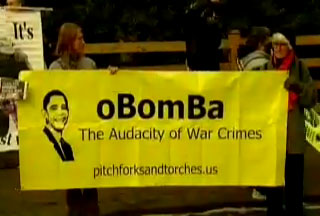
Despite Obama’s rhetoric about reshaping America’s energy future, he’s asking for a budget that would have the Energy Department continue to spend 10 times more on nuclear weapons than energy conservation. More than 65 percent of our energy budget covers military nuclear activities and the cleanup of weapons sites. Its single largest expenditure maintains some 9,200 intact nuclear warheads. Even though the department hasn’t built a new nuclear weapon for 20 years, its weapons complex is spending at rates comparable to that during the height of the nuclear arms race in the 1950s. Even with economic stimulus funding, the department’s actual energy functions comprise only 15 percent of its total budget and continue to take a backseat to propping up the nations’ large and antiquated nuclear weapons infrastructure. In fact, the Energy Department’s proposed budget for the 2011 fiscal year, minus stimulus money, looks a whole lot like it did in the Bush administration, and as it has during several presidents’ tenures.
The Savvy Mr. Blankfein
By Dean Baker | Center for Economic and Policy Research | February 15, 2010
 Last week, when President Obama was asked about the $9 million dollar bonus for Goldman Sachs CEO Lloyd Blankfein, he described Mr. Blankfein as a savvy businessman, adding that Americans don’t begrudge people being rewarded for success. While Obama later qualified his comment about Mr. Blankfein and his fellow bank executives, it’s worth examining more closely some of the ways in which Blankfein and the Goldman gang were “savvy.”
Perhaps the Goldman gang’s best claim to savvy was in buying up hundreds of billions of dollars of mortgages and packaging them into mortgage-backed securities, and more complex derivative instruments, and selling them all over the world. Mr. Blankfein and Goldman earned tens of billions of dollars on these deals.
The great trick was that many of the loans put into these securities were issued fraudulently, with the banks filling in phony information so that borrowers could get loans that they would not be able to repay. But this was not Goldman’s concern. They made money on the packaging and the selling of the securities. Goldman did not care that the loans in their bundles might not be kosher.
In fact, Goldman actually recognized that many of these loans would go bad. So they went to the insurance giant AIG and got them to issue credit default swaps against many of the securities it had created. In effect they were betting that their own securities were garbage. Now that is savvy. (It says something else about the highly paid executives at AIG.)
Goldman doesn’t just confine its savvy to the U.S. economy; it shares it with the rest of the world as well. According to the New York Times, it worked closely with the Greek government over the last decade to help it conceal its budget deficit. The trick was to construct complex financial arrangements that appeared on the books as “swaps,” even though they were in fact loans. Greece was adding billions of dollars to its debt, and thanks to the ingenuity of the Goldman crew, no one knew about it until now.
But Goldman’s greatest triumph was to get the government to come to its rescue when the financial sector was melting down in the fall of 2008 as the housing bubble that they had helped to fuel began to collapse. Treasury Secretary and former Goldman CEO Henry Paulson rushed to Congress and demanded $700 billion for the banks, no questions asked. He dragged along Federal Reserve Board Chairman Ben Bernanke for support, along with Tim Geithner, then the important head of the New York Federal Reserve Bank and now President Obama’s Treasury Secretary.
Using exaggerations and half-truths, this triumvirate convinced Congress that we would have a second Great Depression if it didn’t cough up the money immediately with no conditions. At that point Goldman, Morgan Stanley, Citigroup and most of the other major banks were staring at bankruptcy. While this cascade of bank failures would have been bad news for the economy, there was no plausible scenario in which it would have led to a second Great Depression.
There was also no reason that Congress could not have put conditions on its money. For example, Congress could have dictated that as a condition of getting the money that bankers would get the same sort of paychecks as other workers, that they would get out of highly speculative activity, that the largest banks would be downsized and that the principle would be written down on bad mortgages. At that point, Congress could have told the bank honchos that they had to run around Wall Street naked with their underpants on their head. The bankers had no choice; their banks would crash and burn without government support.
But the savvy Mr. Blankfein and the other bankers got the money no questions asked. In fact, Goldman even got the government to pick up the bankrupt AIG’s debts. Thanks to the government’s intervention, Goldman got paid every penny on its bets with AIG. This came to $13 billion, enough money to pay for 4 million kid-years of health care under the State Children’s Health Insurance Program.
No one should doubt that Mr. Blankfein is a very savvy banker. Without his ingenuity Goldman Sachs would likely be out of business, its component divisions being auctioned off to the highest bidder. Instead it is making record profits and paying out record bonuses.
But unlike the successful ballplayers to whom President Obama compared Mr. Blankfein, Goldman’s success is inherently parasitic. It comes at the expense of taxpayers and the productive economy. Goldman and the other Wall Street banks are successful in the same way as the savvy Bernie Madoff was successful. It seems that President Obama must still decide whether he stands with the Wall Street banks or whether he stands with the workers and businesses who actually produce wealth.
Dean Baker is the co-director of the Center for Economic and Policy Research (CEPR). He is the author of False Profits: Recovering from the Bubble Economy. He also has a blog on the American Prospect, “Beat the Press,” where he discusses the media’s coverage of economic issues.
Civis Romanus Sum
By Philip Giraldi | February 13, 2010
“I am a Roman citizen” was a proud boast in the first century A.D. It implied the obligations of citizenship but also guaranteed privileges and rights that would be observed and protected by the Roman government. Among those rights was the ability to demand one’s day in court to produce evidence if accused of a crime. No citizen could be tortured and the death penalty was reserved for cases of treason. Some might recall that the Roman citizen Apostle Paul of Tarsus, placed under arrest in Jerusalem, successfully claimed his right to appeal to the Emperor and ask for trial in Rome. He was duly transported to the capital city to be tried.
It was not so long ago that “I am an American citizen” might have had a similar resonance. Embattled farmers at Lexington and Concord fired the shot heard round the world, the start of the first successful revolution staged by a colony against a European monarch. The founders of the United States sealed the victory with a Constitution which was intended to guarantee in perpetuity the rights and freedoms that their fellow Americans had fought and died for. Those freedoms were enshrined in the Bill of Rights. The Fifth Amendment states that no American can be “deprived of life, liberty, or property, without due process of law.” And then there is the Sixth Amendment: “In all criminal prosecutions, the accused shall enjoy the right to a speedy and public trial, by an impartial jury of the State,…and to be informed of the nature and cause of the accusation; to be confronted with the witnesses against him; to have compulsory process for obtaining witnesses in his favor, and to have the Assistance of Counsel for his defense.”
Fast-forward two centuries to find that the United States Congress and a President, now defined by some as a unitary executive, have done much to dismantle the rights and privileges that once defined American citizenship. The Uniting and Strengthening America by Providing Appropriate Tools Required to Intercept and Obstruct Terrorism Act of 2001 might well be described as one of history’s more spectacular euphemisms employed to gut a constitution. It is better known as the Patriot Act I. Patriot Act I became law six weeks after the fall of the twin towers and was followed by the the Patriot Act II of 2006, the two laws together diminishing constitutional rights to free speech, freedom of association, freedom from illegal search, the right to habeas corpus, prohibition of cruel and unusual punishment, and freedom from the illegal seizure of private property. The First, Fourth, Fifth, Sixth, and Eighth Amendments in the Bill of Rights have all been discarded or abridged in the rush to make it easier to investigate, torture, and jail both foreigners and American citizens. The also incorporates the Financial Anti-Terrorism Act of October 17th, 2001, which permits the freezing of assets and investigation of individuals suspected of being financial supporters of terrorism. “Suspected” is the key word, as there is no oversight or appeal to the process.
The Military Commission Act of 2006 followed the Patriot Acts, creating military tribunals for the trying of “unlawful enemy combatants,” including American citizens. Unlike a civil or criminal court, the accused needs only a two-thirds vote by the commission members to be convicted. The act permits the indefinite jailing of suspects in a military prison without providing access to a lawyer or charging with a crime. The government is not required to produce any normally admissible evidence at a commission hearing and can rely on hearsay or even on information obtained overseas during torture to make its case. Detainees do not have access to any classified information being used against them and cannot cross examine or even know the identity of witnesses. The MCA suspends habeas corpus for anyone charged and forbids the application of the Geneva Conventions to mitigate conditions of confinement or to challenge the judicial process or verdict. The Geneva Conventions also cannot be invoked if the accused subsequently claims he was tortured or otherwise abused, protecting overly zealous interrogators from later charges of “war crimes.” The act was also designed to cover all cases that were pending, meaning that it was retroactive.
Those concerned about civil liberties could have predicted that worse might be coming and it has, it seems, finally arrived. On February 3rd Director of National Intelligence Dennis Blair told members of the House Intelligence Committee that the United States government can kill American citizens overseas who are “taking action that threatens Americans.” Blair reportedly was revealing a secret policy that has been in place since the Bush Administration. It is the ultimate irony that Blair is representing the new Administration in Washington headed by President Barack Obama, who had, during his campaign, opposed the infringements on liberties inherent in the Patriot and Military Commissions Acts. Instead of confining those Acts to the dustbin, Obama has continued them and has also strengthened his Administration’s ability to use the state secrets privilege to silence criticism and dissent.
Blair’s remarks ought to mortify every American citizen but instead have attracted very little critical commentary. They should be examined in some detail. He told the congressmen that the intelligence agencies and Department of Defense would “follow a set of defined policy and legal procedures that are very carefully observed.” That, in all probability, means that if actionable intelligence indicating that an American citizen who is suspected of ties to a sanctioned group is developed a US government lawyer and senior bureaucrat can get together and decide that he should be killed. As the criteria for that decision are secret there is no way to know if there is any kind of rational due process involved.
There are reported to be three American citizens who are on the current hit list, including US-born Yemeni cleric Anwar al-Aulaqi, who has been connected to the US Army Major Malik Nadal Hasan, responsible for the November 2009 Fort Hood Texas shooting incident, and also to Christmas underwear bomber Nigerian Umar Farouk Abdulmutallab. Al-Aulaqi denies any connection to any terrorist conspiracy and the evidence that he or any other individual is actually planning to kill fellow Americans is subject to the usual problem, i.e. that intelligence can be and frequently is wrong or inadequate while divining the intentions of any individual is most often sheer speculation. It all comes down to an official deciding that someone is a terrorist without the government having to prove its case with the penalty for the unfortunate suspect being death.
Blair then went on to explain in more detail, saying “We’re not careless about endangering American lives as we try to carry out the policies to protect most of the country” adding “We don’t target people for free speech. We target them for taking action that threatens Americans.” A question from Representative Peter Hoekstra revealed the mindset behind the policy in asking what to “do when it comes to Americans who have joined the enemy.” Blair responded that the intelligence community will take “direct action” against terrorist citizens when “that American is involved in a group that is trying to attack us, whether that American is a threat to other Americans.”
It doesn’t take a genius to see the flaws in the policy, beyond the semantic problems with an assassination program that protects “most of the country” and presumably leaves everyone else vulnerable. Few would dispute the US government’s right to kill someone who is acting in flagrante, either planting a bomb or participating with a group of armed insurgents to kill American soldiers or civilians. But that is not what we are talking about here. We are talking about a US citizen who is living overseas being accused of a capital crime based on secret evidence and being assassinated under orders of the President of the United States. He is not necessarily killed while engaged in an act that directly threatens American citizens but rather can be assassinated when he is asleep with his family, traveling in a car with associates, or having dinner in a restaurant. Anyone unfortunate enough to be near him will quite likely also die. And the suspect has no appeal in the process and no ability to have his day in court to demonstrate that the evidence against him might be wrong.
Anyone who has followed the intelligence narratives linked to the so-called global war on terror now-called overseas contingency operations realizes that intelligence is often flawed or deliberately faked. Most of those arrested on terrorism charges in the US are never charged as terrorists. Overseas, note how many civilians have been killed by drone strikes in AfPak. By one estimate in the Pakistani media, 700 civilians have been killed in Pakistan by drones in attacks that have killed only five militants while the Brookings Institute believes the ratio is more like ten to one. So to my mind, Anwar al-Awlaki and the others on the government hit list are innocent until proven guilty and all are entitled to their day in court, the same rights that I would like to enjoy if I were accused of a crime.
Blair also opens the door wide to extending the practice of killing Americans. He says that the US government can target anyone “involved” with a group that threatens to attack American targets. Well, involvement can mean anything from contributing to a charity that is tied to an organization that the US calls terrorist to sending a letter to the local newspaper defending a group’s actions. Where does it stop? And Blair’s claim that the US government is not interested in targeting free speech is essentially hollow because his own elastic definition of his authority permits him pretty much to go wherever he wants to when it comes to killing whomever he presumes to be a terrorist.
Obama’s decision to assassinate Americans overseas without any due process might well be viewed as an inevitable development from the established practice of killing foreigners using hellfire missiles fired from unmanned drones in places like Afghanistan, Pakistan, Yemen, and Somalia. The United States has not declared war on any of those countries yet it reserves to itself the right to attack and kill local residents based on information that it does not subsequently have to reveal. This process is given a legal fig leaf by the US assertion that anyone connected to a terrorist group can be killed anywhere in the world and at any time. It assumes that in such matters the United States has extraterritorial jurisdiction, a claim that no other nation makes and which might reasonably be contested by those on the receiving end. It also does not require the President of the United States to prove his case that someone actually was a terrorist.
The role of the Washington as the Lord High Executioner for the world is tough to reconcile with the high idealism of the Founders as expressed in the Bill of Rights. It also begs the question of where it might go from here. Now that the government is not being challenged in its belief that it can assassinate American citizens anywhere overseas it is perhaps not too much to suggest that killing Americans at home will also become more acceptable to a public that has been properly prepped through fear of terrorism. Indeed, some might argue that Waco and Ruby Ridge demonstrate that that process is already far advanced. Dennis Blair’s comments should serve as a wakeup call for all Americans who care about their liberties, but it is possibly too late. The tepid reaction in the media and from congress reveals that just another few deaths, even if they are American citizens, really don’t matter very much anymore.
New Phase, Not Just Another Recession
By Ismael Hossein-zadeh | February 12, 2010
It is becoming increasingly clear that the financial meltdown of 2008 and the subsequent economic contraction that continues to this day represent more than just another recessionary cycle. More importantly, they represent a structural change, a new phase, the phase of the dominance of “finance capital,” as the late Austro-German political economist Rudolf Hilferding put it.
Although the current domination of our economy by finance capital seems new, it is in fact a throwback or “retrogression” (as financial expert Michael Hudson puts it) to the capitalism of the late 19th and early 20th centuries, that is, the capitalism of monopolistic big business and gigantic financial institutions. The rising economic and political influence of powerful financial interests in the early 20th century led a number of political economists (such as John Hobson, Rudolf Hilferding and Vladimir Lenin) to write passionately on the ominous trends of those developments—developments that significantly contributed to the eruption of the two World Wars and precipitated the devastating Great Depression of the 1930s, by creating an unsustainable asset price bubble in the form of overblown stock prices.
The harrowing experience of the Great Depression, followed by the devastating years of World War II, generated momentous social upheavals and extensive working class struggles worldwide. The ensuing “threat of revolution,” as F.D.R. put it, and the “menacing” pressure from below prompted reform from above—hence, the New Deal reforms in the US and socialist/Social-Democratic reforms in Europe. Combined, these historic developments significantly curtailed the size and the influence of big business and powerful financial interests—alas, only for a while.
As those reforms saved Western capitalism from more radical social changes, they also provided grounds for its regeneration and expansion. By the 1970s, finance capital, headed by major US banks, had risen, once again, to its pre-Depression levels of concentration, of controlling the major bulk of national resources, and of shaping economic policy. Since then, big banks have created a number of financial instabilities and economic crises—usually through predatory, sub-prime loan pushing or unsustainable debt bubbles. These include the “Third World debt crisis” of the 1980s and 1990s, the 1997-98 financial crises in Southeast Asia and Russia, the tech or dot.com bubble of the 1990s in the U.S. and other major market economies, and the latest, housing/real estate bubble that burst in 2008
A number of characteristics distinguish the stage of the dominance of finance capital from lower phases of capitalist development. Under liberal capitalism of the competitive industrial era, a long cycle of economic contraction would usually wipe out not only jobs and production, but also the debt burdens that were accumulated during the long cycle of expansion that preceded the cycle of contraction. In the stage of finance capital, however, debt overhead is propped up through its monetization, or socialization, even during a most severe financial meltdown such as that which occurred in 2008. Indeed, due to the influence of the powerful financial interests, national or taxpayers’ debt burden is further exacerbated by the government’s generous bailout plans of the bankrupt financial giants, that is, by simply transferring or converting private to public debt.
In The Class Struggle in France, Karl Marx wrote, “Public credit rests on confidence that the state will allow itself to be exploited by the wolves of finance.” Today we see more clearly how the “wolves of finance” are hollowing out national treasuries and subjecting governments to unsustainable debt burdens. This explains the near bankruptcy not only of the US Government but also of many of the European states, especially those of Greece, Ireland, Spain, Portugal and a number of East European countries. Proposed government “solution” in all these cases is to have the general public pay for the gambler’s debt—in the form of extensive cuts in essential social programs and drastic reductions in living standards.
A major hallmark of the age of finance capital is domination of the State and/or political process by the financial oligarchy. Bank- or finance-friendly policies of the government have been facilitated largely through generous pouring of money into the election of “favorite” policy makers. Extensive deregulation that led to the 2008 financial crisis, the scandalous bank bailout in response to the crisis, and the failure to impose effective restraints on Wall Street after the crisis can all be traced to Wall Street’s political power. Wall Street spent more than $5 billion on federal campaign contributions and lobbying from 1998 to 2008, and its fervent spending on the purchase of politicians continues unabated.
Michael Hudson, Distinguished Research Professor at University of Missouri (Kansas City), aptly calls this ominous process of the buying out of policy-makers by major contributors to their election “privatization of the political process.” Paul Craig Roberts, Assistant Secretary of the Treasury in the Reagan administration, likewise argues that the political system “is monopolized by a few powerful interest groups that…have exercised their power to monopolize the economy for the benefit of themselves.”
Such sentiments regarding the class nature of the State are corroborations of Vladimir Lenin’s characterization of the capitalist state as “the executive committee of the ruling class.” Lenin was often scoffed at by the capitalist ruling elites when he made this statement over ninety years ago; they deviously dismissed him as having overstated his case. Perhaps it is time to dust off and read old copies of Lenin’s The State and Revolution, if only to better understand the incestuous politico-business relationship between the State and the financial oligarchy of our time.
Another hallmark of the stage of finance capital is that, under the influence of the powerful financial interests, government intervention in national economic affairs has come to essentially mean implementation of neoliberal or supply-side restructuring policies. Government and business leaders have for the last several decades used severe recessionary cycles as opportunities to escalate application of neoliberal economic measures in order to reverse or undermine the New Deal reforms. Naomi Klien has called this strategy of using periods of economic crisis to reverse the gains of the New Deal and other reform programs “the shock doctrine”—a strategy that takes advantage of the overwhelming crisis times to apply supply-side austerity programs and redistribute national resources from the bottom up. This explains how under the Bush-Obama administrations the financial oligarchy has been able to use the failure of the Lehman Brothers and the specter of “apocalyptic” failure of other financial giants to extract their gambling losses from the public purse.
It is generally believed that neoliberal supply-side economic policies began with the election of Ronald Reagan as the president. Evidence shows, however, that efforts at undermining the New Deal economics in favor of returning to the old-time religion of market fundamentalism began long before Reagan arrived in the White House. As Alan Nasser, emeritus professor at the Evergreen State College in Olympia (Washington), points out, “The foundations of neoliberalism were established in economic theory by liberal Democrats at the Brookings Institution, and in political practice by the Carter administration.”
Neither President Clinton changed the course of neoliberal corporate welfare policies, nor is President Obama hesitating to carry out those policies. His administration has made available more than $12 trillion in cash infusions, loans and guarantees to the financial industry, but for state governments that are facing massive budget deficits, it has thus far provided only one quarter of 1 percent of that amount in federal stimulus funds—about $30 billion. The White House is sitting by while states across the country lay off workers and slash spending on education, health care and other essential social programs.
The left/liberal supporters of President Obama who bemoan his “predicament in the face of brutal Republican challenges” should look past the president’s liberal/populist posturing. Evidence shows that, contrary to Barack Obama’s claims, his presidential campaign was heavily financed by the Wall Street financial titans and their influential lobbyists. Large Wall Street contributions began pouring into his campaign only after he was thoroughly vetted by the powerful Wall Street interests and was deemed a viable (indeed, ideal) candidate for presidency.
On ideological or philosophical grounds too President Obama is closer to the neoliberal, supply-side tradition than the New Deal tradition. This is clearly revealed, for example, in his The Audacity of Hope, where he shows his disdain for “…those who still champion the old time religion, defending every New Deal and Great Society program from Republican encroachment, achieving ratings of 100% from the liberal interest groups. But these efforts seem exhausted…bereft of energy and new ideas needed to address the changing circumstances of globalization. . . .” It is no accident that Mr. Obama has surrounded himself by neoliberal economic experts and financial advisors such as Larry Summers, Timothy Geithner, and Ben Bernanke.
Not only has the major bulk of the Obama administration’s anti-recession assistance been devoted to the rescue of the Wall Street financial magnates, but also the relatively small stimulus spending is funneled largely through the Wall Street (mainly through generous government loans and tax incentives) in the hope that this would create jobs. This stands in sharp contrast to what F.D.R. did in the earlier years of the Great Depression: creating jobs directly and immediately by the government itself.
The main purpose of the administration’s (or, shall we say, of the ruling kleptocracy, both Democratic and Republican) strategy of delaying direct job creation is to stall, and fraudulently keep the hopes of the unemployed alive, until the massive supply-side corporate welfare giveaways would eventually begin to gradually trickle down and slowly create jobs. In the absence of compelling pressure from below, this neoliberal scheme of further weakening the working class may eventually succeed. But even if successful, the jobs thus created would be supply-side jobs, subsistence or below-subsistence jobs, which would be grabbed by desperate workers at any price/wage, not union jobs that would pay decent wages and benefits.
Political theatrics within the ruling circles over “how to create jobs” should not mask the fact that delays in job creation are deliberate: they are designed to further subdue American workers and bring down their wages and benefits in line with those of workers in countries that compete with the U.S. in global markets. It is part of the insidious neoliberal race to the bottom, to the lowest common denominator in terms of international labor costs. It is, indeed, an application of the IMF’s notorious Structural Adjustment Program of austerity measures that have been vigorously pursued in many less-developed countries for decades—with disastrous results.
It is no accident that President Obama frequently pleads with the unemployed Americans to “be patient,” and “keep hope alive.” What he really means to say is: “look, we have invested trillions of dollars through bailout schemes and other supply-side recovery measures. So, please be patient and wait until they come to fruition and benefit you through trickle down effects.” At least, Ronald Reagan had the honesty and integrity to explicitly defend or promote his supply-side philosophy. Perhaps that is why Barack Obama can be called Ronald Reagan in disguise.
In the wake of the 2008 financial meltdown, many left/liberal economists envisioned an opportunity: a reversion back to the Keynesian-type economic policies. One year later, it is increasingly becoming clear that such expectations amounted to no more than wishful thinking—a dawning recognition that, regardless of the resident of the White House, economic policies are nowadays heavily influenced by the powerful financial interests.
The view that economic policy would be switched back to the Keynesian or New Deal paradigm by default stems from the rather naïve supposition that policy making is a simple matter of technical expertise or economic know-how, that is, a matter of choice—between good or “regulated capitalism” and bad or “neoliberal capitalism.” A major reason for such hopes or illusions is a perception of the State that its power is above economic or class interests; a perception that fails to see the fact that national policy-making apparatus is largely dominated by a kleptocratic elite that is guided by the imperatives of big capital, especially finance capital.

Historical evidence shows, however, that more than anything else the Keynesian or New Deal reforms were a product of pressure from the people. Economic policy-making is not independent of politics and/or policy-makers who are, in turn, not independent of the financial interests they are supposed to discipline or regulate. Stabilization, restructuring or regulatory policies are often subtle products of the balance of social forces, or outcome of class struggle. Policies of economic restructuring in response to major crises can benefit the masses only if there is compelling pressure from the grassroots. In the absence of an overwhelming pressure from below (similar to that of the 1930s), Keynesian or New Deal economic reforms could remain a (fondly-remembered) one-time experience in the history of economic reforms.
Ismael Hossein-Zadeh, author of the recently published The Political Economy of U.S. Militarism (Palgrave-Macmillan 2007), teaches economics at Drake University, Des Moines, Iowa.
The Assassins of Langley
February 9, 2010
Last Friday President Barack Obama visited the CIA’s headquarters to attend a memorial service for seven of its operatives blown up in Afghanistan. Over 1000 CIA officers and family members were present, as well as staff from the White House, the Pentagon and members of Congress. In his address, Obama referred to the dead agents as “seven heroes”- by Richard Neville
This is bunk. Yet, everyone present at this memorial is likely to have endorsed Obama’s verdict. “Everything you instilled in them” the President told the families, “the virtues of service and decency and duty were on display that December day. And our nation will be forever in your debt.” While one can feel sympathy for the families of the bereaved and acknowledge the dedication of the agents, it is absurd to see them as heroes.
They were paid assassins.
Backed by the weaponry of the world’s most belligerent nation and quarantined from legal consequences, the role of the agents was to eliminate “suspected militants”, usually with drone strikes. According to Pakistani estimates, for every terrorist killed by drones, about 140 innocent civilians are slaughtered. This is not fair, it’s not smart, it’s not legal.
The first CIA air strikes of the Obama Administration took place in January last year – the President’s third day in office. According to the New Yorker, one strike targeted the wrong house, hitting the residence of a pro west, pro-government tribal leader. The blast killed the patriarch’s entire family, including three children, one of them five years old. In keeping with US policy, the strike was not acknowledged. Perhaps this is because in 1976 President Gerald R. Ford, signed an executive order banning American intelligence forces from engaging in assassination.
Such edicts are ineffectual, as the CIA is beyond the reach of the law. It operates in countries where US troops are not based, including Australia, where it uses the facilities of Pine Gap to blast away “bad guys”. Since the loss of their agents, the CIA has switched to deep revenge, unleashing squadrons of drones on “suspects” and their families in remote tribal areas. This will recruit new militants, as will the ramped up torture, renditions, secret incarcerations.
Considering its blood-drenched history and the multiplicity of its brutal and indiscriminate operations, it is stupid to pretend the CIA is an engine of freedom. It is a blot on America, a curse on humanity and it is the world’s biggest terrorist cell. Surely its time to freeze its funds and put the assassins out to grass.
The defense industry is pleased with Obama
By Laura Flanders | Online Journal | February 4, 2010
Who says the president is failing to show leadership? In one area at least, there’s no sign of flag or falter. If anything, the administration’s only becoming more forthright. Sad to say, that area is military build-up.
Last year, the White House made a big deal of cutting a weapons program — the F-22 fighter jet — and the cuts conveniently obscured the growth in spending on unmanned aircraft or drones (the weapons that Pakistanis say killed a record 123 civilians in 12 attacks last month; 41 for every alleged Al Qaeda member.)
This year, the president dispensed with window dressing. No big deal about cuts — except on the domestic side. While the administration’s record $3.8 trillion budget shrinks or freezes spending on domestic needs, it requests $708.3 billion for war. That’s $14.8 billion more than we’re spending now.
The total includes $548.9 billion for “regular” war, plus $159.3 billion for special spending on the wars in Afghanistan and Iraq. Oh yes, the administration’s also asking Congress to increase spending on new nuclear weapons by more than $7 billion dollars over the next five years — despite that peace prize-winning pledge to cut the US arsenal and seek a nuclear weapons-free world.
The quote of the day comes from the CEO of a military contractor-funded policy group called the Lexington Institute. Loren Thompson tells Tuesday’s New York Times, “The defense industry is pleased but bemused . . . It’s been telling itself for years that when the Democrats got control it would be bad news for weapons programs. But the spending keeps going on.”
Take that you Nobel committee!
And to think some whiners complain about Democrats suffering from a lack of direction.
Show Trial
By Margaret Kimberley | BAR | February 3, 2010
The United States government has held Khalid Sheikh Mohammed in Guantanamo ever since his capture in 2003. He was one of many “enemy combatants” held there without charge or trial. Not only did he suffer from this violation of American and international law, but Mohammed suffered through water boarding torture an incredible 180 times in just 30 days.
In November 2009 the Obama administration Justice Department announced that Mohammed would finally be tried in federal court in Manhattan. The courthouse is located just blocks away from the World Trade Center site that Mohammed is now charged with plotting to destroy.
A collection of reactionary, racist politicians eager to incite hysteria, such as Rudy Giuliani and Congressman Peter King, led New Yorkers and the rest of America to believe that Mohammed and his co-defendants should have been tried by military tribunal. Mayor Bloomberg initially appeared to be supportive of the venue but recently joined his police commissioner in claiming that security measures would require a shut down of all of lower Manhattan. Now the Obama administration has back tracked and no longer promises a trial in New York City.
It probably doesn’t matter where Mohammed is tried. Barack Obama and Attorney General Eric Holder both promised a conviction. Holder assures us. “Failure is not an option. These are cases that have to be won. I don’t expect that we will have a contrary result.” His boss said pretty much the same thing. When asked about those who might be offended by a civilian rather than military trial Obama told everyone to relax, promising that they wouldn’t find it “. . . offensive at all when he’s convicted and when the death penalty is applied to him.” The law professor president knew he had made a faux pas and tried to extricate himself immediately. “I’m not going to be in that courtroom. That’s the job of the prosecutors, the judge and the jury.”
While easily impressed liberals sang praises for the civil trial, the administration has chosen to continue military tribunals at Guantanamo for other defendants. Mohammed is in fact an anomaly for the Obama administration. The Bush policy continues unabated.
In the days of the Soviet Union, Americans and other westerners were quick to use the derisive term “show trial” when dissidents faced prosecution. That term can now surely be applied to the United States if a guilty verdict and execution are presented as foregone conclusions by both the president and his chief law enforcement officer.
Now Obama seems to be backing away from a commitment to civilian prosecution. His press secretary, Robert Gibbs, continues the promise of conviction and death, but not the promise of a trial in a courtroom. “He will be brought to justice and he is likely be executed for the heinous crimes he has committed in masterminding the killing of 3,000 Americans. That you can be sure of.” When pressed on the question of civilivan versus military jurisdiction, Gibbs was less than forthcoming. “The Attorney General believes the best place to do this is in an American courtroom.” (*link Gibbs) Smelling blood in the water, Republicans are determined to prevent any civilian prosecution of Mohammed. Senator Mitch McConnell has threatened to prevent the use of federal funds for a trial to be held in New York City or anywhere else.
Once again all Americans are made complicit in their government’s crimes. Phony concerns about security costs and whipped up fears of impending terror attacks are used to subvert the legal system that was once held up as a model for the rest of the world to follow.
Barack Obama and the Democratic Party still have solid majorities in the House and Senate. A few off year election defeats have given the president an excuse to cut and run before shots have been fired. Just as he announced a freeze on domestic spending programs that benefit every American citizen, he and the rest of the craven Democrats are now ready to toss the entire legal system under the back wheels of a large bus.
Bill Clinton didn’t begin his retreat away from Democratic Party principles until he actually lost control of Congress. As in all other matters, Obama is out-Clintoning Clinton. The Obama doctrine appears to be, “Why wait for defeat when you can create it yourself.”
The consequences of progressive Democratic capitulation to Obama grow more terrible every day. The military budget balloons, domestic spending vanishes and the Bush doctrine of an imperial president is continued by his predecessor. A show trial is but one symptom of what ails the Democratic Party and the nation.
Margaret Kimberley’s Freedom Rider column appears weekly in BAR. Ms. Kimberley lives in New York City, and can be reached via e-Mail at Margaret.Kimberley(at)BlackAgandaReport.com.
Obama’s Conspicuous Failure
January 30, 2010

Conspicuous failure
From rich sounding promises, Obama’s Israel-Palestine policy appears reduced to simply managing, not resolving, the conflict, writes Khalid Amayreh in the West Bank
The conspicuous failure of the latest visit to the region by US envoy to the Middle East George Mitchell raises questions as to the Obama administration’s ability — or even willingness — to pressure Israel to end its occupation of Palestinian lands. Prior to his arrival, Mitchell was widely thought to be carrying “serious ideas” that would help resume stalled peace talks between Israel and the Palestinians.
However, after meetings with both Palestinian and Israeli leaders, it became clear that the American envoy was near completely empty handed, and that he was succumbing to Israeli intransigence. Seeking to obscure his surrender to Israeli whims, Mitchell tried to cajole the increasingly vulnerable Palestinian leadership to resume the moribund peace process without receiving any guarantees that renewed talks would go anywhere.
Mitchell pressed the Palestinian Authority (PA) and Israel to start “low level talks” which he suggested might help leaders tackle the hard issues. However, in making such suggestions, Mitchell seemed to have forgotten that his proposal had been tried numerous times before but to no avail, mainly due to Israel’s refusal to give up the spoils of the 1967 war.
Mitchell also offered the PA leadership what one Palestinian official termed “secondary inducements” to return to the negotiating table with Israel, including enhancing Palestinian mobility in the West Bank and allowing PA police to operate in additional localities. But Mitchell refused to commit himself to pressure Israel to freeze settlement expansion and reportedly tried to circumvent the issue, saying that the sides would discuss the issue in bilateral negotiations.
Mitchell also suggested that the sides initiate “indirect talks”. The Israelis described the proposal as “interesting” while the PA called it “totally pointless”.
As Mitchell arrived in Israel, Prime Minister Binyamin Netanyahu issued a plethora of provocative and uncompromising — even pugnacious — statements, suggesting that Israel will never agree to the establishment of a truly viable Palestinian state. Marking a Jewish holiday at the settlement of Gush Etzion north of Hebron, Netanyahu declared that, “we are here to stay” and “this [settlement] is Jerusalem’s southern gate while Maali Adumim is Jerusalem’s eastern gate.”
Earlier, he stated that, “in the context of any peace arrangement, Israel would completely surround any Palestinian entity from all sides,” adding that Israel would have to maintain a “presence” in “Judea and Samaria” (the biblical names of the West Bank).
Maintaining a broad smile throughout his visit, Mitchell didn’t try to challenge Netanyahu and instead kept repeating old platitudes about the continued commitment of the Obama administration to Palestinian-Israeli peace. However, it was obvious that at least some of Mitchell’s Arab interlocutors were exasperated, having seen the Obama administration waste precious time while Israel steals more Arab land.
One Palestinian official in Ramallah remarked: “Every new visit by Mitchell makes the prospect of resolving the conflict more elusive.” The official, who spoke on condition of anonymity, complained bitterly that all that Mitchell wanted was to force the PA to absorb Israeli provocations.
The growing defiance displayed by Netanyahu finds encouragement in what is widely seen here as Netanyahu’s “victory” over Obama in the apparent tug-of-war between them over a settlement expansion freeze. Obama had been demanding that Israel freeze all settlement expansion in the West Bank, including Arab East Jerusalem. However, Netanyahu refused to budge. Eventually, it was Obama who really budged, allowing Netanyahu to emerge victorious.
To be sure, Netanyahu made a half-hearted decision to freeze some settlement building for 10 months. However, that freeze was disingenuous to a large extent, given continued building in numerous locations, as revealed by Israeli peace groups such as the Peace Now movement. On Tuesday, 26 January, the veteran Israeli journalist Akiva Eldar argued that, “only an idiot would say Israel has frozen settlements.”
Recently, Netanyahu has also been encouraged by Obama’s lost Democratic majority in Congress, which the Israeli premier hopes will make it impossible for the US administration to take decisions Israel doesn’t like. Moreover, Obama’s own admission that he had underestimated the hardship of making peace in the Middle East seems to militate in Netanyahu’s favour, as he is interpreting this as a vindication of his policy of “playing it tough”, not only with the Palestinians but also with the Americans.
In a recent interview with Time magazine, Obama admitted that his attempts to break the deadlock in Palestinian-Israeli negotiations by pressuring the Israeli government to end the construction of Jewish colonies have failed. The US president said he raised expectations of a breakthrough too high because he underestimated the obstacles involved.
“This is just really hard. This is as intractable a problem as you get. If we had anticipated some of these political problems on both sides earlier, we might not have raised expectations as high.”
Upset by the belated realisation that Mitchell’s main goal is to “keep the process going”, the Palestinian leadership of PA President Mahmoud Abbas is finding itself at a loss as to what to do in light of Obama’s failure. Reacting to Netanyahu’s remarks about Israel’s intention to annex large chunks of the West Bank, Palestinian officials countered: “This is an unacceptable act that destroys all the efforts being exerted by Senator Mitchell in order to bring the parties back to the negotiating table.”
Nabil Abu Rudeina, an aide to Abbas, added that the PA was still insistent that the resumption of the peace process would have to be preceded by a comprehensive settlement freeze. However, in order to avoid being accused of stonewalling and impeding peace, the PA is demanding that the US steps in and declare the endgame of the process, in which case the suspension of settlement expansion would no longer be a Palestinian pre-condition.
Regardless, only political novices think that a US declaration of the “endgame” would overcome the huge conceptual gap between the two sides, and Israel’s dominant influence over US politics and policies. Hence, most observers believe the Obama administration will merely continue to “manage” the conflict, not resolve it. The Obama administration might also seek a more “malleable” Palestinian leadership — one not answerable to the Palestinian masses, or even Fatah.
Such a scenario would undoubtedly generate a lot of frustration, anger and tension in occupied Palestine and throughout much of the Middle East, and might trigger a new wave of violence against US interests here and beyond. Moreover, the collapse of the peace process, even if kept alive by artificial means, would seriously undermine the credibility and survival of pro-US regimes in the region while bolstering the appeal of resistance groups such as Hamas and Hizbullah.
Mounting Criticism of US Drone Strikes in Pakistan
By Jason Ditz, January 29, 2010
US drones, conspicuously absent from the North Waziristan region for several days after militants shot one down on Sunday, returned to the region today, killing five people in the town in Muhammad Khel.
The drone strikes, and more importantly America’s default “no comment” position on them except on those rare occasions when they successfully kill a high profile target, have long been a sore spot for the Pakistani public, but the broad base of this opposition has only increased.
According to a Gallup poll, only 9 percent of Pakistanis support the idea of US drone strikes on Pakistani soil. There is increasing pressure for the US to be more transparent with their attacks, in hopes that it might calm the opposition to them.
President Barack Obama has dramatically increased the number of drone strikes since taking office. In 2009 the US launched 44 drone strikes in Pakistan, killing over 700 people. The vast, vast majority of those were civilians, with only a handful of meaningful militant leaders slain. Today’s attack was the 12th attack of 2010. Though the attacks killed just under 100 people, only one named militant, al-Qaeda bodyguard Mahmoud Mahdi Zeidan, has been confirmed killed.
Biden: US to increase spending on nuclear arsenal
Reversing a decade of declining spending on nuclear weapons
Press TV – January 29, 2010

US Vice President Joe Biden says that Washington will increase investment in its nuclear arsenal and infrastructure in the country’s new budget.
In an opinion piece which appeared in The Wall Street Journal‘s website on Thursday, Biden said that the administration will propose USD 7 billion to maintain US nuclear weapons stockpile, which would be USD 600 million more than Congress approved last year.
“Even in a time of tough budget decisions, these are investments we must make for our security. We are committed to working with Congress to ensure these budget increases are approved,” Biden said.
The comment comes at a time when the US and Russia are negotiating a new Strategic Arms Reduction Treaty, which entails decommissioning of both sides’ nuclear weapons.
The administration of US President Barack Obama will publish its budget for fiscal year 2011 on Monday February 1.
The proposal will include a budget increase for nuclear issues while paring back other areas in an effort to control record deficits.
Secret detention may amount to crime against humanity: UN experts
January 28, 2010
GENEVA (AFP) – UN human rights experts warned in a report on Wednesday that “widespread and systematic” secret detention of terror suspects was continuing and could pave the way for charges of crimes against humanity.
The report listed 66 countries that have allegedly been involved in secret detentions — from Ethiopia to Romania, from Kosovo to Pakistan — and called on governments to investigate and prosecute those who ordered such detentions.
In their first in-depth global study on secret detentions, the UN experts said that virtually no judicial steps had been attempted against the practice despite the “widespread” manner in which suspects were held in a legal limbo.
“Secret detention continues to be used in the name of countering terrorism around the world” in spite of international human rights norms, said the study, which is due to be submitted to the UN Human Rights Council in March.
“If resorted to in a widespread and systematic manner, secret detention might reach the threshold of a crime against humanity,” the authors cautioned.
The “global war on terror,” which was launched by President George W. Bush’s administration after the September 11 attacks, had “reinvigorated” the use of secret detentions in an organised manner, they said.
The campaign saw the creation of “a comprehensive and coordinated system of secret detention of persons suspected of terrorism, involving not only US authorities, but also other states in almost all regions of the world.”
The study was compiled by two independent UN experts on counter-terrorism and torture, as well as UN panels overseeing arbitrary detention and enforced disappearances.
Campaign group Amnesty International said in a statement that governments must be held to account.
“States must act swiftly to implement the recommendations in this important study, to confront and end secret detention and the human rights violations it entails and enables,” said Widney Brown, Amnesty’s director of international law, citing torture and unlawful executions.
The UN study welcomed commitments by US President Barack Obama to dismantle and investigate secret detentions.
But the experts also called for clarification of outstanding issues such as short term CIA holding facilities and those operated by the military Joint Special Operation Command.
Human rights campaigners say other countries took advantage of secret detentions to crack down on their own political opponents or restive ethnic groups.
Extraordinary rendition involved abducting suspects without legal proceedings, and flying them to foreign countries or secret CIA prisons.
Drawing on its own interviews with former detainees, witnesses, officials and its own analysis of flight records, as well as published material, the UN study named dozens of secret detainees — including some alleged to have died in custody.
Thailand denied that it had hosted a secret detention facility for the United States in a response to the experts, but the study maintained that it was “credible that a CIA black site” existed there.
The study also welcomed a Lithuanian parliamentary inquiry into similar allegations, which had concluded that there was no evidence to back them up.
However, it stressed that the findings “in no way constitute the final word on Lithuania’s role in the programme.”
The UN study also cited evidence of secret US-run facilities in Romania, Poland, and Kosovo as well as several in Afghanistan and Iraq, including “Dark Prison” and “Salt Pit.”
Accounts by detainees added weight to claims that Jordan, Egypt, Morocco, Syria, Pakistan, Ethiopia and Djibouti were proxy centres where “detainees have been held on the CIA’s behalf,” the report added.
How to Get Out of Being Held Indefinitely Without Charge
By Spencer Ackerman – 1/22/10
So the Obama administration’s Guantanamo task force has decided that about 50 people ought to be held indefinitely without charge. What’s the remedy for that? Basically, there’s habeas corpus, the procedure by which a detainee requests that a court determine the validity of the government’s claim to hold him (in this case) because of his status as a belligerent in the conflict with al-Qaeda. Notice that’s not the same thing as asking a court to decide whether the government in the first place has the power to detain someone indefinitely without charge. According to lawyers for Guantanamo detainees and prominent civil liberties advocates, any lawyer who asks a court to decide that broader question will immediately be told, “Your client has the right to a habeas hearing. File a habeas petition and then come talk.” So here’s what the procedure is for the 50 or so detainees in this indefinite-detention-without-charge category.
First a detainee has to win a habeas case. (Check their track record here.) Easy, right? If the government decides not to contest the decision, then the detainee — who, recall, the Obama administration is saying is too dangerous to responsibly release — walks. (More on that in a second.) We haven’t been faced with this situation yet. But if the administration appeals, then the detainee has to win. And on up to the Supreme Court, if the government really wants to contest the issue. Joseph Margulies, a professor of law at Northwestern University who’s focused extensively on Guantanamo, estimates that this process could take at least 18 months to exhaust itself at the earliest. Possibly years. (And even then, it wouldn’t be certain that the Supreme Court would use a habeas appeal as an opportunity to decide the first-order question: whether the Obama administration has the constitutional power to hold a member of al-Qaeda or the Taliban in indefinite detention without charge.)
The real inflection point will come “when the government loses” a habeas case, said Margulies. “Are they going to let [a detainee] go?” If the administration concedes the loss, then there’s no crisis. But if it decides it can’t let someone go, and runs out of appeals, then the administration’s most likely option is to get a preventive detention bill from Congress, a civil liberties Rubicon. The Obama administration briefly considered that option this summer and balked. But if the administration loses a habeas case; seeks to detain someone indefinitely even so; and doesn’t have explicit preventive detention powers from Congress, then it most likely is just simply breaking the law.
“I heard about this listening to an NPR story this morning,” said Sabin Willett, a lawyer for the Uighurs at Guantanamo Bay, describing his big-picture reaction to the Guantanamo task force’s conclusions. “The intro to that story described them as ‘the terror suspects at Guantanamo.’” Willett pointed out that his clients have been cleared by Defense Department tribunals and exonerated by the courts. They are not terrorists, and no one believes they’re terrorists. “This proves the power of the press — those two words ‘terror suspects.’ How do I fight that?”
From there, Willett continued, it’s natural to start wondering if those “terror suspects” really are too dangerous to release. “I keep saying, give me a name. Who’s too dangerous? Give me a reason. Then start asking what other regimes had people they considered ‘too dangerous to release.’ You’re going to find yourself on a list of countries you’re not too proud to be on.”
Featured Video
Dan Dicks with James Corbett on Solutions Watch
or go to
Aletho News Archives – Video-Images
From the Archives
$1.5bn up in smoke: US THAAD missile stockpile dries up defending Israel against Iran
By Ivan Kesic | Press TV | July 2, 2025
According to American media, defense news outlets, and independent analysts, the 12-day Israeli military aggression against Iran significantly depleted the US stockpile of THAAD (Terminal High Altitude Area Defense) interceptor missiles.
Citing official sources, American magazine Newsweek reported on Friday that the US transferred a substantial portion of its advanced missile defense capabilities to support the Israeli regime, an effort with questionable results and a critical impact on US strategic reserves.
THAAD, developed by Lockheed Martin arms manufacturing company, is a key component of Israel’s multi-layered air defense architecture. It is designed to intercept medium-range ballistic missiles, including those launched from Iran and Yemen.
The US-made system is capable of targeting short-, medium-, and intermediate-range ballistic missiles during their terminal phase, whether inside or outside Earth’s atmosphere.
THAAD uses a “hit-to-kill” method, relying on kinetic energy rather than explosive warheads to destroy incoming threats, intercepting at altitudes of up to 150 km and ranges between 150-200 km.
Operated exclusively by American personnel, the US military maintains eight THAAD batteries with an estimated 350–400 interceptors in total. The eighth battery was activated during the June 20 Israeli aggression against Iran and is capable of intercepting hypersonic missiles. … continue
Blog Roll
 Aletho News
- Zionist Bought Senate Blocks Information About American Citizens Killed By Israel
- While Gaza dominates the UN, these are the people keeping it alive
- New Report: “Scholasticide and Genocide in Gaza: Assessment, Testimonies and Legal Analysis”
- ‘THAAD Delusion’: Iran war exposes US missile shield limits – The Atlantic
- Moscow issues warning to NATO over Russian exclave
- Yes, the Iran war has destroyed Trump’s presidency
- The fallacy of US delusions about Iran’s economic collapse
- Hezbollah denies Syria cell link, warns of Israeli plan to sow discord
- The legacy of US sanctions, war, and occupation in Iraq
- Iraqi resistance group rejects disarmament, vows to maintain support for Lebanon
- If Americans Knew
- Mamdani releases plan to combat antisemitism and hate crimes in New York City
- Iran’s Revolutionary Guards Publish Letter to the American People
- DMFI launches $1 million ad campaign supporting Virginia’s Elaine Luria
- US Senate blocks resolution seeking report on Americans killed by Israel
- Israeli Attacks Kill Ten Palestinians in Gaza
- Massacre at Minab: The School That Became a Grave
- Israeli media: The IDF Shows It Doesn’t Turn a Blind Eye; It Actively Emboldens Settler Havoc
- As settlers ravage West Bank, Israeli forces kill 10 in Gaza – Daily Update
- New Report: “Scholasticide and Genocide in Gaza: Assessment, Testimonies and Legal Analysis”
- Ex-Biden officials are desperate for a Gaza scapegoat
- No Tricks Zone
- Green Energy Debacle: German Expert Professor Fritz Vahrenholt Warns Of Severe Economic And Social Consequences
- Two More Paleo Reconstructions Affirm Meters-Higher Sea Levels Across Ireland, Brazil 7000-6000 Years Ago
- New Study: Earth And Venus Surface Warmth Largely Explained By Convection And Lapse Rate, Not CO2 Or Radiation
- 2025 Nature Paper Claiming Worsening Global Drought Gets RETRACTED …Heavily Flawed
- New Study: ‘Global Drought Shows No Detectable Recent Acceleration Under Climate Warming’
- Economic Masterminds: German Socialists Suggest Taxing Productivity Gains Stemming From Using AI
- The South China Sea Has Not Been Cooperating With The Climate Change Narrative
- Energy Crisis: Germany Enters Heating Season With Historically Low Gas Reserve Fill Levels
- New Study: The Antarctic Ice Sheet Gained Mass From 2020-2024 Due To Staggering Snow And Ice Accumulation
- Study: Ocean Heating Rates From Thousands Of Years Ago ‘Dwarf’ Modern Ocean Heating Rates

