Finnair is nearly broke after ban from Russian skies
Samizdat | June 26, 2022
Finland’s flag carrier Finnair has reportedly become the latest casualty of the sanctions war between Russia and the West. The airline suffered heavy financial losses due to the forced necessity to fly around Russia, after the country closed its airspace in retaliation to Western sanctions.
Since the beginning of 2022, the operating loss of one of the world’s oldest airlines amounted to €133 million, of which €51 million in expenses fell on fuel costs, the Finnish newspaper Helsingin Sanomat reports.
EU countries and a number of other Western states closed their airspace to Russian flights after Moscow launched its military operation in Ukraine in late February. Russia responded in kind, banning the airlines of 36 states and territories from its skies and, in so doing, closing the traditional routes from Europe to Asia to Western carriers.
The tit-for-tat restrictions have forced airlines in Europe to re-route flights, and have deprived some nations of the monthly air navigation fees that they used to receive when flights from neighboring states passed through their airspace.
Since December 2021, Finnair’s fuel costs have reportedly surged from 30% to 55% of its total expenses. Apart from a nearly twofold increase in prices, the Finnish airline has faced the need to change air routes.
As a result of closing skies Helsinki has lost a key advantage over other Scandinavian countries – the shortest distance to China, Japan and South Korea. Some flights to the Asia-Pacific region, which had been generating for Finnair up to 50% of its profit, were canceled. The journey to Japan that previously took about nine hours now takes 13 hours.
Moreover, the loading of Finnair planes has also significantly dropped due to the absence of Russian tourists, who used to make up about 20% of its passenger traffic. Meanwhile, EU residents have slashed their travel spending amid increased economic instability, with a reluctance to fly exacerbated by constantly rising cost-of-living expenses.
BRITISH “WATCHDOG” JOURNALISTS UNMASKED AS LAP DOGS FOR THE SECURITY STATE
By Jonathan Cook | MintPress News | June 21, 2022
Events of the past few days suggest British journalism – the so-called Fourth Estate – is not what it purports to be: a watchdog monitoring the centers of state power. It is quite the opposite.
The pretensions of the establishment media took a severe battering this month as the defamation trial of Guardian columnist Carole Cadwalladr reached its conclusion and the hacked emails of Paul Mason, a long-time stalwart of the BBC, Channel 4 and the Guardian, were published online.
Both of these celebrated journalists have found themselves outed as recruits – in their differing ways – to a covert information war being waged by Western intelligence agencies.
Had they been honest about it, that collusion might not matter so much. After all, few journalists are as neutral or as dispassionate as the profession likes to pretend. But as have many of their colleagues, Cadwalladr and Mason have broken what should be a core principle of journalism: transparency.
The role of serious journalists is to bring matters of import into the public space for debate and scrutiny. Journalists thinking critically aspire to hold those who wield power – primarily state agencies – to account on the principle that, without scrutiny, power quickly corrupts.
The purpose of real journalism – as opposed to the gossip, entertainment and national-security stenography that usually passes for journalism – is to hit up, not down.
And yet, each of these journalists, we now know, was actively colluding, or seeking to collude, with state actors who prefer to operate in the shadows, out of sight. Both journalists were coopted to advance the aims of the intelligence services.
And worse, each of them either sought to become a conduit for, or actively assist in, covert smear campaigns run by Western intelligence services against other journalists.
What they were doing – along with so many other establishment journalists – is the very antithesis of journalism. They were helping to conceal the operation of power to make it harder to scrutinize. And not only that. In the process, they were trying to weaken already marginalized journalists fighting to hold state power to account.
RUSSIAN COLLUSION?
Cadwalladr’s cooperation with the intelligence services has been highlighted only because of a court case. She was sued for defamation by Arron Banks, a businessman and major donor to the successful Brexit campaign for Britain to leave the European Union.
In a kind of transatlantic extension of the Russiagate hysteria in the United States following Donald Trump’s election as president in 2016, Cadwalladr accused Banks of lying about his ties to the Russian state. According to the court, she also suggested he broke election funding laws by receiving Russian money in the run-up to the Brexit vote, also in 2016.
That year serves as a kind of ground zero for liberals fearful about the future of “Western democracy” – supposedly under threat from modern “barbarians at the gate,” such as Russia and China – and the ability of Western states to defend their primacy through neo-colonial wars of aggression around the globe.
The implication is Russia masterminded a double subversion in 2016: on one side of the Atlantic, Trump was elected U.S. president; and, on the other, Britons were gulled into shooting themselves in the foot – and undermining Europe – by voting to leave the EU.
Faced with the court case, Cadwalladr could not support her allegations against Banks as true. Nonetheless, the judge ruled against Banks’ libel action – on the basis that the claims had not sufficiently harmed his reputation.
The judge also decided, perversely in a British defamation action, that Cadwalladr had “reasonable grounds” to publish claims that Banks received “sweetheart deals” from Russia, even though “she had seen no evidence he had entered into any such deals.” An investigation by the National Crime Agency ultimately found no evidence either.
So given those circumstances, what was the basis for her accusations against Banks?
Cadwalladr’s journalistic modus operandi, in her long-running efforts to suggest widespread Russian meddling in British politics, is highlighted in her witness statement to the court.
In it, she refers to another of her Russiagate-style stories: one from 2017 that tried to connect the Kremlin with Nigel Farage, a former pro-Brexit politician with the UKIP Party and close associate of Banks, and WikiLeaks founder Julian Assange, who has been a political prisoner in the U.K. for more than a decade.
At that time, Assange was confined to a single room in the Ecuadorian Embassy after its government offered him political asylum. He had sought sanctuary there, fearing he would be extradited to the U.S. following publication by WikiLeaks of revelations that the U.S. and U.K. had committed war crimes in Iraq and Afghanistan.
WikiLeaks had also deeply embarrassed the CIA by following up with the publication of leaked documents, known as Vault 7, exposing the agency’s own crimes.
Last week the U.K.’s Home Secretary, Priti Patel, approved the very extradition to the U.S. that Assange feared and that drove him into the Ecuadorian embassy. Once in the U.S., he faces up to 175 years in complete isolation in a supermax jail.
ASSASSINATION PLOT
We now know, courtesy of a Yahoo News investigation, that through 2017 the CIA hatched various schemes to either assassinate Assange or kidnap him in one of its illegal “extraordinary rendition” operations, so he could be permanently locked up in the U.S., out of public view.
We can surmise that the CIA also believed it needed to prepare the ground for such a rogue operation by bringing the public on board. According to Yahoo’s investigation, the CIA believed Assange’s seizure might require a gun battle on the streets of London.
It was at this point, it seems, that Cadwalladr and the Guardian were encouraged to add their own weight to the cause of further turning public opinion against Assange.
According to her witness statement, “a confidential source in [the] U.S.” suggested – at the very time the CIA was mulling over these various plots – that she write about a supposed visit by Farage to Assange in the embassy. The story ran in the Guardian under the headline “When Nigel Farage met Julian Assange.”
In the article, Cadwalladr offers a strong hint as to who had been treating her as a confidant: the one source mentioned in the piece is “a highly placed contact with links to U.S. intelligence.” In other words, the CIA almost certainly fed her the agency’s angle on the story.
In the piece, Cadwalladr threads together her and the CIA’s claims of “a political alignment between WikiLeaks’ ideology, UKIP’s ideology and Trump’s ideology.” Behind the scenes, she suggests, was the hidden hand of the Kremlin, guiding them all in a malign plot to fatally undermine British democracy.
She quotes her “highly placed contact” claiming that Farage and Assange’s alleged face-to-face meeting was necessary to pass information of their nefarious plot “in ways and places that cannot be monitored.”
Except of course, as her “highly placed contact” knew – and as we now know, thanks to exposes by the Grayzone website – that was a lie. In tandem with its plot to kill or kidnap Assange, the CIA illegally installed cameras inside, as well as outside, the embassy. His every move in the embassy was monitored – even in the toilet block.
The reality was that the CIA was bugging and videoing Assange’s every conversation in the embassy, even the face-to-face ones. If the CIA actually had a recording of Assange and Farage meeting and discussing a Kremlin-inspired plot, it would have found a way to make it public by now.
Far more plausible is what Farage and WikiLeaks say: that such a meeting never happened. Farage visited the embassy to try to interview Assange for his LBC radio show but was denied access. That can be easily confirmed because by then the Ecuadorian embassy was allying with the U.S. and refusing Assange any contact with visitors apart from his lawyers.
Nonetheless, Cadwalladr concludes: “In the perfect storm of fake news, disinformation and social media in which we now live, WikiLeaks is, in many ways, the swirling vortex at the centre of everything.”
‘SWIRLING VORTEX’
The Farage-Assange meeting story shows how the CIA and Cadwalladr’s agendas perfectly coincided in their very own “swirling vortex” of fake news and disinformation.
She wanted to tie the Brexit campaign to Russia and suggest that anyone who wished to challenge the liberal pieties that provide cover for the crimes committed by Western states must necessarily belong to a network of conspirators, on the left and the right, masterminded from Moscow.
The CIA and other Western intelligence agencies, meanwhile, wanted to deepen the public’s impression that Assange was a Kremlin agent – and that WikiLeaks’ exposure of the crimes committed by those same agencies was not in the public interest but actually an assault on Western democracy.
Assange’s character assassination had already been largely achieved with the American public in the Russiagate campaign in the U.S. The intelligence services, along with the Democratic Party leadership, had crafted a narrative designed to obscure WikiLeaks’ revelations of election-fixing by Hillary Clinton’s camp in 2016 to prevent Bernie Sanders from winning the party’s presidential nomination. Instead they refocused the public’s attention on evidence-free claims that Russia had “hacked” the emails.
For Cadwalladr and the CIA, the fake-news story of Farage meeting Assange could be spun as further proof that both the “far left” and “far right” were colluding with Russia. Their message was clear: only centrists – and the national security state – could be trusted to defend democracy.
FABRICATED STORY
Cadwalladr’s smear of Assange is entirely of a piece with the vilification campaign of WikiLeaks led by liberal media outlets to which she belongs. Her paper, the Guardian, has had Assange in its sights since its falling out with him over their joint publication of the Iraq and Afghanistan war logs in 2010.
A year after Cadwalladr’s smear piece, the Guardian would continue its cooperation with the intelligence services’ demonization of Assange by running an equally fabricated story – this time about a senior aide of Trump’s, Paul Manafort, and various unidentified “Russians” secretly meeting Assange in the embassy.
The story was so improbable it was ridiculed even at the time of publication. Again, the CIA’s illegal spying operation inside and outside the embassy meant there was no way Manafort or any “Russians” could have secretly visited Assange without those meetings being recorded. Nonetheless, the Guardian has never retracted the smear.
One of the authors of the article, Luke Harding, has been at the forefront of both the Guardian’s Russiagate claims and its efforts to defame Assange. In doing so, he appears to have relied heavily on Western intelligence services for his stories and has proven incapable of defending them when challenged.
Harding, like the Guardian, has an added investment in discrediting Assange. He and a Guardian colleague, David Leigh, published a Guardian-imprint book that included a secret password to a WikiLeaks’ cache of leaked documents, thereby providing security services around the world with access to the material.
The CIA’s claim that the release of those documents endangered its informants – a claim that even U.S. officials have been forced to concede is not true – has been laid at Assange’s door to vilify him and justify his imprisonment. But if anyone is to blame, it is not Assange but Harding, Leigh and the Guardian.
EFFORT TO DEPLATFORM
The case of Paul Mason, who worked for many years as a senior BBC journalist, is even more revealing. Emails passed to the Grayzone website show the veteran, self-described “left-wing” journalist secretly conspiring with figures aligned with British intelligence services to build a network of journalists and academics to smear and censor independent media outlets that challenge the narratives of the Western intelligence agencies.
Mason’s concerns about left-wing influence on public opinion have intensified the more he has faced criticism from the left over his demands for fervent, uncritical support of NATO and as he has lobbied for greater Western interference in Ukraine. Both are aims he shares with Western intelligence services.
Along with the establishment media, Mason has called for sending advanced weaponry to Kyiv, likely to raise the death toll on both sides of the war and risk a nuclear confrontation between the West and Russia.
In the published emails, Mason suggests the harming and “relentless deplatforming” of independent investigative media sites – such as the Grayzone, Consortium News and Mint Press – that host non-establishment journalists. He and his correspondents also debate whether to include Declassified UK and OpenDemocracy. One of his co-conspirators suggests a “full nuclear legal to squeeze them financially.”
Mason himself proposes starving these websites of income by secretly pressuring Paypal to stop readers from being able to make donations to support their work.
It should be noted that, in the wake of Mason’s correspondence, PayPal did indeed launch just such a crackdown, including against Consortium News and MintPress, after earlier targeting WikiLeaks.
Mason’s email correspondents include two figures intimately tied to British intelligence: Amil Khan is described by the Grayzone as “a shadowy intelligence contractor” with ties to the U.K.’s National Security Council. He founded Valent Projects, establishing his credentials in a dirty propaganda war in support of head-chopping jihadist groups trying to bring down the Russian-supported Syrian government.
CLANDESTINE ‘CLUSTERS’
The other intelligence operative is someone Mason refers to as a “friend”: Andy Pryce, the head of the Foreign Office’s shadowy Counter Disinformation and Media Development (CDMD) unit, founded in 2016 to “counter-strike against Russian propaganda.” Mason and Pryce spend much of their correspondence discussing when to meet up in London pubs for a drink, according to the Grayzone.
The Foreign Office managed to keep the CDMD unit’s existence secret for two years. The U.K. government has refused to disclose basic information about the CDMD on grounds of national security, although it is now known that it is overseen by the National Security Council.
The CDMD’s existence came to light because of leaks about another covert information warfare operation, the Integrity Initiative.
Notably, the Integrity Initiative was run on the basis of clandestine “clusters,” in North America and Europe, of journalists, academics, politicians and security officials advancing narratives shared with Western intelligence agencies to discredit Russia, China, Julian Assange, and Jeremy Corbyn, the former, left-wing leader of the Labor Party.
Cadwalladr was named in the British cluster, along with other prominent journalists: David Aaronovitch and Dominic Kennedy of the Times; the Guardian’s Natalie Nougayrede and Paul Canning; Jonathan Marcus of the BBC; the Financial Times’ Neil Buckley; the Economist’s Edward Lucas; and Sky News’ Deborah Haynes.
In his emails, Mason appears to want to renew this type of work but to direct its energies more specifically at damaging independent, dissident media – with his number one target the Grayzone, which played a critical role in exposing the Integrity Initiative.
Mason’s “friend” – the CDMD’s head, Andy Pryce – “featured prominently” in documents relating to the Integrity Initiative, the Grayzone observes.
This background is not lost on Mason. He notes in his correspondence the danger that his plot to “deplatform” independent media could “end up with the same problem as Statecraft” – a reference to the Institute of Statecraft, the Integrity Initiative’s parent charity, which the Grayzone and others exposed. He cautions: “The opposition are not stupid, they can spot an info op – so the more this is designed to be organic the better.”
Pryce and Mason discuss creating an astroturf civil-society organization that would lead their “information war” as part of an operation they brand the “International Information Brigade”.
Mason suggests the suspension of the libel laws for what he calls “foreign agents” – presumably meaning that the Information Brigade would be able to defame independent journalists as Russian agents, echoing the establishment media’s treatment of Assange, without fear of legal action that would show these were evidence-free smears.
‘PUTIN INFOSPHERE’
Another correspondent, Emma Briant, an academic who claims to specialize in Russian disinformation, offers an insight into how she defines the presumed enemy within: those “close to WikiLeaks,” anyone “trolling Carole [Cadwalladr],” and outlets “discouraging people from reading the Guardian.”
Mason himself produces an eye-popping, self-drawn, spider’s web chart of the supposedly “pro-Putin infosphere” in the U.K., embracing much of the left, including Corbyn, the Stop the War movement, as well as the Black and Muslim communities. Several media sites are mentioned, including Mint Press and Novara Media, an independent British website sympathetic to Corbyn.
Khan and Mason consider how they can help trigger a British government investigation of independent outlets so that they can be labeled as “Russian-state affiliated media” to further remove them from visibility on social media.
Mason states that the goal is to prevent the emergence of a “left anti-imperialist identity,” which, he fears, “will be attractive because liberalism doesn’t know how to counter it” – a telling admission that he believes genuine left-wing critiques of Western foreign policy cannot be dealt with through public refutation but only through secret disinformation campaigns.
He urges efforts to crack down not only on independent media and “rogue” academics but on left-wing political activism. He identifies as a particular threat Corbyn, who was earlier harmed through a series of disinformation campaigns, including entirely evidence-free claims that the Labour Party during his tenure became a hotbed of antisemitism. Mason fears Corbyn might set up a new, independent left-wing party. It is important, Mason notes, to “quarantine” and “stigmatize” any such ideology.
In short, rather than use journalism to win the argument and the battle for public opinion, Mason wishes to use the dark arts of the security state to damage independent media, as well as dissident academics and left-wing political activism. He wants no influences on the public that are not tightly aligned with the core foreign policy goals of the national security state.
Mason’s correspondence hints at the reality behind Cadwalladr’s claim that Assange was the “swirling vortex at the centre of everything.” Assange symbolizes that “swirling vortex” to intelligence-aligned establishment journalists only because WikiLeaks has published plenty of insider information that exposes Western claims to global moral leadership as a complete charade – and the journalists who amplify those claims as utter charlatans.
In part two, we will examine why journalists like Mason and Cadwalladr prosper in the establishment media; the long history of collusion between Western intelligence agencies and the establishment media; and how that mutually beneficial collusion is becoming ever more important to each of them.
Microsoft Says Russian Media Popular in US, Ukraine Despite Efforts to Reduce Traffic
Samizdat – 23.06.2022
In a move to punish Russia for launching a military operation with a goal to “denazify and demilitarize” Ukraine, Western countries have tried their hardest to target Russian media outlets by reducing their traffic and blocking their social media channels. However, it seems the efforts have proven to be fruitless.
Content produced by sanctioned Russian media outlets Sputnik and RT is still in high demand in the United States and Ukraine despite efforts to curb viewer traffic, Microsoft said.
“Even after all efforts to reduce traffic to Sputniknews and RT.com, consumption of Russian propaganda is still higher than before the war (~60MM per month in the US, on par with the WSJ),” the company said on Wednesday.
Since January 2022, there has been a significant increase in traffic to Russian media websites in the US, according to the report. The peak of Russian media content consumption activity occurred on February 24, when it spiked 82%, Microsoft added.
Sputnik’s International News website boasts more than 40 million hits from January to May 2022. After scoring 5.3 million hits during January, Sputnik’s website exceeded 13 million views in March. Sputnik International’s US-based audience increased from 29% of its entire audience in March to 41.5% in April and 42.9% in May.
The situation in Ukraine has been similar, with the consumption of content Microsoft designated as “Russian propaganda” having grown by 216% since the last week of February, hitting a peak on March 2, the report said. It began to decline afterwards but still remains at a level higher than before the start of Russia’s military operation in Ukraine, Microsoft noted.
On February 24, Russia launched a military operation in Ukraine after the breakaway republics of Donetsk and Lugansk appealed for help in defending themselves against Ukrainian forces. In response to Russia’s operation, Western countries have rolled out a comprehensive sanctions campaign against Moscow, which includes airspace closures and restrictive measures targeting numerous Russian officials and entities, news media and financial institutions.
India’s weapon diversification not a “humiliating blow for Putin”
By Paul Antonopoulos | June 22, 2022
India for decades has had a close cooperation with Moscow, which extends into the defence industry. With India attempting to rise to Great Power status in the context of the current multipolar system, it has also engaged in an ambitious effort to achieve a thriving indigenous military industrial complex through joint productions, which includes Russia. However, according to Western media, India’s diversification of its defence systems is a “humiliating blow” for Russian President Vladimir Putin.
Britain’s Express newspaper, with the title “India turns on Russia and strikes major deal with West in humiliating blow for Putin”, wrote on June 20 that India is beginning talks with the US, Israel and European countries for a new arms deal.
The article explains that “India is not a major importer of Russian oil and gas” but omits, according to Bloomberg, that the South Asian country has bought more than 40 million barrels of Russian oil between late-February and early-May, which comes to about 20% more than flows for all of 2021.
India imports 80% of its oil but usually only buys about 2% to 3% from Russia. With oil prices increasing following the Russian military operation in Ukraine, New Delhi has increased its intake from Moscow, taking advantage of the major discounts. In this way, India is rapidly becoming a major market for Russian energy, so-much-so that the country has overtaken Saudi Arabia to become India’s second biggest supplier of oil – only behind Iraq.
The article’s author writes: “Russia’s ability to influence European decisions due to its energy dependence has sparked concerns about relying too heavily on a single supplier.” However, there is no evidence or indication from New Delhi that Europe’s energy dependence on Russia has motivated India’s weapon diversification.
In fact, Javin Aryan in his March 2021 paper titled “The evolving landscape of India’s arms trade”, stated that: “defense transfers from the US to India declined by 46% as well. India’s goal, thus, seems to have been to cut its dependence on other countries for defence systems across the board rather than to pivot from one supplier to the other. This underlines New Delhi’s resolve to promote indigenous defence manufacturing and export.”
He then stresses that “India should find ways of becoming self-reliant that would not adversely affect relations with its partner countries”, naming Russia, France and Israel, as they are countries which New Delhi find “operationally, diplomatically, and politically unviable to sever” from.
In this way, India’s weapons diversification and indigenous programs is not a “humiliating blow to Putin” as the Express leads readers to believe, but rather a years-long stated goal that has been worked on, and even with assistance from Russia. More importantly, it is certainly not a reaction to the war in Ukraine and Europe’s energy dependence on Russia.
Rather, it is a lazy attempt to coverup the fact that the West has been humiliated time and again in their incessant demand that India ends its decades long cooperation with Moscow to impose sanctions and end energy imports.
“Furthermore, Putin’s invasion of Ukraine has deepened relations between Russia and China, a neighboring country that India is continually in a border conflict with,” the Express article added.
Although the strategic relationship between Moscow and Beijing has certainly strengthened over the course of the war in Ukraine, the statement alludes that this has affected Russia-India ties. Moscow, New Delhi and Beijing, unlike most of the West, operate on principles of bilateral relations not being beholden by third parties. In this way, despite tensions that may exist between India and China, it will not spill over into their relations with Russia.
As the Express was alluding to Putin’s “humiliation” from India, Indian banks met with Russian banks, that are not under Western sanctions, on June 15 to facilitate bilateral payments. According to the Economic Times, these Indian banks will likely open accounts at their Russian counterparts and vice versa without violating the economic sanctions on Russia over the Ukraine war.
If these banks from both sides start engaging bilaterally, banking transactions can take place in any currency, including the dollar, euro, rupee or the rouble. A proposal of paying Russians in rupees was also discussed.
The British tabloid alludes that there is a crisis, or at least a looming crisis, in Russian-Indian relations. However, despite these allusions, deceiving Western readers does not change the facts on the ground that Moscow-New Delhi ties and cooperation is only expanding and not contracting just because India is pursuing its years-long stated goal of diversification and indigenisation of its defence systems.
Paul Antonopoulos is an independent geopolitical analyst.
Von Der Leyen’s Proposal to Reduce Heating Temperature by 2 Degrees ‘Naive’, Analysts Say
Samizdat – 21.06.2022
BRUSSELS – The proposal voiced by European Commission President Ursula von der Leyen to lower domestic thermostats in Europe by 2 degrees Celsius to replace gas supplies from Russia’s Nord Stream 1 is “incredibly naive,” energy experts said on Tuesday.
On Monday, the EC head said that Europeans can replace gas supplies coming via Russia’s Nord Stream 1 pipeline by lowering the heating or air conditioner temperatures by 2 degrees, adding that the EU has comprehensive emergency plans in place, including energy savings.
Samuele Furfari, a professor of geopolitics of energy at ULB university in Brussels, believes that von der Leyen’s proposal is “ridiculous,” as a two-degree reduction in heating cannot replace energy demand of 194 million European households.
“It is incredibly naive of the President of the European Commission to present a 2-degree reduction in domestic heating, for more than 194 million households in the Europe at 27 [countries], as a solution to the end of the supply of Russian gas by Nord Stream 1. It is moreover only the capacity of Nord Stream 1 which would be ‘covered’ by this theoretical and simplistic reduction. There are other gas pipelines delivering Russian gas. She even specifies, since the commission seems to have thought about this ridiculous idea, that it would also apply to air conditioning. We navigate in a pure dream,” Furfari said.
Gas demand is inelastic, so Europe cannot lower the heating in hospitals or schools, and it is “a dream” to believe that EU residents will simply comply with von der Leyen’s proposal, which will “hit people hard” in their comfort zone, he added.
“How are we going to apply this theoretical measure seriously? By installing ‘limited’ room thermostats, such as for car or motorcycle engines? Are we being prepared for Orwell’s society? No EU government is going to accept that Brussels gives them temperature reduction instructions or face sanctions. I am not even talking about the electricity market, which does not work in Europe, with the emphasis wrongly put on pseudo-renewable energies. Obviously, the European Commission is totally stuck, and Brussels does not know what to do. There is no other solution than that of Russian gas supplies for a long time to come. We are waiting for the next ‘brilliant’ idea from the European Commission,” Furfari said.
According to the professor, 70% of the gas consumed in Europe is allocated to the production of heat, and even when Germany relaunches its coal power stations, which emit large amounts of CO2, it will be far too little to compensate for the loss of gas.
Damien Ernst, a Liege university professor in Belgium and a specialist of electromechanical engineering and energy, said that von der Leyen’s proposal shows how much the EU is “at a loss.”
“Europe will suffer terribly in terms of energy prices and scarcity. This astonishing reaction from Ursula von der Leyen is even scary, as she is so naive, and shows how much the EU is at a loss. The EU is not going to send armies of controllers to check the ambient temperature in people’s homes. At best, Europe can only carry out awareness campaigns on the need to save energy,” Ernst said.
If there is a signal that the price will become “astronomically high,” people and businesses will spontaneously reduce their consumption, causing a sharp decrease in demand and reducing the competitiveness of European producers compared to those from Asia and the US, Ernst explained.
“Europe has it all wrong,” he lamented.
AfD spokesman in the Bundestag Economic Affairs and Energy Committee Steffen Kotre, in turn, said that the EC head should advise her German colleagues to immediately open the Nord Stream 2 pipeline, instead of proposing to reduce domestic heating.
“Mrs von der Leyen, the head of the European Commission, should advise Germany to open Nord Stream 2 immediately to compensate for the loss of throughput of Nord Stream 1, and to restart German nuclear power plants for electricity production, rather than make ridiculous statements about the energy savings Europeans should make by reducing their thermostat to compensate for Europe’s misguided policy in the Ukrainian conflict. It would impose a loss of comfort to all the citizens of the union,” Kotre said.
According to the expert, the German federal government is endangering the country’s future with its “energy policy narrow-mindedness,” and the six nuclear power plants, which were shut down at the end of 2021, or scheduled to be shut down at the end of 2022, could replace a significant part of Russia’s natural gas, which is converted into electricity. To cover the rest, the phase-out of Russian gas must be halted.
“Minister [Robert] Habeck’s energy policy is driving our country against a wall,” the professor concluded.
Analysis of the French legislative election
By Gilbert Doctorow | Irrussianality | June 20, 2022
It was a delight to participate yesterday evening in a featured news program on Press TV just as the results of the voting were coming in. It is quite remarkable that the news room and their correspondent in Paris took a line of commentary that would fit perfectly within the reportage of the French mainstream news Establishment, Figaro or Le Monde. Their top question was whether Macron’s movement, which now had lost its absolute majority, could regain control of Parliament by forming a coalition with the traditional centrist party, the Republicans. Their top concern was whether this would enable Macron to proceed with his neo-Liberal domestic reform policies, such as raising the legal retirement age from 62 to 65.
It was my pleasure to throw a spanner in the works and redirect attention to Macron’s foreign policy, namely his support for Ukraine in the ongoing military conflict with Russia, a policy which the nominally Leftist Opposition coalition of Mélenchon shares fully. Indeed, judging by foreign policy issues, there was only one true Opposition in this election, Marine Le Pen and her Rassemblement national, which seeks good relations with Russia and distances itself from NATO. Note that Le Pen’s party did better in yesterday’s elections than ever before and will capture as many as 10 times the number of seats it held before the elections.
As I argued in yesterday’s mini-debate, continuation of the war thanks to French and other European and American military and financial assistance to Kiev, and the continued imposition of draconian sanctions on Russia particularly in the energy sphere, are feeding an inflationary cycle that will overwhelm political and economic life in France in the coming months, especially when the home heating season begins.
©Gilbert Doctorow, 2022
British Army’s New Top General Tells Troops to Prepare to ‘Fight in Europe Again’, ‘Defeat Russia’
Samizdat – 19.06.2022
Russia and the UK haven’t engaged one another directly in battle since the Crimean War of 1853-1856. It was that conflict which became the subject of Lord Alfred Tennyson’s famous poem ‘The Charge of the Light Brigade’, the disastrous cavalry charge against Russian troops during the 1854 Battle of Balaklava which nearly wiped out British forces.
Britain must prepare to return to continental Europe to fight and win a conflict against Russia, General Sir Patrick Sanders, the new Chief of the General Staff of the British Army, has said.
“There is now a burning imperative to forge an Army capable of fighting alongside our allies and defeating Russia in battle. We are the generation that must prepare the Army to fight in Europe once again,” Sanders wrote in a letter to the troops after taking over from his predecessor, Gen. Sir Mark Carleton-Smith earlier this week.
Sanders emphasized that he was the first British chief of general staff “since 1941 to take command of the Army in the shadow of a land war in Europe involving a continental power,” carefully wording his comment to avoid mentioning NATO involvement in the 1990s Yugoslav Wars, including the 78-day-long bombing of Yugoslavia in 1999.
The general suggested that the crisis in Ukraine highlighted the Army’s “core purpose” of protecting Britain “by being ready to fight and win wars on land.”
Sir Patrick’s sentiments have been echoed by Prime Minister Boris Johnson, who wrote in an article for The Sunday Times that the UK and its allies must “steel” themselves for a “long” slog in Ukraine, and that the West needs “to enlist time on Ukraine’s side.”
Separately, in an interview with Bild, NATO chief Jens Stoltenberg similarly urged allies to “be prepared” for the Ukraine crisis “to last for years,” and stressed that the bloc “must not weaken in our support of Ukraine, even if the costs are high – not only in terms of military support but also because of rising energy and food prices” at home.
Sanders’ enlistment as Chief of the General Staff comes at a difficult time for Britain’s military, with the government announcing plans last year to whittle the regular Army down from 82,000 troops to 72,500 personnel by 2025 – its smallest size since 1714. The prime minister’s office assured that large land forces aren’t necessary in conditions of modern warfare, where smaller units supported by technology and electronic warfare tools are expected to do the job. It remains to be tested whether such logic is applicable to hypothetical conflicts with a large power like Russia, or limited to the kinds of operations the UK has engaged in in recent years, including the invasions of Afghanistan and Iraq, and the aerial bombardment of Libya in 2011.
Britain and Russia haven’t fought directly in a war since the 1850s, and were allies in both the First and Second World Wars, as well as the conflict against Napoleon in the early 19th century.
Russian officials have accused the West of sending billions of dollars’ worth of military hardware to Ukraine to prolong the crisis as long as possible, and “fight Russia to the last Ukrainian” through the proxy conflict. The Russian military has warned that it will destroy Western arms deliveries and foreign mercenaries.
Minsk deal was used to buy time – Ukraine’s Poroshenko
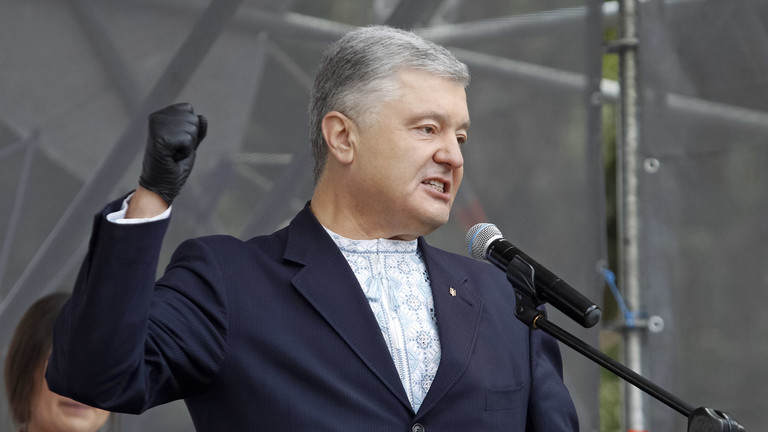
Petro Poroshenko said the Minsk agreements “meant nothing” – ©STR / NurPhoto via Getty Images
RT | June 17, 2022
Petro Poroshenko has admitted that the 2015 ceasefire in Donbass, which he negotiated with Russia, France and Germany as president of Ukraine, was merely a distraction intended to buy time for Kiev to rebuild its military.
He made the comments in interviews with several news outlets this week, including Germany’s Deutsche Welle television and the Ukrainian branch of the US state-run Radio Free Europe. Poroshenko also defended his record as president between 2014 and 2019.
“We had achieved everything we wanted,” he said of the peace deal. “Our goal was to, first, stop the threat, or at least to delay the war – to secure eight years to restore economic growth and create powerful armed forces.”
He cited Sun Tzu’s stratagems as an inspiration for the deception. Winning a war does not necessarily require winning military engagements, Poroshenko said, calling the deal he made a win for Ukraine in that regard.
Poroshenko failed to be reelected in a landslide vote for President Volodymyr Zelensky, who promised voters that, unlike his predecessor, he would secure peace in Donbass.
In the interviews, Poroshenko spoke about his role in negotiating the Minsk agreements, a roadmap for reconciliation between his government and the Donetsk and Lugansk People’s Republics. The former president apparently confirmed that Kiev hadn’t come to the talks in good faith, but simply wanted a reprieve after suffering a military defeat.
The agreements included a series of measures designed to rein in hostilities in Donbass and reconcile the warring parties. The first steps were a ceasefire and an OSCE-monitored pullout of heavier weapons from the frontline, which were fulfilled to some degree.
Kiev was then supposed to grant general amnesty to the rebels and extensive autonomy for the Donetsk and Lugansk regions. Ukrainian troops were supposed to take control of the rebel-held areas after Kiev granted them representation and otherwise reintegrated them as part of Ukraine.
Poroshenko’s government refused to implement these portions of the deal, claiming it could not proceed unless it fully secured the border between the rebellious republics and Russia. He instead endorsed an economic blockade of the rebel regions initiated by Ukrainian nationalist forces.
Zelensky’s presidency gave an initial boost to the peace process, but it stalled again after a series of protests by right-wing radicals, who threatened to dispose of the new Ukrainian president if he tried to deliver on his campaign promises.
Kiev’s failure to implement the roadmap and the continued hostilities with rebels were among the primary reasons that Russia cited when it attacked Ukraine in late February. Days before launching the offensive, Moscow recognized the breakaway Ukrainian republics as sovereign states, offering them security guarantees and demanding that Kiev pull back its troops. Zelensky refused to comply.
Now an opposition MP, Poroshenko, called on Western nations to provide more and heavier weapons for Kiev so that Ukrainian soldiers can “do [the West’s] job” and defend Europe from Russia. He also called for more anti-Russia sanctions and for his country to join the EU and NATO as soon as possible.
Poroshenko claimed that Russian President Vladimir Putin was the one who broke the Minsk agreements. He claimed credit for Ukraine not falling into Russia’s hands within a matter of days, which was the prediction of some Western officials. The country stood up to the attack thanks to military reforms that his government implemented, the former president claimed. Moscow never gave a timeline for its military operation in Ukraine, stating only that it has proceeded as intended.
The Ukrainian official also called for the “de-Putinization” of Europe, his own country and Russia itself. He said this meant curbing Russian influence in other nations and toppling Putin. It is the only way to save the world from an “existential threat” that, Poroshenko claimed, the Russian leader poses.
Why India must decouple from I2U2
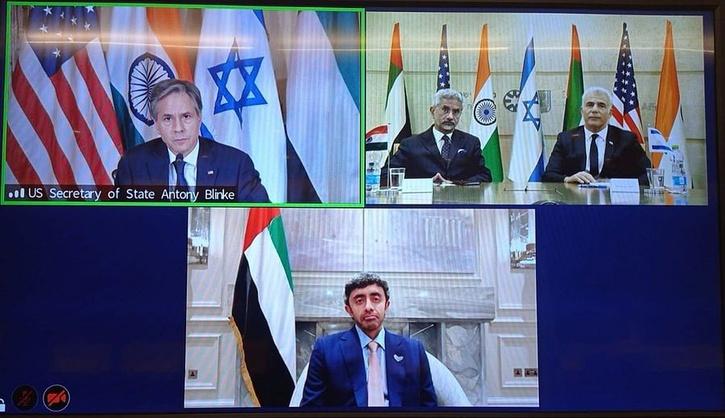
Foreign Ministers of India, Israel, UAE, US (clockwise) held a videoconference in October 2021 to launch a ‘Quad’ for West Asia
BY M. K. BHADRAKUMAR | INDIAN PUNCHLINE | JUNE 17, 2022
Indian diplomacy is descending from the sublime to the absurd. Such wild swings signal rank opportunism. These are extraordinary times when to be smart is equated as being opportunistic.
Hardly a week passed since PM Modi received the Iranian Foreign Minister Amir-Abdollahian in Delhi and expressed high hopes for India-Iran relationship. Now it transpires that India also forms part of the Gang of Four led by US President Joe Biden to “contain” Iran, from a new platform called I2U2 — the ‘I’ being India and Israel, and ‘U’ being US and UAE.
The I2U2 summit in mid-July between Biden, Israeli Prime Minister Bennett, Modi, and Emirati President Mohammed bin Zayed is destined to be a signpost in the geopolitics of West Asia. This new Quad first appeared on 18th October 2021 as an offspring of External Affairs Minister Jaishankar’s 5-day trip to Israel when from Tel Aviv he pulled a rabbit out of the hat, leaving the Indian public wonder what new grandstanding their impulsive minister was indulging in.
Between October and July this year, the I2U2 is getting an upgrade from foreign minister to prime minister/president level. On Tuesday, while announcing Biden’s first West Asian tour as president in mid-July, Washington has made some effort to rationalise Biden’s intentions in undertaking the planned visits to Israel and Saudi Arabia. A senior White House official said Biden intends:
- To demonstrate “the return of American leadership to bring countries together”;
- To create “new frameworks that aim to harness unique American capabilities to enable partners to work more closely together, which is essential to a more secure, prosperous, and stable Middle East region over the long term”;
- To build on the “resounding vote isolating Iran last week at the IAEA Board of Governors in Vienna where 30 countries condemned Iran’s lack of compliance with safeguard obligations” (where India, by the way, had abstained from supporting the US move);
- “To make sure we’re doing all we can to strengthen Israel’s security, prosperity, and integration into the larger region, both now and over the longer term”;
- To “focus on Israel’s increasing integration into the region” through new formats other than Abraham Accords, such as the “entirely new grouping of partners… what we call I2U2”!
So, that’s it. India will lend a hand to assist the US to refill the fizz that has gone out of the Abraham Accords. The hope that more countries would join Abraham Accords is withering away. Israel needs to be shown around to prospective suitors in its neighbourhood. I2U2 is, in essence, a dating agency. When it concerns Israel, the role of pandar comes naturally to the US presidents. But why should India squander away its soft power?
The US prestige and influence in West Asia has suffered a severe jolt during the Biden presidency. Not too long ago, Biden had called Saudi Arabia a “pariah” and pledged to make a horrible example of it on account of its human rights record. But now the shoe is on the other foot. Biden is craving for attention from Saudi Arabia. He had taken a second vow not to have any dealings with the powerful Saudi Crown Prince Mohammed bin Salman. But he is now beseeching the proud Prince for an audience. His recent phone calls weren’t answered.
The White House official explained Biden’s U-turn this way: “we have important interests interwoven with Saudi Arabia, and engagement is essential to protecting and advancing those interests on behalf of the American people.” In reality, Biden is swallowing pride and reviving the old matrix of US-Saudi relationship riveted on the petrodollar.
With poll rating falling abysmally low, Biden is desperate to tackle the rising inflation in the US economy, and the soaring price of oil is fuelling public disaffection. Saudi Arabia can help Biden salvage his standing.
However, it is the turn of the Saudis now to tell Americans there’s no free lunch. They want a written treaty to the effect that the US won’t ditch them when the crunch time comes or if the Kingdom or the ruling family feels insecure. Put differently, they want the Americans to act as their Praetorian guards as before.
In return, of course, Saudis will generate massive business for the US military-industrial complex, recycle their petrodollar to strengthen the Western banking system and create lucrative business for American companies — in short, help the beleaguered Western economies to pursue their post-pandemic recovery that is getting derailed by the war in Ukraine.
Indeed, the Saudis also have a rich history of lavishly greasing the palm of the American elite in the administration, the Pentagon and the Congress. In a nutshell, Biden as a seasoned operator in the Beltway knows which side of the bread is buttered.
But to rationalise his U-turn, an alibi is needed. So, Biden has decided to hoist “Iranian threat” as the leitmotif of the revamped US-Saudi security alliance. All signs are that Biden has acceded to the Saudi demand to scuttle the JCPOA and pile new sanctions against Iran, although the negotiations in Vienna are in home stretch and an agreement is within sight.
Biden’s West Asian agenda is completely US-centric, aimed at securing US business interests and shoring up its regional influence. Israel, of course, is a “holy cow”. Very soon Biden will begin fund-raising for his re-election bid in 2024, and Jewish donors are a generous lot.
However, the million dollar question remains: What has India got to do with Biden’s agenda? There are real risks, for the subplot here is that Biden hopes to nix India’s plans to revive its atrophied relationship with Iran. The recent visit of the Iranian foreign minister to India would have set alarm bells ringing in Washington and Tel Aviv.
Biden has a game plan for leaders like Modi who have a tendency to disregard the US diktat occasionally. Biden’s national security advisor Jake Sullivan spoke candidly just the other day:
“We’re playing the long game here. We are investing in a relationship (with India) that we are not going to judge by one issue even if that issue is quite consequential, but rather that we are going to judge over the fullness of time, as we try to work to convergence on the major strategic questions facing our two countries.
“On one of those questions — how to deal with the challenge posed by China — there’s much more convergence today, and that is important to US foreign policy. On the question of Russia, obviously, we have different historical perspectives, different muscle memories, but we feel confident that the dialogue we have going with India right now will bear fruit over time.”
Sullivan was discussing India’s time-tested relationship with Russia — how Washington hopes to erode and dissolve it all in good time.
Plainly put, Americans estimate that Indians have no “staying power,” or “big picture.” They probably estimate that the Indian government would grab the I2U2 platform to burnish its international image. But if there is any sanity left in the Indian foreign policy establishment, a subaltern role to serve US and Israeli interests cannot enhance India’s prestige in West Asia where, as it is, Modi government is perceived as an Islamophobic regime backed by religious fanatics.
In the life of individuals and nations alike, there are moments when one has to learn to say “no.” This self-serving, cynical overture from 78-year old Biden is one such moment. That’s why, despite zero chance of India turning down Biden’s invite, not to urge Modi to say “Nyet” to I2U2 will be a serious lapse.
South Block is underestimating the gravity of its folly. India never ever got entangled in the intra-regional issues in West Asia. It never acted as the surrogate of extra-regional powers, either. Most important, it never sought the “containment” of any regional state. That’s how it held its head high in the choppy waters of the Persian Gulf.
EU chief, Italian PM Head to “Israel” for Energy Talks
Al-Manar | June 14, 2022
President of the European Commission Ursula von der Leyen and Prime Minister of Italy Mario Draghi were scheduled to visit the Israeli occupation on Monday as the EU seeks to reduce its reliance on Russian fossil fuel imports.
Both leaders were scheduled to hold energy talks in “Israel”, which has transitioned from a natural gas importer to an exporter in recent years due to large offshore discoveries.
Von der Leyen was to meet Israeli Foreign Minister Yair Lapid on Monday and Israeli Prime Minister Naftali Bennett on Tuesday, with talks projected to focus “in particular on energy cooperation,” a commission statement read.
Mario Draghi, who is on his first Middle East trip since taking office last year, will also discuss energy and food security during his two-day trip, according to Italian media.
Both leaders will meet Palestinian Prime Minister Mohammed Shtayyeh in the occupied West Bank on Tuesday.
The EU formally adopted a ban on most Russian oil imports this month, the EU’s toughest sanctions yet against Russia over the war in Ukraine.
It is worth noting that Von der Leyen has proposed that the EU phase out its reliance on Russian hydrocarbons, including gas, by 2027.
Draghi and other EU leaders have warned that as energy prices rise, European customers may require protection. Israeli Energy Minister Karine Elharrar and other officials have stated that if “Israel” can deliver gas from occupied Palestinian offshore reserves, which are estimated to be worth nearly 1,000 billion cubic meters, it could help meet EU demand.
Before Von der Leyen’s visit, European Commission spokesperson Dana Spinant told reporters to “stay tuned for announcements on energy cooperation with Israel and other partners in the region.”
For the time being, supplying gas to Europe would be difficult and would necessitate significant and long-term infrastructure investments.
With no pipeline connecting its occupied Palestinian offshore fields to Europe, one option for the Israeli occupation is to pipe natural gas to Egypt, where it could be liquefied and shipped to Europe.
Another possibility is the construction of a pipeline to Turkey.
The EastMed project, a proposal for a seafloor pipeline connecting “Israel” with Cyprus and Greece, is option three.
Experts have raised concerns about the project’s cost and viability, while “Israel” has stated that it would like to see Italy sign-on.
Germans warned of ‘difficult autumn’ and ‘tough winter’
“Whoever saves energy helps Germany become more independent from Russian imports and also does it for the sake of the climate”
Samizdat | June 11, 2022
Germans should brace for a difficult autumn and winter due to skyrocketing prices, as the country pushes for independence from Russian energy, the Vice Chancellor, and head of the Ministry of Economy, Robert Habeck warned on Friday.
“As for the support of the people who need it, I clearly indicated what is ahead of us and what is already partially a reality… we are facing a very difficult autumn and a very tough winter,” he said, as cited by RIA Novosti.
Habeck made the prediction as he presented a new energy saving initiative of the Federal Ministry for Economic Affairs and Climate Action (BMWK). Berlin is planning to replace Russian coal and oil by the end of the year and stop importing Russian gas by 2024, and is struggling to find alternative energy sources. According to the vice chancellor, energy prices are already extremely high and “many people will get significantly higher bills than usual” in the upcoming heating season.
“For this reason alone, saving energy is urgently needed, and I know that many are already looking at where they can save something, especially when they have to watch every cent anyway,” he said.
The new initiative – ‘80 million together for energy change’ – aims to motivate people to save energy. It provides examples on its website from everyday life and recommendations for saving energy, including: regularly defrosting the freezer, raising the refrigerator temperature to 7C, using LED light bulbs in offices, ways to cut down on water consumption and heating in the bathroom and kitchen, etc.
“Whoever saves energy helps Germany become more independent from Russian imports and also does it for the sake of the climate,” Habeck said.
The tumultuous situation with energy prices around the world has hit Germany hard. The availability of Russian energy carriers on the global market was put into jeopardy following the launch of Moscow’s military operation in Ukraine and the retaliatory sanctions from the West.
Energy prices propelled annual inflation in Europe’s largest economy to 7.9% in May, its highest level in nearly 50 years. Energy prices in the country rose 38.3% year-on-year last month, while food prices posted an 11.1% leap, data from the Federal Statistical Office (Destatis) shows. As a result, nearly half of German citizens have been forced to change their lifestyle and cut back on spending, media reports, citing polls. According to a study conducted for Bild newspaper by INSA this week, every sixth German citizen does not eat regularly due to the rise in prices, and another 13% are considering the possibility of saving on food.
One in Six Germans Forced to Skip Meals Thanks to Food Price Crunch: Survey
Samizdat – 11.06.2022
Europeans face a perfect storm of soaring inflation, self-inflicted energy price shocks caused by sanctions on Russia, and fears of a looming recession. In Germany, the region’s traditional economic and industrial powerhouse, ordinary people have taken a hit to their wallets, while businesses have warned of large-scale losses and layoffs.
Nearly one in six Germans (16 percent) have been forced to go without regular meals to make ends meet, and another 13 percent may face a similar situation if food prices continue to rise, a new survey by the Institute for New Social Answers (INSA) for Germany’s Bild newspaper has found.
According to the survey, people from low-income households whose income after taxes is less than 1,000 euros per month have been the most heavily affected, with 32 percent of respondents forced to skip meals regularly.
42 percent of those polled also indicated that they are forced to cook more sparingly due to inflation, leaving out certain ingredients in meals, or dessert. Another 41 percent said they rely on supermarket special offers and discounts to stretch their euros as far as possible.
INSA’s study was conducted on 7 June, with a representative sample of 1,002 people queried.
Adolf Bauer, president of the German Association for Social Affairs, told Bild he was “greatly worried” by the survey’s results, saying it was a “clear sign that the measures taken by the federal government to date are not sufficient.” Bauer had previously warned Berlin not to introduce an energy embargo on Russia, saying it would add to suffering among ordinary people caused by out of control energy, food and rent prices.
Verena Bentele, president of the Social Association of Germany, a major Berlin-headquartered socio-political advocacy organization, echoed Bauer’s concerns, saying the figures show that people are “suffering greatly from the increased prices.”
“Members tell us they can only afford pasta and toast. We urgently need the VAT on fresh foods to be abolished and financial relief for those who have so far received nothing from the government’s energy price flat-rate,” Bentele urged.
Germans and other Europeans have faced out of control inflationary and price pressures in recent months, with Handelsblatt reporting double-digit growth on some food items in April. Last month, Deutsche Wirtschafts Nachrichten reported that EU sanctions on fertilizer imports from Russia and Belarus would result in losses of up to 3 million tonnes of harvest in the current year. Europe relied on the two countries for some 4.6 million tonnes of its 13 million tonnes-worth of fertilizer consumption last year, while local production efforts have been hampered by the large amount of energy required to produce them.
Russian President Vladimir Putin has lamented at the European Union’s decision to commit “economic suicide” by depriving itself of cheap and reliable Russian energy supplies, and expressed sympathy for ordinary Europeans and Americans suffering as a result of their leaders’ decision-making. “The truth is that the current problems that millions of people in the West face are the result of many actions by the ruling elites of their states, their mistakes, myopia and ambitions. These elites are not thinking about how to improve the lives of their citizens. They are obsessed with their own selfish interests and surplus profits,” he suggested at a briefing in March.
Featured Video

The Truth About the Trump Shootings with Ken Silva
or go to
Aletho News Archives – Video-Images
From the Archives
Trans ‘milk’ as good as the real thing – NHS
RT | February 18, 2024
The drug-induced nipple secretions of trans women are as good as mothers’ breast milk for babies, the University of Sussex Hospitals NHS Trust claimed in a letter to campaigners made public in a report by British think tank the Policy Exchange on Sunday.
The healthcare trust’s medical director, Rachel James, argued that the off-label prescription drug cocktail men transitioning to female take in order to produce milk was “similar to the natural hormones which encourage lactation to develop when the baby is newly born.”
“The evidence which is available demonstrates that the milk is comparable to that produced following the birth of a baby,” James wrote in the letter, sent to Children of Transitioners last August.
Biological men who wish to lactate must first take hormones to grow milk glands and then take high doses of either domperidone or metoclopramide to stimulate milk production. Neither drug is approved for this use, though they are occasionally prescribed off-label to biological women who have trouble lactating.
However, domperidone’s own manufacturer, Janssen, warns patients the drug “may cause unwanted side effects affecting the heart in a breastfed baby” and “should be used during breastfeeding only if your physician considers this clearly necessary.” … continue
Blog Roll
 Aletho News
- Seyed M. Marandi: U.S. Strike Imminent – Toward Total War in the Middle East
- Russia Voted Under Fire. Washington Is Loading the Tankers.
- 12 Things Your Oncologist Was Trained Not to Tell You
- Anthrax Attacks Paved Way for COVID-Era ‘Junk Drugs and Vaccines’
- How Real Is the Impact of Western Sanctions on Israel?
- France, You Are Guilty: How Paris Turned Western Sahara into the Maghreb’s Powder Keg
- 2025 Nature Paper Claiming Worsening Global Drought Gets RETRACTED …Heavily Flawed
- Your Milk Is Not the Problem
- The Truth About the Trump Shootings with Ken Silva
- ARE PATIENTS BEING PROPERLY INFORMED ABOUT OZEMPIC?
- If Americans Knew
- An error has occurred; the feed is probably down. Try again later.
- No Tricks Zone
- 2025 Nature Paper Claiming Worsening Global Drought Gets RETRACTED …Heavily Flawed
- New Study: ‘Global Drought Shows No Detectable Recent Acceleration Under Climate Warming’
- Economic Masterminds: German Socialists Suggest Taxing Productivity Gains Stemming From Using AI
- The South China Sea Has Not Been Cooperating With The Climate Change Narrative
- Energy Crisis: Germany Enters Heating Season With Historically Low Gas Reserve Fill Levels
- New Study: The Antarctic Ice Sheet Gained Mass From 2020-2024 Due To Staggering Snow And Ice Accumulation
- Study: Ocean Heating Rates From Thousands Of Years Ago ‘Dwarf’ Modern Ocean Heating Rates
- Climate Extremists Target, Attack Large-Scale Power Grid Infrastructure In Germany!
- New Study: Antarctic Ice Melt Has Contributed Less Than 1 Centimeter To Sea Level Rise In The Last 30 Years
- Fear Of Debate: Alarmist German Climate Scientist Calls On Mainstream Media To Discredit Skeptic Voices
 Aletho News