Slovakia rejects Russian oil ban proposal
Samizdat | May 5, 2022
Slovakia warned on Wednesday that it will not be able to agree to the European Commission’s proposal for a ban on Russian oil, and has called for more time to find alternative fuel suppliers.
The proposed embargo is part of the latest Ukraine-related sanctions against Moscow that would see crude imports from Russia phased out within six months and refined products by the end of the year. An exemption was drafted for Slovakia and Hungary, which are heavily dependent on Russia, giving them until the end of 2023 to comply.
The proposed time frame “is unfortunately not enough,” Slovakia’s deputy economy minister in charge of energy policy told internet publication Politico on Wednesday. “We are expecting at least three years,” Karol Galek added, explaining that a key refinery in the country requires heavy Russian oil and that it’s impossible to secure alternative supplies within the proposed time frame. Last year Slovakia got 96% of its oil from Russia.
Galek stressed that the current proposal “will destroy our European economy,” as it will not only hurt energy supplies in his country, but also in Austria, the Czech Republic and Ukraine.
The current blueprint for a ban on Russian oil has to be unanimously approved by the bloc’s 27 member states to come into force. Hungary has expressed reservations, saying the European Union has so far failed to give Budapest guarantees regarding its energy security.
Biden’s ‘Disinformation Governance Board’ is another propaganda tool
By Ian Miles Cheong | Samizdat | May 3, 2022
US President Joe Biden’s Department of Homeland Security announced last week that it had formed a “Disinformation Governance Board” to fight the spread of so-called disinformation on the Internet. While White House spokeswoman Jen Psaki didn’t elaborate on how the bureau would operate, she suggested that it would monitor disinformation on topics like COVID-19 and elections.
Conservatives have often half-joked about George Orwell’s “1984” becoming a reality, but it appears that the Biden administration has decided to literally take a page from the book and create a “Ministry of Truth”.
The board’s aim is to target “disinformation,” but what constitutes disinformation? Many times over the years we have seen complete censorship from government officials and Big Tech social media companies, most infamously during the Hunter Biden laptop scandal, which saw major tech platforms and politicians painting it as “Russian propaganda.”
Allowing the government to dictate what “the truth” is sets a dangerous precedent, as it instead promotes desired narratives to bolster poll numbers, ratings, or nudging the citizenry into following government edicts – all on the basis of “trust us, we know what’s best for you.”
Facts be damned. Just do as you’re told. This was seen multiple times during the pandemic era, when both Dr. Anthony Fauci and then-Surgeon General Jerome Adams hummed and harred over mask-wearing and social distancing – first instructing the public not to wear masks, and then much later calling it a necessity.
Gatekeeping discourse is a surefire way to control the narrative, controlling what people see, what they say, and ultimately – what they believe. It’s also an effective means to silence dissent, and quash those who might speak out against the regime’s approved narrative – or even the regime itself.
The new Ministry of Truth is a tool, and there is no reality in which this tool will not be used for bad intent – and it’ll claim to be doing it all in the name of the greater good.
Unsurprisingly, the Ministry of Truth was rushed into creation seemingly as a reaction to “free speech absolutist” Elon Musk’s purchase of the social media platform, Twitter, the de facto town square of political discourse and public narratives.
With the relinquishment of Twitter to Musk, those who control mainstream narratives fear they will lose out on an important resource, and will no longer be able to promote narratives and fix algorithms to sway public opinion – at least not with ease. There will be pushback, and their positions are not ones they are willing to defend, hence why the creation of this new tool is necessary. It keeps the plebeians in check.
Free speech, which in Musk’s belief is “essential to a functioning democracy,” flies directly in the face of the Biden administration’s attempts to crack down on viewpoints that contradict the regime’s official narrative. And who better to head the Disinformation Governance Board than Nina Jankowicz, who herself perpetuated several regime-approved falsehoods?
Jankowicz, who previously advised the Ukrainian government on disinformation and strategic communications under the auspices of a Fulbright-Clinton Public Policy Fellowship, voiced her support for Christopher Steele, whose infamous “Steele dossier” on Russian election interference during Donald Trump’s 2016 election dogged the presidency for years. Despite Steele’s loss of credibility, Jankowicz hyped up the former spy in August 2020 as being able to offer “some great historical context about the evolution of disinfo” when he spoke on a podcast about the topic.
It’s worth noting that the infamous dossier, which included the unverifiable claim that Russia had “kompromat” on Trump in the form of a sex tape, has since been entirely discredited. Steele’s main source, Igor Danchenko, was later charged with five counts of making false statements to the FBI. Jankowicz also repeated the unproven theory that Hunter Biden’s laptop was the product of a Russian disinformation campaign, spread by members of the Trump campaign.
“Back on the ‘laptop from hell,’ apparently—Biden notes 50 former natsec officials and 5 former CIA heads that believe the laptop is a Russian influence op,” Jankowicz said on Twitter. “Trump says ‘Russia, Russia, Russia.’”
She attempted to distance herself from her remarks with the claim that she was simply livetweeting Trump’s first presidential debate with Biden. However, when solicited by the Associated Press in October 2020 for her thoughts on the laptop, Jankowicz told the publication that “We should view it as a Trump campaign product,” dismissing the fact that the laptop belonged to Hunter Biden.
As detailed by Newsweek, Jankowicz continued to perpetuate doubt against the story, tweeting on October 22, 2020 that “The emails don’t need to be altered to be part of an influence campaign. Voters deserve that context, not a [fairy] tale about a laptop repair shop.”
In a consolidated effort to disqualify the New York Post’s original report on Hunter Biden’s laptop as “disinformation”, Twitter, Facebook, and other social media platforms banned the New York Post and prevented its users from sharing the story weeks ahead of the 2020 US presidential election. The original report on the laptop has since been validated by a comprehensive report about the ongoing federal probe into Hunter Biden’s tax filings, published by the New York Times.
Twitter’s then-CEO Jack Dorsey later admitted to a Senate Judiciary Committee hearing that censoring the report was a “total mistake,” and chalked up the decision to a “process error.”
Both Twitter and Facebook heads were grilled over their companies’ perceived anti-conservative bias and penchant for censoring so-called “disinformation,” with the censorship usually aimed at conservatives. It’s worth pointing out again that the now-discredited “Steele dossier” had no problem gaining traction when it first ran on BuzzFeed.
Nina Jankowicz had no problem spreading actual disinformation while helping to silence the truth under the auspices of “combating disinformation.” Given her predilection towards perpetuating anti-Russian narratives, one might ask if contradictory evidence to the “Snake Island” and “Ghost of Kiev” hoaxes constitute forms of “disinformation” in her book. After all, the mainstream media is chiefly responsible for promoting these heroic war stories, both of which were almost immediately discredited by the Russian media – and later by western experts. Even Ukraine’s own propagandists were forced to instruct the public to stop promoting disinformation about the conflict. Would the Ministry of Truth move to silence such attacks on its credibility?
Those concerned with the truth must do everything in their power to resist the Biden administration’s efforts to police the truth. To that end, Florida Gov. Ron DeSantis is one of the few American leaders who has stepped up and vowed to fight back against the Orwellian disinformation bureau.
“They want to be able to put out false narratives without people being able to speak out and fight back,” DeSantis said. “But we’re not going to let Biden get away with this one, so we will be fighting back.” Referring to the regime as a “decaying and discredited ruling elite in this country,” DeSantis said: “We believe it’s essential that individual Floridians and Americans are able to speak out against the false narratives trying to be jammed down our throats by this regime.”
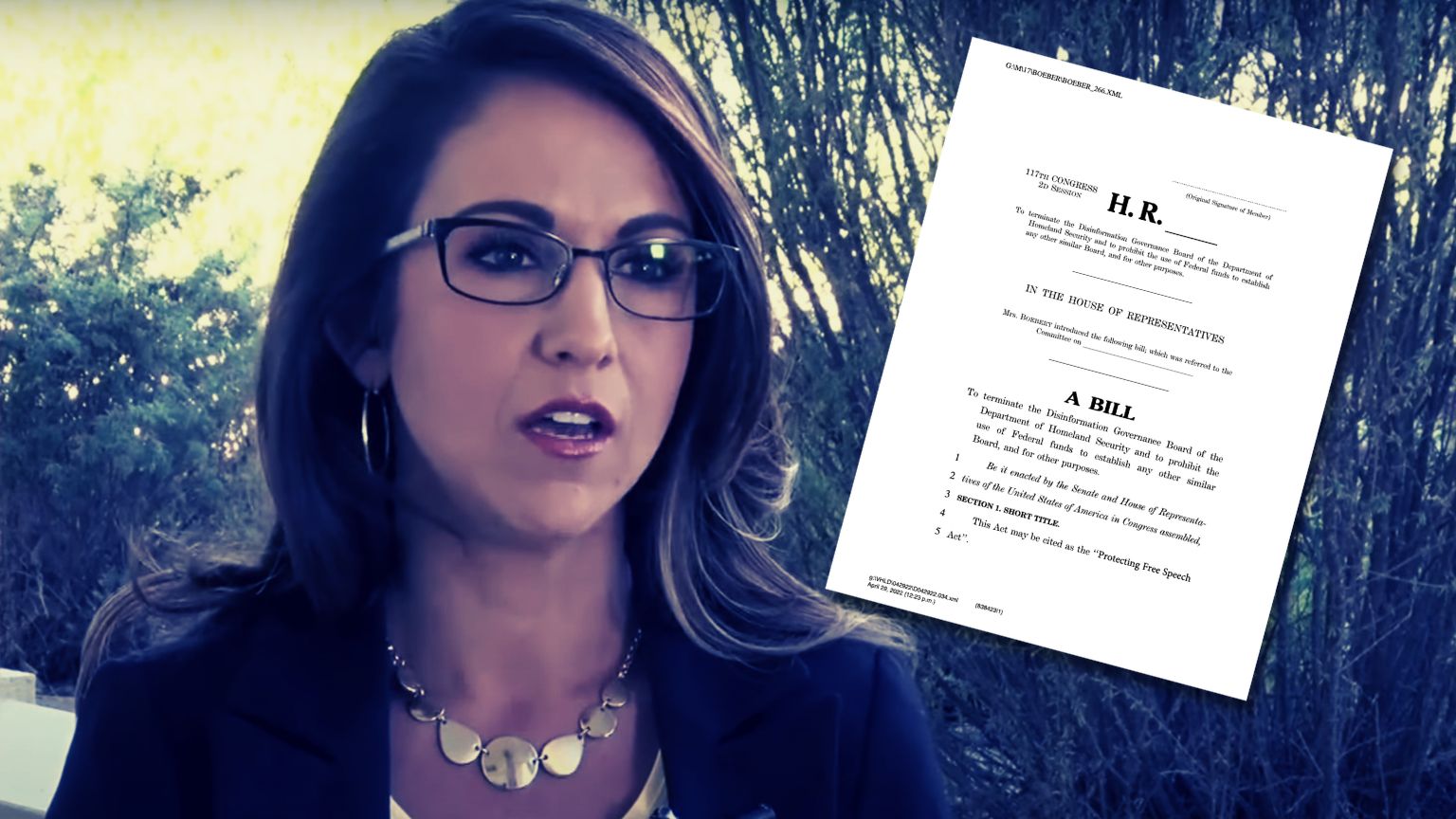
New bill aims to dissolve Biden administration’s Disinformation Governance Board
Defund the Department of Homeland Security
By Dan Frieth | Reclaim The Net | April 30, 2022
Rep. Lauren Boebert is leading the way in introducing a bill to defund the newly formed Disinformation Governance Board, under the Department of Homeland Security (DHS).
We obtained a draft copy of the bill for you here.
“This kind of stuff is terrifying. We in Congress have the power of the purse. It is our duty to shut down this department immediately,” Boebert told Fox. “I’m calling on leadership in the Republican Party – Leader McCarthy, Whip Scalise, and others — to join me in calling for this department to be shut down and defunded.”
The new board will focus on Russian propaganda and “misinformation” spread by and about human traffickers at the border.
The head of the board, Nina Jankowicz has previously been accused of spreading misinformation. She called the New York Post’s Hunter Biden laptop story Russian disinformation. The authenticity of the laptop has since been proven.
“No tax dollars should go to where Biden can use the power of the federal government to silence truthful stories like Big Tech did with the Hunter Biden story,” Boebert said.
Boebert compared the formation of the new board to the draconian world in George Orwell’s book “1984.”
“Democrats took that [book] not as a warning, but as a guide,” she added.
Boebert is looking for cosponsors for the bill, which she is expected to introduce next week.
“This really is a department of propaganda,” Boebert said. “To say that the federal department has a say in what’s right and what’s wrong. What’s truth and what is not. This is a very dangerous place that we’ve come to.”
Bulgarians want Russian gas back – minister
Samizdat – April 28, 2022
Bulgarian businesses want Sofia “to make it possible to resume talks with Gazprom” after the Russian energy giant cut off gas supplies to the country, according to Bulgarian Deputy Prime Minister and Economy Minister Kornelia Ninova.
“We propose that, by then, gas prices should be frozen or capped at their level in the contract with Gazprom and the difference with the higher prices of alternative supplies be paid for by the State,” she said at a press conference after meeting with the Bulgaria Professional Employer Organization (PEO).
The calls come a day after Gazprom ceased delivering gas to Bulgaria after the country refused to pay for energy supplies in rubles. Bulgaria relies on Russia for nearly 90% of its gas, with the remainder coming from Azerbaijan.
Earlier in the day, Bulgarian Prime Minister Kiril Petkov said that Bulgaria has enough gas supplies to last more than one month should nothing change, stressing that Sofia would not accept Russia’s terms on exports of gas.
“But we hope to complete the construction of a new interconnector with Greece by the end of June. And we also look forward to a common strategy for the procurement of liquefied gas by the European Commission,” Petkov said in an interview with Le Monde.
Lithuanian Railways plans to lay off about 2,000 employees
The Baltic Times | April 28, 2022
Lietuvos Gelezinkeliai (Lithuanian Railways, LTG) said on Thursday it is planning to lay off around 2,000 of its 9,000-plus employees, with around a quarter of the state-owned group’s managerial staff at various levels set to leave.
The company said in a press release that 6 million euros will be allocated for severance payments to employees.
The planned layoffs will affect around 1,200 workers in LTG Cargo, the group’s freight transportation subsidiary, about 500 in LTG Infra, the infrastructure subsidiary, and some 300 in LTG. The group currently has around 9,200 employees in total.
Both LTG and the Employment Service will provide assistance to the redundant workers, according to the press release.
The company has said earlier that it may lose some 150 million euros in revenue this year as freight volumes are forecast to halve, compared to last year, to around 26.5 million tons.
LTG has lost around 11 million tons in annual freight because of EU and US sanctions against Belarus’ potash giant Belaruskali, which will trim its annual revenue by 61 million euros.
The railway company is set to lose another 2.6 million tons of freight and 12.8 million euros in revenue due to EU sanctions on the [Russian] owner of Lithuania’s phosphate fertilizer producer Lifosa.
The EU’s sanctions on Russian coal and Poland’s refusal to buy it will result in a loss of 2.5 million tons of coal shipments and 12 million euros in revenue for LTG.
The railway group will lose another 1.4 million tons of freight and 17 million euros in revenue as a result of Belarus’ ban on the transit of oil and oil products and fertilizers from Lithuania. Ninety-five percent of these shipments were destined for Ukraine.
Lithuania’s draft revised 2022 budget, approved by the Cabinet, earmarks 155 million euros in additional financing for LTG.
How Selling the ‘Russia-China’ Threat Serves the US
By Salman Rafi Sheikh – New Eastern Outlook – 27.04.2022
Today, if there is one issue in the United States that draws equal support from both the Republicans and the Democrats, it is the fact that China presents the most serious threat to the US global supremacy. Related to this is the other point of agreement i.e., developing a global coalition against China. The Trump administration’s Secretary of State, Mike Pompeo, was on a mission throughout his tenure to build that coalition. The Biden administration, too, has devoted itself to the same task. Indeed, the level of deterioration we have seen in the US-China relations during the Biden era surpasses the trouble that the Trump administration caused. The same holds true about US geopolitics vis-à-vis Russia. The ongoing Russian military operation in Ukraine has allowed the US to cement its position vis-à-vis Europe.
One very useful way for the US to maintain its hegemony is through the sale of its weapons to its allies. Selling weapon systems is a multi-dimensional activity. On the one hand, the US makes billions of dollars by selling weapons. On the other hand, by selling its weapon systems to its allies, the US enhances these countries’ dependence on the US. All of this is achieved, first and foremost, by selling the China-Russia threat to the world. It is, therefore, not surprising to see that ever since the beginning of tensions between Russia and Ukraine – which began because of the US push to expand NATO to Eastern Europe to encircle Russia – the US military-industrial complex’s finances have jumped massively.
As reports in the US media have indicated, ever since the breakout of the Russia-Ukraine war, market shares of major US military companies have jumped massively, with Lockheed Martin’s registering a growth of 25% while Raytheon’s shares have gained 16.4% in the same period. For these companies, the US-created crisis is, thus, a major business opportunity. This was indeed confirmed in so many words by James Taiclet, the CEO of Lockheed Martin himself.
On January 25, in an ‘earning call’ meeting with investors, the Lockheed CEO told his that,
“If you look at the evolving threat level and the approach that some countries are taking … especially Russia today, these days, and China, there’s renewed great power competition that does include national defense and threats to it … And the contribution we can make at Lockheed Martin is to increase the efficiency and the reliability of our products that we have today for our customer. And secondly, to try to bring this 21st century digital technology to the enterprise in a way that allows us to keep up with the adversaries while we’re developing even newer and more advanced systems.”
They are minting money already in ways that complement the overall political economy of the US. The US has been providing military assistance to Ukraine – weapon systems that are supplied directly by these companies. Military assistance worth millions of dollars being provided to Ukraine is part of the total aid package of $13.6 billion for Ukraine. This aid makes the US, on the one hand, the sole ‘protector’ of Europe, and on the other, paves the way for other countries to rely more and more on the US for their defence needs. As it stands, many countries in Europe – including Germany – have adjusted their defence policies. Germany is even buying F-35 jets, thus creating many more business opportunities for the US military-industrial complex.
The exponential growth the US military-industrial complex is experiencing is not tied to the Russia-Ukraine conflict alone. The US has been effectively selling the China threat to countries that are relevant, e.g., Australia.
As some recent reports indicate, Australia is all set to purchase more weapon systems from the US to shield itself against the ‘China threat.’ On April 5, Australia’s Defense Minister Peter Dutton, referring to the ‘Russia-China threat’, said that they will be spending US$2.6 billion to increase Australia’s deterrence to potential adversaries. To quote him, “There was a working assumption that an act of aggression by China toward Taiwan might take place in the 2040s. I think that timeline now has been dramatically compressed.”
Given the so-called ‘imminent’ nature of the Chinese attack, Australia’s FA-18F Super Hornet fighter jets would be armed with improved U.S.-manufactured air-to-surface missiles by 2024.
In addition to this, Australia has also hired Raytheon Technologies and Lockheed Martin to help build guided weapon systems in the country. As reports indicate, the Australian government is planning on spending US$761 million to build a system of guided missiles.
This partnership with the US military-industrial complex is in addition to AUKUS allies’ April 5 statement that showed cooperation in the field of “hypersonics and counter-hypersonics, and electronic warfare capabilities, as well as to expand information sharing and to deepen cooperation on defense innovation.”
Importantly enough, this renewed cooperation comes against the backdrop of what the statement called “Russia’s unprovoked, unjustified, and unlawful invasion of Ukraine”, showing how the US, alongside its time-tested ally, continues to sell the ‘Russian threat’ across the Pacific to maintain what the US calls a “free and open” Pacific Ocean.
However, as the details of the profits and contracts that the US companies are generating through these very crises shows that, for the US, it is never about doing anything to maintain a ‘free’ system.’ On the contrary, it is always about benefitting the US, both geopolitically and economically.
More contracts for the US military companies means more business, which means more jobs for the Americans in those companies. The more these countries buy weapons from the US, the greater their reliance on the US for their defense and survival. This is how Washington aims to maintain its supremacy.
Salman Rafi Sheikh is a research-analyst of International Relations and Pakistan’s foreign and domestic affairs.
The Guardian inadvertently shakes up Bucha narrative
By Drago Bosnic | April 28, 2022
When the events in Bucha were first reported, Ukrainian and Western mainstream media were unanimous – Russian Armed Forces were the alleged “perpetrators of the Bucha massacre”, while some even called it a “genocide”. The Ukrainian side claims Russian troops killed at least 412 people, while so-called “independent” sources state there were 50 victims. The peculiar claims were completely unsupported by any actual official investigation by any neutral side. The Kiev regime and their Western sponsors flatly refused to allow an international investigation, while any claims contrary to the official narrative were immediately suppressed. If anyone dared to question the narrative, they would be labeled “conspiracy theorists”, “genocide deniers” and “Putin’s propagandists”.
It is more than clear that such a blunt approach to the events in Bucha is designed to silence not just those opposing the official narrative, but even those who are not invested with either side and simply want answers to legitimate questions regarding the veracity of mainstream media reports. This completely removes any sort of public debate, limiting it to one-sided talkshows where so-called “pundits” are called to brainwash the public into thinking that the Russian military is entirely composed of alleged rapists, murderers, alcoholics, drug addicts, etc. By pushing this narrative, the mainstream media are “normalizing” Russophobia and anyone trying to denounce it is promptly silenced.
However, lies are still lies. And they are significantly harder to sustain than the truth. The truth is just truth, it stands by itself. Lies require the liar to circumvent and twist facts. In other words, more lies are necessary to sustain just one. It’s a neverending rabbit hole which inevitably spirals out of control. And precisely this happened on 24 April, when The Guardian published an article about new findings regarding the events in Bucha. According to the UK-based daily, “independent” investigators found evidence of fléchettes used by artillery (supposedly Russian) in Bucha.
“Independent” pathologists and coroners who are carrying out postmortems on bodies found in mass graves in the region north of Kyiv, where “occupying” Russian forces have been accused of alleged atrocities, said they had found small metal darts, called fléchettes, embedded in people’s heads and chests, the report stated.
“We found several really thin, nail-like objects in the bodies of men and women and so did others of my colleagues in the region,” Vladyslav Pirovskyi, a Ukrainian forensic doctor, told The Guardian. “It is very hard to find those in the body, they are too thin. The majority of these bodies come from the Bucha-Irpin region.”
“Independent” weapons experts who reviewed pictures of the metal arrows found in the bodies, seen by The Guardian, confirmed that they were fléchettes, an anti-personnel weapon widely used during the First World War.
These small metal darts are contained in tank or field gun shells. Each shell can contain up to 8,000 fléchettes. Once fired, shells burst when a timed fuse detonates and explodes above the ground. Fléchettes, typically between 3cm and 4cm in length, release from the shell and disperse in a conical arch about 300m wide and 100m long. On impact with a victim’s body, the dart can lose rigidity, bending into a hook, while the arrow’s rear, made of four fins, often breaks away causing a second wound.
“According to a number of witnesses in Bucha, fléchette rounds were fired by Russian artillery a few days before forces withdrew from the area at the end of March,” the report added.
As with all cases of Western-reported alleged crimes, there are always numerous witnesses, independent international experts, anonymous whistleblowers, etc. We just never get to see them. Which means we should simply take the claims of these people, whose very existence we cannot verify, at face value. And any sort of view opposing this narrative is immediately shut down.
According to Neil Gibson, another “Independent” weapons expert at the UK-based Fenix Insight group, who has reviewed the photos of the projectiles seen, they include the 122mm 3Sh1 artillery round, in use by Russian artillery and which are filled with fléchettes. What Mr. Gibson conveniently “forgot” to mention is that these same shells are used in all post-Soviet countries, including Ukraine. More specifically, the shells fit the D-30 howitzers, which are in service with both Russia and Ukraine, as well as dozens of other countries.
A spokesperson for the Ukrainian Ground Forces was quick to state that Ukraine’s military “does not use shells with fléchettes”. However, facts beg to differ, as surgeons in eastern Ukraine have reported the use of fléchettes by Ukrainian artillery in Donbass warzone since at least 2014. It’s obvious the Ukrainian and Western media find it convenient to use Soviet-era weapons as “proof” of alleged Russian war crimes, while ignoring the fact that these same weapons are used by Ukraine. What’s more, Ukraine is more likely to use them, since they have produced little to no new weapons and munitions since the collapse of the USSR.
Russian forces left Bucha on March 30. It took only a few days for the “independent” pathologists and coroners to file the reports from Bucha. At first, the reports claimed Russian forces allegedly shot civilians at point-blank range. Satellite image company Maxar Technologies claimed its photos provided “critical evidence that mass killings of civilians in the Ukrainian city of Bucha must have occurred when Russian forces were occupying the territory in mid to late March”. Combined with the report about fléchettes, this would mean the Russian artillery fired at the city while Russian troops were there, which defies any military logic.
If the reports about the usage of fléchettes are true, the only logical conclusion is that the Ukrainian military shelled Russian positions after the decision to withdraw from the Kiev and Chernigov regions. Russian forces deployed in Bucha certainly didn’t shell their own positions. Since we now know that the Ukrainian forces have and use fléchettes in their artillery shells, what conclusion can we draw except that the civilians were killed by the side which shelled the city while Russian troops were there?
Drago Bosnic is an independent geopolitical and military analyst.
“RUSSIAN CYBERATTACKS” INCOMING?
OffGuardian | April 24, 2022
The last few days have seen a barrage of warnings and predictions of possible Russian cyber warfare.
The Telegraph warns that work from home software could be vulnerable to Russian cyber attacks. The Guardian says that “cyber crime groups” have “publicly pledged support for Putin”. ITV wants you to be scared of cyberattacks taking down the NHS or a nuclear power stations.
Apparently, those darn Ruskies have already started, attacking not the Western banking system, the NHS OR a nuclear power station… but the Ukrainian post office, for printing propaganda stamps.
It’s all ludicrous propaganda, of course… but that doesn’t mean there won’t be a “cyber attack” (or something they pretend is a cyber-attack).
Remember, Klaus Schwab and the WEF have been predicting a “major cyber attack” with “Covid-like characteristics” (whatever that means) for over a year now, including holding a “cyber pandemic” training exercise as part of Cyber Polygon in October 2021, well before the Russian “special operation” in Ukraine.
With both the energy and food markets beings put under deliberate pressure to raise the cost of living, a “cyberattack” to take out the power grid or further hurt supply lines is not at all out of the question. But if it does come, it will have nothing to do with Russia.
“Operation Thermostat”: Energy rationing & the pivot from Ukraine to climate?
By Kit Knightly | OffGuardian | April 22, 2022
Italy is officially becoming the first country to start rationing energy after cutting their supply of Russian gas and oil.
From next month, until at least March 2023, public buildings across the nation will be banned from running air conditioning at lower than 25 degrees, or heating higher than 19 degrees.
The plan, termed “Operation Thermostat” in the press, is being sold as a way for ordinary people to show “solidarity” with the people of Ukraine, with Italian Prime Minister Mario Draghi saying:
Do we want to have peace or do we want to have the air conditioning on?”
I’m not exactly sure how adjusting your thermostat is going to achieve ‘peace’, but hey we’re living in the age of sentimental manipulation over reason, so – just believe.
For example, the Guardian is illustrating the story with pro-peace artwork allegedly done by Italian schoolchildren (in English, for some reason).
There’s no talk yet of this kind of energy-rationing rule extending to private businesses or homes, but a marker has been set down. Expect other nations to follow suit.
After that of course will come the opinion pieces asking questions like “we rationed gas to fight Putin, why not climate change?”, and headlines saying that “Europe-wide gas rationing was good for the planet” or something similar.
… Oh wait, it’s already happening.
Honestly, when I originally wrote the above paragraph I had no idea the Wall Street Journal had published this opinion piece for Earth Day, headlined:
This Earth Day, We Could Be Helping the Environment—and Ukraine”
It argues that rationing energy to fight Putin is just like digging for victory to fight Hitler, and – just as I predicted – would also be good for the planet:
During the Second World War, victory demanded more oil […] In the wars dominating the globe today — Putin’s land grab in Ukraine, and the global land grab caused by rising sea levels and spreading deserts — victory demands getting off fossil fuels as fast as we possibly can.
It even hints at a quasi-lockdown – this time for the sake of beating Putin and combating climate change:
Everyone who can work from home could continue to do so, at least on, say, Mondays, knocking a day off the national commute. Carpools could be organized, taking special advantage of the fact that there are now two million electric cars on the road. More bike paths could be made available, and, when air-conditioning season begins, Americans could turn their thermostats up a degree.
Remember lockdowns were marketed as planet-saving almost from the moment they were put in place, despite it making almost zero sense. The agenda was pretty obvious right from the start.
It’s interesting that “operation thermostat” should be announced on April 22nd – Earth Day – despite having zero to do with climate change. It’s also noteworthy that climate protests groups have piggy-backed on the idea to call for an EU-wide boycott of Russia’s fossil fuels.
We already know they planned a “pivot from covid to climate”, and moves like this mean they can easily “pivot from Ukraine to climate” too.
Sanctions against Russia will slow global economic growth, hurt vulnerable nations – minister
Samizdat | April 22, 2022
The accelerating inflation in most developed nations has come as a result of the irresponsible actions of Western financial authorities during the pandemic, worsened by a sanctions campaign against Moscow, according to Russia’s Minister of Finance Anton Siluanov.
“The scale of inflationary pressure is unprecedented in the context of recent decades,” the minister said, speaking at a plenary meeting of the International Monetary and Finance Committee of the IMF.
“This is the result of the irresponsible actions of the financial authorities of Western countries, from which the whole world suffers, and above all the most vulnerable countries with a low level of income,” he added.
According to Siluanov, the latest sanctions imposed by the West on Russia are exacerbating the situation.
“Dynamics of the accelerated energy transition is also pushing up energy prices, worsening the problems of poverty, food security, energy availability,” the minister said.
The US and its allies have introduced unprecedented economic penalties on Russia in response to the military operation in Ukraine. In less than two months, the country became the subject of over 6,000 different targeted restrictions. Russia is a major global exporter of all types of commodities, including energy and grain.
Using War to Assault Freedom
By Judge Andrew Napolitano | April 20, 2022
Most judges and lawyers agree that the war on drugs in the past 50 years has seriously diminished the right to privacy guaranteed by the Fourth Amendment.
Now a small group of legal academics is arguing that the war in Ukraine should be used to diminish property rights guaranteed by the Fifth Amendment.
Here is the backstory.
The Fourth Amendment was written to guarantee that the government may only search and seize persons, houses, papers and effects pursuant to a search warrant issued by a judge after the presentation under oath of evidence demonstrating that the place to be searched more likely than not contains evidence of crime. And the warrant itself must specifically describe the place to be searched and the person or thing to be seized.
These requirements — the work of James Madison, who was the scrivener of the Constitution in 1787 and the author of the Bill of Rights in 1791 — were intended to have two effects.
The first effect was to uphold the quintessentially American right to be left alone. The second was to compel the government to focus its law enforcement personnel and assets on crimes for which there is probable cause, not fishing expeditions or hunches.
Madison’s language prohibited absolutely the use of general warrants, a favorite tool of the British government against the colonists. General warrants were based on whatever the government wanted or claimed it needed.
The colonists were tormented by, and driven to revolution over, general warrants, as they authorized British agents to search wherever they wished and seize whatever they found. Surely, the dreadful colonial experience with general warrants was a driving force behind the wording and ratification of the Fourth Amendment.
Sadly, during the war on drugs, prosecutors and police persuaded judges to craft “emergency” exceptions to the Fourth Amendment. These included allowing police to look for whatever they wanted in cars and homes, and using the CIA for warrantless surveillance, lest the drugs supposedly being sought be destroyed before capture.
The effect of this was to destroy a fundamental liberty in deference to easing police work; that’s the definition of a police state. The courts effectively ruled that somehow the Constitution prefers liberty — rather than evidence of crimes — to be destroyed.
The Fifth Amendment protects the life, liberty and property of all persons from destruction or aggression by the government without due process of law. Due process requires a jury trial at which the government must prove fault.
Thus, property cannot be seized temporarily or taken permanently without either a search warrant or a jury trial.
Now back to the war in Ukraine.
I have argued in this column and elsewhere that the Biden administration sanctions imposed on Russian and American persons and businesses are profoundly unconstitutional because they are imposed by executive fiat rather than by legislation and because the sanctions constitute either the seizure of property without a warrant or the taking of property without due process.
When the feds seize a yacht from a person whom they claim may have financed Russian President Vladimir Putin’s rise to power, they are doing so in direct violation of the Due Process Clause of the Fifth Amendment.
Similarly, when they freeze Russian assets in American banks, they engage in a seizure, and seizures can only constitutionally be done with a search warrant based on probable cause of crime.
As well, when the feds interfere with contract rights by prohibiting compliance with lawful contracts, that, too, implicates due process and can only be done constitutionally after a jury verdict in the government’s favor, at a trial at which the feds have proved fault.
As if to anticipate these constitutional roadblocks to its interference with free commercial choices, Congress enacted the International Emergency Economic Powers Act of 1977 and the Magnitsky Act of 2016. These constitutional monstrosities purport to give the president the power to declare persons and entities to be violators of human rights and, by that mere executive declaration alone, to punish them without trial.
These laws turn the Fourth and Fifth Amendments on their heads by punishing first and engaging in a perverse variant of due process later. How perverse? These laws require that if you want your seized property back, you must prove that you are not a human rights violator.
As if to run even further away from constitutional norms, a group of legal academics began arguing last week that the property seized from Russians is not really owned by human beings, but by the Russian government. And, this crazy argument goes, since the Russian government is not a person, there is no warrant or due process requirement; therefore, the feds can convert the assets they have seized and frozen to their own use.
To these academics — who reject property ownership as a moral right and exalt government aggression as a moral good — the argument devolves around the meaning of the word “person.” The Fourth and Fifth Amendments protect every “person” and all “people,” not just Americans.
And in American jurisprudence, “person” means both human beings and artificial persons — corporations and governments capable of owning property. Property ownership is defined by the right to use, alienate and exclude. Only persons can exercise those rights.
Madison and his colleagues clearly sought to protect property rights from government aggression, no matter the legal status of the owner. We know this from the judicial opinions involving foreign property that preceded and followed the ratification of the Fifth Amendment. If this were not so, then nothing could prevent the feds from seizing and converting the property of states or local governments or international religious institutions to federal use.
War is the health of the state and the graveyard of liberty. The drug war was a disaster for freedom. The war in Ukraine will be so as well, only if we permit it.
COPYRIGHT 2022 ANDREW P. NAPOLITANO
Lavrov responds to nuclear weapons claim
Samizdat | April 19, 2022
Russia’s Foreign Minister Sergey Lavrov has rejected claims that Moscow could resort to the use of tactical nuclear weapons in Ukraine.Lavrov was questioned on the issue during an extensive interview with India Today in Moscow on Tuesday.
When the journalist mentioned that “President Zelensky said that Russia plans to use tactical weapons,” the foreign minister didn’t even let her finish the question. “He says many things,” Lavrov said.
He reminded that Russia had never mentioned the use of nuclear weapons as an option during its military operation in the neighboring country, and the Ukrainian leader was the only one to speak about this.
Lavrov reiterated the notion that “there could be no winners in a nuclear war,” and assured that Russia would only rely on conventional weapons in Ukraine.
Zelensky claimed that Moscow could use tactical nuclear weapons in Ukraine during his interview with CNN on Friday.
Featured Video

The Truth About the Trump Shootings with Ken Silva
or go to
Aletho News Archives – Video-Images
From the Archives
Trans ‘milk’ as good as the real thing – NHS
RT | February 18, 2024
The drug-induced nipple secretions of trans women are as good as mothers’ breast milk for babies, the University of Sussex Hospitals NHS Trust claimed in a letter to campaigners made public in a report by British think tank the Policy Exchange on Sunday.
The healthcare trust’s medical director, Rachel James, argued that the off-label prescription drug cocktail men transitioning to female take in order to produce milk was “similar to the natural hormones which encourage lactation to develop when the baby is newly born.”
“The evidence which is available demonstrates that the milk is comparable to that produced following the birth of a baby,” James wrote in the letter, sent to Children of Transitioners last August.
Biological men who wish to lactate must first take hormones to grow milk glands and then take high doses of either domperidone or metoclopramide to stimulate milk production. Neither drug is approved for this use, though they are occasionally prescribed off-label to biological women who have trouble lactating.
However, domperidone’s own manufacturer, Janssen, warns patients the drug “may cause unwanted side effects affecting the heart in a breastfed baby” and “should be used during breastfeeding only if your physician considers this clearly necessary.” … continue
Blog Roll
 Aletho News
- Seyed M. Marandi: U.S. Strike Imminent – Toward Total War in the Middle East
- Russia Voted Under Fire. Washington Is Loading the Tankers.
- 12 Things Your Oncologist Was Trained Not to Tell You
- Anthrax Attacks Paved Way for COVID-Era ‘Junk Drugs and Vaccines’
- How Real Is the Impact of Western Sanctions on Israel?
- France, You Are Guilty: How Paris Turned Western Sahara into the Maghreb’s Powder Keg
- 2025 Nature Paper Claiming Worsening Global Drought Gets RETRACTED …Heavily Flawed
- Your Milk Is Not the Problem
- The Truth About the Trump Shootings with Ken Silva
- ARE PATIENTS BEING PROPERLY INFORMED ABOUT OZEMPIC?
- If Americans Knew
- Salah Sarsour’s Legal Team Says DHS Has Not Met Its Burden to Prove He Is Deportable
- An analysis of tax forms by The Intercept show Kraft’s charity and LLC have donated to Friends of the IDF and AIPAC’s super PAC.
- Israeli attacks kill four Palestinians in Gaza – Daily Update
- Inside Gaza’s death trap of collapsing, bombed-out buildings
- The everyday items Israel bans from Gaza every day
- Inside the siege, the ruined buildings of Gaza – Daily Update
- Debunking The Claim That Macklemore Has A “History Of Antisemitism”
- CPJ demands release of arrested Palestinian-US journalist near Bethlehem
- Robert Kraft: The Billionaire Friend of Netanyahu Pulling The Strings Behind the Macklemore/Ed Sheeran Blow Up
- Columbia Administered Fund Gives Big Money to Pro-Israel Groups
- No Tricks Zone
- 2025 Nature Paper Claiming Worsening Global Drought Gets RETRACTED …Heavily Flawed
- New Study: ‘Global Drought Shows No Detectable Recent Acceleration Under Climate Warming’
- Economic Masterminds: German Socialists Suggest Taxing Productivity Gains Stemming From Using AI
- The South China Sea Has Not Been Cooperating With The Climate Change Narrative
- Energy Crisis: Germany Enters Heating Season With Historically Low Gas Reserve Fill Levels
- New Study: The Antarctic Ice Sheet Gained Mass From 2020-2024 Due To Staggering Snow And Ice Accumulation
- Study: Ocean Heating Rates From Thousands Of Years Ago ‘Dwarf’ Modern Ocean Heating Rates
- Climate Extremists Target, Attack Large-Scale Power Grid Infrastructure In Germany!
- New Study: Antarctic Ice Melt Has Contributed Less Than 1 Centimeter To Sea Level Rise In The Last 30 Years
- Fear Of Debate: Alarmist German Climate Scientist Calls On Mainstream Media To Discredit Skeptic Voices
 Aletho News